




Abstract
The authors investigate the effects of Chinese import competition on transitions into and out of employment using comparable worker-level data for 14 European countries. Results indicate that, on average, Chinese imports are associated with an increased probability that employed workers become unemployed and with a reduction in worker flows from unemployment to employment. In countries with high levels of employment protection, incumbent workers are shielded against the risk of job loss due to Chinese competition, but unemployed workers’ prospects seem to be particularly negatively affected in these countries. The authors also provide evidence that the effects of increased Chinese imports differ by worker groups and the tasks performed on the job.
Keywords
Free trade has come under increasing scrutiny from both politicians and economists in recent years, focused particularly on the potentially adverse effects for workers in highly industrialized countries. One of the major milestones toward free trade was China’s accession to the World Trade Organization (WTO) in 2001, which was accompanied by important reductions in tariffs and quotas. As a result, China’s share of world manufacturing exports increased from almost 2% to 18.8% between 1991 and 2013 (Autor, Dorn, and Hanson 2016), and the share of Chinese exports to countries from the European Union relative to world manufacturing exports rose from approximately 2% in 1998 to more than 7% in 2007. 1 A number of empirical studies on individual countries have analyzed the labor-market responses and distributional consequences of exposure to Chinese trade (see next section), yet the role of labor-market institutions in shaping the labor-market effects of China’s exports on industrialized countries has hardly been investigated.
In this article, we therefore analyze the effects of the large increase in Chinese exports in the early 2000s on European workers. In our analysis, we focus on the manufacturing sector as it accounts for the large majority of the increase in Chinese exports. Taking a cross-country perspective allows us to account for the effects of one of the most important labor-market institutions, employment protection legislation (EPL). We aim at answering the following research questions. First, what were the overall effects of imports from China on European workers’ flows into unemployment and unemployment exit rates, and what role did the prevailing institutional framework in European labor markets, particularly EPL, play in this context? Second, which types of workers were most affected, and which types of workers benefited most from higher EPL?
To answer our research questions, we exploit comparable microdata across 14 European countries from Eurostat’s European Union Labour Force Survey (EU-LFS), which contains information on employment status, occupation, and socioeconomic characteristics at the worker level. We combine these worker-level data with trade flows at the industry level from the UN Comtrade database in order to capture exposure to Chinese imports. This approach allows us to investigate the effects of Chinese imports on workers’ transitions probabilities between employment and unemployment. To account for possible endogeneity of Chinese imports, we apply an instrumental variable (IV) strategy that passes a number of robustness tests.
Our contribution to the literature is threefold. First, we provide comparable evidence on the labor-market effects of China’s WTO accession for a large number of European countries, whereas the previous literature has largely focused on individual countries. 2 The focus on a large set of industrialized countries is of great importance to assess the potential costs and benefits of international trade exposure for the workers from a set of countries making up the majority of the European Union. Second, we analyze job losses and job findings (measured by worker transitions between employment and unemployment), also for various demographic groups, which allows us to investigate important aspects of worker welfare. Third, we examine how the effects of imports from a low-wage country vary with cross-country differences in labor-market institutions of importing countries. This approach allows us to shed light on the importance of EPL by analyzing how a common economic shock within industries can lead to diverse labor-market adjustments across countries, a question that is highly relevant from an economic policy point of view.
Literature
A number of studies have investigated the labor-market effects of imports from China to specific industrialized countries. For the United States, these studies generally reported larger declines in manufacturing employment and earnings of workers that were most affected by Chinese imports, with the analysis taking place at the regional level (Autor, Dorn, and Hanson 2013), the plant level (Pierce and Schott 2016), and—most closely related to our study—the worker level (Autor, Dorn, Hanson, and Song 2014). In a related vein, Bernard, Jensen, and Schott (2006) showed that increased exposure to import competition from China leads to lower probability of plant survival and to a sharp decrease in plant employment and output growth in the United States. Chan (2017) found that the effects of Chinese imports differ across US states with distinct labor-market characteristics such as union density and minimum wages.
Looking at firm-level adjustments in 12 European countries over the period 1996 to 2007, Bloom et al. (2016) found that higher levels of Chinese import competition caused a decrease in employment and in the share of unskilled workers at the industry level. In addition, they found that Chinese imports led to an almost 15% increase in patenting, increased adoption of information technology, and higher productivity of European firms. For Germany, Dauth, Findeisen, and Suedekum (2014) found that rising imports from China and Eastern Europe had a mild adverse effect on employment at the regional level, while, in the aggregate, losses were more than offset by gains from export exposure.
Worker flows, especially job losses and hirings, have been extensively analyzed in the literature. Job loss (or the fear of job loss) has been shown to have important negative consequences for long-term earnings (see, e.g., Jacobson, LaLonde, and Sullivan 1993 for a seminal article), job satisfaction (Origo and Pagani 2009), mental health (Reichert and Tauchmann 2017), and overall worker well-being (Böckerman, Ilmakunnas, and Johansson 2011). Low hiring rates imply long unemployment duration, which can have major effects on human capital depreciation (Schmieder, von Wachter, and Bender 2016) and negative signaling effects (Kroft, Lange, and Notowidigdo 2013), both leading to negative duration dependence and low life satisfaction (Ochsen and Welsch 2011). At an aggregate level, Elsby, Hobijn, and Şahin (2013) showed for Organisation for Economic Co-operation and Development (OECD) countries that unemployment inflows and outflows jointly determine the dynamics of the unemployment rate. They also argued that the relative importance of the two flows for the unemployment rate depends on the institutional context of the countries analyzed.
In addition, a large literature examines the role of EPL for labor markets. In a study on seven industrialized countries, Kahn (2007) found important differences between sociodemographic groups in the impact of EPL on joblessness and temporary employment. As for the role of EPL for worker flows, higher EPL can be expected to reduce worker outflows from employment since higher costs for employers to dismiss workers make firing less attractive for a given level of productivity. Because employers are forward-looking, higher EPL also decreases vacancy creation and therefore inflows to employment. Hence, EPL lowers labor turnover but has ambiguous effects on unemployment (Mortensen and Pissarides 1999).
Empirical evidence is in line with this theory: Higher EPL is associated with lower aggregate labor-market flows, and there is no clear association between EPL and the unemployment rate (Martin and Scarpetta 2012). Bassanini and Garnero (2013) investigated the impact of dismissal regulations on worker flows using cross-country and time-series variation for OECD countries. Their findings point out that job protection regulations tend to reduce the rate of within-industry job-to-job transitions. However, they find no significant effect on industry switching or transitions to non-employment. Similarly, Haltiwanger, Scarpetta, and Schweiger (2014) found that more restrictive labor-market regulations are associated with smaller firm-level job flows and employment adjustments, in particular in those industries and firm-size classes in which technological and market-driven factors require labor adjustments more regularly. The welfare effects of lower labor-market flows (caused by higher EPL) are not clear-cut, however, as discussed above.
Our article is also related to a large literature on the effects of international competition induced by trade liberalization more generally (e.g., Pavcnik 2002; Trefler 2004; Amiti and Konings 2007; De Loecker, Goldberg, Khandelwal, and Pavcnik 2016). There is also a large literature on how the impact of trade exposure varies with occupation, education, gender, and other characteristics within a single country (recent contributions include Utar 2018; Traiberman 2019; Dauth, Findeisen, and Suedekum 2021), and on the labor-market effects of offshoring (e.g., Grossman and Rossi-Hansberg 2008; Antras, Fort, and Tintelnot 2017) and foreign direct investment (Bachmann, Baumgarten, and Stiebale 2014). By contrast, our article focuses on the effects of international competition from China rather than offshoring from high- to low-wage countries or foreign direct investment.
Contributions in the international trade literature have argued that increased exposure to foreign competition induces domestic firms to downsize and leads to a reallocation of resources across firms (Pavcnik 2002; Melitz 2003). The reduction in domestic production might be partly offset, however, by firms reallocating workers to other activities. For instance, Bloom, Romer, Terry, and Van Reenen (2013) developed a theory to show that Chinese competition can decrease the returns to old production activities and reduces the opportunity cost of new activities such as innovation if production factors are “trapped” inside firms because of market frictions (see also the overview of related literature in Shu and Steinwender 2019). It is plausible that workers are more likely to be “trapped” inside firms in countries where EPL and thus firing costs are high. EPL will thus affect the speed at which firms can adjust their production process through hiring and firing and the level of reallocation of resources across firms (Aghion, Burgess, Redding, and Zilibotti 2008). Although workers’ risk of becoming unemployed might be higher when EPL is low, unemployed workers might benefit from reallocation induced by import competition, in particular when firing costs are low. During our sample period, China mainly had a comparative advantage in the production of products with low skill and technology intensity. We find it plausible that relatively unskilled workers and those performing routine tasks are most likely to be negatively affected by this reallocation process.
Data and Descriptive Evidence
In our empirical analysis, we use microdata on individual workers, in particular for their labor-market status, transitions between labor-market states, and sociodemographic characteristics, as well as data on Chinese imports at the country-sector level and on EPL at the national level. Microdata at the individual level come from the EU-LFS database, which includes all EU member states as well as Norway, Iceland, and Switzerland. For reasons of data availability with respect to both EU-LFS and the other data sources described below, our final sample of analysis consists of 14 European countries: Austria, Belgium, Czech Republic, Denmark, Finland, France, Germany, Greece, Hungary, Italy, Slovak Republic, Spain, Sweden, and the United Kingdom.
The EU-LFS is based on national household surveys conducted by the national statistical agencies of the participating countries. The resulting data are of high quality and are fully representative for the resident population (Eurostat 2018). Furthermore, the underlying surveys apply harmonized concepts and definitions, for example, for the economic sector (Nomenclature of Economic Activities [NACE]) and the occupation (International Standard Classification of Occupations [ISCO]) of individual workers, which enables us to perform a cross-country comparison.
The EU-LFS data consist of repeated cross-sections of workers. As the data include information on a person’s current and previous labor-market status, we can identify a worker’s transitions between labor-market states. The data also enable us to compute the stock of employed, unemployed, and non-participating individuals, along with transition rates between every labor-market state by year and country. In the data, an individual’s current labor-market status is defined according to the International Labour Organization (ILO) standard. 3 By contrast, the labor-market status in the previous year is based on self-perception of the interviewed person. Although these two definitions might not overlap perfectly, using both to identify labor-market flows from one year to the next is preferable to alternative approaches, which would not allow for consistent measurement across countries (see Bachmann and Felder 2020 for details). 4 The EU-LFS data have been used in a related context by a number of other studies, for example, Angrist and Kugler (2003).
Employment protection legislation (EPL) refers to the rules governing the hiring and firing of workers, which are summarized by EPL indicators constructed by the OECD (OECD 2013). These indicators measure the requirements with respect to notification, negotiation, and authorization before an employment relationship is terminated by the employer, as well as severance pay, and the definition and costs of unfair dismissal. The more difficult and/or costly the requirements make the hiring or firing of a worker, the higher the value of the EPL indicator, which ranges from one to five. The OECD provides two main EPL indicators, one for regular workers, including provisions for collective dismissals, and one for temporary workers. As there are more regular workers than temporary workers in the countries we analyze, we select the EPL indicator that applies to regular workers for our analyses.
We provide descriptive evidence on labor-market transitions between employment and unemployment, as well as on EPL in Figures A.1 and A.2 in the Online Appendix. (Hereafter, numbering for all Online Appendix material is prefaced with an “A.”) The transition rates generally behave very differently across the countries in our sample. While the transitions from employment to unemployment mostly display relatively strong fluctuations, the transitions from unemployment to employment are more constant over the time period analyzed. The trends in the strictness of employment protection of regular contracts for European countries in our sample are also relatively subdued. The levels of EPL for regular workers increased slightly in three countries (Belgium, France, and the United Kingdom), decreased in five countries (Austria, the Czech Republic, Finland, Slovakia, and Sweden), and remained unchanged in six countries (Denmark, Germany, Greece, Hungary, Italy, and Spain).
We obtained information on trade flows from the UN Comtrade (United Nations International Trade Statistics) database. The database contains annual bilateral imports and exports by product category for more than 170 countries. Trade values are available in various aggregations. We use data classified using 4-digit SITC (standard international trade classification) Rev. 3 codes that we match and aggregate to 3-digit industry level codes at the NACE classification using a correspondence table by the UN. A detailed description of the database can be found in Autor et al. (2013). The main focus of our empirical analysis is on manufacturing sectors (which account for more than 95% of trade flows in goods), although we did not drop sectors related to agriculture, mining, and fuel products (which together account for less than 5%). Data on domestic production is obtained from the OECD STructural ANalysis (STAN) database, in which production (or gross output) at current prices corresponds to the value of goods and services produced in a certain industry or occupation in country
Figure 1 shows the significant rise of imports originating from China as a share of domestic production for the EU countries in our sample between 2000 and 2007. This increase varies considerably across countries. For example, the share of China’s imports in domestic production increased notably in the Czech Republic (from less than 0.01% of GDP in 2000 to more than 0.3% of GDP in 2007), while it remained quite low and unchanged for Denmark and the United Kingdom during this period. The share of Chinese imports in imports from all low-income countries increased from 35% to 70% during our sample period. For our sample, variation in Chinese imports across occupations, countries, and time accounts for 94% of the variance of low-income imports.
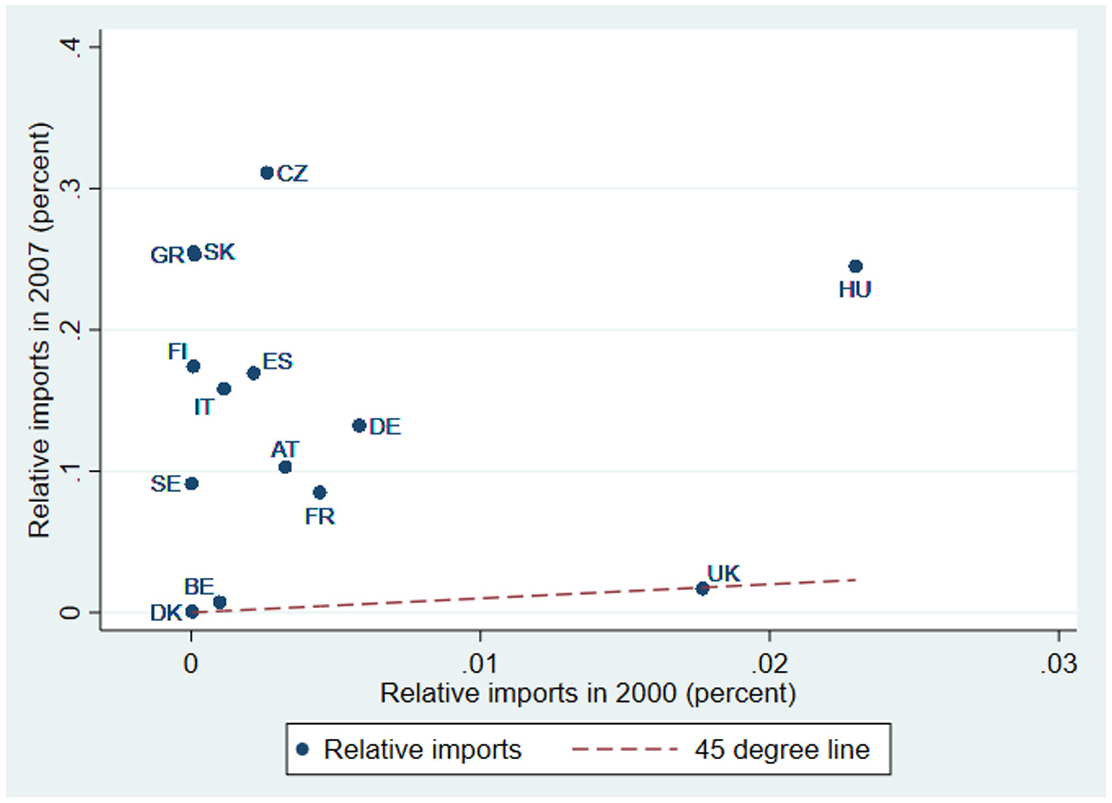
Imports from China as a Share of Domestic Production, 2000 and 2007
Methodology
The aim of our empirical analysis is to identify the effects of Chinese imports on worker flows in European countries. For this purpose, we need a measure of import exposure that can be matched to individuals. One challenge in the empirical analysis is that imports are measured at the industry level but worker-level information in the EU-LFS contains sectoral information at the 1-digit level only, which is far too broad to construct a measure of import exposure. However, EU-LFS contains information about an individual’s occupation at the 3-digit level. Further, we obtained information about the distribution of occupations across industries at the 3-digit level, from Eurostat’s tailor-made extraction procedure. 5 We are therefore able to follow Ebenstein, Harrison, McMillan, and Phillips (2014) and Baumgarten, Geishecker, and Görg (2013) in assigning the industry-level variables using the distribution of occupations across industries. Our mapping of occupations to industries varies across countries and years to account for differences in industry composition across regions and time. It should be noted that a large number of occupations are specific to broad industries in which they are typically employed. For instance, consider workers within the group “plant and machine operators and assemblers.” Examples of 3-digit occupations in our sample within that group include “metal-processing plant operators,”“chemical-processing-plant operators,”“textile-, fur- and leather-products machine operators,” and “food and related products machine operators.” We therefore believe that using occupations instead of industries to measure workers’ exposure to Chinese imports is a valid strategy.
Our occupation-specific variables, that is, import exposure, as well as the industry-level control variables contained in vector

where
To analyze the effects of Chinese imports on worker flows, we relate the probability of making a transition from employment to unemployment, and from unemployment to employment, to our measure of import exposure as follows:


Indicator variable
In addition, we include a large number of control variables.
Although we introduce a large set of control variables, including country, occupation, and year fixed effects, one might be concerned about possible remaining unobserved factors that lead to an increased inflow of Chinese imports, and simultaneously affect subsequent labor-market outcomes. As a result, Chinese imports might be endogenous to occupation-country-level employment outcomes. We address this issue by conducting an IV approach based on lagged import shares similar to Bloom et al. (2016).
6
Specifically, we use
The idea behind the instrument is to capture time-series variation in Chinese supply shocks. These supply shocks are likely to have a greater impact on industries in which China has a comparative advantage (see Bloom et al. 2016), which is captured by the initial conditions weight
A remaining concern for the instrument described above is that the initial level of Chinese imports may be correlated with unobservable characteristics at the occupation level that determine subsequent labor-market outcomes. We believe this outcome is unlikely since the initial level of Chinese imports is likely to reflect past comparative advantage of China rather than European labor-market conditions. Nonetheless, as a robustness check, we use an alternative IV, the exposure to Chinese imports at the occupational level in the United States (
Results
We start our analysis by estimating the conditional transition probability into and out of unemployment as described by Equations (2) and (3), using both a regular probit model and a control function approach. In a second step, we investigate the role of EPL in detail. In a third step, we examine heterogeneous effects on various worker groups. Finally, we conduct a battery of robustness tests in order to assess the validity of our results.
Impact of the China Shock and EPL on Labor Market Transitions
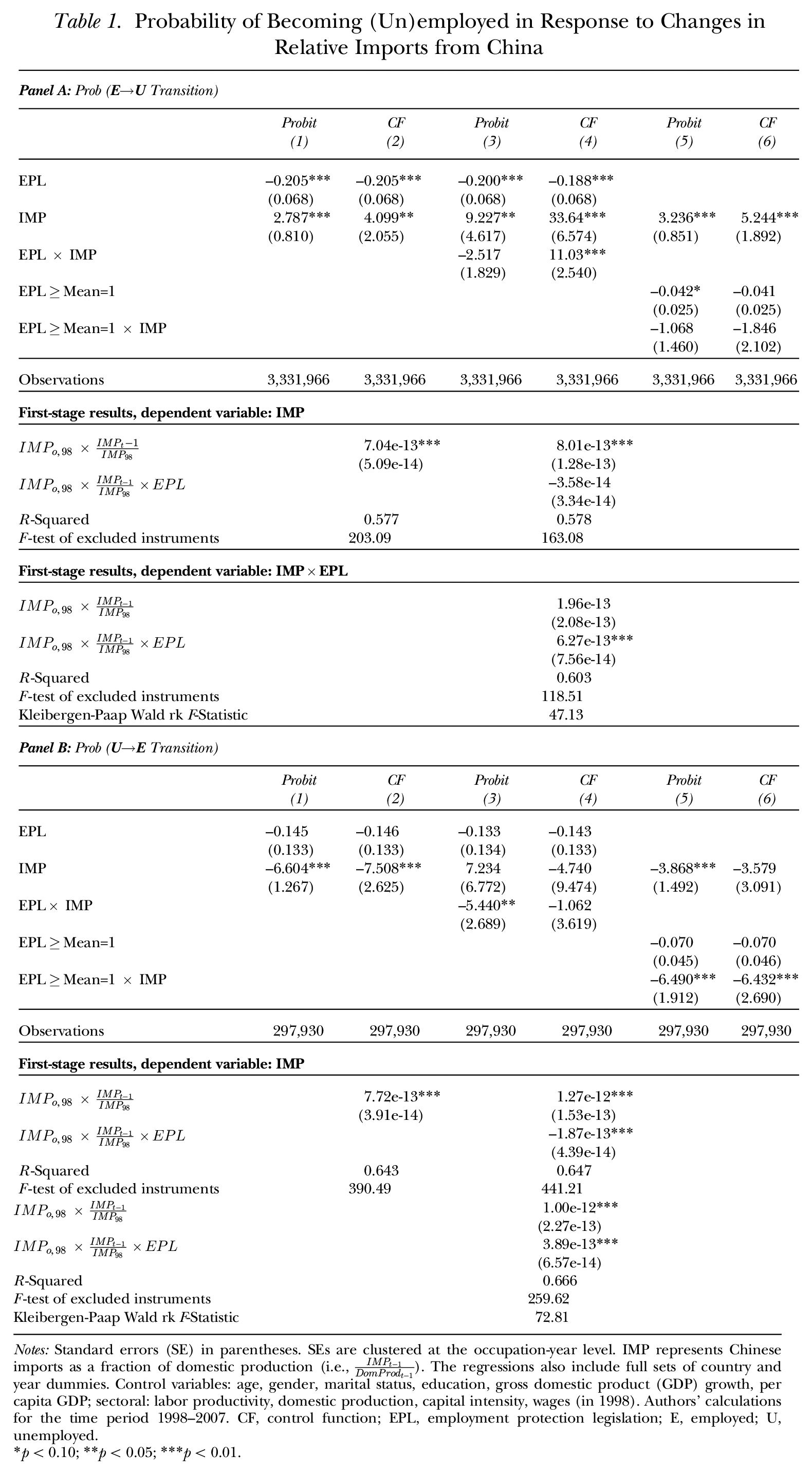
We start by giving a brief overview to what extent higher imports from China affect workers’ employment security. To do so, we analyze the transition rate from employment to unemployment, and unemployed workers’ job-finding probability. Table 1 presents the core results of our econometric analysis for our main variables of interest for the transition probability from employment to unemployment (panel A) and the transition probability in the reverse direction (panel B). 8
Probability of Becoming (Un)employed in Response to Changes in Relative Imports from China
Notes: Standard errors (SE) in parentheses. SEs are clustered at the occupation-year level. IMP represents Chinese imports as a fraction of domestic production (i.e.,
p < 0.10; **p < 0.05; ***p < 0.01.
The coefficients on the relative imports variable suggest that higher exposure to Chinese imports is correlated with a higher transition rate from employment to unemployment. A potential concern about these results is that our import variable might be endogenous to employment outcomes, thus raising concerns about a potential bias in the coefficients. To address this concern, we instrument our imports variable with lagged import shares multiplied with the overall growth in Chinese imports as explained in the Methodology section The first-stage results reported in the middle section of panel A indicate that our instrument is a strong predictor of relative imports (i.e., the F-test statistic is equal to 203.09). Turning to the second stage (in the top section of panel A), the results of the control function (CF) approach reported in column (2) show that the coefficient remains significant and even increases compared to the baseline specification reported in column (1).
As for the transition rate from unemployment to employment (panel B), exposure to imports from China is strongly negatively correlated with the unemployment outflow rate. This finding can be interpreted as higher exposure to Chinese imports reducing the job-finding rate of the unemployed and therefore increasing the duration of unemployment. Again, we use a control function approach to account for potential endogeneity. As in the case of the transition rate from unemployment to employment, the instrument is strong (F-statistic: 390). Sign and significance remain robust to the use of instruments and the coefficient changes only slightly.
The sample-average marginal effects of the variable “relative imports,” corresponding to coefficients in column (1) of panels A and B, imply that a 1 percentage point (pp) increase in relative imports from China is associated with an increase in the probability of making a transition from employment to unemployment by 0.19 pp and a decrease in the probability of making a transition from unemployment to employment by 2.4 pp. These findings are similar to the average marginal effects that we estimate from the IV-probit models in column (2), namely 0.28 pp for the propensity to become unemployed in panel A, and 2.9 pp for the probability of becoming employed in panel B. The size of these marginal effects is equivalent to 6 to 10% of the mean transition probabilities per year. 9 The results indicate that Chinese competition has quantitatively important effects, particularly for the job prospects of employed and unemployed workers.
Turning to our research question on the role EPL plays for the labor-market adjustment to the China shock, we start by looking at the coefficient on EPL only. For the transition rate from employment to unemployment (panel A in Table 1), the negative and significant coefficient suggests that stricter dismissal regulations (associated with higher EPL) go together with a lower transition probability from employment to unemployment. This finding is in line with theoretical predictions as higher adjustment costs can be expected to lead to lower worker flows. For transitions from unemployment to employment, we find no significant correlation with the level of EPL.
To investigate whether EPL has an influence on the labor-market effects of Chinese imports, we examine the interaction between employment protection regulations and imports from China on the transition rates between employment and unemployment. For the transition rate from employment to unemployment, the results of the probit model do not show a significant coefficient for the interaction of EPL and Chinese imports (column (3) in panel A of Table 1). The interaction term becomes statistically significant, however, in the control function approach. The instruments are again strong, with an F-statistic for the interaction of approximately 118 in the first stage and a value of the Kleibergen-Paap Wald F-statistic of approximately 47. The negative coefficient on the interaction term suggests that Chinese imports affect the transition rate from employment to unemployment to a varying extent in countries with levels of EPL that differ. 10
To quantify the importance of the level of EPL for the size of the import effects in more detail, Figures 2 and 3 show average marginal effects of a 1 pp increase in relative imports for a range of values of EPL and initial values of imports. As can be seen in Figure 2, for small values of EPL below the mean (which equals 2.45), an increase in relative imports raises the probability of transiting from employment to unemployment substantially. For instance, for a level of EPL equal to 1.9, a 1 pp increase in import exposure increases the probability of transition to unemployment by about 1 pp for initial values of import exposure between the 25th and the 90th percentile. The effect is even twice as large when the value of EPL equals 1.4 and the initial level of Chinese competition is high. By contrast, for levels of EPL above the mean, the effect on the probability of making a transition is close to zero. Therefore, EPL seems to shield workers from the risk of becoming unemployed as a result of Chinese competition.
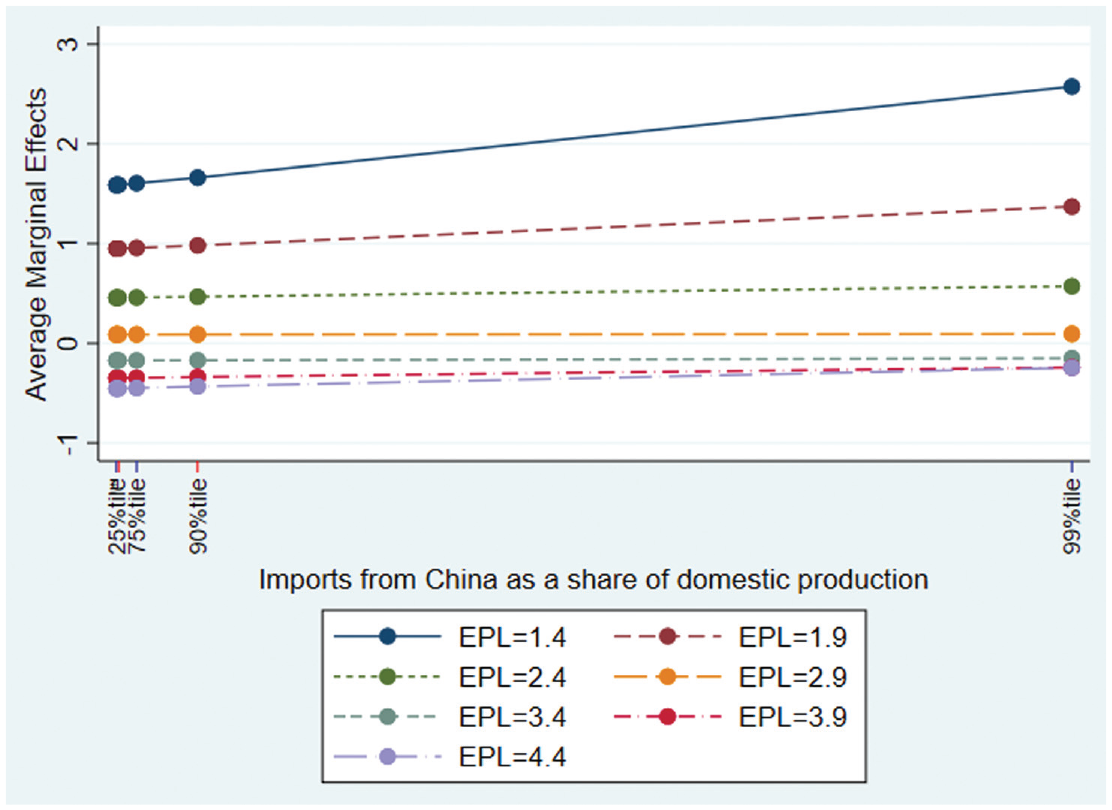
Average Marginal Effects of Relative Import on Probability of Transition to Unemployment
To illustrate the importance of EPL, consider the effects of a marginal increase in import exposure for initial values of Chinese imports between the first and the third quartile of the distribution across workers in our sample. 11 For instance, an increase in Chinese import exposure by 1 pp has almost no effect on average transition probabilities in countries with the highest levels of EPL in our sample, such as Greece and the Czech Republic. By contrast, a 1 pp increase in Chinese import exposure would lead to an increase in transitions to unemployment by approximately 1 pp in a country with an EPL index slightly below the mean (e.g., Belgium) and by more than 1.5 pp in a country such as the United Kingdom, which has the lowest value of EPL in our sample.
To analyze whether the above results are driven by the way EPL enters the regression, we construct a dummy variable that equals 1 if the value of EPL is above 2.46 (the mean of EPL in our sample), and equal to 0 otherwise. Using this variable instead of the original EPL variable yields qualitatively similar results, that is, the coefficients are still negative, but mostly insignificant.
As for the transition rate from unemployment to employment, the interaction term between EPL and Chinese imports in the probit regression displays a significantly negative coefficient (column (3) in panel B of Table 1). Figure 3 shows the marginal effects of the variable “relative imports” for varying values of EPL, for the case of the conditional probability of an unemployed worker becoming employed. At lower levels of EPL, the effect of higher Chinese imports on the transition rate to employment is smaller than at higher values of EPL if the initial level of import penetration is not too high. For instance, for an EPL value of 1.4, an increase in Chinese import exposure by 1 pp is associated with a decrease in the probability of a transition out of unemployment by about 2.2 pp. When the level of EPL increases to 4.4, the estimated effect increases to more than 3 pp for low initial values of Chinese imports. One plausible interpretation for this result is that unemployed workers’ employment prospects are particularly adversely affected when labor-market rigidities prevent restructuring and reallocation processes after a trade shock.
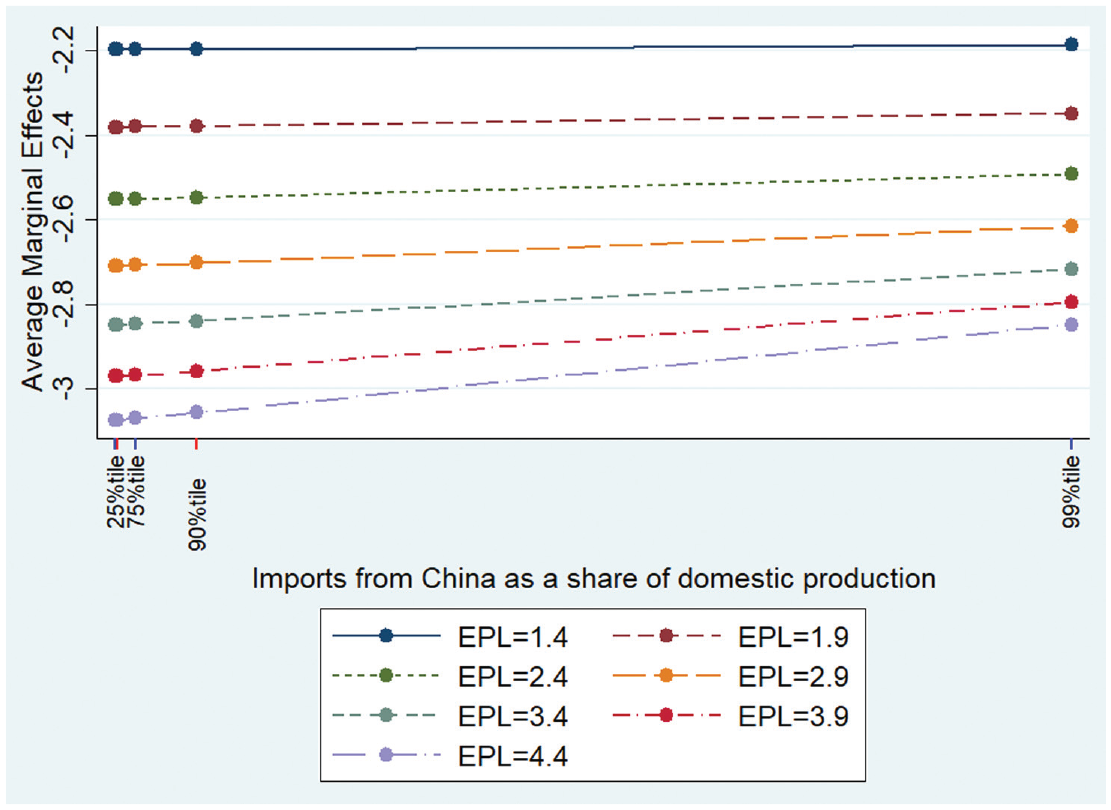
Average Marginal Effects of Relative Import on Probability of Transition to Employment
This finding implies that in countries with higher levels of EPL, imports from China are more negatively correlated with the transition rate from unemployment to employment than in countries with lower levels of EPL. While the interaction is not statistically significant in the control function approach, separate coefficients for countries below and above the mean value of EPL in columns (5) and (6) of Table 1, panel B, clearly indicate that the negative effects of Chinese competition are more pronounced when EPL is high. Therefore, EPL seems to aggravate the negative impact of Chinese competition on the job prospects of unemployed workers.
Taken together, these results imply that countries with low employment protection adjusted to the China shock both through the firing and the hiring margin, whereas countries with high employment protection mainly adjusted through the hiring margin. The level of EPL therefore plays an important role for the reallocation of employment as a response to Chinese imports. This finding has important policy implications, which we discuss in the conclusion.
Table A.4 shows results of country-specific regressions for a few selected countries for which we observe a sufficient number of transitions (Germany, Italy, Spain, United Kingdom). For the United Kingdom, the country with the lowest average level of EPL during our sample period, Chinese imports affect only transitions from employment to unemployment significantly. In the other countries, which have substantially higher values of EPL, transitions to unemployment are much less affected, but we observe strong and significant effects on transitions to employment. These results are consistent with previous findings from the literature that labor-market adjustment occurs mainly through unemployment inflows in countries with low EPL, whereas unemployment outflows play a more dominant role in countries with high EPL (Petrongolo and Pissarides 2008).
Were Worker Groups Affected in Dissimilar Ways?
Chinese import exposure differed strongly across industries, which in turn are characterized by a dissimilar composition of their workforce. As a consequence, the China shock is likely to have generated heterogeneous effects among European workers, and these effects may also depend on the level of EPL. To analyze this heterogeneity—our second research question—we use the binary version of our EPL variable introduced in the preceding section to compare low versus high EPL regimes, and we run regressions that include the three-way interaction of EPL × Chinese imports × worker characteristics. In doing so, we focus on workers’ age, education, and the tasks performed on the job.
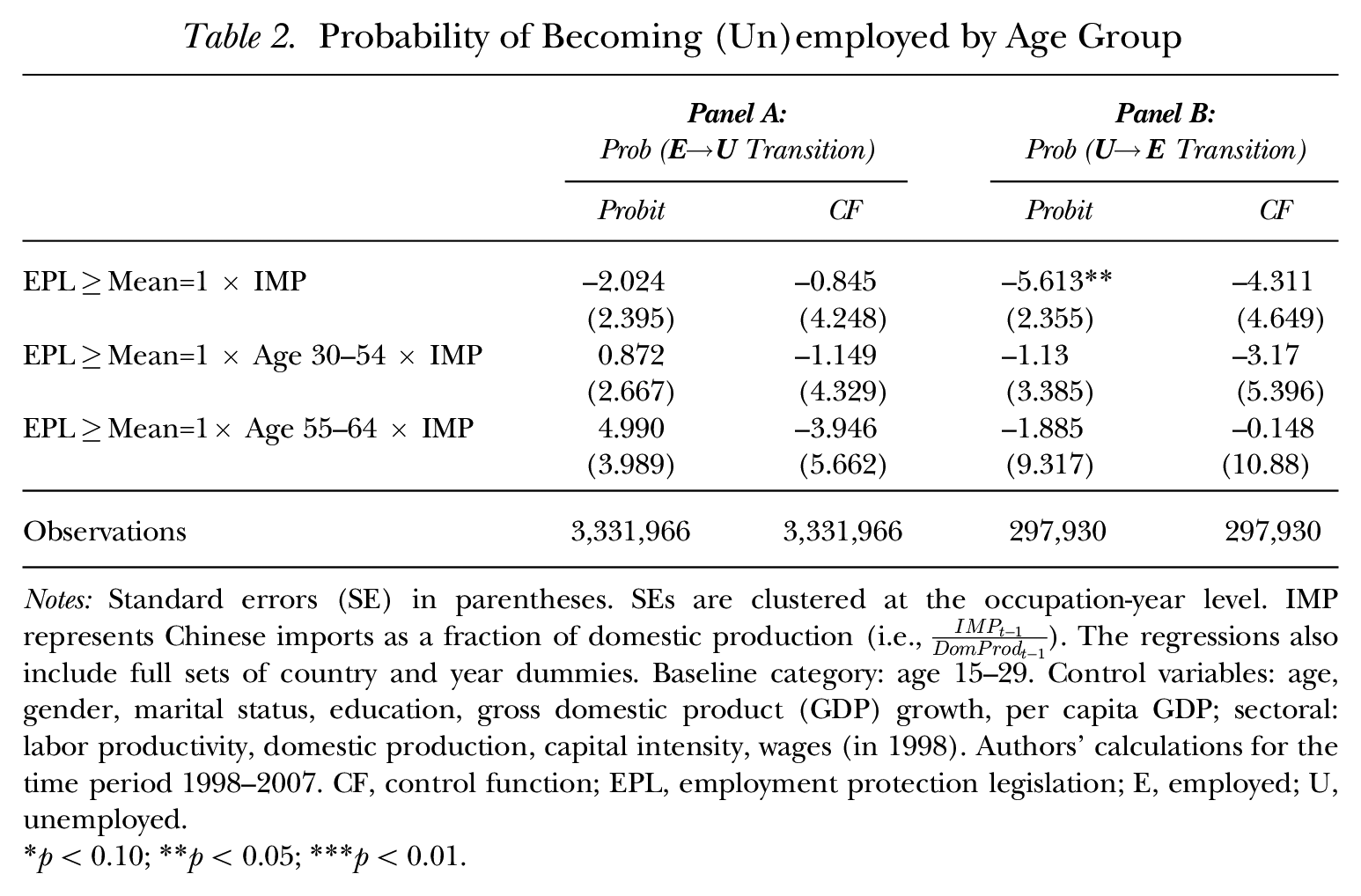
Results based on workers’ age groups indicate that older workers are most strongly affected by Chinese imports (see Table A.5). The corresponding sample-average marginal effects of an increase in Chinese imports for instance show that a 1 pp increase in the Chinese imports ratio is associated with an increase in the probability to become unemployed of 0.67 pp for older workers when EPL is low (Table A.6). 12 EPL seems to play some role in this context. As indicated in Table A.6, the marginal effects are smaller for all age groups when EPL is high, but the effects are quite imprecisely estimated. Coefficients and marginal effects for transitions from unemployment to employment are depicted in panel B of Table 2 (see also panel B of Table A.5 for more complete results) and panel B of Table A.6. The results indicate that mostly unemployed workers between age 30 and 54 are less likely to be hired when Chinese imports increase. This negative effect is somewhat amplified when EPL is high, although the results are quite imprecisely estimated.
Probability of Becoming (Un)employed by Age Group
Notes: Standard errors (SE) in parentheses. SEs are clustered at the occupation-year level. IMP represents Chinese imports as a fraction of domestic production (i.e.,
p < 0.10; **p < 0.05; ***p < 0.01.
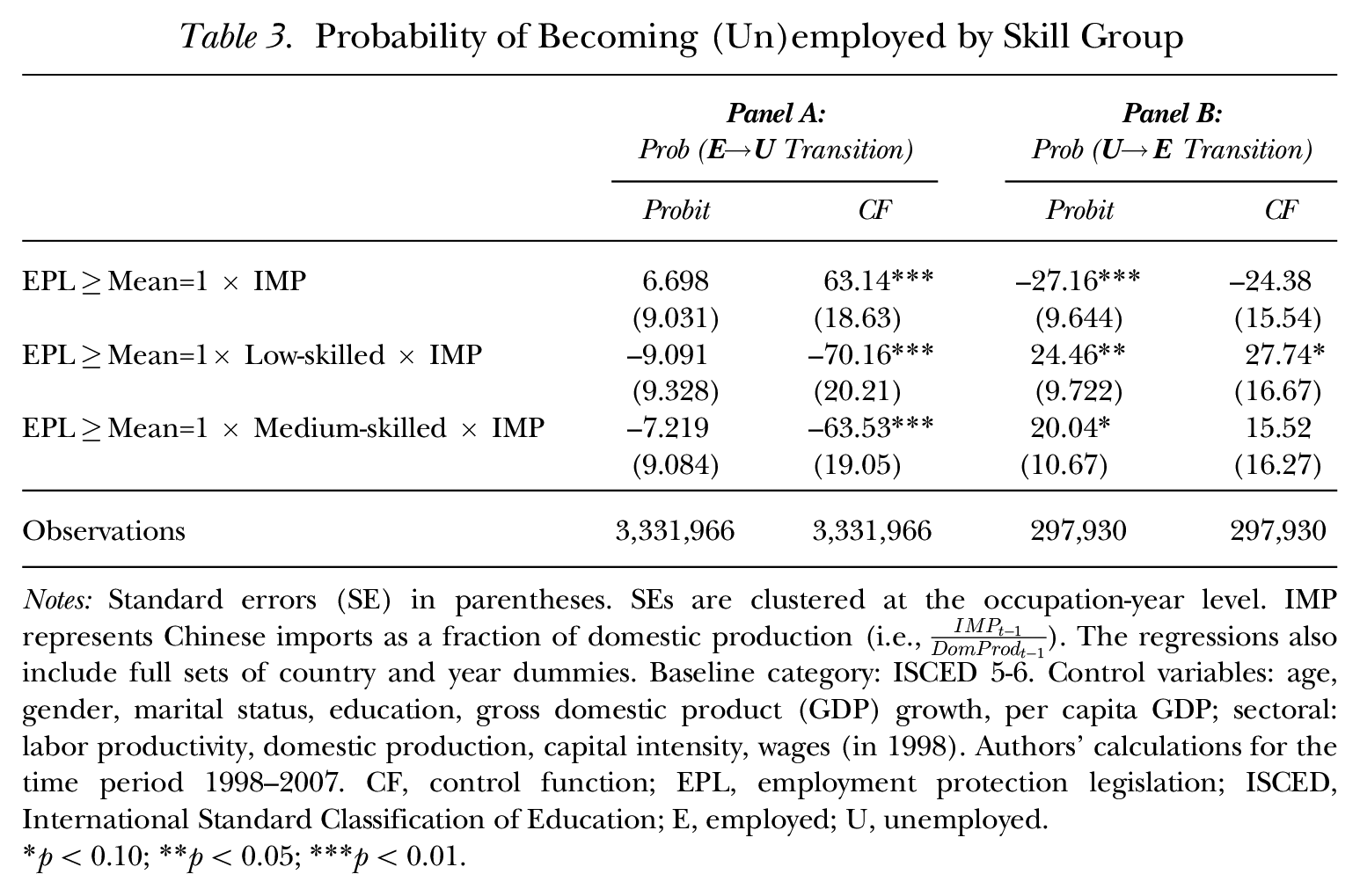
To analyze the role of workers’ skills, we classify individuals into three skill groups: low-skilled (individuals with primary or lower secondary education), medium-skilled (individuals with upper and postsecondary education and/or a completed apprenticeship), and high-skilled (individuals with tertiary education). We confirm results from the literature that the lower the skill level, the higher is the likelihood to make a transition from employment to unemployment (see Table A.7, panel A). The difference between high-skilled workers and workers with lower skill increases with import competition when EPL is low as indicated by the positive interaction terms Chinese imports × low-skilled and Chinese imports × medium-skilled (see Table A.7). The corresponding sample-average marginal effects suggest that a 1 pp increase in Chinese imports is associated with a 0.7 pp increase in the probability of unemployment for low-skilled workers when EPL is low; for medium-skilled workers, this coefficient is smaller, and for high-skilled workers even negative (see Table A.8). Results from the control function approach, however, suggest that low- and medium-skilled workers benefit more from high EPL when imports increase, as indicated by the negative triple interaction terms. For instance, when EPL is high, the average marginal effect of a 1 pp increase in Chinese imports for low-skilled workers decreases and becomes statistically insignificant. This outcome could be attributable to EPL playing a more important role for industries and occupations with a high share of low-skilled workers.
Looking at the transitions from unemployment to employment, we again confirm results from the literature that low- and medium-skilled workers are less likely to make such a transition (Table A.7, panel B). Low-skilled workers are affected more strongly than other skill groups by Chinese imports in their transitions from unemployment to employment, indicated by the negative interaction term between low-skilled and IMP. This difference is less pronounced when employment protection is high (see Table 3). The corresponding marginal effects (Table A.8, panel B) suggest that the probability that unemployed workers re-enter the labor force decreases with Chinese imports for low-skilled workers but (weakly significantly) increases for high-skilled workers when EPL is low. A potential explanation is that firms facing import competition differentiate their production from Chinese competitors toward activities that require higher skills. 13 The heterogeneity in responses across skill groups of unemployed individuals is, however, reduced when EPL is high.
Probability of Becoming (Un)employed by Skill Group
Notes: Standard errors (SE) in parentheses. SEs are clustered at the occupation-year level. IMP represents Chinese imports as a fraction of domestic production (i.e.,
p < 0.10; **p < 0.05; ***p < 0.01.
Finally, we analyze whether the effects of Chinese imports depend on the job tasks performed by workers. This may be the case as jobs with high routine intensity are likely to be more vulnerable to imports from a low-wage country. To obtain information on the task content of occupations, we follow the strategy of Hardy, Keister, and Lewandowski (2018) and use the Occupational Information Network (O*NET) database and merge it with our EU-LFS data through the occupation code.
14
To compute our measure of task routineness of an occupation, we follow an approach similar to Goos, Manning, and Salomons (2014) and Hardy et al. (2018): We first standardize the values of task items in the first year and create the DOT task measures of Autor, Levy, and Murnane (2003): routine cognitive, routine manual, non-routine cognitive analytic, and non-routine cognitive interpersonal. After that, we standardize these task content measures again and define the routine task intensity (RTI) index as
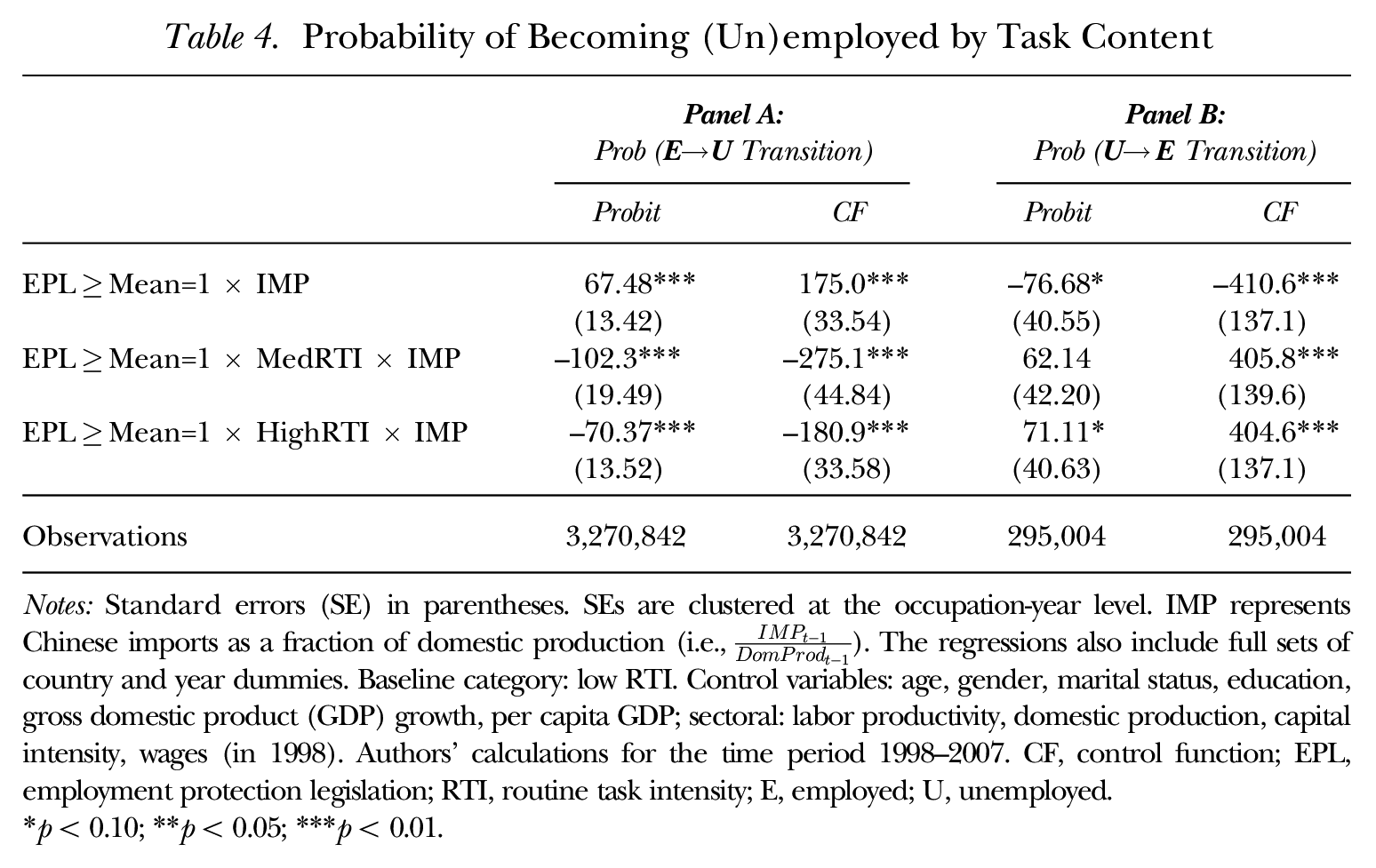
Consistent with the literature (e.g., Goos et al. 2014; Cortes 2016), we find that high levels of routine intensity are associated with a higher probability of making a transition from employment to unemployment (Table A.9, panel A). This effect is even enhanced through Chinese imports, though statistically significant only in the probit model and not in the control function approach. EPL plays a protective role in this context: With high EPL, workers in jobs with higher RTI are less likely to become unemployed than are workers in jobs with low RTI (see Table 4).
Probability of Becoming (Un)employed by Task Content
Notes: Standard errors (SE) in parentheses. SEs are clustered at the occupation-year level. IMP represents Chinese imports as a fraction of domestic production (i.e.,
p < 0.10; **p < 0.05; ***p < 0.01.
Turning to the results for the transition rate from unemployment to employment, we find that higher RTI is associated with a higher probability of making such a transition (Table A.9, panel B). This finding is in line with the previous literature, which found a higher churning rate (i.e., higher transition probabilities both from employment to unemployment and from unemployment to employment) for workers who perform jobs with higher RTI (Bachmann, Cim, and Green 2019). This effect seems to be reversed through higher imports from China when EPL is low, indicating that workers in occupations with high RTI are most likely to be negatively affected by Chinese imports (see Table 4). This outcome is likely attributable to Chinese imports replacing products that are made using routine production technologies. Moreover, the estimation results suggest that when EPL is low, workers previously employed in jobs with low RTI are more likely to re-enter employment when Chinese competition rises. 15 The three-way interaction terms suggest, however, that when EPL is high and Chinese imports rise, the likelihood of exiting unemployment to employment is higher for individuals who were previously in jobs with medium or high RTI, again indicating higher churning for these worker groups.
Finally, we are interested in how the China shock affected structural change, and whether this effect was slowed by EPL. 16 To answer this question, we analyze whether exposure to Chinese imports is associated with higher transitions from unemployment to service sectors. For this purpose, we estimate multinomial probit models in which we relate the probability of making a transition from unemployment to a job in manufacturing, services, and other sectors, respectively. We document these results in Table 5. We find that exposure to Chinese imports increases the probability of taking up a job in a service sector or remaining in non-manufacturing industries (such as mining and agriculture) and that this effect is dampened by a higher level of employment protection. This finding indicates that high levels of EPL might slow structural change in response to rising import competition from low-wage countries.
Probability of Becoming Employed in Different Sectors Conditional on Being Unemployed in the Preceding Year
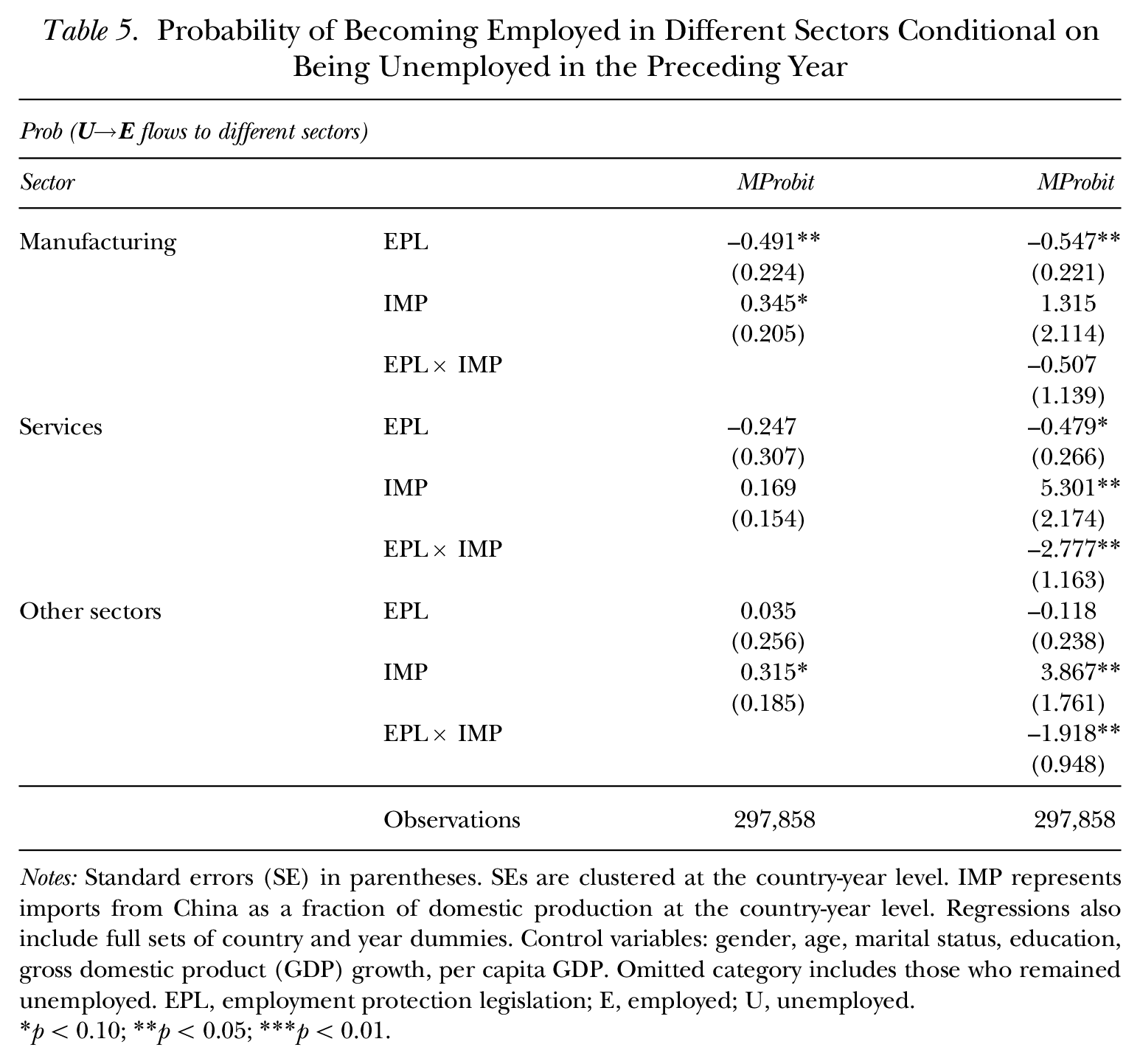
Notes: Standard errors (SE) in parentheses. SEs are clustered at the country-year level. IMP represents imports from China as a fraction of domestic production at the country-year level. Regressions also include full sets of country and year dummies. Control variables: gender, age, marital status, education, gross domestic product (GDP) growth, per capita GDP. Omitted category includes those who remained unemployed. EPL, employment protection legislation; E, employed; U, unemployed.
p < 0.10; **p < 0.05; ***p < 0.01.
Robustness
To assess the sensitivity of our previous estimates, we conduct a series of robustness checks. First, in order to take into account that the effect of employment protection legislation is concentrated on regular workers with permanent contracts, we control for the share of workers with temporary contracts. Second, one might be concerned that our results are driven by European exports to China, which could be correlated with Chinese imports to European countries. We therefore include a measure of export exposure to China as an additional control variable. Third, our IV strategy would be invalid if the level of Chinese imports was correlated with unobserved industry characteristics that affect subsequent employment outcome patterns. To alleviate this concern, we include a full set of 3-digit occupation dummies to capture time-invariant differences between occupations. We furthermore use an alternative instrument, Chinese imports to the United States. Fourth, we replace the time-varying controls at the country level with country-year fixed effects. A further concern is that EPL could be correlated with other labor-market institutions such as collective bargaining. For this purpose, we include a country-year specific measure of collective bargaining coverage and an interaction with Chinese imports. As shown in detail in the Online Appendix, our results are robust to these sensitivity checks.
Finally, we analyze whether the effects of Chinese imports differ from those of other low-income countries. In Table A.14, we show results when replacing Chinese import exposure with those from all low-income countries. Corresponding marginal effects are depicted in Figures A.3 and A.4. The results are very similar to the preceding analysis: Imports are associated with a higher probability of transitions from employment to unemployment and vice versa, and this effect is dampened in countries with high levels of EPL. 17
Conclusion
In this article, we analyze the effects of a large increase in Chinese exports on European workers following the accession of China to the WTO. Using comparable microdata across 14 European countries allows us to estimate heterogeneous effects across countries with various labor-market institutions. We answer two main research questions. First, what were the effects on European workers’ job security, specifically, outflows from employment to unemployment, and unemployment exit rates to employment, and how were the consequences of this shock affected by differing levels of employment protection legislation (EPL)? Second, given the important increase in Chinese imports, which types of workers were most affected, and which types of workers benefited most from higher EPL?
Our results indicate that Chinese exports strongly affected workers’ job security as well as the job-finding rates of the unemployed in the European Union. In particular, we find that the increased exposure to Chinese imports was associated with higher worker flows from employment to unemployment, and with a reduced probability that unemployed workers become employed. Second, we find that countries with high levels of EPL display a stronger reduction of worker flows from unemployment to employment as Chinese imports increased. Thus, our results indicate that a high level of EPL prevents (re-)entry of individuals into employment. Third, our results demonstrate important differences between worker groups, especially with respect to age, skill, and job tasks.
The results of our analysis have crucial implications for welfare considerations with respect to the effects of international trade on individual workers, as well as for economic policy. Increased inflows into unemployment and reduced outflows from unemployment imply the loss of job- or industry-specific human capital, as well as higher costs of searching for a new job. Furthermore, these effects seem to be stronger for some worker groups than for others. Our results thus complement the studies that have investigated the labor-market effects of the China shock on specific national labor markets (e.g., Autor et al. 2013; Dauth et al. 2014).
Finally, our results strongly influence our views on EPL. In countries with high levels of EPL, the hiring margin is more important for labor-market adjustment, that is, firms hire fewer workers instead of laying off incumbent ones. This strategy has the positive effect of providing higher job security to employed workers; however, it also has a number of negative effects. First, it is likely to increase the segregation of national labor markets by exacerbating the dual structure of the labor market that characterizes a number of European countries (Dolado 2016). Second, adjustment along the hiring margin is likely to be much slower than adjustment along the firing margin. While good for incumbent workers, this means that relatively unproductive jobs are safeguarded, that is, “creative destruction” is prevented, at least in the short run. In the longer run, this could imply lower productivity growth—thus reducing the positive productivity effects found by Bloom, Draca, and Van Reenen (2016)—and eventually lower employment in the affected sectors. Our finding that EPL slows the reallocation of workers to the service sector may be seen as evidence supporting this hypothesis.
One open question in this context is the role of direct job-to-job transitions, which we could not investigate because our cross-country data set does not include retrospective information on the occupation or sector of an employed person. Investigating the role of direct job-to-job transitions for the adjustment to the China shock using national data sets is therefore clearly warranted.
Supplemental Material
sj-pdf-1-ilr-10.1177_00197939211052283 – Supplemental material for The China Shock, Employment Protection, and European Jobs
Supplemental material, sj-pdf-1-ilr-10.1177_00197939211052283 for The China Shock, Employment Protection, and European Jobs by Hedieh Aghelmaleki, Ronald Bachmann and Joel Stiebale in ILR Review
Footnotes
Acknowledgements
We are grateful to Daniel Baumgarten, Rahel Felder, Hanna Frings, Holger Görg, Michael Kvasnicka, Sandra Schaffner, and Bernhard Schmidpeter, as well as to conference and workshop participants at the EALE and the ETSG Annual Conferences, the Kiel Institute for the World Economy, and RWI for helpful comments. We gratefully acknowledge financial support of the Leibniz Association. An Online Appendix is available at  .
.
For information regarding the data and/or computer programs used for this study, please address correspondence to
Notes
References
Supplementary Material
Please find the following supplemental material available below.
For Open Access articles published under a Creative Commons License, all supplemental material carries the same license as the article it is associated with.
For non-Open Access articles published, all supplemental material carries a non-exclusive license, and permission requests for re-use of supplemental material or any part of supplemental material shall be sent directly to the copyright owner as specified in the copyright notice associated with the article.
