




Abstract
The authors evaluate the exemption of long-term unemployed job seekers from Germany’s national minimum wage. Using linked survey and administrative micro data, they rely on a regression discontinuity design to identify the effects of the policy by comparing hiring rates, employment stability, and entry wages around the administrative threshold between short-term and long-term unemployment. They find that the exemption is very rarely used and that the minimum wage binds irrespective of past unemployment duration. While the minimum wage led to a relative rise in entry wages for the long-term unemployed compared to the short-term unemployed, the authors do not detect a relative deterioration in their employment prospects.
Keywords
Minimum wages are generally quite popular with the public, yet among economists and policymakers they remain one of the most controversial policy instruments for the regulation of labor markets. Even advocates of minimum wages often argue that the minimum wage might be “too high” for certain groups of very vulnerable workers. They propose minimum-wage exemptions for these groups to increase employability and labor market attachment. As a result, exemptions from the national minimum wage are in place in a number of countries and include special rates for young workers, apprentices, disabled workers, and certain sectors or occupations (OECD 2015). Do such exemptions have the intended effects, though? Are they even used at all, especially when they are temporary in nature as is often the case for employment policies?
In 2015, Germany introduced a national minimum wage of 8.50 EUR/hour. At that time, approximately 15% of the German workforce earned wages below that level (Destatis 2016). The minimum wage was even more strongly binding for job seekers who were unemployed for more than one year, that is, the long-term unemployed. These job seekers frequently take up jobs in the low-wage sector, and more than one-third of them had entry wages below the minimum wage before 2015. To meet the new minimum, their entry wages had to increase by 2.30 EUR/hour, on average. Moreover, their jobs are generally short lived. Merely 58% of the jobs that former long-term unemployed workers entered in 2014 lasted longer than six months. The large wage gap and lack of job stability raised concerns that the introduction of the minimum wage could further complicate the labor-market integration of the long-term unemployed. The German government therefore exempted workers for the first six months on the job if they were hired directly after experiencing long-term unemployment.
In this article, we analyze the effects of this minimum-wage exemption on employment and wages by exploiting the administrative threshold that separates the long-term and the short-term unemployed. We can precisely identify both groups by relying on individual-level data linking our own survey of more than 14,000 workers hired after prolonged unemployment to these same workers’ social security records.
Our identification strategy relies on a regression discontinuity (RD) design that exploits differences in discontinuities over time: First, we contrast the unemployed with an unemployment duration somewhat below and somewhat above the threshold of one year in unemployment. Then, we study how the treatment effect measured at the threshold changes with the introduction of the minimum wage.
Our article contributes to an emerging literature on the German minimum wage in general. It also complements the international literature on special minimum wage rates, which almost exclusively focuses on young workers. This literature mostly finds special rates to be binding, but with quite mixed effects on employment for those affected.
However, no other country has established a minimum-wage exemption for the long-term unemployed, and we are the first to study this kind of intervention. We thereby add a rare case to the literature in which a minimum wage exemption targets mainly older workers, as these workers are clearly overrepresented among the long-term unemployed.
Literature
Although no other studies focus on minimum-wage exemptions for the long-term unemployed, the literature on the effects of special rates for young workers appears most comparable to our case. This literature has found most of these special rates to be binding, and has attempted to evaluate their employment effects. The available evidence, however, is quite mixed. Studies reporting significant and sizeable disemployment effects of increasing a special rate for young workers include Neumark and Wascher (1992) for the United States, Dolado et al. (1996) for Spain, Abowd, Kramarz, Lemieux, and Margolis (2000) for France, Pereira (2003) for Portugal, Neumark and Wascher (2004) for 17 Organisation for Economic Co-operation and Development (OECD) countries, Yannelis (2014) for Greece, and Kreiner, Reck, and Skov (2019) for Denmark. An important mechanism behind these negative effects appears to be a substitution away from affected young workers toward older or low-skilled workers. By contrast, no sizeable negative or even positive effects on employment were found by Dolado et al. (1996) or Kabátek (2020) for the Netherlands, Portugal and Cardoso (2006) for Portugal, Stillman and Hyslop (2007) for New Zealand, Shannon (2011) for Canada, Giuliano (2013) for the United States, and Dickens, Riley, and Wilkinson (2014) for the United Kingdom.
Although subminima for young workers are usually reported to be binding, we are aware of two notable cases in which such special rates have been applied to a small extent only. The first case, in the United States, is an exemption for certain full-time students and a special rate for teenagers. Freeman, Gray, and Ichniowski (1981) documented the rare usage of the student exemption, and Katz and Krueger (1992) estimated that less than 2% of fast food restaurants in Texas in 1990 (and less than 5% in 1991) had applied the teenager subminimum. As a second case, in the Finnish retail trade the general minimum wage was lowered for a period of two years during a recession. Yet, this exemption has not been commonly used (Böckerman and Uusitalo 2009).
Institutional Background
The German Minimum Wage Law passed the Bundestag (Germany’s national parliament) on July 3, 2014, and the minimum wage came into effect on January 1, 2015. Although the decision process took place in times of relatively robust economic growth, long-term unemployment remained disturbingly persistent. Some policymakers voiced concerns that the introduction of a minimum wage could further complicate the labor-market integration of the long-term unemployed. In the end, the law incorporated an exemption clause aiming to foster employment prospects of the long-term unemployed, or at least to avoid reductions in their employability caused by the minimum wage.
According to the exemption, individuals who are long-term unemployed immediately prior to job start can be paid an hourly wage of less than 8.50 EUR for the first six months of employment. Afterward, the hourly wage has to increase to at least the minimum wage. To prove their long-term unemployment status, individuals can request a certificate at their local Job Center. Although such a certificate is not mandatory for long-term unemployed job seekers, it is necessary for employers to verify that they are allowed to pay a subminimum wage. When customs authorities inspect the firm, those that lack certificates may be heavily fined for not complying with the minimum wage law.
The exemption was critically discussed in both political and public debates. Some critics viewed it as too bureaucratic, generally unattractive for both employers and prospective employees, or even immoral. Others feared a strategical exploitation of the exemption as a circumvention scheme for the minimum wage. They argued that employers would have an incentive to substitute the hiring of short-term unemployed job seekers with the long-term unemployed, regularly displace newly hired long-term unemployed after six months of work, or both. We discuss the possible effects of the policy more closely in the following section. We also provide more details on the institutional background of the minimum wage introduction in Germany in Online Appendix A.
Theory
The theoretical effect of minimum wages on employment depends critically on the chosen labor market model. In a competitive model, a minimum wage will drive the lowest-skilled workers out of the market. Additionally, the substitution of high-skilled labor for low-skilled labor by employers will hurt the low skilled. The “losers” in such a setting are those most willing to be employed at the lower market equilibrium wage (Ahn, Arcidiacono, and Wessels 2011).
Several theoretical frameworks propose an alternative to the competitive model. In those models, labor market frictions arise from search costs (Flinn 2006), monopsony power (Manning 2003), asymmetric information (Drazen 1986), or efficiency wages (Rebitzer and Taylor 1995). As a result, the employment effect of a minimum wage becomes indeterminate as positive effects from increased labor market participation, search intensity, or reduced costs of supervision counterbalance the negative effect predicted by the competitive model. A minimum wage might still produce winners and losers, however, even if the overall employment effect is not negative (Ahn et al. 2011).
Since many long-term unemployed job seekers show particularly low productivity, we can expect them to be overrepresented in the loser group. 1 An exemption could then insulate those workers from the negative effects of a minimum wage. In addition, its use would lead to shifts in the distribution of wage and job offers at the long-term unemployment threshold, allowing us to analyze the effect of the exemption similarly to the recent literature studying special rates for the young (Kreiner et al. 2019; Kabátek 2020).
Flinn (2006) provided a useful framework to think about the change in wage offers at the long-term unemployment threshold. In this model, job seekers and firms split a match-specific rent in a constrained Nash-bargaining game. Assuming the productivity draws of the unemployed are often low, a minimum wage reduces their ability to find a new job. This outcome is especially true if prolonged unemployment further reduces productivity. With an exemption in place for the long-term unemployed, the resulting wage offer distribution shifts at the threshold: Wage offers bunch at the minimum wage for the short-term unemployed, as employers will rather waive part of their surplus than reject the match completely. However, the long-term unemployed will be offered wages below minimum if the match-specific productivity is low. As jobs with a match-specific productivity below the minimum wage become feasible only after job seekers have crossed the long-term unemployment threshold, the hiring rate will increase at that point, leading to a discontinuous jump. Moreover, exempted workers will face an increased rate of layoffs once the exemption runs out after six months.
Whether employers will actually use the exemption rests on the assumption that they are willing to pay less to the exempted group. Akerlof and Yellen (1990) argued, based on sociological, psychological, and management research, that this approach might not be optimal. The new minimum wage can alter the workers’ perception about what constitutes a fair wage offer. “Unfair” wages below minimum might then lead to reduced effort, especially when other workers in the same firm earn more for comparable tasks. Experimental evidence shows that these considerations can be quite important (Falk, Fehr, and Zehnder 2006; Koenig, Neyse, and Schroeder 2019). As a result, few firms may consider subminimum wages a profitable strategy. This might even apply if the reductions in labor costs were substantial.
Methods and Data
Empirical Strategy
Our empirical strategy is to analyze labor market outcomes of job seekers after a given number of days in unemployment. We refer to the latter as the running variable. Key outcomes are the hazard rate from unemployment into new employment and the likelihood to earn an hourly entry wage of less than the minimum wage, which we also refer to as the fraction affected. We identify the effects of the minimum-wage exemption on the outcomes of the long-term unemployed by focusing on discontinuous breaks at the long-term unemployment threshold in those outcomes as a function of the running variable.
Our preferred approach to implement this strategy is to estimate discontinuous breaks directly at the threshold in a sharp RD design. We consider a sharp RD because we are interested in the intent-to-treat effect, which is arguably most relevant for policy design.
To illustrate this approach, let

with
For estimating

with
To identify the causal effects, we need to assume that individuals with unemployment durations around the threshold are comparable in all aspects relevant for both the outcomes and the running variable except for the exemption clause. This assumption implies that all potential effects of the minimum wage in a hypothetical world without an exemption evolve continuously at the threshold. We will show that individuals with unemployment durations close to the threshold are indeed comparable in terms of observable characteristics.
Two factors complicate our estimation strategy: 1) a pronounced seasonal pattern in hiring rates due to beginning-of-month effects and 2) increased employment transitions directly at the threshold due to unemployment benefits running out for many eligible job seekers after one year (see Schmieder, von Wachter, and Bender [2012], who document this phenomenon for Germany in detail). In our analysis, we show that we can adequately control for these patterns by specifying the data in first-differences using observations before the minimum-wage introduction to control for time-invariant discontinuities.
Data
We base our analysis on individual-level German administrative records from source data of the Federal Employment Agency’s Statistics Department, processed for research purposes (vom Berge, Kaimer, Copestake et al. 2016; vom Berge, Kaimer, Eberle et al. 2016). These data contain detailed information on individual employment biographies from employers’ notifications to the social security system. The notifications cover any type of employment that is subject to social security contributions, as well as marginal employment. We observe the exact start and end dates of employment relationships as well as sociodemographic characteristics of the worker, such as age, gender, nationality, and education. Unique establishment identifiers allow us to infer information about employers, such as firm size and workforce structure.
As we also observe the start and end dates of periods during which individuals are registered unemployed in Germany, it is possible to measure duration in unemployment exactly to the day. Both employment and unemployment data can be linked and are organized in monthly cross-sections, reflecting the state at the end of each month. We use data on the universe of individuals entering unemployment between December 2011 and December 2015 for our analyses based on administrative records.
Unfortunately, this data source does not include information on wages. We therefore conducted a survey among formerly unemployed workers to gain further insights into the hiring process, entry wages, and working conditions of unemployed job seekers. The survey covers individuals entering a new job after at least eight months of unemployment. We used the administrative data to identify the target group and realized 14,176 interviews in three survey waves. The waves were designed to reflect the situation before and after the minimum wage introduction: Wave 1 participants entered employment in April 2014; wave 2 and 3 participants started a job in April 2015 and July 2015, respectively.
To assure a sufficient number of interviews around the long-term unemployment threshold, we stratified the target population into 10 bins according to the individual unemployment duration before the job start and sampled an equal number of people from each bin. The first 9 bins include job entries occurring after 8, 9, . . . , and 16 months of unemployment. The last bin includes job transitions occurring after 17 months in unemployment or longer. We apply bin-specific weights to make our results derived from the survey data representative for the target population.
In our analysis, we use interviews with complete information and linkage permission. This restriction leaves us with 11,877 survey observations that we link to our administrative data. We provide further information on the survey in Online Appendix A.
Results
We begin by presenting some basic descriptions of the unemployment and hiring patterns in Germany before and after the minimum wage introduction. Because our identification strategy involves a comparison between short-term and long-term unemployed job entrants, we focus especially on similarities and differences between those two groups. As wage effects measured at the long-term unemployment threshold are hard to interpret without knowing whether or how the minimum-wage exemption has shifted hiring patterns, we deviate from tradition in the minimum wage literature: First, we estimate the effect of the minimum-wage exemption on the likelihood of the long-term unemployed to start a new job. Next, we analyze its impact on entry wages. Finally, we conclude with robustness and sensitivity checks.
Descriptives
The decade before the introduction of the German minimum wage saw a marked decline in unemployment. The overall unemployment rate fell from greater than 11% in 2005 to less than 6% in 2014 (Bundesagentur für Arbeit 2016). The 2009 recession interrupted this trend only briefly. Not all unemployed individuals benefited from robust employment growth to the same extent, however. As can be seen in panel (a) of Figure 1, short-term unemployment was still slightly decreasing between 2012 and 2014 while long-term unemployment remained constant at 1 million people. Panel (b) of Figure 1 shows the much lower hiring rates for the long-term unemployed compared to the short-term unemployed, reflecting their reduced chances of finding a way back into work.
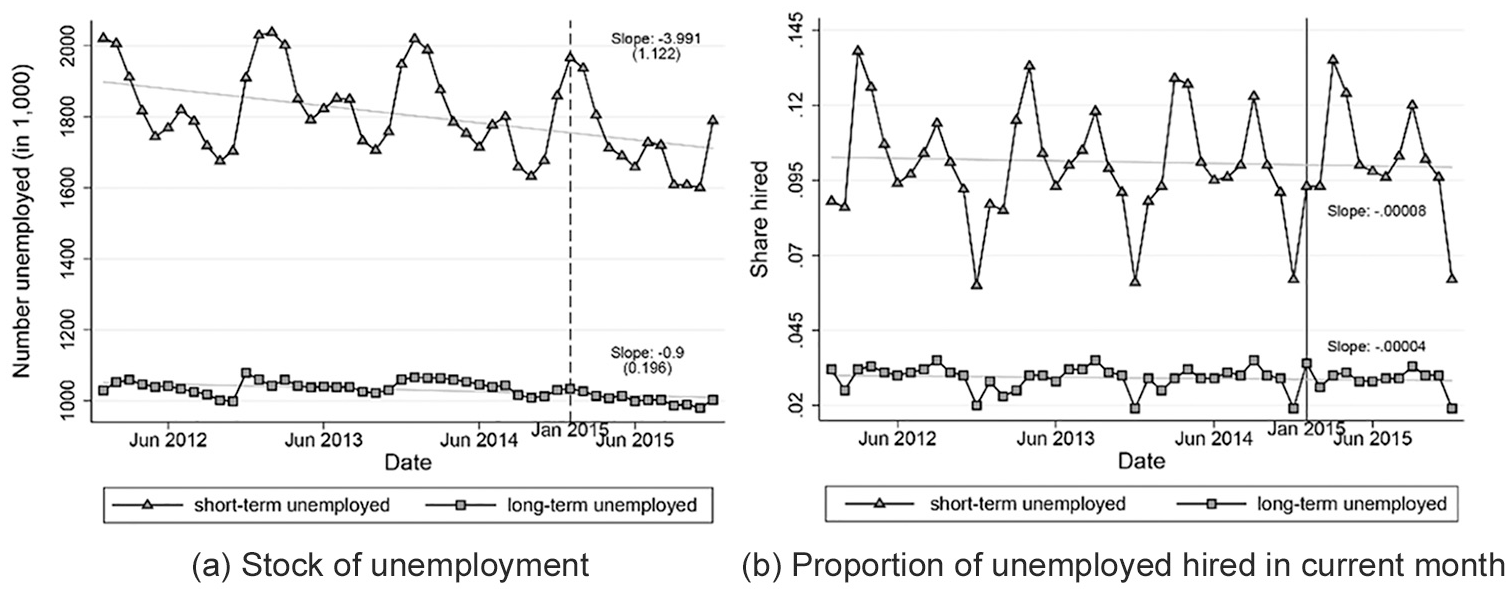
Stock of Unemployment and Hiring Rate by Unemployment Duration and Month
These observations suggest some selectivity in personal characteristics. To test this, Table 1 compares means of some personal characteristics between the short-term unemployed and the long-term unemployed in 2014 (panel A, columns (2) and (5)). We indeed find that relative to the short-term unemployed the long-term unemployed tend to be more often female, older, and lacking any vocational training. Given those discrepancies, one needs to be very careful when using the short-term unemployed as a control group for the long-term unemployed.
Observable Characteristics of the Unemployed – by Year and Unemployment Duration
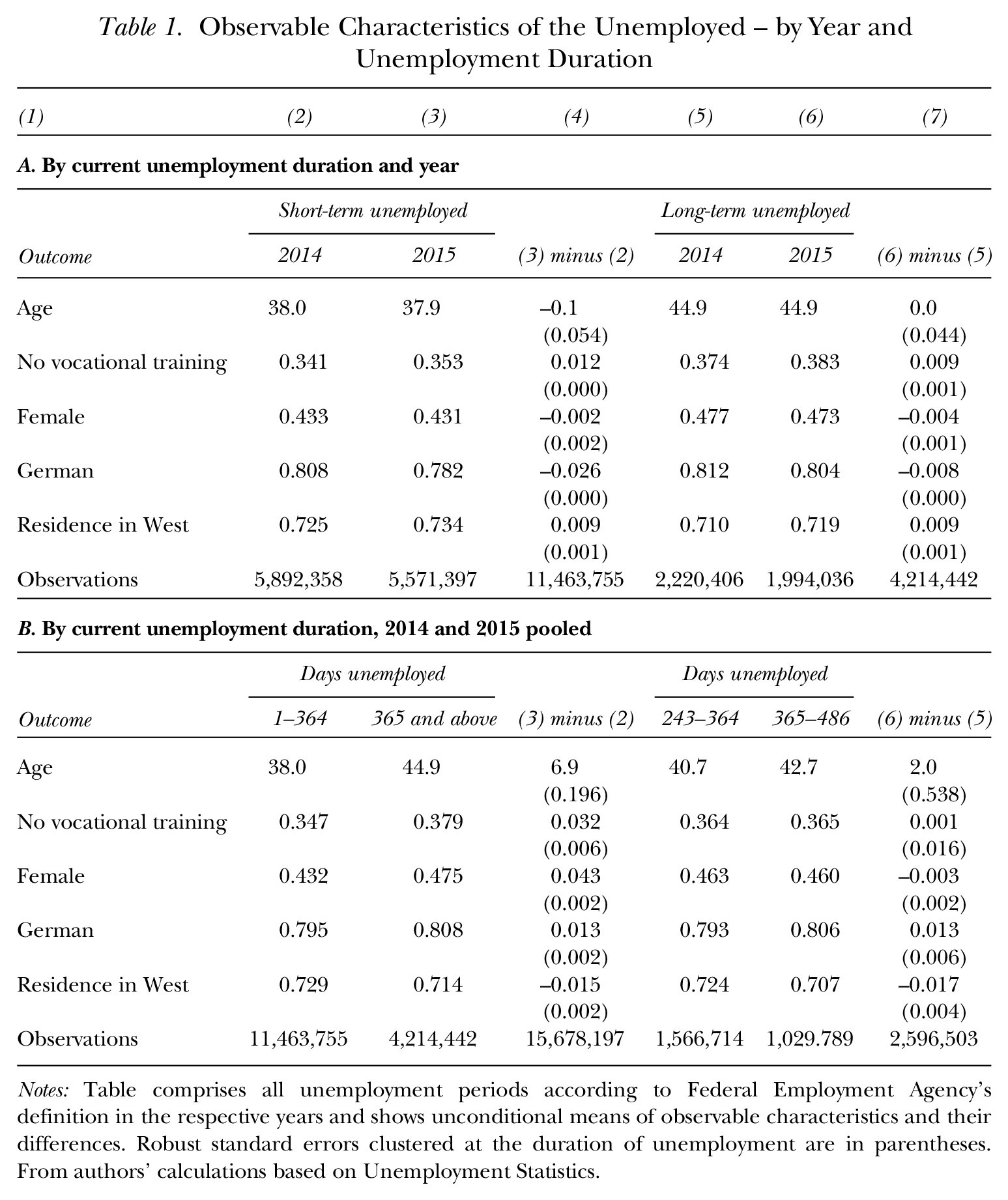
Notes: Table comprises all unemployment periods according to Federal Employment Agency’s definition in the respective years and shows unconditional means of observable characteristics and their differences. Robust standard errors clustered at the duration of unemployment are in parentheses. From authors’ calculations based on Unemployment Statistics.
We address this issue in three ways: First, panel A of Table 1 indicates that the differences are quite stable over time (columns (4) and (7)). We therefore use before/after comparisons to separate the effect of the minimum-wage exemption from the effect of differences in composition. Second, panel B of Table 1 shows that group differences in characteristics are much less pronounced when we restrict our sample to job entrants close to the threshold of 365 days in unemployment (columns (5) and (6) versus columns (2) and (3)). When we consider only cases between 243 and 486 days in unemployment, the differentials mostly vanish, especially in the before/after comparison. Third, we run regressions that directly control for differences in observable characteristics.
Employment Effects of the Long-Term Unemployment Exemption
We start our investigation of the effects of the minimum-wage exemption by analyzing the hazard rate of moving from unemployment into new employment. Our estimation strategy involves a flexible two-step procedure that enables us to apply standard RD techniques. First, we use all unemployment spells in the administrative data in a given year to calculate the hazard rate
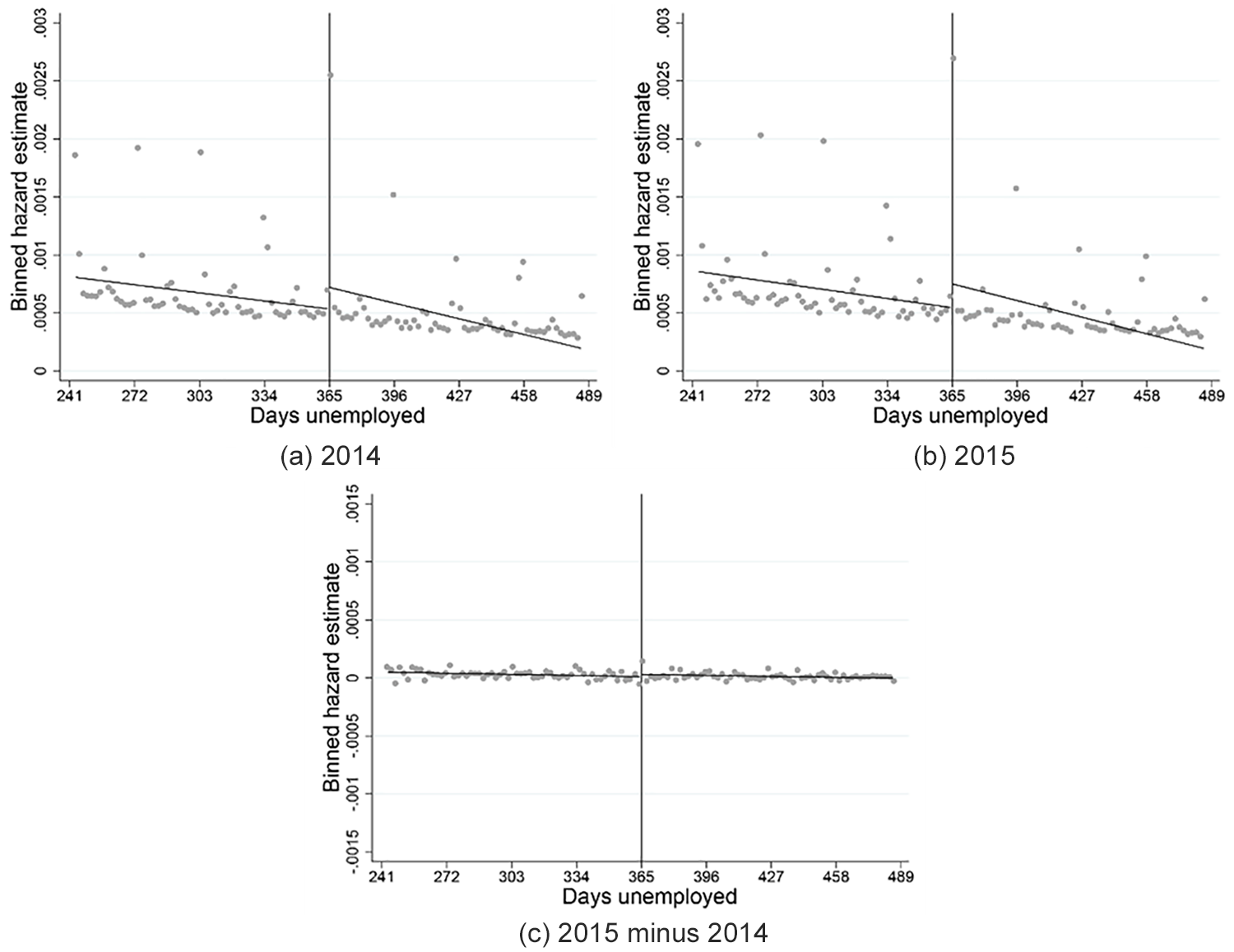
The upper part of Figure 2 plots these bin-means for 2014 (the pre–minimum wage period) and 2015 (the post period). The solid vertical lines mark the long-term unemployment threshold at 365 days. As we are most interested in changes at the threshold, the figure focuses on unemployment durations between 8 and 16 months. Each panel further displays a local linear fit of the bin-means, relying on a triangular kernel, left and right of the threshold. Table 2 reports the corresponding RD point estimates of the hazard rate in logs, derived with the help of a Calonico, Cattaneo, and Titiunik (2014b) bias-corrected estimator (see Equation (2)). We bootstrap the standard errors by replicating our two-step procedure 500 times.
Regression Discontinuity at the Long-Term Unemployment Threshold in Employment Transitions from Unemployment by Year
Regression Discontinuity at the Long-Term Unemployment Threshold in Employment Transitions from Unemployment – by Year
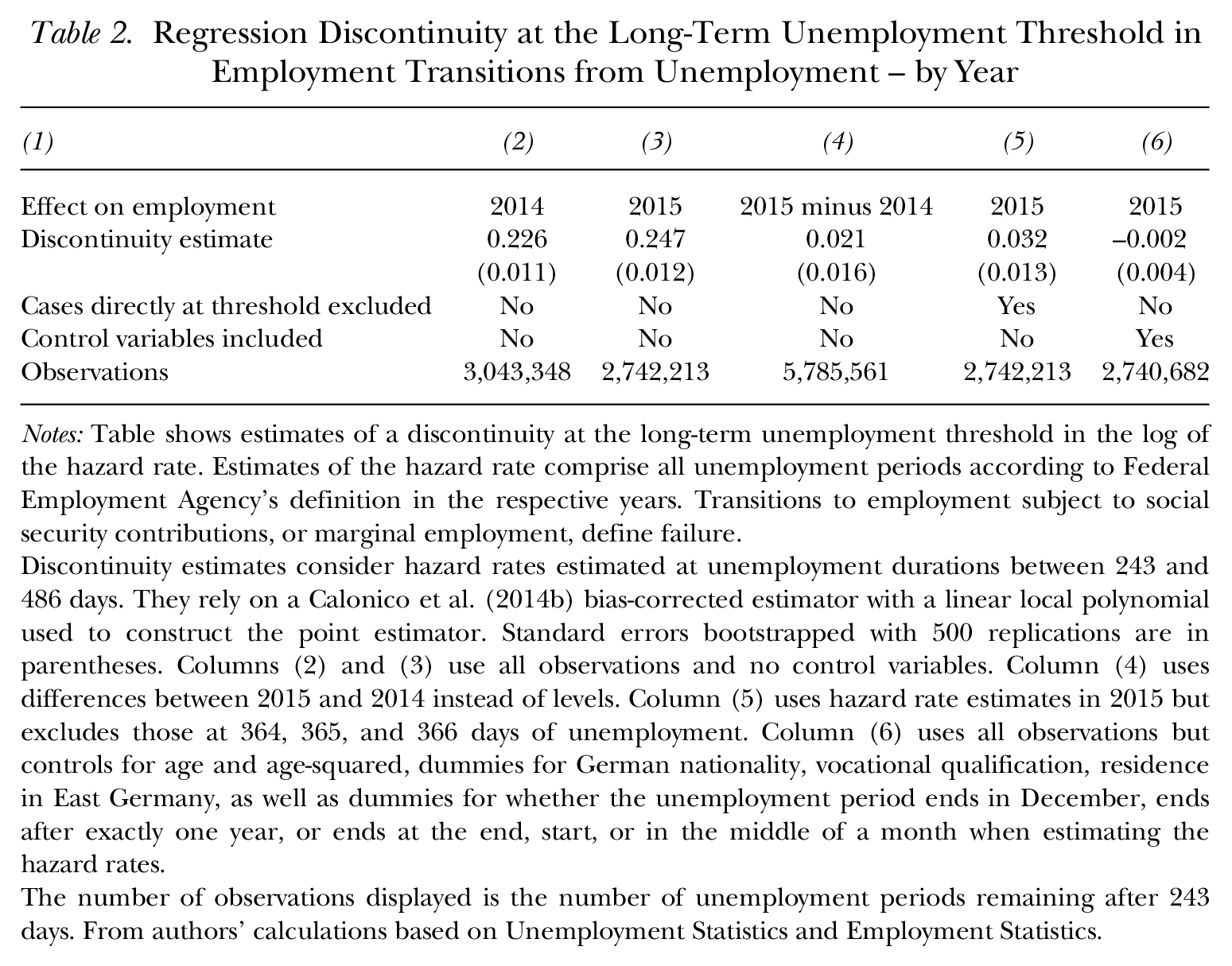
Notes: Table shows estimates of a discontinuity at the long-term unemployment threshold in the log of the hazard rate. Estimates of the hazard rate comprise all unemployment periods according to Federal Employment Agency’s definition in the respective years. Transitions to employment subject to social security contributions, or marginal employment, define failure.
Discontinuity estimates consider hazard rates estimated at unemployment durations between 243 and 486 days. They rely on a Calonico et al. (2014b) bias-corrected estimator with a linear local polynomial used to construct the point estimator. Standard errors bootstrapped with 500 replications are in parentheses. Columns (2) and (3) use all observations and no control variables. Column (4) uses differences between 2015 and 2014 instead of levels. Column (5) uses hazard rate estimates in 2015 but excludes those at 364, 365, and 366 days of unemployment. Column (6) uses all observations but controls for age and age-squared, dummies for German nationality, vocational qualification, residence in East Germany, as well as dummies for whether the unemployment period ends in December, ends after exactly one year, or ends at the end, start, or in the middle of a month when estimating the hazard rates.
The number of observations displayed is the number of unemployment periods remaining after 243 days. From authors’ calculations based on Unemployment Statistics and Employment Statistics.
Figure 2 shows that the chances to start a new job tend to decline with the duration of unemployment, both before (panel (a)) and after (panel (b)) the minimum wage introduction in a very similar way. Both panels show a significant discontinuous break at the threshold, as Table 2 columns (2) and (3) confirm. Two main reasons explain this break: First, unemployment periods end comparatively often after exactly one year because of the legal expiration of unemployment insurance benefits. 3 Second, we observe a pronounced seasonal pattern in the hazard rate. For instance, jobs tend to dissolve at the end of each month and new jobs are particularly likely to start at the beginning of each month. This tendency leads to monthly spikes in the distribution of unemployment durations, with the spike after one year being particularly large.
We have to control for these patterns as they impede our identification strategy. Our preferred solution is to take the differences of the duration-specific hazard rates between 2015 and 2014, assuming that the cyclicality and “expiration” effect in 2015 are the same as in the year before the minimum wage introduction. Panel (c) of Figure 2 shows that the differences of the hazard rates fluctuate around zero both directly at the threshold and at durations further away from it. The corresponding RD estimates of the hazard rate in log differences in column (4) of Table 2 are also close to zero and statistically insignificant, confirming that the estimated discontinuities in the annual hazard rates are about the same size in 2014 and 2015.
Another possibility to control for the selectivity at the threshold is to follow a “donut” approach and to exclude hazard rates at 364, 365, and 366 days of unemployment, that is, directly at the threshold. The underlying assumption for the validity of this approach is that most job seekers and employers reacting to the exemption cannot time the hiring date so precisely that it falls exactly on the threshold, leaving enough mass to the left and right to identify behavioral adjustments. Column (5) of Table 2 shows that in 2015 the hazard function in this restricted sample is flat around the threshold. Consequently, solely those specific outlier observations drive the discontinuity.
As a third possibility, we keep all observations in 2015 and replace the raw hazard rates in step 1 of our procedure by conditional duration-specific hazard rates estimated using a linear probability model that takes account of differences in predetermined observable characteristics, the expiration effect, and the seasonality in hirings. We do this by running regressions of a dummy variable taking on unity if the individual starts a new job right after

We run these regressions separately for each unemployment duration and restricted to individuals still being at risk of leaving unemployment at this duration. The key regressor of interest is the intercept of Equation (3), as it reflects the hazard rate. The controls are collected in
Overall, after accounting for selectivity due to seasonality and benefit exhaustion, we see no evidence for any effects of the exemption on the hiring chances of the long-term unemployed.
Wage Effects of the Long-Term Unemployment Exemption
Distribution of Entry Wages
We now study the impact of the exemption on the distribution of entry wages for new job entrants. Figure 3 depicts the hourly wage distributions of the former short-term unemployed versus the former long-term unemployed (first column versus second column) for hires taking place in 2014 or 2015, respectively. Since the wage information comes from our survey, the figure considers only workers hired after at least eight months in unemployment. We present hourly wage distributions for both the full sample and a cleaner restricted sample of workers covered by social security who reported an exact value for their hourly wage and were not subject to any other minimum-wage exemption (first row versus second row). 5
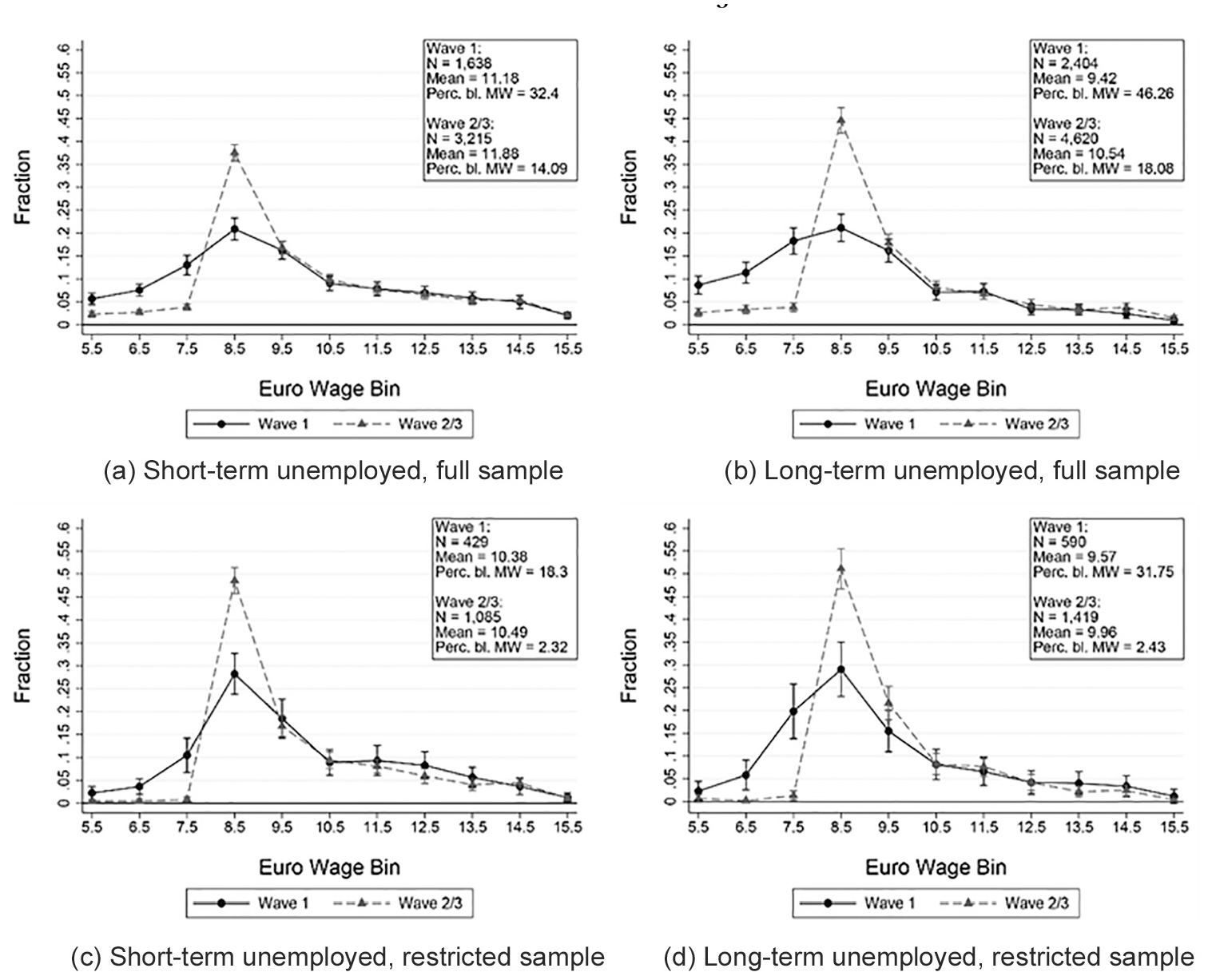
Distribution of Hourly Entry Wages by Sample, Survey Wave, and Unemployment Duration Cumulated Prior Job Start
The wage distributions of former short-term and former long-term unemployed show a similar shape before the introduction of the minimum wage. On average, long-term unemployed job entrants earn lower wages than do the short-term unemployed, which confirms our assessment based on Table 1 that individuals in the former group are more negatively selected. The fraction affected by the minimum wage is generally high in both groups. Specifically, 18.3% of workers hired in 2014 as short-term unemployed and 31.8% of workers hired in 2014 as long-term unemployed earn below 8.50 EUR/hour if the restricted sample of reported wages is considered. For the full sample, the respective findings are 32.4% for short-term unemployed and 46.3% for long-term unemployed. Furthermore, the average long-term unemployed in 2014 with an entry wage below the forthcoming minimum wage earns on average 2.30 EUR/hour below it. The gap to the new minimum is apparently quite sizeable for affected workers.
After its introduction, the minimum wage is binding in the majority of cases (see again Figure 3). The fraction affected drops sharply to 2.3% for the short-term unemployed and 2.4% for the long-term unemployed if the restricted sample of observations is used. Respective findings for the full sample are 14.1% and 18.1%. The wage distributions are now compressed from the left, inducing a large spike at the minimum. Additionally, the fraction of wages below the minimum has converged between the long-term and the short-term unemployed. Although wages in the former group are still on average lower than in the latter, the difference is no longer as pronounced as in the year preceding the minimum wage introduction. We interpret the patterns documented here as indicative of strong positive wage effects of the minimum wage in general. These patterns again show that the population under study is highly affected by the new minimum wage. We still have to clarify if the exemption has neutralized some of these wage effects for workers who fall under the long-term unemployment exemption. This is the goal of the next subsection.
Effects on Entry Wages
The interpretation of our findings on employment hinges critically on whether the exemption is actually used. Does the exemption offset more negative employment effects for the long-term unemployed that the minimum wage otherwise might have, or is it simply not used? As a test, we contrast the entry wages of former unemployed job entrants hired right before and right after their unemployment duration crosses the threshold from short-term to long-term unemployment. Ultimately, we should see a discontinuity at the threshold if the exemption is frequently used.
Providing a graphical analysis of the wage effect of the exemption, Figure 4 plots the fraction of wages that fall below the minimum within narrow bins of the unemployment duration elapsed before job entry. Additionally, it depicts a local linear fit to the left and to the right of the threshold and 95% confidence bands. As in Figure 2, we rely on a triangular kernel but reduce the number of bins as we do not have as many observations in our survey as in the administrative data.
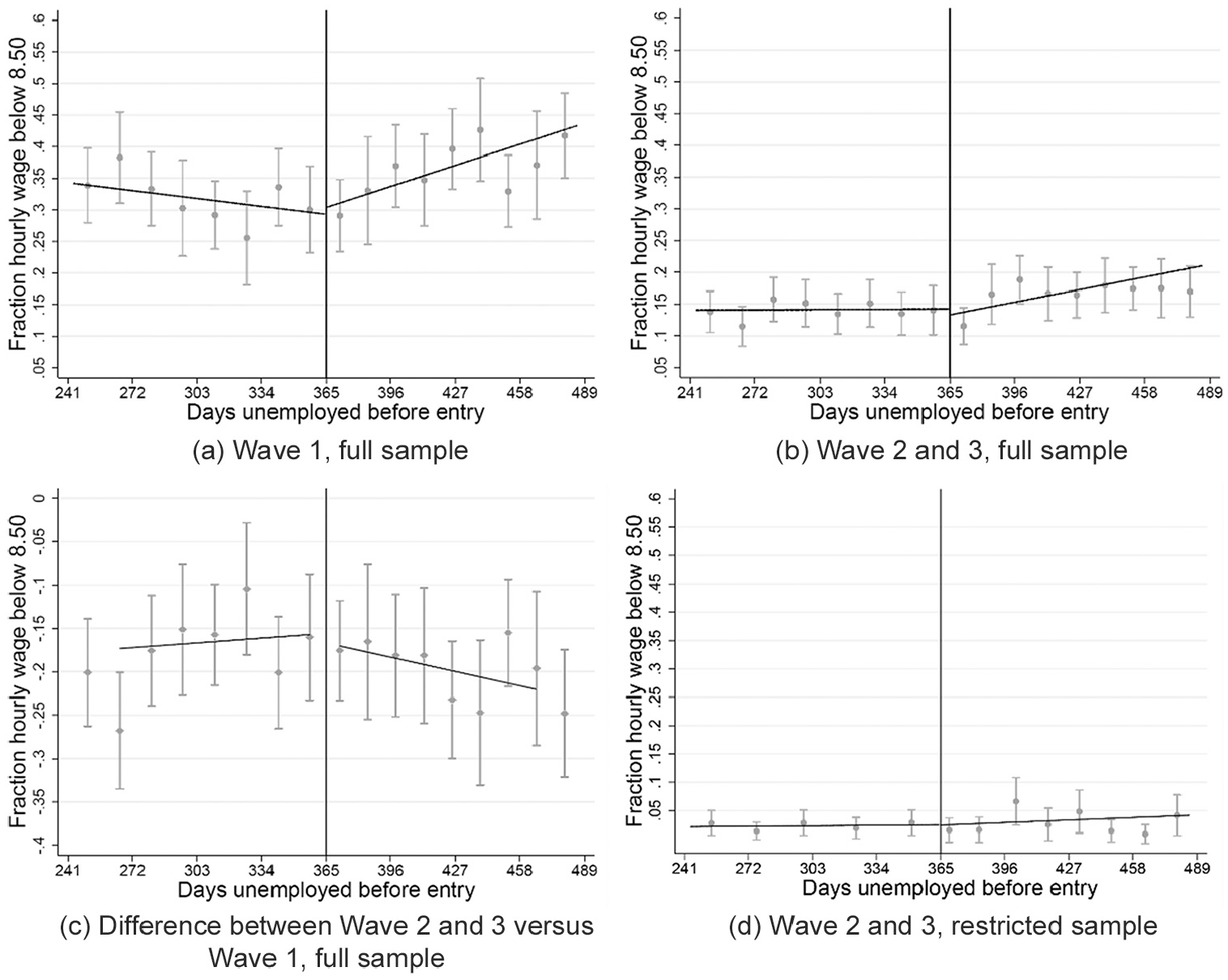
Regression Discontinuity at the Long-Term Unemployment Threshold in Fraction of Entry Wages below Minimum by Survey Wave
Panel (a) of Figure 4 shows the situation before the minimum wage introduction, specifically, for survey respondents hired in April 2014. Approximately 30% of workers hired as short-term unemployed earn entry wages of less than 8.50 EUR/hour. This fraction increases up to roughly 47% once the long-term unemployment threshold is crossed. However, the relationship between fraction affected and previous unemployment duration evolves continuously around the threshold.
Panel (b) of Figure 4 plots the fraction of entry wages that fall below the minimum for workers hired in either April 2015 or July 2015. Because the minimum wage is now binding for the short-term unemployed, we are not surprised that the fraction of newly hired workers earning less than the minimum has been reduced by more than 50% as compared to hires taking place in 2014. We also observe a sizeable downward shift in the fraction affected among the formerly long-term unemployed. This shift is at least as large in magnitude as the one to the left of the threshold. Note that there is no sign of a significant discontinuous jump in the relationship at the long-term unemployment threshold. Panels (c) and (d) confirm this result for the differences of the bin-means between 2015 and 2014 as well as for job starters in 2015 from the cleaner restricted sample, respectively.
To back up the results of the graphical analysis, we again conduct some formal tests of a discontinuity in the fraction affected at the threshold from short-term to long-term unemployment.
Table 3 reports RD estimates of the fraction affected based on Equation (2) using the estimator of Calonico et al. (2014b) (we use bias correction and a linear local polynomial to construct the point estimator). Column (2) reflects the analysis for the first survey wave entering new jobs before the minimum wage introduction and column (3) does so for the second and third waves entering afterward. Column (4) analyzes a discontinuity in the first differences of the bin-means of the fraction affected between the before and after periods. Because of the relatively small sample size in the pre–minimum wage period, in this case we derive the RD point estimate by subtracting the two bin-differences closest to each side of the threshold. Columns (5) and (6), finally, re-estimate column (3) but either exclude unemployment periods ending after 364, 365, and 366 days or control for observable characteristics (age, age-squared, dummies for German nationality, gender, vocational qualification, and residence in East Germany) using the full sample, respectively. The goal is to provide evidence that the selectivity discussed in the previous section on employment effects does not drive the results.
Regression Discontinuity at the Long-Term Unemployment Threshold in Fraction of Entry Wages below Minimum – by Survey Wave
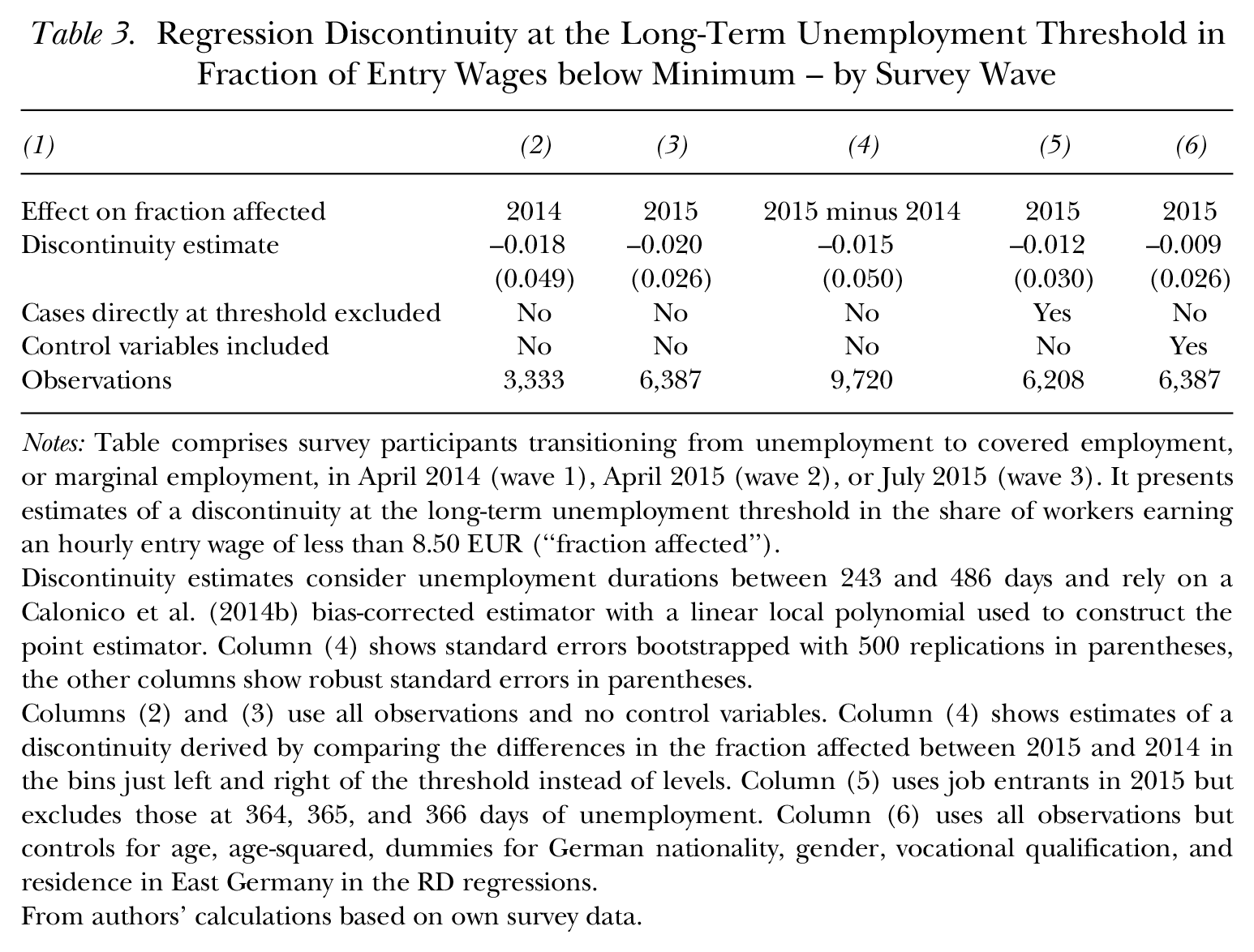
Notes: Table comprises survey participants transitioning from unemployment to covered employment, or marginal employment, in April 2014 (wave 1), April 2015 (wave 2), or July 2015 (wave 3). It presents estimates of a discontinuity at the long-term unemployment threshold in the share of workers earning an hourly entry wage of less than 8.50 EUR (“fraction affected”).
Discontinuity estimates consider unemployment durations between 243 and 486 days and rely on a Calonico et al. (2014b) bias-corrected estimator with a linear local polynomial used to construct the point estimator. Column (4) shows standard errors bootstrapped with 500 replications in parentheses, the other columns show robust standard errors in parentheses.
Columns (2) and (3) use all observations and no control variables. Column (4) shows estimates of a discontinuity derived by comparing the differences in the fraction affected between 2015 and 2014 in the bins just left and right of the threshold instead of levels. Column (5) uses job entrants in 2015 but excludes those at 364, 365, and 366 days of unemployment. Column (6) uses all observations but controls for age, age-squared, dummies for German nationality, gender, vocational qualification, and residence in East Germany in the RD regressions.
From authors’ calculations based on own survey data.
RD estimates in all five specifications are negative, of similar magnitude, and statistically insignificant. Although Figure 4 shows a decline in the fraction affected by the minimum wage after the introduction of the new minimum, this decline appears to be of similar magnitude across all unemployment durations considered. The consistently negative RD estimates suggest that, if anything, wages of the long-term unemployed increased even more than did wages of the short-term unemployed, as the fraction affected decreased more for the former than for the latter.
Overall, the evidence presented here is in line with the minimum wage being equally binding for all types of hires and the exemption to keep wages of the long-term unemployed below the national minimum being rarely used. Responses from our survey further support rare usage of the exemption: Less than 3% of workers report that their wage is subject to the minimum-wage exemption for the long-term unemployed and merely 1% of the newly hired long-term unemployed report that they have submitted a certificate of their long-term unemployment status to their employer. This latter observation is in line with the Federal Employment Agency reporting that it issued only a small number of certificates (Sueddeutsche Zeitung 2016).
Robustness and Sensitivity
Our identification strategy requires ruling out effects from selective sorting or attrition around the long-term unemployment threshold. In Table 1, we showed that job seekers are very similar with respect to a number of personal characteristics when comparing observations close to the threshold. In Online Appendix B, we present further and more detailed results on selectivity looking at individual and firm characteristics as well as the density of the running variable around the threshold. We conclude that our results are not biased by selectivity that we cannot control for in our differences-in-RD approach.
We also checked whether our findings of insignificant effects of the exemption on employment and wages change when we focus on particularly strongly affected subsets of the labor market such as firms in low-wage sectors or in high-turnover sectors, or firms without collective bargaining agreements. We present results on those subsets in Online Appendix C. We do not find significant discontinuities at the threshold in any of those subsamples of our data.
Our RD approach requires that employers or job seekers observe the actual duration of unemployment with reasonable precision and are able to time hiring accordingly. This assumption might be problematic if information is incomplete, timing of hiring imperfect, or both. If the assumption is violated, there may be an effect of the exemption, but we cannot measure it directly at the threshold. Still, it appears plausible that potential effects of the exemption arise primarily at unemployment durations relatively close to the threshold, as the productivity of applicants tends to decline with unemployment duration. To complement the RD estimates of entry wages, we therefore applied a classic difference-in-differences (DiD) estimator that takes the focus away from the threshold to produce alternative estimates that are arguably more robust when timing is fuzzy. This DiD estimator identifies the effect of the exemption on the fraction affected by contrasting the long-term and the short-term unemployed before relative to after the new minimum wage is introduced. We present the approach and results in more detail in Online Appendix D. Again, we find no negative effects of the exemption on entry wages of the long-term unemployed. Our finding of no significant effects of the exemption therefore holds for unemployment durations further away from the threshold, too.
Given that we do not observe any impact of the exemption on the hiring chances of the long-term unemployed, we do not expect to see an impact on the separation rate of formerly long-term unemployed workers after six months either. In Online Appendix E, we show that the survival rates of workers hired as long-term unemployed in the first quarter of 2015 do not indicate any unusual increase in separation rates after six months on the job, when the minimum wage also binds for them.
We conducted a number of additional analyses to further back up our main results. 6 First, we contrasted the hazard rates at 3 to 5 years of unemployment before and after the introduction of the minimum wage to reveal any deterioration in the hiring chances of the extremely long-term unemployed. We did not find any significant differences.
Second, to rule out anticipation effects, we repeated our analysis of the hazard rates comparing 2015 to 2013 rather than to 2014. The results using 2013 as a reference are not qualitatively different from the results using 2014. Our results relying on our survey data should not be subject to anticipation effects, as the outcomes in the first wave relate to April 2014.
Third, we repeated our analysis of the hazard rate for unemployment periods falling into the second half of each year to check whether some effects are present once the minimum wage is in place somewhat longer. Again, our results are robust to this sample restriction.
Fourth, instead of the hazard rate as our main outcome of the employment analysis, we used the hiring rate (estimated as kernel densities of the running variable). Analyzing densities allows us to focus more directly on actual hires. The results, however, are very similar to those we observed when using the hazard rate as the outcome.
Fifth, we varied the order of the local polynomial used to construct point estimates in our RD analysis, as well as the method to select bandwidths. Our results are robust with respect to these functional form assumptions.
Sixth, instead of defining hourly wages according to contractual earnings and contractual working hours, we incorporated special payments and paid overtime hours into our wage measure. Reassuringly, results based on this alternative wage measure do not qualitatively differ from our previous results.
Discussion
We document that employers rarely use the exemption for the long-term unemployed from the German minimum wage and that they increase wages even in cases in which the new minimum wage is not legally binding. This result is very similar to findings on minimum-wage exemptions for young workers from studies in the United States and Finland (Katz and Krueger 1992; Böckerman and Uusitalo 2009). The authors of those studies stress fair wage considerations (Akerlof and Yellen 1990) as the major explanation for low take-up.
For an employer, using the exemption means paying workers differently, perhaps even for comparable tasks. Such differences in pay can discourage the newly hired workers (Falk et al. 2006; Koenig et al. 2019). This can lower effort, threaten internal peace within the firm, or lead some unemployed job seekers to refuse to work for less than the minimum wage. 7 As a result of these considerations, employers might prefer to offer wages at or above minimum even if the minimum does not bind legally, a response frequently described in our survey among Job Center staff (vom Berge, Klingert, Becker et al. 2016).
Another potential explanation for our findings are information deficits. Although the exemption was frequently discussed in both the media and political debates, and information was broadly available (BMAS 2017), only about one-quarter of the former long-term unemployed interviewed in 2015 knew about the exemption clause, according to our survey. We are not aware of any direct employer survey data related to this matter, but assume that employers should be better informed if they are directly affected by the minimum wage and thus have to find out how to implement the new legislation. We talked to several regional Chambers of Industry and Commerce, who confirmed our expectations. 8 This finding is in line with evidence from the United States documenting that employers are generally well informed about minimum-wage exemptions (Katz and Krueger 1992).
Insufficient monetary incentives are a third potential explanation. Paying long-term unemployed job seekers wages that were typical before the minimum wage introduction, however, would save employers a sizable amount of total labor costs. Our survey shows that in 2014 the average wage gap of those long-term unemployed hired for an hourly wage below 8.50 EUR was 2.30 EUR. For a full-time worker, the potential saving therefore amounts to approximately 2,700 EUR in total labor costs over six months. 9 Moreover, recall that nearly 40% of jobs entered by the long-term unemployed dissolve within the first six months. The saving potential, therefore, appears particularly large taking the short duration of many jobs into account. Ultimately, we believe insufficient monetary incentives are not the main driver of our results. 10
As a fourth explanation for low take-up, other integration measures for the long-term unemployed might be used more intensely if they prove more effective than the minimum-wage exemption. However, the number of workers assisted by the German direct wage subsidy program for employers remained flat after the minimum wage introduction for both the short-term and the long-term unemployed. In addition, we observe no increase in the associated program costs in response to the introduction of the exemption. 11
Conclusion
We studied the effects of a unique policy intervention: the exemption of long-term unemployed job seekers from the new German minimum wage legislation introduced in January 2015. The exemption is effective for up to six months after recruitment and aims to protect the long-term unemployed from potential negative employment effects of the wage floor.
We documented substantial effects of the minimum wage on workers’ wages. In our survey among unemployed job seekers entering a new job, the fraction of wages below the national minimum of 8.50 EUR/hour drops sharply from 42% in 2014 to 18% in 2015, or from 32% to 2%, respectively, depending on whether we include all workers or only respondents who report an exact hourly wage.
We find it interesting, however, that the minimum wage is equally binding for both the short-term unemployed (i.e., job seekers unemployed for less than one year) and the long-term unemployed. This finding is also in line with our observation that merely 1% of the newly hired long-term unemployed submitted a certificate of their long-term unemployment status to their employer.
As a result, comparing hiring rates between these groups revealed no discernible differences, especially around the long-term unemployment threshold after one year. Furthermore, we did not find any evidence of strategic hiring behavior by employers. Particularly, there is no bunching of hires once the exemption comes into effect shortly after the threshold. Likewise, no bunching in layoffs occurs when the exemption expires six months after job start.
We conclude that, thus far, the long-term unemployment exemption has been used infrequently. Because the long-term unemployed had lower entry wages than did the short-term unemployed before 2015, the minimum wage led to a relative rise in their compensation. This increase, however, did not reduce relative hiring rates and job stability of the long-term unemployed.
We discussed several possible explanations for low take-up of the exemption, including fair wage considerations, information deficits, and lack of monetary incentives. Although our quantitative and qualitative data do not allow us to determine the relative importance of these channels conclusively, we think that fair wage considerations are a crucial factor in explaining our findings. Monopsonistic competition or rent sharing could then explain why employers were able to raise entry wages of long-term unemployed job seekers without hurting their hiring probability relative to the short-term unemployed.
Supplemental Material
ILRR_Umkehrer_Vom_Berge__Online_Appendix_Revised-2-26-20 – Supplemental material for Evaluating the Minimum-Wage Exemption of the Long-Term Unemployed in Germany
Supplemental material, ILRR_Umkehrer_Vom_Berge__Online_Appendix_Revised-2-26-20 for Evaluating the Minimum-Wage Exemption of the Long-Term Unemployed in Germany by Matthias Umkehrer and Philipp vom Berge in ILR Review
Footnotes
Acknowledgements
We are grateful to the colleagues who worked with us on the project “Mindestlohnbegleitforschung –Überprüfung der Ausnahmeregelung für Langzeitarbeitslose”: Isabell Klingert, Julia Lenhart, Sebastian Becker, Simon Trenkle, Rita Kleinemeier, and Henry Puhe. The project was funded by the German Ministry for Labour and Social Affairs. We thank Joe Altonji, Attila Lindner, Till von Wachter, as well as participants of the SOLE, ESPE, and EALE annual meetings and minimum wage conferences in Berlin and Nuremberg for helpful comments and suggestions.
For our analyses we use administrative data from the Institute for Employment Research (IAB). The data are social data with administrative origin, which are processed and kept by IAB according to the German Social Code III. There are certain legal restrictions due to the protection of data privacy. The data contain sensitive information and therefore are subject to the confidentiality regulations of the German Social Code (Book I, Section 35, Paragraph 1). The data are held by the Institute for Employment Research (IAB), Regensburger Str. 104, D-90478 Nurnberg,
If you wish to access the data for replication purposes, please contact the authors or IAB directly. Computer programs are also available from the authors upon request; e-mail
1
Productivity of the long-term unemployed can be particularly low for a number of reasons. For example, a job seeker’s human capital may decline while she is out of work (Pissarides 1992; Acemoglu 1995). In addition, long-term unemployment might simply reflect low search effort of low productivity workers receiving a certain level of benefits (Pissarides 1990). There might also be a perception of low productivity through stigma ( ).
).
2
For a more detailed description of the estimation procedure, see Calonico, Cattaneo, and Titiunik (2014a).
3
More details on the institutional background can be found in Online Appendix A.
4
We control for age and age-squared, dummies for German nationality, vocational qualification, and residence in East Germany. We also add dummies for unemployment periods that end in December, end after exactly one year, or end at the first, middle, or last day of a month.
5
Using the full sample might overstate the true fraction of workers affected by the minimum wage for several reasons. First, some wages fall below the minimum because of exemptions other than for the long-term unemployed (7% of all cases, see also Online Appendix A). Second, many respondents in our sample do not know their contractual hourly wage or are not paid on an hourly basis (64% of all cases). We therefore have to infer their wages from individual-reported working hours and monthly earnings, potentially inducing measurement error (). Third, some workers report categorized wage and/or hours information only, further increasing measurement error (8% of all cases). We exclude all those cases in the restricted sample to obtain a cleaner picture. The restricted sample provides a lower bound estimate of the true fraction affected in our sample population, whereas the full sample provides an upper bound estimate.
6
Results from these additional analyses are available from the authors upon request.
7
Both labor supply- and demand-side factors can be behind the low take-up. The long-term unemployed may fear reputational costs or stigmatization if they accept jobs subject to the exemption. Their reservation wage might thus increase to the new minimum wage. Insisting on subminimum wages therefore reduces the applicant pool, making it harder to fill a vacancy. We note, however, that such labor supply effects alone cannot explain our results. Without employers adjusting the wage offer distribution accordingly, the relative hiring rate of the long-term unemployed would decline, which we do not find. In addition, found evidence against an adjustment of workers’ reservation wages toward the new minimum wage.
8
We conducted telephone interviews with employees from four regional Chambers of Industry and Commerce in East Germany, where the minimum wage affected firms quite strongly. Those chambers are in close contact with local employers in order to provide advice and therefore have a lot of detailed knowledge about challenges for local firms. The responses show that information deficits among employers cannot be ruled out, especially among smaller firms. Nonetheless, several respondents also stressed that most employers they were in contact with were rather well informed about the new legislation and were receiving support from tax consultants and the chambers themselves.
9
This calculation assumes 38 working hours per week. The exact amount saved depends on social security contribution and taxation details of the employee.
10
These savings have to be weighed against the costs of applying the exemption. As certificates of unemployment duration are issued free of charge, no direct monetary costs apply. Therefore, these additional costs will be low as long as the employer does not significantly change hiring behavior, which is consistent with our data. Additionally, there might be some bureaucratic costs for employers to screen job seekers for their long-term unemployment status as well as documentation for future review. , however, showed that take-up of minimum-wage exemptions does not necessarily increase when bureaucratic barriers are reduced. Therefore, such barriers are probably not the major reason for low take-up.
11
Results are available upon request from the authors.
References
Supplementary Material
Please find the following supplemental material available below.
For Open Access articles published under a Creative Commons License, all supplemental material carries the same license as the article it is associated with.
For non-Open Access articles published, all supplemental material carries a non-exclusive license, and permission requests for re-use of supplemental material or any part of supplemental material shall be sent directly to the copyright owner as specified in the copyright notice associated with the article.
