




Abstract
This article provides a new analysis of Chinese labor politics. Most scholars suggest that China has no labor movement because Chinese labor protests are apolitical, cellular, and short-lived, and thus inconsistent with the properties of social movements identified in the political process model. By contrast, the author draws on Antonio Gramsci’s ideas regarding movements undermining hegemony and on ethnographic and archival research to demonstrate that the activities of movement-oriented labor nongovernmental organizations (MLNGOs) coupled with associated labor protests since 2011 constitute the embryo of a counterhegemonic labor movement. MLNGOs have reworked the hegemonic labor law system to undermine the regime’s legal fragmentation of workers, nurtured worker leaders who speak for and represent migrant workers to temporarily substitute for impotent workplace unions, and developed alternative organizational networks of labor organizing that challenged the union’s monopoly. This incipient counterhegemonic movement persisted several years after state repression in late 2015 but was curtailed by another wave of repression in January 2019. The very severity of state repression suggests that a movement countering hegemony has been formed.
Keywords
Despite thousands of strikes each year and the activities of movement-oriented labor NGOs (MLNGOs) in China, most scholars of China’s labor activism question whether these activities resulted in a “labor movement.” The source of their doubt is the notion that Chinese labor unrest is apolitical, cellular (disconnected and localized), and short-lived, falling short of the stylized image of social movements portrayed by prominent political process theorists who view movements largely as massive, organized national-scale protests over political issues. Despite growing criticisms of the political process model and its shortcomings under authoritarian regimes, the dominant pessimistic perspective prevails over the views of a minority of scholars who hold more sanguine views regarding whether labor protests constituted a movement.
In this article, I draw on Antonio Gramsci’s insight regarding hegemony and counterhegemony to elucidate an alternative framework of what constitutes a social movement. A counterhegemonic approach to movements emphasizes three facets: reworking hegemonic ideology and apparatus, nurturing organic intellectuals as leaders from within the proletariat, and developing alternative organizational networks for progressive practice. I argue that the activism of MLNGOs, coupled with protests during the 2011 to 2018 period, constitute such a counterhegemonic labor movement.
Drawing on archival and ethnographic data from 11 MLNGOs and striking workers during the 2011 to 2019 period, I show how MLNGOs reworked the regime’s hegemonic apparatus—the labor law system—to undermine fragmentation (atomization) of workers through the legal system, nurtured worker leaders as organic intellectuals of migrant workers to temporarily substitute for workplace unions, and developed alternative organizational networks for labor organizing to challenge monopolistic union bureaucracy. Although funded mainly by international sources, the MLNGOs mobilized and organized workers to engage in collective bargaining in ways similar to Western trade unions before their institutionalization. Four MLNGOs continued their activities as before in the three fronts despite state repression since late 2015. A recent arrest of MLNGO activists in January 2019, however, exterminated or incapacitated the MLNGOs and the movement. My argument and the comprehensive evidence presented in this article contribute to the literature on Chinese labor politics by providing a new analysis of labor organizing in China.
Does China Have a Labor Movement?
China has witnessed waves of worker unrest since its transition to a market economy, which was launched in 1978. Millions of veteran state workers left jobless by the reform took to the street in the late 1990s and early 2000s (Chen 2000: 41; Cai 2002). A few years later, a new force of private-sector workers—mostly rural-to-urban internal migrant workers—increasingly protested sweatshop conditions (Lee 2003, 2007; Chan 2010; Elfstrom and Kuruvilla 2014). For instance, a commonly cited source of strike information in China, the China Labor Bulletin (CLB), recorded a rising number of strikes in the 2010s, from 185 in 2011 to 2,660 in 2016 and 1,702 in 2018. 1
The Dominant Pessimistic View of China’s Labor Protests
The dominant view among researchers, however, is that increasing labor militancy in China does not amount to a labor movement (Blecher 2002; Lee 2003, 2016; Elfstrom and Kuruvilla 2014; Franceschini 2014; Friedman 2014a, 2014b; Leung 2015; Chen 2016; Chen and Gallagher 2018; Kuruvilla 2018). This view holds that no movement is occurring in China because of three characteristics of worker militancy. First, Chinese workers’ protests address mainly economic issues and do not put forth political demands such as the right to strike or the need for independent unions (Friedman 2014a: 19). That is, workers’ resistance is legalistic (i.e., pursuing legal entitlements and relying on legal channels) and self-limiting to state-defined boundaries (Lee 2016: 33).
Second, Chinese labor activism is considered cellular, because worker mobilization rarely goes beyond the factory gate and is localized at the workplace level without cross-workplace or region coordination (Lee 2007; Friedman and Lee 2010; Chen 2016: 25). This pattern leads to the conclusion that a broad-based labor movement has failed to emerge in China (Chen and Gallagher 2018). Elfstrom and Kuruvilla (2014: 458) commented that “no ‘organized labor movement’ is thriving in China nor is a ‘social movement’ as defined by Tilly and Tarrow (2007),” since Chinese strikes and protests did not come together to form a “campaign.” Third, Chinese labor activism is described as ephemeral, lacking sustained mobilization and enduring worker organizations (Friedman 2014a: 19; Chen 2016: 25; Chen and Gallagher 2018). Chen (2016: 25) noted that “almost all collective worker actions are short-lived” and “do not produce any sort of organization that could continue to exist afterwards.”
Yet, a number of grassroots mobilizing organizations do exist in China. Indeed, since 2011, close to a dozen labor-oriented nongovernmental organizations (LNGOs) in Guangdong Province have shifted from assisting individual workers (which Fu [2018: 91] called “disguised collective action”) to helping workers elect representatives to collectively bargain with employers (C. Li 2016; Chen and Yang 2017; Froissart 2018). This subset of LNGOs has been called MLNGOs (Chen and Yang 2017) or “solidarity machines” (Pringle 2018). However, after the crackdown of a pioneering MLNGO in Guangzhou in December 2015, Lee concluded that the number and impact of these MLNGOs were limited (2016: 329), with limited success in building sustained organization in the face of state co-optation and repression (2017: 93). Similarly, Chen and Gallagher (2018) argued that despite the activities of MLNGOs, legal procedures and the official union impeded the development of sustained collective action and a movement.
Against this dominant pessimistic assessment of Chinese worker protests, a few sanguine views are also heard. For instance, Pringle (2013) suggested that the strike waves by rural migrant workers in the auto industry in 2010 were forming a nascent labor movement, facilitated by labor shortages, LNGOs, and some reforms within the state. Several authors (Smith, Brecher, and Costello 2007; Chan 2018) have made casual reference to Chinese worker protests as a nascent labor movement, although they did not precisely define what a movement is.
Theoretical Underpinning of the Pessimistic View: The Political Process Model
The argument that labor militancy does not amount to a movement is rooted in the political process model (McAdam 1982; Tarrow 1994), in which the attributes of a movement are that it should be a large scale, political protest targeting the state. Thus, the apolitical, cellular, and short-lived protests in China do not qualify as being part of a movement. For example, Friedman (2014b: 19) explicitly described Chinese migrant workers’ resistance as an “insurgency” rather than a “movement” because, he wrote, “‘social movements’ as conceived of in classic works by political process theorists (McAdam 1982) generally display the following characteristics: 1) relatively coherent political programs and well-articulated goals; 2) a preponderance of formal ‘social movement organizations;’ 3) targeting of the state; 4) exploitation of political space that is available in liberal democracies (e.g., through public marches, media outreach, political lobbying, etc.).” 2 Note that this list of movement properties can exclude alternative forms of activism in authoritarian regimes by definition because they do not use the contentious repertoires “available in liberal democracies.” An authoritarian context (such as China) not only limits feasible contentious repertoires (Tilly 2006), it also tends to constrain social movement organizations to informal networks and framing to include pragmatic claims (O’Brien and Stern 2008).
The political process model has itself been criticized from several perspectives within the social movement literature (Goodwin, Jasper, and Khattra 1999; Polletta and Jasper 2001). Voss and Williams (2012) in particular highlighted the classic model’s neglect of community organizing and local social movements such as the living wage movements in many US cities. Indeed, many social movement researchers have studied meso- and micro-level movement dynamics such as framing (Benford and Snow 2000) and emotions (Jasper 2011). Nevertheless, the conception of political movements on a national scale remained influential in Chinese labor studies, despite the argument by a key political process theorist—Doug McAdam—that the stylized image of social movements, based largely on the struggles in the 1960s in the United States as disruptive protest in public settings and loosely coordinated national struggles over political issues, threatened to distort our understanding of popular contention (McAdam, Sampson, Weffer, and MacIndoe 2005: 9, emphasis is original).
Alternative conceptions of social movements (e.g., Piven and Cloward 1979: 4–5) emphasize the collective defiance of traditions and laws as the key feature of a protest movement. They even consider “atomized acts of defiance” as movement events when “those involved perceive themselves to be acting as members of a group” and sharing a common set of protest beliefs (p. 4). In other words, cellular protests may not inhibit movement formation. The protest movements covered in their classic book developed with sequences of short and long local protests (not one or few sustained mass protests) and declined after evolving into endurable formalized mass organizations. Similarly, influential new social movement scholar Melucci (1996: 30) defined a movement as “contentious collective action that breaks the rules of the game and challenges the legitimacy of power.” In short, these conceptions of movement do not privilege political goals, large size, or endurable mass mobilization or formal organizations, and, instead, underline the notion of a challenge to incumbent norms and legitimacy. Although alternative conceptions in new social movement tradition are helpful in understanding Chinese cellular protests, their theorization tends to see class and worker as one of many identities that protesters articulate and usually considers labor movement as “old” social movement. I therefore draw on Gramsci’s (1971) insights, which emphasize both battles of ideas and the pivotal role of workers, fitting this article’s focus on labor activism. A Gramscian approach allows me to highlight the features of a counterhegemonic labor movement that incorporate the seemingly apolitical activities of Chinese MLNGOs and worker militancy that are only now starting to gain the attention they deserve.
A Gramscian Approach to Labor Movements
Although Gramsci theorized hegemony and counterhegemony 3 based mainly on western democratic capitalist societies, his insights have been widely applied to various contexts, including authoritarian regimes. 4 A hegemony project attempts to increase legitimacy or active consent from subordinate classes (goal) through continuous organization and hegemonic apparatus (process and tools) (Thomas 2013).
State Hegemony in China
The Chinese state’s hegemony project has achieved uneven success: Many classes such as entrepreneurs and professionals accepted authoritarianism (Wright 2010) and approximately 80% of respondents to waves of national surveys trusted in the central government (L. Li 2016). The Chinese state’s paternalistic face (Friedman 2014a) and mass consent render Gramsci’s insights regarding hegemony an apt analytical tool. Indeed, Blecher (2002) and Hui (2016, 2017) have utilized Gramsci’s notion of hegemony to analyze labor politics in China. Although Blecher (2002) found acceptance of state and market hegemony among many former state workers, Hui (2016) found that Chinese hegemony as mediated through the labor law system has influenced migrant workers unevenly with some assenting while a few do not consent. I extend their analysis by showing how migrant workers’ dissent is formed and organized to challenge state hegemony.
In the field of labor, the Chinese government has attempted to foster hegemony among the working class through legal incorporation (Gray 2010; Hui 2016) and appropriated representation (Friedman 2014b) based on monopolistic official unions. Crucial among the hegemonic apparatus is the labor law system (several pro-labor laws and a conflict resolution system since 2008), which appears to provide a justice mechanism while concealing domination and inequity (Hui 2016). The underlying hegemonic ideology of legality induces employers and many workers to accept legislated procedures and minimum standards as the norm regarding terms of employment and ways to resolve conflicts. Many workers assent; however, this legal incorporation is atomized, based largely on individual employment rights with only a few vague principles on collective consultation and contracts (Hui 2016).
Chinese workplace unions remain subordinated to management control and are impotent to represent workers (Chen 2009; Kuruvilla and Zhang 2016; for very rare representative workplace unions, see Li and Liu 2018 and Pringle and Meng 2018). The central and regional union bureaucracies serve as part of the government organs (Chen 2009) and actively disseminate state discourse, such as harmonious labor relations among workers (Hui and Chan 2011). Rising labor unrest prompted the state to push the official unions to build a “rainbow” between the state and workers. The government and union bureaucracies indeed carried out several national plans and policies to promote unionization and collective consultation from 2010 to 2014 (Liu and Kuruvilla 2017), trying to strengthen the mass base of the Party-state. Whether the initiatives of the official unions enhanced state legitimacy among workers was questionable (Friedman 2014b). But appropriated representation does set strong constraints on alternative forms of worker representation and thus restricts challenge to incumbent hegemony indirectly.
These hegemonic apparatuses of China’s authoritarian regime paradoxically provide potential space for LNGOs to exploit and develop counterhegemonic activities. After all, the LNGOs can use rights in law to mobilize workers and confront government officials and employers.
Three Facets of a Counterhegemonic Movement
For Gramsci, counterhegemony develops gradually on three fronts: reorganizing hegemonic apparatus and ideology, nurturing the organic intellectuals of the proletariat, and constructing an alternative organizational network for progressive praxis (Mouffe 1979; Adamson 1980; Carroll 2010). First, counterhegemonic initiatives begin with a critique of hegemonic ideology and apparatus. It is not a process of introducing from scratch a totally new system, but rather one of renovating and making “critical” an already existing activity (Gramsci 1971: 330–31). That is, counterhegemony does not take the form of overhauling the whole system or putting forward nonexistent political claims on the state; instead it takes the form of appropriating and valorizing those elements within incumbent hegemony that are most consonant with the experience and interests of workers (Mouffe 1979: 197–98; Burawoy 2003: 225). Thus, a key task is to unveil the inequity and injustice that are embedded in the hegemonic apparatus and to develop critical understanding among the masses. In doing so, the existing sociopolitical arrangements cease to be neutral and inevitable, but they are instead susceptible to change. Gramsci (1971: 246) noted in particular that lapses in the justice system can make an especially disastrous impression on the public. Existing “structure ceases to be an external force . . . is transformed into a means of freedom, an instrument . . . a source of new initiatives” (Gramsci 1971: 367). That is, hegemonic ideology and apparatus are reorganized, undermining some elements while valorizing others toward progressive ends.
Second, a counterhegemonic movement must work incessantly to produce organic intellectuals who arise out of the masses and remain in close contact with their class (Gramsci 1971: 340). “Every social group, coming into existence . . . creates together with itself, organically, one or more strata of intellectuals which give it homogeneity and an awareness of its own function, not only in the economic but also in the social and political fields” (Gramsci 1971: 5) Organic intellectuals of the proletariat seek to inspire workers’ confidence as historical actors (Adamson 1980: 143). They not only express the demands of workers but also actively participate in practical life as organizers and persuaders (Gramsci 1971: 10). To mobilize the mass, they “must be capable of re-living concretely the demands of” the mass and elaborating collective principles in most relevant fashion (p. 340–41). Their emergence would be supported by collective struggles and a political party that Gramsci also called a “collective intellectual” (Adamson 1980: 154, 207; Femia 1987: 133).
Third, Gramsci thought that a political party or “Modern Prince” was an ideal institutional vehicle for a counterhegemony (Adamson 1980: 207). He used “political party” in a broad sense to denote the loose coupling of individuals and organizations with similar interests and a similar ideology (Femia 1987: 155). Gramsci suggested three elements in a party’s organizational network: At its core is a cohesive and coordinating central committee that innovates theory and strategy when necessary, second is the mass whose participation takes the form of discipline and loyalty, and third is an intermediate level of organic intellectuals of the proletariat maintaining contact between the first and second elements (Gramsci 1971: 152–53; Adamson 1980: 212). As seen, a counterhegemonic political party cannot be reduced to a formal organization; rather, it is a provisional condensation of organizations and networks of individuals who continuously modify its composition as a progressive process in motion (Thomas 2013: 32). These networks shall also extend beyond workers to win the support of various social groups (Gramsci 1971: 53).
Finally, counterhegemony is a dynamic, long-term process that features evolving claims and tactics as well as progress and setbacks, confronting countermoves from incumbent hegemony. “One may say that no real movement becomes aware of its global character all at once, but only gradually through experience” (Gramsci 1971: 158). Such a dialectical process involves iterative exchange between mass and leaders and between movement from below and countermobilization from above (Thomas 2013: 27). In particular, the central coordinating committee of alternative hegemony “can be more easily destroyed in that it is numerically weak, but it is essential that if it is destroyed it should leave as its heritage a ferment from which it may be recreated” (Gramsci 1971: 153). This ferment can be best formed and subsist among the mass and organic intellectuals.
In sum, a counterhegemonic movement works within the existing system to reorganize hegemonic apparatus and ideology and to develop leaders and organizational networks for alternative progressive vision and practice. A counterhegemonic approach to social movements does not prioritize new political demands on the state or national scale protests, although these are good to have during efforts to seize state power. Table 1 compares a counterhegemonic approach to social movements to the prominent political process approach.
Comparing Political Process and Counterhegemonic Approaches to Social Movement
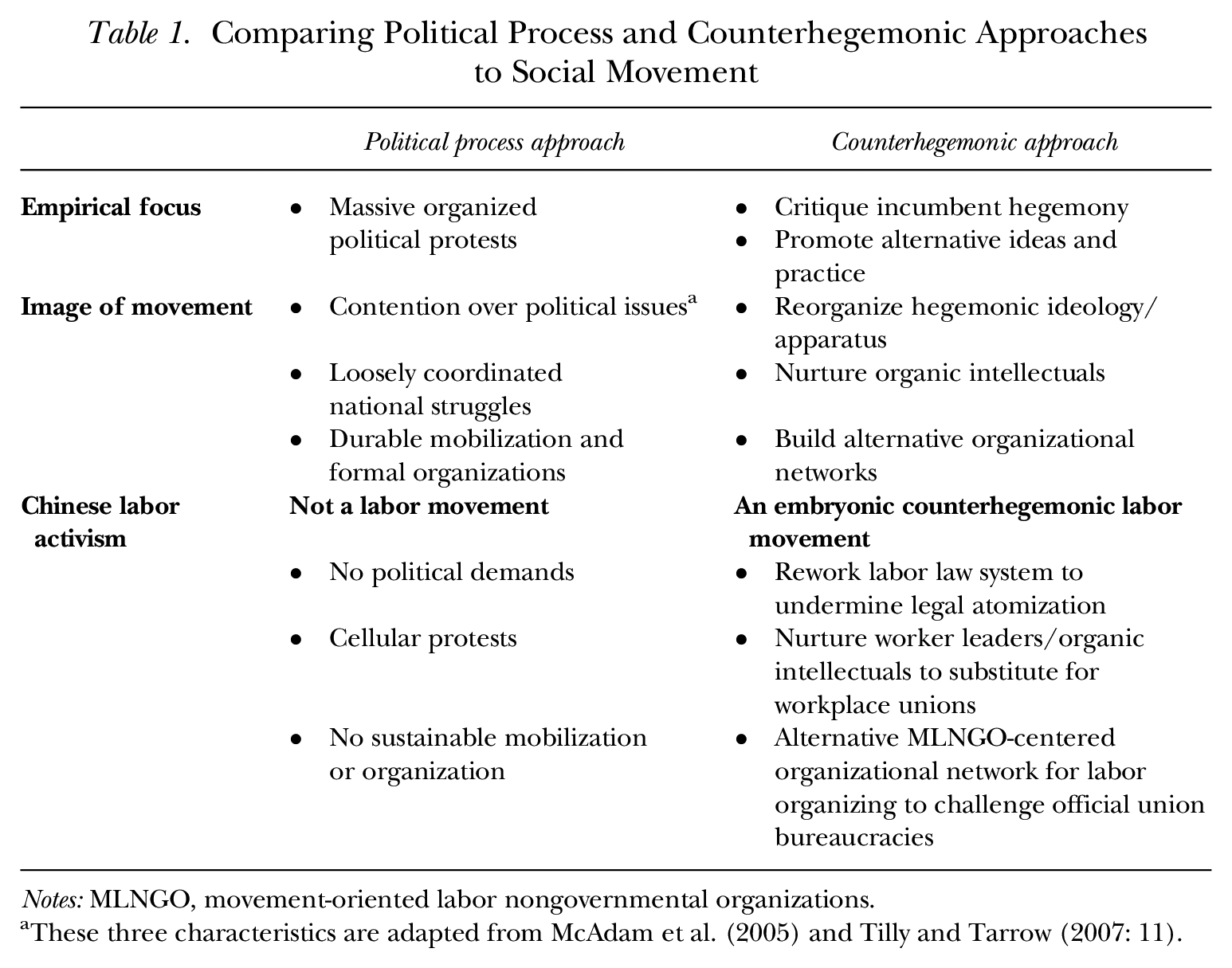
Notes: MLNGO, movement-oriented labor nongovernmental organizations.
These three characteristics are adapted from McAdam et al. (2005) and Tilly and Tarrow (2007: 11).
Argument for a Counterhegemonic Labor Movement in South China
Based on the features of a counterhegemonic movement as elaborated above, I argue that MLNGOs and the associated protests from 2011 to 2018 in China harbored the embryo of a counterhegemonic labor movement. Specifically, the MLNGOs penetrated the labor law system and reorganized it. They used “rights” to embolden workers to protest, while simultaneously dissuading workers from relying on the official individualist conflict resolution system. They exposed the injustice of the justice system and convinced many workers to take concerted action through steps such as worker-led collective bargaining (WLCB), appropriating the state- and union-controlled collective consultation principles. In doing so, they reworked the elements of the labor law system—a key hegemonic apparatus—and countered the regime’s legal atomization of workers.
Furthermore, MLNGOs nurtured a number of worker protest leaders, or worker representatives, as organic intellectuals of migrant workers. MLNGOs’ close contact with migrant workers helped build trust among workers, after which they used patient coaching and relevant language and experiences to develop worker leaders. The worker leaders articulated workers’ demands and organized collective protests following the repertoire of WLCB. They represented workers’ collective interests to both employer and government officials. They embodied temporary, issue-based worker organizations that substituted for workplace unions, countering appropriated representation at the workplace level.
Finally, the MLNGOs forged alternative organizational networks to support workers’ struggles and to advocate for WLCB, which emphasized workers’ collective power and self-representation. They coordinated a sequence of short and sustained WLCB protests in Guangdong and beyond. They built networks among worker representatives from various workplaces and between workers and other social groups, such as scholars and lawyers. The MLNGOs served as a central coordination committee that linked to groups of workers via workplace representatives, countering the official union bureaucracies.
In short, the MLNGOs and mobilized workers countered legal atomization and appropriated representation while promoting alternative collective practice—WLCB, countering the state’s hegemonic project. They were perceived by the government as a movement, which is clear in the governments’ repressive responses. For example, seven activists in Guangdong were arrested in December 2015. Moreover, the government undertook a national campaign on television and in official media to delegitimize the MLNGOs by unraveling “the true colors of ‘labor movement start’” 5 —the leader of a pioneering MLNGO in Guangzhou. In addition to outright repression, the Xi Jinping administration enacted a new foreign NGO law in 2017 to limit the financial resources for MLNGOs (Franceschini and Nesossi 2018; Fu and Distelhorst 2018; Howell and Pringle 2018). This heightened political constraint significantly reduced the number of MLNGOs and associated WLCB protests post-2016. Worse still, the arrest of five MLNGO activists in January 2019 incapacitated the MLNGOs and the movement.
Methods and Data
This study focuses on a subset of LNGOs in China. Depending on how one defines and delineates the boundary of LNGOs, there were 72 to 100 LNGOs across China in the 2010s (C. Li 2016; Fu 2018: 36). The majority of them focused on providing legal assistance or cultural and recreational activities to individual workers, shunning strikes. Since 2011, however, a subset of them in Guangdong Province have gradually changed to promote WLCB and to facilitate collective protest. These MLNGOs developed in Guangdong because of its proximity to Hong Kong, the “offshore civil society of China” (Hung and Ip 2012; Pringle 2018); its more developed market economy relative to other Chinese provinces; and its more intensive labor conflicts.
This article is based on archival and ethnographic data on all MLNGOs across China (which overtly organized WLCB protests), collected mostly in Guangdong from 2011 to 2018. I conducted participant observation in six MLNGOs in Guangdong from April 2013 to May 2014 (four in Shenzhen and two at Guangzhou, see Appendix Table A.1). During that time, I worked at A(LW)—the coded name for an MLNGO in Shenzhen—as a volunteer, assisting its director in documenting his training and mobilizing activities. Since A(LW) was at the center of a mainland network of MLNGOs that promote WLCB, I had plenty of opportunities to meet people from other MLNGOs as well as striking workers and to visit them frequently. My participant observation sought to understand how they mobilized workers’ collective action and why they did so. I also observed eight strikes and three collective bargaining sessions. Many of the conversation and mobilization sessions were recorded with the permission of the participants and were then transcribed while key points were also written down in fieldnotes.
To reach MLNGOs beyond these six, I interviewed the heads of an MLNGO in Shenzhen (December 2013) and one in Zhongshan city several times to understand their main activities. Taken together, to my knowledge, I have observed or interviewed all the MLNGOs 6 that have practiced WLCB in China by mid-2014. 7 After leaving the field, I also conducted intensive open-ended interviews with MLNGO leaders in 2014, 2015, 2016, 2018, and 2019, including the heads of three new MLNGOs founded in 2014 and 2015 (see Appendix Table A.1 for details), to learn about any changes to their work due to government repression in late 2015. To understand how the MLNGOs influenced the worker leaders, I also interviewed 37 worker leaders who were formally elected by fellow workers at 13 workplaces.
To further extend and triangulate my observations, I collected vast archival documents from the MLNGOs, including their case records, annual reports, transcriptions of NGOs’ interviews with workers, and written reflections of LNGO staff and workers from 2011 to 2018. Finally, an MLNGO staff member compiled for me a comprehensive set of materials (documents, videos, and scanned artifacts) regarding WLCB cases assisted by eight MLNGOs from 2011 to 2018.
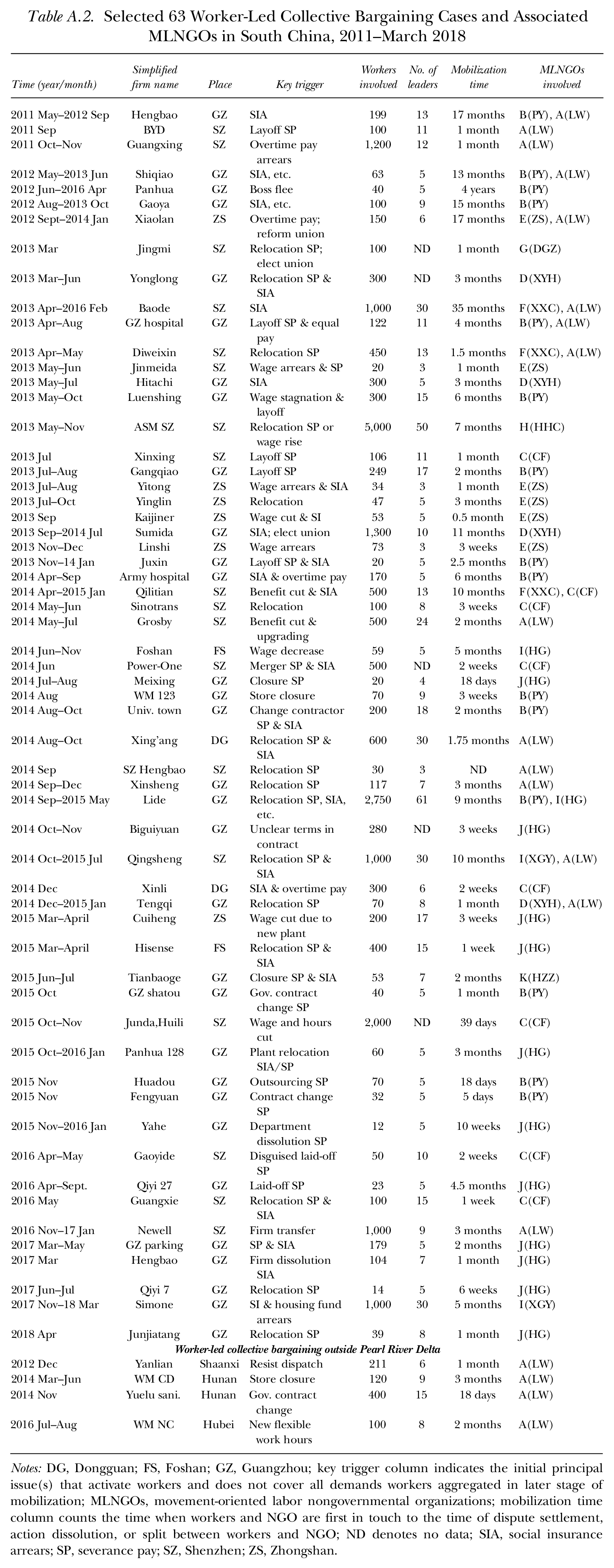
In total, I have observation, interview, or archival data on all the 11 MLNGOs and 63 WLCB cases between 2011 and March 2018 (see Appendix Table A.2). The defining feature of these cases was that the workers elected worker representatives, although a few of these worker groups did not strike or have not succeeded in forcing recalcitrant employers into bargaining. Nine of the 11 MLNGOs (the exceptions being G(DGZ) and H(HHC), which are less transparent about their mobilization process) have adopted similar steps of WLCB. The WLCB protocol included connecting with workers, helping workers elect representatives and formally authorizing worker leaders through signatures and red-thumbprints, aggregating workers’ demands, and coordinating collective action to pressure the employer into bargaining and concession. Specific tactics for each step varied to some extent across the MLNGOs and cases. I did not include dozens of short cases that provided no clear information on the number of worker representatives and the time/methods by which the MLNGOs mobilized workers. Thus, the cases I analyzed represented only a portion of the struggles assisted by the MLNGOs, though they were the most comprehensive on this topic to date.
To protect the activists, I coded the names of MLNGOs and the staff members and workers quoted in the presentation below. I have also significantly simplified the names of the targeted enterprises in Appendix Table A.2. I have mentioned a few specific firm names when the cases have already been widely disseminated on social media or in academic publications.
Findings: A Counterhegemonic Labor Movement in South China
I demonstrate below how activities of MLNGOs and associated protests fit each of the three features of a counterhegemonic movement. Further, I show how activism on the three fronts countered legal atomization and appropriated representation—the state’s hegemonic project.
Reworking the Labor Law System to Undermine Legal Atomization
The MLNGOs penetrated the hegemonic apparatus and dissected the labor law system into two parts: rights and procedures. They made good use of the rights written into the laws to raise workers’ rights consciousness and embolden workers to pursue their rights. Meanwhile, the MLNGOs revealed the problems in the legal procedures—the individualized dispute resolution system, persuading workers to forgo the prescribed conflict resolution mechanism. Instead, the MLNGOs taught workers to use WLCB to address their grievances, appropriating the few collective principles on collective consultation in the labor laws to buttress their advocacy.
Using Rights to Embolden Workers
The MLNGOs actively disseminated workers’ rights and legal entitlements to encourage workers to take action. Although some argued that the state’s hegemonic laws limited workers to legalistic claims and pre-empted political demands and labor movement formation (Friedman 2014a; Chen 2016), just knowing these rights was transformative for many workers. After all, law and legal consciousness simultaneously contain space for engagement, repression, and resistance (Silbey 2005: 346). Tens of thousands of workers learned about, for instance, overtime pay and paid leave for the first time from LNGOs. “This is the first time I heard about these rights. All along, we workers were entitled to these many things. Let’s ask the employer for them” was frequently uttered by workers during mobilization sessions.
Furthermore, legal support often consolidated workers’ conviction of the employers’ wrongness and increased their confidence in addressing their grievances. As Gallagher’s (2006) observation of legal aid plaintiffs showed, they often had only vague and imprecise knowledge of their codified rights and legal procedure. That MLNGOs show workers their specific rights with particular legal articles can equip them with “a source of righteousness and justice” (He, Wang, and Su 2013: 709). For example, several workers from a textile factory in Shenzhen felt something was wrong when the employer, on short notice, decided to transfer batches of people to other departments. The workers believed they had a just cause after learning from C(CF) that according to the law the employer must consult with workers to transfer them to posts not listed in the employment contract. They started to mobilize fellow workers and expressed gratefully that “with these legal articles [provided by A(LW)] we can argue confidently with the employer.” 8 That MLNGOs use laws to mobilize workers echoes the findings of scholars working on other aspects of Chinese contentious politics, such as rightful resistance of peasants (O’Brien and Li 2006), albeit not from a Gramscian perspective.
Revealing Injustice in Legal Procedures
While MLNGOs used legal rights to embolden workers, they also quickly exposed the high costs of upholding these rights through the official conflict resolution procedures—one voluntary mediation, one mandatory nonbinding arbitration, and two court hearings. Indeed, all the MLNGO leaders had experienced the heavy costs imposed by the official system. Four of the MLNGOs had rural migrant worker-turned founders who suffered injury at work and had to navigate the cumbersome process to claim compensations. Another three rural migrant worker-turned founders spent months in the legal procedures to resolve their disputes with their former employers. Not only worker-turned founders—two founders with legal backgrounds (see Appendix Table A.1) were heartbroken after failing to help workers obtain justice even for simple disputes. For instance, the head of the pioneering MLNGO—A(LW)—burst into tears when reflecting how his first worker client died during the long-term process to qualify her for occupational disease treatment. These bitter firsthand experiences resulted in “informed disenchantment” (Gallagher 2006), a crucial factor prompting them to explore alternative actions and to promote solidarity and collective action since 2011.
The greatest problem with the legal procedures exposed by MLNGOs was the long duration required by the official steps, which can enmesh disputing workers in the system for one to two years. The majority of rural migrant workers cannot afford long stays in the cities without wages. The time-consuming steps constituted formidable barriers, especially for those workers who confront urgent issues such as factory relocation or layoffs. Here is an example of how G(DGZ) guided a group of 100 plastic molding workers who were facing impending factory relocation to take collective action. “They [workers] came in dozens, and a few of them knew that the issue was quite urgent. Factory relocation may take one to two months. But, with one to two months workers can only initiate arbitration. We analyze the steps in the legal procedures. They [workers] decided [to take collective action].” 9 In fact, layoffs and factory closures or relocation among private-sector firms became a serious trigger of labor conflicts in Guangdong after the 2008 financial crisis. Indeed, more than half (38) of the 63 WLCB cases I analyzed involved “rupture” disputes in which workers demanded severance pay and restitution for lump sum pay violations to which they previously acquiesced.
A second common, but taxing, requirement by the dispute resolution system concerns evidence. Indeed, He et al.’s (2013: 720) study of migrant workers in Western China found that these workers hold vastly different perceptions of what constitutes evidence (common sense views such as finished work) from the state’s version (e.g., formal employment contract). Workers often do not possess documents showing their employment or the time they first worked for the firm. This circumstance is a particularly important problem when workers want to obtain social insurance arrears. For instance, a group of 181 workers from the Hengbao jewelry factory in Guangzhou was convinced that “there is no other way but collective action” after three activists from A(LW) explained that “we [workers] want back pay of social insurance from the time we entered this firm. But, the majority of workers do not have evidence of the exact time of their entry [some 10 years ago]. These materials are held by the boss who does not have a legal obligation to provide evidence regarding social insurance beyond two years. So, if we choose the legal procedures, we cannot get social insurance arrears back to our entry dates.” 10
MLNGOs also spotlighted the disempowering effects of the fragmenting legal proceedings. The labor law system fragments workers first by separating them into distinct categories, for instance, regular employees versus dispatched workers, and then further treats workers who apply for dispute resolution on an individual basis. Ignoring these fragmentary regulations, MLNGOs often encouraged workers to build solidarity with as many workers as possible regardless of their jobs and employment status. The most telling example in this regard is the protest at a Guangzhou university hospital. Three legally distinct groups of workers (nursing assistants, dispatched security guards, and regular security guards) were encouraged by B(PY) and A(LW) to take concerted action in May 2013. An activist from A(LW) explained to the worker representatives why workers should insist on collective bargaining instead of filing arbitration applications: “Firstly, when you enter arbitration or courts, even though you have these many people, they will examine your cases one by one, not as a collective. Each individual’s power is very weak. When the arbitrator or judge criticizes you, you as an individual may not withstand the psychological stress. . . . Second, the legal procedure takes a very long time . . . normally about one year. . . . Third, the process will require much legally recognized evidence. . . . Finally, and most importantly, you may not win after going through this long process.” 11
Finally, MLNGOs sometimes explicated the failure of laws to cover all workers’ legitimate interests and used this to encourage collective action. For instance, wages beyond the legal minimum are often an issue for workers at declining companies who see a sharp decline in wages as a result of decreasing orders from overseas or factory relocation. In this regard, CHH, a former staffer of B(PY) and the founder of J(HG), has encouraged several groups of workers from Luenshing, Foshan, and Xinsheng to use collective bargaining to demand bottom-line wages beyond minimum wage. As CHH explained to a group of molding workers, “[The employer] violated no law. But, we workers deem it unfair. . . . The only thing we can do under this circumstance is to rely on workers’ solidarity and concerted action.” 12 CHH also advised workers to add legal violations, such as absent social insurance and paid leave, to justify workers’ protest and to increase workers’ bargaining chip to achieve their extralegal demands.
Valorizing Vague Collective Principles in Laws
While MLNGOs dissuaded workers from using the individualized resolution system, they appropriated the vague collective principles in law to justify collective protest and WLCB. When MLNGOs try to persuade a few workers to mobilize their fellow workers, they often need to provide elaborate legal basis and justification. Typical content in MLNGO training on collective bargaining includes the laws and policies on collective consultation. MLNGOs specifically invoke general principles on collective consultation in 1995 Labor Law (Article 33) and 2008 Labor Contract Law (Articles 4 and 51), which stipulate that unions or worker representatives under the guidance of unions can negotiate and sign collective contracts with the employer. Interpreting these laws in accordance with workers’ interests, the MLNGOs downplay the official emphasis on the guiding role of unions and highlight the role of “worker representatives” instead. In fact, the MLNGO-promoted WLCB sidesteps the official unions, subverting official collective consultation by centering on workers’ participation and initiatives.
Of note, sometimes MLNGOs even invoke the constitution to justify workers’ collective pursuit of their interests. For example, the head of C(CF) explained to a group of Nokia Donguan workers: “China’s Constitution provides that working class is the ruling class of this country . . . and it should have the right to participate in the distribution of company profit, which is completely appropriate, legal, and natural.” 13 Like the empowering individual rights, the MLNGOs interpret vague collective rights in a way to embolden workers to take concerted action.
Nurturing Organic Intellectuals of Migrant Workers to Temporarily Substitute for Workplace Unions
The MLNGOs challenged appropriated representation at the workplace level by cultivating organic intellectuals of migrant workers to organize collective action and to represent workers to negotiate with the employer and government officials. These organic intellectuals mainly take the form of workplace representatives elected by fellow workers to coordinate their protest. The worker protest leaders articulate workers’ demands and defend workers’ collective interests in opposition to management and local government authorities.
Connecting with and Teaching Workplace Leaders Organizing Skills
The MLNGOs’ close contact with migrant workers facilitated mobilization. As most MLNGO founders and staff members are former rural migrant workers (see Appendix Table A.1), these activists are a stratum of dedicated organic intellectuals of migrant workers. Their common experiences and shared identity with the rural migrant workers allow them to understand workers’ concerns and to express ideas easily accessible to workers. For example, some MLNGOs use the daily life example of one chopstick versus a bundle of chopsticks to explain the power of solidarity. Even the head of A(LW)—a former rich lawyer—frequently talked about his short-term worker experience in the 1970s as an effort to connect with workers. In addition to leveraging common languages and shared experiences, the MLNGOs normally build trust among workers through shared Laoxiang identity (originating from the same county or province). Thus, a common ice-breaking question is “where are you from?” Furthermore, MLNGO activists’ previous success in helping individual workers also enhances workers’ trust in them. The workers who benefited often came back to the MLNGOs when encountering workplace problems, and they introduced their relatives or fellow migrant workers to the MLNGOs. Direct and indirect ties with migrant workers and word of mouth helped expand MLNGOs’ reach to workers.
Likewise, the MLNGOs taught workers to activate their strong ties with fellow migrant workers to efficiently mobilize and organize collective action. It was typical for MLNGOs to ask workers to contact and mobilize their close friends at the factory after a mobilization session and to bring their friends to the next session. After several mobilization sessions, those active workers (including middle- or low-level managers) who mobilized many fellow workers naturally became leaders. These leaders then communicated frequently with their close friends, who in turn communicated with their close friends, forming a ripple-like organizing network. As the head of A(LW) explained: “One worker representative [leader] would have three to five strong supporters. Each of these three to five supporting workers, in turn, contact another three to five workers, and so on and so forth.” 14
In addition to organizing a network, the MLNGOs normally help workers conduct a democratic election of workplace representatives. Workers cast their votes, often by a show of hands, and more important, sign their names and red-thumbprints (which means vow in Chinese culture). Indeed, elections are such a crucial step of WLCB that MLNGOs usually record the election process, the number of representatives elected, and total workers involved in their case records, supplemented by signatures and authorization papers. The number of elected worker leaders among the 63 cases ranged from 5 to 61 depending in part on the number of workers involved and the preferences of particular MLNGOs (see Appendix Table A.2), totaling 674 elected representatives during the eight years.
In addition to elections, the MLNGOs trained worker representatives to be accountable to workers, an important attribute of a worker organization. Accountability starts with collecting grievances from each worker and then discussing prioritization of demands with a worker collective. Authorization letters for leaders typically specify the responsibilities and conduct of the elected representatives. Furthermore, MLNGOs taught worker leaders to constantly update progress or setback, to report back to workers after every bargaining session, and to sign collective agreements only after the majority of workers accepted it. Nine of the MLNGOs, all except G(DGZ) and H(HHC), explicitly promoted these election and accountability practices among worker leaders.
Inspiring Workplace Representatives’ Confidence to Negotiate with Employers and Officials
The MLNGOs also used sustained and patient coaching to increase worker leaders’ confidence to articulate workers’ collective interests and to bargain with the employers and officials. Many worker representatives fear top managers, let alone confronting them, which is a situation shaped by a long-term despotic factory regime. As a female worker representative ZWN accounted, “I could not utter words when we [representatives] entered [the boss’s office] for the first time. I have worked here for 10 years but have barely seen the boss’s face. I myself am a humble worker and very much fear the top managers.” 15 The MLNGOs spent endless hours encouraging workplace representatives through legal counseling, home visits, and mock bargaining, tactics commonly practiced by B(PY), D(XYH), and J(HG). Among the 63 WLCB cases, the MLNGOs took an average of 4.6 months to contact workers, cultivate workplace leaders, and help leaders sustain collective action (see the column titled “mobilization time” in Appendix Table A.2, which counts the time when the MLNGOs contact the workers to the time of conflict settlement or action dissolution).
MLNGOs’ patient coaching has transformed many otherwise timid migrant workers into worker leaders. Several workplace representatives (at least six that I interviewed) joined or founded MLNGOs to become dedicated advocates for migrant workers’ rights and mobilization. For example, a former worker representative HXJ described her change into an articulate worker leader and the important support from MLNGOs: “Before interacting with B(PY), my Mandarin was awful. I could not articulate well. When I first came here [B(PY)], I could not speak much. . . . Another major obstacle was fear. . . . Every time we came here [B(PY)], we expressed our concerns, what to do and how to say. They [B(PY) staff] taught us many techniques, resolved some of our concerns and increased our confidence. . . . We asked them for copies of the labor laws, and they explained them to us well and answered our queries. Gradually, I was not so afraid [of defending workers’ rights].” 16 After leading one-year collective bargaining at a jewelry factory from 2012 to 2013, HXJ joined an MLNGO as a collective bargaining consultant and spoke confidently about workers’ rights during an interview for a local TV program in 2015.
Besides confronting employers, MLNGOs enhanced workplace leaders’ confidence to contend with government officials. Workers typically are anxious about police and arrest during collective action. To address this concern cognitively, MLNGOs constantly emphasize that defending workers’ interest is just or righteous, thus, protesting workers should not fear policemen whose job is to fight criminals. Technically, MLNGOs, especially A(LW), B(PY), and J(HG), often provide training to leaders on risk management before striking or street protest, including how to maintain order during street action, arranging females in front lines to reduce physical conflict with policemen, and assigning a few workers the task of taking photos and/or videos of encounters with police or officials. Moreover, as the MLNGOs have ample experience with police or security officials during their daily work or when assisting worker action, they often use these personal experiences to demystify police power. A telling episode is how a staff member of B(YP) emboldened the worker representatives at Luenshing, addressing their fear of police by telling his story: “Over the past dozen years, I have overcome many local policemen. Back to 2006 . . . one policeman did not record facts [as required by law] after my fellow worker reported a case. I immediately took the worker to police office and asked to meet their director. . . . The director called and ordered the policeman to ‘get your ass back.’ . . . My complaint stressed him [policeman] to sweat. . . . Policemen fear losing their jobs. Don’t think little of us migrant workers. When you speak boldly . . . the police will behave.” 17 These personal experiences revealed legal rules that constrained police behavior as well as their concerns. These worker representatives were inspired to debate boldly with the policemen and other government officials who attempted to dissolve their two-month strike.
Training Workplace Leaders to Speak to the Public through Social Media
MLNGOs also encouraged workplace representatives to articulate and disseminate workers’ protests and their rationales behind the protests on social media to present migrant workers’ stories to the public. The majority of MLNGOs consider social media usage a core training for the worker leaders, who learned to create accounts in various blogs and microblogs to post their collective action. Workplace leaders reported dozens of WLCB protests on social media from 2012 to 2015 when microblogs enjoyed widespread popularity. In these social media posts, workplace leaders described workers’ grievances and explained why workers’ demands were legitimate (e.g., employer violated the law). Timely updates on protests often revealed employers’ unresponsiveness or hostility to workers’ legitimate demands. Sometimes police brutality was also reported, which often attracted attention from the public.
In addition to publicizing particular protests, some MLNGOs helped workers articulate and publicize their needs on general issues. For instance, on May 1, 2014, F(XXC) issued a Labor Day statement on social media explaining rural migrant workers’ contribution to economic development, the injustice of denying them social security, and the urgency for Shenzhen city government to enact new social insurance policies. This statement was signed by 1,200 workers from various factories. Continuing the campaign, F(XXC) helped a group of worker representatives from a few factories report problems in paying long-term retrospective social insurance contribution in a half-hour CCTV program in October 2015.
Overall, workplace representatives lead temporary, issue-based worker organizations to address particular workplace grievances. Many of these workplaces do not have a union, and others have unions with leaders appointed by the employer. The workplace representatives substitute for the absent or impotent workplace unions by organizing workers and representing them to bargain with management. These representative-led temporary worker organizations dissolve after the collective achieves its demands or is defeated by the employer or government. Afterward, a few representatives join MLNGOs while some became committed volunteers of MLNGOs. In this connection, B(PY) and J(HG) were particularly effective in maintaining networks of former workplace representatives. Finally, many former workplace representatives move on to new jobs at different locations, carrying their leadership skills and the practice of WLCB to various places.
Developing Organizational Networks for Labor Organizing as Alternative to Official Union Bureaucracies
The MLNGOs challenged the monopolistic position of union bureaucracies by developing alternative organizational networks to support workers’ collective struggles. The core repertoire of this movement—WLCB—has evolved to include two related elements since 2015: worker self-representation (gongren daibiao zhi) and collective bargaining. The former directly challenged appropriated representation. Similar to the official union structure, which basically comprises union federations embedded at various governments and workplace unions, the MLNGOs function like regional unions linked with several workplace branches led by workplace representatives. Whereas the union bureaucrats are disconnected from the workers, the MLNGOs integrate workers in three-level organizational networks: MLNGOs in the center, the intermediate element of workplace leaders, and mass participating workers.
Developing MLNGOs as the Core of Alternative Organizational Networks
At the core of these alternative organizational networks are the MLNGOs, which form a networked center to coordinate worker collective action. A(LW) is an early developer and promoter of WLCB among LNGOs. With two WLCB cases in late 2011, it experimented core steps of WLCB (authorizing independent workplace leaders and bargaining) suitable to the Chinese institutional context bereft of representative unions. As a law firm, it then worked closely with B(PY) in Guangzhou, and to a lesser extent with C(CF) in Shenzhen, to develop protocol for NGOs to coordinate collective action from 2011 to 2012. Three successful WLCB cases by the summer of 2012 proved WLCB to be a viable mobilizing strategy in China, accepted by workers and tolerated by the state. These early trials made WLCB a modular collective action (Tarrow 1994), appropriate for diffusion to many LNGOs and worker groups under various situations. Meanwhile, an LNGO in Hong Kong with financial resources actively supported WLCB among mainland LNGOs in early 2010s. By the end of 2012, modular WLCB and funding allowed the transformation of five LNGOs into MLNGOs in Guangdong (D(XYH) and E(ZS) in addition to the abovementioned A, B, and C), which collaborated closely with each other due to common funding. Modularization of WLCB and resources are the driving force behind the movement’s escalation in scale in 2013 and 2014, supporting close to 20 WLCB protests each year (see Appendix Table A.2).
Pulled by viable modular WLCB protocol and pushed by the futility of previous individualized approaches, another three LNGOs—F(XXC), G(DGZ), H(HHC) in Shenzhen—changed to practicing WLCB in 2013. This continuous development of MLNGOs and associated WLCB protests bred three spin-off MLNGOs by former workplace representatives and staff members in 2014 and 2015: I(XGY) in Shenzhen, J(HG) in Guangzhou, and K(HZZ) in Guangzhou (briefly from May to December 2015 before arrest of the head). Among these MLNGOs was another cluster: F(XXC), G(DGZ), I(XGY), which were influenced by another LNGO funder in Hong Kong to support each other. The two MLNGO clusters supported by two distinct Hong Kong funders were bridged primarily by A(LW), which explicitly collaborated with most MLNGOs except G(DGZ) and H(HHC) (see Appendix Table A.2 for the pattern of collaboration in WLCB protests).
In total, 11 MLNGOs in the Pearl River Delta have organized 53 worker protests before the repression at the end of 2015 (see Appendix Table A.1 for the list of MLNGOs). The MLNGOs, except G(DGZ) and H(HHC), adopted the modular WLCB steps and collaborated with each other, contrary to Franceschini’s (2014) comment that the LNGOs were too fragmentary to be seen as a movement.
Three-Level Organizational Networks in Action
The 11 MLNGOs coordinated a sustained sequence of collective protests in Guangdong and beyond since 2011 (see Appendix Table A.2). They mobilized more than 24,000 workers across various companies through the bridge of workplace representatives. Besides linking with the specific MLNGO(s) that assisted them, these workplace leaders were often connected with representatives from other firms via MLNGOs. For instance, B(PY) simultaneously coordinated four collective protests in June 2013 and often met with workplace representatives from multiple factories to discuss progress and contention tactics. Furthermore, A(LW), B(PY), and C(CF) held a tradition of organizing victory parties to celebrate workers’ successful protests, and such occasions were often attended by dozens or hundreds of workers and worker representatives from various firms who shared their protest tactics and encouraged one another. Through these activities, MLNGOs forged networks connecting workplace leaders and workers from nearby factories.
The MLNGOs also fostered specific worker networks concentrating in a particular industry: for instance, nine of the 63 WLCB cases concerned the jewelry industry at Guangzhou. A driving force was an MLNGO activist, CHH, who used to be a jewelry worker and had established a stronghold among the jewelry workers at Panyu district in Guangzhou. CHH once said that he could easily establish a jewelry industry union if the government permitted it. 18 His reputation and success with WLCB cases among jewelry workers have inspired dozens of protests at Panyu, a regional nodal point of WLCB protests.
Moreover, a few MLNGOs have targeted various Walmart workplaces across China. A(LW) in particular has been mobilizing Walmart workers in Shenzhen since 2011, providing dozens of trainings to Walmart workers from various stores. Outside Shenzhen, A(LW) has assisted a protest against a Walmart store closure in Hunan Province and contacted protesting workers from Walmart workers in Anhui Province in late March 2014. A(LW)’s support has nurtured several committed Walmart worker activists including ZLY and WSH based in Shenzhen, who together with Walmart worker ZJ from Shangdong Province established the Walmart China Worker Association in September 2014 to reach thousands of Walmart workers in China.
Forging Networks between Workers and Various Social Groups
In addition to educating and organizing workers, MLNGOs forged networks between workers and various social groups. Most important in this regard is building workers’ networks with scholars and students. A(LW) in particular has organized more than 10 conferences involving scholars, workers, and reform-minded government officials to discuss pathways to effect collective labor rights. It also managed a magazine called Research on Collective Bargaining Institutions to publish articles from labor activists and pro-labor scholars from 2011 to 2015, at which point it faced heightened restrictions. In addition to creating a discursive environment, MLNGOs invited scholars and students to support workers’ protests. For example, MLNGO activists involved prominent labor scholars in Beijing and Changsha (Hunan) to support workers’ protests at Walmart stores in Changde (see Li and Liu 2018 for details). Activists involved students to support a sanitation workers’ strike in Guangzhou University Town (see Xu and Schmalz 2017 for details). Moreover, the MLNGOs regularly invited labor or human rights lawyers to support workers, especially when they were fired by management or detained by police. For instance, an MLNGO swiftly summoned 12 lawyers (including five human rights lawyers) to represent the 12 workers arrested during a protest at a Guangzhou Hospital in early September 2013.
Finally, the mainland MLNGOs are supported by an international network of labor activists and funders, many of which are located in Hong Kong. The Hong Kong LNGOs channel funding and international discourse to the MLNGOs. Hong Kong–based China Labor Bulletin in particular played a crucial role in supporting seven MLNGOs in Guangdong to promote WLCB and fostering networks among the latter. Further, the Hong Kong LNGOs including CLB and other university- or union-based groups coordinated international campaigns to support mainland MLNGOs and workers’ struggles (for more details see Pringle 2018).
MLNGOs’ activism on the three fronts developed rapidly in 2013 and 2014, the interface years between the Hu-Wen administration (2003–2013) and the Xi Jinping era. Although the Hu-Wen regime was relatively open to local experimentation and input from social actors, the Xi regime consolidated party control over civil society groups including MLNGOs since 2015 (Fu and Distelhorst 2018; Howell and Pringle 2018). The crackdown on pioneering B(PY) and arrest of seven activists in December 2015 signaled the state’s disapproval of this bottom-up labor movement. In 2015, state repression closed three MLNGOs—B(PY), I(XYH), and K(HZZ), after forcing E(ZS) to close in 2014. Political hostility also forced F(XXC), G(DGZ), and H(HHC) to re-orient to service and legal training and sometimes engage in clandestine organizing without publicity. 19
State Repression and MLNGO Activism Post-2015
Since late 2015, the political space for MLNGOs has contracted substantially. However, several groups have continued their programs as before, creatively dodging pressures. On the front of reworking the labor law system, the four active overt MLNGOs—A(LW), C(CF), I(XGY), J(HG)—carried out regular legal training, through which they continued to criticize the labor law system and promote the ideas and repertoire of WLCB to many workers. I(XGY) and J(HG) in particular carried out approximately one legal training session for a few to a few dozen workers each week over the years, whereas A(LW) and C(CF) provided training less frequently. One participant observer of I(XGY) and J(HG) commented that they were very busy and active in the summer of 2018. 20
On the front of nurturing organic intellectuals of migrant workers, the remaining MLNGOs continued developing worker leaders through collective action, coaching 102 workplace representatives in 10 WLCB cases from 2016 to 2018 (Table 2). The MLNGOs creatively dodged official red-lines to teach mobilizing skills to the worker leaders. For example, J(HG) asked workers to come to his center to discuss action strategies after security officials restricted their entering workplaces to mobilize workers. In Shenzhen, I(XGY) interpreted the restriction of street protest as allowing within-factory action and helped dozens 21 of worker groups’ collective action. He often played a cat-and-mouse game with security officers. For instance, he provided training to workers from Simone at Guangzhou in late 2017, without the officers in both cities knowing. He helped Simone workers elect 30 worker representatives and coordinate a nine-day, 1,000-worker strike in early March 2018. In general, the MLNGOs took a low-key strategy without politicizing collective protests on social media, as warned by local security officials. 22 This no-exposure, understated strategy in part contributed to some external observers’ perception that the MLNGOs were not active anymore.
Development of MLNGOs and WLCB across Hu-Wen Era and Xi Era
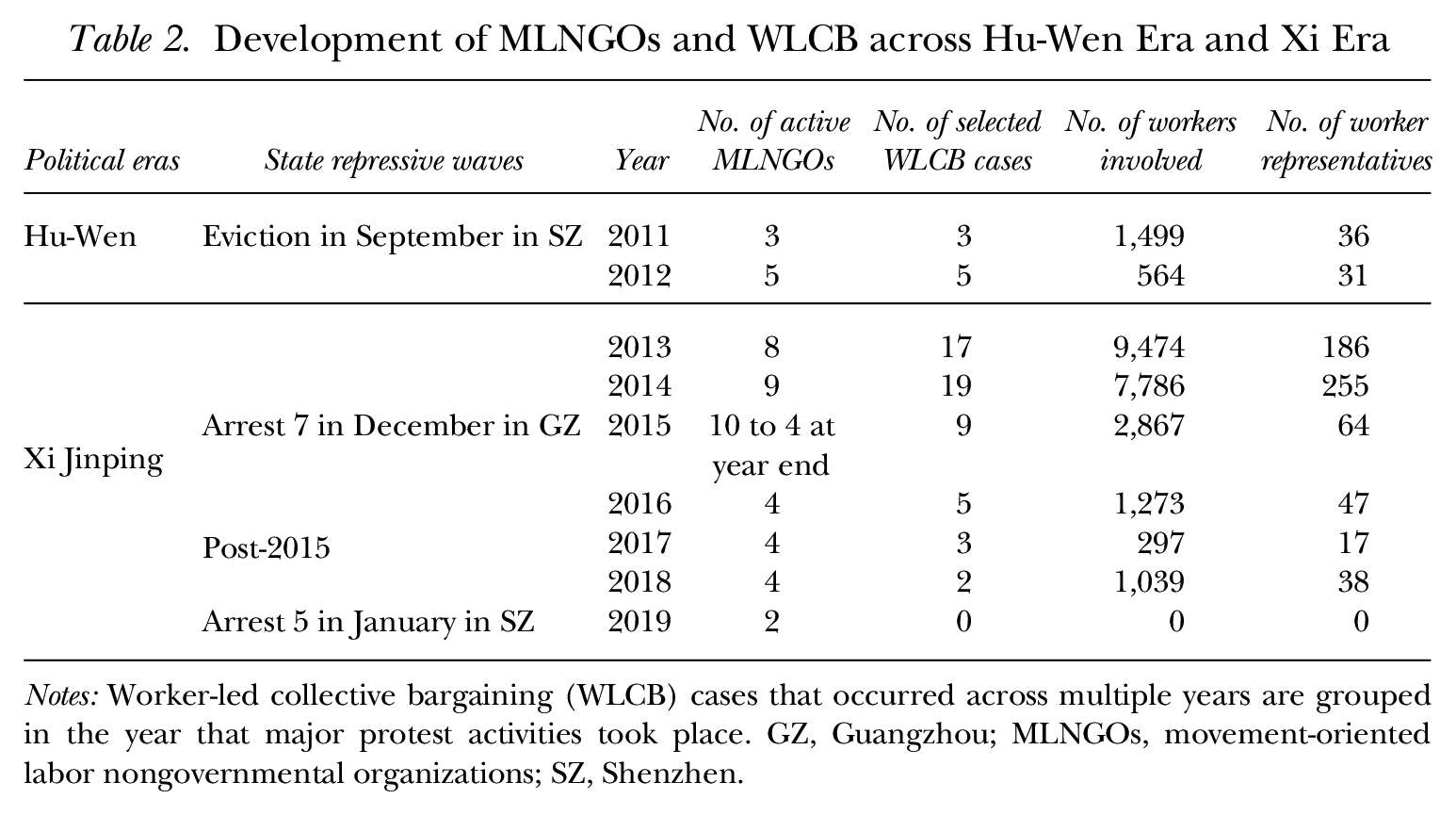
Notes: Worker-led collective bargaining (WLCB) cases that occurred across multiple years are grouped in the year that major protest activities took place. GZ, Guangzhou; MLNGOs, movement-oriented labor nongovernmental organizations; SZ, Shenzhen.
On the front of building alternative organizational networks, although the active MLNGOs have significantly reduced mass meetings of workers from various factories, they continue to coordinate worker networks primarily through social media outlets, such as WeChat groups. Each of the four MLNGOs manages WeChat forums comprising 60 to more than 170 members (mainly workers and people interested in labor issues). Through such forums the NGO staff members and workers can share legal and protest information, albeit less frequently after 2015. Furthermore, A(LW) and C(CF) involved themselves in Walmart China Worker Association’s mobilization of 20,000 Walmart workers across China to protest a new flexible hour policy via dozens of WeChat groups from May 2016 to 2017.
Moreover, the MLNGOs have expanded legal training and network building to include Marxist or leftist student groups. One MLNGO in Shenzhen, in particular, has provided training to college students since 2017 and thus has built strong ties with a few Marxist students who played crucial roles in supporting the widely reported protest of Jasic workers from July to September 2018. In this case, approximately 20 workers from the Jasic factory in Shenzhen complained about low wages and despotic management practices and wanted to establish a workplace union in June and July 2018. More than a dozen Jasic workers and supporting Marxists students/activists were arrested, and many remain in jail or under close surveillance in August 2019. See reports by Reuters on August 15, 2018, and by Financial Times on February 13, 2019. The MLNGOs also coordinated their advice and financial support to the Marxist students through WeChat forums established in previous years.
Nonetheless, the very severity of state repression suggests that a counterhegemonic movement has been formed. Indeed, some stability maintenance officials categorized the MLNGOs as a faction that “loosens the soil” [shaking the mass foundation of the state]. 23 After the crackdown in December 2015, five current and former activists of three MLNGOs in Shenzhen—A(LW), C(CF), and I(XGY)—were detained on January 20, 2019. They face criminal charges of disturbing social order and remain in jail as of January 2020. This repression exterminated I(XGY) and C(CF), whose leaders are arrested. Currently, only J(HG) remains active in providing legal training (criticizing the legal system and advocating alternative tactics) based on funding from foreign embassies, while A(LW) is severely handicapped. This second Shenzhen-focused repression may relate to the Jasic incident in Shenzhen whereby Marxist students’ use of original Marxist ideas challenged the state’s claim of its Marxist inherence, attacking one core element of state hegemony. The resulting tense political climate may be seized by some anti-NGO officials to justify wiping out the MLNGOs in Shenzhen.
Discussion
Drawing on Gramsci’s ideas, I argue in this article that an embryonic labor movement in China was taking place from 2011 to 2018. In so doing, I am providing an alternative perspective to the dominant literature on labor activism in China, which has argued that the apolitical, cellular, and short-lived protests imply there was no labor movement in China. Consistent with Gramsci’s analysis of counterhegemony, I show that MLNGOs and associated protests manifested three facets of a counterhegemonic movement.
Admittedly, the MLNGO-spearheaded labor movement was in an early developmental stage. The MLNGOs and workers have not yet put forward a fully fledged counterhegemonic ideology to mobilize massive workers or to rally with wider social groups. Nor have they critiqued capitalism, the market economy, or one-party autocratic rule. They focused on partially countering state hegemony, leaving market hegemony largely intact. The MLNGOs’ advocacy of WLCB without a systematic ideology was less a deficit than a pragmatic choice. After all, the MLNGOs knew too well the government’s unrelenting repression of movements with ideological claims (e.g., the Falungong movement) amid selective toleration of pragmatic protests.
My argument and findings that the MLNGOs coupled with associated protests constituted a movement, even if they were small (especially given only four surviving MLNGOs post-2015), contrast with the dominant view from political process theorists that movements must be large-scale political mobilizations against the state. My evidence here is consistent with alternative conceptions and examples of small movements. For example, Ganz (2000) referred to a single union (the United Farm Workers) organizing agricultural workers as the California farm workers’ movement. The Trotskyism movement in the United Kingdom comprised three organizations with a grand total of just 124 members in the 1950s and peaked in the 1980s with 15 organizations and a membership of slightly more than 20,000 across England (Kelly 2018: 41).
Although state repression in late 2015 diminished this movement in China and the recent repression in early 2019 incapacitated the MLNGOs, the impact of this movement has not been completely wiped out. Indeed, Gramsci acknowledged that central coordination committees of counterhegemonic movements, being numerically weak (small), can be easily destroyed but he underscored that if destroyed the committee should leave ferment among workers and organic intellectuals. I suggest in this article that MLNGOs have left such a ferment. After all, the dozens of former MLNGO staff members, 674 elected workplace leaders, and more than 24,000 workers have critiqued the labor law system, practiced collective solidarity and WLCB, and established networks. From this ferment, a labor movement could grow in the future.
Conclusion
The dominant view in prior literature on Chinese labor activism suggests that the workers’ apolitical, cellular, and short-lived protests do not constitute a labor movement. This view is based on the political process model that depicts a stylized image of a movement in terms of massive, organized, and political protests (McAdam et al. 2005). I draw on Gramsci’s work on the three features of counterhegemonic movements to argue that MLNGOs and associated worker protests constituted a fledgling counterhegemonic labor movement. Specifically, my ethnographic and archival data from 2011 to 2018 show that MLNGOs 1) reworked the hegemonic labor law system to undermine the regime’s legal atomization, 2) nurtured worker leaders who represented and defended workers’ collective interests to temporarily substitute for impotent workplace unions, and 3) developed organizational networks for labor organizing to challenge the official union bureaucracies.
My argument and findings contribute to China labor studies by providing a new analysis of labor unrest. The Gramscian framework of counterhegemonic movements permits a positive and much-deserved focus on aspects of Chinese MLNGO activism and worker organizing. My study also presents the most comprehensive empirical evidence regarding MLNGOs’ activities and WLCB protests over the past decade in China. And my argument and findings contribute to the small but growing number of studies that suggest an alternate conception of what constitutes a labor movement (e.g., Voss and Williams 2012).
Currently, the Xi Jinping administration’s repression of civil society including MLNGOs has curtailed the development of this counterhegemonic labor movement. The Xi regime’s suppression of labor is, however, not without paradoxical ramifications from the perspective of counterhegemonic analysis of movement development. Specifically, after the 2008 financial crisis, the current regime entered a new normal of slow growth (Lee 2017), which means the erosion of the hitherto economic performance that enabled it to win the consent of various social groups. At a time of a waning economic base for incumbent hegemony, the current regime’s enhanced coercive face is likely to create a “crisis of authority” when “the ruling class lost its consensus, i.e., no longer ‘leading’ but only ‘dominant’, exercising coercive force alone” (Gramsci 1971: 275–76). Consequently, enhanced authoritarianism, on the one hand, constrains the organizational resources for subaltern groups to organize themselves. On the other hand, however, an ostensible coercive face may also create widespread dissent in society, a situation that is vulnerable to the development of alternative hegemony.
Footnotes
Appendix
Selected 63 Worker-Led Collective Bargaining Cases and Associated MLNGOs in South China, 2011–March 2018
| Time (year/month) | Simplified firm name | Place | Key trigger | Workers involved | No. of leaders | Mobilization time | MLNGOs involved |
|---|---|---|---|---|---|---|---|
| 2011 May–2012 Sep | Hengbao | GZ | SIA | 199 | 13 | 17 months | B(PY), A(LW) |
| 2011 Sep | BYD | SZ | Layoff SP | 100 | 11 | 1 month | A(LW) |
| 2011 Oct–Nov | Guangxing | SZ | Overtime pay arrears | 1,200 | 12 | 1 month | A(LW) |
| 2012 May–2013 Jun | Shiqiao | GZ | SIA, etc. | 63 | 5 | 13 months | B(PY), A(LW) |
| 2012 Jun–2016 Apr | Panhua | GZ | Boss flee | 40 | 5 | 4 years | B(PY) |
| 2012 Aug–2013 Oct | Gaoya | GZ | SIA, etc. | 100 | 9 | 15 months | B(PY) |
| 2012 Sept–2014 Jan | Xiaolan | ZS | Overtime pay; reform union | 150 | 6 | 17 months | E(ZS), A(LW) |
| 2013 Mar | Jingmi | SZ | Relocation SP; elect union | 100 | ND | 1 month | G(DGZ) |
| 2013 Mar–Jun | Yonglong | GZ | Relocation SP & SIA | 300 | ND | 3 months | D(XYH) |
| 2013 Apr–2016 Feb | Baode | SZ | SIA | 1,000 | 30 | 35 months | F(XXC), A(LW) |
| 2013 Apr–Aug | GZ hospital | GZ | Layoff SP & equal pay | 122 | 11 | 4 months | B(PY), A(LW) |
| 2013 Apr–May | Diweixin | SZ | Relocation SP | 450 | 13 | 1.5 months | F(XXC), A(LW) |
| 2013 May–Jun | Jinmeida | SZ | Wage arrears & SP | 20 | 3 | 1 month | E(ZS) |
| 2013 May–Jul | Hitachi | GZ | SIA | 300 | 5 | 3 months | D(XYH) |
| 2013 May–Oct | Luenshing | GZ | Wage stagnation & layoff | 300 | 15 | 6 months | B(PY) |
| 2013 May–Nov | ASM SZ | SZ | Relocation SP or wage rise | 5,000 | 50 | 7 months | H(HHC) |
| 2013 Jul | Xinxing | SZ | Layoff SP | 106 | 11 | 1 month | C(CF) |
| 2013 Jul–Aug | Gangqiao | GZ | Layoff SP | 249 | 17 | 2 months | B(PY) |
| 2013 Jul–Aug | Yitong | ZS | Wage arrears & SIA | 34 | 3 | 1 month | E(ZS) |
| 2013 Jul–Oct | Yinglin | ZS | Relocation | 47 | 5 | 3 months | E(ZS) |
| 2013 Sep | Kaijiner | ZS | Wage cut & SI | 53 | 5 | 0.5 month | E(ZS) |
| 2013 Sep–2014 Jul | Sumida | GZ | SIA; elect union | 1,300 | 10 | 11 months | D(XYH) |
| 2013 Nov–Dec | Linshi | ZS | Wage arrears | 73 | 3 | 3 weeks | E(ZS) |
| 2013 Nov–14 Jan | Juxin | GZ | Layoff SP & SIA | 20 | 5 | 2.5 months | B(PY) |
| 2014 Apr–Sep | Army hospital | GZ | SIA & overtime pay | 170 | 5 | 6 months | B(PY) |
| 2014 Apr–2015 Jan | Qilitian | SZ | Benefit cut & SIA | 500 | 13 | 10 months | F(XXC), C(CF) |
| 2014 May–Jun | Sinotrans | SZ | Relocation | 100 | 8 | 3 weeks | C(CF) |
| 2014 May–Jul | Grosby | SZ | Benefit cut & upgrading | 500 | 24 | 2 months | A(LW) |
| 2014 Jun–Nov | Foshan | FS | Wage decrease | 59 | 5 | 5 months | I(HG) |
| 2014 Jun | Power-One | SZ | Merger SP & SIA | 500 | ND | 2 weeks | C(CF) |
| 2014 Jul–Aug | Meixing | GZ | Closure SP | 20 | 4 | 18 days | J(HG) |
| 2014 Aug | WM 123 | GZ | Store closure | 70 | 9 | 3 weeks | B(PY) |
| 2014 Aug–Oct | Univ. town | GZ | Change contractor SP & SIA | 200 | 18 | 2 months | B(PY) |
| 2014 Aug–Oct | Xing’ang | DG | Relocation SP & SIA | 600 | 30 | 1.75 months | A(LW) |
| 2014 Sep | SZ Hengbao | SZ | Relocation SP | 30 | 3 | ND | A(LW) |
| 2014 Sep–Dec | Xinsheng | GZ | Relocation SP | 117 | 7 | 3 months | A(LW) |
| 2014 Sep–2015 May | Lide | GZ | Relocation SP, SIA, etc. | 2,750 | 61 | 9 months | B(PY), I(HG) |
| 2014 Oct–Nov | Biguiyuan | GZ | Unclear terms in contract | 280 | ND | 3 weeks | J(HG) |
| 2014 Oct–2015 Jul | Qingsheng | SZ | Relocation SP & SIA | 1,000 | 30 | 10 months | I(XGY), A(LW) |
| 2014 Dec | Xinli | DG | SIA & overtime pay | 300 | 6 | 2 weeks | C(CF) |
| 2014 Dec–2015 Jan | Tengqi | GZ | Relocation SP | 70 | 8 | 1 month | D(XYH), A(LW) |
| 2015 Mar–April | Cuiheng | ZS | Wage cut due to new plant | 200 | 17 | 3 weeks | J(HG) |
| 2015 Mar–April | Hisense | FS | Relocation SP & SIA | 400 | 15 | 1 week | J(HG) |
| 2015 Jun–Jul | Tianbaoge | GZ | Closure SP & SIA | 53 | 7 | 2 months | K(HZZ) |
| 2015 Oct | GZ shatou | GZ | Gov. contract change SP | 40 | 5 | 1 month | B(PY) |
| 2015 Oct–Nov | Junda,Huili | SZ | Wage and hours cut | 2,000 | ND | 39 days | C(CF) |
| 2015 Oct–2016 Jan | Panhua 128 | GZ | Plant relocation SIA/SP | 60 | 5 | 3 months | J(HG) |
| 2015 Nov | Huadou | GZ | Outsourcing SP | 70 | 5 | 18 days | B(PY) |
| 2015 Nov | Fengyuan | GZ | Contract change SP | 32 | 5 | 5 days | B(PY) |
| 2015 Nov–2016 Jan | Yahe | GZ | Department dissolution SP | 12 | 5 | 10 weeks | J(HG) |
| 2016 Apr–May | Gaoyide | SZ | Disguised laid-off SP | 50 | 10 | 2 weeks | C(CF) |
| 2016 Apr–Sept. | Qiyi 27 | GZ | Laid-off SP | 23 | 5 | 4.5 months | J(HG) |
| 2016 May | Guangxie | SZ | Relocation SP & SIA | 100 | 15 | 1 week | C(CF) |
| 2016 Nov–17 Jan | Newell | SZ | Firm transfer | 1,000 | 9 | 3 months | A(LW) |
| 2017 Mar–May | GZ parking | GZ | SP & SIA | 179 | 5 | 2 months | J(HG) |
| 2017 Mar | Hengbao | GZ | Firm dissolution SIA | 104 | 7 | 1 month | J(HG) |
| 2017 Jun–Jul | Qiyi 7 | GZ | Relocation SP | 14 | 5 | 6 weeks | J(HG) |
| 2017 Nov–18 Mar | Simone | GZ | SI & housing fund arrears | 1,000 | 30 | 5 months | I(XGY) |
| 2018 Apr | Junjiatang | GZ | Relocation SP | 39 | 8 | 1 month | J(HG) |
|
|
|||||||
| 2012 Dec | Yanlian | Shaanxi | Resist dispatch | 211 | 6 | 1 month | A(LW) |
| 2014 Mar–Jun | WM CD | Hunan | Store closure | 120 | 9 | 3 months | A(LW) |
| 2014 Nov | Yuelu sani. | Hunan | Gov. contract change | 400 | 15 | 18 days | A(LW) |
| 2016 Jul–Aug | WM NC | Hubei | New flexible work hours | 100 | 8 | 2 months | A(LW) |
Notes: DG, Dongguan; FS, Foshan; GZ, Guangzhou; key trigger column indicates the initial principal issue(s) that activate workers and does not cover all demands workers aggregated in later stage of mobilization; MLNGOs, movement-oriented labor nongovernmental organizations; mobilization time column counts the time when workers and NGO are first in touch to the time of dispute settlement, action dissolution, or split between workers and NGO; ND denotes no data; SIA, social insurance arrears; SP, severance pay; SZ, Shenzhen; ZS, Zhongshan.
Acknowledgements
I thank Sarosh Kuruvilla and Mingwei Liu for their constructive comments on earlier drafts of this paper.
This study is supported by National Social Science Foundation of China “Empirical comparison and policy responses to multiple modes of employee-organization relations under new economy” (17BGL106).
For information regarding the data and/or computer programs used for this study, please address correspondence to the author at
1
CLB changed the data collection and reporting method in 2017 and have recorded fewer strikes since then.
2
These attributes resemble the four qualifying properties of social movement in Tarrow (1994: 4–5) and in  : 11).
3
4
Researchers have studied hegemonic authoritarianism in fascist Italy and Singapore (Riley 2005; ).
5
This was the title of a TV report in a top CCTV “morning news” program.
6
I did not include one LNGO in Shandong Province that has occasionally facilitated worker collective action because it focused on legal assistance and did not promote the steps of WLCB.
7
I did not include a few LNGOs that provided training only on collective bargaining but did not organize workers to practice WLCB.
8
Fieldnotes, August 26, 2013, Shenzhen.
9
Fieldnotes, November 5, 2013, Shenzhen (emphasis added).
10
Interview with worker leader MA, October 20, 2013, Guangzhou.
11
Fieldnotes, July 15, 2013, Guangzhou.
12
Fieldnotes, July 21, 2013, Guangzhou.
13
From fieldnotes and training slides, December 21, 2013, Shenzhen.
14
Text on WeChat group, May 5, 2014.
15
Interview, July 20, 2013, Guangzhou.
16
Interview, July 20, 2013, Guangzhou (emphasis added).
17
Fieldnotes, July 21, 2013, Guangzhou.
18
Fieldnotes, November 8, 2013, Guangzhou.
19
Interview, former staff of an LNGO in Hong Kong that supported mainland MLNGOs, March 13, 2019, UK. An example was G(DGZ), which top official media and the government accused of instigating workers during the investigation of the Jasic incident in the summer of 2018.
20
Telephone interview, February 18, 2019, a US doctoral student.
21
The head of I(XGY) counted 40 collective cases in 2015, 20 in 2016, and 10 in 2017 (interview, June 25, 2018, Beijing). I could not collect these cases because I(XGY) did not systematically document its cases or did not share them for security reasons.
22
Interview, heads of I(XGY) and J(HG), August 23, 2018, Beijing.
23
Interview, Head of J(HG), January 21, 2018, Beijing.