




Abstract
The authors provide novel insights on employee voice and employees’ intentions to quit after conflict situations. They analyze a survey of employees in Australia to consider two research questions: What are the relationships between employee voice at work, dispute resolution, and intention to quit? Does the type of dispute affect these relationships? Findings show that employee voice is associated with successful dispute resolution, which reduces employees’ intentions to quit. Further, employee voice has the additional benefit of directly reducing intentions to quit, besides its indirect effect of helping to resolve disputes at work. Results also indicate that regardless of the level of voice at work, those who report bullying claims are less likely to find resolution. The authors provide recommendations for improving workplace dispute resolution that they believe offer mutual gains for stakeholders.
Keywords
Lipsky, Avgar, and Lamare remind us that “the handling of workplace conflict in the US has changed dramatically over the last four decades” (2014: 405). This change reflects a transition from the dominance of collective to individualized forms of workplace dispute resolution in parallel with declining union density in the manufacturing and primary sectors and growing employment in the less-unionized service sector. Unsurprisingly, analyses of workplace conflict highlight the increasing incidence of individual employment rights cases, absenteeism, illness, and covert uncooperative behaviors. These phenomena underscore the need for research on employees’ views of conflict resolution. Our study, undertaken in Australia’s service sector, captures the impact of employee voice in organizations on conflict resolution and employees’ intention to quit. An important finding is that the effects of employee voice depend on the type of dispute involved.
Like many other developed economies, Australia has experienced the rapid de-unionization of workplaces and the associated rise in individual conflicts. These include bullying, interpersonal and individual grievances submitted to tribunals, employees’ compensation claims (including stress-related claims), absenteeism, and labor turnover. Workplaces are particularly vulnerable to the damage caused by the adverse behaviors of those who feel aggrieved. Following Hirschman (1970), exit-voice theorists have argued that when employees are dissatisfied at work, they may either voice a concern or quit. Freeman and Medoff (1984) argued that unions are the best mechanism with which to voice collective concerns to management. Over time, however, a more nuanced categorization of employee voice has developed. Categories include, for example, articulation of individual dissatisfaction, expression of collective organization, contribution to management decision-making, and demonstration of mutuality and cooperative relations (Barry and Wilkinson 2015). In a period of union decline it is apt that Dundon, Wilkinson, Marchington, and Ackers (2004) described voice as the extent to which individual employees can articulate their dissatisfaction to their line manager and contribute to decision-making to resolve conflicts.
Employee voice is linked to the literature on workplace fairness, particularly that focused on employees’ participation in decision-making leading to a resolution of workplace conflict (Budd 2004). Key elements of voice identified in the literature on workplace conflict resolution include employees’ ability to voice their concerns directly, to be directly involved in the conflict resolution process, and to have access to indirect voice mechanisms such as employee representatives or unions (Ury, Brett, and Goldberg 1988). Formal and informal workplace dispute procedures are important avenues for employee voice, as they allow employees to participate in a decision-making process leading to the resolution of a problem (Lewin and Mitchell 1992). Offering employees dispute processes that allow for voice can also redress negative behaviors in response to perceived unfairness at work. Eigen and Litwin (2014: 173) noted that “improved perceived legitimate opportunities for voice and greater perceived access to procedurally fair and neutral processes for resolving disputes should increase employees’ organizational commitment and decrease turnover, consistent with the ‘exit-voice-loyalty’ trade-off.”
As mentioned, the essence of Exit-Voice theory is that rather than voice a concern, employees may simply quit their jobs; turnover intention, however, is a precursor to the decision to quit (Tett and Meyer 1993: 262). It follows that a positive relationship should occur between employee voice and the settlement of a dispute and a negative association between employee voice and the intention to quit. Much of the literature focuses on voice, dispute settlement, and intention to quit. One of our goals in this study is to bring these strands together through a specially designed survey that explores the relationships among conflict resolution, employee voice, and turnover intention in relation to the type of dispute experienced. In this context, we examine two research questions (RQs):
In view of the high economic and human costs of workplace conflict and employee turnover, these questions are important. This is especially true given the low unionization rates in Australia, 1 the United States, and elsewhere, which have decreased considerably since they were at their peak in the middle part of the twentieth century. We consider these questions in light of the types of conflict experienced, and provide a more nuanced view of voice and turnover and their relationship to conflict resolution. We find that the presence of employee voice in organizations has both a direct and an indirect effect on intention to quit (mediated by whether the conflict was resolved). We also find that employees reporting bullying, harassment, or uncivil behavior are less likely to have a successful resolution of the dispute, irrespective of the extent of employee voice. Further, disputes related to employment conditions and supervisory decisions are independently associated with a stronger intention to quit. These findings have implications for theory and management practice and are addressed later in the article.
Workplace Conflict and Dispute Resolution
Workplace conflict takes various forms, including interpersonal disputes; legally regulated complaints (for instance, about bullying, dismissal, harassment, discrimination, and health and safety); workplace decision-making (supervisors’ decisions, workplace policy); and disciplinary and industrial disputes. Most of these conflicts can be classified as disputes about either rights or interests. Rights disputes arise from breaches of pre-existing legal rights, which might be contained in awards or agreements, whereas interest disputes could reflect a claim for a pay increase or a breakdown of communications during bargaining. “In practical terms, interest disputes arise between parties trying to forge a relationship while rights disputes arise between parties already in a relationship” (Lipsky and Seeber 1999: 67).
Workplaces have a range of formal and informal mechanisms for resolving conflicts. These dispute resolution procedures tend to decrease employee turnover and enhance firm performance by signaling problem areas to management for action and monitoring (Lewin and Mitchell 1992). A dispute resolution procedure that employees perceive as fair is likely to be used and to be regarded as effective (Peterson and Lewin 2000), to result in greater perceptions of fair treatment, and to enhance job satisfaction (McCabe 1997).
In the United States, dispute procedures have a well-documented history in unionized contexts, where they are designed to reduce workplace litigation by keeping dispute resolution in-house (McDermott and Berkeley 1996). This finding has been seen as evidence that unionization can reduce employee quits through a “voice” effect (Rees 1991). The situation in Australia differs in that arbitrated awards and enterprise agreements provide the terms and conditions of employment and must contain a dispute resolution clause identifying the steps to be taken in resolving the matter (Van Gramberg et al. 2016). Australian dispute procedures cover interest and rights disputes and apply to unionized and non-unionized workplaces alike; they also apply to most employees at those workplaces, whether union members or not. Workplaces covered by an enterprise agreement are mandated to provide for an independent and binding settlement of disputes that the direct participants do not resolve.
In addition to formal dispute resolution procedures, a range of informal measures exist, including “open door” policies and “management by walking around,” both of which encourage direct and often proactive communication of disputes to managers (McCabe and Lewin 1992). Another type of informal procedure, designed to manage discrimination and bullying complaints, is approaching a “contact officer.” This person is usually a volunteer employee who has been trained to provide advice on the relevant human resources (HR) policy. Contact officers may serve as “sounding boards” for employees who want to be heard but who may not want to pursue their rights to a resolution, and contact officers also provide an alternative to the supervisor as a channel for complainants (Rayner and Lewis 2011).
Research Methods and Data
We surveyed employees who worked for one of six service-sector organizations in Australia; they were sourced through the permission of their HR directors. As in most developed countries, the Australian service sector is growing rapidly and employs many more people than any other sector (ABS 2018). We invited all employees from the six organizations to participate in an online survey and provided them with assurances of anonymity. The survey took approximately 10 minutes to complete. We received 773 responses, a response rate of 24%. In return for their participation in the study, we provided each organization with a summary report containing de-identified group-level results.
The six service organizations involved in the research are relatively large by Australian standards, with an average size of just over 500 employees. Three are in the private sector and three in the public sector (including two in local government); all are unionized to an extent.
Measures
Employee voice was measured using a 3-item scale from the UK Workplace Employee Relations Survey (WERS; see Kersley et al. 2006). The survey asked respondents to rate on a 5-point scale (from 1 = very poor to 5 = very good) how effective the managers at their workplace were at seeking the views of employees or employee representatives, responding to suggestions from employees or employee representatives, and allowing employees or employee representatives to influence final decisions. This measure has been used in earlier research (e.g., Wood 2008) and has demonstrated reliability and validity. The scores on the three items were averaged to form a composite measure (with a possible range of scores from 1 to 5), with higher scores indicating greater employee voice (Cronbach’s alpha coefficient = .94).
Conflict resolution outcomes were investigated by asking respondents if they had personally experienced conflict at work in the past 12 months. If they reported more than one conflict, they were asked about their most recent experience. The resolution of the conflict was measured by a single item that asked whether the respondent reported that the conflict was fully resolved, partly resolved, or not resolved. For the purpose of analysis, we numerically coded the conflict resolution variable as 3 if the conflict was resolved in full, 2 if it was resolved in part, and 1 if it was not resolved at all.
Turnover intention was measured using a 3-item scale developed by Cammann, Fichman, Jenkins, and Klesh (1983), which asks respondents to rate their intentions to leave the organization on a 5-point scale (1 = strongly disagree to 5 = strongly agree). An example item is: “I often think about quitting my job.” The scores on the three items were averaged to form a composite measure (with a possible range of scores from 1 to 5), with higher scores indicating greater intention to quit (Cronbach’s alpha coefficient = .90).
Following other studies in the field, we controlled for a range of demographic characteristics in the regression analyses: age (coded 1 = 18–25 years to 6 = 66+ years), gender (coded 1 = male, 0 = female), employment status (coded 1 = part-time, 0 = full-time), organizational tenure (coded 1 = less than one year to 5 = 10 years or more), and union membership (coded 1 = union member, 0 = otherwise).
Method of Analysis
The research questions were answered using ordinary least squares (OLS) regression. We report both pooled and fixed effects regression models. The major advantage of using a fixed-effects model in our study is that we control for potential omitted variables, such as organizational culture, HR practices, and leadership (Cohen, Cohen, West, and Aiken 2003). For robustness, we report heteroscedastic consistent (HC3) standard errors. We checked that the variance inflation factor values are less than 10 (Cohen et al. 2003). These results suggest there were no multicollinearity issues.
Results
We begin by describing the profile of the sample, experience of conflict at work, mechanisms used to resolve such conflict, and the extent to which the conflict was resolved.
Table 1 presents a profile of the respondents. The sample was predominantly female (75%), aged 36 to 55, with approximately equal numbers employed full-time and part-time. Respondents had varied tenure with their organization and generally worked in professional or community support roles, reflecting the service-oriented nature of the six organizations. Union membership was just over 20%, only slightly higher than the union density in the broader Australian economy. Union membership was highly variable across the organizations, ranging from 6% to 50%.
Profile of Sample
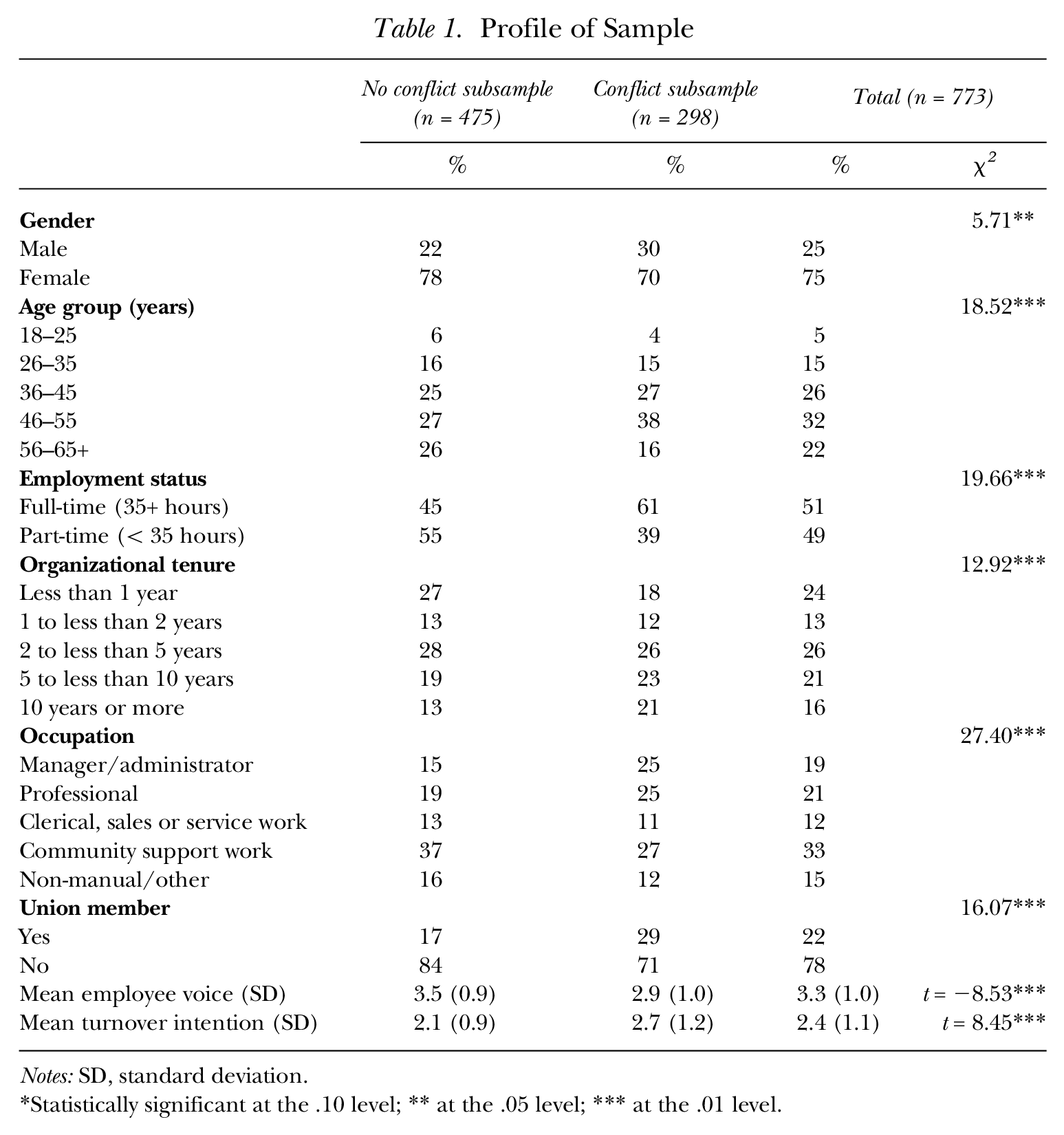
Notes: SD, standard deviation.
Statistically significant at the .10 level; ** at the .05 level; *** at the .01 level.
Employee Experience of Conflict in the Workplace
In total, 298 (approximately 40%) of the respondents reported experiencing conflict in the past year. This percentage is considerable and consistent with the evidence cited earlier indicating that workplace conflict is widespread.
A profile of the subsamples reporting and not reporting conflict are shown in Table 1. Of those reporting conflict in the past year, the majority were women (70%), slightly lower than the percentage of women not reporting conflict (78%) (χ2 = 5.71, p < .05). Note that a significantly higher proportion of those reporting conflict were middle-aged (46–55 years old) (χ2 = 18.52, p < .01), were full-time employees (χ2 = 19.66, p < .01), had longer organizational tenure (χ2 = 12.92, p < .01), had professional roles (χ2 = 27.40, p < .01), and were union members (χ2 = 16.07, p < .01).
Extent to Which Conflict at Work Is Resolved
Table 2 shows that the most frequently experienced dispute types encompass employment conditions, supervisor decisions, personality conflicts, and uncivil behavior. As also shown in Table 2, although only 21% of respondents reported that their conflict was fully resolved, just less than half (45%) reported that it was partly resolved. About a third (34%) reported the conflict was not resolved at all.
Summary of Conflict-Related Variables
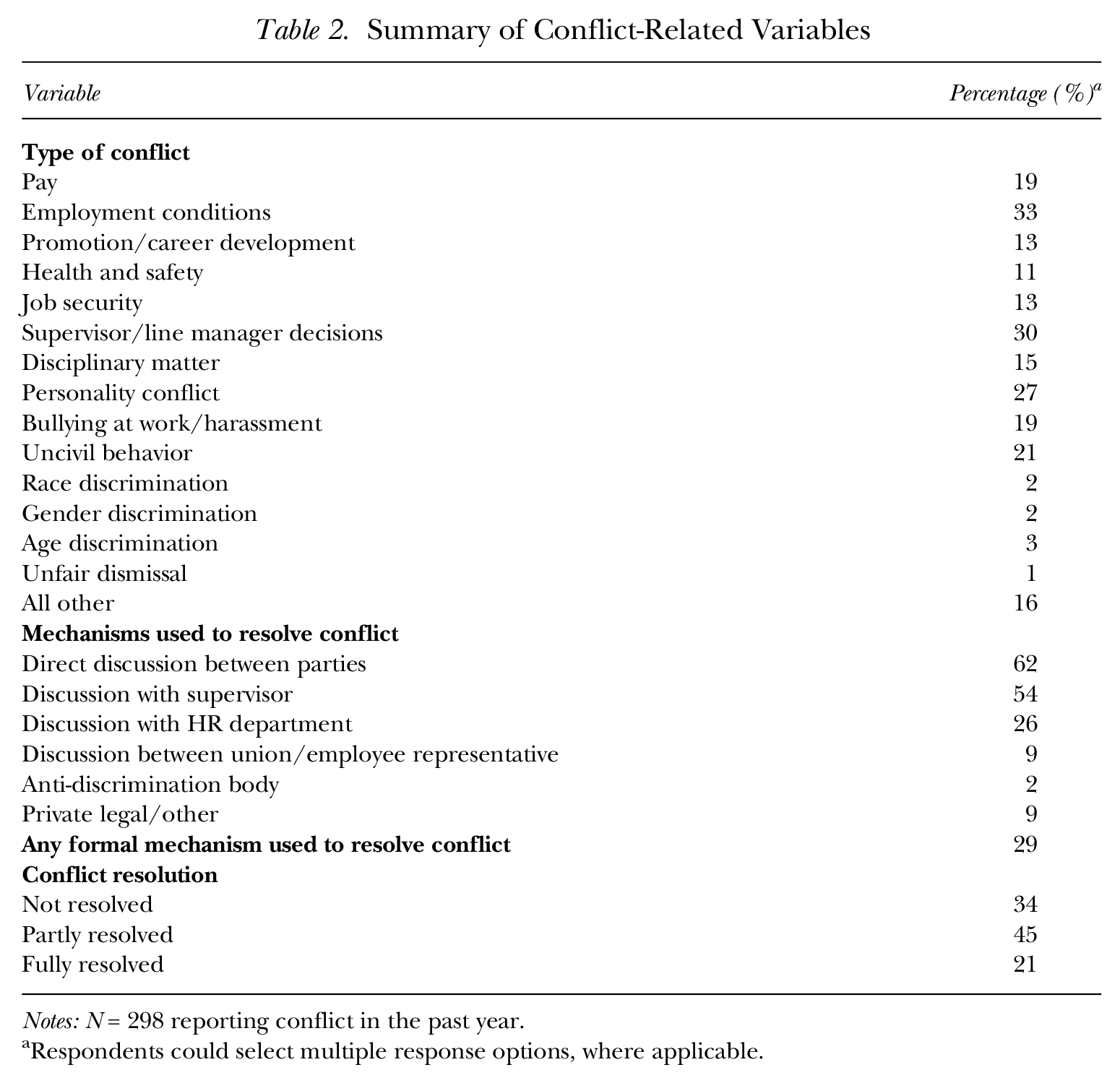
Notes: N = 298 reporting conflict in the past year.
Respondents could select multiple response options, where applicable.
Mechanisms Used by Employees to Resolve Conflict at Work
Table 2 also shows that most respondents reported using direct discussion with the parties or with the supervisor/line manager to resolve conflict at work. This is consistent with our earlier explanation of the pervasiveness of conflict and that most conflicts are resolved routinely by the direct parties. Only a minority of respondents (29%) reporting conflict used at least one formal method of dispute resolution. The study defined this as a method other than direct discussion with the parties or with the supervisor/line manager, for example, discussion with HR, a union, or a government agency. Moreover, a very small number of respondents (n = 7) used a formal method only to resolve conflict; most also used an informal method in an attempt to resolve the conflict. This outcome is perhaps unsurprising as most dispute resolution procedures begin with an informal step such as discussions between the parties or with a supervisor. Only 21 respondents (7% of those reporting conflict) did not use any method of conflict resolution, whether informal or formal. In sum, as largely expected, the overwhelming majority of those experiencing conflict at work in the past year reported using at least one informal method of conflict resolution.
Regression Modeling
We now turn to the regression results. Our first research question is considered with a mediation model (see Figure 1) in which employee voice as the antecedent variable acts directly and indirectly (via the dispute resolution variable) on employees’ intention to quit. A strength of our analysis is that we introduce a full set of statistical controls and also organizational fixed effects to address potential confounding associations. The regression results are shown in Table 3. The explained variance (OLS R2) estimates are similar for both the pooled and the fixed-effects models, suggesting that it is unlikely that unobserved characteristics of the six organizations confound our findings. Nevertheless, we focus on the fixed-effects models (models 2 and 4) with the inclusion of heteroscedastic consistent (HC3) standard errors to adjust for any heterogeneity (both observed and unobserved) in the data.
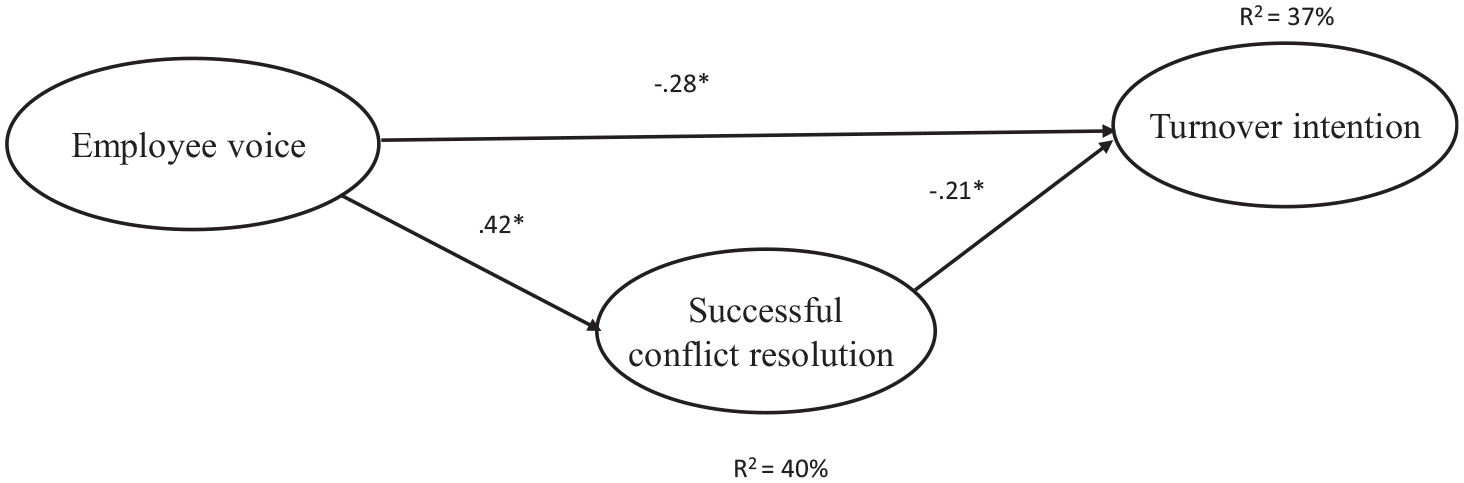
Summary Results of Mediation Model
Results of Regression Analyses
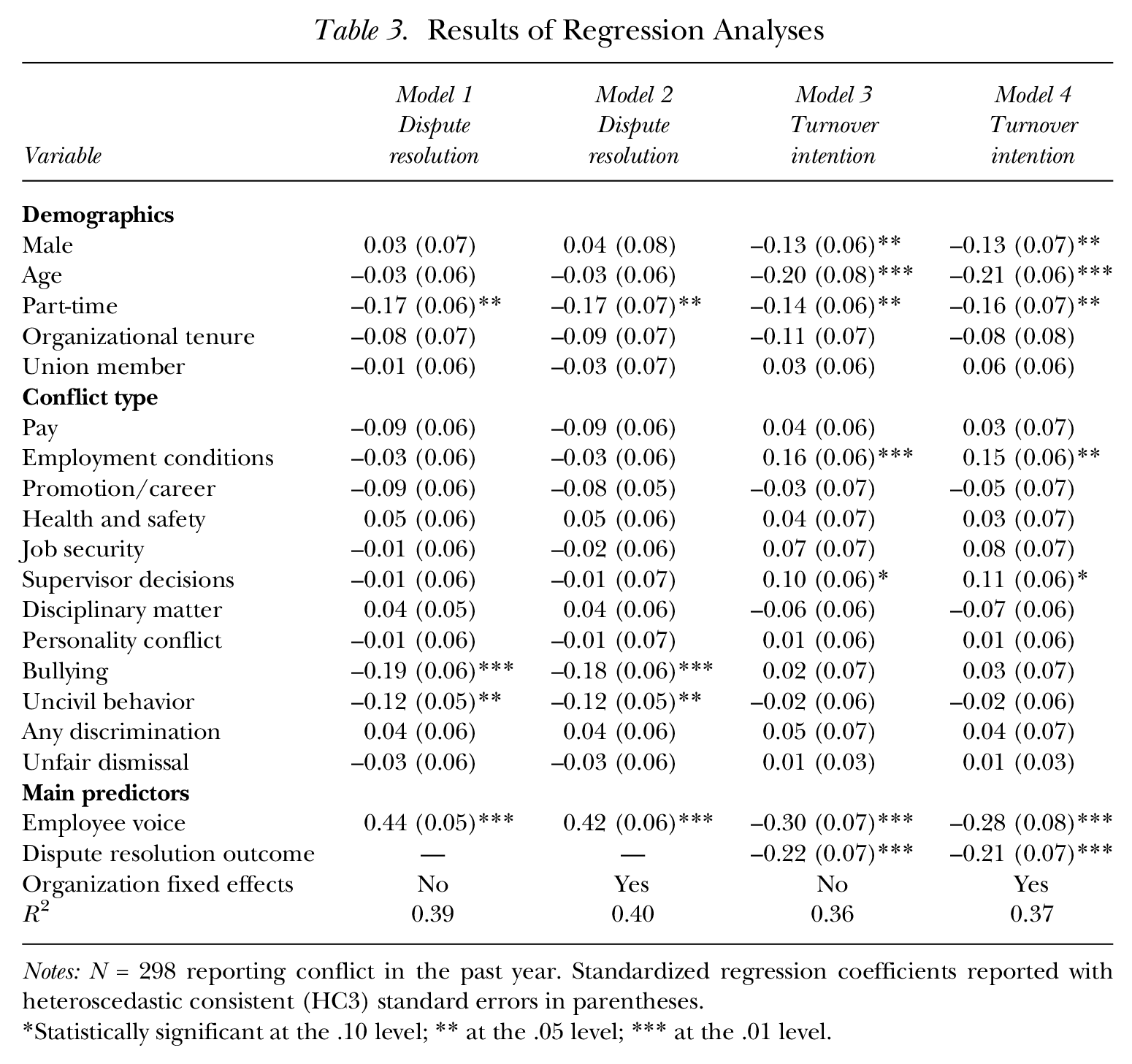
Notes: N = 298 reporting conflict in the past year. Standardized regression coefficients reported with heteroscedastic consistent (HC3) standard errors in parentheses.
Statistically significant at the .10 level; ** at the .05 level; *** at the .01 level.
In regard to our two research questions, employee voice is associated with a more favorable dispute resolution outcome (β = 0.42 p < .01, model 2), which, in turn, is negatively related to intention to quit (β = −0.21, p < .01, model 4). A bias-corrected bootstrap using 1,000 re-samples finds that the indirect effect of employee voice on intention to quit through dispute resolution outcome is −0.09 (95% CI:−0.16 to −0.03). That zero is not contained in the 95% confidence interval for the indirect effect is evidence of a statistically significant mediated effect. Controlling for dispute resolution outcome, employee voice has a negative relationship with intention to quit (β =−0.28, p < .01, model 4). This result suggests that voice is an important direct predictor of intention to quit, independently of the dispute resolution outcome.
Analysis of our second research question delivers novel and potentially important findings. We investigated whether dispute resolution type has a bearing on the relationship between level of voice, conflict resolution, and intention to quit. Those employees who reported bullying, harassment, or uncivil behavior were less likely to successfully resolve the dispute. Additionally, irrespective of the amount of employee voice or the dispute resolution outcome, disputes related to employment conditions (β = 0.15, p < .05) and supervisory decisions (β = 0.11, p < .10) are independently associated with stronger intentions to quit (see Table 3, model 4). Of note is that, irrespective of employee voice, part-time employees are more likely to report a less favorable dispute resolution outcome (β = −0.17, p < .05) but are also less likely to intend to quit (β = −0.16, p < .05), possibly reflecting fewer opportunities to exit the workplace. For robustness, we also examine and find no statistically significant interactive effects among the study variables. In particular, no differences emerge between union members and non-union members in relationships among voice, conflict resolution, and intention to quit. Union membership also shows no evidence of a statistically significant main effect on conflict resolution outcome or on intention to quit (see Table 3).
Taken together, these results help to answer our two research questions and demonstrate that greater employee voice increases the likelihood of resolution among those experiencing conflict at work, and operates in both direct and indirect ways to reduce an employee’s intention to quit. However, these effects are dependent on the type of dispute (see Figure 1 for a summary of our results).
Discussion
The apparent transformation of workplace disputes over time from large-scale, overt collective disputes, such as strikes, to smaller-scale, but possibly more frequent, individual disputes provides a background for our study. In total, 298 respondents (approximately 40%) reported experiencing conflict in the past year. This conflict was most frequently attributed to employment conditions, supervisor decisions, uncivil behaviors, personality conflicts, bullying, and pay disputes. Respondents overwhelmingly dealt with individual conflicts through informal, direct voice mechanisms.
Our research has four main findings. First, employee voice has a direct negative effect on intentions to quit. Second, voice has a direct positive effect on the resolution of the dispute. That is, voice has at least two beneficial effects. These findings confirm that employee voice is an important antecedent for effective dispute resolution and that it impacts employee intentions to quit. Third, we find that dispute resolution itself has a mediating effect on intentions to quit, highlighting that employee voice tends to reduce intention to quit. Fourth, by examining the type of dispute associated with employee voice and resolution, we find that: 1) employees reporting bullying and harassment and uncivil behavior disputes (irrespective of their perceptions of voice) were less likely to have a resolution, and 2) employees reporting disputes about employment conditions or with supervisors’ decisions were more likely to intend to quit (irrespective of voice and resolution outcome). Together, these results point to an important advance in our understanding of the use of conflict resolution practices and workplace policies to deal with individual conflicts. Let us further analyze the findings and their implications for practice and for future research.
Our study finds that when afforded voice in the organization (and not just in the context of a dispute resolution process), employees report an enhanced ability to resolve their conflicts at work. This finding is consistent with and extends Colvin’s (2004) study, which indicated that high-involvement work systems were associated with a lower incidence of workplace conflict because of the effect of employee voice. More generally, this finding is consistent with work in high-involvement work systems known for the prevalence of employee voice (e.g., Cottini, Kato, and Westergaard-Nielsen 2011).
Further, conflict resolved in a workplace through the use of employee voice significantly increases the likelihood that employees will not form an intention to quit. This finding builds on earlier research showing that conflict resolution is important, not only because employees are more likely to find the outcome fairer because of their own participation but also since they were more likely to remain with the organization (Lind and Tyler 1988). Taking these explanations into account, we suggest that employees who perceive that they have effective voice are more likely to accept a conflict outcome and less likely to have an intention to quit.
Our findings also qualify earlier studies examining the effect of dispute resolution procedures on turnover or turnover intention. In a unionized setting, Rees (1991: 35) found that the stronger the dispute resolution procedure (broadly, those encompassing more grievance types and providing for binding arbitration), the lower the turnover intention of employees. Batt, Colvin, and Keefe (2002), however, revealed that non-union dispute resolution procedures did not significantly reduce quit rates and called for employers to invest in stronger dispute procedures to close the representation gap in non-union workplaces. By contrast, we find that the use of dispute resolution procedures by employees (whether unionized or not) is strongly linked to lower intentions to quit in Australian workplaces. This could be because of the distinctive features of the Australian labor relations framework. Specifically, as noted, Australian legislation requires enterprise agreements to contain a dispute resolution procedure that provides a final step of binding independent third-party resolution of intractable disputes. Consequently, Australian dispute resolution clauses could be classified as strong dispute resolution procedures, and our findings support those of Rees (1991).
Thus far, we have confirmed the importance of voice in employing organizations, particularly its ability to deliver better conflict resolution outcomes and reduced intentions to quit. We also discovered, however, that even in the presence of strong organizational voice, some types of disputes are likely to take a distinctive path. Employees who report having disputes with a supervisor’s decisions or about employment conditions indicate a higher intention to quit, regardless of their perception of voice and conflict resolution outcome. Also, employees reporting bullying or uncivil behavior are less likely to resolve their disputes in the workplace. Interestingly, holding employee voice and conflict resolution outcome constant, we do not find a link between bullying or uncivil behavior disputes and intentions to quit. These four dispute types are also among the most common in the six organizations, signaling an important area for future research and practice in conflict resolution.
The Effect of Dispute Type on Resolution and Intentions to Quit
Yamada (2008: 51) described the behaviors associated with bullying as “yelling, shouting, and screaming; false accusations of mistakes and errors; hostile glares and other intimidating non-verbal behaviors; covert criticism, sabotage, and undermining of one’s reputation . . . use of put downs, insults, and unreasonably heavy work demands.” Not surprisingly, bullying has been associated with higher levels of absenteeism and sick leave (O’Connell, Calvert, and Watson 2007). Hoel, Sheehan, Cooper, and Einarsen’s (2010) review of bullying and turnover intention suggested that the evidence is mixed. They expressed surprise that the link to turnover intention was not as strong as expected. This finding was attributed to factors that encourage actual turnover (quitting following long-term illness as a positive coping strategy), as well as those that keep employees in the workplace. Among these were tolerance of the behavior, a tight labor market, the intermittent nature of bullying, and the pursuit of external legal avenues for redress.
We confirm these findings with regard to bullying and uncivil behavior disputes and the lack of a relationship with intentions to quit. This confirmation implies that those affected employees remain in their workplaces and perhaps exhibit increased absenteeism and other related negative behaviors such as lower productivity, lower morale, or counterproductive work behaviors. It is possible that data on actual turnover (rather than intentions to quit) following bullying and uncivil behaviors may shed more light on the issue; this is a limitation of our study that we consider below.
At the same time, we find greater intention to quit among those reporting disputes with their supervisor’s decisions or dissatisfaction with their employment conditions. This is consistent with earlier studies such as Sheppard, Lewicki, and Minton (1992) and Greenberg (1993). Additionally, employees judge supervisor decisions and employment conditions by their own fairness scale. Perceived fairness at work has been shown to lower labor turnover (Byrne 2005). Typically, the types of dispute we have identified are associated with a breakdown of relationships and trust, and the employing organization’s failure to provide reciprocity in terms of fairly recognizing employee effort. All of these contribute to turnover intention.
The Effect of Dispute Type on Resolution and Conflict Resolution
We find that regardless of voice, bullying and uncivil behavior disputes are less likely to be resolved in the workplace. Notably, these disputes tend to be individual, subjective, and emotionally charged (Einarsen, Hoel, Zapf, and Cooper 2010: 28–30). Literature pointing to consistent inaction by managers suggests that bullying cultures become entrenched. One commentator noted that bullying is prevalent in organizations with weak management control and inadequate HR policies (Salin 2003). Others have suggested that the skills required to handle these types of conflicts are specialized, and that many supervisors and managers may be deficient in this regard (O’Moore and Lynch 2007). In these situations, victims are unlikely to see internal dispute resolution processes as providing an effective outcome to an entrenched problem. In the Australian context, however, it is likely that the availability of specialist tribunals available to employees with bullying complaints leads them to reject internal workplace processes while remaining in the workplace.
Implications for Practice, Limitations, and Future Research
Dispute resolution involves much more than simply the stages of the dispute resolution procedures. Achieving positive outcomes that reduce employees’ intentions to quit—and the associated costs of conflict—requires a commitment from managers to use procedures that provide employees with meaningful voice in determining dispute outcomes.
Our findings have implications for dispute resolution theory as well as practical implications for organizations. In sum, we contribute to dispute resolution theory by helping to better understand and explain the conditions under which dispute processes are most likely to deliver a resolution, and those under which resolution may not be achieved and turnover intentions may remain high. Our study used employee voice—and not simply voice available in a dispute resolution scenario—as a basis on which to argue that successful dispute resolution and reduced turnover intentions are strongly linked to having a culture of voice in the workplace. Such a culture can be built through implementing a range of voice mechanisms, both formal and informal, to resolve disputes and to more broadly facilitate participation in organizational decision-making. We infer that when organizations provide employees with opportunities for voice to resolve workplace conflicts, they are less likely to want to quit. It follows that these workers are more likely to stay and, in turn, that the employing organizations are more likely to avoid the negative consequences of unresolved conflict. As Olson-Buchanan and Boswell (2002: 1167) stated, “minimizing the negative consequences of conflicts is arguably in the best interests of the organizations.”
Further research should consider the effectiveness of managing workplace conflict using generic dispute resolution procedures. Attention might focus on ascertaining whether such procedures can address the particularities of disputes over bullying and uncivil behavior, supervisor decisions, and employment conditions. Organizations can also benefit by considering the type of training and support required to deal with bullying and uncivil behavior disputes in their workplaces. As our evidence suggests that victims of these type of disputes remain with the employer without achieving resolution, questions may be raised as to the their level of motivation and work quality.
All research has limitations and we identify three. First, the analysis of the relationship between intention to quit and voice suffers from a potential problem of reverse causation, from intention to quit to voice. We address this through a detailed set of statistical controls designed to avoid potential confounded associations. In addition, conceptually, it is much more likely that voice influences intentions to quit than vice versa. This accords with Lewin and Mitchell (1992), who found that employee loyalty and perceived effectiveness of the grievance procedure were significantly negatively associated with use of the procedure. Second, our survey was cross-sectional, confined to the services sector, and conducted in only one country. The size and prominence of the service sector in the contemporary economy, however, makes it an appropriate context in which to examine our research questions. Third, generalizability at the organizational level is limited since our sample included only six service-sector organizations. Nevertheless, because our focus is not on organizations per se but on employees, the relatively large sample enables us to capture a diverse range of experiences of conflict with a reasonable degree of confidence.
In terms of a future research agenda, we offer proposals for three similar studies. The first might use data on actual turnover rather than on intention to quit. Nevertheless, the latter is the strongest proximal predictor of voluntary turnover, and many studies use it as a proxy for turnover (see Griffeth, Hom, and Gaertner 2000). The second future study could be conducted longitudinally, using a range of conflict types and in different national contexts. Such comparative studies could shed light on the generalizability and transferability of these findings and the impact of national laws, customs, and institutions. In light of our finding that the unobserved characteristics of the organizations included in the sample have little predictive power, it may be worthwhile for a third future study to draw on a larger sample of organizations. The objective would be to determine whether inter-organizational differences (e.g., workplace culture, HR practices, union presence, and leadership) act as boundary conditions of the relationships among employee voice, intention to quit, and dispute resolution.
Conclusions
In this article, we consider the importance of employee voice as a pre-condition for effective conflict resolution and, in turn, on employee intentions to quit. The analysis yields insights for dispute resolution theory, which links with theories of employee voice. Specifically, we find that employee voice has the additional benefit of directly reducing employees’ intentions to quit beyond its indirect effect of helping to resolve conflicts at work. We identify the conditions under which certain disputes fail to be resolved or to lower turnover intention. These include highly emotive disputes involving bullying and uncivil behavior, and fairness-related disputes involving supervisor decisions and workplace conditions.
The practical significance of these findings is that a more nuanced management of employee voice in workplaces will potentially contribute to resolving conflict. In addition, our study uncovers ways of minimizing the costly negative effects of conflict arising from employees intending to quit and becoming disengaged from their work. Senior managers might do well to consider the implications of these findings when they design training strategies for their line managers, who are at the forefront of conflict resolution in most organizations. They might also think about ways to achieve meaningful voice opportunities for their employees, especially those in non-unionized workplaces. In view of the benefits associated with providing voice in workplaces, organizations should consider refining their dispute resolution procedures. This can be accomplished by providing for external mediation, conciliation, and arbitration to enhance the prospects of settling disputes, particularly intractable ones such as those over bullying and uncivil behavior. Senior managers may also wish to consider training and support for supervisors dealing with this behavior, as well as disputes over decisions and employment conditions; these are less likely to rely on provisions for employee voice. Improving workplace dispute resolution, then, may have significant practical benefits for employing organizations, the people in them, other stakeholders, and the wider society.
Footnotes
Acknowledgements
The authors acknowledge the Australian Research Council, DP120103054; the UK Economic and Social Research Council, L000660/1; and the International Consortium for Research in Employment and Work (iCREW), Centre for Global Business, Monash Business School, Monash University, Australia.
An earlier version of this article was discussed at a conflict resolution conference, in honor of Dave Lipsky, at the Scheinman Institute on Conflict Resolution, ILR School, Cornell University, United States. The authors thank the conference organizers and participants for their helpful comments. They also thank Penny Sara.
For information regarding the data and/or computer programs used for this study, please address the corresponding author at
1
The contexts in Australia and the United States have some similarities: They are both liberal market economies. Yet important differences also exist between the two contexts (Katz 1993; Bamber et al. 2016). For example, specialist, quasi-judicial tribunals play an important role as independent third parties in Australian workplace conflict resolution ( ).
).