




Abstract
This article analyzes the impact of the 2013 Rana Plaza building collapse on garment lead firms’ labor standards policies in the light of new governance approaches, particularly the pathbreaking Accord on Fire and Building Safety in Bangladesh. Based on a sample of 20 Australian and German garment firms, the authors find that firms with low prior baseline standards revised their supply chain and sourcing policies and signed the Accord. Firms with medium and high baseline standards responded variously, from making no changes to revising their policies and signing the Accord. Firm response variation can be explained by stakeholder pressure occurring in different national industrial and institutional contexts following the Rana Plaza incident, which served as a focusing event. Results suggest the wider applicability of the focusing event framework for industrial relations scholarship and highlight some of the mechanisms driving changes in industrial relations institutions.
Intense global competition facilitated by trade liberalization encourages lead firms in advanced economies to pressure suppliers to continually improve productivity. Consequently, exploitation of workers in developing economies has become a major concern, especially in the global garment industry. The Rana Plaza factory collapse in April 2013 (hereafter Rana Plaza), which left 1,130 mainly female Bangladeshi garment workers dead and more than 2,000 injured, constituted a focusing event that generated public criticism of grossly inadequate building safety and related labor standards in garment supply factories. These developments initiated policy discussions at firm, national, and transnational levels to improve building safety and labor standards.
Three main policy initiatives were introduced to address safety in Bangladeshi garment export factories. First, two global union federations and several local counterparts together with more than 200 retailers and brands from Europe, North America, Asia, and Australia signed the Bangladesh Accord for Fire and Building Safety (hereafter Accord). This five-year multi-stakeholder, transnational collective agreement extended a prior memorandum of understanding on building and worker safety by two lead firms following earlier factory accidents. The intention was to introduce worker participation into safety committees with union support. The provision of legally binding arbitration and the inclusion of clauses relating to continuity of orders and supplier transparency make the Accord an innovative form of labor governance. Second, in the wake of Rana Plaza, 29 firms, primarily US and Canadian, supported an alternative policy initiative known as the Alliance for Bangladesh Worker Safety (hereafter Alliance), which is a unilateral, non–legally binding, five-year initiative. Third, the Bangladesh government set up the National Action Plan, an initiative to address building and worker safety in export factories not covered by the Accord or the Alliance. All three initiatives are complemented by a voluntary program, Better Work Bangladesh, which is directed by the International Labour Organization (ILO) to improve productivity, worker safety, and labor relations more generally in garment export factories.
Although research has focused on the governance logic of the Accord (Anner, Bair, and Blasi 2013; Anner 2015; Donaghey and Reinecke 2017), the politics of its emergence (Reinecke and Donaghey 2015), and its weaknesses (Labowitz and Baumann-Pauly 2014), little is known about lead firms’ responses to Rana Plaza in the light of these policy innovations. In particular, why did some lead firms join the Accord, thereby signaling a preference for high safety standards and a commitment to shared decision making, whereas other firms responded by changing their sourcing policies, consolidating their supply chains, or making no changes? Answering this question allows us to assess the extent to which the disaster encouraged changes in lead firms’ labor standards policies that went beyond the immediate concern for improving building safety.
To address this question, we examine similarities and differences in firms’ responses to the Rana Plaza disaster across a sample of 20 comparable Australian and German garment retailers and brands. This design enables us to explore why several major Australian retailers signed the Accord despite very limited sourcing from Bangladesh, whereas a number of leading German retailers that were known to source from Bangladesh—including from the Rana Plaza building—did not sign this collective agreement. The focus of the article relates to ongoing theoretical debates concerning the influence of national institutional systems on firms’ responsible business practices (e.g., Jackson and Apostolakou 2010; Kang and Moon 2012; Fransen 2013) and the potential of new transnational institutional arrangements for improving labor governance in a globalized economy (e.g., Locke, Rissing, and Pal 2013; Meardi and Marginson 2014; Marginson 2016). Our findings indicate that differences in firm responses can be explained by variations in stakeholder pressure occurring in dissimilar national industrial and institutional contexts, including differences in firms’ experiences with global sourcing. We show that stakeholder pressure is shaped by the Rana Plaza focusing event, which provided new opportunities for stakeholder mobilization. Accordingly, we contribute to industrial relations knowledge by suggesting that a focusing event perspective adds a dynamic dimension to extant structure-oriented explanations of industrial relations phenomena, such as changes in labor governance institutions.
Understanding Firms’ Responses to Rana Plaza: A Focusing Events Perspective
Labor standards in the global garment industry are generally weak because of suppliers’ thin profit margins, lead firms’ low switching costs, a lack of national-level labor law enforcement in developing countries, an absence of international law regulating labor standards, and weak or nonexistent supply chain regulation (e.g., Locke, Qin, and Brause 2007; Bulut and Lane 2011; Locke et al. 2013). Reliance on soft law policies (e.g., the United Nations Guiding Principles on Business and Human Rights) and private regulation, mainly in the form of codes of conduct and monitoring by lead firms, are insufficient for improving labor standards except under particularly favorable conditions (Egels-Zandén and Bartley 2015), such as when state and private regulation act in a complementary manner (Amengual and Chirot 2016). Together, these factors constitute a systemic regulatory problem in the garment industry, contributing to the high risk of factory disasters in Bangladesh (Taplin 2014).
Given its scale, the Rana Plaza collapse provided unforeseen leverage for workers and their allies to mobilize for building and labor standards improvements in garment supply chains (Berliner et al. 2015: 142). It can thus be seen as a focusing event, defined as a sudden, major and often harmful, highly publicized occurrence that creates opportunity structures for advocacy groups to mobilize for institutional or organizational change (Birkland 1998). By raising awareness around a specific, morally charged issue, a focusing event provides an impetus for policy innovation. A focusing event requires three mutually reinforcing pre-conditions to open a policy window for change: acknowledgment of a problem that needs resolution, a consensus favoring a policy proposal to solve the problem, and political pressure compelling policymakers to act (Kingdon 2003). Conversion of a major event into a focusing event is not inevitable, however: Key stakeholders may have conflicting perceptions of the event, and it may be crowded out of the relevant political agenda by competing problems. Even if an event succeeds in gaining policymakers’ attention, contestation over goals or means may prevent a viable policy solution (Farley et al. 2007). Focusing event framing has been used to explain national policy changes in fields such as comparative politics (e.g., Wright 2014), but this approach has not, to our knowledge, been used in industrial relations.
The focusing event framework helps us to move beyond structure-oriented arguments regarding lead firms’ labor standards and building safety policies by explicating the salience and meaning of a policy problem at a particular point in time and in a particular context. For instance, being publicly listed might compel firms to be more sensitive to reputational damage and thus supportive of collective regulation (Marx 2008); or, firms could favor short-term returns and discourage the adoption of collective regulation (Milberg and Winkler 2009). Such sometimes-contradictory conjectures can be resolved by paying attention to how firm-level and national-level conditions matter in a specific temporal context. Drawing on the literature that seeks to explain inter-firm variation in support of more stringent, multilateral forms of private regulation, we note several factors that might increase the significance of a focusing event for lead firms.
First, firms change their policies in response to stakeholder pressure from nongovernmental organizations (NGOs) and trade unions, which may mobilize consumers directly or through traditional and social media (Donaghey, Reinecke, Niforou, and Lawson 2014). Several studies indicate that typically large, strongly branded firms are more frequently targeted by stakeholders because they are more directly involved in governing global supply chains and can thus be held accountable for labor standards violations (Lakhani, Kuruvilla, and Avgar 2013; Bartley and Child 2014). Such firms are more inclined to implement stricter forms of labor standards regulation (Fransen and Burgoon 2012). A focusing event might intensify this process, concentrating stakeholder attention on specialty garment product firms that serve morally sensitive consumers (Bartley and Child 2014), and thereby encouraging those large, strongly branded firms to readily support collective institutions. One example is the first garment industry global framework agreement signed by Inditex following the collapse of the Spectrum Sweaters factory in Bangladesh in 2005 (Miller 2011). Alternatively, a focusing event might raise the pressure for non-branded firms, as consumers, activists, or the media become more aware of a problem or gain legitimacy to act upon it. Patterns of stakeholder activism and stakeholder relations also vary across countries (e.g., Egels-Zandén and Hyllman 2006; Bair and Palpacuer 2012), thus leading to various forms of stakeholder mobilization following a focusing event.
Second, national-level government policies and national discourse regarding corporate social responsibility (CSR) vary across countries and influence the salience of a focusing event for firms. For instance, firms embedded in countries with a more mature national CSR discourse are found to be more supportive of stricter forms of labor standards regulation (Fransen and Burgoon 2012). Such firms might face stronger normative pressure to improve labor standards following a focusing event than would firms in a country with weak CSR norms. Firms embedded in countries with stronger CSR norms, however, might already adhere to more stringent labor standards regulations, and hence see no need for additional regulation such as the Accord. In Germany, for instance, national policymakers initiated the multi-stakeholder Textile Partnership in response to the Rana Plaza disaster, thus shifting policy responses away from the firm level toward a national collective arena in which firms, represented by their business associations, negotiate with NGOs, unions, and policymakers regarding stricter supply chain governance. As a consequence, stakeholder pressure following a focusing event might also play out differently in the light of varying CSR norms and institutionally embedded understandings of responsible business practices (Brammer, Jackson, and Matten 2012; Preuss, Gold, and Rees 2015).
Third, industry characteristics, including global value chain configurations (Gereffi, Humphrey, and Sturgeon 2005; Lakhani et al. 2013), may define the importance of a focusing event for firms independent of stakeholder pressure. Fransen and Burgoon (2012) argued that particular types of firms that compete primarily on price, such as supermarkets and discount retailers, will avoid strong labor standards because their customers overwhelmingly prioritize low prices. Such firms may remain unaffected by a focusing event. By contrast, strongly branded firms selling higher value garments tend to support higher standards because their customers prefer garments that are not tainted by labor exploitation, and/or because their emphasis on quality in producing complex garments means they more carefully monitor suppliers’ production processes to ensure contract fulfillment. Such firms may more readily support collective institutions such as the Accord, not least because they are structurally able to meet certain obligations regarding continuity of order volumes and suppliers’ financial status (Accord 2017). Global supply chain configurations are to some extent related to national institutional context (Lane and Probert 2009), again suggesting different dynamics of contestation following a focusing event in different countries.
These considerations indicate that a variety of opportunity structures exist for private policymakers to support or avoid stronger regulation in the light of a focusing event. In sum, we seek to demonstrate that focusing event framing in conjunction with the structural factors referred to above provide a particularly useful framework for understanding the effects of the Rana Plaza disaster on lead firms’ labor standards policies.
Methodology
Lead firms have been attracted to sourcing from Bangladesh because it has among the lowest minimum wages of all major garment manufacturing countries (ILO 2014: 17). In 2014, the European Union and the United States accounted for 61% and 24%, respectively, of Bangladesh’s garment exports. Most of the remaining 15% of exports went to Japan, Turkey, and Australia (BGMEA 2014). Garments represent more than 80% of Bangladesh’s exports and approximately a quarter of the nation’s gross domestic product (Labowitz and Baumann-Pauly 2014). Following earlier incidents, such as the 2012 Tazreen factory fire, Rana Plaza laid bare inadequate building and worker safety regulations, leading into a broader debate about labor standards in the Bangladesh garment industry and the social responsibilities of lead firms. We undertook our study in the years 2013 to 2015 when the new initiatives described earlier were being established.
Comparative Research Design and Sample
We designed our research to explore inter-firm and cross-national variation in two countries, Australia and Germany. Firms from both countries signed the Accord, with Germany comprising the largest number of signatories among European countries and Australia constituting the second largest number of non-EU signatories after the United States. 1 In both countries, the national garment markets are highly competitive with increasing penetration by large multinationals (e.g., H&M and Uniqlo) and online retailers. These characteristics, together with low average real wage growth in both countries, encourage cost-conscious consumerism, irrespective of product complexity. Australian firms have been comparative latecomers to Bangladesh, evidenced by the proportion of total Australian garment imports from Bangladesh increasing from only 2% in 2009–10 to 9.2% in 2014–15 (Queensland Statisticians Office 2017). German imports from Bangladesh made up 14% of total garment imports in 2015, having increased from 7% in 2008 (Commerzbank 2016). For both countries, Bangladesh is the second-largest source of ready-made garment imports (with China being the largest) (Australian Government 2013; Statistisches Bundesamt, n.d.). In addition, these countries differ along the relevant dimensions outlined above, thereby providing a suitable basis for comparison.
First, Australian and German societies vary in firm–stakeholder relations and in the way unions, NGOs, and investors influence management decisions regarding labor standards. In both countries, NGOs, sometimes in collaboration with unions, exert the most influence. In Australia, stakeholder campaigns are relatively recent (George 2017), whereas in Germany they are sporadic and are mainly coordinated by organizations based in other EU countries (Bair and Palpacuer 2012). The erosion of German welfare capitalism (Thelen 2014), which is particularly pronounced in the retail sector (Geppert et al. 2014), has given rise to quite contested relations between businesses, civil society, and the state. Furthermore, investors play a more prominent role in Australia than in Germany, where even large retail conglomerates such as Aldi or Lidl are privately owned.
Second, a public discussion of responsible business practices has developed in Germany, along with other European countries, since 2001 when the European Commission Green Paper on CSR was published (Albareda, Lozano, and Ysa 2007). In the light of these norms and possible EU regulations, large retail firms from Germany have lobbied for voluntary, explicit policies rather than state-regulated CSR policies from the late 1990s. This lobbying led to the inclusion of labor standards in the European Business Social Compliance Initiative (BSCI), a firm-driven association (Hiss 2009). In Australia, successive governments have not yet provided any leadership on CSR or sustainability, and no collective standard-setting initiatives exist. For instance, an Australian National Action Plan (NAP) on business and human rights was first mentioned in 2015 (GCNA/AHRC 2015) with no formal planned date for completion. Germany’s involvement in the EU also means that the federal government is party to the Sustainability Compact with Bangladesh, a trade agreement that requires the Bangladesh government to implement and enforce stronger labor standards than it did in the past. Australia’s trade agreement does not contain a social clause.
Third, garment industry characteristics influence the size and distribution of various types of firms. The German market is more than three times larger than its Australian counterpart 2 and includes a relatively large subsector comprising brand retailers and manufacturing retailers selling complex fashion garments based on production know-how in the form of in-house design and quality production skills (Lane and Probert 2009). This scenario implies relatively strong production oversight and a preference among some retailers for longer-term, relational ties with offshore suppliers. By contrast, Australia’s largest market segment is simple with moderately complex basic fashion garments requiring less in-house production knowledge with a focus mainly on price and arm’s-length supplier relations (Weller 2007). Given that outsourcing of garment production occurred much later in Australia, problematic factory safety and labor standards had been a more prominent feature of discussions between stakeholders and German lead firms in the wake of earlier incidents, such as the 2012 Tazreen factory fire in Bangladesh.
With the above observations in mind, we created comparable sets of lead firms based in Australia and Germany that are typical of the main types of garment retailers in these countries, with a focus on larger firms that are more likely to source from Bangladesh. The estimated distribution of retail firm types by country (Australia/Germany) are specialty garment retailers (48%/49%), department stores (10%/7%), online retailers (15%/14%), discounters (20%/12%), and supermarkets and other mixed retail (7%/18%). Brand manufacturers account for approximately 5% of garment firms in Germany compared to approximately 1% in Australia (our estimates based on BTE 2016; Market Line 2016; Euromonitor International 2017). Except for online and mail-order retailers, our sample includes firms representing all these segments. The main Australian online retailers are based abroad, and German online retailers did not participate in the research. The sample is not statistically representative of the overall population of garment firms in each country, which would be difficult to achieve given the lack of detailed, comparable enterprise data. We exclude majority foreign-owned firms from our analysis so that we do not complicate cross-national comparisons between Australian and German companies.
Data Collection and Analysis
We approached 19 firms representing the main retailer types (supermarkets, specialty retailers, department stores, discounters, and brand manufacturers) in Australia, 10 of which agreed to participate in our study. In addition, we requested interviews with 30 German firms in the main retail firm market categories. We attempted to include both Accord signatories and non-signatories for each type of retailer. Except for supermarkets, for which access to the Accord-signing German supermarkets was denied, we succeeded in obtaining access to a broadly matched sample of 10 German firms. Apart from this exception, the firms that did not participate in our study do not differ significantly from the firms that did participate, as they comprised Accord-signatories and non-signatories across the range of market segments and retailer types. Table 1 presents the characteristics of sample firms in Australia and Germany by market segment, size, and ownership type.
Characteristics of Sampled Firms in Australia and Germany
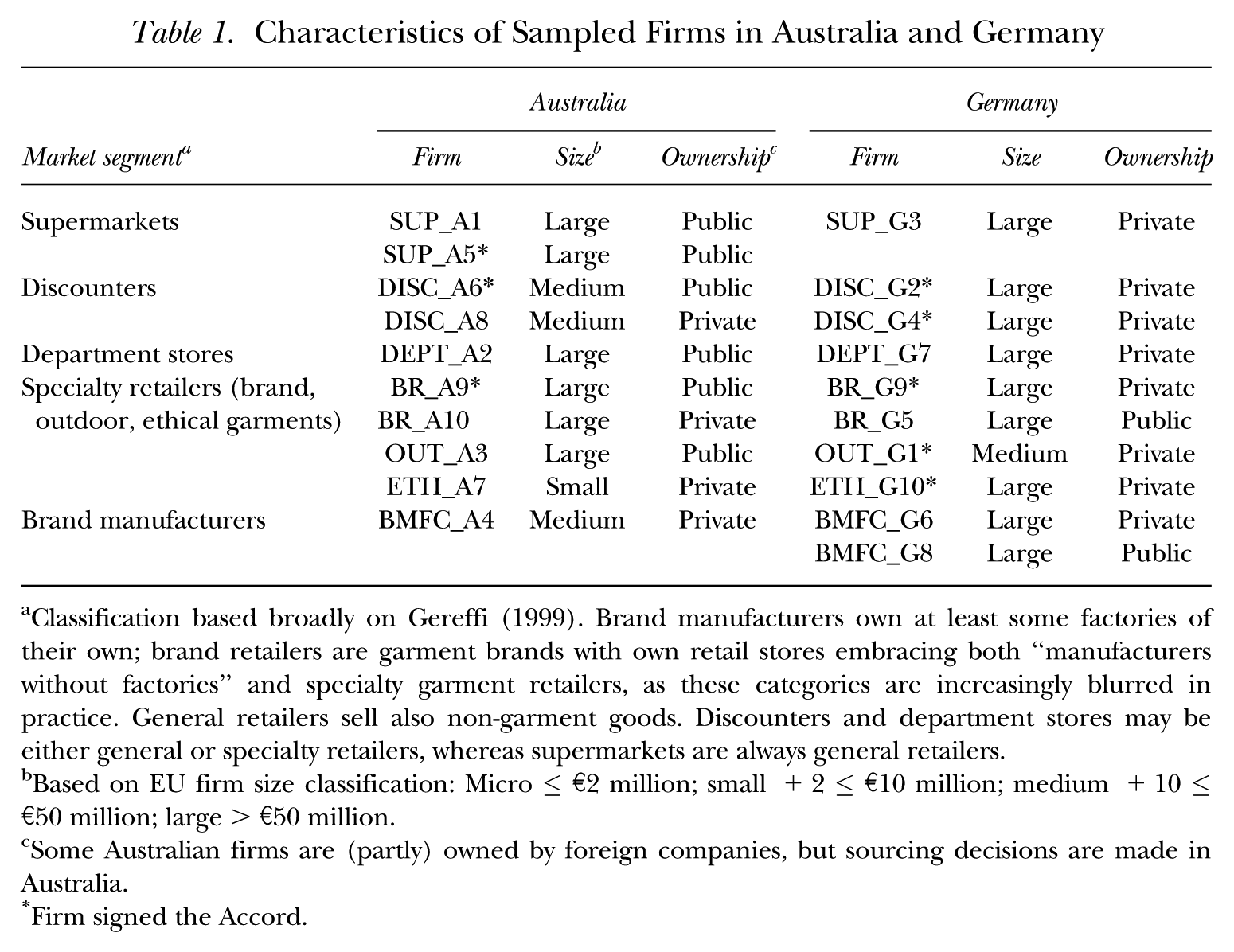
Classification based broadly on Gereffi (1999). Brand manufacturers own at least some factories of their own; brand retailers are garment brands with own retail stores embracing both “manufacturers without factories” and specialty garment retailers, as these categories are increasingly blurred in practice. General retailers sell also non-garment goods. Discounters and department stores may be either general or specialty retailers, whereas supermarkets are always general retailers.
Based on EU firm size classification: Micro ≤ €2 million; small +2 ≤ €10 million; medium +10 ≤ €50 million; large > €50 million.
Some Australian firms are (partly) owned by foreign companies, but sourcing decisions are made in Australia.
Firm signed the Accord.
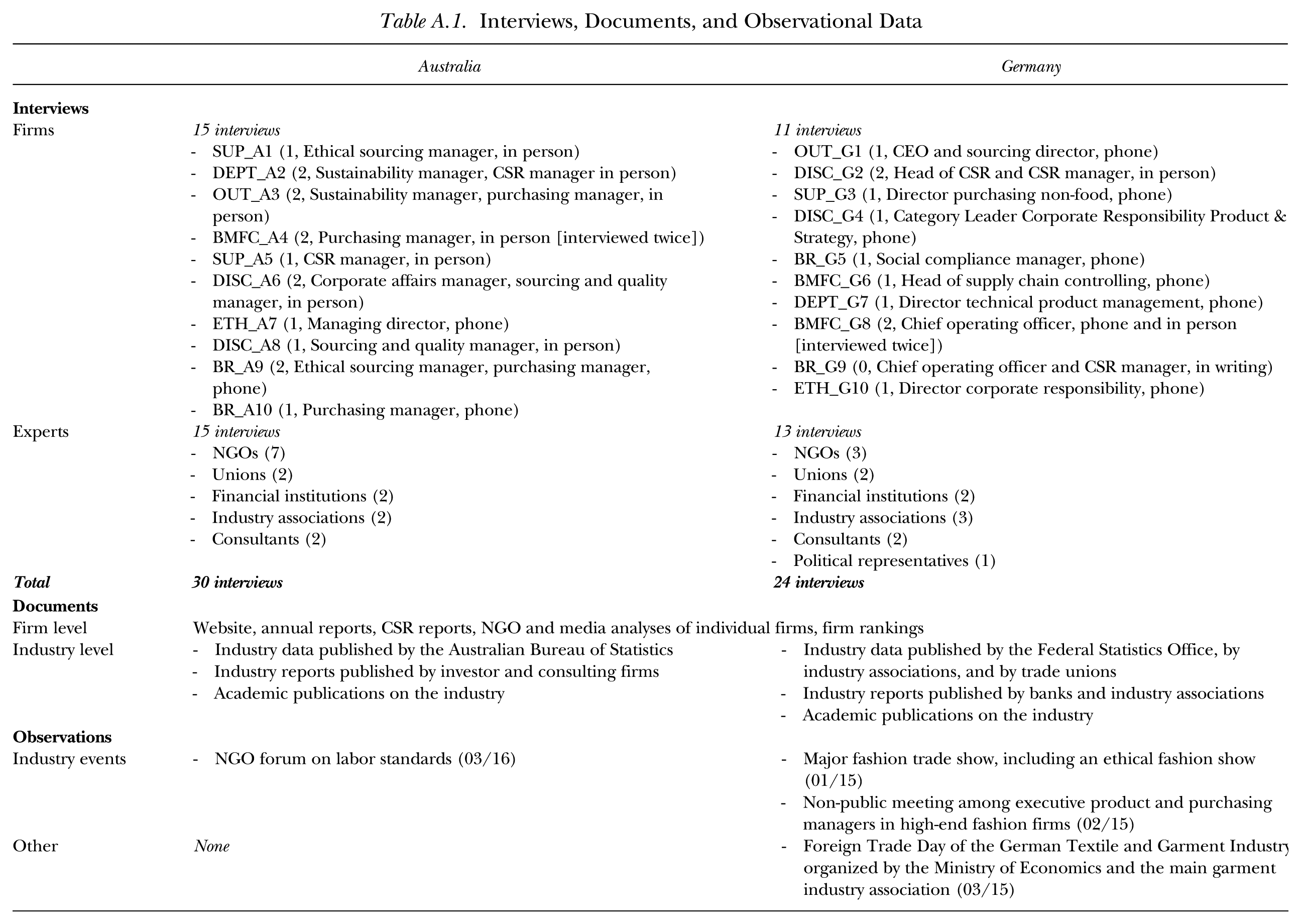
CSR and purchasing managers were the most knowledgeable about supply chain labor standards, and although their positions in the firm implied different perspectives, our questions were largely factual so that differences in their viewpoints were unlikely to affect our findings. Appendix Table A.1 presents information on 15 CSR or purchasing manager interviewees in Australia and 11 in Germany. Our questions concentrated on firms’ supply chain structures, supplier relationships, and labor standards policies before Rana Plaza (which we refer to as baseline standards), and then, on how firms were subsequently affected by and responded to the focusing event. Field experts and stakeholders were also interviewed to obtain information on retailers’ supply chain and labor standards policies before and after Rana Plaza and to understand complementary national-level campaigns and reactions.
We recorded interviews using a digital device, and they were then fully transcribed and analyzed using the coding software Atlas.ti. We transferred relevant information into coding matrixes. Firm-level and industry-level archival data (e.g., annual reports, social reports, and press releases) and insights from participation in several industry events were drawn on to provide an accurate picture of lead firm responses. Appendix Table A.1 provides further details.
Our analysis proceeded in four steps. First, we examined data based on all Accord member firms, analyzing their reasons for joining and when this occurred. In addition, we identified other organizational responses to Rana Plaza; these mostly concerned changes in sourcing policies and supply chain governance including reductions in the number of suppliers or withdrawal of sourcing from Bangladesh. In a second step we compared the firms that decided not to join the Accord, assessing if they instead made any other changes and what their rationales were for doing so. In a third step we sought to identify lead firm response patterns and explanations for these patterns. We identified three groups of firms among the Accord members and three among the non-members, each varying in the extensiveness of their responses and in their pre–Rana Plaza baseline labor standards policies (see Tables 2 and 3 for a summary). We then examined explanatory factors derived from our theoretical framework, such as the exposure to stakeholder pressure, reference to societal norms or alternative regulations, market segment, and the extent to which firms actually sourced from Bangladesh. We classified baseline standards as “strong” when a firm was already a member of a multi-stakeholder initiative (MSI) (e.g., the Fair Wear Foundation) and pursued an explicit sustainability strategy characterized by predominantly direct, long-term supplier relationships. We coded standards as “moderate” when a firm expressed commitment to collective standards (e.g., BSCI) and emphasized frequent oversight of suppliers. We applied the coding label “weak” when relations with a supplier were unilaterally decided by the lead firm and regulated mainly by informal procedures. As a final step in our analysis, we conducted a closer examination of whether the rationales for responding and the forms in which societal pressure were applied showed cross-country differences. This step prompted us to identify particular political economic aspects that contribute to explaining firms’ responses.
Comparison of Accord Signatories
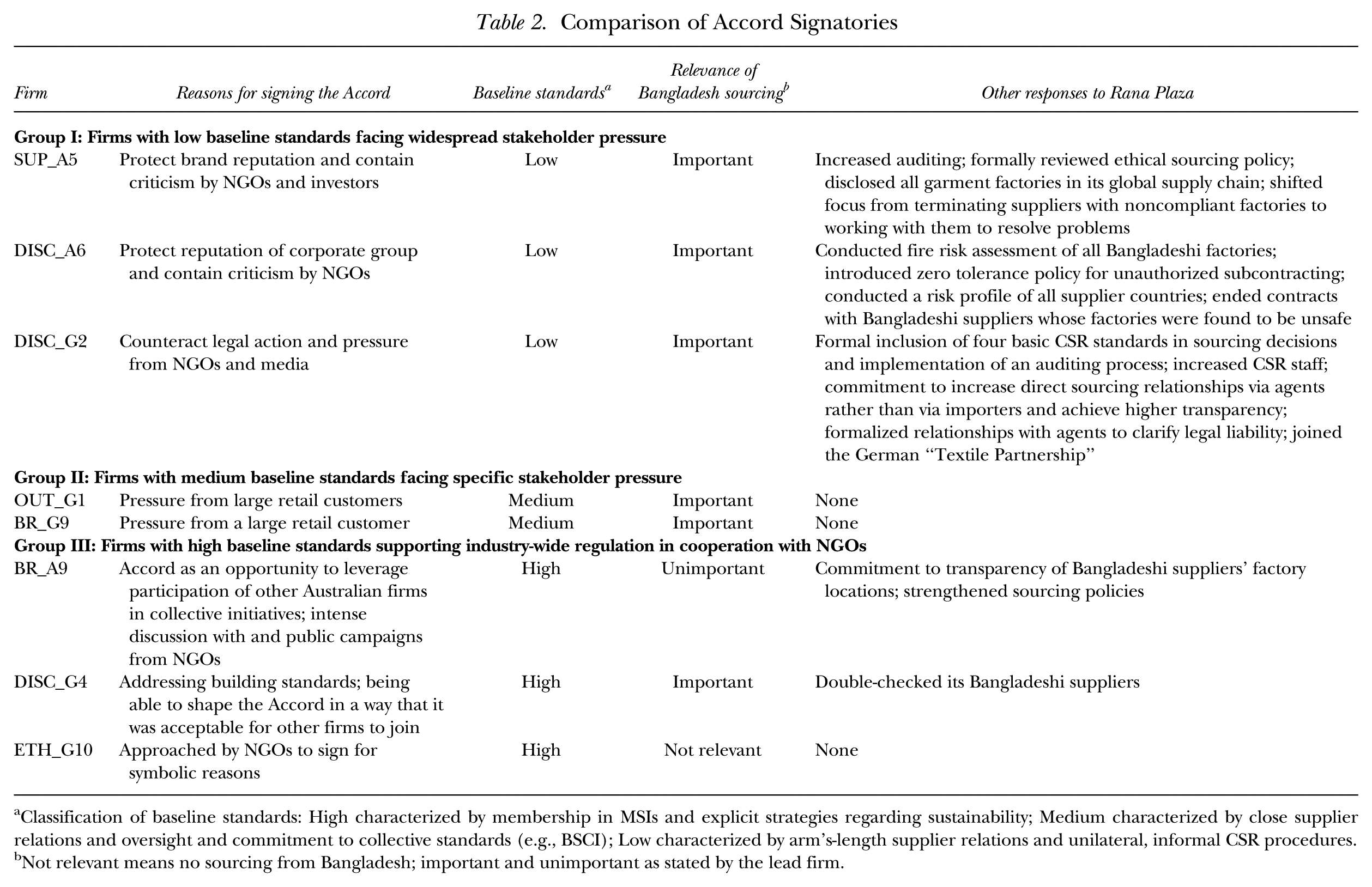
Classification of baseline standards: High characterized by membership in MSIs and explicit strategies regarding sustainability; Medium characterized by close supplier relations and oversight and commitment to collective standards (e.g., BSCI); Low characterized by arm's-length supplier relations and unilateral, informal CSR procedures.
Not relevant means no sourcing from Bangladesh; important and unimportant as stated by the lead firm.
Comparison of Non-Accord Signatories
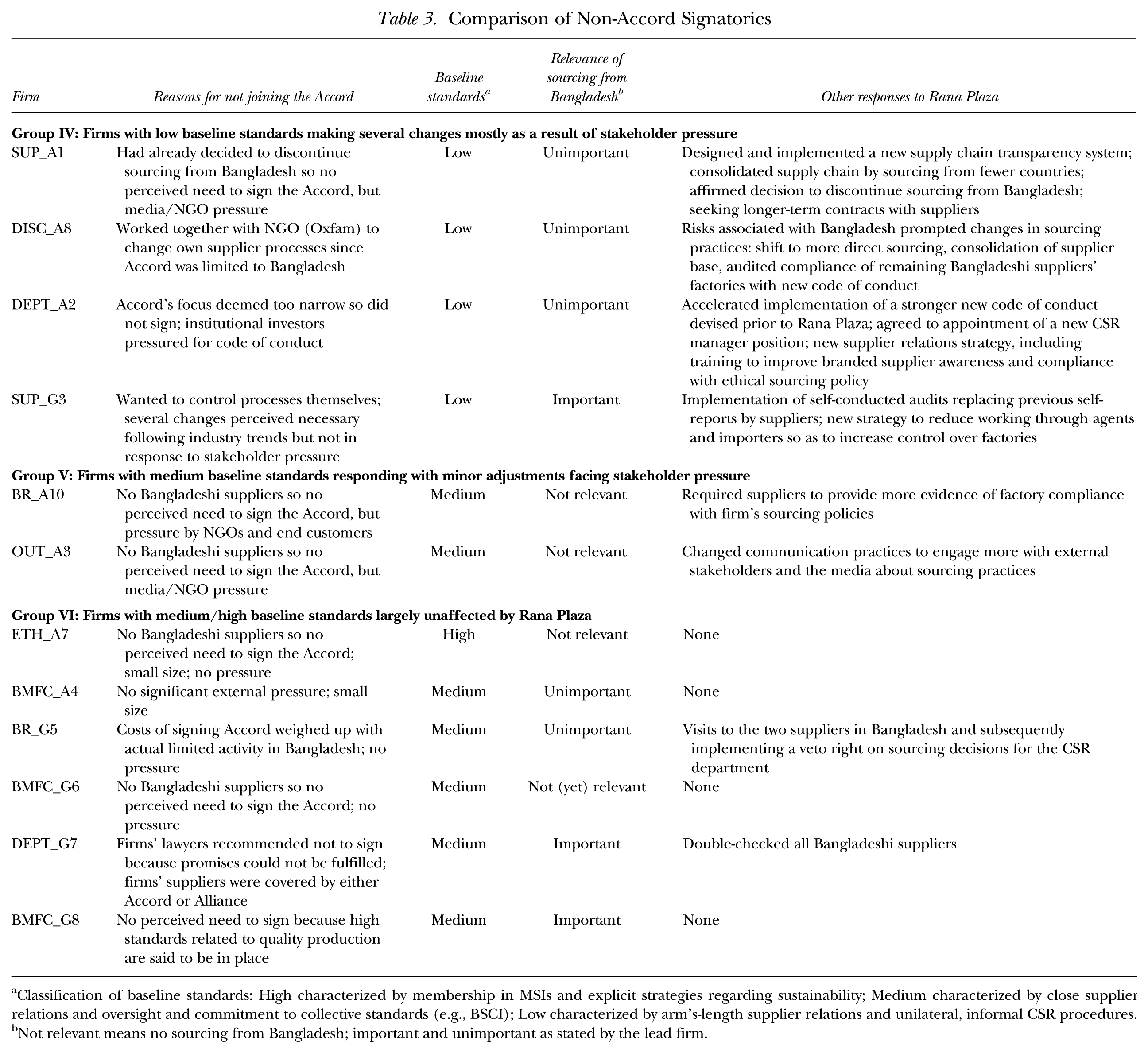
Classification of baseline standards: High characterized by membership in MSIs and explicit strategies regarding sustainability; Medium characterized by close supplier relations and oversight and commitment to collective standards (e.g., BSCI); Low characterized by arm's-length supplier relations and unilateral, informal CSR procedures.
Not relevant means no sourcing from Bangladesh; important and unimportant as stated by the lead firm.
Findings
Accord Members
Table 2 indicates that in our sample of 20 firms, we had eight Accord members, three Australian and five German.
Six of these firms claimed to source a significant proportion of their garments from Bangladesh, and two firms sourced an insignificant amount or none at all. Group I firms are characterized as those making various changes to their supply chains and sourcing policies in addition to signing the Accord. The group includes two Australian and one German firm. All are general retailers with low baseline standards prior to Rana Plaza. These companies sourced a significant share of their garments from Bangladesh and signed the Accord within two months of the disaster in response to intense pressure from consumers, NGOs, the media, and/or investors. The two Australian firms joined the Accord in response to threats to corporate reputation amplified by the media. According to the sustainability manager of SUP_A5, a supermarket that marketed private-label garments: The main objective of the policy . . . is to protect our brand. Our branding is very important to us. It’s the brand we’ve put on all our stores and customers come trusting that brand. So what we don’t want is anything negative to be associated with that which we can partly control to the extent that it’s possible. . . . If it’s in the media that’s the pain factor. . . . It’s the reputation risk.
This firm signed the Accord because managers believed that a collaborative, multi-stakeholder mechanism was necessary to maintain the firm’s legitimacy. According to the same manager: There’s literally no governance framework [in Bangladesh]—there’s one on paper but it basically never works because it’s not resourced. . . . A situation like Bangladesh, there’s not really one [that a] buying company can fix [on its own] so you have to all grow together to the same end.
The manager explained further that having union support for the Accord was a positive feature from a legitimacy point of view. A sourcing manager of DISC_A6, a large Australian general retailer, adopted a similar position: The American Alliance came later and was being portrayed by many NGOs and others as a—I suppose a poor second effort. . . . The Accord was being spoken about by NGOs as the appropriate forum and vehicle for retailers to have a positive change in Bangladesh in the wake of the Rana Plaza collapse and the Tazreen fire. So that was the [initiative] that we thought made sense for us to get involved with.
The German firm in this group, DISC_G2, was directly associated with the Rana Plaza disaster by the German media, as labels of this firm’s garments were found in the rubble. The company had been associated with earlier factory accidents and had avoided collective forms of regulation in the past because the standards, particularly those set by NGOs, were considered too high. But the company’s CSR manager explained that “with Rana Plaza, reality caught up with us.” Yet, reputational concerns were not mentioned as the main reason for signing the Accord. Instead, like SUP_A5, this firm emphasized the Accord as a vehicle for establishing industry-wide standards to which suppliers would need to conform. In addition, the CSR manager welcomed the Accord as a tool to persuade senior management to consolidate the firm’s supply chain: Since Rana Plaza there is a greater understanding in our firm that we cannot continue to increase the number of suppliers, because auditing is already very expensive. Now we can say that if we sign the Accord, we need to know who our suppliers are, because we are already in the line of fire.
These three firms also made changes to their sourcing policies and supply chain organization. SUP_A5 introduced a new ethical sourcing policy that included more frequent auditing of its Bangladesh factories supplying private-label garments. In addition, the firm changed its policy of terminating noncompliant suppliers to instead working with them to resolve problems and publishing the names and addresses of all garment and footwear suppliers, including those located in Bangladesh, on the firm’s website. Stronger supply chain transparency satisfied a prime NGO requirement and provided more opportunities for labor standards enforcement. DISC_A6 claimed that: There’s a lot that we can do better, not just in the ethical sourcing space, but just in the business space about cutting down the number of suppliers we work with, about becoming an easier customer to deal with. . . . One of the big things at [the Company] too is to reduce our [product] range. So we reduce our range and have more depth in each product that we sell. This will also help in terms of working with our suppliers. It gives us more volume [from the preferred suppliers], makes the factories more efficient, all that sort of thing.
DISC_G2 also revised its sourcing policies by introducing the various initiatives outlined in Table 2. The CSR manager explained that these changes mean that “we have now at least caught up with the industry standard regarding sustainability.”
This quote sums up the common denominator among Group I firms: As general retailers with no specialized experience in garment manufacturing, these companies did not exercise strong oversight over their supply chain processes prior to Rana Plaza, and consequently, their baseline labor standards policies were weak. Rana Plaza attracted public attention to these firms, which were previously not targeted by activists or consumers, pressuring them to review and revise their labor standards. This included signing the Accord.
Group II firms comprised two German companies that claimed to source a significant share of their garments from Bangladesh and did not make any additional changes beyond signing the Accord. Both firms, OUT_G1 and BR_G9, are specialty-garment retailers with a history of garment manufacturing, one specializing in outdoor garments, the other in high-quality men’s garments. These firms are both well-known brands that emphasize close, long-term supplier relationships and quality products. They favor an informal approach to labor standards regulation that assumes high-quality production based on superior technical knowledge will be supported by satisfactory labor standards. With a focus on quality rather than on labor standards, these firms are not active in MSIs but are members of the BSCI, thereby fulfilling a widely accepted standard in the German retail industry. Managers of both firms claimed to support the Accord because “it allows us to check our suppliers on safety issues that the BSCI does not cover” (correspondence, BR_G9). The managers conceded, however, that joining the Accord early resulted mainly from pressure by major (German) retailers to whom they supply garments and who had already signed the Accord. Both firms were confident that because of past achievements their supplier structures were satisfactory. A manager from BR_G9 implied that the threat of reputational damage following Rana Plaza had not increased because: We already were active after the Tazreen factory fire [in 2012] and examined our most important supplier sites in Indonesia, Vietnam, China, and Bangladesh through the Global Risk Consultants. Thus we knew [following Rana Plaza] that there wasn’t a heightened risk regarding our suppliers.
Group III comprises three firms, one Australian and two German, with a history of engagement in MSIs. Their business models continue to reflect a focus on sustainability. Although only one of these firms, DISC_G4, a discount retailer, sourced significantly from Bangladesh, all emphasized that signing the Accord was a means of establishing industry-wide labor standards through collective action, a strategy designed to minimize recurring violations. BR_A9 is an Australian firm marketing high-quality specialty and basic fashion items. Prior to Rana Plaza, NGOs recognized BR_A9 for having relatively strong labor standards policies based on its supplier code of conduct and its membership in a reputable MSI. Nevertheless, the incident posed a potential risk for the firm, as a sourcing manager explained: You think about the Rana Plaza scenario and the sort of implications that could have on a business like ours would that have been one of our factories. [This] is not something to just easily dismiss from a risk point of view.
In addition to joining the Accord, this company made changes to its sourcing policies including disclosing the names and locations of its Bangladeshi suppliers’ factories on its website. These changes occurred mainly in response to external pressure: NGOs organized a petition with several thousand signatures demanding the firm join the Accord. This demand was widely reported in the media. The ensuing decision to become an Accord member was based on anticipated benefits flowing from inter-firm cooperation and learning. According to BR_A9’s quality manager: One of the underlying reasons for actually participating in the Fire and Safety Accord is the leverage that we can have partnering with other buyers who may source from the same factory . . . to actually drive some of the improvements that we want to make.
BR_A9 managers also anticipated reduced risks to supply chain operations and brand reputation. DISC_G4, like several other German firms, mentioned that it had already changed its supply chain structures in response to previous disasters. Excepting building standards, these firms claimed to have implemented effective processes. However, to rectify the gap in building standards regulation, Rana Plaza prompted the firm to join the Accord, whose previous draft the firm already supported. This company claimed there was no stakeholder pressure except for customer requests to explain some of their activities. By contrast, ETH_G10 was asked by NGOs to sign the Accord to send a positive signal of endorsement to other firms in the industry.
Non-Accord Members
As indicated in Table 3, seven Australian and five German lead firms did not join the Accord.
Group IV comprises four large general retailers (three Australian, one German) with low baseline standards. These firms responded to Rana Plaza by revising their sourcing policies and supply chain structures, but they decided against signing the Accord. The main reason for the three Australian firms not signing the Accord was that sourcing from Bangladesh was very limited. Yet, the media associated these firms with global labor standards problems and pressed them to publicly respond in other ways.
SUP_A1 sold branded garments and more recently private-label items (mainly basic garments), sourcing from only one Bangladeshi factory prior to Rana Plaza. Reducing brand risk and improving ethical investment ratings were major objectives, so the company decided to re-affirm an earlier decision to cease sourcing from Bangladesh and to source from fewer countries, including selecting suppliers on a longer-term basis. A new supply chain transparency system was introduced to “go further down into the supply chain to understand the standards that are operating within them right back to the source” (SUP_A1, sourcing and quality manager). Pressure from NGOs was the main reason for defining the problem as primarily one of brand defense: “The heat’s been turned up, not just for [SUP_A1] but for everybody,” particularly from Baptist World Aid, an NGO that researched and campaigned for higher supply chain standards and more transparency. This change rationale differed from the German firm SUP_G3, a large German supermarket that services the medium to low end of the garment market. Garments account for only a small proportion of the firm’s revenue. SUP_G3’s sourcing director referred to a trend toward more direct sourcing relationships in the industry, not because of social standards, but to see all aspects and work on improvements together with suppliers, to negotiate the right prices, because the money does not lie in the showrooms, but in the factories, and the aim is to identify aspects for improvement so that the buyer can source more cheaply and the supplier can benefit from these new advantages.
This manager argued that Rana Plaza provided an additional incentive to reduce the number of agents and move toward direct supplier relationships. This decision was more a matter of process control associated with supply chain innovation and efficiency than of limiting reputational damage, as the manager claimed not to have received any stakeholder pressure. Our media analysis confirms this statement.
Group V comprises two Australian firms with medium baseline standards that responded to Rana Plaza in a distinctive way, but not by fundamentally revising their sourcing procedures and supply chain structures. Again, as in Group IV, the two firms reported intense pressure from NGOs, the media, and in the case of BR_A10, also individual end customers, to change their sourcing practices despite not sourcing from Bangladesh. BR_A10 explained: We haven’t had to change anything because we haven’t had a problem as an outcome of an investigation, but yes, there’s been more work, because I will get Uniting Church, I’ll be going to get Baptist World Mission, I’ll get Oxfam, I’ll get World Vision . . . constantly ringing.
The third group of non-Accord member firms (Group VI) comprises two Australian and four German firms. These companies had medium to high baseline standards prior to Rana Plaza and claimed to be largely unaffected by the event, despite two of the German firms in this group sourcing large volumes of garments from Bangladesh. All three brand manufacturers in our sample are in this group. No stakeholder or media pressure was applied to these firms, possibly because their quality was perceived as signifying the presence of acceptable labor standards or, as in the case of the department store DEPT_G7, they were not perceived as participants in global sourcing despite having a strong private-label line. BR_G5, a publicly owned firm that sells moderately priced women’s fashion garments and has two Bangladeshi suppliers responsible for less than 10% of its sourcing volume, nonetheless changed its internal sourcing policies in response to Rana Plaza. The sole CSR manager of this company saw the event as an opportunity to increase her influence by achieving a veto right on supplier selection decisions.
Explaining Response Patterns and Cross-National Differences
The six groups of lead firms discussed above are shown in Figure 1 in relation to their baseline standards (x axis), which relates to their response patterns (y axis). The figures in brackets refer to the numbers of firms, signified also by the width of the bars. An arrow indicates that the Rana Plaza disaster resulted in a shift from low toward at least medium labor standards among the firms in our sample. Note that firms with higher baseline labor standards prior to Rana Plaza are less likely to have required significant changes compared to those with lower standards.
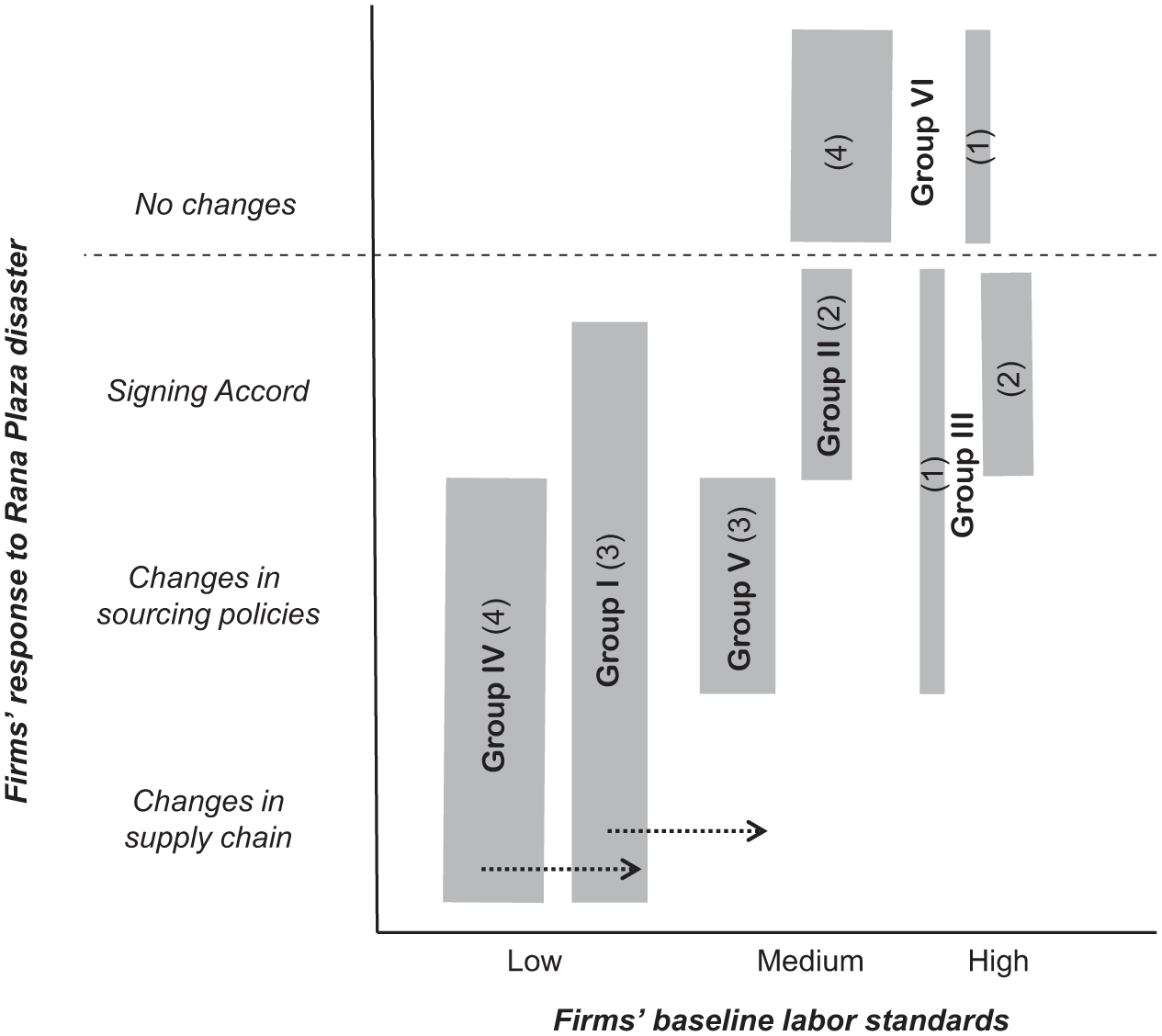
Firms’ Labor Standards Policy Changes in Relation to Rana Plaza
Excepting Group II, which comprises only German firms, and Group V, which is restricted to Australian firms, we find similar response patterns in the two countries: Firms with the lowest baseline standards made the most far-reaching changes. However, the dynamics of contestation behind firms’ responses differed to some extent across countries, particularly regarding the ways in which stakeholder pressure was applied. These differences reflected Germany’s longer experience with global sourcing and existing alternative collective regulation.
Rana Plaza triggered the strongest response among firms that had not been participating in any collective labor governance initiative and had little oversight of their supply chains prior to Rana Plaza, working mostly through intermediary agents or importers (Groups I and IV). All firms in these groups were general retailers who often discount their products and who had previously avoided NGO scrutiny. Rana Plaza was a strong signal for these firms to develop socially acceptable labor standards policies and to consolidate their supply chains (see Figure 1). Whether these firms signed the Accord depended largely on whether they actually sourced garments from Bangladesh. NGOs, especially Baptist World Aid and Oxfam, together with the Textile Clothing and Footwear Union of Australia (TCFUA) and institutional investors, were important in prompting Australian garment firms, regardless of whether they sourced from Bangladesh, to make various changes. By contrast, only those German firms found to be sourcing from the Rana Plaza building were frequently reported in the German media immediately following the disaster. These firms specialized in marketing low-priced, basic garments and had escaped NGO targeting in the past because they served mainly lower-income customers who were strongly concerned about price. This opinion changed because several discount retailers could be tied directly to the Rana Plaza building, leading to a public critique of their practices.
Cross-country differences are also notable regarding Groups II and V. German firms in Group II signed the Accord in response to pressure from retail clients, a pattern we do not see in Australia. Australian firms in Group V were pressured by NGOs to change their sourcing policies despite already being committed to ILO core labor standards and not sourcing from Bangladesh, a pattern we do not observe in Germany. Our interviews with stakeholders revealed that for NGOs in Australia, Rana Plaza opened the policy window on a significant moral issue for garment brands and retailers that had so far avoided local media headlines. This circumstance reflected the weakness of an established CSR discourse in Australia. As a BR_A9 manager shared: What we’re also seeing here in Australia is, I think, a bit of a catch-up in terms of the awareness around corporate social responsibility. The growing interest in this space in Australia . . . in the last twelve to eighteen months has been quite astounding. Because whilst in the EU and the US this has kind of been the norm where you get all sorts of stakeholders showing interest and expecting some form of reporting, here in Australia I think that’s something that’s to come for us.
The Accord was welcomed as a regulatory instrument that firms could use to alleviate the risk of reputational damage in the absence of strong regulatory alternatives in Australia, regardless of whether lead firms were actually implicated in Bangladesh. Australian firms highlighted continuous and constructive engagement with NGOs, seeing them mainly as knowledgeable partners whose advice they valued, including whether to sign the Accord.
By contrast, many large German garment retailers already adhered to a collective, albeit unilaterally determined, set of labor and environmental principles, the BSCI. Excepting one ethical firm, only those German firms that sourced significantly from Bangladesh signed the Accord, which was seen as a complement to extant regulations because of its focus on building standards. NGO and media pressure focused on a few discount firms and, possibly because they were not publicly listed, brand reputation was not a major concern among the German firms in our sample. Instead, with few notable exceptions, German firms preferred to retain unilateral control over supply chain issues, repeatedly stressing the adverse effect of “excessive demands” by NGOs in MSIs, including the German Textile Partnership, which many German firms view unfavorably.
Across both countries, firms in Group VI that sourced from Bangladesh and had medium or high baseline standards were not pressured by stakeholders, possibly because their brands signaled acceptable standards and most were small and privately owned, therefore less subject to public scrutiny.
Discussion and Conclusions
Previous research has indicated that the Rana Plaza disaster opened a policy window at a transnational level, particularly through the establishment of the Accord, which was anticipated to significantly improve Bangladeshi building safety standards and to introduce norms of joint regulation and transparency (Anner 2015; Reinecke and Donaghey 2015; Donaghey and Reinecke 2017). Our findings indicate that, more broadly, Rana Plaza encouraged reconsideration of garment lead firms’ sourcing policies and supply chain structures, often beyond a concern for improving building safety in ways that might benefit labor standards. This reconsideration suggests that Rana Plaza also opened a policy window at the firm level—not only among firms that sourced from Bangladeshi factories but also among those associated with low baseline standards who were susceptible to reputational damage, and others who used the event to support a stronger sustainability orientation on a firm and industry level.
We observed a general tendency among garment retailers to replace transactional, market-based relations with more direct, longer-term, relational sourcing relationships. These arrangements were intended to gain more control over firms’ supply chains and to limit reputational risk, which was accelerated by the disaster. Thus, the impact of a focusing event on labor standards might be mediated by extant global value chain governance configurations (Gereffi et al. 2005; Lakhani et al. 2013), while at the same time contributing to changing these configurations. We also noted that some firms, both those with previously very low labor standards policies and those pursuing a “high road” sustainability strategy, appreciated the multilateral nature of the Accord as setting a level playing field for global competition. This view, however, is not shared widely among the lead firms in our sample, several of which preferred to retain or return to unilateral determination of labor standards. Rana Plaza thus constituted a focusing event that had a diffuse rather than a concentrated effect in terms of the closer scrutiny it generated on lead firms’ labor standards policies across the garment industry.
Building upon extant theory that emphasizes the role of industry characteristics and firm–stakeholder interactions (Marx 2008; Fransen and Burgoon 2012), our findings largely confirm the role of these different factors in driving firms’ support for stronger labor standards regulations. We add the importance of temporal dynamics following a focusing event, which can activate stakeholder pressure for previously untargeted firms and provide micro-political opportunities for firm-level policymakers to promote change. For instance, the extant literature claims that general retailers and discounters typically receive little stakeholder pressure regarding labor standards issues from NGOs or consumers (Bartley and Child 2014). Rana Plaza changed this pattern by legitimizing the public targeting of these firms, which were then quick to respond. This finding is attributable to a combination of having exercised little oversight of production in the past and perceiving negative spillover effects into non-garment sales. A focusing event thus has the potential to overcome the influence of specific structural factors on a firm’s labor standards policies; in our case, making general retailers and discounters vulnerable to reputational damage.
Our findings also inform the debate about which aspects of national political economies influence firms’ labor standards policies (Kang and Moon 2012; Fransen 2013), again pointing to the value of a temporal perspective, particularly regarding industry development and the history of firm–stakeholder interactions. National political economy factors can help to address the empirical puzzle of why some major (especially Australian) retailers signed the Accord even though they did not source from Rana Plaza and sourced only very limited amounts from Bangladesh, and why other major (especially German) retailers did not sign the Accord, despite sourcing extensively from Bangladesh. In Australia, the long-standing protection of the local garment industry by trade barriers meant that lead firms came relatively late to offshoring production; suppliers’ labor standards were not considered a problem (Weller 2007). By contrast, many German brand marketers and manufacturers revised their labor standards policies in the early 2000s in the light of emerging EU norms and NGO activism. Several German retailers had anticipated the possibility of a focusing event such as Rana Plaza causing reputational damage, having experienced similar but less severe events in the recent past, particularly the 2012 Tazreen fire that was frequently mentioned in interviews. Many German firms’ responses thus focused more narrowly on signing the Accord to address building safety concerns, rather than revisiting their sourcing and labor standards policies more broadly. By contrast, Rana Plaza constituted a wake-up call for Australian firms, which had remained outside NGO and media scrutiny regarding labor standards issues in the past. In the light of these historical differences, Rana Plaza meant that stakeholder pressure was exerted quite narrowly on a small group of firms in Germany, but provided the catalyst for widespread NGO and media action in Australia, drawing investor and consumer attention to Australian lead firms’ general neglect of suppliers’ labor standards. NGOs and unions, including the TCFUA, increased the salience and breadth of the problem beyond building safety by associating lead firm behavior with labor exploitation, regardless of whether lead firms sourced from Bangladesh.
The limited history of activism regarding supply chain labor rights in Australia also meant that lead firms had relatively favorable relations with NGOs, who pursued a collaborative strategy and were able to bring expertise and moral legitimacy to the relationship. Our findings thus support and extend Bair and Palpacuer’s (2012) argument that NGO activism varies cross-nationally, pointing to the role of an industry’s history in providing different opportunity structures for stakeholders following a focusing event.
Informing the broader debate on emerging labor governance institutions on different levels (e.g., Marginson 2016), our findings indicate national regulatory alternatives also played a role in shaping firms’ attitudes toward new transnational initiatives. Most notably, the establishment of the Textile Partnership, which included BSCI members, was a reason for several German firms to not join the Accord or to instead change sourcing policies in other ways. Although some German firms welcomed the Accord as a new collective regulatory instrument, most German Accord members in our sample joined in response to specific pressure.
Our study has three main limitations that indicate possibilities for further research. First, we were unable to analyze changes in policy implementation, the influence on suppliers’ practices, and the labor conditions of workers employed by suppliers at the first tier level and beyond. These analyses require deeper and longer access at lead firm and supplier levels, a challenge we are currently pursuing. Second, our study highlights ways in which theories based on large-n studies of firms’ labor standards governance approaches (Bartley and Child 2007; Marx 2008; Fransen and Burgoon 2012) can be questioned and refined, for instance, regarding the role of baseline labor standards and cross-national variation in stakeholder strategies. Given a lack of available garment enterprise population data, medium-n studies using qualitative comparative analysis methodology might be promising in this regard. Third, an extension to other national economies, particularly the United States, where several lead firms signed the Alliance rather than the Accord, promises additional insights regarding changes in lead firm labor standards policies.
It is too early to judge whether Rana Plaza has triggered a paradigm shift in labor standards governance beyond the firm level, particularly in light of a difficult process of renewing the Accord. Nonetheless, given the problem-focused and policy-oriented traditions of industrial relations scholarship (Kochan 1998), and acknowledgment that key events such as the 1911 Triangle Shirtwaist Factory fire in New York and the 1984–85 Miners’ Strike in Britain initiate significant changes in regulation, there is potential in focusing event framing. Such framing facilitates additional, more-detailed investigation into the politics of mobilization; the creation of meaning attached to emerging problems, contestation, and decision making leading to particular outcomes; and the multi-level consequences of a focusing event over time.
Footnotes
Appendix
Interviews, Documents, and Observational Data
| Australia | Germany | |
|---|---|---|
|
|
||
| Firms | 15 interviews - SUP_A1 (1, Ethical sourcing manager, in person) - DEPT_A2 (2, Sustainability manager, CSR manager in person) - OUT_A3 (2, Sustainability manager, purchasing manager, in person) - BMFC_A4 (2, Purchasing manager, in person [interviewed twice]) - SUP_A5 (1, CSR manager, in person) - DISC_A6 (2, Corporate affairs manager, sourcing and quality manager, in person) - ETH_A7 (1, Managing director, phone) - DISC_A8 (1, Sourcing and quality manager, in person) - BR_A9 (2, Ethical sourcing manager, purchasing manager, phone) - BR_A10 (1, Purchasing manager, phone) |
11 interviews - OUT_G1 (1, CEO and sourcing director, phone) - DISC_G2 (2, Head of CSR and CSR manager, in person) - SUP_G3 (1, Director purchasing non-food, phone) - DISC_G4 (1, Category Leader Corporate Responsibility Product & Strategy, phone) - BR_G5 (1, Social compliance manager, phone) - BMFC_G6 (1, Head of supply chain controlling, phone) - DEPT_G7 (1, Director technical product management, phone) - BMFC_G8 (2, Chief operating officer, phone and in person [interviewed twice]) - BR_G9 (0, Chief operating officer and CSR manager, in writing) - ETH_G10 (1, Director corporate responsibility, phone) |
| Experts | 15 interviews | 13 interviews |
| - NGOs (7) |
- NGOs (3) |
|
|
|
|
|
|
|
||
| Firm level | Website, annual reports, CSR reports, NGO and media analyses of individual firms, firm rankings | |
| Industry level | - Industry data published by the Australian Bureau of Statistics |
- Industry data published by the Federal Statistics Office, by industry associations, and by trade unions |
|
|
||
| Industry events | - NGO forum on labor standards (03/16) | - Major fashion trade show, including an ethical fashion show (01/15) |
| Other | None | - Foreign Trade Day of the German Textile and Garment Industry organized by the Ministry of Economics and the main garment industry association (03/15) |
Acknowledgements
We are particularly grateful to Jennifer Bair, Gregory Jackson, Nora Lohmeyer, Juliane Reinecke, and Jörg Sydow for comments on previous drafts. Thanks also go to Laura Good, Xiaoyu Guan, Tony Guo, Anna Hutfils, and Ina Koch for research assistance. We also thank Johannes Kepler University Linz for covering the cost of open access publication.

Earlier versions of this article have been presented at a Freie Universität Berlin research seminar 2015; the British Journal of Industrial Relations (BJIR) conference on Corporate Social Responsibility (CSR) and Labour Standards at the London School of Economics (LSE) 2015; the International Labour and Employment Relations Association (ILERA) conference in Cape Town 2015; and the Wissenschaftliche Kommission Organisation conference in Hamburg 2017, and we are thankful for the useful comments we have received.
For information regarding the data and/or computer programs utilized for this study, please address correspondence to the lead author at