



Abstract
The state of Kerala is experiencing an influx in migration from the northern states of the country for the past decades. In order to study the present migration trend, the article attempts to analyse the wages, employment and working patterns of inter-state migrant workers. The article also compares the condition of inter-state migrant workers to that of the native workers. This study looks at the types of work that migrant workers are engaged in. It examines the inequality faced by the migrant population compared to the native workers. The study also puts forward how it is important to bring a decent work standard for inter-state migrant workers so that it can reduce the inequality and discrimination faced by them.
Introduction
Kerala is a southern state in India which is known for its achievements in social indicators, and the ‘Kerala Model of Development’ is much discussed in the development discourse. Migration has brought a profound impact on the socio-economic, cultural and political aspects of the state as well. It is important to look at the migration trends in the state of Kerala and how the state treats inter-state migrants. The role of the state to protect the rights and welfare of the migrants is very important, especially in a state like Kerala where it has witnessed labour movements and political mobilisation of labourers. The significance of social reform movements is also very much crucial. People moving to Kerala from other states and people migrating out to other states and abroad have been part of the development process of the state. It is important to observe the recent trends in migration, especially inter-state migration to Kerala and study the employment patterns of the migrants.
The internal migrants are poor and they come from backward communities unlike international migrants. Studies have shown that migrants are predominantly from the lower social strata of Scheduled Castes, Scheduled Tribes and Other Backward Classes, and a majority of them are illiterate, landless labourers and marginal farmers (Deshingkar & Start, 2003). This is related to low educational status and poorer asset base of the social groups. Migration is common among the dalits and tribals as per some studies (Datta, 2020; Rao & Mitra, 2013). The inequalities and difficulties faced by migrants are taxing to their work life. An important source of exclusion faced by the inter-state migrants is the categorisation of the migrants as ‘others’ by the host population. The identity-based discrimination has deeper structural dimensions. There is a need for migrant support system to deal with their welfare and protection (Krishnaraj, 2005). Because of their ignorance and lack of political awareness, it becomes vital to make them aware of their rights as workers. The migrant workers are also unaware of their labour rights which need to be formalised in the jurisdiction.
Profile of Migrant Workers in Kerala
The inter-state migrant workers in Kerala have become an integral part of the economy, and they have become one of the wealth creators in the state. It is estimated that more than 25 lakh inter-state migrant workers are there in the state according to the study by the Gulati Institute of Finance and Taxation (Venkiteswaran & Narayana, 2013), whereas there are 22.8 lakh emigrants living abroad as per the 2011 Migration Survey (Rajan & Zachariah, 2012). It is interesting to look at the factors that led to the present migration trends in the state. The state has experienced a mass migration of unemployed labour force from the early 1970s, especially to the Gulf countries and some Western countries. This was due to factors like the loss of jobs in agriculture, other productive ventures and increase in educated people and demographic transition. Increase in literacy of the people led to rise in educated unemployment in the state. Rise in unemployment along with the migration of the educated manpower created a shortage of skilled manpower in the state. It can be said that the state failed to provide enough productive ventures and job openings for the educated people in the state and they decided to move to urban centres and cities in other states in India and abroad (Nair & Gopinathan, 1989). This created a gap in the labour force in Kerala. Even the educated people were reluctant to take up semi-skilled and unskilled jobs in the state. The state also failed to provide enough productive ventures to the educated people. Fall in agricultural output along with a shift in employment from primary to secondary and tertiary sectors led to a structural change in the employment sectors (Prakash, 1998). At the same time, dichotomy in the labour market for formal/organised and informal/unorganised sector jobs has also created a shift in the demand for labourers.
The state of Kerala is experiencing a demographic transition as the fertility and mortality rates have come down and the working age population has increased. Infant mortality rate in Kerala is low; the life expectancy was higher in the state (72.2%) for males and (78.2%) for females in 2011–2015; fertility rates had fallen to 1.6 in 2015–2016. The combined fall in mortality and fertility rates has resulted in a decline in the growth rate of the population. Migration is an important phenomenon that can significantly alter the population scenario in the state. There is a rise in the ageing population and a fall in the young population (0–14 years) during the past three decades. Therefore, the pressure on the working-age population is so much that they are forced to migrate out for better employment and higher wages. It can be said that the international migration is likely to decrease due to the nationalisation schemes, and inter-state migration from Kerala has also been declining (Rajan et al., 2018). However, due to limited scope of employment prospects within the state, the propensity to migrate is likely to increase. This calls for a rigorous and smart investment in the employment market by the state.
The concept of replacement migration has also been introduced in the migration literature in order to explain the reasons for the flow of inter-state migrants into Kerala. Replacement migrants are temporary workers who came to Kerala from other states to take up work, especially in the field of non-agricultural, construction and service sectors. They are called as replacement migrants as they are thought to be replacing the workers from Kerala who have migrated to the Gulf and other parts of the globe. The emigration of workers to the Gulf and other foreign countries has created a demand for labour in the market (Arun, 2017). The replacement migration trend is likely to increase in the coming years because of increased migration to states outside of Kerala and foreign countries.
Objectives
The present paper focuses the migrant workers, employed in the construction sector in Kerala. It analyses the type of work, wages and employment status of the migrants in the state in order to get an understanding of their position in the employment structure and compares it with that of the native workers in the construction sector. The study also explores the different categories of work undertaken by migrants and native workers in the construction sector. The article also focuses on the work status and employment of the migrant population in the light of inequality that exists in the workspace.
Sample and Methodology
The empirical analysis of the study is based on primary data collected from migrant workers and native workers who were employed in the construction sector. A migrant worker is defined as a person who works in Kerala, which is not his home state, for a period of not less than six months. The research is conducted in Ernakulam district of Kerala. This district has the largest percentage (21.19%)of migrant workers in the whole state. The construction sector has been chosen as the unit for analysis because 18.8% of the migrant population is employed in the construction sector (Economic Review, 2018).
Random sampling is done to select the migrants working in the construction sector in the state. A blend of both quantitative and qualitative methods was employed for the study. An interview schedule is used to collect information from the migrant and native workers. The quantitative and qualitative techniques include interviews with open-ended questions to get additional details. Data on 200 migrant workers and 100 native workers have been collected for the study. While doing the fieldwork, the snowball technique of sampling was employed in which information about the migrant workers’ whereabouts was provided by the earlier set of migrants interviewed. The workers belonged to both skilled and unskilled categories. The workers belonged to all categories of labour which included daily wage earners, contract labourers and task-based workers who were working in minor construction projects like construction of houses and small buildings.
Theoretical Understanding of Migration
Migration is too diverse and multifaceted to be explained by a single concept and theory. Several attempts have been made by theorists to contextualise and explain migration in terms of various theories. More recent attempts to blend deductive with inductive reasoning have led to a variety of middle-range theorisations which resonate more closely with the realities of migration today (King, 2013). The theories of migration are mainly associated with wage differentials. But there are other theories which contextualise the migration process in terms of market conditions, structures and networks. Important theories among those are the segmented labour market theory and the institutional theory.
The Segmented Labour Market theory states that wage differentials are not a result of underlying skill differentials, but rather a direct consequence of the ‘dual’ nature of the market. Duality in the labour market implies that all jobs belong to either the primary sector (skilled workers) or the secondary sector (unskilled workers) of the labour market. The primary sector contains all the good jobs, normally to be found within firms with internal labour market structures, where institutional rules are substituted for market purposes. These jobs are characterised by high negotiated wages, economic security and rapid turnover, leading to career advancement. The secondary sector, on the other hand, contains bad jobs which are typically unskilled, offer no regular career ladders and wage rates are low and determined competitively (Leontaridi, 1998, p. 69). The theory uses job characteristics to define segments. Segmented Labour Market theorists like Pigou and J. S. Mill (1909) believed that often labour markets will fail to clear. J.S. Mill analysed the effects of social class and education as being important determinants of ‘pre-market segmentation’ which is a result of the attributes acquired by the workers prior to entering the workforce. Jobs can be roughly divided among those with low wages, bad working conditions, unstable employment and little opportunity for advancement (secondary jobs) and those with high wages, good working conditions and opportunities for advancement into higher paying jobs. As a result, it is suggested that the mechanisms governing wage and employment determination differ among the segments. Pigou (1945) argued that ‘labour is not perfectly mobile within the centres of production’ and that labour markets are segmented not just due to the skill differentials but also due to their restricted movements within segments and centres.
The new institutional economics theory, the term coined by Oliver Williamson has emerged in Coase’s article ‘The Nature of the Firm’ (1937). The most commonly used definition for institutions is a set of formal (laws, contracts, political systems, organisations, markets, etc.) and informal rules of conduct (norms, traditions, customs, value systems, religions, sociological trends, etc.) that facilitate coordination or govern relationships between individuals or groups. Institutions provide for more certainty in human interaction (North, 1990). Institutions have an influence on our behaviour and therefore on outcomes such as economic performance, efficiency, economic growth and development. Institutions are humanly devised constraints that shape human interaction, and it is the framework within which human interactions take place. It includes any form of constraint that is formal (rules that human beings devise) or informal (conventions and codes of behaviour which evolve organisationally over time). Migration is identified as a channel of transmission between institutions and economic outcomes. This theory can be used to analyse how and why institutions emerge within a society. It studies how the institutions interact within society and how it affects society. The theory is used to observe how the institutions influence the society and its stakeholders. This theory is an extension of the neo-classical theory. Coase (1998) says that the firms exist because of transaction costs, if that is zero then, the firm, money and public institutions become irrelevant. Firms take the cost for their services and this is decided by the market mechanisms. Institutional economics emphasises a broader study of institutions and views markets as a result of the complex interactions of these various institutions, for example, individuals, firms, states and social norms. North (1990) says that institutional change will occur at those margins which are considered the most pliable in the context of the bargaining power of interested parties.
Wages and Work Status
The inter-state migrant workers are employed in all sectors of the economy in Kerala. These workers are found in every corner of the state, irrespective of rural or urban areas. The migrant workers are spread in agriculture, manufacturing, construction, hotel and other service sectors. In the case of the construction sector, migrant workers are employed mainly as unskilled workers. Majority of the construction workers are employed as helpers who do not require any skill or training.
In the state of Kerala according to the 1991 Census, 62.4% migrants were from Tamil Nadu, 14.2% from Karnataka and 2.4% from Andhra Pradesh; Census 2001 showed that 67.8% were from Tamil Nadu, 13.5% were from Karnataka and 2.29% from Andhra Pradesh. These workers were engaged broadly on a contract basis and those seeking work in labour market on a day-to-day basis. It is estimated that the number of emigrants from Kerala living abroad in 2011 was 2.28 million according to the Kerala Migration Survey, 2011, by CDS (2012). At present, 41.39% of migrants who work in Kerala are from West Bengal, 14.36% from Assam, 10.73% from Odisha, 10.13% from Bihar and 9.01% from Tamil Nadu (Economic Review, 2018).
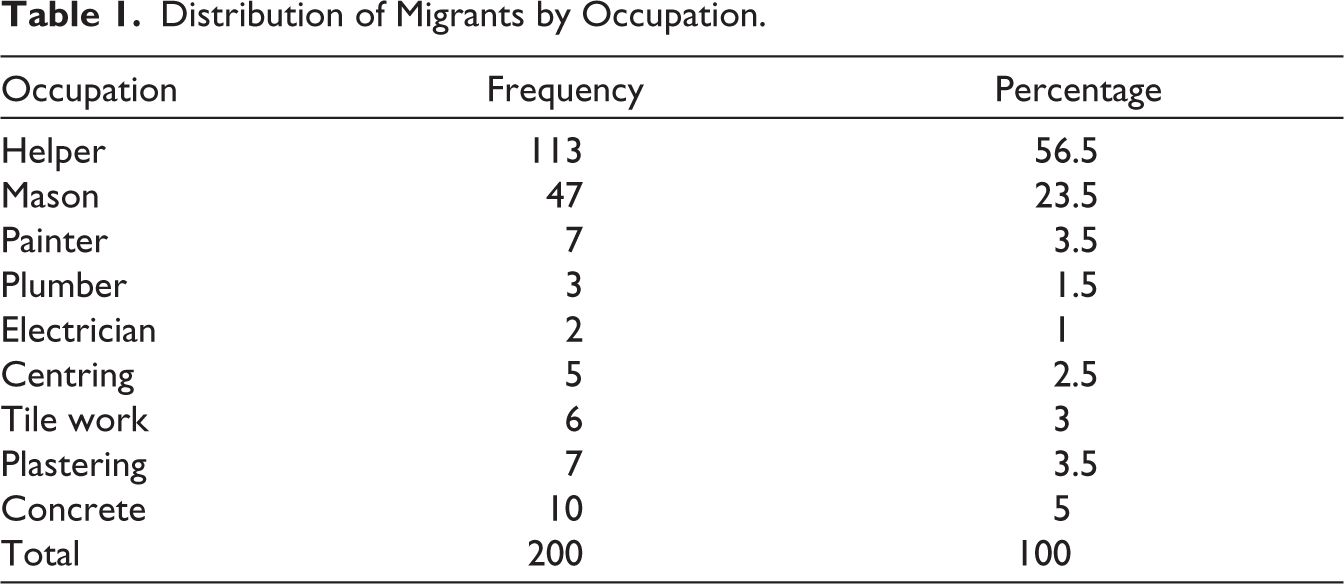
Table 1 shows that 56.5% of the inter-state migrants are working as helpers in construction sites, which means that they do not require higher skills. Among the migrants, 23.5% are working as mason; the remaining 20% are employed in skilled jobs within construction sector as painters, plumbers, electricians, tile workers and so on.
Distribution of Migrants by Occupation.
It is important to note that only the migrant population is employed for unskilled or semi-skilled jobs only and they remain in the lower jobs for the whole time. The migrant population is mostly employed in temporary occupations. Their lack of skills could be a reason for their employment in unskilled informal sector. According to studies conducted by GIFT (Gulati Institute of Finance and Taxation) and CMID (Centre for Migration and Inclusive Development), the inter-state migrants are mainly doing unskilled work in informal sector (Venkiteswaran & Narayana, 2013; Peter & Narendran, 2017). According to Economic Review (2018), daily wage rates of carpenters and masons had increased from ₹792.83 and ₹789.50 in 2016–2017 to ₹841.17 and ₹834.83 in 2017–2018, respectively. The average daily wage rate of unskilled workers increased from ₹179.01 for male and ₹123.96 for female workers in 2006–2007 to ₹656.79 for male and ₹480.90 for female workers in 2017–2018 (Table 2).
Daily Wages for Male for Casual Work.

Table 2 shows the different wages in different states in comparison to Kerala. In Assam, the daily wage in rural Assam is 41.33% lower than Kerala, and in urban Assam, it is 47% lower. Likewise, in West Bengal, daily wage in rural area is 36% lower, and in urban areas, it is 40% lower than in Kerala. The wage in rural Kerala is 40% higher than that of rural Uttar Pradesh and 43% higher than that of urban Uttar Pradesh. In Odisha, the rural wage is 36% lower than in Kerala and urban wage is 49% lower than in urban Kerala. From the table, it can be analysed that wage differences play an important part in migration. Several studies have made similar analysis while studying the migration decision (Kumar, 2016; Peter & Narendran, 2017).
It was observed that more than half of the migrant population is employed in the unskilled labour force. This affects the wages that they earn too. The migrant workers who are employed as construction workers also try to learn some skills so that they can earn better wages from the next year onwards. It is also vital to establish what determines the wages of the migrant labourers in the market. In the literature, there are several factors that determine the wages; it is usually the education status, years of experience, skills gained and so on. So the factors that influence the wages also need to be studied.
From Figure 1, it can be incurred that the wages of migrant workers start from ₹500/day. Figure 1 shows that 28% of the migrants are earning ₹700/day, 12.5% are earning ₹800/day; ₹600 and ₹700 are earned by 11% each. Whereas for native workers the wages are spread in the higher side of the graph where 28% of native workers earn ₹1,000, 19% earn ₹850 and 14% earn ₹900, respectively. Compared to the wages of Malayali population, wages of migrant population are lesser. This clearly points out the wage differences of inter-state migrants in the construction sector.
Wage of Inter-state Migrants and Native Workers in Kerala.

Construction sector employs a large number of migrant workers in the informal sector. Many of the migrant people work on daily wage basis. They move from one place to another in search of jobs through their social networking. There are a lot of imperfections in the labour market of the migrants such as asymmetry in the information, presence of intermediaries, wage differences and so on. The classical and neo-classical theories of migration mainly talk about the wage differences as an important determinant of migration. But they do not account for these imperfections in the labour market. The collective bargaining through trade unions can reduce the risks involved in wage differences. But among the migrant workers in Kerala, the presence of trade union is negligible or absent. The migrant workers are unorganised and there is a significant difference in the wages of migrant and non-migrant workers. The migrants are ready to work for any wages that their employers offer and this could be for two reasons: first, the wages in Kerala are higher than the wages that they received in their villages or elsewhere in their own states; second, they want to get work on a regular basis so that they are reluctant to bargain. There occurs a general consensus among the workers and their employers on the wage rate as the employers also want to retain their workers for a longer time and the workers are also satisfied with their wages.
Employment and Unemployment Among Labourers
The employment status of the migrants throws light on the type of work which the migrants are engaged in. Several studies show that inter-state migrants unlike international migrants come from poorer backgrounds (Deshingkar, 2006b). Their social and economic status is inferior compared to the international migrants. Rural–urban migration is a major trend in the migration process as people from rural areas move to urban centres in search of better occupation and employment prospects. Better jobs and better incomes are something that the migrants and prospective migrants look for when they make a decision to move (Bhagat, 2011).
Figure 2 shows the different types of jobs that the migrants and native workers are engaged in the construction sector. Daily-wage workers are those workers who work on daily basis. These workers assemble in a particular area called labour naka (junction) where their employers can come and pick the number of workers required for work by fixing their wage for that day’s work. The next day these workers assemble again at the same place to be called for work by some other persons. Contract workers are those who work with a contractor. Even their wage is fixed on wage-per-day basis but working with a contractor will ensure them with consistency of work than searching for work on their own. Task-based workers are those workers who perform particular tasks like tilework, electric work, plumbing and so on. These workers fix their wages on per-day basis till that task (contract) is finished. There are these three categories of workers in the market within migrants. Figure 2 shows that among migrant workers 58% of the workers are daily wage workers; 31.5% are contract labourers and 10.5% aretask-based workers, whereas among native workers 79% are contract workers, 4% daily-wage workers and 17% are task-based workers. More than half of the migrant workers are daily wage workers and more than half of native workers are contract workers. This means that migrant workers have lesser employment security and higher risk in securing employment compared to those of native workers.
Type of Employment.

A migrant labourer from Assam says that ‘I came to Kerala seven years earlier as a helper in the construction site. I came with a friend from my village. I worked as a helper for two years and I earned Rs 500 per day. Now I am a mason and I get Rs 900 for one day. I work with a contractor and I am getting work on a regular basis. When I go home, I bring my friends with me to work here. The money that I get here is much more than what I earn in my village. Even though I am not with my family here and I miss my village, but now I have to stay here (in Kerala) to look after my family and children back home’.
The urban unorganised sector provides easy access to different employment opportunities to rural migrants as well as for the deprived sections of urban society (Srivastava & Sasikumar, 2003). The migrants are mostly available as casual footloose labourers and they face issues like exclusion and inequality in the destination states. The work opportunities of the migrant workers are restricted and their participation in the labour market operates around prevailing rates of unemployment and underemployment.
By looking at the number of days of employment, there is no sign of unemployment or under-employment among the inter-state migrant workers. It can be seen from Table 3 that 41% of the migrant workers get employment for six days in a week; 30.5% get employment for five days in a week. Only 8.5% have reported their working days less than four days in a week.
Unemployment or Underemployment of Migrant Workers.

Unemployment is also determined by several factors. As per the data collected, it was observed that the nature of work had a significant influence on the unemployment of migrant workers. The equation explains that as majority of the migrant workers are daily-wage earners, unemployment is also quite common among them. The nature of work which is determined by the difficulty in getting work based on daily wage makes unemployment a common threat for the inter-state migrants. The negative value of the intercept shows the existence of other explanatory variables which explains unemployment and which were not covered in the present research. The regression shows a significant relation between unemployment and nature of work and the R-square value shows the goodness of fit of the model (Table 4).
Regression Output for Unemployment.

Unemployment = f(−0.491
1
+ 0.255β2 +
Inequality and Work Standards
The process of migration itself is a result of inequality in wages, employment opportunities, social, economic, cultural, political and spatial. Therefore, the phenomenon of people’s movement is not new and the decision to migrate is an outcome of the inequalities and hardship faced by the individuals. In the Indian context, rural-to-urban migration is very much common and gains importance due to agricultural failures and low wages in the agricultural sector. A major proportion of migrants who move to urban localities are agricultural labourers who search for jobs in manufacturing, construction and service sectors.
Migration is crucial for the growth and development of the people and contributes to improving their socio-economic condition. But despite the positive impacts of migration, it is a risky process and involves great challenges. The migrants are usually socially and politically treated as second-class citizens and they form a class of invisible workers. The migrants work in poor conditions and their living environments are also terrible. They are vulnerable and their employers make them do extra work for long hours and pay them less wages. The migrants face issues like poor and unsafe working conditions, lack of occupational safety and discrimination at work. It is important to address the issues of inclusion and integration of migrants into the social, economic and political life of the economy.
Migration deals with inequality in several forms. The discrimination faced by the migrants in the form of wages, working and living conditions requires further intervention from public policies and the governments. Even though the migrants are aware of the wage differences between the local and migrant workers, they are not informed regarding how to contest for their rights and privileges. It is this kind of contestations and solutions that is lacking in the policies framed by the governments. The International Labour Organization (ILO) has brought in standards for international migrants and refugees; there should be decent work for internal migrants as well. Majority of the migrants are temporary migrants who mainly involve the poor, lower castes and the less educated; the inequality is present not just in the attitude of the people but also in the wages, working and living conditions of the migrants.
In the state of Kerala, the wages of both agricultural and non-agricultural workers are higher than in other states and also than the all-India average. This difference in wages is an important factor which attracts migrant labourers to the state. Table 5 shows that the state provides much higher wages than the all-India average for different jobs in non-agricultural sector.
Average Wage of Non-agricultural Workers.

ILO has tried to implement the idea of a decent work agenda among international migrants; likewise, it is important to address the issues of fair employment standards to the inter-state migrants as well. Such a focus should be given to the inter-state migrants as they lack any awareness and privileges. The need to concentrate on guaranteeing right at work, extending the social protection and promoting social dialogues are relevant for internal migrants also. The link between internal migration and development has been overlooked because it has a greater impact on poverty reduction due to the fact that it is more accessible to poor people in developing economies (Deshingkar, 2006a). The migration process is seen as a livelihood strategy by rural residents. The discrimination faced by internal migrants in the case of wages, living environment, working conditions, social security and insurances are vital issues to be addressed by the state.
It is observed that the decent work agenda which is about guaranteeing the rights to the migrants must be working among the internal migrants in the same way as well. Rural–urban migration is very common in India and the migrants are employed in the informal sector. Issues like wage discrimination, too much work for long hours, less pay, no safety equipment for work and so on are common among the migrants. They do not have any bargaining power to fix higher wages for them. The migrants are not part of any trade union, and majority of them are not aware of any union that works for them. They work independently and raise their issues by themselves. Putting decent work at the heart of policymaking and development plans will help to generate more robust and inclusive growth.
Like there are international agencies to protect and safeguard the labour rights of international migrants, it is the state government that must aim to guarantee an equal and inclusive environment to live and work for internal migrants in the destination state. The inter-state migrants have to be made a part of the state policies and programmes as they are a part of the development of the country, and therefore the policies should aim at addressing their issues and concerns as well.
Labour Policy and Social Security
Migration is a part of the development trajectory of the economy and also the people involved in the process. It is important that migration needs to be given a priority among the policy interventions. The role of the state in a welfare state like Kerala is vital; the policymakers and the state can play a significant role in ensuring a safe migration, decent working and living conditions, awareness about the rights and social welfare of the migrants.
The rights of international migrants are protected through instruments such as UN Universal Declaration of Human Rights (1948), UNESCO’s Universal Declaration of Cultural Diversity (2001), UN International Convention on the Protection of the Rights of All Migrant Workers and Members of Their Families (1990). The migrant workers and members of their families enjoy the equality of treatment with that of the nationals in the economic, social, cultural and legal arenas. Within developing countries, inter-state migration needs to be given a focus and the policies and programmes must aim at protecting the rights of the inter-state migrants.
The government of Kerala had introduced Aawaz Health Insurance Scheme in 2017. It was a state government’s initiative that was developed in order to provide health insurance and accident or death coverage to migrant workers who are living in the state. This insurance can be availed by those workers who are of the age between 18 and 60 years. During the time of enrolment, the labourers must provide fingerprints, eye (iris) detection, photographs, a valid Id proof and work-related proof for generating the Aawaz Insurance Card. The health insurance coverage is up to ₹15,000 and accidental death coverage is up to ₹2 lakh. It was guaranteed that the worker has to provide the card at the government hospital or any empanelled private hospital to get free medical treatment. The scheme ensured cashless medical treatment to the beneficiaries through bio-metric cards.
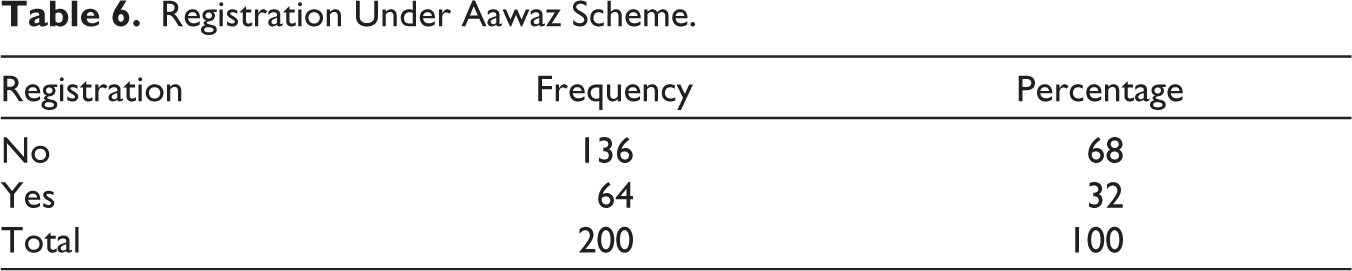
Table 6 shows that only 32% of the migrants were registered under the Aawaz Scheme of the government. This means that the programme has not reached even a half of the population of the migrants. The knowledge and awareness among the migrants regarding these schemes are very poor. It is important that the social security schemes reach the targeted community. But from Table 6, it is clear that the scheme has not reached enough number of people.
Registration Under Aawaz Scheme.
There are in total 459,138 active cards under the scheme where 435,560 (94.8%) are held by male migrant workers and 23,494 (5.1%) cards are held by female migrant workers and 84 (0.09%) cards for transgenders. Ernakulam district has the maximum number of cardholders in the state which is 21.87% of the total cardholders (total 100,414, male 91,511, female 8,876 and transgender 27). Among the migrant workers who have been registered for the scheme, 40.8% are from West Bengal, 16.5% from Assam, 11% from Odisha and 9.83% from Bihar. About 23.2% of workers in Kerala avail social security which is 1.6% higher than the national average (21.6%). In Karnataka, 27.1% avail social security, 20.3% in Tamil Nadu and 13.4% avail social security in Andhra Pradesh. The casual workers who received social security in Kerala are 5.7%, whereas the national average is 1.7% (Economic Review, 2018).
A migrant worker from Murshidabad, West Bengal, said that, ‘… I have been working in Kerala for the past ten years. I have had issues at the worksite with my previous employer where he did not pay the wages. I did not know where to go and whom to approach in such situations. I did not say this to anyone…’ Such issues of exploitation were common among the migrant workers, and this worker said: ‘… I have come here to work and earn money, so I have to find work on my own … I am planning to stay here (in Kerala) for another few years and return to my village and live with my family….’ He did not have an insurance card, though he knew about it. He did not know where to go and what were the procedures involved in the process of registration and he was not aware of the benefits of having the Aawaz Card.
The migrant workers are not unionised in any form. They are spread out in all sectors of employment and they face similar issues at their living and working surroundings. The fact that they are not unionised affects their bargaining power. There are incidences where the migrant workers have faced issues like irregular payment, inappropriate and offensive working environment, unpleasant living conditions and so on. There is a need to address such issues faced by the migrant workers. Therefore, it is vital that the state and policymakers need to focus on the migrant people who work in dangerous and hazardous conditions. The policies should aim at guaranteeing their protection and security at the worksite and also at their lives.
Kerala is the first state in the country to provide insurance and free medical treatment to inter-state migrant workers. The state has followed a rights-based approach and the government aims to seek the overall development and growth of the sectors and the workers. The working population has been protected through a constant intervention of the government on their right to work, right against discrimination, social security, protection of wages, right to organise and form a union, collective bargaining and dealing with grievances (Economic Review, 2018).
Table 7 shows the union and schemes for which the native workers are registered. According to the study, only 11% were not part of any schemes and 88% had registered in some scheme or the other. The scope of labour welfare schemes and labour union movements in the state of Kerala is much wider than in other states. The state has a history of reform movements and labour movements which have ensured a decent work environment for the labourers. The state has been facing many challenges in the labour sector in terms of unemployment or underemployment, low-labour-force participation, low rate of productive-employment-creation and lesser worker population ratio. The government must aim at accommodating the inter-state migrant workers as well in the development journey of the state.
Registered Schemes Among Native Workers.

Conclusion
The condition of migrant and non-migrant workers in the state shows that there are differences in the facilities available to both in terms of wage differences, employment patterns and social security schemes. The study shows that with regard to migrant and non-migrant workers in the state, the facilities that are available for both are different. The role of the state to implement the already existing social security schemes and create new welfare programmes for the migrant workers have to be a major development agenda. Social security plays an important role in the social and economic life of migrants. Majority of the migrant workers are employed as casual workers in the informal sector in Kerala. They are not a part of the permanent workforce and therefore not much attention is given to them. The migrants in general are treated as second-class citizens, so the level of benefits to be provided to the inter-state migrant workers is crucial for their recognition and acknowledgement. It becomes the responsibility of the state to protect the migrants and give them equal status as their own people.
Footnotes
Declaration of Conflicting Interests
The authors declared no potential conflicts of interest with respect to the research, authorship and/or publication of this article.
Funding
The authors received no financial support for the research, authorship and/or publication of this article.