



Abstract
Parliamentary committees are evolution of practice and procedures of legislations in liberal democracies over the years. The strength of a procedural democracy is enriched by the way the committees act to provide scrutiny, evaluation, and the improvement of the legislation and policy outcomes. This article articulates the imperative of parliamentary committees in strengthening legislation and policy commitments. How do parliamentary committees improve legislations and policy formulation in majoritarian democracies? This article includes the following sections: first, it discusses the meaning, role and objectives of parliamentary Standing Committees. Second, it focusses on the types of committees and their constitutional role in the process of legislation. Third, it deals with elaborate examination of the functions of the committees. The last section explores the recent trends of the functioning of the committees. The author concludes with the remark that the success of parliamentary democracy as an institution of representation would be strengthened with an integrated and independent role of parliamentary committees.
Parliamentary Committees: Meaning, Role, and Objectives
Parliamentary democracies are entangled with the responsible government for the executive, on the one hand, and on the focus of parliamentary accountability and need for direct access and influence, on the other. In this context, the parliamentary committees play a major part to scrutinise the executive and act as a channel to facilitate public contributions to parliamentary deliberations. The dilemma to Mattson and Strøm (2004) can be mitigated by the effective functioning of parliamentary committees as the ‘major loci of innovation in the processes and structures of parliaments’. It contributes to the understanding of the working of the parliaments all over the world. It serves as the main organising centre of legislation and parliamentary oversight of government. Committees are a main focal point of legislative representation in democracies.
Parliamentary committees function to formulate policy and oversee various administrative functions with openness and accountability. Members of Parliament participate in decision-making that coincides with the access of the greater community to the legislation process (Alvey, 2008). Bates and Hansen (2008) suggest that due to cross-party nature of the committees, the members deliberate without party compulsions and give way to legislation without any partisan burden. It has been observed that the great strength of parliamentary committee work lies with its protection and transparency by Parliament (Rodrigues, 2008). Committees perform as dynamic and robust institutional innovations that shape institutional change of parliaments since the 1960s, and ‘today it is difficult to find a Parliament without committees as a focal point of policymaking and parliamentary activities in general’ (Aldons, 1985; Arter, 2006; Hindmoor et al., 2009; Krehbiel, 1992; Lijphart, 1999; Longley & Davidson, 1998; Mattson & Strøm, 2004; Shepsle & Weingast, 1987). In the conundrum of power equations, the committees develop strength to facilitate legislative process, and make solid connection between the State and the civil society. This helps secure representation and conduct oversight of the executive.
The objectives of parliamentary standing committees emphasise on the character of institutional imperatives and procedural aspects of representative democracy. They determine the effectiveness and the accountability of government which makes law to protect various rights of the people. First, committees help to manage the business of the Parliament in a better way by examining a subject in depth by a number of limited sophisticated Members on behalf of all. Second, they secure the opinions, views, and recommendations directly from the experts and stakeholders who would be directly or indirectly affected by such a legislation. Third, the close-door deliberation without public glare allows members to build consensus without constituency and public pressures. Fourth, committee members work without partisan inclinations to build consensus for the common wellbeing of the nation. Fifth, committee members act in an impartial manner without partisanship and thereby overcome trial of anti-defection law. Finally, committees allow the members to build specialised knowledge on specific areas so that in-depth-scrutiny of issues minimises the challenge of authenticity of legislation. Kashyap (2004, pp. 187– 188) lucidly mentions the rationale and logic of parliamentary committees as follows:
The importance of parliamentary committees is linked to numerous complicated tasks like the review of administrative action and scrutiny of various legislative proposals and subordinate legislation. The Parliament is always overburdened with multiple tasks. Thus, it delegates the power to committees to examine in detail the complicated and technical issues related to bills and policies. The committees deal with matters with efficiency and depth without any partisan inclination. It is in such a closed-door scenario debate and deliberation, that consensus are made to accommodate various interests of the people in the representative system. The role of Rajya Sabha in the present times is considerably increased as a House of elders or experts, guarding against hasty and faulty legislation. Under such a situation, the Select Committee or Joint Committee on Bills may inter alia perform the role of the traditional second chamber. The idea of proportional representation in the formation of committees helps various opposition members participate directly in policy matters with serious impact which would have not been as effective as on the floor of the House. The expertise of the committee members helps to comprehend the policies and laws to give effective and legitimate authority. The committees act as a link between the Parliament and the people, on the one hand, and between the government and the people, on the other. It provides opportunities to stakeholders, institutions, and experts to present their views and concerns pertaining to laws and policies.
Constitution of Parliamentary Committees
The Constitution of India, under Articles 105 and 88, highlights with passing reference to the requirement of the committees in the functioning of the Parliament in terms of lawmaking and policy formulation. Article 105 of the Constitution in various clauses signifies the importance of the committees, for instance, the parliamentary privileges guarantee that no proceeding against any member would be taken up in any court of law for anything spoken or voted on in Parliament. Further committees would not be liable with regard to any publication with the authority of either House of Parliament of any report, paper, votes or proceedings [Art. 115 (2)]. With respect to the powers, privileges and immunities, each House of the Parliament, as defined by law, shall relate to the House and its members (clause 3). It is highlighted that in connivance with clauses 1, 2, and 3 that clause 4 shall be applicable to persons by virtue of the right to speak and participate in the proceedings of any committee or Parliament as generally applicable to the members of Parliament.
Further, Article 88 of the Constitution notes that the Attorney General of India and every Minister possess the right to speak and participate in any committee or proceedings of any of the House or even in joint sitting of the Houses, of which he is a member but shall not vote by virtue of this Article. In the Union List of Seventh Schedule of the Constitution, entry 74 also points out the imperative of committees and their powers, privileges, and immunities that a person being a member enjoys in the Houses of Parliament. The enforcement of attendance of persons, it is impeccably noted, for giving evidence or producing documents before committees of Parliament or commissions appointed by Parliament (Bakshi, 2009, p. 365).
Indian parliament, being bicameral in nature, constitutes some committees for both the Houses. Committees are several in number and act on different areas of legislation and policy formulation. The committees are broadly divided into two types: Standing Committees and ad hoc Committees. The purpose of ad hoc committees is to focus on a particular issue with specific requirements, and once the task vested to a committee is over, it automatically expires. Thus, it is not permanent in nature. Ad hoc committees are broadly classified into two types: Select or Joint committees on Bills that function to make particular Bills, and committees that are constituted to enquire into specific matters. Ad hoc committees are different from Select or Joint Committees on Bills, and follow procedures thereafter according to the Rules of Procedure and Conduct of Business and parts of directions ordered by Chairpersons of either of the Houses. ‘The second category of ad hoc committees is formulated with the requirement of the time based on a motion taken by the Houses on behalf of or by the Speaker or Chairman’ (Shimla, 2015, p. 33). Standing committees are regular and permanent in nature. However, their membership and chairmanship change from time to time or every year. According to Rule 268 of Rules of Procedure, Rajya Sabha, the Departmentally related Standing Committees are to be known as Standing Committees associated with Ministries or Departments. Further in accordance with the Third Schedule, each of the Standing Committees must be connected to the Ministries or Departments as detailed by the chairpersons of both the Houses require to change the said Schedule with requirement of time ‘in consultation with each other. The total number of Standing Committees are 55 in number, out of which 31 are Joint committees and 24 are single-House Committees, which are further divided into 12 for each House of the Parliament’ (Shimla, 2015).
The parliamentary standing committees are classified into six sub-categories based on their composition and functions. The Rules of Procedure and Conduct of Business of Rajya Sabha, under the Rule 269 (1), fixes in cognizance with Rule 268 that the Standing Committees shall have 31 members out of which 21 members are to be nominated by the Speaker from the Lok Sabha and 10 members are to be nominated by the Chairman of Rajya Sabha. In clause (2) Rule 269 it is suggested that each Standing Committee shall have a Chairman to be respectively appointed by the Speaker (Part II of the Third Schedule of the Indian Constitution) and the Chairman of Rajya Sabha (Part I of the Third Schedule). The tenure of office of each member of the Standing Committee shall expire after one year (Rule 269(3)).
It is strictly followed that a minister cannot become a member of a committee, and if a member after his nomination to the committee is appointed as a minister, it is obligatory on his part to quit the membership of the committee from the date of appointment. The Speaker appoints the chairman of the committee from among the members. In as much as these committees are to scrutinise, inter alia, demands for grants in respect of the concerned ministries and the members of each committee shall hold the office for not more than a year from the date of its formation.
Insofar as the nomination of members and appointment of chairmen of the subject committees are concerned, it would be only appropriate that a healthy convention is developed to facilitate such nomination/appointment in consultation with the political parties in both the Houses of Parliament. The strength of the parties in both the Houses should be reckoned with while nominating members to the committees by the Speaker/Chairman. Due representation may also be given to the Opposition in the share of chairmanship of various subject committees keeping in mind their strength in proportion to that of the House. This can be facilitated better through informal negotiations between the ruling party and the opposition parties. This may mean that political parties have a high degree of control over the composition of committees, membership in committees being divided between parties roughly in the same ratio as it exists in the House.
Functions of Standing Committees
As far as the Procedure relating to Bills (Rule 273) is concerned, it is recommended that each standing committee should examine Bills and prepare reports on those Bills specifically referred to it either by the Minister or Chairperson as the case may be. The committee is bound to finish its task of general principles and clauses of Bills within a time limit fixed by the Chairperson. The committees further examine the annual reports of ministries with an intent to locate whether the expenditure incurred was commensurate with the results achieved. They examine matters such as plan projects or activities of ministries as parts of the responsibility vested by the Speaker or the House.
The committees continuously undertake scrutiny of the functioning and activities of the ministries/departments concerned including investigatory functions. The Rule 276 strictly stipulates that ‘matters not to be considered shall not ordinarily be considered within the purview of any other Parliamentary Committee’. Reporting of the Committee (Rule 274) is considered to be crucial for the Parliament for following reasons: (a) that the Report would be on the basis of broad consensus, (b) the member is allowed to note his dissent, if any, regarding the Report, and (c) Reports with dissenting notes of members shall be presented to the House. And ‘the report of a Standing Committee shall have persuasive value and shall be treated as considered advice given by the Committee’ (Rule 277).
Kashyap (1981) categorically points out the appointment of departmentally related specialised subject committees of Parliament embracing multiple functions; these are as follows: ‘(a) close pre-budget scrutiny of the estimates and complex expenditure plans (Demands for Grants) before they are voted on the floor of the house; (b) Concurrent and contemporaneous examination of the activities of government departments and matters of national concern in a calm, non-partisan atmosphere; (c) monitoring and evaluation of performance relating finance output to policy objectives and actual results to measure effectiveness and detailed examination of supplementary estimates; (d) feedback of valuable insights and information to Parliament and to the government to re-appraise economic proposals; (e) closer and more competent scrutiny of all legislative proposals or all Bills introduced in the House automatically stand referred to the appropriate subject committee for detailed consideration and discussion; (f) review of the implementation of laws passed by Parliament in respective subject areas; (g) leadership recruitment and training, ground for higher responsibilities in government, participation by back -benchers and building a second line of leadership; and (h) development of specialisation and expertise among members’.
The committees, besides examining the activities of the concerned ministries, would report regarding the performance and excellence in economies, organisational effectiveness, steps of administrative reform and how these innovations do consistently work in tandem with policy approved by the Parliament. Parliamentary Committees are an essential component of the parliamentary form of governance in India. They provide valuable support to the legislature in the discharge of its duties and share a substantial amount of their workload. Their support includes supervision, control, and vigilance, besides reducing the workload of the legislature. The committees also provide a better insight into the issues during discussions and conduct detailed scrutiny and analysis; they are a form of aid to the Parliament.
The committee’s performance depends on the fact that to what extent it brings the balance between legislative and deliberative functions of Parliament as an institution of representation by providing surveillance tools and deep insights of the fact of legislation. The non-partisan character of committees furnishes a sense of independent debate among its members without the pressure of party to produce effective, lasting, and abiding consequences. ‘These committees would provide a potent mechanism for a meaningful multilateral dialogue between the government and the members of Parliament enabling a proper appreciation of each other’s views, reasonable accommodation of varying viewpoints and harmonisation of conflicting interests. In the ultimate analysis, such parliamentary committees alone can ensure that we are making the best use of the parliamentary system of government’ (Kashyap, 1981).
The staffing pattern of these committees avoids hierarchical levels as found in other government departments. To avoid diffusion of responsibility in handling the work of the committees, the staff is to be kept small in size with just one officer backed by the minimum supporting staff, to be fully responsible for the work of each committee. Each committee is to be under the charge of an officer of the rank of director/joint director/deputy secretary/deputy director assisted by one assistant director/research assistant, one senior assistant and one clerk-typist/stenographer.
In addition to the committee staff, the subject committees may also take the assistance of specialist advisers/technical experts/consultants when particular enquiries are conducted/topics taken up for examination with a view to obtaining technical/specialised information which is not readily available for elucidating matters of complexity. They can be asked to prepare memoranda or background/specialised papers for the committee. The advisers/experts may be required to attend meetings of the committees. They may also be called to appear before the committee and even be cross-questioned. That way the committee can have the benefit of the views of different experts and can then decide which views, if any, to accept.
After the jurisdictions of the subject committees are delineated and the subject areas identified, the secretariats of these committees may concentrate on preparing detailed background papers to be nicknamed ‘green papers’ based on study and in-depth research in their respective areas. These ‘green papers’ covering the entire gamut of activities of the concerned ministries/departments and other allied organisations are to be constantly updated and circulated to the members of the committees from time-to-time to serve as necessary background, orientation and reference documents.
Kashyap (1979) mentions that the subject committees are specialised ones and their staff possess high degree of professionalism and research experience (p. 305). The committee staff indispensably accomplish at various stages of the work of parliamentary committees, for instance, to collect information and material from the ministries/departments/library, prepare memoranda and briefs for committee members, frame questions for the examination of witnesses, help members in sifting evidence, and prepare the draft report. They have to prepare internal working reports, papers, etc., for consideration of the chairmen and committee members. This implies research-oriented studies by them of all relevant materials—books, reports, articles, press clippings, questions answered in parliament, annual reports of the concerned ministries, audit reports, five-year plans, annual plans and projections, etc., reports of the financial committees, etc., on subjects dealt with by the concerned ministries/departments and allied organisations. The committee staff have to constantly feed the committees with all relevant information so as to enable the members to be abreast of the latest developments in their subject areas.
By pursuing committee recommendations, members can secure corrective action, ask more informed questions and generally raise the level of debate. By way of questions, members may follow-up the implementation of committee recommendations accepted by the government. (Kashyap, 1979, pp. 312–313). Similarly, legislation can also be brought within the ambit of the subject committees. Bills in the areas covered by these committees may, where the House so decides, be referred to them for pre-House scrutiny. In course of time, a convention or rule may grow to the effect that all Bills, unless otherwise decided by the House stand so referred to these committees. This has its own advantages. From the government’s point of view, the committee stage can provide an opportunity to give second thoughts to controversial and complicated provision of a Bill without the glare of publicity that accompanies discussion in the House.
In the committee atmosphere the government may find it possible to concede a point or two to the Opposition members and accept or accommodate some of their suggestions. Moreover, a committee’s expert advisers can see to it that a Bill’s provisions bring out clearly the intention underlying the Bill, that there is no procedural defect in its wording, and that it does not offend the provisions of the existing laws. In general, the association of members having a special knowledge or interest in the subject matter of the Bills at the committee stage provides Parliament with the benefit of their expertise in enacting complicated and technical laws. Non-referral of Bills to committees adversely affects the quality of legislation because the floor of the House is not the most suitable place for a close and candid scrutiny of complex legislations.
Recent Trends
The democratic legitimacy of the representative institutions is augmented by functioning of the elected or nominated members in specific ways. The bicameral character of Indian Parliament ensures that the government should function with procedural norms. On this account, it is ensured that the scrutiny of the works of the government should be held by proper channels of committees. The Houses typically meet for about 70 days a year to conduct their business. Beyond the visible work in the two Houses, a substantial part of the work is carried out by committees.
The Departmentally Related Standing Committee (DRSC) invites experts to find out the opinion that helps members to scrutinise the bills more effectively. However, this is not always the case. It is observed that the Right to Education Bill, 2008, failed to invite experts’ witnesses for guaranteeing free and compulsory education to all children from ages 6 to 14. The recent farm laws faced the same consequences because of the noncompliance of experts’ opinion for its effective implementation. The farm laws are repealed now. The then Union Minister Mukhtar Abbas Naqvi did not respond to the specific question of this larger trend, but refuted the impression that the government avoided scrutiny with the passage of the farm bills. ‘They [Opposition] didn’t even discuss the select committee properly. They just created a din. The question of division comes if they sit in their seats and ask’, he said. One in five bills was sent to panels during NDA’s 2nd term (September, 20, 2021, The Hindustan Times). Out of a total number of 82 bills introduced in Parliament since 2019, only 17 of them were referred to different standing committees for reviews. In the 16th Lok Sabha (2014–2019) during the first term of the Narendra Modi Government, 25% of the bills introduced were referred to committees. ‘The figure, however, is much lower than 71% and 60% in the 15th and 14th Lok Sabha, respectively’, in United Progressive Alliance (UPA) government which was in power in the 15th and 14th Lok Sabha. (PRS data,
The recommendations of committees are not binding. It is for the Government or any other member to move the relevant amendments, which may then be voted upon by the House. The idea is, committees are a small part of Parliament which make recommendations, and the full House has the authority and responsibility to make the final decision.
It may be relevant to highlight a new trend. Several Bills piloted by the Finance Ministry have been referred to specially formed joint committees of the two Houses rather than the DRSCs. Though one does not know the actual reason for this, one cannot but fail to notice that the DRSC is chaired by a member from the Congress while the joint committees were chaired by a BJP member. As explained earlier, the DRSCs also examine other subjects and demand for grants. The Government reports back on the recommendations and the committees publish an action taken report. In the five-year period of the last Parliament (2014–2019), the Government accepted 54% of the recommendations, the DRSC was satisfied by its response in 13% cases; it rejected 21% of the responses, and did not get responses for 12% of the recommendations. One major weakness of these committees is the lack of standing research support. They are backed by the general support staff of Parliament and do not have a dedicated set of researchers associated with them. While they can (and often do) reach out to outside experts, there is no internal expertise that can finesse such opinion. A related issue is the high churn in parliamentary membership. In each of the last three Lok Sabhas, over 50% of the members elected were first-time MPs. As several of the experienced members become ministers, only a small pool of MPs gain subject knowledge by being in a committee for long (PRS data,
Another issue is transparency of the way the committees work. Commonly the committees work behind the closed doors and finally publish the reports with minutes of the meetings. A counter-argument suggests that all the meetings of the committees should be held in open with televised broadcast so that the discussions and deliberations can be reached with consensus without any pressure from partisan grounds. However, the purpose can be lost if the entire proceedings of the committees are opened to public. At least ‘the middle path would be to publish the submissions and evidences given by various experts and members of the public so that any advocacy is made more transparent while keeping the members free from constituency-pressures’ (PRS data,
Parliamentary committees are usually constituted in September every year. Opposition MPs have alleged that the delay in the constitution of standing committees is a reflection of the government’s ‘overall attitude about the functioning of Parliament’. They say this is a part of the ‘larger plot’ to destroy the sanctity of the institution. Rajya Sabha MP Binoy Vishwam, a leader of the Communist Party of India (CPI) parliamentary party, said:
This is a very unfortunate situation. This is part of a systematic effort to put parliamentary committees in cold storage. I have no idea what is causing the delay because my party at least has not been given any information on this. But this goes beyond the timely constitution of standing committees. This is a reflection of the government’s approach as a whole to the functioning of Parliament. Committees function under the framework of Parliament. They want to weaken it. (
Jawahar Sircar, Rajya Sabha member from Trinamool Congress, added:
I was just told that there is an inordinate delay in the constitution of standing committees. It is very demoralising. This means that the members’ time is not being fruitfully utilised for parliamentary work, and that is extremely unfortunate.
P.D.T Achary, former Secretary-General of Lok Sabha, suggests that traditionally committees work together without partisan inclination. However, it is observed of late that this tradition seems to have broken down and members have started political posturing’. (
The important role of standing committees in the NDA regime seems to have been diminished. The members’ attendance was also reduced to very low even prior to the lockdown during Covid. Sana Ali and Amber Sharma (IndiaSpend.Com, September, 2016) point out that: ‘the average attendance of every departmentally-related standing committee was 54% in the second session (November-December 2019) and 48% in the third session (January-March) of the 17th Lok Sabha (National Democratic Alliance or NDA-2). The standing committee on finance, which scrutinises the expenditure of the Ministry of Finance, had the lowest attendance of all (Figure 1). Over 78% of members were not present in the committee meetings held between November and March’.
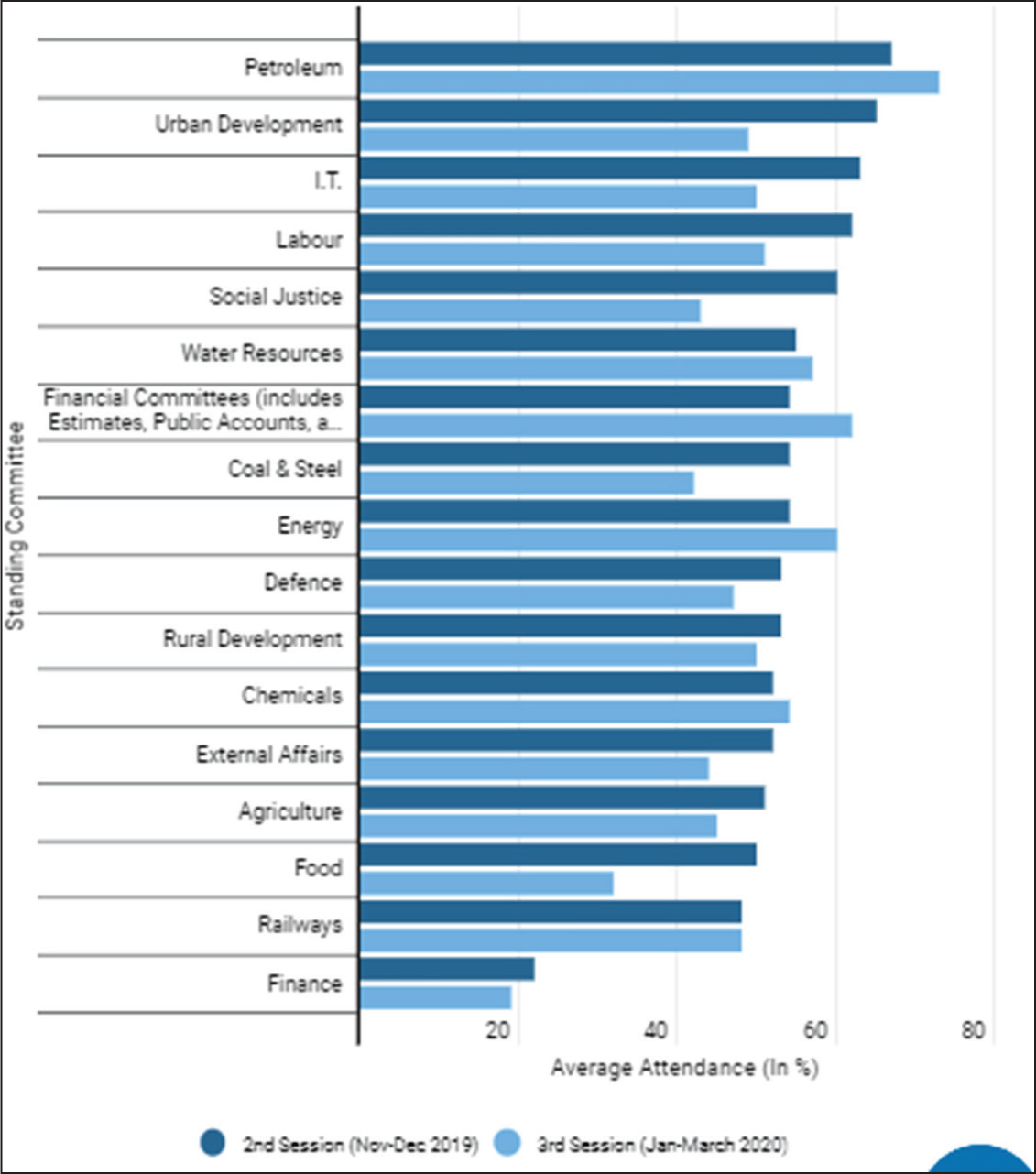
The role and performance of standing committees has witnessed a deteriorating trend in recent times. The published data by IndiaSpend highlights a decline of the role of parliamentary data of eight standing committees. In the first NDA government, standing committees worked for 145.5 hours which is less than the preceding first UPA government. It is simply observed that an average Lok Sabha session contains 100 hours. The standing committees’ number of meetings and number of hours in the NDA as compared to the UPA is sharply declined. The number of sittings, it is found, was reduced by 22.1%. It is clearly visible that compared to the UPA’s 15th Lok Sabha, there is 26.8% less productivity of the standing committees in the NDA’s 16th Lok Sabha. (Mansi Verma,
It is observed that there is a decline of the standing committee’s involvement in legislative affairs. The data suggest that under the NDA-1 only 25% of all bills got referred to committees compared to 60% in14 Lok Sabha and 71% in 15 Lok Sabha (of the UPA-1 and 2). In the 17 Lok Sabha only 10% of bills were refereed to committees. We notice that ordinances took precedence against law making in recent years. Bills are passed when Parliament is not in session and its tenure is not more than six months (Art 123) without the approval of the Parliament. The Parliament cannot be without session for more than six months (Art 85). One of the Supreme Court rulings made in 1987 suggests that ordinances must be used in extraordinary situations and it cannot replace lawmaking power of the legislature. Maansi Verma, the founder of Maadhyam, a civic engagement initiative on parliamentary matters observes that:
Ordinances are most often brought to escape parliamentary scrutiny and the law-making process. If we look at the subject matter of ordinances passed during the lockdown, some reforms had nothing to do with the pandemic. These could have been brought as bills and sent to the committees for review, but the pandemic was used as an excuse’. (
Against the established trend that committee members usually do not follow partisanship line, however, it has not practised in the abrogation of Art-370 by the committee on home affairs. In a meeting held on 15 November 2019, the committee discussed the bifurcation of State of Jammu and Kashmir into Union Territories following the Rule 331 P, Lok Sabha Procedure. Finally, the bifurcation of the State of Jammu and Kashmir into two Union Territories took place on 30 October 2019. Parliamentary standing committees are mandated to hold discussions on all Union Territories according to Rule 331 P of Lok Sabha procedures. Restrictions in Jammu and Kashmir were ordered on 5 August, 2019, and the bifurcation of the State into two Union Territories was effectuated on 30 October, 2019 (Resume of Work, Lok Sabha website for Session 2 and Session 3 of the 17th Lok Sabha).
The DRSC system has been a fairly successful experiment. It is important to further strengthen its ability for detailed scrutiny of issues so that it helps Parliament work better in its lawmaking and accountability roles. These would include mandatory examination of all Bills, creating research teams, and improving the transparency of inputs from advocacy groups. Many MPs call these committees ‘mini-parliaments’ and strengthening their working will improve Parliament’s overall effectiveness. (The person quoted is the President and co-founder of PRS Legislative Research, Delhi, and a CASI Fall 2017 Visiting Scholar).
Conclusion
The conception of subject committees is indeed a landmark in the annals of our Parliament. It has resulted in the emergence of a new dimension in the structure and process of administrative accountability and parliamentary surveillance. The idea of ministerial responsibility is strengthened in a parliamentary democracy by having committees working as integrated system and provide concrete visions in effective ways by saving precious time of Parliament to produce substantive outcomes as a representative institution. Without partisan inclination as an integrated system, committees initiate deliberations between the members of Parliament and the government and incorporate diverse views by quashing antagonistic interests.
And more importantly, these new structures constitute significant improvements in the existing instrumentalities for ensuring scrutiny of the government. There is a serious misapprehension in some quarters that establishment of a full-fledged system of such parliamentary committees might have the effect of diluting the position and power of the ministers, creating new or rival centres of power in the form of committee chairmen thereby weakening the system of parliamentary democracy with its concept of ministerial responsibility. Nothing can be farther from the truth.
The whole purpose of these committees is to strengthen the system of ministerial responsibility and parliamentary polity and not to weaken them in any way. In the context of the parliamentary system, committee scrutiny of administration is intended to assist the government. The committees do not question policies, they do not formulate policies. Policies are initiated by the government and approved by the Parliament. The committees examine and oversee the implementation of policies by the administration. They basically do not sit in judgment over what the ministers have done or not done but what the administration has done. The committees are an additional supervisory or overseeing authority along with the minister and on behalf of and representing Parliament like the minister himself.
Footnotes
Declaration of Conflicting Interests
The author declared no potential conflicts of interest with respect to the research, authorship and/or publication of this article.
Funding
The author received no financial support for the research, authorship and/or publication of this article.