



Abstract
Digitisation of records and the subsequent implementation of e-Office 1 software in various Durbar Move 2 offices of the Union Territory (UT) of Jammu and Kashmir (J&K) has changed the concept and nature of governance significantly. With the implementation of e-Office software in various departments of the Civil Secretariat, there has been a significant impact on the governance efficiency and service delivery in the UT. The present paper attempts to understand, examine, and analyse the impact of e-Office software on the delivery of governance services in J&K. It is an endeavour to understand how the new system of e-Office enables the administrative apparatus and enables the governance to be more responsive, accountable, transparent, and citizen-friendly.
Keywords
Introduction
In the modern world, e-governance has revitalised democracy and improved the quality of citizen-services through the use of information and communication technology. It has enabled states to transcend from the traditional bureaucracy-centric approach to a more citizen-centric approach by taking recourse to the use of online services (Milakovich, 2021, p. xii). In fact, information and communication technologies have influenced every aspect of the administrative machinery (Milakovich, 2021, p. xiii). The concepts of governance, public administration, and public services have evolved so quickly in recent times that the world has now shifted to what is rightly called ‘Smart Digital Governance’ (Milakovich, 2021, p. xiv). The modern world has transcended to the concept of e-governance, with the objective of providing home-delivery of good governance and services to the citizens. Certainly, e-Governance has become one of the most satisfactory models of governance in the contemporary world, for it facilitates a state to deliver efficient, effective, accountable, and transparent governance services to its citizens (Mahmood, 2019). The conception of e-Governance is fundamentally premised on the notion of delivering services to the public in an efficient manner and at an affordable cost by making use of information technology by the government in order to bring about Simple, Moral, Accountable, Responsive, and Transparent (SMART) governance.
Over time, the concept of governance has evolved, and the volume of government business has significantly multiplied. The process of submitting anything to the government and transforming it into an output involves a complex workflow with multiple stages. This includes creating files, recording data, conducting assessments at various levels, and ultimately issuing decisions in the form of letters, circulars, orders, and notifications (General Administration Department, 1998). Managing the diverse collection of official records and running administrative affairs in a State like J&K, where the capital alternates between two geographical regions biannually, poses multifaceted and time-consuming challenges. The practice of switching the capital, commonly known as the ‘Durbar Move’, has been a distinct feature of the political-administrative system of J&K for the last one and a half centuries. While this tradition has been defended by many analysts, civil society members as well as political parties and leaders for socio-political reasons, however, there are opposite arguments as well pointing to its negative impact on the economic growth and governance of the region. It is argued that the perpetuation of the Durbar Move practice negatively affects both the public purse and common citizens ( Ismail Azra vs The Union Territory of Jammu and Kashmir, 2020 ). Despite acknowledging its negative effects on governance and public services delivery, all the previous governments were hesitant to end the practice due to political considerations thereby overlooking its economic or efficiency implications. The fear of emotional backlash in both Jammu and Kashmir regions, impacting the vote bank, hindered any attempts to discontinue the tradition (Badhwar, 1987). Few attempts made in the past were immediately halted in the face of stiff opposition, both by the political opponents and the public. However, after the J&K State Reorganisation Act of 2019, which resulted in the bifurcation of J&K into two Union Territories, the administration of J&K went for the digitisation of official records in Durbar Move offices and subsequently introduced e-Office software (ETGNC, 2021; Verma, 2021). The implementation of e-Office, aimed to rationalise if not entirely eliminate the traditional Durbar Move practice. It has brought about transparency, accountability, and responsiveness in the governance benefiting the masses. With this background in mind, the present study aims at uncovering potential triggers for Durbar Move rationalisation. It attempts to analyse situations that led to the eventual implementation of e-Office software in the Durbar Move offices. The study endeavours to investigate, examine, and comprehend the impact of electronic office software on the delivery of diverse governance services in J&K.
Methodology
A multi-dimensional methodology has been used to ensure that the study is meaningful, reliable, and reasonably accurate. Historical approach has been used to comprehend the history and operation of the Durbar Move. Analytical method is used to delve deeper into its functioning and effectiveness. To enhance accuracy, effectiveness, and purposefulness, primary data have been obtained through interviews, government orders, and press statements from government agencies. The collection of primary data involves employing the fieldwork method in both regions—Jammu and the Kashmir Valley. Open-ended interview schedules were utilised to gather data on socio-economic and demographic aspects, as well as individuals’ perceptions and opinions regarding the Durbar Move. Participant observations were also employed to verify and substantiate the accuracy of the data. Books, journals, reports, surveys, official records, and some archival sources were consulted to gain insights into the capital shifting process.
History and Working of Durbar Move
The Durbar Move was introduced as a traditional practice of capital city relocation in the erstwhile state of J&K in 1872 by Maharaja Ranbir Singh, the former Dogra Maharaja of Jammu and Kashmir (Chhibber, 2020; Ganai, 2021; Raina, 2021). The Maharaja initiated the practice of Durbar Move, ‘partly to escape the unfavourable climate of the two regions of his kingdom and partly to look after the affairs of the two regions of his kingdom more closely. The practice was introduced so that the petitions of the people of distant locations could be resolved at their door-steps’ (Charak, 1985, p. 70; Drew, 1875, pp. 61–63). Therefore, Durbar Move tradition is primarily a concept of ‘time-distributed capital city’ where the capital city is relocated from one region to another on the basis of seasons and climate (Rossman, 2017, p. 18).
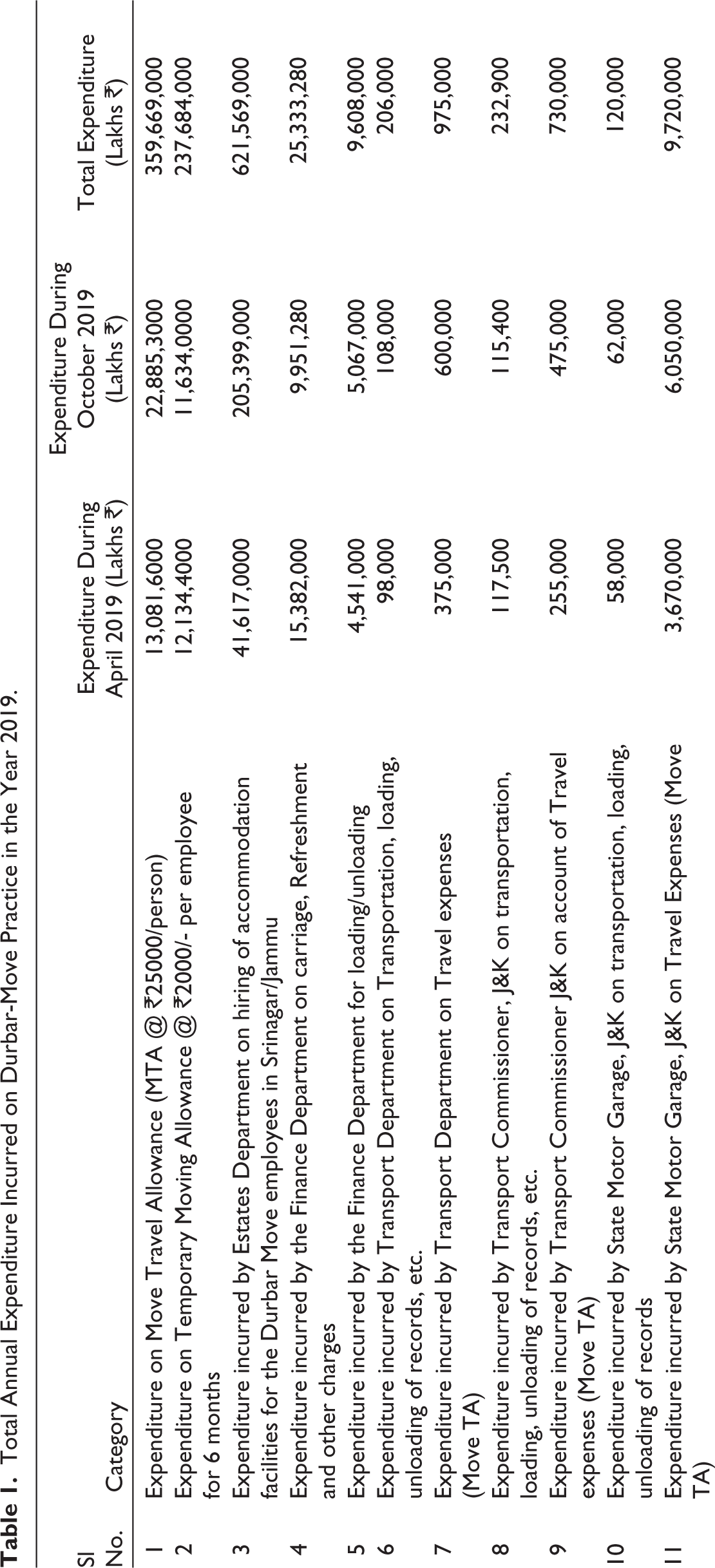
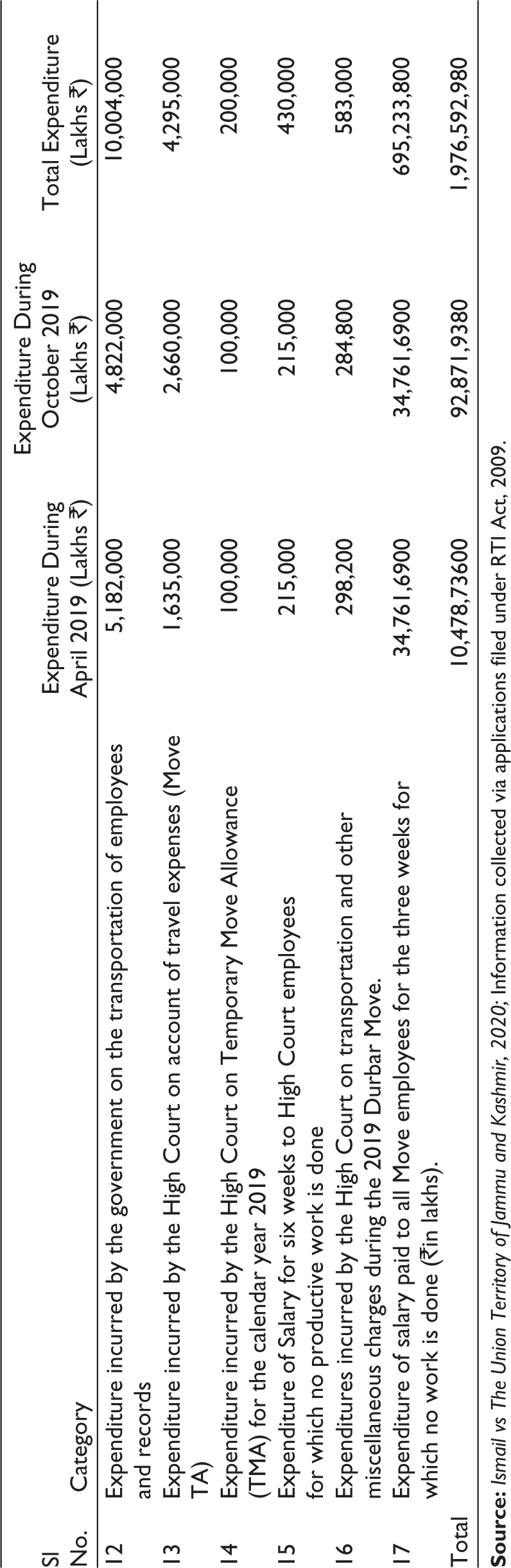
Every year, the Durbar is relocated from Srinagar to Jammu during the winter months, spanning from November to April. Similarly, during the summer months from May to October, the Durbar would move from Jammu to Srinagar. As a result, the former State boasted about two capital cities, with Srinagar serving as the summer capital and Jammu as the winter capital (Makhdoomi, 2020; Sharma, 2021a; The Hindu, 2017). This traditional practice, which means relocating the entire administrative apparatus biannually, involves enormous economic resources as transition costs thereby negatively impacting not only economic growth but also the delivery of governance services in the State. Table 1 displays approximate annual expenditure associated with multiple aspects of the Durbar Move.
Total Annual Expenditure Incurred on Durbar-Move Practice in the Year 2019.
Every time, the Durbar leaves a region, there is almost no grievance redressal mechanism in place for the people of that specific region for the next six months. This causes enormous hardships and deprives people of their fundamental right to access information (Khajuria, 2015). People from far-flung areas would have to travel long distances to resolve minor issues (Wani, 2018). This becomes even more cumbersome during the winter months due to frequent road closures because of heavy snowfalls. In fact, it results in a situation of ‘no-government’ in the region from where the Durbar relocates for six months of the year. As a result, the primary principle of ‘accessibility of institutions’, which is a foundation of a good governance system, suffers. It goes without saying that accountability of officials and institutions, transparency of the administrative apparatus, responsiveness of governance mechanisms, and citizen services, all of which are basic tenets of a good governance system, would get compromised every time the Durbar relocates, which encompassed not merely a shifting of the Civil Secretariat but rather a relocation of more than 100 government departments, including the seat of the political executive (The Chief Minister, his Cabinet, Political Advisors and Council) (Government Order No. 569-GAD of 2018), legislature, judiciary, and the office of Lieutenant Governor. While the divisional, district and field offices would cooperate throughout the years across J&K; however, the shifting of political executive along with policymaking departments (secretariat) would put one of the regions at disadvantage for six months of the year on rotation basis.
It is in this context that the lately introduced digitisation of all the official records of the Durbar Move offices and the subsequent implementation of e-Office software has rationalised, if not completely ended, the concept of seasonal capital-shifting in J&K. In fact, with the introduction of e-Office software in the Durbar Move offices in 2021, there has been an increase in the degree of transparency, accountability, and responsiveness in the governance responsiveness and service delivery in the Durbar Move offices (ETGNC, 2021; Sharma, 2021b).
Attempts to Rationalise Durbar Move
As the Durbar Move practice would impact various aspects of governance, there has been a debate on the rationalisation or discontinuation of the practice for a long period of time in the erstwhile State. Almost all the previous governments acknowledged the adverse impacts of the Durbar Move on the governance, administration, economy, and various other basic foundations of a good governance system. However, no government was courageous enough to discontinue it owing to the political significance of the practice in both the regions of J&K (Badhwar, 1987). Even though, it is frequently argued that it is unjust to deny either region access to governance services for six months of a year on account of the Durbar Move, yet it is often argued that the tradition of Durbar Move has played a considerable role in controlling the feelings of alienation and separatism between the distinct and diverse ethnicities of Jammu and Kashmir (Tarigami, 2018).
Sheikh Mohammad Abdullah, the leader of the National Conference, occasionally acknowledged the negative effects of the Durbar Move on governance services, but even he refrained from ending the practice of seasonal capital relocation due to its emotional and integrative significance in the state (Drabu, 2021). However, some attempts were made to reform or rationalise the traditional practice of the Durbar Move by some governments. In 1957, Bakshi Ghulam Mohammad, who succeeded Sheikh Abdullah, attempted to reform the system by permanently stationing some government offices of the Civil Secretariat in Srinagar while keeping the remaining offices in Jammu throughout the year. But Bakshi’s reform attempt faced opposition from his own cabinet ministers and the people of the Jammu region, who criticised the proposed move as an administrative failure (Tiku, 1987). Recognising the strong emotional connection the Durbar Move holds for the people, Bakshi Ghulam Mohammad comprehended that discontinuing it would only enrage the people and alienate the two regions from each other. Consequently, he abandoned the decision to reform the Durbar Move tradition in order to safeguard his government, owing to the significance of the capital city status and the politics associated with it (Tiku, 1987).
In 1987, another attempt was made to reform the Durbar Move practice by the coalition government of the National Conference and Congress, led by former Chief Minister Dr Farooq Abdullah (Raina, 1987). The government believed that the Durbar Move practice was anachronous and detrimental to public interests (Mehta, 1987). Backed by Prime Minister Rajiv Gandhi, Dr Farooq Abdullah aimed to reform the tradition (Bhat, 1987), condemning it as a ‘retrograde practice’ and an unnecessary burden on the State’s exchequer (Saraf, 2017). Following his predecessor, Bakshi Ghulam Mohammad, Farooq Abdullah announced the permanent stationing of some Civil Secretariat offices in Srinagar and others in Jammu. This decision aimed to control extravagant expenditures involved in the seasonal capital relocation (Kashmir Times, 1987a; Singh, 1987), prevent waste of time and resources ( Daily Excelsior, 1987a , 1987b; Mehta, 1987), and ensure year-round administrative services for both regions of the erstwhile state (Kashmir Times, 1987a, 1987b). However, Farooq Abdullah went a step further by publicly announcing his intention to make Srinagar the permanent capital city (Mehta, 1987). This sparked dissatisfaction in the Jammu region, which feared further marginalisation. Concerns aroused that conceding permanent Capital City status to Srinagar would perpetuate the neglect already experienced by Jammu (Daily Excelsior, 1987c, 1987d). Consequently, a sense of deprivation, discrimination, neglect, and alienation emerged in Jammu, not only from the government but also from Kashmir (Jagmohan, 1991, p. 220; Singh, 1987). The Jammu region had apprehensions that ending the Durbar Move practice would harm their economic interests (Jagmohan, 1991, pp. 220–221; Singh, 1987) and lead to the dominance of Kashmiri culture (Singh, 1987). Furthermore, there were apprehensions that discontinuing the Durbar Move was a conspiracy to realise Sheikh Mohammad Abdullah’s dream of a Greater Kashmir by incorporating the Muslim-dominated areas of Doda and Poonch into Kashmir (Badhwar, 1987). As a result, the entire Jammu region erupted in protests against the proposed government’s move to end the Durbar Move practice (Daily Excelsior, 1987e), and grant permanent capital city status to Srinagar (Jagmohan, 1991, pp. 220–222). The entire region came to a standstill for several weeks (Daily Excelsior, 1987f), thereby paralysing and polarising Jammu (Daily Excelsior, 1987g; Jagmohan, 1991, p. 220). Criticisms were directed at the government for fostering separatist forces and sponsoring regional discord at the cost of State unity, integrity, and consolidation (Daily Excelsior, 1987h). The Congress (I) party, being part of the coalition government, suffered significant damage to its reputation in Jammu (Daily Excelsior, 1987f). To safeguard their political interests, several Congress leaders supported the protesters and requested intervention from the Central government (Mudgal, 1987). The protests eventually turned violent (Daily Excelsior, 1987i, 1987j; The Hindustan Times, 1987a), pushing the Central government to intervene and force the Chief Minister to rescind the order for Durbar Move rationalisation. Consequently, a promising initiative aimed at improving administrative convenience, efficiency, and sustainable resource utilisation was abandoned due to violent protests fueled by a sense of regional marginalisation, neglect, and alienation ( The Hindustan Times, 1987b ). Though there was a simultaneous counter-agitation in Srinagar advocating for permanent capital city status for Srinagar (Daily Excelsior, 1987g; Kashmir Times, 1987c). However, when the Central government intervened and forced the State government to rescind its order of a truncated Durbar Move, the counter-agitation in Srinagar, supporting the rationalisation of the Durbar Move, also faltered. Buta Singh, the then Union Home Minister, even hailed the Durbar Move as a ‘cementing force of unity’ (The Hindustan Times, 1987). Consequently, the government’s audacious endeavour to reform and rationalise the Durbar Move practice ultimately failed. It is evident that the failure stemmed from regional political interests entangled with the Durbar Move tradition (Noorani, 2008).
Fast forward, in 2012 the then Chief Minister of J&K, Omar Abdullah, acknowledged that the Durbar Move practice imposed an unnecessary burden on the governance services and the limited resources of the state. However, he also expressed his helplessness to reform the tradition, recognising the regional political interests and emotional significance attached to it (Ganai, 2012; Khajuria, 2015; The Economic Times, 2012). Omar Abdullah was probably wise enough to understand that interfering with this customary practise could potentially harm the political interests of his government. Thus, while over time various political parties, activists, and scholars have consistently called for either abolition or rationalisation of the Durbar Move, aiming to establish a year-round, fully functional administrative apparatus in both regions of the State, where the Durbar does not shift after every six months (Saraf, 2017). However, despite these frequent demands, it could not be done due to political and other reasons.
Digitisation of Records and Implementation of e-Office
After the Central government read down Article 370 of the Constitution of India in August 2019, changing the status of the erstwhile state of J&K into two Union Territories, debates regarding the discontinuation of the Durbar Move practice in the UT of J&K resurfaced. Additionally, calls were made to establish a singular permanent Capital City, ensuring efficient governance of the newly created Union Territory (UT) without the need for biannual Capital relocation (Makhdoomi, 2020). Reflecting on the urgency of ensuring fully functional Civil Secretariat in both regions round the year, Gurchain Singh Charak, the former J&K Minister and Chairman of the Dogra Sadar Sabha, asserted: ‘We want the Civil Secretariat to be functional round the year in both Jammu and Kashmir regions. This is the only way we can stay together; otherwise, it is time to separate Kashmir from Jammu and Kashmir’ (Javeed, 2021).
Consequently, as a step towards bringing reforms, the UT government decided to digitise all official records associated with the Durbar Move offices. This initiative aimed to introduce e-Office system across all UT offices, thereby obviating the need for physical shifting of offices and records during the Durbar Move (IBT, 2021). During Governor Satya Pal Malik’s tenure, funds were allocated for the procurement of machinery to digitise records within the Civil Secretariat (Verma, 2019). However, it was only after the enactment of the J&K State Reorganization Act of 2019 that the actual digitisation process commenced and was successfully completed under the administration of the Lieutenant Governor of the newly formed UT of J&K (Government Order No. 17-JK (ITD) of 2021).
In fact, the demands for digitising files to avoid physical file-shifting during the Durbar Move existed even before the birth of the Union Territory, but these debates and demands could not take a practical shape. Earlier, in July 2013, there was a shattering fire incident in some parts of the Civil Secretariat Complex in Srinagar, resulting in the destruction of hundreds of files. Besides, service books concerning approximately 300 employees were also lost (Verma, 2019, 2021). Reflecting on this incident a Civil Secretariat employee, who wished not to be named, stated: ‘A large number of confidential records were placed in a few rooms of Secretariat building where the then-government was likely to conduct an investigation. However, a fire broke out unexpectedly in the building, destroying not only the records but also the entire structure’ (Anonymous, April 17, 2021).
Consequently, there arose a demand for the digitisation of official records to mitigate future losses. However, this demand failed to materialise into practical action (Verma, 2019, 2021). Subsequently, in September 2014, when a devastating flood ravaged the entire valley, the official records of several Durbar Move offices were also destroyed (Verma, 2019 & 2021). This event once again emphasised the urgency of digitising official records. But, like previous announcements, the demands and intentions for digitisation remained confined to mere words on paper and lacked practical implementation. However, in 2018, following the collapse of the coalition government between the People’s Democratic Party (PDP) and the Bharatiya Janata Party (BJP), the former State came under the direct control of the Central government, and Governor Satya Pal Malik. The Governor’s administration promptly initiated the much-debated and long-desired project of digitising the official records of Durbar Move offices. An allocation of ₹5 crore was sanctioned and placed at the disposal of a dedicated nodal agency named the Jammu and Kashmir e-Governance Agency (JaKeGa), established under the administrative control of the Department of Information Technology, for this purpose. Furthermore, an additional amount of ₹15 crore was granted to the J&K e-Governance Agency to procure hardware and software for the respective Civil Secretariat buildings in Jammu and Kashmir. The objective was to obviate the need for physically relocating computers and other hardware machineries each time the capital was relocated (Verma, 2019).
By around February 2020, the Covid-19 pandemic that plunged the entire world, including J&K, into an unforeseen crisis and further highlighted the need for digitisation of records and use of ICT. Meanwhile, a Public Interest Litigation titled ‘Azra Ismail vs The Union Territory of Jammu and Kashmir’ was filed in the Honourable High Court of Jammu and Kashmir and Ladakh, requesting an investigation into the feasibility of the Durbar Move. In its verdict on 5 May, 2020, the High Court concluded that the Durbar Move lacked constitutional validity or legitimate justification and that its perpetuation has substantial negative consequences for J&K’s administration, governance, economy, and society (Ismail Azra vs The Union Territory of Jammu and Kashmir, 2020). The High Court directed the Union Ministry of Home Affairs and the Jammu and Kashmir government to explore alternatives to the Durbar Move for the sake of public interest (Makhdoomi, 2020; Ismail vs The Union Territory of Jammu and Kashmir, 2020 ; TND, 2021). It was argued that since the tradition, which originated under the former Monarchy, prioritised personal comforts over effective governance, it should no longer undermine the constitutional principles. The High Court’s verdict reignited the debate, leading to renewed demands for ending the practice. Consequently, the much-awaited digitisation project received a boost, and the government announced its completion in distinct stages within a year (Government Notification No. 03-JaKeGa of 2020). The government declared that all digitised data would be securely stored in the State Data Centre, with hard copies retained by concerned departments (Government Notification No. 03-JaKeGa of 2020). It asserted that a Data Recovery Centre would be established outside Jammu and Kashmir to ensure proper backup of the entire record (Verma, 2021). The government also specified that scanning and digitisation of official files and records, along with their storage in an easily retrievable digital format through a tailored Data Management System, would be implemented for authorised users (Verma, 2019). Consequently, the J&K government initiated its digitisation project in three phases, commencing with the Civil Secretariat of Jammu (Government Order No. 972-JK (GAD) of 2020), followed by the Civil Secretariat of Kashmir (Shah, 2020; Verma, 2021), and concluded with the Durbar Move offices situated outside the Civil Secretariats (Government Order No. 234-JK (GAD) of 2021, 237-JK (GAD) of 2021; Shah, 2020, 2021; Shuchismita, 2021a).
Implementation of e-Office and Durbar Move Rationalisation
Upon the successful digitisation of paper-based physical files, the government promptly began working on the implementation of e-Office software as a means to streamline the Durbar Move practice in the UT. In March 2021, government announced the adoption of e-Office software across all administrative offices of the Union Territory at an estimated cost of Rs 67.62 crore, encompassing offices in both capital cities, including the Raj Bhawan (LG Office) (Government Order No. 17-JK (ITD) of 2021). The government further announced that all administrative offices would make transition to the e-Office software as their only mode of operation within one month, that is, by or before 15 April, 2021 (Government Order No. 17-JK (ITD) of 2021). The circular issued by the government for the implementation of e-Office software read as follows:
In order to improve efficiency and effectiveness of the government, and to obviate the requirement of physical movement of files/records from Jammu to Srinagar and vice-versa, it has been decided to completely switch over to e-office by April, 15 2021. To ensure its timely implementation all records/files of various Government Departments have been digitized except some files/records which are sensitive/confidential in nature and require to be carried to Srinagar. (IBT, 2021)
Subsequently, on June 20, 2021, Honourable LG Manoj Sinha announced that the J&K Administration had successfully completed its transition to the e-Office software. Accordingly, the bi-annual Durbar Move practice was deemed unnecessary, resulting in an annual government savings of ₹200 crore, which would be allocated towards the welfare of disadvantaged sections of the society (Raina, 2021). LG Sinha further explained that both regions of the UT would now have fully functional Civil Secretariats operating throughout the year, effectively bringing an end to the tradition of the Durbar Move (Bukhtiyar, 2021; The Hindu, 2021; TND, 2021). He asserted, ‘Both the Jammu and Srinagar secretariats could now operate normally throughout the year simultaneously, resulting in significant cost-savings of around ₹200 crore per year, which would be utilised to benefit the underprivileged (Bukhtiyar, 2021). The government subsequently issued several orders to distribute staff between the two secretariats in Jammu and Srinagar, enabling them to function throughout the year (Government Order No. 365-JK (GAD) of 2021, 366-JK (GAD) of 2021, 1133-JK (GAD) of 2021; Shuchismita, 2021c). Thus, the implementation of e-Office software became pivotal in transitioning to and establishing a successful and efficient alternative to the Durbar Move practice. It may be noted that the Durbar Move has not been completely abolished officially; however, in view of the implementation of e-Office it has become almost redundant. With e-Office software all departments would have the ability to access any file at any time, from anywhere, simply by entering the computer code number, file number, or subject in the search engine (Verma, 2021).
The concept and practice of good governance is based, among others, on the principles like efficiency, transparency, accountability, cutting down the cost and economic management. The introduction of e-Office software has not only helped control extravagant expenditures associated with the practice but has also rationalised the Durbar Move process (Shuchismita, 2021a). By eliminating the need for physical shifting of files and offices between regions, it has effectively addressed this issue. Now, all files are available electronically and can be accessed from anywhere, at any time, via a Virtual Private Network (VPN)-based web browser. Further, it has brought efficiency, effectiveness, accountability, and transparency to office operations. It has minimised the time wasted in file processing and facilitated speedy disposal. Most importantly, e-Office has emerged as a successful alternative to the Durbar Move practice, enabling both the Jammu and Srinagar Civil Secretariats to operate simultaneously throughout the year.
Notably, the digitisation project undertaken by the J&K government had several key objectives. Firstly, it aimed to convert all physical files into electronic files to obviate the need for transporting physical records during the Durbar Move (Makhdoomi, 2020). This transition would ensure the availability of records promptly for administrative actions and minimise disruptions caused by file loss or damage during the bi-annual Durbar Move (Verma, 2019). Secondly, the project aimed to control extravagant costs associated with physically shifting records from one region to another during the Durbar Move (Verma, 2019). Lastly, the government intended to shift to e-Office software, enabling offices to operate without the need for physical relocation during the Durbar Move, by making files available in electronic format, accessible from anywhere at any time (Shah, 2021). Therefore, to achieve these objectives, the government’s e-Governance Agency scanned and digitised over 2 crore pages from around three and a half lakh files across various Durbar Move offices (Daily Excelsior, 2021; ETGNC, 2021; Sharma, 2021b).
According to Jammu and Kashmir Administration, by rationalising the Durbar Move practice, there has been an annual savings of ₹200 crore and a remarkable 97% increase in file disposal rate, resulting in enhanced governance efficiency (Dutta, 2021). Simplifying the tracking of file movements has led to increased accountability and transparency and facilitated the delivery of public services to promote good governance in the UT (Daily Excelsior, 2021). Applauding the impact of e-Office implementation in the UT, the Chief Secretary of J&K, Dr Arun Kumar Mehta (IAS) observed:
Erstwhile state used to lose two months due to Durbar’s relocation. Every year, the files had to be physically transported from one capital to another, and many files would get misplaced in the process. But now they can be tracked immediately with the help of e-office, which has elevated us to the modern league and has made a significant difference in governance. (Dutta, 2021)
Thus, e-Office implementation in the J&K UT has played a pivotal role in enhancing accountability and delivering citizen-centric governance. By reducing transaction costs and streamlining processes, e-Office has provided avenues for public officials to leverage advanced technologies, effectively manage remote workforces, measure performance, and enhance service delivery (Milakovich, 2021, p. xiv). It has helped not only in controlling unnecessary expenditures on stationary items such as pens, papers, file covers, cartridges, etc., but has also facilitated to secure organisation, classification, and safeguarding of records by reducing the likelihood of file getting lost or tearing out of records. Overall, e-Office has fostered a more efficient and citizen-focused approach, benefiting both the administration and the people it serves. Speaking about the benefits of the new electronic office, a petitioner, wishing anonymity, asserted:
Earlier, it would take us several months to get our petition redressed. Depending on the climate, we would have to travel hundreds of kilometers to reach the administration seated in another province. But now, with the introduction of e-Office, not only are our petitions resolved rapidly, but our money has also been saved. We no longer need to frequently visit offices. In fact, e-Office has increased accountability and transparency in the administration. (Anonymous, March 28, 2021)
Undoubtedly, in today’s world, e-Office is widely recognised as an advanced tool that contributes to informed political decision-making, increased citizens participation, government reforms, and the transformation of public administration (Mahmood, 2019; Milakovich, 2021). It enhances citizen access to information by promoting civic knowledge, builds trust in government by reducing costs, and facilitates the dissemination of citizen-centric virtual government services by enhancing the quality of information transmission and reception (Milakovich, 2021, p. xv). However, it is important to note that the government has not indicated any changes in the status of the twin Capital cities and has affirmed that J&K will continue to have two Capital cities, with Srinagar serving as the summer capital and Jammu as the winter capital (Shuchismita, 2021a).
Conclusion
The implementation of e-Office software in Durbar Move offices has brought significant governance reforms to J&K. All files and records are now easily accessible in electronic format, enabling anytime, anywhere access. This has led to a reduction in case-processing time and enhanced responsiveness, ensuring timely disposal of petitions, grievances, and files for the public’s benefit. Transparency and accountability have been bolstered as all files are open for discussion, allowing applicants to check the status of their petitions or files through the Central Registry Units. It has helped to make annual savings of approximately ₹200 crores apart from enhancing record organisation and security. Most importantly, the implementation has enabled the government to operate two Secretariats simultaneously in both geographical regions, thereby rationalising the Durbar Move practice, for the wellbeing of the common people. However, certain challenges still need to be addressed. The conventional practice of physically signing digital files persists due to the absence or lack of updates to the digital signature feature. Software gaps, such as the lack of certain features of Microsoft Word in e-Office, need to be addressed. Connectivity issues and power cuts affect the functionality of the system, and while VPN technology protects data, there are vulnerabilities that could lead to data loss. The availability of antivirus software is currently lacking and should be considered to mitigate potential risks. With few improvements that can surely be made with time, this can go a long way to enhance governance in the UT.
Footnotes
Declaration of Conflicting Interests
The authors declared no potential conflicts of interest with respect to the research, authorship and/or publication of this article.
Funding
The authors received no financial support for the research, authorship and/or publication of this article.