




Abstract
In recent years, there has been a significant expansion in India’s development policy discourse accompanied by rights-based approach, grassroots transformation and socio-economic change. Consequently, impact evaluation has become central to development interventions. However, the evaluation of subjective measures within development policy discourse remains under-studied. The purpose of this article is to examine the impact of development policies on subjective economic wellbeing (SEWB) in India. Utilising household data from India human development survey and applying ordered probit regression, we test medium-term impact of development policies on SEWB. The findings show that while development policy does have significant impact in driving SEWB, interaction among development policies also curates interesting perspectives. Moreover, evidence suggests that relative social and economic considerations are significant in driving SEWB. The article attempts to combine insights from the development discourse and an empirical approach to go beyond a critique and draw emphasis on SEWB in an emerging economy context.
Introduction
India’s development policy discourse draws attention because of its deliberate attempts to deepen democracy and induce empowerment, as well as for various sociological perspectives (Gurtoo & Udayaadithya, 2014; Khera & Nayak, 2009; Kumar et al., 2020; Rao et al., 2017). On the one hand, there is rights-based approach to social security that ensures basic entitlements to the most deprived and vulnerable (Drèze & Khera, 2017; Khera, 2011; Vikram & Chindarkar, 2020). On the other hand, there are institutional and resource limitations, policy-induced inefficiencies and counterproductive outcomes (Banerjee & Duflo, 2011; OECD/ICRIER, 2018; Ravallion, 2019a). There is a vast literature on the impact of development policies on objective measures of economic wellbeing such as wages and consumption; however, there is paucity of studies assessing the nature of works created and its impact on peoples’ lives (Ranaware et al., 2015). To better understand efficacy and coherence among development policies, studies should also assess subjective economic wellbeing (SEWB) that constitute various situational parameters such as living conditions, derived experiences and behavioural aspects (Government of India, 2019; Jaikumar et al., 2018).
There is a multifaceted concept of wellbeing interplaying with multiple heterogeneities (Stiglitz et al., 2009); thus, it is important to take care of initial conditions and differential changes. As set-point theory indicates that change in income has mostly short-run impact on SEWB because often people readily ‘adapt to environment’ (Conceição & Bandura, 2008). Furthermore, the functioning-capabilities framework (Nanarpuzha & Sarin, 2021; Sen, 1999) questions the undue focus on outcomes and satisfaction while arguing that focus should be more on characteristics and commodities at one’s disposal. Within this conceptualisation, Nussbaum (2001) argues of ‘suitable external conditions’ as important determinants in driving SEWB. Recent research on SEWB (Jaikumar et al., 2018; Kulkarni et al., 2021; Nanarpuzha & Sarin, 2021) established the significance of ‘weaker endowments’ in influencing wellbeing aspects such as ageing and inequalities. Hence, the impact on SEWB is related to the assessment of socio-economic changes with respect to employment, health, living standards and derived social experiences among others (Feeny et al., 2014).
In this article, we study two important paradigms of India’s development policy—(a) livelihood intervention and (b) social security initiatives—and their impact on SEWB. Table 1 presents the outlay on some of the major development policies in India. As it can be seen from the table, the Mahatma Gandhi National Rural Employment Guarantee Act (MNREGA) has received a large share of total public spending, and therefore remains one of the major interventions. Apart from MNREGA, other important development policies constitute social security initiatives for income support to vulnerable groups (e.g., old-age, disabled people), social development (e.g., education and healthcare) and empowering weaker sections among others. Three questions will be of special interest in the article. First, to what extent do India’s development policies translate to a higher SEWB. Second, how development policies address challenges such as pervasive inequalities and poverty to deliver a higher SEWB. Third, have India’s development policies shifted the terms of trade against rural economy.
Outlay on Major Development Policies in India
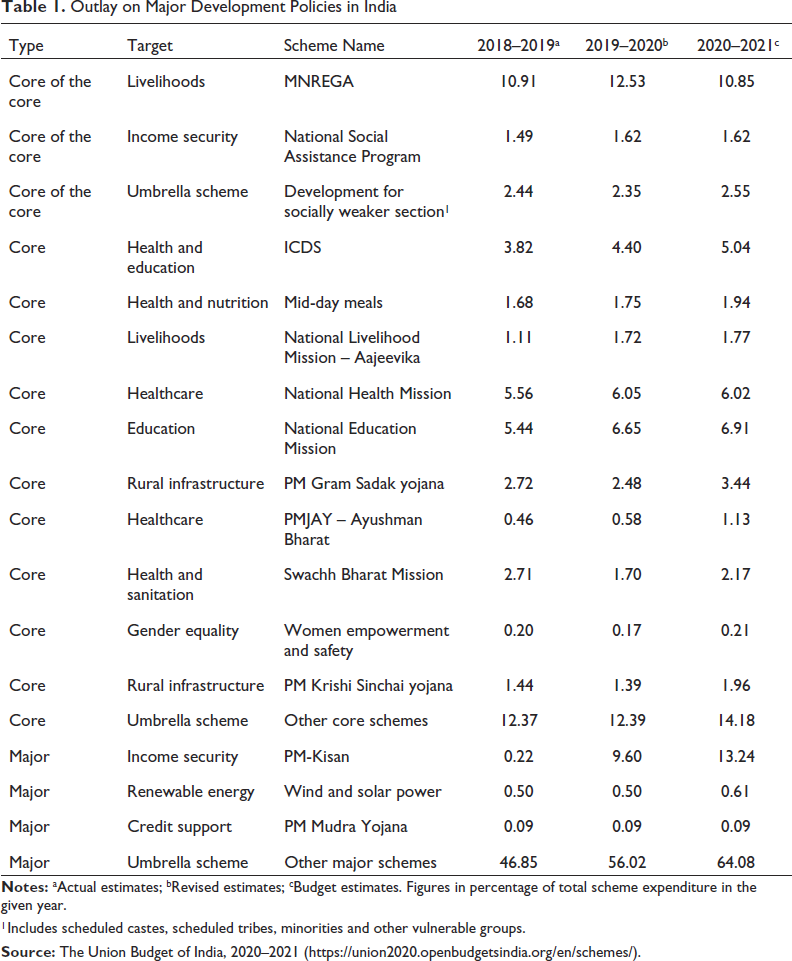
Outlay on Major Development Policies in India
1 Includes scheduled castes, scheduled tribes, minorities and other vulnerable groups.
This study contributes to the literature on development policy discourse as well as quantitative assessments of SEWB. One stream of literature focuses on perceived utility and explains the role of relative incomes and inequalities (Asri, 2019; Das, 2016; Joshi & Rao, 2017; Piketty, 2014), while another stream of literature underscores ambiguous association between economic development and perceived economic wellbeing (e.g., Easterlin, 1974; Rajan, 2019; Stevenson & Wolfers, 2013). The insights are combined and then concluded that while development policy does matter in driving SEWB, integrated policy design could perhaps more likely to enhance the sense of SEWB.
The remainder of the article is organised into four sections. First, we review India’s recent development policies. Second, we elucidate some of the exclusive features of Indian Human Development Survey (IHDS) dataset and variables of interest, and then describe the empirical strategies used to test the relationships of interest. Third, we present the results obtained and make comparisons for different income groups. Finally, we discuss the findings and their implications and directions for future research and policymaking.
India’s development policy discourse addresses four broad themes: poverty alleviation, building institutional capabilities, social inclusion and reducing inequalities (Gurtoo & Udayaadithya, 2014). As social and economic inequalities are pervasive (Guha, 2007), it is important to capture perceived wellbeing of individuals coming from different socio-economic backgrounds. In this context, SEWB is influenced by two major factors: capabilities of the individuals to achieve favourable outcomes and conditions that facilitate or falter those attempts (Nussbaum, 2001). Inequalities, relative economic status considerations or any other situational parameter could be the determinants of SEWB (Nanarpuzha & Sarin, 2021). Hence, an interpretation of changing social and economic status by each household could give a better picture of the extant development discourse while controlling the differences in the interpretation of SEWB (Jaikumar et al., 2018).
In the welfare literature, it is a popular belief that economic growth leads to better welfare (Cracolici et al., 2012). The literature against the assumption ‘changes in economic welfare indicate changes in social welfare in the same direction’ originates from the theory proposed by Easterlin (1974). According to ‘Easterlin paradox’, economic growth or rising income is not necessarily systematically accompanied by social welfare. For instance, GDP per capita may not provide an adequate assessment of people’s wellbeing, if there are large inequalities, as then more people will be worse-off (Stiglitz et al., 2009). To understand how determinants of SEWB interact and in what ways social and economic forces are at interplay with these judgements, we review the development policy discourse of India in what follows.
Mahatma Gandhi National Rural Employment Guarantee Act
In emerging economies, one of the major concerns is to provide social security net, typically based on welfare programmes, social assistance, unemployment insurance and related programmes. MNREGA is India’s rights-based welfare programme that has public works approach and combines income support as well as asset creation, providing hundred days of ‘right to work’ (Ravallion, 2019b). Enacted in 2005 as the biggest employment guarantee scheme in the world, MNREGA aims to ensure livelihood security to each household based on demands in public works such as construction of rural roads, reforestation and irrigation projects (Das, 2016). Beyond bottom-up demand-driven self-targeting design and built-in social audit mechanism, there are several positive long-term impacts such as empowering women, improving school enrolments and financial inclusion (Desai et al., 2015; Khera & Nayak, 2009). Desai et al. (2015) find that MNREGA significantly changed the rural labour market in terms of wages and non-farm labour. Sharma et al. (2016) find that while the total income effects is 1.73 times of the total expenditure effects for MNREGA, indirect output effects and employment effects are higher than direct effects, although also suggesting higher income effects for better-off households. Ranaware et al. (2015) find that MNREGA works as a pro-poor scheme, underscoring its utility to create productive and durable assets.
In theory, employment guarantee programmes such as MNREGA serve long-term development through potential asset creation, shifting the production function towards higher returns and giving direct and indirect benefits (Ravallion, 2019b). However, in practice, these are seen as short-term measures against poverty, leading to low quality and poor perception for assets created. In addition, Ravallion (2019a) indicates limitations and concerns in the implementation of MNREGA such as inclusion and exclusion errors. Further, Das (2016) finds disparities between intended and achieved targets. Instances such as 26% below the poverty line (BPL) participating households, 41% unskilled labour and 42 average working days suggest MNREGA has not been completely successful in improving access to resources and wellbeing. MNREGA also faced hurdles such as ‘rationing’ of work, payment delays, undermining of accountability process and excess demand of work (Drèze & Khera, 2017).
Other Development Policies
One of the central goals of development policies is to raise the income of the poor (Banerjee et al., 2019). In general, income support, conditional or unconditional, provides regular predictable income security to the poor to take care of household expenditure. Social security pensions can be looked as early experiments with targeted unconditional income support (Narayanan, 2011). Under the National Social Assistance Program (NSAP), pensions through cash transfers are facilitated in three broad segments—old age, widows and differently abled—providing social security net to households facing socio-economic deprivation (Chopra & Pudussery, 2014). India’s recent initiative that aims to support income for landholding farmers is PM-Kisan. The scheme provides ₹6000 (nearly $80) annual income support to all the eligible small and marginal farmers, to meet the agricultural input cost and to improve debt portfolio.
Apart from unconditional cash transfers, other important social security initiatives are: Integrated Child Development Services (ICDS), food security schemes such as mid-day meals for school children (Khera, 2013) and Public Distribution System (PDS). Under the targeted PDS initiated in 1997, there are three categories of ration cards provided to households for subsidised food grains: above poverty line, below poverty line and Antyodaya (poorest of the poor), created in 2001 (Khera, 2011). With the implementation of the National Food Security Act (2013) as a step towards targeted PDS reforms, two-third households get the right to receive subsidised cereals. In addition, for advancing early childhood development, ICDS provides a range of services related to healthcare, nutrition, education and social security to children under the age of six, and to pregnant and lactating women (Vikram & Chindarkar, 2020). Considering the underlying objective utility, systemic inequalities and divides such as formal–informal, it is imperative to investigate how a series of development policies influence the lives of individuals with multiple heterogeneities.
Data and Empirical Framework
Data and Sample
We use data from the IHDS, which was conducted and organised together by the University of Maryland and the National Council of Applied Economic Research (NCAER), India (Desai & Vanneman, 2011; Desai et al., 2005). Utilising the detailed information, recent studies have used the IHDS data to: (a) examine the impact on SEWB (Jaikumar et al., 2018); (b) review development policies (Drèze & Khera, 2017); and (c) empirically test the medium-term impact on cognitive abilities in early childhood care (Vikram & Chindarkar, 2020). The IHDS panel dataset of 34,621 households comprises two waves of interviews: IHDS-I (2004-05) and IHDS-II (2011-12), where a majority of the IHDS-I households (83%) were re-interviewed in IHDS-II. The re-interview rate was around 72% and 90% in urban and rural areas, respectively (Vikram & Chindarkar, 2020). Further, IHDS-I sample consists of data from 41,554 households across India, covering 971 urban areas and 1,503 villages. In IHDS-II, the sample consists of 42,152 households that covered 1,042 urban areas and 1,420 villages.
The surveys provide the detailed information on consumption, incomes from various sources and other household characteristics well established in the literature. Furthermore, in IHDS-II, households responded to: ‘Compared to seven years ago (2004–05), would you say your household is economically doing the same, better, or worse today’. The responses were re-coded in an increasing order of SEWB as: 1 – worse, 2 – same and 3 – better. The above-stated question assesses the changing economic circumstances in subjective terms and the perceived measures of how much wellbeing the households achieved in the given time period (Jaikumar et al., 2018). Moreover, IHDS-I was conducted prior to the implementation year of MNREGA (2006), and IHDS-II was conducted 6–7 years after the implementation. Through our analysis, we empirically test the medium-term impact of MNREGA for participating households on SEWB.
Dependent and Independent Variables
Our analysis begins with the hypothesis that participating households should experience greater improvements in SEWB as compared to the non-participating households prior to and post the MNREGA intervention, all else remaining equal. Our basic specification is thus as follows:

where the dependent variable
The variable
The impact of interaction of development policies on SEWB is measured by β3. The interaction term between
For income inequality, the Gini coefficient (
where 
Our analysis considers a three-group distribution, and thus, the basic equation is as follows:

For household-level variables, dummy
Empirical Framework
Since the SEWB responses are on three discrete levels (worse, same, better), we employ ordered probit regression as it utilises embedded additional order information in computing the likelihood of a household for SEWB responses. Jaikumar et al. (2018) expressed the model as follows:

where 
where
Table 2 reports descriptive statistics of the variables considered in our analysis. The univariate statistics present some interesting background; 30% of the households participated in MNREGA and two-thirds of our sample are rural households. On SEWB responses, we see nearly 46% households experience no change, while 25% responded better-off and 29% responded worse as compared to the last 6–7 years.
Descriptive Statistics.
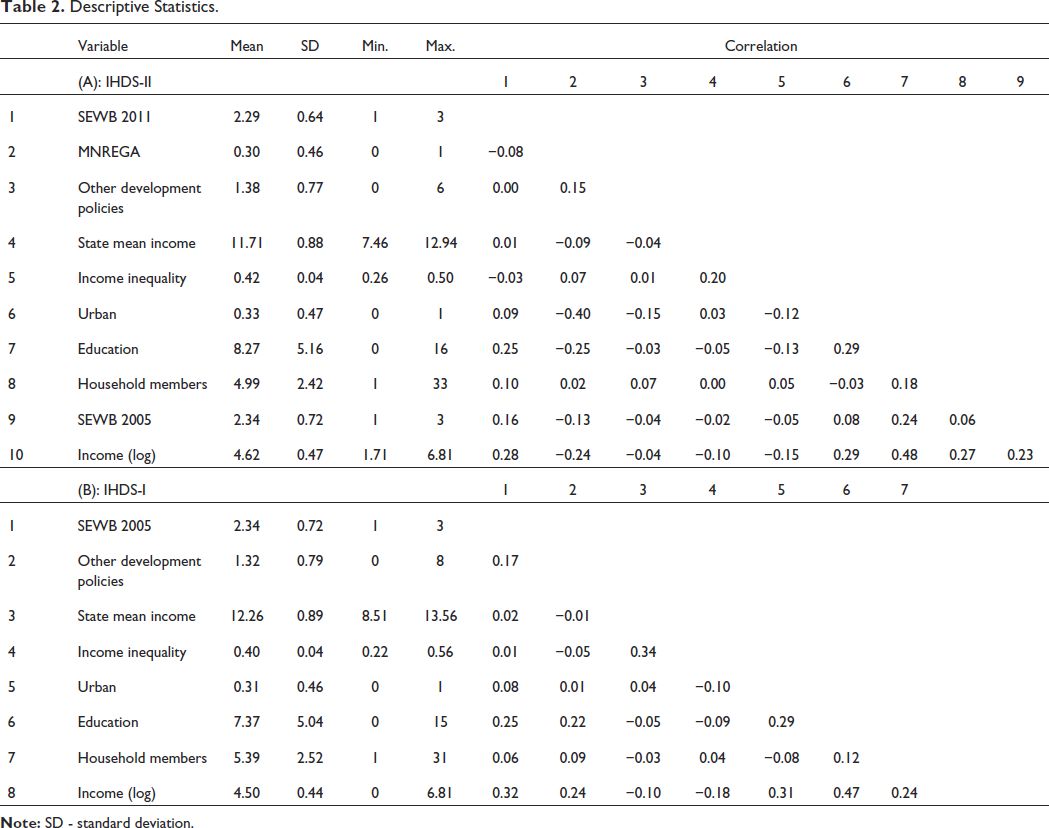
Descriptive Statistics.
Table 3 presents the results of our random-effects ordered probit model. The five columns show coefficients and their standard errors in parentheses. The first two columns correspond to our key variables of interest (MNREGA and other development policies); in addition, the third and fourth columns include state-level and household variables. The fifth column presents the results of the full model that also include indicators of social and economic status (social groups and change in income). Consistent with our prediction, the sign of coefficient of the variable of interest (
Impact of Development Policies and SEWB.
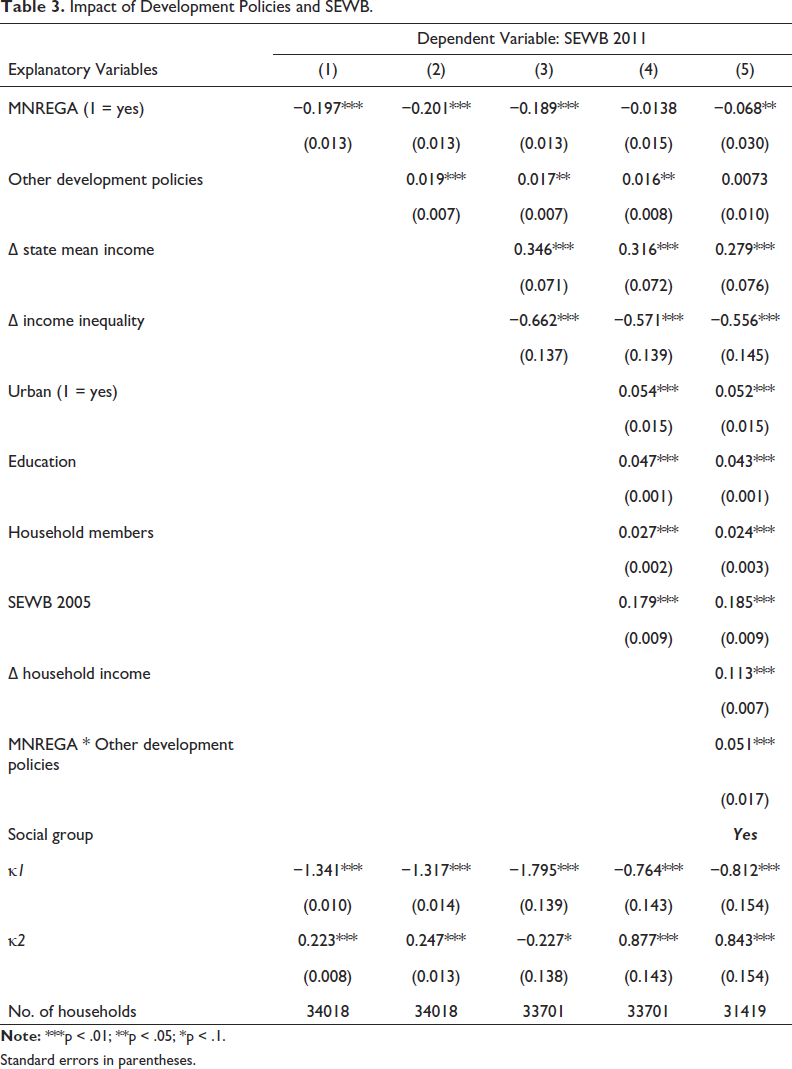
Standard errors in parentheses.
Income Groups
Furthermore, we categorise sample households into three income groups: low-income (bottom 50 percentile), middle-income (middle 40 percentile) and high-income (top 10 percentile) groups in terms of household income, as considered for Equation (4).
Table 4 shows results for our hypothesised direct for income groups. Column 1 constitutes the results for low-income groups. Consistent with our prediction, all the three variables of interest are statistically significant (p < .05). The results for middle-income (column 2) and high-income (column 3) groups are significantly similar, unlike those for the low-income group. While ∇ state mean income is positive and significant (p < .05) for middle-income and high-income groups, ∇ income inequality is negative and significant (p < .05) for the low-income group. In line with earlier findings, we find that indicators of relative income levels play a significant role in determining SEWB than economic growth. Finally,
Impact of Development Policies and SEWB: Income Groups.
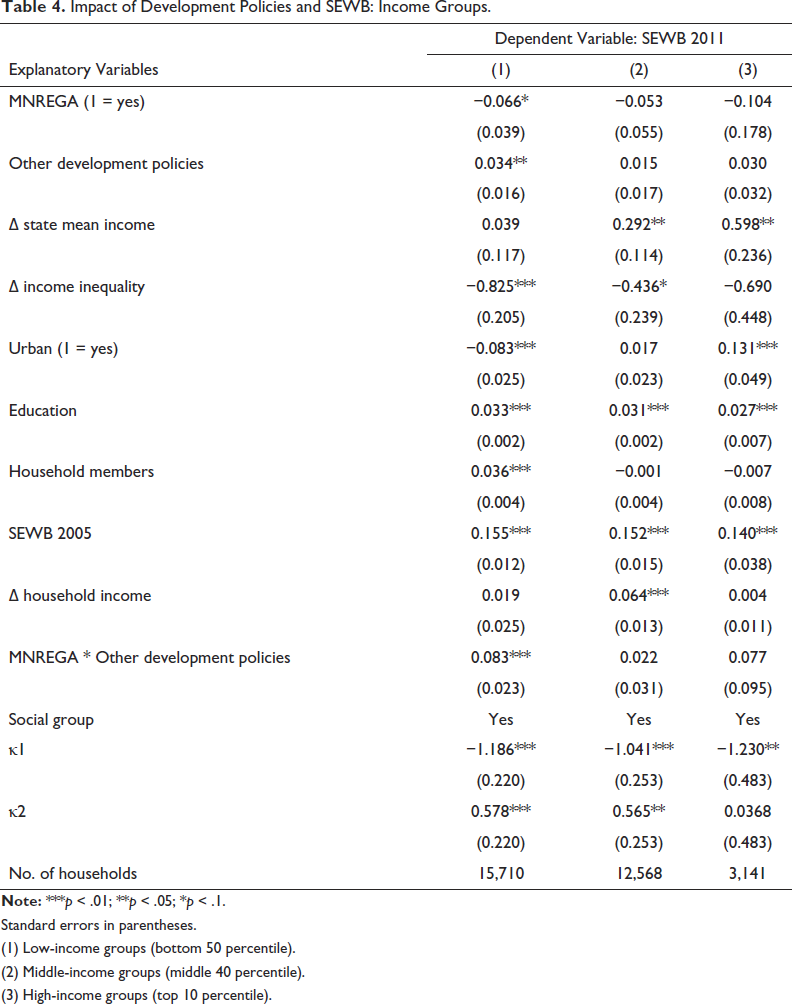
Standard errors in parentheses.
(1) Low-income groups (bottom 50 percentile).
(2) Middle-income groups (middle 40 percentile).
(3) High-income groups (top 10 percentile).
Table 5 presents the predicted probabilities of three income groups reporting SEWB for change in
Marginal Effects: Income Groups.
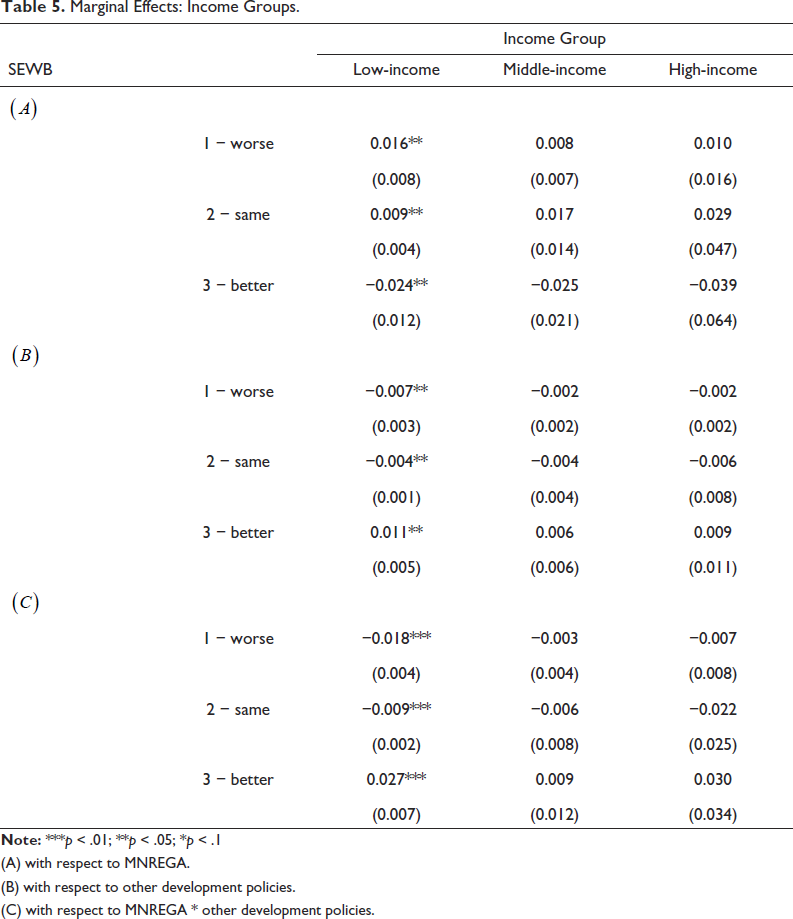
(A) with respect to MNREGA.
(B) with respect to other development policies.
(C) with respect to MNREGA * other development policies.
Robustness Tests
To ensure robustness of results, we also ran alternate specifications. First, while we believe our approach for computing income inequality is appropriate and based on previous studies (e.g., Piketty, 2014), we acknowledge that there is no theoretical reasoning for cut-off consideration. Thus, we change our definitions for low-income (bottom 50 to bottom 40), middle-income (next 40 percentile) and high-income (top 20 percentile) households and run the analyses again. Our results are qualitatively similar to the reported results. Second, we also ran ordered logit regression and found results to be consistent. Further, while we use two waves of data to address the effects on SEWB, we do not identify any factor to address potential endogeneity issues. However, we partly address the issue of endogeneity that changes in SEWB may lead to changes in independent variables by reporting changes in the variables (Jaikumar et al., 2018).
The findings support the directed hypothesis that households engaging in a number of development policies achieve higher SEWB. Consistent with Easterlin paradox, findings also indicate that economic growth alone is not an adequate policy objective, as inequalities negatively impact SEWB. Overall findings are in line with previous studies: Das (2016) on the impact of MNREGA, Jaikumar et al. (2018) on the impact of inequalities on SEWB and Aiyar and Mukhopadhyay (2019) on the significance of convergence among development policies.
Impact on SEWB
The findings show significant impacts of MNREGA on SEWB. A beneficiary of MNREGA needs to do unpleasant work for little income—as those who find other work opportunities will not seek to avail benefits under MNREGA any longer. Therefore, participating households that come from deprived sections are relegated to lower levels of SEWB. However, as such households tend to participate in more development policies, which to an extent ensures basic entitlements, they tend to perceive a higher sense of wellbeing over time.
The most important finding underscores a positive interaction between MNREGA and other development policies, in significantly driving SEWB. The practical success of MNREGA has been uneven, and with low-income levels and paucity of access to public services, participating households do experience lower levels of SEWB. Emerging economies need a more holistic approach to effectively elevate SEWB. Inclusion in a greater number of development policies illustrates a case of good governance and better convergence. Therefore, rather than focusing on each development policy separately, the priority should be on a comprehensive view of development discourse.
To integrate a comprehensive view, two important dimensions should be taken care of. First, there are policies as well as institutional and other external factors that feed on each other; thus, a broader structure that supports these development policies should bring synergies and create an ecosystem wherein policy consistency matters more. Second, since the development policy process is iterative and complementing in nature (Hans, 2017; Kumar & Giri, 2020; Umar et al., 2019), therefore, the policy approach should evaluate aspects such as contextuality, efficacy, sustenance and relevance.
Finally, while we argue of a universal welfare architecture which should have a core basket of priority areas that could holistically improve wellbeing, it is imperative that the system should incorporate a flexibility-based bottom-up approach and adaptive mechanism. For example, in the case of MNREGA, there came several conflicts with the advent of technology (Khera, 2016, 2019). In addition, the findings for urban poor indicate limited interaction among development policies as households face ‘urban penalties’ (Kumar & Saiyed, 2019). These instances sketch an important narrative—improving SEWB is less likely unless there is holistic improvement in basic needs and individual capabilities. Otherwise, gaps between capabilities of the individuals and opportunity structure of the state could pose serious challenges to wellbeing.
Limitations and Future Research
Our study did reveal some interesting findings; however, in conclusion, we do acknowledge a few limitations and directions for future research. First, our empirical approach is based on two waves of IHDS data that limits our ability to infer strong causal relationships. Also, while we address effects of household characteristics on SEWB, we do not recognise any variable that addresses endogeneity issues. Thus, there might be a possibility of time-variant variables that correlate to changes in dependent and independent variables. Second, with the rapid expansion in the coverage of development policies and increased attention on subjective aspects, it is likely that future evaluations of development policies, perhaps with IHDS-III, show stronger impact of SEWB. Finally, the importance of development policies in emerging economies like India cannot be overstated. MNREGA with other social security initiatives not only provides a safety net to the poor and disadvantaged but also mitigates the ill-consequences of inequalities, exclusion and deprivations. Focus on comprehensive policy discourse will transform human potential and mitigate distributional concerns and thus contribute to an elevated sense of economic wellbeing.
Footnotes
Declaration of Conflicting Interests
The authors declared no potential conflicts of interest with respect to the research, authorship and/or publication of this article.
Funding
The authors received no financial support for the research, authorship and/or publication of this article.
