




Abstract
This article attempts to construct an extremely rudimentary framework to argue that the long-term losses from the pandemic shock are likely to far exceed the short-term one. In the simple structure presented here, output depends on labour force, efficiency that is determined by past nutrition levels and capital accumulated from the past. The immediate effect of the pandemic is to lower the effective labour size, principally due to lockdowns to prevent or delay the spread of the pandemic. The other two factors cannot be affected. However, the decline in present output is likely to lower both the efficiency of labour and the future capital along with the labour supply in the future, thereby causing a greater impact on future output.
Introduction
The impact of coronavirus on our lives is simply unprecedented. It may not be an exaggeration to state that no one alive has seen anything close to it. It has directly impacted the life almost every person in the world, no matter what their age, sex and country of residence. Not even the World Wars had a greater worldwide impact. And although the Wars and the Spanish flu did kill many more people, most were unaware of their extent and intensity. 1
It has affected the health and lives of an immense number—at this time, more than 51.82 million have been infected with nearly 1280000 recorded deaths in 215 counties. In India, the figure is 8.63 million infected and over 127000 deaths. Leaving aside China where the virus originated, this has happened in just six months from March to October 2020. There is enormous pressure on the health and administrative infrastructure and the consequent rush to devote resources to the management of the virus. On the one hand, there are attempts to raise the number of beds, isolation facilities, testing facilities, ventilators, etc., either in existing hospitals or in new ones. On the other hand, there are the efforts to ramp up research on medicine to manage this virus or to develop vaccines for it.
The pandemic has had a severe impact on livelihoods as well as more broadly on the economy. This is not merely due to the huge requirement of resources or the impact on the lives of those directly affected—but the much more widespread interruption of and impediment to overall economic activity—specifically due to the introduction of the ‘lockdown’ in most countries to slowdown the spread of the virus. Along with this, there is the enormous uncertainty surrounding most aspects of this event—How long will the spread continue to increase? How long will the ‘lockdown’ continue? When will a vaccine be developed? When will there be a reliable medicine/treatment regime be found? When will travel be normalised? Will I have/get a job? When will I be able to complete my education? When will I be able to return home? In addition to the direct impact on life, livelihoods and the economy, such uncertainty clearly results in a dampener to economic activity—household (consumer) demand and investment demand.
Understandably, most of the research on the economic impact of the coronavirus has focused on the immediate impact. 2 In this article, by contrast, we propose to examine some of the possible long-term impacts of coronavirus on the labour force and implication on the so-called demographic dividend. As indicated in the following survey of the emerging literature, the pandemic has had a much stronger immediate impact on the working age population and an even stronger one on elderly retirees than on minors. Thus, the pandemic seems to have had a more serious immediate impact on developed economies with a higher number of elderly than on poor economies with a much higher proportion of children and younger adults. By contrast, the increase in poverty and malnutrition due to the lower productivity is likely to have a greater impact on the more youthful population in poor economies restricting their future productivity. In the coming years, many poor countries are likely to reap a demographic dividend—an increase in productivity due to large additions to their labour force. Unfortunately—as many have noted—these gains will be reduced if the potential additions to the labour force lack education and are not healthy. 3
The rest of the article is organised as follows: Section II presents a brief survey of literature relevant to the present study. Section III analyses the impact of the pandemic on the present and future population. Section IV studies aspects of the economic impact of the shock. Section V concludes this article.
A Brief Survey of Literature
This brief survey covers some of the main strands of the emerging literature on Coronavirus connected to the present study, specifically on:
the incidence and age structure of deaths from coronavirus, the economic and financial impact of the pandemic, poverty, malnutrition and the demographic dividend and policies to address the pandemic.
It has borrowed heavily from two excellent and detailed surveys—one in the general context (Brodeur et al., 2020) and one mainly focused on India (Ray & Subramanian, 2020).
The Death Rate from Coronavirus
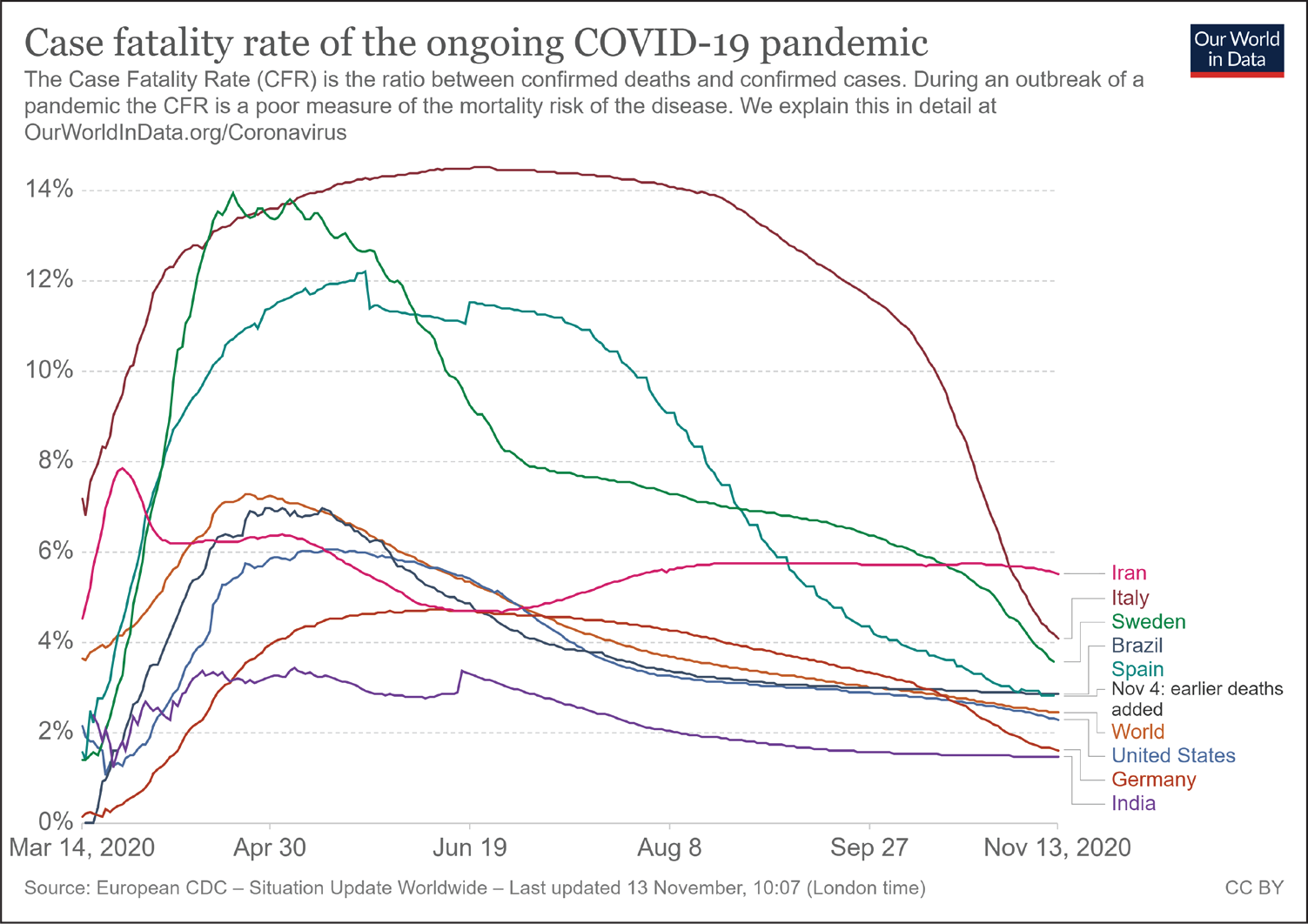
As is well known by now, the data on case fatality rate (CFR) = number of recorded deaths/number of confirmed cases and crude mortality rate = number of recorded deaths/total population are now widely available (e.g., our world in Data 13/11/2020) as Figure 1 shows.
However, since the actual number of infections and even sometimes recorded deaths due to coronavirus are very difficult to obtain, the more crucial data on the infection fatality rate = no of recorded deaths due to coronavirus/number of actual infections are difficult to estimate.
The second important issue is that the death rate is much higher among the elderly—particularly those who are 65 and lower. On the other hand, it is very low among children and minors—that is, those below 18 years.
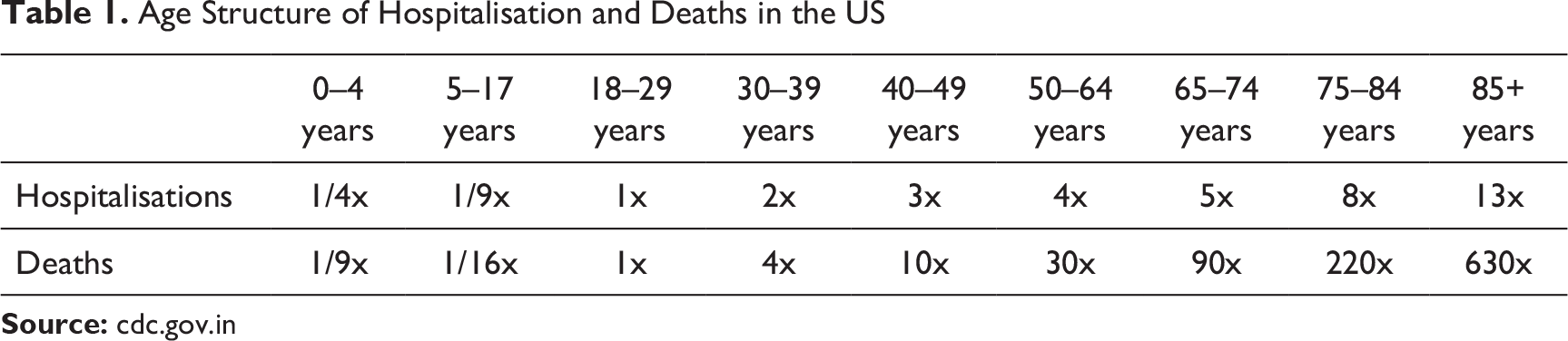
US Centers for Disease Control and Prevention data updated to August 10, 2020 and the death ratios relative to the comparison group are presented in Table 1.
This clearly shows that the elderly are more likely to die from the disease, while the risk for children and minors is much lower. Another estimate of the relative incidence of deaths by age (Stokes et al., 2020) is presented in Table 2.
Age Structure of Hospitalisation and Deaths in the US
Age Structure of Infection and Deaths

Age Structure of Infection and Deaths in India

While the CFR typically falls as larger numbers are tested, since the number of confirmed cases increase (leading to a rise in the denominator), India has a low CFR compared to most developed countries despite much lower testing levels. Ray and Subramanian (2020) have explained this apparent contradiction by pointing to the age structure of the Indian population, which has a much higher proportion of young people than the developed world.
The Economic and Financial Impact
We begin with a study of the economic impact of past pandemics. It is mentioned that COVID-19 is the most serious pandemic since the Spanish Flu in 1918, which killed between 40 and 50 million people (Ferguson et al., 2020). Jonas (2013) finds that the negative impact of the pandemic ranges from (a) reduced consumption, (b) rise in medical costs, (c) loss of output and labour and (d) disruption of trade and other services. Barro et al. (2020) estimate that the 2.1 per cent death rate based on the Spanish pandemic would presently correspond to about 150 million deaths worldwide, 6 per cent fall in GDP and 8 per cent fall in private consumption.
Carlsson-Szlezak et al. (2020a, b) foresee three kinds of shocks—(a) reduced consumption, (b) negative impact on financial markets, possibly compounded by uncertainty (Baldwin, 2020) and (c) supply-side disruptions due to halting of production, prolonged layoffs fall in employment and interruptions in the supply chains. The interconnectedness of the modern economy causes these factors to have a cascading effect on the circular flows, that is, reduced income → reduced consumption and investment demand → lower imports → lower world income → lower exports and lower income. This is combined with disruptions in the international supply chain and fall in output and employment (Baldwin, 2020; Gourinchas, 2020).
In terms of macroeconomic impact, Ludvigson et al. (2020) argue that a pandemic such as COVID-19 is equivalent to a large multi-period exogenous shock that can lead to a 12.75 per cent drop in industrial production, 17 per cent loss in employment as well as sustained macroeconomic uncertainties (see also Baker et al. 2020). According to Jorda et al. (2020), the shock results in excess capital per unit of labour causing the investment demand to fall bringing down the real natural interest rate. The lockdowns introduced to tackle the pandemic also disrupt the global supply chains leading to lower labour supply and fall in productivity, which adversely affect firm revenue ultimately leading to a fall in output employment and consumption (Bonadio et al. 2020; Coibion et al., 2020a, b; Elenev et al., 2020; Fornaro & Wolf, 2020). The loss from non-working days due to lockdowns leads to lower labour capital ratios and idle capacity in the workplace (Mulligan, 2020). Baker et al. (2020) found that households increased their spending in the initial period followed by a decrease in overall spending, while Binder (2020) shows that 28 per cent delayed/postponed future travel plans and 40 per cent forewent food purchases.
An important area is the estimation of unemployment due to lockdown/social distancing policies. Gupta et al. find that US employment rate fell by about 1.7 percentage points for every extra 10 days a state was under lockdown during March 12 to April 12. Coibion et al. (2020a) calculate a fall in long-run labour participation rate accompanied by increase in unemployed workers who have stopped searching for work—possibly due to the disproportionate impact of COVID-19 on the older population. It is also found that unemployment is more severe for vulnerable sections of the populations (Alstasaeter et al., 2020) such as people with lower education and immigrants who are less likely to be in jobs that allow working remotely (Adams-Prassl et al., 2020; Béland et al. 2020; Yasenov, 2020), which also reduces the supply of labour in these industries (Avidu & Nayyar, 2020).
Poverty, Malnutrition and the Demographic Dividend
In regions that are home to a majority of the world’s poor—like South Asia and sub-Saharan African—malnutrition due to poverty is quite endemic. As household incomes fall due to job losses of more vulnerable sections of the population due to COVID-19, the number of children categorised as poor in South Asia may grow from 240 million to 360 million (UNICEF, 2020). Poor nutrition in the first 1,000 days of a child’s life can also lead to stunted growth, which is associated with impaired cognitive ability and reduced school and work performance Thus, the stunting and wasting due to malnutrition, 4 which already affect 56 million and 7.7 million children, are likely to rise sharply if vulnerable families are unable to provide nutritious meals for their children.
Age Structure of Population, 2017
But there are more complex ways in which exogenous health shocks are likely to affect productivity. For example, during the earlier stages of demographic transitions, higher rates of child mortality are associated with higher fertility rates along with reductions in the labour force brought on by mortality, and early retirement can cause an increase the ‘dependency ratio’ that ultimately reduces income (Ruger et al., 2001; Kalemli-Ozcan, 2002). However, the converse—that decreases in mortality raises per capita income—claimed by some of these studies has been contested (Acemoglu & Johnson, 2007) on the grounds that higher life expectancy as a result of these changes can raise capital-to-labour and land-to-labour ratios, which can depress per capita income. Of course, this initial decline is later compensated by higher output as more people enter the labour force and as more capital is accumulated and may even exceed the initial level of income per capita if there are significant productivity benefits from longer life expectancy.
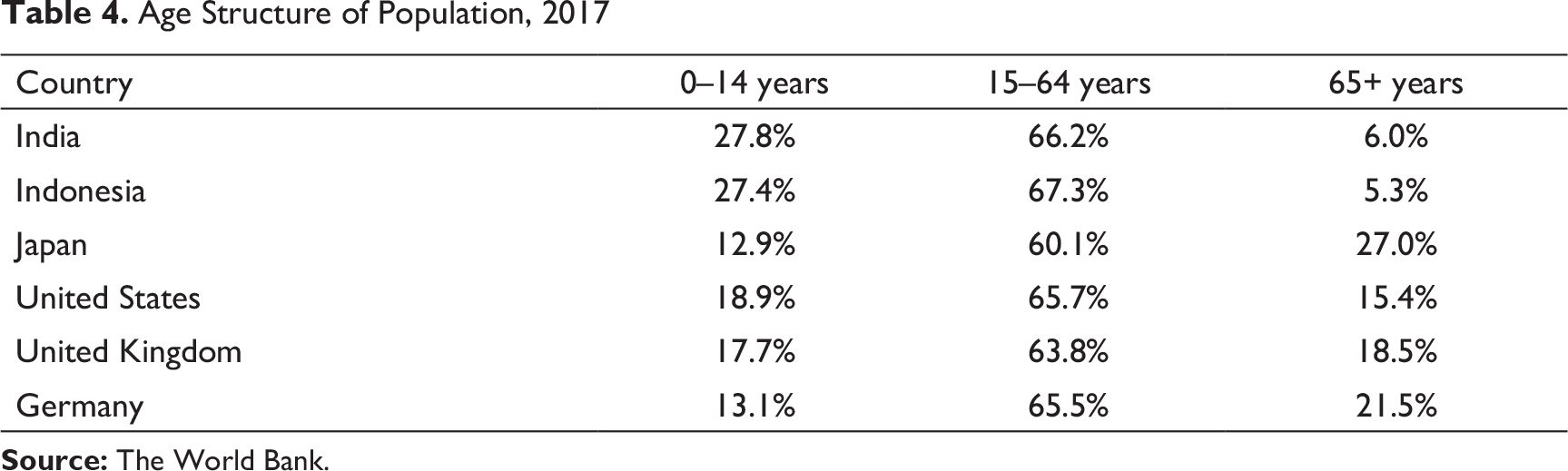
As developing countries are able to tackle their high child mortality, low life expectancy and high fertility rates, they transition into states where the working age population forms a high proportion of the population contributing to higher output and savings. This window of ‘demographic dividend’, however, is limited (Bloom et al., 2004), before the economies are burdened with a large proportion of retirees dependent on the shrinking working age population. In developing countries, such as India and Indonesia, the proportion of children are much higher compared to developed countries as shown in Table 4.
Policies to Address the Pandemic
Finally, we briefly review the literature on policies to address the pandemic. These may briefly be categories into three types:
Health and awareness policies Government restrictions to prevent spread Economic policies
Health and Awareness Policies
Health and Awareness Policies
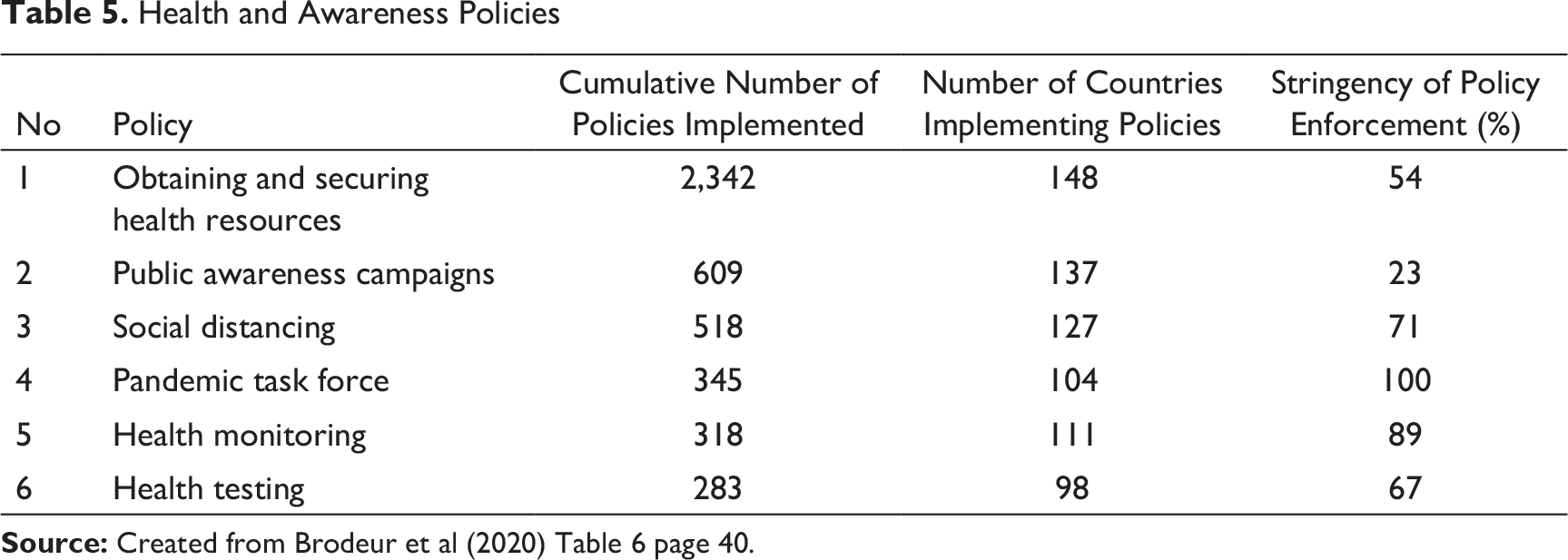
Table 5 shows that in terms of implementation of health and awareness policies, ‘obtaining and securing health resources’ comes first. This includes materials (e.g., face masks), personnel (doctors, nurses) and infrastructure (e.g., hospital). Although testing for COVID-19 seems to have much lower down in priority, there is a large medical literature developed on COVID-19 testing (Abbasi, 2020; Carter et al., 2020; Kobokovich et al., 2020). An issue here is whom and how widely to test—randomly or people with symptoms (Rockmore & Herron, 2020). Testing is crucial to understand in real time whether the dynamics of the pandemic are accelerating or decelerating (Baunez et al., 2020)
Policies to Prevent Spread
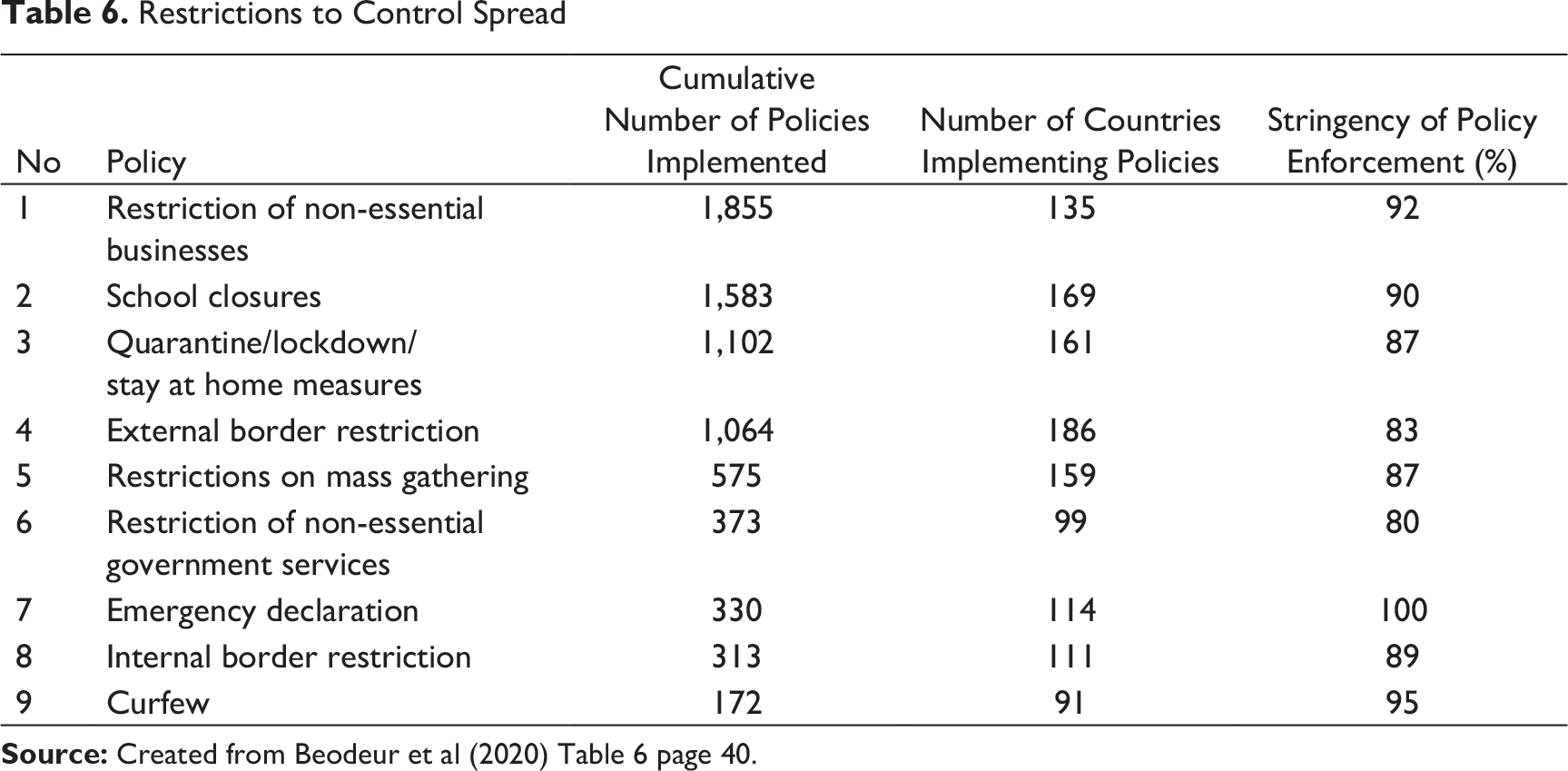
The most important set of policies—other than improving awareness and bolstering the health facilities to tackle the lockdown—has been to introduce and implement restrictions on physical interactions between people including restrictions on travel, gatherings, schools and businesses culminating in curfews, quarantines and lockdowns (see Table 6).
While most of us have experienced measures such as internal or external travel restrictions, closures of business, schools and restriction on mass gatherings and curfews—either to control disease or for various public safety reasons—few have ever encountered quarantine and lockdown restrictions at such a widespread scale over long periods. Nonetheless, in the opinion of Ray and Subramanian (2020) ‘the first-best (or “unconstrained”) approach to tackling the viral epidemic is a fully implemented lockdown, which is accompanied by a comprehensive welfare measures designed to compensate for the negative impact on human lives of such a lockdown.’
Restrictions to Control Spread
Economic Policies
Bigio et al. (2020) determine that the optimal mix between government transfers and credit subsidy policies them depends on the level of financial development in the economy. According to them, economies with a developed financial system should utilise credit policies. On the other hand, developing economies should engage in more transfer spending. Specifically, in economies with high incidence of casual labour, informality and low savings, a redistributive plan should necessarily accompany lockdown (Ray et al., 2020). If in addition—as in India—the banking system is characterised by high non-performing assets, then supply-side policies to improve the positions of firms are unlikely to work by themselves, not only because firms would be unlikely to invest in a situation of depressed demand but also because banks are unlikely to pass on the credit to vulnerable entities. In these situations, measures such as direct cash transfers, employment guarantee schemes and distribution of food through the public distribution system not only provide immediate relief to the vulnerable, but also boost demand, which is crucial to the revival of the economy (Khera, 2020, Ray and Subramanian, 2020).
In this model, period 0 (whenever applicable) refers to the past, period 1 to the present and period 2 to the future. This is clearly a simplification and could be easily changed to t – 1, t and t + 1
Population Dynamics in Absence of the Pandemic Shock
We assume that in period 1, a proportion 
In the next period, a fixed proportion, λ, of the retirees in period 1 survive from death due to natural causes. A further (fixed) proportion of the people in the work force, β, retire. In other words, the number of retirees in the future (period 2) may be stated as

The labour force in future (period 2) then consists of the proportion of non-retirees (
The number of children in future (period 2) is assumed to be a fixed proportion α of the people of the workforce—of those members who have children

The population increases (decreases) in the future in the absence of the pandemic as

or as the number of minors added, 
Observe further that the labour force will grow (fall) in future when

that is, if the number of minors (added to the labour force) exceed those who retire. Thus
Population Dynamics Following the Pandemic
The Impact on Current Population
In the current period, the exogenous shock will lead to decline in the number of retirees as well as in the number of workers

In other words, both the number of retirees and workers declines while that of minors remains fixed. Further, it is easy to check that the number of retirees and workers decline more when the level of the shocks,
The Impact on Future Population
The coronavirus shock then causes both the number of retirees and workers in period 1 to fall so that the number of retirees in period 2 is also reduced. Since a proportion of 
The population shock then affects only the proportion of workforce who continue—assuming that the minors are not affected by the shock

Since the number of workers in period 1 falls, so does the number of children in period 2

However, a reasonable alternative is to assume that those who withdraw from the labour force due to joss in employment also desist from having children (perhaps because they are unable to sustain them) so that we may have

Thus, with higher pandemic shock, 
As before, there are two periods, where period 1 refers to the present and period 2 to the past. And as before, these periods are longer than the ones conventionally considered. In period 2, for example, the children in period 1 join the working force, a portion of the working force retires while a portion of retirees pass away. In the same way ‘capital’ K is perceived in the model from a longer term (physical?) perspective than the usual model, so there is only ‘present’ capital K1, available at the beginning of period 1 and ‘future’ capital K2, available at the beginning of period 2. In the model, the workers
The Economy Without the Pandemic
The Production Function is assumed to be a simple one which depends on the amount of capital and the amount of labour multiplied by an efficiency (productivity) factor:

The efficiency factor, 
The Distribution of Income, Output: It is assumed that out of the current output, the retirees must be given a mandatory pension, p, per capita. After allotting an amount 
Wages, worker families and nutrition: It is also assumed that the minors are members of the worker families and are distributed evenly per worker. Hence, the level of nutrition achieved per individual (worker or minor) may be defined as

Note that in period 1, the efficiency level, 
Similarly, 
We assume that a per cent of output is allocated to savings which is converted to savings and form the savings in the next period. Since our periods are long (thought of as present—period 1—and future—period 2), we assume that 
where

Thus, labour in efficiency units in future may be defined as

In the absence of the shock the output in the future period is then given by
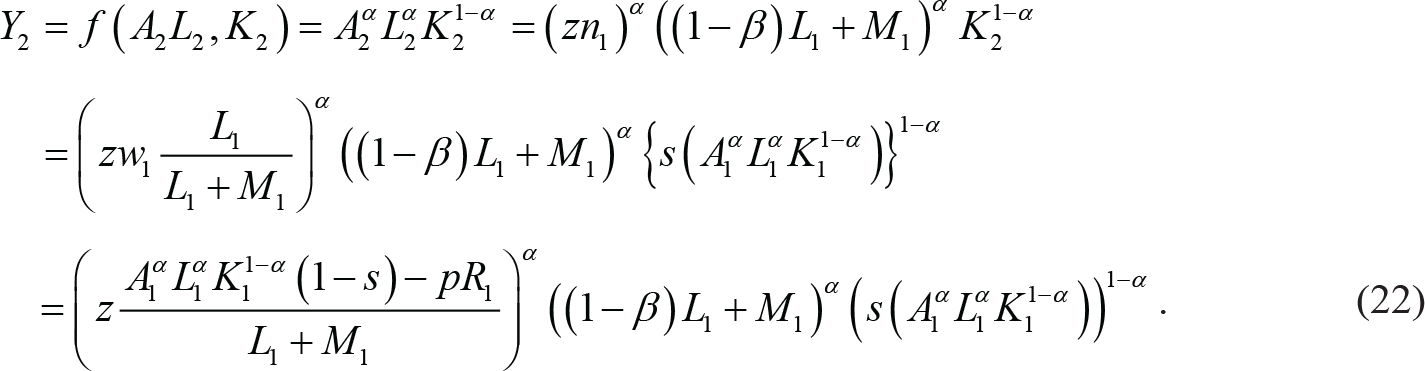
It is evident that
The number of minors in period 1 is at least as large as the proportion of workers about to retire so that the size of the labour force does not fall
The savings in period 1 is at least as large as the capital accumulated from the previous period so that the amount of capital does not fall
The nutrition per individual in worker families in period 1 is at least as large as that in the previous period so that efficiency does not fall

The Economy in the Pandemic
The Economic Impact in the Current Period
The shock leads to a reduction in output due entirely to a reduction in the number of workers who can effectively participate in work due to the lockdown (particularly those that cannot work remotely or through online mode) because worker efficiency 
In other words, output in the present period declines by a factor of
The Economic Impact in the Future Period
Assuming that the rate of savings following the pandemic remains the same (or at least does not exceed that in its absence (
which is lower than that in absence of the pandemic by a factor of 
However, it is still possible that
The Decline in the Supply of Labour
It is obvious that the future labour force

This implies that

The Decline in the Efficiency Factor
Since the number of retirees decline due to the population shock the amount to be distributed to a (reduced) labour force after paying the retirees, a fixed lockdown allowance, u, to the unemployed labour (families) and saving for future investment (possibly at a reduced rate 
where 
Clearly 
while that achieved per member of the working families is

Thus, labour in efficiency units in future following the pandemic may be defined as

Observe that since 
Hence
Comparison of Present and Future Economic Impact
From the above discussion, we have [using (24), (26) and (30)]

A comparison with (23) makes it clear that:
This article has argued that the future cost of the COVID-19 pandemic is likely to exceed the present costs—as some have indicated in case of the Spanish flu epidemic. This particularly hurts developing countries such as India, who are at the threshold of realising their ‘demographic dividend’ from the contribution of a large working population. However, a complete analysis of this would require a fully articulated model of economic growth with demographic dividend—of which this is the first step.
