




Abstract
This article discusses the life-story of Suchet Singh (1841–1896). The ruler of the Himalayan kingdom of Chamba, Singh was deposed by the colonial authorities soon after his accession in 1870, and spent the rest of his life seeking restitution. We argue that the strategies employed by Singh, who combined appeals to the international press with political manoeuvrings in India and Europe, evince a novel type of cosmopolitanism. This new development allowed elites from the colonies to contest the empire by exploiting unprecedented technological advancements in communications and travel alongside the support of a widening liberal lobby in the metropole. While Singh ultimately failed to regain his patrimony and died destitute in exile, his life story demonstrates the capacity of judicious engagement with the public sphere and the cultivation of global support-networks to improve the standing of colonial subjects in the Age of Empire.
Introduction
On Monday, 17 August 1896, an Indian gentleman in his mid-fifties was spotted staggering on a West London pavement. He fell unconscious soon afterwards and was carried into a building by two strangers, who placed him at the bottom of the stairwell to be nursed by a young Frenchwoman who claimed to have lived with him, ostensibly as his wife, for the previous four years. He was reported to be dead by the morning. While the death of a colonial subject in the metropolis was hardly an exceptional event in turn-of-the-century London, this particular instance was deemed sufficiently important to be reported in newspapers across the empire. Come Saturday, the news of the ‘Indian Tragedy in London’ was reported in northern England; by the following week, it appeared in the Indian press. 1
The ‘staggering gentleman’, it turned out, was prince Suchet Singh (1841–1896), the erstwhile ruler of the Himalayan kingdom of Chamba (today in Himachal Pradesh, India). Having been dethroned by the British soon after his accession to the throne in 1870, Singh spent most of his adult life seeking redress in India and Europe. By 1894 his efforts had rendered him a bankrupt alcoholic. The post-mortem examination revealed ‘a blood clot on the brain weighing six ounces’ and internal organs ‘shriveled [sic] from chronic alcoholism’, prompting the coroner to remark that ‘it was a wonder that the man had lived so long’. 2
The life-story of Suchet Singh is instructive of the interplay between liberal cosmopolitanism and colonial subjectivity in the era that Eric Hobsbawm had characterised as the Age of Empire (c. 1870–1920). 3 By liberalism, we refer to the progressive strand of British and European politics that began in the 1810s, but whose origins can be traced to the early modern period. 4 We argue that the evolution of liberal thought in tandem with the expansion of European empires engendered new possibilities for cosmopolitanism. By cosmopolitanism, we refer to the political-theory reading of the term emphasising equality before the law in multi-cultural political settings. Specifically, we focus on the infusion of cosmopolitanism with liberal thought as it had developed in late-nineteenth-century European colonial empires. 5 Supported by unprecedented technological advancements in global communications and travel, colonial subjects of standing gained new opportunities to operate as effective cosmopolitan agents despite the structural constraints of empire.
The engagement of elites from the colonies with liberal circles in the metropole was part of a broader process of rapprochement between imperial centres and peripheries at the turn of the century. 6 At the same time, the expansionist thrust of empire and the political inequalities that it entailed ensured that the purportedly universal goals of liberty and equality remained unrealised. Mired in structural asymmetries and constrained by the legal institutions of empire, elite colonial subjects could nonetheless make real gains within the system by allying with liberal progressives in various constellations. Political clubs and cultural centres such as the British Indian Society and the East India Association in London became arenas for debating the implementation of liberal ideals in colonial policy in different publications and pamphlets, while committed radicals became professional representatives for disenfranchised Indian elites in negotiations with political authorities.
Central to these activities was the emergence of an increasingly vibrant public sphere capable of exerting pressure on imperial policy-makers. Already prominent in British social life prior to the Age of Empire, the printed press and the news agencies that supported it became an arena for contesting the old guard of oligarchic leaders.
7
As Michael Mann explains:
With the growing flow of news facilitated by the fabric of the telegraph network, public opinion and its biggest constituent, the press, played a hitherto unknown role in shaping the public sphere.… This public sphere (Öffentlichkeit: ‘publicity’ or ‘the public’), as Jürgen Habermas has called this virtual community, originally came into existence as a critical counterpart to Europe’s ancien régimes of the seventeenth and eighteenth centuries.… The public sphere thus entailed critiquing the state through collective bourgeois pressure with a locus of legitimacy and authority that was independent of the state.
8
As a platform for expressing popular and individual grievances, enlisting the sympathy of readers and applying pressure on British authorities, newspaper reports and interviews that were published in India and Europe presented counter-narratives capable of reaching numerous public spheres. At the same time, the interests of liberal progressives and elite colonial subjects were only partly congruent. 9 The prince’s life-story exposes this fundamental paradox of European imperialism, in which the metropoles boasted dynamic public spheres which were governed by liberal bourgeois values, while the colonial apparatus that sustained them relied on the political oppression of overseas subjects. 10
Lured by the disingenuous promise of fair play, Singh—like many disenfranchised elites from the colonies before him—attempted to regain his patrimony on legal grounds by appealing to authorities in India and London. These appeals manifested the limitations of the supposedly impartial rule of law that the empire claimed to uphold. Thus, in practice, Singh was allocated pensions that were stalled, under various pretexts, in order to deliberately undermine his case. Nevertheless, the growing global connectivity and technological changes that characterised Singh’s era enabled him to travel between India and Europe with ease and to build a robust network of political and financial support that was complemented by an effective engagement with the international press. Enacted at strategic points of friction between imperial powers, these engagements seem to have both made and unmade Singh.
We reconstruct Singh’s life story through the extensive paper-trail that he had left in archives in Delhi, Paris and London, and through numerous newspaper articles that were published about him in India, Britain and France. 11 Our discussion is divided into two sections: the first examines the prince’s relationship with the press, the second explores the social, political and financial networks behind his activities. We thus begin by reviewing the intersection of politics and media through diverse representations of the prince’s narrative in the French, Indian, and British press at various points in time. This is followed by an investigation of the network of allies and a chronology of the political actions performed between Singh’s deposition in 1870 and his flight to Paris in 1884. The final section charts the unravelling of the prince’s efforts during the last decade of his life, revealing the limits of cosmopolitanism for colonial subjects in the imperial heartland.
The Prince and the Press
Some time ago, visitors to the Court of Justice in the 17th arrondissement were surprised to hear ‘Prince Suchet Singh of Chamba’ summoned to the bar. ‘Chamba? What is Chamba? Where do we get it?’, they asked themselves. ‘In Congo? In Spitzberg? On the moon?’ Casting curious glances at the prince, they quickly discerned this geographic detail without the least training in physiognomy. For the prince is, in fact, the purest type of Hindu (le plus pur type indou) to be found: of medium height and fairly strong, with a dark complexion, especially around the eyes, a hooked nose without clear lines and a tousled moustache, Prince Suchet Singh is, at first sight, quite plain and affable. I had the opportunity to meet the prince with a mutual friend yesterday, and I gathered details about this royal exile which seemed to me to be of interest to the readers of Le Voltaire. Not only are these details interesting in themselves, but they also teach us a great deal about the way our good neighbours, the English, conduct their affairs in India. 12
The prince of Chamba’s engagement with the press spanned several decades and assumed various forms. Appearing on the front page of Le Voltaire shortly before Christmas 1886, the opening lines of the story of ‘An Expelled Prince’ (Un prince expulsé) which are cited above encapsulate the spirit of inter-imperial rivalry permeating Parisian society in the height of its so-called belle époque. Combining oriental fantasy with a critique of British rule in India, Guillaume Livet (1856–1919), the publicist-playwright who wrote the piece, charted the essential turning-points of the prince’s narrative in a light, informative style that played to the concerns of the Republican paper’s bourgeois readers: a commitment to liberal values, intellectual curiosity about foreign cultures, and a competitive value-judgement of these qualities against their parallel manifestation in Britain. Livet honed his arguments by downplaying Singh’s agency and emphasising the oppressive conduct of virtually all of the British imperial bureaucracy, from the peon administrators in the subcontinent to the Secretary of State for India in London.
In describing the ‘ancient country’ of Chamba, Livet depicts a reclusive state ‘neither very extensive nor very well known’, which had nonetheless attained ‘the most advanced level of civilization … from a Hindu point of view, of course’. 13 Incorporated into the British Empire in the 1840s, Chamba had allegedly retained this heritage during Singh’s youth, which was spent in palatial comforts of unimaginable wealth, complete with ‘golden-tusked elephants’ and ‘forests filled with tigers’. When his brother died without leaving an heir, Singh inherited the throne, receiving the customary endorsement from ‘the assembly of the rajas of the Punjab’. However, the British, ever eager to extend their control over the subcontinent—including ‘in those countries that they pretended to leave to [local] kings’—decided to depose him and place his brother as a puppet ruler on the throne instead. 14 To avoid aggravating the public, they decided to deceive the incumbent by inviting him for an ostensibly cordial visit to the ‘Viceroy of Lahore’ a mere three weeks after his coronation. 15 When Singh reached Lahore, they informed him that he was banned from returning to Chamba and that his older half-brother—‘a poor sire devoid of will or intelligence’—had taken his place. Three years later, the plot had fully ripened, as the British proclaimed the half-brother unfit to rule and placed his minor son on the throne under the ‘supervision’ of a political agent.
Livet next describes Singh’s numerous appeals to the Indian and British Governments. Despite the support of well-meaning and well-connected friends and benefactors in India and Britain, his efforts yielded nothing. He then entered negotiations with the India Office, which offered him a pension (‘paid for from the Chamba Treasury, of course’) in exchange for his renouncing all claims to power. After several rounds of negotiations, the prince acquiesced. However, instead of providing him with the agreed sum, the authorities stalled on various pretexts. With the British Government systematically stalling on payments, Singh accumulated debts which led to repeated run-ins with the law. 16 By the time of his meeting with Livet, his sole wish was ‘to live out his days in the “free society” of Paris’, but instead of letting him be, the British stripped this ‘Indian rajah’ of all assets so that he was now being sued ‘for a debt of 200 francs’ while his masters funnelled his fortune into their coffers. 17 Lest his readers miss the point, Livet snidely concluded by explaining the moral of his tale: for the British Government, exploiting overseas subjects to benefit the imperial centre was no haphazard error, but a guiding principle, an approach best characterised as ‘understanding colonisation intelligently’. 18
While these rhetorical musings on avarice and manipulation would have struck a chord with metropolitan readers in Paris, Livet’s narrative unwittingly demonstrates the considerable scope of the prince’s ability to act within and against the imperial system. He thus contested the authorities on numerous occasions through petitions and diplomacy, received support from high-ranking politicians in Britain, and travelled between India and Europe with an ease that hints at substantial social, financial, and political capital. Further, if Livet could argue that ‘it is a strange thing that the [colonised] princes are never quite as happy as when they live in a Republican country’, the very appearance of the story on the front page of a leading Republican journal suggests the prince’s acumen in using the media to further his cause. 19 Indeed, appealing to the public sphere through newspaper articles was integral to Singh’s strategy. This approach is nowhere more apparent than in the detailed accounts of the events surrounding his deposition that were published in newspapers in India, Britain, and France.
Reporting the Succession
If the account in Le Voltaire tailored Singh’s story to suit the values of the liberal bourgeoisie of mid-1880s France, the detailed narratives of the contested succession to the Chamba throne that appeared in French and Indian newspapers between 1870 and 1882 are instructive of the central role that print media played in his struggle for redress. The most detailed account of Singh’s deposition in the French Press was published in the Gazette Nationale (alias Le moniteur universel) in 1882, four years before Livet’s account and a full twelve years after the events. 20 Based on an extensive interview with the newspaper’s London correspondent in the prince’s ‘humble villa’ in West London, the story relayed the details of Singh’s plight before non-British European readers for the first time, and thus marks a strategic shift in Singh’s battle against the establishment: while the correspondent presented the story as a case-study exposing the ‘innately despotic tendencies’ of British rule in India, for Singh it served to renew pressure on British policymakers after years of futile negotiations. 21
Conducted soon after Singh’s return from a ten-month journey to India, where he had unsuccessfully attempted to settle his claims with the colonial government, the interview was unequivocally supportive of the exile. Admitting to being overcome by an ‘intense sympathy’ towards the prince who had ‘lost it all’, the correspondent observed that, despite his plight,
[t]here is something in his attitude, in his movements, his voice, that attracts and commands respect. The English public, it must be said, shares neither the grudge nor the errors of its government. Upon realising that someone had fallen victim to deplorable events, it generously galvanises to correct the ministerial evils. This has been seen a thousand times: the prince of Chamba has also appealed to this public, whose grand and noble qualities he recognises, to help him regain the crown and property that are his in the English Courts.
22
Pinning his hopes on the sensibility of the liberal public, Singh sought to persuade the newspapers’ readers—through the words of the London correspondent—of the legality of his claims by delving into the heart of the events surrounding his succession to the Chamba throne. According to the correspondent, the death of Suchet Singh’s brother, Raja Sri Singh (r. 1844–70), placed the kingdom in a legal conundrum. 23 The charter (sanad) that the British East India Company (EIC) had issued shortly after the kingdom’s conquest in 1848 stated that an heirless ruler would be succeeded by the brother ‘nearest in age’. 24 Since the late raja had no children, his crown was to pass to one of two brothers: the younger, full brother Suchet, or the older, half-brother Gopal. The correspondent further explained that while Suchet was a renowned military leader serving the maharaja of Jammu and Kashmir and popular among the people, Gopal was infamous for limited mental faculties and provenance from a wife of lower standing. 25 In keeping with Brahmanical tradition, Suchet returned to Chamba to perform the funerary rites as soon as he learned of his brother’s death. This act, the correspondent explained, was ‘equivalent to investiture in the eyes of the Hindus’. 26 Having allegedly been recognised as heir apparent by the public and by key British administrators before this, Singh claimed he was accepted as successor without objections. 27
A few weeks later, however, the British representative in Chamba, Captain Blair Reid, intervened in the matter with disastrous consequences for Singh. Having originally arrived to manage the kingdom’s forests in 1864, 28 Reid’s authority had since extended well beyond his mandate to become the paramount colonial authority in the state. 29 According to Singh, Reid was informed of the raja’s death while on tour and quickly repaired to the capital with a body of Gorkha soldiers. Ostensibly present to honour the late ruler, the troops were actually intended as a show of force to deter claimants to the throne. Although Suchet had already been ‘invested’ by virtue of having completed his brother’s death rites, Reid colluded with the ‘ministers (wuzeers) and chief officers’ to pronounce his half-brother ruler instead. 30 He was then invited to Lahore, where he was officially banned from returning to the state.
In summarising the story of the deposition, the London correspondent dwelled on the illegitimacy of Reid’s choice. First, he noted that Gopal was actually older than the late raja had been. Had he been a legitimate candidate, Gopal should have already been made king before the late raja was crowned. The fact that he had not been made king earlier thus proved his illegitimacy. Second, he claimed that the late raja had, in fact, already demoted Gopal to a lower position in the court hierarchy several years before his death, on account of the latter’s being ‘no more than a child of the harem’ (rien plus qu’un enfant du harem). 31 Third, and most convincingly, Suchet’s performance of the funerary rites of his brother was advanced as irrefutable evidence for his legitimacy insofar as the legal mandates of Hindu (Brahmanical) tradition are that the executor of the last rites replaces the deceased as the head of the household. It followed that Suchet Singh had, in the eyes of the law, inherited the position of raja. 32
Debating the Succession in the Indian Press
The claims advanced against the colonial regime in the Gazette Nationale twelve years after Singh’s deposition were not entirely new. In fact, they echoed a narrative that had already been established in the Indian press shortly after the events, while Singh was still in India. The details in these reports and the sense of urgency that they convey indicate that the prince’s deposition was far from acceptable among the public. And while colonial histories would ultimately come to dismiss Singh’s claims as false, the consistency between these early reports and the narrative that Singh propagated in later years lends credibility to his claims regarding the illegality of the colonial regime’s acts and oppressions. 33
For example, reporting on ‘a great disaffection’ in Chamba a few weeks after the succession, the Indian Public Opinion blamed Reid for placing ‘a man of neither spirit nor wisdom’ (Gopal Singh) on the throne instead of Suchet, whom the people considered to be ‘the lawful heir’. 34 When the Forest Officer tried to win Suchet Singh over by offering an allowance in return for quietly dropping his claims, the latter defiantly ‘retired to his residence in Jummo territory’ instead. 35 Three weeks later, The Pioneer reported that ‘the people of Chumba State intend to appeal against their new ruler’. 36 Professing to speak on behalf of the people, the author—a colonial plantation-owner from near Chamba—demanded a full enquiry into the succession, asserting that Gopal Singh ‘is deformed, an imbecile, and very intemperate’, whereas ‘Mian Soochet Singh is a clever upright man, and is acknowledged as such by the Maharajah of Cashmere – no mean judge – as well as the people of Chumba’. 37 A year later, the Civil and Military Gazette suggested that Reid and his accomplices in the Chamba leadership had poisoned Singh’s sister so as to prevent her from presenting evidence that ‘would have been most valuable’ to the legally embattled prince. 38
While the extent of Singh’s involvement in fashioning the reports regarding the Chamba succession is unclear, the recurrence of the story a dozen years on can plausibly be connected to the prince. As noted, after his return to London following a failed mission to India in November 1882, Singh devised a new strategy for exerting pressure on the British Government. This was the occasion for his interview with the Gazette Nationale, which presented his narrative to liberal elites in Europe. At the same time, the prince’s narrative was also republished in the English and vernacular press in India. While most of the original coverage is difficult to locate, the response of The Civil and Military Gazette to a story published in the Home News suggests that the spread of these articles was rather wide:
The Home News, some little time ago, devoted a paragraph to ‘Rajah Suchet Singh’ of Chamba. ‘This Prince’, says the Home News ‘complains that, although he had been fully recognized as heir apparent to the Raj, he was set aside in favour of a half-brother, whose incapacity led to his deposition and the installation of his son’. This, and further statements, have been copied by some of our contemporaries in this country, under the impression, apparently, that Mian Suchet Singh has a real grievance. The Mian is at present in England; and as efforts are being made to bring his case once more before the public, it may be as well to re-state the main facts of it.
39
That a leading English-language newspaper attempted to refute the reports about Singh that were then circulating in the Indian press suggests considerable anxiety on the part of the British Indian authorities. Now toeing the government line, the Gazette proposed to negate Singh’s claims by detailing the dates of birth of the three brother-princes of Chamba: the late raja, Sri Singh, was said to have been born in 1838; his half-brother Gopal Singh in 1839; and the aspiring claimant Suchet Singh in 1841. 40 In presenting a sequence of birth-dates that tallied with the British Establishment’s choice of successor, the newspaper sought to nullify the claimant’s narrative.
Anticipating resistance on the part of some of its readers, the author of the piece proceeded to chide the Home News and other ‘contemporaries in this country’ for providing a platform for the prince’s claims.
41
Glossing over the facts, the Gazette claimed that the Indian press had neglected to explain that
[a]lthough Suchet Singh had, at one time, been allowed to hold the position usually assigned to the heir presumptive, nevertheless, for eleven years preceding 1870, the date of the Rajah’s death, the Rajah absolutely rejected Suchet Singh’s claim, and asserted Gopal Singh to be the rightful heir.… [T]he fact that Rajah Siri Singh [sic] and Mian Suchet were full brothers, while Gopal, the middle one, was only a half-brother, made no difference.
42
As far as The Civil and Military Gazette was concerned, the case of Suchet Singh was settled and done with. The British Government seconded these views with the most efficient tools at its disposal: ignoring the prince’s requests and ceasing all payments of his pension.
The stories that ran in the Indian and French press between Singh’s deposition (1870) and his relocation to Paris (1884–94) illustrate the centrality of printed media as an arena for contesting imperial rule. The stories from the Gazette Nationale (1882) and Le Voltaire (1886) used Singh’s narrative to criticise British imperial policy while enabling the prince to address increasingly wider publics. In India, by way of contrast, the stories that were published near the time of the events forewent imperial critique and were squarely aligned with the prince’s interests. Reflective of the rapid flow of information in late colonial India, The Indian Public Opinion and The Pioneer ran stories which countered official policy on the same grounds that Singh would present in later years. To make sense of Singh’s persistent—and, at times, effective—use of the public sphere, it would be useful to examine the persons and networks that supported his endeavours in India, Britain, and France.
Networks and Alliances in India and Britain
The prince of Chamba complemented his engagement with the press with tenacious political action in both India and Europe. The combination of inherited social capital and the contacts that it provided enabled Singh to take substantial loans in India and Britain, and facilitated the development of an expansive network of support. This network was composed of members of the political and economic elite of the Punjab and Himalayan Hill States, anti-imperialist activists, liberals critical of colonial policies, royal exiles from India, and an emergent class of Indian political leaders in Britain. 43 These persons—many of whom knew each other and who liaised in similar circles—provided the material, diplomatic, and political means necessary to contest the colonial government’s decisions, assisted in launching appeals to the British and Indian Governments, and consequently improved Singh’s standing at particular points in time. This section explores the role of these individuals and institutions in Singh’s life in exile, illustrating how the colonial subject could advance political agendas despite falling out of favour with the establishment.
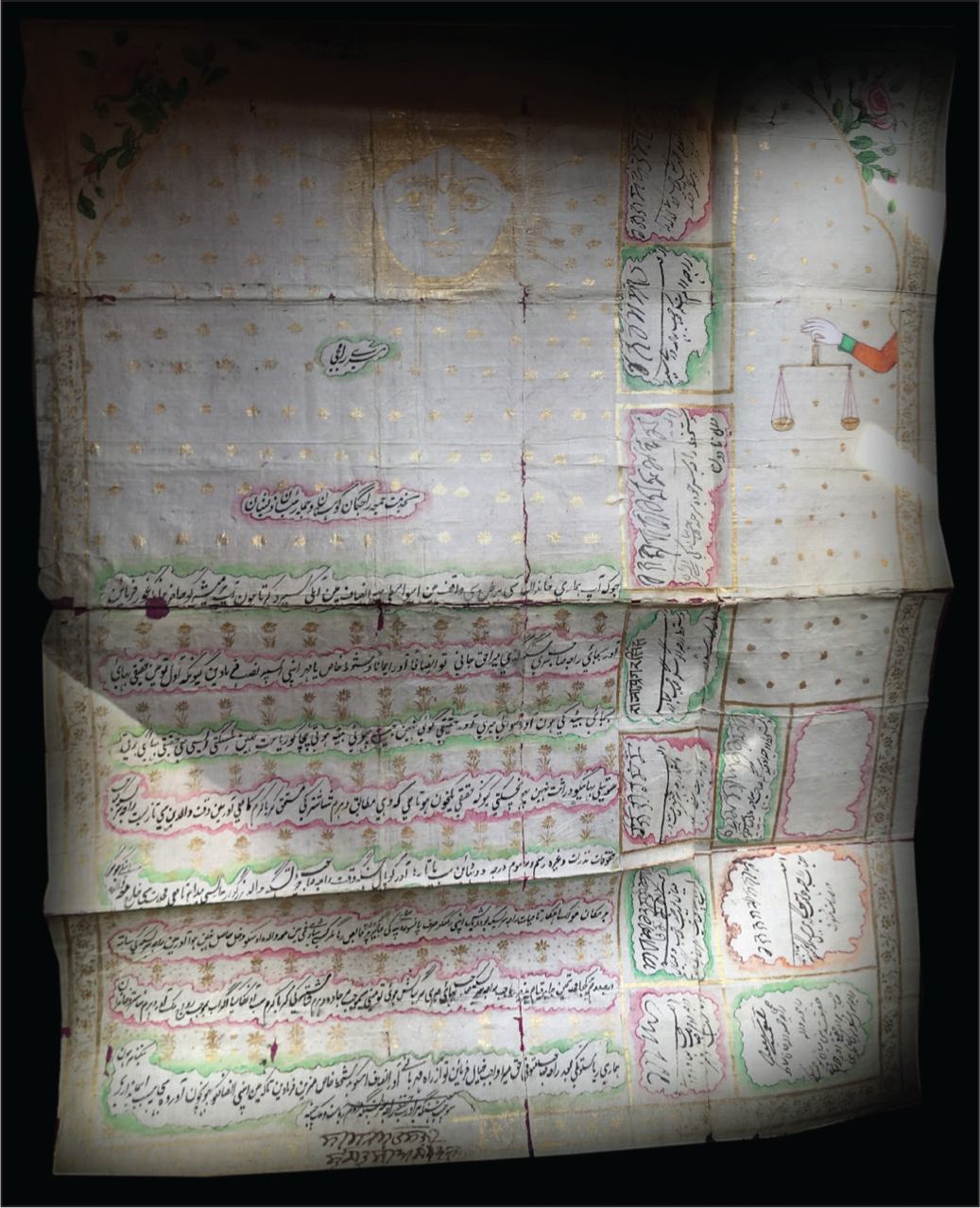
Within weeks of his deposition, Singh began gathering documents to support his case. Now archived in the Bibliothèque Nationale in Paris, these include several dozen affidavits of rulers and headmen from the Chamba region (Figure 1), genealogical charts with extensive comments about key members of the family, and even a ruling of a council of pandits from Benares that provided religious justification for the annulment of his rival’s succession. 44 While these documents seem to have established Singh’s status as heir presumptive (duthain), they were consistently ignored by officials in India. 45 His petitions unanswered, the prince resolved to personally present his case before the Viceroy, Lord Mayo.
While still in Amritsar, he attempted to meet Lord Mayo during the latter’s tour of the countryside, but was prevented from leaving the city by the lieutenant-governor of the Punjab. 46 Several months later, he again tried to contact the Viceroy, this time during an inspection of tea gardens in Kangra. In a pamphlet commemorating the visit, the author describes how Singh and his followers unsuccessfully tried to pressure the members of the Viceregal party into granting an audience by thrusting tribute (nazrana) into their hands; in accepting tribute, the recipient was customarily obliged to respond. Later on, as the party left the plantations and made its way towards Chamba, the local shepherds (gaddis) of the kingdom came out in large numbers to protest in the prince’s favour. They too were ignored. 47
Meanwhile, in Chamba, Reid’s manoeuvre was nearing completion. In April 1873, less than three years after his appointment, Gopal Singh retired to an estate on the Jammu border and left the kingdom to his seven-year-old son, with Reid as ‘supervisor’. Suchet Singh was once again offered a modest pension in return for accepting the change, but preferred exile. 48 Having exhausted his options in the subcontinent, the prince boarded a steamer in Bombay with a view to petition Her Majesty’s Government in person. He reached the British capital at the beginning of 1874.
The seeds for cooperation between British sympathisers and Singh seem to have been sown while the prince was still in India. Already upon disembarking in London, he was ‘warmly received’ by Lord Stanley of Alderley (1827–1903), possibly the most prominent of Singh’s supporters in exile. 49 Unique among his peers in the British nobility, Lord Stanley had been passionate about the Orient from childhood. After occupying several official positions in the Near East during the 1850s, Stanley went on a solitary exploration of the Middle East and Asia (reaching as far as Indonesia) in February 1859 and returned to London in April of the following year. He became the first Muslim MP after his conversion to Islam, and earned fame among scholars as the translator of Magellan’s travelogue for the Hakluyt Society, of which he was vice-president. 50 In politics, Alderley used his position in the House of Lords to plead for disenfranchised elites from the colonies, and played a central role in supporting Singh.
Another supporter of the prince arrived in London soon afterwards. Having left Shimla in August 1874, Major George Fenwick brought documents pertaining to the Chamba succession and a substantial amount of cash to plead with the authorities in London on the prince’s behalf. Described as a person of ‘bold, independent spirit, with an immense amount of humour’, Fenwick was the founder and editor of the Civil and Military Gazette, a vociferous opponent of Lord Northbrook, and thus a natural ally of the prince. 51 While Fenwick took the preliminary steps necessary for petitioning the government, Alderley complemented them with politics and diplomacy.
Fenwick and Alderley were part of a wider group of British liberals who were intent on reforming the Empire with a view to making it more agreeable to colonial subjects. The brash officer-publicist of Shimla and the idiosyncratic member of the peerage were thus patriots whose criticism sought to correct and improve the Empire, rather than dissolve it. In this respect, they represented a significant—if politically ineffectual—current in the metropole that brought people of diverse backgrounds propagating reform together. At the same time, the discourse of reform remained far-removed from the general public opinion of nineteenth-century British society, which perceived individuals the likes of Lord Stanley as eccentrics.
Political Action in India and Britain
An important venue for political reformers in London was the East India Association (EIA), which served as a crucial link for political mobilisation between Indian and British leaders. Founded in 1866 by Dadabhai Naoroji (1825–1917), the first Asian MP, the EIA brought together various people connected with India. 52 These included public figures from the subcontinent—such as the raja of Jaipur and the industrialist Tata—British politicians, retired colonial officials, and others. The EIA’s official mission was to pursue ‘the independent and disinterested advocacy and promotion, by all legitimate means, of the public interest and welfare of the inhabitants of India generally’. 53 In practice, it became something of a ‘cultural bureau’ as Naoroji stocked ‘its Westminster premises with an extensive library and promoted the association as a clearinghouse for information on India, a resource for the public as well as Parliament’. 54
Naoroji argued against Britain’s economic exploitation of India and presented the princely states as an alternative model to colonial rule, where he claimed efficient management of politics and economy could yield positive results. Naoroji and sympathisers from the EIA—like the British India Society before them—thus rendered exceptional support to Indian princes seeking to counter colonial misrule. 55 While the EIA may have failed to become the progressive forum that Naoroji had hoped for due to a takeover of its leadership by conservative members about a decade after its foundation, the history of Singh’s legal appeals and politicking—in which several EIA members participated—attest to its positive contribution to the prince’s struggle.
Within a month of his arrival in Britain, Suchet Singh had already appealed to the Secretary of State for India. 56 The latter, however, had allegedly burnt all the documents presented in support of Singh’s claim, only later recognising his error. Fearing that making his regret publicly known would display weakness on the part of the British Government, he refrained from taking the matter further. Five years later, in 1879, the dignitaries supporting the prince had grown to include several MPs and eminent legal advisors, many of whom were also members of the EIA. These included the progressive social reformer Lord Shaftesbury, the diplomat-scholar Lord Aberdeen, the Marquis of Tweeddale, William Hay the Superintendent of Hill States near Chamba in the 1850s, Edward E. Meakin who was a staunch supporter of Singh and also lent him money, radical abolitionist and MP Samuel Morley, diplomat and Member of the Queen’s Counsel Sir Patrick Colquhoun, and another MP Sir Henry Havelock. 57 Forming a delegation, these persons appealed to the then-Secretary of State for India, Lord Cranbrook (1878–80) on Singh’s behalf. While Cranbrook refused to examine the prince’s claims on the grounds that they concerned the colonial leadership in India rather than Britain, he did offer to pay off Singh’s debts and grant him a ‘suitable pension’ should he return to India and renounce his claim to the throne—a proposal that Singh declined. 58
The efforts of the Chamba exile and his supporters took a positive turn with the swearing-in of a Liberal government in 1881. The new Secretary of State for India (Lord Hartington) agreed to renew the prince’s pension, made provisions to settle a portion of his debts and financed his travel to India to represent his case before the authorities there. 59 Thus, after nearly a decade in Europe, Singh returned to India. Having presented his case in Bombay, he was redirected to Calcutta to address the Viceroy’s Executive Council. Accompanied by several servants, he took a first-class coach to Mathura where he spent an unknown period of time, and eventually reached Calcutta only to be sent back to Bombay with directions to file an official complaint at his first port of call. The authorities in India were clearly stalling. After 10 months on the road, the prince decided to return to London, reaching the capital in November 1882, by which point his pension had ceased once again.
Transplanted Hierarchies: Indian Nobles in Europe
Singh responded to the unfavourable outcome of his journey by expanding his struggle to new arenas. Apart from the aforementioned Gazette Nationale interview, in which he presented his narrative before the French-reading public and the resurgence of his story in the Indian press, the prince also made use of pre-existing contacts with other exiles from the subcontinent to further his cause. The erstwhile maharaja of the Punjab, Dalip Singh (1838–93), is a case in point.
Contrary to the relatively obscure profile of the prince of Chamba, Dalip Singh had become a celebrity in British high society. 60 Having signed away his inheritance at the age of five (including the famous Koh-i Noor diamond), the exiled maharaja had been ushered away from the control of his politically-restive regent mother at a young age to be educated in British circles. The young royal’s assimilation seemed to have been completed with his subsequent embrace of Christianity and relocation to England, where he became a favourite of Queen Victoria. However, by the 1880s Dalip Singh had become more critical towards the British Government, denounced Christianity and launched an international campaign to reclaim his kingdom.
As fellow-exiles from the subcontinent who would have frequented similar circles, the prince of Chamba and the maharaja soon came to know each other in England. 61 In a sense, the two leaders had transplanted their hierarchical connections from India into the heart of metropolitan Europe: Chamba had formerly been a tributary to the kingdom of the Punjab, a situation that was sustained by the economic discrepancy and status-division between the claimants to the two kingdoms. The relationship between the two leaders continued after Suchet Singh had returned to London. In 1886, the prince of Chamba successfully petitioned the India Office to regain his pension and a certain amount of cash for liquidating debts in return for a promise to desist from any attempt at agitation. 62 However, less than a year later, he joined Dalip Singh on a mission to Russia with the aim of establishing a pact with the Czar against the British. 63 The Russian authorities were indifferent to the visitors, who left the country empty-handed. 64
Having failed to convince the Russians to invade India and stir local rulers there into rebellion, Dalip Singh moved to Paris. Three years later, in 1890, he petitioned and received a pardon from Queen Victoria. 65 At the same time, Suchet Singh, who had already hastily quit London for Paris in 1884 after citing a dubious fear for his life, was leading a life of abject poverty in the French capital. While both rulers had subverted British interests by seeking an alliance with the Czar in 1887, they met with decidedly different fates. In an unfiled petition from 1892, the frustrated prince of Chamba noted that ‘Duleep Singh, although a traitor’ was ‘royally pensioned by England’, whereas ‘Suchait Singh whose allegiance to Her Most Gracious Majesty has been unbroken is treated with severity and contempt’. 66
Despite the obstacles faced by colonial subjects who had fallen out of favour with the imperial establishment, Suchet Singh built an expansive cosmopolitan network of support in both India and Europe that sustained his struggle over decades. Whether in London, Paris, India, or even St Petersburg, the exile from Chamba held meetings with influential people, solicited authorities, borrowed money and maintained the credible appearance of a royal Indian prince for more than two decades under trying circumstances. Indicative of the innovative possibilities available to colonial subjects of standing in fin de siècle Europe, these achievements would ultimately collapse under the constraints of empire, causing the prince and his engagement with the press to founder.
Suchet Singh’s Final Years: At the Limits of Press and Politics
The sense of frustration that permeated Singh’s endeavours in later years is patently evident in his reiteration of unwavering loyalty towards the British Empire in the unfiled petition of 1892:
Of what crime has the petitioner been guilty? What has he done to merit this hard treatment? Neither by thought nor word nor deed has the petitioner ever shown hostility to England; he has always been loyal to her Government and friendly to her citizens. During the Indian mutiny he gave shelter to hundreds of English women and children, who but for his protection, would have been massacred; at the head of his troops, he captured and delivered over to the British authorities, at Dalhousie, 500 rebel Sepoys although they were his fellow countrymen and his coreligionaries; during the Cabul war, he asked for leave to fight against the enemies of England. This is the petitioner’s record and yet he is left almost to starve, a stranger in a strange land, of which he is ignorant of the language, nearly friendless, while honours and favours are lavished upon others whose treachery and enmity to England have been proven.
67
Poignantly phrased by the radical polemicist William Digby, the petition captures the chasm that had opened between Singh’s early life as a youthful nobleman-warrior in India and his later years as a clochard in Europe. 68 The prince’s progressive marginalisation in political circles was mirrored in his relationship with the press. By the 1890s, Singh’s exceptional ability to navigate print media and public opinion in earlier decades seemed to have dissipated along with his wealth. While the display of opulence had frequently served colonial elites to counter claims of cultural and racial superiority in the metropole, its absence led to an almost inevitable waning of their influence with the press. 69
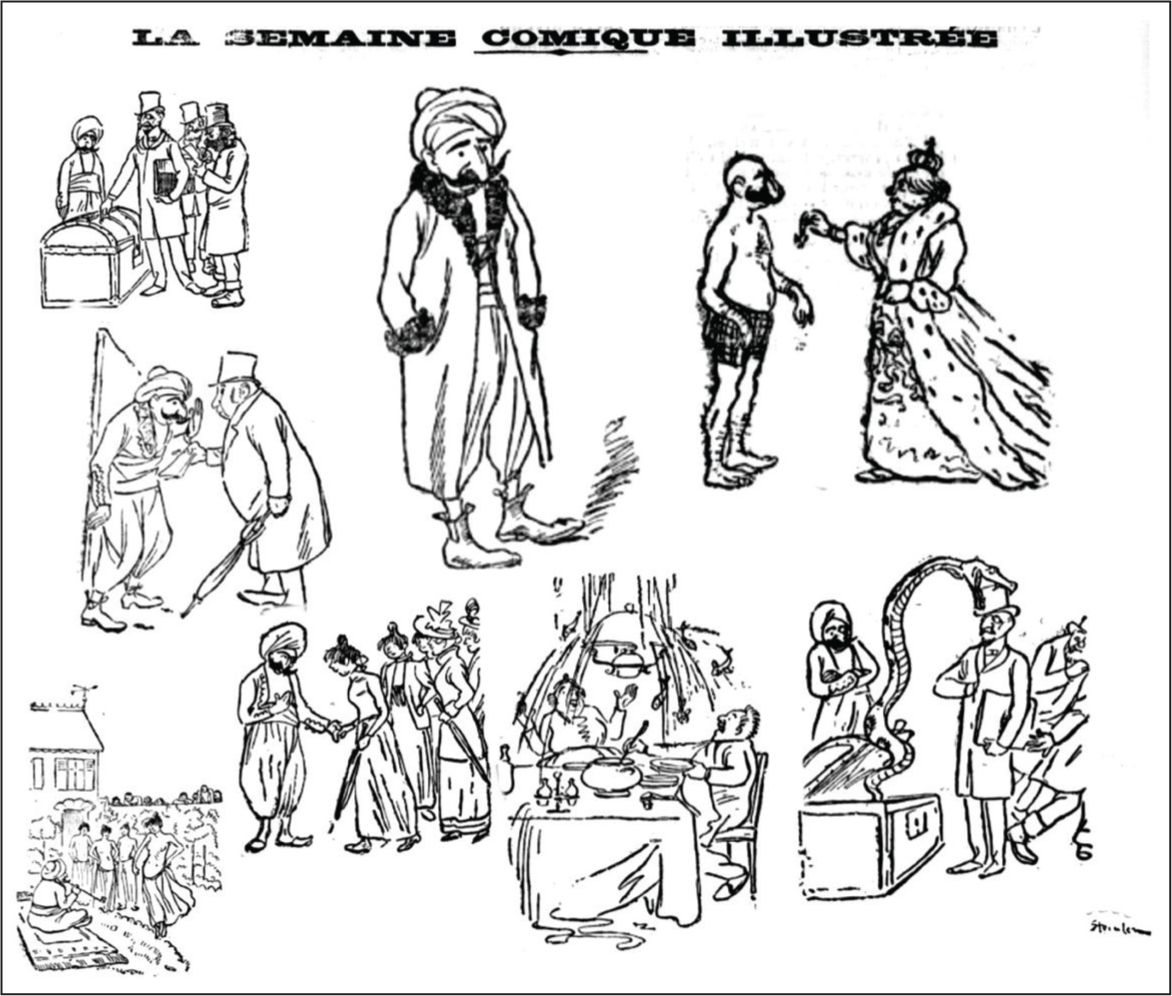
Riddled with debts and embroiled in a recurrent stream of legal actions, Singh was reduced to an object of ridicule. In France, the earlier coverage that had paraded the prince as an unfortunate victim of British imperialism now tilted towards clichéd portrayals of ‘Oriental’ hedonism and corruption. 70 In a series of fantastical reports, the prince was said to host wild parties with disreputable characters in his Parisian apartment, even allegedly filling his dining room with water to create an indoor swimming pool, and other such outrageous claims. These attacks culminated in a half-page caricature in L’Éclair in 1892, as shown in Figure 2. 71 Justifiably offended, Singh responded to these insults by suing the paper, only to bring more ridicule upon himself in the press.
This line persisted in reports outside of France. In Britain, the discussion of the Chamba succession which had stirred the press in earlier years fizzled out as sensationalist accounts of the prince’s dealings in Paris came to the fore. 72 The Indian—or rather Punjabi—press stands out as an exception. In two articles which appeared in the Lahore-based Panjabi Akhbar in 1884 and 1885, the editors called for the government to live up to its commitments, demanding an increase in Singh’s pension and soliciting consideration for the social consequences of his impoverishment. 73 By the 1890s, the prince’s appearance in the Indian press would primarily be in connection with the ‘scandalous’ rumours about his alleged misconduct in Paris. In discussing Singh’s supposed ‘harem’ in the Parisian suburb of Suresnes, the progressive reform paper of the Brahmo Samaj gleefully predicted that ‘some dirty linen will be washed before the public’ now that the case had drifted into the courts. Evincing the prince’s plummet into obscurity, the reporter concluded by wondering just ‘who might this Soochait Singh be?’ 74
Faced with these tribulations, the network of friends, allies and benefactors that Singh had formed during his years in London began to crumble. Many of them realised that the chances of the prince repaying his debts had become slim, and consequently began to distance themselves. Even Dadabhai Naoroji, who had earlier vouched for the prince among potential creditors and lent him money, stopped responding to his letters. 75 Nevertheless, several long-standing supporters who had also lent the prince substantial sums forewent their debts and continued to defend him even after he returned to England and filed for bankruptcy in 1894. Notable among these were Lord Stanley who provided apartments in Paris and London for Singh to live in, William Digby who drafted a petition to the India Office on Singh’s behalf, and Edward Meakin and Milton Bradford both of whom assisted in official communications with the British Establishment and the press. In a letter to the editor of The Evening Standard, Bradford defended Singh against an earlier report that suggested he was an impostor advancing fictitious claims to the Chamba throne. Having represented him since (at least) 1881, Bradford was intimately familiar with the details of Singh’s case. Forcefully denouncing the India Office, the lawyer called ‘for public inquiry, and if for political reasons the prince cannot be restored to the chiefship of Chumba, the Indian Government should return to him the whole of his private property and moneys, and pay his creditors as they have already agreed to do’. 76
Bradford’s public defence of the prince was mirrored in private correspondences between his allies. Six months after the letter to The Standard, Meakin wrote to Naoroji with concern over Singh’s portrayal in the British press:
They amuse themselves with his incoherent letters, but they would not find it so amusing to be in his position. The poor fellow still raves about Lord Northbrook & others. There is a deadlock in his affairs, because the India Office declines to deliver up the funds which, for years past, they have pretended to want to distribute amongst his English creditors & they refuse to answer the official letters on the subject, or to recognize the authority of the Courts. This carries us back to the time of James II, when the people rose & turned him out, - I wonder how the contention in this instance will end!
77
Abandoned by the majority of his supporters, ridiculed in the international press and incapable of establishing alliances with Britain’s rivals in Russia and France, the denouement of Singh’s life-story aligns with that of earlier generations of royal exiles from the colonies. A few months before Meakin’s letter, the prince had been declared bankrupt. Still residing in a London flat paid for by Lord Stanley, he succumbed to the excesses of alcohol the following summer.
The life-story of Suchet Singh, the prince who had stood up to his countrymen in order to save the lives of ‘English women and children’ at the age of sixteen only to find himself deposed and banished, exemplifies the limits of late-nineteenth-century cosmopolitanism. Supported by an international network of allies, Singh’s savvy engagement with the press in India, England and France demonstrates an understanding of the growing importance of public opinion. His tenacious appeal to different yet interconnected public spheres across continents was complemented by the politicking and solicitation of supporters who formed a network spanning the metropole and its colonies. While the prince may have successfully contested his unlawful deposition, the scope of his agency was ultimately tied to the unyielding interests of empire. Thus, even in the cosmopolitan setting of the Age of Empire, the colonial subject seems to have been destined to remain, by his own account, ‘a stranger in a strange land’. 78
Footnotes
Acknowledgements
This research was supported by The Israel Science Foundation (grant No. 203/21).