




Abstract
This article explores the reasons behind the marked differences in the gender division of labour in the emerging textile factories in Japan and India in the first half of the twentieth century. In Japan, the overwhelming majority of the workers in spinning mills were young, unmarried women, while in India men—married as well as unmarried—formed the bulk of the factory textile workforce. We argue that variations in agrarian systems and labour regimes constitute an important set of factors explaining some of these differences in gender patterns. The structural differences in the productivity, intensity and the social organisation of labour in agricultural economies in both countries led to notable variances in the gender composition of the supply of (rural) labour for the factories. Differential deployment of rural farm and non-farm labour, in combination with distinct labour recruitment practices in the countryside, caused rural households to adopt radically different income-generating strategies.
Introduction
Given the strong interrelationships between the agricultural/rural and industrial/urban economies, rural economic change cannot be divorced from the growth of the modern industrial sector, even if the relationship between the two is not necessarily as one-way as the standard agrarian transition model might suggest. 1
Economic development is usually defined as the process in which low-income, agrarian national economies transform into modern industrial economies. 2 Although in recent decades, other indicators of well-being besides economic growth have been proposed, such as health, education and gender equality, 3 many economists, policymakers and historians still agree that structural change is essential for development. While the process of industrialisation has historically been highly uneven across the world, 4 one common characteristic of almost all early industrialisers has been the importance of textile production. Before industrialisation, the textile sector was characterised by highly labour-intensive production processes, but labour has continued to be important in this sector after mechanisation, and in fact it still is up until today. 5 Considering this large demand for (cheap) labour, women and children have been highly important to the textile sector, in the pre-industrial and in the industrial periods, continuing to the present. 6 Some scholars have even argued that women’s (and children’s) textile labour was crucial in the transition to an industrial society and, thus, for modern economic development. 7
Historians have pointed towards multiple reasons for employing women and children in the early textile factories. First of all, they considered their generally lower wage rates, regardless of whether these ought to be attributed to productivity differences or to direct wage discrimination. 8 Second, it has been argued that the particular physical characteristics of women and children, for instance, their dexterity, their ‘nimble fingers’ and their relatively small size, made them specifically suitable for attending to the first spinning machines. 9 Third, historians have claimed that women and children would have formed a more ‘docile’ and easier-to-supervise workforce, which would have been convenient in the context of larger concentrations of workers in the factories. 10
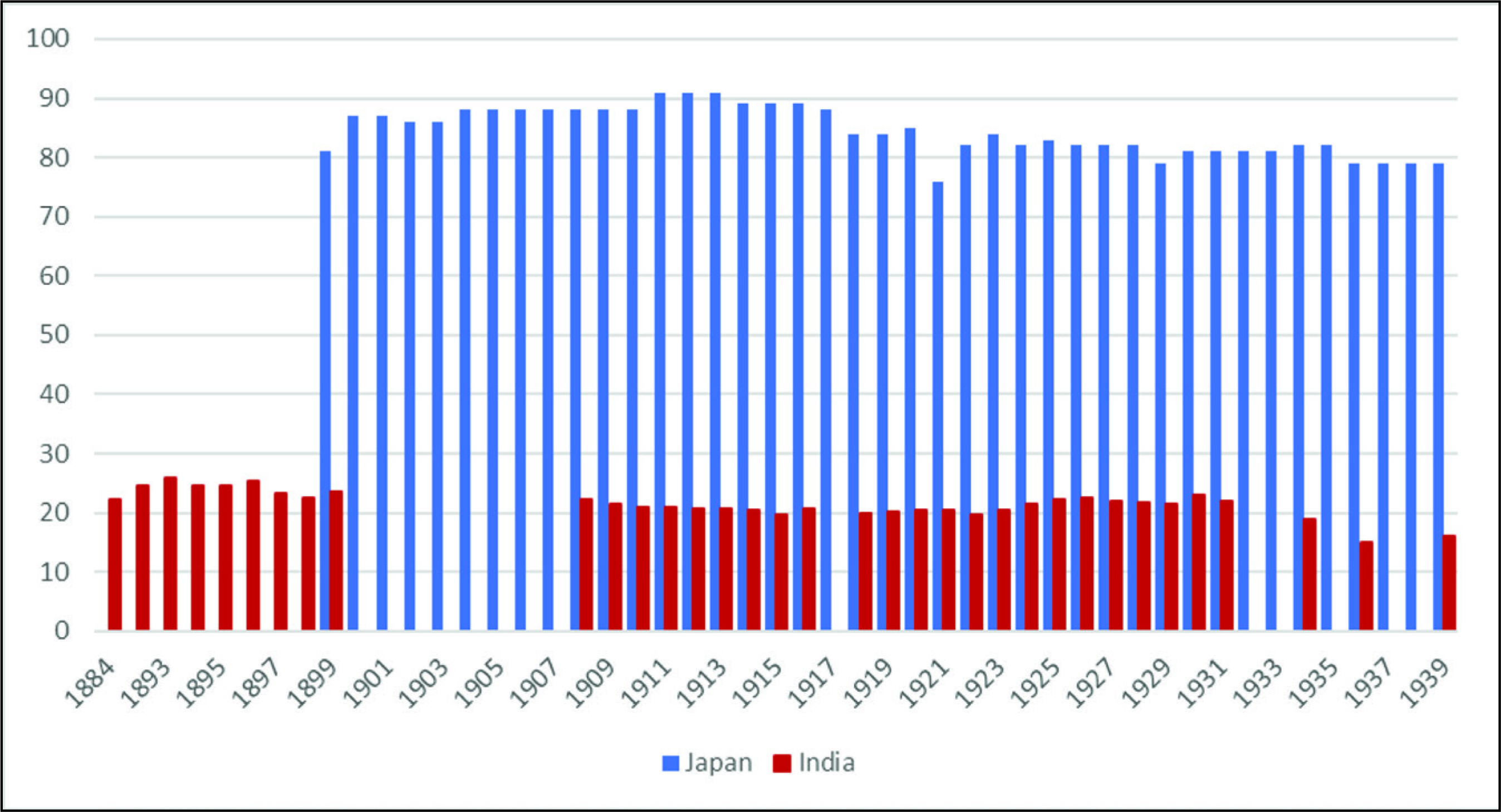
However, all these rather generic explanations do not account for the vastly differentiated experiences in various regions of the world. While in many industrialising economies, women comprised a significant section of the textile workforce, there still were vast differences across and within countries. In the late nineteenth-century US cotton textile factories, for example, more than half of all the workers were female, but at the same time, this varied regionally, from 53% in Fall River to 73% in Lowell. 11 Japan stood out with exceptionally high shares of (young) women in its nascent textile industry, comprising between 76% and 91% of all workers throughout the period 1889–937 (see Figure 1). 12 Conversely, in other regions of the world, women occupied a marginal share of the textile workforce. 13 In colonial India, for instance, the cotton textile workforce was overwhelmingly male since the earliest stages of mechanised production around 1850. The share of women in the pre-Independence ‘modern’ Indian textile industry never exceeded 25%, and it even steadily declined over time to 11% in 1947. 14 These historical patterns of women’s employment often betray ‘long-term resilience of a gender division of labour’, like in the Indian case, 15 and have a more general bearing on women’s socio-economic status in different country-specific/regional contexts. 16
This article compares these intriguingly differentiating, and simultaneously strikingly persistent, trajectories of women’s industrial textile work in India and Japan and seeks to explain these differences. Moreover, it assesses the consequences of these differences for the position of women in the labour market, which in turn may have affected industrial development. Our hypothesis is that an important part of the explanation for gender differences in the textile factories lies in the variances in the agrarian labour systems and agricultural productivity between the two countries. Underlying these differences were emerging institutional variations, such as divergent landholding practices and tax pressures, marriage patterns, and existing (gendered) labour divisions in handicraft textile production. To investigate differentiated opportunity structures for men and women, and thus for household income strategies, we compare wage rates in agriculture and textiles in Japan and India. Wage levels between countries have come to play an important role in the debate on economic divergence. 18 Recently, the need for including the role of (low) women’s textile wages in discussions on the process of industrialisation has been stressed. 19 However, variegated rural–urban wage differences within countries and its implications for patterns of industrial development have usually not been attempted in such analyses.
We argue that differential income-generating strategies in the countryside led to different opportunity structures for households, which consequently sent specific members to work in urban textile factories. In Japan, the late nineteenth and early twentieth centuries constituted a period of modest, but rather consistent, productivity growth in agriculture. 20 Especially men were employed as farm workers in this sector, freeing up young unmarried women to perform temporary labour in the emerging textile factories. In India, agriculture remained highly seasonal, with the peak of agricultural (wage) labour mainly taking place in the period between harvesting and threshing. Off-season activities were the domain of women, leaving an under- or unemployed male labour force for a part of the year. These men were often recruited by jobbers for temporary work in the textile factories of Bombay. The different labour recruitment practices reinforced the Indo-Japanese divergence in rural households’ income-generating strategies and, in the long run, impacted women’s position in the household.
Despite the growing body of work on women’s work in early industrialisation, a differential interrelationship between industrialisation and women’s work status has not been studied much in a comparative framework, particularly not in the Asian context. 21 It is puzzling as to why, compared to other industrialising countries, such as Great Britain and the USA, Japan, at this stage, employed relatively more female labour, whereas India instead employed significantly less. It is worthwhile to compare developments in India and Japan, because they are both Asian countries that are considered to have been ‘labour-intensive’ industrialisers, 22 but with very different outcomes in terms of economic development and women’s work. 23 Moreover, undertaking a comparative analysis of regions that diverged markedly in gendered work patterns offers us a better understanding of the underlying causal mechanisms that affect women’s work historically. While some authors have sought to explain differences in productivity using either cultural 24 or rational individual characteristics of the workforce, 25 we here choose to approach this matter from the framework of the opportunities and constraints which the rural households faced in Japan and India while reallocating their labour. This turned out to have distinctly different consequences for the gender composition of the workforce, which, in turn, likely affected industrial development.
Economic Structures in Japan and India in the Age of Empire
The relative ‘backwardness’ of Asia compared to modernising/industrialising (parts of) Europe—the Great Divergence—had its own counterpart in the ‘little Asian divergence’, leading to different pathways between Japan, on the one hand, and India and China, former spearheads of development, on the other hand. 26 Although the exact timing of the divergence between Japan and India is contested, 27 by the late nineteenth century, per capita levels of GDP of the two countries started diverging. 28 This divergence was premised on differentiated socio-economic and political developments in India and Japan in this period. We argue that these conditions reinvigorated differences in economic structures, leading to less productive agriculture as well as a less mobile workforce in India, with crucial consequences for the labour supply to its emerging textile factories. 29 While India was under a colonial regime, the Japanese state was a modern nationalist force, which eventually emerged as a coloniser itself. 30 Although this does not mean that India experienced no development at all, it was much more uneven and less sustained than in Japan, also because the colonial state was reluctant to stimulate the general development of the population or productivity in agriculture than the Japanese State. 31
Most historians agree that the preconditions for Japan’s successful transition to modern growth lay in agricultural developments of the preceding Tokugawa period (1603–1867). 32 However, without the political revolution led by the Meiji State (1868–1912), Japan’s eventual economic success would not have been guaranteed. 33 Specific socio-economic reforms followed, including the loosening of rigid rural class structures, as well as tax reforms in 1872, relieving agricultural households’ budgets over time. 34 Moreover, a favourable climate for industrial investments was created, thus paving the way for structural economic change and an industrial society. 35
India’s colonisation achieved completion by 1858 when a large proportion of present-day India was placed under direct British rule. Various historians have noted that land revenues formed the main source of profit for the British colonial state in India. 36 The agrarian system that the British inherited had become highly stratified over centuries. Land revenue extraction and its distribution over different strata of the population formed the basic foundation of the pre-British economy and polity. 37 Under British rule, the actual tax burden became even higher than under preceding regimes, as a result of changes in the method of assessment and greater ‘efficiency’ in tax collection. 38 Moreover, British attempts to industrialise India from the 1850s onward were at best of an ambivalent nature and did not create many incentives to invest large amounts of capital in the industry sector. 39
These differentiating trajectories in the nineteenth century led to a process of structural change in Japan that was virtually absent in India in the first half of the twentieth century. From 1900 to 1940, the share of the primary sector in Japan’s total economic output declined from approximately 33% to 13%, and the share of its secondary sector rose from approximately 14% to 42%. Over the same time period, changes in the structure of the Indian economy proceeded slowly, with the share of its primary sector in the total economic output declining from about 59% to 46% and that of its secondary sector increasing only marginally. Indeed, recent estimates of GDP show that the agricultural sector stagnated, and industry and services only increased marginally. 40 In terms of occupational structures, the contrast is even more pronounced. The Indian share of workers active in agriculture hardly changed, stagnating around 70% to 75% between 1900 and 1940. So, despite modest income growth in industry and services, these sectors did not offer new employment opportunities. 41 Conversely, in Japan, the proportion of workers in agriculture declined from around 70% to a mere 45% over the same period. 42 We will now broadly sketch developments in agriculture for both countries and then proceed with an overview of industrial changes.
Developments in Agriculture
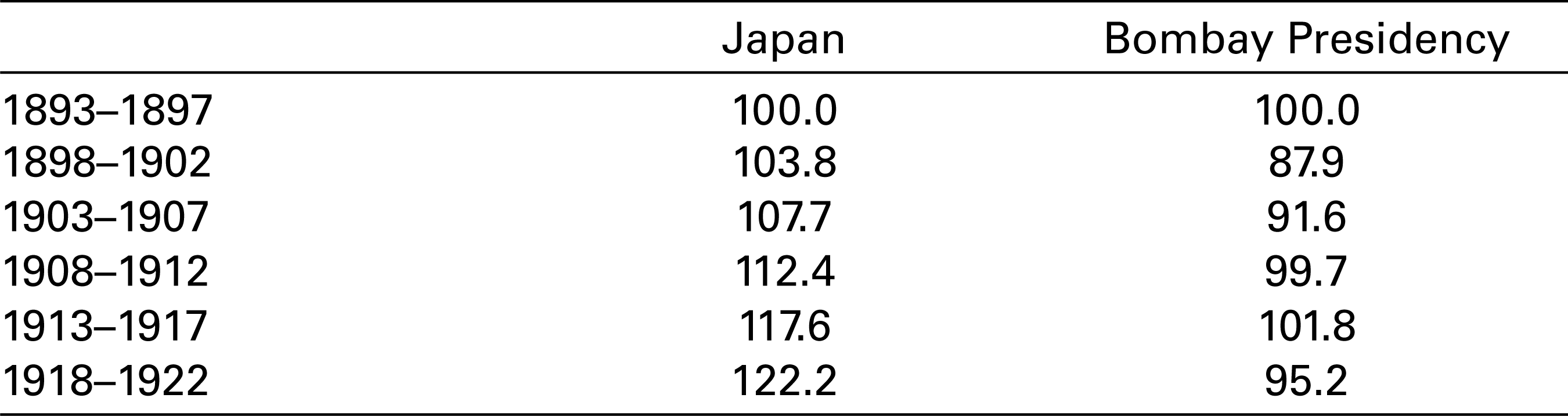
Due to Japan’s quite uniform rural structures and institutions, we consider the country, as a whole, to be a suitable unit of analysis. Regional variations notwithstanding, Japan’s main agricultural zones were relatively similar in terms of geography and environment; rice was central to agricultural production virtually everywhere, and there were hardly any considerable territorial or migration shifts over the described period. 43 Up until the Second World War, Japanese farming remained predominantly small-scale. The number of farm households stayed fairly constant at about 5.5 million, and the agricultural labour force consisted of about 14 million people throughout the period under investigation here. 44 Between 1880 and 1939, the total agricultural output in Japan grew modestly, with growth rates consistently between 1.3 and 1.7. 45 In the context of considerable population growth, this obviously implies increase in labour productivity, averaging 1.56 over the pre-war period. Because of the given factor endowments in Japan (a relatively high labour to land ratio), these gains in productivity were not so much induced by upscaling or the introduction of labour-saving techniques, but rather by innovations in breeding and plant varieties, a strategy that proved to be viable at least until the 1920s. 46 In many cases, double-cropping was also introduced, thus enhancing the labour intensity of the agricultural year, and commercial fertilisers were increasingly applied. 47 Table 1 shows the steady increase in paddy rice yields per acre over the period 1893–1922, resulting from these innovations.
Indices of Paddy Rice Production (Yields Per Area) in Japan and Bombay Presidency, 5-Year Averages (1893–1897 = 100)
The workforce on pre-war Japanese farms mainly consisted of family workers, at least the male household head and (if present) the eldest son. Female farm workers, both single and married, formed a substantial part—around 40%—of the total farm labour force. More than 70% of these female workers were housewives and adult daughters aged 25 years or older. 49 Many of these women combined their agricultural activities with rural industry, and farming and non-farming activities remained intertwined to a great degree. The complementary economic activity of cottage industry, such as silk winding and weaving by peasant women, had already existed for centuries. 50 In combination with the small scale of most farms, this means that a true separation between specialised commercial agriculture and proto-industry—as for instance occurred in many regions in Europe— did not emerge in Japan. 51 For as far as wage labour in agriculture occurred, this category consisted mainly of second and third sons, who did not have the prospect of inheriting the family farm. As rising labour productivity over time depressed the demand for agricultural (wage) labour, the second and third sons increasingly migrated to urban areas, where they tried their luck in construction, manufacturing or services. Young, unmarried farm girls often did the same, but their work opportunities instead clustered in the emerging textile industries (see next section). 52
Being a vast and geographically diverse country, it is hard to generalise about agricultural development in India. Nevertheless, aggregate statistics reveal that between 1900 and 1947, the average annual growth rate of per capita output in agriculture in India was around zero. 53 Productivity and wages were generally low, and due to the skewed patterns of rainfall, many agricultural wage workers were periodically unemployed over the year. 54 Because of the variety of systems, we limit ourselves here to the discussion of the agrarian features of Ratnagiri district in the Konkan region (Bombay Presidency, located in western India), which was an important source for Bombay textile workers. 55
During the late nineteenth and early twentieth century, Bombay Presidency, as a whole, experienced stagnation of agricultural output and even a ‘decline in the installed productive base of agriculture’. 56 Large parts of Konkan came under the oppressive Khoti tenure system. In combination with the heavy revenue extractions demanded by the colonial State, the Khot landlords, who were essentially revenue farmers that came to enjoy hereditary ownership of lands over the nineteenth century, extracted heavy burdens both in terms of output and labour. 57 The agricultural season typically lasted from May to November, peaking during the transplanting and harvesting periods with intermittent weeding work during the remaining months. Traditionally, Konkan was characterised by relatively productive agriculture, but the pressure on the land and the squeeze by the Khotis put tremendous pressure on local peasants. 58 Table 1 illustrates this in terms of stagnating yields per capita in the Bombay Presidency in this period. Like in Japan, women comprised around 45% of the total agricultural labour force in central and south India. 59 However, besides subsistence agriculture, there were few (wage) labour opportunities for men or women, and poverty loomed large. 60 In contrast to Japan, peasants in India were hardly able to generate income from non-agricultural activities such as weaving, as this was to a large extent in the hands of specialised caste workers who had come to be concentrated in (sub)urban areas. 61
The Rise of Modern Industry
In both Japan and India, modern industrial development initially hinged largely on the growth of textile manufacturing. In the period under investigation, Japan was the only Asian country to successfully industrialise. Around 1880, modern industry took off here, at a much more rapid pace than in any other region of the world. Mechanised textile production became particularly concentrated in the rather urbanised Osaka–Tokyo belt, with the Osaka Spinning Company being the first modern factory established in 1882. Already around 1890, Japan managed to produce more factory spun yarn than it imported, and by 1897, it had become a net yarn exporter. 62
A range of studies have investigated that to what extent and why Japan’s course of industrialisation differed from Western economies at the time. One important feature would have been the ‘relative backwardness’ of the Japanese economy, which Minami has more positively framed as Meiji Japan’s ability to successfully combine traditional and modern elements to embark upon a path of sustained economic development. According to him, the textile industry even functioned as a catalyst for the later development of heavy and chemical industries in Japan, as its import substitution and export-directed strategies saved and earned foreign exchange, thereby enabling further investments in other industrial sectors. 63 More recently, Gareth Austin and Kaoru Sugihara have also argued that the abundance of labour in relation to land and capital scarcity in the case of Japan resulted in labour-intensive industrialisation strategies. 64 Interestingly, the cheap labour of young unmarried girls, who often only worked for a few years in the textile factories, was central to the initial success of Japanese firms, first in the national market, and after the First World War in the global market for textiles. 65
India had been a major textile producer in the eighteenth century, providing for around a quarter of the world’s cotton cloth. When Lancashire rapidly industrialised after 1750, the Indian textile industry faced fierce competition. It took until 1856 to open the first operational steam-powered cotton mill in Bombay. The real take-off, however, occurred in the 1870s, and by 1883 almost 80 factories were in operation. Initially, the industry was primarily focused on yarn production for other Asian markets. 66 Modern industry was mostly concentrated in the urban areas of Bombay, Ahmedabad and Calcutta. However, productivity and profitability in the mills were low, and the factories suffered from a high turnover of labour, recruited from a generally low-skilled pool of rural, overwhelmingly male, migrants. 67 At the same time, artisan weaving experienced an increasing output and productivity as well as a relatively high-skilled and stable male labour force, that to some extent profited from the semi-manufactured goods which the factories provided. 68 Notwithstanding its considerable jute and cotton textile industries, the benefits of modern industries did not spill over to other sectors; so at the time of Independence in 1947, India was still largely non-industrial. 69 By this time, only 2% of the total labour force worked in a large-scale factory. 70
Now that broad developments in the structure of the economy have been described, we will move on to investigating the determinants of women’s early industrial employment for India and Japan. The next section analyses the different trajectories of women’s involvement in the modern textile industry from the perspective of developments within the industries in both countries, stressing the labour demand in the respective contexts. The subsequent section will consider the particularities in the supply of labour from the rural recruitment areas, in relation to gendered agricultural work patterns.
Textile Production and Gendered Work Patterns in Japan and India
As noted, Japan and India occupy two ends of the early industrial female employment spectrum (Figure 1). Women accounted for 75% to 90% of the Japanese textile factory workforce in the first half of the twentieth century, and for less than 25% in the Indian case for the same time period. In the Bombay textile industry, the proportion of women had declined to as low as 11% by 1947. 71 Although the proportion of Japanese women in the textile industry also decreased over the 1930s, this decline was marginal and the textile industry workforce in Japan continued to be predominantly female. Janet Hunter underlines continuities in the gender division of labour in traditional Japanese settings and modern factory employment of women in the cotton spinning mills of Japan. Textile work—spinning and weaving—in the Japanese context was understood to be women’s work, a point reiterated by Tanimoto. 72 This association was rooted in the Tokugawa period (1600– 1867), when peasants had diversified their incomes by taking on non-agrarian by-employment, such as silk-reeling and cotton weaving, which were primarily done by women. 73 There was hence a link between textile work being a female activity and their absorption as the primary workers in the mechanised Japanese cotton textile mills. 74 This fed into conceptions of desirable traits of women that were suitable to textile factory work, such as their greater manual dexterity or compliance towards work demands. 75 These perceptions of textile work as women’s work in Japan are likely to have contributed to their low wages and flexible work conditions in the industry. 76 As cotton spinning came to be mechanised, factories employed predominantly young, unmarried migrant women from the countryside, about half of whom were 18 years or younger. 77 Although young women were used in many mechanising textile industries worldwide, in Japan they formed ‘the integral force in the fifty-year drive of the Japanese cotton textile industry to world dominance’. 78 The girls usually stayed on for a relatively short period of time, between 1 and 3 years on average, and they typically lived in dormitories as they were recruited from further-off rural areas and were often too young to take care of themselves. 79 Working and living conditions were deplorable, with 12- to 13-hour workdays, very low payments, poor quantity and quality of food, overcrowded sleeping areas and little personal freedom. 80 This resulted in a high turnover, with girls running away or returning home right after their first contract ended. The eagerness of Japanese girls to leave suited the employers very well. It gave the system a high degree of flexibility, and the absence of notable numbers of experienced, as well as male, workers meant that wages could be kept low throughout most of the period. 81 At the same time, Japanese cotton weaving experienced a dual development: although some spinning factories worked with adjacent weaving factories with power looms, the majority of cloth (at least two-thirds until the First World War) was produced in rural areas by peasant women on handlooms. 82 The diffusion of power looms and the factory system in weaving proceeded more rapidly after 1910. 83
Table A1 in the online appendix shows the average nominal day wages in Japan for men and women in the Japanese textile industry, as well as female/male wage ratios. 84 From these data, which, admittedly, are on a highly aggregated level, providing national averages and no differentiation by occupation, it appears that both in the cotton mills and in handloom weaving, women earned structurally less than men. Also, gender wage inequality in the textile mills increased over the course of industrialisation (see Figure 2).
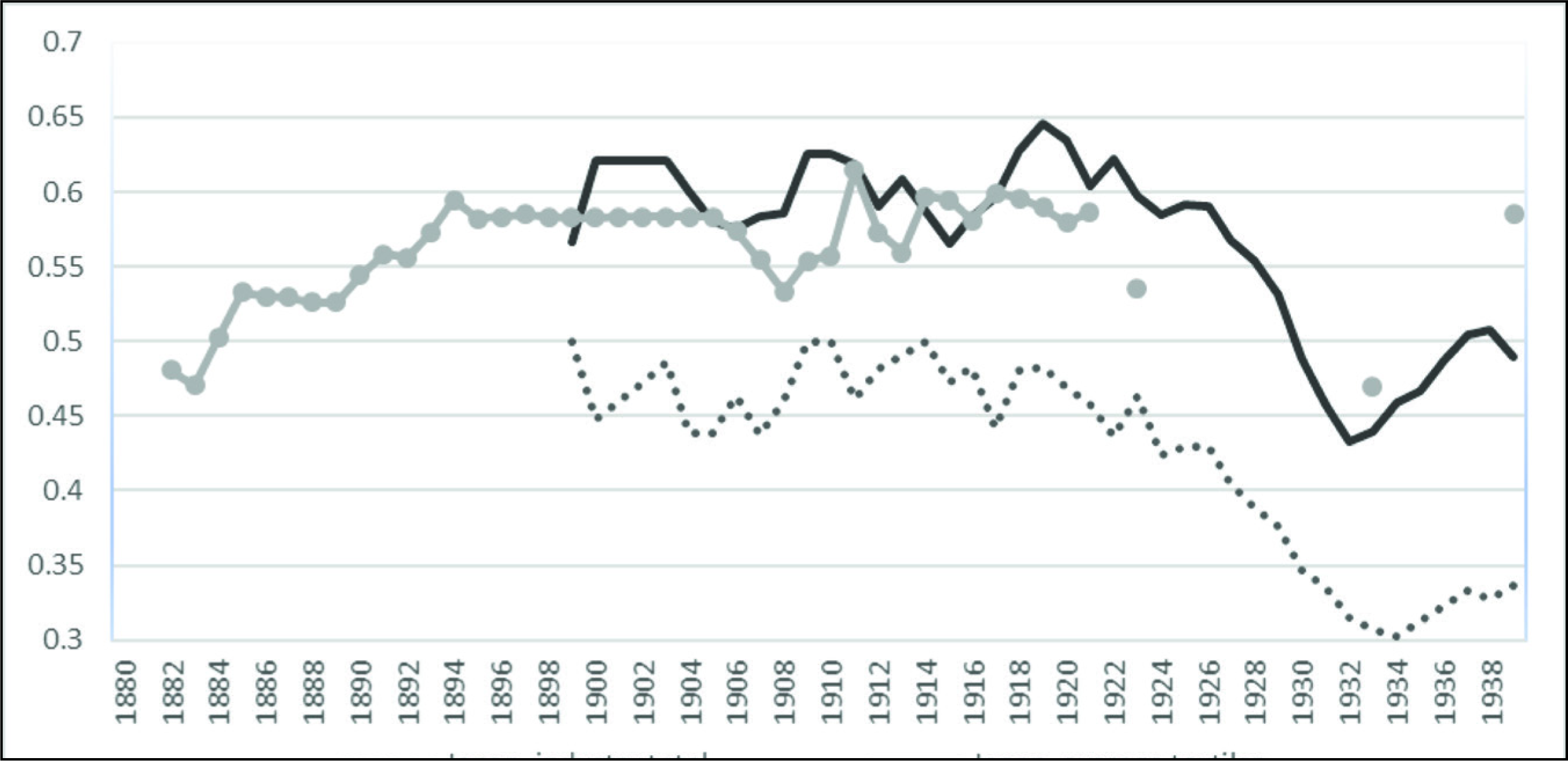
From the Great Depression onwards, women’s wages in Japanese textile production only constituted half of those of men or less. Still, despite the large supply of female workers in the textile industry, the gender wage gap appears to have been more modest for the textile sector than in the industry sector in general. For both cases, there is a quite significant positive relationship between the share of women in the industry and equality in wages. 86 This is surprising, as one would expect a downward pressure on female wages when supply of labour is large. Potentially, this relates to growing segmentation within the textile industry. We know that the share of men in the textile industry became larger over time (from around 10% before the First World War to about 20% in the interwar period), employed in more specialised, higher-skilled technical jobs in the industry as well as more diversified managerial positions as factories became larger. 87
In the Indian case, there were both continuities and breaks with the past where textile workers were concerned. The textile labour force in the late nineteenth and early twentieth centuries in India came to be divided between the ‘skilled craftsmanship and cheap under-employed rural labour’. 88 The former comprised artisans and weavers of the more traditionally organised household-based/handmade textile production, and the latter formed the bulk of the labour force in the spinning and integrated spinning and weaving mills. The former category bore continuities with the past, when artisan production was concentrated among specific ‘weaver communities’ where ‘caste associations and a recreated sense of community became prominent features of artisans clusters in the twentieth century’. 89 These specialised caste weavers, moreover, were not linked to the sort of rural diversification that had occurred in Japan, but became concentrated in more urban areas. 90
The gender division of labour within Indian artisan households was as follows: adult men typically operated the looms, whereas women, young children and sometimes the elderly helped with preliminary processes such as winding and reeling yarn, separating threads in preparation for the warp and sizing. 91 Hand-spinning was traditionally widely considered as an exclusively feminine task, and it underwent a drastic decline during the nineteenth century due to imports of factory yarn. 92 When Indian mills opened to produce machine-made yarn, spinning became a predominantly male occupation in the mill sector. While this development was common for many industrialising countries, it was more pronounced in India than in most other regions of the world. 93 Saxonhouse and Kiyokawa bring in technology as a possible explanation for the differences in gender composition of the Japanese and Indian workforce. 94 Indian factories more often used spinning mules, which required more physical strength and thus was prone to using male labour, whereas Japan saw a nearly complete transition to ring machines, a technology that would have facilitated a shift to female labour. However technology alone cannot explain the predominance of men, because, once India did shift to rings, this did not automatically result in a higher proportion of women in spinning departments, 95 an observation that is shared by Saxonhouse and Kiyokawa. 96
The small and declining share of women in the Indian textile industry (see Figure 1) has also been explained by the ready availability of excess or surplus supply of male migrant workers to work for low wages under uncertain employment conditions. 97 Indeed, we find many men in a much greater variation of occupations than ranging from lowest to the highest positions. Women in textile mills were predominantly employed as winders and reelers. Only 14.6% of all women in the Bombay textile industry were recorded working outside the reeling and winding departments in 1921, and this share even declined to 12.7% in 1934. 98 Usually, these were also auxiliary tasks such as doffers, piecers, etc. For example, an enquiry on wages and labour hours in the Bombay cotton mills in 1923 gives 220 different job titles for men, ranging from assistant card master to yarn dyer. Women only held 14 different positions, although the percentage working outside, reeling or winding, was slightly higher than what Savara suggested (27%). However, most of these women also worked in the lowest-status jobs, although we do find some gaiters in ring spinning and even some ‘forewomen’ (though all in the reeling and winding departments). 99
A more detailed wage analysis on the occupational level shows that the abovementioned gender division of labour was the most important cause of women’s unequal earning potential. On the one hand, in most cases, when men and women did the same work, it seemed that their daily earning capacity was roughly on par, especially when piece rates prevailed and physical strength was not so much of an issue. 100 On the other hand, women were simply not working in most of the higher-paid occupations, leading to much more confined daily earnings than for men. Table 2 shows the distribution of the entire Bombay textile mill workforce in 1921, divided by men (99,014 workers, or 75%), women (19,584 workers, or 15%) and children (13,958 workers, or 10%).
Daily Earnings of Men, Women and Children in the Bombay Textile Mills in Annas (16 Annas = 1 Rupee), 1921
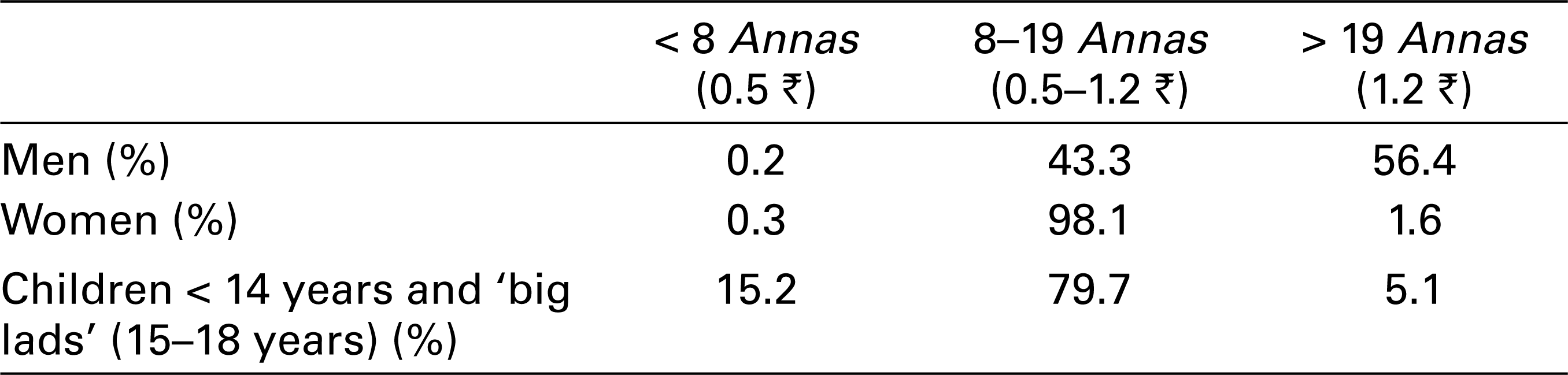
While almost all women in the industry earned between 8 and 19 annas (0.5–1.2 rupees) daily, the majority of male workers earned significantly more. The fact that 5% of the children also earned over 19 annas relates to the decision to factor in 15- to 18-year-old boys as children, whereas girls were considered to be adults once they reached the age of 15. Apart from the apparent job segmentation, the wage differential between adult men and women was thus further induced by age.
For men, the wage categories ranged until >79 annas per day (4.9 rupees). Still, however, these were the happy few, as around 85% of male workers earned under two rupees per day. More than 40% of all men did not earn significantly more than most female workers. There were relatively few permanent textile operators with stable, well-paid jobs; often urban dwellers or migrants coming with their families to Bombay or other textile towns. Adjacent to this, there was a larger pool of more temporary workers with shorter contracts, usually rural migrants. A last category was that of the badli workers, consisting of a pool of flexible ‘substitute’ labour that gathered at the gates of the mill in the mornings, part of whom were recruited by jobbers to get a day’s (or even only a few hours’) work in the textile factory. 102 The badli system has been seen as a unique and defining feature of the Indian industrial workforce, intended to provide mill owners with a flexible, cheap labour supply for the rather volatile daily operation of the factories. 103
In conclusion, our analysis shows that in both Japan and India, textile employers were searching for ways to keep down the wage bill in distinct ways. In both cases, a large pool of flexible labour was employed, with little opportunity and/or interest in gaining a permanent, higher-skilled employment contract. In the case of Japan, this pool was mostly recruited from young unmarried country girls, whereas in India, adult male workers—to a large degree temporary migrants—formed the bulk of the cheap flexible workforce. Regardless, the relatively few women in the Indian textile mills earned even significantly less, as they were generally assigned to the lowliest and most unskilled jobs, such as reeling and winding. We will now go on to explore the motives on the supply side of the labour force in Japan and India peasant households, in order to more adequately explain these diversified patterns of gendered work in both regions’ textile industries.
Households, Agrarian Systems and the Supply of Textile Labour
Many studies have highlighted the importance of a number of supply-side factors that resulted in the feminisation of the textile industry workforce in Japan, and conversely, their marginalisation in India, though usually not in comparison to each other. The discussions often boil down to demographic factors, in combination with cultural specificities of the two contexts. In the following, we first briefly discuss these arguments, after which we will bring to the fore our alternative explanatory framework: the role of agrarian systems and labour supply to the emerging textile factories.
Demography and Culture
Textile workers in India and Japan had specific demographic, age and family profiles. In both cases, the majority were from rural areas. In Japan, they comprised mostly young unmarried women who worked for specific periods in their lives. Around two-thirds of the Japanese textile labour force comprised women of 16 to 30 years, the majority of whom were between 16 and 20 years. 104 Female factory workers were viewed as supplementary earners/providers. These perceptions also aided the lower material status of these women workers and were often used to either marginalise women in tasks that paid less or keep their wages low (previous section). In the Indian case, the largest proportion of those women who did work in the Bombay cotton textile mills were between 26 and 45 years old. Widows and female-dominant income providers with families prevailed, even when the official outlook was that of women as supplementary earners. 105
Marriage patterns formed a key difference between India and Japan. In Tokugawa Japan, women’s average age at marriage had been relatively high (around 19) and the childbearing age span was limited. Moreover, marriage was not universal, and (as fertility) varied with changing economic circumstances. 106 Over the period studied here, the average marriage age of Japanese women rose considerably, to 23 years in the first half of the twentieth century. 107 In contrast, in India, marriage was a universal phenomenon with a much lower age of marriage, especially for girls. 108 In many regions, Indian girls were married off before menarche, that is around 11–12 years. This increased over the first decades of the twentieth century under the influence of 1929 British legislation that forbade marriages under the age of 14, and due to the rise in primary schooling. Still, the average age at which women married was only 15 years during Independence. 109 In Japan, the relatively higher age of marriage for women enabled the entry of unmarried women into factory labour for a few years before marriage. Conversely, the lower age of marriage of Indian women and its associated high fertility have often been central to explanations of women’s low participation in factory work. 110
Studies nonetheless show that the patterns of women’s entry age for work varied considerably across different regions. Women in India usually entered employment in their twenties and their participation reached its peak between ages 35–55 years. 111 Moreover, the demographic explanation for the lower work participation of women fails to account for industrial, regional or temporal variations in women’s work. It appears as an autonomous variable that is variously pitched to help the claim—whether it be low/high seasonal, factory or agricultural work performed by women. Often, demographic explanations also supplement cultural explanations for low female labour participation, which have been dominant in explaining work patterns of women in India. So, for instance, Tirthankar Roy states that women’s ‘casual or seasonal labour was more compatible with the domestic sphere’, thus referring to the social and cultural roles that women were supposed to take on. 112 Elsewhere, he notes that women were less mobile than men due to their childcaring and domestic duties, and therefore ‘tended to work more in households and farms, rather than in urban factories’. 113 Chandavarkar has pointed out that seasonal work in the context of Bombay mills was incompatible with the social and family position of women, thus enhancing ‘the importance of female field labour’. 114 However, Samita Sen notes that cultural or patriarchal tendencies to maintain control over women’s mobility and labour did not extend to seasonal migration by women for rural/agricultural work, which was prevalent at the time. 115 Similarly, seasonal industries, like cotton ginning factories, employed more women than the cotton textile industries. 116
We do not intend to completely deny cultural values shaping work, particularly in a society pervaded by caste-patriarchy hierarchies, in which these controls impacted castes differentially. However, in line with authors such as Sen and Kaiwar, we aim to turn the argument around, by suggesting that family systems like universal marriage in India and high fertility were also partly the outcome of economic developments within the agrarian structure in the late nineteenth and early twentieth centuries. 117
Agrarian Conditions and the Rural–Urban Wage Gap
As outlined in our introduction, we believe that labour supply conditions, in particular stemming from the division of labour in agrarian households, form an important explanatory factor for the (differences in) gendered work patterns in the emerging textile factories in Japan and India, related to differences in agricultural growth and agrarian systems in these two regions. While Japanese research has taken a broader view of patterns of family strategies with respect to labour deployment in farm and non-farm activities, this is a rather understudied field in the Indian case, particularly where women industrial workers are concerned.
In Japan, the moderate growth in agriculture was largely due to improved productivity, particularly labour productivity, which was premised on labour-intensive inputs on the farm. 118 These more productive methods of farming were actively promoted by the State. 119 State-induced reforms and programmes were also accompanied by specific community-level institutional measures. These measures included changes in landlord–tenant relations that also led to improvements in agricultural productivity. Of this, a specific example was the ‘rent-reduction contract’ that was managed and enforced by informal village community institutions that enabled rent reduction in the case of suboptimal output. 120 The emergence of these institutions was thus conducive to a higher degree of landlord–tenant cooperation and risk-sharing than in the Indian region of Ratnagiri–Konkan. In the context of this agricultural growth, the Japanese rural class structure also differentiated, with some proletarianisation occurring at the lower end of the peasant class spectrum, who nevertheless usually held on to their small farms. 121 In the higher and middle end of the spectrum, (adult) women undertook weaving in a putting-out system next to their agricultural tasks. Conversely, young factory workers were drawn from the more ‘impoverished end of the farming spectrum’. 122
Diversification among economic peasant households thus provided an incentive to supply wage labour for the emerging textile mills. In the context of the household economy, it made sense for poorer Japanese peasants to send their unmarried daughters to the factories. After all, the opportunity cost of these girls’ labour was lowest among the different household members. In the modal peasant family with three to five children, the (usually male) head of the household was crucial for the maintenance of the small-scale farm. As primogeniture prevailed, the eldest son would inherit the property, and his involvement was thus crucial for the continuity of the family farm, generally making the opportunity cost for him leaving to an urban factory too high. The housewife was needed for year-round agricultural as well as reproductive tasks, and in some contexts, she could earn considerable additional income with proto-industrial activities such as silk-reeling or cotton weaving. Younger brothers, who were destined to become tenants if they stayed in the countryside, either went out to perform wage work in agriculture, or—especially after the First World War—migrated to urban areas to find work in trade, transport or heavy industry. 123
Consequently, the opportunity cost of sending young girls, aged between 10 and 18, to the textile factories, was by far the lowest, as they played a relatively small role in family farming. For really poor peasant families, the fact that their daughters’ food and housing was included with the factory contract must also have been beneficial in terms of relieving total household consumption. Indeed, a 1903 state report investigating the working conditions of textile workers stated that peasants often looked down upon girls who were sent to the factories, and that ‘most of the local women employed at factories seem to come from financially-pressed families’. 124 Not coincidentally, girls were often recruited in districts sufficiently remote for labour intermediaries to effectively lie about the ‘excellent’ working circumstances in the factories. Moreover, the advances these recruiters offered their fathers were later often deducted from the girls’ wages, as were their travel costs and other expenses made for their recruitment. 125 Nevertheless, these factory girls’ contributions added to the household income, and the prospect of them returning after a couple of years, in order to become peasant housewives themselves and return to agricultural work and weaving activities, kept the system in place until well into the 1930s. 126
Interestingly, until the First World War, both for adult women and men, urban wages were on par with, or even lower than, rural wages for day labourers (see Figure 3). In the 1920s, the relative wages for women in the city even dropped further, whereas the opposite occurred for men. Judging from these rates, it would not have been profitable throughout the period to migrate to work in one of the textile mills. This confirms that for adult peasant men and women alike, migrating to a city was not a lucrative option. Consequently, the younger girls, for whom it was the most difficult to find attractive wage work in the countryside, temporarily moved to the cities. The relatively small gender wage difference also explains why moving back to rural areas was attractive for many girls once they had come of age.
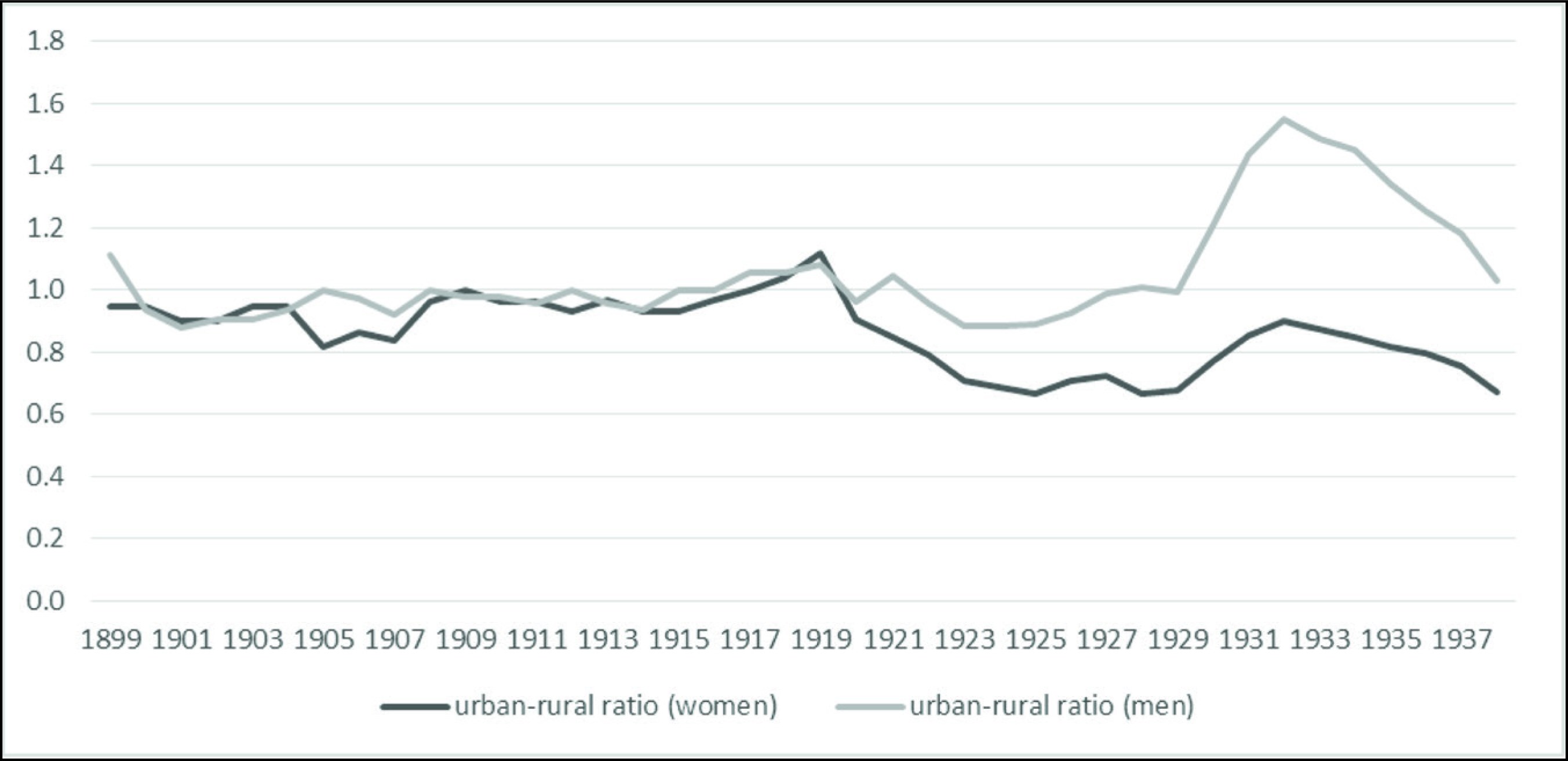
With the relative decline of the agricultural labour force (demand stayed stable while population grew), boys and young men also increasingly migrated to cities to find industrial employment. They, however, usually did not end up in textiles, but in other, often small-scale urban (export) industries, as well as in the emerging metal and chemical industries. 128 A persistent image arising from the occupational censuses is that throughout the period 1920–1940, the textile and clothing sectors only provided 25% of gainful employment for men in industry, whereas these sectors accounted for around 70% of all women’s industrial employment. 129 Apart from woodworking and food industries, which both hovered around 10% of women’s gainful industrial employment, there were few opportunities for them elsewhere in manufacturing. This was different for men, who found ample work in the ceramic industry, metal- and machine-making, or in the bookbinding and printing industries. 130
In India, the role of women in the peasant household economy was larger than in Japan, and their labour supply also grew over the period as a result of the decline of hand-spinning as a by-employment. 131 Moreover, labour opportunities for Indian men—married as well as unmarried—were much smaller than in Japanese agriculture. Their options worsened towards the end of the nineteenth century. In Konkan, the region where about half of the Bombay textile workers were recruited, this agricultural slump was related to oppressive circumstances resulting from a combination of heavy rent extractions of the colonial state and the Khoti tenure system (see ‘Developments in Agriculture’). In addition, by the mid-nineteenth century, population growth had overstretched Ratnagiri’s already fragile physical environment. In the late nineteenth century, peasant proprietors and tenants/sharecroppers comprised 85% of Konkan’s population, and only about 12% were agricultural workers, the lowest share in Bombay Presidency. 132
The coincidence of declining proportions of agricultural labour and a growing peasant class, along with increasing land fragmentation, underlines the dominance of family/household labour in the area. 133 With stagnant output and even declining productivity, the likely effect would have been a reduction in the number of working days/work intensity in agriculture and a stagnant if not reducing income from agriculture. 134 Developments in agriculture in the nineteenth and early twentieth centuries seem to imply not differentiation in household labour as in Japan, but generalised pauperisation, pushing male workers to the mills.
Segmentation and fragmentation of land reached disturbing proportions in Konkan. Acreage of rice land per head in 48 villages in the north of Ratnagiri had dropped slightly from 0.16 per capita in 1830 to 0.14 per head in 1866, whereas cultivated hill land per head dropped more dramatically from 0.54 acres in 1830 to 0.44 acres in 1867.
135
As Kaiwar notes,
in Ratnagiri district, on land growing coconuts individual fragments could be as small as 1/160 of an acre (about 30 square yards). Each tree could be an individual holding, or for that matter be divided among several holders. In some cases, fragmentation could go so far that it rendered some of the fragments uncultivable.
136
These limited cultivation opportunities likely resulted in a relatively greater emphasis on subsistence crop cultivation, such as rice.
The traditional gender division of work in paddy cultivation dictates a relative increase in the labour input for women workers. 137 Indeed, census data show that in the Ratnagiri district, women’s relative input increased over time: the proportion of female cultivators increased from 43% in 1881 to around 49% in 1921. 138 While land preparation, transplanting/sowing and harvesting were usually performed by men and women together, these occupied a relatively short period of time in a year. The intermittent tasks of manuring and weeding—traditionally female tasks—were spread over large stretches of time during the seven months between transplanting and harvesting. 139 The specific type of land preparation operation undertaken in Ratnagiri—rab manuring or rabbing—involved the preparation of a seedbed using hand digging to loosen the soil, application of cow dung manure, layered with straw and other forest wood and which was eventually burnt after a wait of 3–4 months. 140 This operation was performed for over four months starting in December and reaching its completion in April. The most labour-intensive part of the task—spreading of manure over seedbed—was performed by women and children. 141 Transplanting and weeding, which formerly were concentrated over a short period, but came to be more intermittent throughout the agricultural cycle, were also largely performed by women.
Besides agriculture, there was little local demand for other work. 142 Women were occasionally employed in non-farm work as domestic servants or fishmongers, but were usually excluded from skilled and/or heavy manual labour. 143 Due to the scarcity of non-agricultural (wage) labour, seasonal male migration—for example to work in military establishments—was common in this region even before the establishment of large streams of migrant workers to the textile mills of Bombay. By the first half of the nineteenth century, Bombay had emerged as the most important trading port and large commercial capital. The ebb and flow of labour demand emerging from the ports, docks and Bombay’s construction boom shifted with monsoons, a pattern that would have adjusted to the converse surge in demand for labour in monsoon supplied rice agriculture.
This large pool of male rural migrants, in combination with the pervasive role of women in subsistence agriculture, largely explains the comparatively low supply of female textile workers in the mills. Although cultural limitations for women to migrate did exist, the household strategy of having a (young) wife at home involved in agrarian work and married and unmarried men moving for (often temporary) labour opportunities in the city prevailed. 144 Rates of female migration from the district were the highest in the case of well-off castes and in the case of the most oppressed castes. 145 It appears that in the former category, family migration with the objective of the male household head finding a permanent occupation in the city was an affordable and desirable strategy. In the latter category, opportunities of whatever work was available defined migration patterns. A reasonable assumption in the case of poorer sharecroppers and tenants would be that they diversified their income strategies, with some—often married—women ending up in the lowest possible jobs in the textile mills, as reelers and winders of yarn.
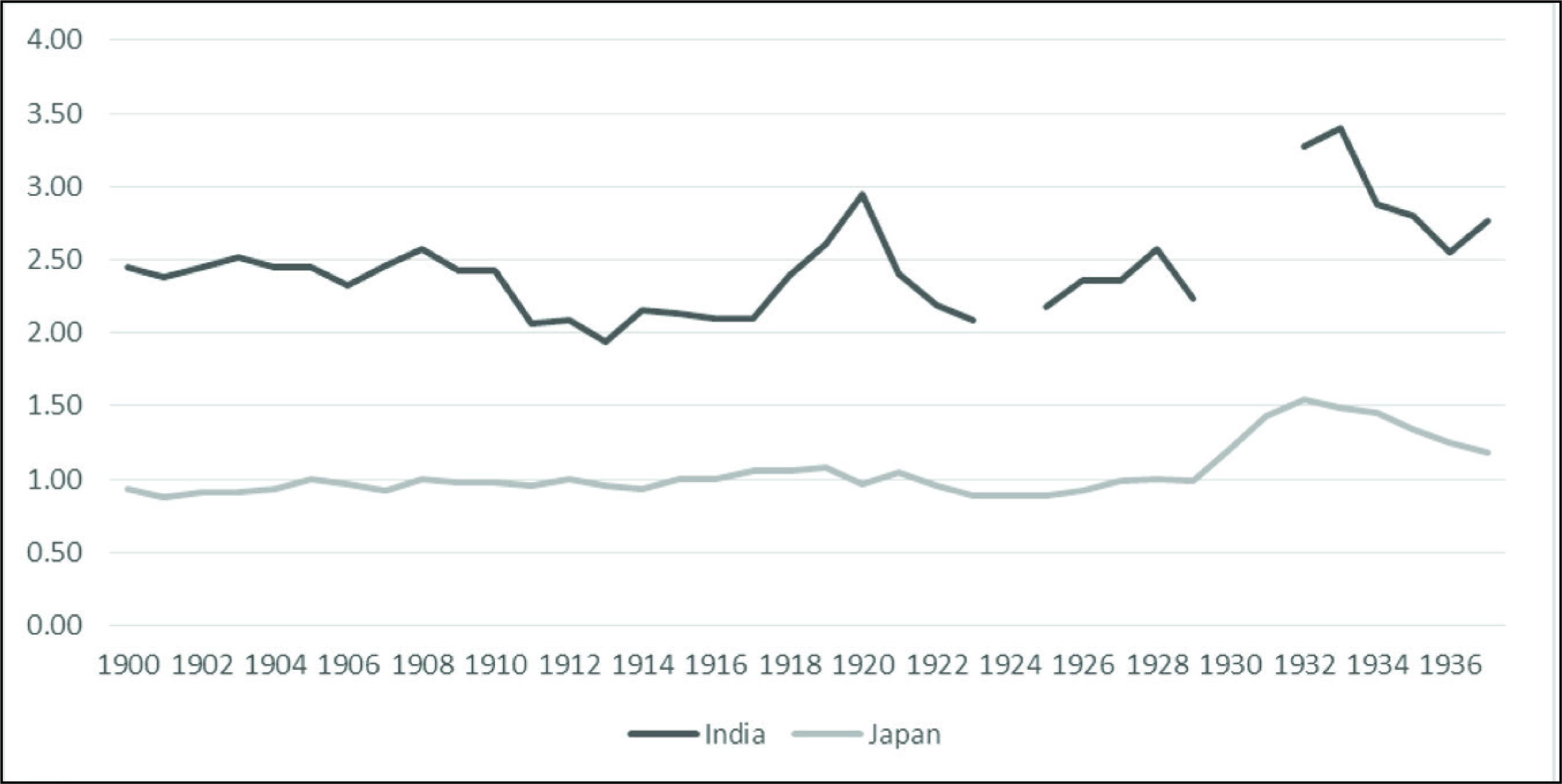
The data on agricultural wages for India, as a whole, shows that these were low and stagnant from the last quarter of the nineteenth century to the first quarter of the twentieth century. 146 For Bombay Presidency, however, real wages increased by around 50% from 1900–22, with the highest nominal wages prevailing in the Konkan region. 147 Nonetheless, prior to the First World War, wages in Bombay mills were considerably higher than the rural wages in the Konkan–Ratnagiri belt, at least twice, sometimes thrice, as high (see Figure 4). Even though the cost of living was undoubtedly higher in urban areas, this difference seems too large to offset the advantage of working in a town at most times. 148 Wages in the Bombay textile mills, however, were not standardised across the various establishments, a point that regularly emerged in the official enquiries on the subject of labour. Besides, variations among different establishments, wages rates between the permanent workers and the temporary/badli workers, who formed at least a third of the workforce in the textile industries, also differed. According to Mazumdar, ‘the fall in the earning strength of the family, the higher cost of living in town and the differential due to skilled workers would each account for significantly higher earnings for the permanent workers compared to rural wages’. 149 As already mentioned, the opportunities for employment within the textile industries for women were also limited and declining. In Bombay, where mill employment was highly sought after, women were pushed into the poorer quality jobs in the unorganised sector. 150
Another factor was that recruitment practices via which jobbers did not necessarily travel to the hinterlands to get workers pushed up the costs of migration. 152 Since in this system all costs of transition were borne by the worker and his family, it was much more expensive if the entire family were to migrate. Once in Bombay, living costs would also be higher for a family than for an individual male worker, and greater still if work was either not guaranteed or intermittent. In the context of uncertainties of work for both sexes, but particularly women, and a much more feminised agricultural regime, the family strategies adopted by most migrant families were to diversify their income opportunities. Thus, men mostly migrated, and women stayed on the farm. In the harvest period, we see many male textile workers returning to their homesteads to help out or to perform wage work in times of relatively high demand for agricultural labourers. 153
All in all, highly varying opportunity structures in the Japanese and Indian rural recruitment areas led to very different age and gender structures in the supply of labour. In Japan, where agricultural productivity was higher, and men were relatively more important, urban–rural wage differentials were not sufficiently favourable for adult men to migrate (Figure 4). For poor peasant households in Japan, there was often a need to at least keep the parents and the eldest son on the farm, but the opportunity costs to send off younger sons, and especially daughters to other farms or to the emerging textile mills, were much lower. Girls could usually not earn much as wage labourers in other farms or other industries (as opposed to their brothers) or in proto-industrial activity (as opposed to their mothers), so they represented excess labour that could be recruited—sometimes under false pretences—for the mills. For the poorest families, their temporary absence also meant one mouth less to feed. In India, women married much earlier, and their labour was dearly needed throughout the agricultural season, whereas due to the low productivity, fewer lucrative income opportunities were available to men. In contrast to Japan, urban wages were relatively much higher than their rural counterparts. So, despite the higher cost of living, migrating to the city was a viable earning strategy, especially if one left his family behind. In this case, in order to survive, and to live up to the increased tax burdens, it was adult Indian men who served as a cheap source of labour for the textile mills in cities such as Bombay and Ahmedabad.
Conclusion
This article set out to explain the remarkable difference in gendered work patterns in the early textile industry in two Asian countries, Japan and India. The former depended predominantly on young, female labour, whereas women were hardly present in the latter. We have argued here that while tradition and culture played a role in emerging gender structures in the textile mills, in both countries, the most important factor was the interplay between employers’ strategies to recruit the cheapest labour, on the one hand, and the supply-side incentives of peasant households to provide those family members who were least able to be sufficiently occupied in agricultural work, on the other hand.
These links to agricultural labour systems related to differences in productivity, which were partly rooted in earlier periods of agricultural (under)development. Perhaps more important, however, were changing landholding structures that in the Japanese case led to lower taxation as well as to more diversification and modest productivity growth among peasant households, whereas it led to increasing fragmentation, tax burdens and financial pressure for Indian peasant households. In terms of another important institution, the state, the fact that India was under colonial rule undoubtedly increased this pressure on the agricultural system, whereas Japan became a colonial player itself, which was able to extract considerable amounts of cheap rice from Korea and Taiwan from the 1920s onward. 154
The relatively favourable agrarian conditions in Japan led to secure work for a large part of the male workforce. By the late nineteenth and early twentieth centuries, a rapidly expanding modern military and industrial sector provided more diverse opportunities to both men and women. Conversely, in India, overall output as well as periods of seasonal slackness led to under- and unemployment for men, whereas women, who married young, were mainly responsible for subsistence rice production. Consequently, opportunity costs for young rural women were lowest in the case of Japan, whereas this was the case for—single and married—men in the Indian countryside. Migration restrictions for women were stricter in India, for cultural reasons, but, in our view, also because their growing role in subsistence agriculture formed an incentive to tie them to the family farm, and thus constrain their movement to urban areas. This was promoted by the British colonial government, which introduced a series of measures to enlarge legal control of families over women’s labour from the middle of the nineteenth century. 155
Both Japanese and Indian textile mills recruited a large pool of flexible labour, with little opportunity for gaining a permanent, higher-skilled employment contract. In the case of Japan, this pool mostly consisted of young unmarried country girls, while in India, temporary male migrants formed the source of cheap flexible labour, although there was a small, more permanent male workforce available in the Indian case. The desire for temporality seems to have been mutual: both Japanese girls and many male Indian migrants were eager to leave the factory, either after a period of a few years, or seasonally, to work in agriculture. Here too, income opportunities differed traditionally, as rural proto-industrial activity had declined much faster in India, where handloom weaving became increasingly concentrated in the hand of artisan (male) weavers’ castes, whereas in Japan, it was still a viable supplementary income for peasant women from the middle strata of the peasant class.
Our analyses of male–female wage ratios in the textile mills in both countries, as well as the comparison of urban–rural wage rates, highlight these fundamentally different opportunity structures in Japan and India. While in both countries, the gender wage gap loomed large, and segmentation in the textile factories existed in both cases, gender differences were much more pronounced in India, attesting for the greater competition by male migrant workers in the lower echelons of the production process in the latter case. An interesting difference was that the urban–rural wage differentials were much lower in Japan than in India, making it—at least until the 1920s—much less attractive for Japanese peasant adult men and women to move into the urban industrialised sector. In India, instead, it made sense for adult men to try to profit from the comparatively higher urban nominal wages.
To conclude, we turn to the consequences of these respective developments for women’s position in the household economy. In Japan, the cheap labour of young unmarried girls is said to have been crucial to the initial success of Japanese industrial firms, first in the national market, and after the First World War in the global market for textiles, with effects that in later years spread from textiles to other industrial sectors, such as heavy and chemical industries. Simultaneously, young girls’ textile wages made a small, but welcome, contribution to many peasant households’ incomes. Ultimately, this must have strengthened young women’s position in society as well as in the family, which is also suggested by the pronounced rise in their age of marriage over the period. 156 In contrast, the general trend in India was that of further marginalisation of women’s work—in terms of their participation in industrial work, the nature of tasks they performed and rising perceptions regarding their low status and respectability. The proportion of the female workforce engaged in agriculture rose as women were increasingly pushed into seasonal, low-productive, poorly paid or unpaid agricultural work. 157 Scholars have argued that as women’s access to visible work fell, their contributions were ‘invisibilised’ and undermined ‘their bargaining power in the labour markets’. 158 Although not being the only, nor perhaps the most decisive factor for both countries’ economic development, we hope to have convincingly argued that women’s position formed a constituting element in Asian’s ‘Little Divergence’ that cannot be overlooked.
Footnotes
Acknowledgements
This research is part of a project that has received funding from the European Research Council (ERC) under the European Union’s Horizon 2020 research and innovation programme (Grant agreement No. ERC Consolidator Grant #771288). The article has greatly benefited from comments on earlier versions provided by our colleagues of the TextileLab project (People–TextileLab, 26 March 2020), attendants of the online RHI seminar at Wageningen University (12 May 2020), participants of the online lunch seminar at Bochum University (25 November 2020), participants of the online ESSHC, March 2021. We also wish to thank the editorial board and peer reviewers of the IESHR, as well as Jan Lucassen and Preeti Chopra for their valuable comments to an earlier draft of the article.