




Abstract
Scribes in early modern South Asia relied on their skill in writing to secure the support of powerful courtly patrons. The rapid expansion of emerging regional states in the eighteenth century created new opportunities to apply these skills to administration, land-holding, and politics. This article examines the changing professional identity of the Kayastha scribal household in eighteenth-century western India. I focus on the ascendancy of the Chitnis household of Satara in the context of the growth and diversification of Kayastha employment under the Maratha sovereign Shahu Bhonsle (1682–1749). By consolidating portfolios of titles, appointments, and rights to property, ambitious scribes and secretaries, as epitomised by the career of Govind Khanderao Chitnis (d. 1785), were able to pursue riskier and more lucrative political assignments and form networks of kinsmen and associates across Maratha governments. Yet greater scrutiny and competition for state largesse, not least from within the Chitnis household itself, forced members of later generations to adopt creative and sometimes risky strategies to defend their claims to property. This article explores how the profound dislocations of political transformation in eighteenth-century South Asia enabled distinctive modes of individual and collective self-fashioning amongst skilled, upwardly mobile groups.
Introduction
One of the most striking features of the emerging regional states of eighteenth-century South Asia was their promotion of skilled, upwardly mobile service people. Professional mobility was not always considered to have a salutary effect on the health of the political order. Among the reasons that the jurist, scholar, and social reformer M. G. Ranade adduced in explaining the decline of Maratha power in the late eighteenth century was the desire of ‘new men’ to join ‘the general Councils of the Empire’. 1 While Ranade was alert to any whiff of corruption, another thesis might posit that the bureaucratisation of a state with limited resources is bound to produce a degree of flexibility in its structure of duties, roles, and functions. The balance of social elements, as the historian Jadunath Sarkar put it, might even seem ‘artificial, accidental, and therefore precarious’. 2 Yet contingency alone is an unsatisfactory answer to the question of how the institutions of the state and the talents and ambitions of its subjects interacted at specific historical conjunctures. Any account of social and political change must examine both how skilled, mobile individuals took advantage of existing institutions and how those institutions adapted to the establishment of new networks of influence and expertise.
The flourishing of skilled ‘service gentry’ has been integral to the revisionist view of the eighteenth century in South Asia. 3 The figure of the scribe, in particular, looms large in recent scholarship. It is now well-known that specific castes and communities possessed a high level of literacy in regional and transregional scripts and languages as well as a command of specialised epistolary conventions and forms of documentation. Studies of North India, Bengal, and Hyderabad have found a mixture of Brahmans, Kayasthas, and Khatris fluent in the idioms of Persian composition, 4 while the Brahman appears to have been dominant in the south. 5 In the case of the western Deccan, Sumit Guha has highlighted the centrality of Marathi-speaking Brahman scribal officials to Bahmani, Deccan Sultanate, and Maratha local- and district-level revenue administrations. 6 More broadly, Rosalind O’Hanlon has shown how transregional networks of Marathi-speaking Brahman pandit-scholars protected their social and ritual status through the production of Sanskrit knowledge. 7 As Prachi Deshpande has illustrated, manuals itemising the conventions, categories, and short-forms of the Modi script of precolonial Marathi documentation sacralised scribal labour by propounding a Brahman-centric ideology of writing. 8 The recurrence of public disputes with Kayasthas about ritual practice and varna status indicates that Brahman dominance was not uncontested. 9 Nevertheless, the overwhelming image of state chancelleries and bureaucracies in the early modern western Deccan remains that of a ‘Brahman raj’. 10
The aim of this article is to grapple with the transformation of the scribal household in the context of the changing socio-functional formation of the eighteenth-century state by exploring the professional trajectories of Chandraseniya Kayastha Prabhu officials in the Maratha Empire. Hitherto the scholarly consensus has held that the settlement of significant numbers of Chitpavan Brahmans in the western Deccan in the eighteenth century displaced an earlier Kayastha administrative presence with clusters of Kayastha officials surviving at Nagpur and Baroda. 11 It is not merely that the presence of Kayasthas has been underestimated, though, as I outline in the first section of the article, it is true that there were a significant expansion and diversification in Kayastha employment after the restoration of Chhatrapati Shahu Bhonsle (1682–1749). Rather, I argue that the flexibility and mobility of Kayastha service households demonstrate how functional compatibilities between writing, communication, administration, and politics allowed for socioeconomic mobility and professional fluency across a wide range of roles not easily captured by the term ‘scribe’. The changing role of literate Kayastha officials thus resonates with parallel developments across early modern Eurasia whereby the management of politics and government increasingly became the purview of scribal and secretarial classes. 12 To explore the relationship between writerly work, professional mobility and state-formation, I follow the pathways taken by members of a single household—the Chitnises of Satara—while paying attention to the broader patterns of Kayastha service within the Maratha bureaucratic apparatus.
In using the household as a key site of analysis, I am conscious of what Frank Perlin called the ‘semi-patrimonial’ character of the Maratha state. 13 Recent studies of early modern state-formation have emphasised that a modern, impersonal bureaucracy did not replace the patrimonial household in a linear Weberian fashion, but rather the interaction of familial and caste- and clan-based structures with processes of bureaucratic routinisation produced composite ‘patrimonial-bureaucratic’ organisations. 14 Patrimonial control over government largesse persisted even after the British East India Company regime made deliberate efforts to establish a more impersonal mode of governance. 15 In the reconstituted Maratha state of the early eighteenth century, Kayastha households gained a competitive advantage within a stratum of subordinate officialdom responsible for executing the everyday processes of bureaucratic writing, and the Chitnis family in particular held a near-monopoly on several specific secretarial offices. Moreover, as the second section of the article details, they amassed an eclectic portfolio of rights and perquisites that enabled Govind Khanderao Chitnis (d. 1785) to take on the unofficial, but far more consequential roles of advisor and consigliere. At the same time, the mutual imbrication of household and state exacerbated conflict within the household as less privileged members forged their own pathways of mobility. 16 In the third section, I examine how differently situated individuals responded to the decline in the Chitnis family’s status and wealth in the late eighteenth and early nineteenth centuries, highlighting the case of Raghunathrao Laxman Chitnis’ ‘fabrication’ of a claim to an assistantship. Perhaps the most creative strategies to advance and represent one’s own interests, and to revive the prospects of the Kayastha scribal household, developed when opportunities for mobility were most scarce. Finally, I conclude by reflecting on how the legacy of the Chitnis household has shaped historical understanding of the relationship between caste, politics, and Maratha state-formation.
Pathways of Kayastha Service in the Maratha State
The Chandraseniya Kayastha Prabhus of western India are a regional sub-group of the Kayastha caste, often distinguished from the Chitragupta Kayasthas of North India. According to a story in the Sahyādri-khaṇḍa, their progenitor was the son of the Kshatriya king Chandrasena.
17
When the gods deputed Parshurama to massacre the Kshatriyas, Chandrasena’s pregnant wife fled to the ashram of the sage Dalbhya, who then bartered her for her son with the provision that he would be trained in the arts of the pen rather than the sword. Existing scholarship has thoroughly discussed debates about the purported Kshatriya origins of Kayasthas.
18
Whatever these origins might have been, they clearly obtained significant roles within the polities of medieval South Asia. Across the Indo-Gangetic plain in the Gupta period, kāyastha referred to a relatively open functional group without a fixed varna status as well as ‘scope of horizontal mobility’.
19
Upon migrating southwards, Kayasthas became associated with the designation prabhu.
20
By the twelfth century
By the late fourteenth century, significant numbers of Kayasthas had come to reside in both the Konkan and the ‘12 Mavals’ region of riverine foothills and narrow valleys nestled in the Western Ghats mountain range. In Hirdas Maval, Nane Maval, Paudkhore, Muthekhore, Musekhore, Kanadkhore, and other sub-divisions, Kayastha officials staffed the local- and district-level revenue administration of the Bahmani and Deccan Sultanates. 23 Kayastha scribes and soldiers gained access to a ‘wide field of employment’ by helping the Maratha founder Shivaji Bhonsle to mobilise the hardy inhabitants of the Mavals. 24 The most famous Kayastha followers of Shivaji burnished pre-existing appointments with extraordinary acts of martial service. Particularly celebrated in historical memory is Baji Prabhu Pradhan, the record-keeper (deśkuḷkarṇī) of Hirdas Maval. 25 In 1660, Baji Prabhu perished while guarding Pavankhind pass against Adil Shahi Sultanate forces during Shivaji’s narrow escape from Panhala to Vishalgad. 26 He was remembered long after his death in Marathi poetry and narrative. Even the Bisāṭ al-Ghanā’im (1799) of Lachmi Narayan ‘Shafiq’ Aurangabadi, whose oeuvre is discussed extensively in Purnima Dhavan’s contribution to this volume, mentions his service. 27 Burial shrines have been erected for him and his brother, and a nine-foot bronze likeness planted at Panhala continues to draw visitors today. 28
Less illustrious but more illustrative of the pattern of Kayastha employment in the early Maratha state are the trajectories of Baji Prabhu’s progeny. Occupying the position of jamenīs under the Maratha head general (senāpati), his son Babaji Baji Prabhu failed to accompany Chhatrapati Rajaram Bhonsle to Gingee in the Karnatak, triggering the transfer of his office to another Kayastha. Thanks to the intercession and subsequent death of his brother, the Chhatrapati was inspired to forgive this transgression: ‘Your maintenance is indispensable. Your father Baji Prabhu served our late master loyally and incurred costs in carrying out his deeds. You have also served loyally and will continue to do so’. 29 By an order dated 27 August 1692, Babaji was reinstated to the jamenīs with an annual salary of 2,000 hons supporting his own expenses as well as those of his auxiliary staff, including 12 palanquin-bearers, two torchbearers, an umbrella-bearer, and several bodyguards. 30 Members of this lineage subsequently held this post at an increased salary of 5,000 hons. 31 His late brother’s son Baji Mahadev was appointed to the office of kārkhānīs, while another brother rose through the ranks of the Karnatak cavalry. 32 The Chhatrapati also ordered that the family’s income from inʿām lands associated with the lapsed Hirdas Maval deśkuḷkarṇī office be guaranteed to them in perpetuity. 33
The appointments of Baji Prabhu’s sons and grandsons exemplify a trend from the late seventeenth century onwards towards Kayastha employment within a subordinate stratum of clerical bureaucracy comprised of officials known as kārkun or darakdār. Both terms referred to staff performing the labour of writing accounts, documentation, and correspondence within a government establishment. 34 Under the Adil Shahi Sultanate, kārkun referred to a clerk who assisted a centrally appointed district revenue manager (ḥawāldār) and occasionally had a more specific title and function. 35 In a directive issued by Muhammad Adil Shah in 1649 to the manager and clerical staff of Sandlapur (Solapur) district, the head clerk (shabnawīs), the writer of Marathi correspondence (chitīnawīs), the departmental writers (nawīsandagān-i kārkhānhā), the writers of Persian correspondence (fārsī-nawīsān), and various other officials all the way down to the cultivators of the villages (riʿāyān-i dīhā) are all mentioned. 36 Gradually it became customary to recognise an assortment of similar specialised clerical offices: head administrator (kārbhārī), 37 head accountant (majmūdār), deputy accountant (phaḍnīs or phaḍnavīs), writer of correspondence (ciṭnīs or ciṭnavīs), head clerk (sabnīs), fort-based deputy clerk (kārkhānīs), army-based deputy clerk (jamenīs), and cash-keeper (potnīs). 38 Wherever required, but most notably in diplomatic communication, the writing of Persian correspondence was the duty of an official bearing the title of pārasnīs or munshī.
It is evident from the titles alone—many end with the Marathi suffix nīs derived from the Persian word nawīs, meaning ‘writer’—that these clerical offices were functionally interrelated through the practice of writing. Individuals appointed to these offices performed the routine processes of written documentation, enumeration, and communication that undergirded a rapidly expanding Maratha state apparatus. By the second half of the eighteenth century, a centralised bureaucracy had developed at Pune with ultimate authority over the subordinate clerical staff working for far-flung generals, revenue collectors, and commanders of forts. Day to day, clerks operated within a chain of command tied to rates of compensation. The staff attached to a grant of military service tenure in 1762 included eight clerks with annual salaries ranging from ₹5,000 earned by the diwān to ₹300 earned by the jāmdār. 39 Not only was there a strong family resemblance between clerical functions, but also clerks worked in pairs or triplets to create a multi-layered system of administrative review and approval of documents. In the district revenue-collection offices answering to the Pune government, the majmūdār was to ‘to inscribe in all writs or deeds…the words “Muruttub Shood” or “approved”’ at the end of each document before the phaḍnīs wrote the date. 40 Regulations composed under the last Chhatrapati Pratapsinha Bhonsle enjoined the ciṭnīs and the phaḍnīs to collaborate in issuing copies of new grants to officials at different levels of government. 41 At Nagpur, the ciṭnīs Krishnarao Madhav wrote the date and the closing word bār on all official documents, while the munshī Shridhar Laxman applied the seal of the ruler. 42
Kayasthas also found employment in the staffing of military outfits. 43 The kārkhānīs of a fort or the jamenīs of a body of troops kept track of cash, grain, and basic provisions that were critical to survival during long sieges or campaigns. The Sabhāsad Bakhar (1697) claims that while Brahmans were directed to the office of head clerk (sabnīs), kārkhānīs and jamenīs posts were reserved for Kayasthas. 44 Kayasthas do appear to have held a competitive advantage in this sector of state employment. A member of the Kayastha deśpāṇḍe lineage at Kanadkhore claimed the kārkhānīs position at the hill-fort of Raigad. 45 The Sashtikar Guptes, whose founder had been an assistant village headman in Ratnagiri district on the Konkan coast, occupied the kārkhānīs post at Sashti (Salsette) fort until it was ceded to the British East India Company in 1782. 46 Further inland, Vitthal Dadaji Gupte served as the kārkhānīs of Purandar fort in the 1730s, obtaining inʿām rights in surrounding villages. Later he lost this post and left to find work as the ciṭnīs of Fattesingh Bhonsle, the raja of Akkalkot, but his grandson was restored to it in 1773. 47
There is especially strong evidence for recruitment of Kayastha jamenīs officials during the re-establishment and expansion of Maratha power in the first half of the eighteenth century. 48 As Maratha military commanders conquered new territories in central and eastern India, there was increasing need for personnel to manage the records of military establishments on the move. Hence the expansion of the Maratha state drove the incorporation of Kayasthas into clerical service. Government diary entries recording grants of jamenīs to Kayasthas indicate that they received annual salaries ranging from ₹700 to ₹3,000. Some were awarded additional rights and privileges. According to an entry for a grant issued on 13 November 1730, Vinaji Nilkanth Prabhu won the jamenīs post under Ranoji Bhonsle along with rights to the revenue of three villages in Narnala district in Berar. 49 Bhonsle’s ciṭnīs at this time, Yesaji Krishna Prabhu, held a revenue share in another village in the same district. 50 The jamenīs Raghunath Gangadhar Prabhu had the responsibility of supervising a Kayastha assistant. 51 Junior writer and assistantship positions were points of entry into an extensive bureaucratic network within which individual clerks exploited their talents and connections to advance their careers.
Clerical positions were not strictly hereditable, yet certain households were able to aggregate and bequeath appointments across generations, in effect converting entire departments of state into family property. Exemplary is the family who came to monopolise the office of potnīs under the Chhatrapatis of Satara. They traced their origins to Baji Murar Umrao Mahadkar, a rather obscure Adil Shahi notable whose descendants’ paths resembled that of the deśkuḷkarṇī lineage of Hirdas Maval. 52 Two of his sons, Murar Baji and Sambhaji Baji, died in battle, occasioning a grant of inʿām in the village of Gugulwada in the Konkan in 1695. 53 First held by their nephew, who found work as a personal accountant (khāsnīs), this inʿām was eventually passed on to Sambhaji Baji’s descendants. 54 Another nephew Yashwantrao Mahadev obtained the office of potnīs and khāsnavīs. 55 Whilst amassing a sizable patrimony in land and office, Yashwantrao Mahadev and his relations established an enviable position at the Satara court, in part by contracting a marriage alliance with the Chhatrapati’s beloved ciṭnīs. 56 But it was his professional partnership with the latter’s son Govind Khanderao that launched him out of the humdrum routines of clerical labour into the cut and thrust of palace politics.
Property, Politics, and Professional Mobility in the Satara Chitnis Household
While the most successful clerical writers acquired permanent assets in the form of hereditable rights to land revenue, most relied on the more uncertain income of an annual salary. Even then, some were not always able to make ends meet. Govindrao Nilkanth, the Kayastha munshī of Sambhaji II of Kolhapur,
57
frequently bemoaned his financial situation in a compilation of Persian letters known as the Durj al-Gawāhar.
58
In a plea for assistance to an employee of his patron’s brother and rival at Satara, he complained,
Besides the business of beggary (darweza-garī)—besides this art or the business of writing (munshī-garī)—there is no clear means of filling one’s belly here, and [except for you] I do not have another favorable opportunity at that ever-prosperous court of that king of exalted power.
59
Observing that ‘there is a connection from this side in the business of writing and from that side in the business of record-keeping’, he encouraged his nephew to study Persian writing until he learned to write with elegance of style (inshā-pardāzī). 60 It was naive for a young clerk to expect to escape from a lifetime of scribbling down the whims of a temperamental patron.
Nevertheless, members of Kayastha households did transcend the limits of their profession to amass diverse portfolios of rights, honours, and perquisites and even to take up the vocation of politics. The paradigmatic case of this kind of professional mobility is Govind Khanderao of the Satara Chitnis household (see Figure 1). Early nineteenth-century bakhars composed by members of Chitnis family took great pride in the scribal proficiency of their forebear Balaji Avaji. A surviving register of the family’s papers includes copies of several letters from Shivaji to his brother Ekoji Bhonsle, the raja of Thanjavur, which it identifies to be ‘letters of the hand of Balaji Buva [Balaji Avaji]’. 61 But the family’s service portfolio gradually expanded beyond the scribal arts to encompass administration, land-holding, and politics. As emphasised by a royal order in 1739, the Chitnises, unlike their counterparts at Kolhapur, were so prosperous that they were able to give up the hard work of writing (lihiṇyācā kasālā). 62 While those who remained in the Maratha heartlands found themselves in a more vulnerable position after the consolidation of Chitpavan Brahman political dominance in the late eighteenth century, the branch of the family that migrated to Nagpur in central India in the 1740s continued to rise in status and influence until the transition to Company rule.
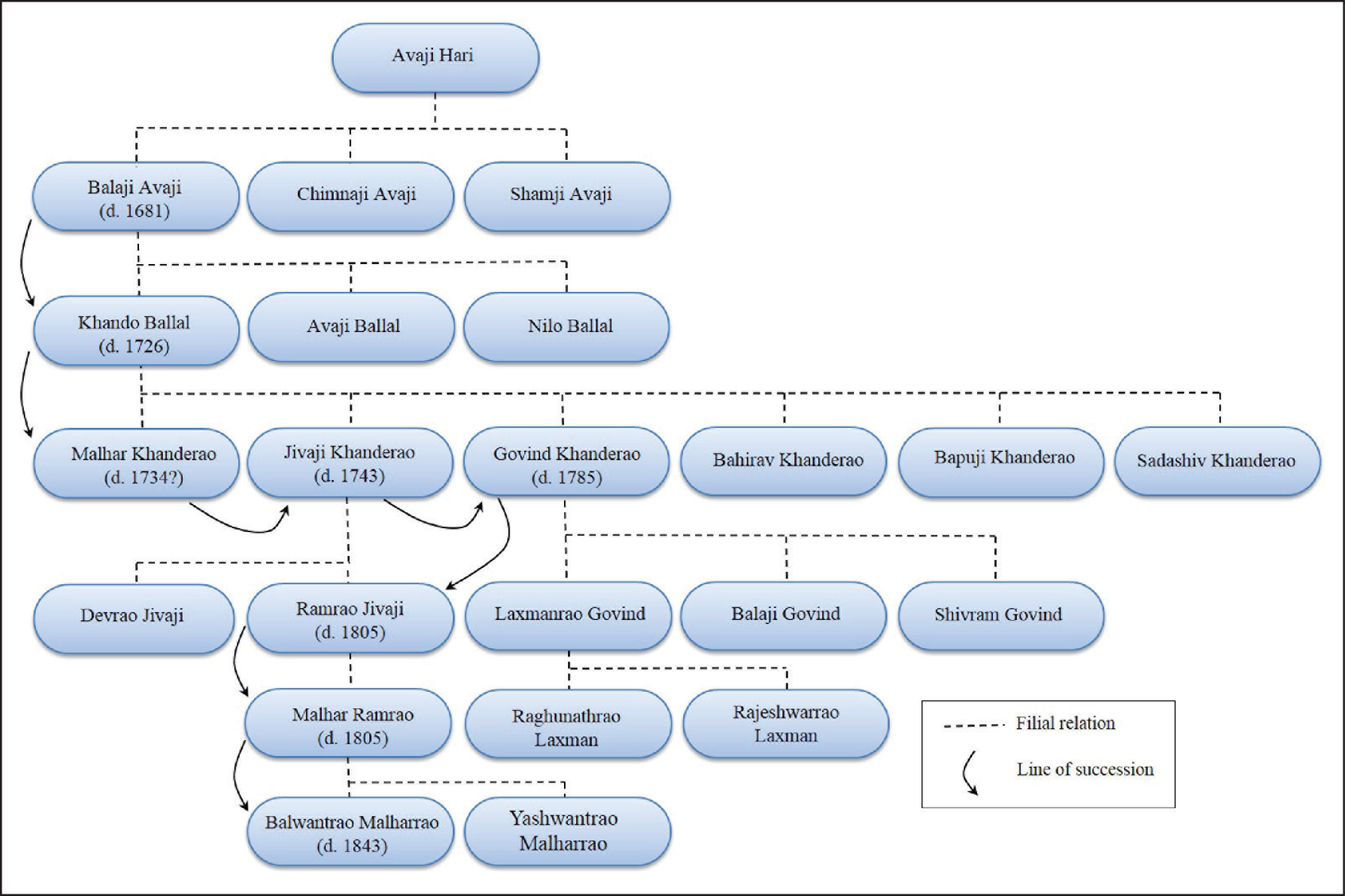
The conditions surrounding the rise of the Satara Chitnis family remain somewhat opaque because the sources available to us post-date the deaths of its first two patriarchs, Balaji Avaji (d. 1681) and Khando Ballal (d. 1726). 63 These sources state that Balaji was living in the important Konkani coastal trading depot of Rajapur when Shivaji hired him to pen his correspondence. Balaji’s father had been a clerk with the title of diwān or majmūdār under the Siddis of Janjira. 64 Due to some unnamed transgression, he fell out of favour and was sentenced to death, leaving behind three young sons. It was through the intervention of their mother that instead of being killed or sold into slavery, they found refuge in the home of their maternal uncles, who were maritime merchants of one sort or another. Balaji assumed the role of ciṭnīs sometime between 1648 and 1650 and played a significant role in inviting the Benares-based Brahman pandit Gagabhatta to administer Shivaji’s coronation ceremony. 65 But his career was abruptly cut short when Shivaji’s troubled heir Sambhaji put him, his brothers, and eldest son to death for abetting the faction opposed to his succession.
The Chitnis family continued to maintain a social and political network in the Konkan even after migrating upcountry. Through their contacts in the shipping business, they arranged for the transportation of Rajaram’s wives and children from the western Deccan to Gingee. For this service, they were rewarded with inʿām rights to revenue in several villages in Rajapur province that were subsequently re-confirmed and supplemented. 66 Govind Khanderao and his brother Jivaji acted as diplomatic intermediaries between Satara and the seafaring Angre clan during their joint campaigns in the 1730s to capture strategic sea forts from the Siddis. Jivaji himself commanded a body of soldiers in the 1734–36 siege against Anjanwel. 67 In 1735, the Angres’ Kayastha minister landed himself and his family in prison under an accusation of attempted desertion, prompting the brothers to intercede on his behalf. 68 Their efforts must have eventually met with some success, as their relationship with the minister persisted in the form of a marriage alliance between his niece and Jivaji’s nephew in April 1737. 69 Moreover, the Angres re-confirmed the family’s claim to the sardeśmukhī revenue of Cheul province, an example of the varied character of their growing proprietary portfolio. 70
The Chitnises’ re-establishment in the good graces of the Chhatrapati enabled the establishment, expansion and diversification of a portfolio of rights to land revenue. A copy of a deed of security (abhayapatra) issued to Jivaji Khanderao in 1735, including an appended list of 45 villages held in inʿām, tells a story about the family’s history of service at a crucial conjuncture in their career.
71
Like narratives in the genre of maḥzār-nāma, it establishes a clear link between acts of service and durable rights to property.
72
Several of its claims, in fact, would be repeated in later bakhars recounting the family’s history. It states:
Your grandfather Balaji Avaji at the time of our late master’s [Shivaji’s] attainment of the kingdom proved useful in his efforts and exertions. He served with him when disaster struck on the occasion of going to Delhi, and he also brought our master’s intention to fruition at his coronation. Therefore, having been promised a title among the eight ministers, he requested [instead] to receive the property of the ciṭnisī in perpetuity, and so such a promissory note was given to him. Later, the great Maharaj died, and our late master [Sambhaji], based on someone’s misinformation, punished the servants and officials of the state. [Balaji Avaji] having been among them, your father Khando Ballal behaved very loyally and exhibited courage in the battle of Goa. When our master’s horse was caught deeply in the ocean, he took hold of him and leapt off the horse. Deeply gratified, [our master] promised to exalt him.
The memorialisation of Khando’s valorous acts along with the documented military service of his son Jivaji supports Nandini Chatterjee’s point that clerical labour ought not to be ‘detached from land and violence’; rather, Kayastha service households ‘could marshal both pen and arms’ in their search for remunerative employment.
73
The abhayapatra closes with a summation of the family’s core rights and perquisites:
Based on this, it has been found necessary to show you favor. The ciṭnisī has been faithfully entrusted to you. In accordance with agreements, the two businesses of the kārkhānisī and the jamenisī of the kingdom (don dhande kārkhānisī jamenisī rājyātīl) have been given to you, and the village lands and revenue associated with the ciṭnisī property (ciṭnisī vatanās gãv va mokāse va jaminī) have been given to you in inām.
74
This document is a striking representation of the complexity of the Chitnis family financial portfolio, which featured an array of village- and district-level revenue rights as well as a determinative stake in the allotment of kārkhānisī and jamenisī posts in a period of demonstrable expansion in Kayastha employment within the clerical sector of the Maratha state. Letters of appointment to ciṭnisī posts from the Chitnis collection now held by the Samartha Vagdevata Mandir in Dhule show that the family continued to influence bureaucratic employment through the second half of the eighteenth century. 75
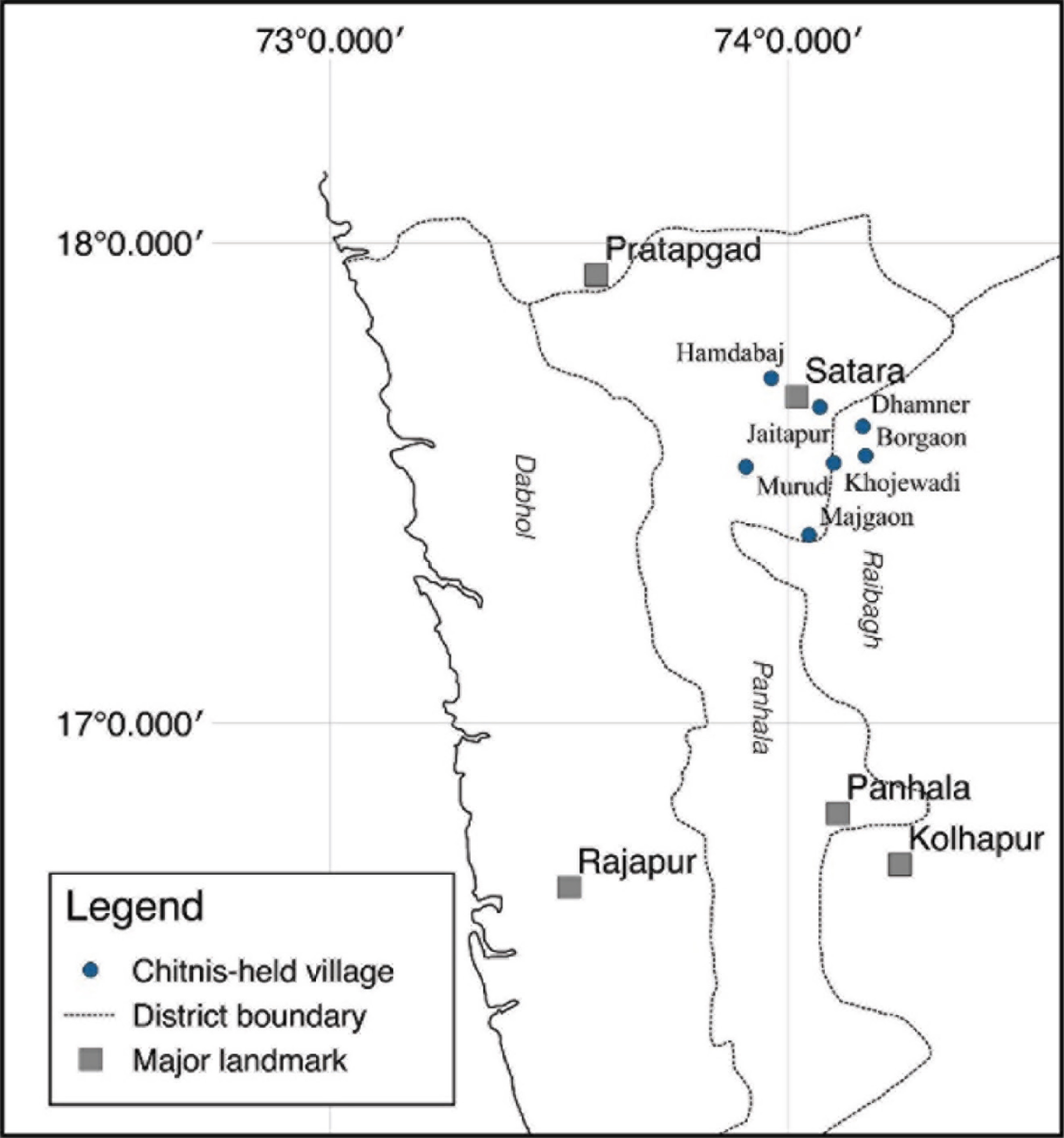
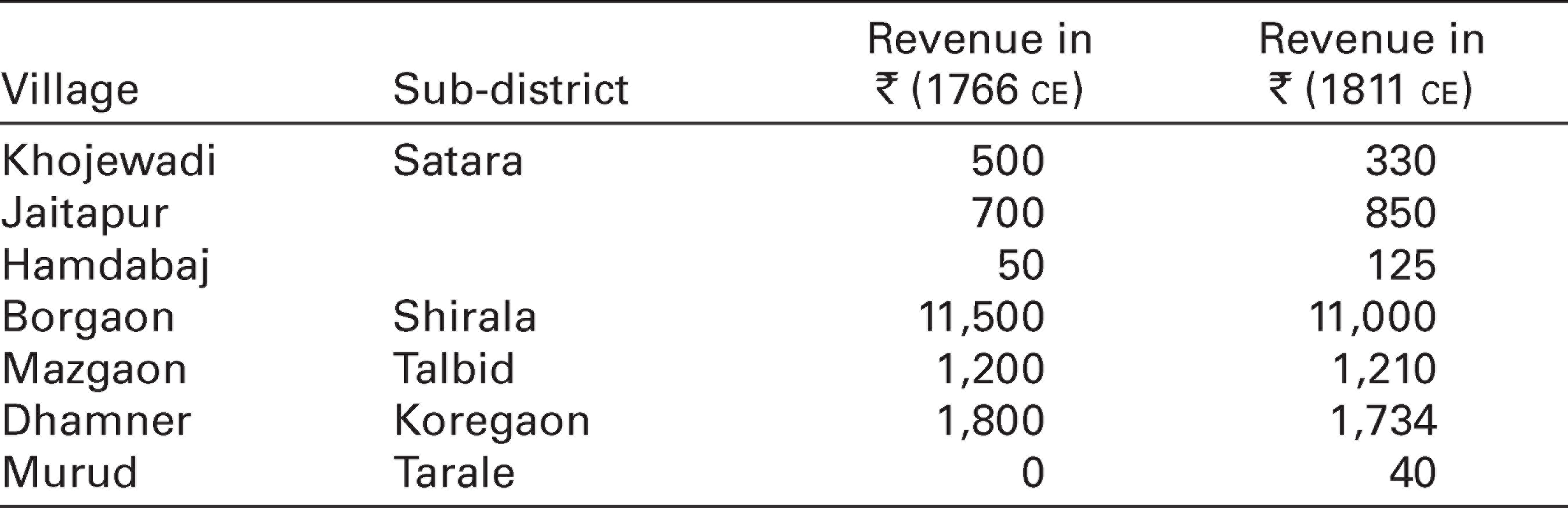
The value of the Chitnis financial portfolio fluctuated over time. According to a 1766 statement, it was worth an estimated total of ₹51,425. But given that this statement factored in losses incurred as a result of the civil war between the Pune and Nagpur governments, it is likely that its value was even higher. 76 Pre-assessment estimates for subsequent years ranged from approximately ₹75,000 to ₹100,000. 77 In addition to the sardeśmukhī revenues of Cheul, they were entitled to the nāḍgauḍī revenues of the old Mughal sarkār of Parnala (Panhala). 78 Nāḍgauḍa was a Kannada term for a landlord and district headman comparable to the deśmukh, and so the Chitnises’ claims in Cheul and Panhala were especially prestigious components of their revenue portfolio. 79 But it mainly consisted of prebendal rights to revenue classified as mokāsā or mokāsa-bābtī (and more occasionally as sarañjām). Most of these rights were located in villages in Panhala and Junnar sarkārs with a few scattered as far afield as Ratnagiri district in the Konkan and Chandwad district near Nashik; however, their most enduring rights were in a cluster of villages located between 17.3 and 17.7 degrees north and between 73.9 and 74.2 degrees east in the fertile tracts straddling the Krishna and Koyna rivers (see Figure 2 and Table 1). The most important of these villages was Borgaon, the seat of their main residence and revenue administration. 80
Revenue Projections of Select Chitnis-held Villages in 1766 and 1811 ce
As the Chitnises transformed themselves from modest salaried clerks to affluent landlords, they established local authority by offering patronage to Brahman priests and various religious mendicants, making provisions for village deities and ritual holidays, and resolving conflict between village officers. The family established a special donative relationship with the sect founded by the seventeenth-century saint and spiritual teacher Ramdas. 81 But their status as landlords depended upon their ability to address local needs. In 1795, the ascetic Bapujibuva Nigadikar received an endowment (dharmadāya) of four bighas near the fort of Santoshgad. 82 Jivaji Khanderao’s son Devrao in 1799 ordered the headman and accountant of Dhamner to reserve 25 bighas of land for the upkeep of Vitthala and Ramchandra idols in the village. 83 Beneficiaries of the Chitnises’ largesse called upon them to secure their possessions from the predations of village officials and the challenges of rival claimants. The family ordered the headman of Mazgaon in that same year to desist from imposing a ₹10 tax on the dharmadāya of a Brahman ritualist. 84 Although increasingly subject to the oversight of the Peshwa’s government, the Chitnises’ knowledge of the customary rights of village residents continued to hold weight in proprietary disputes. Take the case of Damodar Khirsagar, a headman of Dhamner who travelled to Pune in 1809 to lodge a complaint against the Peshwa’s tax collector for annulling his headmanship and associated perquisites, including a ₹60 salary, ₹50 robes, control over the labour of Mahar villagers, access to gardens and orchards, and ceremonial seniority during Holi festivities. When the collector could not produce any documents to justify his actions, the court summoned Balwantrao Malharrao Chitnis, who testified, ‘It has been nine or ten years since the village was detached from us; before that, it was in our possession for approximately one hundred years. At that time, Damodar’s forefathers were administering the headmanship’. 85 Further inquiries corroborated Chitnis’ account, and the headman was eventually reinstated.
To maintain and expand their authority at the local level, the Chitnis household relied upon their standing with Maratha rulers and their clients and followers. Senior male members of the Chitnis family were among the most honoured and influential participants in the social and political life of the Satara court. They made regular gifts to the Chhatrapati on the holiday of Vijayadashami (Dasara). 86 The names of Khando Ballal and one of his sons appear on a list of recipients of scarves and turbans on the occasion of the marriage of Fattesingh Bhonsle in 1719. Ganesh Rakhmagad, Khando’s sister’s husband, also appears on this list. 87 When Khando died in 1726, Ganesh Rakhmagad began to perform the ciṭnīs duties on behalf of his brother-in-law’s adolescent sons, allowing them to seek out new and different professional opportunities. 88 By the late 1740s, Govind Khanderao had become Shahu’s chief intermediary. Often working alongside the Kayastha potnīs Yashwantrao Mahadev, he negotiated partitions of revenue and territory with some of the most powerful fief-holders in the Maratha Empire.
The deals that Govind Khanderao successfully negotiated extended his personal, professional, and political network beyond the immediate orbit of the Satara court. In 1744, he secured part of the ransom for the upstart nawab Chanda Saheb who Fattesingh Bhonsle and the Nagpur raja Raghuji Bhonsle had captured during the Karnatak campaign of 1740–41. He obtained ₹100,000 for the ransom from a moneylender associated with Raghuji Bhonsle’s creditors Viswanathbhat and Balambhat Vaidya. 89 Two years later, he offered presents to Balambhat’s eldest son to celebrate his donning of the sacred-thread, reinforcing his relationship with this ambitious clan of merchant-moneylenders and diplomats. 90 Certain accounts also suggest that he advocated for the succession of Raghuji’s son to the Chhatrapati title. 91 Whether or not such speculations have any merit, it is clear that they remained in close confidence. 92 His efforts to maintain the relationship paid off when the Nagpur raja recruited his cousin Rakhmaji Ganesh—the son of the aforementioned Ganesh Rakhmagad—to serve as his ciṭnīs. Members of this subsidiary lineage, particularly the secretary-diplomat Krishnarao Madhav (d. 1803), carried out important missions on behalf of the Nagpur government. 93
Much to his own peril, Govind became more deeply involved in court politics as an agent of Peshwa Balaji Bajirao in the months leading up to Shahu’s death on 15 December 1749. He was perceived to be so partisan that the senior queen Sakwarbai threatened him with harsh punishments ‘up to and including Govind’s decapitation’. 94 Escaping this fate, it was reported on 28 April 1748 that when the royal household pleaded for money to liquidate their debts to the Peshwa, ‘Govindrao came, and after talk of their debt took place, they proffered a note indicating that they would pay it back’. 95 These discussions led to the finalisation of an agreement for the repayment of ₹2 million over the course of four years. 96 Around this time, Govind became involved in another set of negotiations—he and his frequent collaborator Yashwantrao Mahadev took the lead in demanding legal authorisation of the right of Kayasthas to perform Vedic rituals, which led to a major dispute with a Brahman faction in Satara. 97 Conventionally known as grāmaṇya, such disputes centrally concerned whether or not Kayasthas should be permitted access to Vedic recitations (vedokta) in their performance of core life-cycle rituals (saṃskārā), which in turn depended upon the question of whether they should be classified as Kshatriyas or Shudras in the varna hierarchy. In an 8 June 1749 judgment issued against them, it was suggested that they had persuaded many Brahman priests and court officials in the city to support their position ‘mainly through [their] wealth and business (bahutkarūn dravyadvārā va kārbhārāmuḷe)’. 98 While upwardly mobile Kayasthas’ efforts to improve their varna status continued to provoke vociferous opposition, their public advocacy for ritual change would have been impossible without the long-term investment that they had made in family-, caste-, and state-based networks of influence.
In one of his most consequential deals, Govind helped to prepare documents investing the Peshwa with the authority to govern in the name of the Chhatrapati’s heir, an arrangement that persisted for the remainder of Maratha rule.
99
The language of an order included in a published edition of Malhar Ramrao Chitnis’ bakhar is representative:
Order to the Honourable Balaji Pradhan Pandit [Balaji Bajirao]. You should secure the army…The Maharaja [Shahu] is in pain. He will not get well. The responsibility of government (rājyābhār) must be borne. My lineage should be seated [on the throne]. Do not act for that of Kolhapur [Sambhaji II]. [Whatever] is said to the ciṭnīs [Govind Khanderao] should be done. The king’s circle should operate according to the orders of who will [succeed]. The ciṭnīs is the master’s [Shahu’s] confidante. The kingdom will be protected by his and by your consideration.
100
In providing the requisite assurance to delegate the responsibility of government (rājyābhār), Govind took part in a complex process of political development typically associated with the rise of the Peshwa and the formation of a ‘Brahman raj’. But given the increasingly political responsibilities of Kayastha clerical households, the empowerment of the Peshwa should be understood as a contingent outcome, rather than a foregone conclusion of the transformation of the structure of authority in the Maratha state. 101
Govind’s position at Satara became more tenuous after the succession of Tarabai Bhonsle’s estranged grandson Ramraja. The new Chhatrapati was erratic and immoderate in his demands, importuning Govind and others for cash to meet his personal expenses.
102
In one especially dramatic episode during a hunting trip in early June 1750, the Chhatrapati cross-examined two passing soldiers, who reported that they had been sent by Govind to take control over the fort. Cursing and fighting with his attendants, he reportedly exclaimed, ‘The Brahmans and the Prabhus have become one, and a third—the Marathas—have joined with them. They have made a plaything of my kingdom’.
103
When Tarabai sought to replace him with Sambhaji II of Kolhapur, the Peshwa panicked: ‘If Sambhaji is brought to the fort, everything will be destroyed. The fort should be searched from top to bottom. Govindrao should carry out a full investigation’.
104
By November 1750, she had confined the Chhatrapati and re-initiated plans to punish Govind, who, fearing that he had lost the Peshwa’s favour, smuggled his family out of the city. In February of the following year, she attempted to take Satara by force, and in the ensuing battle, cannon fire struck his house. In an 8 February 1751 letter to the Peshwa’s brother, he lamented:
My master might think badly of me, but he should be confident. I am very dejected…Please give reassurance that a servant has no support in the three worlds without his master. I will behave in accordance with any order that I receive. If I am ordered to present myself, I will come. There is no trouble with us servants. Wherever my master places [me], and whatever service he demands, I will do.
105
Despite these entreaties, Govind’s reputation never fully recovered from the blows dealt to it by the chaos of a long and contested succession struggle.
The status and influence of the Chitnis household reached its zenith in the mid-eighteenth century with the remarkable ascendancy of Govind Khanderao from administration to politics. With the important exceptions of certain members of a junior branch at Pune and the Nagpur-based collateral relations who claimed descent from Ganesh Rakhmagad, the family’s role in politics diminished in the second half of the eighteenth century. To make matters worse, their property was confiscated in 1783. The orders of confiscation stated that they would be forgiven for their sedition and various other offences (phiturāce vagaire aparādha) once they paid a fine of ₹100,001. 106 But in 1788, the government circulated fresh orders to district officials to transfer their holdings to new revenue collectors on the basis of some unnamed transgression (amaryādā). 107 Worse still, a memorandum (yādī) indicates that because Ramrao Jivaji Chitnis had been part of a rebellion (banḍa), the revenue collection of the village of Borgaon had been re-assigned to the superintendent of Pratapgad fort in 1803. 108 Henceforth the Chitnises were only entitled to a portion of the revenue yield of their core rights, now termed vatanī amal sardeśmukhī va nāḍgauḍī, which amounted to a fraction of their former income. 109
The Chitnises continued to maintain a residence at Borgaon in a condition of noticeable penury while making every effort to regain their proprietary rights. In a 21 August 1805 letter, a pilgrim who stayed in the village for several days observed, ‘Narharirao [Balwantrao Malharrao], Malharrao Dada’s son, met me and took me to his home. He has a family that is in a very bad state. Malharrao is with me in Pune, petitioning for the release of his sarañjām and inām’. He also noticed that the village was depopulated. Many of the residents had fled to a nearby village, while others had flocked to temples to seek redress. Cultivation was at a standstill. The proximate cause of the depopulation was an insurrection in response to excessive revenue demands. 110 Amidst the Peshwa’s conflict with his southern feudatories and the royal house of Kolhapur, it seems that passing armies had imposed unwonted levies on the village. 111 By all accounts, the Chitnises espoused the position of its inhabitants, even whilst paying lip service to the government’s remonstrations against disrupting the orderly collection of taxes. In light of the difficulties plaguing the allied Maratha states in the early nineteenth century, the Chitnises, like many landed elite households in western and central India, focused on salvaging what remained of their local authority.
The rise and fall of the Chitnis family fortunes was swift, though perhaps not entirely unexpected. In a letter of condolence to the sons of Khando Ballal included in the Durj al-Gawāhar, the munshī Govindrao Nilkanth expressed high hopes for their future:
Writing of Govindrao to the sons of Khand Parbhu, citī-nawīs of the government of King Shahu…May his beautiful sons Jivba and Babuji [Bapuji?] expect to see the signs of happiness. May they be of good education and good breeding. May they act quickly and be able to speak eloquently in public and truthfully at the appropriate time, and may they read and speak well with understanding of the necessary sense and substance of things. In every occurrence, may they have the determination to strive freely and to promote dialogue in accordance with the situation and with measures both abstract and particular. May they have an alert mind, especially in works both sacred and worldly, and in all things foreign and familiar, may they have wise judgment and skill and compassion. With understanding of both external and internal, may they have so much prudence and sobriety.
More ominously, he warned that if one failed to escape the clutches of the demon of poverty (dev-i iflās), it would ‘lay waste to one’s talents (shamā’il-i khud ba-ghārat mīdahad), and clothed in the blanket of lunacy (gilīm-i junūn pūshīda), one would become an ignorant and confused hermit in the eyes of one’s kinsfolk (ba-naẓar-i aqwām ʿuẓla-nishīn-i ḥairānī wa nādānī mībāshad)’. 112 In auguring both the prospects and pitfalls of the Chitnises’ prosperity, Govindrao Nilkanth recognised that the mutability of the professional identity of multi-talented and ambitious clerical officials allowed for sudden changes in their access to social, economic, and political capital. Depending upon the resources, opportunities, and connections available to an individual member of such a household, they might choose from a repertoire of strategies for forging a path to success.
The (MIS)Representations of Raghunathrao Laxman Chitnis
The scribal household in popular memory is the dominion of its senior patriarchs, obscuring the fact that the household in early modern South Asia comprised natal, affinal, and collateral relations as well as ‘a range of dependencies’, including slaves, servants, disciples, and concubines. 113 Because the household’s portfolio was shared, it was both ‘shot through with conflict’ and ramified across multiple circuits of capital, goods, and labour. 114 While different members of the household had different degrees of access to its resources, even junior relations and senior women of the household held small parcels of land, maintained personal retinues, and offered patronage in exchange for services. Bayashri Chitnis, the wife of Govind Khanderao, held a small plot of land in Jaitapur worth about ₹27 ½ per year. 115 When she and her husband made a pilgrimage to Benares, their long-time priest Vamanbhat Sawade requested a permanent source of income to support his family. To that end, Ramrao Jivaji Chitnis in 1773 granted an inʿām in the priest’s name comprising eight bighas in Borgaon. 116 In this fashion, each member of the Chitnis household might become a node in an extended network of relations, friends, and associates.
Internal conflicts over control of household resources, and the strategies of self-advancement to which those conflicts gave rise, are central issues in two published Chitnis family histories. 117 The first account focuses on the financial and proprietary schisms that led to the creation of a separate branch at Pune, while the second chronicles the haphazard efforts of a junior relation to secure his patrimony. Several features of these narratives indicate that they are the product of lore, stories, and memories transmitted across generations. They employ affectionate nicknames, such as Appaji and Annaji for Khando Ballal and his less successful brother Nilo Ballal, as well as titles connoting affection and respect like kākī (father’s brother’s wife) and bābā (father or elder). Because they encompass marriage arrangements and other facets of intimate family life, they provide more details about women of the household than in the more well-known bakhar literature. For example, it is said that Balaji Avaji’s mother was called Rakhmabai and that she earned refuge for herself and her sons by performing her brother’s household labour (daḷākānḍā). 118 Occasional irruptions of the first-person voice—most evocatively in the recurring phrase ‘we heard (āmhī aikle)’—intimate the potential for partial and partisan representation of fact. The unusual qualities of these family histories make them excellent sources for understanding how conflict within the scribal household produced highly individual and ingenious strategies for advancing claims to property.
Although we are missing the introductory section of the narrative about the family’s later years, its author’s identity becomes clear when he writes, ‘I went to Nagpur for the wedding of [my] younger brother Rajeshwarrao. Then Govindrao Baba [Govind Khanderao] died. At the time of his death, my late father Laxmanrao Bhau (tīrtharūpa kailāsvāsī Laxmanrāva Bhāū āmce vaḍīl) was near’. 119 Moreover, the phrase ‘Handwriting [of] Raghunathrao Laxman himself (hasta akshara Raghunātharāva Lakshmaṇa khud)’, which was probably appended by the editor rather than the author, follows the concluding statement: ‘[I have] written the foregoing on the basis of the information that [I have] heard from the mouth of my father and that [I have] seen in the course of doing business’. 120 Based on these lines, we can surmise that the author was Raghunathrao Laxman Chitnis, the son of Laxmanrao Govind and the grandson of Govind Khanderao, and the date of composition was likely between 1795 and 1800.
Raghunathrao Laxman constructs the facts of his case in the mordantly defiant tone of a falsely accused supplicant, barely suppressing the righteous outrage that he must have felt at being denied a rightful share in his patrimony. Early on, he gestures towards his objections to the current state of household affairs:
I proceeded in accordance with what Raobava [Govind Khanderao] did. He will carry out whatever is in his self-interest (svārtha)…Govind [so] acted, saying that the patrimony (inām-vatane) has been allotted equally to the four brothers. The eldest’s share is different and separate from that of the fourfold distribution. So what must be said is said. He will do whatever is in his self-interest. Whether or not everyone agrees, there are a thousand family quarrels about giving and taking, and someone or other must take it upon himself to carry out his design. Such is his doing.
121
The four ‘brothers’ were the prospective heirs to the Chitnis fortune at the time of Govind Khanderao’s death: Ramrao Jivaji, Laxmanrao Govind, Khanderao Bapuji, and Baburao Khanderao. In 1767, these parties affixed their names to a memorandum (yādī) stating that out of an estimated ₹60,000 due to the family in land revenue, a special assignment of ₹15,000 would be set aside for the ciṭnīs title-holder, while the remaining ₹45,000 would be split into three and a half shares. 122 While even the basic distribution was manifestly unequal, Raghunathrao’s main objection was that his uncle Ramrao and cousin Malhar had reserved an additional portion for themselves. He demurs, ‘Three and a half shares were made and noted down. Whatever patrimony is and will be ought to be taken by the four brothers equally, and in that, there is no share for the ciṭnivīs’. Furthermore, he believed that his uncle and cousin were hypocritical in holding that whatever was expedient for them was right, but ‘whenever we say what is pleasing to us, they say we should not go beyond what Raosaheb [Govind Khanderao] has done. Is this right?’ 123 Convinced of his seniority in the Chitnis line, his uncle, so Raghunathrao alleges, felt alienated towards him and began to harbour outright malice (dvesha), but he refrained from acting on his feelings in their senior relation’s presence.
In recounting the major events of this period, he contextualises the government’s first sequestration of the Chitnises’ revenue holdings in 1783. In his view, the charge of ‘sedition and other offences (phiturāce vagaire aparādha)’ that we noted in the orders of sequestration was a pretext for punishing the family for its connection to Sakharam Hari, a Kayastha general and courtier allied with the disgraced Peshwa Raghunathrao ‘Dadasaheb’. It was believed that Hari had helped the latter arrange for the assassination of his nephew, Peshwa Narayanrao, in 1773. Three years later, he and his brother were jailed for sedition (phitūr), and the terms of their imprisonment included a prohibition against sending or receiving Kayastha clerks. 124 Raghunathrao does not clarify what role, if any, that his family had in these political machinations; rather, he simply asserts that his uncle Ramrao in his capacity as Hari’s son-in-law had stored his possessions while he was in prison. 125 Given that there are significant gaps and errors in his chronology, including a seven-year delay between Hari’s imprisonment and the sequestration, we should treat the particulars of his explanation with some caution. Still, it is worth considering more generally how his family’s loss of status, favour, and financial security, and their ongoing connections with networks of Kayastha officials, may have shaped the choices that he defended in this account.
Raghunathrao’s relationship with his uncle and cousin rapidly deteriorated. He describes how the seed of hostility (vāṅkaḍepaṇācī guñja) that Ramrao had first planted in his own mind grew into a full-blown mental disease (vikṛti), causing him to insist that all of their worldly affairs ought to be separated. 126 Raghunathrao was cut out of the administration of the family’s revenue holdings. ‘Before Ramrao and I would both manage the saran˜jām. Occasionally if he was not there, I would execute any and all business related to the saran˜jām. Such was the custom from the days of Raosaheb’, but after his grandfather’s death, he states, ‘He began to do everything as he liked. He set me aside’. Worse still, ‘the government clerks and administrators (daulatītīl kārkūn kārbhārī māṇse) began to give their attention to Ramrao, and my father’s administrator was lazy. He didn’t do anything that he ought to have done’. 127 At this critical juncture in the narrative, Raghunathrao abruptly returns to the scene of his grandfather’s death to relay the contents of two conversations in defence of the illicit course of action that he would eventually adopt.
The first conversation took place in Borgaon after Raghunathrao left Pune, where he had grown close to the Peshwa’s leading minister Nana Phadnavis. He objected to the distribution of the Chitnis patrimony in the following terms:
Why and on what basis have you created these shares? They have no relation to the ciṭnivīsī. Have you done what you ought to do? With all of us here, how can you have done what you ought to do with what Balajibava [Balaji Avaji], your and Jivajibuva’s [Jivaji Khanderao’s] grandfather, obtained? Ramrao’s steps do not look good. Even now, they are moving further and further astray. Out of respect for you, nothing has happened to any purpose. Yet it is clear from his conduct that later he will not allow me any place. You should attend to this and give me something. If this is not ok, then I will have to consider this, and this negotiation (jāb-sāl) will turn towards Pune, which ought not to be the case.
128
Govind’s response to this thinly veiled threat was equivocal. He validated his grandson’s concerns, but he also noted that Ramrao had required extra funds to support himself in the wake of his father’s untimely death. He urged caution until he could make arrangements to somehow rectify the balance in the distribution of the family’s assets. Virtually on his deathbed, he made good on this promise in a second meeting in which he furnished Raghunathrao with a letter of appointment (sanad) whose contents could be supported by documentary evidence (dākhlā) contained within the records of the former minister Ramchandra Nilkanth Amatya in Satara. He instructed, ‘Make whatever needs to be made. If Ramrao treats you well, then don’t make these efforts. If he doesn’t treat you well, then do make these efforts’. Here Raghunathrao shrewdly insinuates that his last-ditch efforts to obtain a piece of the family business were merely the execution of his grandfather’s last words.
Raghunathrao initially shared his complaints with an old, knowledgeable, and similarly disgruntled clerk, Avaji Bapuji Deshpande of the Maval region of Musekhore. Believing that ‘both sides ought to be of one view’, and that ‘their antagonism would be a disaster for the government’, the clerk drew up another memorandum (yād) to settle the dispute between the two sides of the family. 129 The clerk’s brother then re-drafted this document in the form of articles of agreement (kalambandī) with a closing statement (ekuṇāta) to the effect that all should act in accordance with the promises exchanged by Ramrao Jivaji and Govind Khanderao. Raghunathrao and his cousin Malhar affixed their handwriting somewhere on or above this statement to convey their acknowledgement of its binding power. Each retained copies of the agreement, and in fact, Raghunathrao adds that a second clerk was still in possession of his cousin’s copy. But after the elderly clerk died, Malhar dismissed the agreement out of hand, remarking, ‘My father Ramrao says, “Who is Avba [Avaji Bapuji]? Does a servant have the right to issue a yādī?”’ He scornfully declared that he would rather try his luck than submit to the will of a man as false as courtier (darbārī). 130
Having once again failed to settle his quarrel internally, Raghunathrao turned to more desperate measures. He sent his brother to Satara to enlist a scribe named Dada Bhikaji to meet with Sadashiv Anant Abhyankar, the right-hand man of Nana Phadnavis. Bhikaji explained to Abhyankar that Govind Khanderao had given an old sanad to Raghunathrao, one that had arranged for the appointment of an assistant to the head scribe (ciṭnivisīkaḍīl mutālikīcī sanad). Searching for evidence to support the existence of this position, Abhyankar acquired a document from the grandson of its author, a record-keeper in the majmū office. This document recorded the appointment of Ganesh Rakhmagad to an assistantship supported by the revenue of three and a half Chitnis-held villages. 131 With this document in hand, Abhyankar informed the Pune minister that Ramrao Jivaji had wrongly monopolised the portion of the Chitnis patrimony due to the scribe’s assistant and recommended that Raghunathrao’s father be appointed to the position. 132 It was settled that the requisite sanads, robes, and pen-case (kalamdān) should be issued once Raghunathrao found the means to pay a gift into the treasury. He contacted Parshuram Patwardhan, the chief of Miraj, whose cousin was responsible for revenue collection in Borgaon. Over the course of several meetings, it was settled that the Patwardhans would front the cash, and the Chitnises would provide surety by pledging the sanads and robes of office. Raghunathrao then forwarded a letter from the Patwardhans to his brother, who carried it to Abhyankar in Satara to retrieve the pledged items as well as a clerk to fetch the cash-gift. The final step in this dizzying chain of transactions was the circulation of copies of the sanads and letters from the Peshwa to Borgaon and the other Chitnis-held villages confirming the new office. 133
After enjoying his newfound success for a few years, Raghunathrao learned that his uncle told Nana Phadnavis that the assistantship had been granted on the basis of a misrepresentation (gairvākā). In the narrative, he contends that this complaint led to an inquiry in which his uncle was able to acquire a positive judgment by bribing his Pune circle of associates with money for court expenses. He pleaded for the inquiry to be re-opened, but everything came to a standstill when preparations began for the battle of Kharda of 1795. ‘In that confusion’, he reflects, ‘who is going to look after this negotiation (jāb-sāl)?’ 134 Once the main action subsided, his vakīl carried a letter urging further investigation to one Bajaba Shirwalkar to bring to the attention of Phadnavis. Apparently, their timing was fortuitous—just when they were presenting the letter, Phadnavis was holding the pen to write the date on sanads in Ramrao’s name. They received permission to look into the matter; however, the investigation came to an abrupt halt when the Peshwa died in October 1795. Raghunathrao closes the main narrative section by contrasting his straightened circumstances in Borgaon with his relations’ relative prosperity in Pune. He laments, ‘What will I eat? How will I live? So it has become incumbent on me to bide my time and seek my livelihood in another country’. 135 In the remainder of his account, he re-iterates his line’s historical claim on the Chitnis village revenues and condemns the selfish, deceitful behaviour of those who refused to acknowledge this claim. 136
The basic facts of this seemingly improbable tale can be corroborated. A letter dated 20 May 1793 from the Peshwa to the village of Borgaon refers to the re-allocation of Ganesh Rakhmagad’s scribal assistantship (mutālik lihiṇāra dimmat ciṭṇīs) and the full revenues of Borgaon, Khojewadi, and Varuda as well as half those of Karkhel to Laxmanrao Govind. 137 Two years later, on 24 July 1795, the Peshwa sent an order to the same village confirming that because Laxmanrao Govind had made a misrepresentation (gairvākā), Ramrao Jivaji should be reinstated in the office pursuant to his liquidation of Patwardhan’s loan. 138 Both documents state that the assistantship had been copied (nakal jāle), raising the question: should these events be regarded as a case of forgery or at least false documentation? The historian Gajanan Mehendale has shown through painstaking formal analysis that families quite commonly forged documents to support their claims to supposedly ancestral properties. 139 Yet the case in question demonstrates that even fabricated documents could refer to real precedent. As I discussed earlier, Ganesh Rakhmagad’s professional and familial connection with Govind Khanderao is attested in multiple sources. Moreover, two Shahu-period lists of villages assigned to the writer under the scribe (lihiṇār dimmat ciṭnisī) name Ganesh Rakhmagad as the recipient of revenue assignments in Khojewadi, Varuda, Karkhel, and Kololi. 140 So although Raghunathrao’s claim on Borgaon was probably specious, his supposition of the existence of an assistantship subsidised by revenue from Chitnis-held villages was true.
In light of the multifarious kinds of documents that Raghunathrao commissioned in his pursuit of justice, we ought to consider the fundamental indeterminacy of documentation within the epistemic regime of the bureaucratic world that he conjures. The sanad that he ‘forged’ in support of his appointment is merely one instance. Equally problematic was the memorandum with articles of agreement that he commissioned to resolve the dispute with his uncle. While this particular document was ultimately ineffective, the agreement was a key tool in the practice of dialogue and negotiation—collectively known as jāb-sāl (or, in Persian and Urdu, jawāb-suwāl)—that officials employed to resolve disputes in the diplomatic realm as well as in their own households. As Rosalind O’Hanlon suggests in this volume, mastery of these practices was key to the professional trajectories of vakīls working for Maratha governments. 141 At the same time, Raghunathrao’s narrative itself is an example of the type of family history of property that supported claims to entitlements and laid the foundations of Marathi bakhar literature. Although the East India Company state would seek to separate ‘authentic’ from ‘fabricated’ documents, narratives, and related sources of knowledge, they continued to be highly malleable in the hands of the scribes, clerks, administrators, and assistants who circulated within Maratha bureaucratic networks. 142
Conclusion
The Chitnises’ machinations to replenish their social, economic, and political capital appear all the more implausible in light of the eventual transformation of the South Asian political landscape wrought by the British East India Company. Yet Maratha governments at Pune, Satara, and Nagpur still tasked members of the Chitnis household with sensitive diplomatic missions, often in direct response to the problem of Company expansion. In January 1780 in the middle of the First Anglo-Maratha War (1775–82), Laxmanrao Govind Chitnis—well before the unfortunate events that his son set in motion—came to Surat on behalf of Nana Phadnavis to persuade the Bombay Council to agree to a set of demands. 143 Nevertheless, the prospects of the Pune- and Satara-based branches of the household appeared somewhat bleak at the moment of the Company’s removal of the last Peshwa Bajirao II and ‘restoration’ of the captive Chhatrapati Pratapsinha Bhonsle in 1818. Partly in hopes of attaining a better position under the new dispensation, Balwantrao Malharrao Chitnis represented Pratapsinha’s interests with the Company during the war. His efforts initially paid off: he became a trusted member of the Chhatrapati’s circle of intimates; he received land to build a residence in Shaniwar Peth in Satara; 144 and, most strikingly, his father was honoured with the title of paṇḍit sumant. 145 The title appears to have realised an existing notion within family lore that they had long been entitled to a spot on Shivaji’s fabled council of eight ministers. 146 It further permitted them to play a prominent role in the coronation ceremony. 147 But Balwantrao too fell prey to court factionalism—in 1837, he was imprisoned on suspicion of playing a role in effecting Pratapsinha’s loss of favour with the Company and deposition two years later on charges of sedition. 148
It was at one of several financial and professional nadirs that Malhar Ramrao Chitnis wrote bakhars about the deeds of the first four Chhatrapatis, the accomplishment for which the family is perhaps best known today. 149 Composed sometime between 1808 and 1812 and deemed of little value by James Grant Duff, the Company resident at Satara and author of A History of the Mahrattas (1826), these works became key sources of Maratha historical memory and, as part of the wider body of bakhar genre, objects of empiricist critique and analysis in the late-nineteenth and early-twentieth centuries. 150 The doyen of Maratha history V. K. Rajwade had serious doubts about the ‘historical veracity’ of the Chitnis bakhars. 151 Being an advocate of the view that the Maratha Empire reached its apotheosis under the Peshwa, Rajwade extended his reproach of Kayastha-authored histories to Kayasthas’ grāmaṇya quarrels with Brahmans. He suggested that ‘the political effects of these social disputes were strange and frightening’, citing Kayastha interventions in dynastic succession and encouragement of rulers’ antagonism towards Brahmans. 152 Contemporary histories authored by Kayastha scholars and caste associations, such as the Kāyastha Prabhūñcī Bakhar (1881–82) and Prabondhankar Thackeray’s Gramāṇyāñcā Sādyanta Itihāsa Arthāth Naukarshāhice Baṇḍa (1919), countered these charges against Kayasthas and re-asserted various brands of non- and anti-Brahman nationalist pride. Somewhat lost in these debates has been the complexity of the services that Kayastha households performed in the formative period of the Maratha state’s re-constitution and expansion.
While the case of the Satara Chitnises shows just how diverse the portfolios of Kayastha service households could be, it is worth concluding with a brief reflection on how their multi-faceted role in Maratha state-formation might contribute to understanding of the history of caste. On the one hand, the existence from the late seventeenth century onwards of something akin to a jati-based system of checks and balances in clerical recruitment enabled Kayastha households to establish a professional niche. Furthermore, as we have seen, the Chitnis household was able to convert competitive advantage into a clerical monopoly resulting in substantial benefits for their caste fellows. On the other hand, Brahmans too experienced upwardly mobility. Competition between Brahmans and Kayasthas for similar posts may have exacerbated disputes over Kayasthas’ changing ritual life, such as the one prosecuted by Govind Khanderao in 1749. Detailed studies of grāmaṇya disputes have shown that appeals to the Peshwa at Pune and wider networks of Brahman assemblies could result in new restrictions, such as Peshwa Narayanrao’s issuance of nine articles (nau kalamī) regulating Kayastha ritual practice, yet ‘political factionalism, lobbying, and individual efforts could also be instrumental in altering the course of justice’. 153 The orthodox Brahman position did not always win the day, in part because of the influence that Kayastha service households had acquired by the late eighteenth century. Therefore, the Chitnis household’s complex pathway from service to politics shows that structures of caste and kin with all of the ritual and domestic concerns that they entailed were not separable from forms of social, professional, and political mobility. Links between household, caste, and state, and between private and public life, were a double-edged sword in that they created opportunities for advancement but also set limits to this advancement through sometimes forceful re-instantiations of social dominance.
Inter-caste disputes are of course vital to any historical understanding of how society and the state interacted in eighteenth-century South Asia. But this article has suggested another kind of state-society linkage by exploring the broader constellation of relations between Kayastha scribal households and the Maratha state. In tracing the Chitnis household’s activities across clerical labour, military service, land-holding, diplomatic negotiation, and historical composition, I have suggested that compatibilities between different spheres of skilled work facilitated both social mobility and political development. Further research into the social and professional composition of Maratha governments in different regions and localities, and the forms of documentation employed by political professionals to manage relations between these governments, promises to elucidate the making and unmaking of polities in eighteenth-century South Asia.
Footnotes
Acknowledgements
For their assistance in developing the arguments here, I am grateful to the fellow participants in the Oxford Early Modern South Asia Project workshop held in Oxford in June 2017 on the subject of ‘Professions in Motion: Culture, Power, and the Politics of Mobility in Eighteenth-century India’. I am especially grateful to Rosalind O’Hanlon, Anand Venkatkrishnan, Richard Williams, Naveena Naqvi, Purnima Dhavan, Nandini Chatterjee, and the anonymous IESHR reviewer for their editorial assistance and helpful suggestions for revision.