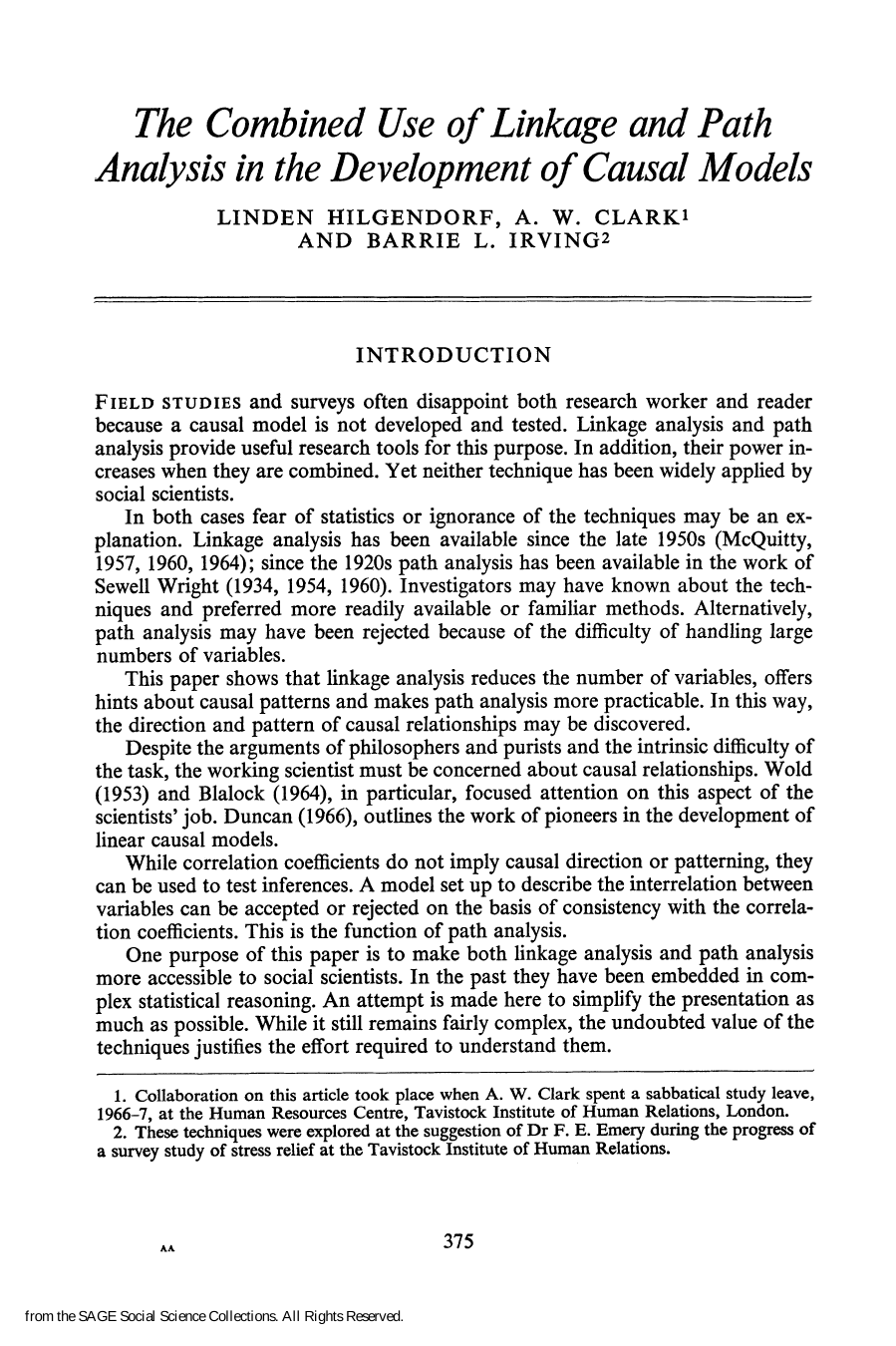
ASCH, SOLOMoN (1952). Socialpsychology. New York: Prentice Hall .
2.
BLALOCK, H. M. Jnr. (1964). Causal inferences in non-experimental research. Chapel Hill: University of N. Carolina Press .
3.
CLARK, A. W. (1967a). Conditions influencing patient response to treatment in a therapeutic community. In press. Soc. Sc. & Med.
4.
CLARK, A. W. (1967b). Patient participation and improvement in a therapeutic community . Hum. Relat.20, 3-3 .
5.
DUNCAN, O. D. (1966). Path analysis: Sociological examples . Amer. J. of Soc.72, 1-16 .
6.
McQuiTrr , Louis, L. (1957). Elementary linkage analysis for isolating orthogonal and oblique types and typal relevancies . Educ. Psychol. Meas.17, 207-229 .
7.
McQuirrr , LouIs, L. (1960). Hierarchical linkage analysis for the isolation of types . Educ. Psychol. Meas.20, 55-67 .
8.
McQuirrr , LouIs, L. (1964). Capabilities and improvement of linkage analysis as a clustering method . Educ. Psychol. Meas.24, 441-456 .
9.
WOLD, HERMAN & JUREEN, LARs (1953). Demand analysis. New York: Wiley .
10.
WRIGHr, S. (1934). The method of path coefficients . Annals of Math. Stat.5, 161-215 .
11.
WRIGHT, S. (1954). The interpretation of multivariate systems. In O. Kempthorne et al. (Eds.). Statistics and mathematics in biology. Ames: Iowa State College Press . Ch. 2.
12.
WMIUGR, S. (1960). Path coefficients and path regressions: Alternatives or complementary concepts . Biometrics, 16, 189-202 .