




Abstract
In contrast to the concept of craft, which is shaped by Western ontological assumptions connected to colonial logics, indigenous traditional modes of production (ITMP) arise from a distinct ontological worldview that guides how making is understood and practiced in indigenous communities. To move beyond colonial framings and advance Indigenous-grounded understandings of making, this systematic review draws on 47 empirical studies published in English and Spanish focused on ITMP in Indigenous communities across Abya Yala (Latin America). The review identifies three interrelated dimensions of ITMP: a kincentric paradigm that situates humans within nature, a reciprocal economy that renders making as an act of mutual exchange, and intergenerational matriarchal leadership through which knowledge and responsibility are transmitted. Together, these dimensions form a nested model that centers cultural continuity and renewal in making. Building on these insights, the review foregrounds ITMP as sovereign Indigenous lifeways rather than peripheral forms of craft, underscores the ethical imperative to center Indigenous voices and engage Indigenous epistemologies through respectful and reciprocal relations, and advances a decolonial conception of rigor when conducting a literature review.
Introduction
Craft, defined as an organized work based on the skillful manual production of goods (Kroezen et al., 2021), has been celebrated within Western discourse as a way to tackle the disenchantment of the world caused by modernity (Suddaby et al., 2017). Its potential to re-enchant modernity arises from how specialist producers draw on the symbolisms of handmade, small-scale production, human agency, and technical mastery to counter the dehumanizing effects of mass production and standardization (Ocejo, 2017). This strategic use of craft is evident in cultural industries such as winemaking (Beverland, 2005), beer brewing (Pozner et al., 2022), watchmaking (Oertel and Thommes, 2018), and cuisines (Schifeling and Demetry, 2021).
Despite the acknowledgment of the relationship between craft and modernity, less is known about how craft relates to coloniality, understood as ongoing colonial dynamics in modern society (Quijano, 1991). From a decolonial lens, modernity and coloniality are inseparable (Mignolo, 2011; Quijano, 1991), yet coloniality remains largely invisible in craft scholarship since Indigenous voices receive limited attention in mainstream journals (cf., Gasparin and Neyland, 2022; Zakrzewska et al., 2025). This neglect reflects the dominance of Western theoretical perspectives and empirical contexts in management and organization studies (MOS; Jammulamadaka et al., 2021; Wickert et al., 2024), which is a further manifestation of coloniality.
Therefore, decolonizing the concept of craft is crucial because its current framing imposes a colonial logic that fails to account for and erase Indigenous epistemologies of making. For example, while Western literature emphasizes understanding craft within the communities where it is practiced (Sennett, 2008), this perspective often fails to recognize how indigenous traditional modes of production (ITMP), a term we use to describe practices frequently labeled as “Indigenous craft” in Western frameworks, contribute to the resilience and resurgence of Indigenous communities.
Building on these insights, we ask: How do contemporary ITMP in Abya Yala express Indigenous-grounded understandings of making and, in doing so, reveal the colonial framings of craft? Following the critical orientation of Human Relations, we conducted a systematic literature review (SLR; Ogbonnaya and Brown, 2023) on ITMP within contemporary Indigenous communities in Abya Yala, a Kuna term meaning “mature land” that many Indigenous communities use to reclaim the territory commonly labeled “Latin America” in colonial discourse (Misoczky and Flores, 2012). Overall, we reviewed 47 empirical studies published in English and Spanish.
Our SLR reveals that ITMP emerge from sovereign Indigenous lifeways grounded in distinct ontological foundations, rather than functioning as alternative or supplementary forms of Western craft. These practices are shaped by a kincentric paradigm emphasizing land relationships, a reciprocal economy rooted in community-based exchange, and intergenerational matriarchal leadership based on knowledge transmission through women-led kinship networks. Together, these themes reflect Indigenous worldviews of relationality, reciprocity, and cyclical temporalities that fundamentally diverge from Western linear, human‑centered notions of craft oriented toward mastery, control, and commodification. By centering Indigenous knowledge systems, values, and modes of production, this review presents an ontological reframing of making that exposes and challenges the colonial assumptions embedded in MOS scholarship on craft.
Theoretical background
Decolonial theory
Decolonial theory, developed in the late 20th century from Latin American scholars, has made two crucial contributions to critical studies of colonialism and its enduring structures. First, it claims European modernity began with the 1492 conquest of the Americas, positioning modernity as inherently colonial and rooted in racialized practices (Banerjee, 2022; Bhambra, 2014). To capture this entanglement, Quijano (1991) introduced the concept of “coloniality of power,” often abbreviated as coloniality, a neologism that joins the terms “colonialism” and “modernity.” Unlike colonialism, which involved the presence of a colonial administration imposing its systems on the colonized, coloniality describes the persistence of colonial logics after formal independence (Grosfoguel, 2002). Second, decolonial theory advances decolonial thinking, which foregrounds ways of thinking, knowing, being, and doing that were marginalized or suppressed through colonial domination, particularly those rooted in Indigenous communities (Mignolo, 2011; Mignolo and Walsh, 2018). This endeavor opens the possibility of a “pluriverse”: a world in which multiple worlds, knowledge systems, and modes of existence can concur (Banerjee, 2022; Mignolo and Walsh, 2018). Thus, decolonial theory emerges as “the analytic task of unveiling the logic of coloniality and the prospective task of contributing to building a world in which many worlds will coexist” (Mignolo, 2011: 54).
Within the decolonial framework, the control of labor is a fundamental mechanism through which coloniality persists within the capitalist economy (Grosfoguel, 2006, 2007). Quijano (2000) argues that racial hierarchies were deliberately constructed to justify the enslavement and exploitation of Indigenous communities in the service of European capitalist accumulation. Land dispossession parallels labor exploitation, as colonialism involved the violent appropriation of Indigenous territories for European benefit (Rivera Cusicanqui, 1997; Tuck and Yang, 2012). These dynamics persist in contemporary global capitalism through extractivist and green colonial practices that continue to marginalize Indigenous and other marginalized communities (Ramirez et al., 2024). Underpinning these processes is a Western anthropocentric worldview that prioritizes humans over nature, reducing the latter to a resource for accumulation (Banerjee and Arjaliès, 2021). In contrast, decolonial thinking calls for reimagining relations with land beyond Western property frameworks. For example, the Indigenous concept of kincentricity frames territory as a living relative that warrants care, reciprocity, and respect rather than exploitation (Salmón, 2000).
Coloniality also manifests in the control of knowledge, often termed “coloniality of knowledge” (Maldonado-Torres, 2007). This control is tied to the geopolitics of knowledge, whereby knowledge produced in the North is imposed on the South, disconnecting colonized and Indigenous communities from their ways of being, knowing, and valuing (Grosfoguel, 2002; Mignolo, 2011). This dynamic extends beyond the Global North-South divide, as Indigenous communities are also present in the Global North. Accordingly, Mi’kmaq scholar and educator Battiste (2018) conceptualizes “cognitive imperialism” as the imposition of Western knowledge systems, values, and epistemologies as universal. Similarly, Sámi scholar Rauna Kuokkanen (2011) argues that epistemic ignorance is embedded in Western education and governance through the systemic exclusion and frequent dismissal of Indigenous knowledge systems. A key expression of Western epistemic dominance is the “dualist ontologies of liberal modernity” (Escobar, 2010: 4), in which Western thought frames human and nature, and past and future, as oppositional. In contrast, Indigenous ontologies are relational, emphasizing “that knowledge is circular and cyclical as well as socially and culturally constructed,” extending to kincentric relationships with nature (Salmón, 2000) and cyclical temporality, where past, present, and future are interconnected rather than strictly sequential (Bastien et al., 2023: 663).
While Quijano (1991) identified coloniality across the domains of economy, authority, knowledge, and sex, his framework largely naturalized gender, overlooking how colonialism imposed a specific gender system alongside racial and economic hierarchies. Addressing this gap, Lugones (2010, 2016) introduced the concept of the “coloniality of gender,” showing that colonialism did not simply exploit pre-existing gender systems but imposed a patriarchal and heteronormative order that intertwined race and gender to sustain domination. Patriarchy, a social and political order privileging male dominance and subordinating women and nonbinary identities, became embedded in the classed and racialized hierarchies within the capitalist economy, positioning White European masculinity as the standard of power, rationality, and civilization (Ballestrin, 2022; Walsh, 2016). As Lugones (2007, 2020) explains, the coloniality of gender operates through a “light side,” which ascribes gender to White heterosexual couples as men and women, and a “dark side,” which denies gender to colonized individuals, reducing them to males and females through dehumanization and animalization. Consequently, decolonial thinking entails supporting Indigenous efforts to reclaim gender practices and sexual autonomy, including the recognition of non-binary identities that persist despite colonial erasure.
Using decolonial theory as an analytical framework, the following section examines manifestations of coloniality in the craft literature within MOS, a field not insulated from colonial influence (Banerjee, 2022; Jammulamadaka et al., 2021). This analysis serves as a preliminary step toward considering how decolonial thinking can unsettle and reconfigure these colonial assumptions.
Coloniality in craft studies
Coloniality operates through an anthropocentric paradigm that positions profit maximization as the primary mode of relating to matter and the environment within craft practices (cf., Bell, 2025; Bell and Vachhani, 2020). In viticulture, for example, wineries recognize the limits of their control over natural factors (Voronov et al., 2013), yet instrumentalize terroir (i.e., the combination of natural factors like soil, climate, and topography that grants regional wine its distinctive qualities) as a marketing tool to authenticate products and maximize profit (Beverland, 2005; Massa et al., 2017; Smith Maguire, 2018). However, emerging scholarship in Western contexts is beginning to challenge this anthropocentrism by exploring more-than-human relationships. Examples include UK craft bakers engaging with microorganisms (Bell, 2025) and makers of bicycles, shoes, and hand-decorated pottery who work attentively with materials, considering their affective traces and emergent aesthetic qualities (Bell and Vachhani, 2020). Research in non-Western craft contexts further illuminates alternatives grounded in human-nature interdependence. For instance, Japanese sushi chefs follow seasonal almanacs and honor firstlings (Holt and Yutaka, 2018), and Hmong women practice sustainable indigo farming to dye textiles (Gasparin and Neyland, 2022).
Coloniality is also evident in the transactional economy, underpinned by capitalist logics that translate craft into commodity, narrow definitions of authenticity, and reinforce colonial hierarchies of value and legitimacy. For example, research on the wine and craft beer industries reveals that traditional production methods can coexist with modern technologies to enhance quality (Kroezen and Heugens, 2019; Massa et al., 2017). Yet, such innovations are frequently downplayed to preserve an image of authenticity detached from commercial interests (Beverland, 2005; Voronov et al., 2013), as craft is often portrayed in opposition to profit maximization (Solomon and Mathias, 2018). Large perfume companies, for instance, appropriate the creative innovations of artisanal perfumers, marketing products as handmade while avoiding the risks and responsibilities of genuine craft (Endrissat and Noppeney, 2018). Similarly, major beer corporations mimic craft beer aesthetics by acquiring established craft breweries, thereby commodifying and appropriating craft imaginaries for profit (Pozner et al., 2022).
Although most studies on craft do not explicitly address gender ideologies, scholars have criticized patriarchal language and proposed using “craftspeople” instead of the word “craftsman” (Kroezen et al., 2021) and “craftship” and “workship” instead of “craftmanship” and “workmanship” (Land et al., 2018; Waehning et al., 2018). This critique reflects a broader gendered division, in which craft as art has typically been associated with men, while craft as a hobby has been linked to women (Rippin and Vachhani, 2018). For example, Paxson (2013), as cited in Blundel (2018), traces cheese-making from a practical farm chore undertaken by colonial and pioneer women to a blue-collar occupation for rural men, and later to a 20th-century lifestyle and expressive pursuit adopted by professionals seeking to escape office-based careers, particularly those from urban or suburban backgrounds. Similarly, the craft beer industry remains male-dominated despite its historical association with women as early brewers due to their roles in food and beverage preparation (Land et al., 2018). This pattern reveals a patriarchal ideology in which crafts traditionally associated with women are appropriated and elevated by men, often in response to a perceived “crisis” of masculinity (Bell et al., 2018; Ocejo, 2017), while craftswomen are relegated to the status of hobbyists (Luckman and Andrew, 2018). However, this examination has focused primarily on Western contexts, limiting the understanding of the intersection between craft and gender beyond this perspective.
The coloniality of knowledge is reflected in linear notions of time that structure craft temporalities into past and future imaginaries that convey authenticity. Imaginaries of craft-in-the-past are marked by nostalgia and romanticism, framing craft as rooted in traditional making and an idealized preindustrial era to appeal to contemporary desires for authenticity (Bell et al., 2021). These imaginaries are expressed through the use of traditional production methods (Oertel and Thommes, 2018; Verhaal et al., 2015), small-batch production (Beck et al., 2019; Cruz et al., 2018), and narratives of heritage and history surrounding products or producers (Beverland, 2005; Toraldo et al., 2018). In contrast, future-oriented craft imaginaries emphasize creativity, openness to innovation, and the capacity to reshape the present and explore alternatives to dominant organizational forms (Bell et al., 2021). These imaginaries are expressed through experimentation (Endrissat and Noppeney, 2018; Slavich et al., 2020) and reinterpretation of traditions (Schifeling and Demetry, 2021; Zakrzewska et al., 2025). Together, these temporalities frame the past as a source of inspiration or something to transcend, and the future as the site of progress. Time is thus often imagined as linear and developmental, reinforcing a worldview in which tradition and innovation are sequenced rather than held in dialogue.
In sum, we identify three interlocking colonial dimensions in the MOS literature on craft: an anthropocentric paradigm, a transactional economy, and individualized patriarchal leadership, all underpinned by a linear temporality, as illustrated in Figure 1. Each dimension operates independently yet propels the others, revealing how coloniality is reproduced not only in Western craft practices but also in the production of knowledge about craft, where Indigenous voices remain largely absent (cf., Zakrzewska et al., 2025). To advance decolonial thinking grounded in Indigenous epistemologies, the following section outlines our SLR of ITMP in Abya Yala, drawing on journals beyond mainstream MOS outlets to surface diverse perspectives that challenge Western assumptions about craft.
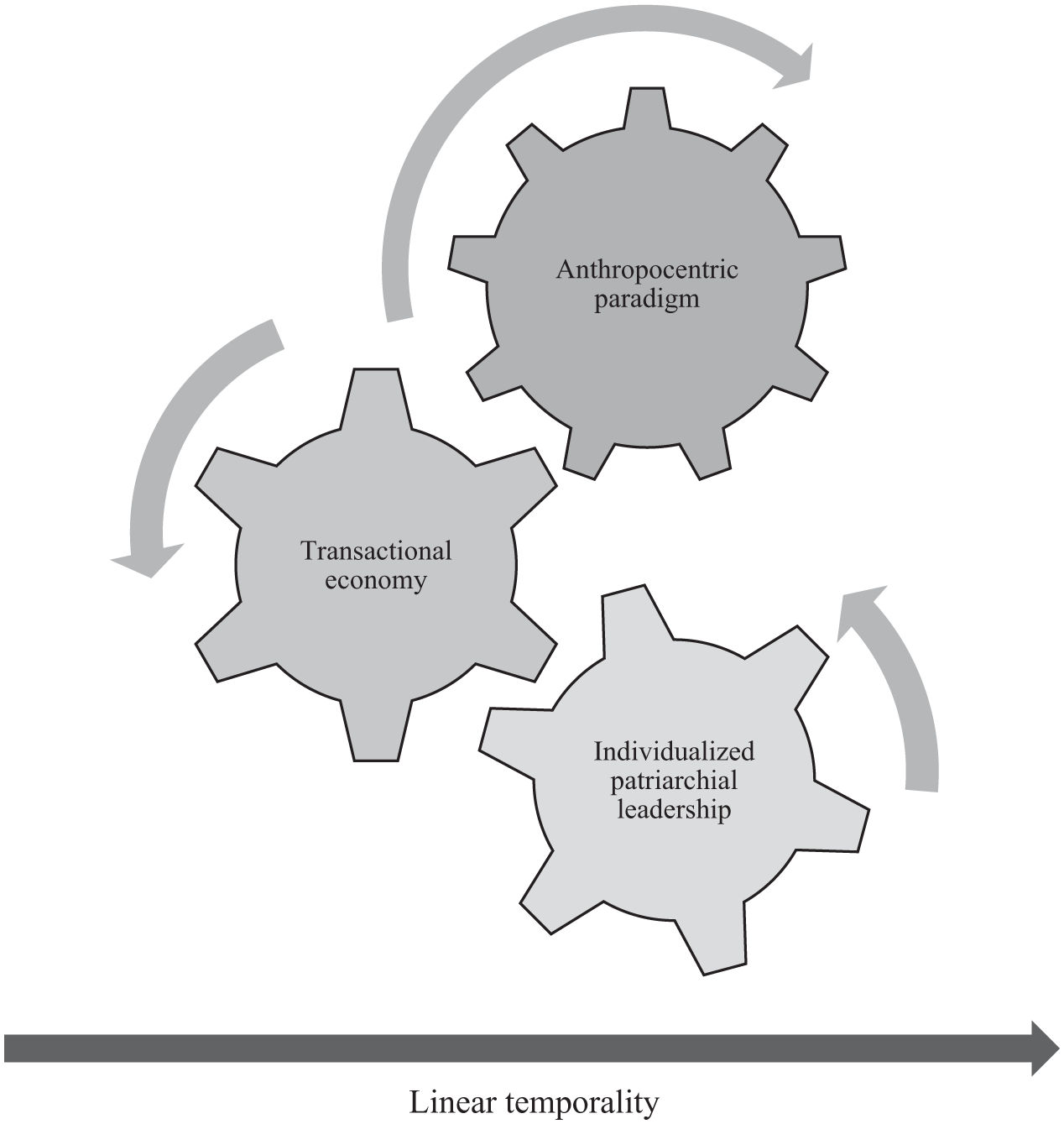
Dimensions of craft in the MOS literature.
Methodology
Self-location
The first author is a woman of color who was born in Lima, Peru, to a Polish father and a Peruvian mother. Due to her mixed heritage, she has navigated the complex dynamics of privilege and exclusion. She recognizes the advantages her European background afforded her, including reduced discrimination associated with her European surname and appearance, as well as the opportunity to pursue further education in Europe. Yet, she has also faced marginalization from Peru’s elites and witnessed persistent discrimination against people from the Andes and the Amazon in the capital. These experiences have shaped her awareness of her own privilege and fueled her commitment to challenging enduring colonial power structures.
The second author’s story begins in Wendake. He is a member of the Huron-Wendat First Nation. He and his family now reside on the traditional lands of the WSÁNEĆ Peoples. They are grateful for the opportunity to live and learn from those who have stewarded and protected the land on which they now reside since time immemorial. He has worked for, lived in, played, and developed relationships with many Indigenous Peoples and communities, which have all contributed to his learning journey. Within Western post-secondary institutions, he has observed a persistent struggle to decolonize and indigenize the academy in a meaningful way. For him, reconciliation entails a co-constructed, mutually beneficial path: one grounded in collaboration, transformation, and shared responsibility.
Data collection
This review examines ITMP in contemporary Indigenous communities in Abya Yala, a focus that is warranted for two main reasons. First, while a SLR on Indigenous communities globally could enable comparison, it also risks subsuming Indigenous communities under a universal narrative that obscures distinct colonial dynamics and lived realities. Second, although MOS research has extended beyond Western contexts (e.g., Gasparin and Neyland, 2022; Holt and Yutaka, 2018), it has left Abya Yala largely underexplored (cf., Zakrzewska et al., 2025), particularly with respect to Indigenous perspectives. This gap is particularly significant given that decolonial theory emerged from scholars in Abya Yala. Focusing on this region, therefore, enables an examination of how shared colonial histories have shaped ITMP while remaining aligned with the epistemological foundations of decolonial theory.
To initiate the SLR, the Preferred Reporting Items for Systematic Reviews and Meta-Analyses (PRISMA) protocol was adopted to ensure a methodical approach (Liberati et al., 2009; Shamseer et al., 2015). Although PRISMA originated in medical science, it has been widely used in MOS to enhance transparency and document the SLR search process (Bıçakcıoğlu-Peynirci, 2023; Knight and Parker, 2021). Consistent with this work, Figure 2 presents the four-step PRISMA process, detailed below.
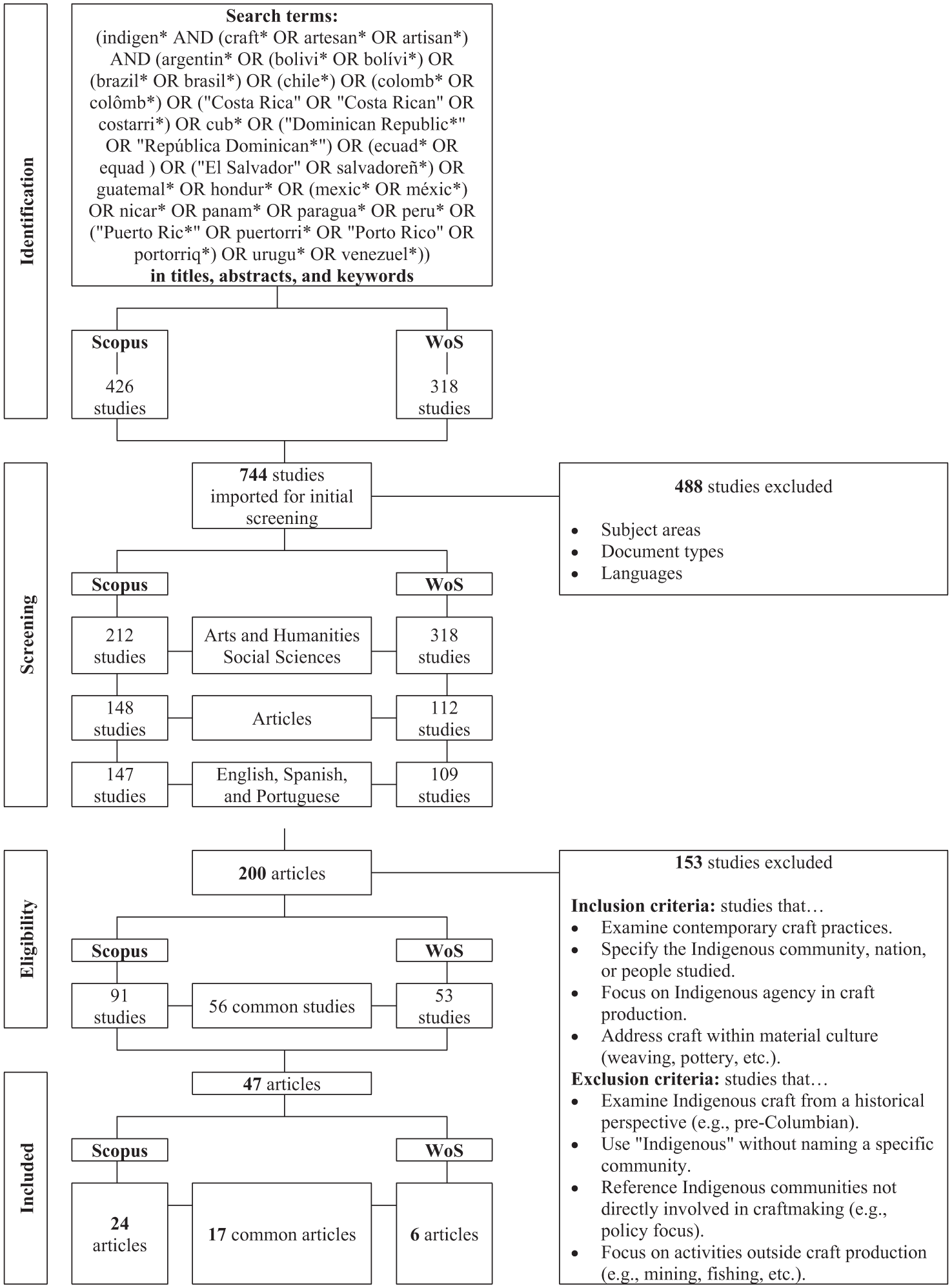
Summary of the search strategy and sampling process.
Following a database-driven approach (Hiebl, 2023), Scopus and Web of Science (WoS) were selected as the primary sources because of their broad disciplinary coverage, their inclusion of a multilingual body of scholarship, and their support for transparent and reproducible search strategies. The search string was developed using terms in English, Spanish, and Portuguese, the main languages spoken in Abya Yala. The term indigen* captured “indigenous” in English and its Spanish and Portuguese equivalent, indígena, reflecting the study’s focus on Indigenous communities. This term was combined with craft*, artisan*, and artesan* to capture words related to craft and artisan in English, and their equivalents in Spanish, artesanía, and Portuguese, artesanato. Although the Western concept of craft predates and obscures Indigenous ways of understanding making, it remains the dominant terminology within academic literature. Accordingly, craft and its Spanish and Portuguese variants were included to ensure comprehensive retrieval of relevant literature. However, the practices are analyzed as ITMP, a concept coined by the authors that is not indexed in databases and therefore does not appear in the search string. These terms were further intersected with variations of the names and demonyms of the 20 countries that constitute Abya Yala, using truncation and quotation marks. These variations were also searched across all three languages. This search led to 426 documents in Scopus and 318 in WoS.
These methodological choices reflect our commitment to decolonial scholarship. Rather than narrowing the review to English-language scholarship, we intentionally designed a search process that recognizes and values knowledge production across multiple linguistic and geographic contexts beyond dominant English-language publications (Lehman and Tienari, 2025; Murphy and Zhu, 2012). In doing so, we move beyond the sample-selection practices that dominate many SLR, which frequently rely on articles retrieved from Western outlets listed in ranking systems such as the Academic Journal Guide and the Financial Times Top 50 (Hiebl, 2023). Our approach instead affirms the importance of epistemic plurality, ensuring that the review engages with a wider spectrum of scholarship and avoids reproducing coloniality of knowledge.
During the screening stage, the search was refined to include: (1) research areas of Arts and Humanities and Social Sciences, 1 as other research areas (e.g., Medicine, Environmental Science, Physics, and the like) are not relevant to the focus of the SLR; (2) articles as document type, and (3) studies in English, Spanish, and Portuguese. This search yielded 147 articles in Scopus and 109 articles in WoS.
Next, all the articles were compiled into a single dataset, revealing 56 duplicate articles across Scopus and WoS, 91 articles unique to Scopus, and 53 unique to WoS. The resulting 200 articles were then assessed by reviewing titles and abstracts for alignment with the research question (Hiebl, 2023): How do contemporary ITMP in Abya Yala express Indigenous-grounded understandings of making and, in doing so, reveal the limits of colonial framings of craft?
To systematically identify relevant literature, both authors agreed on inclusion and exclusion criteria aligned with the research question. Initial screening was conducted by the first author, who is proficient in English and Spanish and can read Portuguese, allowing for the assessment of titles and abstracts across all sources. The second author did not participate in this stage, as he could assess only English-language sources. Articles lacking sufficient detail to determine eligibility were marked as ambiguous, retrieved in full for assessment against the criteria, and discussed jointly by both authors to determine final inclusion. This yielded 47 articles in English and Spanish. For transparency (Hiebl, 2023), the final sample is presented in the supplementary material.
We recognize that the included studies vary in depth, focus, and methodological detail. For example, some articles present a clearly defined methods section, while others embed methodological discussion within the text. A few are reflective pieces or essays (e.g., Calambás Soscué, 2014; Di Matteo, 2024), whereas others provide extensive ethnographic documentation, including photographs (e.g., Healy, 1992; Marks, 2015; Tiffany, 2004). Despite these differences in structure, content, and presentation, each study offers valuable insights into the Indigenous communities and making practices under discussion. Rather than viewing these differences as a measure of quality, we focus on how each study contributes to our understanding of ITMP.
Data analysis
The first author extracted key information from each study into a data spreadsheet, including (1) bibliographic details such as the year of publication, author(s), article title, publication outlet, language; (2) contextual information such as the name of the Indigenous community, geographical region, country, and type of craft; (3) methodological characteristics, with particular attention to data collection methods; (4) whether authorship included Indigenous researchers, based on the authors’ self-identification where reported; and (5) relevance to the research question, as determined through coding.
The coding procedure followed an interpretivist qualitative synthesis approach (Ogbonnaya and Brown, 2023). Both authors independently read a subset of 10 English-language articles to develop an initial understanding of key themes. They then compared interpretations, resolved discrepancies, agreed on final codes, clarified coding definitions, and refined the coding guide. For example, first-order codes such as “sourcing and cultivating local fibers,” “using plants for dyes,” and “working with locally available natural resources” were synthesized into the second-order code “integration of ecological knowledge into material practices.” Similarly, first-order codes such as “adapting techniques to plastic,” “using recycled materials,” and “keeping connections to land despite migration” were grouped under the second-order code of “adaptation of traditional ecological knowledge.” Drawing on his lived experience, the second author recognized that these codes reflected a kincentric paradigm in which humans and other-than-humans exist in reciprocal relationships of care, responsibility, and accountability. As a non-Indigenous researcher, the first author might not have identified this interpretation independently.
Our discussions also revealed themes associated with marketplace engagement. The first author initially interpreted codes on maintaining community-based craft traditions and codes about producing items for tourists as contradictory. The second author reframed these practices as part of a reciprocal economy, in which communities strategically blend reciprocal and relational economic principles with capitalist logics as an adaptive response to colonial histories and an assertion of their place in contemporary economies.
The authors also discussed how to categorize time-related codes. The first author proposed a separate dimension for cyclical temporality that encompassed multiple elements, including generational knowledge transmission. The second author, however, argued that cyclical temporality is transversal to the existing dimensions of kincentricity and reciprocal economy, and that generational knowledge transmission, particularly by women, should be analytically distinguished as its own dimension. Using the finalized coding guide, the first author reviewed all articles in the sample, including non-English sources that the second author could not assess, to examine gendered divisions of labor. This led to the identification of codes on women’s roles in cultural continuity and leadership, synthesized as intergenerational matriarchal leadership, which the second author viewed as central to both existing dimensions, with cyclical temporality intersecting all three through its role in sustaining cultural continuity.
Results
Kincentric paradigm
Kincentricity, a worldview common among Indigenous cultures, understands humans and nature as members of an extended family, emphasizing the interconnectedness of all living beings (Salmón, 2000). In Abya Yala, this relationship with the natural world underpins the continuity of ITMP across time and space. ITMP are not limited to material production but reflect sustained stewardship of the natural world, a self-determined responsibility maintained by Indigenous communities since time immemorial. These practices constitute acts of care as well as reservoirs of knowledge grounded in distinct Indigenous cosmologies and worldviews.
Kincentric practices are embodied in ITMP through the sourcing, cultivation, and transformation of materials from local environments, integrating ecological knowledge throughout production processes (Ariza Porras and Marfil Carmona, 2024; Carruthers, 2001). For example, Zapotec weavers and their families forage local plants to create natural dyes for wool, including tropical fruit zapote for brown, bougainvillea flowers for pink, and vines for yellow (Tiffany, 2004). The Hñähñu harvest maguey plants for their fiber, which is used in the production of traditional textiles, such as ayates (textile pieces; Reyes-Samilpa et al., 2020), while the Arhuaco use the same plant to produce mochilas (knapsacks; Castelblanco Pérez, 2021, 2022). The Warao semi-cultivate the ohidu palm (Mauritia flexuosa) for hammock weaving (Sørhaug, 2021) while a Quechua-speaking artisan uses tonewoods from the Peruvian lowlands to create musical instruments (Tucker, 2016). The Jiw sustainably harvest cumare (Astrocaryum aculeatum) fibers by marking harvested palms, signaling that they should be spared to allow regeneration in the following year (Ariza Porras and Marfil Carmona, 2024). Maya Yokot’an groups rely primarily on solar energy for drying materials, while some also draw on lunar cycles, tied to beliefs associated with the goddess Ix Bolón, to soften materials like fibers and wood (Yanes Pérez and Vera Cortés, 2025)
Kincentricity also materializes in ITMP through symbolic designs that encode ecological and cosmological relationships. Among the Tsotil, woven symbols articulate an ordered relationship between nature and the cosmos, representing community, life, sky, earth, water, and fertility (Del Carpio, 2012). Similarly, the Nasa’s cuetandera (handcrafted pouch) carries spiritual and communal meaning, with rainbow colors and triangular motifs symbolizing mountains, unity, and resilience (Castelblanco Pérez, 2021, 2022). For the Mayans, weaving is sacred, as garments weave together time, space, and mythology through symbols tied to identity and cosmovision (Albarrán González, 2023; Cone, 1995). The Kuna’s molas (colorful hand-sewn textile panels) depict nature, rituals, and cosmology, preserving sergan (ancestral designs) as a form of cultural resistance and reaffirmation of their identity in the face of modernity (Alves Da Silva and Ortiz, 2022; Marks, 2015). Kichwa Chibuleo clothing reflects their cosmovision, with floral embroidery symbolizing Pachamama (Mother Earth) and white sombreros representing Killa Mama (Mother Moon; Pinos Montenegro et al., 2022). Jaiq’a axsus (overskirts) depict khurus, enigmatic animals shown in chaotic free fall that may represent chulpas, primal beings from Andean oral traditions believed to have existed before the dawn of time (Healy, 1992).
Spiritual practices further embed ITMP in relationships that view land as animate, agentic, and authoritative, guiding human responsibilities, ethical conduct, and production practice. For example, the Ye’kuana seek permission from the “owners” (i.e., “invisible” forces to which plants, animals, objects, and places belong) before harvesting materials for baskets, following rituals that link the physical and spiritual worlds (Caputo Jaffé, 2018). Similarly, the Nasa ask permission from the spirits to cut, scrape, and make threads from the cabuya plant for their textiles (Castelblanco Pérez, 2021). The Lenca honor earth spirits inhabiting natural elements through composturas (offerings) or pago a la tierra (payment to the earth) when extracting clay to restore resources used in pottery (Toombs, 2023; Tucker, 2010). According to Laklãnõ belief, rainbows reveal the location of clay “cooked” by their presence, making it ideal for pottery, and before collecting it, Laklãnõ people would sing to and seek permission from nature spirits, taking only what was needed to maintain spiritual balance (Machado et al., 2020). In the Chipihuayco community, hills and mountains are revered as living, sentient, and guardian beings, and honored through annual libation rituals (Avila and Echenique, 2024).
However, ongoing colonial pressures increasingly threaten these relationships, sometimes resulting in disengagement from traditional ecological knowledge (Carruthers, 2001). For example, to meet market demands and obtain a greater quantity of fibers in less time for the vueltiao hat, the traditional bleaching process, which involved cooking fibers with cañagria (Costus laevis) and air-drying them, has been replaced by peroxide treatment, while criolla fibers, valued for their quality, are being phased out in favor of faster-growing alternatives (Babativa Chirivi et al., 2024). The Arhuaco’s mochilas, traditionally produced with maguey fibers and neutral wool tones (gray, black, white, brown), increasingly feature brighter colors as locally sourced materials are replaced by processed threads from external markets (Castelblanco Pérez, 2021). Similarly, Zapotec weavers widely adopted synthetic dyes in the late 20th century due to cost and color intensity (Davenport, 2007), while the Kichwa Chibuleo artisans have shifted toward cheaper alternatives and materials, replacing the chumbi (girdle used as a belt) with a leather strap, the coral-and-gold washca (choker) with plastic beads, and the cabuya-fiber shigra (handbag) with ones made mostly of synthetic wool (Pinos Montenegro et al., 2022). Qom artisans who migrate and cannot access traditional resources adapt by using industrial materials (Voscoboinik, 2025).
In other cases, colonization and migration have prompted adaptive and hybrid ITMP that sustain cultural ties and land-based relationships. For instance, Wounaan women who migrate to urban areas continue to care for the land by adapting traditional techniques to new materials, such as plastic (Osorio Iregui, 2020). Wichí and Qom women work with recycled plastic and discarded fabric (Perret, 2020), and the Warao incorporate plastic into the creation of hauanona (small baskets traditionally woven from ohidu palm fibers; Sørhaug, 2021). The Purépecha have replaced Southern bulrush with invasive southern cattail for general weaving, showcasing their adaptability and sustainable approach for ITMP (Maldonado and Voeks, 2021). Maya Yokot’an groups integrate electric energy for tools, lighting, and machines such as sewing machines or woodcutters while maintaining Indigenous knowledge systems (Yanes Pérez and Vera Cortés, 2025).
Indigenous communities also use ITMP to honor and maintain relationships with the land in the face of (voluntary or involuntary) migration to urban areas. For instance, Wounaan women strive to recreate a sense of home through traditional basket weaving, using familiar techniques and materials to evoke memories of their former home (Osorio Iregui, 2020). Similarly, Sateré-Mawé migrants sustain their bond with the land by returning to their homes to collect seeds or cultivating native species such as pucá in urban spaces (Sertã, 2022).
Reciprocal economy
In Abya Yala, ITMP reflect processes of cultural continuity, spiritual well-being, and reciprocal relationships with the natural world. While these practices are not fully subsumed within capitalist economies, they are increasingly intertwined. This growing entanglement subjects ITMP to pressures of commodification and exchange, reshaping how they are produced, circulated, and valued. As a result, ITMP undergo transformations that generate persistent tensions between reciprocity and transaction, cultural preservation and adaptation, and tradition and commodification.
Reciprocity manifests in an ethos that prioritizes cooperation over competition in the production and circulation of ITMP. Rather than maximizing individual profit, artisans commonly engage in collaborative practices such as knowledge sharing and mutual support, reinforcing social bonds and collective well-being. These practices blur the separation between work and personal life and challenge the division of working hours and individual environment, which are characteristic of an industrial model (Babativa Chirivi et al., 2024). For instance, the Chipihuayco (Avila and Echenique, 2024), the Zapotec (Lira et al., 2022; O’Connell, 2021), and the Lenca (Tucker, 2010) maintain community-based ownership of the land and its resources. Put differently, these communities collect raw materials for ITMP, and when ready to be sold, they prioritize the community’s profitability over individual gain (O’Connell, 2021). In Otavalo’s market, vendors collectively enhance cultural symbols and commercial reputations, fostering a shared identity that attracts customers and sustains the market’s appeal (Colloredo-Mansfeld and Antrosio, 2009). Among the Warao, hammock weaving fosters kinship ties and enables economic participation for women, while canoe building plays a similar role for men (Sørhaug, 2021). Despite migration, the Qom continue to engage in ITMP to secure livelihoods, maintain reciprocity, and transmit cultural knowledge across generations, thereby supporting cultural continuity and guiding youth away from harmful influences associated with modern urban life, such as drugs (Voscoboinik, 2025).
This reciprocal ethos also shapes interactions with consumers, collaborators, and support networks. For example, a Zapotec weaver enacts reciprocity by educating consumers about the value of natural dyes through handouts, demonstrations, and week-long classes, thereby distinguishing his work from cheaper synthetic alternatives (Davenport, 2007). A Nukak woman named Rosa demonstrates traditional dyeing techniques to tourists by carrying an achiote (annatto), a stone used for coloring cumare fibers woven into manillas (bracelets; Ariza Porras and Marfil Carmona, 2024). Educators from the Royal College of Art and Universidade de Brasília partnered with the Munduruku people to create an online village library that allows for sharing craft knowledge and stories within the community and beyond (Triggs et al., 2025). Similarly, long-term collaborations between indigenous artisans in Oaxaca and Stockholm-based artists blended traditional skills with new media to support economic sustainability and cultural preservation (Becker and Brečević, 2014). Grassroots organizations such as Antropólogos del Sur Andino (Anthropologists of the Southern Andes) worked with the Jalq’a to facilitate the revival of weaving traditions through workshops where traditional rituals were necessary, such as the inaugural ceremony involving an aysiri (shaman) who called upon and spoke through Mallkus (mountain deities) to bless the project and reinforce the importance of conserving Jalq’a culture and promoting cooperation (Healy, 1992).
At the same time, engagement with markets can reproduce capitalist transactional dynamics. Collaborations aimed at increasing market reach often result in exploitation and cultural appropriation (Albarrán González, 2023; Flores Morales and Flores Montes, 2022; Healy, 1992). For instance, intermediaries frequently capture disproportionate profits from Indigenous artisans, as observed in Tsotsil communities (Bayona Escat, 2020). Moreover, these agents often prioritize consumer demands and marketable aesthetics over authentic cultural practices, distorting Indigenous identities. Wichí women, for instance, are encouraged to modify colors in their symbolic yica bags, deviating from traditional white chaguar fiber, but discouraged from substituting wool when lacking chaguar as it is not part of their culture (Perret, 2020, 2022). Similarly, state-driven tourism narratives distort Lenca identity by promoting invented traditions, such as new textile practices, over ancestral practices like pottery (Toombs, 2023). Moreover, instances of cultural appropriation occur when companies brand Indigenous products, such as Zapotec mezcal, under their own names (Lira et al., 2022).
To counteract exploitation and navigate colonial market dynamics, Indigenous communities have developed cooperatives that emphasize solidarity and collective action (Alves Da Silva and Ortiz, 2022). For example, Zapotec women formed cooperatives to disrupt merchant control in the local textile economy (Carruthers, 2001; Cohen, 2001; Stephen, 2005). Lenca pottery cooperatives organize sales and establish financial safety nets through strong social networks, compensating for the limited support from the state and non-governmental organizations (NGOs; Toombs, 2023).
Negotiating between reciprocal values and market demands often requires adapting while preserving cultural expressions to appeal to diverse audiences (Caputo Jaffé, 2018; Castelblanco Pérez, 2022). For example, Sateré-Mawé women vary necklace designs depending on the audience: vibrant, dyed designs for urban buyers, natural tones for international markets, and black pucá seed necklaces for their community, which hold protective and identity-marking significance (Sertã, 2022). Similarly, Kuna women adapt molas for tourism by simplifying designs (e.g., less detailed approach and the use of pastel rather than warm colors) and incorporating Western motifs (e.g., from comics, brand logos, and pop culture elements; Alves Da Silva and Ortiz, 2022; Marks, 2015). The Ye’kuana have adapted wïwas by incorporating Western and mythical elements, transforming them into both a key source of income and a medium for reinterpreting traditional myths (Caputo Jaffé, 2018, 2020). Zenú hat-makers have adjusted production techniques to meet the aesthetic expectations of buyers by stitching pre-braided strips together (“sin pega”) instead of weaving one continuous spiral (“con pega”), resulting in more symmetrical hats (Babativa Chirivi et al., 2024). Likewise, many Lenca potters are increasingly adopting non-traditional methods like molds to increase commercial appeal (Toombs, 2023). Other communities diversify their product ranges while retaining traditional techniques. For example, Kichwa Otavaleño weavers have expanded beyond ponchos (Colloredo-Mansfeld and Antrosio, 2009), and Tukano artisans, who apply traditional weaving techniques to new items such as glass cords and dog leashes (Ariza Porras and Marfil Carmona, 2024).
Against this backdrop, Nasa artist Calambás Soscué (2014) critiques the commodification of Indigenous art within the tourism market, arguing that it reduces culturally significant objects to decorative souvenirs stripped of their original meaning. For example, Náhuatl artisan women often regard embroidery as employment rather than cultural expression, and although the National Indigenist Institute program sought to reverse this, it instead encouraged market-oriented production that fetishized identity and obscured labor conditions (Flores Morales and Flores Montes, 2022). Similar dynamics are observed among Quechua and Aymara women in Bolivia, who create products and designs that often conceal their ethnic origin or cultural traditions, prioritizing market appeal over cultural continuity (Stenn, 2013). For the Nukak, crafts that once held daily and ritual significance now circulate primarily as commodities for survival (Ariza Porras and Marfil Carmona, 2024). Therefore, Calambás Soscué (2014) argues that Indigenous artists bear responsibility for safeguarding the cultural integrity and depth of their work.
Intergenerational matriarchal leadership
In Abya Yala, intergenerational matriarchal systems of labor organization shape the production of ITMP. These systems position women as primary producers as well as central agents in the transmission of knowledge and practices across generations. They also reflect longstanding gendered divisions of labor structured through heterarchical relations that emphasize complementarity over dominance. Intergenerational matriarchal leadership contrasts with labor configurations more commonly observed in Western contexts, where gendered roles often follow hierarchical models. However, the incorporation of ITMP into capitalist frameworks has introduced complex dynamics, at times constraining women’s autonomy or mobility, and at other times enabling the renegotiation of traditional roles and labor arrangements.
Although the intergenerational gendered organization of ITMP takes varied forms across communities in Abya Yala, they foreground women’s leadership in production and transmission. For example, in the Iku (Arhuaco), women are taught traditional crafts and prepared for spiritual and communal roles through cancurbas, their Indigenous wisdom schools (Castelblanco Pérez, 2022). In the Lenca community, women produce most pottery and remain at home after childbirth to work and care for children, while men and later older children undertake sales trips (Tucker, 2010). Purhépecha women are responsible for the production and commercialization of costura (traditional, embroidered, and crocheted linens and garments; Nelson, 2006). Notably, the intergenerational gendered organization of ITMP is not limited to binary gender roles. In the Zapotec community, the Muxe (assigned male at birth but embracing traditionally feminine roles such as childcare, cooking, and cleaning), recognized as a third gender, often specialize in textile crafts such as embroidery and the production of huipiles (sleeveless tunics; Di Matteo, 2024).
Women also serve as key transmitters of ancestral kincentric knowledge and skills, safeguarding these cultural traditions for future generations (e.g., Bayona Escat, 2020; Tiffany, 2004; Triggs et al., 2025). For example, Arhuaco narratives recount how Naboba, the first woman, left knitted mochilas as a model for her descendants, ensuring cultural continuity (Castelblanco Pérez, 2021). Older Arhuaco women, especially grandmothers, play a central role in teaching young girls how to identify maguey plants, extract fiber, and knit mochilas (Caputo Jaffé, 2018). A Tsotil artisan expressed that through her work, she remembers past generations and feels that “[b]ordar es heredar lo que mis padres y mis abuelitos son” (“embroidery is inheriting what my parents and grandparents are”; Del Carpio, 2012: 194). Laklãnõ elder Verônica Mõkónã recalls learning ceramics from her grandmother during childhood (Machado et al., 2020). In the Lenca community, girls begin assisting their mothers at an early age by learning to select clay, form shapes, and support tempering processes (Tucker, 2010). These patterns differ across contexts, as in the Purhépecha community, where men traditionally weave using wetland vegetation, while women engage more directly with market exchange (Maldonado and Voeks, 2021).
Historically, many Indigenous communities have organized labor through complementary rather than strictly hierarchical gender roles. Among the Ye’kuana, men extract and process minñatö (liana) and weave baskets used in food processing, while women prepare the food contained in these baskets and produce distinct wïwa baskets for the tourism market (Caputo Jaffé, 2018). Among the Warao, both genders gather palm leaves for hammock making; however, men cut trees and build hawaka (hammock looms), while women process the fibers and weave hammocks (Sørhaug, 2021). Lenca men traditionally gathered resources and transported goods while women made pottery, though men now increasingly participate in production when economically advantageous (Toombs, 2023; Tucker, 2010). In the Laklãnõ community, women often work with seeds and feathers to create items such as necklaces, while men more commonly shape wooden objects, including bows and arrows (Machado et al., 2020). In Zapotec mezcal production, men handle planting, harvesting, crushing, and distillation, while women support by weeding agave fields, assisting in distillation, and cooking for workers (Lira et al., 2022). In Oaxaca, women typically paint and gild indoors, while men perform carpentry in courtyards (Becker and Brečević, 2014). Among the Jalq’a, men contribute to domestic and spinning tasks to complement women’s increased focus on weaving production (Healy, 1992). Among the Munduruku, men primarily undertake basket weaving and braiding, women focus on utilitarian basketry and domestic crafts, and both genders collaborate in the production of tucumã seed necklaces (Triggs et al., 2025). These examples illustrate gender-specific yet interdependent roles within artisanal and subsistence economies.
Nevertheless, the participation of Indigenous communities in the market economy has produced mixed outcomes for gender roles in the division of labor, yielding both opportunities and challenges. In some cases, market participation has enabled women to renegotiate traditional roles and assume new forms of leadership (Cone, 1995; Marks, 2015). Among Mixtec communities, for instance, women’s economic independence through ITMP has enhanced their decision-making power, while men have assumed more domestic and childcare responsibilities (de la Paz Hernández Girón et al., 2004). Sateré-Mawé women have gained political influence in urban contexts by leading organizations centered on ITMP, challenging the traditionally male ideal of the tuxaua (chief; Sertã, 2022). Women-led cooperatives have also played a transformative role. Maya Yokot’an women in Tabasco formed the artisanal group Las Mariposas (The Butterflies) to contest restrictive gender norms that confined them to the home, enabling them to gain autonomy and pursue entrepreneurial goals (Yanes Pérez and Vera Cortés, 2025). Lenca pottery cooperatives pool resources and expand markets, increasing women’s control over income (Tucker, 2010). Moreover, engagement in ITMP provides essential economic support for families, as seen in the cases of the Muxe (Di Matteo, 2024) and the Wichí and Qom (Perret, 2020).
Conversely, other cases illustrate how market engagement has reinforced or reshaped gender roles in ways that limit women’s autonomy or mobility (Carruthers, 2001). Among the Emberá, women once farmed alongside their husbands but now focus more on domestic responsibilities, while their weaving serves as either a supplemental or primary source of income (Colin, 2013). Purhépechan women face criticism from their husbands when traveling to sell their costuras, as their mobility and public interactions spark gossip, risking their reputations (Nelson, 2006). Institutional assumptions and practices further complicate these patterns. For example, NGOs supporting Indigenous tourism often pay men, assuming they control household decisions, instead of compensating women directly for their work (Henshall Momsen, 2002).
Discussion
The findings of our SLR identify kincentricity, reciprocal economies, and intergenerational matriarchal leadership as key dimensions through which ITMP function as alternate realities to Western assumptions about craft work. Although presented separately, these themes are interconnected and collectively reflect Indigenous epistemologies of being, doing, knowing, and relating. Figure 3 illustrates this interconnectedness through a nested model of ITMP, where permeable boundaries, shown as dotted lines, represent the interplay among these dimensions. The nested dimensions also demonstrate how a cyclical sense of time sustains cultural continuity, linking the kincentric worldview, reciprocal economy, and intergenerational matriarchal leadership. Each dimension provides a space to enact culture through ancestral relationships with land, relational economic practices, and intergenerational transfer of knowledge and responsibility. Together, these dimensions relate to each other as a circular and nested process connecting past, present, and future.
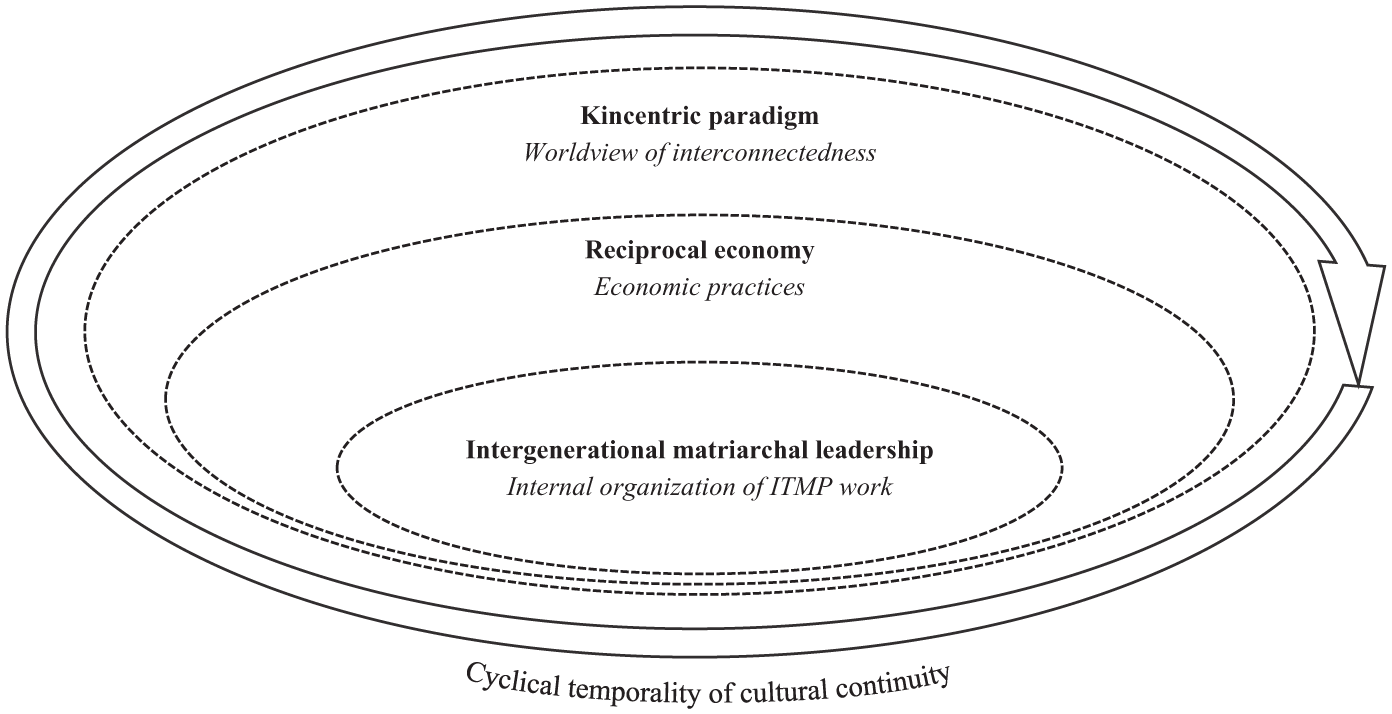
Nested dimensions of ITMP.
Nested ITMP model
Our proposed nested ITMP model asserts that, in the outer nest, kincentricity fundamentally shapes ITMP production. This worldview emphasizes a profound connection to the land, reflected in the respectful harvesting of materials regarded as living relatives that embody spirit and history and in the incorporation of natural elements into the material forms of ITMP. The very act of making becomes an engagement with kin, a continuation of ancestral practices, and a dialogue with the natural world that provides the resources. Cultural continuity is sustained through the relational accountability embedded in acts of sourcing, weaving, carving, or dyeing in relation to land and place, which in themselves can be considered active cyclical processes of cultural regeneration. As the findings show, even in cases where colonial dynamics have compelled Indigenous communities to adopt materials and techniques, they continue to strive to maintain their cultural and ecological ties (Osorio Iregui, 2020; Sertã, 2022).
In the middle nest, reciprocal economy captures how kincentricity intersects with market dynamics. Here, ITMP extend beyond economic activity to express reciprocity rather than mere profit maximization (Ariza Porras and Marfil Carmona, 2024; Caputo Jaffé, 2018, 2020; Sertã, 2022). That is, ITMP are not treated as isolated commodities but circulate through networks that reinforce community cohesion. While Western marketplace economies have created opportunities for Indigenous communities in Abya Yala to market their ITMP for their own benefit, these reciprocal economies also face colonial challenges such as cultural appropriation, commodification, and marginalization within dominant capitalist markets (Bayona Escat, 2020; Lira et al., 2022; Perret, 2020, 2022). Even so, ITMP prioritize relational balance over accumulation, transforming exchange into a means of cultural continuity rather than assimilation.
In the inner nest, intergenerational matriarchal leadership reflects the lived organization and production of ITMP within Indigenous communities. This leadership style is both gendered and generational, involving elders and youth in teaching and learning processes that sustain ITMP while reinforcing kinship ties to land, community, and ancestors through embodied practice and governance (Tiffany, 2004; Triggs et al., 2025; Tucker, 2010). Thus, the making of ITMP is an act of matriarchal resistance, ensuring that skills, stories, and sovereignty persist across generations despite colonial erasure. Rather than a linear succession, this can be better understood as a cyclical transmission where knowledge returns, grows, and adapts, driven by relational accountability through time and kinship responsibilities to place.
Ultimately, the model presents a framework for understanding ITMP in Abya Yala. Far from static cultural artifacts or mere economic commodities, ITMP represent tangible expressions of ancestral wisdom, ecological responsibility, and community cohesion, demonstrating how Indigenous communities continue to embody and adapt their values in a changing world. The cyclical temporality surrounding all nests in Figure 3 represents the temporal dimension of cultural continuity, situating ITMP within ongoing processes of renewal.
Decolonizing craft
Our findings contribute to efforts to decolonize craft by foregrounding Indigenous epistemologies of being, doing, knowing, and relating as alternate realities that challenge Western understandings of craft work. To begin with, the concept of “craft” itself is a Western construct that often lacks relevance to Indigenous communities. Within Western assumptions, craft is framed through dichotomies such as large-scale versus small-scale production, machine-centered versus human-centered work, maximization versus customization, and local versus global orientations. However, such categories do not apply to ITMP, which instead reflect distinct traditions, cultures, worldviews, and pre- and postcolonial experiences. Thus, decolonizing craft requires questioning these taken-for-granted dominant paradigms and emphasizing the importance of place-based Indigenous knowledges.
In the outer nest, kincentricity challenges Western anthropocentric paradigms that prioritize humanity over the natural world and treat nature as a resource for exploitation or commodification (Topa and Narvaez, 2022). For example, in their literature review on craft, Kroezen et al. (2021) emphasize the importance of human control and intention in craft work. In contrast, ITMP are grounded in a relational ontology in which the natural world is animate, has agency, and is spiritually significant. In other words, ITMP extend beyond human cognition to exist in direct experience with other-than-human beings, recognizing the natural world as a source of tangible knowledge and guidance. In considering kincentricity, this review presents a worldview where materials are understood as living and interconnected beings, beyond a purely utilitarian or aesthetic appreciation of craft, requiring respectful engagement and reciprocal relationships, which have only recently begun to receive attention in Western contexts (e.g., Bell and Vachhani, 2020; Vachhani, 2013). Rather than assigning economic value to nature, ITMP understand the natural world as an interconnected web of significance that sustains practice while being sustained in return. This enduring sense of place and space across time positions human beings and the work they perform as one dimension within the broader complexity of life (Salmón, 2000).
In the middle nest, a relational economy challenges the Western capitalist logics centered on human dominance and extractive profit by rejecting colonial principles of accumulation, competition, and profit maximization in favor of ecological and relational interdependence. In the capitalist economy, the value of crafted objects is largely determined by market price and production efficiency. In contrast, a relational economy emphasizes ITMP as a vital means through which Indigenous communities assert cultural identity and resist the erosion of their traditions. The importance of cultural continuity and, in some cases, cultural resurgence (i.e., challenging and disrupting colonial oppression to embark on a journey of cultural revitalization and political sovereignty, Corntassel, 2012; Simpson, 2011) is important to ITMP. While Indigenous communities can engage in ITMP within Western market frameworks, they also use these practices to navigate contemporary colonial conditions while sustaining traditional lifeways. In doing so, they interweave multiple temporalities and responsibilities that challenge linear capitalist logic. ITMP transmit and reinforce cultural identity and knowledge through embodied experiences, sustaining culture through doing and sharing values across physical, mental, and spiritual dimensions. As such, ITMP enact cultural continuity and resurgence through practice rather than functioning merely as heritage preservation.
In the inner nest, intergenerational matriarchal leadership challenges hierarchical and often patriarchal organizational forms prevalent in Western craft (Lugones, 2013; Waehning et al., 2018). ITMP link past, present, and future in a circular ontology of time in which the engagement in work contributes to cultural well-being through rematriation (i.e., restoring a living culture to its rightful place on Mother Earth, see Newcomb, 1995; Price et al., 2025). This form of leadership actively decolonizes scholarship by legitimizing forms of expertise, leadership, and knowledge transmission that defy Western patriarchal and institutional norms. It reclaims Indigenous women’s agency in shaping material culture and challenges their historical marginalization in academic accounts of craft, thereby expanding our understanding of who creates knowledge and how craft practices sustain it. Many Indigenous communities in Abya Yala had matriarchal or matrilineal structures before colonization, and many still do (Caputo Jaffé, 2018; Castelblanco Pérez, 2021; Del Carpio, 2012). ITMP sustain and, in some cases, revitalize these structures by reclaiming land-based responsibilities and re-centering them through women’s ongoing engagement in making practices.
Scholars should therefore avoid reducing the epistemic framing of ITMP to analytical categories constructed through Western theoretical lenses: ITMP are not expressions of nostalgic longing (Bell et al., 2021), residual artifacts of the past (Lamertz et al., 2016), strategic resistance (Tweedie and Holley, 2016), or counter-narratives to the alienation of modern labor (Bozkurt and Lara Cohen, 2019). Instead, they emerge from a relational ontology grounded in intergenerational transmission, land-based knowledge, and community-specific worldviews. These practices are not static but continually reinvented, ensuring the vitality of future generations. ITMP are not commodities with fixed endpoints but living place-based collaborations that constitute Indigenous futurities rooted in cultural, political, and spiritual regeneration. While Western market economies have created opportunities for Indigenous communities in Abya Yala to commercialize their products, ITMP extend beyond economic activity, constituting expressions of cultural continuity embedded in ecological and community-based reciprocity and, thus, serving as a vital means of resisting cultural erasure.
Moreover, while recent scholarship on craft has drawn from diverse critical traditions such as feminist materialism and posthumanism (Bell, 2025), frameworks of resistance (Tweedie and Holley, 2016), and explorations of the emotional and relational dimensions of craft (Bozkurt and Lara Cohen, 2019), these perspectives remain limited in their ability to comprehend the ontological rupture that ITMP represent. ITMP are neither acts of opposition nor counter-narratives to Western paradigms of mass production. Instead, they emerge from fundamentally different ontological foundations, grounded in Indigenous cosmologies of relationality and reciprocity that challenge the foundational assumptions of Western thought. ITMP do not critique modernity from within but regenerate worlds through Indigenous ways of being, doing, knowing, and relating. In this sense, ITMP are not simply “craft” interpreted through critical theory but sovereign lifeways that assert Indigenous presence and continuity beyond the confines of Western academic or economic categories.
Building on these insights, the visual models in Figures 1 and 3 function as conceptual mirrors of two contrasting worlds, representing distinct ontological orders rather than analytical frameworks. Moving from Figures 1 toward 3 marks a shift from a human-centered worldview to a kincentric one, from a transactional to a reciprocal economy, and from an individualized and patriarchal form of organizing to a collective and matriarchal orientation. Moreover, while Figure 1 is progress-oriented and linear, Figure 3 is continuity-oriented and cyclical, embodying an Indigenous understanding of time and renewal. From this perspective, temporality is not about leaving the past behind in pursuit of a better future, but about living in a relation with place, culture, and the natural world so that knowledge and practice reflect the intergenerational and cyclical nature of life itself. These cycles are evident in the changing seasons, lunar rhythms, and recurring practices of planting and harvesting, among many others. If Western craft production unfolds along a straight line, ITMP emerge through cycles of renewal that privilege cultural continuity over progression, emphasizing connection rather than forward movement.
Further considerations for future research
Throughout this research, we identified that only two of the articles in the sample about ITMP were authored by or in collaboration with Indigenous scholars (Calambás Soscué, 2014; Machado et al., 2020). This finding points to a broader systemic issue: Indigenous authors remain significantly underrepresented in academic research, particularly in research concerning Indigenous communities. Prioritizing Indigenous voices is therefore essential to ensure scholarship is ethical, accurate, and contextually grounded (e.g., Bastien et al., 2023; Maher and Loncopán, 2024; Price et al., 2025; Ramirez et al., 2024). This shift is essential to move from extractive research about Indigenous communities toward relational research with them (Bothello and Bonfim, 2025). Engaging with Indigenous scholars beyond MOS is one example of a cross-disciplinary approach that can challenge Western scientific silos and enrich understanding. Crucially, genuine engagement with Indigenous worldviews cannot occur without Indigenous voices at the center.
Moreover, researchers cannot adequately derive ITMP from research conducted about Indigenous communities for non-Indigenous audiences and articulated through Western assumptions of craft, labor, or entrepreneurship. While attempts to bridge Western craft concepts with Indigenous worldviews may appear productive, they risk misappropriation. Indigenous epistemologies are grounded in spiritual, relational, and land-based ways of knowing that long predate, and fundamentally diverge from, Western assumptions of craft. These knowledge systems have not merely been excluded from Western frameworks but have been actively dismissed, devalued, or co-opted through colonial processes of knowledge extraction and erasure. Interpreting Indigenous realities through Western theoretical lenses reduces living dynamic worldviews to static categories, reinforcing hierarchies of knowledge that privilege Western perspectives. Meaningful engagement with Indigenous realities, therefore, goes beyond analyzing colonial aftermaths and requires respectful and reciprocal commitment to Indigenous worldviews, openness to unlearning, and humility to be guided by those whose knowledges have withstood centuries of attempted erasure.
Finally, our review contributes to the methodological development of SLR by demonstrating how decolonial principles can reshape both review practices and the very notion of rigor. Instead of treating English-language publications in highly ranked Western journals as a neutral benchmark of quality (Lehman and Tienari, 2025), we reconceptualize rigor as the deliberate inclusion of diverse knowledge traditions, languages, and epistemic contexts. This approach challenges the coloniality of knowledge and interrupts forms of epistemic erasure (Banerjee, 2022) that have historically marginalized Indigenous and non-Western scholarship. Our SLR shows that methodological robustness and epistemic plurality are not competing commitments: alongside following the PRISMA protocol to ensure transparency, we intentionally included scholarship that remains structurally marginalized and reflected on how the self-locations of the Indigenous and non-Indigenous authors influenced every stage of the review. Thus, we offer this approach as a transferable framework for scholars who wish to conduct literature reviews that are methodologically systematic while remaining critically attentive to power, language, and the geopolitics of knowledge production.
Conclusion
Through our SLR, we call for a more inclusive and grounded understanding of craft that moves beyond Western notions of disenchantment and rationality by centering Indigenous models rooted in kincentricity, relationality, and intergenerational matriarchal leadership. ITMP embody ancestral knowledges anchored in specific territories and transmitted intergenerationally through kinship with the natural and spiritual world. Unlike Western craft, they are not reducible to creative outputs or commodified expressions of cultural resilience, but constitute systems of responsibility, ceremonial acts of reciprocity, and living expressions of Indigenous worldviews. They enact cyclical relationships between past, present, and future, offering pathways for healing, resurgence, and self-determination. While Western temporality positions the past as something to overcome, ITMP understand it as a living presence that must be continually renewed through practice, highlighting the need for greater scholarly attention to cyclical temporalities in future MOS research.
Taken together, these insights invite MOS to reimagine “organization” as a relational process that includes land, ancestors, and future generations. This shift transforms both craft scholarship and the ethical foundations of organizational research, moving from explaining to accompanying, and from theorizing about to learning with Indigenous communities. In doing so, MOS scholars can engage in the decolonial work by supporting Indigenous-led resurgence and studying not only how work is organized but how life is sustained, while exposing the epistemic limits of Western theorizing.
Supplemental Material
sj-xlsx-1-hum-10.1177_00187267261437673 – Supplemental material for Decolonizing craft: A systematic literature review of indigenous traditional modes of production in Abya Yala
Supplemental material, sj-xlsx-1-hum-10.1177_00187267261437673 for Decolonizing craft: A systematic literature review of indigenous traditional modes of production in Abya Yala by Belinda Zakrzewska and François Bastien in Human Relations
Footnotes
Acknowledgements
The authors thank the Associate Editor Helena Liu and the reviewers for their thoughtful guidance throughout the review process. We are also grateful to Nilay Bıçakcıoğlu-Peynirci; the members of the Marketing and Consumption Group at the University of Bristol, the Write Club at the University of Sussex Business School, and the Interdisciplinary Authenticity Group; and participants in the AOM 2024 PDW “Craft & Organizations” and the EGOS 2025 subtheme “Reimagining Craft: New Discourses on Creativity and Change” for the insightful feedback received on earlier drafts of this manuscript.
Funding
The authors received no financial support for the research, authorship, and/or publication of this article.
AI usage declaration
The authors acknowledge that they have followed Human Relations’ AI policy. Accordingly, AI was used only for copy editing or proofing the manuscript.

Supplemental material
Supplemental material for this article is available online.
Notes
References
Supplementary Material
Please find the following supplemental material available below.
For Open Access articles published under a Creative Commons License, all supplemental material carries the same license as the article it is associated with.
For non-Open Access articles published, all supplemental material carries a non-exclusive license, and permission requests for re-use of supplemental material or any part of supplemental material shall be sent directly to the copyright owner as specified in the copyright notice associated with the article.
