



Abstract
This study investigates how disparities in access to telework arrangements within organizations influence collective outcomes. By incorporating social identity with justice theories, we develop a conceptual model and hypothesize that greater dispersion in organizational telework access correlates with diminished organizational performance, primarily due to its association with lower collective positive affective tone. However, we argue that collective organizational identification can mitigate this negative impact. Our empirical analysis, leveraging a multisource dataset of 26,783 employees across 186 companies, substantiates this model. These findings advocate for the importance of intra-organizational variation of telework access in enriching our understanding of both the advantages and disadvantages associated with this prevalent work modality.
Introduction
The COVID-19 pandemic instigated an abrupt and significant transition to remote work, catalyzing an upward trend that had already begun in numerous developed economies (Felstead and Henseke, 2017). Since then, the persistence of telework (i.e., when employees perform their job outside their primary workplace for at least part of their working hours; Gajendran and Harrison, 2007) has varied widely across countries, sectors, and organizations, with many organizations opting for hybrid arrangements for at least some employees. As such, there is a wide variety of access to telework, even within organizations (e.g., Barrero et al., 2023; Williams et al., 2021). Our research was motivated by this real-world variability in telework access, or what we call organizational telework access dispersion within organizations.
Existing research on telework predominantly focuses on its positive outcomes for both employees and organizations (e.g., Baltes et al., 1999; Gajendran and Harrison, 2007; Onken-Menke et al., 2018). While these individual-level insights are valuable, they neglect the broader social context in which employees operate. This gap is critical, as the dynamics of teamwork, social comparisons, and interpersonal interactions within organizations significantly shape workforce experiences (Ashforth and Mael, 1989; Dineen et al., 2007; Salancik and Pfeffer, 1978). In response to this limitation, we contribute to a growing body of literature that emphasizes the importance of the social context in understanding the implications of telework (e.g., Golden, 2007; Maier et al., 2022; Van der Lippe and Lippényi, 2020). By doing so, we deepen our understanding of how telework can enhance or deplete how employees collectively feel and perform at work. Specifically, our work is guided by this research question: How does variation in organizational telework access dispersion affect collective affective and performance-related outcomes and under what condition are the potential downsides of such unequal access mitigated? We investigate this question by examining a multisource dataset that comprises responses from 26,783 employees across 186 companies.
This study makes three main contributions to the literature. First, we introduce, for the first time, the construct of organizational telework access dispersion, 1 a term that we define as the extent to which individuals within an organization differ in their ability to work flexibly away from the organization’s premises. Drawing on Chan’s (1998) dispersion composition model, we suggest that low levels of dispersion indicate scenarios where nearly all employees can telework or very few have this option, while higher levels of dispersion reflect significant within-organization variability in the telework access afforded to employees. The distinction between an organization’s mean and dispersion of telework is critical; prior meta-analyses have shown a small but positive relationship between mean telework use and organizational outcomes such as productivity, retention, organizational commitment, and performance (Martin and MacDonnell, 2012), leading to the conclusion that organizations should embrace telework for enhanced performance. However, our study challenges this notion by highlighting that while mean telework access shows positive associations with collective outcomes, examining its dispersion reveals a negative correlation with some of the same outcomes. This dual perspective underscores the importance of examining telework access dispersion, as it offers an understanding of how the distribution of telework access can significantly influence organizational performance, ultimately suggesting that an emphasis solely on mean access could mislead decision-makers regarding the true effects of telework on their firms.
This research goes beyond establishing a correlation between organizational telework access dispersion and firm performance; we explore an underlying mechanism to clarify this relationship. To do so, we integrate insights from social identity (Ashforth and Mael, 1989; Tajfel and Turner, 1986) and justice (Colquitt and Zipay, 2015; Tyler and Blader, 2003; Tyler and Lind, 1992) theories to suggest that employees who lack access to telework may experience feelings of injustice when they compare themselves to their teleworking peers (Putnam et al., 2014). Such disparities foster a culture characterized by diminished engagement and collaboration (Colquitt and Zipay, 2015). We therefore empirically examine the relationship between organizational telework access dispersion and positive affective tone, defined as the shared, uplifting emotions that permeate an organization (Knight et al., 2018). We argue that this collective-level mediator is fitting for our firm-level analysis because emotions are inextricably tied up with justice-related matters (Colquitt and Zipay, 2015) and given the contagious effect of emotions in the workforce (Hatfield et al., 1993), telework may depress the affective tone of the organization. However, we recognize that this narrative may not capture the full complexity of the situation. Therefore, we identify collective organizational identification, an essential concept from social identity theory (Ashforth and Mael, 1989), as a potential mitigating factor. Our model suggests that collective organizational identification can reunite subgroups that are dispersed by telework for the greater good of the organization (see Figure 1).
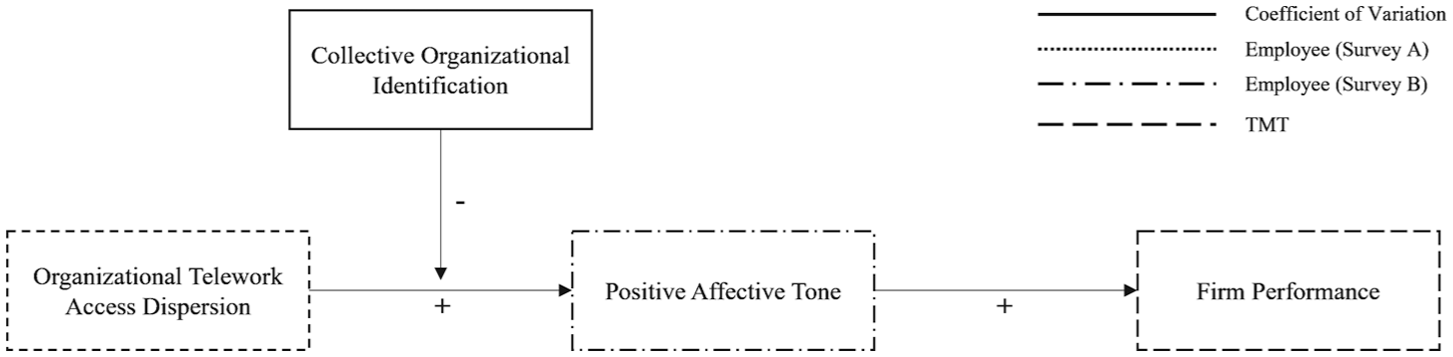
Conceptual model for the organizational-level relations between organizational telework access dispersion and firm performance.
Finally, we contribute to conversations about the tensions that can arise when organizations implement flexible work practices (e.g., Cañibano, 2019; Kelliher and Anderson, 2010; Putnam et al., 2014). While existing studies have largely focused on the positive effects of telework on individual (e.g., Baltes et al., 1999; Gajendran and Harrison, 2007; Onken-Menke et al., 2018) and organizational levels (Martin and MacDonnell, 2012), there is a notable scarcity of critical perspectives that address the potential risks associated with telework for both employees and firms. This gap is particularly relevant as organizations worldwide are reevaluating the effectiveness of telework practices, prompting researchers to examine both the benefits and limitations of this work arrangement. In our study, we extend this small, yet important body of work (e.g., Golden, 2007; Maier et al., 2022; Van der Lippe and Lippényi, 2020) by illustrating that disparities in telework access impact organizational dynamics, influencing the overall positivity of workplace culture and firm performance.
Theory and hypotheses
Organizational telework access dispersion
Teleworking is “an alternative work arrangement in which employees perform tasks elsewhere that are normally done in a primary or central workplace for at least some portion of their work schedule” (Gajendran and Harrison, 2007: 1525). Although most people who telework end up working from home, some work from cafes, shared workspaces, or other premises that are not part of the employing organization’s workspace (Garrett et al., 2017; Hill et al., 1998), and so we consider telework to be any work that is done outside of the ordinary workplace premises. While much of the existing research on telework has primarily highlighted the positive benefits for teleworkers themselves (e.g., Baltes et al., 1999; Gajendran and Harrison, 2007; Onken-Menke et al., 2018), a growing body of scholarship emphasizes the importance of examining the broader social context to fully understand the complexities of telework, both its advantages and its drawbacks (e.g., Golden, 2007; Maier et al., 2022; Mele et al., 2021; Van der Lippe and Lippényi, 2020). Building on these foundational insights, this paper introduces the concept of organizational telework access dispersion, which captures the variability in remote work opportunities among employees within an organization. A greater level of dispersion signifies more pronounced differences in telework access among staff.
Social identity (Ashforth and Mael, 1989; Tajfel and Turner, 1986) and justice (Colquitt and Zipay, 2015; Tyler and Blader, 2003, Tyler and Lind, 1992) theories converge and/or are complementary in their articulation of several critical processes that are relevant to our conceptualization and predictions. First, individuals categorize themselves based on various characteristics. When there is visible variability in attributes within a group (i.e., in our case, telework access), social identity theory offers that people notice differences more easily, and they may start to categorize others into subgroups based on salient features. This happens quite naturally, as people seek to reduce uncertainty and affirm their identity by creating social categories; dispersion offers the raw material for this (Hornsey and Hogg, 2000). Once dispersion is noticed, the mind naturally creates simplified “us” versus “them” distinctions. While existing research often focuses on attributes such as race, nationality, gender, and profession, theory and research also show that individuals categorize themselves according to their access to certain job conditions. For instance, research shows that job conditions such as social support (Häusser et al., 2023; McKimmie et al., 2020) or job autonomy and compensation (Lheureux and Parmentier, 2022; Tanjitpiyanond et al., 2023) prompt employees to distinguish themselves from those who have or do not have these job conditions. Like other telework researchers (e.g., Leslie et al., 2012; Maier et al., 2022; Putnam et al., 2014), we assume that employees use their telework status to categorize themselves into “us” versus “them” categories.
A second critical process involves social comparisons, in which individuals evaluate their in-group relative to an out-group to shape their social identity and self-concept (Tajfel and Turner, 1986) and make justice decisions (Adams, 1965). Again, drawing from social identity theory, this occurs when the dispersed dimension is meaningful and salient (Tajfel and Turner, 1986). Telework access is meaningful because it functions as both a status marker and signal of organizational care. For instance, Grant and Parker (2009) found that autonomy and job design serve as markers of valued resources and roles, reinforcing group identification. Leslie et al. (2012) found that employees interpret flexibility policies as status indicators, and those without access are assumed to have lower standing. Indeed, when members of an in-group assess their standing against out-group members, they not only gauge their relative position but, as justice theories attest, they also examine perceptions of fairness in the treatment received by both groups (by comparing the input–output ratio of a comparable other; Adams, 1965). Since telework is oftentimes seen as an inducement (Cañibano, 2019), it may signal preferential working conditions, with the increased autonomy and flexibility that telework affords (Mele et al., 2021).
Salience refers to the degree to which a resource or distinction is visible and psychologically accessible for comparison. In the case of telework, its salience is reinforced through at least two mechanisms that render it observable in the workplace. First, institutional visibility is ensured by legal requirements in several jurisdictions mandating that employers codify and communicate telework arrangements. In the United States, the Telework Enhancement Act requires agencies to provide employees with written notice of their telework eligibility (U.S. Congress, 2010). Similarly, the EU Framework Agreement on Telework mandates that teleworkers receive written information on the applicable conditions (European Social Partners, 2002). These provisions create a baseline of formal awareness, ensuring that employees are informed about the existence and structure of telework access even if they are not direct beneficiaries. Second, telework is actively promoted by employers as part of their employer brand and talent strategy, thereby increasing its salience through organizational signaling. Empirical evidence shows that the mere communication of telework access enhances perceived employer attractiveness (Moens et al., 2024). Telework is not only a functional work arrangement but also a symbolically loaded organizational signal, reinforcing its visibility across employee groups. This symbolic dimension is further institutionalized through external evaluations such as the Great Place to Work ranking, where the availability of remote and hybrid work has become an important criterion for assessing workplace quality and employer attractiveness.
Telework access, a meaningful and salient distinction that serves as a basis for social comparison, leads people to make justice appraisals. The relational perspective of justice (Colquitt and Zipay, 2015; Shao et al., 2013; Tyler and Lind, 1992) suggests that equity is important to individuals because it offers cues on social standing within groups. If in-group members perceive their group as disadvantaged or treated unjustly compared to the out-group (Adams, 1965; Colquitt and Zipay, 2015), it can foster feelings of injustice and resentment, ultimately impacting group engagement and collaboration (Tyler and Blader, 2003), even among those who are relatively better off (Feather, 1999; Pfeffer and Langton, 1993). We therefore anticipate that organizational telework access dispersion has a negative relationship with collective positive affective tone—a construct defined by shared positive emotions such as enthusiasm, optimism, and engagement among employees (Knight et al., 2018). Disparities in telework access may prompt employees within the same organization to compare themselves with their colleagues, leading to perceptions of inequity regarding the advantages enjoyed by those who telecommute (Putnam et al., 2014), thereby dampening the emotional mood of the organization. This argument is supported by justice research that finds that “emotions precede, coincide with, and follow justice-related events. Emotional reactions impact how employees perceive a situation and interpret information and thus are central to the formation of fairness perceptions” (Colquitt and Zipay, 2015: 84). We expect that the feelings of inequity that arise from social comparisons of telework access coincide with a decrease in positive emotions (Colquitt and Zipay, 2015), and, given the contagious effect of emotions in the workforce (Hatfield et al., 1993), are associated with a depressed positive affective tone of the organization.
There is a small body of research that lends support to these arguments by showing that teleworking use can have negative consequences for both the teleworker and non-teleworker colleagues. Putnam et al. (2014) looked across research on workplace flexibility and revealed an inherent tension between equitable versus inequitable implementation of flexible working policies. For instance, non-teleworkers experience negative attitudinal and behavioral consequences when their co-workers (Golden, 2007; Maier et al., 2022) and line managers (Golden and Fromen, 2011) telework. Van der Lippe and Lippényi (2020) showed that high levels of remote work within teams negatively affects individual performance, and team-level performance declines as co-worker telework prevalence increases. Maier et al. (2022) demonstrated that disparities between teleworker and non-teleworkers elicit negative emotions and detrimental behaviors among non-teleworking staff. Research has revealed a similar picture for telework access; Lee and Kim (2018) found that being eligible to telework leads to enhanced perceived procedural fairness, job satisfaction, and intentions to remain with the organization compared to employees who do not have access to telework. Given that heightened social comparison processes are often linked to negative workplace culture and conditions (Koopman et al., 2020; Matthews and Kelemen, 2025; Morse and Gergen, 1970), it stands to reason that these social categorizations founded on telework access could foster discontent and thereby be associated with lowered positive affective tone. We hypothesize as follows.
Positive affective tone at the organizational level can be reflected in various aspects of organizational life, including communication, collaboration, and interpersonal relationships (Knight et al., 2018). Additionally, a positive affective tone can facilitate teamwork, reduce stress, and contribute to a culture of resilience and adaptability within the organization (Barsade, 2002; Tsai et al., 2007). These effects extend beyond the individual level, as repeated interactions and interdependencies among organizational members reinforce shared norms of behavior (Morgeson and Hofmann, 1999; Reinwald et al., 2019), in which behaviors that enable performance (e.g., increased task persistence, cooperation, and support) become a shared organizational norm (Menges et al., 2011; Reinwald et al., 2019). Connecting the aforementioned arguments, we therefore expect an indirect effect of telework dispersion on firm performance through a reduced positive affective tone.
Thus far, we have integrated insights from social identity and justice theories to articulate two processes to support the abovementioned hypotheses. We now leverage a third process that helps to guide our predictions about what alleviates the negative effect associated with high levels of organizational telework access dispersion. Social identity theory posits that individuals who identify with a group (such as their organization) internalize the identity and behaviors that are linked to that group, which can subsequently impact their self-esteem and social perceptions. As a result, individuals tend to perceive themselves through the lens of their group membership, aligning their attitudes and behaviors with those of the group (Tajfel and Turner, 1986). We have already suggested that teleworkers and non-teleworkers identify with their respective subgroups, yet research suggests that people often hold multiple work-related identities (Blader et al., 2017). We focus here on an identity that could unite workers regardless of their telework status, that is, organizational identification, which refers to the extent to which individuals define themselves through their membership in an organization, adopting its values, goals, and norms as integral components of their self-concept (Mael and Ashforth, 1992). Specifically, we examine collective organizational identification, which indicates a strong culture in which employees feel a sense of belonging to the company, and where there is a clear idea of what is valued and rewarded by the organization (Bowen and Ostroff, 2004).
High levels of shared organizational identification can play a crucial role in mitigating the impacts of negative workplace dynamics (Newton and Teo, 2014), including, in our case, environments characterized by disparities in telework access. Indeed, the negative feelings that unfairness evokes from social comparisons can diminish morale and create interpersonal tensions within the workplace (Koopman et al., 2020; Matthews and Kelemen, 2025; Morse and Gergen, 1970). However, when employees share a strong collective organizational identification, these negative effects may be less pronounced (Blader and Tyler, 2003). Employees who feel a deep connection to their organization may be more forgiving of disparities in telework access, as their shared identity fosters solidarity and collaborative spirit. Instead of viewing telework opportunities through a lens of personal disadvantage, they may embrace a collective ethos that prioritizes the organization’s goals and values over individual access to remote work. By emphasizing shared values and fostering an inclusive organizational culture, employees may experience reduced tensions related to telework dispersion, leading to enhanced positive affective tone. This line of argumentation is supported by research that shows that a superordinate identity (i.e., organizational identification) can ease intergroup conflict based on subgroup identities (i.e., teleworker vs non-teleworker) (Doosje et al., 2002; Gaertner et al., 1993; Hornsey and Hogg, 2000). Consequently, we hypothesize that at high levels of collective organizational identification, the negative relationship between organizational telework access dispersion and positive affective tone is weakened.
We bring the aforementioned theoretical arguments together: We first suggested that greater dispersion in telework access negatively affects positive affective tone, as disparities lead employees to engage in social comparisons, fostering feelings of inequity and dampening morale. This decline in positive affective tone, proposed next, mediates the negative relationship between telework access dispersion and firm performance, indicating that emotional tone is crucial for organizational success. Importantly, we also introduced collective organizational identification as a mitigative factor, positing that a strong sense of belonging can reduce the negative impacts of telework disparities on affective tone. Ultimately, our last hypothesis encapsulates our moderated-mediation model, predicting that high levels of collective organizational identification will lessen the adverse indirect effects of telework access dispersion on firm performance through enhanced positive affective tone. The full moderated-mediation hypothesis is therefore offered next:
Methods
Research setting and sample
The data for this study were collected in three waves from March until September in the years 2020 (n = 48 organizations with 6957 employees), 2021 (n = 71 organizations with 11,154 employees), and 2022 (n = 67 organizations with 8672 employees) from small and medium-sized private companies in Germany, as part of a larger benchmarking project (this study is the first publication generated from this dataset). Each wave consists of a different set of participating organizations and employees. In exchange for participation, the firms received a detailed benchmarking report. Having a physical location in Germany and employing no more than 5000 employees were requirements for participation in this study. The firm size varied from 6 to 2242 employees (M = 307; SD = 499). The companies were distributed across four industries, with 33% in the production and construction sector, 14% in the trade sector, 45% in the service sector, and 7% in finance. Across the 186 companies in total, 26,783 employees responded to a survey, resulting in a within-organization response rate of 74%. On average, 144 (SD = 167) employees per organization responded to the survey. The participating employees were, on average, 39 years old (SD = 12.1), there were more males than females (61.3% male), and 20.2% reported holding a leadership position within the organization.
To avoid common method concerns (Podsakoff et al., 2012), we used three different data sources for the core variables in our model. We used two different employee surveys to capture (A) access to telework and organizational identification and (B) positive affective tone. As a third source, members of the top management team were asked to evaluate the (C) performance of their firm in comparison to other companies in the same sector.
Measures
We used 5-point Likert scales (1 = strongly disagree; 5 = strongly agree) for all measures, unless otherwise stated. To justify aggregation procedures for firm-level variables, we inspected common statistical benchmarks, including the intraclass coefficient (ICC1 and ICC2; Bliese, 2000) and the rwg(j)-index (James et al., 1984). All measures used can be found in the Appendix.
Individual telework access
Employees in survey A were asked the extent to which they agreed with this statement: “I can freely choose my place of work (on-site at work, home office, on the commute to work . . ..” The use of a single-item measure to capture this variable is consistent with prior research on telework access (e.g., Martínez Sanchez et al., 2007, 2008; Siegwarth-Meyer et al., 2001). A single-item measure of this variable is adequate because the construct is unambiguous and unidimensional (Allen et al., 2022; Bergkvist and Rossiter, 2007; Wanous et al., 1997). The mean access to telework was M = 2.88 (SD = 1.45).
Organizational telework access dispersion
Using a dispersion composition model, we aggregated individual responses regarding access to telework with the coefficient of variation to the organizational level to capture telework dispersion within companies. The coefficient of variation 2 is the most appropriate measure for our study for two reasons: (1) our theoretical rationale is consistent with this measure and (2) the empirical distribution of individual telework access in our sample is consistent with the assumptions of conceptualizing this construct as dispersion (Harrison and Klein, 2007). The coefficient of variation is calculated by dividing the standard deviation of telework access within an organization by the mean telework access in that organization, then multiplying by 100 for straightforward interpretation (Harrison and Klein, 2007). Theoretically, the coefficient of variation ranges from 0 to ∞ and exceeds 100 when the standard deviation is greater than the mean. In our sample, the mean coefficient of variation was M = 42.95 (SD = 17.79), with values ranging from 0 to 77.63. A higher coefficient of variation indicates greater dispersion in telework access across employees within an organization.
Collective organizational identification (α = 0.90, ICC1 = 0.06, ICC2 = 0.74; median rwg(j) = 0.84) was assessed with the widely applied five-item identification measure by Mael and Ashforth (1992) in employee survey B. We followed prior research (e.g., Cole and Bruch, 2006) and adhered to established practices for adapting validated scales by minimizing changes (Heggestad et al., 2019), modifying only the referent from “this school,” as used in the original study by Mael and Ashforth (1992), to “this company.” Consistent with our theoretical reasoning and supported by aggregation indices, we created a firm-level measure of collective organizational identification by using a direct-consensus composition model (Chan, 1998).
Positive affective tone (α = 0.97, ICC1 = 0.14, ICC2 = 0.89; median rwg(j) = 0.87). We asked employees of employee survey A to report how often “employees in this company” experienced five high activation and pleasant emotions (e.g., enthusiasm) in the last 6 months (Knight et al., 2018). Following Knight et al. (2018), we measured affective tone as a construct that inherently lies at the organizational level of analysis. Consequently, we used a referent shift composition model (Chan, 1998).
Company performance (α = 0.89). Members of the top management team reported the company’s performance. Following the conceptualization of Combs et al. (2005), we assessed company performance by measuring both organizational and operational performance dimensions. Consistent with prior studies (Leicht-Deobald et al., 2021), the subjective performance measure was benchmarked by asking the top managers to evaluate the performance of their company compared to their direct competitors.
Controls
We followed established practice regarding the choice and treatment of control variables (Becker, 2005; Carlson and Wu, 2012). We controlled for industry affiliation (i.e., organizations were allocated to one of four dummy variables: 1 = belongs to this industry; 0 = does not belong to this industry; reference = manufacturing; Dickson et al., 2006), firm size (measured as the natural logarithm of the number of employees; Berger et al., 2022), firm-level mean of employees’ age (in years, e.g., Leicht-Deobald et al., 2021), and the degree of formalization (Deshpande and Zaltman, 1982), answered on a 7-point scale from 1 = strongly disagree to 7 = strongly agree and aggregated to the firm level (α = 0.88, ICC1 = 0.25, ICC2 = 0.94; median rwg(j) = 0.65). Moreover, consistent with established practices in telework research (see, e.g., Beckel et al., 2023; Golden and Eddleston, 2020), we collected a proxy for homework use by asking employees to report the percentage of their typical weekly working hours spent working from home (“home office”). Respondents entered a value between 0 and 100 to indicate the proportion of their average workweek completed in the home office. As such, the observed arithmetic mean of 25 in homework use indicates that, on average, employees in our sample work 25% of their time from home (rather than 25% of employees work from home). We also controlled for the (partial) enforcement of teleworking, due to the COVID-19 pandemic. The COVID pandemic led to the enforcement of a teleworking offer requirement in Germany between January 27, 2021, and June 30, 2021, and again between November 24, 2021, and March 19, 2022. As such, the first two waves of our data were (partially) affected by these obligations, while the third wave in 2022 was not. This opened a unique opportunity for us to (imperfectly) control for mandatory teleworking. Thus, we created a year-specific dummy variable to capture whether there was a telework mandate policy and included it as a control variable.
In line with recommendations on the use of control variables (Becker, 2005; Carlson and Wu, 2012), we repeated all tests of hypotheses without controls. Since the two analyses revealed very similar findings in significance and magnitude, we report the results with all control variables.
Statistical approach
To test our moderated-mediation model at the level of the firm, we used PROCESS for R (Hayes et al., 2017) to examine the proposed hypotheses. To determine the significance of indirect effects at different levels of the moderator, we used a product-of-coefficients procedure (Preacher et al., 2007) and examined the conditional indirect effect using bias-corrected 95% confidence intervals with 10,000 bootstrapping samples. In particular, we analyzed the indirect effects across different levels (i.e., 1 SD below, average, and 1 SD above) of collective organizational identification (Hayes et al., 2017).
Results
Discriminant validity
A confirmatory factor analysis (CFA) of the two latent constructs (i.e., positive affective tone and collective organizational identification) in our research model revealed that this baseline model exhibited good fit with the data (χ2(31) = 88.11, Comparative Fit Index (CFI) = 0.97, Tucker Lewis Index (TLI) = 0.96, Root Mean Square Error of Approximation (RMSEA) = 0.10, Standardized Root Mean Square Residual (SRMR) = 0.04). We also ran a CFA with an alternative one-factor model with collective organizational identification and positive affective tone loading on a common factor and compared it to the two-factor model. The model with the two-factor solution fit the data significantly better than the one-factor model (χ2(45) = 278.41, CFI = 0.88, TLI = 0.83, RMSEA = 0.20, SRMR = 0.12, Δχ2 = 190.31, Δdf = 1; p < 0.001). Thus, the two latent constructs were empirically distinct.
Descriptive statistics and correlations between variables
The means, standard deviations, and intercorrelations of the study variables are provided in Table 1. The correlations support our hypothesized model. Organizational telework access dispersion was negatively related to positive affective tone (r = −0.32, p < 0.001), which in turn showed a significant positive correlation with firm performance (r = 0.44, p < 0.001). It is noteworthy that we observed a non-significant correlation close to zero between organizational telework access dispersion and firm performance (r = −0.05, p > 0.05), which underscores the importance of the social identity and justice processes that we described. In addition, there was a positive association between collective organizational identification and positive affective tone (r = 0.63, p < 0.001), between mean telework access and the positive affective tone in organizations (r = 0.25, p < 0.001), and between mean telework access and mean homework use (r = 0.76, p < 0.001).
Descriptive statistics and correlations.
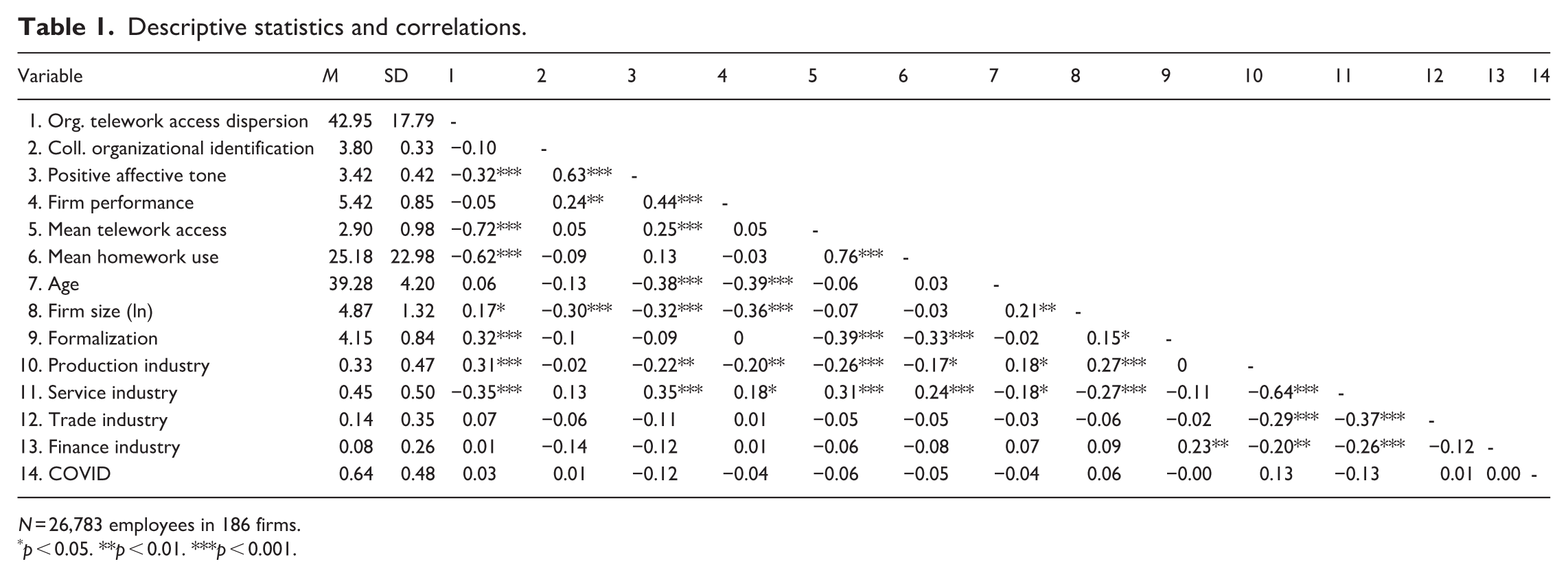
N = 26,783 employees in 186 firms.
p < 0.05. **p < 0.01. ***p < 0.001.
Hypothesis testing
We report the results of the multiple regression analyses in Table 2. After running a first controls-only model on the mediating variable (i.e., positive affective tone), we additionally included organizational telework access dispersion as a predictor and found a negative relationship thus supporting hypothesis 1 (β = −0.24, p < 0.05). When regressing firm performance on positive affective tone, we observed a positive relationship between it and firm performance (β = 0.33, p < 0.001). To further test whether positive affective tone mediates the association between organizational telework access dispersion and firm performance, we applied a bootstrapping-based product-of-coefficients procedure with 10,000 bootstrap samples. The bias-corrected bootstrap 95% confidence interval for this indirect relation did not include zero supporting hypothesis 2 (β = −0.08, bootstrap standard error (BootSE) = 0.04, bias-corrected 95% bootstrap confidence interval (Boot95%CI) = (−0.17, −0.02)).
Results from the multiple regression analyses.
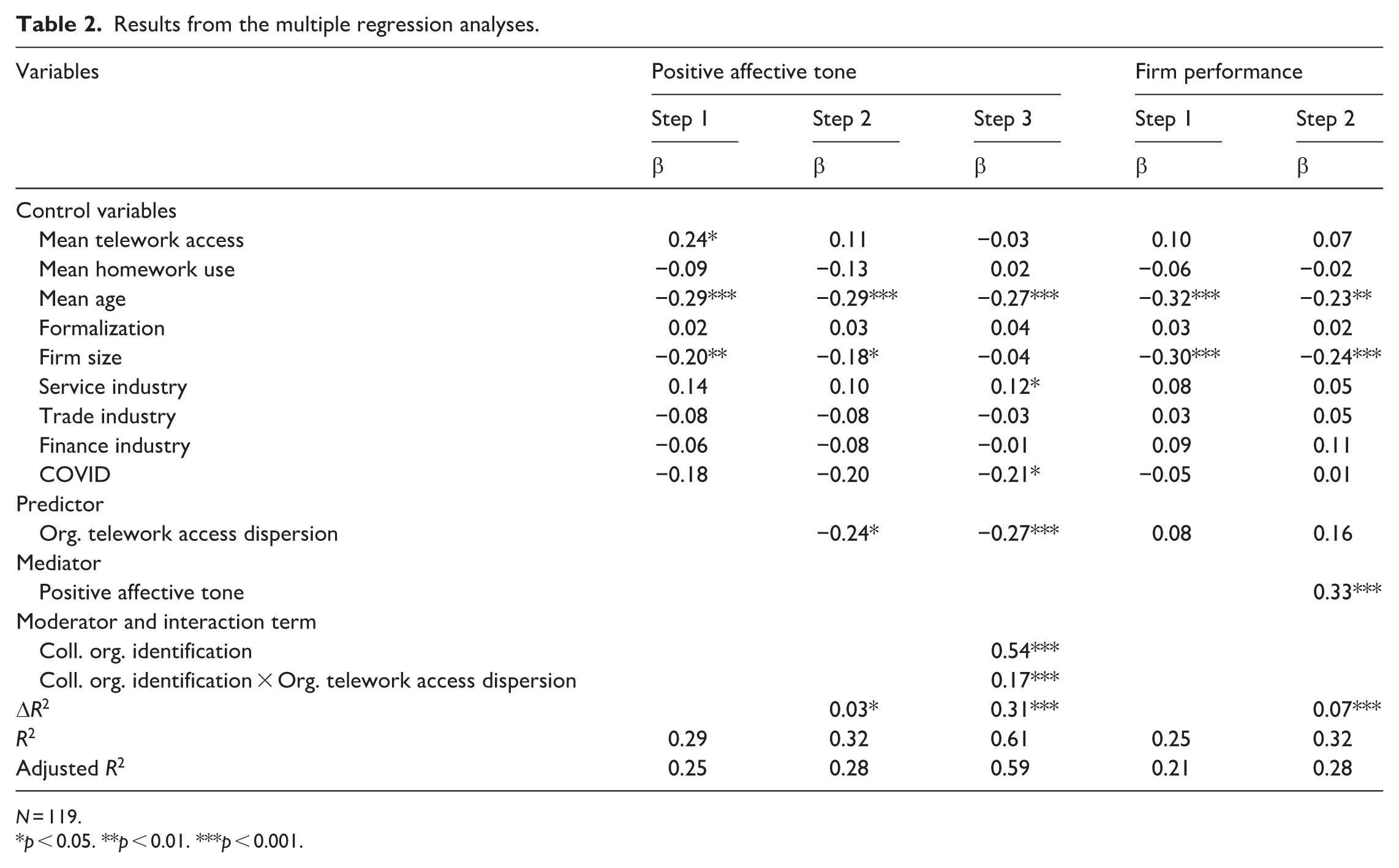
N = 119.
p < 0.05. **p < 0.01. ***p < 0.001.
To test the moderation effect formulated in hypothesis 3, we entered collective organizational identification as well as the interaction term of organizational telework access dispersion and collective organizational identification as predictors in the model with positive affective tone as the dependent variable. The significant interaction effect (β = 0.17, p < 0.001) explained a significant amount of incremental variance in collective positive affective tone (ΔR2 = 0.03, p < 0.001). Thus, hypothesis 3 was supported. To understand the moderation effect in more detail, we plotted the moderation at low (−1 SD; β = −0.44, p < 0.001), average (β = −0.27, p < 0.01), and high (+1 SD; β = −0.10, n.s.) values of collective organizational identification (see Figure 2a). Thus, collective organizational identification acted as a buffer that diminished the negative relationship between organizational telework access dispersion and positive affective tone. Furthermore, we derived the regions of significance of the conditional indirect effect of organizational telework access dispersion on positive affective tone using the Johnson–Neyman technique (Hayes and Matthes, 2009). The results revealed that there is no evidence of an indirect relation between organizational telework access dispersion and positive affective tone for values of collective organizational identification greater than 0.75 standard deviations above the mean (see Figure 2b). As such, there was no evidence for an effect of organizational telework access dispersion on positive affective tone in 36 of the 186 firms in our sample (19.35%). The regions of significance also showed that for extremely high values of collective organizational identification (i.e., greater than 3.20 standard deviations above the mean), there even is a positive effect of telework dispersion on positive affective tone. However, this only applies to one of 186 companies in our sample.
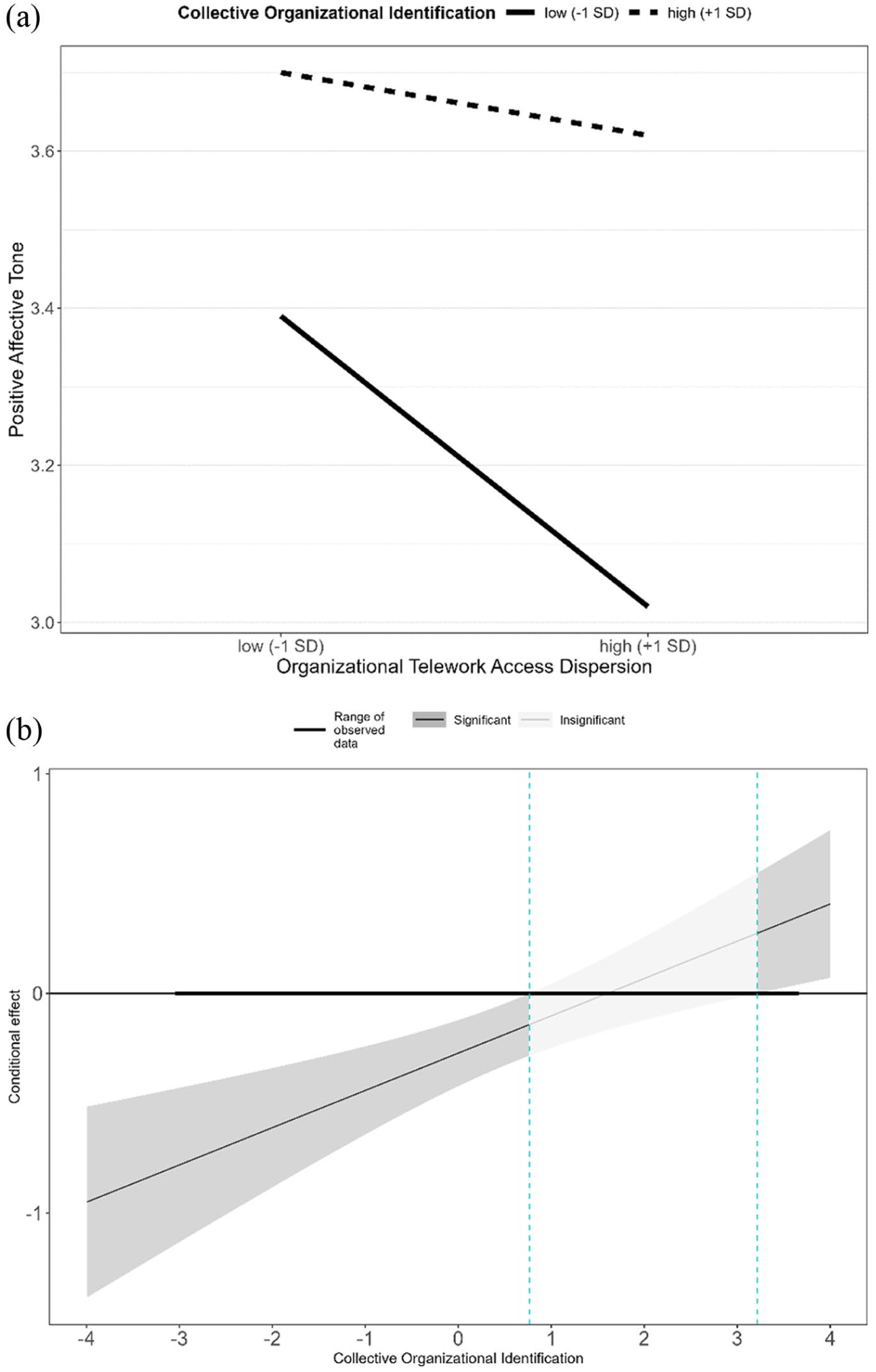
(a) Moderation effect of collective organizational identification on the relation between organizational telework access dispersion and positive affective tone. (b) Johnson–Neyman plot for the effect of organizational telework access dispersion on firm performance for different values of collective organizational identification.
Finally, we turned to investigate the conditional indirect effect of organizational telework access dispersion on firm performance. The indirect negative association between organizational telework access dispersion and firm performance is positive and significant under low (i.e., −1 SD) collective organizational identification (β = −0.14, BootSE = 0.05, Boot95%CI = (−0.26, −0.05)) and average (β = −0.09, BootSE = 0.04, Boot95%CI = (−0.18, −0.02)). At high values of collective organizational identification (i.e., +1 SD), the indirect negative association is becoming insignificant and close to zero (β = −0.03, BootSE = 0.04, Boot95%CI = (−0.13, 0.03)). Additional support for our moderated-mediation model is given by the index of moderated mediation, since the bias-corrected bootstrap 95% confidence interval for the index did not include zero (Index = 0.06, BootSE = 0.02, Boot95%CI = (0.01, 0.10)). Thus, hypothesis 4 was supported, providing evidence for the conditional indirect effect of telework dispersion on firm performance moderated by collective organizational identification.
Post hoc analyses
We conducted three sets of post hoc tests. First, we aimed to verify with our data the meta-analytically established finding that the mean of telework access is positively related to firm performance (Martin and MacDonnell, 2012). There was no evidence for a direct effect of mean telework access on firm performance (β = −0.01, p > 0.05), consistent with the non-significant coefficient when correcting for publication bias in the firm-level meta-analysis (Martin and MacDonnell, 2012). Next, we examined the effect of mean telework access on firm performance through positive affective tone, using all the control variables used in the main analyses but excluded organizational telework access dispersion. The results revealed a significant positive relationship between mean telework access and positive affective tone (β = 0.24, p < 0.05) and between positive affective tone and firm performance (β = 0.30, p < 0.001). Moreover, the indirect effect from mean telework access on firm performance through positive affective tone was supported via bootstrapping (β = 0.07, BootSE = 0.04, Boot95%CI = (0.01, 0.15)). When we included organizational telework access dispersion to the model, the mean of telework dropped from significance. In other words, the beneficial effects of telework access did not emerge when considering its dispersion.
We conducted a second set of post hoc analyses to investigate the possible impact of the COVID-19 pandemic on our findings. Notwithstanding the evidence that we showed in the main analysis that the pandemic likely did not influence our results (see non-significant dummy control variable in Table 1), we sought to replicate the meta-analytically well-established link between teleworking and turnover intentions at the individual level (Gajendran and Harrison, 2007), as well as the positive relationship of telework on firm performance through reduced turnover intentions (Martin and MacDonnell, 2012). Various theories such as job characteristics theory, self-determination theory, signaling theory, and social exchange theory (Gajendran et al., 2024; Onken-Menke et al., 2018) are commonly used to explain the relationship between telework access and individual turnover intentions. Studies examining the negative relationship between turnover intentions and firm performance frequently cite human capital and social capital theories (Park and Shaw, 2013). To assess individual-level and cross-level effects, we employed Multilevel Structural Equation Modeling 3 with MPLUS (Muthén and Muthén, 2017; Preacher et al., 2010). We examined the direct relationships at both the within and between levels and estimated the indirect relationships at the between level (Preacher et al., 2010, 2016). Individual telework access was negatively associated with individual turnover intentions (b = −0.159, p < 0.001). In addition, there was a significant direct relationship between turnover intentions and firm performance (b = −0.131, p < 0.01) and between turnover intentions and firm performance between organizations (b = −1.216, p < 0.001). Using the product-of-coefficients method and the Monte Carlo Method for Assessing Mediation with 95% confidence intervals that are bootstrapped with 10,000 samples (Bauer et al., 2006; Preacher et al., 2010), our results revealed that individual telework access had a positive and significant indirect relationship with firm performance through reduced turnover intentions (b = 0.160, p < 0.05, Boot95%CI = (0.027, 0.292)). Our results therefore replicate established findings that were published in years before the pandemic, lending further support to our argument that the COVID pandemic-related restrictions did not significantly influence our results.
We conducted a third post hoc test 4 to examine whether homework use dispersion might show similar patterns to our findings regarding telework access dispersion. To this end, we estimated the same moderated-mediation model using PROCESS for R (Hayes et al., 2017) with homework use dispersion as the focal predictor, including the same set of control variables used in our main analyses plus mean telework access. The results revealed no significant direct effect of homework use dispersion on positive affective tone (β = −0.03, p = 0.77) or on firm performance (β = −0.04, p = 0.72). Moreover, the interaction between homework use dispersion and collective organizational identification was not significant (β = 0.06, p = 0.28). We also examined the conditional indirect effect of homework use dispersion on firm performance via positive affective tone. Across levels of collective organizational identification (i.e., low, average, and high), none of the indirect effects reached significance, and all associated confidence intervals included zero (e.g., at low collective organizational identification: β = −0.02, BootSE = 0.03, Boot95%CI = (−0.10, 0.04)). These findings reinforce the distinction between telework access and homework use. We assert that the former is more appropriate for predicting organizational outcomes because it operates as a signal that shapes collective perceptions of fairness and support (Nishii et al., 2008).
Discussion
The hallmark contribution of this paper lies in the introduction of the construct organizational telework access dispersion, a perspective that has been overlooked in the existing literature, despite the significant shift toward hybrid work environments where some employees are given access to telework, and others are not, even within the same organization (Williams et al., 2021). This study demonstrates that recognizing both the mean and dispersion in telework access is vital because they exert opposing effects on firm performance. Specifically, while greater dispersion in telework access is negatively associated with organizational performance via positive affective tone, a post hoc analysis confirmed that higher mean access correlates positively with these same outcomes. This dual perspective underscores the complexity and nuance within the telework landscape, highlighting the necessity for a comprehensive approach that considers both constructs. Indeed, by establishing organizational telework access dispersion as a key area of inquiry, this research can prompt an array of future research questions that deepen our exploration of the often contradictory and tension-filled impact of telework on organizations (e.g., Cañibano, 2019; Kelliher and Anderson, 2010; Putnam et al., 2014).
Our contribution extends beyond merely identifying the correlation between organizational telework access dispersion and firm performance; we delve into the underlying processes that explain this relationship. Our findings reveal that disparities in telework access diminish the collective positive affective tone among employees, thereby adversely impacting organizational performance. By integrating social identity (Ashforth and Mael, 1989; Tajfel and Turner, 1986) and justice (Colquitt and Zipay, 2015; Tyler and Blader, 2003; Tyler and Lind, 1992) theories, we articulate how unequally distributed telework opportunities can create a detrimental shift in the overall mood within an organization, ultimately leading to a decline in performance outcomes. This finding is important because it equips scholars and leaders with a critical understanding of how inequities in telework access can undermine organizational climate, emphasizing the need for equitable policies that foster a positive work environment across the entire organization.
Furthermore, our research uncovers a mechanism for mitigating the adverse effects of high levels of organizational telework access dispersion: collective organizational identification. We demonstrate that collective organizational identification acts as a protective buffer, enhancing positive affective tone even in the face of disparities in telework access. Employees with strong collective identification may be less likely to perceive inequities in their work circumstances, primarily because this overarching organizational identity supersedes their affiliation with specific subgroups (such as teleworkers vs non-teleworkers). By emphasizing shared values and cultivating an inclusive organizational culture, organizations can reduce the tensions associated with telework access discrepancies, thereby fostering an environment that enhances collective morale. Overall, our insights provide a pathway for organizations to cultivate solidarity and resilience amid the challenges posed by telework access disparities.
We also contribute to research that has established that the social context is critical for understanding the effect of telework on important outcomes. Although the field is rich with studies that have revealed positive effects of telework at both the individual (e.g., Baltes et al., 1999; Gajendran and Harrison, 2007; Onken-Menke et al., 2018) and firm (Martin and MacDonnell, 2012) levels, there are far fewer studies that take a critical perspective to understand how telework may pose significant risks to individuals and companies. This is particularly important, since organizations in many countries around the world are beginning to question the value of telework, and so it behooves researchers to consider both the drawbacks and advantages that this work modality may accrue. Whereas prior research has found that non-teleworkers suffer declines in job attitudes and behaviors when they work with teleworkers (e.g., Golden, 2007; Maier et al., 2022; Van der Lippe and Lippényi, 2020), we demonstrate that unequal access to telework has implications at the firm level too, both in terms of the overall positivity within firms (i.e., positive affective tone), and firm performance. Through this perspective, we underscore the importance of understanding the social dynamics that surround telework, particularly in how they influence employee positive culture and firm effectiveness.
Study limitations and directions for future research
While our study offers several methodological strengths (i.e., use of a large-scale, multisource organizational-level dataset), it also contains some limitations. For instance, the cross-sectional nature of our study limits our ability to definitively establish causality. Like other studies (e.g., Leicht-Deobald et al., 2021), firm-level performance outcomes were evaluated by key informants (i.e., top management team), raising concerns regarding reliability (Starbuck, 2004). Most companies in our sample are not publicly listed, limiting our ability to access objective performance data. These issues can be addressed in future research by employing longitudinal and quasi-experimental designs, collecting data from multiple sources at different time points, and sourcing objective performance data.
Another limitation of this study is that we were unable to measure all constructs implied in our theorizing. For instance, positive affective tone may not be the only mediator that explains the relationship between telework access dispersion and firm performance. There are likely overlapping variables that our theoretical development implicated that, if included in the analyses, may increase the explained variance. For instance, perceived injustice or justice climate are theoretically plausible additional mechanisms, as are in-group ties and in-group affect (Cameron, 2004). There is growing recognition that complex outcomes are rarely explained by a single mediating mechanism. Instead, many psychological processes operate in parallel or sequentially, with different mediators capturing distinct aspects of the phenomenon (Colquitt et al., 2013; Hayes, 2013; Weiss and Cropanzano, 1996). Future research should therefore explore multiple mediation models, including collective affective tone, to explain the relationship between organizational telework access dispersion and firm performance.
Another limitation is that we did not have access to an adequate measure of telework use. This is important because our theorizing rests, in part, on the assumption that telework access is salient or visible to employees. Indeed, it is arguable that when employees are granted access but do not use telework, the resulting experiential inequality (e.g., in daily work routines, visibility, collaboration) may be minimal. On the other hand, disparities in telework use could signal meaningful differences in workplace experience, even if access appears equal on paper. Although we did not have access to a measure of telework use in our dataset, we did have a measure of homework use. We therefore controlled for homework use to isolate the unique effects of access dispersion in our main analyses. Our results show that homework use was not significantly related to positive affective tone. Moreover, we examined the consequences of homework use dispersion which revealed non-significant relationships between homework use dispersion and our outcome variables. These findings should provoke future research to collect data that directly compares telework access with use. In one of the only studies to do so, Lee and Kim (2018) found that simply being eligible to telework elevated perceived procedural fairness, job satisfaction, and intentions to remain with the organization compared to ineligible peers. Telework use, on the other hand, conferred no additional attitudinal benefit beyond fairness, indicating that access, not use, relates to employee reactions. However, when employees are technically eligible but cannot use telework because of their manager’s refusal or poor IT support, the positive effects disappear and can even turn negative. This suggests that the impact of telework use depends on the context. Interestingly, employees who had the freedom to choose not to telework, even though they were eligible, report especially high satisfaction and intentions to stay. This shows that employees care more about having fair access than about how often they or others use the option.
Another limitation concerns the fact that approximately two-thirds of the data were collected during the COVID-19 pandemic. We took two measures to alleviate associated concerns. First, we created a dummy variable that captures whether our data was collected during potential pandemic-related disruptions. Second, we replicated well-established findings at the individual and between levels of analysis regarding the mediating role of turnover intentions in the relationship between individual telework and firm performance (Gajendran and Harrison, 2007; Martin and MacDonnell, 2012). Nevertheless, there are several unanswered critical questions about mandatory versus voluntary telework. Although studies have shed some light on this topic (e.g., Gutworth et al., 2024; Kaduk et al., 2019), it is difficult to ascertain the extent to which the uncertainty of the COVID-19 pandemic influenced the results of prior research since data is typically collected either before, during, or after the pandemic. Future research should aim to decouple the “forced versus voluntary” dimension from the “COVID versus non-COVID” timeline, ideally by employing panel or longitudinal designs that allow for within-organization comparisons over time. Such approaches would provide clearer insights into how telework practices and perceptions evolve in response to changing external conditions.
Apart from these limitations, our study offers promising avenues for future research. While we established the phenomenon of organizational telework access dispersion, future research is now needed to furnish our understanding of telework dispersion at various levels of analysis, and in different industries, and national contexts. For instance, it is plausible that disparities in telework access vary within departments or functional units, depending on task requirements, functional roles, and hierarchical positions (Leonardi et al., 2024). Research shows that co-workers’ telework status influences both individual and team performance, underscoring the importance of unit-level social dynamics (Golden, 2007; van der Lippe and Lippényi, 2020). Moreover, future research could examine how individual-level characteristics that increase the motivation for telework access and use (e.g., caregiving responsibilities; Hilbrecht et al., 2008) interact with telework access dispersion. Employees with dependent care obligations may be particularly sensitive to perceived inequities in access, which could exacerbate social comparison processes and feelings of unfairness (Allen et al., 2013). Investigating these individual differences in the context of telework access dispersion could shed light on the boundary conditions and differential effects of telework policies across diverse employee groups.
Practical implications
The findings of this study illuminate a paradox for managers as they navigate telework policies. While an increase in the mean level of telework can significantly enhance employee engagement and foster a positive organizational culture, disparities in access to telework can adversely affect collective outcomes, such as positive affective tone and overall firm performance. To effectively manage this tension, HR leaders should implement a “both-and” strategy, as articulated by Putnam et al. (2014). This approach underscores the necessity of expanding telework opportunities while simultaneously cultivating an inclusive culture that bridges the gap for those with limited access. By prioritizing open and transparent communication, managers can ensure all employees feel valued and supported, thereby promoting a cohesive workforce that thrives amid the challenges of telework dispersion.
Moreover, our findings indicate that high levels of telework access dispersion need not precipitate negative outcomes. In fact, organizations can enhance employees’ organizational identification to mitigate potential downsides. Practitioners should consider leveraging strategies such as fostering a transformational leadership climate (Walter and Bruch, 2010), or enhancing perceived organizational support (Riketta, 2005). These initiatives can create a strong sense of belonging and commitment among employees, which is essential when varying levels of telework access exist. By doing so, organizations not only bolster performance but also empower employees to align individual contributions with organizational goals.
Ultimately, it is imperative for managers to actively cultivate organizational identification across their workforce. By uniting employees around a shared vision and objectives, leaders can bridge the divide created by telework access dispersion. Encouraging collaborative effort, celebrating shared successes, and reinforcing organizational values will further solidify this sense of unity. By addressing these complexities with a strategic and inclusive approach, managers can not only enhance firm performance but also foster a resilient and engaged workforce capable of thriving in the context of telework.
Conclusion
In today’s evolving work landscape, telework is still an enduring component of many organizations’ practices. For many firms, the question is no longer whether to implement telework, but rather how to do so effectively. While previous research has predominantly highlighted the mean levels of telework and their positive correlation with organizational performance, this study offers a different perspective. We introduce the concept of organizational telework access dispersion, which reveals that an unequal distribution of telework opportunities can detract from firm performance, by diminishing the collective positive affective tone. Indeed, our findings suggest that while increased telework can have beneficial effects, the disparities in access must be carefully managed to avoid unintended consequences. Notably, we identify a promising antidote: fostering high levels of collective organizational identification can counteract the negative impacts of telework dispersion. By nurturing a strong sense of belonging and shared purpose among employees, organizations can not only mitigate the risks associated with disparities in telework access but also enhance overall engagement and morale. In conclusion, understanding the dynamics among telework access, the emotional workplace tone, and organizational identification is essential for managers seeking to cultivate a thriving workplace. By embracing a comprehensive strategy that addresses these elements, we hope that leaders can create an environment where all employees feel valued and supported, ultimately driving improved firm performance.
Footnotes
Appendix
Acknowledgements
We would like to thank the Associate Editor Dr Mina Beigi and the anonymous reviewers at Human Relations for their helpful and constructive feedback throughout the review process.
Funding
The authors received no financial support for the research, authorship, and/or publication of this article.
AI usage declaration
The authors acknowledge that they have followed Human Relations’ AI policy. Accordingly, AI was used only for copy editing or proofing the manuscript.
