



Abstract
How can a complicated, ambivalent relationship with a boss be both draining and generative? This paper challenges the view that leader–member exchange (LMX) ambivalence is solely harmful. Using the Challenge–Hindrance Stressor Framework, we examine how conflicting feelings toward a leader can be experienced as both constraining and motivating. We focus on epistemic motivation—the tendency to seek deeper understanding—as a key factor that shapes how followers process such ambiguity. Across three studies, LMX ambivalence was linked to two distinct outcomes: emotional exhaustion and voice. These associations operated through different ruminative pathways: affective rumination, characterized by intrusive negative thoughts, and problem-solving pondering, involving reflective sense-making. Followers higher in epistemic motivation were less inclined toward affective rumination and more inclined toward problem-solving pondering, thereby strengthening the link between ambivalence and constructive voice while softening its association with exhaustion. Our findings highlight the hybrid nature of LMX ambivalence and suggest that it does not uniformly undermine followers but can also be associated with adaptive engagement. By unpacking the interplay of ambivalence, rumination, and epistemic motivation, this research provides a more balanced account of the complexities of leader–follower relationships.
Keywords
Introduction
Leader–member exchange (LMX)—the perceived quality of the relationship between a leader and a follower (Sparrowe and Liden, 1997)—has long been viewed as a driver of employee attitudes and behaviors (Martin et al., 2016). In practice, however, employees often hold simultaneously positive and negative views of their leaders. This subjective experience, referred to as LMX ambivalence—defined as the coexistence of positive and negative evaluations of the leader–follower relationship (Lee et al., 2019)—is not only common but consequential for employee wellbeing (Han and Sears, 2024). Most studies to date report negative outcomes, linking ambivalence to, for example, emotional strain, psychological discomfort, and impaired functioning (Holt-Lunstad and Uchino, 2019), reduced job performance (Lee et al., 2019, 2024), engagement (Zhou et al., 2023), and career commitment (Dechawatanapaisal, 2020). Such findings underscore broader social psychology perspectives, which position ambivalence as a highly stressful and dysregulating state (van Harreveld et al., 2009).
Yet, a contrasting, more adaptive view has also emerged, in which ambivalence is argued to foster reflection, cognitive complexity, and adaptive coping (Pratt and Pradies, 2011; Rothman and Melwani, 2017). Recent studies have documented dual outcomes of LMX ambivalence, such as simultaneous increases in both helping and deviant behavior (Chen et al., 2025a), feedback-seeking and silence (Mao et al., 2024), or knowledge sharing and knowledge hiding (Youssef and Tao, 2025), suggesting that ambivalence may provoke not only withdrawal or strain, but also constructive engagement. This growing, yet irreconcilable body of evidence raises two critical issues. First, it remains unclear how LMX ambivalence—an inherently conflicting state—is psychologically processed to yield divergent dual (i.e., both positive and negative) outcomes. Second, current explanations rely on divergent theoretical frameworks, such as affect theory (Chen et al., 2025a), conservation of resources theory (Huang et al., 2022), and impression management theory (Mao et al., 2024), resulting in conceptual fragmentation. Moreover, many studies infer psychological processes without directly measuring them.
In order to address these issues and advance a more unified and testable account, we draw on the Challenge–Hindrance Stressor Framework (CHSF; Cavanaugh et al., 2000; Podsakoff et al., 2023), integrating theorizing on cognitive interpretation (Kruglanski and Webster, 1996), to develop a novel perspective explaining when and how LMX ambivalence—conceptualized as a hybrid interpersonal stressor—gives rise to divergent dual outcomes. The CHSF offers a powerful lens because it emphasizes the subjective appraisal of stressors. Individuals may interpret the same stressor either as a challenge (something that enables growth) or as a hindrance (something that obstructs progress), with these appraisals triggering different motivational and emotional responses which ultimately shape behavioral and health outcomes (LePine et al., 2016; Prem et al., 2017). Accordingly, LMX ambivalence may be appraised as either as a challenge (e.g., a relational tension that can be navigated constructively) or as a hindrance (e.g., a source of confusion and instability). Importantly, we argue that these appraisals influence whether followers respond to LMX ambivalence with problem-solving pondering (reflective, future-oriented rumination) or affective rumination (negative, intrusive thought), respectively (Cropley and Zijlstra, 2011; Querstret and Cropley, 2012). In turn, these ruminative responses predict distinct outcomes: problem-solving pondering may lead to proactive voice behavior (Du Plessis and De Beer, 2022), whereas affective rumination is likely to increase emotional exhaustion (Sousa and Neves, 2021).
Crucially, not all employees interpret ambivalent leader behavior in the same way. We propose that epistemic motivation—an individual’s dispositional drive to seek a thorough, structured understanding of situations (Kruglanski, 1989)—shapes how LMX ambivalence is appraised. Individuals high in epistemic motivation are more likely to engage in systematic processing and reframe ambiguous leader behavior as cognitively manageable, increasing the likelihood of challenge appraisal and problem-solving pondering. In contrast, those lower in epistemic motivation may be more inclined to rely on surface-level appraisal, interpreting LMX ambivalence as threatening and responding with affective rumination.
Across three studies, we test our moderated mediation model using multi-wave and multi-source data from culturally diverse contexts, demonstrating that LMX ambivalence can elicit both constructive and harmful responses depending on how it is appraised and by whom. In doing so, our research makes three contributions. First, by anchoring our model in the CHSF, we provide a theoretically grounded explanation for the dual effects of LMX ambivalence. Prior research has used diverse frameworks to account for ambivalence’s paradoxical outcomes, but these often treat positive and negative effects as separate or competing. The CHSF, in contrast, offers an integrated account of how the same stressor can elicit both maladaptive and adaptive responses depending on appraisal. By reconceptualizing LMX ambivalence as a hybrid interpersonal stressor—capable of eliciting both challenge and hindrance appraisals—our approach yields several important insights. Not only are we able to explain why prior findings diverge—negative outcomes reflect hindrance appraisals, while positive outcomes reflect challenge appraisals—we also demonstrate that these ruminative response pathways are not mutually exclusive but can co-occur, clarifying why LMX ambivalence is especially taxing yet potentially generative. Furthemore, our model extends the CHSF to the interpersonal domain, demonstrating that ambivalence in leader–follower relationships can operate in ways similar to (but distinct from) task-related stressors.
Second, we advance stress and leadership research by distinguishing between affective rumination and problem-solving pondering as mechanisms through which LMX ambivalence shapes outcomes. Prior research often treats work-related rumination as a uniformly harmful construct (Vahle-Hinz et al., 2017). By disaggregating it, we demonstrate that LMX ambivalence can trigger two different processes: one maladaptive, characterized by intrusive negative thoughts that perpetuate strain (affective rumination), and one potentially adaptive, characterized by reflective thinking oriented toward solutions (problem-solving pondering). This distinction provides a clearer explanation of the dual effects of LMX ambivalence: affective rumination helps account for why ambivalence often produces exhaustion, while problem-solving pondering helps account for why ambivalence can sometimes promote proactive behaviors such as voice. In doing so, we refine our understanding of how relational stressors are processed psychologically, extending appraisal theory by showing that the same stressor can channel into different forms of ongoing cognitive engagement, building a bridge between the stress-coping and proactive behavior literatures.
Third, while most research emphasizes situational factors in determining stressor appraisals, we theorize and test how a stable individual difference, epistemic motivation, affects the likelihood that LMX ambivalence will be processed adaptively. This advances cognitive appraisal theory by highlighting how dispositional traits interact with stress appraisals, and demonstrate that relational ambivalence, as a context of inherent ambiguity, is a particularly revealing domain for studying these dynamics.
Theoretical background and hypotheses development
LMX Ambivalence and the CHSF
Ambivalence, the conflict that arises from experiencing both positive and negative emotions and/or cognitions (Piderit, 2000), is a fundamental and pervasive aspect of human experience and organizational life (Rothman et al., 2017). Freud (1930/1964) proposed that ambivalence is inherent in close relationships, supported by studies in various relational contexts such as parent–child (Maio et al., 2000), friendships (Holt-Lunstad et al., 2007), and romantic partnerships (Zoppolat et al., 2022). In leadership, Lee et al. (2019) found LMX ambivalence to be distinct from LMX quality and negatively linked to in-role performance via negative affect. Ambivalence violates consistency motives (e.g., Festinger, 1957) and is typically seen as undesirable and physiologically arousing (van Harreveld et al., 2009).
Research has largely focused on the negative effects of relational ambivalence on well-being, particularly when individuals are consciously aware of it. This subjective or felt ambivalence (Priester and Petty, 1996; Zoppolat et al., 2024) has been associated with stress and negative outcomes such as anxiety, depression, and relationship dissatisfaction (e.g., Birmingham et al., 2019; Herr et al., 2019; Zoppolat et al., 2022, 2024). Importantly, ambivalence’s effects go beyond positive or negative evaluations, suggesting its unique consequences (Birmingham et al., 2019; Faure et al., 2022). Research shows ambivalence in relationships can be more harmful than purely negative interactions (Birmingham et al., 2019; Holt-Lunstad and Uchino, 2019). This research suggests LMX ambivalence is a significant interpersonal stressor with detrimental effects on followers (Lee et al., 2019). Interpersonal stressors, compared to task-related ones, have a more lasting impact on health and performance (Yang et al., 2014; Bolger et al., 1989). Unsurprisingly then, of the eighteen current published empirical studies on LMX ambivalence, fourteen report negative outcomes (Chen and Weng, 2023; Chen et al., 2025a, 2025b; Dechawatanapaisal, 2020; Han and Sears, 2024; Kim et al., 2023; Lee et al., 2019, 2024; Leong et al., 2025; Lin and Du, 2023; Liu and Liu, 2024; Molines et al., 2024; Setthakorn, 2023; Zhou et al., 2023). This interest highlights the need for a deeper understanding of this construct (Methot et al., 2017).
Traditional views that treat all job demands—including LMX ambivalence—as uniformly harmful overlook the possibility that such demands may also be experienced as motivating under certain conditions (e.g., Geisler et al., 2019; Kronenwett and Rigotti, 2019). The CHSF (Cavanaugh et al., 2000; Podsakoff et al., 2023) provides a useful lens here. Stressors are broadly defined as demands that require sustained psychological effort and thus have the potential to tax or exceed individual resources (Lazarus and Folkman, 1984). Challenge stressors are those demands that, while effortful, offer opportunities for growth and achievement (e.g., workload, responsibility), whereas hindrance stressors are demands that constrain or obstruct goal attainment (e.g., role conflict, politics; LePine et al., 2016; Ma et al., 2021). Crucially, stressor effects depend on appraisal: the same demand may be perceived as either challenging or hindering depending on context, resources, and individual differences (Li et al., 2020; Webster et al., 2011). LMX ambivalence fits this definition of a stressor because it requires continuous psychological processing of conflicting relational cues, involving the coexistence of both positive and negative evaluations (Lee et al., 2019). This duality makes the relationship unpredictable and stressful—hindrance-like features—while simultaneously retaining access to support, influence, and opportunities for development—challenge-like features. Thus, we conceptualize LMX ambivalence as a hybrid interpersonal stressor capable of eliciting both challenge and hindrance appraisals, consistent with recent calls to view stressors as multi-faceted rather than fixed (Podsakoff et al., 2023).
Challenge and hindrance appraisals are not mutually exclusive, meaning a stressor can be seen as both (Horan et al., 2020; Searle and Auton, 2015; Webster et al., 2011). Recent studies show that LMX ambivalence is associated with both positive and negative outcomes, depending on the mechanisms involved. For instance, it has been linked to helping and deviance through emotional ambivalence (Chen et al., 2025a), to both hindering and promoting innovation via job anxiety and cognitive flexibility (Huang et al., 2022), and to mixed forms of silence and feedback-seeking (Mao et al., 2024) as well as simultaneous knowledge-sharing and knowledge-hiding (Youssef and Tao, 2025). Such evidence underscores arguments that ambivalence can stimulate cognitive processing, fostering problem-solving and idea sharing (e.g., Ashforth et al., 2014; Methot et al., 2017; Pratt and Pradies, 2011; Rothman et al., 2017). Thus, in contrast to the large body of work in social psychology that posits that individuals turn to one-sided or simplistic thinking in an effort to reduce ambivalence or the negative affect it produces, some management scholars have taken a more positive, functional perspective. In the next section, we suggest that this tension can be resolved by thinking about LMX ambivalence as a specific type of job demand—a hybrid interpersonal stressor—using the CHSF as a lens for exploring its effects on psychological processing in a more balanced way.
LMX Ambivalence and work-related rumination
The CHSF further enables the investigation of potential mediators in the relationship between job demands, such as LMX ambivalence, and employee outcomes (e.g., Xie and Feng, 2024). Prior research has often treated work-related rumination as a unidimensional construct that explains why job demands continue to affect employees outside of work. Work-related rumination is defined as “the repeated or chronic activation of the cognitive representation of stress-related content” (Brosschot et al., 2005: 1045), reflecting an individual’s difficulty disengaging from work (Cropley and Zijlstra, 2011). Rumination has been widely applied to explain the impact of job demands on workplace outcomes (e.g., Berset et al., 2011; Vahle-Hinz et al., 2017), and has been identified as a mediator between challenge and hindrance stressors and employee outcomes (e.g., Feng, 2024; Janurek et al., 2024; Van Laethem et al., 2019). When employees experience high job demands, they may struggle to stop thinking about work, causing stressors to persist beyond working hours (Junker et al., 2025; Sonnentag et al., 2014). As such, rumination often impedes psychological recovery by sustaining cognitive activation (Brosschot et al., 2005). However, emerging research shows that rumination is not uniformly maladaptive. Cropley and Zijlstra (2011) distinguish between affective rumination (intrusive, recurring negative thoughts about work) and problem-solving pondering (reflective evaluation of past tasks to improve future performance). This distinction is critical because it enables us to explain the dual effects of LMX ambivalence: affective rumination is generally associated with strain and depletion, while problem-solving pondering may foster creativity, proactive behavior, and voice (Binnewies et al., 2009; Querstret and Cropley, 2012; Vahle-Hinz et al., 2017).
Rumination allows an individual’s emotional, cognitive, and behavioral responses to stressors to persist beyond the immediate situation (von Hippel et al., 2019), carrying work demands into non-work time through continued cognitive activation (Janurek et al., 2024). Research shows that different types of stressors are associated with distinct forms of rumination: hindrance stressors often trigger intrusive negative thoughts, or affective rumination, while challenge stressors are more likely to evoke reflective problem-solving pondering (Feng, 2024; Wach et al., 2021; Zhang et al., 2024).
It is important to note, however, that rumination does not represent a direct measure of challenge–hindrance appraisal. Instead we examine downstream mechanisms that are consistent with CHSF logic. In this sense, our model follows prior research that has extended the CHSF by identifying coping responses (e.g., rumination, problem-focused strategies) as pathways through which challenge and hindrance appraisals exert their effects (Feng, 2024; Janurek et al., 2024; Van Laethem et al., 2019).
We argue that LMX ambivalence, as an interpersonal stressor, can stimulate both forms of rumination. Ambivalent leader–follower relationships demand ongoing cognitive and emotional processing of contradictory cues (Methot et al., 2017), making them likely to elicit affective rumination that drains resources, but also problem-solving pondering aimed at managing or improving the relationship. Evidence from relational ambivalence more broadly supports this duality: individuals who report higher subjective ambivalence about their partners spend more time reflecting on difficulties but also on ways to improve the relationship, engaging in both constructive and destructive behaviors (Zoppolat et al., 2024). Thus, drawing on the CHSF, we specifically propose that:
Hypothesis 1: LMX ambivalence will be positively related to affective rumination.
Hypothesis 2: LMX ambivalence will be positively related to problem-solving pondering.
The mediating role of affective rumination and problem-solving pondering
A core tenet of the CHSF is that challenge and hindrance stressors have distinct relationships with work outcomes (Mitchell et al., 2019; O’Brien and Beehr, 2019), including opposing correlations with job attitudes, such as satisfaction and commitment (Cavanaugh et al., 2000; Podsakoff et al., 2007). Scholars have explored mediating mechanisms, including rumination, to further understand these relationships. For instance, Feng (2024) found that both stressors are linked to problem-solving pondering and affective rumination, with the former promoting and the latter inhibiting flow experiences at work. Although affective rumination and problem-solving pondering share similarities, they are differentially associated with employee outcomes (Firoozabadi et al., 2018; Hamesch et al., 2014; Querstret and Cropley, 2012). While both types may be elicited by LMX ambivalence, we argue that affective rumination is maladaptive, creating a self-perpetuating cycle of anxiety, while problem-solving pondering fosters adaptive self-reflection aimed at improvement. Grounded in the CHSF, we propose that these different forms of rumination uncover the dual nature of ambivalence (Rothman et al., 2017), linking it to both negative (emotional exhaustion) and positive (voice behavior) work outcomes. Specifically, affective rumination, focused on worry and uncertainty, drains emotional and attentional resources, leading to emotional exhaustion (Kammeyer-Mueller et al., 2012; Sousa and Neves, 2021). This aligns with the CHSF, which posits that hindrance stressors deplete resources and increase exhaustion (Demerouti et al., 2001; Maslach et al., 2001). Thus, we posit that LMX ambivalence indirectly leads to emotional exhaustion via affective rumination.
In contrast, problem-solving pondering, focused on finding solutions, is less harmful and may even promote recovery by reducing psychological arousal (Cropley and Zijlstra, 2011). We propose that problem-solving pondering encourages voice behavior, a constructive response to stress that benefits employees and organizations (Pfrombeck et al., 2022). Voice behavior entails proactively speaking up to express concerns and drive constructive change (Morrison, 2011) and has been extensively examined as a coping response to workplace stressors (Ng and Feldman, 2012). In the context of LMX ambivalence, voice behavior allows employees to express concerns and influence their leader-follower relationships, with recent studies indicating a link between LMX ambivalence and cognitive flexibility (Huang et al., 2022; Rothman and Melwani, 2022; Stollberger et al., 2024). We, thus, propose that problem-solving pondering enables cognitive flexibility (Junker et al., 2021, 2025), which leads to voice behavior as a means of coping with LMX ambivalence and improving the work environment (Dundon and Gollan, 2007). Indeed, the CHSF highlights that challenge stressors can foster motivation and constructive behaviors (Cavanaugh et al., 2000; Fredrickson, 2001). Problem-solving pondering further supports this by framing LMX ambivalence as an opportunity for growth, motivating proactive voice behavior.
Hypothesis 3: LMX ambivalence will be indirectly associated with follower emotional exhaustion via affective rumination.
Hypothesis 4: LMX ambivalence will be indirectly associated with follower voice behavior via problem-solving pondering.
The moderating effect of epistemic motivation
In the previous section, we discussed how the impact of LMX ambivalence hinges on whether followers appraise it as a challenge or hindrance stressor. These appraisals involve individuals’ assessments of how a stressor impacts their goals (LePine et al., 2016; Webster et al., 2011). A challenge appraisal reflects the expectation that a stressor will facilitate goal achievement, such as work success or personal growth, whereas a hindrance appraisal signals the expectation that a stressor will hinder or limit these goals (Cavanaugh et al., 2000; Lazarus and Folkman, 1984; LePine et al., 2016; Webster et al., 2011). Early research on the CHSF followed this assumption by categorizing stressors a priori, distinguishing between challenge and hindrance stressors based on their impact on personal growth and work accomplishment (LePine et al., 2005). It was assumed that challenge stressors were always appraised as challenges, and hindrance stressors as hindrances, with each having distinct relationships with work outcomes (LePine et al., 2005; Podsakoff et al., 2007). However, these studies did not account for subjective appraisals, overlooking the possibility that the same stressor might be perceived as both challenging and hindering (Webster et al., 2011). In response, a growing body of research has shifted toward considering subjective appraisals (e.g., Li et al., 2020; Ma et al., 2021; Prem et al., 2017; Webster et al., 2011). This shift aligns with transactional stress theory, which proposes that challenge and hindrance appraisals are not mutually exclusive (Lazarus and Folkman, 1984). Building on this perspective, we argue that follower epistemic motivation plays a critical role in shaping how individuals appraise LMX ambivalence.
Traits like epistemic motivation influence individuals’ goals, values, and preferences, leading them to assign varying degrees of significance to the same experience (Lazarus and Folkman, 1984). These traits are crucial in determining whether a stressor is more likely to be seen as facilitating (i.e., a challenge appraisal) or obstructing (i.e., a hindrance appraisal) something personally meaningful (Kilby et al., 2018; Lazarus and Folkman, 1984). Research suggests that traits act as dispositional cognitive frameworks that shape how individuals interpret and assign meaning to stressors (Ma et al., 2021). Epistemic motivation refers to individuals’ inherent drive to seek and maintain an accurate and comprehensive understanding of their environment (Kruglanski, 1989). Although situational factors, such as time constraints, can influence epistemic motivation, it is primarily a stable individual difference, often linked to the need for cognitive closure or a personal need for structure (De Dreu and Carnevale, 2003). Individuals with high epistemic motivation engage in thorough and systematic processing of social information (Kruglanski and Webster, 1996), whereas those with low epistemic motivation tend to process information heuristically and superficially, making them more vulnerable to emotional reactions to leader behavior. In the context of leader–follower relationships, van Kleef et al. (2009) found that followers with low epistemic motivation had stronger negative emotional reactions to a leader’s anger, while those with high epistemic motivation were less influenced by their emotions and relied more on cognitive inferences to guide their efforts. When appraising LMX ambivalence, epistemic motivation, thus, influences how individuals interpret and respond to the uncertainty it elicits.
Followers with high epistemic motivation are more likely to engage in reflective thinking and consider both the positive and negative aspects of their leader–member relationship. This reflective approach increases the likelihood that ambivalence will be processed in ways that highlight potential benefits, such as opportunities for growth, gaining a broader perspective on their leader, or improving the relationship. This deeper sense-making can foster adaptive coping strategies like problem-solving pondering, which may ultimately fuel proactive behaviors such as voice. Importantly, however, high epistemic motivation does not preclude strain: when contradictions feel irreconcilable, these individuals may still experience affective rumination and exhaustion. Conversely, followers with low epistemic motivation are less inclined to engage with the complexity of mixed evaluations of the LMX relationship. Their heuristic processing style increases the likelihood of affect-driven responses, heightening susceptibility to affective rumination and emotional exhaustion. Nevertheless, constructive responses are possible: with sufficient contextual resources (e.g., supportive climate, psychological safety), even followers low in epistemic motivation may still engage in problem-solving pondering or voice.
In sum, epistemic motivation does not deterministically dictate whether LMX ambivalence is appraised as a challenge or hindrance stressor. Rather, it influences the probability and predominance of the pathways through which such ambivalence is processed (Kilby et al., 2018; Lazarus and Folkman, 1984). Higher epistemic motivation makes adaptive coping more likely, while lower epistemic motivation makes maladaptive responses more likely—but neither is exclusive. Combining our theoretical rationale with Hypotheses 3 and 4, we propose the following moderated mediation relations:
Hypothesis 5: Followers’ epistemic motivation will moderate the indirect effect of LMX ambivalence on emotional exhaustion via affective rumination, such that this indirect effect will be stronger for followers lower (rather than higher) in epistemic motivation.
Hypothesis 6: Followers’ epistemic motivation will moderate the indirect effect of LMX ambivalence on voice via problem-solving pondering, such that this indirect effect will be stronger for followers higher (rather than lower) in epistemic motivation.
Overview of studies
To provide a robust and incremental test of our model (see Figure 1), we conducted three complementary field studies across different samples and contexts. Each study served a specific purpose that could not have been fully addressed by a single design. Study 1, conducted with a large online panel of working adults, provided an initial, time-lagged test of whether LMX ambivalence predicts ruminative responses. Study 2 extended this model in a culturally distinct context using leader–follower dyads, allowing us to test the downstream consequences of distinct ruminative responses on emotional exhaustion and leader-rated voice. Study 3 further advanced the model by incorporating a theoretically relevant boundary condition (epistemic motivation) and testing the full moderated mediation model in a third national and organizational context. Together, these studies offer complementary strengths: Study 1 prioritizes statistical power and temporal separation; Study 2 leverages multi-source data; and Study 3 integrates boundary conditions and multilevel analysis. This stepwise approach ensures both internal robustness and external generalizability.
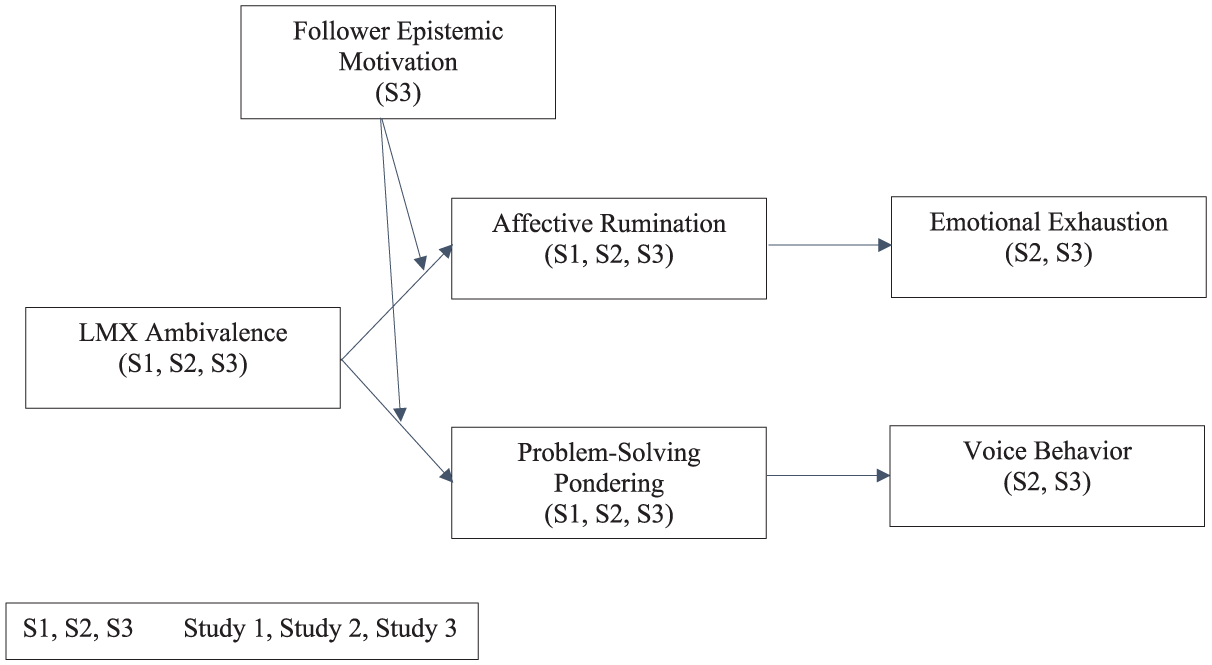
Conceptual Model of the Dual Effects of LMX Ambivalence.
Study 1 methods
Data and sample
To provide an initial examination of the association between LMX ambivalence and work-related rumination, we collected data from a sample of working adults via ProlificAcademic. Prolific (http://www.prolific.ac) is an online crowdsourcing data collection platform designed for participant recruitment by the scientific community. We recruited participants who were fluent in the English language, employed (either full or part time), and with a direct supervisor. Participants (in all three studies we report) were informed about the nature of the research and told they would be answering questions about their work and experiences with their direct leader/supervisor. Participants were screened out of the survey if they did not meet the selection criteria. Upon completing each survey, participants received compensation for their time and effort. To reduce common method variance issues, we collected data at two time points using the same participants (Podsakoff et al., 2012). Specifically, we measured LMX ambivalence and the control variables at Time 1 and at Time 2, 2 weeks later, we measured affective rumination and problem-solving pondering. To improve data quality when using Prolific samples, we only recruited respondents with sufficiently high reputations on previous Proflific tasks (i.e., a 95% approval rating or above; Newman et al., 2021). Furthermore, we included an attention-check question to examine participants’ attention (Keith et al., 2017). Data from 26 participants were omitted either due to failing the attention check or not finishing the survey. In total, 1,186 participants completed the survey at Time 1 and 907 at Time 2 (response rate 76%; 55% female; average age 35 years).
Measures
LMX ambivalence
LMX ambivalence was measured using the seven-item scale developed by Lee et al. (2019). A sample item is “I have conflicting thoughts: Sometimes I think that my working relationship with my manager is very good, while at other times, I don’t.” (α = 0.92). Participants were required to rate each item using a 7-point Likert scale ranging from 1 (strongly disagree) to 7 (strongly agree).
Work-related rumination
We used ten items from the Work-Related Rumination Questionnaire designed to measure perseverative thinking about work (Cropley et al., 2012). This includes five items to measure affective rumination (e.g., “Are you troubled by work-related issues when not at work?”; α = 0.92) and five items to measure problem-solving pondering (e.g., “After work I tend to think about how I can improve my performance”; α = 0.92). Participants responded using a 7-point Likert scale ranging from 1 (very seldom/never) to 7 (very often/always).
Control variables
Given that LMX quality and LMX ambivalence are conceptually distinct but (negatively) correlated, we controlled for overall LMX quality using a seven-item scale (Graen and Uhl-Bien, 1995) at Time 1. This ensured that the effects attributed to LMX ambivalence are not simply a reflection of overall relationship strength (Chen et al., 2025a; Lee et al., 2019). A sample item is “I would characterize my working relationship with my manager as very good” (α = 0.91). Additionally, we controlled for the gender of the follower, given that it is shown to have significant associations with both rumination (Cropley et al., 2023; Johnson and Whisman, 2013) and burnout (Purvanova and Muros, 2010), and research has shown that the expression of voice is associated more with male employees (e.g., Farrell and Finkelstein, 2007) 1
Results
Discriminant validity
The discriminant validity of the variables were established by conducting confirmatory factor analyses using MPlus (version 8.3). The goodness-of-fit indicators of a four-factor model, which included LMX ambivalence, affective rumination, problem-solving pondering and LMX quality as distinct latent factors (X2 = 32854.18, df = 325, RMSEA = 0.07, CFI = 0.95) indicated a good model fit.
Hypothesis testing
We conducted multivariate regression analysis using MPlus (version 8.3). LMX ambivalence and the control variables (Time 1) were included as independent variables, with affective rumination and problem-solving pondering (Time 2) as the dependent variables. Support was found for Hypotheses 1 and 2, as LMX ambivalence was positively related to affective rumination (β = 0.24, SE = 0.03, p < 0.01) and problem-solving pondering, respectively (β = 0.14, SE = 0.03, p < 0.01).
Study 1 discussion
Based on a time-separated design using data from over 1100 participants, Study 1 yielded support for our first two hypotheses, providing initial evidence for the distinct rumminative responses that LMX ambivalence can elicit. Specifically, and in accordance with the CHSF, we found that regardless of LMX quality and follower gender, the interpersonal stressor of LMX ambivalence can provoke both affective rumination and also problem-solving pondering. However, further examination of these differing rumminative responses and their potential consequences was warrented using a multi-source design.
Study 2 methods
In Study 2, we set out to test a process perspective concering the potential dual nature of LMX ambivalence by examining the indirect relationship between LMX ambivalence, emotional exhaustion and voice behavior via the distinct forms of work-related rumination examined in Study 1. To test our mediation model, we collected data from 126 leader–follower dyads who were alumni of a business school located in East China. In total, 318 alumni were invited to participate. Followers and leaders were sent a questionnaire using an online survey website, Wenjuanxing (https://www.wjx.cn/), the Chinese version of Qualtrics, which has often been used to recruit participants (e.g., Wei et al., 2022). To reduce issues of common method bias, we used a time-separated design. At Time 1 we collected followers’ ratings of LMX ambivalence, at Time 2 (2 weeks later) we collected followers’ ratings of affective rumination and problem-solving pondering. At Time 3 (2 weeks after time 2) we collected follower ratings of emotional exhaustion and leader ratings of follower voice behavior. We relied on supervisor ratings of voice for two reasons. First, upward voice is evaluated and acted upon by leaders, so the leader’s perception is the criterion-relevant assessment. Second, using a different source for voice reduced common-method bias relative to follower-reported predictors and mediators (e.g., Podsakoff et al., 2012).
Measures
LMX ambivalence (α = 0.92), affective rumination (α = 0.92), and problem-solving pondering (α = 0.94) were measured using the same instruments used in Study 1, except a five-point Likert scale was used.
Emotional exhaustion
We used the five-item emotional exhaustion measure from the Maslach Burnout Inventory (Schaufeli et al., 1996). A sample item is “I feel used up at the end of the workday” (α = 0.91). All items were scored on a five-point frequency rating.
Proactive voice behavior
We used the voice behavior scale developed by Van Dyne and LePine (1998). Leaders were asked to evaluate their followers’ voice behavior (α = 0.84) on a five-point Likert scale. A sample items is: “This employee develops and makes recommendations concerning issues that affect this work group.”
Results
As shown in Table 1, and consistent with Study 1, LMX ambivalence was significantly positively correlated with both affective rumination (r = 0.40) and problem-solving pondering (r = 0.35). Furthermore, affective rumination and problem-solving pondering were significantly positively correlated with emotional exhaustion (r = 0.61) and voice behavior (r = 0.36), respectively.
Means, standard deviations, and intercorrelations for Study 2 variables.
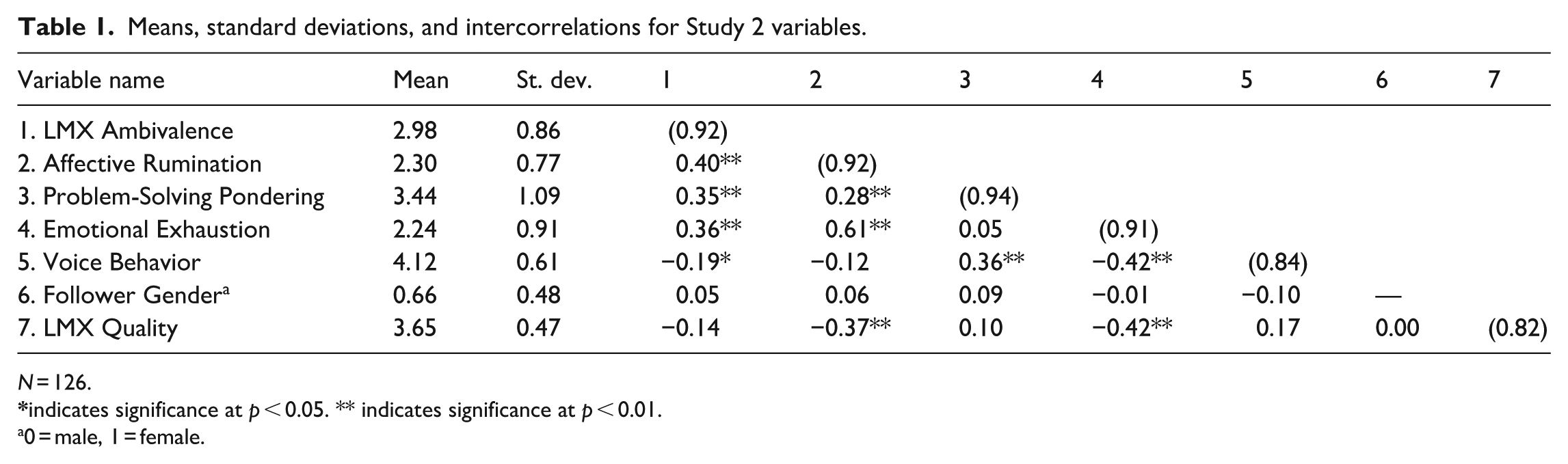
N = 126.
0 = male, 1 = female.
Discriminant validity
The goodness-of-fit indicators of a five-factor model, which included LMX ambivalence, affective rumination, problem-solving pondering, and the dependent variables (voice behavior and emotional exhaustion) as distinct latent factors (X2 = 607.60, df = 289, RMSEA = 0.09, CFI = 0.91) indicated an acceptable fit.
Hypothesis testing
To test our hypotheses, we ran a mediation model in MPlus (version 8.3), in which we tested the indirect relationship between LMX ambivalence and emotional exhaustion and voice behavior via affective rumination and problem-solving pondering, which were included as parallel mediators. Support was found for Hypotheses 1 and 2, as LMX ambivalence was positively related to affective rumination (b = 0.32, SE = 0.07, p < 0.01) and problem-solving pondering, respectively (b = 0.47, SE = 0.10, p < 0.01) while controlling for LMX quality and follower gender. To analyze indirect effects, we calculated 95% confidence intervals (CIs) based on bootstrap analyses with 10,000 repetitions. The results of our analysis are shown in Table 2 and support our hypotheses. We found evidence of a significant indirect effect of LMX ambivalence on emotional exhaustion via affective rumination (b = 0.18; 95% CI [0.10, 0.28]), supporting Hypothesis 3. In support of Hypothesis 4, a significant indirect effect of LMX ambivalence on voice behavior via problem-solving pondering was found (b = 0.19; 95% CI [0.06, 0.20]).
Study 2 mediation results.
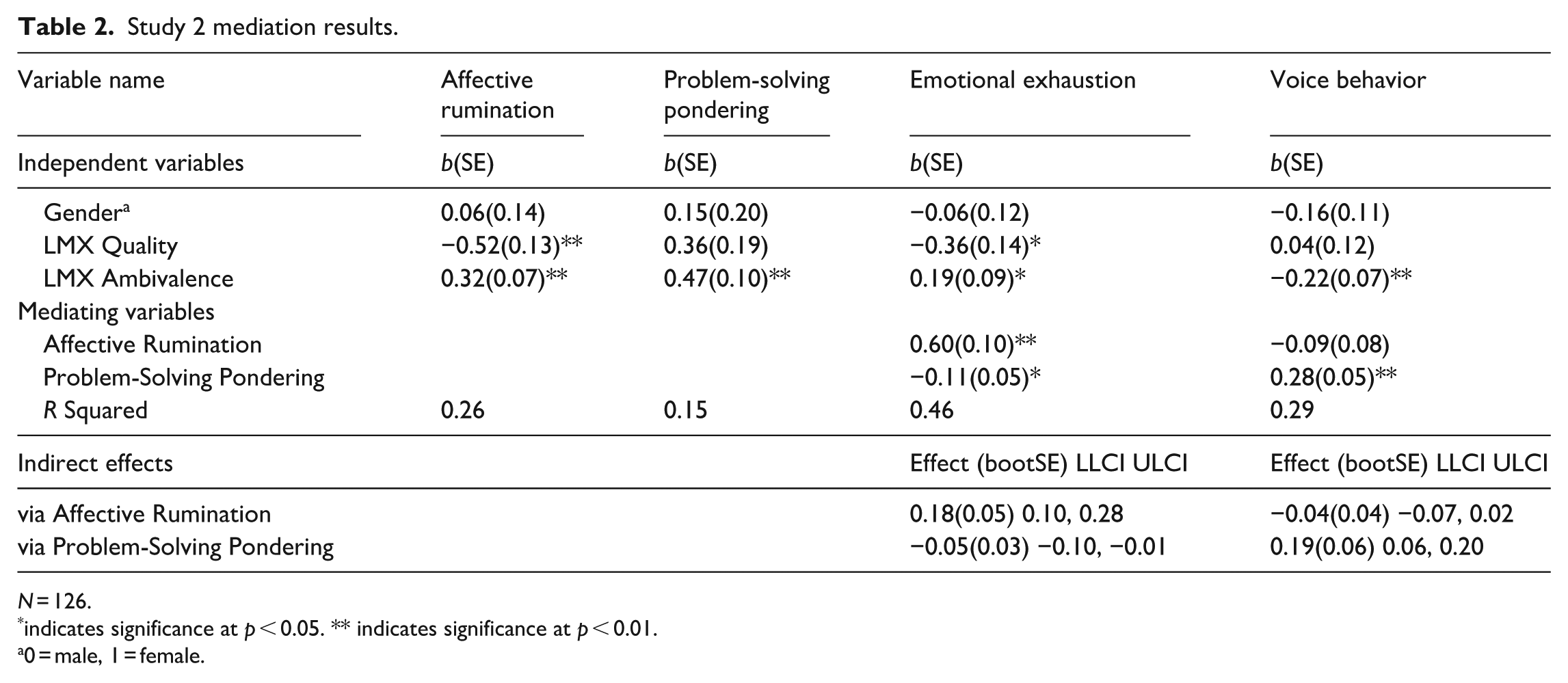
N = 126.
indicates significance at p < 0.05. ** indicates significance at p < 0.01.
0 = male, 1 = female.
Study 2 discussion
Study 2 served as both a constructive replication and an extension of Study 1. It replicated the core relationships between LMX ambivalence and the two forms of work-related rumination, thereby increasing confidence in the robustness of these effects across samples. In addition, Study 2 extended the model by examining the consequences of different ruminative responses. This allowed us to move beyond establishing the antecedents of rumination to also demonstrate its role as a dual mechanism linking LMX ambivalence to both strain-related and proactive outcomes, providing further support for Hypotheses 1 to 4.
Study 3 methods
Study 3 sought to replicate the findings of Study 2 while also adding a first-stage moderating variable—epistemic motivation. Data for Study 3 were collected from 298 supervisor–subordinate dyads working in 30 teams from 9 service organizations (5 banks, the stock exchange, and 3 hospitality organizations) in Lagos, Nigeria. All surveys were distributed in English, the working language of the participants, and coded to ensure the responses could be matched. To reduce potential concerns of common method variance, we collected data at three different times and from two different sources (Podsakoff et al., 2012). In total, 400 subordinates (i.e., followers) were invited to participate. At Time 1, 311 subordinates completed the paper-and-pen survey which included measures of LMX ambivalence and LMX quality, epistemic motivation, and demographics. At Time 2, 3 weeks later, subordinates who had completed the first survey were invited to complete a second paper-and-pen survey with the mediating variables and the dependent variable of emotional exhaustion, yielding 298 responses. The 30 direct supervisors of the subordinates completed a survey measuring follower voice behavior. The overall response rate was 75%.
Measures
LMX ambivalence (α = 0.92), affective rumination (α = 0.92), problem-solving pondering (α = 0.94), and emotional exhaustion (α = 0.94) were measured by subordinates using the same instruments used in Study 2. Voice behavior (α = 0.94) was measured from direct supervisors, again using the same instrument as Study 2. Additionally, at Time 1, subordinates completed a measure of epistemic motivation using the 11-item scale developed by Neuberg and Newsom (1993). An example item is “I like to have a place for everything and everything in its place” (α = 0.87).
Results
Correlations and descriptive statistics can be found in Table 3.
Means, standard deviations, and intercorrelations for Study 3 variables.
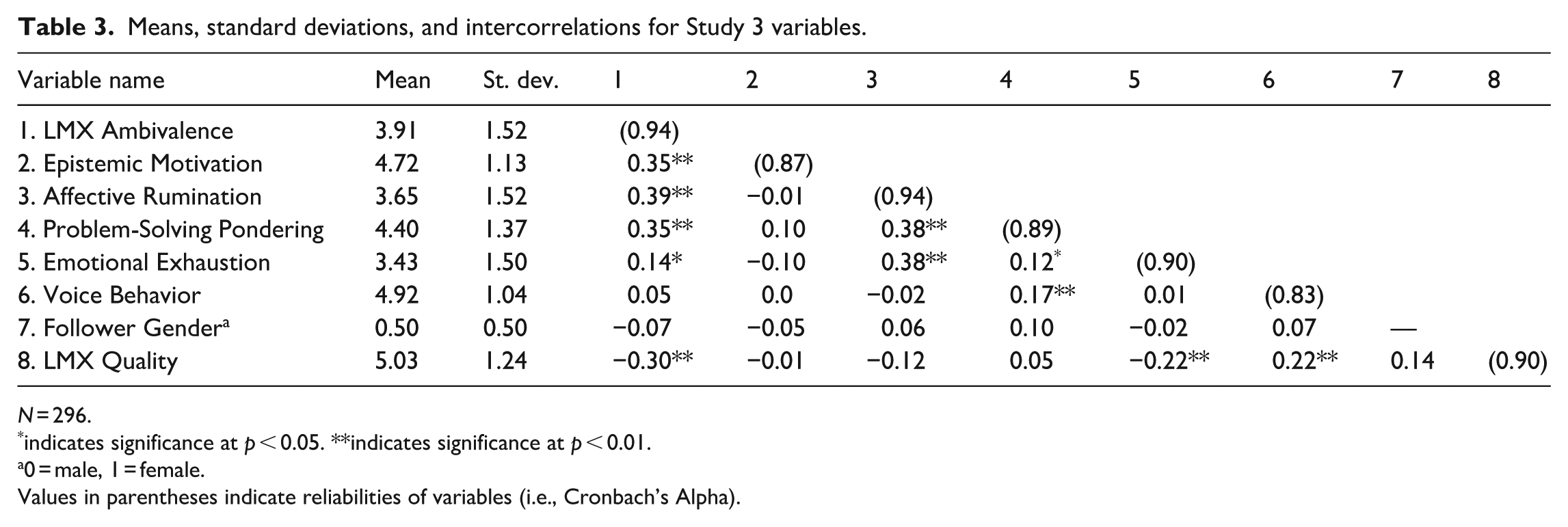
N = 296.
indicates significance at p < 0.05. **indicates significance at p < 0.01.
0 = male, 1 = female.
Values in parentheses indicate reliabilities of variables (i.e., Cronbach’s Alpha).
Discriminant validity
Given our data was nested (individuals nested within supervisors), multilevel confirmatory factor analysis (MCFA) was conducted to ensure that our study variables were conceptually disctinct. We analyzed a five-factor model, which included LMX ambivalence, affective rumination, problem-solving pondering, as well as dependent (voice behavior and emotional exhaustion) as distinct latent factors at both levels. MCFA results demonstrate adequate model fit (χ2(1936) = 2454.99, p < 0.001, TLI = 0.93, CFI = 0.94, SRMR within = 0.07, RMSEA = 0.03).
Hypothesis testing
As the participants in Study 3 were subordinates (N = 296) working in teams who shared the same supervisor (N = 30) uncorrected assessments of individual-level associations may have unknowingly included team-level effects (e.g., Bauer et al., 2006). Thus, to enable a comprehensive assessment of direct and indirect effects in our model while controlling for any effect of non-independence, we conducted multilevel moderated mediation analysis using MPlus (version 8.3).
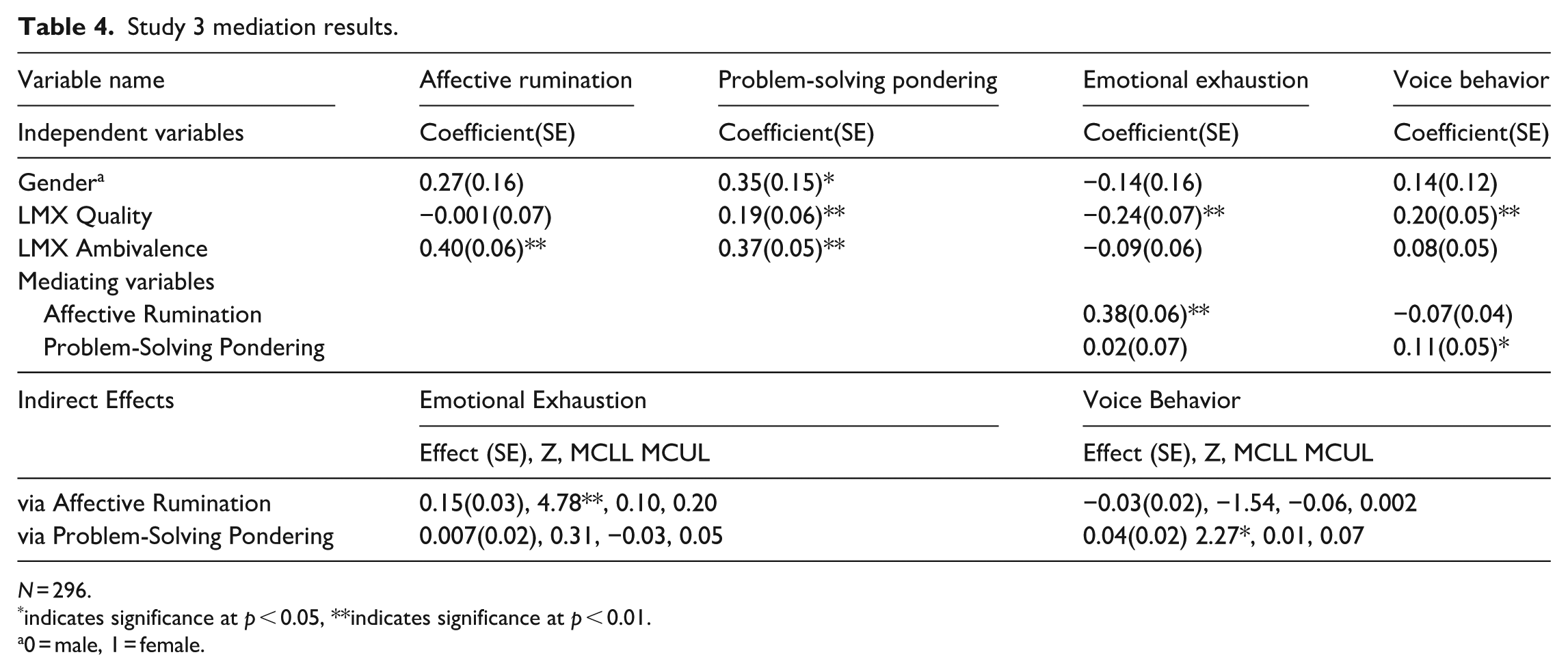
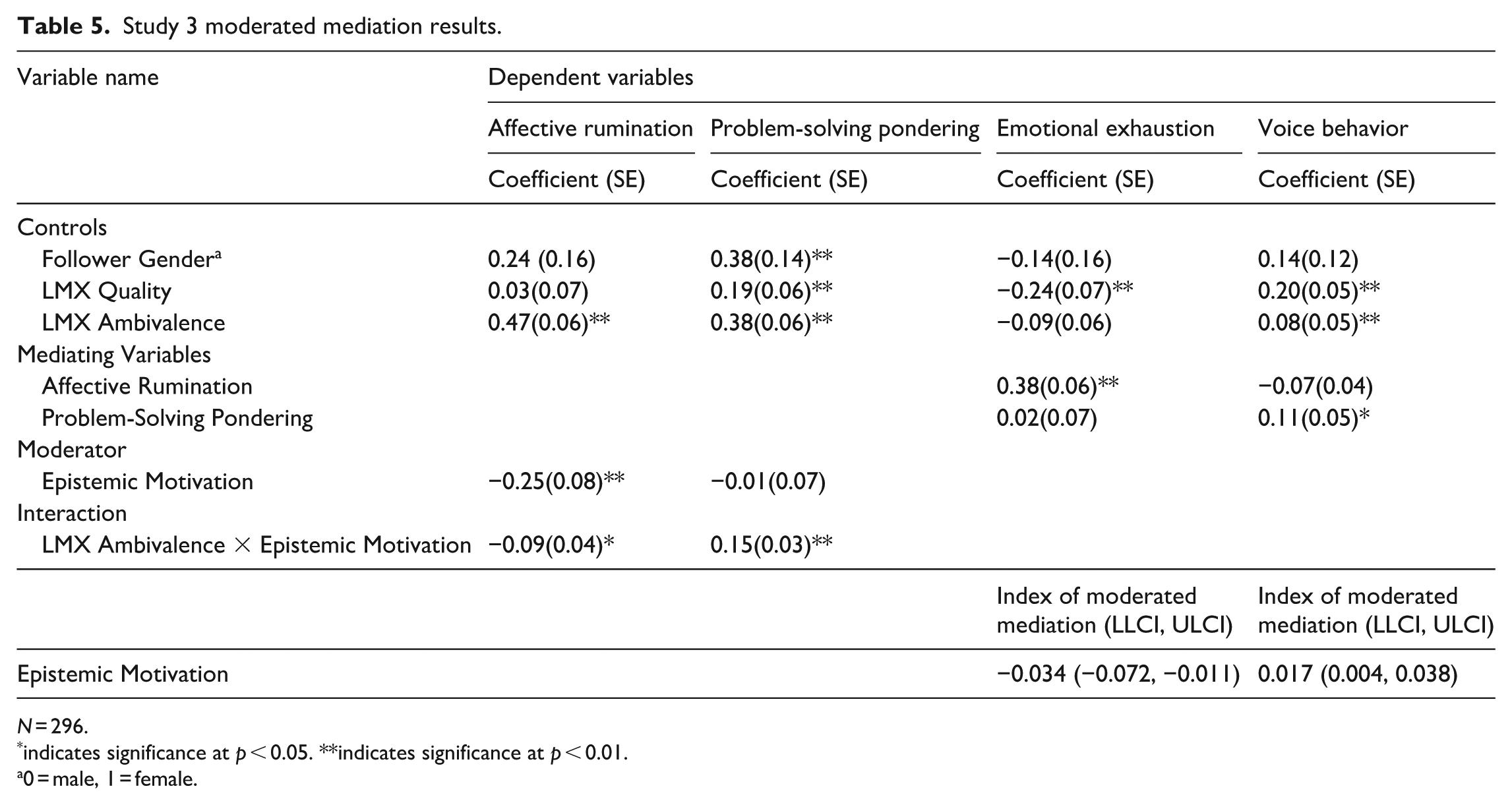
As shown in Table 4, LMX ambivalence was positively and significantly associated with affective rumination (b = 0.40, p < 0.01) and problem-solving pondering (b = 0.37, p < 0.01), supporting Hypotheses 1 and 2, respectively. In support of Hypothesis 3, we found a significant indirect relationship between LMX ambivalence and emotional exhaustion via affective rumination (b = 0.15; 95% CI [0.10, 0.20]). We also found a significant indirect relationship between LMX ambivalence and voice behavior via problem-solving pondering (b = 0.04; 95% CI [0.01, 0.07]), supporting hypothesis 4. Results from the moderated mediation analyses revealed a significant interaction between LMX ambivalence and epistemic motivation for both affective rumination (b = −0.09, SE = 0.04, p < 0.05, Table 5) and problem-solving pondering (b = 0.15, SE = 0.03, p < 0.01, Table 5).
Study 3 mediation results.
N = 296.
indicates significance at p < 0.05, **indicates significance at p < 0.01.
0 = male, 1 = female.
Study 3 moderated mediation results.
N = 296.
indicates significance at p < 0.05. **indicates significance at p < 0.01.
0 = male, 1 = female.
We plotted this interaction in Figure 2, which shows that LMX ambivalence was significantly positively associated with affective rumination, however, this relationship was weaker when followers have high epistemic motivation. Simple slopes analyses revealed LMX ambivalence was more strongly positively correlated with affective rumination when epistemic motivation was low (simple slope = 0.56, p < 0.001) than when epistemic motivation was high (simple slope = 0.38, p < 0.05). Likewise, as depicted in Figure 3, the positive effect of LMX ambivalence on problem-solving pondering was stronger when epistemic motivation was high (simple slope = 0.53, p < 0.05); LMX ambivalence was not significantly associated with problem-solving pondering when epistemic motivation was low (simple slope = 0.23, ns). The mediated effect of LMX ambivalence on emotional exhaustion via affective rumination was significantly moderated by epistemic motivation, and the 95% CI of the index of moderated mediation (Hayes, 2015) did not contain zero (−.034, 95% CL [−0.072, −0.011]). Similarly, the indirect effect of LMX ambivalence on voice behavior via problem-solving pondering was significantly moderated by epistemic motivation (index of moderated mediation (Hayes, 2015) = 0.017, 95% CL [0.004, 0.038]).
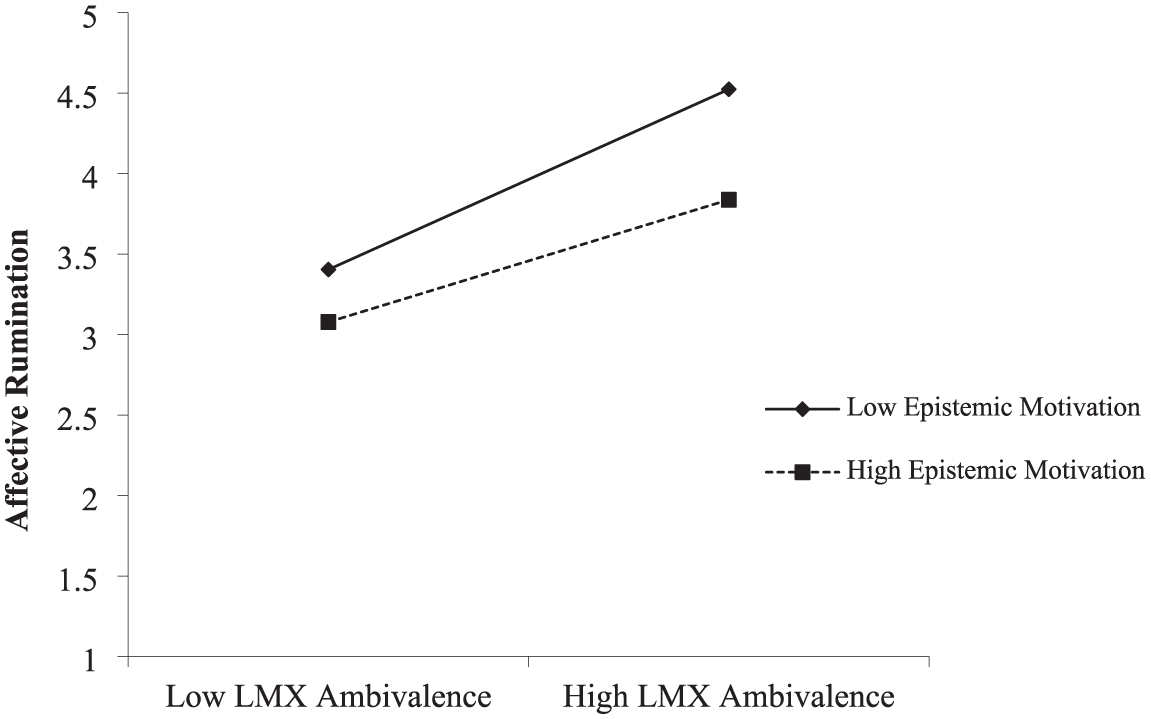
The interaction effect of LMX ambivalence and epistemic motivation on affective rumination.
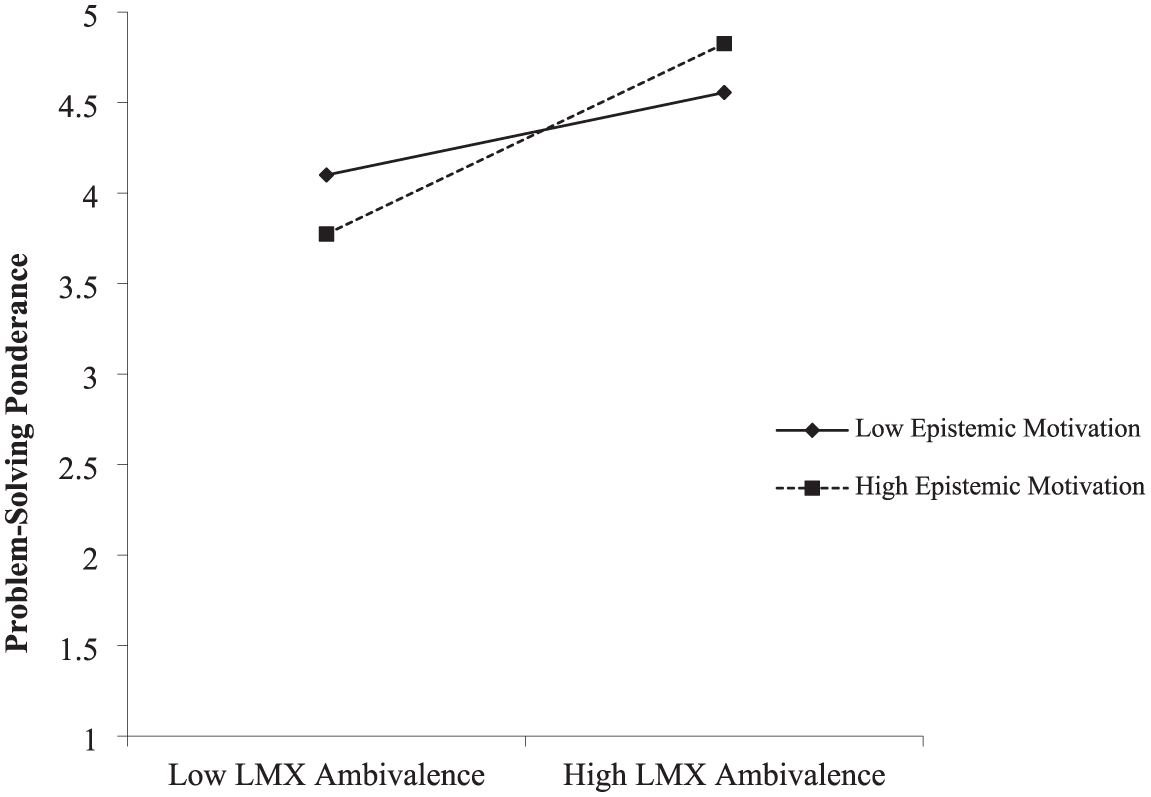
The interaction effect of LMX ambivalence and epistemic motivation on problem-solving pondering.
Study 3 discussion
The findings of Study 3, aligned with those of Studies 1 and 2, providing further support for hypotheses 1 to 4. In addition, based on the multi-source time-separated design, Study 3 found evidence for the moderating effect of epistemic motivation, thus, uncovering the conditions under which LMX ambivalence is related to distinct forms of work-related rumination according to how it is appraised and yielding support for hypotheses 5 and 6. Although some correlations differed across Studies 2 and 3, scale reliabilities were good, suggesting that these discrepancies may reflect contextual variation rather than data quality. For instance, in Study 2 (China), voice behavior was negatively correlated with both LMX ambivalence (r = −0.19, p < 0.05) and emotional exhaustion (r = −0.42, p < 0.01), whereas in Study 3 (Nigeria), these correlations were nonsignificant (r = 0.05 and r = 0.01, respectively). Similarly, LMX quality was negatively related to affective rumination in Study 2 (r = −0.37, p < 0.01) but showed no such relationship in Study 3 (r = −0.12, ns). Such differences may reflect cultural and contextual variation in relational expectations and the role of hierarchy (Rockstuhl et al., 2012; Chen et al., 2014). Importantly, these variations did not substantively alter the main pattern of results but highlight the need for greater attention to cultural context when extending stress-based models of leadership. In line with recent calls to embrace non-Western contexts in management scholarship (Wickert et al., 2024), our findings encourage future work to examine whether theories developed in Western settings can be straightforwardly applied elsewhere, thereby advancing global generalizability.
General discussion
Research on LMX ambivalence has largely emphasized its adverse consequences for follower well-being and performance. Yet, emerging evidence suggests that ambivalence may also prompt constructive outcomes such as helping, bootleg innovation, and feedback-seeking (Chen et al., 2025a; Huang et al., 2022; Mao et al., 2024). This mixed evidence highlights the need for a coherent framework to explain why and when LMX ambivalence produces harmful versus beneficial effects. Guided by the CHSF (Cavanaugh et al., 2000; Podsakoff et al., 2023), we conceptualized LMX ambivalence as an interpersonal stressor that can be appraised in both hindrance- and challenge-like ways.
Across three studies, we found that LMX ambivalence significantly predicted both affective rumination and problem-solving pondering, demonstrating its potential to be appraised as both a hindrance and a challenge stressor, respectively. Studies 2 and 3 provided evidence for the beneficial (i.e., voice) and harmful (i.e., emotional exhaustion) downstream consequences of LMX ambivalence via distinct cognitive (i.e., problem-solving pondering) and affective (i.e., affective rumination) pathways, elucidating the divergent mechanisms through which LMX ambivalence exerts its dual effects. Moreover, Study 3 highlighted a key person-centered contingency that shapes the ruminative response to LMX ambivalence, ultimately determining whether its consequences are beneficial or harmful. Specifically, higher levels of epistemic motivation weakened the indirect effect of LMX ambivalence on emotional exhaustion via affective rumination, while simultaneously strengthening its indirect effect on voice behavior via problem-solving pondering.
Although the overall pattern of results was consistent across studies, some differences warrant discussion. In Study 1, using a large online panel, the effects of LMX ambivalence on both forms of rumination were statistically significant but somewhat smaller in magnitude compared to later studies—likely reflecting the broader heterogeneity of that sample. In Study 2, conducted in China with multi-source dyadic data, we observed stronger associations with problem-solving pondering and a robust link to leader-rated voice, which may reflect cultural norms around relational interdependence and the value placed on constructive employee input. Study 3, conducted in Nigeria, replicated the indirect pathways but revealed comparatively weaker effects of problem-solving pondering on voice unless epistemic motivation was high. This suggests that the translation of cognitive rumination into proactive behaviors may be more contingent on individual traits in certain contexts. These differences underscore the value of a multi-study approach: while the core mechanisms appear robust, contextual and cultural factors, as well as sample composition and measurement source, shape the strength of effects. Rather than undermining the findings, such variation provides a richer understanding of the conditions under which LMX ambivalence exerts its paradoxical consequences.
Theoretical implications
Our findings underscore that LMX ambivalence cannot be understood solely as a maladaptive experience, as much of the existing literature has implied. Instead, it carries the potential for both harmful and beneficial consequences depending on how followers appraise and respond to it. To account for this complexity, we advance a theoretical framework that explains the dual effects of LMX ambivalence and clarifies the mechanisms and conditions under which they occur. Specifically, we contribute to existing theoretical discourse in three key ways. First, our findings establish LMX ambivalence as a discrete, hybrid interpersonal stressor and explicitly situate it within the CHSF (Cavanaugh et al., 2000). This framing adds value in two important ways. At the construct level, it advances leadership and ambivalence research by clarifying that LMX ambivalence is not simply a relational quality or exchange dynamic, but a form of stressor that requires sustained psychological effort that can deplete or mobilize resources. At the theoretical level, it provides a more parsimonious and unifying stress-based account of ambivalence’s dual consequences, in contrast to the fragmented application of diverse frameworks such as affect theory of social exchange (Chen et al., 2025a), conservation of resources theory (Huang et al., 2022), and impression management theory (Mao et al., 2024). By demonstrating how LMX ambivalence meets the CHSF inclusion criteria (LePine, 2022; Podsakoff et al., 2023)—as a demand that can constrain or facilitate goal attainment, is positively related to strain, and is conceptually distinct from existing job demands—we contribute both to a clearer understanding of ambivalence and to the refinement of the CHSF. This theoretical integration provides a foundation for a more coherent future research agenda on the paradoxical consequences of LMX ambivalence.
Second, by extending the CHSF to incorporate distinct forms of rumination, we identify the simultaneous mechanisms through which LMX ambivalence produces opposing outcomes. Specifically, we differentiate between maladaptive affective rumination, which perpetuates strain and leads to emotional exhaustion, and adaptive problem-solving pondering, which reframes ambivalence as a challenge and fosters proactive behaviors such as voice (Cropley et al., 2012). This intrapsychic perspective clarifies why the same interpersonal stressor can yield both harmful and beneficial effects. Our contribution is twofold. At the process level, we show that rumination provides the stress-related mechanisms linking LMX ambivalence to dual outcomes, thereby extending its nomological network beyond prior studies that examined only single, positively valenced consequences (e.g., Huang et al., 2022). At the outcome level, we connect problem-solving pondering to employee voice, offering a novel cognitive–motivational pathway that complements established perspectives in the constructive voice literature (Bashshur and Oc, 2015; Kim, Lam, et al., 2023). Together, these insights advance both stress and leadership research by showing how simultaneous ruminative processes can help explain the nature of LMX ambivalence.
This leads to our third theoretical contribution: identifying and testing a person-centered moderator that explains when the divergent effects of LMX ambivalence emerge and unfold. Boundary conditions help clarify when and for whom certain relationships hold (Busse et al., 2017). In our research, epistemic motivation serves as a boundary condition that determines how individuals appraise LMX ambivalence—whether as a challenge or a hindrance—leading to different outcomes. This finding helps to refine our theoretical understanding of LMX ambivalence by identifying the limits of its generalized effects. When epistemic motivation is low, followers are more likely to engage in affective-focused rumination, processing adverse events in a heuristic manner (van Kleef et al., 2009). Conversely, while LMX ambivalence typically elicits cognitive and emotional dissonance, followers high in epistemic motivation are more likely to engage in adaptive responses, employing deeper cognitive processing (Kruglanski and Webster, 1996) through problem-solving pondering. In this sense, LMX ambivalence is neither universally harmful, as previously assumed (e.g., Lee et al., 2019), nor necessarily beneficial, as recently suggested (Huang et al., 2022). Rather, its effects depend on how followers interpret it—specifically, according to their intrinsic need to understand complex situations. This finding serves to address a key tension regarding the ramifications of LMX ambivalence in the current literature, highlighting the importance of taking a person-centered perspective to further unravel its mixed effects.
Our findings also contribute to the broader literatures on employee voice and well-being. For the voice literature, we identify problem-solving pondering as a novel cognitive–motivational pathway that stimulates proactive speaking-up behavior. Existing work on voice has emphasized factors such as leader openness, psychological safety, and felt obligation (Bashshur and Oc, 2015; Morrison, 2011), but has paid less attention to the role of stress-related cognitive processes. By showing that ambivalence can trigger reflective rumination that, in turn, fosters voice, we highlight how relational stressors may serve as antecedents of constructive change-oriented behaviors. For the well-being literature, we establish affective rumination as a mechanism through which relational stress depletes resources and culminates in emotional exhaustion. While much well-being research has examined the role of job demands and affective events (Guthier et al., 2020), our findings underscore that ambivalent leader–follower relationships can be an equally potent source of interpersonal strain. Together, these insights broaden the theoretical foundations of both literatures by linking voice and well-being outcomes to the intrapsychic processing of relational stressors.
Practical implications
Our findings also offer several practical implications for organizations seeking to manage and harness the effects of LMX ambivalence. First, they suggest that leaders and followers would benefit from greater awareness that ambivalence is a normal, recurring feature of relationships rather than a sign of dysfunction. Targeted education and coaching can help leaders recognize when relationships feel ambivalent to followers, understand how this may manifest in day-to-day interactions, and develop strategies for managing it constructively. For instance, training programs could prepare leaders to clarify expectations, communicate consistently, and acknowledge tensions openly, thereby reducing the likelihood that followers dwell on negative experiences through affective rumination. Similarly, coaching could help followers set realistic expectations for leader–follower interactions and adopt healthier cognitive strategies for processing relational tensions. Such practices are vital, given that emotional exhaustion is a strong predictor of performance decrements and turnover (Wright and Cropanzano, 1998).
Second, our results indicate that LMX ambivalence is not always detrimental and can also be appraised as a challenge stressor that fosters constructive outcomes. This suggests that organizations should avoid simply trying to eliminate ambivalence and instead provide resources that enable followers to interpret such complexity more productively. Workshops on proactive coping, reflective journaling, or peer discussion groups could encourage followers to treat relational ambivalence as a developmental opportunity, channeling it into adaptive sense-making rather than strain. Because appraisal is shaped by individual differences such as epistemic motivation, organizations may also consider using assessments or self-reflection tools to help employees understand their own processing tendencies. Tailored interventions could provide support for employees lower in epistemic motivation.
Finally, our findings regarding epistemic motivation also carry important implications. Because epistemic motivation is partly dispositional, organizations might consider it in selection or placement decisions, particularly for roles that involve frequent relational ambiguity (e.g., boundary-spanning, client-facing, or matrix leadership positions). However, hiring exclusively for this trait is neither practical nor sufficient. Research shows that epistemic motivation can also be shaped by situational factors such as accountability, autonomy, and task significance (De Dreu and Carnevale, 2003). Thus, organizations can provide contextual resources—such as job designs that encourage deeper reflection, psychological safety to explore divergent views, and structured opportunities for feedback—to mitigate the negative effects of LMX ambivalence and to foster constructive coping even among employees lower in epistemic motivation. In this way, organizations can leverage both selection and development levers to manage relational stressors effectively.
Limitations and future research directions
Notwithstanding the strengths of our research (e.g., time-lagged between-person design; multi-source data), there are some important limitations to note. First, like most research that relies on correlational designs we are precluded from drawing strong causal inferences between our variables, necessitating the importance of experimental and longitudinal intervention research to directly test causality and confirm our findings. Secondly, although we examined the dual nature on LMX ambivalence on proximal stress-related employee outcomes (i.e., voice; emotional exhaustion), its downstream ramifications for the leader-follower relationship itself were not examined. More research is needed to establish the consequences of follower ruminative thinking for the ongoing and dynamic nature of the leader-follower relationship. For example, drawing on notions from prolonged activation theory (Brosschot et al., 2005), it would be important to establish if the voice behavior that follows problem-solving pondering subsequently serves to reduce perceptions of LMX ambivalence from both leader and follower perspectives, over time (Park et al., 2015). Relatedly, our study design could not establish if the content of follower voice behavior sought to address the issue of LMX ambivalence, per se (e.g., voicing suggestions on how to improve the relationship), versus targeting general work challenges—which may (or may not) have had direct implications for the leader-follower relationship. Given that ambivalence elicits punctuated responses that may “alternate between love and hate by viewing the relationship target totally positively today, but totally negatively tomorrow” (Pratt and Doucet, 2000: 219), it seems plausible that voice behaviors emerging from problem-solving pondering may be directed elsewhere in the organization, for example, forging a high quality relationship with an alternative leader (or work group), with whom the follower perceives a better “fit.” Future research should, therefore, seek to isolate the content of work-related rumination and examine the extent to which it is relatively stable over time (see Kinnunen et al., 2019) or shows daily fluctuations (see Junker et al., 2021, 2025).
Finally, a central aim of our research was to position LMX ambivalence within the CHSF. Our research provided an initial test of some of the key assumptions of the framework, but we encourage further tests of this perspective. For instance, it would be worthwhile for future research to explicitly examine whether LMX ambivalence is appraised as a challenge or hindrance stressor by those experiencing it, and to identify the personal and contextual moderators—such as psychological safety or organizational culture—that shape these appraisals. Importantly, while our study theorized that such appraisals underlie the emergence of different forms of work-related rumination, we recognize that rumination itself is not a direct measure of appraisal but rather a coping response that is likely shaped by it. Future research could benefit from simultaneously measuring both appraisal and rumination in order to disentangle more precisely how evaluations of ambivalence translate into coping mechanisms and outcomes. Moreover, while proactive voice is a key positive outcome, other potential benefits of LMX ambivalence such as creativity, resilience, and adaptability warrant further attention to generate stronger evidence for its positive consequences. Extending this line of inquiry, future work could also adopt a more nuanced view of rumination as a mechanism. Although our model emphasized affective rumination as a hindrance pathway and problem-solving pondering as a challenge pathway, empirical research indicates that both forms of rumination may yield either positive or negative outcomes depending on context. Affective rumination is typically associated with fatigue, burnout, and poor recovery (Querstret and Cropley, 2012; Hamesch et al., 2014), yet in some cases surface-level appraisal may conserve resources through disengagement rather than depletion (Cropley et al., 2012; Demsky et al., 2018). Similarly, while problem-solving pondering has been linked to creativity, engagement, and proactive behavior (Vahle-Hinz et al., 2017), it can also become taxing under high workload conditions, interfering with sleep and increasing fatigue (Kinnunen et al., 2017; Syrek et al., 2017). This raises the intriguing possibility of cross-over effects, whereby ostensibly constructive coping responses (e.g., problem-solving pondering) may under certain circumstances deplete resources and contribute to strain, while emotional coping responses (e.g., affective rumination) may in rare cases facilitate distancing or disengagement that conserves energy. Future research could investigate the conditions under which these cross-over effects emerge, thereby advancing a more dynamic account of how ambivalence-related stress unfolds. Such investigations would provide a fuller picture of the nature of rumination within the CHSF framework.
Supplemental Material
sj-pdf-1-hum-10.1177_00187267251392384 – Supplemental material for Can’t get you out of my head: The stress-driven dual effects of LMX Ambivalence
Supplemental material, sj-pdf-1-hum-10.1177_00187267251392384 for Can’t get you out of my head: The stress-driven dual effects of LMX Ambivalence by Allan Lee, Joanne Lyubovnikova, Jakob Stollberger, Geoff Thomas, Yu (Jade) Han, Gary Schwarz and Jie Cao in Human Relations
Footnotes
Acknowledgements
None
Funding
The authors received no financial support for the research, authorship, and/or publication of this article.
AI usage declaration
The authors acknowledge that they have followed Human Relations’ AI policy. Accordingly, AI was used only for copy editing or proofing the manuscript.

Supplemental material
Supplemental material for this article is available online.
Notes
References
Supplementary Material
Please find the following supplemental material available below.
For Open Access articles published under a Creative Commons License, all supplemental material carries the same license as the article it is associated with.
For non-Open Access articles published, all supplemental material carries a non-exclusive license, and permission requests for re-use of supplemental material or any part of supplemental material shall be sent directly to the copyright owner as specified in the copyright notice associated with the article.
