



Abstract
Frontline workers who occupy public-facing, non-managerial roles are critical to the ongoing sociotechnical accomplishment of safety in complex systems, yet their role is often overlooked in relation to organizational safety programs, protocols, and training. In this paper, we examine how frontline workers make judgments about potential hazards during routine work and how they respond to organizational directives that contravene their expertise. Drawing on interviews with train drivers working for private franchises in the United Kingdom, our findings show how frontline workers’ safety culture and unique embodied knowledge constitute their epistemic authority which ultimately supports robust safety voice and listening in a complex sociotechnical system. We show how train drivers are subject to extensive organizational controls that are meant to realize safety, but that in practice these controls are insufficient for responding to the incidents that occur on the tracks. These findings offer insight into how frontline workers draw on occupational authority to uphold a societal mandate for safety.
Keywords
Although safety has long been conceptualized by organizational scholars as a sociotechnical accomplishment involving coordination among multiple actors (Almond and Gray, 2017; Evans and Silbey, 2022; Gherardi and Nicolini, 2000; Silbey, 2009), it is also instantiated in directives that push responsibility down to “individual actors, the lowest-level actors, with least authority, in the organizational hierarchy” (Silbey, 2009: 343). These directives are problematic when adopted by organizational managers and policymakers because they imply that safety incidents can be attributed to individual errors rather than systemic failings (Chikudate, 2009; Hutter, 2001). Yet, institutional directives to prioritize safety can also become opportunities for actors to exercise their judgment about how these mandates should most effectively be realized in practice. For example, studies have shown how powerful occupations, such as scientists, co-opt and translate safety regulations to align with their professional work practices (Bruns, 2009; Evans and Silbey, 2022). In these occupational communities, members collectively ensure safety through socialization, observational learning, and interpretive work to turn abstract rules into enforceable safety behaviors (Evans and Silbey, 2022; Gherardi and Nicolini, 2002). However, because these studies have been conducted in contexts that feature co-located work and high mutual visibility, we know less about how frontline workers who operate in isolated or customer-facing contexts nevertheless behave in accordance with a safety culture aligned with their occupational norms and practices. Furthermore, prior literature offers few insights about how frontline workers might effectively challenge organizational directives that do not cohere with their collectively held definition of safe practice, or what resources they might draw on to do so.
The concept of frontline work generally captures non-managerial roles in which workers interact with customers or the public. Some examples of frontline roles highlighted in prior research include doctors, airline flight attendants, museum guides, and emergency responders (Balogun et al., 2015; Hochschild, 1983; Karunakaran, 2024; Wilhelm et al., 2020). These studies illustrate how frontline workers help to deliver organizational strategies through skillful interaction with customers and other audiences, who are enrolled into the interaction order of the setting through frontline workers’ physical and social cues (Balogun et al., 2015). However, frontline workers may also be subject to scrutiny and oversight from both managers and audiences outside of their organizations—and therefore balance an imperative to act autonomously “at the coalface” when performing their tasks while responding to these disciplining forces that operate at a remove from the work itself (Karunakaran, 2024; Wilhelm et al., 2020). In the context of research on safety culture in organizations, frontline workers have long been acknowledged as crucial carriers of the norms and assumptions that support safe practice (Silbey, 2009), but the mechanisms through which they uphold an occupational safety culture that is nested within a broader field of safety regulation and oversight is not as well understood. This lacuna may exist in part because much prior research focuses on failures of safety culture rather than the relatively less visible practices that sustain strong safety records (e.g., Vaughan, 1996).
In the existing literature, the concepts of “safety voice” and “safety listening” offer an important precedent for understanding how frontline workers might respond to perceptions of unsafe working conditions and play a critical role in upholding field-level safety standards in sociotechnical systems. Safety voice captures the act of speaking up to prevent physical harm from hazardous situations (Bienefeld and Grote, 2012). Studies that examine the antecedents and practice of safety voice have linked this behavior to concepts such as individual personality, power distance in organizations, and the legal requirement to report malpractice in healthcare settings (Noort et al., 2019). However, safety voice as a concept is typically limited to those moments in which actors raise an alarm in response to a perceived safety risk—it does not fully capture how employees negotiate with and assert their concerns with other stakeholders in a socio-technical system. In addition, although one study has shown that peer support mediates the likelihood of bus drivers reporting hazards to their employers (Tucker et al., 2008), the literature on safety voice lacks a discussion of mechanisms that might explain how and why frontline workers speak up and challenge their employers when they perceive potential hazards while engaging in safety listening, and how other actors may be compelled to respond to their concerns.
Given this lacuna in the scholarly conversations on both safety culture in organizations and safety voice and listening in sociotechnical systems, we address the following research question in this paper: How do frontline workers uphold an occupational safety culture in both routine work and when faced with directives that contravene their safety judgments? To explore this question, we draw on the case of frontline workers who work in isolation but belong to a powerful occupational community: train drivers employed by private rail franchises in the United Kingdom, which operate for-profit passenger and freight services using the public infrastructure of the national rail network. Specifically, the train drivers in our study assume responsibility for passenger safety while responding to the demands for efficiency and delay avoidance from the franchises. We show how, in this multi-stakeholder sociotechnical system, drivers assert their judgment in moments of potential hazard, a practice that reflects multiple forms of knowledge—from rules to changing track conditions, to rituals for maintaining attention. We find that drivers generate epistemic authority—perceived expertise and trust in an actor who relays information (Riaz et al., 2016)—from a unique combination of embodied and institutional knowledge, which supports their ability to make sense of ambiguous information from the environment, and ultimately their safety voice.
According to official statistics published by Britain’s Office of Rail and Road (ORR) in 2022, Britain’s railways ranked first in Europe for “whole society” safety risk which combines the overall average number of fatalities and serious injuries across five risk categories for passenger, employee, level crossing user, trespasser, and other risks (ORR, Common Safety Indicators Statistical Release, 2023). Moreover, Britain’s railways have ranked among the safest in the world since 2010 and the network is considered the safest in Europe when compared to networks of a similar sizei. This ongoing accomplishment suggests that Britain’s rail network has succeeded in developing an exceptionally strong safety culture formalized through a system of regulatory oversight.
Building on prior studies of safety culture in occupational communities (Evans and Silbey, 2022; Gherardi and Nicolini, 2000, 2002), safety voice and safety listening (Noort et al., 2019; Pandolfo et al., 2024), and occupational authority in organizations (Hughes, 1971), we develop theory about novel antecedents and practices for realizing safety in sociotechnical systems. We draw on 46 interviews, observation of driver training, and extensive secondary materials to explain how systems that depend on isolated frontline workers prevent hazards from becoming deadly accidents. That is, by highlighting a potentially “hidden link” between occupational culture and expertise, frontline work, and safety voice and listening in sociotechnical systems, this study contributes another perspective on how societal safety mandates are realized in practice.
The limits of safety voice and the antecedents of safety culture
Past accounts of safety in high-reliability systems have often focused on accidents, disasters, or other perceived failures of safety culture (e.g., Barton and Sutcliffe, 2009; Chikudate, 2009; Davidson, 1990; Jasanoff, 1994; Petryna, 2013; Shrivastava et al., 2009; Vaughan, 1996, 2004, 2006). Many of these studies illuminate the organizational decision-making cultures and chain of events that may have caused these incidents, pinpointing moments when decision-makers ignored critical warnings (Vaughan, 1996).
More broadly, organizational safety culture is defined as “the attitudes, beliefs, perceptions and values that employees share in relation to safety” (Cox and Cox, 1991: 93). In practice, safety culture is often instantiated through worker compliance with rules and regulations within organizational systems (Luria and Rafaeli, 2008; Nichols, 1998; Rispler and Luria, 2021). Although analyses of organizational attempts to institutionalize safety (e.g., Hutchinson et al., 2022; Rispler and Luria, 2021) suggest that safety training programs are common, these prior studies do not offer a complete account of how managers and employees negotiate safety “on the ground” in incidents that involve ambiguous hazards or conflicting directives which require discerning between urgent and routine safety cues from the environment.
Studies suggest that organizations contain heterogeneous beliefs about safety which shape how members perceive organizational safety mandates (Luria and Rafaeli, 2008). For example, Clarke’s (1998) survey research of train driver’s, manager’s, and senior manager’s attitudes about safety showed that train drivers rate managers as being less committed to safety than they are. In general, when employees viewed their employer as having a “low organizational safety climate,” they were less inclined to view safety interventions as authentic (Rispler and Luria, 2021). These studies highlight how beliefs about safety might more usefully be conceptualized at the occupational or role level, rather than as a property of an organization, especially when occupational members may need to challenge organizational actors who hold competing priorities (Barley and Tolbert, 1991; Barnes et al., 2023).
Indeed, a few studies have highlighted how occupational cultures—for instance, those of laboratory scientists and wildland firefighters—enable a measure of autonomy and reflexivity about what individuals should do to enact safety through their ongoing work practices (Barton and Sutcliffe, 2009; Bruns, 2009). Ethnographic studies show how resilient safety cultures are socially situated and reinforced by broader occupational control processes. For example, in their study of construction workers, Gherardi and Nicolini (2002) show how novice members of a construction crew learn how to maintain safe practices in dangerous work, such as building demolition, through observation, emulation, verbal feedback, and other forms of social habituation through interaction with more experienced members of the community. In their study of a bioscience laboratory, Evans and Silbey (2022) show how members expand the scope of safe practices to account not only for risks the regulators have identified (body and environment) but also those they have overlooked (work tasks and collegiality) as a result of being outside the professional community and therefore drafting regulations at a distance from the work itself. In doing so, these scientists preserve their professional control over how work is carried out and craft a locally resilient and effective safety culture. However, although these studies offer nuanced findings about how safety demands are enacted and institutionalized in technically complex work through organizational and occupational control processes, they do not explain how enacting safety may stem from the decisions of frontline workers who bring their judgment to bear to engage in safety voice or listening in response to both routine and urgent cues from the environment.
By contrast, studies of safety voice suggest a plethora of antecedents for when and why individuals might speak up when they observe a potential hazard, but with just a few exceptions, do not link these factors to occupational control processes (c.f., Noort et al., 2019). Several insights from this literature are salient to our study. First, voicing safety concerns is insufficient—the recipient of the warning must engage in “safety listening” as well, as a study of cockpit voice recordings in aviation accidents reveals (Noort et al., 2021). The researchers found that in all but 2 accidents in their dataset covering 172 aviation accidents, crew members voiced safety concerns—and it was the responses to those concerns that determined the course of the accident (Noort et al., 2021). Second, peer support mediates the likelihood of engaging in safety voice, as shown in a cross-sectional survey study of urban bus drivers in the United Kingdom (Tucker et al., 2008). The findings from this research stop short of suggesting antecedents of collegial support for safety, but they nevertheless highlight the important influence of occupational peers. Finally, role demands are correlated to different reasons for not voicing safety concerns, as shown in a study of flight attendants, pursers, first officers, and captains of airline crews (Bienefeld and Grote, 2012). Flight attendants, captains, and first officers were more likely to cite relational concerns related to embarrassing or angering their purser or co-pilot, respectively, while pursers (who are in charge of overall cabin operations) cited the tension between voicing a safety concern that could delay a flight and having to face consequences for those delays in the event they are wrong. As one purser in the study conveyed, “We all know that when it comes down to business, all that counts is on-time departures. If I had delayed that flight [. . .], there could have been a report from the captain” (Bienefeld and Grote, 2012: 5). This study suggests that occupational group membership shapes the varying rationales that airline crew members convey for not voicing safety concerns but does not explain how occupational members may differentially identify and speak up about potential hazards. Although peer support may be one important resource developed in occupational communities, many occupations also claim a broader expertise-based mandate to carry out their work—which they enact through demonstrations of appropriate work practices in relation to values such as professionalism, care, and customer orientation (Fayard et al., 2017). To understand how train drivers uphold safety mandates by drawing on their expertise, we turn to the literature that examines how these workers more generally defend their right to assert their authority and knowledge in organizations.
Epistemic authority in frontline work
In most contemporary organizations, decision-making authority is shared among multiple actors who each possess a form of knowledge-based authority or epistemic authority to “make decisions in reaction to local-level contingencies encountered when carrying out work duties” (Benoit-Barné and Fox, 2022: 3). Yet, unlike organizational settings in which work occurs through regular interactions that sustain a clear negotiated order in which rules are enforced or ignored in close collaboration (Strauss et al., 1963), in many frontline work contexts, authority is distributed and “pushed down” to individuals who act under time pressure to defend their judgment in situations of risk or uncertainty (Benoit-Barné and Cooren, 2009; Benoit-Barné and Fox, 2022; Silbey, 2009).
Although the research on how frontline workers develop epistemic authority is sparse, prior work on how occupational communities defend their authority through the continuous maintenance of multiple forms of technical and normative knowledge provides some hints about how they might do so (Van Maanen and Barley, 1984). For example, stem cell scientists developed expertise in moral frameworks to have a voice in moral debates about stem cell research, and to control how their work practices were interpreted in the face of public controversy (Evans, 2021). The relationship has also been shown to work the other way—experts who fail to develop requisite technical knowledge may weaken their claim to determine what is right and wrong. Barley (1986: 93) shows how “radiologists’ moral authority tarnished” in the eyes of technologists when they displayed continuing ignorance about how newly introduced CT scanners should be operated: “technologists formulated the view that the radiologists knew less than they rightfully should and that their ignorance created unnecessary work and kept the CT operation from running smoothly.” That is, in addition to their epistemic authority, the moral authority of these groups is often contingent on their technical knowledge. As Hughes (1971: 287) suggests, “if people in the occupation have any sense of identity and solidarity, they will also claim a mandate to define—not merely for themselves, but for others as well—proper conduct with respect to the matters concerning their work.” Occupational values stem from and help reinforce a group’s mandate in relation to their role in society (Samuel and Lewin-Epstein, 1979). These values are often closely linked to the particular work that occupations perform—for instance, whether work is oriented to caring for others or administering justice will be reflected in an occupational community’s espoused values (Dunkerley, 1975).
When this right to determine proper conduct is challenged, occupational members may be able to draw on other sources of authority or influence. For example, studies show how technical occupations invoke regulations, professional bodies (such as ethics committees), and other “agents” whose powers can be “embodied” or “incarnated” by the focal actor to defend their claims in complex organizations (Benoit-Barné and Cooren, 2009: 14; Riaz et al., 2016). Prior research also illustrates how lower-power professionals draw on relational tactics that combine their particular expertise-based authority, with informal knowledge about their clients’ or superiors’ priorities, values, or work contexts to accomplish their objectives (Barnes et al., 2023; DiBenigno, 2022; Thomann et al., 2018). However, as the majority of this research has been conducted in collocated, hierarchical, organizational contexts, the literature is still missing an explanation for how some frontline workers—who work at a remove from their managers and other stakeholders—may assert their epistemic and occupational authority to uphold safety as a core value. In this paper, we examine how train drivers invoke multiple sources of expertise that allow them to challenge or override directives by exercising a safety voice and enforcing safety listening, thereby upholding their occupational and societal mandate.
Setting and methods
Empirical context: Train drivers and the UK rail network
The UK rail network is a mature, safety-critical industry (Clarke, 1999). The history of how UK rail safety culture has developed over decades has been punctuated by a few major railway accidents (Clarke, 1998, 1999; Hutter, 2001). Among the major accidents on the UK railway, two stand out as defining how safety culture in the UK has developed in the past 40 years: the 1988 accident at Clapham Junction, and the 1999 Ladbroke Grove accident in Paddington. Both accidents led to the deaths and injury of passengers and have since produced important lessons in safety culture failure in the British rail network. The Ladbroke Grove accident incited a public inquiry resulting in the creation of the Rail Safety and Standards Board (RSSB) in 2003. Since 2003, the RSSB has governed safety standards on UK railways, overseeing a fragmented organizational landscape that involves both public and private organizations (see Table 1 for an overview of the organizations and their roles in the railway industry).
Organizations in the UK rail industry.
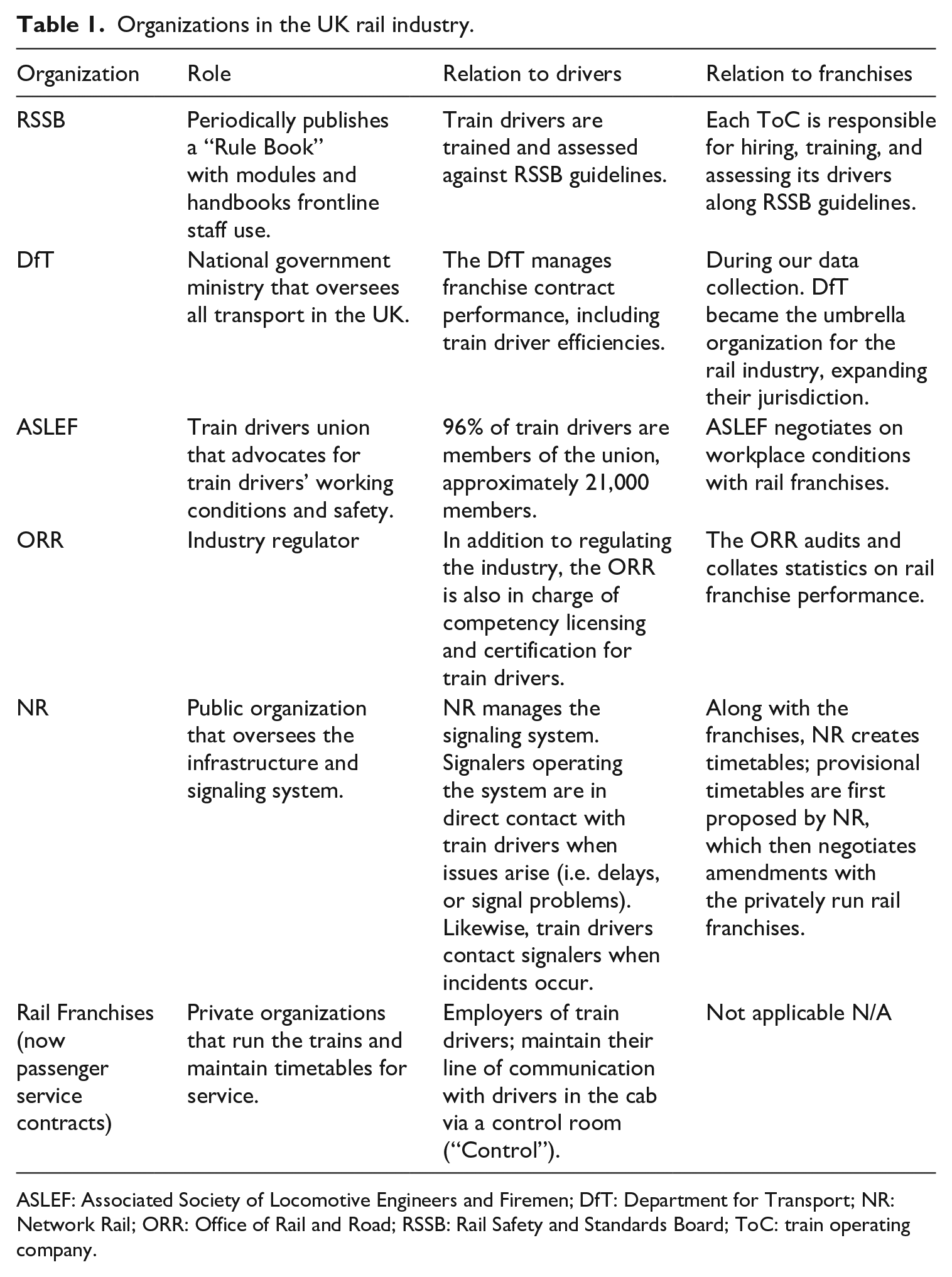
ASLEF: Associated Society of Locomotive Engineers and Firemen; DfT: Department for Transport; NR: Network Rail; ORR: Office of Rail and Road; RSSB: Rail Safety and Standards Board; ToC: train operating company.
Train drivers are unionized through the Associated Society of Locomotive Engineers and Firemen (ASLEF), which has approximately 21,000 members and an occupational density of 96% and is considered one of the most powerful unions in the United Kingdom. The rail sector as a whole is governed by the Department for Transport in conjunction with Network Rail (NR), a public organization that oversees the infrastructure and signaling system. Since the 1993 Railways Act, the rail franchise system in the United Kingdom has been part-privatized, under the assumption that private rail companies will better meet efficiency targets in a competitive market. 1 The trains are run by for-profit franchises (e.g., Great Western Railway, Virgin). There are 28 franchises or train operating companies in the UK contracted to run services on public infrastructure managed by NR. NR is responsible for communicating and coordinating information between train drivers and franchises via the signal room, which drivers refer to as “the signaler.” Similarly, franchises maintain their line of communication with drivers via a control room, which drivers refer to as “control.” Drivers work according to shifts and schedules issued to them by their home depots. Drivers refer to their schedule as a “diagram.” ASLEF’s Health and Safety Charter demands that train drivers work on average no more than 32 hours over 4 days a week and has called for the “elimination of institutionalized overtime” in the industry. 2 Train drivers’ schedules must also incorporate rest days (when they do not drive at all) to allow for physical and mental recovery. These calculations are referred to as maintaining a “fatigue index” for drivers. Fatigue in particular is a focal point for risk mitigation within rail safety culture. Alongside ASLEF’s guidelines around train driver fatigue are guidelines published by the RSSB as well as guidelines published by the industry regulator, the ORR. Safety is regulated at the interface of these organizations (i.e., the RSSB, ASLEF, and ORR).
While depots implement diagrams for train drivers, NR is expected to negotiate train timetables twice a year with the franchises. Creating these timetables also reflects NR’s mandate to maintain enough capacity on the rail lines to ensure that the public’s transportation needs are met. When trains are running normally, NR and the franchises work together to maintain safe, reliable, and efficient operations. However, in the event of service delays, the signaler and control have different priorities which can be in conflict. For example, franchises have an economic incentive to avoid delays because delays result in monetary fines which can harm their profits. As a result, franchises often try to attribute delays to NR, to avoid both blame and fines. Delays or cancellations are often attributed to safety concerns. For instance, if a pedestrian trespassed onto the tracks, drivers must stop and often the area must be searched to avoid injury. Other reasons for delays could be faulty equipment on the trains themselves. However, the attribution of a delay is regularly in dispute between NR, which oversees the infrastructure, and the franchises that operate the trains. If a delay is attributable to infrastructure concerns, NR would normally pay the fine for the delay. By contrast, if a driver cites a fault related to the train’s operation, the franchises would likely have to pay all, or part of a fine. Both NR and the franchises employ delay attribution teams that carry out investigations, checks, and negotiations about who is at fault. NR as a public body is less concerned about fines than franchises, as they receive funding from the state; however, NR will contest a delay attribution if they believe a franchise is at fault. Despite the potential for disagreements due to these differing organizational priorities and incentives, NR, the franchises, and drivers share a common mandate from the state, regulators, and unions to ensure safety.
Safety is, unsurprisingly, a strongly asserted priority of the franchises. Train drivers are monitored through onboard technology consisting of automatic warning systems and driver safety devices (DSDs). Some in the occupation refer to such technology as “human factor devices.” This onboard technology regulates the attention of the driver by demanding vigilance through repetitive actions, ensuring the presence and attention of the driver while maintaining surveillance of the driver through finely tuned data points related to the train’s movements. For example, there is a foot pedal—what some drivers refer to as a “dead man’s switch”—to which the driver’s foot must apply constant pressure while driving. Another DSD is on the dashboard near the driver’s switch. This DSD is a button that must be regularly pressed when a vigilance buzzer is triggered at a different pitch. Within seconds of this buzzer sounding, the driver must swiftly press this button or risk the train coming to a halt and causing delays. The franchises also employ “driver managers” to inspect drivers’ fitness to work before their shifts begin. Specifically, driver managers inspect drivers for signs of drug and alcohol consumption and ensure the driver is mentally and physically prepared for their shift. Driver managers also regularly meet with drivers to chat with them about their health. Driver managers build a personal relationship with the drivers they are monitoring, so they can better spot signs of depression, anxiety, or simply unusual cues. Following these conversations, driver managers may opt to liaise with occupational health if drivers have a medical issue or are taking prescribed medication that could potentially affect their mental or physical state. At the same time, driver managers are expected to maximize the availability of train drivers in relation to diagrams. Driver managers also periodically assess their drivers’ performance during shifts by pulling “driver downloads”—which show data that track all the train movements a driver makes, including the timings of stops and departures. These data are then analyzed by the driver manager and discussed with the driver to monitor their performance and ensure they are driving according to the rules. These discussions then feed into how a driver manager manages his or her team and optimizes their performance, in turn optimizing the efficiency of the train service.
All of these practices are organizational efforts to ensure a safe service for the public, but in many cases, they simultaneously work to realize the financial imperatives of the franchises. Assessing driver downloads not only captures a driver’s safety performance but also helps to closely monitor their efficiency, which then helps to avoid fines for late services. As our data will illustrate, drivers experience pressure from franchises to resume service to avoid incurring fines. Disruptions and delays can be caused by a myriad of factors—among them weather, mechanical problems, and unexpected events (e.g., suicide attempts by track trespassers). Most of these factors are outside the control of both the franchises and the drivers. However, in general, only drivers have direct contact with the conditions on the tracks. As we go on to show, how an overarching safety mandate is realized partly depends on how these frontline workers negotiate these competing demands by drawing on their epistemic authority to assert their judgments in moments of potential hazard and prevent deadly accidents.
Data collection
The data collection initially followed an inductive approach to understanding the “life-worlds” (Suddaby, 2006: 635) of train drivers, who belong to a powerful occupation within a safety-critical industry. The sample eventually comprised a total of 46 interviews with train drivers employed by multiple franchises, driver managers, customer managers, and directors of franchises (see list of participants in Supplemental Material to the study). We conducted data collection in 3 phases over a 12-month period, completing 10 interviews in phase one, 35 interviews and observations in phase 2, and 1 interview in phase 3. Initially, the first author recruited participants employed by 1 franchise, conducting 10 semi-structured interviews with train drivers and managers, before seeking out additional informants who worked for other franchises through snowball sampling that involved referral chains between several key participants (Robinson, 2014).
In phase 1, our inductive approach (Edmondson and McManus, 2007) was driven by an initial research question that asked how train drivers as an occupational community work within a safety-critical industry that is experiencing increasing technical and automated controls. Our interviews were semi-structured (Charmaz, 2014) and involved careful listening as well as comprehensively signaling our understanding of participants’ work by taking notes, drawing diagrams, and repeating back what participants reported (Lavee and Itzchakov, 2023). The interviews lasted 1 hour on average and were recorded and transcribed verbatim. Throughout the data collection process, we asked participants a set of open-ended questions and modified the interview protocol between each round of data collection to include additional questions about emerging themes (Spradley, 1979). For example, all informants were asked to describe their role and their tenure, how they interacted with other roles in the NR system, and how they responded to safety incidents or delays to service.
In the second phase of data collection, we conducted informant checks (Lincoln and Guba, 1985) by asking participants for examples of situations in which drivers faced risks and how they responded to those risks; eliciting mock scenarios to understand in detail what drivers would do or say; asking how drivers justified their responses or challenged their franchise; and probing how drivers collectively understood their safety mandate. The first author was also trained on a 700-class simulator and observed the training between an experienced driver manager and novice train driver. This observation and direct experience on the simulator provided important grounded understandings of the work life of the train drivers and the physicality of their role. After completing the second round of data collection, we re-coded the full data set and developed a set of axial codes that organized the observations from the open coding into more analytically informed categories. In the final phase of data collection, we conducted a much longer interview with a key informant to confirm whether our model was consistent with the experiences and observations of members of the occupational community.
Data analysis
Our initial analytic approach focused on cataloging the practices that comprise the safety culture in our setting. Between the three phases, we reviewed the literature (e.g., Evans and Silbey, 2022; Gherardi and Nicolini, 2000, 2002) and used analytic techniques such as open coding and memo-writing processes to guide subsequent data collection (Charmaz, 2014; Corbin and Strauss, 2008). In doing so, we identified a possible anomaly that formed the basis for further investigation: in contrast to what prior studies of organizational safety culture have shown—that rules and regulations are enforced in a “top down” manner and employees are censured for non-compliance—we noted in open coding that there were multiple instances of the train drivers quoting the rulebook and enforcing compliance with the rules from their position as frontline workers. Following this observation, which suggests that safety trainings, rules, and disciplinary measures are necessary but insufficient to explain how safety culture is maintained, we took an abductive approach to theorizing, focusing not only on cataloging safety practices, but explaining why this anomaly was so apparent in this setting (Sætre and Van de Ven, 2021).
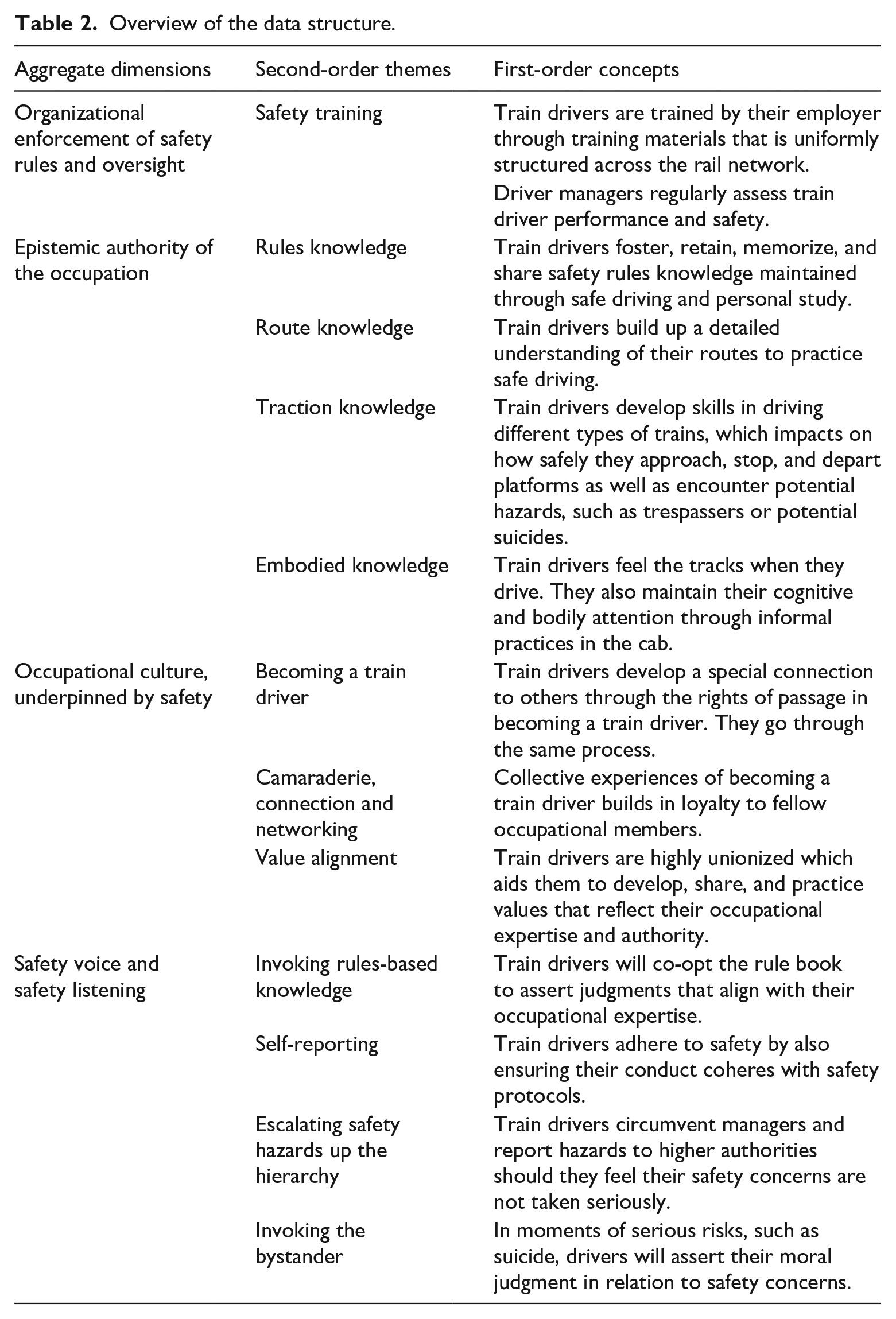
We then open coded the data corpus (46 interviews) to account for train drivers’ rules knowledge, route and traction knowledge, embodied knowledge about fatigue signals, and habits for maintaining attention (see Table 2). In open coding for these attributes of safety culture, we also generated a specific and detailed list of knowledge-sharing and socialization practices in the occupational community. We also coded the specific instances in which train drivers and control negotiated to resolve safety concerns on the tracks. We used tables to classify these incidents according to how the safety hazard was identified, and how the driver and/or controller reported handling it. We then wrote analytic memos connecting these findings to existing literature on safety culture, safety voice and listening, and occupational authority. This coding process helped us to iteratively identify patterns and linkages, that eventually led us to bundle our codes into more abstract second-order and aggregate themes (Locke et al., 2022). Once we identified a key finding—for example, that train drivers saw themselves as the authority on safety on the tracks and interpreted and acted on directives from control from this perspective, we then set out to abductively analyze what mechanisms support train drivers in asserting their occupational authority in this setting. We reached “theoretical saturation” (Glaser and Strauss, 1967: 65) after the third round of data collection. We then developed our narrative account of how train drivers develop expertise in making judgments about routine and urgent safety information, and how this expertise guides their interactions with other stakeholders within the system.
Overview of the data structure.
Findings
As prior research suggests, exercising safety voice does not guarantee that potential hazards will be addressed by other actors within a sociotechnical system (Bienefeld and Grote, 2012; Noort et al., 2019). In our data, train drivers recount how they exercise safety voice—in the form of pointing out hazards or anomalies that they observe during a service—but do not always garner a response from controllers that they deem proportionate. As one driver commented, “I’ve had situations where they’ve [control] basically said, no, you’re alright to carry on [despite a hazard]” (Interview 36). In other scenarios, drivers engage in safety listening when they interpret a potentially dangerous situation on the tracks—most commonly related to potential trespassers. For example, as one driver recounted: It was late at night—and there was clearly a distressed lady under the influence of alcohol on the platform. There was a platform member of staff and they said she’s threatening to jump in front of the train when you move. I said “okay well we won’t move.” (Interview 41)
The driver in this scenario makes a decision to classify this call from the platform staff as urgent safety information and to prioritize this threat over requests from control to get the train back in service: “Every 10 minutes control were ringing me saying, can you move the train, can you move the train. I said no because this lady’s threatening to jump. If I move the train and she jumps do you want to take responsibility for that? So I just refused to move. It delayed me getting home. I didn’t get home till three in the morning” (Interview 41). As these instances demonstrate, and as prior literature shows, simply exercising voice is not sufficient; frontline workers therefore play a crucial role when they differentiate between routine information and those signals from the environment that require an escalation to ensure systemic safety. How do train drivers effectively engage other stakeholders in the system such that their safety judgments are respected, and how do they ensure safety even when their safety voice is ignored?
In the following sections, we show how train drivers develop multiple forms of expertise within their occupational community that support their safety voice and safety listening practices. Specifically, we highlight two mechanisms that support their societal mandate: the transmission of occupational safety culture, which encompasses collective expertise and practices that support driving safely, and the assertion of epistemic authority which these frontline workers derive from their unique embodied knowledge of track conditions and institutional knowledge of the rail system. We suggest that train drivers combine this collective, embodied, and institutional expertise to challenge directives effectively—either by coordinating a response with control or else exercising their mandate to ensure systemic safety by disengaging from or overriding control’s directives. By tracing these two mechanisms and how they inform train drivers’ safety voice and listening, we extend the literature by showing how frontline workers overcome poor safety listening by other stakeholders and how they enforce safe practice on the basis of their unique epistemic position within this sociotechnical system. We conclude by highlighting how frontline workers who belong to occupational communities may be uniquely positioned to create moral accountability within a sociotechnical system by being both a voice and an arbiter of safety information in the face of potential hazards (see Figure 1).
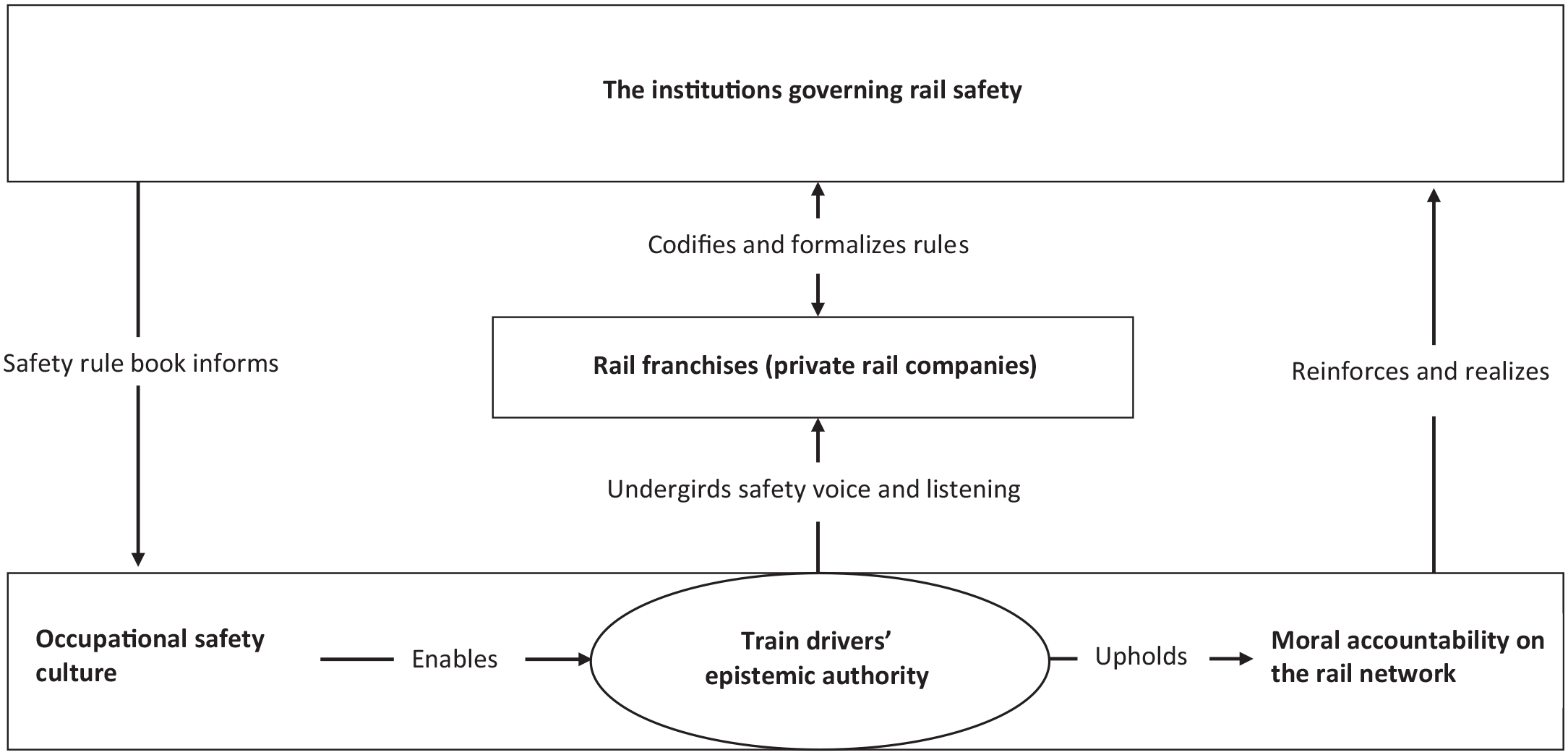
How occupational epistemic authority realizes institutional safety mandates.
How train drivers uphold shared expertise on rules and personal safety practices
Train drivers update and maintain expertise related to rules and practices for safe driving within the occupational community to engage in effective safety voice and listening. Importantly, we find they do so through their collegial networks, which extend beyond the franchises such that there is a strong sense of commitment to an occupational, rather than organizational, safety culture among train drivers. As one driver explained: Drivers always keep in touch with other drivers.—this guy I joined up with him, we both started off in this company, and he’s gone off to another company, and people will still keep in contact. And that’s how you get a network of drivers . . . it’s a driver thing, not a company thing. (Interview 5)
While general information gets passed on through the network, so too do safety practices between train drivers, as one train driver points out: We do have a briefing from management on risks on a route, but you get the best knowledge from other drivers. They’ll say, “I just about got away a bit from the skin of my teeth” or they’ll relay a story and then also, you get near misses [safety errors] and you learn [from other drivers] how others got out [of the situation]. Yeah, we share mistakes with each other. We’re not so keen on sharing our mistakes with management. (Interview 25)
But as this driver further explains, sharing safety information and practices is a continuous process that is not just limited to initial training by driver managers in one franchise, nor just to people who drive the same routes. This diffusion of knowledge allows them to extend their expertise beyond official training opportunities. Instead, train drivers learn from their peers across the network throughout their careers: You will get freight drivers come and learn with you and you’ll get passengers drivers come and learn with you. So you will gladly share [safety knowledge] with other drivers from other companies, and they’ll share things that they know as well. It sort of works like that because even though we’re all split up into separate companies—under privatization method—there is still that sort of “we’re all one” kind of thing. (Interview 25)
The detailed transmission of route knowledge allows drivers to fully appreciate and implement rules and route-specific safety protocols in practice. For example, drivers must learn both organizational rules (both NR and franchise rules) and health and safety rules. The “rule book” is an industry-wide set of instructions for railway staff published by the RSSB. Rules knowledge informs procedures for departures, arrivals, delays, and disruptions. Rules knowledge depends on the geographic coverage of train drivers. For instance, Eurostar drivers must maintain rules knowledge in three jurisdictions: the United Kingdom, France, and Belgium. Within the United Kingdom, rules knowledge may be divergent depending on whether a service is intercity (e.g., Edinburgh to London) or a commuter line (e.g., Thameslink) because these services entail different maximum speeds, numbers of stops, and whether particular routes are shared by multiple franchises or run exclusively by one franchise. To drive a route, drivers must first be supervised on that route by a driver manager. Experience of driving the route and the notices (notes from franchises and NR about irregularities on the tracks) they review before each shift comprise what drivers refer to as “route knowledge.” Route knowledge encompasses the varying conditions on the tracks and how drivers should respond. Drivers also maintain “traction knowledge” which refers to the type of train that is driven. For example, freight trains are usually carrying heavier loads which can impact how the brakes are applied, or certain cabs may have technology that releases sand on to the tracks in slippery conditions caused by leaf fall. Such traction knowledge is important for safety. While management also provide safety briefings, other train drivers act as instructors for new drivers or drivers learning new routes. Because experienced drivers train novice drivers, formal and informal safety information and practices are reinforced at the occupational level. For example, instructors may relay important safety information about how a particular train operates or issues with a particular route (e.g., route knowledge), as one driver who was also an instructor relayed: The role of an instructor is not just out on a train. We teach drivers about the train outside in the yard, we walk around the train showing new trainees different parts of the trains—also teaching people different routes, even qualified drivers, they still have to learn other routes. So teaching new trainees and qualified drivers as well. (Interview 5)
Drivers also abide by shared norms about how to combine rules and route knowledge with a unique source of epistemic authority that involves their attention to and embodied knowledge of the conditions on the tracks (as we go on to show in the next section).
The second key tenet of the occupational community’s safety culture is a commitment to a personalized approach to maintaining the physical and mental capacity to drive a safe service. Although franchises maintain a “fatigue index” and monitor drivers’ fitness to be in service, because the stakes in ensuring safety are high, drivers follow lifestyle moderation practices that are upheld as best practice within the occupation. For instance, drivers accept that to operate safely, they must allow the demands of driving to govern their personal lives “off the clock.” As one driver put it, “Train driving is something that really requires a moderation of your lifestyle” (Interview 8). Drivers do this in many ways, but perhaps most important among their concerns is being well-rested. Drivers repeatedly stressed the importance of managing the body clock and fatigue levels in the face of challenging diagrams that conflict with the demands of their personal lives, linking it to the overriding importance of driving a safe service: There is no denying some days you have to get up at two in the morning, some days when we go to bed at two in the morning. It can be hard . . . but if I make a mistake at work, that could mean a major train crash. That could mean death. That could mean heartache for people. So it sort of helps you figure out what’s good for you in the sense of rest. (Interview 32)
Drivers also highlight the importance of exercise and nutrition to maintain their focus on the job: The running and the exercise, I do a lot of stuff to keep myself fit and healthy which I find helps [with job fatigue and safety]. A couple years ago I was really out shape and it made me exhausted, I find keeping the personal health up helps a lot with fatigue and a lot of the will to keep focused at work, because before that when I was out of shape, I found a lot harder. I have had a few incidents in my time and I can attribute them to lifestyle. (Interview 25)
By proactively combating fatigue and making fatigue avoidance a cornerstone of their personal lives, drivers subscribe to an occupational safety culture that informally governs their capacity to drive a safe service. Collectively upholding safety knowledge and practices within the occupation allows train drivers to engage in safety voice and listening because they can invoke rules and regulations and call out their own and others’ mistakes. These aspects of collective occupational expertise are combined with another form of epistemic authority that drivers uniquely possess: embodied knowledge of real-time conditions on the tracks.
How train drivers generate epistemic authority through embodied knowledge of the tracks
Train drivers occupy a unique role in the rail network because only they maintain the embodied route and traction knowledge that allows them to identify potential hazards in the physical environment in real time. Route knowledge becomes embodied knowledge as drivers become experts on their routes. Drivers listen through their bodies to tune into conditions on the tracks and socialize rookie drivers to pay attention to the subtle embodied signals that the track sends about potential dangers. For instance, track conditions change as the seasons change, and drivers learn to recognize how these conditions affect important motions like braking: During the leaf fall season, I think most drivers just naturally go into a different mode of train driving. It’s likely to be slippy, so I will build in a safety net for myself. When you have a slide [from leaf fall] you can hear the clunking—and you say [to yourself], that’s because the wheels locked up because of low adhesion. (Interview 36)
Drivers bring their knowledge of idiosyncratic hazards to bear on their physical bodies to ensure safety. For example, the problems that become noticed are often first identified by drivers themselves feeling those hazards through their bodies: So, it’s [a hazard] usually either identified by a train driver reporting it saying, I’ve just gone over a piece of track, it felt funny. So, for example, when you’re in the cab, when you drive over the same pieces of track, day in, day out, you almost—hypothetically if you close your eyes whilst driving a train you—you would know where you are because you’ve driven those tracks so many times you can feel where you are. So you’ll get a bump and you’ll think—that’s not right. (Interview 9)
Drivers understand that when conditions are poor, they will need to exert more effort to drive a safe service: “The autumn is notorious for low rail adhesion—leaves on the line. You’d do your round trips and sometimes you’d get out of the cab, and you’d be sweating from the concentration” (Interview 17). Thus, an additional source of epistemic authority is drivers’ awareness of the difficulty of driving in certain weather conditions because they believe it detracts from the mental focus they need to maintain: If I get back on time [when turning a train around], then I’m back on time. And that’s great. But if I’m two minutes late, then that’s just the way it is. I think it’s better to be that way. Your head has got to be right for this job. And if you rush and you’re not quite right for it, you can make a big mistake, and then you end up having an incident—it’s not worth rushing in this job. (Interview 16)
Drivers generate unique epistemic authority—in the form of route and traction knowledge—from their awareness of the physical infrastructure of the rail system. They also engage in practices to maintain vigilance when track conditions are routine. For instance, the route knowledge that drivers develop through training and experience becomes a means of managing bouts of fatigue, which they consider a major source of mistakes or accidents. Drivers maintain their attention by tracking landmarks and distances between stations: The advice I was given about sort of losing my train of thought, was simply—and it sounds really weird—but it was, “what’s your speed.” “What’s your signal.” “What’s your next station.” Those kinds of route specific stuff are our direct access point. Am I on a viaduct? Am I in a tunnel? (Interview 34)
Another ritual is what is called “commentary driving” which is the practice of a driver literally speaking out loud about the actions they are engaging in, from accelerating using the lever to passing a speed restriction: It is amazing how much you are thinking about while you’re in the cab. What I find helps me the most is commentary driving. You feel a bit weird at first talking to yourself in the front of the train. And if you’re on certain trains, you do sort of think to yourself, oh, I wonder if they can hear me out there and whatever else. But it is a really good way of focusing or refocusing the mind if you have got thoughts that are going on in your head. (Interview 24)
But while commentary driving or opening cab windows are common practices, individuals also develop their informal rituals: “I mean, I can just sing to myself—not too loudly if I’ve got passengers” (Interview 4). Other drivers perform a small ritualistic action to create a boundary between driving and non-driving: It sounds a bit weird, but I open the door if I’m doing something out of the blue [that distracts from driving safely]. If I’m sat on a red signal, if I’ve got a call coming in on the radio—and I then shut the door—it makes me say, “right. I’m getting back into the seat. I’m getting back in the zone” [of driving safely]. This technique sits on the periphery, really. But it is another tool that I know a lot of my colleagues use as well. (Interview 36)
Through these rituals and practices for resisting fatigue and maintaining vigilance, the occupational community of train drivers upholds a culture around driving to meet safety demands, which in their view, subsume efficiency demands: “Efficiency in the context of the job is getting passengers from A to B safely” (Interview 26). In part this is because many of the factors that would hinder an efficient and reliable service are outside the locus of control of a train driver; and yet, drivers are tasked with reacting appropriately to any possible disruption or danger on the track: “Every single thing is a judgement call—because you’ve got all this information coming at you” (Interview 11). In the following section, we show how train drivers combine their collective expertise that encompasses rules and regulations, and strategies for invoking other sources of authority, to uphold their safety mandate through effective safety voice and listening.
How train drivers draw on their collective expertise and epistemic authority to challenge directives and support safety listening
Invoking the rules
The train driver occupation’s epistemic authority is made manifest when drivers combine their knowledge of the tracks and the rules to determine their actions in response to delays and disruptions, which may require them to challenge control. When the franchises try to impose efficiency pressures on them in the form of keeping trains on time and moving in these situations, drivers can negotiate by drawing on their superior knowledge of the official rules that govern driving. Often drivers know the rule book in more detail than the people working in control, which enables them to invoke the rules to have their safety voice heard. For example, when drivers are under pressure from control to restart service as soon as possible after a disruption, drivers are aware that their personal judgment about track conditions may not be perceived as sufficient, and so they invoke the rule book to justify their decision and support safety listening between drivers and control: I’ve had situations where they’ve [control] basically said, no, you’re alright to carry on [despite a hazard]. And I’ve quoted the rule book at them. And they’ve said, “Oh, no, no, no, that’s fine [the risk is fine]. We’re happy for that to continue [happy for you to go].” And I’ve said, “You’re authorizing me, or instructing me to take this train into service, which is in contradiction of the rule book, is that correct?” At which point, nine times out of ten they say, “Oh, actually, no, let me just make a quick phone call and they come back and say, ‘No, no, actually [driver’s name] that’s fine.’” (Interview 36)
Drawing on their rules-based knowledge allows drivers to assert their mandate related to safety. When drivers negotiate with franchises by invoking the rule book, they understand that control must defer to the rules, despite not knowing them to the letter—which ensures that drivers are heard when they make judgments: You need to have very good knowledge of the rules and understand that a controller [franchise] sitting in the office isn’t necessarily telling you what’s correct. It’s down to you to protect your license and the safety of all your passengers. (Interview 26)
Drivers understand that although franchises (i.e., control) can pressure them to resume service, they derive authority from the rule book about what is safe and what is legal and use this expertise to escalate their safety voice and to create urgency around potential hazards. Sometimes, however, train drivers simply avoid interacting with control to ensure safety—they defer to their expertise rather than attempt to engage in a safety voice. Some drivers report that they avoid communicating with control altogether (the franchise) when a safety incident occurs, and instead defer to their knowledge of the rule book to make a decision that excludes control: I try to avoid it [engaging with control]. [Because] there can be a lack of knowledge of the rule book [from control], where they might actually tell you to do something and it’s not actually safe. (Interview 31)
When under pressure from the franchises about running late, drivers assert their epistemic authority by privileging their knowledge of the rules and the immediate track conditions over getting in on time: Something I learned in my training, safety’s first, and the clock goes out the window when anything like that happens [disruption]. Don’t worry about causing delays or anything like that. As soon as you get a signal that isn’t green, as soon as you get an orange signal, time goes out the window because you’re then having to drive to the rules rather than just trying to keep time. I never tried to keep time anyway—I don’t pay any attention to it. I just drive safely. (Interview 41)
Members of the occupation uphold these rules even in the face of pressure from the franchises—and fall back on their own “dynamic risk assessments” rather than listening to the control’s directive, which may not be based on a nuanced understanding of the situation: There is a kind instant standoffishness [with control], when I point out an issue. It’s almost like you’ve got this recorded line saying, “Yeah, but you need to get the train going.” “Yeah but we can’t cancel that.” I think that’s one of the biggest issues [pressure from control to keep moving] in empowering people to make the right decision when it comes to safety—you know, you’ve got to be able to make that dynamic risk assessment and say, does this support that the train can continue. (Interview 24)
Invoking other actors in the network
Drivers also generate epistemic authority by knowing whom to approach when their concerns are ignored and invoking the authority of these other actors within the sociotechnical system. Reported safety hazards might be disregarded by driver managers for a variety of reasons. In one case, a driver recounts how he identified a safety hazard related to incorrectly laid out signage on the tracks detailing an emergency speed restriction, reported it to the driver manager who did not engage in safety listening, and when he was disregarded, circumvented the driver manager by approaching the area driver manager (the next grade up) to enforce the rules: I found myself on occasion speaking to the area driver manager and escalating it myself, because I feel it’s important to circumvent the driver manager grade because I know that there’s just this kind of wishy-washy response that you might get. (Interview 46)
In such situations, drivers also draw on their observation of the tracks and knowledge of the rule book to ensure that safety issues are dealt with by the franchises, based on non-compliance with the rules. For example, when this driver spotted the issue with the speed restriction that was incorrectly laid out on the tracks, he escalated the issue to the area driver manager by drawing on the rule book: I was reporting an issue with a temporary speed restriction. And I wasn’t getting the response that I felt I needed in that process. I didn’t think the report was being taken seriously. So I looked up the rail group standard [in the rule book] for that situation, and then quoted it, at which point there was no way out of just accepting the issue. (Interview 46)
Because train drivers see themselves as “the eyes and ears of the railway” (Interview 7), their perception of safety hazards supersedes pressure from control to keep the trains moving. When this pressure is asserted, train drivers will use their safety voice and find another stakeholder on the rail network that will listen and follow their advice: I was in London and the doors came open [on the wrong side] on the train and control were saying, it’s all sorted. We’ve got permission for you to proceed. Set off. Everything’s done. Go. So I went back to the cab and I thought I’m just going to ring the signaler [NR]. And the signaler agreed with me and said definitely not, so we terminated the service—but they just want to get things moving, and out of the way, that’s their [franchise] thing. (Interview 25)
They may also invoke the authority of the signaler, who is not concerned about being fined for the delay, and who plays a role in enforcing safety protocols across the network: I’ve had it before where they’re [control] being insistent, and I’ve ended up ringing the signaler [Network Rail]. And saying, I have this fault on the train, which I must declare to you, my control has said, “continue with it” and the signaler has said, “I’m not happy with that.” So Network Rail control, calls our control [the train operating company] and so I get a call from my control saying “Oh, actually, we’ve reconsidered the situation and we’re not happy for it [the train] to continue in service.” (Interview 36)
Ultimately, train drivers reserve the right to make the call about moving the train and they justify this right of refusal by invoking the codes related to safety as well as their position “on the ground”: I think it would be fair to speak for the vast majority of other drivers—that they would just do the safe thing—when being pressured by control. When safety is no longer in the background and something that we have to think about now. . .then we’re in charge. Control might order us to move, but I’m on the ground, I’m dealing with it and what I think should happen will happen—when we’re driving in those situations, we’re making the call. (Interview 16)
How train drivers’ safety voice and safety listening create moral accountability
Train drivers, in addition to exercising a safety voice and listening to respond to potential hazards, also assert their judgments to create moral accountability—both to themselves as employees of the franchises and to their passengers. If the crux of exercising a safety voice is to ensure that technical failures within a sociotechnical system do not cause harm, frontline workers like train drivers play an important role in enforcing this mandate by exercising moral judgments about their actions. For example, drivers apply the rule book to their conduct, a practice that is most evident when drivers self-report their mistakes. If a driver fails to live up to the standards of safety to which they have been trained, or if a driver identifies a safety concern created by their actions, they can proactively report safety issues. One driver recounted how he left the pantograph up when it was not needed for drawing power, forcing him to apply emergency brakes. He reported his mistake quickly so that he would not endanger an oncoming train by being unexpectedly stalled on the tracks while he got the train back into service (Interview 28).
Mistakes can also emanate from personal issues that occur in the workplace. As a train driver recounted to us after feeling bullied by colleagues at work, his mind wandered while driving and he failed to recognize the oncoming platform for the next stop: You don’t get very long to sort of make a judgement as to whether or not you should try and stop or just go through. And I made the decision in a split second that it was worth me trying to stop. So I made an emergency brake application. And as I hit the end of the platform, I thought might be alright, I was wrong. I ended up a coach past the end of the platform. So I had to ring the signaler—and I had to do the walk of shame. (Interview 46)
Drivers are all aware of the danger that a distracted or emotionally distraught driver may pose and recognize when they have been driving in the wrong state of mind: “We’re encouraged to leave everything at the doorstep [when leaving home for work] as it were—just concentrate on work, but we’re all human—it’s impossible, to be honest. I’ve probably driven trains in the wrong frame of mind when I shouldn’t have done” (Interview 19). To mitigate these instances when drivers are responsible for delays, one driver described how they accept the situation and refocus their attention on driving safely: Everybody gives you advice as you’re coming through the training school and people provide their experiences. So, one thing that always stuck with me from one of the guys is that when “you’re late, you go slower.” Because you cannot physically make the time up. So you just ensure that you’re doing what you need to do. (Interview 34)
Drivers are also the arbiters of morally ambiguous scenarios involving trespassers and suicide attempts on the tracks, and they often face pressure from control to keep the trains on time following such extreme events. In these moments, drivers decide what is right for themselves and the people on their train by drawing on their unique position as the observer of the conditions on the tracks: I’ve heard of fatalities where the signaler is being asked by control if the trains can get past on the slow line. And the signaler will say, I’m really sorry but I’ve been asked to ask you this question. I can’t believe they’re asking that already, it’s only been two minutes [since the fatality], and the trains will be able to see everything—to see the body. (Interview 25)
How drivers respond to fatalities on the tracks is fraught with ambiguity, not only in terms of whether they can drive on the obstructed track but also in terms of exposing the driver and passengers to upsetting images. Even if they have not experienced an incident themselves, drivers know that moving the train to meet the demands of the franchises is a moral hazard that they face on the job. They have been given advice on how to react if such an incident should happen on their shift: The things people have told me is this sort of technique that they use is—you shut your eyes—you put your fingers in your ears—because the last thing the person will do [before they kill themselves] is try and lock eyes with you because naturally you’ll be looking at them and they will look at you, and I’ve been told that sticks in people’s minds. And also there’s quite a sort of significant crunch, under the wheels of a train—you’ve got to have your fingers in your ears. (Interview 34)
Because drivers are the ones who ultimately bear witness to these attempts, they understand that when situations present risks, however ambiguous, they must err on the side of preserving life: I think you do get a little bit of a sixth sense as a driver—because when you’re coming into a station—no one should really stick out but if someone catches your attention, you immediately think whoa, hold on a minute, that’s not right, and I think I would stop the service. For me it would be wrong to continue and again hear on the radio that they jumped in front of the train behind you. (Interview 34)
Although not all drivers will witness a fatality during their careers, the community of drivers is aware that they can be life changing: “I’m aware of people who’ve had one incident [fatality] and it’s changed their life, but conversely I’m aware of some drivers who have had half a dozen fatalities, just accepted as part of the job” (Interview 2). Drivers cannot always avoid witnessing fatalities, but they take it as their prerogative to make judgments that reflect their occupational mandate, which includes drawing on their epistemic authority to assert their safety voice and, when needed, override directives that cause moral injury to themselves or their passengers.
Discussion
As more occupations cope with the rationalization and surveillance of their work, and the concomitant loss of autonomy that may accompany this process (Edwards, 1979; Kellogg et al., 2020), we argue that it is important to shed light on how these communities might defend their right to make critical judgments that draw on their knowledge-based expertise and uphold their occupational mandate—in other words, how they maintain their right to assert their unique epistemic authority within increasingly complex systems. As previous research has highlighted, neither high-reliability systems (Barton and Sutcliffe, 2009; Chikudate, 2009; Davidson, 1990; Jasanoff, 1994; Petryna, 2013; Shrivastava et al., 2009; Vaughan, 1996, 2004, 2006) nor safety voice (Bienefeld and Grote, 2012; Noort et al., 2019) guarantee systemic safety will be realized. In this study, we have shown how train drivers ensure that their safety voice is heard, a process that plays an important role in upholding a societal safety mandate. Specifically, we identify how these frontline workers generate and enact epistemic authority to challenge directives and support effective safety listening within the UK rail network.
How frontline workers generate and enact epistemic authority
Our findings show how frontline workers bring together multiple sources of expertise to generate epistemic authority that they invoke to override organizational demands that contravene their safety judgments. We also unpack how their belonging in the occupational community of train drivers is a key antecedent of this process. While prior research offers insights into how safety is accomplished through collocated organizational and occupational control processes (Bruns, 2009; Evans and Silbey, 2022; Gherardi and Nicolini, 2002; Hallett and Ventresca, 2006; Nichols, 1998), we show how safety also depends on dispersed networks of frontline workers who identify strongly as members of occupational communities and draw on collective knowledge and practices to exercise safety voice and support safety listening. Building on research that emphasizes how organizational safety culture involves worker compliance with rules and regulations (Luria and Rafaeli, 2008; Nichols, 1998; Rispler and Luria, 2021), our study shows how occupational safety cultures support effective safety voice and listening in real-time situations. In our setting, while technological and social controls imposed by the franchises are intended to ensure safety, we show how safety cannot be fully automated or technically controlled through human factor devices or training. Instead, we find that drivers’ encompassing occupational safety culture, transmitted through networks that cut across employers, allows these frontline workers to assert their independent judgments when faced with demands that require them to manage trade-offs between safety and efficiency. We identify two key mechanisms that explain how train drivers effectively challenge directives.
First, train drivers negotiate the demands of other stakeholders, such as control, by becoming experts on the rules, rather than by transforming them. Prior research has illustrated that some powerful occupations, such as scientists, elide and enact safety regulations to better support their technical activities, co-opting regulators in the process (Evans and Silbey, 2022). By contrast, we find that, in the moments when train drivers need to challenge other stakeholders—particularly signal and control—they can assert their knowledge of the existing regulations to make their case. We identify how drivers draw on shared rules-based tactics to engage other actors in robust safety listening, ranging from invoking the specific application of rules and route knowledge to drawing on the formal authority invested in other roles and relations within the rail network. This collectively held knowledge of how to engage in safety voice allows these isolated frontline workers to “inhabit” the institutions related to rail safety in the United Kingdom, especially as it is instantiated in the rulebook (Hallett and Ventresca, 2006). These findings contrast with prior studies that show how subordinate occupations draw on relational tactics that draw on informal knowledge of their clients’ or superiors’ priorities, values, or work contexts (Barnes et al., 2023; DiBenigno, 2022; Thomann et al., 2018). We show that, in contrast to these relational tactics for influence, train drivers draw on rules-based authority to influence their controllers and do so without falling back on personal relationships. Our findings thus point to a very different type of resource for challenging superiors or managers: more stringent enforcement of the rules or, more generally framed, greater expertise about the regulations governing the industry and an independent voice in negotiations with employers.
Second, train drivers also generate epistemic authority through occupational practices that support their close attention to real-time conditions that only they can act on (Benoit-Barné and Fox, 2022). For example, our data show how train drivers “listen” to the tracks identify potential hazards, and combine these cues with their knowledge of the rules and regulations that govern the rail infrastructure. We also show how train drivers support safe driving through collective norms about lifestyle and fatigue management. While previous work has shown how powerful occupations may collectively interpret safety rules and regulations to serve their working practices (Bruns, 2009; Evans and Silbey, 2022), we highlight how isolated frontline workers who belong to these communities draw on shared knowledge related to interpreting the environment and their bodily cues to make safety judgments in response to unpredictable hazards, which build on the findings of other studies of isolated frontline workers.
For example, recent research on drone pilots finds that solitary, technologically mediated work can induce a sense of moral ambiguity and alienation for workers who lack decision-making power over how these technologies are deployed (Rauch and Ansari, 2022). The two mechanisms we have identified may help to explain how frontline workers who face ambiguous situations may be able to clearly assert their prerogatives, rather than be silenced or ignored. Other studies of frontline workers have shown how workers experience a sense of personal responsibility because they are solely in control: “being alone meant rarely being able to rely on colleagues for help in their day-to-day jobs or share the blame with anybody if something went wrong” (Bourmault and Anteby, 2020: 1464). Bourmault and Anteby’s (2020) study of subway drivers demonstrates how a strong sense of personal responsibility undergirds these workers’ commitment to performing their job effectively—similar to train drivers—but their study does not explain how subway drivers might challenge other groups to uphold safety in the face of real-time risks. We find that when train drivers face potential hazards, they can act as the arbiter of the situation by communicating with other actors (i.e., signaler and control) to assert their judgments based on their collective rules-based and embodied expertise. When they face pressure to keep the trains moving, they claim an occupational prerogative to ignore their employers and do what they believe is right by bringing their knowledge to bear on a real-time understanding of the situation.
Thus, our findings also contribute to the literature on safety voice and listening by highlighting how occupational networks and shared practices are resources that enable frontline workers not only to speak up about potential hazards but also to challenge directives from employers when they perceive a threat to safety. An important feature of this system is that train drivers who work for private franchises in the United Kingdom are unionized, comparatively well-paid, and secure in their employment contracts. Indeed, the importance of unionization cannot be overlooked as their structural power likely aids members of this occupation in asserting their right to challenge the franchises. This insight suggests that the erosion of occupational protections, such as union membership, may be a contributing factor to the rise of safety incidents in certain sectors like healthcare, though more research is needed to understand the exact relationship in other contexts (Noort et al., 2019). By relating frontline workers’ epistemic authority to broader occupational mandates and structural conditions within this sociotechnical system, we shed light on how such mandates are realized in the context of competing demands, such as efficiency, profitability, and safety. We show how safety voice and listening (Noort et al., 2019) and the discursive accomplishment of authority (Benoit-Barné and Cooren, 2009) are enacted by frontline workers in complex sociotechnical systems in ways that extend our theoretical and practical understanding of safety in these settings (Silbey, 2009).
Directions for future research and practical implications
Future research might examine how other frontline workers exercise epistemic authority in their contexts. For example, train drivers share some similarities with airline pilots (Gladwell, 2009; Oliver et al., 2019), truck drivers (Levy, 2023), subway drivers (Bourmault and Anteby, 2020), and some types of gig workers (Wood et al., 2019). Prior work on airline pilots has highlighted how technological controls designed for safety can operationally undermine workers’ ability to manage safety in risky situations. In one study that examined the Air France crash between Rio de Janeiro and Paris that led to the deaths of 228 passengers and crew members, the authors found that technological controls prevented pilots from making an independent judgment about the situation in real time (Oliver et al., 2019). Future research could consider how occupational groups might challenge this level of automation and participate in the design of organizational controls to serve mandates for safety. We also see overlaps with work on truck drivers, who are also surveilled by onboard devices like video cameras and accelerometers, but with surprising consequences for safety. Recent research finds that the implementation of surveillance technologies designed to improve safety correlates with a 30-year high in fatal accidents (Levy, 2023).
By contrast, another study of truck drivers found both pay and employment conditions, such as healthcare provision, correlated to fewer dangerous driving incidents (Kudo and Belzer, 2019). The study attributes this finding to marketization pressures brought on by deregulation, which have led to low pay and high turnover and resulted in a lack of experienced drivers. When organizations counteract these forces through better working conditions, safety incidents may be reduced. We suggest that these studies show how surveillance or automation technologies cannot compensate for a committed workforce that upholds safety through knowledge, embodied practices, and the capacity to exercise judgment. In this vein, gig work platforms that enable precarious working conditions, low pay, and physical and emotional exploitation of the workforce may be challenged because they harm society by stripping these workers of the ability to effectively exercise their real-time judgments about safety, despite the increasing levels of surveillance and automation the platforms espouse (Wood et al., 2019). We suggest that understanding how safety voice is expressed to realize an overarching occupational mandate is an instructive and useful direction for future research about how accelerating patterns of surveillance and financialization in other contexts may nevertheless be mitigated by occupationally-based processes to retain elements of control and moral accountability over their work.
Building on the findings of our study and relating them to prior research, we suggest there are germane practical implications for organizations and institutions tasked with upholding whole-society safety mandates. We suggest that because organizational demands may at times conflict with occupational or institutional mandates, it is important to consider the role that frontline workers play in realizing such mandates through proactively exercising safety voice, and more generally retaining a degree of independent judgment. To that end, organizations and policymakers should avoid approaches to upholding safety that rely on punishing employees, administering fines, and other such negative incentives. Instead, organizations and institutional bodies should reinforce and support occupational communities’ continuing flourishing—through the protection of labor organizing rights, lifelong employment, secure contracts, and other mechanisms that generate robust occupational voice. As our study has shown, frontline workers who claim the prerogative to challenge their employers as a result of these labor protections may be the linchpin of a safe sociotechnical system.
Conclusion
The UK enjoys one of the safest rail networks in the world. In our study, we show that, while the UK’s rail safety culture is formalized through a sociotechnical system of oversight that reflects a multi-faceted societal mandate for safety, train drivers’ judgments also play an important role in realizing this mandate. When drivers assert their judgments by drawing on multiple forms of occupational knowledge and embodied expertise, they reinforce their epistemic authority, and, in turn, uphold the societal mandate of safety. By shedding light on the role of frontline workers, this article shows how safety is not just the outcome of powerful regulatory institutions but also depends on workers claiming the right to exercise their expert judgment, which is instantiated in moments of exercising safety voice and supporting safety listening.
Supplemental Material
sj-pdf-1-hum-10.1177_00187267251335859 – Supplemental material for “The eyes and ears of the railway”: How frontline workers uphold safety through their occupational expertise and embodied epistemic authority
Supplemental material, sj-pdf-1-hum-10.1177_00187267251335859 for “The eyes and ears of the railway”: How frontline workers uphold safety through their occupational expertise and embodied epistemic authority by Daniel Fisher and Daisy Chung in Human Relations
Footnotes
Acknowledgements
We would like to thank Bobby Banerjee, Andre Spicer, Joelle Evans, Sandra Portocarrero and the participants of the Sussex Business School Write Club for their helpful comments and suggestions. We also appreciate the guidance and support of Zhijun Chen and our three anonymous reviewers. We would also like to thank the many train drivers and members of the rail industry who were generous with their time throughout the data collection phase.
Funding
The author(s) received no financial support for the research, authorship, and/or publication of this article.

Supplemental material
Supplemental material for this article is available online.
Notes
References
Supplementary Material
Please find the following supplemental material available below.
For Open Access articles published under a Creative Commons License, all supplemental material carries the same license as the article it is associated with.
For non-Open Access articles published, all supplemental material carries a non-exclusive license, and permission requests for re-use of supplemental material or any part of supplemental material shall be sent directly to the copyright owner as specified in the copyright notice associated with the article.
