



Abstract
Prompted by the Black Lives Matter movement, and COVID-19’s deepening of inequalities, philanthropic foundations are increasingly claiming racial justice as a core part of their mission and strategy. This study uses a racial capitalism lens to examine racial justice organizations’ (RJOs) accountability relations towards the philanthropies that fund them. Drawing on interviews with leaders of Canadian RJOs, we unveil how the racial partitioning of leaders, fantasy and partners in these relations materially and symbolically dispossesses RJOs and the communities they represent. Our study complements the extant literature, which focuses on the depoliticization and co-optation effects of RJO–philanthropy accountability relations. Instead, we show how these accountability relations enforce ‘double dispossession’, thereby reproducing the racial capitalist political economy on which philanthropy is predicated. Our analysis indicates that philanthropy for racial justice, as it is currently practised, is impossible. We further identify the conditions under which it could become feasible.
Keywords
Introduction
Prompted by the Black Lives Matter movement and COVID-19’s deepening of social inequalities, philanthropic foundations in North America have increasingly claimed racial justice as a core part of their mission and grantmaking strategy. Major foundations have made significant funding and programmatic commitments to under-resourced racial justice organizations (RJOs) (Oatley, 2022), engaged in foundation-led advocacy and activism (e.g. Share, 2023), and participated in the creation of community-focused funds (e.g. Sobowale, 2022), in an attempt to move more philanthropic assets to historically marginalized and systemically disadvantaged communities (Sen and Villarosa, 2020). These efforts have taken place against the backdrop of a growing public discourse touting institutional philanthropy – the use of private resources for public purposes by independent organizations that hold donated assets (Phillips, 2018) – as a critical partner in the struggle for racial justice (e.g. Chunilall, 2020; Florant et al., 2023; Hayling, 2021; Jackson, 2022; Ramirez, 2023).
Despite this shift in policy and the celebratory discourse in which it is couched, the recent scholarly literature paints a less optimistic picture of institutional philanthropy’s role in fostering racial justice. Specifically, studies have documented how RJOs’ relations of accountability towards philanthropic foundations operate as mechanisms of co-optation and capture, whereby white elites mute, depoliticize and socially engineer racial justice movements (e.g. Dunning, 2023; Francis, 2019; Marquez, 2003; Saifer, 2019). In these relations, the RJO is obligated to explain and justify their conduct towards the philanthropic foundation, which can pose questions, pass judgements and exact consequences on the RJO (see Bovens, 2007). These studies build on the critical non-profit literature that documents unequal relations of power, donor control and upwards accountability within economically stratified donor–grantee relations (e.g. Arvidson and Lyon, 2014; Baur and Schmitz, 2012; Ostrander, 2007; Scott, 2003). They detail how white-led philanthropic organizations exert substantial control, both material and ideological, over RJOs, including Black-led civil rights organizations (e.g. Francis, 2019; Marshall, 2015), Mexican-American social movement organizations (e.g. Carpio, 2016; Marquez, 2020) and migrant farmworker organizations (e.g. Kohl-Arenas, 2014, 2015).
This literature provides insight into how accountability towards philanthropic funders can negatively impact RJOs’ own functioning and the broader racial justice movements of which they are a part. However, these studies tend to leave outside the scope of analysis the broader racial capitalist political economy in which such relations unfold. This neglect is notable given the vast and growing evidence that institutional philanthropy is part and parcel of capitalism, as philanthropic assets are produced through racialized and colonial processes of corporate accumulation by exploitation and dispossession (e.g. Gilmore, 2007; Kapoor, 2012; Saifer, 2021; Villanueva, 2018). Moreover, institutional philanthropy serves the ideological function of legitimizing these accumulation practices and the actors who profit from them (Ahmad and Saifer, 2023; Kapoor, 2016; Thorup, 2013).
This study mobilizes a racial capitalism lens to examine how RJOs’ relations of accountability towards philanthropies reproduce the racial partitioning upon which the accumulation of philanthropic assets depends. Racial capitalism scholars emphasize that race, racialization and racism are integral to capitalist accumulation (Robinson, 2000). Specifically, they argue that capital can only accumulate by moving through severe forms of inequality, and that racism provides the symbolic forms of separation, or ‘partition’, necessary to subordinate, exploit and dominate (Melamed, 2015). From a racial capitalism perspective, racialized differentiation through partitioning is not merely a cultural phenomenon separate from and coeval with capitalism. Rather, it constitutes the structural relations necessary to reproduce racial regimes of capital accumulation at the core of the capitalist political economy (Dawson, 2018; Gilmore, 2021; Harris, 2021; Issar, 2021).
Empirically, we draw on in-depth semi-structured interviews with leaders of RJOs in Canada, a country where racial justice is at the top of the institutional philanthropy agenda (e.g. Vancouver Foundation, 2023) and philanthropic wealth has soared owing to a regime of extensive fiscal incentives (Phillips, 2018; Raddon, 2008). Focusing on a range of causes related to racial justice, all participant organizations engage in activities to oppose systems and structures of oppression in Canadian society, which some combine with more traditional charitable service provision. Relying on institutional philanthropy for funding and thus accountable towards it, they provide suitable locales to empirically observe and theorize how the terms of such relations both reflect and reproduce the racial partitioning constitutive of the political economy of racial capitalism.
This study advances the critical literature on philanthropy by showing how RJOs’ relations of accountability towards institutional philanthropies materially and symbolically dispossess RJOs and the communities they represent. Specifically, we unveil how this ‘double dispossession’ is enforced through the racial partitioning of leaders, fantasy and partners in these relations, and how it contributes to the reproduction of a racial capitalist political economy of philanthropy. Our analysis thus fundamentally problematizes claims about the potential of philanthropy to redress racial injustice. By showing how philanthropy itself partakes in the reproduction of the racial capitalist political economy on which it is predicated, it recasts the problems faced by RJOs away from one of power imbalance, vulnerability and insufficient autonomy from donors, which are central in the extant literature (e.g. Dunning, 2023; Marquez, 2003). From this perspective, it becomes clear that institutional philanthropy, as it is currently practised, is part of the problem rather than its solution. Any intervention that leaves the role of philanthropic grantmaking in the racial capitalist political economy intact, such as imposing stricter regulations and scrutiny or combating race and class biases and prejudices held by philanthropic decision-makers, will not resolve this contradiction. These insights invite scholars of philanthropy and non-profit sector organizations to structurally integrate the role of racial partitioning and capitalist institutions in their future analyses. More broadly, our study makes a case for taking a racial capitalism political-economic perspective to theorize the role of organizations in reproducing inequality.
Relations of accountability and the depoliticization of racial justice organizations
RJOs’ accountability relations towards institutional philanthropies have been the object of scholarly investigation since the mid-1980s. This literature explores how RJOs’ relations with wealthy white institutional donors limit their capacity to advance their missions on their own terms, with important repercussions for the communities they serve and the broader landscape of racial justice movements. Taking a historical approach, a number of studies have documented and theorized the mechanisms through which philanthropic foundations advance elitist issue agendas and manipulate racial justice movement strategies to temper their radical expressions. An early study by Jenkins and Eckert (1986) on white elite patronage of the Black Power movement, for example, demonstrates how funders contribute to the ‘channelling’ and ‘professionalization’ of racial justice movements towards moderate goals and tactics.
More recent work by Marshall (2015) similarly shows how relations with philanthropies can facilitate the institutionalization of elite community leaders, co-opting and diffusing radical racial justice movement demands into existing power structures. His findings illustrate the so-called ‘NGO-ization of resistance’ (e.g. Choudry and Kapoor, 2013; Roy 2014), a phenomenon whereby accountability relations towards institutional donors transform social movements into increasingly professionalized, bureaucratic and institutionalized organizations, creating new forms of ‘colonial control’ (Arda and Banerjee, 2021). Taking a Gramscian approach, Kohl-Arenas (2015) outlines the insidious mechanisms through which control is accomplished. Rather than understanding philanthropy as unilaterally imposing an elite agenda on RJOs, she contends that control is enacted through the messier and more subtle process of hegemony and consensus-building. Within the relations of accountability of RJOs towards donors, underlying differences, conflicts and the political stakes of marginalized groups are concealed, ultimately contributing to RJOs’ consent.
White philanthropic influence over RJOs is also achieved by exploiting their dependency on philanthropic grants and related vulnerability (Ashley and Faulk, 2010). Francis (2019) documents how foundations use financial leverage to steer the agenda of racial justice movements away from radicalism and towards conservatism. Even when white wealthy institutional donors do not overtly impose their agendas on RJOs and movements, they consistently advance their values through restricted grants and partnerships with like-minded activists (Marquez, 2003). Dunning’s (2023) study of the brief alliance in the late 1960s between the Fund for Urban Negro Development and the Boston Black United Front Foundation demonstrates how even efforts to eliminate administrative, financial and cultural pressures associated with philanthropic grants for RJOs can leave other, less explicit, ‘strings’ intact.
Taken together, these studies demonstrate how these accountability relations enable the political interests of white donors to prevail over the interests of individual RJOs, as well as racial justice movements as a whole. They explain these effects as stemming from power imbalances and the explicit and implicit biases of donors. As a result, it is implied that institutional philanthropy’s inability to foster racial justice could be addressed through regulatory changes, shifts in philanthropic foundations’ priorities and objectives, and the implementation of more equitable grantmaking practices (e.g. trust-based philanthropy). At the same time, the focus of these analyses on the depoliticizing effects of these accountability relations, as a form of governmentality that reproduces white elite hegemony, tends to disconnect these relations from the broader racial capitalist political economy within which they unfold.
Yet, this racial capitalist political economy is not incidental to institutional philanthropy. Villanueva (2018: 127) observes that philanthropic wealth in North America was ‘created on the backs of Native people, whose role was never compensated and never acknowledged [and] on the backs of enslaved Africans. This wealth was made with stolen resources on stolen land with slave labor or low-wage labor’. Moreover, philanthropic assets are not solely the result of historical acts of primitive accumulation that occurred in the past through violence, war, slavery and colonialism. They also emerge from ongoing processes of dispossession (e.g. Rodriguez, 2017). Some of the world’s most renowned philanthropists, such as Andrew Carnegie and John D Rockefeller, built their wealth on the merciless suppression of workers’ rights and violent strikebreaking tactics (Andrews, 2008; Harvey et al., 2011). The charitable wealth of modern-day philanthropic heroes like Bill Gates and George Soros is the result of anti-competitive conduct, the extraction of monopoly rents, financial speculation and market deregulation (Kapoor, 2016). Today, many celebrated philanthropies are funded through the dispossession of Indigenous communities to extract oil and gold, forced evictions of refugees and poor immigrants for real estate development and the exploitation of workers in the Global South for cheap garment production (Saifer, 2021). By highlighting how the political economy of philanthropy is predicated on the dispossession of Black, Indigenous and racialized communities, this literature calls for analyses of philanthropy–RJO relations that better acknowledge their embeddedness in the racial capitalist political economy.
Accountability relations through a racial capitalism lens
Racial capitalism provides us with a conceptual vocabulary for understanding the relation between racism and capitalism and, key to our purpose, for examining the role of micro-level relations of accountability between white-led philanthropies and RJOs in the reproduction of the racial capitalist political economy. In recent years, Management and Organization Studies scholars have increasingly mobilized racial capitalism as an ‘activist hermeneutic’ (Byrd et al., 2018) to examine global architectures of capitalist accumulation, labour markets, debt regimes, governance and administration, disparities in health outcomes from COVID-19 and organizational responses to injustices (e.g. Abdallah et al., forthcoming; Mir and Toor, 2023; Prasad, 2023, 2024; Romani et al., 2021; Saifer, 2023; Wilson et al., 2023). Foundational to this concept is the idea that race, racialization and racism are inextricable from capitalist development processes and, more specifically, both primitive and ongoing forms of accumulation (Du Bois, 1947; Robinson, 2000). Capital is not a thing, but rather a process, always in motion (Harvey, 2014). It must always be accumulating, and it can only accumulate by producing and moving through differentiations in human value (Melamed, 2015).
Theorists of racial capitalism assert that these differentiations in human value have, historically, been produced through the exaggeration of regional, subcultural and dialectical differences, resulting in the ‘partitioning’ of groups along racial lines (Issar, 2021). Necessary for capitalist exploitation and appropriation (Fraser, 2016), partitioning involves racialization – ‘the process of turning groups into biological entities called “race”’ (Go, 2021: 41) – and assigning different symbolic value to racial groups within a hierarchy (Prasad, 2023), what Du Bois (1903) called ‘the colour line’, in service of regimes of capital accumulation (Dawson, 2018). In more concrete terms, the legitimization of slavery, colonization, racialized labour exploitation along global value chains and expropriation of land and resources, for example, ‘require [. . .] the unequal differentiation of human value, and racism enshrines the inequalities that capitalism requires’ (Melamed, 2015: 77).
Applied to institutional philanthropy, racial capitalism and the concept of partition alert us to the fact that the accumulation of philanthropic assets occurs through racialized relations within a capitalist political economy. These relations allow wealthy white elites to colonize, dispossess and exploit racialized bodies and cultures, which are framed as ‘less-than’ to justify this process (Pulido, 2017). It further highlights both the material and symbolic dimensions of racialized dispossession underpinning philanthropic giving despite institutional philanthropy’s claim to foster racial justice. Finally, it suggests that RJOs are always already entangled in the racial capitalist political economy, as dispossession and partition generate the injustices RJOs seek to address alongside the philanthropic grants they depend on.
If racial capitalism is a social order resting on a system of partition, whereby ‘forms of humanity are separated (made “distinct”) so that they may be “interconnected” in terms that feed capital’ (Melamed, 2015: 78, referring to Gilmore, 2012), then it is also about ‘control [over] who can relate and under what terms’ (Melamed, 2015: 78, emphasis added). This control over who can relate and under what terms, we argue, is key to understanding RJOs’ accountability relations towards philanthropic funders. Such relations are not merely mechanisms of depoliticization and co-optation. They are also, we suggest, social relations where racial partitioning is symbolically and materially entrenched in ways that are functional to the reproduction of the racial capitalist political economy of philanthropy.
This study mobilizes the concept of racial capitalism to critically interrogate institutional philanthropy’s claim to foster racial justice. Given that philanthropic wealth is predicated on the racial capitalist political economy, we pose the following research question: how does racial partitioning manifest itself in the accountability relations between RJOs and philanthropies, and what are its effects on the political economy of institutional philanthropy?
The context: Canadian institutional philanthropy and its shift to racial justice
Over the past decade, there has been a rapid and dramatic increase in the size and scope of Canadian institutional philanthropy (Phillips, 2018). From 2013 to 2022, the total assets of foundations in the country rose from approximately CAN $56b to $123b, with the bulk of this amassing in a select few private family foundations (Elson et al., 2018; Philanthropic Foundations Canada, 2022). This growth can be attributed to the tax incentives provided to Canadian philanthropists, which are widely regarded as some of the most generous in the world (Alepin, 2021). Currently, when a high-income earner makes a gift to a foundation (including their own private foundation), they receive a tax credit of between 44.5% and 54.8% (depending on the province of residence) up to 75% of their annual net income. Additionally, philanthropists who donate ‘non-cash gifts’ in the form of publicly traded securities, commodities and mutual funds receive a tax write-off and do not need to pay tax on any capital gains. In Canada, these tax incentives for philanthropic giving emerged in the mid-1990s as a form of ‘market-based damage control’ (Saifer, 2023: 225) amid neo-liberal welfare state retrenchment and austerity policies (McBride and Whiteside, 2011). The resulting increase in size and scope of philanthropic grantmaking did not come close to accounting for cuts in social spending (Reed and Howe, 2002). However, this neo-liberal restructuring led to growing levels of economic stratification in Canadian society, which were most significantly felt in racialized communities already experiencing lower household incomes relative to white communities, as well as overrepresentation in low-income sectors and non-unionized workplaces (Galabuzi, 2006).
Although the primary purpose of the philanthropic foundation as a legal organizational form is to distribute grants to registered charitable organizations, since 2004, Canadian foundations have only been required to disburse 3.5% of their total assets to charities each year. As part of a set of post-COVID-19 pandemic regulatory reforms, the Liberal Party of Canada recently announced that the annual amount that foundations must disburse to charity would be increased to its pre-2004 rate of 5% for assets above CAN $1m beginning in 2023 (Ahmad and Saifer, 2023). Despite the increase, this is still significantly lower than the 10% rate at which the assets of Canadian private foundation grow annually (Hallward, 2020). As a result, the vast share of philanthropic foundation funds does not go towards charitable causes, but is rather managed as an endowment in the form of invested capital that, similarly, grows tax-free. Importantly, Canadian legislation does not impose any rules or guidelines around how foundation endowments need to be invested (e.g. in line with environmental, social, and governance guidelines), leaving foundations free to invest in any lucrative asset of their choice. In this sense, Canadian taxpayers de facto subsidize wealthy donors’ philanthropic – and investment – activities as potential tax dollars are redirected to the causes of a philanthropist’s choosing.
Institutional philanthropies in Canada have long concerned themselves with social change efforts. The shift towards issues of racial inequality is, however, much more recent; first in the form of diversity, equity and inclusion philanthropy and then, in the context of the Black Lives Matter movement and the COVID-19 pandemic, as a more explicit shift to racial justice philanthropy. Similar to the United States (Jung et al., 2023), this response manifested in Canada in the form of public statements by foundations and member associations (e.g. Chunilall, 2020; Toronto Foundation, 2020); corporate monetary and organizational commitments (e.g. Business Council of Canada, 2020; Walmart Foundation, 2021); foundation-led activism (e.g. Share, 2023); the creation of community-focused funds like the Indigenous Peoples Resilience Fund (Sidorovska and Duprez, 2020) and the Foundation for Black Communities (Sobowale, 2022); and research reports documenting the systematic underfunding of organizations led by – and serving – Black, Indigenous and racialized communities (e.g. Lasby, 2023; Pereira et al., 2021).
These initiatives have risen amid a diffuse public discourse portraying philanthropy as both a necessary and promising ally in struggles for racial justice (e.g. Julien et al., 2023). At the root of this discourse is the recognition that race impacts philanthropic grantmaking (Dorsey et al., 2020) and that foundations need to take steps to address these disparities through changes in hiring practices, the revision of funding application and reporting requirements, and pledges to fund RJOs (e.g. Mercer, 2022). The discourse centres on ‘philanthropy[’s] huge role to play in shifting power’ to racialized communities (Vancouver Foundation, 2023: para. 6) by ‘mov[ing] money first, then build[ing] an intentional practice of learning from [. . .] our BIPOC [Black, Indigenous, People of Colour] grantees with lived experience who are organizing for lasting systemic change’ (Hayling, 2021: 62, emphasis in original). Advocates argue that: . . . philanthropic organizations have an essential role to play and can start by beginning or continuing their own racial equity journey [but that] our work on racial equity can’t be thought of solely as a funding priority; it must be a critical component of our own way of being. (Washington, 2023: 2)
Methodology
Data collection
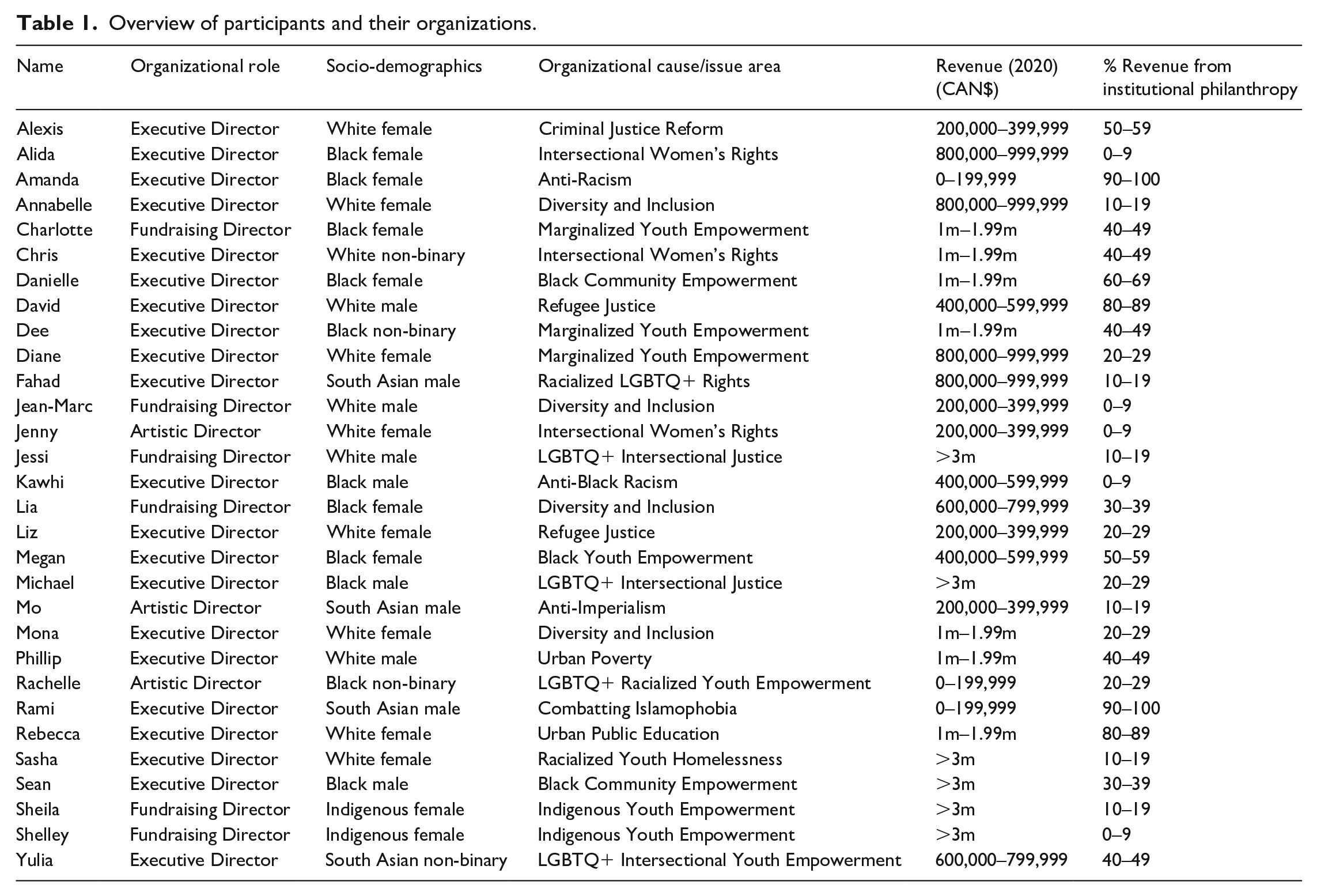
Data for this research were collected through one-to-one, in-depth, semi-structured interviews with leaders from 30 RJOs in Toronto and Montreal. All participating organizations are registered charities eligible to receive funding from philanthropic foundations. Likewise, all engage in programming explicitly related to racial justice goals. Some organizations work on race-specific issues (e.g. anti-Black racism; refugee justice; combatting Islamophobia). Other ones work on racialized causes (e.g. criminal justice reform; anti-poverty work). And yet others work on intersectional causes, giving prominence to the role of an anti-racist approach in the work they do. RJOs ranged widely in annual expenditure and share of revenue received from philanthropic funders. Table 1 provides an overview of the RJOs of our respondents (under pseudonyms), their roles in the organization and key socio-demographic characteristics, as well as their organizations’ focus, annual revenue (from 2020) and the percentage of that revenue that came from institutional philanthropic donors.
Overview of participants and their organizations.
Participants were contacted by email and provided with a letter of information and consent form detailing the research project, what their participation would involve and the potential benefits and harms associated with participation. Additionally, they were informed that they could choose all or some of their responses to be anonymized, both as individuals and organizational representatives, and that they would have the option of altering this decision post-interview and again after reading their transcript. Interviews were conducted by the first author in English and/or French between May and November 2020 over Zoom or telephone owing to the COVID-19 pandemic and lasted between 40 and 90 minutes. Interviews were semi-structured by open-ended questions around: (1) the charity’s history and primary activities (e.g. What does [organization] do? Can you provide a brief history of [organization]?); (2) communities served (e.g. Who comprise the beneficiaries of your organization’s programmes? What does accountability look like in these relations?); (3) funding structure (e.g. Where does your funding come from? Are there any funders that you refuse to work with?); (4) experience with philanthropic funders (e.g. Which philanthropic foundations fund you? How do these relations originate?); and (5) accountability relations with philanthropic funders (e.g. What do these relations look like in practice? What challenges have you experienced working with philanthropic funders?).
Interview transcripts were complemented by other data sources on the participating organizations, including mission statements, strategic plans, annual reports and funding history between January 2015 and December 2020. This allowed us to contextualize and triangulate participants’ narratives and more accurately reconstruct the mission, history, activities and funding structure of the RJOs. Public organizational documents and reports were accessed through participating RJOs’ websites, while internal ones (e.g. previous annual reports or strategic plans) were provided by participants. Funding history was accessed through the Canadian Revenue Agency’s database of annual T3010 tax returns (which all charities must submit). Additionally, we utilized charitydata.ca to do a longitudinal analysis of participating RJO revenue sources between 2015 and 2020. In total, our complementary data included 30 mission statements, 23 strategic plans and 109 annual reports, as well as 118 T3010 tax returns.
Data analysis
The interviews were analysed in multiple phases. We began by watching (or listening to) each recorded interview, jotting down notes, thoughts or information that might not translate directly to text transcription, such as vocal mannerisms, interview conditions or technical issues. We then used software (Otter.ai) to produce rough transcriptions of the interviews, which we corrected while re-listening to them. As neither author is a native French speaker, the first author also verified with a francophone colleague French slang or words that remained unclear at this stage. Once the transcripts were complete, we sent them to each study participant, providing the opportunity to review them and make any changes, edits or alterations. In doing so, we actively co-constructed a version of events that was true to the participant’s own interpretation. Changes were made over a two-week period using email or follow-up Zoom calls.
Next, we closely read the final transcripts. We conducted a first round of open coding of all excerpts in the texts describing aspects of the relation of accountability between the RJO and its philanthropic funders. This led to the identification of a total of 143 excerpts. We then searched this material for any reference to racial partitioning, or distinctions between racialized groups, and – following Melamed (2015) – their role in accessing the relation of accountability (who can relate?) and shaping it (on what terms?). This resulted in the identification of 51 excerpts, which we could cluster, through multiple rounds of discussion, into three main sites of racial partitioning: (1) partitioned leaders (19 excerpts); (2) partitioned fantasies (14 excerpts); and (3) partitioned partners (18 excerpts). In the last phase, to answer our research question, we identified how each of these sites of partitioning related to the racial capitalist political economy of philanthropy and, more specifically, the wealth accumulation at the core of philanthropy.
Findings
Reflecting on their accountability relations towards philanthropic funders, RJO leaders elaborated at length on how such relations structurally undermined the capacity of their organizations to promote their racial justice objectives. Their narratives revealed how the racial partitioning of leaders, fantasy and partners in these relations entangle their organizations in the racial capitalist political economy of philanthropy. In the following sections, we show how these racial partitionings in the social practices of account giving materially and symbolically dispossess RJOs and their communities. Beyond thwarting their own efforts to advance racial justice, this ‘double dispossession’ reproduces the political economy of racial capitalism of which philanthropy is part and parcel.
Racially partitioned leaders
Many participants elaborated at length about how profound racial, social and economic divides between their RJO’s leaders and philanthropies’ leaders structurally hampered access to philanthropic funding. This exclusion is perpetuated by philanthropy’s reliance on informal social connections dominated by wealthy white elites. Notably, RJOs often prioritize community accountability by choosing a board that reflects the marginalized communities they serve. This practice, however, limits RJOs’ access to the elite networks necessary for securing philanthropic wealth expropriated from the communities they represent.
At the onset, RJOs struggle to access philanthropic networks because prior contact with a donor is often a necessary precondition to entry. As Rachelle, the artistic director of an LGBTQ youth empowerment organization, put it: ‘it’s really all about who you know. It’s continuously all about who you know’. Within the philanthropic sector, however, ‘who you know’ is not randomly distributed. Rather, it reflects the social, economic and cultural networks stratified along the political economy of racial capitalism. Giving through private philanthropies requires vast sums of private wealth, the accumulation of which has long been highly concentrated in specific segments of the population: wealthy white families. Charlotte explains: There’s lots of foundations that function like that where you have to know somebody. And when you think about the ways in which Black people are more likely to be unemployed, more likely to be low income, more likely to be in junior positions [in organizations]. That just means that we’re probably not getting any private money then. Because [our community] doesn’t have the clout and influence to actually drive that kind of decision making in the [philanthropic] institution. (Black female fundraising director, marginalized youth empowerment)
Danielle further points to how the terms of RJOs’ relations with funders are defined by ‘wealthy white women’, determining which organizations can make initial contact: I don’t have connections per se to foundations. And wealthy white women rule those relationships. To establish those relationships [with philanthropies], and even trying to do a scan of potential foundation funders, you need to realize that this is not an open process, right? [. . .] It's very closed doors. Lots of foundations don't even have contact information. (Black female executive director, Black community empowerment)
The philanthropic sector’s reliance on informal social networks reflects the racial partitioning of leaders through the systematic exclusion of RJOs from elite philanthropic networks and, consequently, wealth distributed through them.
This exclusion is reinforced by RJOs’ purposive choice to have boards of directors that reflect the communities they serve, to remain accountable to them and to stay true to their mission. For example, Dee, the executive director of an RJO that works with marginalized youth, notes, ‘our board is largely BIPOC [Black, Indigenous, People of Colour], a huge amount of queer folks on our board. Our board is also part of the community that we’re trying to serve. I think that’s important’. Jean-Marc describes how several members of his RJO’s racially diverse board lack access to philanthropic networks because they were born outside the country: We should talk about the board. Usually [board members] go to cocktails or events and they will meet people. But the difficult part is most of my [racially diverse] board have no networks, no contacts here. Two were born in Canada. All the other ones were born abroad [in Argentina, France, Benin and Belgium]. I think it’s hard for anybody to get money. But still, they’re a step behind because they have no record here. (White male fundraising director, diversity and inclusion)
Partitioning along racial lines is also reaffirmed when RJOs with boards that reflect the communities they serve succeed in making initial contact with a philanthropic funder. Jean-Marc moves on to describe how racialized and immigrant board members encounter cultural barriers to cultivating relations with philanthropies’ leaders: Usually, you start relations with small talk. But if [racialized board members] don’t have the same experiences in their life – you don’t watch the same TV programmes, you don’t like the same sports, you don’t know the same artists – how are you going to connect?
Philanthropic donors’ and minoritized subjects’ different race-, class- and culture-specific practices and experiences impede RJO leaders’ access to relations with elite philanthropic networks. David, the white executive director of an organization that works with refugees in Quebec, reflects on how his own demographic profile, conversely, facilitates building rapport with white donors: I grew up in Quebec. I went to French school in Quebec. And so, if [potential donors] in Quebec are listening to me or seeing me on TV, they can say, well, ‘this guy thinks refugees have rights’. They can identify with me in a way that they may not if I were a person of colour, or I had an accent.
These excerpts aptly illustrate the partitioning of white philanthropic leaders from racialized RJO leaders. Racialized, national and classed networks hamper the latter’s ability to enter a relation of accountability with the former and further disadvantage them by shaping the terms of such relations around donors’ dominant white and elite culture and mores. Institutional donors’ leaders fail to recognize racialized RJO leaders and RJO leadership decisions on their own terms, dispossessing them symbolically. But their dispossession is also material, as misrecognized RJOs cannot access funding that redistributes part of the wealth accumulated through the racial capitalist political economy. This ‘double dispossession’ points to the impossibility for RJO leaders to foster racial justice within their accountability relations towards philanthropic leaders. These accountability relations, or their absence, on the contrary become the place where the racial capitalist political economy of philanthropy is materially and symbolically reproduced, as expropriated philanthropic assets fail to be redistributed to racialized communities and the hegemony of white elites is reaffirmed.
Racially partitioned fantasy
Participants describe how, in their accountability relations to philanthropy, their RJOs are expected to represent the communities they serve as exemplars of racialized ‘vulnerability’ and ‘need’. Such social practices make racialized communities legible for institutional philanthropies on the terms of wealthy white funders to increase their chances of securing competitive grants. In doing so, RJOs provide a ‘social fantasy’ that satisfies dominant philanthropic impulses, serving the psychic capitalist political economy of philanthropy. Fahad explains how this manifests in his communication with philanthropic donors: We work with a lot of South Asian and Middle Eastern children who are HIV-positive. And [donors] always say: ‘We need that story.’ And I’m like: ‘We’re not UNICEF, we’re not World Vision.’ We’re not going to sit there and show that poor child who they could help with their money. Especially to a privileged person who is sitting there looking at this dead carcass. (South Asian male executive director, racialized LGBTQ+ rights)
Fahad recounts a particularly egregious example of how this social fantasy shaped the demands of a donor amid a community tragedy: the case of Bruce MacArthur, a serial killer who murdered eight gay men in Toronto between 2010 and 2017, most of whom were of South Asian and Middle Eastern descent: [Funders] even said that with Bruce MacArthur: ‘Why didn’t you share one of the families or showcase one of the families?’ And I’m like: ‘They’re struggling!’ I’m not going to make money for them or for the organization based on the struggle of the individual. [. . .] I’m not going to parade them around like a show pony.
The philanthropic desire for pernicious stories of racialized vulnerability and struggle – even in instances of murder and fatal disease – requires that RJOs treat community members as ‘show ponies’. Such representations, however, are not only resisted because of their overt instrumental nature and indecent taste, but also because they symbolically dispossess the communities they serve, re-entrenching racial hierarchies, biases and prejudices.
The expectation of account-giving practices that reaffirm hegemonic images of racial partitioning from the donor’s perspective extends to RJO staff as well. Lia explains how racialized RJO staff navigate these accountability demands from donors: Part of it is using your own closeness to the clientele as an advantage to be like, ‘it could be me’. I think some of us have really perfected the perfect balance of emotionality without hysteria. [laughs] When you’re a person of colour or a queer person or trans person in fundraising, [donors] look at you and they’re like: ‘Let me help you.’ [. . .] Fundraising is selling and selling is flirting and all these things that go into it. (Black female fundraising director, diversity and inclusion)
The production of the social fantasy of racialized community vulnerability also occurs through the imposed collection of participant data along racial and class categories to ‘measure’ beneficiaries in the communities. Charlotte explains: The demographic stuff can be complicated for us. Asking people to self-report whether they’re a person of colour or not can be problematic. People will be like: ‘That’s an insulting question.’ And [those people] tend to be white. But I think that is definitely hard for some of our team, particularly our street work team, because they’re just out meeting random kids or random people on the street. And it would totally ruin their ability to provide good care to kind of be like: ‘Are you a person of colour? What kind?’ (Black female fundraising director, marginalized youth empowerment)
While social quantification has long been a defining feature of donor–grantee accountability relations and is not exclusive to relations with RJOs, these data can function to cement a story of racialized need, material vulnerability and racialized hierarchies of value. When bound up with the promise of philanthropic funding, this donor desire for ‘race-based quantification’ is not simply a request that can be entertained or refused. Rather, the social practice of performing ‘otherness’ within accountability relations with philanthropies has concrete material consequences for RJOs. Rami, the South Asian executive director of an RJO that combats Islamophobia, explains: We know of at least one funder who stopped working with us because they’re like: ‘You’re not doing a good enough job telling the story of what you did to combat Islamophobia. Sure, it might have had an impact on the communities that you work with. But we want to be able to tell their story.’
Rami’s account giving has little to do with proving his organization’s impact on the Muslim communities he works with. Rather, it has to do with facilitating philanthropy’s ability to ‘tell their story’ about how the white elite donor was able to combat the Islamophobia that Muslim communities are victims of through their philanthropic giving.
These excerpts illustrate how the psychic and discursive terms of accountability play out to dispossess RJOs and the communities they serve. RJOs are conscripted into giving accounts that reproduce a pernicious racially partitioned fantasy of community need and vulnerability necessary for white elite saviourdom. Whether produced through narratives of beneficiaries, staff performances or the gathering of participant data, these accounts symbolically dispossess the racialized communities RJOs serve. This symbolic dispossession is materially enforced, as it is bound up with the possibility of receiving philanthropic funds. Consequently, it is impossible for RJOs to pursue racial justice within the accountability relation with the donors and along the terms imposed by them. This relation, on the contrary, reproduces the partitioning that underpins the racial capitalist political economy of philanthropy.
Racially partitioned partners
Finally, participants detailed how, within the accountability relation, RJOs and RJO staff are continuously racialized by wealthy white philanthropies who fail to recognize and treat them as trustworthy partners. These relationships are marked by donor distrust, micro-aggressions and surveillance, illustrating the partitioning of philanthropies from RJOs and their staff. This differentiation along racial lines fundamentally structures the RJOs as the controlled vis-a-vis philanthropies as the controller. In the following excerpt, Dee notes how racial partitioning shapes and is reproduced through interactions between donors and the staff of their RJO partners: The damage of working with philanthropy, it’s more about the personal toll it takes on marginalized bodies. [. . .] Our former executive director went into a meeting with a foundation staff [member] who was white, and [our executive director] was Black and the foundation staff was like, ‘Who are you, by the way?’ And she was like, ‘I’m the executive director. That you’re here to meet.’ [. . .] They will not trust you; they will not see you as professional. With the way we dress and our embodiment, they’ll be less interested, saying, ‘I don’t see myself in you.’ (Black non-binary executive director, marginalized youth empowerment)
RJOs are viewed with suspicion and are on the receiving end of racist accountability demands. Along the same lines, Amanda describes these relations by drawing a parallel to her experience as a Black woman being surveilled while shopping in a store: Everything is questioned. Every penny we spend is questioned in a way that I’m not sure [white-led] organizations are. And every time I see an organization of colour get found out, I’m pretty sure white organizations are doing the exact same thing. But they’re not under the gun in the same way. [. . .] I feel the same nervousness I feel when I walk into a store. The assumption is I’m probably going to steal something. (Black female executive director, anti-racism)
Partitioning along racial lines also occurs through donors’ relentless suspicion regarding RJO resource allocation, particularly when it comes to the remuneration of racialized labour within RJOs. As Megan notes, ‘they often ask our salaries or my salary’ (Black female executive director, Black youth empowerment). Diane, whose staff of 10 includes eight racialized women, explains: You’ll hear [funders] say, ‘Oh, I give it to the place that spends the least on administration.’ So you’re basically saying you want to give somewhere that’s not run as well? [. . .] You want people working in these uncomfortable environments to do really important work? Or maybe not retain really high-performing staff, because we can’t pay them a competitive salary? We had this one foundation, where maybe 35% of the overall grant was staff salaries. ‘Why is that so high? [they said.] I’d rather pay for that in art supplies.’ (White female executive director, marginalized youth empowerment)
Philanthropies treat racialized workers as less deserving of fair wages than white workers in ways that reflect and reproduce the partitioned labour markets of the racial capitalist political economy. Donors’ fixation on keeping administrative costs and salaries within RJOs low and preference for physical objects like art supplies reinforces a distrust of RJO leaders’ capacity to properly manage and allocate funding and fear that they will appropriate it for their own gain.
Similarly, racial partitioning occurs in funders’ treatment of RJO programmes. Fahad describes white donors’ suspicion around his organization’s use of non-western methods, tools and approaches to social change: We use cooking as a social way of gathering people, engaging people and having them talk about their feelings and emotions and learn through those processes. But in the western world, for us to be qualified as providing a programme or service, we need to have a 12-step programme where we are able to monitor someone who walks in desperate, and then they walk out feeling great. [. . .] We still need to fit into the sort of western way of doing things rather than an inclusive way of doing things. Which becomes a problem for us. Because then we fight with our funders. When we start doing things from an eastern practice, or philosophy, or whatever you want to call it, then there’s direct conflict. It’s like, ‘well, you said you were going to do a support group. But cooking is not a support’. But we are providing support through cooking. People are talking and I think that’s a good thing. It’s our unique way of doing things that actually are effective in helping people move through and move forward and establish themselves in community. And so that becomes a problem for us and funders. (South Asian male executive director, racialized LGBTQ+ rights)
These excerpts show how racial partitioning within the accountability relation constitutes RJOs as untrustworthy partners for elite white philanthropies. This hierarchization based on racial difference is reproduced and affirmed through donors’ racialized surveillance, micro-aggressions and the delegitimization of methodologies aligned with the community’s culture and needs. The resulting psychological harm, devaluation of racialized workers and scepticism of culturally specific approaches to social change symbolically dispossess RJOs, RJO staff and their communities of their worth and materially deny them access to wealth. Donor–RJO accountability relations not only hamper the activities of RJOs to advance racial justice. They also function as a site for both the symbolic and material reproduction of the racial capitalist political economy of philanthropy.
Discussion
Against the background of institutional philanthropy’s recent turn to racial justice, this study has investigated RJOs’ accountability relations with wealthy white philanthropies. Building on the emergent literature showing institutional philanthropy’s entanglement with racialized and colonial processes of corporate accumulation (e.g. Gilmore, 2017; Kapoor, 2012; Saifer, 2021; Villanueva, 2018), we adopted a racial capitalism lens to uncover how partitioning takes place within these relations. Partition refers to the process whereby communities are racialized and assigned differential symbolic value (Prasad, 2023) in order to subordinate, exploit and dominate them, fuelling capital accumulation (Melamed, 2015). Our study makes three main contributions to the extant literature.
First, we have unveiled and extensively documented how racial divisions profoundly structure RJOs’ accountability relations towards white philanthropies. Our analysis of narratives collected with leaders of Canadian RJOs allowed us to identify three key sites of partitioning within these relations: racial and class divisions within elite philanthropic networks providing access to funding; social fantasies of racialized communities’ vulnerability alongside white elite saviourism; and partnerships marked by racialized images of RJOs and their staff as untrustworthy and requiring donors’ heightened control. Across these sites, we show how, in the social practices of account giving, through interactions, images, narratives, mores and rules, RJOs and the communities they serve are continuously racialized, misrecognized and symbolically dispossessed. As a consequence, RJO leaders and staff face significant constraints on their leadership and administrative decisions, their organization’s programmatic choices and their ability to render themselves accountable to the communities they serve. Yet, this dispossession through racial partitionings attributing less human value to them is not confined to the symbolic. Crucially, RJOs’ own involvement in the reproduction of racial partitioning becomes an essential condition for accessing philanthropies’ wealth, dispossessing them materially in a unique bind of ‘double dispossession’.
In line with recent calls to more seriously integrate race into analyses of non-profits (e.g. Dunning, 2023; Nickels and Leach, 2021), our study advances the current literature on RJO–philanthropy accountability relations by foregrounding the specific role racial divisions play in such relations. Rather than highlighting (economic) power inequality, donor control, agenda setting and the institutionalization of leaders in these relations (e.g. Francis, 2019; Jenkins and Eckert, 1986; Kohl-Arenas, 2015; Marshall, 2015), we show how they enforce the symbolic and material dispossession of RJOs and the communities they serve. Future research on philanthropy and racial justice could explore accountability relations through a racial capitalism lens more in-depth by including the perspectives of multiple actors, including philanthropies and community members, and in different geographies characterized by distinct race relations and institutional contexts.
Second, a racial capitalist analysis of accountability relations allows us to point to the role these relations play in the reproduction of the broader racial capitalist political economy of philanthropy (Issar, 2021; Melamed, 2015). Whereas the extant literature has extensively documented how institutional philanthropy is itself the product of wealth stolen from racialized communities and continuously accumulated (Gilmore, 2017; Saifer, 2021; Villanueva, 2018), our analysis shows how ‘double dispossession’ through racial partitioning reproduces the racial injustice it claims to combat. To obtain material resources from philanthropies partially redistributing wealth stolen from the communities they represent, RJOs are expected to reproduce the racial partitioning that legitimizes and fuels the accumulation of philanthropic assets under racial capitalism in the first place (Gilmore, 2007; Melamed, 2015). Refusing such relations fortifies the material disenfranchisement of the racialized communities they serve. Accepting them legitimizes institutional philanthropy as a force for racial justice and the broader capitalist political economy that powers the racial partitioning of wealth. Therefore, within this racial capitalist accountability relation, RJOs can only exist through relations that dispossess them materially and symbolically.
The ‘double dispossession’ that emerged from our analysis bridges analyses of RJO–philanthropy accountability relations (e.g. Dunning, 2023; Francis, 2019; Marquez, 2003) with the critical literature on the political economy of philanthropy (e.g. Gilmore, 2017; Kapoor, 2012; Villanueva, 2018). Specifically, this ‘double dispossession’ points to how specific donor–grantee relations are locations where social practices take place that themselves re-entrench the material and symbolic foundations of the racial capitalist social order. This insight is important to advance racial capitalism theory by showing how organizations, and their mutual relations, partake in structurally reproducing the racial symbolic foundations on which capitalism is predicated (Du Bois, 1903; Kelley, 2017; Robinson, 2000). In doing so, our study also provides a novel critical political-economic perspective that speaks to the burgeoning management and organization studies literature on the role of organizations in the (re)production of inequalities that has grown steadily since the 2008 financial crisis (e.g. Amis et al., 2018, 2020; Bapuji et al., 2020; Riaz, 2015).
Third, the constitutive entanglement of institutional philanthropy with racial capitalism casts a fundamental doubt about its potential role in mitigating racial injustice, despite claims to the contrary. Our study reconceptualizes the failure of the philanthropic sector to bring about racial justice differently from current accounts emphasizing depoliticization and/or social movement capture (Francis 2019; Kohl-Arenas, 2015) caused by elite donors’ demands on highly dependent, precarious grantees (e.g. Barkan, 2013; Ostrander, 2007). Rather, we argue that institutional philanthropy – and the accountability relations at its core – should be understood as part and parcel of the racial capitalist economy. Thus, all manner of relational accountability – regardless of funders’ or RJOs’ intentions – entangles RJOs in it, reproducing its material and symbolic foundations.
In this way, our study problematizes the growing public discourse around philanthropy’s important role and function in realizing racial justice outcomes, dispelling the philanthrocapitalist claim that philanthropy can adequately step into a civil society void created through state retrenchment and austerity policies (e.g. Bishop and Green, 2010). Our findings suggest that the racial justice objectives and priorities of RJOs cannot be advanced owing to their accountability relations towards philanthropies. In line with this insight, some philanthropic foundations have begun experimenting with new approaches aimed at reconfiguring their relations with grantees. One of the most popular methods, ‘participatory grantmaking’ (Gibson, 2018), involves engaging community members in funding decisions that impact their lives. Even in those cases when decision-making is fully ceded to community members and grants come formally with ‘no-strings-attached’, there still are ‘invisible strings’ (Dunning, 2023) that are likely to reproduce ‘double dispossession’.
A more radical and promising alternative is large-scale capital transfers to RJOs to move resources outside such accountability relations. For example, in 2023, the McConnell Foundation committed CAN $30m in such transfers to Indigenous-led foundations, beginning with a CAN $10m transfer to the Indigenous Peoples Resilience Fund (McConnell Foundation, 2023). In capital transfers, once the money is transferred, the organization can use it as they wish, whether for investment, programming or their own grantmaking, without needing to report back to the donor during the next grant cycle to request more funds. Such an approach embodies a spirit of reparations. Recognizing that philanthropic wealth is essentially stolen wealth (Gilmore, 2017), it aims to give back control over wealth to the organizations and the communities from which it was extracted. Our analysis indicates that large-scale capital transfers could help mitigate the ‘double dispossession’ resulting from accountability relationships. While this option appears to be the most promising for philanthropists dedicated to racial justice, there is, to date, limited evidence suggesting that philanthropic organizations will willingly relinquish their material and symbolic power on a large scale.
A second way of partially removing the accountability relation from accessing philanthropic resources would be to impose a wealth tax on charitable contributions to philanthropic foundations as well as on philanthropic foundation assets themselves (Saifer, 2020). It is important to note that a wealth tax would not directly impact the accountability relationship, as philanthropies would still have the ability to allocate their remaining funds to grantee organizations in a manner of their choosing. However, if included in a broader public restorative justice policy, this would enable the state to democratically redistribute some wealth historically taken from those communities back to them, granting them autonomy in its use. Such a public policy would address the accusation levelled by some economists and public policy scholars that institutional philanthropy is fundamentally anti-democratic (e.g. Reich, 2020; Saez and Zucman, 2019). Because donations by elites to their philanthropic foundations are tax-deductible, the grantmaking decisions of philanthropists are, in essence, funded by the public tax base. It is for this reason that Ruth Wilson Gilmore (2017: 46) describes philanthropic foundations as ‘repositories of twice-stolen wealth – (a) profit sheltered from (b) taxes – that can be retrieved by those who stole it at the opera or the museum, at Harvard or a fine medical facility’. Actors in the philanthropic sector who are dedicated to racial justice – including foundation staff, donors, policymakers and researchers – should leverage their financial, social and political influence to advocate for regulations and practices that aim to completely eliminate existing accountability relations, rather than simply reforming them.
Conclusion
Since we conducted this study, many philanthropic foundations have drawn even more heavily on the language of racial justice and anti-racist movements. Our study, however, points to the impossibility of philanthropy for racial justice as currently practised. It shows how accountability relations to philanthropies doubly dispossess RJOs and the communities they serve, reproducing those same racial inequalities that capitalist structures and institutions are predicated on. A racial capitalism lens is key to understanding the role organizations play in the reproduction of inequalities. Specifically, it offers concepts, such as racial partitioning and symbolic and material dispossession, that reveal how organizational processes and relations partake in the functioning of a racial capitalist political economy. We hold that such analyses are essential for envisioning new forms of philanthropy that can advance racial justice.
Footnotes
Acknowledgements
Thank you to Ajnesh Prasad and the three anonymous reviewers for their thoughtful, generous and encouraging input.
Funding
The authors received no financial support for the research, authorship and/or publication of this article.
