



Abstract
Democratizing entrepreneurship itself is by far no guarantee for emancipation: the majority can (over)rule, masculinist dominance or regressive ideologies may flourish, and exclusions occur. By ethnographically following the transformation of a socially engaged agency into a diverse cooperative, we offer a processual study of emancipatory entrepreneuring that is undoing the paternal, family-like, and pseudo-democratic enterprise and creates a diverse cooperative with shared ownership, co-leadership, and queered sensitivities to gender, racism, and affective difference. Our analysis thereby relies on the political concept of “disidentification” and its process of queer worldmaking as developed by José Esteban Muñoz. On this conceptual basis, we redraw becoming democratic as an ongoing in-between process of “decomposing” heroic and patriarchally inclined entrepreneurship and ongoingly “recomposing” democratic entrepreneuring through revising interrelated layers of inequality. By introducing the theory of “disidentification”, we contribute with a queer-feminist conceptual vocabulary to analyze the intertwined political and processual nature of emancipation. Transformation is neither understood as a revolution nor a planned linear change but rather as an ongoing in-between process that subversively recycles former, habitual ways of interacting into undertaking different, more inclusive worldmaking.
Keywords
Introduction
This article responds to the call by Benali and Villesèche (2024: 940) to encourage research of emancipatory entrepreneurship to finally “go beyond the lead entrepreneur” and to understand the complex relational changes needed to constitute collective, democratic, and post-neoliberal forms of entrepreneurship. As entrepreneurship is often associated with masculinist heroes, centering on archetypal White males (Verduijn et al., 2014), there is a need to zoom out on an extended mix of heroines, queers, persons of color, and other minoritarian subjects to acknowledge their often collective, entrepreneurial potential. Countering this masculinist fixation on success and profit, research on emancipatory entrepreneuring has reconceptualized entrepreneurship as a means of empowerment and transformation (Rindova et al., 2009) that not only creates wider social, ecological, and humanitarian change (Calás et al., 2009; Steyaert and Hjorth, 2006) but also requires the formation of different subject positions and alternative relations that go beyond the entrepreneurial heroic ideal and its paternalistic hierarchy. We will investigate this complex, relational transformation in the context of a becoming cooperative that embraces co-ownership and democracy (Fernandez-Guadaño et al., 2020; Montgomery et al., 2012).
In their influential article, Rindova et al. (2009: 477) proposed the term “emancipatory entrepreneuring” to refer to the study of a “wide variety of change-oriented activities and projects” that can “bring about new economic, social, institutional, and cultural environments through the actions of an individual or group of individuals”, and thereby indeed shifted the focus away from wealth creation, innovation, and images of phantasmatic success. While research on emancipatory entrepreneurship has continuously increased since then, there is a considerable range of critical, feminist readings that emphasize its “role in overcoming extant relations of exploitation, domination and oppression” (Verduijn et al., 2014: 98) and that are sensitive to different, often intersectional dimensions of power and inequality (Calás et al., 2009; Goss et al., 2011; Qureshi et al., 2023). Especially, feminist research on cooperatives has proposed that such enterprises can enact post-capitalist principles (Daskalaki et al., 2015; Zanoni et al., 2017) while ameliorating gender inequalities (Bastida et al., 2020; Sobering, 2016) and redistributing power (Battilana et al., 2022). However, we propose to study these forms of emancipation by emphasizing their processual nature, as we interconnect processes of “emancipation from” and “emancipation to” (Laine and Kibler, 2022). Therefore, this study is interested in the following puzzle: which processes characterize the emancipatory transformation toward a democratic cooperative that simultaneously allow us to let go of the masculinist cloak of paternalism and generate different, more equal relations that resist gendered, racial, and neoliberal layers of inequality?
To conceptualize these processes, we extend the above-mentioned feminist approaches with a queer perspective, which forms still a rare conceptual angle (Marlow and Martinez Dy, 2018; Rumens and Ozturk, 2019) in entrepreneurship studies. To develop such a queer-feminist reading, we turn to the queer theorist of color Muñoz’s (1999) concept of emancipation as “disidentification” and its process of queer (of color) worldmaking. According to Morrissey (2021: 2), disidentification is “both a theoretical framework and a political strategy”. Conceptually, we believe the notion of disidentification enables us to theorize the experiences of resisting a patriarchal, White, neoliberal, and masculinist hegemony while engaging with practices of worldmaking that open up for alternative relations that break with gendered, racial, and other layers of inequality. As a political strategy, disidentification and queer worldmaking invite us to “decompose” aspects of domination while “recomposing” and reworking the organization as a different relational world. Translating this, in our view, truly processual notion of disidentification from an artistic-cultural to an entrepreneurial context, this conceptual framing allows us to document how emancipation (in a becoming cooperative) requires a transformational process that consists of both decomposition and recomposition, and therefore, can connect the study of “emancipation from” with that of “emancipation to” (Laine and Kibler, 2022). We, hence, can refine our puzzle in the following research question: which queer-feminist disidentificatory processes characterize the emancipatory transformation toward a democratic cooperative?
Based on this conceptual development, we turn to our empirical site, which is based on an organizational ethnography of a communication agency. After seven years of operation, tensions between the influential male founders who claimed participatory work, and the team that felt passed over, led to a dismantling and reinvention of the socially engaged agency as a cooperative. The re-inauguration as a cooperative came with a substantial transformation toward democratic leadership, egalitarian co-work, and diverse and inclusive work relations, which makes it an intriguing case to study emancipation. Our findings show that redistributing entrepreneurial action “amongst both similar and diverse actors” aspiring to “positive societal change” (Stervinou et al., 2021: 759) not only involves installing formal democratic governance and co-ownership but also entails ongoing emancipation from heroic (Johnsen and Sørensen, 2017) and hegemonic masculinity (Hamilton, 2013) toward more gender-based equality (Clark and Ozkazanc-Pan, 2016). Furthermore, emerging democratic relationalities interrupt gender and sexual categories (Muhr and Sullivan, 2013), open for building interrelated, decolonial sensitivities (Imas and Garcia-Lorenzo, 2023; Paludi et al., 2019), while queering understandings of work, self, and life (Marlow and Martinez Dy, 2018; Parker, 2002).
With a queer-feminist approach, we contribute to the understanding of emancipatory entrepreneurship by underlining its imbricated political and processual nature. Becoming sensitive, gradually transforming, and overcoming interrelated layers of inequality requires a slowly formed and intricate in-between process based on a political stance that regards entrepreneuring as a mode of emancipatory worldmaking in organizations and wider societal institutions. By applying the queer processual concept of disidentification to entrepreneurship studies, we reconceptualize “breaking free” from patriarchal relations as a twofold in-between process of decomposing the old and recomposing more inclusive and diverse relations. Emancipation becomes an ongoing democratizing through de- and recomposition that is forever sensitive to intertwined layers of inequalities that make worlds differently so that diverse entrepreneurial subjects feel they belong there.
In the remainder of this article, our literature review follows to present the intertwined political and processual nature of emancipatory entrepreneuring. We then propose our conceptual framework of disidentification and queer worldmaking. After explaining our methodology, the analysis traces the decomposing of the patriarchally inclined agency and its recomposing into a diverse cooperative, while unfolding further layers of de- and recomposition that retinker democratic equality, relearn anti-discriminatory relationalities, and rebalance affective intensities. Finally, we discuss our contributions, refer to the implications of this study and propose further possibilities of research before concluding.
The political and processual nature of emancipatory entrepreneuring
Since Rindova et al.’s (2009) seminal article, the emancipatory perspective has been extensively developed: conceptually (Laine and Kibler, 2022; Rindova et al., 2022), empirically (Chandra, 2017; Tobias et al., 2013), and especially critically (Alkhaled and Berglund, 2018). In our view, Rindova et al.’s (2009) work requires closer scrutiny of both its political and processual features. From a political angle, they focused on emancipation “because it refers to ‘the act of setting free from the power of another’” (2009: 478), an idea embraced since especially by feminist critiques of the emancipatory perspective (Alkhaled and Berglund, 2018) that among others draws attention to the intersection of gender and postcoloniality (Benali and Villesèche, 2024). From a processual angle, Rindova et al. (2009: 490) observed that this power shift involves a social process rather than an individual, heroic endeavor because they did not intend “to champion a heroic view of the entrepreneur who breaks away from authority and dislodges structures of power”. Therefore, we understand this remark as an opportunity to conceptualize emancipation as a process of social change (Steyaert and Hjorth, 2006). Such a processual perspective enables expanding the potential of entrepreneuring as emancipation by not focusing on the starting- or endpoint of transformation but on how this process unfolds in the in-between (Weiskopf and Steyaert, 2009). Accordingly, we aim to intertwine the political and processual nature of entrepreneuring.
Emancipation as political work on layers of inequality
Feminist critiques have especially highlighted the political nature of emancipatory entrepreneuring (Alkhaled and Berglund, 2018). These critiques have sought to understand how actors can emancipate themselves entrepreneurially “from” poverty, discrimination, and oppression and thus enact social change “toward” more equal, sustainable, and free societies. Such critiques have instigated emancipatory scholarship to no longer remain blind to broader inequality regimes (Ahl and Marlow, 2012; Calás et al., 2009; Jennings and Brush, 2013). Emancipation from this critical vantage point can only be “conceptualized [. . .] as intimately related to oppression” and as a means of developing more equal and democratic alternatives (Verduijn et al., 2014: 98). For instance, Alkhaled and Berglund’s (2018) study of female entrepreneurs in Sweden and Saudi Arabia distinguishes between “empowerment” and “emancipation”. While “empowered” female entrepreneurs free themselves as individuals within given institutional setups through entrepreneuring, “emancipation” changes the oppressive institutional and organizational worlds in which these actors operate. Emancipatory entrepreneuring gears organizations toward “community and bottom–up formats” besides supporting “women in employment”, departing from “male-centered values”, “coupling business with a social mission”, yet also pressuring “governments for (social) policy change” (Alkhaled and Berglund, 2018: 892).
Alkhaled and Berglund (2018) and similar studies enable arguing that since “entrepreneurship itself is institutionally embedded axiomatically [. . .] [and] entrepreneurial endeavors will reproduce constraints rather than offer liberation from them”, it is essential to transform formal and informal organizational environments (Jennings et al., 2016: 101). Therefore, emancipation from oppressive environments can be formal (i.e. changing policies and organizational forms) but also informal (i.e. cultural norms and expectations geared toward entrepreneurial operations). Especially female entrepreneurs struggle against the normative cultural demands of neoliberal, performance-driven societies, a culture of (pseudo) meritocratic achievements, and masculinist traits that pressure them into performing an “individualized superwomen entrepreneurial identity” (Byrne et al., 2019: 175). Hence, we argue that conceptualizing emancipation through political work requires not only addressing formal and informal oppressions and inequalities, which are institutionally enshrined, but also changing power structures as emancipatory entrepreneurs work on organizational and institutional answers to attain “collective freedom” (Alkhaled and Berglund, 2018: 877; Benali and Villesèche, 2024).
Given this emancipatory impetus to transform organizational arrangements to not only empower individual entrepreneurs but also to achieve a more comprehensive emancipatory impact, there is an urgent need to study and understand the complex yet hitherto underresearched transformation process of organizations toward more democratic (Battilana et al., 2022), participative (Stervinou et al., 2021), and cooperative entrepreneurial ventures (Bastida et al., 2020; Diaz-Foncea and Marcuello, 2013). While collectivist-democratic organizations such as cooperatives are not per se emancipatory or entrepreneurial and can suffer from internal conflict (Slade Shantz et al., 2020), informal hierarchies (Diefenbach and Sillince, 2011), and various layers of control (Resch and Steyaert, 2020), the question remains through which processes democratic governance and mutual ownership can become enacted (Ferreras et al., 2022; Sobering, 2019), which requires us to understand the processual dynamics of emancipatory entrepreneuring.
Emancipation as an in-between process
Conceptual scholarship has theorized emancipation as a social imaginary (Dey and Mason, 2018; Laine and Kibler, 2022), a notion first introduced by the Canadian political philosopher Charles Taylor (2004). These authors conceptualize emancipation as a process that both involves identifying the constraining orthodox social imaginary and also inventing and expanding possible imaginaries (Dey and Mason, 2018). Similarly, Laine and Kibler (2022: 395) examined literary fiction and distinguished “two different, yet complementary, conceptions of emancipation”. Their first negative conception of emancipation understands the entrepreneurial subject as being liberated “from prevailing constraints to action”, whereas their second positive conception of emancipation posits that this process aims “to inflict changes in society in a broader sense” (Laine and Kibler, 2022: 395; emphases in original).
However, both conceptions are often studied in a separate way as researchers emphasize either the from- or the to-aspect of emancipation, hereby installing a from/to binary. For example, Chandra (2017) investigated how 10 religious terrorists emancipated themselves from their ideological constraints and past behavior by establishing a culinary arts social enterprise and Dey and Mason (2018: 84) studied how “disruptive truth-telling” is a means of “breaking free from existing limitations of collective imagination”, and thus enables “activist entrepreneuring”. Contrastingly, Rindova et al. (2022) conceptualize emancipatory entrepreneuring to as replacing the dominant “market order of worth” with alternative, “civic”, or “inspired” ones (Boltanski and Thévenot, 2006: 15), thus fostering pluralistic understandings of the “common good”. Or, it is emphasized that entrepreneurship strives to be “transformative” and “not conceptually distinct from society” (Tobias et al., 2013: 728) because “entrepreneuring geared toward social change relies on a collective capacity to create organization that generates value for citizens, measured in greater possibilities for living” (Daskalaki et al., 2015: 420).
We see, while emancipation entails processual transformation through political change, a conception of emancipatory entrepreneuring that distinguishes from and to is unable to overcome the from/to binary and to consider both elements together in an interwoven and balanced in-between process (Hjorth et al., 2015). While Rindova et al. (2009: 478) consciously choose the present participle “entrepreneuring” to draw “attention to actions and processes geared toward change creation”, most studies seem to prioritize one or the other aspect—despite realizing that both elements should be considered. We therefore propose to link the emancipatory perspective to a processual view that understands entrepreneuring as the process of becoming in the “in-between” (Steyaert, 2005; Weiskopf and Steyaert, 2009). To conceptualize this political in-between process, we will develop a queer-feminist view drawing upon the concept of disidentification (Muñoz, 1999).
Disidentification: A queer-feminist view of emancipation
To create a conceptual framework, we build on the feminist critiques of emancipatory entrepreneuring while giving equal attention to the processuality of emancipatory entrepreneuring by turning to the queer-theoretical concept of “disidentification” developed by José Esteban Muñoz (1999) in his book, entitled Disidentifications: Queers of Color and the Performance of Politics. Interweaving the feminist critique with a queer-theoretical notion into a queer-feminist view makes sense as feminism and queer theory are part of “the same family tree of knowledge and politics” (Weed and Schor, 1997: vii). Therefore, it is feasible to let feminism and queer theory resonate with each other rather than see them as distinct because in “[p]olitics and ethics, queers need feminists and feminists need queers” (Huffer, 2013: 9). The same applies to the context of entrepreneurship research: we need the feminist critiques of emancipatory entrepreneuring, which have through their long gestation sought to redraft gendered inequality and masculinizing norms, while queer theory—which is rarely adopted in entrepreneurship studies—offers a generative concept like disidentification that imbricates a dedicated intersectional focus with a subversively processual vocabulary.
At its core, disidentification describes a “theoretical heuristic” as well as a “performative practice” of deconstructing majoritarian, masculinist, White, able-bodied, middle-classed superiority as marginalized subject positions subversively “make” new, more inclusive “worlds” (Morrissey, 2021). As a performative practice, disidentification is not a priori given but follows an ongoing unfolding that needs to be studied empirically in its processual dynamics. As a theoretical heuristic, disidentification is a complex and open concept that draws upon and interweaves various intellectual traditions, such as women of color feminism, psychoanalysis, and queer theory (Morrissey, 2021). Furthermore, Muñoz aimed to disrupt the often-dominant perspective of White queer scholarship and to prevent queerness from being reduced to being a one-dimensional phenomenon (Ferguson, 2018). Therefore, we highlight (only) those features that we will activate in the upcoming empirical study: (1) its utopian element through queer worldmaking; (2) its post-binarity; and (3) its processuality.
First, disidentification has a utopian moment as the notion is closely related to the concept of “worldmaking” that he borrows from Goodman (1978) who emphasizes the double element of “composition and decomposition” (Muñoz, 1999: 196). For Muñoz, the disidentificatory desire entails an expansion of the present toward new possibilities, what he terms queer worldmaking. As disidentification is enacted in aesthetic events, everyday interactions, and—as we will document—in work contexts, he posits that such “performance is nothing short of the actual making of worlds” (Muñoz, 1999: 200). Muñoz situates queer worldmaking as a form of building that takes place both in the future and the present. Worldmaking offers “a utopian blueprint for a possible future while, at the same time, staging a new political formation in the present” (Muñoz, 1999: 200). The transformative effect is to carve out the future within the present, looking for possibilities that can ameliorate societal inequalities (Janssens and Steyaert, 2025). In short, through disidentification, queer worldmaking is about making worlds of “transformative politics and possibilities” (Muñoz, 1999: 195).
Second, the notion of disidentification is not an either–or model that either supposes assimilation or counter-identification but proposes an in-between strategy. Analyzing the deep-rooted inequality of minoritarian subjects, Muñoz (1999: 200) argued that “people of color and queers are scapegoated, targeted, and assaulted in all manner of ways [. . .] [and we are called to] perform our liveness for elites who would keep us from realizing our place in a larger historical narrative”. Muñoz’s (1999: 200) analysis of art performances zooms in on minoritarian subjects to emphasize that rather than succumbing to White, male, middle-class domination, they should subvert the “stuff of the ‘real world’ to remake collective sense of ‘worldness’ through spectacles, performances, and willful enactments of the self for others”. Building on feminists of color, especially Chicana theorists such as Cherríe Moraga or Gloria Anzaldúa, Muñoz (1999: 32) reimagines the theory of identity through hybridity and post-binarity, as a majoritarian culture is resisted by “shuttling between different identity vectors”. Here, minoritarian performances labor to make worlds that critique “oppressional regimes of truth”, “deconstruct reality”, and form “counterpublics” (1999: 195–196).
Third, “disidentification” is a deeply processual notion that requires us in Muñoz’s understanding to interrelate the processes of “decomposition” and “recomposition” of the hegemonial, oppressive culture into a different one. “Decomposing” necessitates us to deconstruct, unsettle, and move away from majoritarian identity positions and actions, while “recomposing” consists of experimenting with and performing new, subverted, reorganized, and hybrid identity positions. Muñoz (1999: 196) understands disidentification as a dual process through which a stigmatized identity is simultaneously decomposed and recomposed; where values and tastes are reordered and reweighed utilizing alternate criteria; where a degree of editing, deletion, and supplementation is applied to an oppressive social script; and where a fundamental deformation of the dominant public sphere is achieved. All of this is the work of disidentification.
In summary, adopting “disidentification” and queer worldmaking to emancipatory entrepreneuring offers us three conceptual sensitivities for our analytical strategy that we now turn to in the methodological section: queer worldmaking is performative as it experiments in the here and now to anticipate an alternative future, it is post-binary as it negotiates between and transforms the old and the new in an in-between process, that consists of intersecting “decomposition” and “recomposition”.
By suggesting this translation of Muñoz’s concept of “disidentification” to a European work context, we simultaneously want to point out its limitations. While Muñoz’s original concept sought to describe the oppression of black queer minorities and their intricate ways of seeking dignity and survival amid persecution and violence in the 1980s and 1990s, contemporary entrepreneurial and organizational contexts might vary and be in need of framing for different conditions. However, amid the current ubiquity of neoliberal, patriarchal, and colonial (elements of) societies and economies, we believe that the concept is readily apt to describe transformations of classical, neoliberal, masculinist, hetero-normative, neocolonial, and racist hegemony in entrepreneurship studies toward a more democratic and egalitarian organizational context.
Methodological approach
Our processual study is embedded in an organizational ethnography (Cunliffe, 2010; Van Maanen, 2011b) that comprises various longitudinal data, among them interviews, group discussions, and a workshop that allow us to assess intricate social, power-laden processes as they unravel in entrepreneurial emancipation through disidentification (Langley et al., 2013; Van Hulst et al., 2017). We thus follow a phenomenological processual approach that argues “what is real (or maybe it would be more accurate to say, what is realised) is just the set of relations at stake in the process of becoming” (de Vaujany et al., 2023: 701). This approach assumes “that human action is embodied and embedded ‘in’ the life world” (Steyaert, 2007: 461) while entrepreneurial becoming reveals “patterns and associated outcomes in organizational and agent performance over time” (Hjorth et al., 2015: 601). Furthermore, following queer phenomenologists such as Ahmed (2006) or Ortega (2016), our analysis draws attention to inequalities, power, and domination as they prevail in everyday organizational life while meticulously describing entrepreneurial activities that struggle to establish more egalitarian and inclusive relations.
Research context
We focus on a communication and consultancy agency hereafter referred to as CREACOOP. Our case is unique in that it enables studying a shift from capitalist ownership structure and workplace relations after seven years of operation, as the agency reinvented itself as a cooperative (Figure 1). CREACOOP comprises 30 co-owners and co-workers, most of whom work in their central office in a European capital while around 10 staff regularly work decentrally. It is important to stress the policy context of the case within the European social market economy and the cultural embedding of the case in a progressive, cosmopolitan milieu. The agency was founded as an enterprise with limited liability by three founder-chief executive officers (CEOs), who initially sought to leverage the “potential of social media for social change”. Over time, the agency grew from six to 20 employees and began to work for left and green political parties, public institutions, and activist non-governmental organizations (NGOs). After lengthy team discussions on ownership structure, responsibility, and control that fell short of the employees’ desire for cooperation and participation, two of the three CEOs left, and CREACOOP was transformed into a cooperative under applicable law (Figure 1). Over the next seven years, the newly established co-owned, democratically governed enterprise underwent a process of relational change that surfaced gender, race, and autonomous work-related issues. Gradually, the organization’s mission shifted to “enabling customers to pursue the social and ecological transformation of society” by creating communication strategies, campaigns, texts, websites, and events, but also by consulting on strategic and organizational development. The enterprise understood itself as a “laboratory for common good-oriented and self-organized business”, and thus provides an excellent opportunity to study emancipatory entrepreneuring.

Timeline of CREACOOP.
Data collection
Relying on the “situated, unfolding and temporal nature” of organizational ethnographies, which reveal “process dynamics” (Jarzabkowski et al., 2014: 282), the data collection at CREACOOP consisted of five periods of participant observation (six months in total) spanning two years (see years 13 and 14 in Figure 1). Besides taking part in regular on-site and online meetings, group discussions and individual interviews were recorded to enable reconstructing critical organizational episodes (Cunliffe, 2010). Also, a collective workshop was conducted on the organization’s history and development (for an overview of data collection methods, see Table l in the online Appendix).
The first author experienced the cooperative as a participant observer (Spradley, 2016) by being immersed in everyday work activities and practices. During the first and longest period of 12 workweeks, the first author entered CREACOOP as an intern and subsequently returned for four shorter stays of one to three weeks. His tasks included preparing presentations, proofreading strategy papers, or attending brainstorming sessions. He also played an “active, participatory role” and at times “challenged their reasons”, which embedded him in the flux of entrepreneuring (Dimov et al., 2021: 1184). The observation periods resulted in 480 pages of ethnographic field notes, which were taken during breaks or at the end of workdays in the form of diary entries or spontaneous notes (Van Maanen, 2011b). The first author also collected various kinds of organizational documents (e.g. presentations, workshop materials, internal minutes, and website content).
Heeding the call to “pursue a variation of qualitative research methods that can help us grasp processes-in-context” (Steyaert, 1997: 27), the first author also conducted 34 individual interviews and seven group discussions. Individual interviews were conducted with two-thirds of the current CREACOOP staff, but also with two of the three founders and other former employees (for an overview, see Table 2 in the online Appendix). Interviews were open-ended and followed a narrative form that allowed participants to describe and make meaning of their work experience and reconstruct their understanding of change, especially their experience of CREACOOP becoming co-owned and democratic (Czarniawska, 2002; de Medeiros and Rubinstein, 2015). Group discussions (Gibbs, 2012) (mostly) took place over lunch and served to identify different positions on the cooperative’s recurring themes, struggles, and aspirations. Finally, a 90-minute workshop on the history of CREACOOP was held and audio-recorded to flesh out in greater depth the co-workers’ narratives of the transition to cooperative entrepreneuring. The workshop was followed by a survey that included questions such as “How did CREACOOP become what it is today?”.
Data analysis
We applied two interrelated analytical strategies to understand emancipatory entrepreneuring through disidentification. Based on an integrative process of “fieldwork, headwork and text work” (Van Maanen, 2011a: 218), our phenomenon-driven inductive approach generated conceptual interests and led to abductive theorizing (Earl Rinehart, 2021; Timmermans and Tavory, 2022). In this abductive step, we linked our analysis of the phenomenological data to feminist and queer theory. Besides an “impressionist (interpretative)” analysis, this approach enabled a “critical” reading of emancipatory entrepreneurial life (Cunliffe, 2010: 230).
The first inductive step consisted of the first author systematically rereading and coding the transcribed interviews, ethnographic notes, and workshop material in an open-coding process. Together with the second author, a range of concepts were subsequently formulated by grouping codes. This interpretive step enabled the reconstruction of the core features of the initial “socially engaged agency” as “patriarchally inclined”. It comprised elements such as “entrepreneurial family spirit”, feelings of “pseudo-democracy”, or references to the “charismatic, inspirational, and loving founders”. In contrast, the diverse cooperative was characterized as “democratic and egalitarian”, aligning notions such as “diverse work and life setups”, “dedicating oneself to creating justice in leadership”, and “struggling to cooperate”. Over time, our phenomenological curiosity began to focus on how the entrepreneurs “strive[s] to alter the social landscape” (Daskalaki et al., 2015: 420).
Consequently, in a second abductive analytical step, we came to rely on the two processual notions “decomposition” and “recomposition” that form in our reading a central part of Muñoz’s (1999) concept of “disidentification”. Our analysis revealed that CREACOOP’s transformation far exceeded simply introducing co-ownership and democratic governance. It also involved struggling to reshuffle gendered relations and other lines of inequality as an unfinalizable emancipatory process. We came to understand empirical themes such as “dissociating from traditional ownership” or “dismantling heroic leadership” as elements of “decomposing”, or, for example, “reframing flexible, decentral, and care-oriented work” as “recomposing”. In this regard, critical emancipatory entrepreneurship (Alkhaled and Berglund, 2018; Verduijn et al., 2014), feminist entrepreneurship (Ahl and Marlow, 2021; Calás et al., 2009), and queer-feminist organizational literature (Muhr and Sullivan, 2013; Rumens et al., 2019) enabled us to abductively frame our central analytical categories: “decomposing the patriarchally inclined agency”, “recomposing the diverse cooperative”, and finally “performing ongoing de- and recomposition”. These processes of de- and recomposition already work on emerging diverse and egalitarian relationalities as they “retinker democratic equity”, “relearn anti-discriminatory relations”, and “rebalance affective intensities” (Figure 2).
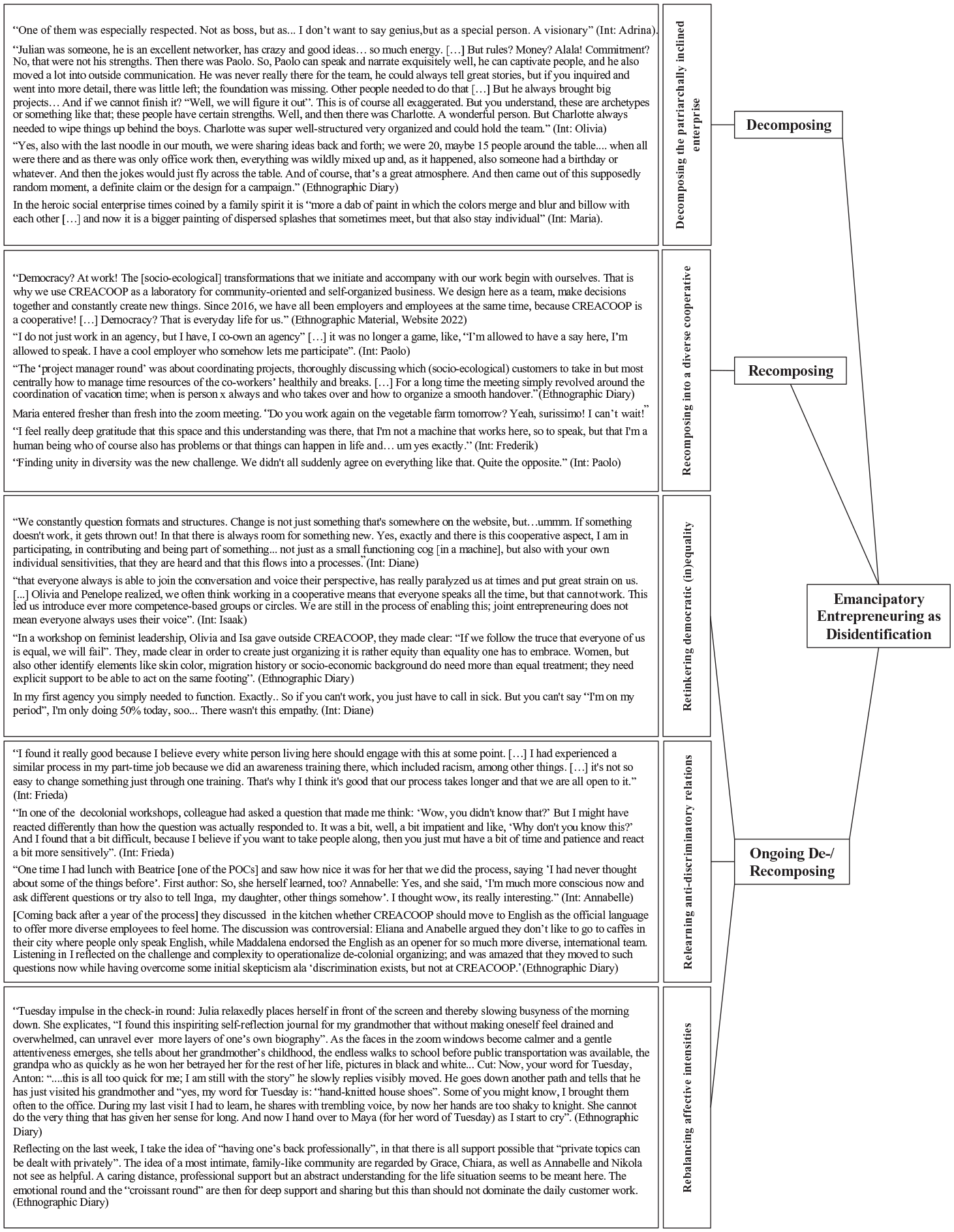
Coding table and exemplary data.
Emancipatory entrepreneuring through disidentification
We reconstruct CREACOOP’s entrepreneurial process of emancipating from a socially engaged agency to a diverse cooperative. Drawing on Muñoz’s (1999) concept of “disidentification”, we show that emancipatory entrepreneuring involves both “decomposing” “patriarchal” elements of the agency while “recomposing” an alternative, diverse cooperative based on democratic and egalitarian relations. Further, we illustrate how disidentification is an ongoing process that requires further de- and recomposition concerning issues such as democratic inequality, discrimination problems, and affective imbalances.
Decomposing the patriarchally inclined agency
CREACOOP was driven by an emphatic and socially engaged impetus to “use the power of social media for social ends”. Olivia, a longstanding co-worker, describes especially the two male founders (Javier and Julian) as “crazy, good networkers with intriguing ideas, which they bring to the street”. As their (widely shared) story so often goes, when they met for the first time, two “quirky best mates” knew immediately that “we must start up together”. As Julian himself observed, their journey became a fully fledged “adventure” of doing “wicked projects” in the world of social entrepreneurship, ecological change, and the sharing economy, for example, by working with Grameen Bank, the Green Party, and a big urban conference. Javier spoke of “extasy” to describe this early phase, which was characterized by heroic ideas and adventurous projects, but also by a paternalistic social setup that soon created tensions with employees and initiated what we call a process of decomposition, as we will now illustrate.
In the first seven years, CREACOOP grew to 20 staff. Throughout, the founders intended to work on equal terms with team members, to take decisions together, and to foster hippie-like values (e.g. “trust” and “interpersonal love”, as Julian put it). Yet, these intentions often remained dead letter as they were never fully acted upon. Nikola, a longstanding project manager, remembered that the founders nevertheless pulled out their trump card and said, “Hey, in the end, we are the owners, we are liable, and you can tell each other something nice while sitting cozily in a circle but when shit hits the fan we have to decide.”
Julian, looking back self-critically, admits that it “surely was a two-class society somehow” while Maria, at CREACOOP since the early years, added that “it was always a bit pseudo-democratic”.
This two-class setup became even more pronounced by the founders “cherry picking” the exciting projects. For instance, Javier only wanted to work for the Green Party on the national level, while Julian admitted that “I set all of this up, now I am also allowed to reap some of the fruits”. Regarding this power asymmetry, Charlotte, the second-generation CEO who entered with Paolo, recalled the team demands and intensifying tensions as follows: Doing things on an equal footing and in a friendly, collegial manner quickly overwhelmed us because everyone began making demands. And that applies to all kinds of demands, like demands on salary, demands on participation, at all levels, in all areas.
This initial arrangement was also mirrored in other relations as members often felt absorbed by a family-like setup that complicated drawing boundaries. People were supposed to act as friends rather than as equal co-workers. Javier, one of the two “paters familias”, recalled that the distinction between work and private life often became very blurred, as everyone felt part of the joint family adventure: At the time, what we now call “work–life balance” was real and authentic: friendship and work blended seamlessly. [. . .] Yes, it was a discovery trip. [. . .] It was simply: let’s race ahead! What’s next? Let’s simply blast. . . And have fun and run to conferences, preferably dressing up as a “Yes-Men Balloon” and going wild during the “Green Week”.
Maria used the term “marrying in” to describe how accepting her job at the newly founded agency felt: she had “married into” a family where total professional commitment was rewarded with becoming part of the founders’ extended family.
However, in our interpretation, the agency, which claimed to be egalitarian and participatory, resembled a “paternalistic pseudo-democracy”. These team tensions amounted to significant moves to counter and start to unravel a top–down domination and family culture that could not live up to its claims of team democracy, participation, and boundary-setting. Despite its social and ecological outlook and despite embracing participation as a core value, the agency was experienced as imbalanced and too family-run. Gradually, a chasm opened: between the aspiration to hippie-like equality and a fundamental power inequality. This divide eventually made it unfeasible to maintain this paternalistically inclined organizational form. Finally, after seven years of operation, the CEO team went its separate ways. The agency was taken over by its employees, who inverted the prevailing power positions by formally reinventing the organization as a workers’ cooperative. Sixteen of the 24 employees signed a cooperative agreement and owned a stake, while others supported the endeavor as silent members.
This transition split between those who could not easily let go of elements of the patriarchal model from those who embraced the new chance for equality. For instance, Charlotte, one of the departing CEOs, remembered this transition as a “pretty tough process”. She felt that the team did not understand how stressful “being responsible for bank loans, juridical and emotional weight” was—something that was also reflected in the meager payout for her and the other former owners. In contrast to Charlotte, Paolo remained involved (as only one of three CEOs). He recalled the incisive experience of establishing co-ownership and distributing responsibility onto all shoulders: suddenly, every co-worker felt “not just working in an agency, but I now co-owned an agency [. . .] I am responsible for all of us, the whole organization”. Maria also embraced the different sense of commitment and belonging, a feeling of “being seen, trusted and supported”, which came with co-leading. Feeling attracted to this new possibility enabled organizational members to dissociate themselves from the traditional ownership understanding of the neoliberal firm, including who profits, decides, and has formal control over others. As most members were ready to let go of the patriarchal entrepreneurial relations, they were open to initiating the process of co-leadership.
Javier, however, still adhered to his old, heroic, and adventurous self-image. Years later, after his departure and after the cooperative had been established, he remarked that “heroic is great” while also admitting: It is also a little disease. To put it in terms of Gestalt psychology: your self-worth depends on the crazy thing you founded and what kind of a king you are on LinkedIn or whether you establish another amazing start-up or develop mad ideas. Letting this go has become a lifelong challenge for me.
Even if Javier embraced equality, he realized that he could not easily let go of a king-like and top–down entrepreneurial comportment also reinforced by a masculinist, neoliberal achievement society. Like Julian, Javier also left.
In contrast, Anton, a longstanding co-worker, who visualized the transformation to co-ownership and co-leadership in a drawing, reported how dismantling the prevailing power relations also enabled undoing the prevailing self-absorbed tendency to occupy organizational space at the expense of others: “The founders took up lots of space, each forming a large circle and leaving very little space for the rest”. The future cooperative, he observed, offered everyone equal space, also by establishing changing co-leading coalitions. He concluded: “Suddenly, two big bubbles were gone”, which not only allowed to decompose the masculinist work relationalities but to also try out more diverse relations that subscribed to the egalitarian values of the cooperative.
Recomposing into a diverse cooperative
The disappearance of the two leaders’ “big bubbles” created space for initiating a cooperative organized around co-leadership. According to Nicola, cooperative entrepreneuring based on co-leading implies an “incessant redistribution of responsibilities”. He invoked the image of a Calder-style “mobile” to describe co-workers constantly changing positions, from which evolved the ever-changing relationality characteristic of a diverse cooperative. Anton expanded on Nicola’s image of the cooperative as a Calder mobile: “As everyone entering the organization brings a new spin, everyone has to move, and then everything has to sort itself somehow new, and then everything rebalances again, at least for a while”. As top–down paternalistic dominance was decomposed, power relations were recomposed through the ongoing redistribution of responsibilities around shifting entrusted co-leadership.
The founding of the cooperative and the resulting redistribution of ownership and leadership also entailed reshuffled relations toward a diverse community that made plural work-life worlds possible. This differentiated relationality required dissociating from the all-in family style of intense work and exploring new ways of shaping the work–life relationship. For instance, CREACOOP transformed into a workplace that embraced part-time workloads (50–80%), starkly contrasting the previous overtime culture. Not only did this change enable redrawing the boundaries between work and life. It also prioritized private or political engagements: members could now take care of their children or pursue civil society activities or other voluntary engagements. Reestablishing boundaries between work and other aspects of life refreshed members’ understanding of work because plural professional and societal engagements became accepted. For instance, Isa, who joined CREACOOP after it had become a cooperative, envisioned a good work–life balance: “25% friends/family time, leisure, fun; 25% voluntary societal engagement, 25% work, and 25% personal development”. Thus, work no longer took self-evident priority but instead became reframed as more flexible and decentral—and not merely on a daily basis. Extended absences became possible: members could return to university, take extended holidays, or become politically engaged (e.g. Isa joined a climate camp).
This flexibility established new types of relations so that the cooperative became organized around more diverse work-life worlds. Maria, no longer feeling “married in”, emphasized that CREACOOP had become a great employer to start a family instead of the workplace serving as a proxy family. She added: Sometimes, I even think I would like to be a father within CREACOOP because it is simply so much easier, and so established to take parental leave since it involves no discussion whatsoever. In the firm of her partner Jacob, they said: [raises her voice] “Did you see how long Jacob took parental leave?” Even if my husband Jacob took a relatively small amount of parental leave compared to my male colleagues here, Jacob’s colleagues still thought he was exaggerating.
At CREACOOP, these developments further dismantled the intense work culture established and upheld by the paternal founders, thus empowering all aspects of the organizational members’ lives. It seems to us that this more balanced and care-oriented understanding of a diverse cooperative contributed to disrupting the earlier neoliberal logic of the agency.
Flash forward to one morning at CREACOOP, as recorded in the first author’s ethnographic diary: Maria’s little child is held by several colleagues—both male and female, joint caring in the group. At some point, Samuel, carrying the child, placidly strolled amidst the workgroup: his gentle masculinity has a touch of sweetness and proud fatherhood.
This entry illustrates that the organization was no longer focused on strong and overworked founding fathers but that gender roles had become more fluid. Also, traditional career paths now began evolving: younger women (e.g. Penelope, Grace, or Maya)—all in their late 20s—were joining the board, while Xavier—in his late 30s and supposedly in the prime of his career—took a three-month sabbatical. Besides, Anton, Nikola, and Samuel—all part-timers—could now indulge their fatherhood.
However, this recomposition surfaced new challenges, including how to express one’s solidarity with others while respecting one’s capacities. Some members were simply better at “saying no”, while others overworked themselves, at times drowning in stress or unsure how much they needed to contribute to feel worthy members. Maya, who had just become a project manager, observed: I understand us as a solidarity-based community and there are phases in which some co-workers share a lot and pull in the same direction while over time this can shift to others: I find that very beautiful. But personally, I often feel like: I want to give a lot because I don’t know if I have already given enough. To know exactly when enough is enough and I should live my life, that’s difficult for me.
Responding to this challenge, CREACOOP used an online time tracker in which co-workers entered their projects, time use, and expected workload. At the weekly project management meeting, project managers systematically checked each other’s temporal resources while responding caringly to their peers’ workloads: “Anton is red [excess hours] and has had a high stress level for a long time”. To which Xavier responded: “I will check in with him and see how he is doing and whether I can reshuffle the work with Nikola”.
In our interpretation, traditionally linear and heteronormative work and career concepts (including temporal arrangements) were decomposed, and different life segments became more explicitly balanced. Instead, a plurality of rather queer-looking life paths became supported by flexible co-working and organized support to prevent overwork. These work- and life-related flexibilities decomposed the previous masculinist understandings of employment, which had required everyone to focus completely on work. Paternalistic elan was now replaced with plural and diversified identities and work-life paths that followed queer-feminist sensitivities toward cooperative work relations.
Ongoing de- and recomposing
Decomposing the paternalistically inclined agency and recomposing it into a diverse cooperative consisted of creating relationships of co-leadership and diverse understandings of work, selectively also conserving earlier elements like the playful and mission-driven entrepreneurial forces that were at work in the agency. However, disidentification is never finished, as other relational challenges emerge that need to be tackled. As we will show futher on, the already emerging democratic entrepreneurial relationalities allowed for a stronger dynamic of “recycling” old elements into novel, more inclusive worlds of work. We describe and analyze three such areas of ongoing disidentification that concern democratic inequality, discriminatory problems, and affective imbalances.
Retinkering democratic (in)equality
After CREACOOP was established, the organization repeatedly experimented with its participatory and democratic formats, but also implemented various co-working layers to decompose paternalistic elements of entrepreneuring. The democratic cliche that “everyone decides everything” soon proved to be “unrealistic” and was quickly questioned, largely because it was far too time-consuming and also because—and members learned this the hard way—it resulted in uninformed and bad decisions. Introducing “temporary roles” as part of “delegated circles” for finance, human resources (HR), communication, and other areas went hand in hand with learning to refrain, at least now and then, from voicing one’s own ideas and to respect others’ expertise and responsibilities, or simply the time they were investing. However, democratic relations were also retinkered beyond efficiency and practical considerations.
For example, recrafting democratic formats toward more delegation and representation also raised awareness of being both alert and listening attentively to others: instead of loud and competitive debates where the most eloquent triumphs, meetings became occasions to listen and let others voice their ideas and concerns. Learning to listen and waiting one’s turn created a “sense of de-acceleration” and “calm attentiveness”, as recorded in the first author’s ethnographic diary. In our interpretation, this recomposition shifted the previous masculinist discourse toward rebalanced, pluralist interaction, which surfaced the slumbering feminist values of both female and male co-workers.
However, this retinkering through feminist values did not happen overnight and remained central during further democratic recomposition, for instance, by raising the question of how to empower women. In a workshop on feminist leadership in cooperatives, Olivia and Isa discussed how the cooperative had early on decided to introduce gender quotas for the board. However, the arrangement “never needed to be enforced”, as the joint deliberation created sufficient awareness. Instead, Olivia mentioned that “merely bringing women into leadership is not enough, more elements of the organization need to be changed as well”. For example, CREACOOP initiated a working group on “cyclical working” to discuss the bodily needs of menstruating bodies while raising awareness of diverse experiences and the need for rest and work-related flexibility. Isa mentioned, “When I have premenstrual syndrome (PMS), I cannot go to the board meetings. I always feel so weak and shaken”. Therefore, CREACOOP introduced co-project leadership. Also, management teams and supervisory board meetings were enlarged to enable members to temporarily step out (e.g. owing to PMS, a sick child at home, or other urgent caregiving). Accordingly, others taking over became the norm. “Now”, as Isa explained concerning board meetings, “I just don’t come anymore; I mean [we organized it that way that] there are four others”. The recrafting of democratic procedures orients toward additional layers of equality as specific bodily needs and characteristics are taken into account that respect differences among formally equal members.
On reflection, this understanding of bodily health was no longer viewed as a purely “women’s issue” but was approached beyond a male–female binary. For instance, Isa observed, “I think it might also feel quite similar for men: they also don’t always bring the same amount of energy to work or into a meeting. I know cycles are different for everyone, but they are still cycles”. It seems to us that this focus on embodied feelings at work follows a “queer” sensitivity as the female–male binary is also unraveled in favor of manifold embodied sensations and care duties. It implies that males also are recognized to have bodies and need not always perform at full throttle. Such a queer-feminist decomposition of workplaces as sites of machine-like bodily functioning and homogenized subjects initiates an emancipatory turn that embraces non-binary differences, which, in turn, can infuse different work-life worlds and diverse subjectivities.
Relearning anti-discriminatory relations
At CREACOOP, organizing revealed that introducing democratic governance does not per se reduce all kinds of inequalities. After two persons of color (POCs) and some with migration background voiced their experiences of unintended acts of discrimination, a collective process of handling these discriminatory issues was initiated. Addressing institutional racism and cultural discrimination was further instigated as several customers inquired about the agency’s name, which is taken from a North American Indigenous tradition and became regarded as culturally appropriated. Two experts were hired to facilitate a year-long decolonizing process of joint reflection.
While the decision to contract an external decolonial consulting team was agreed upon by all members of CREACOOP (despite its substantial financial cost), the beginning of the process entailed skepticism and different degrees of commitment: Eliana voiced, “I’m confused, and really don’t understand what all this stuff about identities really means”, while Olivia saw most of the work in joint discussion: “discussing discrimination is a tool, a means and a method for ensuring equality”. Frederic reflected later during the process, while the “vast majority” saw the “necessity [for the process][. . .] a few didn’t understand, felt personally attacked, and somewhat blocked it out, but not so much that they said they won’t participate”. To our reading, these externally fostered anti-racist activities allowed for a disidentificatory process that entails a critical unlearning and relearning of how inclusive and power-sensitive relations in a dominantly White organization can be supported.
After a year of separate and joint discussion groups for White and colored persons, learning about allyship strategies, familiarization with decolonial knowledge, guided self-reflection, and concepts like critical friends (in which White persons help each other to deconstruct othering behaviors and superiority), Annabelle reflected about her learnings: “If you had asked me two years ago, I would have said: well, Penelope and Beatrice [the two POCs], they belong here, right?” But now, I understand they feel: “Yes, you always act as if we belong, but for us, it doesn’t really feel that way”. Frieda added, “[surely I have] experienced discrimination as a woman [. . .] but it’s, of course, a whole different story when you also have black skin”. By having taken considerable steps in their relearning toward empowered anti-discriminatory relations, CREACOOP has moved on to address questions of institutional answers such as changing their name (and how to publicly and self-critically communicate it), potentially reparation payments (in the form of donations), but also inclusive hiring strategies and transposing their operational language to English.
The disidentificatory unlearning and relearning process was not only challenging for the ones fundamentally expanding their decolonial and anti-racist understandings and sensitivities but also for the initiators. Xander reflected on feeling deeply frustrated when realizing that “it’s possible to ‘lead an okay life in the wrong,’ so to speak. . . And we just have to inch our way toward it”. Also, as a new member, Maddalena was very tense as she made a serious decolonial process a condition for taking the job at CREACOOP. In hindsight, she reflected: The tendency is: instead of claiming that we are not racist, it’s more about confronting the reality that we can’t shed our colonialist thinking overnight. Rather, it’s about properly dealing with the discomfort that comes with our own guilt or something like that. . . It’s about moving in that direction.
The decomposition of White dominance and the recomposition of power-sensitive relations demands processual patience and seems to remain an ongoing relearning process.
Rebalancing affective intensities
CREACOOP’s emancipation toward a diverse cooperative not only involved addressing different layers of inequality but also required decomposing and rebalancing the often flamboyant and strong emotional forms of working together. Interestingly, playful and emotional support was part of the agency from the start, as Olivia emphasized: I’m super thankful for the work culture with the team outings, which they had as their approach from early on. This is very important; almost magical. . . It is interesting that Julian said that CREACOOP always had this appreciative and communal spirit. So, I’m not criticizing them for their patriarchy. . . Yes, that was part of them. . . but they also used it to set impulses that are valuable and carry on till today.
Over the years, CREACOOP organized manifold social gatherings, from extravagant parties through public performances to more personal, daily, or weekly exchanges, that, at times, made a parody of traditional, heteronormative understandings of entrepreneurial work. For instance, after the annual election, the first author found himself at an after party with his face being painted golden, holding home-made CREACOOP currency in his hands, while being enticed to dance to ABBA’s “Money, Money, Money” tune.
Members repeatedly mentioned how such spaces of communal aesthetics and emotionality became excessive and dominating—which Annabelle called “community overload”. These affective transgressions needed to be toned down and were recalibrated into a more balanced and careful version. To this end, CREACOOP decomposed parts of the family and fun orientation where parties and impromptu events often simply happened during everyday work and sometimes even continued into the night, even on workdays. In contrast, “intense” community time was rescheduled (e.g. tri-annual four-day team events, monthly half-day full-staff cooperative meetings, or daily “check-ins” before lunch). These more robust temporal frames also facilitated flexible, often remote project work, which created at least some emotional distance. Gradually becoming more sensitive to each other’s needs, “louder” members learned to give space to less vocal ones—also because some members had previously felt claustrophobic (as if they “were back at school”).
“Emo-rounds” were another deeply affective format that disrupted daily CREACOOP operations and also needed rebalancing. These rounds involved three or four co-workers meeting on a regular basis to support, listen to, and coach each other and create a safe space in order to balance hard-nosed project- and managerial work with more personal exchanges. Eliana indicated that emo-rounds served “to create space for exchange and share your feelings”. Composing spaces to listen to everyone’s concerns acted as an antidote to result-oriented thinking, which sees co-workers as profit generators. However, Annabelle, as HR delegate, argued that such spaces were an opportunity rather than an obligation, while Lorena added that “it is important people do not feel a pressure to share”, an allusion to the fact that the prevailing social dynamics sometimes created that feeling. Such recomposition helped to counterbalance the intense emotional contact, which some members experienced as transgressive: “sometimes I don’t want to absorb this baggage from other people. Well, quite often I feel ready to listen deeply to others, but sometimes I also think: no, it’s too much” (Frederic).
In our interpretation, this rebalancing of affective intensities kept and fostered the time and space for profound sharing, support, and care of earlier days while setting limits to what and when it can be shared. For instance, Maya explained that certain personal topics (e.g. “childhood trauma”) needed to be delegated to outside professional support. Rebalancing contributed to preventing the previous paternal family from being replaced by another intense constellation, namely, transgressive egalitarian emotionality.
Discussion
In this article, we have offered a queer-feminist reading of the transformation of a patriarchally inclined venture into a diverse cooperative as an intertwined political and processual process of emancipatory entrepreneuring. Introducing a queer-feminist approach does not only come with a rich conceptual vocabulary to detect and deconstruct intersecting layers of inequality, as it thinks beyond binaries and embraces intermeshed understandings of power (Acker, 2006; Alkhaled and Berglund, 2018; Verduijn et al., 2014), but also simultaneously provides a processual repertoire for analyzing non-conforming, counter-hegemonic transformation (Gibson-Graham, 1996; Parker, 2002; Rumens et al., 2019). Fifteen years after Calás et al. (2009) called for plural, feminist, and—as we added—queer approaches to entrepreneurship as social change, we aim to underline in this discussion the significant conceptual, empirical, and practical potential of such approaches, which remain all-too-marginalized and epistemically suppressed (Bell et al., 2020; Benschop, 2021).
Overall, the value of the queer-feminist politicality, which infused our analysis, extends the critical emancipation literature that sees emancipation as inseparably connected to the transformation of oppression (Verduijn et al., 2014) and seeks to analyze not only individual “empowerment” but also especially “emancipation”, as the latter disrupts wider structures of domination (Acker, 2006; Alkhaled and Berglund, 2018; Sobering, 2016). This queer-feminist lens proved especially pertinent in describing, deconstructing, and reformulating the entrepreneurial transformation of the status quo that is often caught in top–down, heroic, neoliberal, White, male, and colonial perspectives (Clark and Ozkazanc-Pan, 2016; Essers et al., 2017; Imas and Garcia-Lorenzo, 2023; Johnsen and Sørensen, 2017). Democratizing an entrepreneurial venture, as we have shown, is not simply an act of entrepreneurial organization-creation by introducing democratic procedures and practices in co-ownership and co-leadership (Battilana, 2022; Rothschild, 2016) but entails a substantial reshuffling of relationalities from masculinist dominance to diverse, democratic, and queered work-life that extends sensitivities to racial, affective, and other forms of domination and inequality.
Furthermore, the value of a queer-feminist view on emancipatory entrepreneuring is that it simultaneously redrafts its politicality in processual terms (Hjorth et al., 2015; Steyaert, 2007). Therefore, we theoretically emphasized and empirically showed that a queer-feminist politics of emancipatory entrepreneuring operates through in-between spaces that do neither only focus on emancipation merely “from” nor “to” (Laine and Kibler, 2022). Emancipatory entrepreneuring is understood as the “processes geared toward change creation” (Rindova et al., 2009: 478) that incessantly deconstruct, selectively delete, and re-construct top–down, neoliberal, and masculinist forms of entrepreneuring into different forms of democratic and diverse entrepreneurial organizing (Farias et al., 2019). We will now develop both assets of a queer-feminist view into two contributions while also shortly addressing the practical implications.
Emancipatory transformation as disidentification through de- and recomposition
The main innovation of this study is the specific introduction of the concept of “disidentification” (Muñoz, 1999) to theorize emancipatory entrepreneuring. “Breaking free and breaking up” (Rindova et al., 2009: 479) as inherent features of emancipatory entrepreneuring, are reframed through disidentification as a twofold political process of “decomposing” and “recomposing” the hegemonic “social matrix of dominant publicity” (Muñoz, 1999: 168). The analysis revealed that the transformation of an enterprise toward a post-capitalist and collective organization requires “decomposing” a masculinist entrepreneurial subjectivity and a homogenizing family spirit, which were both linked to implicit and explicit patriarchal dominance. When the entrepreneurial team realized that they operated under a “pseudo-democracy” that was paradoxically coined by the “heroic” leadership of the founders, a gradual process of decomposition of these relations was initiated: the identification with the pater familias and the linked uniform relationality of a “two-class” organization came to a halt. This kind of decomposition comes close to the etymological meaning of emancipation as the “freeing of a son or wife from the legal authority of the pater familias to make his or her own way in the world” (Online Etymology Dictionary, quoted in Rindova et al., 2009: 480).
Decomposition essentially entailed the team becoming aware of the chasm between claims of “hippie-like equality” while, at the same time, organizational power relations rather subjugated them to what Battilana (2022: 4) describes as instrumental “human resources”. This realization came with feminist ethical demands (Ferreras et al., 2022) that grant “equal rights and equal voice, where one’s voice can be heard by others and will not be silenced without good reason” (Herzog, 2022: 55). Thus, the politics of decomposing top–down entrepreneurial positions of power not only questions “masculine entrepreneurship” and “masculinizing norms” (Lewis et al., 2022: 68), but also reconfigures pressures on “individualized entrepreneurial femininity” (Byrne et al., 2019: 180) as masculine and feminine norms were queered in joint processes (Rumens and Ozturk, 2019).
Intertwined with decomposition is the process of recomposition that experiments and builds a diverse cooperative as (co-)ownership and (co-)leadership are redistributed. Through recomposition, space was made for diverse subjectivities that can coordinate work with leisure activities, political engagement, or de-feminized caregiving. Through decomposing the homogeneous and paternal family, dominant subject positions in the “heterosexual matrix” were deconstructed (Butler, 1990), which created an opening for a “constant mix, blurring and interruption of masculinity and femininity” (Muhr and Sullivan, 2013: 418). Also, conceptions of work and life were collectively pluralized, in line with Asenbaum’s (2021: 101) argument that participatory spaces potentially cater to the homeliness of a “multiple self” that is no longer dominated by performance-driven work. Instead, career paths were reinvented along multiple interests and scenarios, enabling what Halberstam and Halberstam (2005) have called a “queering of time”, countering a linear conception of time that aims to climb the ladder. Emancipatory de- and recomposition take old elements such as ownership, leadership, or coordination of work-life or careers and partly delete them, but also reinterpret, subvert, and newly assemble them toward respectful plurality.
Reiterating multiple layers of domination
Furthermore, we propose to understand disidentification as an unfinalizable process. The transition to cooperative entrepreneuring is not a one-shot moment of decomposition and recomposition as, again and again, other layers of domination need to be reiterated. Building on the disidentification from the patriarchally inclined enterprise through giving in the first place attention to gender and bodily issues, the process of disidentification also got occupied by demands for further democratic equality, anti-discrimination, and balanced affectivity. For instance, retinkering democratic equality implied further attention to questions on how to organize for democratic differences among the members through respecting bodily health differences (e.g. menstruation) or introverted dispositions. This new insight extends feminist research on the neoliberal entrepreneurial subjectivities of female entrepreneurs (Ahl and Marlow, 2012; Lewis et al., 2022). Contrary to the “contemporary neo-liberal pressure for young women to embody ‘perfect’ femininity, and experience success in both personal and professional domains” (Byrne et al., 2019: 180), our case analysis illustrates multiple endeavors to make leadership accessible also to organizational members performing other forms of care work, seeking to acknowledge that care work is not less valuable than professional work. Importantly, this attunement to differences is not limited to issues related to the female body but is also extended to reconsidering the limits of the male body, undoing the gender binary and heteronormative assumptions (Ferry, 2018). Through further reiteration, the acknowledgment of vulnerable bodies and caregiving obligations goes beyond female biological categories, queering understandings of healthy work and care obligations for any sex category (Muhr and Sullivan, 2013).
Future queer-feminist research could further investigate how moving “between masculinities and femininities” (Muhr and Sullivan, 2013: 418) can be fostered in other entrepreneurial contexts, such as family businesses, which are increasingly pressured to combine co-ownership and democratic governance while giving space to alternative conceptions of family (Boers, 2017; Ferry, 2018). Here, we point to a possibly new research agenda in entrepreneurship studies that documents examples of post-neoliberal and non-binary modes of entrepreneuring that integrate ungendered care work and family life and become sensitive to intersecting aspects of inequality.
Another difficult reiteration of disidentification was needed concerning problems of discrimination. Democratizing and queering gender relations was not seen as enough, as the organization needed to tackle and unlearn racial discrimination and enact and relearn anti-discriminatory relations. Through hiring a decolonial expert consultancy, everyone was invited to reflect upon institutional racism and cultural appropriation. This complex reiteration of disidentification shows not only how difficult it is for this cooperative to “unmask their colonial past”, but, more broadly, contributes “to decolonize and emancipate the notion of entrepreneurship” (Imas and Garcia-Lorenzo, 2023: 392). Concerning this struggle to unlearn and relearn anti-discriminatory Whiteness, our insights emphasize the importance of patience, gradual relearning, and step-by-step decomposition and recomposition of anti-discriminatory practices that demand change initiators to accept “an okay life in the wrong” for some time. As Nkomo (2021: 212) reflected three decades later on in her article “The emperor has no clothes: Rewriting race in organizations” (Nkomo, 1992), “there has been a lack of significant progress toward positioning race as a core analytical concept”; this is even more the case in studies of entrepreneurship. Therefore, we suggest that further research seeks to better understand the unlearnings of White, racial dominance and its institutional enshrinement in emancipatory and social entrepreneurship (Bruton et al., 2023; Imas and Garcia-Lorenzo, 2023; Manning, 2021).
A final reiteration concerned rebalancing affective intensities. Communal, playful, and hyper-emotional events at times subvert “performing a manager” or “acting professionally” (Parker, 2002: 160) as a mode of “drag” (Muñoz, 1999) but can become transgressive and feel overwhelming. Our analysis revealed that this appreciated element of the past was in need of being toned down or changed altogether. For instance, rebalancing the organization as affective space consisted of deepening affective intensities (e.g. team events, parties, or emo-rounds) and reflecting on them. This also required us to temporalize and to negotiate a space for more quiet and introverted dispositions, so that cooperative members who often felt overwhelmed by too intense communal immersion, do not need to take part or can step out (Benschop, 2021; Paludi et al., 2019; Resch and Rozas, 2024). While there is some research on affective intensities in democratic organizing (Lüthy, 2024; Resch and Steyaert, 2020), we recommend further research to probe deeper into the enabling and restraining capacities of affective intensities to subvert and support, yet not overwhelm organizational members, in an attempt to reduce affective inequality as a critical dilemma in emancipatory entrepreneuring.
Implications
For organizational change makers, this study implies that thorough emancipation toward equality needs time and a mix of subversive and adhesive measures. Our process study reconstructed the development of CREACOOP over 14 years, in which, after seven years, they introduced collective ownership. As a consequence, the cooperative experimented initially with binary co-leadership practice, then went on to queering it, while only recently moved into decolonial and racial sensitivities. This ongoing disidentification thereby calls for gradual steps of subversion and transformation, in which certain elements are decomposed, and some older ones are reconsidered and recomposed. This insight cautions against opting for fully blown or abruptly initiated transformation. As, for example, the feelings of frustration of one of the initiators of the decolonial process has shown, unlearning discrimination and getting the entire team on board needs time and patience. Furthermore, our study also emphasized that emancipation toward diverse and equal relations is unfinalizable. While democratic procedures already create formal equality in voice and ownership, further iterations of decomposition and recomposition must address the next layers of power based on gender, race, and other identity elements, which require continuous relational and institutional disidentification. Acknowledging that always more can and needs to be done about inequality and oppression does not exclude opting for a gradually changing form of worldmaking that simultaneously appreciates its utopian hopefulness.
Conclusion
To conclude, we recall that Rindova et al. (2009: 477) set out to move entrepreneuring away from its obsession with financial gain and let entrepreneurs “break for from existing constraints” and “bring about new economic, social, institutional, and cultural environments”. We have requalified emancipatory entrepreneuring by adopting a queer-feminist view centered on the political and processual notion of “disidentification” by Muñoz (1999). This concept has enabled us to theorize the democratization process of a patriarchally inclined agency in collectively “breaking free” (Rindova et al., 2022) as employees became cooperative entrepreneurs and readjusted their relationalities by decomposing the masculinist understanding of today’s entrepreneurial, individualized neoliberal performance culture and recomposing it into a diverse cooperative through a slow, careful, and caring process of transformation. Essentially, we have underscored the imbricated political and processual nature of a queer-feminist understanding of emancipation as a twofold in-between process that stops neither at emancipation from nor is only seen as emancipation to (Hjorth et al., 2015; Steyaert, 2007) while ongoingly deconstructing intermeshed layers of inequality and re-assembling novel, diverse, and inclusive worlds (Imas and Garcia-Lorenzo, 2023; Jack et al., 2011; Sobering, 2016; Verduijn et al., 2014).
Reconceptualizing emancipatory entrepreneuring through “disidentification” frames its political transformational process neither as total destruction nor as a novel creation as “disidentifications allows us to carefully examine intersectional border contestations of sexuality, gender/sex, race/ethnicity, class, and body as simultaneous processes of assimilation and resistance” (Eguchi and Asante, 2016: 176). Rather, disidentification denotes a change from within, an in-between process, which “uses the majoritarian culture as raw material to make a new world” (Muñoz, 1999: 196). Thus, emancipation involves not only a “deconstructive practice” (Rumens et al., 2019: 594), which dismantles patriarchal and neoliberal traditions (Ogbor, 2000) but also a constructive, reconfigurational, and experimental element. Furthermore, disidentification manifests itself “through iteration and reiteration” (Muñoz, 1999: 196; emphasis in original) because processual moves decompose and recompose the dominant order and reimagine alternative non-binary and intersectionally sensitive forms of entrepreneuring and organizing (Bell and Sinclair, 2016; Muhr and Sullivan, 2013).
Finally, we need to underline the utopian moment of disidentification as queer worldmaking comes with a strong desire to not give up on the inequalities of this world (Janssens and Steyaert, 2025). As Muñoz (2019) believes that the future is queerness’ domain, the worldmaking potential of entrepreneurship should be queered. While entrepreneurship has been seen for a long time as a form of worldmaking (Mösching and Steyaert, 2022; Weiskopf and Steyaert, 2009), a mode of fundamentally changing social, material, and cultural worlds, our queer-feminist reading critically qualifies this process as one that becomes attentive to and deconstructs marginalization, oppression, and hegemony. Much of traditional entrepreneurial worldmaking has been involved in neoliberal hyper-individuality, masculinity, or profit-obsession, but also contributed to the neglect of social welfare and environmental protection. Disidentification actually can deconstruct such oppressive worlds and engage with the creative worldmaking of more inclusive ones.
Supplemental Material
sj-pdf-1-hum-10.1177_00187267241302783 – Supplemental material for Emancipatory entrepreneuring as disidentification: A queer-feminist view of becoming a democratic cooperative
Supplemental material, sj-pdf-1-hum-10.1177_00187267241302783 for Emancipatory entrepreneuring as disidentification: A queer-feminist view of becoming a democratic cooperative by Jonas Friedrich and Chris Steyaert in Human Relations
Footnotes
Acknowledgements
The authors would like to thank members of CREACOOP for letting the first author participate and experience the firm as an ethnographer from within. Thank you for your trust that could only allow writing such an article about emancipatory entrepreneuring in your “democratic laboratory”. We thank the anonymous reviewers and the editors of the special issue for their constructive and critical remarks. For the analysis, writing, and review process, we are grateful for the feedback of the members of the Research Institute for Organizational Psychology at the University of St. Gallen, and from the participants of the Organization Theory Publishing Workshop at Copenhagen Business School. Finally, we appreciate the detailed language editing by Mark Kyburz.
Funding
The authors received no financial support for the research, authorship, and/or publication of this article.

Supplemental material
Supplemental material for this article is available online.
References
Supplementary Material
Please find the following supplemental material available below.
For Open Access articles published under a Creative Commons License, all supplemental material carries the same license as the article it is associated with.
For non-Open Access articles published, all supplemental material carries a non-exclusive license, and permission requests for re-use of supplemental material or any part of supplemental material shall be sent directly to the copyright owner as specified in the copyright notice associated with the article.
