




Abstract
Whereas vision is central to understanding leadership influence in organisations, it has mostly been explored either in predominantly hierarchical or predominantly pluralistic contexts. We know relatively little about how the processual dynamics, content and sources of vision evolve when senior teams are undergoing a transition from hierarchical to collective leadership. Drawing upon a qualitative longitudinal study undertaken within a UK-based academic–practitioner partnership in the healthcare sector, we examine the transitions and transformations in leader vision triggered by deliberate attempts to pluralise leadership arrangements in its senior team. We develop a process model that highlights three stages in the evolution of vision (‘problematising’, ‘debating’ and ‘accepting’) and accounts for variation in how different components of vision develop over time. Our contribution lies in underscoring the heterogeneous, temporally fluid and contested nature of vision; its continuous shaping as a result of the dynamic interplay between individualistic and collectivistic forces; and the multifocal and multidirectional agentic influences involved in its evolution. We argue that managed pluralisation, viewed as an interplay between hierarchical and collective forms of control, leads to accommodation and incorporation of divergent views within the evolving shared vision, facilitating acceptance but diluting the potential of the resulting vision to stimulate change.
Keywords
Introduction
The concept of vision continues to be central to our understanding of leadership influence in organisations for several reasons. First, it pays attention to both means and ends: articulating a clear vision provides leaders not only with a starting point and specific agenda for change (Griffin et al., 2010), but also offers a higher-level set of goals that can help shape the nature and direction of change by guiding and motivating organisational members (Haslam and Platow, 2001; Landau et al., 2006; Zhang et al., 2022). Second, it straddles the heroic and post-heroic perspectives on leadership: while historically associated with single charismatic figures (Beyer and Browning, 1999; Den Hartog and Verburg, 1997; Mumford and Van Doorn, 2001; Weber, 1968), the concept of vision is increasingly deployed by scholars working in the pluralistic paradigm that views leadership as a multidirectional, relational and distributed phenomenon (Ensley et al., 2003; Margolis and Ziegert, 2016; Picard and Islam, 2020). Finally, visions render themselves easily to routinisation and codification (Beyer and Browning, 1999) and can be used to promote both conformity and empowerment (Kearney et al., 2019), which makes them a particularly suitable tracer for exploring complex permutations of power and control: individual and communal, hierarchical and concertive, liberatory and oppressive (Edwards and Bolden, 2023; Foldy and Ospina, 2023; Holm and Fairhurst, 2018).
At the same time, perhaps reflecting the pervasive propensity of the leadership studies field for dichotomisation (Collinson, 2014), leader vision has mostly been studied in either predominantly hierarchical (e.g. Haslam and Platow, 2001; Paine et al., 2024) or predominantly pluralistic (e.g. Gram-Hanssen, 2021; Ospina and Foldy, 2010) contexts, with longitudinal explorations remaining scarce. This limits the applicability of this body of knowledge to settings that are undergoing transition from a hierarchical form of leadership (privileging the individual leader as a primary or sole source of vision) towards a more collective arrangement (shifting the function of developing a vision to a leadership configuration, i.e. a group of formal and/or emerging co-leaders). Such hybrid arrangements are increasingly relied on by cross-boundary organisations and teams responding to the challenge of ‘adjusting and harnessing the agency of a wide set of autonomous actors’ to secure their cooperation and collaboration (Denis et al., 2023: 10).
We know that deliberate pluralisation of leadership ‘is likely to be messy, multilayered and involve the exercise of both hard and soft power’ (Lloyd and Carroll, 2021: 815). Yet, one of its central challenges remains unexamined: while a hierarchical approach to leadership yields visions that are produced and diffused in a top–down manner, a pivot towards collaborative leadership essentially delegitimises a vision previously imposed by an authority figure and calls for a collectively produced vision. So how does that change unfold? Recent process-oriented literature on collective leadership emergence (Croft et al., 2022; Pettit et al., 2023; Picard and Islam, 2020; Sklaveniti, 2020) falls short of addressing this question as it tends to conflate collective leadership with shared vision, downplaying the continuous operation of individual agency in pluralistic contexts and/or glossing over the potential for discord arising from differences between the initial formal leader’s vision and alternative visions espoused by other members of the leadership configuration. We suggest there is a need for a better understanding of how the processual dynamics, content and sources of leader vision evolve during this transition, with explicit attention to the contestation of vision and interplay between its individualistic and pluralistic aspects.
Our article addresses this gap by focusing upon the challenges and transitions that occurred in the case of a UK-based academic–practitioner partnership in the healthcare sector that was explored longitudinally over the period 2014–2017, principally through observations and interviews with its senior leadership team (SLT). This setting locates our study within a specific type of leadership configuration, namely one that involves ‘pooling leadership at the top of organizations’ (Denis et al., 2012: 211) and operates in a hybrid context combining strong positional authority of a formal leader with strong professional autonomy of emerging co-leaders. Our inquiry is guided by the following research question: how does leader vision evolve as a senior leadership team undergoes a deliberate transition from individualistic to collective leadership?
Our empirical account charts the transitions that occurred in the leadership team and its vision(s), focusing upon the juxtaposition between the initial vision of the formal leader, its problematisation by the collective, how those tensions were managed and how that resulted in a shift to a modified vision that was generally accepted, but not necessarily universally adhered to, by members of the leadership configuration. Taking an approach that emphasises both the relational nature and individual embodiment of leadership (Gronn, 2015; Ospina et al., 2020), it highlights how managed pluralisation transformed the vision from something affixed to a single authority figure towards a multifocal phenomenon, how this transformation was shaped by – and, in turn, fused together – various individualistic and collectivistic influences, and how the content, acceptance and change potential of vision evolved as a result.
Theoretically, we develop a process model of vision evolution underpinned by the transition from predominantly individualistic to more collective leadership. This model highlights the heterogeneous and dynamic nature of vision, identifying three broad stages in its evolution (‘problematising’, ‘debating’ and ‘accepting’) and demonstrating divergence in the developmental paths of its various components. We argue that managed pluralisation, viewed as an interplay between hierarchical and collective forms of control, leads to accommodation of divergent views within the evolving shared vision but may dilute its potential to stimulate radical change. Finally, uncovering multiple internal and external sources of vision as well as their dynamic interactions over time points towards a multifocal, rather than decentred, perspective on vision elaboration and negotiation within leadership configurations.
The article is organised as follows. First, we further explore the concept of vision in relation to both hierarchical and pluralistic leadership contexts. The following section focuses on transitions between these contexts as well as on the associated interplay between hierarchical and collective forms of power and control. The case and method section describes the research setting and outlines our methodology. The findings are then presented according to the three observed stages of vision evolution (‘problematising’, ‘debating’ and ‘accepting’) and three processes (‘validating’, ‘contextualising’ and ‘challenging’) underpinning the variation in how different components of vision evolved in the debating stage. The discussion section focuses on managed pluralisation as a vehicle of vision evolution, analyses the heterogeneity in the content and sources of vision, and outlines the boundary conditions, limitations and directions for future research. The article concludes by summarising the study’s theoretical contributions and practical implications.
Vision in hierarchical and pluralistic contexts
Leader vision can be broadly defined as the expression of an idealised image of the future based on the organisation’s core values (Griffin et al., 2010). Seen as one of the key tasks performed by effective leaders (Berson et al., 2016; Carton et al., 2014; Larwood et al., 1995), it offers a statement of purpose that combines an ideal manifestation of the organisation’s direction with a tangible ‘roadmap’ for realising its goals (Landau et al., 2006). The articulation of a vision is typically viewed as a starting point for any leader’s effort to create change (Griffin et al., 2010), whereas its content is often critical in determining the leader’s success (Berson et al., 2001). By providing a clear, compelling and discrepant image of the future, vision is believed to act as an important motivational tool that highlights the uniqueness of an organisation, represents a high-level set of goals shared by the organisational members and guides them towards a desired end state despite potential uncertainties and contradictions (Berson et al., 2001; Landau et al., 2006; Zhang et al., 2022).
Historically, the concept of vision has been central to the individualistic, ‘heroic’ leadership paradigm exemplified by transformational, visionary and charismatic approaches to leadership (Oreg and Berson, 2019; Van Knippenberg et al., 2004). It is therefore unsurprising that it has often been studied in hierarchical contexts with a clear division between ‘leaders’, who unilaterally construct and communicate the vision, and ‘followers’, who derive a sense of shared meaning and identity from it (George et al., 1999; Larwood et al., 1995; Mumford and Van Doorn, 2001). This approach has highlighted individual-level psychological antecedents of vision (Akrivou and Bradbury-Huang, 2011; Van Knippenberg et al., 2004), rhetorical devices and communicative techniques deployed by leaders (Carton et al., 2014; Den Hartog and Verburg, 1997) and positive effects of vision communication on team and organisational performance (Griffin et al., 2010; Zhang et al., 2022).
Impacts of vision in hierarchical contexts can be realised through developing shared mental models (Akrivou and Bradbury-Huang, 2011; Morgeson et al., 2010) and affirming shared organisational identities (Haslam and Platow, 2001). Through activating these mechanisms, vision helps the leader exercise control over followers, which can be easier to achieve if the vision is routinised in the organisation’s administrative structures and cultural practices (Beyer and Browning, 1999; Weber, 1968) and aligned with followers’ perceptions of the changing environment (Paine et al., 2024). Recent contributions highlight the importance of engaging followers in implementing the pre-existing vision (Oreg and Berson, 2019) – for example, through dialogical communication (Jensen et al., 2018) or granting them some degree of autonomy (Kearney et al., 2019). But, overall, followers are not seen in this paradigm as legitimate sources of leader vision in their own right.
This approach is questioned by the post-heroic leadership paradigm that views leadership as a multidirectional, relational and shared (or distributed) process among individuals in groups that implies the combined influence of multiple leaders (Contractor et al., 2012; Denis et al., 2012). Applying this perspective to teams, for instance, shifts the focus away from the role of a formal leader towards ‘the interaction of team members to lead the team by sharing in leadership responsibilities’ (Hiller et al., 2006: 388). In contrast to the ‘heroic’ paradigm, the key assumption here is that vision is co-created by multiple individuals, rather than a single leader in isolation (Berson et al., 2016); in other words, collective leadership produces shared vision (Ensley et al., 2003). Emerging evidence from truly pluralistic contexts, such as indigenous communities (Gram-Hanssen, 2021; Sveiby, 2011) and networks of non-profit social change organisations (Ospina and Foldy, 2010), suggests that the development of shared vision is a consensus-based process aiming to attend to power inequities and recognise the strategic value of difference.
To summarise, leader vision has been studied in either predominantly hierarchical or predominantly pluralistic contexts. At the same time, as noted by Sveiby (2011: 403), ‘it is virtually impossible to find a “pure” state of collective leadership untouched by hierarchical leadership today’. Most leadership contexts are hybrid, with a mix of hierarchical and collective arrangements often co-existing in the same context (Denis et al., 2012; Fairhurst et al., 2020). Furthermore, different degrees of collective leadership can emerge, evolve or be deliberately facilitated within hierarchical leadership environments in response to challenges facing a group or organisation (Drath et al., 2008; Sveiby, 2011). The next section will examine the processes of transitioning from hierarchical to collective forms of leadership, preparing the ground for investigating how vision evolves as part of this transition.
Transition from hierarchical to collective leadership
We start with a premise that, while collective leadership emerges from interpersonal relationships, it is still humanly embodied and therefore ‘it is easy to identify the sources of leadership within distinct relationships and patterns of interactions among concrete social actors’ (Ospina et al., 2020: 445). From this standpoint, hybrid (Gronn, 2011), or blended (Collinson and Collinson, 2009), forms of leadership are co-constructed by members of ‘leadership configurations’ fusing different degrees of individualistic and collectivistic tendencies (Chreim, 2015; Currie and Lockett, 2011; Gronn, 2015). Leadership configurations can take the form of dyads (Gibeau et al., 2020), triads (Contractor et al., 2012), formal and informal teams (Empson, 2020; Ensley et al., 2003) or be more loosely distributed within and across organisations (Currie and Lockett, 2011; Currie et al., 2009). They are shaped by the framing and relating practices unfolding in ambiguous, fluid and power-laden ‘leadership spaces’ that provide opportunities for multiple interpretations and can become areas of collaboration, negotiation, domination or withdrawal (Chreim, 2015).
Within leadership configurations, a formal leader is seen not as an ‘innovation hero’, but as an ‘orchestrator’ bringing together the network of collaborators, managing its boundaries and creating conditions for collective leadership (Crosby et al., 2017; Margolis and Ziegert, 2016; Pearce, 2004). It often involves acting as a ‘benevolent hierarchical’ leader (Sveiby, 2011: 403), starting the process of pluralising leadership and providing a singular vision that acts as a ‘framework for possibilities for the group’ (Kramer and Crespy, 2011: 1035) – particularly when a nominated individual leader is ultimately accountable for the organisation’s performance (Currie et al., 2009; Huxham and Vangen, 2000). At the same time, giving away some of the formal leader’s positional power and making leadership arrangements more collective may potentially facilitate a vision-building exchange between the members of the leadership configuration, harmonise the divergent foundational logics and perspectives, and ultimately lead to the formation of shared vision (Berson et al., 2016; Mumford et al., 2002).
Enactment of collective leadership is context-specific, being shaped both by the power-laden interactions between multiple individual (co-)leaders within a leadership configuration as well as by factors operating at the policy and organisational level (Currie et al., 2009; Empson, 2020; Empson and Alvehus, 2020; Gibeau et al., 2020). This contextual variation creates the potential for both emancipatory and oppressive consequences stemming from deliberate attempts to pluralise leadership arrangements (Edwards and Bolden, 2023; Foldy and Ospina, 2023; Holm and Fairhurst, 2018). On the one hand, in line with post-heroic ideals, a transition to collective leadership may involve a genuine shift from hierarchical ‘power over’ to concertive ‘power with’ (Fletcher, 2004: 650), unsettling existing authority relations and facilitating emancipatory shifts in practice (Fitzsimons et al., 2011).
On the other hand, collective forms of leadership can be co-opted as a vehicle for maintaining existing power structures. For example, in the context of formalised leadership teams, individual leaders (or their groupings) may grant leadership identities to other team members without necessarily granting them leadership authority (Empson and Alvehus, 2020). Furthermore, transition to more collective arrangements can mask the development of new forms of organisational control exercised through community policing and scapegoating of contrarian voices (Denis et al., 2023; Picard and Islam, 2020). Drawing on Lukes’s (2021) theory of power, Lumby (2013: 582) argues that the rhetoric of distributed leadership can be used to create ‘an apolitical workplace’ not only through agenda control (Lukes’s ‘two-dimensional power’), but also through indoctrinating individuals into accepting the status quo as their own choice to the detriment of their real interests (‘three-dimensional power’).
Overall, the evolution of vision in the process of leadership pluralisation has received little attention. This is partly owing to the fact that most research on vision lacks a longitudinal perspective. A few notable exceptions provide largely apolitical accounts of formalised organisation-wide initiatives, in which increased participation of organisational members was deployed either to realign the vision with the changing environment (Landau et al., 2006) or to translate it into actionable ways of working (Pettit et al., 2023). It is also problematic that the existing literature on vision is silent on how it can be affected by the intersection of hierarchical and collective trends, whereby the continued influence of a top formal leader may clash with the interests of others claiming leadership authority. Given that an increasing plurality of authority may eventually deauthorise a hierarchical leader (Jarrett and Vince, 2024), it is important to understand whether and how the formal leader’s initial vision can be translated over time into a shared vision espoused by the members of an emerging leadership configuration.
Case and method
Research setting
A qualitative longitudinal single case study was conducted from 2014 to 2017 in a SLT of a UK-based academic–practitioner partnership (subsequently referred to as the ‘Collaboration’), which brought together a university and a number of National Health Service (NHS) 1 organisations. The Collaboration aimed to conduct applied health research and ensure that knowledge gained from this research was directly used to improve health services across one of the UK regions. This partnership illustrates a recent international policy trend towards the creation of system-level collaborative entities in which university-based researchers work closely with stakeholder groups representing the healthcare sector, such as clinicians and managers. Together, they seek to create a favourable environment for the translation of research evidence into day-to-day clinical practice, increasing the impact of research on the quality of healthcare service provision (Croft et al., 2022; Kislov et al., 2017).
The Collaboration received £20m over five years following a competitive bidding process that resulted in 13 similar academic–practitioner partnerships being established across the UK. Half of this amount was provided by the National Institute for Health Research (NIHR) – the UK’s leading funder of applied health research, and the other half by the partnering NHS organisations, such as hospitals (providing secondary and community care) and networks of general practices (providing primary care). Importantly, the £10m funding from the NIHR was contingent on the Collaboration’s ability to obtain – and maintain – the equivalent amount of ‘matched funding’ from its partnering NHS organisations. The Collaboration was organised around several programmes, each focusing on a certain clinical (e.g. stroke) or organisational (e.g. workforce) domain and comprising a range of research and implementation projects agreed with its partnering organisations.
The SLT was led by a business school academic who, as a principal investigator, was held dually accountable to the NIHR and to the Collaboration’s board representing the partnering NHS organisations. At the outset of the study, the SLT was seen as a largely consultative body comprised of several senior NHS managers, who were responsible for the day-to-day operational management, and several academic leads, who were heading the Collaboration’s research programmes but had limited influence on the strategy of the Collaboration as a whole. Academic leads included both health services researchers (predominantly in the field of nursing) and business school academics (with expertise in organisation and management studies), reflecting the interdisciplinary nature of the Collaboration. As shown in Supplemental File 1, the composition of the SLT evolved over time, with one academic member leaving and four academic members joining the team in 2016, and two members (an academic and a manager) resigning in 2017.
The SLT was selected as a setting because the Collaboration’s foundational documents articulated the need to develop collective leadership arrangements at the senior level, offering a unique opportunity to examine in real time the evolution of leader vision. In addition, the first author was employed by the Collaboration as a full-time researcher throughout the study, and his insider position was invaluable for facilitating access, rapport and in-depth understanding.
Data collection and analysis
All members of the SLT were interviewed four times between 2014 and 2017, which resulted in 40 in-depth face-to-face interviews lasting between 44 and 90 minutes, with an average duration of 65 minutes. In year 1, the interviews were relatively unstructured and had a broad focus on the emerging strategy of the Collaboration. The findings of the first round of data collection informed the semi-structured nature of the interviews conducted in years 2–4, which explored the dynamics of the SLT meetings as a forum for collective leadership as well as the following three tensions, which were seen by SLT members as central for developing the Collaboration’s vision: (1) between the production and implementation of research; (2) between the Collaboration and its NHS partners; and (3) between the academic and managerial aspects of the Collaboration. In years 2–4, the first author also observed 21 bimonthly SLT meetings, two SLT away days and two meetings held as part of an external advisory review of the Collaboration – amounting to 56 hours of participant observation in total.
Interviews were digitally recorded and transcribed verbatim. Transcripts and field notes were coded and analysed with the aid of NVivo, with versions 10, 11, 12 and Release 1 deployed throughout the data analysis period. Each of the four previously described rounds of data collection was followed by a round of (predominantly inductive) data analysis adopting a narrative analytical strategy that aimed at the construction of a detailed story from the raw data (Langley, 1999). This involved a series of emergent descriptive codes (e.g. ‘middle ground’, ‘achieving impact’, ‘co-production’, ‘changes over time’), which were grouped under the three key tensions outlined above into an analytical template (King and Brooks, 2018) organically evolving over time (see Supplemental File 2). The findings of each round were summarised in the form of four detailed anonymised reports circulated to SLT members for feedback. In years 2–4, these reports were collectively discussed at the SLT away days or regular SLT meetings. These discussions, chaired by external facilitators (in year 2) or the first author (in years 3–4), were recorded, transcribed and coded, providing invaluable opportunities for refining the emerging empirical account through member checking. 2 Supplemental File 3 presents illustrative examples of coded data excerpts both from the original interviews and from the subsequent collective discussions of the study reports.
The final (fifth) round of analysis involved a shift towards an ‘interpretative/theoretical case’ (Pettigrew, 1990: 280), aiming to elicit a more nuanced understanding of how leadership vision evolved over time and to link the emerging narrative with the wider debates in the literatures on leader vision and collective leadership emergence. As part of this, an additional round of coding was undertaken on the aggregated dataset, with most of the new categories (e.g. ‘vision’, ‘context’, ‘power and control’) and codes (e.g. ‘sources of vision’, ‘evolution of vision’, ‘vision elaboration’) derived from the literature reviewed in the previous sections. These codes and categories were subsequently aggregated with the existing analytical template (see Supplemental File 2).
Matrix analysis (Nadin and Cassell, 2004) was used to compare and contrast the coded material across: (1) different components of the Collaboration’s vision; (2) individuals and groups represented within the SLT; (3) collective leadership forums (e.g. ‘external review’ and ‘staffing model consultation exercise’); and (4) rounds of data collection. Through re-reading the data excerpts coded under ‘vision acceptance’, ‘vision elaboration’, ‘vision rejection’, ‘evolution of vision’ and ‘variation’, and juxtaposing them against the inductively coded excerpts pertaining to different aspects of vision, the three stages in the evolution of vision were identified (see the matrix in Supplemental File 4). Final interpretation involved reviewing all coding templates and matrices, looking for patterns in data and prioritising those insights that helped address the research question (King and Brooks, 2018), with a focus on identifying causal factors and contingencies that influenced the overall direction of change, transitions between the stages and variation across (and within) them (Cloutier and Langley, 2020).
The first author’s insider position presented its own challenges owing to his relatively junior status and over-familiarity with the setting as well as the SLT’s expectation that critical analysis would contribute to improving the leadership dynamics within the Collaboration. These challenges were managed through continuous reflexive questioning of the researcher’s positioning and its impact throughout the study (Cunliffe, 2022), facilitating ‘a journey from nearness to distance – and back’ (Brannick and Coghlan, 2007: 66). The dual organisational member/researcher role was articulated and discussed with the SLT early on. Preparation for interviews involved structured reflection aiming to surface the first author’s hidden assumptions, enabling their subsequent exploration with research participants, whereas member checking provided opportunities for exposing early interpretations to alternative reframing. The Director was not involved in interpretation or presentation of findings (except for member checking), and the final round of data analysis was conducted after his/her tenure in the Collaboration ended. Finally, regular peer-debriefing sessions were conducted with the second author (one of the Collaboration’s academic leads who was part of the SLT in 2016–2017) and the third author (an external academic not involved in the Collaboration) throughout data collection and analysis, ensuring integration of the insider and outsider perspectives.
Findings
In this section, we describe how the collectively shared vision iteratively developed within the Collaboration’s SLT from the original vision initially offered by the designated formal leader. This evolution, schematically depicted in a process model (Figure 1), unfolded in three broad stages (problematising, debating and accepting) and involved divergent trajectories for different components of vision (through the underlying processes of validating, contextualising and challenging that manifested in the debating stage). The process was driven by deliberately initiated ‘managed pluralisation’ of leadership aiming to transform its predominantly hierarchical mode into a set of more collectivistic arrangements. It was shaped by the continuous tension – and interplay – between evolving individualistic and collectivistic forces, which unfolded in a series of collective leadership spaces providing a platform for the original vision to be deconstructed, (re)formulated, debated, modified and (re)assembled. The resulting revisited vision was to a large degree – albeit not universally – accepted by the SLT acting as a transformed – and transformative – leadership configuration.
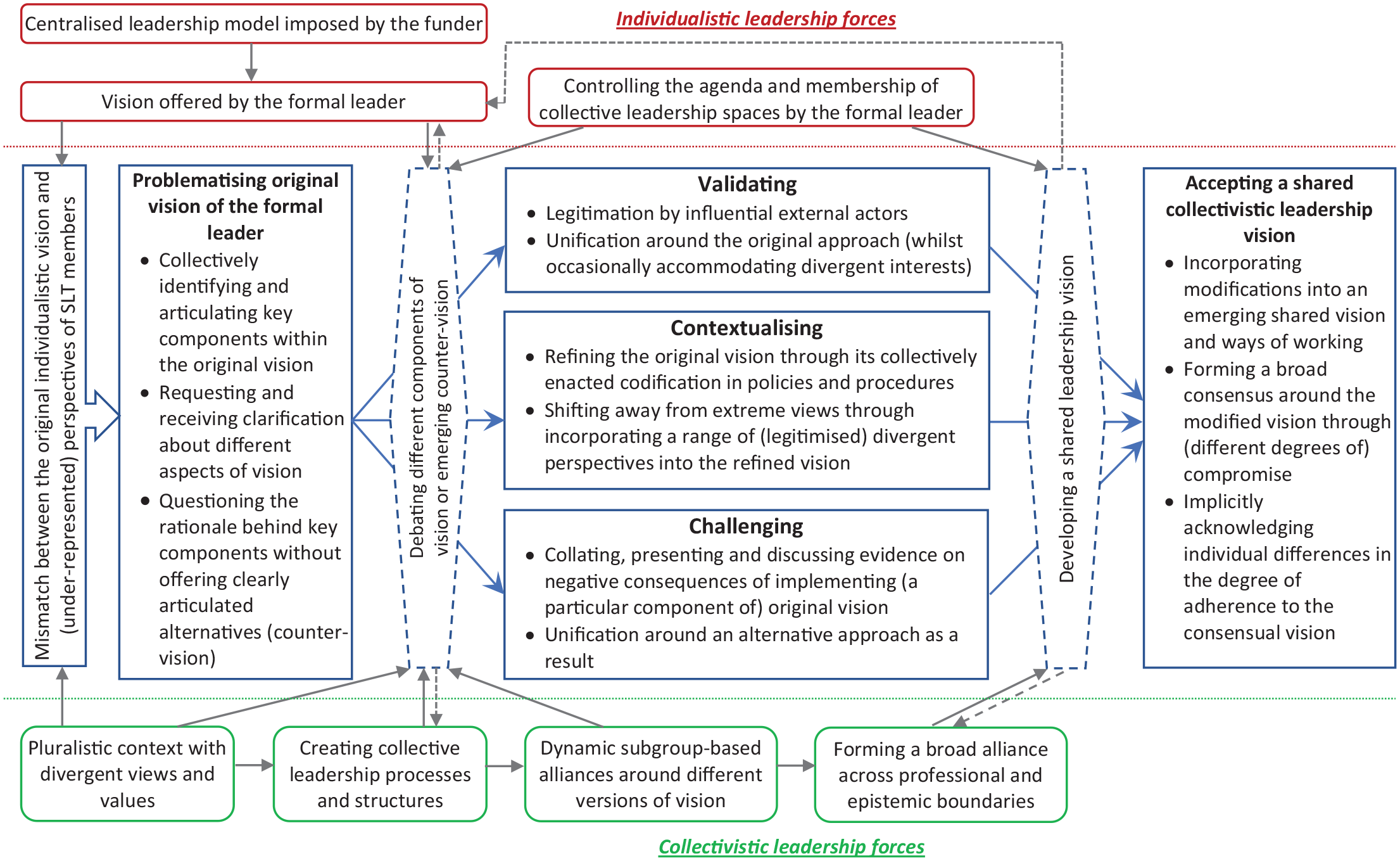
Process model capturing the evolution of leader vision in the context of managed pluralisation of leadership.
Problematising hierarchical leadership and vision
Although collective leadership was explicitly mentioned in the Collaboration’s foundational documents, the first year of its existence predominantly displayed the characteristics of an individualistic model. Most decisions related to the Collaboration as a whole were made by the Director, with subsequent ‘rubber-stamping’ (M3 – 1) 3 by the rest of the team. Interestingly, the hierarchical model of leadership was initially accepted by the SLT members without much resistance, not least because it was prescribed by the funder and aligned with the academic leads’ own expectations, reflecting the persistence of individualistic leadership forces at the beginning of this stage: ‘The [Collaboration] has a director, who’s deputed, for all purposes, as the leader’ (A4 – 1).
At the same time, the operation of collectivistic forces became apparent, when some of the academic leads started to express concerns that they were excluded from the development of the strategic vision of the Collaboration. The Director’s original vision emphasised getting research into practice, engagement with the NHS stakeholders and joint working between academics and managers. However, these ideas largely remained implicit and under-articulated, not least because they were never explicitly discussed at the SLT meetings, which were dominated by operational, rather than strategic issues. There was, however, a growing understanding that ‘a shared set of values’ only existed ‘at a fairly superficial level’ (A1 – 1), that the SLT was not ‘enough of a team to be able to make decisions corporately’ (D – 1) and that ‘there were two camps within the senior leadership meeting: an academic camp and [a] management camp’ (A5 – 2).
To address these issues, the Director, who was seen by SLT members as ‘open to discussion and to reflecting a broad range of views’ (A4 – 1), organised an externally facilitated away day. Here, the Director acknowledged that the Collaboration’s vision had multiple components and that their acceptance varied across the SLT, posing a question as to how a shared vision could be achieved: ‘I think each of us identifies with parts of the vision that we are comfortable with. What is our responsibility for achieving all of the parts?’ (D – AD; respondent’s emphasis).
It was the subsequent process of questioning the formal leader’s vision by the group that enabled the leadership team to dissect it, in effect: (1) identifying and articulating its three main components; (2) requesting clarifications from the Director as to how different components of vision would be achieved; and (3) questioning the rationale behind these key components without offering a clearly articulated counter-vision. Overall, however, problematisation focused more on the processes of implementing the Director’s vision rather than on its content: ‘There is a vision in the end point, but the process how we get there is not clear’ (A2 – AD). Below, we outline the three components of vision articulated during the away day and how they were problematised by the SLT members.
1. Working together with NHS stakeholders when designing and implementing research. The Director argued that owing to the Collaboration’s matched funding model, addressing the NHS partners’ priorities was critical to the Collaboration’s success and that their representatives should be included in the design, implementation and dissemination of research. In response, academic leads raised questions about how decisions on engaging with partners should be made, particularly when the practitioners’ and researchers’ goals were not aligned. Academic leads also questioned the rationale behind this component of vision by highlighting that being ‘reactive to opportunities’ (A2 – AD) presented by the NHS partners could potentially negatively affect the Collaboration’s ability to pursue its own overarching academic agenda.
2. Prioritising research with a strong potential to ‘make a difference’ through its implementation in practice. The Director argued that owing to the inherently applied and local nature of the Collaboration, all of the Collaboration’s projects would have ‘some element of research and some of implementation’ (D – 1). Here, follow-up questions related to how shared decision making should be configured to ensure that the Collaboration moved away from the position characterised, in the words of one academic lead, as ‘some implementation without science and some science without implementation’ (A2 – AD). Questions were also raised by several academic leads in relation to how this component of vision would accommodate the (perceived) research funder’s expectation that the Collaboration would need to produce high-quality research leading to novel and original contributions to knowledge: ‘Ours is a research world; we need to be mindful of this as a cornerstone. We will be accountable for that before the NIHR. What is our overarching academic contribution?’ (A4 – AD)
3. Joint working between academics and managers on all research projects. This component of vision was seen by the Director as a specific mechanism for implementing the two goal-oriented components outlined above, with managers employed by the Collaboration seen as instrumental for implementing research findings in practice and for engaging with the NHS stakeholders. Here, the clarification questions largely revolved around the division of labour: ‘What is the distribution of strategic responsibilities between programme managers and academics?’ (A5 – AD). In addition, questions were raised as to whether the Collaboration’s managers were optimally suited for managing the interface between the NHS partners and the academic themes: ‘We have layers of people, but I am not sure who is managing the interface between us and the partners. How are we warming up future partners?’ (A4 – AD).
It was agreed at the end of the away day that several arrangements would be introduced to facilitate the development of collective leadership and shared decision making within the SLT. These included: rotating the chairing responsibilities between members of the team; circulating a draft meeting agenda in advance so that all SLT members could contribute to it; and balancing information-only items with those for strategic discussion. It was the interplay between these collective leadership arrangements and the questions raised about different components of vision that exerted a major influence on the subsequent co-evolution of the Collaboration’s collective leadership and vision.
To sum up, at the problematisation stage, the original top–down vision was not shared by the members of the leadership team; nor was it directly challenged owing to the relative immaturity of collective leadership mechanisms and spaces, the lack of evidence as to how the implementation of vision throughout the organisation was working (or not) and the associated absence of a clearly articulated counter-vision. It is possible to identify three key drivers for the development of the problematisation stage. The first driver was the mismatch between the vision articulated by the designated formal leader and the perspectives held by other members of the leadership configuration. It is worth noting, however, that it was not the content of vision itself (which largely remained implicit until a facilitated discussion in a collective leadership space) that was the main object of contestation at this initial stage, but the perceived domination of the managerial ‘camp’ over the academic ‘camp’. The second driver, therefore, was the discontent caused by the exclusion of the powerful group of actors (academic leads) from the formulation or modification of the organisation’s vision. Finally, it was the Director’s decision to open up the collective leadership space (taking the form of a facilitated away day), enabling the team to collectively reflect on the Collaboration’s vision (or lack thereof), articulate their concerns and propose specific interventions aiming to further collectivise the Collaboration’s senior leadership, thus establishing a set of structures and processes that would pave the way for the debating stage.
Debating the original vision and its alternatives in the collective leadership spaces
This stage, taking place in year 2, saw a more intense debate about the Director’s vision, which involved the emergence of alternative counter-visions as well as a range of compromise-oriented, ‘middle-ground’ views. The transition to debating was enabled by the increased clarity about the different components of vision achieved through its previous problematisation, by the inclusion of dissenting voices in the newly opened collective leadership spaces, and by the gradual crossing of the boundary between the academic and the managerial members of the SLT, facilitated by joint working. Each of the three components of the original vision followed a different pathway as they became debated – and transformed – in collective leadership spaces. The first component of the original vision (engaging with the NHS stakeholders) was accepted, largely owing to external legitimation; the second (prioritising research with a potential to make a difference in practice) was contextualised and refined through surfacing and codification of differences between the original vision and a counter-vision; and the third (involving managers in all research projects) was rejected and reformulated based on its respective counter-vision. These three diverging scenarios (referred to, respectively, as ‘validating’, ‘contextualising’ and ‘challenging’) are described below.
Validating the original vision: External legitimation
In one of the SLT meetings, an academic lead who was critical of the Director’s emphasis on working with the NHS stakeholders, which some academics saw as potentially detrimental to their research agenda, proposed that the Collaboration should organise an external advisory review to scrutinise its research projects and ‘to look at overarching scientific direction’ (A1 – SLTM). This was supported both by the clinical academics, whose emerging shared ‘counter-vision’ prioritised researcher-led ‘high-quality’ studies, and by the Director and senior managers, who saw this as an opportunity to garner external support. Even though the idea for a new collective leadership space (external advisory review) came from one of the academic leads, the Director retained control (or, in the words of Lukes (2021), ‘two-dimensional power’) over the focus and format of the review, as well as over panel member selection and briefing, which were ‘carefully managed’ (M3 – 3) to ensure that the outcomes were in line with his/her vision.
Unsurprisingly, the external review endorsed the Director’s original vision emphasising the need to engage with the NHS stakeholders, which contributed to shifting the SLT members towards accepting it: The process served as something of a reminder to me about the need to ensure that the research that we’re doing is reflecting the stakeholder priorities. . . . I suppose part of me thinks it’s our responsibility to tell the stakeholders what the research is that they need doing in an area where I know more about it than they do . . . What we’ve got from [a member of the review panel] was quite a different model, which was about: no, it really has to come from them . . . What that did for me was implant in my brain the need to at least think about these principles constantly. (A1 – 3)
This recommendation was not contested by the SLT, which can be explained by a number of reasons. First, it was legitimised by the fact that the external review was conducted by academics with an international reputation and significant impact in the discipline of research implementation. Second, going through the review brought the SLT closer together, mobilising the mechanisms of group identification, as the SLT members were forced to present ‘a united front that develops in the face of an external threat’ (A6 – 3). Finally, it gave some of the academic leads external endorsement to undertake more ambitious research projects as long as these projects were co-designed with the NHS partners and included ‘thinking about implementation from the design stage’ (A5 – 3), even when they had previously been opposed by the Director as not having strong potential to ‘make a difference’ in practice – that is, to address the second component of the original vision.
Contextualising the original vision: Legitimation of differences through their codification
Making a difference in practice through prioritising research with a strong potential for impact – the second component of the Director’s original vision – needs to be considered in light of an epistemic boundary between clinical academics and social scientists that came to the fore in year 2. Clinical academics, who tended to value a deductive, protocol-driven approach to research, were particularly unhappy with the Director’s vision leading to the Collaboration participating in ‘local evaluations’ of healthcare provision often guided by relatively small-scale and context-dependent practical questions. By contrast, social scientists, who were more comfortable with iterative, inductive and co-produced modes of academic inquiry, argued (in support of the Director’s vision) that these evaluations could still result in high-quality research outputs and/or larger research grants.
The Director’s approach to addressing this tension involved initiating and overseeing the development of the Collaboration’s policies and procedures, aiming to reconfigure boundaries through altering the existing project classification logics. One example included the development of a typology of the Collaboration’s projects, which assigned existing or potential projects to a category, depending on their position in the research-to-practice pipeline. Another example was a checklist against which all potential projects were expected to be assessed to become part of the Collaboration. Drafted by a group of social science academic leads who were broadly supportive of the Director’s vision, these documents were subsequently discussed – and refined – in several SLT meetings. In subsequent interviews, many research participants noted that collectively discussing these emerging policies allowed academics to air their differences in opinion, contributing to legitimating the validity of different epistemological and methodological approaches to research.
Overall, this process reinforced some of the Director’s messaging related to the broader notion of ‘making a difference’, such as the importance of thinking ‘about relationships and about networks and about opportunities’ (D – 2) rather than purely about high-quality research. At the same time, it accommodated a range of divergent perspectives on what Collaboration projects should look like, highlighting that the research programmes could combine projects that were ‘at completely different ends of the typology’ (M2 – 3). This signified a marked departure from the original expectation that ‘all the projects have got to involve an element of research and implementation and so they wouldn’t get approved as projects if it was too research-y’ (M1 – 1). The codified policies and procedures also provided a legitimate reason for academic leads to decline some of the proposed ‘quick rapid evaluations’ (A5 – 4) if these were seen as low priority for their programmes.
Challenging the original vision: Unification around an evidence-informed ‘counter-vision’
The Director’s original vision involved joint working between researchers and managers at all levels, which was seen as a way of driving the process of ‘making a difference’ in collaboration with the NHS partners. There was some growing dissatisfaction on the part of the clinical academics (supported by two senior managers) about having the cadre of ‘programme managers’, ‘project managers’ and ‘facilitators’, leading to the development of an alternative counter-vision prioritising the employment of research staff instead of junior managers: Seemingly endless managers – I don’t really know who they are, or what they do because there’s too many of them. So I struggle with who does this and who does that, and who should I communicate with . . . I’d have probably brought the implementers in later and I’d have had more researchers. (A2 – 1)
Widespread resistance to this arrangement can be attributed to the fact that it had been institutionalised in the Collaboration’s structures from the very beginning. On the other hand, this institutionalisation enabled one of the clinical SLT members (following extensive consultations with supporters) to compile a comprehensive document, systematically presenting the criticisms of the Collaboration’s staffing model. After discussion at an SLT meeting, a ‘consultation exercise’ was launched, which was coordinated by one of the senior managers and involved collection of written responses to this issue from all SLT members. Its findings were then presented and extensively discussed at another SLT meeting, where a broad consensus was reached, bringing together clinical academics, social scientists and senior managers. In line with the counter-vision, it was agreed that more junior staff (‘facilitators’) were often too inexperienced to ‘facilitate’ engagement with the NHS stakeholders – particularly in the early stages, when ‘there was almost nothing to facilitate’ (A1 – 2) – and that the current staffing model needed ‘to be more fluid around the edges’ (M1 – 2).
Despite the Director’s (initial) resistance, these discussions led to the relaxation of the initial requirement (inherent in the Director’s original vision) to have project managers and facilitators attached to every single Collaboration project. This ‘better awareness of matching and making sure you got the right sort of mix on the project’ (A8 – 4) allowed academic leads to bring in more research staff and/or ‘repurpose’ existing facilitators as research assistants in all but name. While being in direct opposition to the Director’s original vision, this ‘active change in the position’ (A7 – SLTM) resulted in ‘massive progress’ (M2 – 3) in joint working, with a nearly universal agreement that the refined Collaboration’s staffing model was ‘working much, much, much better’ (A5 – 4).
To conclude, the debating stage presented divergent evolutionary trajectories for different components of vision, with three scenarios (‘validating’, ‘contextualising’ and ‘challenging’) describing how the content of vision may develop over time. This was underpinned by the following shifts. First, as the SLT members got to know each other better through the process of joint working, the initial boundary between senior academics and senior managers became less problematic, which, on the one hand, highlighted new key divisions (such as the one between clinical and social scientists) and, on the other, enabled the SLT members to form situational subgroup-based alliances depending on the question being debated. Second, the debate was enabled by the ongoing evolution of collective leadership arrangements, which were now only partially controlled by the Director and included multiple opportunities for collective discussion, some of which were rather broad in scope and involved external actors (such as the external advisory review) and some focused on specific components of vision internally within the SLT (such as the staffing consultation exercise). Finally, these developments were accompanied by the shift from merely questioning the Director’s vision towards active mobilisation of internal and external allies around this vision, alternative vision or a compromise between the two, resulting either in the unification of the SLT members around some vision (or counter-vision) components or in legitimation of differences between diverging versions of vision.
Accepting the refined vision in an emerging pluralistic leadership context
Years 3 and 4 were characterised by convergence around a consensual vision of the Collaboration, with SLT members ‘singing from the same hymn sheet a lot more than they were’ (M3 – 3). Overall, it is possible to discern two trends that enabled transition to the acceptance stage. The first trend reflected the ongoing operation of collectivistic leadership forces as part of (by then largely institutionalised) hybridisation of leadership towards ‘more of a devolved mode’ (A6 – 3), with increased opportunities for SLT members ‘to actually express what they think and input to the decisions’ (D – 4), thereby ‘formulating the strategy as a group’ (M1 – 4). This involved regular provision of ‘a space and an imperative to reflect’ (M1 – 3) – both individually (through interviews conducted for this study) and collectively (through structured discussions of emerging findings in away days or SLT meetings), illuminating ‘areas to discuss which might not have been opened up otherwise’ (A3 – 3), contributing to at least ‘some resolution of the issues’ (M2 – 3) and providing a catalyst for ‘coming to a common understanding’ (M1 – 3). What resulted was a broad alliance emerging within the SLT across professional and epistemic boundaries, characterised, in the words of one respondent, by ‘everybody’s . . . will to have consensus . . . and to be seen to be cohesive’ (A3 – 3) and underpinned by the internalised belief that all successful teams had to go through ‘the forming, norming, storming, performing stuff that you have in groups’ (A9 – 3) and that it was now time ‘to perform’.
The other trend, reflecting the ongoing operation of the individualistic leadership forces within the managed pluralisation framework, involved the Collaboration retaining significant elements of a ‘[Director]-centric approach’ (A3 – 4). The Director’s control over granting SLT membership was, somewhat paradoxically, instrumental in enabling convergence around a shared vision. Expanding the SLT by appointing four new academic leads (three of whom were working in the same university department as the Director) helped to ‘dilute’ the dissenting voices (which were prominent in the problematising and debating stages): We’ve made a massive improvement actually [by expanding the SLT]. Because conversations used to be dominated by a few people with certain opinions, and I think that’s less so. Everybody has a voice. Everybody is heard. And it diluted some of that . . . high senior, academic, ‘I’m really important’, type of power that some people bring to the table. (M2 – 3)
Acceptance of the modified shared vision was seen as ‘coming together after a difference of views and a difference of opinions’ (A7 – 3), which were not only identified and debated (as happened in the previous stage), but now also acknowledged and incorporated both in the co-constructed vision and the way the Collaboration was operating. Overall, the new shared vision was more nuanced and allowed for greater flexibility depending on the project-specific context. Comparing different components of this refined vision with the original vision of the Director demonstrates different degrees of compromise between these two positions:
On being responsive to the NHS stakeholders. Overall acceptance of the Director’s message that partners ‘need to be listened to’ (A9 – 3), while acknowledging that ‘it’s a compromise between what the partners want and the expertise that the [academics] have got’ (A9 – 3). As demonstrated by the previous subsection, unification of the SLT members around the original component of vision proposed by the Director was facilitated by its (deliberately orchestrated) external legitimation through the advisory review.
On making a difference in practice. Transformation of the Director’s original vision through its contextualisation and shifting the level of analysis from individual projects to programmes, which were seen as ‘a portfolio of projects’ (D – 4) aiming to achieve a balance between (different types of) research and implementation rather than rate them ‘on some kind of scale or ladder’ (A7 – 4). This was driven by surfacing, rather than supressing, epistemic differences between the views of research held by different academic ‘tribes’ and legitimising these differences through their codification in internal policies and procedures. Achieving compromise allowed some clinical academics to continue prioritising research over implementation as before, but with a heightened need to at least publicly justify what they were doing in terms of impact on practice.
On joint working between researchers and managers. Significant departure from the original vision towards ‘flexibility . . . in terms of not enforcing the same model on every project’ (M2 – 4) and decreasing managerial involvement at the lower levels of the Collaboration, while reiterating the value of ‘decent project management’ at a higher level (A3 – 4). The rejection of the Director’s original emphasis on compulsory involvement of managers in every project was enabled by the unification of the SLT members around a counter-vision praising managerial involvement at the senior level (including the SLT) but suggesting that the staffing of programmes and projects should be flexible, driven primarily by their needs.
Doubts, however, remained as to how deeply the consensual vision was adhered to or whether ‘a greater understanding of different ways of doing things’ (i.e. incorporation of differences into a shared vision) actually led to undertaking ‘a broader range of research’ (A7 – 4) within their programmes of work (i.e. corresponding change in one’s behaviour): ‘There seems to be more of a common vision, but on the whole . . . people probably are still within their own positions, and they do their own thing, and they are who they are’ (A8 – 4).
An overall impression was that there were ‘probably more people in the middle ground, than not’ (M1 – 4). Individual perceptions of this, however, ranged from acknowledging ‘fundamental change through the time working with [the Collaboration]’ (A7 – 4) to denying any shift (‘[the Collaboration] hasn’t changed anything in me’ (A4 – 4)). There are several potential reasons behind such variation. First, identification with the Collaboration’s shared vision could be hindered by the relatively small proportion of time some SLT members dedicated to the Collaboration and the related ‘lack of (intellectual, emotional, theoretical) investment in the work’ (A1 – MC). Second, those academic leads who were more junior appeared to be more accepting of the emerging shared vision because they lacked positional power or legitimacy to contest it. Finally, deeply ingrained epistemic differences between the academic tribes inevitably shaped their perceptions of vision evolution: while social scientists tended to see themselves as ‘more adaptive and flexible’ (D – 2), enthusiastically embracing the outcome, some of their clinical colleagues believed that the Collaboration’s vision should have been formulated and refined much earlier, prior to the commencement of funding.
Discussion
Managed pluralisation as a vehicle of vision evolution
Our process model highlights the temporally fluid and heterogeneous nature of vision, which may consist of several separate but inter-related components that undergo differential evolution as leadership arrangements move towards a more collectivistic mode. It identifies the three broad stages of vision evolution that differ across several dimensions, such as the degree of articulation and acceptance for different components of vision, the presence of counter-vision(s) and the tactics used by different actors acting as sources of vision. These findings reveal a more complex picture than previous portrayals of vision making as top–down communication (Stam et al., 2014), orderly incorporation of followers’ feedback (Berson et al., 2016) or bottom–up consensus building (Gram-Hanssen, 2021). Our case raises the following key questions: What are the mechanisms underpinning the overarching vision trajectory from problematisation through debating towards acceptance? Why do different components of vision embark on different evolutionary trajectories in the debating stage?
With respect to the first question, we should not overlook the operation of the so-called ‘teleological motor’, evident in the SLT members’ engagement in ‘reflexively monitored action to socially construct and cognitively share’ a vision (not least, perhaps, to gain an edge in a competitive research environment) (Van de Ven and Poole, 1995: 525). This motivation acted in synergy with the well-attested patterns of group dynamics, whereby fragmentation and ensuing debate have the potential to make underlying tensions more visible, stimulating the desire to resolve them (Jarrett and Vince, 2024), especially when reflexive practices are initiated and facilitated (Day and Dragoni, 2015). Still, this forms just part of the overall picture. What our findings add is surfacing how vision evolution can be triggered and continuously shaped by the process of managed pluralisation, seen here as a dynamic interplay between hierarchical and collective forms of control. Our case suggests that skilful management of this interplay is vital for leadership (and other) teams struggling to develop a sense of shared direction (cf. Coutu and Beschloss, 2009), particularly in professional bureaucracies in which ‘the vision is unlikely to be created either by the marginalized top management or by the self-centered professionals’ (Pawar and Eastman, 1997: 95).
While previous commentators have highlighted the crucial contribution of benevolent hierarchical leaders (Denis et al., 2012; Sveiby, 2011) to the development of blended forms of leadership, our empirical case reveals the inherently complex and contradictory nature of this role. On the one hand, the Director’s decision to make leadership arrangements more collective could be interpreted as a manifestation of what Lukes (2021: 3) refers to as positive, nurturing, cooperative power: ‘a matter of acting in concert rather than dominating others’. On the other hand, the pluralisation of leadership was triggered by the SLT members’ resistance and dissent in year 1 and skilfully managed by the Director by retaining overarching control over the agenda and membership of the leadership configuration. As such, simultaneous attempts to open up leadership and to direct the influence this opening up of leadership exercises on the evolution of vision can be interpreted as a manifestation of ‘two-dimensional power’ (Lukes, 2021), where the outward relinquishment of direct coercive influence may serve to hide the retention of control over the context in which decisions are being made.
At the same time, in contrast to critical analyses of distributed leadership (Lumby, 2013) and liberating leadership (Picard and Islam, 2020), our empirical case does not provide evidence for the development of more deep-seated and hidden ‘three-dimensional power’ that would manifest itself as uncritical internalisation of the emerging shared vision to the detriment of participants’ individual interests (Lukes, 2021). This can be explained by the following. In the absence of classical charismatic leadership with its ‘grand vision’, which is likely to generate strong affective and collective identification processes among followers, managed pluralisation has more chances to succeed through relying on ‘the active structuring of institutional or situational contingencies’ (Mumford and Van Doorn, 2001: 297) rather than attempting to inculcate a shared vision. This ‘two-dimensional power’ as a form of central control was counterbalanced by multidirectional flows of power and its predominantly episodic, rather than systemic, nature – features that reflected the development of collective leadership as ‘a simultaneous, ongoing, mutual influence process’ (Pearce, 2004: 48). Perhaps even more importantly, in a leadership configuration characterised by strong autonomy and authority of individual members who display dissent – either openly (in the debating phase) or covertly (through ‘disinvestment’ in the acceptance phase) – acknowledging differences is arguably a more reasonable and effective strategy than promoting ‘sameness’ around the shared vision.
To sum up, we view managed pluralisation as the evolving interplay – and sophisticated mutual adjustment – between the hierarchical and collective forms of control, driving the transformation of the SLT into a functional leadership configuration with a shared vision. Transition from problematising to debating reflects the shift towards collective control, which may, however, result in centrifugal tendencies if it unfolds in a team characterised by a relatively low experience of joint working and strong epistemic boundaries. Transition from debating to accepting reflects the centripetal shift achieved through a relative alignment between residual hierarchical control and the associated maturation of collective leadership arrangements, the consideration of the intra-team epistemic boundaries and the internalised imperative to achieve shared vision. This perspective underscores the importance of attending to the power-laden social structures and processes at the strategic apex – usefully complementing a more traditional emphasis on cognitive processes (Bingham and Kahl, 2013) – as organisations adapt their mental models to environmental changes by synthesising old and new perspectives (Bartunek, 1984; Paine et al., 2024).
Heterogeneity in the content and sources of vision
Our findings show that, through enabling the unification and dispersal of meanings (Cunliffe and Eriksen, 2011), the interplay between the centripetal and centrifugal forces also affects the content of vision. This brings us to the second question raised by our empirical case: why do different components of vision embark on different evolutionary trajectories?
Previous theorising suggests that contestation of vision would be more likely in highly professionalised contexts characterised by a strong autonomy of organisational members and the dominance of professional identities over loyalty to one’s organisation (Mumford et al., 2002; Pawar and Eastman, 1997). We develop this idea further by positing that divergence of evolutionary trajectories for different components of vision can be explained by the differences in the extent to which these components could trigger the resistance of members of a leadership configuration. This resistance is higher when a component of vision poses a direct challenge to professional autonomy and deeply held professional beliefs: the component of vision prescribing compulsory joint working between academics and managers generated the greatest degree of resistance, not least because this requirement had been subject to the most extensive top–down operationalisation and formalisation. The latter suggests that external legitimation can mitigate resistance to top–down vision, possibly through its ability to shift the followers’ perceptions of the change context as well as their motivational orientations (Paine et al., 2024).
As a result, the same pairs or clusters of co-leaders may diverge on some components of vision but converge on others, making possible the formation of shifting and unstable situational alliances between different members of the leadership configuration. In our case, these alliances contributed – along with joint working in collective leadership spaces – to bridging the initial divide between the academics and practitioners. As could be expected from previous research (Currie et al., 2014; Kislov, 2014), boundaries between different ‘tribes’ of academics proved more difficult to bridge, which helps explain the prominence of the clinical/social scientist boundary over the academic/manager boundary in the debating stage as well as the retention of marked differences between academics in terms of their adherence to the agreed vision or incorporation of its principles in their respective organisational units. It also underscores the need to pay greater attention to variation when analysing direction, alignment and commitment as outcomes of leadership collectivisation (Drath et al., 2008).
It is the same clinical/social science boundary that is instrumental for understanding the evolution of the remaining vision component (prioritising research with potential to make a difference in practice), which involved surfacing and legitimation of epistemic differences between the academic ‘tribes’ rather than attempting to facilitate convergence around one of the competing perspectives. Building on previous scholarship that highlights the role of divergent views in collective leadership emergence (Berson et al., 2016; Croft et al., 2022), we demonstrate how the codification of existing differences in policies and procedures (with the subsequent incorporation of these codified differences in the emerging shared vision) enable a balancing act between diverging stakeholder perspectives, contributing to the overarching trend towards acceptance. At the same time, our findings suggest that although codification, incorporation and normalisation of differences may fulfil the collaborative mission of equitably balancing stakeholders’ competing demands (Gibeau et al., 2020), these processes may significantly dilute the future-oriented and change-provoking potential of initial vision, refocusing it towards a more tolerant and shared acceptance of the status quo.
Our findings also highlight heterogeneity in the sources of vision, uncovering its multifocal nature and providing a more nuanced understanding of the interplay between different directions of agency in vision elaboration, which contrasts with previous scholarship that has tended to view the development of vision as either centralised (Stam et al., 2014) or decentralised (Gram-Hanssen, 2021; Sveiby, 2011). First, we show that the original leader vision may contain hidden contradictions that could be mobilised by other members of the leadership configuration to their advantage, echoing previous observations of meso-level actors using policy inconsistencies to legitimise their decisions (Kislov et al., 2023). Second, we demonstrate that bottom–up and lateral contributions to shared vision formation can in many cases be traced to specific members of a leadership configuration, their alliances or even external actors – at least in the initial stages of problematising and debating – rather than emerging, anonymously, in the relational interstices (cf. Sklaveniti, 2020). Finally, we demonstrate how heterogeneity in the content and sources of vision may translate into the heterogeneity of outcomes (namely, unification around the original vision, incorporation of divergent perspectives or unification around a counter-vision) for different vision components. These findings challenge the previous models of vision elaboration that underplay the role of discord arising from divergent perspectives and view the legitimation of the original vision as the main pathway to translating an individualistic leader vision into a shared one (Pawar and Eastman, 1997; Stam et al., 2014).
Overall, our analysis makes us revisit the previous conceptualisations of the interplay between pluralisation of leadership and development of vision. The heroic leadership paradigm sees vision as a tool through which leaders exercise influence, uniting followers around shared objectives. Studies informed by the collective leadership paradigm also view ‘community vision’ (Gram-Hanssen, 2021) – or ‘public imaginary’ (Quick, 2017) – as a mechanism through which leadership can move from individualistic to collective. In our specific case, it is the managed pluralisation of leadership that drives the development of shared vision, whereby vision can be seen as an outcome of managed pluralisation, rather than its precursor. Our findings therefore corroborate theoretical propositions that view the development of shared vision as a product of collective leadership emergence (Drath et al., 2008; Ensley et al., 2003), and suggest three possible boundary conditions for this relationship: (1) absence of a pre-existing community united by shared identity and values; (2) pragmatic, rather than charismatic nature of the ‘proto-vision’ (and therefore its relatively low immediate appeal); and (3) the fact that collectivisation of leadership was not seen by the members of the leadership configuration as a core component of the organisation’s vision (cf. Pettit et al., 2023; Picard and Islam, 2020).
Boundary conditions, limitations and directions for future research
A broader set of boundary conditions applies to our study as a whole. These include the relatively small size of the leadership team (Lorinkova and Bartol, 2021); the representation of clinical research on the SLT by nursing academics who are likely to be less confrontational in collaborative settings than physicians (Kislov et al., 2016); and the western, high-income country context (Dorfman et al., 1997). The top formal leader’s characteristics should also not be underestimated: although in our case the Director was instrumental in starting the process of managed pluralisation, his/her co-optation into a managerial logic may have generated increased reticence from clinical academic leads (Gibeau et al., 2020), fuelling the processes of debating the original vision and contributing to its eventual transformation.
This work is not without its limitations. First, there is an inevitable trade-off between the possibilities the single case study methodology renders in terms of in-depth longitudinal analysis versus replicability and generalisability of its context-specific findings. Thus, we do not make extensive claims about the generalisability of our insights. However, our findings do reflect the issues faced by a range of work teams transitioning towards collective forms of leadership, particularly those operating in the highly pluralistic and fragmented contexts of multiprofessional and inter-organisational networks, partnerships and alliances. Second, by focusing on a senior team, we have not explored whether and how pluralisation of leadership at the team level cascaded throughout the organisation (see Margolis and Ziegert, 2016 for an excellent example). Finally, we did not investigate the origins of the initial vision offered by the top formal leader (cf. Abreu Pederzini, 2018) or its subsequent translation throughout the rest of the organisation (cf. Pettit et al., 2023).
This study opens a number of avenues for future research. We acknowledge that there are multiple pathways through which vision and leadership could be inter-related and would welcome comparative longitudinal studies exploring variation in vision trajectories across a range of leadership configurations as well as in their effects – both intended and unintended. Recent work on leadership as ‘hyper-management’ draws our attention to the potential uncoupling between leadership narratives and organisational practices (Bromley and Meyer, 2021), and it is important to investigate to what extent and under what conditions the development of shared vision – and its acceptance at the level of discourse – is accompanied by actual shifts in organisational direction, practice and regime of control. Our empirical case also provides initial evidence for variation in the degree to which co-leaders’ perspectives shift in the process of developing shared vision, pointing towards organisational identification, epistemological position and social status as possible causes. We therefore call for examining the antecedents, mechanisms and consequences of variation in developing and enacting shared vision in a range of professional and organisational contexts.
Conclusion
In a radical departure from the previous conceptualisation of vision as a relatively uniform, static and uncontested leadership tool applied in a top–down fashion in hierarchical contexts, we develop a process model of vision evolution propelled by a managed transition from predominantly individualistic to more collective leadership. Our theoretical contribution is threefold. First, focusing on the managed pluralisation of leadership as key driver behind the evolution of vision, we address the calls to surface and explore the contradictory manifestations of power in collective leadership emergence (Foldy and Ospina, 2023) and to document different ways in which hierarchical and shared forms of control can co-exist in leadership configurations (Holm and Fairhurst, 2018). Our analysis reveals how the interplay between these forms of control shapes the overarching direction of vision evolution, resulting in a significant transformation of the original vision, whereby balancing a range of divergent perspectives facilitates overarching acceptance (albeit with questionable individual adherence) but dilutes its potential to stimulate radical change.
Second, by tracing the evolution of vision over time, we capture the heterogeneous nature of vision’s content and demonstrate how and why its components may follow divergent trajectories (ranging from validation to rejection) as they are debated in a series of collective leadership spaces. By conceptualising vision as comprising multiple components that can differ in relation to their degree of prescription, potential to activate change or ability to generate resistance, we explain variation in evolutionary outcomes for these components within a leadership configuration characterised by strong autonomy and authority of individual members. In so doing, we challenge previous scholarship that conflates the concepts of ‘shared vision’ and ‘collective leadership’ (Picard and Islam, 2020) or posits the operation of uniform pathways in vision elaboration (Pawar and Eastman, 1997; Stam et al., 2014).
Finally, we address calls for exploring co-production of vision by multiple actors (Berson et al., 2016) and, more broadly, for restoring a focus on individual agency into a process-based approach to collective leadership emergence (Denis et al., 2023). We extend previous analyses of leadership configurations (Chreim, 2015; Empson and Alvehus, 2020) by viewing collective leadership emergence as a multifocal, rather than decentred, process and highlighting the importance of considering not only downward and upward, but also lateral directions of agency. Overall, our study provides a marked contrast with a purely processual approach (Croft et al., 2022; Sklaveniti, 2020), which tends to focus on emergence of collective leadership decoupled from the individual leader(s) and that may fall short of uncovering the ‘power-laced foundations’ of collective leadership configurations (Fairhurst et al., 2020: 598).
The key practical implication arising from this study relates to the trade-off inherent in deliberate promotion of shared leadership. On the one hand, making leadership arrangements more collective has the potential to bring a range of diverse stakeholders together. On the other, formal leaders need to be prepared for a significant modification – or even rejection – of their vision once it starts being questioned, debated and challenged in the newly established collective leadership spaces, particularly if this vision represents a significant departure from the status quo. Leadership development training and interventions should sensitise aspiring leaders to the risks and complexities involved in leadership pluralisation, developing their reflexivity, ability to engage in relational dialogue and responsiveness to ‘moments of difference’ (Cunliffe and Eriksen, 2011: 1438). Finding the right balance between hierarchical and collective forms of leadership, which is vital for the success of vision making in the process of managed pluralisation, can also be supported by group coaching or external facilitation, helping the teams to incorporate their divergent views into a shared vision.
Supplemental Material
sj-pdf-1-hum-10.1177_00187267241301720 – Supplemental material for Getting your message across? The evolution of leader vision and managed pluralisation of leadership
Supplemental material, sj-pdf-1-hum-10.1177_00187267241301720 for Getting your message across? The evolution of leader vision and managed pluralisation of leadership by Roman Kislov, Mike Bresnen and Gill Harvey in Human Relations
Supplemental Material
sj-pdf-2-hum-10.1177_00187267241301720 – Supplemental material for Getting your message across? The evolution of leader vision and managed pluralisation of leadership
Supplemental material, sj-pdf-2-hum-10.1177_00187267241301720 for Getting your message across? The evolution of leader vision and managed pluralisation of leadership by Roman Kislov, Mike Bresnen and Gill Harvey in Human Relations
Supplemental Material
sj-pdf-3-hum-10.1177_00187267241301720 – Supplemental material for Getting your message across? The evolution of leader vision and managed pluralisation of leadership
Supplemental material, sj-pdf-3-hum-10.1177_00187267241301720 for Getting your message across? The evolution of leader vision and managed pluralisation of leadership by Roman Kislov, Mike Bresnen and Gill Harvey in Human Relations
Supplemental Material
sj-pdf-4-hum-10.1177_00187267241301720 – Supplemental material for Getting your message across? The evolution of leader vision and managed pluralisation of leadership
Supplemental material, sj-pdf-4-hum-10.1177_00187267241301720 for Getting your message across? The evolution of leader vision and managed pluralisation of leadership by Roman Kislov, Mike Bresnen and Gill Harvey in Human Relations
Footnotes
Acknowledgements
First and foremost, we extend our heartfelt gratitude to our research participants who made this project possible. We are also grateful to the three anonymous reviewers and Human Relations Co-Editor Andrew D Brown for their insightful comments. Finally, we appreciate the valuable feedback on the initial version of this article kindly provided by the convenors and participants of Sub-theme 77: Translating Leadership: Tensions, Contradictions, and Ambiguities at the 39th European Group for Organizational Studies (EGOS) Colloquium held in Cagliari, Italy, on 6–8 July 2023.
Funding
The authors disclosed receipt of the following financial support for the research, authorship and/or publication of this article: This study was funded by the NIHR Collaboration for Leadership in Applied Health Research and Care Greater Manchester (CLAHRC GM), now recommissioned as NIHR Applied Research Collaboration Greater Manchester (ARC-GM). The views expressed in this publication are those of the authors and not necessarily those of the NIHR or the Department of Health and Social Care.

Supplemental material
Supplemental material for this article is available online.
Notes
References
Supplementary Material
Please find the following supplemental material available below.
For Open Access articles published under a Creative Commons License, all supplemental material carries the same license as the article it is associated with.
For non-Open Access articles published, all supplemental material carries a non-exclusive license, and permission requests for re-use of supplemental material or any part of supplemental material shall be sent directly to the copyright owner as specified in the copyright notice associated with the article.
