




Abstract
Pushing for social change at work is frustrating and precarious. Many employee activists therefore seek support in communities that form around their aspirations and reside ‘between’ organizations. This article advances our understanding of how community participation shapes employee activists’ experiences of their change agency as they return to and pursue their social purpose in their corporate lives. Grounded in an in-depth qualitative study of an inter-organizational community of employee activists, we introduce the notion of ‘dispersed collectivity’: employee activists generate a shared sense of collectivity that they maintain even as they disperse into their workplaces. Dispersed collectivity enables subtle agentic experiences by emboldening employee activists to endure their often-challenging corporate lives, unsettle corporate norms, and detach from their corporate positions. Even without mobilizing a collective push for change across firms, communities can thus play a critical role in sustaining employee activism. Our study contributes a more nuanced account of employee activists’ change agency and offers new theoretical insights into the role of inter-organizational communities in social change, the practices they can use to build collective momentum and empathic connections, and their impact on employee activists’ determination to drive social change from within.
Keywords
Introduction
A growing body of research has explored the transformative potential of efforts by employee activists passionate about a social purpose to change corporate practices from within firms (Girschik et al., 2022; Heucher et al., 2024; Schifeling and Soderstrom, 2022; Wickert and de Bakker, 2018). As corporate insiders with access to internal knowledge and political processes, employee activists are in a unique position to micro-mobilize others more effectively than activists agitating as ‘outsiders’ (Briscoe and Gupta, 2016; Gond and Moser, 2021). Despite these advantages, employee activists often face harsh headwinds in their efforts to bring about change, and their portrayal as ‘activists in suits’ (Carollo and Guerci, 2018) or ‘tempered radicals’ (Meyerson and Scully, 1995) alerts us to the difficulties of being an activist within corporate walls. In addition to social exclusion, ridicule, and shaming from colleagues (Kenny et al., 2020; Scully and Segal, 2002), employees who break with corporate social norms and practices often experience opposition and even sanctions from managers and colleagues (Kellogg, 2012; Soule, 2012). To avert such upsetting and potentially career-threatening social sanctions, activists may feel compelled to conceal their non-conformist values and ideals behind a ‘corporate mask’ (Scully, 2015).
Many employee activists seek support in communities that center on a shared social purpose but are outside their organizations. Inter-organizational ties are well known to provide external legitimacy and leverage for employee activists (Buchter, 2021; DeJordy et al., 2020). In addition to strategic mobilization purposes, communities ‘between’ organizations matter to individual members because they allow them to remove their corporate masks and connect with people who share their concerns (Meyerson and Scully, 1995). Residing outside members’ workplaces means these communities can function as free spaces that liberate activists from the challenging and sometimes dire constraints of their daily working lives (Furnari, 2014; Rao and Dutta, 2012; Reedy et al., 2016). As such, communities can provide opportunities for members to define new courses of action aimed at challenging the status quo (Creed et al., 2022; Villesèche et al., 2022). While these communities undoubtedly make a difference, employee activists likely face difficulties carrying community practices and resources into their change efforts at work. To better understand the significance of inter-organizational communities for employee activism, we ask whether and how community participation shapes employee activists’ experiences of their change agency as they pursue their social purpose in their corporate lives.
Foregrounding employee activists’ experiences, we adopt a phenomenological view of change agency that sensitizes us to how they conceive of and feel about their ‘place in the world’ and the courses of action they can meaningfully undertake to drive change (Creed et al., 2022; see also Coole, 2005). Our research is grounded in an in-depth qualitative study of an inter-organizational community of employee activists advocating – as stated on the community’s website – for a more ‘self-organizing and meaningful world of work’. We find that employee activists carry these community experiences into their corporate lives through what we term ‘dispersed collectivity’: a sense of collectivity that carries across contexts. Theorizing from our findings, we develop a model explaining how employee activists cultivate dispersed collectivity in their community and how dispersed collectivity offers them a repertoire of interconnected agentic experiences they can draw upon, transforming how they experience their change agency at work.
By providing a nuanced view of the potential and limitations of inter-organizational communities for mobilizing and sustaining employee activism, our study contributes to the literature on employee activism by highlighting how inter-organizational communities matter even when they do not develop a collective push for change: they can offer a space for employee activists to cultivate a sense of collectivity that strengthens and sustains their change efforts as they disperse to their firms. Theorizing individual change agency and collectivity as recursively co-constituted, we offer a novel explanation of how communities can contribute to social change as a collective resource, not merely as a resource for individuals. In so doing, our study also provides a new perspective on the role of self-care practices for social change efforts by explaining how a community can use such practices strategically to generate collective momentum. Lastly, our study addresses persisting questions regarding the impact of community participation on employee activists’ commitment to driving change from within, as opposed to leaving the corporate world to pursue their aspirations elsewhere. While community participation may not lessen the constraints employee activists face when trying to drive change in their workplaces, it emboldens them to relate to their constraints more agentically.
Employee activism: Transformational aspirations meet corporate reality
Employee activism is fraught with tensions. On the one hand, employee activists are well positioned to act on their aspirations by leveraging their insider knowledge, access to political channels, and other resources to promote their social purposes (Briscoe and Gupta, 2016; Rheinhardt et al., 2023; Wickert and de Bakker, 2018). On the other hand, being positioned ‘under the umbrella of management’ means they find themselves limited in their scope for action (Scully and Segal, 2002). Firms generally uphold strong norms as to which roles and courses of action are considered viable and desirable, imposing constraints on what roles employees can construct and perform. Illustrating the complex challenges faced by employee activists, Wright et al. (2012) have shown how sustainability managers engage in identity work to negotiate the tensions between their sense of self and the constraints of the work context.
Activist roles tend to be most acceptable when mandated by management or tied to ‘feel good’ initiatives, such as recycling programs (Boiral, 2009; Norton et al., 2015). Employee activists may then enjoy the support of management because they are seen as contributing to the firm’s strategy and reputation (Scully and Segal, 2002). Not unlike corporate mindfulness programs, however, such initiatives often provide employees with a sense of fulfillment while stopping well short of granting them any transformative efficacy (Bell and Taylor, 2004; Islam et al., 2022). These roles may formally appear agentic but are de facto co-opted into corporate agendas, conforming with and reinforcing the organization’s prevailing practices and norms (Girschik et al., 2022). Instead of being put in a position to challenge the status quo in any way meaningful to them, they typically find their aspirations curtailed and rewritten to perpetuate business-as-usual (see, for example, Wright and Nyberg, 2017).
When employee activists deviate from their mandates to challenge power relations and dominant ways of thinking and doing, they and their efforts are likely to become the targets of ‘institutional blockers’ invested in defending the status quo (see also Lawrence and Suddaby, 2006; Levy and Scully, 2007). Such blocking may take the form of colleagues and managers rolling their eyes at them and other acts of dismissive, patronizing, and even shaming micro-aggression (Carollo and Guerci, 2018; Scully and Segal, 2002). They may be silenced, degraded, and excluded (DeCelles et al., 2020; Hafenbradl and Waeger, 2017; Kenny et al., 2020). In extreme cases, opponents of change may actively seek to undermine activists’ careers or to have them dismissed (Meyerson, 2008). Since employee activists depend on their firms for their missions (Briscoe and Gupta, 2016), they must walk a tightrope between passionately pursuing their aspirations and pragmatically adjusting to corporate realities.
Overall, the dependence of employee activists on their firms renders their activism inherently frustrating and precarious. Often, they must settle for piecemeal changes despite their transformative aspirations (Scully and Segal, 2002; Skoglund and Böhm, 2020). Furthermore, employee activists are usually well aware of and reflexive about the instrumentalization and cooptation of these aspirations to serve corporate agendas. They therefore experience dissonance between their aspirations and corporate reality, which dampens their experience of meaning and purpose and renders it challenging to sustain their change efforts (Carollo and Guerci, 2018; Driscoll, 2020; Wright and Nyberg, 2012). Hoping to reinvigorate their activism, many employee activists seek out communities outside their firms where they can connect with like-minded people.
How communities matter for employee activists
The concept of ‘communities’ remains somewhat fuzzy in organizational scholarship. As O’Mahony and Lakhani (2011) have shown, a plethora of definitions circulate across multiple subfields of research, reflecting the different manifestations and affordances of communities in and around organizations. Following Brint (2001: 8), we define communities as ‘aggregates of people who share common activities and/or beliefs and who are bound together principally by relations of affect, loyalty, common values, and/or personal concern (i.e., interest in the personalities and life events of one another)’. In professional contexts, communities have long been recognized as important social units for collective learning, as when people define and build competencies and shared knowledge that can help them develop their skills and solve problems more quickly (Lave and Wenger, 1991; Wenger, 1998; for a review, see Nicolini et al., 2022). Such communities are often rather informal, consisting of self-selected members meeting over lunch every other week or merely maintaining a shared messenger thread (Wenger and Snyder, 2000). Even when organized more formally with established meeting schedules, what distinguishes such communities from other forms of organizing, such as project teams or employee resource groups, is that they are developed bottom–up and driven exclusively by their members rather than being mandated or controlled by top–down management (Wenger, 1998).
In this study, we are specifically interested in communities that reside between organizations in which activists from different firms come together around a shared purpose of driving change in their workplaces. Perhaps because they are work-related, such inter-organizational communities are often presented as ‘networks’ even when they constitute change-oriented spaces. For example, research on feminist business networks has shown that participants use online spaces not only for exchanging business knowledge and career opportunities but also for negotiating meanings and identities, thereby creating new discursive resources and imaginaries for their advocacy work (Villesèche et al., 2022). Conceptually, we consider such professional networks to be communities whenever they center around a shared purpose and their members develop reciprocal relations (O’Mahony and Lakhani, 2011). Illustrating these aspects, Petrucci’s (2020) study of gender-inclusive meetup groups has described how the members of such groups develop safe spaces where people provide each other with the support they find lacking in their workplaces. Not all professional networks constitute communities, however, and as demonstrated in these prior studies, building and sustaining communities where people can be ‘different together’ requires persistent efforts to nurture trusting relations (Husted and Just, 2022).
Studies of social movements similarly suggest that communities can be a crucial force for change by providing alternative spaces at a distance from the institutions that otherwise dominate members’ daily lives (Furnari, 2014; Rao and Dutta, 2012; Reedy et al., 2016). As trusting spaces in which participants are invited to reflect upon, challenge, and redefine prevailing social norms without fear of social sanctions, communities afford activists rare opportunities to experiment with prefigurative practices. That is, they can jointly enact in the here and now the values and ideas to which they are committed (Graeber, 2002; Maeckelbergh, 2011). While usually small-scale, such experimentation with alternative ways of doing and thinking can provide a fertile ground for mobilizing collective action that targets the status quo more contentiously (De Coster and Zanoni, 2023; Skoglund and Böhm, 2022). For employee activists, their aspiration to drive change in their firms makes any collective action more difficult to achieve. Yet, even without a direct strategic promise, prefigurative practices can support activists’ change efforts by cultivating relationships and counterculture (Yates, 2015, 2021) and by enabling activists to envision new possibilities (Ehrnström-Fuentes and Biese, 2022; Reinecke, 2018; Skoglund and Böhm, 2020).
Communities can also come to ‘matter’ for employee activists through their affective impacts. As emphasized by Meyerson and Scully (1995: 597) in their influential work on ‘tempered radicals’, external communities can serve as crucial sources of ‘emotional support, and, perhaps most important, empathy’. Feminist scholars have long cautioned, however, not to take empathy for granted: empathy may grow as part of affective solidarity, which is nurtured when individuals share embodied experiences such as frustrations or anger and thereby move toward the collective (Hemmings, 2012; Vachhani and Pullen, 2019). It is through these embodied experiences of affective solidarity that people can replenish their emotional energy (McCarthy and Glozer, 2022). As Creed et al. (2022) have argued, such embodied experiences can transform how people conceive of themselves and ‘their place in the world’, shaping why and how they feel compelled to drive change.
For employee activists, realizing the transformative potential of inter-organizational communities and integrating their experiences of community participation in their corporate lives is far from free of complications. To begin with, their strong professional identities and dependence on firms for achieving their missions make it more difficult for them to cultivate an alternative and affective space. Further, the more they succeed, the more their community will differ from their workplaces. As such, it is unclear how they can make their community experiences matter for their corporate jobs. Against this backdrop, we set out to explore an inter-organizational community of employee activists empirically.
Empirical approach and methods
To unfold how community participation shapes employee activists’ agentic experiences in their corporate lives, we conducted an in-depth case study of an inter-organizational community of employees in Germany. Grounded in a phenomenological perspective of change agency, our approach emphasizes the relational and context-dependent (and hence potentially precarious) construction of employee activists’ experiences of change agency. Beyond generally conceptualizing agency as entailing certain degrees of reflexivity and potency, a phenomenological perspective is not focused on how idealist forms of agency manifest in the real world but instead privileges the more ‘ambiguous signs of agentic expression as they emerge within a shared lifeworld’ (Coole, 2005: 125). In what follows, we present the community and how we captured and analyzed our participants’ experiences.
Research context
The inter-organizational community we studied was founded by and comprised of employee activists advocating in their respective firms for what the community website describes as a more ‘self-organizing and meaningful [selbstorganisiert und sinnorientiert] world of work’. As declared on this website, the community’s collective aim is to help bring about a societal-level transformation of how we work, including in terms of ‘space, time, the employer–employee relationship, working hours, collaboration, information, communication, and responsibility’. Although definitions of ‘self-organizing’ and related terms such as ‘democratic organizing’ and ‘collectivist organizing’ may vary in practice (Lee and Edmondson, 2017), they all generally refer to employees having a greater say in task allocation and decision making in the workplace (Diefenbach, 2020), while ‘meaningful’ pertains to people’s subjective assessments of their work and tasks as having value and purpose (Michaelson et al., 2014). Again, in the community’s own words, they wanted to ‘establish work that is characterized by self-organization and -responsibility’ because ‘people want to see meaning in their work, identify with the values of their working environment, and take on responsibility’ (quotes from website).
The community was founded in 2017 by 12 employees of different well-known German firms. The founding members had come together at different meetups about self-organization that often linked to then-popular approaches of self-management and decentralized managerial authority (e.g. Laloux, 2014; Robertson, 2015). They had found that most of the discussions at such meetups focused on startups and smaller businesses. They shared the perception that the challenges of promoting more democratic and self-managing forms of organizing were different and more formidable in the corporate sphere. Germany has a ‘collaborative business system’ (Whitley, 1999) characterized by strong ‘horizontal’ forms of association, in particular strong unions and systems of co-determination. Compared with other EU countries, however, Germany has low levels of direct participation in management decision making in white-collar environments, with employees having little influence on how work is organized within their department or organization (Eurofound, 2015). Overall, workplace well-being is among the lowest among firms in EU countries (Eurofound, 2019). The community’s purpose and transformative aspirations were thus motivated by but also clashed with the deeply engrained German workplace norms.
By the time the first author joined the community, it had grown to around 200 members from more than 90 firms. A precondition for membership is that people must be employed in a firm or a similarly large and complex organization at the time of joining the community. One can generally not become a member if one works as an external consultant to avoid the community becoming a marketplace for consultancy services. Membership is free and held by individual members rather than their organizations, allowing members to stay members even if they change jobs. Members have different roles in their firms. While many of them are, as per their organizational role, change agents of some sort, their exact job functions vary and include, for example, generalist inhouse consultants, IT professionals, facilitators in the transition toward more sustainable business practices, or union representatives. Comprised solely of individuals in employee or lower- to middle-management roles, the community operates on a grassroots and non-profit basis. The firms do not support the community financially and are not involved in its agenda setting. However, there is a degree of indirect or tacit backing, as in-person meetups are usually hosted in corporate facilities, and many members attend these meetups during work hours.
We decided to focus our study on this community because it publicly espouses its purpose of bringing together employee activists and making a difference for society by joining efforts across and between organizations. The transformative aspirations to change how we work on a societal level are conveyed in the publicly available data and were described during initial conversations the first author had with several members. Despite limited resources, the community has achieved a high level of maturity with a stable core, formal membership procedures, and consistent activities. This is noteworthy in the hierarchical German corporate context, where such grassroots initiatives are uncommon without management facilitation. Overall, we thus consider the community an ‘intense case’ (Patton, 2002), which offers a valuable opportunity to advance our understanding of how participation in inter-organizational communities matters for employee activists.
Data collection
The first author joined the community and its online platform as a participant observer in March 2021 and attended online and offline community events until January 2023. This researcher’s interest in the community had been sparked by public comments and contributions made by its members on social media and in various podcasts and magazine articles. Having initially joined the community to understand how it was organized and how its members pushed collectively for different work practices in their firms, the first author soon noticed that the community’s practices seemed in some respects disconnected from its publicly espoused aspirations and that the community struggled to mobilize collective change activities. Exploratory interviews with members suggested this struggle had its origins in the very setup of the community since individual activists repeatedly experienced tensions between the shared aspirations they nurtured in the community and the constraints of their corporate roles, with dissonance commonly arising from their efforts to reconcile such tensions. Notwithstanding these apparent challenges, however, many members seemed exceptionally committed to the community.
It was during this early stage that the second author joined the project. Together, we discussed our shared first impressions and set about refining our research focus and planning how best to continue with data collection. To better capture and understand the tensions we observed between members’ community experiences and their limited room for maneuver within their firms, we adopted a phenomenological perspective of agency to sensitize us to the more subtle ways in which participating in the community mattered to its members. In line with this approach, it was crucial for us to tap into the embodied and affective experiences of the community and hence for the first author to let themselves become ‘enchanted’ in the course of their participant observation (Bell et al., 2021), not least to avoid succumbing to the urge to critique or even judge our participants’ practice, but rather foreground their experiences and understand their significance – even if sometimes tacit (see also Ashcraft, 2018). Accordingly, the first author immersed themselves in the online platform, including participating in the main community events that took place once or twice a year at which members came together in larger groups of 50–70 participants.
The first author had worked in the corporate context in Germany before taking up a position in academia and could thus relate to how the participants experienced power dynamics in their workplaces. While their role as a researcher was transparent throughout the data-collection process, their previous corporate experience meant they could speak the same language as the community members and empathize with their challenges. As this prior experience facilitated access to the field and helped build trusting relationships, they soon felt like part of the community and had the impression that the members saw them as ‘one of their own’. The second author deliberately stayed at a distance and did not participate directly in data collection. We took this decision so that the second author could remain ‘unenchanted’ (Bell et al., 2021) and take a more analytical stance as we continuously discussed emerging findings. Our contrasting positions made for constructive dialogue with each other, especially in helping us – as Bell and Willmott (2020) advise – to resist early closure in our analysis, as we detail below.
The first author kept detailed notes of observations while participating in community events and engaging with the online platform throughout the study, taking particular care to note expressions of individual experiences and how social dynamics unfolded within the group. In addition, they formally interviewed 15 members from 14 different firms, beginning with members who were central to the community and most active at events and on the online platform, including several of the founding members. Later interviews were conducted with people who had been members for at least two years and actively contributed beyond the main events (e.g. by organizing sub-group initiatives or joining regular small-group activities). Such purposive selection was important as it emerged early on that only some of the 200-plus members regularly attended and contributed to the community’s development and initiatives. Table 1 displays an overview of the interviewees.
Overview of interviews.

aPlease note that we aggregated some of the industries for the sake of anonymity.
Following a semi-structured interview guide we jointly developed, the interviews sought further insights into how members experienced community participation and change agency at their workplaces, and how these experiences had developed interdependently over time. To this end, the interviews benefitted greatly from the shared ground and trusting relationships established by the first author through participant observation. Lasting between 60 and 90 minutes, the interviews were conducted, recorded, and transcribed in German. Since both authors are native speakers, we could discuss our participants’ experiences in German and only translated the selected quotes into English after we had completed and written up our analysis. Table 2 provides an overview of all collected data.
Overview of data.

Data analysis
Adopting an interpretive and inductive approach, we first read through the interview transcripts and observational data. We annotated these independently before discussing our emerging findings in the original language, staying as close as possible to the terms used by participants. This was consistent with our phenomenological perspective and commitment to privileging the perspectives of people in the community so as not to let theoretical concepts take over early in the analysis. As the data collection and analysis progressed in parallel, we increasingly related empirical observations to emerging theoretical ideas, with the ongoing interplay between our different positions shaping our analytical approach.
Throughout our dialogue, the first author endeavored as an ‘enchanted’ insider to ensure our analysis reflected a deep respect and understanding of our participants’ experiences and their affective embodiment, while the second author maintained a ‘disenchanted’ and theoretically informed outsider position. These distinct positions often led us to divergent ideas about how best to make sense of our case, enabling us to maintain openness in our data analysis through constant dialogue between empirics and theory. This openness prevented us from jumping to early conclusions. To ensure accuracy, the first author discussed emerging findings with various community members throughout the analytical process (Lincoln and Guba, 1985).
Engaging with the data more analytically, we focused on teasing out how and why people experienced tensions between their aspirations and their experiences at work. Through open coding of our data, we captured how members experienced the community, how they felt participating in its various activities, and how they experienced the community as mattering to them when returning to their corporate settings. Discussing the coded sections in several iterations, we eventually summarized them into 23 first-order concepts and sorted these into three sets of second-order themes, totaling seven themes. To identify and understand the dynamic relationships between the second-order themes, we distilled three aggregate dimensions (Gioia et al., 2013). For example (and as shown in our data structure in Figure 1), after subsuming the first-order concept of ‘experimenting with alternatives’ within the second-order theme of ‘cultivating collective momentum’, we sorted this theme together with ‘experiencing empathic connections’ into the aggregate dimension labelled ‘transformative experience of collectivity’.
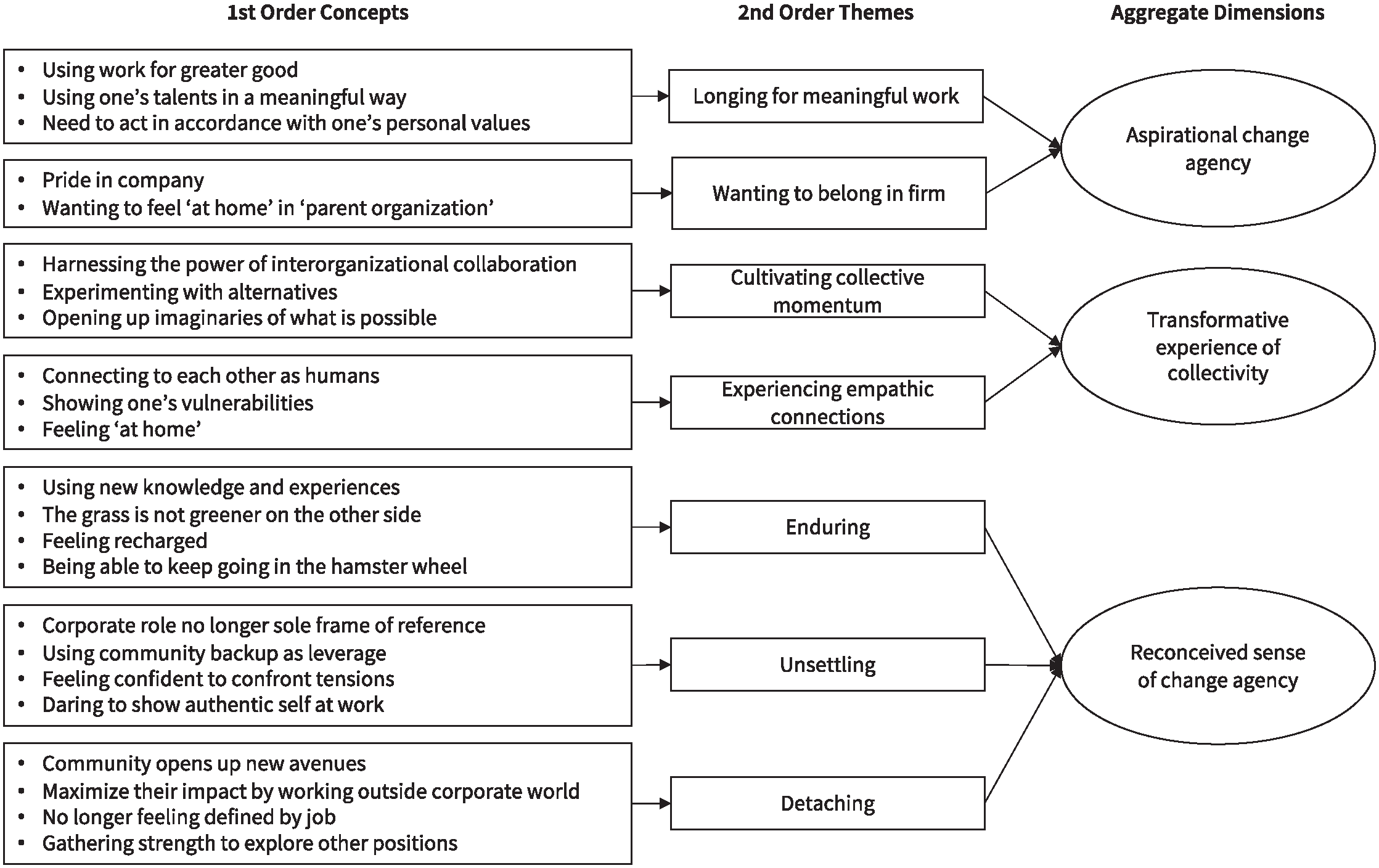
Data structure.
As the final step of our analysis, we developed a theoretical model that presents the transformative community experience and employee activists’ individual agentic experiences in their workplaces as recursively constituted. The model theorizes how our second-order themes and aggregate dimensions are connected, thereby capturing the non-linearity of participants’ experiences. To explain how community participation enables people to carry a sense of collectivity with them as they return to work, we develop the notion of dispersed collectivity, a concept latent in our analysis. We then emphasize the recursive constitution of individual and community experiences by explaining how employee activists’ agentic experiences at work move them back toward the collective, thereby shaping the community.
Findings
In what follows, we detail the tensions around their aspirations that employee activists encounter daily, how the community provides an antithetical space to such tensions, and how the juxtaposition of their experiences in the community enables a repertoire of agentic experiences after the employee activists return to work. Specifically, we identify three distinct experiences in which this reconceived sense of change agency manifests for employee activists: ‘enduring’, ‘unsettling’, and ‘detaching?’
Employee activists’ aspirational conceptions of change agency
The employee activists we encountered during our study had different backgrounds and motivations for joining the community, but they shared conceptions of their aspired change agency. We summarize these aspirations as ‘longing for meaningful work’ and a ‘wanting to belong in their firms’.
Longing for meaningful work
Many community members, also before joining the community, expressed that what made their work meaningful was the pursuit of a social purpose beyond their corporate mandate and to ‘question the system’ (quote from online chat). Or, as Frank said: ‘I am doing [this] because I want to make a difference for Germany.’ They shared a belief in the power of people to transform society for the better by promoting work practices that enable more participation and democracy in the workplace and help to harness the power and resources of corporations to transform the way we work on a societal level, as Simon explained: ‘. . . make the world better every day [sic]. That’s the goal. . . . I have relatively good access to the organization. And I want to position the organization in a more effective way to accomplish this goal’.
Work, from the participants’ perspectives, should not only advance their careers, but they sought to spend their time at work – a large part of many people’s lifetimes – using their talents in meaningful ways as well as enabling others to do so, too: ‘What motivates me, also based on my own experience, is to enable people to do something meaningful in a holistic sense . . . What can we contribute beyond what is expected in a job description?’ (Niels). Many members believed they could advance their societal purpose through their work and emphasized that they felt obliged to act on their aspirations as a matter of personal integrity, like Inka put it: ‘I stand by what I do, that I can do it with a good feeling . . . that I can say “what I’m doing is appropriate, it is consistent, it is right, I can stay true to myself”.’ As this quote illustrates, the aspiration to drive change and their longing for meaningful work was tied to members’ sense of self and their place in the world.
In practice, however, members struggled in their corporate roles. Many of those who joined the community worked to some extent with organizational change in their corporate roles, and those roles ranged from ‘compliance and CSR’, ‘quality management’, and ‘organizational development and agile coaching’ to ‘process development’ (posts on online platform). Our data, however, show that they often found themselves preoccupied with fulfilling their roles and tasks given to them by management, and struggled to find time and energy to pursue the causes important to them. Others explained that they could not integrate their aspirations within their roles. As Hans describes: ‘[My] main responsibility is laboratory analysis. And I have an agreement with my boss that I get some freedom to learn more about all the other things that are important to me.’ Longing for meaningful work, many employee activists joined the community in the hope of fostering their ability to pursue their social purpose in their firms.
Wanting to belong in their firms
The employee activists in the community saw their firm not only as a lever for societal change but also as part of their social identity. One person introduced herself in the community chat on the online platform: ‘During the pandemic, it became clear to me again and again what a great firm I work for. We produce . . . everything you need in a hospital, improving the health of people all over the world.’ This quote illustrates the pride many participants expressed in their firms. Participants’ identification with their firms was also reflected in that they commonly referred to them as ‘mother’, ‘parent’, or ‘home organization’ (quotes from the online platform). Participants shared the understanding that they would return to their ‘home port’.
Yet, in practice, participants’ relations with their firms were often strained, especially when they vigorously pursued their social purpose. As Stefanie put it: ‘I believe the greatest tension for me at this point is to stay true to myself but to fit in still.’ As in this quote, many members expressed that they struggled to experience a sense of belonging in their work lives, feeling ‘like a penguin in the desert’ (Claudia). Some members shared that they were alienated and ridiculed by colleagues when they were more upfront about their transformative ideas. Further, they described efforts to nurture grassroots momentum as dangerous or irresponsible because there was a price to be paid: ‘I’ve seen many colleagues pushed out of [the firm] because they were suddenly odd characters’ (Frank). As Peter described: ‘. . . they lost a piece of home in their organization because some are even being marginalized. Some say, “they are nuts!” or “that’s a no-go!”’. Despite wanting to belong in their firms, many participants thus experienced that they did not fit in.
These tensions between their aspired change agency and the reality of their workplaces, however big or small, motivated the employee activists to seek out the community in the hope of meeting like-minded people who would understand them and support them in dealing with the practical and emotional challenges that advocating for change in a highly institutionalized setting entailed, as Sebastian explained: ‘I’m pretty sure that I’m not the only one who is part of a corporate setting and faces a lot of resistance, challenges, and tensions. And [in the community], we meet people with the same tensions and challenges.’ Next, we unfold how people experienced such connections with like-minded others as they participated in the community.
Community participation as a transformative experience of collectivity
Mirroring members’ aspirational change agency, the community was founded, as founding member Jana put it: . . . deliberately in [the context of] established corporations, because I think – and many others in the community do, too – that we will, at least in Germany, need corporations in the future . . . knowing full well what is and isn’t possible in a corporate context.
The aspiration to use corporations as levers for change was what brought the founding members together as a community in the first place. As Philip explained: ‘Our purpose [in this community] has always been to use the power of our network because we assume that corporations, in particular, have power in the world of work.’ Indeed, the main idea was that the community would strengthen efforts to change firms from within and to ‘combine the potential of our parent organizations in collaboration’ (post in chat).
The community’s declared motto was to ‘be the change’, which features prominently on its website and attracts many members. Many joined because they expected to ‘share experiences and learn from each other’ (post on online platform), to find a ‘shared learning space’, as one interviewee calls it, and ‘to work together on challenges, maybe also competencies . . . to acquire competencies that we all deem increasingly relevant’ (Niels). Others joined looking for emotional support. As one member said: ‘I was very much hoping to find something like an energy station. Or to find like-minded people and no longer feel so alone. That was my hope’ (Christian). Our analysis shows that especially the experience within the community (at meetups and events) exceeded such hopes: members experienced the community as transformative because they cultivated collective momentum and empathic human connections.
Cultivating collective momentum
Members who joined and stayed in the community throughout our study emphasized how much they valued the exchange with like-minded others. As Inka put it, she appreciated how the community enabled her ‘to exchange with other people on a topic that preoccupies you, that bothers you, that you can’t seem to make progress on, and thereby get new ideas’. Their shared aspiration enabled such exchanges because people had a common ground to build on and did not feel that they had as much explaining to do but could instead address the issues they wanted to discuss right on, as Hans described: ‘There is so much mutual support. No matter the question I throw into the room, I get answers, always. Just like that. No tactics, no financial gain, or something like that.’ This quote emphasizes that open exchange among employees from different firms without hidden agendas was a new experience for him. Similarly, Sebastian hinted at the fact that he was somewhat stuck in his bubble before becoming a community member, partly because it was frowned upon as an employee to seek exchange with employees from other firms: ‘To meet people from other firms. Because up until then, we were really in our own [firm’s] bubble. So, you were only allowed to, you only spoke with suppliers and other business partners.’ Meeting all these other individuals interested in the same topic offered new experiences of exchanging with like-minded people that many had hoped for when joining the community.
At the regular community meetups, participants experimented with new practices and ideas. Even the agenda for such meetups was set experimentally, in a so-called ‘barcamp’ style, as the first author could observe, meaning that any member could offer a session, and the others could spontaneously decide which sessions to attend. The topics could range from ‘How to measure team resilience’ or ‘The performance management system is broken’ to topics beyond corporate life such as ‘Autocracy and power and loss of control in times of war in Europe’ or ‘Youth work and education’. Members also used the very planning of community events to run such experiments. For instance, during the pandemic, a group of volunteers designed a very elaborate online experience for a day-long meetup: I’m impressed by the whole online setup. They use this very elaborate tool where they build different virtual rooms for the event (there is a plenary space called ‘arena’ where everyone ‘sits down’ upon arrival and posts a photo and sometimes a fact about themselves or the topics they are interested in talking about). There’s an open space, a lounge, pinboards where people post ideas, etc. (Fieldnote, March 2021)
These experiments offered members a sense of progress in their aspirations in the here and now. They were important, especially considering the barriers that people experience in their corporate lives. As Frank put it: ‘We notice the barriers, right? We’re not finding support. And if we join forces, then we’re stronger. That was the idea.’ While members shared the experience that efforts in their firms were frustrated, they experienced pride when participating in community activities, as Claudia explained: And in the community, ultimately, I co-created something . . . and it was important to me to see what develops from it. And I think the motivation behind it was also a little bit, something like, a sense of pride in my work. Something that apparently was missing in my job.
Through its activities, the community fostered an experience of collective momentum. For one, putting a shared aspiration into practice offered them novel imaginaries of what might be possible. Furthermore, the very engagement in the active community provided a sense of collective achievement that they often found lacking in their firms.
Experiencing empathic connections
Beyond seeking and finding practical support by joining the community, we also found that members experienced the community as transformative because it allowed them to connect empathically with each other. Many described a feeling of strong connection that was noticeable right from the start, as Inka described: We were and are very diverse when it comes to our backgrounds, but . . . I stepped into that room and immediately felt that they were not foreigners, but that we knew each other. You almost wanted to hug each other immediately, you know?
This sense of connection was often expressed after community meetups, as in the following chat post after an online meeting: ‘It is so nice to see friendly faces and to share what’s on our minds. It felt like such a nice and nurturing connection that developed, a sense of connection after just a few minutes.’ Our data show that even those who described joining the community for instrumental reasons and who were not necessarily searching for human connection in the first place felt ‘at home’ and ‘secure’ (video log after meetup) in the community.
Indeed, a shared yearning for empathic connection was core to what brought people together in this community, and members actively cultivated this experience in the community over time: So, what I really like is the space that we have created in [the community]. It’s usually a very, very appreciative, open, trusting, and safe space. . . . That’s what we always wanted to create – in our organizations, too. There is so much appreciation, so much openness, so much diversity, and yet a lot of constructive dialogue and a lot of humanity. (Philip)
Many activities were set up so that members could relate to one another empathically and in a way that would encourage them to show their vulnerabilities, as the first author observed during events. There, they experienced activities such as ‘collective meditation’ or practicing ‘prolonged eye contact’ (Fieldnote, June 2022) to foster connection at a deeper level. Conversations often ran deep very quickly, and people openly shared their struggles: We start the day in small breakout groups . . . Immediately, a very fluid and deep conversation develops in the small group. We talk about how we feel insecure after Covid when events take place offline again and we feel our bodies at work again or moving in space. . . . At the end of this round, one of our group says, ‘I have felt deep trust here in the group . . .’, another person says, ‘I have experienced a really beautiful way of being listened to here.’ (Fieldnote, November 2021)
This openness to show one’s vulnerabilities also manifested in the formation of a sub-group that meets online weekly, as Inka explained: ‘There was this really close proximity that developed, where you would open up so much and say things or talk about things and reveal things – you wouldn’t normally do that.’ This quote shows that members experienced that they could take off their corporate masks, revealing things that usually remain hidden in a work context. Similarly, one person posted in the chat after one of the online community meetups that how they opened up to each other ‘immediately made me tear up again. I don’t have that back in the corporation . . . we are without masks here. Safe.’
These experiences of belonging and feeling safe in the community were very different from how people experienced their relations with colleagues in their firms. As Peter described: ‘Here they meet like-minded people and that makes you feel good – you hear that a lot in the community, “we don’t want to go back [to corporate life],” so it gives you strength and validation, it is home.’ These quotes show that by providing a shared space of human connection that makes members feel at home, the community stood in sharp contrast to their workplaces, and many began to prefer their ‘new home’ to their ‘old home’. Despite these experiences, because they still depended on their firms for their missions, they returned to their firms to drive change.
Reconceived sense of agency: From collective experience to dispersed collectivity
While the community cultivated a sense of collective momentum, members did not mobilize action together to the extent that some members had hoped for: ‘[The community] does not live up to its potential. We could do so much more. We could use a systemic approach to make change happen everywhere at once’ (Sebastian). Claudia flagged that the heterogenous corporate realities made it difficult to push for change together: ‘[The community members] have totally different regimes in their heads . . . even to reconcile those when working in the community! . . . Such diverse perspectives. And such diverse experiences.’ Instead of driving change together, they thus returned to their many different firms and focused on driving change there.
One challenge arose from the sharp contrast members experienced between the community and their corporate realities, and they felt that it was difficult to transfer some of the more experimental learnings into their daily lives. Members expressed that many of the community activities that made their participation so valuable would be completely impossible to implement in their firms, as the first author’s field notes document: During the online session, some members write in the chat, making fun of how they would NEVER be able to try some of the things and tools discussed or tried out in the community in their corporate role. One person writes: ‘You are crazy! We are not allowed to use any of that here . . . Best regards from reality.’ (Fieldnote, March 2021)
David experienced this firsthand when he tried to implement some of the community practices he had learned and enjoyed in his organization: ‘They would tell me, like “now is not a good time”. And that of course is super hard, when you experience all those valuable approaches and cool ideas and then you bring it into the organization and it’s rejected.’ Upon returning to their respective firms, members thus still found their aspired change agency frustrated and continued to grapple with a tension between their longing for meaningful work and their wanting to belong in their firms.
Despite lacking direct applicability of experiences to their daily lives in their home organizations, employee activists found community participation extremely valuable because it gave them a sense of collectivity, even as they dispersed back into their firms. The transformative experience radiated beyond the community, constituting a repertoire through which people reconceived the tensions around their conception of purpose inherent in employee activism and what they considered viable, desirable, and sustainable courses of action to undertake when back in the firm. As Jennifer put it: ‘The community expands my solution space.’ Specifically, we found three interrelated ways in which activists reconceived their sense of agency: ‘enduring’, ‘unsettling’, and ‘detaching’.
Enduring: Feeling recharged to play the corporate game
Agency experienced as enduring entailed that members could keep going in the ‘hamster wheel’ as they gained new perspectives on the tensions they faced and felt renewed strength to sustain their activism. The knowledge and experience acquired in the community enabled them to accept that there are many situations in which one must color within the lines. As Niels described: ‘Knowing what needs to be done and finding the best way to approach it . . . I wasn’t always successful with that in the past, and it still isn’t easy today.’ The community experience played an important role in enabling this agentic experience. Because members openly shared their struggles within the community, some could see that the grass was not necessarily greener on the other side: It helped me to put my own organization into perspective. You often hear things like: ‘Everything is super difficult for us. Other firms are doing much better.’ And if you hear directly from other firms, you notice that they struggle too. (Simon)
Hearing about similar experiences in other organizations enabled members to put their struggles in perspective, reenergizing their commitment to driving change in their firms.
Emotionally, community members found it more bearable to face their constraints and keep playing the corporate game because they experienced that the community allowed them to recharge. As Stefanie explained, such recharging was often much needed: [The work I do] requires huge amounts of self-reflection but also energy. . . . And I can sense that occasionally I need regeneration. And I cannot get that within my team, because if I talk to my colleagues, I know what will happen: everyone gets stuck in some form of self-pity loop, like ‘oh my god, oh my god, oh my god’.
The community provided a way to recharge among like-minded people: ‘. . . and then we refuel. That’s absolutely how I feel when I attend the events’ (Sebastian). Or, as someone wrote in the chat after an event, they were done ‘recharging [their] batteries’. Yet, many also described that they recharged in the community just to be depleted again in their firm, leading to a circle of recharging and depleting: The community backs me up. I have experienced that again and again, that sometimes you’re in despair because you fail to push for change, because of some higher-ups or just the general conditions. That’s tedious and sometimes you lose faith even though you know deep down that it is the right path. And the community supports me to keep going and not give up. (Hans)
Other members echoed this, saying that the community experience helped them ‘to refuel and then go back into the not always easy corporate setting’ (Niels) and to ‘keep at it’ (Claudia). As Frank put it, it helps to ‘stay in the game, you could say’, albeit, as this quote also indicates, playing by corporate rules when they felt it was required. Community participation thus allowed members to sustain their efforts despite enduring pervasive challenges in their firms.
Unsettling: Feeling confident to twist the rules of the corporate game
The agentic experience of unsettling entailed that employee activists enacted and experimented with alternative behaviors, thus moving beyond the tensions inherent in employee activism and instead – when needed – disobeying or subverting corporate norms and expectations. We found that community participation enabled members to proactively engage with tensions as they experimented with or even tried to change the rules of the corporate game. Members used their new knowledge and insights in other firms as leverage to push for more progressive practices in their firms, as Frank explained: [The management] can’t imagine it . . . So I thought, okay, if we showed them: ‘Look, [this firm is already doing it] and [that firm] is doing it . . .’ Then we’d have some leverage to say: ‘Why aren’t we doing it? We have the same problems, after all.’
As this quote illustrates, the community offered an external point of reference that they could mobilize in their efforts. Further, some members experimented with bringing some of the more unusual community activities into their firms to consciously trouble corporate norms: I was fascinated by the laughter yoga we tried out at a meetup, so I brought it with me to the firm. And we said, let’s just try it. . . . And to find that, yes, maybe this creates a big tension for the organization. But then we said in the team, ok let’s face that tension head-on and work with it. (Christian)
Community members were aware that such experimental activities (such as laughter yoga) would break with what was commonly expected in their firm and would cause tension. Rather than avoiding tensions, activists were thus sometimes willing to create and confront them when they thought it would stimulate change.
Our interviewees described that it was the community that gave them the confidence to confront their firm’s practices and their colleagues and managers: I have allies in the community. And if people question why I do certain things, why I am the way I am, why I want to do certain things now, then I always feel like I have the community and the people behind me. . . . So, it strengthens me. To bring new ideas into my organization. (Hans)
Similarly, Stefanie described how they brought the community spirit with them as they dispersed into their firms: A colleague from another department and me . . . We came back from a meetup and brought this energy back to the office. And that was awesome because it was so disconcerting for everyone [in the office]. After all, they weren’t used to that at all.
One reason why such energy was disconcerting for colleagues in their firms was that people now dared to drop their corporate masks, as Hans describes it: In my experience, the community honestly is mask-free. In the corporate context, people sometimes check out which role you have. And then, depending on the role, you cannot say what you really think or feel. And for some time now I very consciously don’t do that anymore, even in meetings with the board. There is no haze over what I say anymore. I say what I think and what I feel. Like in the community.
Many of our interviewees echoed the new sense of daring to unsettle the rules of the corporate game because the community backed them up.
Detaching: Feeling independent to play one’s own game
In some instances, participation in the community had even more far-reaching significance. Agency experienced as detaching entailed that activists felt empowered to consider or explore other positions from which they could drive change, including the possibility of leaving their corporate jobs. We found that community participation could open new horizons and invited members to consider venturing toward what they hoped were greener pastures. Indeed, some members experienced that the grass was truly greener on the other side, as Inka said: I want to make an impact in my [corporate] context but I also notice there is a world out there where things seem to be working – just not at my home, not in my corporate context. That can give you strength on the one hand, because everyone else is dealing with similar issues but maybe it’s even more dramatic at my home and that can be frustrating in the worst case, you know?
Sebastian described how the community made him aware of new opportunities: Opportunities [t]hat weren’t so obvious before . . . either something would have had to be extremely bad, or I would have had to desperately want to take the next step in my career and work toward it. But that wasn’t the case, so it was a gift to notice, hey, this could also be an option for you.
Such new opportunities were especially attractive for those who questioned the extent to which they were in a position to effectuate change effectively, as Philip explained: We notice that many of us . . . then rather say, I can’t be effective here [in the corporate context] or the wheel I have to turn is so huge and it’s so frustrating . . . that many then tend to give up and say I’d rather get out of this and try to be effective somewhere else.
Through their exchange with others, some realized that they could indeed be more effective elsewhere and work in a more constructive environment. David stated: Then you can put as much of your energy into it, it will always fizzle out. And that is, I think, a realization I took away from the community. If I want to use my energy not only to a limited extent in a meaningful way but beyond, then I need to take another path. Because there are firms and people and clients who do want change. And who are willing to make space for it.
The community enabled these experiences by supporting people in loosening their attachment to their firm. The agentic experience of detaching was constituted through the collective community experience because it offered them a sense of collective momentum and empathic connections. As Claudia described, the community endowed her with ‘a sense of pride that was missing in my job’. Further, community practices also made members more attentive to their well-being: This desire to push for change . . . beyond [organizational] boundaries, as we do in the community. And to then notice how quickly you’re pushed back into silos in the firms – that does hurt. So, I believe that some just cannot take that anymore and therefore go their own way. (Hans)
This quote illustrates that some members no longer felt defined by their current job and instead began to consider leaving their firm, where they faced many constraints, in favor of assuming other jobs where their efforts would be valued – and this change was noticed by others in the community.
Detaching as agentic experience did not necessarily mean that people left their jobs: many stayed in their firms but felt no longer defined by them. Some community members did decide to move into new positions at other firms or left their firms to work more self-determinedly, for example as independent consultants. As Peter explained such decisions: They became aware of their skills and gained the confidence to say, I can achieve more if I can provide my experience to more organizations and to those who actually want it instead of being met with rejection all the time.
Regardless of whether members stayed in or left their firms, their participation in the community enabled them to gain sufficient distance to consider a broader range of positions as viable, thereby reminding them that they could decide which game to play. Importantly, our data show that mentally and sometimes more literally detaching from the firms they worked for did not mean they abandoned the shared cause of changing how work is organized in the corporate world or giving their aspirations of changing corporate practices from within. But by enabling members to loosen their attachment to their firm, the community opened new positions and pathways for change.
Discussion: Communities as a source of dispersed collectivity
Aiming to advance our understanding of how participation in inter-organizational communities of like-minded people matters for employee activists, we found that the community did not mobilize strategic action targeted at their members’ firms. Instead, employee activists cultivated collective momentum and empathic connections, which constituted transformative experiences of collectivity for the employee activists. These experiences were transformative because they maintained a sense of collectivity even as the activists dispersed into their firms, enabling them to reconceive their change agency. In what follows, we theorize our notion of dispersed collectivity in a model and explain how our study advances our understanding of employee activism.
Theorizing dispersed collectivity: Toward a model
Our model (Figure 2) displays the recursive co-constitution of the transformative experience of collectivity that employee activists created in their community and the change agency they experience in their corporate workplace. It consists of the two constitutive themes of employee activists’ aspirational change agency: longing for meaningfulness and wanting to belong, as well as the transformative community experience and their reconceived sense of change agency. We now explain how employee activists can cultivate dispersed collectivity within their community; how this dispersed collectivity transforms their experience of change agency at work; and how they continue to move toward the collective.
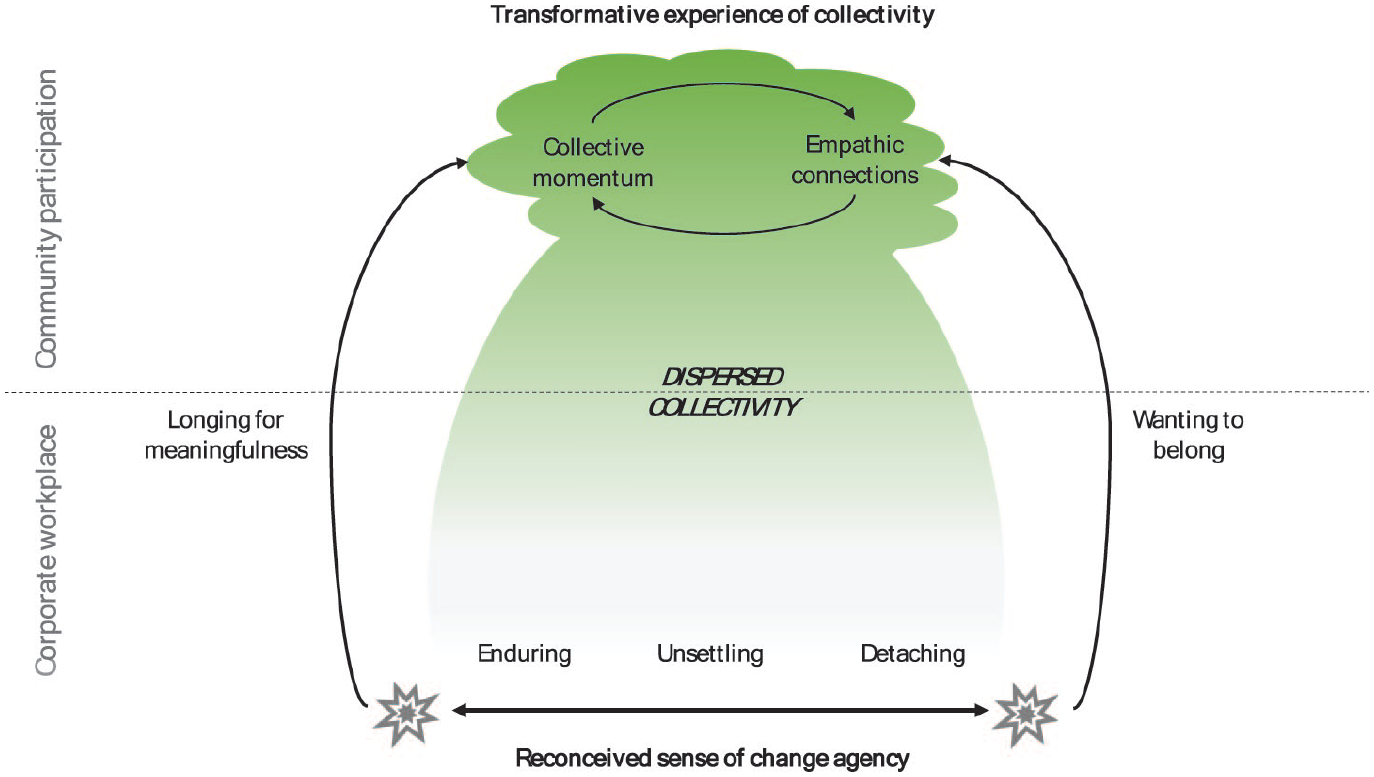
Theoretical model of dispersed collectivity.
Employee activists achieve a transformative experience in their community by cultivating collective momentum and empathic connections. The community experience thus includes but extends beyond the replenishing of emotional energy (see also McCarthy and Glozer, 2022; Meyerson and Scully, 1995). By engaging in activities intentionally designed for sharing affective experiences and that prefigure new horizons, the community generates a strong sense of collectivity. Our study has illustrated that employee activists can maintain and draw on this sense of collectivity even as they disperse into their respective firms. Dispersed collectivity thus entails that a sense of collectivity is carried across contexts and provides employee activists with a repertoire of three interrelated agentic experiences that they can access, depending on the situation they find themselves in at their workplace. Specifically, dispersed collectivity allows them to feel recharged to endure in the corporate game, to feel confident to unsettle the rules of the game, and/or to feel independent to detach themselves mentally and emotionally from the firm and play their own game. These agentic experiences alleviate the intensity of their struggles temporarily, thereby enabling employee activists to sustain and even strengthen their change efforts at work.
Dispersed collectivity wears off, however, as people are back at their workplaces, and it gets exhausted over time (as signified in the model by the fading color). Whereas activists experience collective momentum and empathic connections to be mutually reinforcing within the community, in their corporate lives, their longing for meaningfulness produces tensions with their need for belonging. The community enables its members to work with these tensions more agentically in the workplace. Yet, it also renders such tensions more salient and perhaps more difficult to bear, thus maintaining or even heightening employee activists’ frustrations or ‘affective dissonance’ (Hemmings 2012; Vachhani and Pullen, 2019). It is this affective dissonance (signified by stars in our model) and the desire to re-experience a sense of momentum and connection that drives people back toward the community. Dispersed collectivity thus emboldens employee activists to feel more agentic at work while reinforcing and sustaining community participation.
Theoretical contributions
We contribute to the literature on employee activism by introducing the notion of dispersed collectivity to advance our understanding of how communities between organizations matter for employee activists. Previous literature has emphasized that employee activists can strategically use external ties and resources to pursue change in their firms (Briscoe and Gupta, 2016; Buchter, 2021; DeJordy et al., 2020; Heucher et al., 2024). We expected the community to be especially beneficial in mobilizing action, such as by enabling activists to join forces in their pursuit of social movement tactics (Briscoe and Safford, 2008; Soule, 2009) or even to generate a ‘bureaucratic insurgency’ (Zald and Berger, 1978). In our study, despite the collective momentum for sometimes insurgent ideas and experiments within the community, employee activists did not build a movement for more radical change across firms. Rather, we show that inter-organizational communities matter even when they do not develop a collective push for change because they can offer a space for employee activists to cultivate a sense of collectivity that strengthens and sustains their change efforts as they disperse to their firms.
Previous research on the role of communities in social change has grappled with the concern that such communities favor individual advancement over collective pursuits, thereby weakening the purpose that originally united them (Petrucci, 2020). We have long known that individuals seek out communities to access new knowledge and resources as well as for emotional support (McCarthy and Glozer, 2022; Meyerson and Scully, 1995; Villesèche et al., 2022). To cultivate empathy and solidarity, however, communities must commit sustained efforts (Hemmings, 2012; Husted and Just, 2022; Vachhani and Pullen, 2019). Perhaps somewhat unexpectedly in professional contexts, the employee activists in our study intently cultivated empathic connections to strengthen a sense of collectivity around their shared purpose. Out theoretical model explains that while their sense of collectivity affords the employee activists an experience of emboldened change agency even as they disperse back to their workplaces, this feeling wears out and needs to be restored through continued community participation. Accordingly, instead of merely instrumentalizing the community for their individual advancement, people feel the strong need to move back toward and nurture their community and its shared purpose. By presenting individual change agency and collectivity as recursively constituted, our model offers a new theoretical explanation of how communities can contribute to social change.
To critical management scholarship, our study offers a new perspective on how practices that center on restoring people’s well-being can matter for social change efforts. Scholars have warned that in professional contexts such self-care practices tend to distract from or make people feel better about the status quo, in the worst case denying the need for real change (Bell and Taylor, 2004; Islam et al., 2022; McGee, 2005). Our study shows that activists, within a community that resides outside their workplaces, can strategically use such practices to build empathic relations and foster activities that generate collective momentum. Instead of merely easing the employee activists’ distress, these practices contributed to developing a strong sense of social purpose and change-orientation as the shared basis for collectivity. Overall, because community participation can revitalize their aspirations and heighten the affective dissonance people experience when attempting to drive change at work, employee activists may find it more – not less – important to challenge the status quo. We thus caution against categorically evaluating ‘softer’ and perhaps more self-centered practices as counterproductive to the change agenda and instead invite curiosity into how employee activists may skillfully and reflexively resort to a wide variety of activities to boost and sustain their collective cause.
Finally, our study addresses a critical question: if the employee activists are so discontented, why do they stay in corporate jobs? As others have argued before us, changing a firm from within may require that activists settle on subtle activist tactics aimed at piecemeal change (Meyerson and Scully, 1995; Scully and Segal, 2002). Given the limited ‘transformative efficacy’ (Coole, 2005) of their agentic experiences in their firms, one might indeed expect that employee activists who deeply feel a calling for their purpose sooner or later decide to pursue it elsewhere, for example by joining alternative spaces outside the system (Kociatkiewicz et al., 2021). Yet, most of the employee activists in our study did not fundamentally question their ‘place in the world’ (Creed et al., 2022). The majority of those with agentic experiences characterized by detachment from their firms did not remove themselves from the cause; they remained committed to effecting change from within and using corporations as potential levers for societal transformation. This commitment persisted even among people who questioned whether community members’ efforts were radical enough. Our model suggests that while community participation does not lessen the constraints on employee activists’ change efforts in their firms, it emboldens them to relate to these constraints more agentically and thereby strengthens their understanding of themselves as activists who push for social change from within.
Boundary conditions and future research
Our study has two important boundary conditions that open avenues for further research. First, the inter-organizational community we studied consists of people whose interest in more autonomous and meaningful work is tightly linked to an interest in and openness for new and alternative modes of organizing. This circumstance likely influenced how they experienced and engaged in the community, especially with the more experimental and prefigurative activities. These elements were crucial in generating collective momentum, possibly rendering the transformative experience more potent. Communities focusing on purposes not as closely connected with alternative ways of organizing or for other reasons not lending themselves to such experimentation may struggle to build a sense of collective momentum. Additional empirical studies are needed to understand how and to what extent experimentation is necessary for employee activists to experience collective momentum.
Second, the study was situated in Germany, a ‘collaborative business system’ (Whitley, 1999). As such, this context is characterized by strong ‘horizontal’ forms of association, in particular, strong unions and systems of co-determination providing formal channels of employee representation. With a strong tradition of such forms of association, the German context is relatively more conducive to employee organizing. For example, in our study, employee activists sometimes met during working hours and on several firms’ premises, indicating that some of our participants had received support or at least permission from their managers to participate in the community. Such participation, and hence the creation and sustenance of a community, might be more difficult in contexts where firms are generally more opposed to employee organizing, as often observed with contestation around unionization. Future research may usefully explore how employee activists can organize across organizational boundaries when their firms are opposed to and even punish such connections.
Besides future research to explore the boundary conditions of our study, we also encourage research that addresses questions about the ambition and inclusiveness of employee activists’ inter-organizational communities. In this article, we studied a community that welcomed new members even when their motivations were instrumental. Perhaps because of the variance in members’ ambitions, we found that some members expressed discontent and kept pushing for more radical activities. If individuals with more radical approaches formed a community, it is unclear whether they would find more subtle agentic experiences sufficient for sustaining their activism. Furthermore, the community we studied was relatively homogenous, consisting of German-speaking white-collar employees. We still need to better understand whether and how employee activists can build inclusive communities in which diverse perspectives are represented and in which they can cultivate dispersed collectivity across gender, class, and race. Overall, a key challenge for communities is to balance members’ experiences of meaningfulness and belonging with inviting diversity.
Our call to reappreciate nuanced experiences of change agency backed up by a sense of dispersed collectivity is topic- and context-specific. Depending on the purpose or context, dispersed collectivity and piecemeal change or social movement tactics and radical change may be the most efficacious pathway forward. Transformative efficacy could be affected, for instance, by the degree of societal attention and awareness of a topic or by the extent to which it is possible to formulate tangible and attainable goals. Moreover, which type of employee activism is more likely to emerge and gain traction could also depend on whether activists work for positive change or against corporate wrongdoing. Our findings indicate that when working for positive change, employee activists may be more invested in the firm they work for and, therefore, opt for collaborative instead of antagonistic forms of activism. More research is needed, however, to understand these dynamics.
Conclusion
In this study, we set out to understand how communities matter for employee activists seeking to drive change from within their firms. Our study reiterates that even though the community helps them to develop new meanings and experiment with alternatives, employee activists cannot directly translate community practices and resources into their change efforts at work. Community participation thus does not directly help them enact the change agency they originally aspired to. Instead, our study shows that employee activists cultivate what we have coined ‘dispersed collectivity’: a sense of collectivity that they take with them when dispersing into their workplaces. Dispersed collectivity enables subtle agentic experiences of enduring, unsettling, and detaching from the corporate status quo. Even though they do not form a powerful social movement or emerge as individual heroes, they do not abandon their radical aspirations for change. Instead, by reconceiving their individual role within the bigger picture, they can more agentically walk the tightrope between their aspirations and the constraints of the corporate setting. The community experience thus allows them to sustain their activism as part of a collective albeit distributed change effort.
Our study suggests that, as scholars, we must respect and look for these more subtle manifestations of agency. While one may be tempted to consider the absence of strategic action a limitation, the employee activists in our study did not find such collective action desirable or viable at all costs. Notably, their firms remained the main reference points for many of these activists and the context in which they sought to drive change. Because they were so invested in contributing to positive change from within their firms, they had to act differently from social movements to sustain their activism over time. Instead of mobilizing collective action, the employee activists in our study found that they could best advance their causes by sustaining their efforts in dispersed ways. While extant theoretical assumptions would have led us to evaluate the community’s activities as a failed attempt, our phenomenological perspective has allowed us to gain insight into their strategic and skillful efforts. Our study thus emphasizes the importance of empirically grounded research that prioritizes participants’ epistemic privilege. Doing so helped us develop a more nuanced understanding of employee activists as neither unquestioning followers nor heroes: they drive change that is meaningful, practical, and realistic for them.
Practical implications
For practice, our study has re-emphasized that employee activists and all those seeking to effectuate change from within benefit immensely from connecting with others across organizational boundaries and cultivating a community. To sustain their efforts, we encourage employee activists and anyone seeking to effectuate change within their organization to move beyond bilateral relations with like-minded colleagues, as is common in professional networks, and instead gather allies in or join a community. As scholars, we should consider how universities can facilitate such spaces for practitioners. Moreover, we know that many colleagues can relate to the experiences of our research participants. In very similar ways, we often find our aspirations to contribute to positive change through our research, teaching, and service frustrated. We should continue to experiment with re-orienting our scholarly communities toward cultivating momentum and empathy. By building communities that strengthen and sustain efforts aimed at building a more humane academia (Korica, 2022), we might be able to unsettle dysfunctional and unjust practices from within – one step at a time.
Footnotes
Acknowledgements
We would like to extend our thanks to Associate Editor Professor Melanie Simms and the three anonymous reviewers for their dedicated engagement with our work and a truly inspiring conversation throughout the review process. We also express our sincere gratitude to Sine Nørholm Just for her formative comments during the early stages of the manuscript, as well as Iben Stjerne, Gazi Islam, and Hannah Trittin-Ulbrich for their helpful input on later drafts. Special thanks to Dennis Schoeneborn for catalyzing our collaboration and for his support along the way. Finally, we are deeply grateful to The Community for allowing us to immerse ourselves in their world, which has been both an inspiration and a privilege.
Funding
The authors received no financial support for the research, authorship, and/or publication of this article.
