



Abstract
What role does ‘space’ play in shaping entrepreneurial choices? Much of the western-centric evidence offers abstract models of spatial dynamics, reflecting socio-cultural assumptions about entrepreneurship and the need to fix ‘women’s deficits’, within formal representations of space. We problematize these views by focusing on the everyday realities of women involved in (informal) entrepreneurial activities in a developing country context, exploring their contradictions with the abstract representations of the informal economy and the development policy goals of reforming women’s work through formalization. Based on Lefebvre’s conceptualization of space to explore these contradictions, we draw on empirical data from entrepreneurs in the informal economy in Nepal, where the International Labour Organisation reports that almost 85% of the economically active population to be in informal employment. We offer an entrepreneurial narrative that focuses on women’s work on the maintenance of local attachments and connections, underpinned by reciprocity, moral obligation and indebtedness often appropriated or disrupted by development strategies. By placing emphasis on informal spatial dynamics, we provide empirical support for the limitations of a policy approach that renders women’s work invisible through its homogenizing economic focus, to contribute towards a richer theorization of entrepreneurial contexts.
Introduction
There have been increasing calls in the entrepreneurship literature to appreciate the diversity of entrepreneurial forms, places and development trajectories (Welter et al., 2019). In challenging the many taken-for-granted and western-based assumptions about entrepreneurship through novel theorizations of local contexts (Ben-Hafaïedh et al., 2024; Bruton et al., 2018), the goal of these calls has been to close the gap between theory and phenomenon in entrepreneurship research (George et al., 2023). Research on women entrepreneurship in particular has questioned ‘the false promise of entrepreneurship’, exposing the structural and institutional constraints women entrepreneurs are subjected to (Ahl and Marlow, 2021: 41) along different axes of identification including gender, class and ethnicity (Dy et al., 2017; Essers and Benschop, 2009). Yet, this body of literature has lacked an in-depth focus on the realities of those in survivalist entrepreneurial activities in non-western contexts. While some have called for more research on the nature of patriarchal power relations in these contexts (Marlow and Martinez Dy, 2018; Yousafzai et al., 2018), others believe that a more intimate focus on the economic and social vulnerabilities women face is needed to acknowledge the nature and complexity of social relations underlying these constraints (Jepson, 2005; Phillips, 1989).
We take some of these concerns forward by focusing on the informal economy as an apt space to explore both the structural constraints that draw and keep women in subsistence forms of entrepreneurialism characterized by several uncertainties and vulnerabilities, as well as the different value regimes that guide their actions. The informal economy, defined as ‘the diversified set of economic activities, enterprises, jobs, and workers that are not regulated or protected by the state’ (Chen, 2012: 8), accounts for around 40–60% of developing countries’ gross domestic products (GDPs) (Williams et al., 2016), presenting profound policy challenges for these countries’ governments and international development institutions. Much of this literature presumes the goal of flattened continuity between the informal and formal, iterating masculinized entrepreneurial subjectivities and ‘women’s deficits’, based on western assumptions about formal, productive value, overlooking the everyday realities of women involved in informal entrepreneurial activities (Marlow and Martinez Dy, 2018).
As such, we seek to unflatten this continuum by asking how informal women entrepreneurs navigate intersecting socio-spatial, gender and moral regimes, with what effects on their business choices and potential transitions to the formal economy? To answer these questions, we draw on Lefebvre’s (1991) work on the social production of space as a way to explore how the formalization of the informal economy, a spatial project imposing uniformity of entrepreneurial subjectivities and business enterprises, smooths out everyday forms, sites, practices and affective experiences of entrepreneurship. Many feminist writers (Alfaro, 2021; Bhandar et al., 2008) have drawn on the work of Lefebvre to explore gendered social practices within informal economies.
Drawing on data from 90 qualitative interviews in three different regional centres in Nepal, characterized by a large proportion of women operating informally (88% of total employment in Southern Asian countries is accounted for by those in informal work) and high levels of social and caste-based stratification (ILO, 2015), our findings highlight three interrelated issues: reciprocity and co-dependency; institutional contradictions and formal indebtedness; and repurposing. Through these, we seek to show how women’s work on the maintenance of local attachments and connections is underpinned by socio-cultural, moral and economic orders, pointing towards the dynamic nature of women’s everyday practices, sites and affective experiences of entrepreneurship, thus challenging the frequently theorized formal–informal continuum as misrepresentative of women’s everyday realities. Together, these contribute novel understandings of formalization through: first, introducing a spatialized conception of formalization that is sensitive to the context of (women’s) everyday informal entrepreneurial activities; second, engaging with the highly interconnected nature of women’s practices underpinned by reciprocity and sustained through their self-exploitation; third, their disruption by debt relations that turn their relationships into mechanisms of surveillance capitalism, appropriating local systems of reciprocity, morality and responsibility; and finally, by challenging traditional entrepreneurial subjectivities through a focus on the everyday. Overall, our study provides empirical support for the limitations of a policy approach that considers women’s positions in these informal spaces a result of their feckless behaviour and deficits, contributing towards an increasing body of critical (entrepreneurship) literature that gives voice to the less advantaged, highlighting spatial relations of power (Dey et al., 2023; Essers et al., 2017) and deepening our theorizing of entrepreneurial contexts (Ben-Hafaïedh et al., 2024; Verver and Koning, 2024; Welter et al., 2019).
Women’s involvement in the informal economy
Most working people in the world over the age of 15 are employed in the informal economy (ILO, 2018). In developing country contexts like Nepal, the share of informal work reaches over 80% of the employed population. The persistence and significance of the informal economy has led to revised conceptualizations, from earlier ‘dualistic’ forms of thinking when the informal was perceived as discreet and inherently disadvantaged, to include what are called ‘legalist’, ‘moral’ or ‘structuralist’ perspectives on informality (Kus, 2006; Sassen, 2000). In the legalist tradition, the burdens of regulation are seen to push many to operate informally as a way of cutting costs and increasing capital accumulation (Williams and Nadin, 2012). From a moral economy perspective, informal subsistence economies are seen to rely on obligation and reciprocity to create opportunities for individual and collective actions that aim to resist dependencies and neo-liberalist market orientations, although susceptible to entanglement with them (Palomera and Vetta, 2016). Such analysis provides useful insight into spatio-cultural values and patterns of value accumulation.
In the structuralist tradition, the informal economy is seen as integrally (if subserviently) linked to the formal economy through the abstract processes of global production (Phillips, 2011). This structural blending of informality and formality exposes the conditions under which economic opportunities become available, constraining the capacity to use entrepreneurship in the informal economy to escape poverty and vulnerability. An implication of this structural blending is to argue that informal economies are anything but marginal or a product of the feckless poor (Berner et al., 2012; Gallien and Van den Boogaard, 2023; Graeber, 2011); rather, they are rich in structure, complex in nature and although they do not conform to western market idealizations, they have always been entangled with – and critical to – the formal global economy (Rosaldo, 2021; Sassen, 2000).
Despite these different views of informal economies, they remain seen as a ‘unitary’ entity (Phillips, 2011), often through what Cross (2000) calls the lens of formalomorphism. Treated as ‘the other’ or a poor copy of the ‘decent’ formal economy (Rosaldo, 2021), it is characterized as small scale, inefficient and low skilled, consequently in need of reform, and where informal ventures should aspire towards transition to the formal economy to gain legitimacy (Williams and Nadin, 2012). Support for this transition process often takes the form of tax incentives, access to finance and training, reflecting assumptions about entrepreneurial values, growth orientations and the relevance of state recognition (Sepulveda and Syrret, 2007). This focus on formalization, despite its many critiques (Berner et al., 2012; Xheneti et al., 2019), reflects abstract depictions and dichotomized conceptual bases driven by western-centric ‘development knowledge’, ‘replicable’ economic theories and institutions, and practices that perpetuate domination and power imbalances, particularly through othering (e.g. neo-colonialist) strategies, policies and thinking (Bhandar et al., 2008; Gallien and van den Boogaard, 2023; Palomera and Vetta, 2016; Parker, 1988; Wilson, 2016). These representations neglect the importance of context for entrepreneurial activities (Baker and Welter, 2020; Welter, 2011) and premised as they are on normative values (e.g. lack of education, skills, finance, etc.) about women’s agency, reproduce the very same principles and priorities on which gender inequality is created (Chant and Pedwell, 2008, cited in Xheneti et al., 2019: 17). As such, they overlook the distinctive characteristics of spaces that shape everyday entrepreneurial efforts of women in the informal economy, and local relations.
Through their analysis of entrepreneurship as a gendered phenomenon, feminist scholars have highlighted the role that deeply rooted values, norms and beliefs about gender play in shaping women’s choices, identities and experiences, in and through space (Ahl, 2006; Marlow and McAdam, 2013; Massey, 1994). Their work has shown that many women operate within informal economies neither out of choice nor as a path to formalization, but to position themselves within contexts shaped by family, gender, caste and other social expectations (Xheneti et al., 2019). De Castro et al. (2014), for example, noted that successful entrepreneurs in the Dominican Republic tended to remain in their ‘humble’ local communities to avoid detection for tax liabilities but also to avoid community resentment at success. This is not surprising as entrepreneurs in the informal economy are particularly reliant on protective collective identities to access markets and minimize risk as well as enhancing cooperation in terms of information and other resources (Webb et al., 2009). Those who seek formalization by stepping outside of the security of the group risk ‘deidentification’ (London et al., 2014) or experience ‘greater loss of control over livelihood options than those encountered in the informal sector’ (Lince, 2011: 89). Socio-cultural norms about women, mean that they are often not seen as successful businesswomen but either as mothers and carers or as people who have abandoned their cultural identity (Xheneti et al., 2019).
From this discussion, it can be argued that the context of women’s formalization choices and outcomes (Ramani et al., 2013; Williams and Gurtoo, 2011) and the lived experiences these entail offer great explanatory potential. However, studies of informal entrepreneurial activities have rarely engaged with the everyday as constitutive of both context and wider global formalization processes. The everyday has analytical potential not just as a micro-level approach (Yarker, 2017) but also in connecting micro and macro approaches because concepts like formalization ‘only exist as they are enacted in daily practices, relations and entanglements’ (Guillaume and Huysmans, 2019: 283). We believe Lefebvre’s work on the social production of space allows an exploration of the entanglements of the everyday, underpinned by socio-cultural orders and their focus on maintaining intimate relations and attachments, and formalization and its economic rationality focus, shaped by processes at the global and national level. Several feminist writers (Alfaro, 2021; Bhandar et al., 2008) have used Lefebvre’s spatial approach as a way to bridge gaps between the abstract and the everyday, highlighting the (re)production of differential and meaningful spaces that incorporate resistance and offer opportunity for restoring dignity.
Formalization and everyday informal entrepreneurial activities – a Lefebvrian lens
The work of Lefebvre (1991) most extensively problematizes what is seen to be the abstract relationship between structure, action and relations in which the ‘everydayness’ of people’s experience is set aside in favour of quantified, non-figurative and homogenized depictions of space (Carp, 2008; Lőw, 2008). Lefebvre (1991) seeks to address these limitations of abstract western modes of thinking through a ‘trialectic’ system of meaning. He suggests this first centres on the idea of ‘spatial practice’, manifest in daily rhythms and routines, taken-for-granted patterns of movement and settlement at collective and individual levels, depending on how space is differently perceived, experienced and interacted with. Lőw (2008) explains that although the emphasis here is on actions and perceptions, these are situated within wider structural constraints, not least by the second aspect of space, which Lefebvre (1991) explains as the way space is formally represented or ‘materialized’ through ideas, images, strategies, data and abstract systems. It refers to the ways space is conceived formally and ideologically by policy makers, planners and scientists but also how it is organized, planned and ultimately codified into differing models or discourses, based on dominant perspectives and values (Wrede, 2015). It is through these representations that ideas of ‘hegemonic centres and marginalized peripheries’ underpin a ‘pervasive cultural essentialism’, negating difference or vilifying otherness, evident in development strategies, policies and state interventions (Jackson, 2018: S200). Lefebvre (1991) seeks to ‘infuse’ these first two physical and cognitive facets of space through the symbolic and representational nature of space. Representational space is the space of lived experience, the space of ‘inhabitants and users’ (Lefebvre, 1991: 39); it is socially, culturally and historically contingent (Carp, 2008).
Lefebvre characterizes the relationship between abstract representations of space and the representational spaces of lived experience as one of contradictions/tensions, producing in turn spatial practices (Merryfield, 1993). Spatial practices encapsulate differing normative landscapes and power strongholds, delineated not only by contiguous dimensions but also by the ‘rich material-symbolic assemblages’ of lived spaces (Wilson, 2016: 248). These shape, constrain and temporalize what is permissible or legitimate and what is deviant, through the ‘symbolic meanings of a place’ at personal, domestic and the political levels (Gieryn, 2000: 475). It is through this infusion that spaces are configured, for example, through the everyday attachments and belonging that spawn interactions, proximity and alienation; where houses become homes, livelihoods and also sites of oppression, providing the basis for community and collective agency as well as estrangement (Gieryn, 2000).
Approached through Lefebvre’s (1991) theory of space, formalization emerges, foremost, as a spatial project that imposes an abstract order onto collective and individual patterns of settlement, including bodies, households and communities. Because ‘space commands bodies’ (Lefebvre, 1991: 143), this imposition means that formalization seeks, through economic logics, to produce a certain kind of entrepreneurial subjectivity, not simply economic processes or enterprises. In practice, the imposition of abstract formality onto lived realities is a process filled with contradictions. On the one hand, it has physical, political and symbolic effects on the meaning of spaces, redefining centres and peripheries, ‘crushing’ the boundaries between public and private realms (Lefebvre, 1991: 51) and, by producing different forms of lived experience, ‘in turn embed[s] possibilities for change’ (Alfaro, 2021: 372). It also reproduces underlying patriarchal logics through the value of particular bodies and practices, families, households and communities as economic units in the name of progress and development in which women are seen as the problem in need of intervention (Kabeer, 2003; Phillips, 1989; Roberts, 2015).
However, this focus on formal market logics often downplays the spatial, temporal and affective nature of the everyday (Nyman, 2021), the politics and dynamics of gender norms in the reproduction of households and communities, which are configured through complex and intimate social relations, as well as struggles over differing hierarchical values and potential sources of power (Jepson, 2005). It is proposed that despite the global project of homogenization, the informal persists because the cultural value and the meaning of traditional spaces are relatively independent of economic dimensions (Inglehart and Baker, 2000) and indeed their rich, dynamic contexts are not only characterized by differing moral logics but also as everyday spaces of resistance or evasion from externally imposed and erratically regulated state/market orders (De Soto, 2000). Scott (1976) first discussed the ‘infrapolitics’ behind the peasant rebellions in South-East Asia to refer to the everyday forms of resistance and how the absence of manifest conflict should not be taken as acceptance of new moral or global orders. Infrapolitics denotes whole ways of life in which families, households, communities and business are grounded materially and symbolically in space.
These ideas raise many questions about the nature of informal business enterprises in places like Nepal, where multiple orders – spatial, market, gender, moral – intersect in the maintenance of social relations, in managing small-scale enterprises that teeter along formal/informal status and the impacts these have on women’s lives. This is not to slip into further dichotomizing western/formal and less-developed/informal economies through an idealistic lensing of the altruistic and collective nature of the latter and the individualistic basis of the former. All economies possess ‘moral’ and ‘market’ orientations in some sense; what is ‘moral’ is not mythical or beneficent, rather a character of complex relations centring on norms set within specific spatial and historical contexts. As Graeber (2011: 1) states, what is of interest is a greater understanding of the ‘moral logic of exchange’, how this pervades social relations and informs the choices women entrepreneurs make about their businesses in developing country contexts like Nepal. Our goal in this article therefore is to explore everyday women’s business realities through a Lefebvrian lens, in terms of the relationship between spatial practices, social experiences and the homogenizing effects of market forces.
Research context and methodology
Research context
Nepal is situated in South Asia. It was known as the Himalayan Kingdom of Nepal for over 200 years until 2007. After 100 years of the autocratic Rana regime, 30 years of a party-less panchayat 1 system and 10 years of Maoist conflict (1996–2006), the monarchy system ended in 2007 (Dhakal, 2013). The country adopted an interim constitution and in 2008 became a republic for the first time (Dhakal, 2013). The 1950s, during the Panchayat regime, marked Nepal’s modernization efforts and saw a high presence of international donors that pushed the development agenda as a way to secure progress (Paudel, 2022). The modernizing goal of a developing society the Panchayat regime strived for saw high-caste elites, and their cultural symbols, legitimized as carriers of progress because of their links with international donors (Pfaff-Czarnecka, 1997, cited in Dhakal, 2013).
In the late 1980s, development took a neo-liberal turn whereby efforts were placed in reducing public spending to decrease the budget deficit, privatizing government-owned enterprises and promoting private enterprise (Sugden, 2009), which led to loss of livelihoods for many segments of the population (Paudel, 2022). The Nepali government restructured the banking system to allow micro-credit institutions and non-governmental organizations (NGOs) to extend loans to those lacking collateral and income, on the basis of their membership in self-regulating borrower groups (Rankin, 2003: 119; see also Paudel et al., 2020). However, development reforms have largely failed owing to a number of reasons: political instability related to the Maoist civil conflict, motivated by economic and ethnic inequalities in the country (Basnett et al., 2014); delays in reaching consensus for a new constitution and a federal structure (ILO, 2015); and the post-2015 earthquake 2 reconstruction and the economic hardships that followed (Paudel, 2022).
Nepal is also characterized by slow rates of urbanization underpinned by urban development strategies that historically have viewed internal rural-to-urban migration as a draining of rural/agricultural resources. Official data suggest that this trend and historic perceptions have started to change since new institutional/governance arrangements were introduced by the 2015 Constitution. Bhattarai and Conway (2021) comment, however, that such changes have much to do with territorial reclassifications grafted onto traditional migratory and demographic trends. In many places, nominally larger urban municipalities have been termed as ‘ruralopolises’, with ‘many people living in rural settings within the legally defined urban areas . . . competing for the limited facilities of the urban cores’ (Bhattarai and Conway, 2021: 201).
The business environment is characterized by a decline in investment and exports, weak job creation, labour migration, rise of the service sector, stagnation and deindustrialization (ILO Nepal, 2017), features that were further exacerbated by the Covid pandemic (Danish Trade Union Development Agency (DTUDA), 2023). The World Bank Doing Business Index, for example, ranked Nepal 94 out of 190 countries in 2020. This unfavourable business environment has led to an extensive informal economy averaging a 42% share of the country’s GDP over the 2010–2021 period (Adhikari and Raut, 2024), with 84.6% of the active population in informal employment (ILO, 2023). Women’s labour participation rate of 80% is the highest among other South Asian countries (ILO, 2018) although often in vulnerable forms of employment, which makes their integration into the formal economy a key policy goal (ILO, 2018, 2023).
Nepal also ranks low in the Global Gender Gap Index (106 out of 156 countries in 2021), with the country scoring low in relation to educational attainment for women and economic opportunities, despite a dedicated ministry for women’s issues (DTUDA, 2023). Internal migration is high, with women most often moving from rural to other rural areas initially for religio-cultural reasons reflecting marriage and family traditions with indications that women’s subsequent business start-ups, whether in rural or urban settings, ensue mainly from necessity rather than choice (Khare and Slany, 2011). Despite reforms, Nepal remains a highly patriarchal and caste-based society influenced by Hindu religion, whereby women have a subordinate status, with men being the breadwinners and more able to access good education and other familial privileges (ILO Nepal, 2017). Women have been traditionally barred from inheriting parental property (Collinson et al., 2013) and furthering the rights of women to parental property and land by legislative reform has not altered underpinning socio-cultural traditions.
Some also argue that Nepal’s economic, political and social developments have affected people’s attitudes towards the caste system with traditional divisions of labour and cultural norms associated with caste and ethnic groups slowly disappearing in both urban and rural areas (Subedi, 2011). However, differences in resources such as knowledge, skills and capital are still visible among the different caste groups (Villanger, 2012) and affect women’s social status and the relative equality with men (Badal, 2023). The three case study regions feature multi-ethnic compositions but, nevertheless, historically distinct cultural trajectories. Shneiderman (2017), when researching the spatial aspects of Himalayan life, draws attention to the importance of social and physical space in Nepal to the development of group identities, territorial belonging and political ecologies, and to the disjuncture between local worldviews embodying the rich socio-cultural diversity of the country, with the institutionalizing logic of the state, which posits Nepal as one place. It is within this dynamic and rich cultural environment that we discuss the features of entrepreneurial activities and socio-spatial relations in this article.
Research approach
Our study adopts a qualitative interpretivist approach, given our concern with the complex processes through which women give meaning to their involvement in the (in)formal economy and its implications (Schwandt, 2000). Our research is informed by social feminism, whereby we consider gender differences to be related to early and ongoing socialization processes (Calás et al., 2009) and the interlocking character of gender, socio-economic position and ethnicity. The approach taken reflects our commitment to context and the ways that the ‘everyday’ encapsulates the political production of difference (in terms of gender, status, class and so on) and also the transformative capacity of agency (Alfaro, 2021; Lefebvre, 1991). Qualitative methods are most valuable in engaging with the ‘context and dynamics of informality’ (Ketchen et al., 2014: 100) and our women-only sample allows for an understanding of the embeddedness of gender (Brush et al., 2009). We use semi-structured interviews as the method of collecting data on the experiences of informal women entrepreneurs.
Sampling and data collection
Data for this article were collected in 2015 as part of a project that was concerned with women entrepreneurs’ transitions into the formal economy. Thirty interviews were conducted with women in each of the three regions (Kathmandu, Pokhara and Biratnagar). Location, sector and formalization status variations were built into the sample in order to ensure a wide representation of income-areas and enterprise dynamics and, as a result, women’s life circumstances and socio-spatial contexts. The final sample consisted of a mix of formal and informal women entrepreneurs with over 70% of the sample (23 in each region) working informally. Formalized businesses’ experiences help put into perspective the enablements/constraints of formalization women talked about. Interviews were conducted in Nepalese, by research assistants (RAs) local to each of the regions, subsequently translated into English and analysed using NVivo 14. The three RAs were trained by the Nepalese co-lead of the research project from which the data for this article were collected. Using RAs local to the area allowed us to deal with the insider/outsider aspect of researcher’s positionality (Holmes, 2020), facilitating a better understanding of the cultural aspects explaining women’s actions and/or experiences. The semi-structured interviews lasted between 30 and 100 minutes and focused on several issues, including the motivations to start a business and the range of economic, socio-cultural and institutional factors that affected women’s present choices and future plans.
Of the 90 respondents (Table 1), 30 ran businesses that either sold or processed food and beverages; 23 were involved in clothing and tailoring-related business; 14 ran boutique or cosmetics-related firms; nine ran handicrafts-based businesses, mainly related to domestic and children’s play activities; five were involved in farming-related businesses (including diversified farming such as mushroom production), while other activities included teacher training provision, a kitchenware shop and a motorbike garage. There were no major differences between the three regions in the composition of sectors, a trend observed nationally too (NLFS, 2019). Half of the sample was between 31 and 40 years old, of higher secondary education (up to 10 years of schooling). Caste-wise, most women belonged to the higher Brahmin and Chettri castes, although Pokhara had the highest number of women from indigenous (ethnic) castes. Reflecting the high internal migration rates in the country, most women (and their households) were migrants to the studied regions especially in Kathmandu and Biratnagar. However, migration to Biratnagar tended to be from nearby localities within the district; a factor that may explain their faster integration in their new communities.
Sample characteristics by region.

Data coding and analysis
Data were analysed using our Lefebvrian-inspired theoretical framework as a ‘frame of interpretation’ (Nordqvist et al., 2009: 299), linking women’s experiences of the informal economy to spatialized social relations and their implications for formalization. Data analysis was iterative; we went back and forth from theory to data. In the first stage, one of the co-authors went through each interview to identify how the ‘sensitizing concepts’ our literature review indicated – entanglements of the private/public, formal/informal, market/moral – found expression in the everyday practices of women in our sample. These helped us engage in inductive data analysis, a process that culminated in the identification of 18 first order codes, 3 which both authors discussed in relation to how they found expression in the three different regions under analysis (Gioia et al., 2013). Both family and community support took different forms, but we combined for example support with accessing funding, customers and suppliers under one code. The same applies to the code ‘credit transactions’ that represents women’s use of credit transactions with both customers and suppliers (see Figure 1).
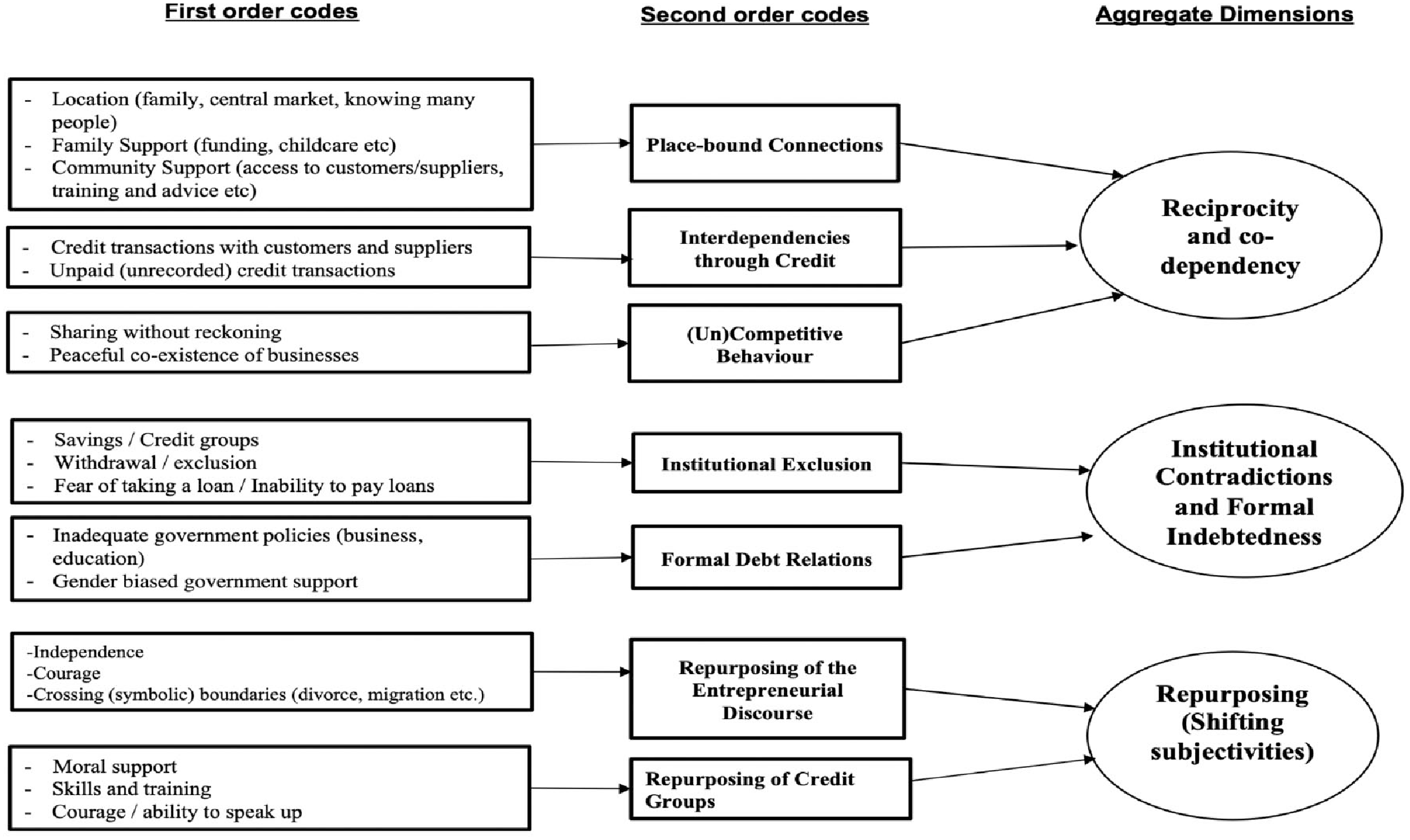
Coding Framework.
In the second stage, we thought of these codes in theoretical terms, seeking to uncover deeper structures behind them with the research team becoming what Gioia et al. (2013: 20) call ‘knowledgeable agents’, drawing on multiple levels of ideas (literature, data and codes, larger narrative) to inform our analysis, abstracting this initial array of codes to seven second order codes. We then re-evaluated our interviews with respect to each of these second order codes to discern how representational space was reflected in our study of informality. The first and second order codes were assessed by all authors of this article until agreement was reached to ensure the trustworthiness of our data (Gioia et al., 2013). In a final step, we moved to our aggregated dimensions – reciprocity and co-dependency, institutional contradictions and formal indebtedness and repurposing – that explained how women’s entrepreneurial experiences in the informal economy are geared towards the maintenance of attachments and connections in place despite the spatial contradictions they encounter. In the next section, we present our data along these three dimensions, engaging in ‘thick description’ by providing detail on the women, their web of family and social relationships and the context of their emotions and actions (Denzin, 1989). Thick description also supports transferability and analytical generalizability in qualitative research (Younas et al., 2023).
Findings: Attachments and connections
Next, we discuss how women in our sample build and maintain attachments and connections (bonds that characterize social relations in close-knit communities) that are underpinned by reciprocity, moral obligation and indebtedness. We show how different spatial practices of engaging in entrepreneurship are shaped by different aspects of lived experience (at the individual, family and community level) as well as formal debt relations and institutional exclusion (abstract space). We highlight women’s encounters, experiences and affective responses to what we described in our theoretical framework as spatial contradictions/tensions between, on the one hand, formal, economic logics and, on the other hand, gendered, socio-cultural and moral orders.
Reciprocity and co-dependency
Entrepreneurial activity and business formalization are often framed in the literature as equalizing discourses as women’s productive/socially reproductive activities are subsumed by capital’s abstraction tendencies (Roberts, 2015). However, our data show how the necessity of ‘survivalist entrepreneurialism’ and the limited and gendered choices it entails project women into contradictory business spaces whereby their quest to secure their family’s or their own well-being and rely on, and maintain, communal relationships faces several structural barriers. Across the three research regions in Nepal women were doing what many describe as activities based on the reproductive and domestic nature of women’s work and feminine gender-based stereotypes (Chant, 2014; Gupta et al., 2009). One-third of the businesses were home-based; many others were either close to home or located in sites marginal to markets and thoroughfares, with only very few being based in central market locations. The literature suggests that locating businesses in or nearby home locations is a deliberate decision, which provides women with flexibility to combine domestic and economic activities, indicating what some call the overlapped spaces of work and home (Ekinsmyth, 2011). This, however, has spatializing effects, propelling women towards the physical and commercial margins of business. Ratna, a tailor in Kathmandu making ‘dresses for ladies’, stated: Here the customers come at any time they prefer. I have to measure their clothes leaving my food. Even when the shop is closed they come to my room. But it is a benefit when I have the shop in my house. I can work in the morning and even late at night. My time is saved.
As with many respondents, Ratna presented her business location as a choice but like many other women their choices were temporally constrained in relation to other domestic duties, reducing business activities (adding, for example, ‘I am happy if only I can make one dress a day’) and a survivalist orientation (‘the income is sufficient to run the family expenses. It is good I can say’). Others, like Romila, a tailor from Pokhara, lamented the undesirability of these home, non-central locations, suggesting that: . . . if the shop were in the centre [the] business would flourish . . . but [we] are always thinking about family and kitchen while working . . . men don’t have to worry about these things. We face tensions with work, customers, and family.
This encroachment of business into private, household spaces is made possible through the self-exploitation of women’s bodies who combine income earning activities with social reproductive ones, often at a great toll on their health and well-being. Kusum, who runs a cafe in Kathmandu from her home stated: ‘I am so busy that I even have no time to eat. The work is really tiring. My health is not well nowadays.’ Galt (2013: 346) explains this type of self-exploitation as ‘underconsumption’ and ‘forgoing the basic needs of individuals in the family’ as a key reserve of resistance in avoiding abject poverty but also as alternative spaces in the competition with bigger, formal businesses. In these quasi-business/domestic spaces, women thus embrace differing and competing logics of survival and in the process forgo their own bodies and subjectivities.
Women’s activities were also framed communally on ideas of moral indebtedness, encompassing social attachments, trust and interdependencies, highlighted for example in spatial co-dependency within their various choices. Jyoti, when talking about the choice to locate her business, stated: ‘we are daughters of this place’, suggesting not only the strong symbolic significance of her choice but also its constraining effect. Mina, similarly, pointed towards the importance of communal relationships for business stating: ‘we know lots of people in this locality’. Many relied on family, neighbours and friends to act as their main business customers, offering support and encouragement, plugging gaps in childcare so that the women could attend training, providing connections to suppliers or sources of recommendation for expanding product or customer bases. Namrata, from Kathmandu stated: After deciding to start the shop, I met one sister called Bimala. Her children are abroad. That time she had been running a boutique for 25 years. She told me that if I start a boutique, she would support me. I knew her because we were neighbours when we were at Baneshwor. She gave me support in every step. She told me to distribute visiting cards to as many friends as I could so that many customers would know the boutique and come.
These strong connections also formed the basis of women’s credit relationships with customers/suppliers and shaped their views of competition. Credit transactions were often used to keep existing social networks tight as well as to bring in new custom and expand networks beyond immediate connections. This approach to business exhibits the distinctly temporal aspect of social practice in these spaces, slowing down the rate of business growth through trust-building rather than market opportunities, keeping women busy in the maintenance of these relations and embedding them (and others) in place. Lefebvre’s (1991) notion of social space emphasizes the locally grounded nature of time, rather than a universal or universalizing category, it is a ‘historical’ element underpinning the everyday lived world of social practices, logics and the symbolic production of space. Time is consummately one of the key resources women have that is exploitable, deeply contested but integral to sense of self-hood, ‘internalized’ within the body and through relations with others (Simonsen, 2005: 4). Kanika (Pokhara) talked about the expectations of credit among the customers in her shop, emphasizing the moral nature of exchange even when they were not buying items worth very much: The grocery items go in credit, even small amounts. It is based on trust. So many shops do that. When I ask for the money [the customers] get angry. We become bad in front of them. It is difficult in the business.
For many women, the daily routines of credit exchange symbolized much more than financial obligation but also a form of community obligation, to help others who had little money but also to keep trust in circulation even to the financial detriment of their businesses. While these credit interdependencies emerged as constitutive of longer-term attachments and belonging, they also increased business uncertainties, limiting capital resources to sustain or expand operations, particularly when customers either could not pay at all or could only pay erratically owing to their own precarious jobs and income. Ratna, a tailor from Kathmandu, indicated the complex nature of her responsibilities in business, stating: The relatives and old customers take on credit. I have no problem with credit transactions. I know all my customers. They also know me . . . I work so hard and when payment time comes the relatives don’t pay when they collect their items. I make plans to use the income but they are shattered when the customers don’t pay on time. When this happens, I regret that I started this business. At first, I wasn’t serious about business. A little income made me happy. But now my responsibility has increased. So, I worry about the money.
The profound impact of obligation is highlighted here by Ratna’s ambivalence towards her business, her readiness to sacrifice, to ‘work hard’ but to little financial advantage and undermining her ability to plan ahead, fixing her in time and space. Her responsibility here seems to be about occupying conflicting interfaces between different rationalities, where neither appears to offer much return – even Ratna’s relations exploit her position (Galt, 2013). But we suggest that Ratna’s efforts here, whether conscious or otherwise, challenge the homogenizing logics of business formalization whereby credit exchange reduces social relations to ones guided solely by profit, even if that cements her into precarious business space. Similarly, Prerna (Pokhara) discussed the complexity and tension of managing local needs through moral obligation, turning to formal credit with suppliers to manage her fragile situation: The customers are locals. They buy in cash also and on credit as well. Some customers pay at the last [day] of the month. No, there have been none who ran away without paying. There are customers who pay very late . . . In the six years of business, nobody has run away . . . Sometimes I am fed up when there are a lot of credits. My customers don’t give the money. But I have to pay the wholesalers. So, at that time there is a lot of tension. So, I tell the wholesaler that I have no money I will pay when I get it from the customers. I sometimes go to the customer’s house to ask for the money. They give a little amount. I go when they don’t turn up in the shop for a long time.
Within this complex system of interdependencies, some women described their obligation to remain with certain suppliers, even where it made more business sense to diversify. For Karuna, a long-term migrant to Kathmandu, creditworthiness as a formal indicator of reliability was more important to her. She stated: I meet many people in the clothing business. They want me to take their pieces. They offer me cheaper rates, but I don’t buy from other people, I buy only from that brother. I trust him a lot, he gives me credit also. Sometimes I don’t have money and I ask him if I can pay later. He agrees so I have built a strong relationship with him.
Generally, women in the sample had to balance the tensions between the material realities of making ends meet or even making a profit, and the moral expectations of what it meant to be a ‘good’ neighbour or citizen. Despite the scarcity and uncertainties that women talked about, they did not seek payment too quickly as credit was also perceived as a ‘delayed’ reciprocal expectation of customer loyalty, particularly in family and kinship contexts (Komter, 1996: 304). These practices of ‘sharing without reckoning’ – explained by Komter (1996: 302) as moral in character, non-competitive in market terms and self-exploitative – included other practices such as not recording credit transactions, relying instead on the good will of the customers to pay for their goods. Kiran, a tailor from Kathmandu, stated: They pay both in cash and credit. I know them and they also know me well. Many haven’t paid the credit amount. I don’t keep a record of the transactions in the business. Some buy the cloth and leave it here to stitch. Later they don’t turn up to take their [tailored] clothes . . . I am not able to control the credit transactions.
This was also evident in the ways some women placed more emphasis on conviviality rather than increased business competitiveness. Despite the density of businesses offering similar products/services, over a third of our sample described their situation as characterized by peaceful and harmonious coexistence of businesses, which did not ‘hamper’ each other, serving a different customer base, dependent on women’s connections. To compete for others’ business custom appeared morally inappropriate. Menuka from Biratnagar who ran a clothing shop states: When I opened my shop, there were no other shops in this area. But nowadays others have also opened clothing shops like mine . . . No, I don’t have any competitors as there are only two clothing shops in this area. But it is okay for me as I have more loyal customers than others. The market has become quite big. In this area, there are altogether 15 shops run by women entrepreneurs.
Many women even welcomed other businesses into their areas and saw their co-existence as a right. Perna, for example, stated: ‘Yes, there are many shops like mine but it’s ok, they should also earn and eat’; while Kavya (also in Pokhara) mentioned: ‘We can’t do business by being envious of others.’ Padma, a recent migrant to Pokhara, added: ‘We have to be satisfied with what we have. People run here and there, but there is no solution. I haven’t met anyone who is happy by earning money.’ Of course, such rights came with expectations of reciprocity, that other women would be prepared to self-exploit as a social practice, with the goal of resisting the impact of formal economic logics on self and community.
A small number of women, however, spoke about their business in terms of profit accumulation and competition. For them, increased competition was an advantage for business and the urbanization of remote areas, for example, was seen as contributing towards larger footfall and hence, more customers for everyone. These women ‘embraced’ the use of terms such as business experience, confidence and customer service in describing their businesses’ sustainability. Women talked about skills and business acumen (‘the clever ones get the customers’ (Grishma, Pokhara)), and the ability to stay ahead of market trends and maintain good customer relationships as crucial in ensuring customer loyalty. Karuna, a tailor from Kathmandu, illustrates this point well: The shop opposite opened a month after mine. When they did, I felt like my husband brought another wife. I was in fear at first, but later I heard many complaints about her . . . Many customers came to me showing her damaged work . . . Now her customers are all mine. There are no other shops like mine around this area. Newcomers can’t compete with me as I am more experienced now.
Many practices we described were not in keeping with running competitive businesses. Women, instead, placed emphasis on communal well-being and co-existence, reminiscent of what Scott (1976): vii highlights as ‘peasant conceptions of social justice, of rights and obligations’. However, these practices also made evident women’s self-exploitative practices and the vulnerabilities experienced in maintaining familial and community attachments and connections. Some women spoke about the material concerns of their business (i.e. profit accumulation, competition and sustainability) but for most, moral considerations provided a cultural script through which they made collective sense of their situations, challenging what Wilhoit (2017: 453) calls the ‘individualising effects of neoliberal subjectivities’, as well as any pressures towards formalization.
Institutional contradictions and formal indebtedness
Women’s embodied experiences of space were full of contradictions and frustrations. They were forced into spaces traditionally associated with normative male roles as ‘heads of households’ or ‘breadwinners’, occupying positions that denote exclusive masculinized spaces (Kaur, 2024: 244). However, their work was often seen to be of no interest to business development agencies or other institutions, which in some women’s words were unsupportive and inaccessible. Some felt that women’s businesses were spaces into which men in formal agencies would not come (Sarita, Kathmandu) or as Menuka, a migrant to Biratnagar running a clothes shop, explained: ‘The government is not able to help women entrepreneurs like us. There is no appropriate policy and loan facility. I do not know any people or organizations who can help me. I don’t believe in anybody.’ What is perceived as ‘appropriate’ here may nominally refer to women’s space but Menuka’s claim points also to the ideas and issues raised earlier, the way that formal policies or loan facilities are not apt to the spatial logics of women’s businesses. It is a view that echoes Lefebvre’s (1991) – critique of abstract, ‘represented’ space that overlooks lived realities and is thus devoid of meaning. Even where government support was accessible, women saw this to be implemented in ways that supported the established orders – men, the rich and the well connected – while further disadvantaging marginalized people like them. Latika from Biratnagar stated her frustration at the lack of government support and how this showed the ways that the poor and disadvantaged learned to accept their status – for example, by appreciating the relative but meagre benefits of informal work (cosmetics trade in her case) compared with the harsher alternatives of agricultural work: We feel the government could support us with some appropriate policies for us [women entrepreneurs]. People who have contacts in higher levels of government benefit from different programmes for women. If I had some contacts my business may have profited. But the business is fine. I don’t have to work in the field.
Many women, however, made use of various micro-credit facilities, in the eyes of which they are seen to be ‘rational economic women’, who can manage debt responsibly (Roberts, 2015: 115). Some deposited and withdrew small amounts of money from savings and credit cooperatives societies (SCCS), established as semi-formal or informal self-help groups or as community-based organizations where money lenders, traders, friends and relatives acted as informal sources of finance. Access to these loans was not necessarily linked to productive demands: more often, they were used for children’s education needs, other household demands or to pay for a sick relative’s treatment, as well as plugging the social welfare gaps of other local people in precarious positions, in lieu of formal institutional protections. Neeta in Kathmandu, who sold cosmetics from her house, showed how important but gendered debt facilities were for both business and household continuities: ‘I have asked for loans from many cooperatives. It is difficult to manage the business and family without any loan. I pay back the loan in one bank and again withdraw a loan from another.’ Others gave examples where differing types of formal and informal indebtedness intertwined with one another. Ratna, for example, a tailor from Kathmandu, talked about borrowing from family but then having to establish her credit worthiness with SCCS by repaying an initial loan before being able to borrow larger sums: The fund was provided by my father. He gave me twenty thousand rupees. I asked for a loan from a cooperative too. The amount was only four thousand rupees. I had asked for ten thousand, but they provided only four thousand rupees. After paying the loan. I have asked for a loan many times from the cooperative. I borrowed a loan of one lakh [one hundred thousand] rupees last year.
Along with several other women, Kopika, who produced sweets in Pokhara, similarly pointed towards the disciplining logics of more formal loans, where the norm of ‘regularity’ of savings and loans with credit organizations determined and legimitized ideas of the ‘good customer’. Women’s informal businesses were often unavoidably entangled with the formal through debt relations (Federici, 2014) that did not easily align with the unpredictability of their business realities. Most of these credit organizations relied on the gendered nature of women’s networks, appropriating ‘their system of social relations’ (Federici, 2014: 236) to encourage women to get together and create groups as a form of ‘community collateral’ (Harker et al., 2019: 278) or for internalizing the ‘policing’ or surveillance of debt (Federici, 2014: 239). These organizations often reproduced gendered, class and other social inequalities by excluding outsiders and regulating group admissions. Bandana, for example, talked about her struggles to access funding, where her status as a single (divorced) migrant influenced access to women’s credit groups. Having moved to Kathmandu following divorce, she relied on her family’s financial support to open a parlour but could not access subsequent funding to buy equipment. As she recounted: They didn’t trust me when I wanted to get involved in a group or asked for a loan from the cooperatives. They asked about my husband all the time . . . ‘Where is your husband?’ I always questioned them: ‘Why can’t a single woman get a loan?’ Later after I raised many issues, they accepted me in the group and gave me a loan.
Grishma (Pokhara), on the other hand, exposed the fragility of these relations and their marginalizing effects. She sustained her business (candle making) mainly through loans from women’s groups or purchases from people in her village. However, following her husband’s illness, her shop became the only source of income for her family and she fell behind with the loan repayments, which caused tensions with the other women in the credit group. Grishma’s inability to pay placed herself and others in the group in difficult situations, affecting her perceived trustworthiness and risking ostracization by other groups in the village as well as many friends and relatives: I have best friends, but all are rich. When I go to them they feel irritated. People don’t want me to go to their homes. They feel that I am going there to ask for a loan. So, I don’t go. I feel that I am poor, so everybody treats me as a beggar . . . Yes, some sisters and relatives are different. Before they used to visit me frequently. Now they are all distant. I don’t go to anyone’s house. I want to pay the loan . . . Own brothers and sisters distance themselves when we are in trouble. One brother helped me. He has also distanced himself now.
It is a powerful example of many women’s socio-economic vulnerabilities and the complexities of managing tensions between the everyday and the formal. Such efforts are not always successful, here leading her to self-estrangement, not only from her network but also from family. The shame of being treated like ‘a beggar’ exposes a deep shift from moral reciprocity to economic imbalance and it seems that the poverty she talks about in this excerpt is as much about her loss of attachments as it is about financial indebtedness. Her concern for restoring her dignity by repaying the loan and fulfilling the social obligations within her network shows how many women internalize their inability to manage these tensions as their own feckless, individual failure rather than an undermining of group solidarities or a result of changing logics of more formal reciprocities (Federici, 2014; Kalpana, 2008).
For many, intentions or efforts to expand or formalize their businesses were seen to be alien or distant from their everyday situations, something that might be considered if situations changed rather than processes that might bring about such improvements. The internalized inadequacy of women in the business world, from the inability to manage loans to their vulnerability when interacting with others when doing business, reinforce wider hegemonic socio-temporal ordering of masculinized and feminized spaces (Lefebvre, 1991), especially as many women viewed men to be more readily suited to function in the business world. Poonam, who runs a kitchenware shop in Pokhara, said: ‘There is a difference when women do business. We [women] feel fear while asking for a loan. We worry about repaying the loan. If the men do, we will be happy. We will have no worries.’
Here, it is accepted as the routine, everyday reality where women absorb fault and ‘perform’ the physical boundaries of what is permissible, acceptable or appropriate (Lefebvre, 1991). Women’s business choices, including orientations to business formalization, are often guided by spatio-cultural norms, which structure social practices, relations and collective strategies, in turn reproducing ideas of acceptability (Löw, 2006) but also offering some openings for challenging them, as we discuss in our next section.
Repurposing
The universalizing and ‘agendered’ discourse of entrepreneurship, prevalent in research and development policies, is normally associated with masculinized qualities of conquest and control over one’s life or new territories, freedom and prestige (Bruni et al., 2004: 407). Yet, it also gives rise to a ‘moral’ project in these women’s transformations, whereby they sought to appropriate and ‘repurpose’ this discourse as well as the formal spaces (e.g. women’s savings groups) created by its adoption into policy, according to their subjectivities and spatial logics, re-articulating them and challenging them as part of moral economies and community conceptions of dignity. As our data show, this was not done through organized processes of (collective) resistance but through rather spontaneous and emergent ones, often ambiguous or compromised, but yet serving to disrupt the hegemonic intention and meaning behind these spaces.
A number of women, who had physically and symbolically transversed highly gendered spaces as a result of rural–urban migration, international migration of their husband or divorce (e.g. becoming household heads as a result), did not accept the vulnerability or constraints they observed around them. Jyoti, who runs a clothing shop in Pokhara, talked about learning and gaining independence through her business while her husband was abroad for work. She relied on her family’s support with childcare and talked about her fears of running a shop and limited education and experience. She stated: At first I knew nothing. The only experience I had was buying clothes in the market. . . . It is a learning process. The more you spend time in business the more you learn. [You] become able to talk with many people. There is no fear, the network spreads . . . we become independent.
Other women also talked about the limited (business) opportunities they had as a result of lack of education. Sachita, a migrant to Pokhara from the small central municipality of Gorkha where she had looked after a farm and cattle that barely supported the family, left her village with only basic (primary) education – as is often characteristic of (but not exclusive to) women from ethnic or disadvantaged castes. Speaking from her small and unregistered grocery store next to her home, Sachita stated: It is difficult when one is not educated. They say an uneducated woman could also do the business [but] they don’t know about the profit and loss of the business. If I were educated, I would have kept many items in the shop and run the business well. The educated people say education is not important. If I were educated, I could have [a] wholesale shop.
Others talked about gaining a greater sense of freedom by moving away from the ‘confinement’ of the village – a place symbolically characterized by hardship and isolation, a place to be escaped. Dilasha had recently migrated to Pokhara from Sindhupalchowk, leaving the village because she did not want to get married and because she ran a tailor shop – a skill normally associated with low-caste groups with spatializing effects, in terms of where it is permissible to go and with whom one can associate. She talked about the oppressive views she had experienced, saying: I like this place very much. In Kathmandu, I can’t do tailoring because the rent is expensive but people in Kathmandu are not as helpful as here. In the village, I can’t do the tailoring as people criticize, they don’t like it. All the relatives and neighbours told [me] this is not a good profession, this work is of the Damai [tailor] caste. I think they are uneducated so they say things like that, so I have the business far from my village here.
Despite this, Dilasha still experienced various constraints on expanding her business; iterating her lack of education as well as the limitation on women of being unable to speak in formal spaces, she added: ‘I have in mind to extend the business. If I register, I have to go to different offices. I can’t speak properly. So I did not register.’ On the other hand, Sudha, who ran a kitchenware shop in Kathmandu, greatly depended on reciprocity to sustain her marginal business, in the form of credit to customers on low or erratic incomes as well as credit given to her in the form of toleration of rent arrears. She said: ‘They say though I am not educated I am doing a good business. They [family/community] are surprised by my courage.’ Lacking formal education and confidence, courage was an attribute normally associated with men, necessary to enable her to manage the liminal space between survival and failure and the uncertainties for women that lie beyond the traditional spaces of the home.
Many women were supported in these goals through the ‘repurposing’ of savings and credit groups, intended as formal spaces of normative control (Alfaro, 2021), to build their social capital, maintain reciprocity of relations and increase their confidence and skills to operate in traditionally masculine spaces. Some credited women’s groups for support with access to funding and customers. Chandra, for example, following her migration to Kathmandu, had been involved in several short-term businesses (tailoring, cosmetics, clothes, etc.) to make ends meet. She closed the clothes shop at great loss, pinpointing the large amount of unpaid credit transactions as the main reason. Currently running a food business that produced fresh roti (bread) with two other local women after attending together a food training workshop, she said of her women’s group: The sisters in my area and group suggested that I do this business for a living as we had already got the training about the business . . . We managed the loan for the business as a loan from our women group. I was in the group for more than a year. The women of the locality started this group. I got involved by asking for a loan and savings. So, it was not so difficult to manage the loan . . . The sisters in the group also buy from us. They recommend other people about our products.
Other women talked about these groups as intimate spaces where they could share their life experiences and increase their sense of self-confidence and self-value in view of their internalized feelings of inadequacy. Deepti (Biratnagar) talked about women’s groups as spaces of respite from her life struggles: I have struggled a lot in life. I talk about my job in any programmes I attend. I take the knitting materials with me. I knit when I sit in the programme. The people ask about my knitting skills and they place orders.
Rojisha, another tailor from Biratnagar emphasized her increased confidence: ‘I was worried that I would not be able to run the business. Now I have no fear. I am confident enough to go anywhere and train’, while Neelam (Pokhara) talked about her ability to speak in unfamiliar spaces: ‘The main thing is courage. We have to be able to speak. I can’t deliver a good speech, but I could speak where necessary’, something that resonated with other women who lacked education and skills. These examples expose the way in which gendered norms regulate spatial order, how that order in turn reinforces gendered norms, in terms of who has permission to speak and what happens when these norms are challenged. For women to speak in spaces hegemonized as male is courageous because, as Butler (1990: 164) argues, speech is to be understood as ‘a potent act, an assertion of sovereignty that simultaneously implies a relationship of equality with other speaking subjects’. In this way, the courage to speak can be seen to challenge the normative dimensions of space in the Nepal context, invoking agency, voicing alterity and revealing the dynamic nature of gender (Soja, 1998; Wrede, 2015). Responding to the demand to speak in unfamiliar contexts exposes the situated (day-to-day routines) and formal (normative representations) modes of space (Lefebvre, 1991), as well as the inequalities and power relations of women’s lived realities. Being able to speak can create spaces of resistance, challenging gender expectations and blurring normative boundaries, thus demonstrating the potential for agency in the face of spatio-cultural orthodoxies.
In this way, the formalization discourse and the savings and credit group spaces were repurposed from a ‘disciplining technology’ (Shakya and Rankin, 2008), intended to nurture the neo-liberal individual subject in pursuit of profit accumulation and business growth, to spaces of control, where shared conceptions of dignity, freedom and moral obligation might be restored. It is through this work that women do, often as a result of emotional and socially inflected processes, that ‘differential spaces’ (Lefebvre, 1991) can appear in the longer term.
Discussion
The aim of this article was to explore the everyday women’s entrepreneurial activities in Nepal as constitutive of formal and informal debates and contexts using Lefebvre’s (1991) theory of the social production of space. Lefebvre (1991) stresses that spaces are always in the making as a complex entanglement of different conceptualizations, understandings and encounters with space, formally defined and informally experienced. Through this approach, we saw women’s informal entrepreneurial activities as the outcome of an ongoing relationship between formalization, as an ordering enacted by the state through dominant representations of space, and the negotiation of this ordering enacted by women who make their living in the informal economy.
Our starting point for this article was that the form and nature of women’s business activities in developing country contexts are often characterized in empirical, conceptual and policy literature by their abstract, deficit and non-figurative dimensionality. These perspectives not only presume a flattened continuity between the formal and the informal; they also imply structural imperfection in the nature and form of informal spaces, articulated through a gendered discourse of development. It is a western-driven discourse that is long established in development strategies, imposing ideas about productive value and logic based upon conceptualizations of entrepreneurship that are historically embodied and spatialized in the ‘symbolic universe of the male’ (Bruni et al., 2004: 408). We aimed to problematize this reductionist view by shifting our gaze to the everyday as the site of both ‘conditions’ and ‘possibilities’ of one’s life, to consider the ways in which the abstract imperatives of development interact with everyday social practices (Lefebvre, 1991).
Based on interviews with 90 women entrepreneurs in three Nepalese regions, our findings highlighted three interrelated issues – reciprocity and co-dependency; institutional contradictions and formal indebtedness; and repurposing – all underlining women’s work on the maintenance of attachments and connections in place underpinned by economic, gendered, social and moral orders. This focus made visible the various everyday spatial practices, sites and experiences of women’s entrepreneurship and the ways through which they coped with risks and vulnerabilities (including through self-exploitation) and negotiated their positions and relations vis-a-vis the spatial contradictions they encountered. In Figure 2, we use Lefebvre’s trialectics to show the relationships between the different issues we highlighted in the Findings.
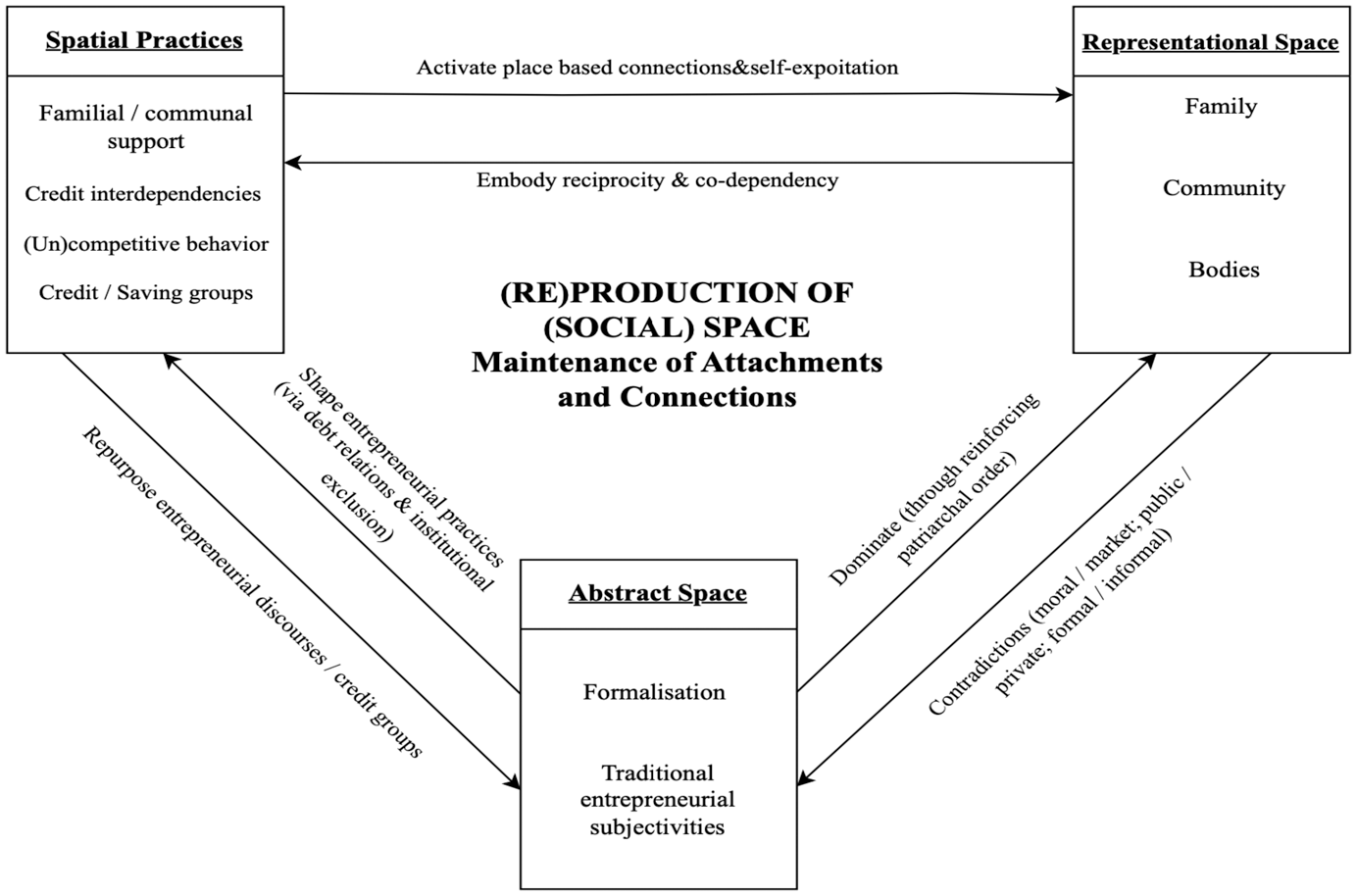
Maintenance of attachments and connections.
As such, we show that informal entrepreneurial spaces are shaped through two processes, depicted in the literature as intertwined (Alfaro, 2021; Wilson, 2016). First, by socio-cultural, moral and economic ordering at the micro level, based on patriarchy, ethnicity, community relations and production institutions. Second, by abstract representations of space, in ways that reproduce female subordination, exploiting what are seen to be feminine qualities, such as building long-term relations, community-mindedness and care-oriented work that are embedded in place (De Vita et al., 2014; Viswanathan et al., 2014). These findings expose insights that complement and add to current knowledge on formalization and (women) entrepreneurship in the informal economy and support us in ‘deepen(ing) our theorizing’ (Welter et al., 2019: 324) of the interplay between entrepreneurship and context.
First, our study contributes towards a spatial understanding of women’s informal spaces through emphasizing the generative power of entrepreneurial activities in the informal economy and the latter’s dynamism in continuously being configured and reshaped through the highly reciprocal and co-dependent nature of (women) entrepreneurs’ daily practices in sustaining household and community livelihoods. Our focus on the highly interdependent nature of women’s family and community relationships makes visible much overlooked activity in the informal economy in the form of emergent and adaptable spatial collaborations and practices that provide for everyday life challenges and vulnerabilities experienced by marginalized communities. These interdependencies were reflected in our data through women’s accounts about familial relationships or relationships negotiated by family on their behalf, local women’s groups through which different types of support were available or a largely localized customer and supplier base. Akin to Simone’s (2004) ‘people as infrastructure’ metaphor, this shows how people’s ‘everyday efforts enable what failed infrastructure cannot’ (Wilson, 2016: 248) but also how their relations become infrastructure when their actions, or their perceived fecklessness, are used for development purposes.
Most importantly, our data highlighted that the mechanism through which these household and community relational infrastructures emerge and sustain themselves is through women’s self-exploitative practices. Self-exploitation, as Galt (2013) suggests, is a transfer of value from these women’s work to their families’ well-being and community relationships. Yet, this maintenance of attachments and connections is also a double-edged sword as self-exploitation cuts into women’s social and economic well-being. The tensions between women’s work in fulfilling family and moral obligations, and maintaining dignity and justice, and those of formal economic expectations of running a business, expose women to several material and symbolic risks, emplacing them in vulnerable and paradoxical situations, which they are often ill-resourced but expected to address. In occupying such contradictory spaces, many women were impelled to forgo their own bodies and well-being but also risking their social position, reputation and family relations, by venturing into masculinized domains. In the context of the everyday, the exploitation of women’s vulnerabilities occurs by virtue of their gender-specific positions, roles and relations (Müller, 2019).
These findings reveal how the fragile infrastructure of reciprocity that we observe in our data ‘sets limits to growth and expansion of subsistence entrepreneurship efforts’ (Viswanathan et al., 2014: 223). Most importantly, however, these findings feed into feminist debates about a ‘crisis of care’ (Fraser, 2016), which emphasizes the finite nature and the stretch to a breaking point of women’s socially reproductive capacities, that sustain important social connections, upon which economies rely. The continued separation of productive and social reproductive work that has led to this crisis of care (Fraser, 2016) has important implications about formalization debates that continue to reproduce the same ideas about reproductive work having little human capital value and whose premise is replicated through the spatio-temporal assumptions, arrangements and regulatory institutions supporting work and economic opportunity (Bourne and Calás, 2013).
Second, our data exposed how the social and spatial relations that sustain women’s infrastructure of reciprocity are disrupted by debt relations, highlighting the entanglements of the lived and conceived spaces (Campbell, 2022; Federici, 2014). The insidious nature of this new debt economy represents a form of neo-colonialism that disciplines and alters social and gender relations, by privileging formal, legal debt over moral indebtedness (Federici, 2014). Some describe this as adverse incorporation, a form of socio-economic inclusion through formal policy instruments and development opportunities that ostensibly offer choice, opportunity or progress, but which instead generate ‘diverse forms of vulnerability and poverty among groups of poor workers’ (Phillips, 2011: 383) relative to wider, global power structures that reproduce those vulnerabilities (Hickey and du Toit, 2013; Sen, 2000; Wood, 1999). At the local level, what we observe here might be described in a more nuanced way as a kind of obverse incorporation, whereby women’s bodies, roles, positions and networks are transmogrified by the logics of debt relations and business formalization to varying effects, but which are challenged (e.g. through self-exploitation, repurposing, etc.) to varying degrees by local logics.
Debt emerges as a mechanism that regulates women’s business relations, on one hand making short-term survival possible but on the other ensuring the businesses remain marginal by subverting growth and creating co-dependency. Women experienced tension between the moral logic of reciprocity, employed in the credit transactions with customers and suppliers with the more individualized (and individuating) economic logic expected of them from the micro-credit institutions from which they borrowed small amounts of credit. The small nature of both forms of credit afforded to them served to maintain survival through combinations of ‘productive’ and ‘non-productive’ loans that, on one hand gave women just about enough credit to maintain day-to-day living but on the other, not enough to bring about change without first adopting the regularizing and disciplining logics of formality. Along with the cautious dispensing of credit facilities to women, the very language of ‘non-productive loans’, being those given to support women’s personal and domestic needs rather than business purposes, underlined an economic logic that invisibilizes women’s work while fixing them to places from where there is little chance of escape or progression to a more sustainable business.
Debt in developing country contexts has become suffused with credit in the form of micro-finance or micro-credit schemes, but without meaningful impact on poverty or empowerment (Bateman et al., 2018). Whether from quasi-formal micro-credit schemes or less formal local savings groups, the use of formal credit arrangements downplays the value of women’s day-to-day activities, disciplining the scope and scale of their business activities while still appropriating their intimate spaces. Unlike the moral logic underpinning reciprocal relations, formalized forms of credit disrupt women’s relations spatially and temporally: their relationships in turn become mechanisms of surveillance capitalism, appropriating local systems of reciprocity, morality and responsibility through formal or formalizing groups that monitor and discipline those who are on the inside of these groups, for example those who default or miss regular payments, as well as those on the outside, such as those who are marginalized owing to their caste or marriage status (Federici, 2014). Thus, the oft-perceived inherent problematics or deficits of feminized space are more the products of formalizing institutions and development technologies that aim to flatten and fetishize space, in the creation of abstract relations and entities with their own homogenizing logics (Alfaro, 2021; Lefebvre, 1991).
Third, our focus on the everyday forms, spaces and experiences of entrepreneurial activities in the informal economy seeks to act as a corrective towards other reductionist, dichotomous accounts of entrepreneurship, centring on formal–informal, necessity–opportunity, modern–traditional, which fail to reflect how entrepreneurship is differently encountered, experienced, understood and felt by those in conditions of marginalization and vulnerability, compounding and perpetuating knowledge systems that are often exclusionary (see also Baker and Welter, 2020; George et al., 2023; Sutter et al., 2019). The entrepreneurial narrative emerging in our data bears little resemblance to the neo-liberal individualized entrepreneurial subject, with its focus on profit accumulation, competitive behaviour and debt-fuelled growth. Instead, a ‘domesticated’ and more collective narrative emerges that incorporates emotional attachments, the articulation of dignity as well as the struggles for potential sources of power (Alfaro, 2021; Graeber, 2011; Lefebvre, 1991; Phillips, 1989). The type of entrepreneurship observed in our data is not, thus, simply an imperfect reproduction of an idealized view of entrepreneurship pushed by the formalization agenda. Rather, it is a product of different economic, socio-cultural and moral processes. Other studies have similarly suggested that ‘“market” values do not merely replace “traditional” values; rather, new regimes of value articulate with old ones, creating different opportunities and constraints for differently positioned social groups’ (Rankin, 2003: 126).
Women in our sample engaged with many behaviours that were not in keeping with traditional entrepreneurial subjectivities, such as uncompetitive forms of behaviours or not recording credit transactions, even if that means forgoing corporeal needs. They also internalized their inadequacies or failures as good entrepreneurs. Through abstract, western-centric representations, the literature has often accounted for these inadequacies and failings as the feckless, inherent problematics of women’s lower levels of human capital (Ahl and Marlow, 2021) but they are guided by the need to maintain attachments and connections and restore dignity in ways that are antithetical to growth through formalization. A spatial lens on the everyday accounts and experiences of women suggests that access to, or exclusion from, certain spaces, knowledge and education, as well as other types of formal institutional support, are distributed according to the norms and practices of those responsible for the production process itself (Colander and Woos, 1997). Greater focus on these everyday representational spaces of business activity suggests a different and highly resourceful reality. Women’s repurposing efforts to create intimate spaces where emotional attachments and connections and courage and confidence take primacy are what Korzenevica et al. (2022: 10) explain as an expression of ‘performative power, emerging in particular times, places and situations’, embodying what are deeply conflictual spaces for many women, ‘where marginality and resistance, suffering and claimed control, interpellation, and re-construction of own identities are simultaneously present’ (2022: 1).
Taken together, the insights from our study inspired by Lefebvre’s (1991) work point out the benefits of an approach to understanding informal entrepreneurial spaces that places emphasis on the everyday context of women’s choices and their entanglement with abstract, homogenizing market practices. Building on the scholarship of Alfaro (2021: 368) and others, our study adds currency to claims that Lefebvre’s work can act as a ‘feminist ally’ in knowledge production.
This has implications about how we can utilize insights about context on both conceptualizations of formalization and its potential benefits but also our understanding of how entrepreneurship is lived and experienced by women. Thus, our study supports the need to account for context specificities and the bodies that constitute them. The vibrant communal life depicted in our study points to the abundance and strengths of social relationships. Governmental agencies should work more closely with some of these grassroot organizations to build their capacities and support their work. While most formalization policies to date have focused on cost/benefit economic rationality, and hence have erased the ‘bodies of those traditionally associated with “non-rational” and “emotional” behaviour, which have historically included the poor, women and non-European “others”’ (Roberts, 2015: 112), we believe this needs to change if nurturing just and tailored formalization policies is the desired goal.
Conclusion
In this article, we sought to explore how women’s informal entrepreneurs in three regions of Nepal navigate economic, socio-spatial, gender and moral regimes and with what effects on their business choices and potential transitions to the formal economy. We drew on Lefebvre’s (1991) trialectic of space to go beyond representations of the informal economy in conceptual and policy literature as imperfect sites in need of formal development and considered the ways the everyday (private, intimate, household and community sites) is entangled with market transformations and global institutions (Alfaro, 2021; Palomera and Vetta, 2016; Wilson, 2016: 261). Through our methodological orientation, we sought to provide a ‘thick description’ of the context of women’s choices and experiences.
Our theoretical approach and analysis raised a number of wider concerns about the factors that produce and constrain women’s business activities and choices. As argued elsewhere, women’s small and informal businesses such as those in our sample are not a result of ‘women’s deficits’ (Marlow and Martinez Dy, 2018) easily fixed through training or finance. Instead, they are an expression of the economic logic of formalization that renders women’s work invisible and disrupts their spatio-cultural contexts (Kus, 2006). As such, we provide novel insights through our focus on the everyday, giving voice to the ‘other’ in entrepreneurship research (Baker and Welter, 2020) and challenging many of the taken-for-granted assumptions in the mainstream academic and policy literature.
Footnotes
Appendix
Representative quotes.

| AD 1: RECIPROCITY AND CO-DEPENDENCY | |
| SoC 1 | Place-bound connections – Women’s choices as family/community-based because of moral obligations and reciprocal relations in place. |
| FoC 1.1 | Location – Represents women’s choices to locate the business at home/near home locations in order to be able to take care of family or to receive support in turn. |
| At first, I worked in my house. People [relatives, friends and neighbours] who knew about my tailoring used to come here. Later we opened this tailoring shop in the main street of this area so that other people could also see our shop and come for our service. The decision was to increase my business. So my sister-in-law and I together started this shop. Sister-in-law sold cosmetics and I did tailoring. Like this, I could also teach tailoring to others. There is a difference between a closed room in my house and a shop. Now we think we can run the shop properly. We look like business partners, but the shop is separate. I do not have staff in my shop. As the workload is enough only for me, I can’t afford to hire staff. (Sagun, Biratnagar) |
|
| FoC 1.2 | Family support – Represents the diversity of forms of support offered by family to women starting businesses. This takes the form of advice, recommendations, funding, etc. |
| I take advice from my aunt frequently and even from sister and aunt. When I order goods and when I have to ask the money on credit I ask her. She taught me not to give more goods to those who have taken on credit a lot. We should remind and ask money also at the time of selling. This has helped a lot. (Prerna, Pokhara) |
|
| FoC 1.3 | Community support – Represents forms of support offered by community members. It ranges from advice and recommendations to community members acting as customers for the women’s businesses. |
| One day I saw my neighbour carrying sweets. I came to know that she was producing and selling sweets for a long time. I went to meet her and asked her to teach me the sweet-making process. I worked with her as an assistant for about eight months and learned different sweet-making processes with her. Later I told her that I want to start my own business. I opened this business three years ago. I call her my sister but she has helped me much more than my real sister. I am very much indebted to her. (Kopika, Pokhara) |
|
| SoC 2 | Interdependencies through credit – Prevalence of informal credit highlighting, moral obligation, marginalization in these communities and co-dependencies. |
| FoC 2.1 | Credit transactions with customers/suppliers – Captures forms of informal debt such as giving or receiving goods in credit. |
| The customers pay in cash and credit both. We can’t deny credit to our customers once we are in the business. We have to make them happy. Some customers haven’t turned up after they stitch on credit. They might sometimes forget. (Kavya, Pokhara) |
|
| FoC 2.2 | Unpaid/unrecorded credit transactions – Captures cases when women did not receive the money on the goods sold or cases when women were relying on the goodwill of customers/community members to pay (source of self-exploitation too). |
| Yes, my customers are mostly locals . . . They pay in cash and sometimes in credit as well. Some do not pay the credit. If I don’t sell on credit to the locals the business won’t run well. (Jyoti, Pokhara) |
|
| Another constraint is funds if we want to expand the business. Sometimes the money is not enough to buy the items in the shop. The problem of credit transactions is a problem. The customers sometimes run away without paying the amount. The customers pay for few initial days. After some time, they ask for credit and do not come again. (Rachane, Biratnagar) |
|
| SoC 3 | (Un)competitive behaviour – Most decisions women make when running their business are not driven by competitive market logics but moral obligation although they are intertwined. |
| FoC 3.1 | Sharing without reckoning – Represents decision making that is not in the best interest of business progression. |
| I have also helped others in the society. Some ask for some amount I give them. I have helped people in the society by cash and kind as well. (Sudha, Kathmandu) |
|
| FoC 3.2 | Peaceful co-existence of businesses – Represents views/behaviours that density of businesses, in what appear as highly saturated markets, is not a problem but a right. |
| There are other two more training centres in this area. I teach whole day daily. It depends upon the trainees. Some learn fast and some learn slowly. No, I don’t feel the new training centres will hamper my business. All should learn and it depends upon the skill. (Rekha, Pokhara) |
|
| AD2 | INSTITUTIONAL CONTRADICTIONS AND FORMAL INDEBTEDNESS |
| SoC 1 | Institutional exclusion – Government policies and support programmes work in ways that exclude women and re-enforce unequal gender relations. |
| FoC 1.1 | Inadequate government policies (business, education) – Inexistence of support or funding for entrepreneurial activities. |
| I have not received any support and facility. The government also don’t have any policy to support regarding the industry. So we are not able to do as we planned. Many times we try and our work is not done. Only time is wasted. And there is a hamper in the business. I will not ask anybody. I will do it myself. I need a vehicle for the delivery to increase the business. I will take training if I get. (Deepika, Biratnagar) |
|
| FoC 1.2 | Gender biased government support – Captures forms of government support that ignore the needs of various groups of women in the society. |
| I hear about support in programmes. They say to help women entrepreneurs. We are after that leaving our shop, but the time never comes. We only listen about the help but we are never near to the support. Maybe it is our lack of knowledge. (Romila, Pokhara) |
|
| SoC 2 | Formal debt relations – Formal debt as a prevalent feature of life and business, linked to the informal debt and affecting social relationships. |
| FoC 2.1 | Savings/Credit group membership – Captures instances in the data where women reported to be members of these organizations. |
| I am a member of Dulari Sundarpur cooperative bank. I am involved in the bank so that I can get a loan whenever I need. But I have not asked a loan till now. (Deepa, Biratnagar) |
|
| I have four machines. I managed the fund by asking a loan from an aunt from my village. It was at 24% interest rate. It was one lakh amount. It was not difficult to get the loan. She trusted me. I said I am going to start a tailor. She said okay and gave me a loan. I haven’t paid the loan. It has been just a month I started the business. The rent is 9000 rupees per month here. I did not go to the banks and cooperative banks. We have to be united in a group to join. I have to pay the interest every month. If the income is not good it will be difficult to pay the loan back. For a person, we can pay back the loan anytime we want. It is easier for us . . . I am a member of Muktinath and Mahila Bikas [women development] group. I save money there. They are located in my village. (Gunjan, Pokhara) | |
| FoC 2.2 | Withdrawal/Exclusion – Captures cases where formal debt re-enforced (gendered) norms and excluded women form participation in groups. |
| I wanted to be in a group, but I was not given a membership as I have no home here. He [husband] is from outside Kathmandu. They don’t trust people who don’t have their own house here. (Ashma, Kathmandu) |
|
| FoC 2.3 | Fear of taking a loan/Inability to pay a loan – Captures cases of women who talk about risk and vulnerabilities related to debt. |
| I was a member of a saving and credit group. It was difficult to continue as a member, so I left. I couldn’t pay the money due to bad business, so I left the group. Many members ran away without paying the loan. I had to pay their loan as I had guaranteed their loan. They cheated me about 50,000 rupees. The business also was not running well so I left that group. (Preti, Pokhara) |
|
| AC3 | REPURPOSING (SHIFTING SUBJECTIVITIES) |
| SoC 1 | Repurposing of the entrepreneurial discourse – Captures the symbolic meaning of entrepreneurship for women given the intricacies of their situations. |
| FoC 1.1 | Independence – Cases where women talk about achieving independence (often through bettering their financial status). |
| I knew knitting before. I had no job so I thought I had to something to earn money. I can train others also make them independent. The children also become happy when I earn. (Deepti, Biratnagar) |
|
| FoC 2.1 | Courage – Cases where women talk about the attitudes necessary to cope with the vulnerabilities of their situations. |
| I took training for a year in Tankisinwari. It was difficult to manage the time that time I had to look after both the shop and household work. I started parlour immediately after the training was over. It was risky to open the parlour so soon. But I started soon after completing the parlour. I had the courage to take any risk. I provided the parlour service and continued the training simultaneously. The course was year-long, but I requested to complete soon and finished in six months. (Latika, Biratnagar) |
|
| FoC 3.1 | Crossing boundaries – Cases where particular life circumstances pushed women towards embracing and persevering with entrepreneurial activities. |
| I had my kids studying in the village. I brought them to Kathmandu for their education. The boarding schools were all demolished by the Maoists. My husband had returned from abroad. We knew the money will finish soon. We had to do something for our living and to run the family. We had no one in contact who offered a job. We couldn’t labour in the hotel. So we decided to start the grocery shop. (Sita, Kathmandu) | |
| I was inspired to open the shop because I had no other option. My kids were small I had to earn my living after my husband’s death. My husband used to look after the wood business. My husband became ill. He was in bed for 17 years. So the business went in loss. After the death of my husband, I had to earn my living. I became like a bankrupt. There was a lot of loans. I had to educate my children though I was illiterate. I had the shop in the market area in a rented house. (Sumitra, Kathmandu) |
|
| SoC 2 | Repurposing of women’s groups – Cases where women use groups more than just about savings/loans but to fulfil their needs for skills/attitudes that are necessary in navigating ‘masculine’ spaces. |
| FoC 2.1 | Moral support – Captures cases when groups offer encouragement and moral support. |
| I am a volunteer in Women’s health. I am a member in Ama Samuha. I save monthly 500 rupees in the group. I save 500 rupees in the Neighborhood association also. I was involved in them to save money. I also talk about my business in meetings . . . I tell everyone in my group about my business. I have taught them then recipes for making the foods. (Binita Biratnagar) |
|
| FoC 2.2 | Skills/training – Captures cases when groups offer help with running the business. |
| We have a group of women entrepreneurs. They are engaged in tailoring, parlour, vegetable farm, etc. One organization selected the members by taking the interview. They also provide training about management and many more. There were many members having tailoring business. So we decided to make a group to help each other. We are four members. We discuss our problem and try to solve by each other’s help. (Ratna, Kathmandu) | |
| We have our own group called nursery group of 32 members. We had started with 11 members with the hope of some savings. I am also involved in Brihat Nepal and other two cooperatives. The cooperative banks charge 24% interest. We have to deposit 250 rupees every day, but I deposit 50 rupees every month. It is beneficial to join groups, so I have joined in groups. We can withdraw up to 20,000 rupees as loan for three months. I learned to be involved in such group from my mother and sister. I was involved in Ama Samuha [Mothers’ group] when I was in the village. We used to save five rupees per day. If we are honest, the involvement in groups and organizations are beneficial. (Latika, Biratnagar) |
|
| FoC 2.3 | Confidence/courage – Captures cases where groups help with ‘personal’ transformation and awareness of one’s position in the society. |
| Women are not able to do business because they lack confidence. They are not able to express themselves. The riches are always free. But the poor are never free . . . But because of the GEFONT [workers’ union], I am able to deliver a speech even in front of a large audience. Now I can speak to all. I have developed a lot of confidence. (Sunaina, Biratnagar) |
|
AD: aggregate dimension; SoC: second order code; FoC: first order code.
Acknowledgements
We are grateful to the research project team for their invaluable support with data collection in Nepal and Louise Frith for professionally editing the manuscript. We would also like to thank our Human Relations Associate Editor, Professor Mina Beigi and the three anonymous reviewers for their developmental recommendations and encouragement throughout the peer review process.
Funding
The authors disclosed receipt of the following financial support for the research, authorship and/or publication of this article: Private Enterprise Development in Low-Income Countries Scheme, Centre for Economic Policy Research and the Department for International Development, UK, Exploratory Grant 2533.
