



Abstract
The article examines the formal process of ‘ethical clearance’ for social science research at a large university and illuminates how it functions to undermine its stated purpose. We find that rather than promoting ethical standards, the bureaucratic process creates negative and cynical attitudes and game playing. For almost all participants, the entire procedure is counterproductive and experienced as absurd, creating a boomerang effect. The findings reveal how a specific rationalization effort leads to widespread experiences of irrationality, where detailed and strict organization merges with experiences of the bizarre. The article develops concepts capturing the experience and resulting organizational type: ‘orbizzarization’ and ‘absurdocracy’. These concepts enrich our understanding of toxic/irrational organizations, including Kafkaesque organizations.
Introduction
I was hearing all these horror stories. (P6) If they’re an ethical researcher, then they do it on their own. But this is what we do here, we put in ethics forms. (P14)
Ethics is an important topic that generates much interest – both in academia and in organizations. For organizations, a key concern is avoiding obvious ethical problems that harm legitimacy and trigger negative responses from media and interest groups. At the same time, organizations often try to minimize engagement with ethical issues, as these can impose constraints on action and absorb time and energy otherwise spent on instrumental and productive activities (Jackall, 1988). Ethics is often reduced to following guidelines and norms to avoid sanctions (Jackall, 1988; Kärreman and Alvesson, 2010). Guidelines become something to be ‘ticked off’, and a decoupling occurs between formal ethics – having mainly ceremonial significance – and actual practices (Maclean et al., 2015).
At universities, regulation of research ethics has increased significantly in recent years, especially in the social sciences (e.g. Boden et al., 2009; Caeymaex et al., 2023; Carr, 2015; Hammersley, 2009). In this phenomenon-driven article, we explore ethics regulation in universities and how academics understand and relate to this. We focus on organizational procedures formally – but not necessarily substantively – aiming to ensure ethical research. As this concerns policies and procedures more than what, given perspectives and definitions, may be seen as ethical, the study is more about organizational rules and regulations than ethics or ethical behaviour per se. The research question is: what is the meaning and significance, from the point of view of people involved, of ethical clearance (EC) procedures in a university?
To answer this question, we undertake a detailed case study of meanings and experiences of EC procedures for research projects in social science at a leading university. Our analysis reveals a phenomenon where organizations may set out to solve certain problems but ultimately induce the opposite, undermining credibility in the problem-solving structure and creating additional issues. The entire EC arrangement appears as an expression of a bizarre organization, with some similarities to Kafkaesque organization (Clegg et al., 2016; Hodson et al., 2013a, 2013b; McCabe, 2014). We note certain problems with vague and diverse use of Kafkaesque organization and suggest two new concepts capturing how detailed and strict organization merges with experiences of the bizarre: specifically, orbizzarization of parts of the organization, which sometimes leads to an absurdocracy. Orbizzarization refers to the backfiring of seemingly rational structures and procedures leading to experiences of these as bizarre. When such experiences are viewed as having more than a partial and modest impact, instead affecting the overall view of the organization, one can talk about the absurdocracy as a specific, dysfunctional, organizational form. We argue that with sufficient ‘spill-over’ from specific structures or procedures – like the EC structure described here – or accumulation of a number of these, the organization is characterized as more than marginally absurd by a large number of employees and becomes an absurdocracy. Orbizzarization and absurdocracy offer a novel process and organizational category to complement more conventional ways of theorizing organizations. In particular, these concepts enable greater differentiation and nuance in our explanations of organizations’ irrational and dystrophic features. Our findings also have relevance to the literature on ethical regulation, revealing how strict and highly structured EC clashes with social science researchers’ ethical ideals. This clash triggers a cynical and mistrustful mindset towards not only the formal EC process, but also the university itself.
We proceed by first reviewing the literature on formal ethics, bureaucracy and Kafkaesque organizations. We then clarify the research design, a case study involving insider research enabling exceptional access yet also requiring high reflexivity. Finally, we present the case, the concepts of orbizzarization and absurdocracy, and outline theoretical implications.
The bureaucratization of research ethics
Research ethics generally relate to obtaining informed consent, avoiding harm, maintaining privacy and confidentiality, and avoiding deception in research (Flick, 2022; Jeanes, 2017), while organizational ethics policies, EC procedures, ethics committees and institutional review boards represent formal efforts to manage research ethics (Haggerty, 2004; Lincoln, 2005). Typically, formal policies and practices are underpinned by national ethics frameworks (e.g. European Commission, 2021; National Health and Medical Research Council (NHMRC), 2018; UKRI, 2023; US Department of Health and Human Services (USHHS), 2023).
In the case we report, participants assert that EC is less about ethical awareness and reflection than it is about bureaucracy and compliance, to the extent it reflects aspects of Kafkaesque organization (Clegg et al., 2016; McCabe, 2014). We thus refer to a minor degree to work on formal ethics and relate more to work on bureaucracy and the Kafkaesque.
On ethics
Ethics is a complicated and ambiguous topic, given the wealth of interest in, perspectives on and criteria for ethics (Christians, 2005; Hammersley, 2009). There is a body of studies addressing the impact of organizational processes on ethical judgement (e.g. Paine, 1994; Watson, 1994, 1998). Perhaps best known is Jackall’s (1988) study of the ‘moral mazes’ of managerial work, which illuminates managers’ ‘ethics-in-use’ in large bureaucracies. Jackall finds that people largely avoid rather than address ethical issues, with morality in the corporation shaped not so much by abstract ethical principles but rather by ‘what the guy above you wants from you’. People tend to comply with what their managers want. Meanwhile, those following official ethics run into trouble. In the corporation, political interests and cultural understandings rule, while formal policy and process play a limited role.
Other researchers focus on formal structures for ensuring ethical practice in organizations. For example, Weaver et al. (1999), taking the business ethics approach to its logical conclusion, argue that ‘formal ethics programs’ are managerial control systems; that is, a way of managing the workforce, no more, no less. Numerous studies corroborate this notion (e.g. Adelstein and Clegg, 2016; Boden et al., 2009). In a study of media organizations, Kärreman and Alvesson (2010) coined the term ethical closure and identified various versions of it. Ethical closure means that ethics is restricted to a narrow set of concerns and ethical reflection beyond this avoided or minimized. For example, processes of sealing typically restrict ethical judgement to a narrow set of formally defined issues – thereby eclipsing others – and ethical ‘reflection’ is guided, or rather confined, by elaborate systems of rules. Ethics can thus be ticked off and reduced to rule following.
Some see ethics in social science as quite different to that which can be formally controlled. Indeed, ethical regulation can be alien to how researchers experience ethics in practice, with the ambiguities and idiosyncrasies of different settings, and the importance of a researcher’s personal morality and situated judgement coming to the fore (Cunliffe and Ivaldi, 2021; Hammersley and Traianou, 2011; Jeanes, 2017). In practice, weighing the risks and benefits of social research is often relative rather than absolute and clear (Flick, 2022). Several researchers advocate equal, reciprocal, respectful interaction with research participants, an awareness of people’s vulnerabilities (e.g. in interviews) and readiness to deal with upcoming emotions (Gabriel, 2018; Rhodes and Carlsen, 2018). This, of course, becomes rather vague, but being specific and rule-focused risks missing vital situation-specific nuances of ethics. Accordingly, the entire topic, at least in social science, becomes caught between strict and counterproductive rules, and vague, positive sounding ideals.
It is also clear that it is difficult to ‘get it right’. There is much critique of dominant (i.e. bureaucratic) ways of managing research ethics in the social sciences in the USA and other countries (Carr, 2015; Hammersley, 2009). Although some express a cautiously positive view of formal ethics procedures and ethics committees (e.g. Wilson and Johnson, 2022), others argue there is excess scrutiny and regulation, with committees seen to be engaged in extensive re-reviews and denial of research proposals, and as not always amenable to qualitative designs (Christians, 2005; Lincoln, 2005; Traianou, 2020). Some worry that the bureaucratic regulation of ethics risks the purpose of research – that is, the pursuit of knowledge – being sacrificed to moralism, either by ‘treating values external to task of research as if they were central to it’ or by imposing such constraints that performing some kinds of research becomes very challenging or impossible (Hammersley and Traianou, 2011: 379). Hammersley (2009: 218) argues that EC in social science – given the low level of ‘ethical risks’ involved and ethics committees’ dubious claims to superior ethical authority – is ‘an illegitimate attempt to legislate morality’ that bureaucratizes research and restricts academic freedom.
On bureaucracy and Kafkaesque organizations
In this article, ‘bureaucracy’ is not intended to imply everyday connotations of sluggishness, complications and inefficiency, but instead represents formal rules, procedures and standards, as defined by Weber (1921). At least to a point, this is typically part of a rational organization, facilitating predictability, reliability and efficiency (Monteiro and Adler, 2022). Mintzberg’s (1983) concepts of machine and professional bureaucracy capture these more positive or neutral meanings. The former refers to mass production through standards and routines enabling efficiency (e.g. McDonald’s and airlines). Professional bureaucracy refers to working through standardized professional competence, leading to predictable use of expert knowledge (e.g. most medical work). Well-functioning bureaucracy is achieved by clear hierarchies, regulatory structures, enabling procedures and coherent frameworks shaped by those in charge of the work performed (Adler and Borys, 1996). Bureaucracy can counter arbitrariness, nepotism and poor judgement, and represents some degree of quality and rationality in organizations. However, drawbacks include inflexibility, over-emphasis on standardized solutions, constraints on creativity, and monotonous and sometimes dehumanizing work (Courpasson and Clegg, 2006; Monteiro and Adler, 2022).
Many scholars warn against the danger of entrapment within an ‘iron cage’ of bureaucratic regulation (Weber, 1921). Early on, Merton (1940) argued that daily life in a bureaucracy may inculcate in employees a ‘bureaucratic personality’ manifesting as strict devotion to formal rules. Rules are transformed into absolutes (rather than a means to an end), with this goal-displacement driving rigidity and inefficiency. In their analysis of the ‘stupidity paradox’, Alvesson and Spicer (2016) provide a contemporary version of this concern, highlighting pervasive ‘functional stupidity’ in modern organizations. They observe this in the inclination to reduce one’s scope of thinking, to focus narrowly on the technical aspects of the job and follow procedure. Functional stupidity is present when managers and employees are encouraged to ‘do the job correctly, but without reflecting on the purpose or the wider context’. ‘Doing things right’ is privileged over ‘doing sensible things’. Functional stupidity thus represents ‘an organized attempt to stop people from thinking seriously about what they do at work’ (Buchanan and Badham, 2020: 103).
Rigid and stifling bureaucracy may lead to ‘Kafkaesque’ organizations. The adjective ‘Kafkaesque’ derives from Franz Kafka’s literary portraits of bureaucracy, and in everyday parlance describes the negative experience of dysfunctional organizations (e.g. finding this bizarre, illogical, frustrating, oppressive, etc.). Kafkaesque is often used to study ‘corrupted’ bureaucracy; for instance, contrasting ‘Kafkaesque’ bureaucracy with the more ideal ‘Weberian’ form (Clegg et al., 2016; Hodson et al., 2013b; Ossewaarde, 2019; Warner, 2007). This work focuses on the informal underbelly of bureaucracy, drawing attention to its ‘darker’ dysfunctions and maladies (Warner, 2007). Hodson et al. (2013a: 257), for example, argue that rule-breaking is a normal and inevitable feature of bureaucracy, and with formal rules and regulations frequently functioning as legitimating ‘façades to cover actual operations’. They elaborate what they see as Kafkaesque features of bureaucracies – divergent goals, chaos, rampant patrimonialism and ‘unwritten’ rules – that increase pressures towards organizational misbehaviour (e.g. deceit, duplicity, bad faith and unaccountability). Clegg et al. (2016: 158) likewise point to the perils of unchecked power and unaccountability in Kafkaesque organizations, showing how practices of meaninglessness, managed inaction and taught helplessness trap people in ‘vicious circles’ of formal rules they can ‘neither understand nor escape’. McCabe (2014) documents the negative experience of being part of a Kafkaesque organization. The organization, a bank, exhibited excessive control, leading to disciplinary measures both vertically and horizontally, that also targeted management. McCabe (2014) draws on Kafka to emphasize that the ‘dark’ side of organizations is the norm rather than an aberration, showing that subordinates exercise power over managers, and that managers are controlled and sometimes powerless. Finally, Ossewaarde (2019) conceptualizes organizational change not as rational restructuring but as Kafkaesque metamorphosis. Here, ‘the remnants of old myths, old desires, tribe-like organizational forms and primitive uses of technology continue to operate in distorting, disorienting sexually perverse ways’, leading to organizations experienced as incomprehensible, lawless and anxiety-inducing (Ossewaarde, 2019: 1000).
The literature thus refers to the ‘Kafkaesque’ in variety of inconsistent, and even contradictory, ways. For some, it refers to organizations experienced as clearly oppressive and alienating, typically involving hard regimes, coercive control, abuse of power and fear (Hodson et al., 2013b; McCabe, 2014). For others, ‘Kafkaesque’ incorporates rather different aspects such as vagueness, unwritten rules and threats. For example, Clegg et al. (2016: 158) refer to Kafkaesque as ‘characterized by a dark enigmatic shadow cast such that nothing is ever what it seems to be yet what it might actually be is never revealed’. References to organization as impossible to understand, as imbued with covert menace and deception are quite different from overtly oppressive bureaucratic structures. In all, we can distinguish several major themes in the Kafkaesque literature. One is unchecked power. Another is divergent goals and chaos. A third is what is unwritten, what is not revealed. A fourth is fear, uncertainty, helplessness and anxiety. A fifth is deception. A sixth is the primitive: old myths, desires, tribe-like patterns. These themes can to some extent be combined, but they also refer to distinct characteristics that go in different directions. Much of what is referred to is rather the opposite to than a specific version of bureaucracy. There is a tendency to refer to Kafkaesque as a catch all for negative features of organizations, suggesting scope for differentiation in how organizations are ‘Kafkaesque’ or otherwise dysfunctional, and an opportunity, perhaps, to suggest new concepts.
The study
The research context is higher education, specifically a business school in a highly ranked Anglo-Saxon university (hereafter CU), where faculty experienced a high level of managerialism. Briefly, managerialism is a means of organizing and controlling professional work relying on bureaucracy, metrics and standardization, and in recent years has become prevalent in many universities (e.g. Barry et al., 2001; Clarke and Knights, 2015; Martin, 2016). Study participants made (very) extensive reference to EC when describing their experiences of managerialism.
We examine EC closely owing to the prevalence of its reference, as well as its other empirically interesting qualities. Notably, while the need to obtain EC in human and animal medical research is uncontroversial, as is the case with social science research on vulnerable groups on sensitive issues, business research is a domain where rules and procedures are not so obvious, and experiences and reasoning are more ‘open’ to variation and contestation. Second, we noticed an exceptionally high level of research ethics rules, regulations and procedures at CU. This was supported by the plethora of complaints from faculty about over-regulation of research ethics. While CU may seem an extreme case, with its comparatively strong emphasis on bureaucratic ethics regulation, it was hoped this would illuminate the underlying meanings, processes and logics involved. Exceptional access possibilities also made EC at CU a good candidate for a case.
Overall, our study reflects a reflexive case design (Alvesson et al., 2022) that emerged gradually as a surprise in the field – that is, an unexpectedly high level of unprompted discussion of EC, which motivated a focus on EC. Underpinning the design is a broadly critical interpretive orientation, which acknowledges the socially constructed nature of EC, that is, representations and meanings of people involved. The focus is on those obliged to do EC and, abstracting from subjective meanings, the meaning of the EC ‘itself’, as interpreted by us.
Data collection
Data collection involved a form of ‘insider research’ (Knights and Clarke, 2014), consisting of semi-structured interviews with CU faculty and observation of the EC process. While our insider status as members of the business research community facilitated excellent access to the research setting, extra reflexivity was required to ensure defamiliarization and sufficient distance from the focal phenomenon, as well as to prevent over-identifying with participants (Brannick and Coghlan, 2007; Vickers, 2019).
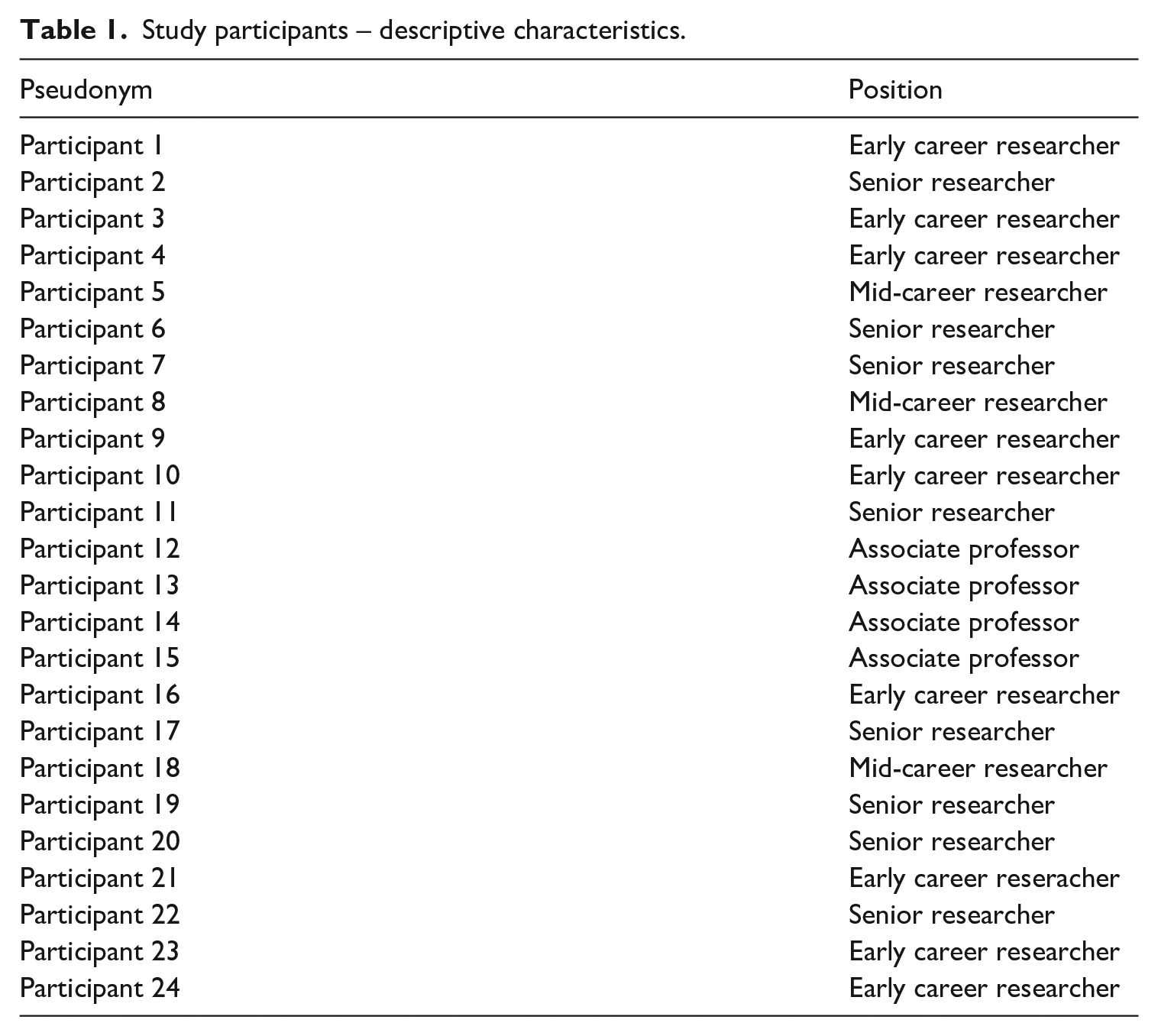
Over six months, we conducted 24 semi-structured interviews with faculty, utilizing purposive sampling that maximized variation in participant characteristics including gender, role, career stage, employment relationship (tenured vs untenured), discipline (e.g. participants were drawn from strategy, management, information systems, marketing and finance) and research interest (see Table 1). Two of the interviewees were also members of the EC review committee. While we do not claim ‘representativeness’ in a positivist sense, the fairly consistent and homogenous views of the majority of those interviewed and observed offer a strong ground for our empirical conclusions. Briefly, interviews included questions on: (1) participants’ background and research experience; (2) how they engaged with the formal EC process at CU; and (3) their views on the outcomes of the EC process. As academics interviewing academics, we were aware that we ‘comprised a specific audience for whom our participants authored particular narratives’ (Knights and Clarke, 2014: 343). For example, our participants, generally frustrated by EC and other processes they identified as managerialist, may have viewed the interviews as a means of political action to generate reform. We do not think interviewees provided misleading accounts, and the interviews were broadly aligned with talk we overheard while present in the organization, but interviewees may have exaggerated problems and cherry-picked illustrations. We are aware of this and comment on this issue later. Interviews lasted from 60 to 90 minutes and were transcribed verbatim.
Study participants – descriptive characteristics.
Finally, we noted people’s everyday talk about EC (e.g. discussion of EC during department meetings, informal advice and coffee chats). We also reflected on our own experiences of completing EC applications (including the application for the present research) in broadly similar organizations. We collected relevant documents, including formal EC policies; the online forms for EC submission; and guidance and educational materials for completing EC. The observations and documents were utilized in a supplementary fashion to both corroborate and challenge interview insights (e.g. looking for alignment/disjuncture between what was stated and what was observed). The overall picture was, to our surprise, one of consistency and alignment (we will address minor variations later). Based on our experiences, we expected more variation and inconsistency.
Analysis and interpretation
We adopted a hermeneutic approach to unpack the meaning and consequences of EC. A hermeneutic approach is distinguished by a search for (underlying) meaning, by seeing empirical material as clues or indicators of a phenomenon. This calls for assessment of the empirical material, some source critique (are sources reliable?), the active role of the researcher(s) and active interpretation – not data management minimizing the researcher’s role (Alvesson and Sköldberg, 2017; Mees-Buss et al., 2022). Although a rigid coding process is one path to rigour (e.g. Gioia et al., 2013), rigour also comes from researchers’ engagement in a deliberate reasoning process that infers theoretical claims from the empirical material (Harley and Cornelissen, 2022). In some cases, including this one, structured coding risks a context-insensitive and ‘chopped up’ way of relating to empirical material (Alvesson and Jonsson, 2022: 732). Additionally, a hermeneutic approach, which emphasizes ‘a skeptical attitude’ in interpretation (Mees-Buss et al., 2022: 420), aids reflexivity during insider research.
Analysis commenced with a deliberately open questioning of the data as to EC’s purpose(s), activities and meanings. First order analysis revealed a range of attitudes towards EC, ranging from a few neutral or moderate to most being negative and cynical and, in some instances, strongly critical. We checked participants’ accounts of how they approached and responded to EC against each other and our EC observations, paying attention to contradictions and differences, while also looking for patterns across sources. Through this, we identified three key phases of EC – preparation, assessment and monitoring – and clarified common strategies, approaches and experiences of these.
Next, we explored what second order meanings of EC were reflected or implicit in participants’ accounts. Our main goal here was to take the EC phenomenon seriously and generate what Sandberg and Alvesson (2021) call ‘comprehending’ theory: that is, to not only provide an account of how people make sense of a phenomenon and themselves in relation to it, but also to move beyond this to point at some unrecognized key aspects or qualities. Accomplishing this required considering a variety of possible EC meanings in an open and (self-) critical way, with this facilitated by probing questions that aided defamiliarization and challenged our pre-understandings of EC. For example, was EC about ensuring ethical standards and protecting research participants, or something else? Is there a link between EC bureaucracy and ethical research practice? Does the former lead to the latter? Or are there other relationships and meanings (unintentionally) produced? What were the consequences – both obvious and more subtle – of the different ways of experiencing and understanding EC? Critical in addressing these questions reflexively was deploying an interpretive repertoire broad enough to read the empirical material in a variety of ways. As noted, this included formal ethics, bureaucracy, Kafkaesque organizations and other critical literatures addressing domination and irrationality, perspectives that arose abductively (Klag and Langley, 2013) during analysis, that is, through considerations of pre-understanding, theory (literature) and, above all, the empirical material, mobilized in a critical dialogue. Through working iteratively with these questions, perspectives and ‘text chunks’ representing participants’ different ways of conceiving and relating to EC, five different meanings of EC emerged: (1) EC as an absurd process generating high costs, frustration and emotional drain; (2) EC as undermining key professional values and resources; (3) EC as a symbol of organizational mismanagement; (4) EC as part of a larger, repressive regime; and (5) EC as meaningless. Most interviews broadly pointed towards these meanings, although with different emphases. We illustrate these five meanings by including empirical materials to some length, focusing on the thoroughness of interpretation and contrastive reasoning to establish their plausibility (Dyer and Wilkins, 1991; Harley and Cornelissen, 2022). Text space is thus dedicated to showing data rather than detailing data management practices (Alvesson and Jonsson, 2022).
Findings
We first convey participants’ perceptions and experience of the EC process, before elaborating the five shared meanings of EC.
What is the purpose and relevance of EC at CU?
The majority of interviewees in our case are sympathetic to the espoused purpose of EC – the protection of research participants – and acknowledge that research can involve ethical problems and dilemmas. As P8 notes, ‘I understand why you need ethics.’ Yet, most participants also observe that EC’s purpose is dual: it is not just or mainly about protecting participants, but also risk management and legal protection of the university: There are really two different functions. One is the protection of participants, the ethics, is this proper? The other is the legal side of things, the risk management stuff. Traditionally, in universities around the world, these are often treated as separate entities, separate processes. It seems like at CU that these processes are starting to come together. (P14)
Here, P14 indicates a contamination effect: legality and risk management invade ethics. Still, most participants accept that senior management has some risk management responsibility, albeit that both this and ethical concerns should be addressed ‘in thoughtful ways that minimize the impact on the everyday nature of work’ (P12). Whether this is the case is open, as many participants also assert that the demands of EC are disproportionate to the risks posed in most areas of business research: I don’t want to discount the importance of ethical clearance, I think it is very important. But I think it’s also a lot more important in more clinical areas versus areas where we go and talk to a company and interview them. (P19)
Next, we explore EC demands during preparation, assessment and monitoring.
EC preparation
At CU, almost any collection of data – even publicly available information and secondary data – requires EC. While some participants recognize that EC can help them to consider ethical issues prior to entering the field, and that ‘we all respect the whole process, that it has to have assessments and things’ (P6), almost every participant describes the application process, and especially the forms, as excessive: Have you seen our ethics form? It is so over the top. (P4) It’s ridiculous. We went through one at the end of last year, I almost died. I’m pretty sure it was 70 pages, everything up. (P20) I think it’s overkill, it’s absolutely overkill. If I were doing a survey I’d expect that I had to do ethical clearance, but I’m using public data. And the price data stuff, I don’t understand. I can go onto the [stock exchange] website and have daily prices and how that has any ethical implications at all, I’ve no idea. (P23)
Frustrations with the forms arise owing to duplication of content and forced responses to issues perceived as irrelevant to their specific project: There were two places where you had to put everything in and some of them were the same question asked slightly different so you couldn’t just copy and paste the same answer, you had to write two different answers for it. (P20) I was doing a project, an international project, looking at government treasuries and I had to go and read the [indigenous] policy, which . . . was totally irrelevant to my research [involving international government treasuries], but I had to have this whole thing in there about how I was going to deal with this issue. (P15)
The main response to the demands of the EC application is to minimize engagement with it, ‘to treat it as a kind of game’ with the objective of ‘getting through it in the most efficient and quick way possible’ (Field notes, talk with faculty). Different tactics are used to do this.
First, researchers try to avoid submitting applications for new projects by extending existing EC approvals, or by seeking EC through a collaborator’s university (if this is seen as less onerous). Second, as a new submission is usually unavoidable, researchers save time and effort by turning to their colleagues ‘to cannibalize parts of’ (P18), or recycle, their forms: ‘Yeah, of course I looked at other people’s forms, I mean that’s a recycling process, everyone does that which defeats the purpose of having an ethics form probably’ (P8). Another common tactic is to carefully select the words to describe a project in order to avoid extra work or having to answer too many questions. A key consideration is ‘what are the trigger words that I can avoid, that stop all these drop-down boxes coming through?’ (P22). Participants also draft applications with the review committee in mind: generally, using language that is broad and vague is claimed to result in fewer questions from the committee as the clearer and more specific one is ‘the more questions get raised’ (P6). Here, we find people responding to the EC forms in ways quite different to ‘full ethics’, involving avoiding EC, copying others, tactical formulations and being as broad and vague as possible.
EC assessment
Assessment involves committee review either at the faculty level (low-risk projects) or centrally (high-risk projects). Our participants provided insight into EC assessment both as applicants and assessors (as some participants sat on the EC committees).
The view from the researchers’ side
Some participants acknowledge that EC committees have a role to play: ‘Look, I do think that it’s important to have ethics committees and I think it holds people to a certain level’ (P12). Even so, many participants characterize the ethics committees as prone to pedantry and micromanagement, expressing frustration at requests for revisions (which leads to delays) for issues seen as trivial (e.g. spelling mistakes), irrelevant to the specific project (e.g. how will the research impact pregnant women?) or beyond the scope of the committee (e.g. is a survey really the right method?): One of my colleagues was looking at the use of Harvard case studies by faculty in this school and his ethical clearance got knocked back because how was his research going to impact on pregnant women? ‘You need to rewrite this section because you haven’t addressed how you’re going to deal with pregnant women.’ (P15)
The interviewee finds this ridiculous. The committees have a reputation for requiring time and energy to be spent on revisions over issues seen not only as harmless and unnecessary, but even bizarre and illegitimate. A picture emerges of EC as an obstructive and constraining force – ‘people feel like it’s a hurdle that doesn’t necessarily add value’ (P14) – rather than a helpful filter securing ethical standards. When queried if EC assessment helped them better deal with ethical issues, a typical sentiment was: Interviewer: Did you feel that you got feedback through this process to help you better understand how to deal with these things [i.e. ethical issues]? P8: I got information about how to fill out the form, which ensured the form got past.
P8, like others in our sample, indicates a disconnect between formal EC and ethics practice.
The view from the committee’s side
While our sample contained a small number of committee members, and insights here are more tentative, it seems that for committee members assessing EC applications involves significant ambiguity and arbitrariness. One EC committee member (ECM) describes significant variation in how committee members perceive and assess ethical issues: ‘People have completely different definitions for what they expect to be an everyday risk’ (P9, ECM). This indicates ambiguity and arbitrary decisions. The ECM goes on to observe that researchers often approach EC with the intention to downplay or even obfuscate ethics issues: Interviewer: Okay, what are you finding when you review people’s work? P9, ECM: Generally it’s very poor [. . .] The difficulty is a lot of the forms are coming in and it seems that – how can I say this? People have been answering the forms with a compliance mindset. [. . .] They don’t want to tell you that there might be a risk because they don’t want the bother of trying to talk to you about risk. [. . .] So for me as an ethics committee member it can be quite difficult, and certainly from the last batch I would have sent back a number of those.
At least some EC committee members are thus aware that assessment can be an arbitrary process, and that applicants are sometimes more interested in compliance with formal requirements than thinking through ethics. While committee members like to think of EC as an opportunity to raise ethical awareness and clarify ethical problems, applicants often view it as an obstacle to doing research. EC paradoxically encourages avoidance rather than reflection on ethical issues.
Another major issue is that it is not so easy to specify and delimit what is ethical, despite constant changes to EC procedures aiming to do so: So we like to think of the ethics as black and white but it’s really not at all. For consistency of standards and forms and all that stuff, the university tries to make it more black and white [. . .] part of the change is that grey areas around ethics are starting to become more formalized. (P14, ECM) Each iteration of the ethics process has led to completely different outcomes. (P9, ECM)
The latter quote indicates a high level of arbitrariness of the process. Ethics appear to be very difficult to regulate, at least in the detail aspired to. Efforts to modify and improve – typically by increasing standardization, procedures and form-filling – tend to increase ambiguity.
EC monitoring
Interestingly, the involved work of obtaining EC does not appear to be followed up with much, if any, monitoring of people’s actual research practice: P21: Who knows what they’re doing. They’re off freelancing. They’ve ticked their boxes and they’ve dotted their I’s and crossed their T’s but who knows what they’re really doing. Interviewer: I have never ever heard of anyone being audited, as in checking that they actually do what they say that they will do on the form. P21: Of course. Nobody wants to know, right?
This sentiment was shared by most participants, including EC committee members, who suggest that the dearth of monitoring indicates an altogether different function for EC: The point is to cover the university. So if you do something silly and you promised that you wouldn’t, they can say we didn’t agree to that. So in that sense it protects the university against the employee. Now the difficulty with that is what you should be doing, if you actually wanted to change behaviour, is getting people to understand themselves and their job in an ethical context. But what they want to do is make sure that the university can drop you so fast if anything blows back. That it firewalls at the ethics committee. (P9, ECM)
EC thus appears as an insurance arrangement, possibly useful for management for blame avoidance. This function of EC is exemplified in the following case.
The messiness of ‘ethics’: The case of studying racism
The notion of EC as an insurance arrangement or ‘firewall’ was starkly demonstrated in a recent incident in the media relating to university ethics – the so-called ‘train case’. This media story related to another university but was mentioned by many participants and is an important reference point for understanding EC. The case involved a professor and PhD student studying racism on public transport. It entailed an experiment where students of diverse racial backgrounds attempted to board a train with faulty travel cards but asked the conductor when queried if they could travel without paying. The study received EC as a low-risk project by the faculty ethics committee. The study found that students were treated differently, with white and East Asian students often being allowed to continue to travel, and black and South Asian students much less frequently. The results were published and picked up by mass media. The public transport authority that ran the train system declared the research ‘unauthorized’ and complained to the university, which apologized and commenced disciplinary procedures against the professor, citing misconduct as appropriate EC had not been sought: P4: the post-hoc argument was that it should have gone up to central [ethics committee] because it is clearly contentious. How do we know it was contentious, because it caused contention. It got on the front page of [tabloid]. Interviewer: Yes, and also the [transport authority] complained. P4: Yes, and 30–40 other times it hasn’t – similar things have been done, but it hasn’t been [an issue], and it was only really just that they found out about it. It was found out post-hoc, we should have done something different. ‘You should have done something different. You get it in the neck.’ That’s kind of this electric fence. S/he followed all the rules, and I think it is actually still ongoing, that battle.
The professor was demoted. Eventually, an external arbitration process saw the professor reinstated and the university – which stood by its claims of misconduct – was criticized for pursuing the professor for ‘punitive reasons’. The professor at the centre of the case said this: ‘The university has previously refused to allow studies that could be embarrassing for the institution or influential interest groups to go ahead. Other academics have described feeling unable to research racism due to the university’s reaction to my research’ (Media extract, paraphrased).
The train case also attracted significant media attention, strongly in favour of the ‘unethical’ professor and critical of the university, with commentary including: ‘This case raises concerns not only for academics working on sensitive topics, but also for the general public who expect institutions sponsored by taxpayers to encourage academic freedom rather than undermine it’ (Media extract, paraphrased).
In sum, the university’s top management disciplined the researchers for not having appropriate EC. ‘Appropriate’ EC would presumably have stopped the research. However, most commentary favours the researchers and critiques management for acting unethically. EC here is applied to repress what most would see as valuable social research. The issue lies not so much with the EC process per se, but rather the way management used it to try to preserve the reputation of the university with a powerful stakeholder. The entire enterprise – intended to protect the university (or rather its management) – misfired, harming the university (or at least its management) through negative media coverage. Managing risk by attempting to repress controversial research can lead to more controversies, and is thus also potentially fraught for university top management. The case illustrates the ambiguous nature of ethical assessment and indicates how ethics regulation can potentially be used unethically.
Consequences and meanings of ‘EC’
None of those interviewed were fully convinced that EC functioned to ensure more ethical research. Some of those involved as designers of the system and committee members may have this as a motive, but the official meaning of EC appears to differ strongly from how participants view and experience it. Five meanings or aspects of EC were identified: (1) EC as an absurd process generating high costs, frustration and emotional drain; (2) EC as undermining professional values and resources; (3) EC as a symbol of organizational mismanagement; (4) EC as part of a larger, repressive regime; and (5) EC as meaningless.
EC as an absurd process generating high costs, frustration and emotional drain
Many participants describe EC as ‘stupid’ and ‘frustrating’: That ethical clearance is extremely frustrating and the managerialism around that is just horrendous. (P15) I think with ethical clearance, I think that is a whole other messy area in terms of the standardization processes that have been involved there. I wouldn’t say it causes me a lot of anxiety. I think it is more just frustration and this is actually really stupid that you’re making me do this. (P3)
Here, we find cynicism and frustration, and a negative view of the university and senior echelons imposing excessive managerialism. Most see EC as a time-consuming obstruction: You can do all these things and then you get to some level of cost and you think actually I’m not getting any research done at all, or I’m not able to read and improve myself and become a better teacher, because I’m filling in all these forms. (P6)
The participant does not think that researcher time, cost and frustration are really considered by top management, as ‘I think it all makes sense to them. We need all this stuff’ (P6). For at least some participants, EC costs and frustrations are emotionally draining: And I don’t think that they’ve really thought through how this is going to affect productivity because I know that I’m doing this current application and because I’ve used the word ‘disability’ because my sample will involve these people, suddenly when I type this one word all these extra fields just unfold, that you have to populate. And so I’ve come to the point where I’ve put this aside because it’s doing my head in. It’s in my diary to do today but I just have this mental block where I’ve gone – I can’t do this because it’s so difficult and it’s driving me down. (P18)
A number of interviewees refer to a comment by one faculty member in a meeting: ‘I loved Lloyd during the discipline meeting the other week where he was like, “Is it worth doing this [EC] or is it better to commit suicide?”’ (P20). Although people may like to dramatize, perhaps exaggerating EC time and frustrations and picking colourful examples, EC is clearly by most participants associated with negative feelings and little respect for committees and management.
EC as undermining professional values and resources
EC, at least as structured at CU, is for many viewed as inconsistent with, if not alien to, traditional academic values: But I found the overall process just cumbersome, demeaning, lack of trust. Which again, undermines that – I always come back to independence and autonomy as the two hallmarks of motivators for academics. That’s why we love our work. And so any processes or practices that actually undermine our autonomy or our independence we’re always going to view negatively. Always. (P18)
Academics are expected to exhibit a high level of professionalism, high standards, a high level of ambition, judiciousness and independence. EC at CU is perceived as contrary to the morality and values of academia, signalling instead a lack of trust, discretion and ability to exercise situated judgement. The strong negative views of EC may be seen as an effect of its symbolism, offering a strong anti-identification and exemplifying a destructive development.
EC as a symbol of organizational mismanagement
Most participants see that EC is strongly directed to protection of the university from negative media coverage or legal issues: So if you ask, who are you protecting by requiring ethics for secondary data analysis, the university is who you’re protecting. In a really roundabout way, the university really just wants to know what questions that you’re asking so that it doesn’t end up on the front page of [tabloid]. (P14) I think it is driven by the university trying to cover their arse so they don’t get sued because there’s been two massive scandals at CU and I think the university has gone insane since that happened. (P15)
These views mainly concern the protection of the ‘university’ or ‘they’ (senior managers) but P15 claims that this has been pushed so far that it’s beyond reason and ‘insane’. However, one participant emphasizes that researchers are also protected: ‘In a way the university’s approved it so it takes away some of the burden from you – I see the advantage of protecting you as a researcher going into the field’ (P8).
The principle of ‘do no harm’, then, is not just about research participants, but also avoiding harm to university management and researchers. This protection motive may be viewed as important and respectable. Apart from protecting those possibly being harmed or treated unjustly by researchers, the university feels they need to protect themselves from bad publicity and legal claims. Researchers also need to avoid running into problems. EC is thus about insurance – you have some protection if things go wrong.
However, this ‘insurance’ need may be seriously overemphasized, and was hardly mentioned as an issue by the majority of the interviewees. Most participants believe that far too much effort and cost is expended relative to the actual risk, a view that is echoed among some social scientists more broadly (Hammersley, 2009). It is also an open question as to how much research in the business studies areas is at risk of generating negative public exposure or legal claims (research in parts of medicine and on highly vulnerable groups is another matter, and outside the scope of this article). Further, as with media attention on the ‘train case’, even when issues arise, the negative public attention was less about the ethics of the research itself – which most saw as a valuable and ethically motivated illumination of discrimination – but rather about how management responded to the protest of an organization that saw the findings as unwelcome (i.e. by acting punitively towards the researcher).
EC as part of a larger, repressive regime
Most participants see EC as an expression of CU’s authoritarian and bureaucratic management, being highly risk-averse, and emphasizing coercion rather than culture as a way of producing compliant subjects: I think part of that is also that, again, because of the regulation rather than education, ethics at CU is more regulation and less education. (P14) So when I hear the sort of going over the ethics processes, it’s more about compliance . . . as opposed to more intrinsic, like educate you about ethical dilemmas and inspire you about particular people who’ve handled them really well and things like that. My coping strategy anyway was just to avoid it, to just not do things. (P6)
EC here exemplifies coercive management leading to compliant but unengaged subordinates. For many, EC is also an expression of irrational and ineffective university management: We know what happened at CU over the last few years, with certain studies that have had to be retracted, it was embarrassing for the university, therefore the university ramped up its research integrity workshops, and therefore there’s now a much bigger scrutiny on ethics even if you’re just trying to talk to academics. And that’s just another knee-jerk reaction. Rather than having the right controls and consequences in place for the people that don’t do the right thing, everybody is affected. (P19)
For some participants, the entire EC arrangement could be skipped, and more practical solutions advocated. To address basic issues of informed consent and anonymity, one could simply: ‘Get a t-shirt that says “researcher, please speak to me if you don’t want to be quoted”’ (P14). Another option is to take a licensing-type approach:
I think we’d be much better off with a licensing-type system, where every five years or whatever you go and you do a two-day course on ethics. And you then have a culture in the department where once a semester or whatever you have a conversation about what’s a tricky challenge I ran into recently. (P21)
As the likelihood of anything ‘unethical’ occurring is viewed as minimal, perhaps research in low-risk fields probably could just skip EC and maybe people would be happy – or at least happier than at present. But the high level of compliance – both as institutionalized in structures and practices and as internalized by people having developed a compliance mentality – makes this option difficult. Few people seriously deviate or resist. As P15 observes: ‘You’ve just got to suck it up. I like working here, I want to stay here, so I need to comply with whatever crap gets put on me.’
EC as rather meaningless?
While most people were critical of EC, committee members had mixed feelings. P9 believes: ‘there’s a philosophical reason to have an ethics committee over and above an outcome reason. But I think in terms of the amount of time it takes . . ..’ P9 then sighs over all the work and the time it takes, with 10 people on a committee needing to prepare for and engage in long meetings. S/he does not think EC involves anything that makes people become more ethical: [T]he documentation with it is compliance based and it doesn’t actually help develop more ethical people, and that should be the point of the ethics committee. [. . .] So I think the forms – the spirit of why it exists I think is still valid. But because all parties, including people in the committee, and who run committees, are more interested in the forms than they are in the reason that we’re meant to be doing it, it ends up being a huge compliance process. I think that if that’s the case, we’re not getting value, we’re not making people better researchers that truly sit down and consider the risks to their participant, then why are we spending the money? So it’s kind of a circular argument where it’s like if you’re not going to do it for the right reasons, then you shouldn’t spend the money and do it in the first place.
Thus, at least some people involved in the EC committees have strong doubts about the functioning of what ends up being a huge and costly compliance process with little value. There are also sometimes doubts about the ethics of those assessing the research, especially when applications are questioned, delayed or rejected for reasons perceived as illegitimate. P12, for instance, claims this is ‘actually quite unethical for an ethics committee’. Similarly, Flick (2022: 1237) notes the arbitrariness of decisions and that ‘there are a variety of reasons why a committee may decide to reject or block a research proposal, which are not always ethical ones’. Some researchers argue that committees create obstacles for qualitative research especially (Hammersley and Traianou, 2011; Lincoln, 2005).
Overall, these meanings capture key parts of most of interviewees’ experiences and views. A few participants pointed at a general need for some regulation of ethics, noted it protected researchers as well as participants and expressed moderate sentiments. Yet, the great majority were very critical and indicate an overall, shared cultural image or gestalt of EC as an absurd organizational structure and practice.
Discussion
This article is phenomenon-driven and focuses on understanding EC in a specific but also illustrative case. We think it shows a range of interesting aspects, including: (1) that EC is not necessarily about ethics and its stated purpose contradicts with how it is experienced; and (2) and the (increasingly?) bizarre nature of (many) organizations, including universities, where management mutated into managerialism creates organizations low in legitimacy but high in cynicism.
EC is not really about ethics
The official purpose of ethics is to raise ethical awareness and prevent unethical research. Researchers, however, can view EC as frustrating and serving little purpose, apart from risk management and protecting the university (and top management in particular). Doing risk management is, to a degree, acceptable, but at CU this becomes too risk-averse and self-protective and thus illegitimate, according to our interviewees at least.
EC is for many a time-consuming, inefficient and repressive bureaucratic structure. Researchers approach EC instrumentally, focusing on compliance and form-filling, and downplaying rather than highlighting ethical issues. EC committee members are viewed negatively: as pedantic, risk averse, inclined to micromanagement and generally obstructing research. EC is besmirched. Perceptions of over-interference lead some to question the ethics of ethics committees. Management is viewed as not promoting ethics as much as self-protection, and wields EC for unethical reasons, including exercise of unmotivated control.
Considering the two ‘logics’ – bureaucratic control and ethics – the idea is to combine them: ethics is somehow accomplished via a bureaucratic EC process. Our case, however, suggests a negative link between the two: ethics is subordinate to and repressed by bureaucracy (see also Hammersley, 2009). The ambitious, diligent, detailed ‘regulation maximization’ and ‘risk minimization’ work via extensive EC applications yields various backfiring effects. This includes perceptions of unethical control of researchers (micromanagement), and encouragement of a strong inclination to ‘beat the system’, to hide ethical issues from scrutiny rather than think these through. Potentially socially and ethically motivated research may be discouraged, delayed, stopped or penalized. Ethics is clouded and undermined by risk management, and ethical judgement constrained. There is wastage of time and resources, including researchers spending substantial time and energy on applications and large costs for EC committees. Overall, these experiences drive low levels of confidence and legitimacy in the system, and the university itself.
Of course, social science academics may still be ethical, yet EC tends to engender the opposite. EC does not produce responsible, honest and ethically reflexive academics giving priority to what they see as important research. Rather EC triggers a more cynical, instrumental and opportunistic mindset, with academics feeling compelled to half-cheat through EC. This tendency is consistent with work showing the contemporary academic is often highly instrumental and extrinsically motivated (Alvesson et al., 2022). Increasingly common bureaucratic structures and procedures like EC may drive this development.
Building on this, one can see EC as a ritual in which academics ‘learn their place’, a local version of bootcamp. The filling in of lengthy and irrelevant forms, the back-and-forth with committees over issues like typos, teaches people they are subordinates in a bureaucracy, not autonomous scholars. The disciplined, normalized subject is produced, not as an ethical subject but rather as a compliant employee. As P15 states, ‘I need to comply with whatever crap gets put on me.’ Of course, this is partial, as research topics, methods and publication are still mainly at researchers’ discretion. But one may see academic orientations highly imprinted by the expansion of large-scale managerialist bureaucracies, where systematic and intensive control from above dominates.
Our findings align with work on formal ethics programmes as tools for managerial control (Weaver et al., 1999), as involving cosmetic and/or risk management functions serving the interests of organizational elites (Adelstein and Clegg, 2016) and as having questionable impact on ethical standards and research quality (Hammersley, 2009; Schrag, 2011). Hammersley (2009: 220), for example, argues that ethical regulation of research may increase ‘bureaucratic demands for accountability, squeezing the time available for the reflective practice of research to a point where it becomes much harder to do what is already a difficult task’. Our study confirms this but adds richness at the level of experience and meaning. It reveals how EC clashes with the idea of the ethical researcher and engenders a cynical and mistrustful attitude, not just in relation to EC but the institution more broadly. This a novel and significant backfiring effect of ethical regulation, at least as implemented in the case we study, and a point that we expand upon shortly. Finally, Boden et al.’s (2009) conceptual piece points to the potential disciplining effects of ethical bureaucracy, warning researchers may become ‘docile bodies’ with circumscribed autonomy and imagination in research. We find empirically that disciplining effects extend beyond research practice, with EC bringing about complaining but compliant subjects adjusting to the requirements of an expanding bureaucratic apparatus (cf. Foucault, 1980; Knights and Willmott, 1989).
‘Orbizzarization’ of the university
Our findings show how EC fuels disidentification and cynicism, orientations not only directed to EC, but also the university more broadly. We interpret academics’ sharp critique of EC as an attempt to demonstrate they are (or at least like to see themselves as) distinct from form-filling bureaucrats; they remain critical and autonomous despite managerialist demands. The much-appreciated joke about suicide as an alternative to EC indicates how alien EC is, and the level of cynical distancing appropriate. Words like ‘absurd’, ‘frustrating’, ‘stupid’ and ‘ridiculous’ are frequently used to describe interviewees’ experiences, but also – indirectly – their own ways of being in this context. Pressure to comply triggers a negative response and an opportunity for identity work.
An interesting aspect is here what we term the ‘orbizzarization’ of the university: a site presumed to valorize knowledge and rationality ends up being, for many, an institution of controlled insanity, characterized by technocratic practices far exceeding sensible purpose. ‘Orbizzarization’, then, refers to intended and systematic organizational structures and procedures that are (probably) meant as rational and functional but are experienced by many as lacking meaning or purpose, or are so ‘overdone’ that a sense of reason and functionality is lost. Ends and means become misaligned, and the means miss or counteract the intended purpose. There is a radical transformation of meaning where organizational rationalization efforts are experienced as irrational, stupid and even bizarre.
In our case, orbizzarization is driven by inordinate belief in design, control and a standardized system seeking to address all possible issues clashing with the identities, understandings and specific situations of researchers. This is to some degree not uncommon and often unremarkable, but sometimes – as in our case – dysfunctionality and waste are clearly perceived, felt and strongly imprint people’s meanings and sentiments. We can identify several distinctive features of orbizzarization. These include a backfiring of purpose where formal policies and procedures (e.g. EC) function to undermine preconditions for practice (e.g. ethics practice). This is a product of extensive procedures and efforts to maximize control by covering all possibilities (e.g. approaching a pregnant woman during research in the ‘wrong’ way), and/or the insistence on strict procedure and control even in the face of unavoidable ambiguity and arbitrariness (e.g. in substantive issues like ethics). Rather than trusting in professional knowledge and ethics, management and hierarchy is relied on to know best (e.g. the moral and methodological authority of ethics committees). This rigid insistence on management and procedure communicates little to no trust in employees, forces their engagement with very time-consuming, box-filling work and ultimately narrows their discretion and autonomy. There is also awareness of pervasive ironies (e.g. unethical ethics committees, wielding ‘ethics’ unethically) and circular logics (e.g. we are ethical because we fill in ethics forms), which work to heighten the sense of the absurd.
Overall, orbizzarization triggers a sensemaking process in which organizational arrangements (probably) intended as sensible and functional are experienced by many as strongly the opposite. It arises as a consequence of a limited technocratic way of thinking that clashes with cultural experiences and ideas of (most) organizational members. Orbizzarization sensitizes us to the links between: (a) an idea or ambition; (b) it leading to an extensive formal apparatus harbouring some form of intended rationality; (c) being experienced as beyond reason and value; (d) triggering negative sentiments; and (e) bringing about meanings and orientations negating the purpose. Key here is dramatization of the problematic and irrational. Employees’ meaning making frames organizational structures and procedures as lacking legitimacy and rationality, thus allowing them to vent, ridicule and distance themselves from these, while also constructing themselves as distinct from and indeed against the ‘orbizzarized’.
Orbizzarization is for us a phenomenological concept – we closely follow interviewees’ meanings. These may appear exaggerated – and we do recognize that some participants may embellish to try to change the situation, do identity work or create a lively interview. Yet, we take seriously that many participants describe working in an environment that in a key area has almost lost its sanity – and that similar views are expressed in daily life and informally – so interview talk is not just about venting or hoped for political effects. To briefly reiterate some statements above quoted at length: EC is ‘beyond ridiculous’ (P19), ‘absolutely overkill’ (P23), ‘totally irrelevant to my research’ (P15), ‘really pathetic and ridiculous’ (P 21) and ‘just cumbersome, demeaning, lack of trust’ (P18). According to one person, because of ethics controversies ‘the university has gone insane’ (P15). Even if there is some over-statement here, these quotes still indicate experiences and evaluations.
Settings where people experience dysfunctional bureaucracy are often described as Kafkaesque (McCabe, 2014; Warner, 2007), or as displaying functional stupidity and irrationality (Alvesson and Spicer, 2016; Paulsen, 2017). Our findings reflect some of the (diverse) features of the Kafkaesque, including experiencing bureaucracy as bizarre, difficult to understand, contradictory, unnecessarily complicated, frustrating, presenting obstacles to action, and yet also humorous and ironic owing to the nonsensical or circular logic underpinning its function. However, orbizzarization in our case does not involve or lead to most of the Kafkaesque themes in the literature. There is no or very little direct abuse of power and unaccountability; nor is there a sense of chaos, rampant patrimonialism or ‘vicious circles’ of inscrutable formal rules; nor are people left especially fearful, hopeless or anxiety ridden (as in Clegg et al., 2016; Hodson et al., 2013a, 2013b; McCabe, 2014). There is even less of ‘the remnants of old myths, old desires, tribe-like organizational forms and primitive uses of technology’ (Ossewaarde, 2019: 1000). Thus, while there is a loose sense of the Kafkaesque, it is also clear orbizzarization does not neatly map to the label. One could even say that the absurdities in our case are mainly not of the Kafkaesque kind(s).
In our case, the frustrations, sense of meaninglessness and feeling of the bizarre are more a matter of machine-like iron cage bureaucracy (Weber, 1921), than something unknowable or chaotic. There is no strong sense of threat or deception (bar minor gaming of EC), and while people are resigned and compliant, they do not seem overwhelmingly despairing or helpless. In contrast to the opacity and incomprehensibility of the Kafkaesque, orbizzarization is fairly clear, strict, formulaic and largely what it seems: a control procedure so excessive it backfires and negates itself. Orbizzarization engenders a sense of exasperation and farce more than uncertainty, anxiety and fear.
Orbizzarization also differs from functional stupidity (Alvesson and Spicer, 2016), where people have so internalized a constraining set of assumptions and conventions they overlook what a more broad-minded outsider would see as a highly narrow way of thinking. Functional stupidity means that what could – given critical reflection – be viewed as problematic or absurd is not seen as such. Instead, people adjust their mindset to the situation and do as expected (e.g. strictly adhere to procedure without much doubt or friction). Orbizzarization, in contrast, includes critical reflection and clear experience of organizational arrangements as bizarre. In our case, top management and other EC architects may be characterized by functional stupidity – where a narrow risk management logic takes over and marginalizes other concerns – while others experience the stupidity of EC, seeing it as dysfunctional and absurd. Of course, this may also be part of a complex organizational reality where systems and practices take on a life of their own, and there is little clear agency (or cleverness/stupidity). Yet, adaptation to and reproduction of EC means a dose of functional stupidity and a disinclination to counter over-regulation and misfiring procedures.
Overall, orbizzarization helps explain how organizations are dysfunctional and bring about outcomes contrary to intentions. In our case, EC becomes a structure and procedure experienced as lacking ethical relevance and value. The concept helps us explain some elements of paradox and internal contradictions, as well as employees’ frustration with and disrespect for organization and management. Orbizzarization also offers a different, and supplementary, route to absurdity than Kafkaesque organizing. Clegg et al. (2016) show the purposeful and effortful practices that produce and sustain Kafkaesque organizing (i.e. meaninglessness, managed inaction and learned helplessness). Orbizzarization is not so much a purposeful and effortful practice than it is a double-layered backfiring effect of excessive faith in rational design, authority and standardization conflicting with the professional ethos, identities and practical circumstances of organizational members. It is a concept ripe for future exploration, including the prevalence and functioning of orbizzarization in settings beyond higher education.
The absurdocracy
When orbizzarization is driven far, it may lead to the professional bureaucracy (or other organizations basically seen as rational) being replaced by the absurdocracy – a mixture of seemingly rational organization coupled with vivid experience of the bizarre. The bizarre is ingrained in significant parts of the organization where rationalizations spur irrationalities including: over-regulation; meaningless tasks; contradictions of purposes; time and resources spent blocking rather than facilitating work; and people feeling caught in a system where there is no or little space for reason and voice. These are key features of the absurdocracy and indicate that significant organizational systems, practices, language use or knowledge claims do not make sense for many employees (although some of course find it more or less reasonable, otherwise arrangements would not be introduced or perpetuated).
Absurdocracy is orbizzarization writ large, the institutionalization of a sensemaking inclination where the bizarre and/or absurd is viewed as a key element of organizational arrangement, close to ‘business as usual’ or at least as not unusual. The absurdocracy is not necessarily total, as there are always parts of the organization that makes sense, but it is a key part of the organizational interpretive repertoire (Parker, 2000). 1 Faith and respect in the organization are challenged by alternative cultural meanings including distrust, suspicion or assumptions of the deeply irrational lurking in a plethora of management decisions, organizational structures and organizational practices.
Absurdocracy exists on a wider, more abstract, and holistic level than orbizzarization. One can imagine a specific system or procedure as orbizzarized, but this may be seen as an exception or as having only weak spillover effects. But sometimes significant examples and/or numbers of orbizzarizations fuel views of the organization as an absurdocracy – at the same time as a sense of much of the organization as being absurd may fuel views of specific systems and procedures as orbizzarized. In an absurdocracy, the experience of absurdity is not temporary or issue-specific but instead is seen as close to normal, or as a symbol for the organization. It is of course not the only meaning-making anchor – as some things are seen to be rational, necessary or at least acceptable – but the absurdocracy does involve an inclination for social information processing to be informed by suspicion and a feeling of fundamental loss of reason. In an absurdocracy, experiences of rationality do not outweigh experiences of the bizarre, absurd or nonsense.
We acknowledge that the empirical accuracy of the ‘absurdocracy’ is somewhat speculative, as our study focused on EC and views of the organization emerging from this, and not participants’ overall view of the university. Absurdocracy is indirectly indicated by our data rather than tightly built upon it. We thus see it as a concept possibly useful to stimulate reflection, rather than one high in descriptive precision. Nonetheless, we do see our case as offering tentative empirical support for absurdocracy as a relevant organizational category. Some participants see EC as illustrative of broader patterns, describing it as ‘just another example’ of highly frustrating and nonsensical things at CU. One person also referred to general notions of CU’s ‘Putin-style management’. The concept of absurdocracy also resonates with many other studies where people experience a fundamental lack of rationality and meaningfulness (Alvesson and Spicer, 2016; Graeber, 2018; Paulsen, 2017; Spicer, 2018) and, as previously noted, with some (of the many) versions of Kafkaesque organization (Clegg et al., 2016). That most universities in the UK and liberal arts colleges in the USA now employ more administrators than researchers and teachers may also signal absurdocracy beyond specific instances like EC (Jump, 2015; Seery, 2017).
We can theorize three interconnected sources of orbizzarization leading to absurdocracy: external forces, organizational structures and local cultural meanings. External forces include the extension of managerial control technologies into the university owing to the neo-liberalization of higher education and the rise of audit culture (Nash, 2019; Shore and Wright, 2000). The ‘burgeoning machinery’ of research ethics is yet another manifestation of such regimes (Boden et al., 2009), exerting control over areas traditionally viewed as best handled by professionals using their judgement (Hammersley, 2009). Increased sensitivity to scandals and a focus on image (Alvesson and Jonsson, 2022), as well as general cultivation of fear and risk management ideals (Furedi, 2018) are also external drivers. Organizational forces include the construction of machine bureaucratic apparatus that pursue risk minimization via regulation maximization (Furedi, 2018). This apparatus, in turn, is experienced and interpreted by employees, still informed by academic cultures of expert knowledge, autonomy and discretion, as bizarre and meaningless. These construction processes are driven by prolific storytelling, complaining and identity work like the examples we have reported.
Importantly, orbizzarized systems and processes encounter little effective resistance from people in absurdocracies, with a tendency to see the absurd as an expected organizational characteristic. There is an absence of powerful counter-drivers (e.g. researchers voicing EC concerns). While acknowledged as frustrating and obstructive, people ultimately seem accepting, normalizing things as ‘just how it is’ and refraining from voice, even under non-repressive conditions (Szkudlarek and Alvesson, 2023). In an absurdocracy, agency is, if not lost, at least reduced, and compliance appears unavoidable and even reasonable in the context of an organizational world at least partly seen as bizarre.
Of course, absurdocracy may emerge through routes other than orbizzarization, for example, charismatic leaders, clan or sect mentalities, or organizational crises leading to irrational responses. Jobs at Apple (Isaacson, 2012), Pepsi executives imagining themselves as the marine corps of the business world (Sculley, 1985), Nokia cultivating optimism at the expense of realism (Vuori and Huy, 2016), organizations with extreme administrative overheads (Seery, 2017) or many people without substantive things to do at work (Graeber, 2018; Paulsen, 2014), may all exemplify organizations with absurdocratic traits without orbizzarization being central. There may be different (sub)types of absurdocracies; for example, some organizations may include many employees experiencing the absurd, in other cases with sect-like qualities it may be mainly outsiders or exiles that observe it. We leave it to other researchers to explore these avenues for future research.
Overall, absurdocracy may supplement other, more conventional ways of describing organizations. It adds to our understanding by combining organizational characteristics with the dramatized meanings of people populating it. Organizational principles and forms addressed by Mintzberg (1983), Monteiro and Adler (2022), Ouchi (1980) and others point at rational structures that fulfil some kind of purpose (e.g. efficiency, the use of professional knowledge, innovation, etc.) through some well-grounded means (e.g. design, cultivation of standardized expertise, coordination through shared meanings, etc.). Absurdocracy enriches how we can think about organizations by indicating that systems, procedures, language use and practices sometimes engender broad and deep experiences of ‘this is absurd’. It captures organizational settings and dynamics where careful reasoning and sense checking are lacking, and many people feel that a wealth of arrangements do not make sense or lead to much good.
Absurdocracy is not an entirely novel concept, with some of its elements noted since the birth of organizations and bureaucracy. But in an age where material production and basic service work are less part of organizational reality, and persuasive work, bullshit jobs, image sensitivity and risk aversion are on the rise, absurdocracy adds interpretive power. It allows for seeing and taking seriously new aspects and consequences, particularly in the interface between cultural meanings and structural characteristics. A key element in social research is developing sensitizing concepts that allow us to make distinctions (e.g. avoiding use of the Kafkaesque to capture almost everything negative or ‘dark’ in organizations).
Conclusion
The article makes two contributions, relating to the substantive theme of ethics and bureaucracy, as well as the more abstract theme of orbizzarization of the university (and other organizations), sometimes leading to absurdocracy. Orbizzarization is a trend or feature of specific organizational practices and structures. When orbizzarizing structures and practices strongly imprint the organization and how members relate to it, we find the absurdocracy.
To elaborate, our findings point at the backfiring of EC in a specific domain of the social sciences, where the merger of ethics and bureaucracy turns out to undermine ethics and cultivate compliance. Researchers downplay ethics to get clearance. University management uses ethics to control researchers and avoid controversial studies. The massive form-filling work associated with anything indicating the slightest sensitivity – pregnant women, minority groups, controversial topics – may discourage researchers from studying many issues. All of this appears destructive, given the main purpose of research, but top management seems largely driven by risk minimization and the desire to avoid ‘blame time’ (Jackall, 1988: 85). Ethics becomes a pretext for control eroding the organizational ethical capital – made up by a culture based on trust, commitment, identification, openness and systems and procedures perceived as reasonable and making sense. EC takes on a negative meaning and value, and serves as a bootcamp for creating compliant ‘homo academicus’.
Second, we highlight the ‘orbizzarization’ of universities and, possibly, many other organizations. Implementing very strict organization in the form of extensive and non-productive procedures, accountability and risk management to address ‘ethics’ prompts the bizarre to take over for many. The ‘logic’ of ethics and ethics approval is experienced as an organizational illogic (Alvesson and Jonsson, 2022), and drives high levels of frustration, cynicism and disidentification with the organization.
Finally, absurdocracy entails orbizzarization significantly characterizing people’s organizational experience. According to some ‘bureaucracy and hierarchy have given way to engaged, empowered, multiskilled teamwork, and rigid procedures have been abandoned in favour of creativity, speed, agility, and flexibility of response’ (Buchanan and Badham, 2020: 248). At CU, and universities like it, the reverse seems apparent: creativity, speed, agility and flexibility of response have given way to excessive bureaucracy, strict control and rigid procedures. This seems like a recipe for a disillusioned faculty, experiencing a bizarre organizational situation. Absurdocracy hopefully adds an important category to the domain of toxic/irrational organizations, and allows for a distinction between this phenomenon and what the Kafkaesque literature highlights.
To sum up, we can see EC at CU as a boomerang, following a tragi-comical trajectory. It appears to be cast in one direction (ethics), it turns away and zooms in on something else (risk minimization, producing compliant subjects), and then hits the university from behind (waste, ridicule, cynicism). The extensive formalization of ethics appears partially rational from a top management and technocratic perspective, but appears totally different to those experiencing it, ending up, in many ways, in an absurd situation. One could argue that instead of managing ethics through procedures, organizations need to develop or nurture ethical capital and minimize orbizzarization. Ethical capital means trust, cultivation of acceptable ethical norms and values, reciprocity in the relationship between organization and employees, and formal regulations being modest, reasonable and legitimate.
Footnotes
Acknowledgements
We would like to thank the anonymous reviewers and the senior editor for their helpful and considered comments that greatly improved our original submission.
Funding
The authors received no financial support for the research, authorship and/or publication of this article.
