



Abstract
This article examines different orientations to planning in the context of the post-redundancy transition of workers in the Swedish steel industry. The aim of the article is to extend our understanding of the role of planning in careers transitions. Drawing on careers transitions theories, the article explores the qualitative experience of the journey between a redundancy event and the employment situation several years later. Within the careers literature planning is regarded as important to transitions, yet there is a tendency to present planning as an ongoing and lifelong process. By going beyond the prevalent focus within the career literature on managerial, professional or creative industries workers, the article raises the question of whether highly agential, ongoing, lifelong approaches to planning apply to everyone. Data are based on working-life biographical interviews conducted several years after redundancy. The findings show that although some participants resembled assumptions within the careers literature, there are key variations relating to ongoing planning, reflecting differences in the expectations of agency and perceptions of structural constraint. The analysis identifies three orientations to planning – strategic, episodic and truncated – and explores these in relation to both post-redundancy transition outcomes and, crucially, the experience of the transition journey.
Keywords
Introduction
The loss of employment through redundancy can have profound consequences for individuals (de Vries and Balazs, 1997), presenting challenges in navigating the post-redundancy transition back into employment (Leana and Feldman, 1995). This article presents a study of post-redundancy transitions of people displaced from their jobs in the Swedish steel industry as a contribution to recent debates in career transitions across geographies (Alacovska et al., 2021). We draw on contributions on career transitions (Alacovska et al., 2021; Taber and Blankemeyer, 2015; Zikic and Klehe, 2006) to explore the journey between a past redundancy event and the employment situation several years later, locating experiences within longer-term processes through working-life biographies spanning early career to the post-redundancy period (MacKenzie and Marks, 2019). Gardiner et al.’s (2009) identification of spectrum of career change experiences highlights the importance of different approaches people take to moving on from redundancy. In related debates around working-life transitions, particularly within the careers literature, the role of planning is seen to be of great significance (Raabe et al., 2007; Taber and Blankemeyer, 2015; Zikic and Klehe, 2006). However, within the careers transitions literature there is a tendency to present planning as an ongoing and lifelong process. In contributing to these debates, this article aims to extend our understanding of the role of planning in careers transitions by identifying a range of orientations to career planning comprised of strategic planners, episodic planners and truncated planners. A novel feature of the research design stems from the collection of qualitative data from displaced workers several years after the experience of redundancy. Rather than focusing on the period immediately before and after the redundancy event, the article locates the approaches to planning in historic patterns within the working life and takes a longer-term view of the labour market transition process.
Quantitative analyses have tracked the labour force destinations of individuals at a single point in time in the years after job loss (Jolkkonen et al., 2018; Oesch and Baumann, 2015). While providing useful insights into employment destination and comparable job quality (Jolkkonen et al., 2018; Leana and Feldman, 1995; Oesch and Baumann, 2015), such snap shots reveal less about the journey between redundancy and the moment of observation, obscuring experiences of labour market churn, for example, faced by many workers (Burgess et al., 2000; Cappelli and Neumark, 2004; Worth, 2005). Basing analysis on working-life biographies spanning early career to the post-redundancy period provides a perspective on how longer-term processes are reflected in the post-redundancy transition.
Much of the careers literature focuses on managerial careers, traditional professions (Tomlinson et al., 2018; Zikic and Klehe, 2006) or creative industries (Alacovska et al., 2021), charting progressive upward trajectories, preferences for flexible careers or the protean self-directed transitions across boundaryless careers (see Tomlinson et al., 2018 for a review). This article instead offers insights into working-life transitions of semi-skilled industrial workers, whose transitions were forced (by redundancy), and whose experiences did not necessarily reflect upward mobility via career crafting (Gubler et al., 2014).
The research was based on a case study of the Swedish steel industry, a key historic sector that has experienced the local restructuring consequences of global trends, with employment levels falling from around 35,000 in 2008 to 28,500 in 2017 (Salminen-Karlsson, 2020). As a Coordinated Market Economy, Sweden has developed Active Labour Market Policies (ALMPs) to address job displacement associated with industrial and organisational restructuring, supporting the transitions of people into work or other activity in the immediate aftermath of a restructuring event. However, little is known about the longer-term qualitative experiences in the years following redundancy. The working-life biographies employed in this study revealed insight into the journey undertaken by displaced workers and not just the destination at which they arrived. The article is therefore guided by the following research question: how do post-redundancy transition experiences align with longer-term career planning processes?
Following a literature review and a discussion of the background and methodology, the findings explore the post-redundancy transitions of people displaced from their jobs in the Swedish steel industry, locating transitions in longer-term working-life experiences. The findings examine working-life experiences such as labour market churn, engagement with social networks and perceptions of agency. The analysis develops three orientations to planning observed in the data: strategic planners, episodic planners and truncated planners. The discursive conclusion explores the relationship between these orientations to planning and the navigation of post-redundancy transitions, set in the context of overall working-life biographies. Through relocating the orientations to planning in the career transitions literature our contribution adds nuance to the conceptualisation of planning as an ongoing and lifelong process.
Literature review
Within the careers literature the role of planning is seen as being crucial to career transitions, contributing to positive employment outcomes and career success (Taber and Blankemeyer, 2015; Zikic and Klehe, 2006). Transitions forced by redundancy, however, provide a very specific context in which notions of success may be relative and multifaceted. On one level, success may reflect the avoidance, minimisation or mitigation of the negative effects of redundancy, including periods of unemployment and career scarring (Dobbins et al., 2014; Eliason and Storrie, 2006). The experience of redundancy can be exacerbated by subsequent labour market churn in and out of jobs, including periods of welfare support (Burgess et al., 2000; Cappelli and Neumark, 2004; Worth, 2005). However, the experience of labour market churn may not be captured in studies that have tracked labour force destinations years after job loss (Jolkkonen et al., 2018; Oesch and Baumann, 2015); hence the need for more insight into the journey undertaken to reach those destinations when assessing transition experiences. Alternatively, success may relate to attaining work that provides a sense of purpose or personal satisfaction (Lysova et al., 2019), perhaps by returning to a latent calling (Sturges and Bailey, 2023) from an earlier stage of the working life. Such themes are apparent in Gardiner et al.’s (2009) study of post-redundancy transition in the UK steel industry, which analyses redundancy as a critical life event or fateful moment, given the often profound negative social, economic and psychological effects associated with job loss. Gardiner et al. (2009) posit a spectrum of career change possibilities shaped by the interplay of structural and cultural contexts, biographical experience and forms of agency. Whereas these factors worked in a relatively complementary way to facilitate transition for active planners, those at a career cross-roads were more bound by structural constraint and cultural context, had less enabling biographical experience and lower levels of agency (Gardiner et al., 2009).
Themes of planning and agency are similarly intertwined within the careers literature. Empirical studies of career planning suggest a positive relationship between higher levels of engagement and career success (Gould, 1979; Spurk et al., 2015). In relation to career transitions, the beneficial outcomes associated with planning often reflect broader patterns of proactive agential behaviour, such as overall career planning, networking and skill development (Taber and Blankemeyer, 2015). Proactive career networking and broadening professional networks (Taber and Blankemeyer, 2015), for example, are thought to positively affect labour market outcomes, both in terms of finding work and job quality (Feeney and Bozeman, 2008; Granovetter, 1974).
The emphasis on proactive agential behaviour similarly permeates debates on career adaptability (Taber and Blankemeyer, 2015; Zikic and Klehe, 2006) and career self-management (Gubler et al., 2014; Jung and Takeuchi, 2018). The capacity to cope with change through proactive agential behaviours associated with career adaptability is seen to be of particular relevance in aiding post-redundancy transitions (Taber and Blankemeyer, 2015; Zikic and Klehe, 2006), with planning a key component. Career adaptability is typically demonstrated by those managing career-related circumstances across the life course (Zikic and Klehe, 2006); hence there is a strong emphasis on future orientation, planning and individual agency. Future orientation, which promotes planning and preparedness, is manifest in the ‘future work self’, a positive or negative self-concept that reflects aspirations, with motivational implications positively linked to success in achieving them (Taber and Blankemeyer, 2015). Similarly, Zikic and Klehe (2006) present career adaptability as two core processes, career planning and career exploration. Crucially, career exploration is seen as a lifelong process, triggered during transitions as a means of coping, that includes environmental exploration (gathering of information on potential jobs) and self-exploration (focusing on interests, values and experiences to gain understanding of oneself). Career exploration is complemented by career planning, which is again an ongoing activity: therefore, ‘contemporary careers are characterized by lifelong planning’ (Zikic and Klehe, 2006: 393). It would be unfair to suggest that such approaches are assumed to be ubiquitous, but there is a tendency within the career transitions literature not to problematise planning. In part this may be owing to the empirical context of the studies, which tend to focus on managerial staff, traditional professions or workers in the creative industries. This is not to suggest this is inherently problematic, as choices of empirical context are made to suit the aims of the study. However, it raises the question of whether such highly agential, ongoing, lifelong approaches to planning apply to everyone.
Similar information gathering, goal development and planning activities resonate in the broader processes of career self-management (Raabe et al., 2007). People develop plans and requisite courses of action based on goals and information gleaned from monitoring their environments (Raabe et al., 2007). Although again emphasising the agential proactivity and individual initiative (Raabe et al., 2007), there is increasing awareness of variations in proactivity people show to career self-management (King, 2004) that challenge assumptions that such behaviour is constant over the life course (Gubler et al., 2014; Jung and Takeuchi, 2018). There is also recognition of variations in people’s attempts to gain agential control over their career, based on differences in the level of desire to do so, or expectations shaped by repeated failure to exert control and exposure to uncontrollable outcomes (King, 2004). Redundancy can be seen as one such uncontrollable outcome; certainly, losing your job can be damaging to a sense of agency and personal control over the future (Paulsen et al., 2005) and in turn individuals may be demotivated by a perception of labour market conditions that suggest overwhelming odds against re-employment (Leana and Feldman, 1995).
Such conceptualisations of agency and personal control within the career transitions literature resonate with Bandura’s (1997) ideas around self-efficacy. An individual’s self-efficacy reflects their expectations of, or belief in, their ability to achieve a certain outcome, which if high can increase their motivation to act, whereas low self-efficacy can have a demotivating effect (Bandura, 1997). Expectations of outcomes impacting motivation to act reflect a temporal conceptualisation of agency based on projections of the future (Bandura, 1989). A temporal dimension to agency is similarly apparent in Emirbayer and Mische’s (1998) conceptualisation of agential behaviour being based on a practical evaluative capacity, combining the contingencies of the moment with past habit and future projects. This emphasis on agency and capacity for future orientation resonate strongly within aforementioned debates on career self-management and career adaptability (Jung and Takeuchi, 2018; Taber and Blankemeyer, 2015), and notably regarding the role of planning in post-redundancy transitions (Gardiner et al., 2009).
However, individual agency must be located in socio-economic institutional and regulatory contexts (Piszczek and Berg, 2014). Individuals’ anticipated career trajectories, and approach to career planning, are shaped by educational experiences and social class (McDonald, 2018). In terms of dealing with career disruptions and expectations regarding navigating transitions, individuals are often socialised into the contingencies of the labour market (Heinz, 2002). Opportunities for agential control over transitions are not uniform, but rather shaped by socio-economic factors and institutional constraints (Tomlinson et al., 2018): so too are agential expectations. Building on these contributions, we take these observations on agency as a point of departure: it is not just a matter of the absence or presence of agency but also differences regarding the expectations of its effect. In turn, the expectations regarding the outcomes of agency impact attitudes towards planning. We seek to problematise the role of planning in the career transitions literature, to move away from assumptions that planning is something that is ongoing or lifelong, undertaken in reflection of proactive agency. In doing so, we go beyond the prevalent focus on managerial careers, traditional professions or creative industries, to offer insights from a study involving semi-skilled industrial workers from the steel industry.
Background and methods
International studies conducted at sectoral level in the UK and Australia, for example, have explored transition support provided to displaced steel workers (Gardiner et al., 2009; O’Brien and Burrows, 2017). However, within Liberal Market Economies like the UK and Australia, such arrangements reflect an uneven pattern of coverage established on the basis of sectoral union presence and political sensitivities towards high-profile restructuring events (McLachlan et al., 2022). In the context of Sweden’s Coordinated Market Economy, the support provided to the workers in this study reflects a national negotiation-oriented restructuring regime, regulated by collective agreements between trade unions and employers regarding the conduct of mass redundancies and the transition support offered to displaced workers (Bergström, 2019; McLachlan et al., 2022). Such transition agreements cover the majority of the Swedish labour market (Jansson and Ottosson, 2021). Collective agreements in relation to restructuring operate at three levels, which in this case are: the national central agreement signed by the Confederation of Swedish Enterprise and the Swedish Trade Union Confederation (LO) covering all ‘blue collar’ workers; sectoral-level agreements between the Swedish Association of Industrial Employers and the union IF Metall; and local agreements signed between individual steel firms and IF Metall. Collective agreements cover support provided by non-profit transition organisations financed by the social partners, including CV writing, competence mapping, developing of individual action plans and guidance to find suitable training for new jobs. The public employment service (Arbetsförmedlingen) also provides support to redundant workers. In order to receive unemployment benefit, displaced workers must register at the Arbetsförmedlingen, participate in meetings and be active in searching and applying for new employment. The majority of workers pay into voluntary insurance schemes administrated by the unions (Lindellee and Berglund, 2022), which provide a financial cushion to support the post-redundancy transition of around 80% of previous income for 200 days, and then 70% for a further 100 days. Redundancies are usually based on a last-in-first-out principle, which is enshrined in legislation and collective agreements; however, under Swedish employment protection law there is also a right to re-employment (återanställningsrätt) for people with at least 12 months’ service who have been displaced owing to restructuring. Displaced workers have the preferential right to be re-employed if the company needs to hire for the same type of position within nine months after they were made redundant.
The data presented come from working-life biographical interviews conducted with 33 displaced workers in late 2019 to mid-2020, which gathered post hoc self-narratives on career transitions over the life course (Alacovska et al., 2021; MacKenzie and Marks, 2019). Working-life biographies encouraged a spontaneous extended narrative account from participants, supplemented with specific questions for clarification (Mrozowiki et al., 2010). The research design was influenced by the biographical methods employed in life story and life course approaches, which garner descriptions of participants’ life trajectories, for insight into patterns of social relations and social processes that shaped them (Bertaux and Kohli, 1984). Biographies allow the exploration of life contexts, social roles and relationships, and so are useful tools for accessing personal reflexivity (Caetano, 2015). Drawing on Bertaux and Kohli’s (1984: 217) maxim that: ‘The life story approach should be based on narratives of one’s life, or parts there of’, an individual’s working-life biography began with their educational experience, appointment to their first job, within or outwith steel, then charted subsequent working-life transitions, the period around redundancy and crucially the experience of transition in the six to 12 years post-redundancy (see Table 1 for more details).
Sample profile and data overview.
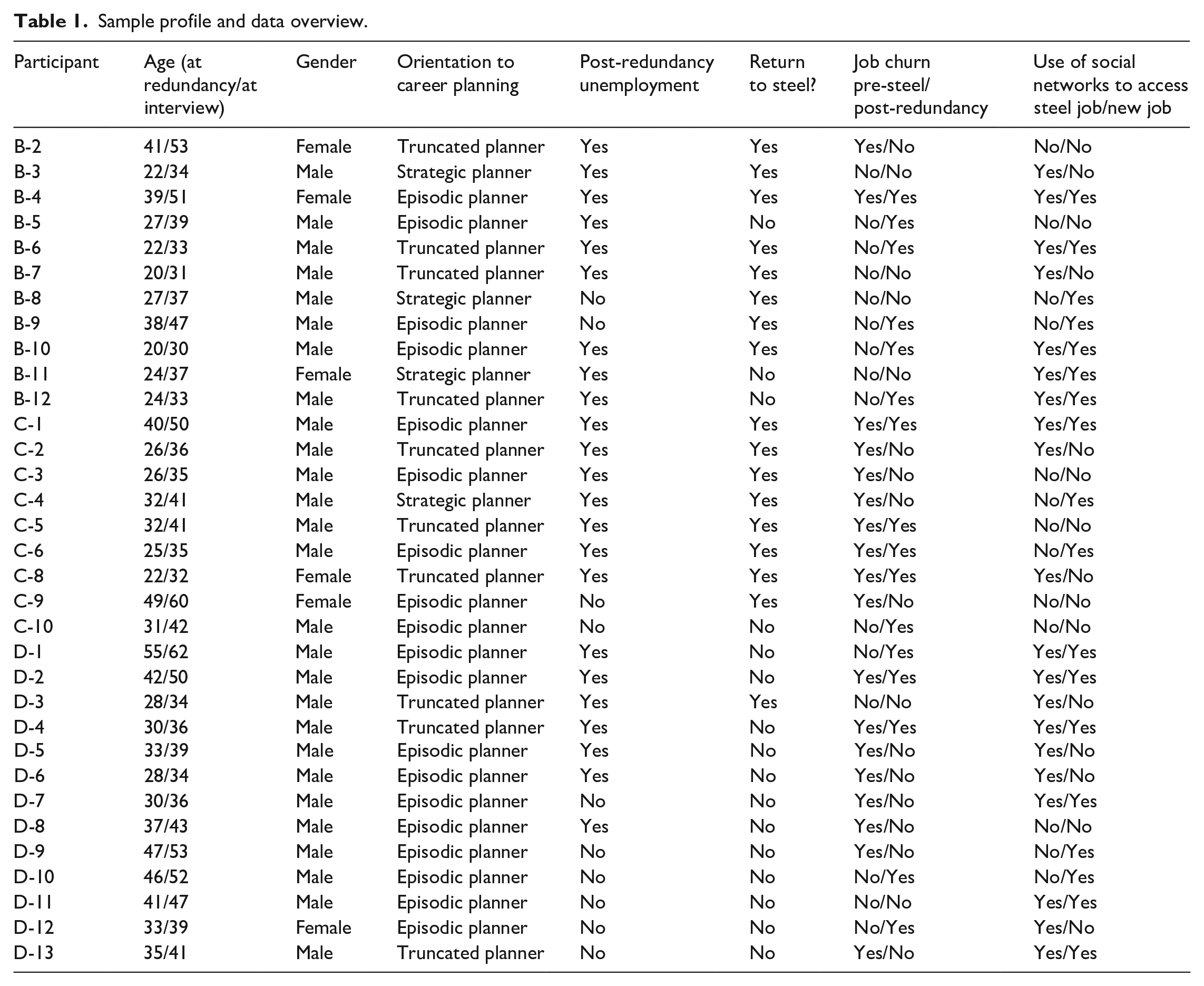
The post hoc self-narratives provided longer-term insight into the relationship between previous biographical experience and the post-redundancy transition. Following Bertaux and Kholi’s (1984) defence of life story methods, the aim was to gather both factual and interpretive information: the working-life biography approach was not intended as an objective account of indisputable facts but rather embraces interpretation and reflection by participants on how events shaped changes in attitude over time (MacKenzie and Marks, 2019). There are nonetheless characteristics of the working-life biography approach that are important to acknowledge. The post hoc self-narratives are ultimately representations of the past in the present moment. Participants were rationalising their redundancy experience after the fact, therefore representations of the past may be projected through the lens of the present. However, any post hoc rationalisation reflects the accumulation of biographic experience, up to the moment it was recorded in the interview: including periods pre- and post-redundancy. Our focus is on how the orientations to planning are reflected in the post-redundancy transition period. By locating the retrospective accounts of the transitions outcomes and experiences within longer-term processes observed through working-life biographies, we show how orientations may be shaped by biographical experience over the life course.
In addition to the working-life biographies of displaced workers, 10 semi-structured, expert informant interviews were conducted with representatives from labour market agencies, employers and unions. Although none of the data are directly reported, these interviews were used for background knowledge, providing contextual material that afforded valuable insight into the restructuring events and the support offered to displaced workers.
The data reported were collected across three research sites, each small towns in which the steel works had been the dominant employer in a provisional region of Sweden that had experienced structural industrial decline over recent decades. Two of the sites had been through mass redundancy events in 2008 (see Table 1, participants with B and C identifiers) and one in 2014 (Table 1, participant identifier D): two of the three sites continued operations after restructuring, one closed down. Initial access to participants was established through the cooperation of the union IF Metall. Local union officials aided in identifying displaced workers via official records or contacts maintained in the local community, and in two out of three sites made initial contact with potential participants. With the union density of 98.8% in one of the case study plants being typical, access via the union did not present a problem in terms of representativeness and arguably lent legitimacy to the research, although it was stressed people should not feel compelled to participate. Snowball sampling via research participants was also used to build the sample, which helped mitigate against potential selection bias. Recruitment and interview conduct followed protocols established in the application for ethical approval, granted by the Swedish Ethical Review Authority. A degree of purposive sampling was used to establish appropriate gender and age balances among displaced workers. The sample reflects contemporaneous employment figures for Swedish steel at the time of research, in which 18% of employees were women (Salminen-Karlsson, 2020). An appropriate age profile was similarly established in order to capture the experiences of workers at different stages of the life course. As the Swedish steel sector has an established record of lay-off and rehire under the auspices of the återanställningsrätt (right to re-employment), the sample included both people who departed the steel sector post-redundancy and those that returned. More details regarding the sample can be seen in Table 1.
The final stages of the fieldwork were impacted by the Covid pandemic. Although Sweden did not have lockdown procedures, face-to-face interviews became practically and ethically problematic. Zoom and telephone-based interviews were used in the final section of fieldwork, involving 12 interviews. Although this alternative proved mostly successful, on a couple of occasions participants seemed less forthcoming and interviews became more reliant on prompt questions around the key themes of redundancy, job-search activity and new employment experiences.
Interviews with displaced workers typically lasted between 60 and 90 minutes. Where interview data are reported in the findings, pseudonyms are used to protect the identity of research participants. The interviews were conducted in Swedish by three of the authors. All interviews were transcribed verbatim, translated into English and coded using Nvivo12 software. All authors participated in the analysis process. Initial analysis was conducted in both Swedish and English; discussions of data and later stages of analysis were conducted in English. Theoretically informed thematic coding was used in the analysis of data (Braun and Clarke, 2006). Having familiarised ourselves with the data, we engaged in an initial coding process that inductively explored the post-redundancy labour market transitions, generating codes relating to new jobs, the ways in which new jobs were accessed and perceptions of the process. Moving back and forth between the data and the literature, these initial codes were then organised into more abstract analytical themes of experiences of labour market churn, engagement with networks and perceptions of agency. This initial phase of analysis followed traditions of fracturing and lumping (Tracy, 2019) data from across the sample into sematic themes (Braun and Clarke, 2006) relating to the post-redundancy transition. The next phase was a return to the analysis of individual working-life biographies. Re-examining whole biographies rather than focusing on fragments of the narrative was key to the development of more abstract latent themes (Braun and Clarke, 2006) relating to orientations to planning, based on biographical descriptions of life course events including transition from school to work, movement between jobs, experiences of internal promotion, education and training, and engagement with support agencies, which also afforded insight into self-exploration, aspirations and goals. This phase included interpretive analysis of issues raised at various stages of the narrative that were not necessarily readily captured in short quotations.
The final phase of analysis was to combine the orientations to planning with the themes of labour market churn, network engagement and perceptions of agency (see Table 2). Despite depiction as phases of analysis, this was not a neat linear process, but rather more overlapping, iterative and discursive. For example, the process of identifying the orientations to planning during the re-examination of whole biographies initially stemmed from the emergence of truncated planners as a group that did not conform to transition navigation as depicted in much of the literature. This process led to an initial binary division between the small group of truncated planners and the main group of planners. Discussion continued within the research team over possible further differentiation within the general group of planners, with the way in which a number of participants presented their long-term career goals being one solution, leading to the distinction between strategic and episodic planners. The key to final agreement on the distinction between the three categories came from observance of conduct over the longer period. Locating the experience of redundancy within longer-term working-life biographies allowed for the identification of clear divergence in approaches to career planning, despite the similarities between certain aspects of these approaches and in particular convergence in conduct around time-bound activities of job search.
Interview data coding sample.
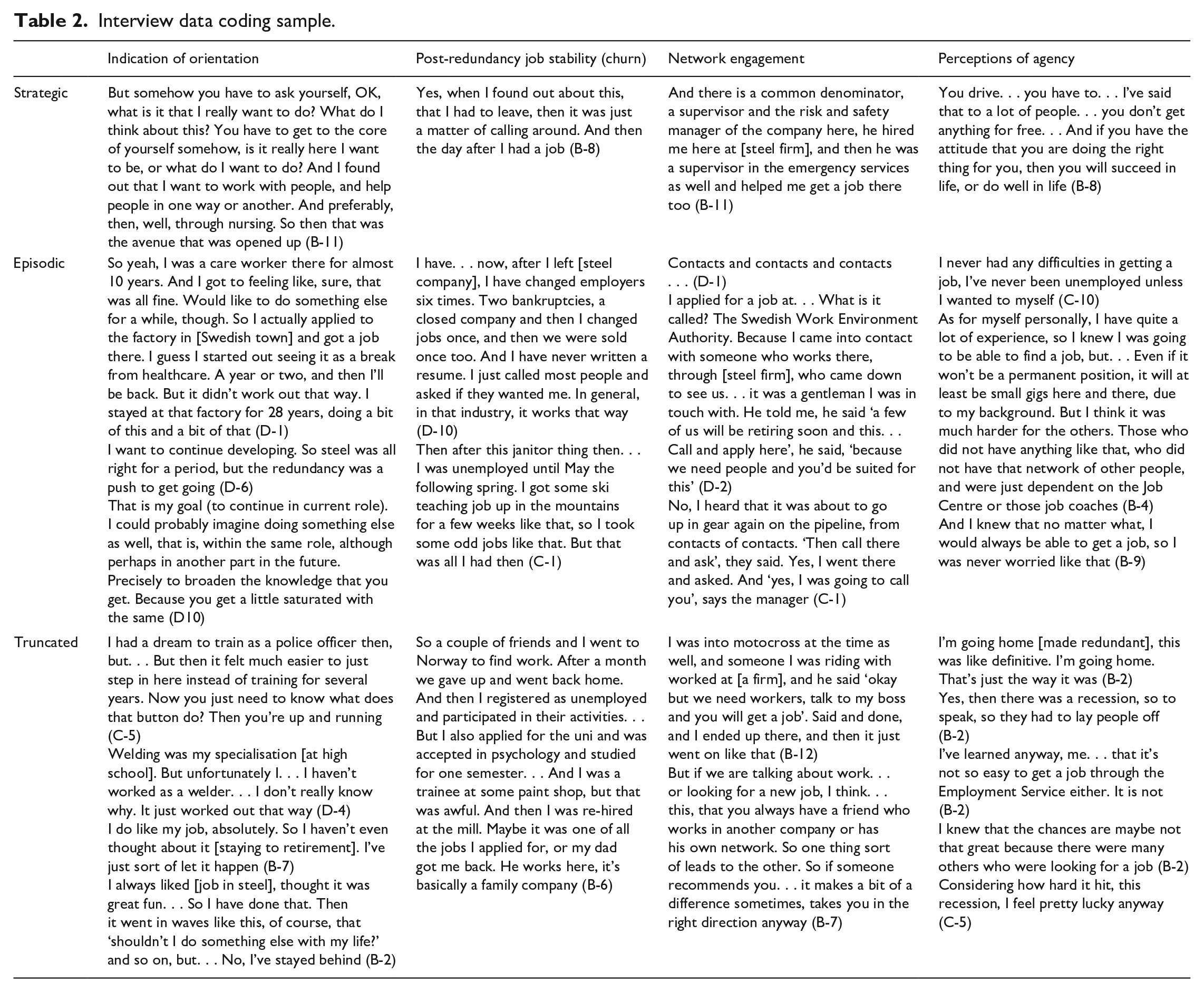
Working-life biographies may involve post hoc rationalisation so that past events are portrayed through the lens of current orientations, which could make orientations to planning seem fixed or static across the life course. This is not the claim of this article and indeed our analysis suggests otherwise, that orientations may change. That orientations to planning are embedded in longer-run processes, experiences and life course events does not mean that they are immutable, as shown in the findings. Nor are we suggesting there is a direct causal relationship between biographical experience and future outcomes, which would to deny the role of agency. Moreover, even if post hoc rationalisation means the orientation to planning may reflect the status quo at the point of interview, this does not detract from their identification as analytical categories; yet, nor can we assume their existence is ahistorical and untouched by past experience; however, that may be rationalised. Working-life biographies provided useful insight into those historical influences.
The methodology employed in this study therefore offers novel insight in two ways: first, the temporal perspective offered by working-life biographies allowed us to locate the post-steel transition within longer-run processes and experiences; second, the extended time frame post-redundancy allowed longer-term insight into transition journeys that often took several years to reach a point of stable employment.
Findings
Episodic and strategic planners: Goal realignment and future orientation
Although transition stories differed, all but one of the participants had returned to stable employment albeit often following periods of instability. Most people were employed on full-time, open-ended contracts although, as seen in Table 1, periods of unemployment and labour market churn in the interim were not uncommon. For those who departed the steel industry, there was little evidence of recovering the level of earnings they had received at the steel plant. However, there were people who derived a greater sense of purpose from their new employment, either returning to previous ‘latent callings’ (Sturges and Bailey, 2023) or realising longer-term ambitions on which they had not previously acted. For some episodic planners, realising a latent calling was facilitated by drawing on experience from previous employment outside the steel industry.
David (D-1) exemplified such episodic planners. Several years after redundancy he had transitioned into driving ambulances, drawing on past experience in the healthcare sector. In his previous working life he had transitioned from an early career in forestry into being a youth worker for a few years, then working for nearly 10 years in healthcare before moving to a job in steel. The moves between jobs were made on the basis of a desire for change in his working life; David had, therefore, exercised considerable agency in the successful pursuit of job-change. Each job-change was planned yet did not reflect a longer-term strategic plan but rather a series of shorter-term planning episodes. The announcements of redundancies led to entry into another planning episode, which spanned David’s final months at the mill: I mean, I was happy there. I was, until the very end. I stayed until the very end, grafting away. . . But. . . Yeah. I think I had processed it all during the period we had, the last few months there, that this is it. Time for us to find something else we like. Let’s do something fun.
Just as planning episodes had facilitated a series of changes prior to entry into steel, subsequent ones shaped his post-steel transition. With support from the transition organisation, David obtained qualifications he had previously not held that allowed for a return to the forestry industry. After six months, the physical toll of the forestry job prompted a new planning episode; drawing on social networks developed in his earlier career in healthcare, David made the transition into driving ambulances. The new job helped to realise a long-held instinct he expressed for helping others, such as had informed his earlier job choices in youth work and healthcare; for David, the transition outcome had been akin to a return to a latent calling.
Similarly, for Daniel (D-2), returning to a latent calling was reflected in realising a childhood ambition of becoming a truck driver as the result of a planning episode prompted by the announcement of redundancies: I didn’t have higher education or anything that everyone wants you to have when you apply for jobs. So I figured I would have to start over. And it’s been a childhood dream of mine to be a truck driver, so I thought I’d have a go at that at the age of 40. So I told [the transition organisation] that I wanted them to cover the expenses of my truck licence. Because we knew even then that there was a shortage of truck drivers on the horizon. And I suppose the guy at [the transition organisation] thought that wasn’t a bad idea, so they agreed to back me, up to 50,000, [€5000] for the truck licence.
After high school vocational training in mechanical engineering, Daniel had worked as a welder for three years. He relocated for personal reasons when he was 22 and initially found work managing a warehouse; experience he would later draw upon in his post-redundancy transition. When the warehouse was moved to a distant town, he declined the offer to relocate again and instead went to work for a friend who owned a car bodywork shop. Here, he combined his high school vocational training in welding with an early interest in working on cars; a role he briefly returned to after redundancy from the steel mill. When work ‘dried up’ at the bodywork shop, he got his first temporary job at a steel mill. Then two years later, on the recommendation of friends, he applied for what would become a long-term job at another steel firm, nearby. While a production worker, Daniel developed an interest in health and safety, undertaking training that led to a role as a union health and safety rep. The skills developed in this role in turn led to a promotion to the newly established position of safety coordinator for the mill, an office job that would be his final post in steel.
Daniel was an episodic planner, who had something in common with strategic planners in that he had a future orientation that prompted a more continuous awareness of the need for preparedness for change, albeit actual proactive engagement with planning or undertaking the requisite training to facilitate change was episodic in nature: If I found training today that offered enough. . . what’s it called, expertise, to work in safety, a course taking four or five months, I wouldn’t mind having a go. . . So. . . I guess you can just never give up. And you never know, this thing I do now isn’t all that secure either. . . So we don’t know what’s going to happen this summer, I might be looking for a job again [laughs]. That’s how it is. But I’ll cross that bridge when and if I come to it.
It is notable that David and Daniel had both demonstrated a high degree of agency and reaped benefits from the outcomes. For example, both had been proactive in their relationship with the transition organisation, approaching with clear plans in terms of retraining needs, for which they received financial support. However, it should be noted that transition destinations had been reached after several years of churning between jobs. For David, transition to ambulance driving followed a period working in forestry. Daniel’s transition story included three years’ churning between work and welfare support, on a series of short-term contracts as a truck driver, holiday cover running a warehouse, plus periodic returns to working in the car bodywork shop. He secured a permanent job as a truck driver in 2017 – five years after being made redundant from steel.
Although for David and Daniel transition involved a change of sector, for half the sample the post-redundancy journey involved a return to work in steel at some point, which in part reflected the ongoing dominance of the industry in the local and regional economy. The post-redundancy transition of this group was not a straightforward story of lay-off and rehire under the right to re-employment. Although most returned to jobs with their former employer, some were recruited by other steel companies in a commutable town following the closure of the plant in which they worked. Others worked for some years outside of steel before returning and so were not covered by the right to re-employment. More than half of those returning to steel reported experiences of labour market churn following redundancy, including movement in and out of other jobs and welfare support prior to returning to steel, subsequent lay-offs after their return to steel and periods on temporary contracts prior to securing permanent employment. Christer (C-6) was an episodic planner whose return to steel after a few months of unemployment was characterised by instability and uncertainty: I actually had to start in a summer job. And then I worked in the summer until August. And then I was supposed to go home [be laid off]. . . And then they called the next day that ‘you can come down and work again for another month’. . . One month at a time, which is terribly stressful as a human being. . . One month at a time I went. . . For nine months, I went one month at a time. . . You don’t know from month to month, do I still have a job, do I not have a job? What should I do? So, it’s terrible.
The initial instability prior to being made permanent at the mill encouraged the continuation of a planning episode developed while unemployed, involving exploration of the options of self-employment either relating to his hobby of fishing, or based on previous experience working for a flooring company: I was looking for a job all the time, I did. Both at [another steel company] and around. And I was into the idea and looked a bit at starting my own [fishing] business too. . . then I looked a little more into this with the flooring also during that time as well to. . . well, maybe go back in time and start my own business in that.
Christer, David and Daniel reflected an episodic orientation to planning. However, for a small number of strategic planners in the sample the approach to planning bore more semblance to the ongoing and lifelong process depicted in the careers literature. For Björn (B-3), returning to steel meant the resumption of a strategically planned career, returning to a job to which he felt a strong emotional attachment and from which he derived a sense of satisfaction akin to those reverting to a latent calling: ‘Now I get to do my thing, what I am good at.’
Björn had planned his career path through climbing the job ladder within steel. He had alternatives available when he graduated his high school programme in technology and computers, but chose to follow the path of his stepfather and uncles into the steel mill. The fact the job was ‘nearby, handy and paid well’ was part of an initial plan to fund a move to a big city to work in computers: a plan he later ‘reconsidered’ in order to focus on his career in steel, although not before gaining some relevant university credits through distance learning. Beginning his career in steel at the entry level of assistant caster, Björn purposefully sought a variety of experience through job rotation and training as a means of rising up the job ladder, eventually reaching the level of casting manager: There was a lot of training then. . . You tried one profession, were trained in it. Went to the next profession, were trained in it. Try out the site, what is it like. What happens, how do you function on that site?
Although as a strategic planner he had been hard hit by the disruption to his career plans as a result of redundancy, Björn had envisaged a return to steel even if this meant a period of unemployment. He had also taken out additional income insurance to supplement the standard voluntary insurance scheme paid into by the majority of workers, which significantly mitigated the financial impact of the period of unemployment: ‘I have always lived like that, planning for the worst-case scenario.’ Following his return to work at the plant after nearly a year of unemployment, Björn underwent goal realignment: a process of establishing new longer-term objectives, that involved both past reflection and future-oriented projection. The disruption to his plan brought on by redundancy, and a significant period out of work, led to a degree of self-exploration and reassessment. Although the new goal again involved the development of his career within steel, it now focused on revisiting his earlier interest in computers. At the time of research, he had recently applied for a three-year leave of absence from employment to complete his university-level studies with a view of facilitating progression through the management grades within the steel industry.
Birgitta (B-11) also demonstrated a strategic orientation to planning. Following the announcement of redundancy from the steel mill, she had gone through a period of self-exploration before deciding upon taking a three-year university programme to retrain as a nurse. Although she had gone through several goal realignments over the years, Birgitta had demonstrated a similar planned approach throughout her working life, accumulating training and competences towards a particular goal.
After joining the steel mill straight from school, on the basis of a family connection, she had made a decision she wanted to go to university to study sports management. When she was unable to find work in this area, Birgitta underwent a goal realignment, away from sports management, towards realising an instinct for helping people by becoming a part-time firefighter. Interestingly, this plan to join the fire service involved a return to work at the mill as the part-time nature of the role, which was the norm for local emergency services, required another source of income and an employer who would be flexible in accommodating her duties. It is notable both roles were also accessed via a social network connection made during her time in steel (see Table 2).
Birgitta’s employment as a part-time firefighter was crucial to her transition following redundancy from the steel mill. Her decision to retrain as a nurse drew on experience from the emergency services. She had purposely accumulated a skill set through targeting training opportunities within the fire service – including medical training, which she had enjoyed the most. Becoming a nurse therefore represented some goal realignment but also a return to longer-held interests. Goal realignment involved a degree of self-exploration, evaluative reflection on past experience and long-term future-orientated thinking: I had to go wild with ideas and ask myself, okay, what is it that I want to do and what can I do? And where can I get a job, where will the work situation be stable in the future? That was also part of it. . . since I already had that education that never resulted in a real job, I thought I do not want to make the same mistake again in any. . . or well, mistake, but I cannot put myself in the same situation again, I also have to keep in mind that I would rather go for something that means stable work for the foreseeable future, you know, and then something that I really want to do. And those things may not always be easy to combine, but in my case I went for a career as a nurse and that means unlimited amounts of work.
There was a paradoxical element in the experiences of those with a strategic orientation to planning in that the successful realisation of the transition reflected in achieving a goal did not end the strategic planning process, but rather led to further goal realignment. Just as Björn had gone through goal realignment to work with computers, similarly Birgitta described the need to aim for new goals that built on her interests, values and experiences: Now I’m thinking more about leadership. . . As a nurse. . . when we delegate work to assistant nurses, for instance, we take a leadership role and an instructive role. And I feel that I can build on that, no doubt. I would like to do that. In some way. But still go on working as a nurse. . . Now I’ve been working as a nurse since 2014 in the same place until now, so right now I am a bit like, okay, something new has got to happen, now is the time to. . . [laughter] I am about to move on somewhere.
Both Björn and Birgitta had a sense of personal control, took purposive action when faced with uncertainty, and held expectations of agency leading to successful outcomes. The counterpoint was that those more used to a sense of control associated with long-term planning were more vulnerable to a sense of disruption associated with redundancy. For those with a strategic orientation to planning, redundancy represented career control in crisis requiring purposive action such as goal realignment to reassert some sense of control. These processes of goal realignment again demonstrated high degrees of agential engagement, locating present actions, within past reflections and new future projections. Again, such actions suggest a sense of control born of experience of successful agential engagement; something not shared by truncated planners.
Truncated planners, agency and constraint
For a small number of the sample, planning had played little role in the journey through their working lives. Benny (B-12) started working alongside his father and uncles at the steel mill during summer holidays from school. He had not had a positive experience of school and left without completing his diploma. Based on past employment and family connections, Benny secured a permanent job at the mill on his return from national service in the military: ‘I don’t remember if I got the job through him [uncle] or if it was through my father. But I have been lucky. I have never had to apply for a job in my entire life.’ Although his time in steel had included some movement between roles, these had not been planned with a particular view of systematic progression, and uncertified skills ‘you learn along the way’ were not transferable in his post-redundancy transition. Churning through several jobs following redundancy had followed a similar pattern. Reflecting on what had become a varied career, but one in which planning had played little role, Benny summarised his working-life experiences: The jobs I have had have been more or less random. A necessary evil, so to speak, that we need money to live. So it has not been like ‘okay, I am going to try to specialise in this since I am interested’, or anything like that. It has more been like taking the jobs that were available, or offered. And again, like I said, I have never. . . The jobs I have had, I have never applied for them. I have only been. . . not assigned to them, but found out about them and then been hired as soon as I said I was interested, so to speak.
For some younger workers, it could be suggested that the absence of planning reflected the life stage of an absence of responsibilities associated with raising a family or mortgage payments. Yet, there were also older workers for whom a working life in steel had forestalled any requirement for planning. What both younger and older truncated planners shared was a strong perception of structural constraint leading to low expectations of their capacity to assert agency in the face of seemingly overwhelming and immutable forces. The personal narratives of their working lives and experiences of redundancy were often located within a wider context of broad economic downturns and structural decline of industrial sectors. The perception of structural constraint was not exclusive to truncated planners; Björn, with a strategic orientation to planning, had described similar circumstances but what differed was his view that through his actions he could bring about a positive change in his situation and thus he expressed a sense of control not shared by truncated planners. The sense of being powerless in the face of broader structural forces led to low expectations and minimalist or instrumental interactions with the support agencies; such agencies could not support transition into jobs that did not exist owing to an economic downturn. The perception of structural constraint was exacerbated by the message promoted by the support agencies regarding the need to adapt to the apparent demands of contemporary labour market. There was a degree of internalisation of the flexibility narrative and the need to be responsive to change owing to broader economic restructuring. However, the internalisation of this narrative contributed to a sense of no control and an absence of expectations of agency. Carl (C-5), for example, recognised the imperative for geographic mobility but this did not make it a palatable option. Although returning to the steel company that had made him redundant had not been planned, in the context of a paucity of opportunities in the local labour market, being contacted by his former employer and offered a job presented a way out of 15 months of unemployment: It was, of course, a bit of trying to find another job as well, but. . . That. . . no, there were no suitable jobs then. I was absolutely moveable across the country, but I was very opposed to that as well. I didn’t want to leave what I. . . the only thing I knew. So I stayed, and it resulted in something good in the end. It did, but I couldn’t know that.
Therefore, for Carl the outcome – though positive – did not reflect the anticipated fulfilment of purposive action, it was serendipity that could not be foreseen owing to a lack of expectations regarding agential behaviour.
This is not to suggest truncated planners lacked agency, indeed the ability and willingness to take action was no less apparent than for strategic and episodic planners. Agency was expressed through job search and transition, or in the uptake of job opportunities, but agency was located within more truncated time horizons, oriented to the present rather than a projected future. What differed was the expectation that purposive action would necessarily lead to aspirational objectives. Benny (B-12), reflecting on a year of unemployment following redundancy from steel, showed the low expectations of agential job search; perceptions of structural constraint meant positive outcomes were more explained by serendipity than agency: So it was more miserable towards the end of that period [of unemployment], and then I tried a bit harder to get a job. But there weren’t enough jobs to go around. It was just pure coincidence that a job turned up for me around one year later.
Interestingly, for some such a sense of being cast adrift on the tides of economic fortune was mixed with a resigned optimism in the face of uncontrollable events. Experience had taught Benny that something always ‘turned up’: after three years’ churning between unemployment and unrelated jobs in road construction and machine tool manufacture accessed via social and familial contacts, Benny was offered temporary work at a security firm, and was eventually made permanent: ‘I think, where I ended up, where I am now. I really like it where I work now. So now that I know how it turned out, it turned out really well.’ The transition journey again reflected a key difference between planners and truncated planners over their experiences and expectations of agency. The outcome of the experience of churning through jobs had ended positively, agency was asserted through each new job uptake, but the sense of control was absent: it just ‘turned out’ he ‘ended up’ in a job he ‘really like’(s).
Such positive outcomes were not shared by all truncated planners. By way of comparison, Dennis (D-4) had continued to experience labour market churn since being made redundant in 2014, including movement back and forth between employment and reliance on welfare support. He had moved between a series of jobs, which were highly varied in nature, including care work, factory work, light manufacturing and a summer holiday contract working for another steel firm, secured on the recommendation of friends. In many ways, this experience reflected his earlier working-life biography. He started his original job in steel working during summer holidays from school. He had specialised in welding at high school but did not complete his diploma and had never worked as a welder. After leaving school, he was unemployed for two months before finding factory work through a family connection. He worked there for a year or so, before becoming unemployed for another year. At the behest of the unemployment agency, he had taken computer training courses in order to maintain his eligibility for benefits but was sceptical of their usefulness. Dennis then secured a permanent job back at the steel mill, based on his previous relationship with the firm: ‘I always had my trainee periods and I’ve had summer jobs at the mills there. So I’ve had a relationship with management there. And then since [this] is such a small town, we know each other personally.’
Dennis worked in steel for nine years until being made redundant in 2014. Several years after being made redundant from steel, he had not transitioned into full-time employment. Interestingly, in the latter stages of this period Dennis had begun to act in ways more akin to an episodic planner, both by being more proactive in his use of social networks to access work and having developed a goal of returning to the steel industry in the hope of securing more employment stability. He had acquired his current by-the-hour contract job with an industrial services firm by approaching a friend who was employed there. Although he liked his work, the unstable nature of his employment had made him agential in realising his goal of returning to the steel company where he had found temporary employment after his initial redundancy: And all the vacancies that [Steel Company] announce, I apply for. And I go to [Steel Company] to work for the company I work at now [as an industrial services contractor]. So I meet the managers and things like that and talk to them. And try to, like, ‘So, uh, you looking for more people? You’re looking a little short-staffed. . . I’m always available.’ And one of the upsides is that I don’t have to give any notice. I try to work that in every time I see someone in management. . . I got an email about a week ago. Because I had worked there before, they want to know if I’d be interested in coming back. . . So I obviously replied and said ‘Absolutely.’ And it always says ‘When would you be able to start?’ And I’ve always said that. . . well, the next day. And stay until retirement, basically. To show that I’m keen.
Dennis’s experience of ongoing churn represented one extreme of the post-redundancy journeys, but one that is illustrative of the instability and uncertainty faced by many regardless of their orientation to planning. What Dennis’s journey shows is the orientations to planning are not static or fixed, but may change over time.
Discussion and conclusions
The working-life biographies utilised in this study allowed the location of post-redundancy transitions within experiences spanning from early career to several years after the initial job loss. This longer-term perspective provided insight into variable engagement with planning, which led to the core contribution of the article, the identification of strategic, episodic and truncated planners as discrete analytical categories. Through problematising the conceptualisation of approaches to planning by differentiating between these three orientations, we add nuance to the notion that planning is something that is ongoing and lifelong. Below, the characteristics of each orientation to planning are discussed then relocated within the careers transitions literature to address their implications for career adaptability (Taber and Blankemeyer, 2015), career self-management (Raabe et al., 2007) and agency (Emirbayer and Mische, 1998). Finally, we discuss these orientations to planning in relation to post-redundancy working-life transitions, both in terms of outcomes and, crucially, the qualitatively different experience of the journey. A summary of the analysis can be seen in Table 3.
Orientations to planning and post-redundancy transition.
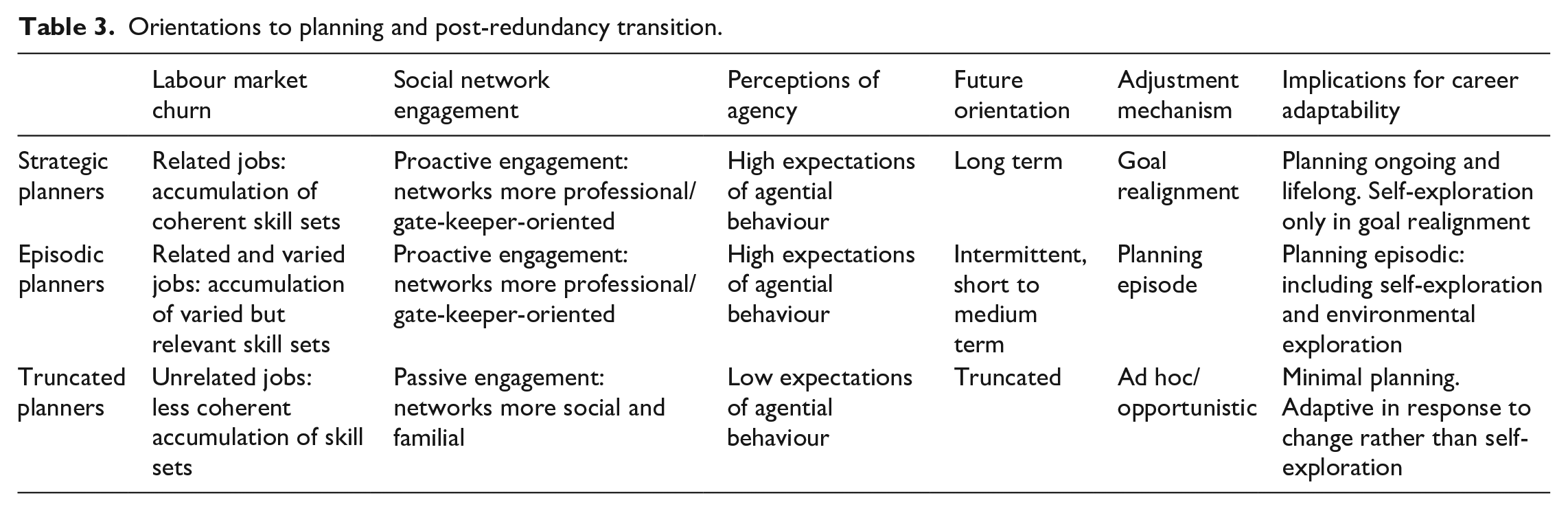
Before expanding on the characterisation of orientations to planning, it is important to note that rather than discrete groupings these classifications should be better understood as a continuum spanning a range between the extremes of planned and unplanned approaches to working life, in which people could be located at the boundary between groups. Birgitta, for example, could be seen to be close to the boundary between strategic and episodic planner; ultimately, it was her ongoing focus on skills accumulation that made her more strategic in her orientation to planning. Nor should the possibility be precluded that people may move across boundaries over time, as shown by Dennis’s journey.
Strategic planners had taken a calculated approach to their working lives and demonstrated a sustained aspiration for upward career mobility. They held long-term goals, and acted consciously in their pursuit over time; for example, identifying aspirational roles and undertaking appropriate training to access new stages in their working lives. Achieving long-term goals often included accruing additional education or training and development of experience over time, guided by aspirational objectives. Whereas many people working within the steel plant entered employment without particular objectives, often following a path set by family members, including previous generations, and continued their employment with similar absence of particular career aspirations, strategic planners planned their career in steel and strategically pursued upward mobility. Within large organisations with defined job ladders, such upward mobility was possible, even offering the chance of transition into management grades. That strategic planners could plan for a career in steel in some ways made them more vulnerable to the impact of redundancy, as long-term plans were torn asunder and career management was thrown into crisis.
Although objectives were pursued over the long term, goals were not immutable. Goal realignment occurred, but crucially the same approach was taken to the pursuit of new goals. Indeed, the experience of redundancy was likely to force goal realignment; even those returning to steel may have reconsidered their long-term objectives in light of their experiences of redundancy. Thus, strategic planners were not defined by their objective per se but rather by their approach to its pursuit and crucially the maintenance of this approach on a continued basis. Given the disruption to career plans imposed by redundancy, a strategic planning approach could also be applied to pursuit of new working-life goals outside of steel. Here again, the approach maintained an established pattern of identifying objectives and the means to attain them; for example, through retraining. Again, it was the maintenance of approach that was key: goal realignment within a longer-term future orientation was distinct from the short-term pursuit of new goals associated with episodic planners.
Episodic planners had not consciously pursued long-term goals in the same way as strategic planners, but engaged in shorter-term planning on a periodic basis as the need arose, associated with transitions in the working-life course. In many ways, working in steel reduced the need for continuous attention to planning. Entry into employment in steel for some was facilitated by a planning episode, while others took an almost preordained path of following family members into working at the plant. Working in steel was relatively predictable although prone to occasional change owing to management reorganisation. The relative predictability of work did not preclude agency; workers changed roles and undertook training to facilitate change, but did so as part of a planning episode rather than as a reflection of objectives consciously pursued over a longer time frame. Future orientation was thus more medium term. Redundancy provided a trigger for a planning episode; although planning episodes could also be triggered by the assertion of agency as a reflection of a periodic desire for change. Planning episodes often included undertaking training in order to facilitate transition, both internal to organisations and within the external labour market: transition was often achieved on the basis of the realisation of the planning episode.
Truncated planners were people whose working lives had been often shaped by happenchance with minimal engagement in planning. Movement into and between jobs had been on the basis of opportunities arising, without the conscious pursuit of particular employment objectives; therefore, any planning required was often reactive, and truncated both in terms of the time frame and degree of engagement. Major transitions in the working-life course had been similarly ad hoc: qualifications gained prior to entering the labour market tended not to be reflected in specialisation in a related field of work. That education had not led to a related field of employment later militated against the speculative investment in training as a route to potential employment opportunities. Entry into employment in steel was again often facilitated by a family member already working at the dominant local employer, thus requiring no prior planning or particular aspiration to take up such work. Working in steel mediated the need for planning. Employment at the plant progressed without the need for career objectives, which did not preclude the possibility of internal mobility or even upward progression but such changes were based on opportunities arising rather than goals pursued.
The lack of a planned approach to training had not meant an absence of skill development for truncated planners, but skill profiles were often varied, without conscious pursuit of skill accumulation, and thus prone to a lack of coherence. This did not preclude the possibility of short-term training prior to taking up a job but the time horizons in which employment aspirations existed, thus future orientations, were far more truncated than for strategic or episodic planners and focused on the immediate needs of the job in question (or having been compelled to undertake courses in order to qualify for welfare support).
Reflecting on specific aspects of careers transitions theories, strategic planners most resembled the notion that planning was ongoing and on a lifelong basis (Zikic and Klehe, 2006). Moreover, strategic planners bore closest semblance to engaging in proactive agential behaviour associated with career self-management (Raabe et al., 2007) and career adaptability (Taber and Blankemeyer, 2015). The degree of career adaptability was notable in terms of the capacity for goal realignment at various stages, involving processes of self-exploration (Zikic and Klehe, 2006). Self-exploration may lead to goal realignment on the basis of a return to a latent calling, and work that resonated with a past interest, which thus provided more personal satisfaction or sense of purpose (Sturges and Bailey, 2023). However, these findings must be tempered with the possibility of a heightened impact of redundancy in terms of the disruption to career planning. Strategic planners were longer-term future-oriented, with a sense of ‘future work self’ (Taber and Blankemeyer, 2015) and proactive in information gathering and goal development, on an ongoing basis. They tended to be highly agential, reflecting a sense of control and self-efficacy (Bandura, 1997) in terms of expectations of agency leading to positive outcomes; but again the heightened expectations of control made strategic planners vulnerable to a greater sense of loss of control, or career control in crisis, associated with redundancy.
Episodic planners reflected the norm within the sample, which holds implications for careers theory. Episodic planners did not engage in career self-management (Raabe et al., 2007) on a sustained or systematic basis but demonstrated high degrees of career adaptability (Taber and Blankemeyer, 2015). Periodic changes in direction were facilitated by planning episodes, whether triggered by external stimuli or internal imperatives of desire for something new in their working lives, and involved processes of both self-exploration and environmental exploration (Zikic and Klehe, 2006) in terms of identifying the necessary means of plan fulfilment. Proactive agential behaviour was therefore manifest in planning episodes, with expectations of agency, self-efficacy (Bandura, 1997) or a sense of control derived from affecting career change in line with newly established goals: although future orientation tended towards the short to medium term. Episodic planners thus also demonstrated higher degrees of career exploration (Zikic and Klehe, 2006), accumulating varied skill sets that could prove useful in terms of returning to previous roles later in their working lives. Although not always the case, the return to a past role could reflect re-engagement with a latent calling identified during a planning episode and thus the uptake of more personally satisfying work (Sturges and Bailey, 2023). Although not undertaken on an ongoing basis, planning episodes included information gathering and goal development; during which engagement with the post-redundancy institutional support played an important role.
Truncated planners had little engagement with career self-management and yet still could be said to have demonstrated a high degree of career adaptability (Taber and Blankemeyer, 2015). However, their career adaptability was reactive to job-change rather than based on proactive career planning or exploration of self and environment (Zikic and Klehe, 2006). Working-life histories showed a high degree of variation, but changes in job were often more a reflection of labour market churn (Burgess et al., 2000; Cappelli and Neumark, 2007) than seeking career exploration or experimentation, with less opportunity for the accumulation coherent skill sets. There would be no reason why a truncated planner should not find work that provided a sense of satisfaction, or even a return to a latent calling based on past interests (Sturges and Bailey, 2023). However, the route to such an outcome would be more characterised by happenchance than being the result of attaining a long-term goal identified through self-exploration. Over the course of their working-life biographies, there was often little in terms of systemic information gathering or goal development. Employment transitions tended to be ad hoc and opportunistic, sometimes accessed through passive engagement with social networks (Granovetter, 1974). The internalisation of discourses of flexibility may have instilled a propensity for career adaptability, but the ad hoc nature of skills accumulation can be seen as a counter tendency hindering potential transition from career adaptability to career self-management (King, 2004), or from truncated planner to episodic or strategic planner. The lack of planning did not preclude agency, or motivation to act (Bandura, 1997); however, biographic experience had created low expectations of the likely efficacy of agential behaviour and militated against other than a truncated future orientation.
What the content of Table 3 demonstrates is that it was less the outcome of transition but rather the qualitatively different experience of the journey that was the basis of the differentiation between strategic planners, episodic planners and truncated planners. Overall, it was not a simple story of planners achieving more positive outcomes in their labour market transitions. For example, being an episodic planner did not necessarily protect from the experience of labour market churn. As can be seen in Table 1, movement in and out of work in the period following redundancy was an experience shared by roughly half of the research participants, and distributed relatively evenly between episodic and truncated planners. However, there were differences in the experience of churn that mirrored broader patterns in the working lives of each group. The types of jobs episodic planners churned through often reflected more of a logic in terms of similar skill profiles and thus afforded more coherent accumulation of experience-based skill sets. The types of jobs truncated planners churned in and out of tended to be more random, in further reflection of the opportunistic approach to accessing employment. Therefore, the subjective experience of churning was qualitatively different, with more of a sense of purpose being associated with a planned approach.
Similarly, the reliance on social networks for finding employment was a widespread phenomenon throughout the sample, as shown in Table 1, but the ways in which people engaged with the networks differed. Strategic or episodic planners were more proactive in their approach, reaching out to people in their networks regarding potential opportunities, or identifying specific contacts who may have access to particular knowledge or could act as a gatekeeper to an aspirational area of work. Truncated planners were often reliant on social networks for finding employment, but tended to engage on a more passive basis, taking up opportunities as they were communicated to them via their networks rather than proactively seeking information on new job opportunities. The networks themselves were also qualitatively different: for strategic and episodic planners networks tended to be more professional and gate-keeper-oriented, including contacts with past or potential employers, which were maintained and nurtured. For truncated planners, networks were more organic and varied in nature, spanning family, school friends and contacts accumulated over time spent in the same location.
The nature of the local labour market, which was dominated by the steel works in the various locations, presented a structural constraint on potential career aspirations (Gardiner et al., 2009; Heinz, 2002; Tomlinson et al., 2018). What is crucial, however, is the perceptions of structural constraint and by extension the expectations of the potential efficacy of agency. Whereas strategic planners and episodic planners recognised the potential constraints of the structural context, they continued to engage in proactive skills accumulation and job search activity commensurate with either long-term planning or planning episodes. For truncated planners, the structural constraints of the local economy weighed heavily upon the expectations of the outcomes of agency, and biographic experience dissuaded them from speculative investment in training or active engagement with institutional support.
Therefore, agency was asserted by strategic, episodic and truncated planners, albeit in different forms, and in each case represented actions in the present being informed by the past, and projected future. Strategic planners most closely fitted the application of agency shaped by self-efficacy (Bandura, 1997) or past experience and a projective capacity to imagine alternative outcomes; with episodic planners also similarly engaging on a periodic basis (Emirbayer and Mische, 1998; Gardiner et al., 2009). Truncated planners were not lacking in terms of agency informed by the past; however, it was this biographical experience that limited expectations of their ability to shape future outcomes. Therefore, it was not necessarily an absence of evaluative capacity to combine the contingencies of the moment with past habit and future projects (Emirbayer and Mische, 1998) that informed the agency of truncated planners but rather the biographical experience and structural context that fettered their perceived prospects of shaping the outcomes of agency.
As noted above, much of the careers literature focuses on managerial staff, traditional professions or creative industries: empirical contexts that are well suited to the study of highly agential, ongoing, lifelong approaches to planning associated with career adaptability or career self-management. In going beyond this prevalent focus to offer insights from a study involving semi-skilled industrial workers from the steel industry, we add a different perspective to the role of planning within career transitions. However, we must acknowledge the limitations of any study of this size and specificity of context.
The Swedish context of the study is of clear importance to the experience of redundancy transition, given the extensive support provide to displaced workers to help them transition to other parts of the labour market through long-standing ALMPs. The institutionalised transition support may be seen to foster an environment in which planning is encouraged. Therefore, independent of the individual agency associated with orientations to planning, the national institutional context has a clear bearing on the process and outcomes of post-redundancy transition (Dobbins et al., 2014). The extent to which orientations to planning would be shaped by the relative absence of support in Liberal Market Economies would be an interesting avenue for future research: if a Coordinated Market Economy such as Sweden fosters an environment that is relatively more encouraging of planning, could a Liberal Market Economy such as the UK see a higher prevalence of truncated planners? However, such national institutional profiling requires additional nuance. Interestingly, sectoral-level comparisons may point to other influences, given the existence of transition support offered in comparative studies of the steel industry in the UK and Australia (Gardiner et al., 2009; O’Brien and Burrows, 2017). For example, in the UK, the relatively generous severance packages negotiated for displaced workers are seen to play a part in post-redundancy transitions (MacKenzie and Marks, 2019). In Sweden, severance packages are not typically as generous, leading to claims from unions that redundancy is a relatively low-cost option for employers. However, the absence of large severance payments must be weighed against the support provided by social insurance in Sweden, which, for example, may be seen as an important contextual factor shaping the choices made by some research participants to await a return to work in the steel industry rather than seek employment elsewhere.
The differing orientations to planning also hold implications for practice, of particular interest to support providers and welfare agencies. Although such a large issue is beyond the scope of this article, implications for transition support would be another potential avenue for future research. Crucially, however, future avenues for research relating to orientations to planning should also go beyond the context of post-redundancy transitions; for example, finding application to other areas of debate in the wider careers literature. Moreover, although orientations to planning were distributed across age and gender within our sample, future research could explore the implications of these and other demographics more extensively. For example, owing to the age profile of the sample, we could not comment on whether orientations to planning may change towards the end of the working life and transition to retirement: this issue would again be a fruitful avenue for future research.
We must also recognise the limitations associated with our methodology based on post hoc narratives of participants; yet, we believe the benefits the insights provided by these long-term reflexive accounts outweigh the drawbacks. In the context of forced transitions brought on by redundancy, the way workers manage and adapt their careers is brought into sharp relief. Previous studies have provided useful insight into responses to the critical moment of redundancy (Gardiner et al., 2009). By focusing research several years after the redundancy event, we provide insight into longer-term labour market transitions. Moreover, the insight into the transition process offered by working-life biographies exposes the difficulties many people face in terms of labour market churn, unemployment and instability associated with temporary contracts, which are obscured in studies that focus solely on the destination of post-redundancy transitions. In short, it is not just the destination but also the journey that is important. It has been argued elsewhere that career planning plays an important role in transition outcomes (Taber and Blankemeyer, 2015; Zikic and Klehe, 2006). As shown in this study, differing orientations to planning are important to a qualitative understanding of transition outcomes and, crucially, the experience of the journey.
Footnotes
Acknowledgements
We would like to thank the editor and the three anonymous referees for their useful comments in the development of this article. We would also like to thank the International Research in Steel (IRIS) Steering Group for their input in the development of the research underpinning this article. Most importantly, we would like to thank the research participants who gave us their time and shared their stories.
Funding
The authors disclosed receipt of the following financial support for the research, authorship and/or publication of this article: This work was supported by FORTE: Swedish Research Council for Health, Working Life and Welfare [grant number 2018-00760].
