



Abstract
Research depicts job crafting as a desirable, ongoing employee behavior rather than a one-off event. However, insights are lacking into how employees’ active engagement in job crafting may be sustained across time. In this study, we advance a dynamic framework of how changes that follow employees’ periods of job crafting may, in turn, motivate versus impede continued crafting of one’s job role over time. Drawing from self-concordance theorizing, we propose and test a framework on how job crafting and employees’ attainment of self-concordant and organizational work goals are reciprocally related over time. Longitudinal data from a large, three-wave study collected over four years among church ministers support a positive reciprocal relationship between job crafting and self-concordant goal attainment, as well as an indirect positive relationship between job crafting and organizational goal attainment via self-concordant goal attainment. However, in line with our theorizing, organizational goal attainment did not predict subsequent job crafting. Instead, high organizational goal attainment weakened the extent to which job crafting at one time point positively related to job crafting at the next time point. We discuss the theoretical and practical implications of our findings for employees’ continued engagement in job crafting in organizations.
Keywords
Beyond formal work design provided by the organization, employees often seek to change their own work in ways that correspond to their idiosyncratic requirements. Such job crafting captures employees’ overall, self-initiated practices to “shape, mold, and redefine their jobs” (Wrzesniewski and Dutton, 2001: 180). Job crafting, at its core, reflects a bottom–up approach to redesign work without substantive line-manager or HR input into this process (Grant and Parker, 2009) and is pervasive across organizational ranks and industries (Berg et al., 2010b; Nielsen and Abildgaard, 2012). Overall, reports of such idiosyncratic changes to one’s job have been linked to positive outcomes both for individuals and their organizations, including greater job satisfaction and performance (e.g. Lichtenthaler and Fischbach, 2019; Rudolph et al., 2017). Thus, the prevailing literature suggests that it is beneficial for organizations to motivate and sustain employees’ job crafting behavior.
It is also generally recognized that crafting one’s role at work is an ongoing, dynamic process rather than a one-off event, yet existing theory and research on job crafting has scarcely considered the role of “time” in job crafting (Weisman et al., 2022). Insights remain limited into whether and when workers are motivated to sustain engagement in job crafting behaviors, and the extent to which the outcomes of job crafting may further stimulate or impede subsequent job crafting efforts in their roles (Rudolph et al., 2017). Thus far, research seems to suggest that job crafting behaviors are positively related to both individually and organizationally desirable outcomes and vice versa (e.g. Lichtenthaler and Fischbach, 2019). However, because this research base relies predominantly on data collected at only one or two time points, or over very short time periods at work, we still lack insights into the temporal dynamics of how employees craft their roles at work and the reciprocal relationships of these job crafting efforts with outcomes (Rudolph et al., 2017; Zhang and Parker, 2019), particularly across longer periods (Harju et al., 2016). This is problematic because job crafting seeks to alter lasting features of a person’s job, effectively blurring the line between antecedents and outcomes of job crafting (Zhang and Parker, 2019). We do not know yet whether attaining desirable goals through job crafting reduces the motivation for future job crafting efforts or, rather, motivates further engagement in crafting one’s role.
To better understand these issues, we advance and test a model that embeds job crafting within the dynamics of different forms of individuals’ goal attainment. Job crafting, particularly the combination of task, relational, and cognitive crafting behaviors, is theorized to arise from employees’ drive to satisfy their basic human needs (Wrzesniewski and Dutton, 2001) and has been suggested to reflect a fundamentally self-concordant process (Unsworth and Mason, 2016). Described within self-concordance theory (Sheldon and Elliot, 1999), self-concordant goals are consistent with an individual’s core interests and values and their pursuit is driven and sustained by intrinsic motivation (Sheldon and Elliot, 1999). In contrast, organizational goals are frequently much less self-concordant. Organizational goals can vary by type of organization, including elements of production, finance, service quality, stakeholder satisfaction, societal welfare, or sustainability (Gagné, 2018). But importantly, they may be of varying personal importance for individuals because they principally reflect end states desired by organizations, with workers’ progress against them usually being explicitly monitored and recognized (Gagné, 2018; Latham, 2001). As such, we expect employees’ engagement in job crafting behaviors may overall relate to self-concordant work goals in different ways than to organizational work goals.
Building from self-concordance theorizing, we propose job crafting primarily serves self-concordant goals and may only indirectly promote organizational goals through this self-concordant goal mechanism. We expect that because self-concordant goals entail satisfaction of basic intrinsic needs (Sheldon and Elliot, 1999), attaining them through job crafting will motivate further job crafting and the sustained pursuit of intrinsic need satisfaction. By contrast, we argue the extrinsic nature of organizational goals means their attainment does not satisfy employees’ basic needs in the same way, and does not promote further job crafting. In addition, because extrinsic goal outcomes tend to disrupt the regulation of self-concordant goal pursuit (Sheldon and Elliot, 1999; Sheldon and Houser-Marko, 2001), we expect organizational goal attainment will disrupt job crafting behavior over time. Overall, our theorizing not only suggests job crafting may be related to different forms of work goals either directly (self-concordant) or indirectly (organizational), but also that different forms of goal attainment will then sustain or inhibit future engagement in crafting job roles.
We test our propositions in the context of the Church of England (CofE), as part of a wider multi-study project on minister effectiveness and well-being. Beyond their role as spiritual community leaders, church ministers provide substantial public benefits within deprived areas and for parts of the population most needing assistance. In particular, in our study we investigate how church ministers’ engagement in crafting their role led to attainment of self-concordant goals in the form of priests’ fulfillment of their calling as a minister—a supremely meaningful and powerful personal orientation toward their work (Conway et al., 2015). Indeed, the fulfillment of a calling is a highly prototypical example of self-concordant goal attainment (Allan and Duffy, 2014). In addition, we investigate how ministers’ engagement in job crafting is related to organizational goal attainment, indicated by recorded congregational attendance levels that reflect one of the organization’s core goals: numerical growth of congregations. Church congregations in England have been shrinking since the start of the 20th century, so sustaining and growing congregations is a key organizational mission (Goodhew, 2012). Despite the arguable social benefit of increasing congregation size, it likely involves extrinsic regulation for several reasons, including its role as a salient and highly monitored organizational goal. In this context, our study sets out to investigate whether and how the achievement of self-concordant (calling fulfillment) versus organizational (congregational growth) goals through job crafting behaviors shapes priests’ continued efforts to craft their role at work over time.
Our study contributes to the organizational literature in three main ways. First, by investigating reciprocal relationships between job crafting and the achievement of different types of goals valued respectively by job crafters and their organization, our study helps to advance insights into the role of antecedents and consequences of job crafting over time. To date, job crafting theory has said little about whether and how different job crafting outcomes motivate continued job crafting behavior (Zhang and Parker, 2019). Our dynamic framework of job crafting therefore helps to improve the explanatory and predictive accuracy of job crafting theory by elaborating on process, directionality, and feedback effects (Fisher and Aguinis, 2017). Most specifically, our study advances insights into Wrzesniewski and Dutton’s (2001) theory of job crafting, reframing task, relational, and cognitive crafting behaviors as occurring within an ongoing and cyclical process alongside their proposed individual and organizational outcomes. In addition, our focus on investigating how church ministers craft their roles at work over time, because of typically lengthy job tenures, allows particularly meaningful insights into the dynamics of job crafting over longer periods of time than previous research has been able to explore. This meaningfully adds to earlier insights from job crafting in the context of hospital cleaners (Wrzesniewski et al., 2003), factory workers (Tims et al., 2015) and early childhood educators (Leana et al., 2009).
Second, with some exceptions of work that has focused on more collective forms of crafting (e.g. Leana et al., 2009), the literature has frequently theorized job crafting being associated with intrinsic benefits for workers, since workers are motivated primarily by the intention to improve person–job fit (Bruning and Campion, 2018) and the desire for more meaningful work (Wrzesniewski and Dutton, 2001). Benefits for organizations have, however, been questioned. For example, Wrzesniewski and Dutton (2001: 187) argue that job crafting “is not inherently good or bad for organizations; employees may change the job in ways that benefit or hurt the organization while benefiting themselves”. Our theorizing advances this debate by arguing that organizational benefits may accrue via self-concordant mechanisms, such that job crafting leads to longer-term “win–win” outcomes within organizations. From a temporal perspective, we posit that worker-centric outcomes are more proximally related to job crafting, whereas organization-centric outcomes are more distally and indirectly related. Thus, our study contributes with clarifying the temporal processes through which employees’ engagement in job crafting may benefit organizational goals.
Third, building on self-concordance theorizing (Sheldon and Elliot, 1999), our study identifies a novel boundary condition that helps to explain how job crafting will unfold over time: organizational (vs. self-concordant) goal attainment. In spite of the overall importance of job crafting behaviors in organizations (e.g. Rudolph et al., 2017), insights into temporal moderators of job crafting have remained limited (Zhang and Parker, 2019) rendering it important to understand what factors can contribute to or impede longer-term job crafting behavior. In this context, our study also helps to advance insights into when and how job crafting behaviors may change over time, contributing to theory-based insights on temporal processes in job crafting in organizations (Weisman et al., 2022).
Theoretical framework: Job crafting as self-concordant action
We base our conceptualization of job crafting as self-concordant action on the original job crafting framework by Wrzesniewski and Dutton (2001: 179), which sees employees “craft their jobs by changing cognitive, task, and/or relational boundaries”. Task crafting involves altering task boundaries by changing the number, scope, or type of job tasks. For a church minister, this could involve actively choosing to reduce time spent in meetings at work to focus more intensively on community-outreach activities. Relational crafting involves changing relational aspects of jobs, such as the quality and/or amount of interaction with others at work. For ministers, this could entail actively seeking to involve ministers from other parishes in jointly working on new networks or combined activities. Finally, cognitive crafting involves changing how one thinks about aspects of the job, which for a minister could mean reframing the meaning of mundane administrative tasks to view them as high-value work for their community. Task, relational, and cognitive crafting have been argued to all form part of one overarching self-concordance strategy to change one’s job to better fulfill higher-order values, needs, and goals (Unsworth and Mason, 2016). We similarly propose job crafting represents self-concordant action because it is motivated by employees’ efforts to seek experienced meaning in their own work (Wrzesniewski and Dutton, 2001) and therefore is closely connected with an individual’s core interests and values (Sheldon and Elliot, 1999).
Self-concordance theory (Sheldon and Elliot, 1999) expands principles from self-determination theory (Deci and Ryan, 1985) to the context of goal systems. Highly self-concordant goals are densely connected within an individual’s core interests and values, and so regulated by more intrinsic motives. In contrast, goals low in self-concordance involve fewer connections to long-term personal goals and are instead regulated more by extrinsic or introjected demands (Sheldon and Elliot, 1999; Unsworth and McNeil, 2017). Goals involving greater self-concordance are seen as more potent motivators that enhance goal striving and sustained effort, leading to greater goal attainment; less self-concordant goals, by contrast, are less well serviced over long time periods because individuals pursuing them demonstrate lower resilience to setbacks (Sheldon and Elliot, 1999). If job crafting is a self-concordant process (Unsworth and Mason, 2016), one can draw from these theoretical principles to expect stronger links between job crafting and more self-concordant outcomes and weaker links between job crafting and less self-concordant outcomes.
A particular characteristic of a self-concordant process is the role of reciprocal effects (Sheldon and Elliot, 1999). Self-concordant goal pursuit and attainment both satisfy basic psychological needs that help individuals maintain positive functioning, in turn enhancing subsequent pursuit of these goals (Sheldon and Houser-Marko, 2001). Conversely, non-concordant goal pursuit and attainment do not satisfy core psychological needs and so do not lead to sustained goal pursuit via a reciprocal pathway (Sheldon and Elliot, 1999). As such, self-concordant goal pursuit (e.g. job crafting) is both an antecedent and outcome of self-concordant goal attainment in a self-sustaining system. In fact, consistent with the treatment of extrinsic motivation in self-determination theory (Deci and Ryan, 1985), more extrinsic goals might not only fail to demonstrate this reciprocity, but also interrupt the regulation of intrinsic processes over time. These effects may be useful for better understanding the relationship between job crafting and organizational goal attainment, which we conceptualize as involving lower self-concordance and greater extrinsic regulation. We set out these propositions as they may apply to job crafting and its dynamic relationships with self-concordant and organizational goal attainment in our framework in Figure 1.
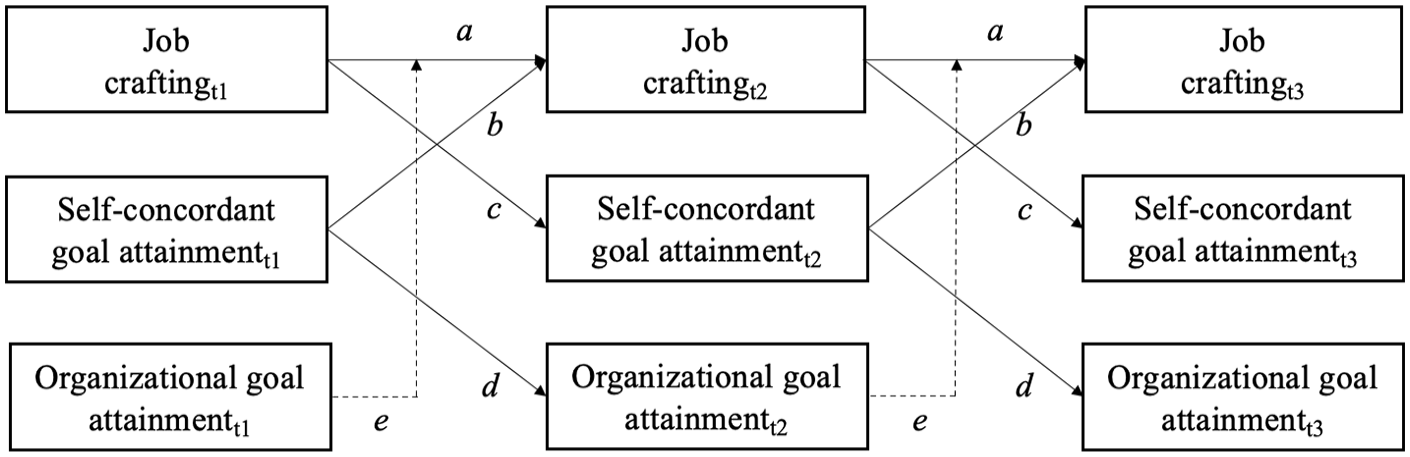
Reciprocal relationships of job crafting, self-concordant goal attainment, and organizational goal attainment.
The role of self-concordant goal attainment for sustained job crafting over time
Within the job crafting literature, a body of work has started making links between job crafting and a set of self-concordant outcomes. For example, Unsworth and Mason (2016) propose that the rewards of job crafting may ultimately be based on the achievement of greater self-concordance and the associated need satisfaction that follows. Berg et al. (2013) expanded on Wrzesniewski and Dutton’s (2001) job crafting theory to detail how work meaningfulness can be enhanced by changing tasks (adding, emphasizing, or redesigning tasks), changing relationships (building, reframing, or adapting relationships), and changing perceptions (expanding, focusing, or linking perceptions). Indeed, Geldenhuys et al. (2021) find positive relationships between task and cognitive crafting and lagged meaningfulness in a weekly diary study. Slemp and Vella-Brodrick (2014) report findings that job crafting practices are overall positively correlated with intrinsic, self-concordant goal setting and show that task, relational, and cognitive crafting each correlate with intrinsic need satisfaction, and in turn with psychological well-being. Further, Gravador and Teng-Calleja (2018) used self-concordance theorizing to investigate work–life balance crafting, finding a positive link between these crafting behaviors and well-being. The job crafting literature therefore suggests a positive relationship between job crafting and self-concordant outcomes.
However, the extent to which reciprocal effects are tested in job crafting research is rare. This is despite reverse effects between job crafting and a range of outcomes being suggested including work engagement, burnout, person–environment fit, and leader–member exchange quality (e.g. Harju et al., 2016; Lichtenthaler and Fischbach, 2019; Petrou et al., 2015; Rudolph et al., 2017). Nevertheless, Tims et al. (2016) found over one-week intervals that job crafting, in terms of seeking job resources/challenges and reducing job demands, positively predicted subsequent person–job fit and, in turn, meaningfulness, but not vice versa. A unidirectional relationship has also been found between work engagement and psychological capital (over three-month intervals; Vogt et al., 2016). Bucking this trend is a recent study by Tomas et al. (2023), which found that job crafting and innovative work behavior were reciprocally related. We extend this literature by studying the relationship between job crafting and self-concordant goal attainment—in this study’s context, those goals intrinsic to church ministers’ callings. Past research suggests job crafting may help workers pursue callings within their jobs, for instance through re-emphasizing certain job aspects, adding new tasks or projects, and cognitive role reframing (Berg et al., 2010a). We propose that ministers’ crafting across the task, relational, and cognitive domains collectively satisfy a sense of mission and communion, and thereby achieve a more fulfilled sense of personal calling and the experience of self-concordance.
In terms of the reverse relationship, the current job crafting literature is equivocal. Tims et al. (2016) and Vogt et al. (2016; discussed above), both using three-wave designs, failed to find signs of reverse causation. Others using two-wave designs, such as Hakanen et al. (2018), find work engagement is predictive of subsequent crafting of job resources and challenges, and reducing hinderance demands, but job satisfaction is not related to these forms of lagged job crafting. Drawing on the self-concordance model, which depicts a self-sustaining cycle in which self-concordant goal attainment and need satisfaction are both reciprocal inputs and outputs (Sheldon and Houser-Marko, 2001), we expect successful attainment of self-concordant goals to promote further job crafting. Our theorizing of job crafting as a self-concordant process expands earlier discussions in the job crafting literature that have focused on need dissatisfaction or discrepancy in job–person fit as key motivators of aspects of job crafting (e.g. Lin et al., 2017; Wang et al., 2020). For instance, discussing the dominant crafting motives within the literature, De Bloom et al. (2020) differentiate needs discrepancy, as a core driver of job crafting, from need satisfaction, as a job crafting outcome that may impel or attract crafting efforts. In contrast, the self-concordance perspective frames need satisfaction as the central motivator, rather than needs discrepancy—the latter would imply a negative association between need satisfaction and subsequent job crafting.
Studies in a wide range of work settings support the role of self-concordant goal attainment as a mechanism that links self-concordant goals with greater need satisfaction (e.g. Greguras and Diefendorff, 2010; Judge et al., 2005). In addition, research on need satisfaction at work also suggests that it supports job crafting behaviors, as well as other positive behaviors in the workplace, such as greater proactive and creative performance (van den Broeck et al., 2016). In addition, as individuals gain resources (i.e. gaining need satisfaction through job crafting), evidence from conservation of resources theorizing (Halbesleben et al., 2014; Hobfoll, 1989) suggests they will be in a better position to invest and gain additional resources (i.e. engage in job crafting for further need satisfaction) in the future. In sum, as a self-concordant process, we expect job crafting will demonstrate a reciprocal positive association with self-concordant goal attainment, with successful self-concordant goal attainment providing the impetus for further job crafting efforts over time:
Hypothesis 1: Job crafting and self-concordant goal attainment have a positive reciprocal relationship over time, such that (a) job crafting is positively associated with subsequent self-concordant goal attainment and (b) self-concordant goal attainment is positively associated with subsequent job crafting.
The role of organizational goal attainment for sustained job crafting over time
Job crafting constitutes, primarily, a type of positive work behavior focused on enriching an individual’s job and is not per se aimed at benefiting the organization (Wrzesniewski and Dutton, 2001). In this context, a body of research has started to explore the extent to which job crafting may also benefit organizational outcomes, such as performance (Tims et al., 2015) and intention to quit (e.g. Rudolph et al., 2017). Evidence to date suggests job crafting has overall beneficial associations with such organizational outcomes (Lee and Lee, 2018). Most recently, job crafting research has found that experienced meaningfulness may mediate positive relationships between task and cognitive crafting with both job and contextual performance over a period of weeks (Geldenhuys et al., 2021), indicating that the overall link of job crafting with organizational outcomes may be indirect.
Adding to these findings we propose job crafting, as a self-concordant process, promotes organizational goal attainment indirectly via increased self-concordant goal attainment. In particular, we expect the need satisfaction accompanying self-concordant goal attainment will enhance intrinsic motivation, effort, and positive affect, which have all been linked to improved worker performance (Gagné and Deci, 2005; Sheldon and Elliot, 1999). Indeed, research has found that need satisfaction mediates a positive relationship between self-concordant goal attainment and outcomes such as task performance and organizational citizenship (Greguras and Diefendorff, 2010). In sum, in line with our theorizing, this literature suggests that while engagement in job crafting may be most closely linked with self-concordant outcomes, outcomes of less personal importance, such as the pursuit of organizational goals, may also be attained through job crafting, albeit more distally.
In addition, although we argued above job crafting is associated with beneficial organizational outcomes via greater self-concordance, we do not expect this relationship to be reciprocal. This is because pursuit and attainment of more extrinsically regulated goals involve more limited satisfaction of core psychological needs (Sheldon and Elliot, 1999). Prior studies show that when behaviors are regulated more by extrinsic than intrinsic motivation, they are less likely to be sustained over time (e.g. with citizenship behaviors, Hui et al., 2000; with engagement in work tasks, Grant, 2008). Two-wave studies of job crafting have also found non-significant relations between measures of performance and subsequent job crafting (e.g. Dubbelt et al., 2019). We argue that this is likely to apply to organizational goal attainment that typically reflect the standards, values and priorities of an organization and define worker performance (Latham, 2001; Mohr, 1973). The pursuit of organizational goals by workers likely involves salient external contingencies because workers’ activities relating to organizational goal accomplishment contribute to the feedback, recognition or rewards workers receive via formal or informal performance management systems (Ross, 1975; Taylor and Fiske, 1978). This occurs irrespective of the extent to which organizational values and priorities are internalized by workers and trigger intrinsic motivation (Gagné, 2018). In the context of this research, although of particular importance to the CofE, the size of congregational attendance is a relatively coarse, quantitative assessment of church ministers’ performance and can contrast with other aspects of ministerial role effectiveness involving greater self-concordance, such as the development of high-quality relationships and spirituality within a (for them) appropriately sized congregation.
In sum, we expect the extrinsic motivation linked to organizational goal attainment does not offer the need satisfaction that is required to sustain further job crafting efforts and therefore no reciprocal relationship exists. Accordingly, we expect a unidirectional, indirect relationship between job crafting and organizational goal attainment via increased self-concordant goal attainment:
Hypothesis 2: Job crafting has (a) a positive indirect association with subsequent organizational goal attainment via increased self-concordant goal attainment, but (b) organizational goal attainment is not associated with subsequent job crafting.
To more comprehensively understand the role of organizational goal attainment within the unfolding self-concordant process of job crafting, we consider how extrinsic motivation may potentially disrupt self-concordant processes. According to self-determination theory (Deci and Ryan, 1985), extrinsic factors tend to be perceived as controlling because employees feel compelled to behave in ways detached from their own interests and values. As such, extrinsic feedback, recognition and rewards linked to goal attainment undermine employees’ intrinsic motivation and frustrate fulfillment of basic needs (Gagné and Deci, 2005). Adding extrinsic regulation to an intrinsically motivating task can often shift people’s attention away from enjoyment or interest in the task toward the extrinsic goal attainment, as this becomes the salient motivational issue (Ross, 1975). In this context, research shows that extrinsic factors undermine intrinsic motivation particularly when directly rather than indirectly linked to performance and when performance is assessed quantitatively rather than qualitatively (Cerasoli et al., 2014), and also when tasks are highly complex (Hewett and Conway, 2016). For church ministers, pursuit of organization-endorsed quantifiable outcomes such as increased congregational attendance may therefore be disruptive given the extrinsic contingencies linked to their attainment.
In sum, we propose that organizational goal attainment is unlikely to sustain job crafting because it may interfere with its regulation over time in terms of individuals’ continued effort and persistence to engage in job crafting practices, as shown in Figure 1 (the moderation of path a by effect e). From this perspective, organizational goal attainment influences the association between job crafting across different time points, as indicated by the strength of its dynamic stability (i.e. the degree to which relative levels of crafting behaviors are sustained, as opposed to increasing or decreasing over time). Thus:
Hypothesis 3: The positive relationship of individuals’ engagement in job crafting over time is moderated by organizational goal attainment, such that the overall positive relationship over time is weaker when organizational goal attainment is high (rather than low).
Method
Sample and procedures
Data were collected through a longitudinal survey of CofE ministers. The survey investigated factors relating to well-being and effectiveness among a nationally representative sample of ministers across a period in which meaningful change was likely to occur. The investigated issues are salient for ministers as they have opportunities for job crafting, given their high in-role autonomy, their vocational orientations to work, and the regular measuring and appraisal of key role outcomes by their organization. The context was also promising for investigating how individuals craft their role over time, given ministers’ long organizational tenures.
The survey was performed in three equidistant waves, every two years from 2013. Longitudinal research needs to cover an appropriately long time frame to capture meaningful change (Dobrow and Weisman, 2021). In the present research, two years allows for sufficient periods for the variables of interest to change; preliminary discussions with organizational stakeholders indicated that meaningful changes to tasks, relationships, and cognitive appraisals are likely to unfold over long periods of time, and their material effects have a substantive lag. Other multi-wave job crafting studies have used similar lags of two (Cenciotti et al., 2017) or three years (Harju et al., 2016). A two-year time frame also had practical meaning in the organizational context; a two-year trend is used as the unit of data from which decisions are made as this smooths fluctuation in the annual parish data. At each time point, we assessed ministers’ engagement in job crafting as a generalized measure to determine the links from job crafting with overall self-concordant and organizational goal attainment in the role. Our approach is in line with scholars who have recommended matching “broad predictors” with “broad outcomes” (Edwards, 2001).
The sample is broadly representative of wider CofE ministers, albeit with a slightly higher proportion of women in our sample than in the general population. In each survey wave, all licensed ministers in England not participating in other sanctioned research within the organization were invited by email to take part. A weblink was also publicized through various professional development channels. It is difficult to calculate exact response rates because of the inability to assess the reach of the weblink and possible inaccuracies in email addresses sourced from the organization, but we estimate that around 7000 individuals were invited to participate at each time point. We used email addresses to link surveys over time, as well as a unique code created through a series of questions about personal information in each survey wave. The full sample providing usable data included 2670 people (38.1% estimated response rate), comprising 1529 at Time 1 (21.8% estimated response rate), 1470 at Time 2 (21.0% estimated response rate), and 1517 at Time 3 (22.4% estimated response rate); 372 participants responded at all three time points. These response and attrition levels are similar to those observed in other long-term multi-wave studies (e.g. Mäkikangas et al., 2021). There was little suggestion of response bias relating to attrition: in a series of logistic regressions, no study variable predicted response likelihood to a t + 1 survey other than age and tenure (both negatively), indicating that retirement from active ministry was the only likely contributing factor. In the full sample of 2670, participants were mostly men (63.9%), ethnic white British (98.7%), and married or in long-term relationships (80.1%); around half (46.1%) had dependent relatives. Mean age was 59.8 years (SD = 10.5; range: 25–90 years) and mean tenure as minister was 19.2 years (SD = 12.5; range: 2–65 years).
Measures
Measures were adapted or designed to reflect features of the institutional context. For example, in item lead-ins we replaced “work” or “job” with the phrase “the ministry for which you hold a license or permission to officiate”. Before the first survey wave, an advisory group comprising active ministers and senior officials in the CofE gave feedback on the wording of all items, and we also drew on insights from preliminary interviews conducted with church ministers. Further, we asked participants to respond to each survey question considering “the last 24 months (or the time you have been in your current role, if less)”. This served to direct their focus onto the two-year period prior to the survey. Unless otherwise stated, participants were asked to indicate the extent to which they agreed with each item on a five-point scale, ranging from “strongly disagree” (1) to “strongly agree” (5).
Job crafting was measured using items we designed based on the core job crafting dimensions of task, relationship, and cognitive crafting of Wrzesniewski and Dutton (2001). Based on our earlier theorizing of job crafting as a self-concordant process, we conceptualized job crafting as a multidimensional construct consisting of three content-related dimensions (task-, relationship-, and cognitive crafting) that aggregate to an overall indication of engagement in job crafting as a church minister (Law et al., 1998). We developed an initial three-item measure of ministers’ job crafting during a preliminary survey in 2011. With advisors in the CofE, we subsequently refined and expanded the measure to comprise six items. Participants were asked, “To what extent do you agree with the following statements?”; this was followed by three pairs of items designed to assess task crafting (“I have intentionally altered what I do [i.e. the type or nature of tasks] for the better”, “I have actively tried to improve how I perform my daily tasks”), relational crafting (“I have actively developed new relationships with others”, “I have tried to improve existing relationships with people around me”), and cognitive crafting (“I have actively tried to think about things (e.g. a task or a relationship) in a different light”, “I have sought to find alternative meanings or interpretations of an important task or relationship within ministry”). All six items were used in a mean composite to represent the generalized job crafting construct. Cronbach’s α values ranged from 0.79 to 0.82 across the three time points. 1
Self-concordant goal attainment was measured by three items from Clinton et al. (2023) that capture the fulfillment of a minister’s calling, reflecting highly self-concordant goals (Sheldon and Elliot, 1999). Specifically, we asked participants how often they experience each of the following: “I feel that I am fulfilling my sense of vocation”; “I feel that I contribute to a discernible and meaningful outcome(s)”; and “I feel that I enact my calling.” Answers were given on a seven-point scale, ranging from “never” (1) to “always” (7). Cronbach’s α values ranged from 0.79 to 0.90 across the three time points.
Organizational goal attainment was measured by congregational attendance—a key organizational outcome for the CofE. Each year the National Church Institutions collate data on church attendances and then provide dioceses with breakdowns of attendances across their parishes. Consequently, each participant was aware of their respective congregational attendance level. The organization reports include averaged attendance levels for the previous two years to acknowledge annual fluctuations; hence, the biennial “score” carries institutional importance. Accordingly, we asked in the survey the extent to which “weekly attendance patterns of your congregation(s)” had changed over the last 24 months. Responses were given on a five-point scale, ranging from “significant decrease” (1) to “significant increase” (5).
Control variables
We controlled for organizational tenure at Time 1, as is recommended for variables linked to sample attrition to reduce potential bias in full information maximum likelihood (FIML) estimation (Newman, 2014). Organizational tenure was measured by asking, “In what year were you ordained as a licensed minister?” We also controlled for internal job role changes between waves for two main reasons. First, the altered job demands and resources (Debus et al., 2019) and need to socialize to the new role (Feldman, 1981) may stimulate job crafting. Second, job crafters are more likely to receive an internal promotion because of their value to the organization (Cenciotti et al., 2017). To measure internal job role changes, we asked participants in each survey, “How many years have you been licensed to your present role? (Please state number of months if less than one year.)” A role for these purposes refers to a position within a diocese, such as managing a church, overseeing a set of parishes, or taking administrative duties within the organization. A dummy variable was produced to capture a job change during the two years prior to each survey (1) versus no job change (0).
Data analysis
Longitudinal research designs, compared with cross-sectional and two-wave studies, are powerful tools for generating insights into causation outside the laboratory (Hoffman, 2015). Analyses were conducted in Mplus 7 using robust maximum likelihood estimation (Muthén and Muthén, 1998–2012). Following good practice (Newman, 2014), all available data were used (N = 2670) and analyses conducted using FIML, which produces less biased estimates and more reliable standard errors than listwise deletion when data are missing (Newman, 2014).
Hypotheses were tested using manifest variables within cross-lagged panel models. In Model 1, direct and indirect effects were tested for job crafting, self-concordant goal attainment, and organizational goal attainment, controlling for internal job changes and organizational tenure. The study variables were autocorrelated with their equivalents at earlier time points and allowed to correlate with all other variables at the same time point. In addition, lagged parameters were specified between each focal variable at one time point and each other variable at the next. Each of these variables was regressed onto organizational tenure at Time 1 and internal job change at the same time point. Lastly, following best practice recommendations for cross-lagged models when time lags are equal (Cole and Maxwell, 2003; Orth et al., 2021), we added equality constraints to each of the lagged parameters for the same relationships: for example, the estimate for the relationship between job crafting at Time 1 and self-concordant goal attainment at Time 2 was fixed to be equal to the estimate for the relationship between job crafting at Time 2 and self-concordant goal attainment at Time 3 (i.e. path c in Figure 1). It is argued that applying equality constraints, if model fit is not affected, enhances precision and power of estimates, reduces model complexity, and aids interpretability (Orth et al., 2021). Indirect effects were tested using bias-corrected bootstrapped 95% confidence intervals with 10,000 samples (Preacher et al., 2007).
Moderation effects were assessed in Model 2 by adding interaction terms (job crafting*moderator within the same wave) at Time 1 and Time 2 and specifying lagged relationships from the interaction terms to job crafting at the next time point. In effect, this method tests the moderation of job crafting’s autocorrelation, which reflects the temporal stability of the rank-order of individuals in terms of job crafting scores from one occasion to the next (Finkel, 1995). The same approach has been used to examine the moderation of concept stability over time in other studies (e.g. for anxiety stability in Wood et al., 2017). A small autocorrelation suggests a substantial reshuffling of the respondents’ relative standings on the construct over time, whereas a sizable autocorrelation indicates very little change in their relative standings on the construct (Selig and Little, 2012). Significant effects were probed using ±1 standard deviations of the moderator (Aiken and West, 1991).
Results
Initial analyses
Before hypothesis testing, measurement validity and longitudinal measurement invariance were assessed by a series of confirmatory factor analyses (CFAs) involving all study variables (Vandenberg and Lance, 2000). To test for construct validity and configurational invariance, the indicators for job crafting and self-concordant goal attainment were fixed to load onto their theorized latent variables at each time point with matched indicators across time points free to correlate, while the single-item measures for organizational goal attainment were free to correlate with one another across time points and with the latent variables for job crafting and self-concordant goal attainment. This model fitted the data well (χ2 = 1342.626, df = 345; CFI = 0.94; TLI = 0.92; RMSEA = 0.033; sRMR = 0.041; all factor loadings > 0.50). This model fit was also better than that of a three-factor model in which indicators at the same time point were loaded onto common latent variables for Time 1, Time 2, and Time 3 (χ2 = 5664.024, df = 375; p < 0.001; CFI = 0.66; TLI = 0.61; RMSEA = 0.073; sRMR = 0.126), and better than the respective fits of alternative CFA models combining different measures (detailed results of all CFA analyses are available from the first author). The configurational model was then constrained to test for (a) weak factorial invariance, with factor loadings fixed to be equal across time points, and (b) strong factorial invariance, with indicator intercepts fixed to be equal across time points. Adding equality constraints on the factor loadings did not significantly reduce model fit (∆χ2 = 13.909, df = 14; p = 0.457). Adding further equality constraints to the indicator intercepts significantly reduced model fit (∆χ2 = 118.109, df = 18; p < 0.001), suggesting it was inappropriate to assume strong factorial invariance. Accordingly, hypothesis testing proceeded assuming of weak factorial invariance, which is required for robust estimates from cross-lagged panel models in Models 1 and 2 (Vandenberg and Lance, 2000).
Model 1, which is based on manifest variables and used to test the three study hypotheses, fitted the data well (χ2 = 96.624, df = 42; CFI = 0.98; TLI = 0.95; RMSEA = 0.022; sRMR = 0.038). Moreover, Model 1 fit was not inferior to that of a less parsimonious alternative model without temporal equality constraints on the structural parameters (∆χ2 = 9.234, df = 12; p = 0.683). Table 1 presents the means, standard deviations, zero-order correlations, and internal consistency values of all the study variables.
Means, standard deviations, reliabilities, and zero-order correlations.
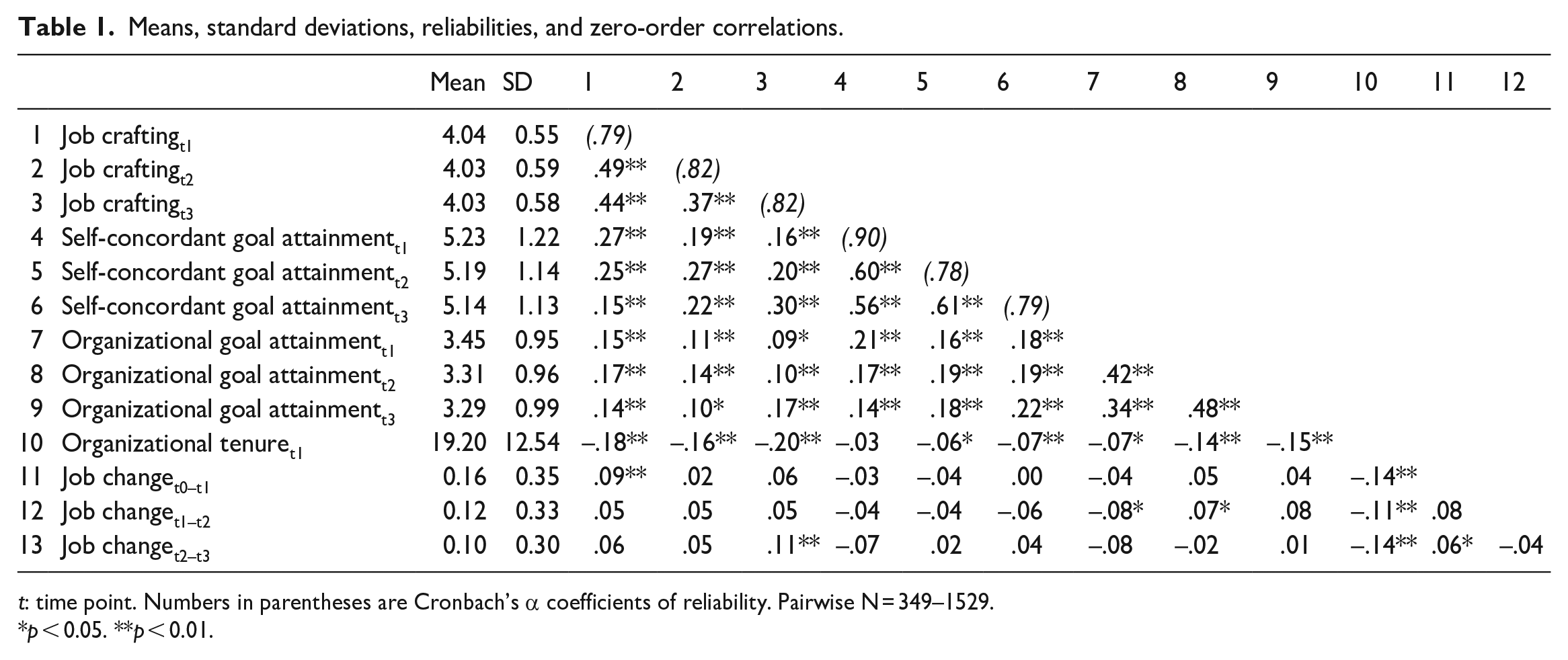
t: time point. Numbers in parentheses are Cronbach’s α coefficients of reliability. Pairwise N = 349–1529.
p < 0.05. **p < 0.01.
Hypothesis testing
Findings for the hypothesis tests are presented in Table 2, including estimates for all autocorrelations and lagged effects in Models 1 and 2. Hypothesis 1a and 1b together predict that the relationship between job crafting and self-concordant goal attainment is positive and reciprocal over time. Supporting Hypothesis 1a, job crafting had a positive relationship with lagged self-concordant goal attainment (b = 0.13, SE = 0.04, p = 0.003). Hypothesis 1b is also supported by the positive relationship of self-concordant goal attainment with lagged job crafting (b = 0.03, SE = 0.01, p = 0.013). In contrast, no significant direct relationships were observed between job crafting and organizational goal attainment in either direction. Therefore, in line with our theorizing, the reciprocal relationship between job crafting and self-concordant goal attainment is fully supported, whereas there is little evidence to support reciprocal relationships between job crafting and organizational goal attainment.
Cross-lagged panel model estimates.
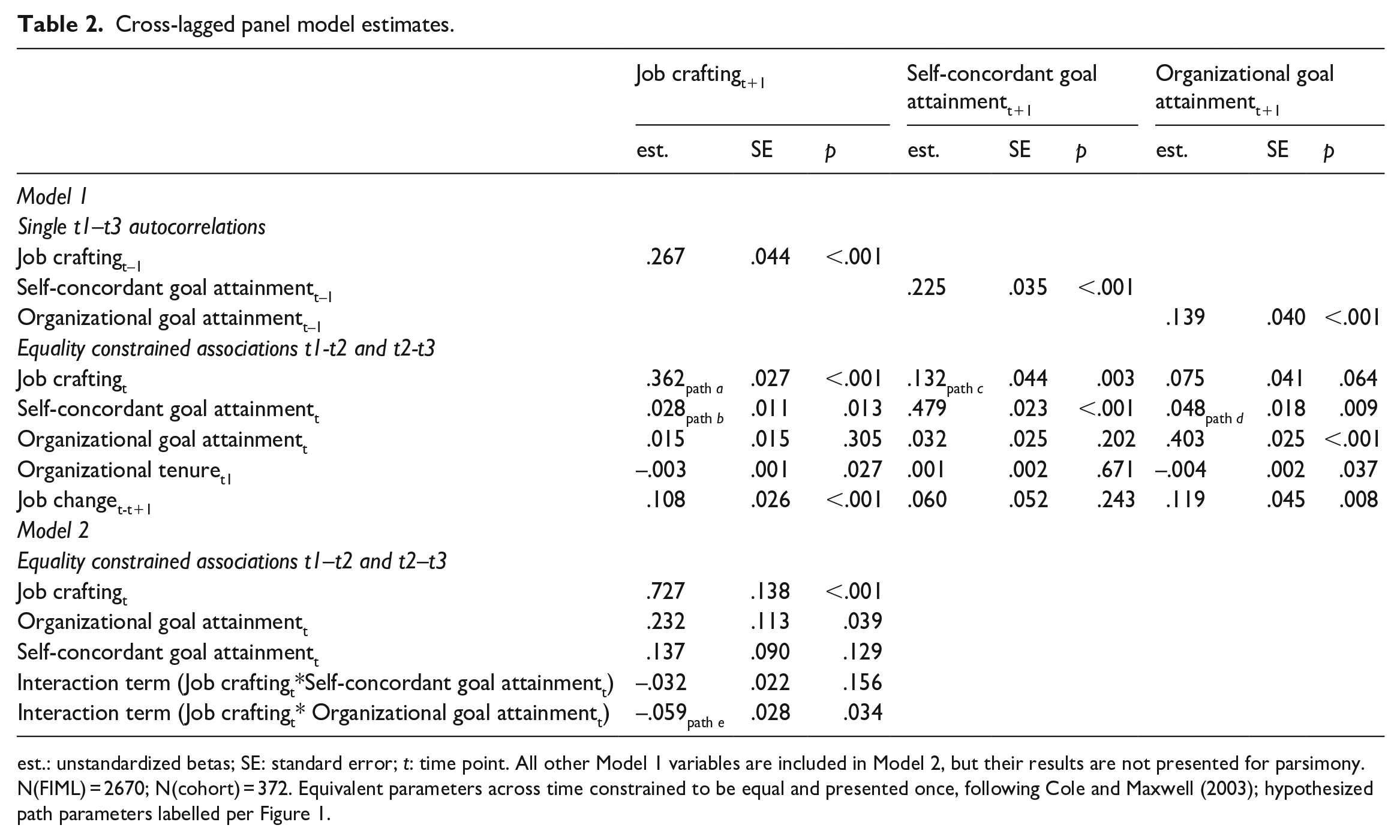
est.: unstandardized betas; SE: standard error; t: time point. All other Model 1 variables are included in Model 2, but their results are not presented for parsimony. N(FIML) = 2670; N(cohort) = 372. Equivalent parameters across time constrained to be equal and presented once, following Cole and Maxwell (2003); hypothesized path parameters labelled per Figure 1.
Hypothesis 2a predicts a positive indirect relationship between job crafting and subsequent organizational goal attainment via self-concordant goal attainment. To test this hypothesis, we examined the indirect relationship between job crafting at Time 1 and organizational goal attainment at Time 3 via self-concordant goal attainment at Time 2. Supporting our hypothesis, the indirect effect was significant (b = 0.006, SE = 0.003; LLCIbc = 0.003, ULCIbc = 0.008). In line with our theorizing, this suggests that, by increasing self-concordant goal attainment, job crafting subsequently promotes organizational goal attainment. In further support of our proposed mechanisms, no similar indirect effect was observed between job crafting and self-concordant goal attainment via organizational goal attainment (b = 0.002, SE = 0.002; LLCIbc = −0.002, ULCIbc = 0.003). In addition, Hypothesis 2b proposes a nonsignificant relationship between job crafting and lagged organizational goal attainment and this is what was found (b = 0.02, SE = 0.02, p = 0.305).
Hypothesis 3 predicts that organizational goal attainment moderates the positive relationship between job crafting over time, that is, its autocorrelation, such that it is weaker when organizational goal attainment is high (rather than low). To test this hypothesis, we added to Model 1 the interaction terms for job crafting × organizational goal attainment and for job crafting × self-concordant goal attainment, thus creating Model 2. The new model continued to fit the data well (χ2 = 149.680, df = 55; CFI = 0.99; TLI = 0.98; RMSEA = 0.025; sRMR = 0.047). Table 2 presents the key lagged relationships for Model 2. Providing initial support for our theorizing, the interaction term of job crafting × organizational goal attainment was significant in predicting subsequent job crafting (b = 0.13, SE = 0.06, p = 0.021; see Figure 2). Moreover, the positive association between indicators of job crafting across time was smaller when organizational goal attainment was high (+1SD; b = 0.47, SE = 0.13, p < 0.001) compared with low (−1SD; b = 0.58, SE = 0.12, p < 0.001). These results indicate that the relationship between job crafting over time was weaker, and therefore less temporally stable, at high (vs. low) levels of organizational goal attainment. In contrast, self-concordant goal attainment did not moderate the association of job crafting over time (b = –0.03, SE = 0.02, p = 0.156). Overall, these findings support Hypothesis 3.
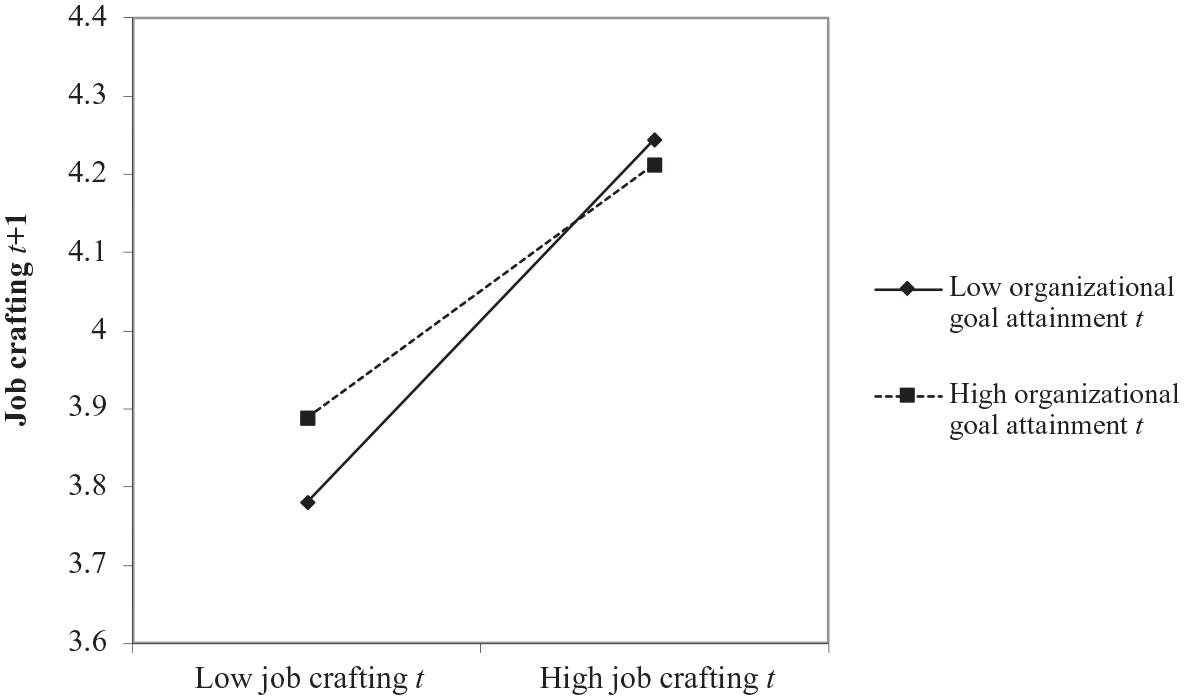
Moderating effect of organizational goal attainment (±1 SD) on the temporal stability of job crafting.
Supplementary analysis
We conducted three sets of additional analyses inspired by suggestions from our three reviewers. First, we explored the reciprocal relationships within our model without temporal equality constraints, finding that while all effects continue to be in the same direction, some vary in their size. Estimates for the effects of forms of goal attainment were quite consistent: for self-concordant goal attainment and lagged job crafting associations were consistently 0.03 (Time 1–2; SE = 0.02, p = 0.067; Time 2–3; SE = 0.02, p = 0.127), and for organizational goal attainment and lagged job crafting associations ranged between 0.003 (Time 1–2; SE = 0.02, p = 0.888) and 0.02 (Time 2–3; SE = 0.02, p = 0.363). Estimates for the effects of job crafting varied more so: job crafting and lagged self-concordant goal attainment associations ranged between 0.18 (Time 1–2; SE = 0.06, p = 0.005) and 0.08 (Time 2–3; SE = 0.06, p = 0.225), and job crafting and lagged organizational goal attainment associations ranged between 0.12 (Time 1–2; SE = 0.06, p = 0.037) and 0.02 (Time 2–3; SE = 0.06, p = 0.744). Estimates of the moderation effect also varied, between –0.07 (Time 1–2; SE = 0.04, p = 0.086) and −0.05 (Time 2–3; SE = 0.04, p = 0.226). We return later to these interesting findings when discussing future research on the dynamics of job crafting.
Second, we performed a series of exploratory analyses using our main dataset focusing on each of the two-item subdimensions of our job crafting measure, respectively, while acknowledging that the lower alpha reliabilities of individual subdimensions (α range 0.61–0.75; mean = 0.69) are a limitation to these exploratory analyses. We began by examining the inter-relations of different types of job crafting practices over time in a model that included only the three subdimensions at each time point, as well as the control variables. Focusing on effects over time, cognitive crafting had a positive lagged association with both relational crafting (b = 0.11, SE = 0.03, p < 0.001) and task crafting (b = 0.12, SE = 0.03, p < 0.001). Further, relational crafting had a positive lagged association with task crafting (b = 0.14, SE = 0.03, p < 0.001), but not cognitive crafting (b = 0.04, SE = 0.03, p = 0.192). Task crafting predicted neither cognitive (b = 0.01, SE = 0.03, p = 0.703) nor relational crafting (b = 0.03, SE = 0.03, p = 0.266). Together, as we discuss later, these exploratory analyses hint at additional temporal processes among distinct dimensions of job crafting.
To explore how each subdimension of job crafting functions within the context of our model in Figure 1 further, we retested the main hypotheses replacing the generalized measure with each subdimension, in turn. Hypothesis 1a (the lagged relationship of crafting with self-concordant goal attainment) was supported for the behavioral types of job crafting [relational crafting (b = 0.06, SE = 0.01, p < 0.001) and task crafting (b = 0.04, SE = 0.01, p = 0.003)], but not for cognitive crafting (b = 0.02, SE = 0.01, p = 0.194). Hypothesis 1b (the lagged relationship from self-concordant goal attainment to crafting) was supported for cognitive crafting (b = 0.10, SE = 0.03, p = 0.003) and relational crafting (b = 0.13, SE = 0.04, p < 0.001), but not for task crafting (b = 0.04, SE = 0.03, p = 0.291). In terms of the proposed indirect relationship between job crafting and organizational goal attainment via self-concordant goal attainment (Hypothesis 2a), we find support for the behavioral types of job crafting [relational crafting (b = 0.06, SE = 0.01, LLCIbc = 0.04, ULCIbc = 0.08) and task crafting (b = 0.04, SE = 0.01, LLCIbc = 0.02, ULCIbc = 0.06)], but not for cognitive crafting (b = 0.02, SE = 0.01, LLCIbc = −0.01, ULCIbc = 0.03). The null hypothesis around the non-relationship between organizational goal attainment and lagged job crafting was replicated for cognitive crafting (b = 0.01, SE = 0.02, p = 0.728) and relational crafting (b = 0.01, SE = 0.02, p = 0.695), but not for task crafting (b = 0.05, SE = 0.02, p = 0.012). Finally, although the individual effects across subdimensions of job crafting were all in the expected direction for the moderation tests (Hypothesis 3) they were not significant, perhaps owing to the sensitivity of moderation tests to lower reliability.
Third, to evaluate the generalizability of the basic relationships between constructs in our study beyond the context of church ministers, we conducted an additional online survey of a diverse sample of 528 UK employees from a wide range of organizations and occupations through an established panel provider (Prolific Academic Ltd). We find a similar pattern of cross-sectional associations in this additional dataset as compared with the pattern of cross-sectional associations from the main study (see Table 1), based on averaged coefficients across time points: the positive association between job crafting and self-concordant goal attainment (mean rmain_t1–t3 = .28 vs. radditional = .45, p < .001; using the same measures as in our main study) is significant and stronger than that between job crafting and organizational goal attainment (mean rmain_t1–t3 = .16 vs. radditional = .12, p < .001; organizational goal attainment was measured in the additional study via five items from an established job performance scale; Williams and Anderson, 1991). We also find a similar level of association between self-concordant goal attainment and organizational goal attainment across the two independent samples (mean rmain_t1–t3 = .21 vs. radditional = .25, p < .001). This suggests the pattern of basic associations we find in our main study is unlikely to be attributable to the particular organizational context of CofE ministers. Full descriptions of all supplementary tests are available from the first author.
Discussion
To date, research has offered only limited insights into job crafting’s reciprocal relationships over time (Rudolph et al., 2017; Zhang and Parker, 2019) as existing findings have been mixed about the unfolding patterns of relationships (Tomas et al., 2023; Vogt et al., 2016). Our findings, based on a model derived from combining job crafting theory (Wrzesniewski and Dutton, 2001) and self-concordance theory (Sheldon and Elliot, 1999) support the notion of job crafting as a predominantly self-concordant process. Specifically, we find that job crafting and self-concordant goal attainment have a positive and reciprocal relationship over time. In contrast, our findings show the relationship between job crafting and subsequent organizational goal attainment was unidirectional and indirect, via self-concordant goal attainment. Moreover, organizational goal attainment moderated individuals’ sustained engagement in job crafting, disrupting the self-concordant process of job crafting at one time point and the next. Next, we describe how our findings inform theory and practice.
Theoretical implications
Our research has several theoretical implications. First, our findings offer broad support for the role of dynamic, self-concordant processes within the original model of job crafting, comprising task, relational, and cognitive crafting (Wrzesniewski and Dutton, 2001). In particular, our model establishes motivational pathways through which such job crafting behaviors will be either maintained or interrupted over time. Our finding of a primary self-concordant pathway answers calls to incorporate self-concordance principles into job crafting theory (Unsworth and Mason, 2016). One key implication of this self-concordant pathway here is that need satisfaction, in terms of the autonomy, competence, and relatedness attained through job crafting (e.g. Bindl et al., 2019), may function to drive continued job crafting over time. This finding arguably extends suggestions that job crafting is primarily motivated by psychological need dissatisfaction (e.g. Wang et al., 2020) or person–environment misfit (e.g. Tims and Bakker, 2010). Our results imply that individuals will sustain job crafting when the opportunity arises—that is, when their needs are satisfied and they have the resources to continue job crafting—rather than out of necessity to address unmet needs or poor fit. Importantly, our study does not rule out the possibility of multiple co-existing effects: job crafting could be influenced by a motivation to enrich lowly resourced or high-stress jobs, as sometimes implied in the literature (e.g. Nielsen and Abildgaard, 2012), as well as by high personal resources providing the opportunity to craft, as our findings suggest. We encourage future research to investigate how these distinct motivating processes of job crafting may function together, following the example of research studying the coexistence of prevention- and promotion-focused crafting (Bindl et al., 2019; Bruning and Campion, 2018).
Our findings also offer a nuanced contribution to the debate over organizational benefits of job crafting by examining relationships more comprehensively, over a longer-term, multi-year period. While the question has been raised over whether job crafting can be potentially problematic for organizational interests that do not align with personal interests (e.g. Wrzesniewski and Dutton, 2001), scholars have called for further evidence on the links between the motivational perspective of job crafting based on task, relational, and cognitive crafting and worker effectiveness (Lee and Lee, 2018; Zhang and Parker, 2019). Our findings overall support the prevailing belief that job crafting will positively contribute to outcomes such as job performance (e.g. Rudolph et al., 2017). However, our framework and findings also suggest that such positive contributions to job performance occur only indirectly, through increased self-concordant goal attainment, in establishing organizational goal attainment as a temporally more distal outcome of job crafting relative to self-concordant goal attainment. This means that organizational benefits of job crafting are likely to accrue as a valuable by-product of the self-concordant gains made by job crafters over time. In sum, our findings add a temporal perspective in reframing not whether, but when, job crafting may be beneficial for organizations, rather than solely for the focal job crafters, themselves.
In addition, the secondary pathway we establish in our model identifies how job crafting may be interrupted over time by incorporating organizational goal attainment, characterized by relatively lower self-concordance and greater extrinsic motivation (Gagné, 2018). Extrinsic goal attainment is therefore an important boundary condition within the dynamics of job crafting that has received little attention to date (Zhang and Parker, 2019). In line with our theorizing, we found job crafting is not directly or reciprocally related to organizational goal attainment; instead, the latter reduces the subsequent temporal stability of job crafting behavior. Overall, these findings suggest attaining organization-sanctioned goals does not contribute to further job crafting but rather reduces the longitudinal connection between job crafting levels—a finding consistent with propositions drawn from self-determination theory (Gagné and Deci, 2005). This finding has important theoretical implications for designing job crafting interventions, as it suggests interventions based on organizational goal-setting may have less longevity than those based on self-concordance.
Further, the supplementary analyses conducted on the subdimensions of job crafting offer intriguing insights into how the task, relational, and cognitive crafting dimensions may be differentially related to each other and to core outcomes of job crafting longitudinally. We found that cognitive crafting precedes behavioral (relational and task crafting) types of job crafting (with relational crafting additionally preceding subsequent task crafting) and that behavioral crafting, in turn, was more strongly linked to lagged goal attainment than cognitive crafting. This temporal sequence across distinct job crafting dimensions mirrors earlier qualitative findings (Berg et al., 2010b). It also reflects the logic within other models of proactive work behavior more broadly, emphasizing the importance of novel cognitive states as initiators of future behavioral change (e.g. Bindl et al., 2012).
Lastly, our findings are based on a representative population of a type of workers (church ministers) who are characterized by a relatively advanced age and organizational tenure compared with the overall working population. This is important to note, considering that negative associations have been reported between age and tenure with approach crafting (Rudolph et al., 2017), perhaps attributable to older workers with longer tenure already experiencing enhanced job satisfaction and favorable attitudes toward their job characteristics (Ng and Feldman, 2010). It has also been noted that age-related changes to job mobility, physical abilities, and crystallized intelligence may all have implications for job crafting (Kooij et al., 2015) and these discussions have led to varying job crafting conceptualizations and operationalizations for workers across the life span (e.g. accommodative, utilization, and developmental crafting; see Kooij et al., 2022). In this context, our findings contribute to this ongoing discussion of job crafting in advanced age by demonstrating that Wrzesniewski and Dutton’s (2001) original model of job crafting, focused on task, relationship, and cognitive crafting, continues to have relevance and meaning for individuals later in their working lives.
Practical implications
Our findings support earlier research (e.g. Dierdorff and Jensen, 2018) that job crafting is an inherently personal phenomenon, motivated and sustained by a drive to satisfy one’s individual needs at work; organizational outcomes like performance are likely only indirectly positively affected by this ongoing process. By implication, organizations may be unlikely to derive immediate pay-offs from job crafting in the workforce and, instead, may have to be patient to see organizationally desirable results. This echoes evidence on enriching and redesigning work top–down by the organization, which, while immediately satisfying and meaningful to workers themselves, similarly takes time to show positive effects on overall worker productivity (Griffin, 1991). In other words, short-term focus on investment returns may need to be reconsidered to allow time for longer-term positive developments through workers’ job crafting. Further, our findings suggest that job crafting can offer organizations a self-sustaining cycle of benefits most readily when they recruit and retain individuals whose self-concordant goals match organizational goals. Job crafting will likely be less effective for organizations whose interests differ greatly from those of their workers. Another implication is that for organizations to sustain job crafting, it may be necessary to further align organizational goals with workers’ intrinsic goal achievement, thereby avoiding disruptions to job crafting when organizational goal attainment is high. Reinforcing the intrinsic aspects of work goals, for example via transformational leadership (Bono and Judge, 2003), may help to prevent the reduction in motivation for job crafting after attaining organizational goals.
Limitations and future research
Our research has limitations that are important to discuss and to suggest potentially useful avenues for future research. First, we focused in our research on a specific work context: ministers in the CofE. This approach was ideal in allowing us to focus in depth on job crafting as self-concordant action over time, given the relatively long tenures of church minsters. Characteristics of church ministers’ roles also share features common to a wide range of work roles, including team-working and supervision, managing budgets and accountability for performance standards. However, other features may be less common, such as the high levels of autonomy, the spiritual nature of the work, the limited separation between work and non-work, and the prosocial orientation of workers. Our supplementary study also suggested overall relationships of the core measures in our research are similar in size across a wider range of occupations and industries, but still our findings may most easily generalize to other contexts containing similar work features as our main sample. We therefore encourage future research to build on our model across a wider range of settings.
Second, our study sought to establish a model of job crafting as self-concordant action and, in doing so, we distinguish self-concordant from organizational goals. However, we did not account for more subtle variation in the self-concordance of goals (Sheldon, 2014). While less self-concordant than goals in the domain of one’s calling, organizational goals may involve greater self-concordance for individuals working for organizations whose values and purpose they share. The context of the CofE arguably offers a conservative test of parts of our framework and stronger effects, for example regarding the disruption of sustained job crafting by organizational goal attainment, may be seen in contexts setting even less self-concordant goals for workers, such as unpleasant or distasteful tasks key for organizational performance. Both personal and situational differences may function as moderators here. For example, person–environment fit, the degree to which a worker perceives their values match the organization’s (Kristof, 1996), may well influence the degree to which organizational goals hold more intrinsic value for workers and the degree to which these goals inhibit further job crafting pursuits. Similarly, we were not able to test some of the proposed mechanisms as mediators, such as need satisfaction. Incorporating more fine-grained mechanisms into longitudinal research on job crafting will be an exciting avenue to follow.
Third, we measured organizational goal attainment using a single, self-rated item, rather than a multi-item scale or independent rating. Multi-item measures offer greater reliability, while single-item measures can be clearer and more valid for role holders (Fisher et al., 2016). Given that congregational attendances are a quantifiable measure recorded within churches, self-ratings in our study context should cohere with independent assessments, with little risk of response bias. We also measured organizational goal attainment in our supplementary study with an established multi-item scale, finding the same overall patterns of organizational goal attainment with self-concordant goal attainment and with job crafting. In this context, we recommend future research to use meaningful constructs of organizational goal attainment for the corresponding organizational context, while ensuring they represent generalized patterns of self-concordant and organizational goal attainment as expected in the broader population.
Fourth, we used a measure of generalized job crafting based on the original perspective of job crafting (Wrzesniewski and Dutton, 2001). While worker-centric perspectives of job crafting have dominated the job crafting literature (Rudolph et al., 2017), it is worth noting that more prosocial forms of job crafting have also been established (e.g. Korczynski, 2003; Leana et al., 2009). Future research could investigate the extent to which more collaborative or other-oriented forms of job crafting involve self-concordant processes to provide a more comprehensive insight into the dynamics of both individualized and group-based job crafting in organizations. In this context, we also encourage future research on job crafting to develop theory on how different foci of job crafting practices (individual vs. collaborative) function together or are dependent on one another to yield more beneficial outcomes for job crafters and organizations, alike.
Finally, future research may examine more systematically how job crafting and the relationships between job crafting and associates vary over time. In this study, we followed best practice recommendations in adding equality constraints to relations over time (Orth et al., 2021), but an unconstrained model suggested some variability across time, especially when considering the consistency of job crafting–outcome relations. This issue seems poorly understood. Our findings on the dynamics of job crafting subdimensions suggest that further research in this area may unlock greater efficiencies within job crafting interventions that focus initially on cognitive crafting, and then relational and task crafting. A shift in thinking about job crafting dimensions as a dynamic system may further provoke new questions: for example, does greater relational crafting with coworkers yield greater social capital at work (e.g. Rofcanin et al., 2019), thereby allowing job crafters to subsequently craft their tasks without incurring backlash in the organization? These research questions align with ongoing discussions on what constitutes “wise proactivity” in organizations (Parker et al., 2019) and, we believe, will be an exciting avenue for future research on job crafting in organizations.
Conclusion
Employees often seek to craft their jobs in organizations. Our framework of job crafting as self-concordant action suggests that different types of goal attainment are differently influenced through job crafting and have distinct implications for subsequent crafting efforts over time. Our research suggests a temporal perspective of job crafting is needed to understand not whether but when job crafting benefits both the crafter and their organization.
Footnotes
Acknowledgements
We thank Dr Tim Ling and his colleagues at the Church of England for their roles in supporting data collection. We also thank Issy De Roche for her work editing the manuscript in the final stages. Lastly, we thank colleagues in the Department of HRM & Employment Relations at King’s for their comments on an early presentation of the article, as well as the editor and the three anonymous reviewers of the article for their helpful comments.
Funding
The authors received no financial support for the research, authorship, and/or publication of this article.
