



Abstract
The information technology (IT) industry is becoming more widely renowned for its professionals seeking global career opportunities. These individuals independently build careers abroad, often receiving limited economic benefits while facing socially conditioned perceptions from their employers, peers, managers and clients. However, there is little research on how they perceive their personal and social worlds, and use their knowledge, skills and other personal resources to shape their careers in these circumstances. This study explores the meaning of being a foreign professional as understood by the IT professionals themselves by reflecting on their expectations, emotions and interactions with others. In-depth interviews were conducted with 11 non-national professionals working in domestic IT companies in Germany. We used interpretative phenomenological analysis to gain insight through their individual perspectives into their agentic work behaviours and the injustices they perceived. We identified three major themes that explained how participants interpreted their roles in their organisations (reinterpretation), resituated themselves in their interactions with clients (recontextualisation) and changed the way they made sense of their status in their current circumstances (reframing). The experiential themes were discussed in light of literature, while individual nuances led us to identify unexplored features of the studied phenomenon.
Keywords
Introduction
I don’t think I get discriminated deliberately based on how I use my knowledge and skills. I’m good, really good. But who you are, like knowledge, does speak to how much power you have. When discussing things like projects or like payment, I got into conversations with managers like, ‘Well, you’re Mexican and come from a university that we don’t know, and we don’t know how much you actually do know, and we cannot guarantee that your knowledge is that you say it is.’ Then I am like, ‘What!’ I mean, knowledge is knowledge, right?
Raúl, like other participants in this study, works in Germany as an IT professional, and the above quote from our interview with him strongly emphasises the focus of this study. There is a constructive and optimistic tone here: confident of his knowledge and skills, Raúl persistently seeks ways to move forward, and achieve his personal and professional goals. However, there is also a bitter reaction to the way his knowledge is evaluated – he believes he is treated unfairly and feels that his efforts to advance his career have been thwarted.
Individuals work abroad for many reasons; however, they also face a variety of challenges when it comes to realising their full potential as professionals who are looking to advance their careers. Such challenges may include career stagnation, language and communication barriers as well as challenges against recognition of professional skills and social integration depending on the welcoming nature of the host country and organisational practices (e.g. Fassio et al., 2019; Irastorza and Bevelander, 2021; Risberg and Romani, 2022). The literature on individuals working abroad is extensive, and how these professionals are portrayed in relation to their personal goals, expectations and circumstances varies. For some scholars, these professionals could be self-initiated expatriates (e.g. Andresen et al., 2020; Tharenou, 2015), while for others they could be referred to as migrants, corporate or business expatriates, and even international business travellers (McNulty and Brewster, 2017). Indeed, there is a lack of consensus about a universal definition for these individuals (e.g. McNulty and Brewster, 2017). In a non-traditional sense, there is growing research on individuals ‘who work globally, rather than the global work they undertake’ (Hutchings, 2022: 128; McNulty and Hutchings, 2016), and what we find worth highlighting is a perspective that prioritises the emphasis placed on the individual themselves rather than the type of their employment. Therefore, our motive in this study was to explore the individual experience itself – the experience of being a foreign professional as understood by foreign professionals themselves and in their own lived worlds. Some researchers refer to these professionals as expatriates, as people who intentionally choose to live and work in a foreign country, and may intend to return home (Tharenou, 2015). But we chose to refer to them as foreign professionals whereas we wanted to place particular emphasis on their experiences of being an outlander – a foreigner in the work setting – to acknowledge the uniqueness of each of these individual stories and the variety of individual expectations, emotions and actions.
The above passage shows Raúl’s expectations, emotions and actions deeply woven together into a piece of subjectively lived and unique experience; and this article focuses on the detailed and structured analysis of the experiences of 11 IT professionals in Germany. Our study was guided by the principles of symbolic interactionism and phenomenology (Blumer, 1969; Charmaz, 2014; Smith et al., 2022; Zahavi, 2018), and situated within the professional agency framework. Professional agency manifests itself when a professional ‘exerts influence, makes choices, and takes stances’ that affect their work and identity as professionals; and it is significant when a professional seeks to develop their role and position in their work environment (Eteläpelto et al., 2013: 62; McNay, 2004). In this vein, we sought to get a deeper insight into what being a foreign professional meant to the foreign professionals themselves. We first examined each case independently and then we identified patterns across these cases to uncover differences and similarities among foreign professionals’ perceptions of their work experience (Smith et al., 2022: 75–108). Similarities among participant experiences helped us determine how and to what extent these experiences would reflect the literature, while individual nuances in participant experiences led to the identification of unexplored or unusual features of the studied phenomenon. The article is structured as follows. To begin, we briefly explain why we chose IT professionals for our research. Next, we discuss our epistemological stance, and the framework we chose as the basis to derive our study questions and outline the study’s context and methodology. We then discuss the similarities and differences among participants’ experiences in relation to the three group-level experiential themes we have identified to explain the studied phenomenon: how participants interpreted their roles in their organisations (reinterpretation), resituated themselves in their interactions with clients (recontextualisation) and changed the way they make sense of their status in their current circumstances (reframing). Finally, we briefly discuss the overall findings in light of our study questions and how they contribute to the literature.
Foreign IT professionals: Intentions, challenges and frustrations
IT professionals support technology infrastructure for companies and create solutions to aid in the operation of business processes. Providing services to companies in a wide range of industries, they are arguably among the highly skilled workers who face the greatest challenges at work when it comes to how they use their skills and expertise to meet customer needs and requirements. We chose IT professionals for two key reasons. First, IT is a knowledge-intensive industry known for its high rate of knowledge growth, pushing professionals towards continuous professional development, and encouraging them to pursue international career opportunities (Atouba, 2021; Ha, 2015). Second, information and communication technologies have become central to how most organisations function. Many IT professionals switch jobs at every opportunity and to counteract issues caused by employee turnover and low commitment, companies develop strategies to improve management and retention (Atouba, 2018, 2021). Indeed, companies in the IT industry, especially mid-sized local companies, face numerous challenges owing to the complexity of their customers’ needs and requirements (Torri et al., 2021), and rely on key staff whose expertise and social skills are vital to their success. These employees are given critical roles and responsibilities, paid more than others and offered special incentives to stay with the company. These key positions are often assigned to native-born individuals, whereas interaction and communication within and outside of the company are crucial to its success (Atouba et al., 2019; Martin and Rawlins, 2018) leaving foreign professionals with relatively few opportunities to assume higher-level roles and responsibilities. Considering these two key factors, we found it interesting to gain insight into this global and opportunity-driven phenomenon from the perspective of professionals and to explore how foreign professionals identify themselves and make sense of their own experiences in this volatile industry. The IT profession is already plagued by unclear job descriptions and ambiguous responsibilities (Atouba, 2021), which puts foreign IT professionals at a further disadvantage when it comes to managing their interactions with their peers and customers, fulfilling their personal goals and professional expectations, performing their jobs at the highest possible level and seizing opportunities for higher and more valued positions.
Mainstream literature focuses on foreign IT professionals as part of broadly defined groups such as knowledge workers, expatriates or highly skilled migrant workers. Some studies focus on foreign IT professionals’ vulnerabilities and disadvantageous circumstances such as taking on roles where their skills and competencies are underused because they fear losing their jobs (Maitra, 2015). Another group of scholars discuss how these professionals are strictly expected to engage in continuous cultural exchanges with others in their work settings (e.g. Risberg and Romani, 2022). Furthermore, IT has long been regarded as a male-dominated industry; however, only a few studies examine foreign IT professionals’ experiences from the intersectionality perspective (e.g. Tassabehji et al., 2021). Rather than generalising these individuals’ expectations and emotions, we argue that the experience of being a foreign professional is materialised within and through interactions with others in one’s complex and multi-layered environment. Although choosing to work abroad is a carefully planned conscious action for most individuals, for others it can be viewed as a sudden change of heart and a quest for a different experience. Either way, working abroad is a matter of an individual’s own choice rooted in expectations, goals and an in-depth self-evaluation. Once this decision is actually implemented, the unique experience begins. From this point on, ‘the individual’s capacity for self-reflection and self-evaluation’ (McNay, 2004: 178) plays a critical role – the foreign IT professional, now a professional agent (Eteläpelto et al., 2013), inspects and evaluates their own thoughts, feelings and behaviours (Grant et al., 2002), and seeks to ascertain the most efficient means for achieving an intended goal.
Our epistemological position and study questions
This study explores the meaning of being a foreign professional as understood by IT professionals working in a country other than their own. In this vein, we set out to explore how these individuals engaged with their experience of working abroad and reflected on the meaning of what was happening in their lived worlds in terms of their expectations, emotions and behaviours. Meanings are shaped by how an individual makes sense of their lived experiences through the lens of their unique perspectives and they are ‘embedded in a matrix of affectivity and cognition’ (Palombo, 1991: 181–182). In other words, meanings are substantially influenced, if not determined, by emotions and, in association with self-resources, could lead to revised or renewed expectations for the future. In light of our epistemological positioning, we are interested in exploring what meanings individuals attach to significant events and actions of others in their own situations. The individual belongs to a world that provides ‘a common field of experience’ shared by everyone (Zahavi, 2018: 88), and interprets their relationship with the world based on their personal feelings and presumptions about others and the context. They situate themselves in their particular environments, and by doing this, they represent themselves by engaging in their situations.
Our research sailed in the waters of symbolic interactionism (Blumer, 1969; Mead, 1934), which posits that individuals act in response to their environment based on what they perceive to be true at the time (Charmaz, 2014: 262). Engaging with IT professionals from this perspective enabled us to gain an understanding of meanings, actions and events in their own worlds and explore how they evaluated and shaped their interactions in their own circumstances. Indeed, individuals are profoundly influenced by their environment, and as Mead (1934; Charmaz, 2014: 266) argued, self-development of individuals is closely related to their learning and use of the language and symbolic meanings of the society in which they live. This is particularly important for foreign professionals. Some work in a country where they have a perfect command of the language and understand the dynamics, etiquette and common sense of the society in which they live. Others may work in an isolated environment, without speaking the language of the country and living in a community of expatriates. Therefore, we find it important to understand not only how context frames the interactions and experiences of foreign professionals, but also how individuals shape their response to others through their own perceptions of their imagined self (Charmaz, 2014: 266); that is, how they believe they appear in the context in which they work.
Rigid adherence to symbolic interactionism would only lead us to the construction of a generic profile for foreign IT professionals without considering how these professionals make sense of their own individual experiences and position themselves in a wider cultural context (Smith et al., 2022: 140–141). Particularly in the case of people working abroad, each individual story is intrinsically valuable, unique and worthy of its own thorough elucidation, and it is essential to understand and respect these individuals’ experiential claims and concerns (Zahavi, 2018: 117). Each foreign professional embarks on a different journey motivated by different reasons, having different expectations, engaging in different opportunities and facing different challenges. To address the uniqueness, complexity and depth of these individual stories, we incorporated a phenomenological approach to gain insight into each individual experience; that is, into how each individual observed, related and responded to the facts and events in their own situation within the framework of professional agency where the individual ‘exerts influence, makes choices and takes stances in ways that affect their work and identity as professionals’ (Eteläpelto et al., 2013: 62; McNay, 2004). Indeed, phenomenology is about examining ‘the way things appear to individuals in their experience’ (Pietkiewicz and Smith, 2014: 8) and it was our intention to explore foreign professionals’ experiences: how they perceived themselves, made sense of their efforts and their situations, and articulated these from their viewpoints and in their own words. As experiencing beings, we experience our own actions as being generated in a way in which we actively facilitate their occurrence (Nida-Rümelin, 2018: 62). In our case, the phenomenon was about the state of being a foreign IT professional – what it meant to our participants and how it felt like. Seeing these individuals as professional agents allowed us to gain a deeper understanding of the thought processes of each of our participants, make sense of their decisions, choices and actions, and discern specific nuances they would emphasise while talking about their social environments and experiences. We had the opportunity to give voice to each individual to get a rich insight into what being a foreign professional meant to the foreign professionals themselves and how they described their expectations, emotions and behaviours as well as their challenging and often socio-culturally less familiar work settings.
Before identifying patterns across individual cases, our goal was to assess how individual experiences converged and diverged based on the context of their particular situation. For example, these professionals might collectively refer to certain aspects of working abroad, but how and to what extent they relate themselves to these aspects would vary. In addition, there might be problems and issues that foreign professionals have in common in a particular country or industry context, but how they deal with these problems and how they choose to interact with their employers and colleagues would vary. In this respect, our approach was not nomothetic – we did not want to ‘collect, transform and analyse data’ in a way that would prevent locating or analysing the ‘individuals who provided the data in the first place’ (Smith et al., 2022: 24). Rather than making a generalisable claim and pushing for a generic profile in which each participant could only be partially represented, we wanted to show the existence of a phenomenon (Smith et al., 2022: 25; Yin, 2009) characterised by the convergence and divergence of participants’ experiences in their own individual rights.
In this direction, our study questions addressed the complexity of how individuals made sense of their experiences and provided an efficient basis for the phenomenon we wanted to explore. From the self-initiated expatriation perspective (Andresen et al., 2020), it could be suggested that foreign IT professionals show a work behaviour that requires significant self-reliance and persistence in relocating themselves abroad. These professionals are internationally mobile individuals, who move to another country through their agency – not through an organisational assignment but independently – for an indeterminable duration (Al-Ariss and Crowley-Henry, 2013: 79). In demonstrating this behaviour, there is a notable sense of self-reliance on the individual power and resources – including knowledge, skills and competencies – but also persistence in the shape of self-adaptation to unfamiliar circumstances (Fay and Frese, 2001). In other words, these individuals intentionally use their ability to regulate their performance in their jobs by using their own knowledge, skills and judgement to achieve their long-term goals under the relative circumstances of a work setting that they know to a limited extent. This intention quintessentially reflects a lived experience – individual thoughts, decisions and actions are highly based on personal feelings, opinions and choices. This eventually leads foreign professionals to make significant changes in how they approach and perform their jobs so that they could fit the purposes of the organisations they work for. Therefore, our first study question is:
SQ1: How do foreign IT professionals make sense of using their knowledge, skills and competencies in response to the purposes and priorities of the organisations they work for?
However, this is not an easy journey. Being a foreigner often puts such advantages of self-containment in a very different context where these professionals could easily be exposed to intersecting social categorisations and biased treatments. In many cases, they experience differential recognition and unjust treatment whereas their knowledge, skills and competencies are discounted or unnoticed because of social biases against characteristics they embody such as ethnicity, race, gender and sexual orientation (Fricker, 2007; Koskela, 2019). This brings forward our second study question:
SQ2: How do foreign IT professionals make sense of their position resulting from socio-cultural biases and the treatment they receive at work?
Although meaning is shaped through the lens of an individual’s unique perspective, it is also context-dependent and context-sensitive – the context in which the shared experience takes place plays a critical role in shaping the meaning derived from the experience (Palombo, 1991: 182). Many countries promote practices that encourage foreign highly skilled labour because of their ageing populations, the increase in high technology investments and their desire to remain competitive in expanding international markets (Batalova and Lowell, 2007; Chand and Tung, 2019). To put our study in context, we selected Germany. The country, a top destination for foreign workers in a wide range of industries, now plays a key role in the fast-growing IT industry in Europe with a significant impact on the country’s ‘products and production processes in manufacturing’ (Diessner et al., 2022: 118). Germany is viewed as a coordinated market economy with strict adherence to employment protection and collective bargaining (Kluike, 2015). Compared with liberal market economies, the trend towards individualised employment arrangements and career paths is not quite as striking. However, some IT professionals in Germany can still pursue a very different path – at least in globally established companies – and individualised working practices are embraced, and highly skilled and well-paid professionals use their knowledge and skills to bargain over their employment and their career (e.g. Kinsella et al., 2021; Süß and Sayah, 2013). In fact, Germany’s IT industry is highly characterised by small and medium-sized enterprises (SMEs) and the major challenge for these companies is staying competitive, which calls for continuous innovation and new technology investments. As a result, companies are seeking highly skilled IT professionals, but skilled labour is in short supply (Müller et al., 2020). Besides, major decisions and strategies in SMEs are typically made by a very small group of people or even, in some cases, by only one individual, who are usually the owners of the business. At this point, we were intrigued by the IT professionals’ experiences within the context of a highly dynamic and employer-centric socio-business environment (e.g. Li et al., 2022) and how they made sense of their expectations and status as foreign professionals in their individual circumstances.
Method
Our primary concern in this study lies in capturing the subjective interpretation of every single participant as well as identifying general themes that encompass the distinct experience of each individual. As such, we turned to interpretative phenomenological analysis (IPA), a qualitative approach based on interviews for the purpose of developing insight into individuals’ lived experiences related to psychosocial phenomena. Originated in psychology, the method provides an approach to ‘capture the experiential and qualitative’ and ‘dialogue with the mainstream’ literature (Smith et al., 2022: 4). Its reach into other disciplines over the past decades is remarkable whereas the method is used to explore existential matters of significant importance for the individual based on their choices (Eatough and Smith, 2017: 205). Among recently published examples in the field of management and human resource management (HRM) studies are early-career engineers transitioning to the workplace (Huff et al., 2019); career change experiences (Ahn et al., 2017); sustainability professionals (Andrews, 2017); career experiences of deputy headteachers (Guihen, 2019); and power crafting at work (Berber and Acar, 2021). Exploring the variety of the human experience of the same phenomenon through the lenses of different individuals would contribute to the growing use of phenomenological research in management and organisational research (e.g. Gill, 2014), and exploring how the future of work is being shaped by global and fundamental changes in employment (e.g. Bonache and Festing, 2020; Harney and Collings, 2021).
IPA offers a detailed reflection on the individual’s experience of being involved in the context rather than providing a critical analysis of the contextual circumstances. That is, the central focus of the IPA researcher is on how the individual makes sense of their experience, and ‘the interpretation of the meaning for a particular person in a particular context’ (Smith et al., 2022: 141; see also Eatough and Smith, 2017). Therefore, in our study, we sought to explore what being a foreign IT professional meant to an individual, and how the individual positioned themselves in their own situation and in their interactions with others in the environment. IPA’s connections with symbolic interactionism help to gain insight into the individual’s understanding of their experience as formed by their many and varied relationships with others in their real-life context (e.g. Pietkiewicz and Smith, 2014). On the other hand, from the phenomenological perspective, emotions provide a ‘powerful indicator’ of an individual’s resonance with their environment (Smith et al., 2022: 144).
Data collection and analysis
Unlike most psychology-based research, IPA is not concerned with making claims at the group or population level establishing general laws of human behaviour. Instead, an IPA study ‘typically involves a highly intensive and detailed analysis’ of the data collected from each individual participant and ‘benefits from a concentrated focus on a small number of cases’ (Larkin et al., 2006: 103; Smith et al., 2022: 43–46). To examine convergence and divergence across participants’ experiences in detail, the sample size is typically small, and the concern with the particular requires the recruitment of a purposively homogenous group of participants (Larkin et al., 2006: 103–104; Smith and Osborn, 2003: 54–56). Our study questions address how participants made sense of their knowledge, skills and competencies, and socio-cultural biases and unfair treatments in their working environments. In this connection, the objective is to ensure the group’s uniformity according to particularly obvious factors relevant to the study (e.g. being a non-German national, not being a native German speaker, relatively small age gap and similar IT work experience among participants to mitigate generational differences, etc.) while exploring in depth the variability within the group from multiple perspectives to gain a deeper understanding of the phenomenon and its implicit characteristics (Larkin et al., 2019; Smith et al., 2022: 44). Calls were placed on various social media platforms to recruit participants. The first author invited volunteers to participate in the screening and gave them a short introduction explaining the purpose and content of the study. Candidates were assessed on their desire to pursue a career in IT with clearly defined goals and their commitment to working outside their country of origin. Eventually, 11 participants from various nationalities were selected and invited for interviews (Table 1). Participants were all residents, but not nationals, of Germany. They belonged to a narrow age range and had similar amounts of work experience in the IT industry. Only three participants identified themselves as fluent German speakers but none of the participants spoke German as their first language. All participants were fluent in English and held postgraduate degrees. Their consent was obtained prior to their interviews, and they were assured that all sensitive information, whether personal or organisation-related, would be kept confidential.
Participants’ information.
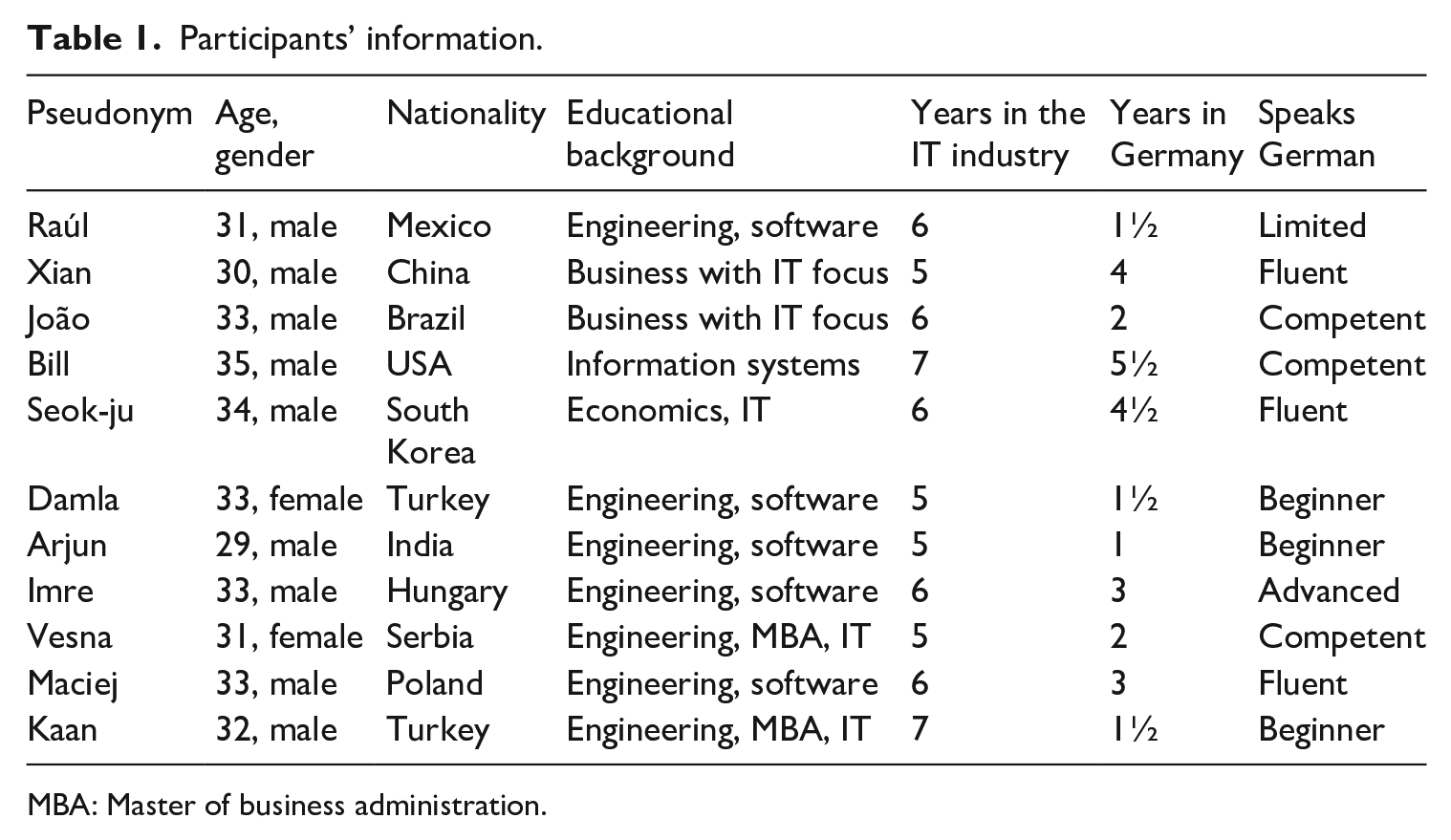
MBA: Master of business administration.
In keeping with IPA’s idiographic commitment (Larkin et al., 2006), we were not much concerned about the nature of working abroad, but rather with our participants’ experiences and understandings of working abroad in their own real-life contexts. The interview protocol mainly covered three topics: barriers in using knowledge and experience; disparities and injustices in terms of equal opportunity; and coping strategies to mitigate disadvantages. The semi-structured interviews were designed to allow participants to describe their own interactions and experiences in the workplace in their own words, reflect on issues they personally found particularly important and offer their own opinions and stories on the above-mentioned topics relevant to our study questions. Each participant was interviewed individually in English for 75–90 minutes. The interviews were recorded and transcribed verbatim except for names and any confidential information that might reveal the identities of participants. All three researchers analysed the transcriptions. MAXQDA Analytics Pro 12 (VERBI) was used to analyse the data.
To fully engage in a double hermeneutic, which is a key feature of IPA (Smith and Osborn, 2003: 51), we focused on data ‘hot spots’ that ‘glowed’ for us as the researchers (Harding et al., 2017: 1215; MacLure, 2013: 173). In an IPA study, data analysis focuses on developing a ‘coherent and psychologically informed’ description of the phenomenon as described by the participants and the researcher’s subjective interpretations of what it means for the participants to make these claims and express these feelings and concerns in their particular situations (Larkin et al., 2006: 104). The idea is not to look out for solid meanings, descriptive interpretations or seek themes in the data, but patiently to see what sparked and gradually grew into ‘greater significance’ in the data creating ‘affective resonances’ such as fascination, exhilaration, suspense and discomfort (e.g. Harding et al., 2017; MacLure, 2013: 173–175) encountered both during the interviews and the analysis of the data. The research diary and memos kept by the first researcher helped all researchers to revisit the moments of interaction with the interviewees to make sense of the first encounters with these hot spots and reach a consensus. The first and the second researchers work in institutions outside their country of birth, while the third researcher works in his home country. This potentially gave opportunity and space to resonate with how the participants made sense of their emotions, decisions and choices, and of their experiences in the analysis stage, while enabling ‘a rigorous search for any ways in which assumptions may have influenced the analysis’ (Smith et al., 2017: 145). Our analysis consisted of two cycles (Smith et al., 2022: 78–104). The first cycle analysis was carried out on the basis of individual cases and each author studied each transcript separately in its own right. These steps were followed for one transcript at a time: following an in-depth mental involvement with the transcript, we examined the semantic content and language use at a highly exploratory level. We then identified the participant’s statements related to how they made sense of their relationships and the places, events, values and principles in their particular situation. Next, these statements were compared to generate a set of personal experiential themes illustrating the participant’s experience, as agreed upon by the researchers. These steps were repeated for each participant’s case. The second cycle analysis aimed at exploring divergence and convergence across the personal experiential themes. A cross-case analysis was conducted to generate a set of group-level experiential themes (Table 2). Our goal was not to identify a common type of behaviour that would explain the entire group’s approach or norm but both the shared and the unique features of each participant’s life experience. Throughout the entire data analysis process, we paid close attention to how participants used rhetoric and language to describe and justify their experiences, and how they positioned themselves in their situations as foreign IT professionals (Gibbs, 2018: 83 and 95).
Group-level experiential themes.
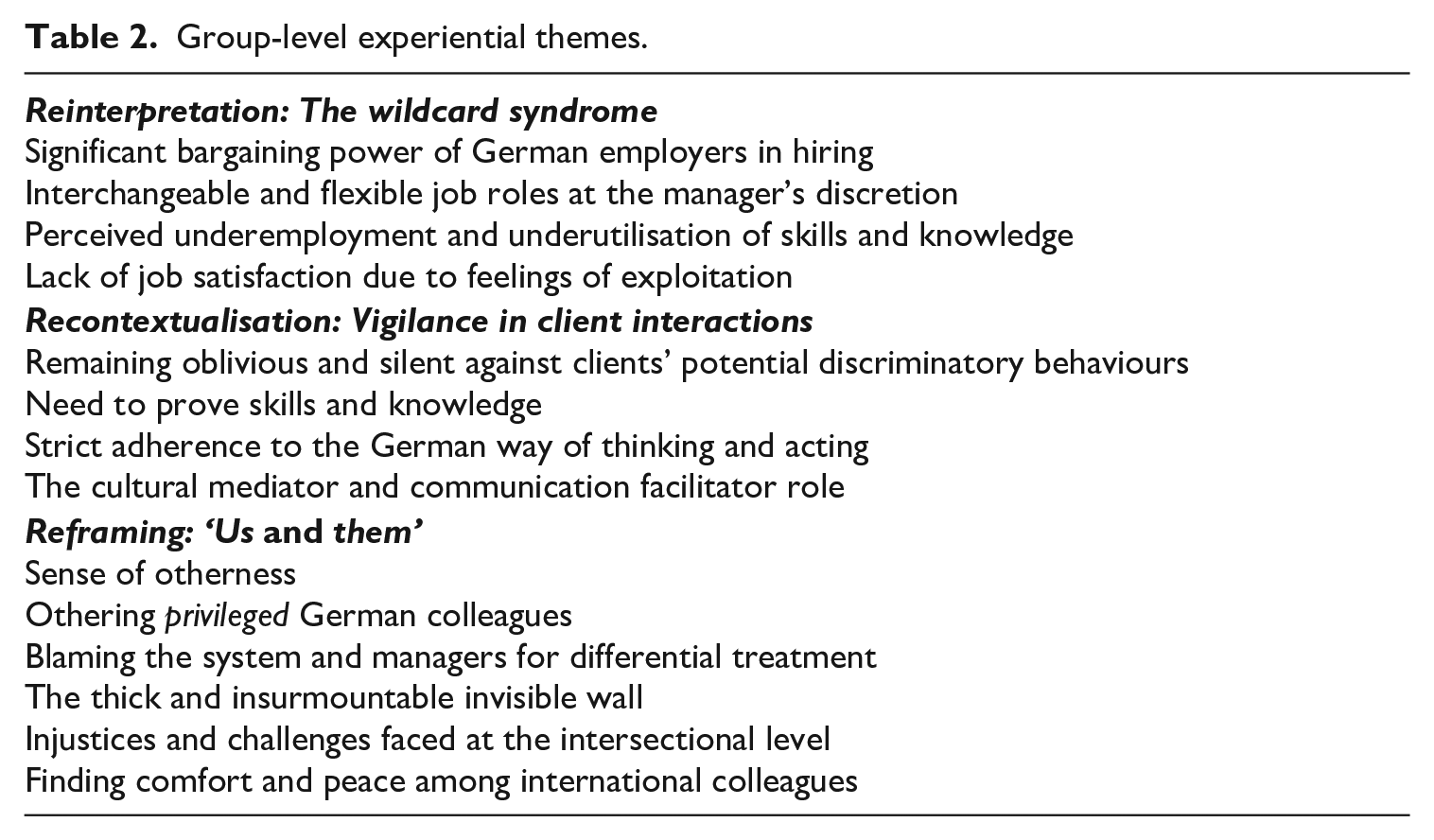
It was evident from our findings that the socio-cultural influences and the challenging nature of the IT industry were prevalent in all participant experiences. We identified three group-level experiential themes: reinterpretation, recontextualisation and reframing. In the following sections, we explore these themes and how they relate to literature.
Reinterpretation: The wildcard syndrome
A wildcard is a ‘playing card that can have any value, suit colour, or other property in a game at the discretion of the player holding it’ (Oxford Dictionary, 2010: 2029). Using this lexical definition, we illustrate the experiences of our participants who have been hired into flexible roles in their companies and given non-explicit tasks at the discretion of their managers. These companies are German SMEs sharing a highly dynamic market with global technology giants. Managers play a key role in bringing their teams together to confidently achieve their goals. From the participants’ perspective, this flexible role brings with it a syndrome – an inner conflict fuelled by ambivalence, confusion or dissatisfaction that leads to a wait-and-see state. Two participants pointed out that foreign labour was readily available in Germany, giving employers considerable bargaining power. According to Arjun, among the many international applicants, only those who would be of greatest benefit to the company were selected: Everybody wants to find a job and come here [Germany], and they [IT companies] know this very well and they’re cherry-picking people a lot. You cannot just say, like, ‘I want to be a consultant’, or ‘I will do sales’, or things like that. My uni credentials alone wouldn’t take me anywhere . . . I had to find people, ask my friends and their friends to find contacts in Germany and support my job applications.
Arjun had to rely on his social skills to convince employers that he was the right candidate. Despite his persistence, he faced several challenges. ‘Born and raised as a Hindu, I never thought I would visit unusual and unfamiliar places like a slaughterhouse’, he said, but then added, ‘this is acceptable as part of a job in a different country and there must be a reason for me in doing this’. Clearly, Arjun had high expectations, but he also had great confidence in the company. Xian showed a similar attitude as he seemed fairly content with his role. Once, his manager even told him that he was highly capable of doing the job, but he lacked managerial skills. This did not bother Xian too much. Instead, he believed managers knew what they were doing: Firstly, I have to fill in. I’m a person who doesn’t really like changes, and I’m feeling fine with this job. It is not the most suitable job for me, but I can manage it, I think. They ask you to do it. If you can, good. If you can’t, you are not responsible but the manager is. If you can’t do it, they give you something new. They normally don’t question or kick anyone out. There’s always use, maybe?
While Arjun actively sought opportunities to prove his skills, Xian took a more conservative approach to his role with a sense of commitment and appreciation leaving the responsibility up to his manager. In the end, both participants felt attached to their companies and took any task their managers requested. Emotional attachment to the work environment and organisation may be key for some foreign workers to develop motivation and expectations that are more aligned with organisational goals and tasks assigned by managers (e.g. Hua et al., 2019). Indeed, both Arjun and Xian were patient but eager to see what the future would bring.
On the contrary, three participants were concerned that their interchangeable and flexible roles exposed them to exploitation in their organisations. Clearly upset, Maciej said, ‘[I] feel like nothing more than a cheaper workforce dealing with other people’s unfinished stuff!’ Vesna, a little more even-tempered, believed she was there ‘to fill the holes that others just left’. Both participants were referring to their German colleagues, and Imre took this reference even further. Aggrieved, he described his situation as that of a player in a game who was assigned second-hand roles: OK, efficiency is our goal. Managers think they know best about the needs of the customers; but discarded, unwanted, uninteresting projects, because they are in places far, far away, or because they are not financially exciting!? And we are kindly [laugh] asked to do them. Oh, of course, they are busy, they know better, etc., etc. But am I here to fill the holes?
Imre had the feeling of being used by the people in the organisation rather than hired for the job itself. Many of the tasks he was assigned were already rejected or abandoned by German colleagues, and his skills and experience went unnoticed. He expressed resentment by laughing about how managers made decisions, revealing he felt exploited as a foreign worker. Likewise, research shows that in Germany, ‘foreign skilled workers practice highly credentialed occupations less often than domestic skilled workers’, and working in positions that hardly match their qualifications, skills and career expectations, they are more likely to experience low job satisfaction and earn less than their German counterparts (Chiswick and Miller, 2009; Rohrbach-Schmidt, 2020: 377). Two other participants expressed genuine concerns about not being able to meet their professional expectations. For Raúl, accepting interchangeable roles was an obstacle to his actual professional advancement: Spanish is my native tongue, but they aren’t using it for Spanish-speaking markets. They’re not seeing this as a value. Nobody cares. They don’t even know what your qualifications are, or they don’t really care. They just kind of see you like we just need someone from this part of the world, so let’s just hire them. Yeah, like, ‘Can you deliver this?’ OK, and the rest, they don’t care. There is a huge effort to have the same thing done by multiple people. They know what exactly they want. Internationals are usually quicker to pick up things.
For Raúl, working abroad was strongly associated with exceeding his own limits and achieving his own targets while contributing to the company’s goals. But he used an objectional tone that displayed frustration, disapproval and despair. He felt he was hired to fulfil a duty and had very little opportunity to demonstrate his skills and knowledge. His second-person narrative (e.g. Harding, 2008) immerses us in a world in which he never wished to be – a world of foreign workers who fell victim to a rigid and immutable order governed by managers with a predetermined agenda. Perceived underemployment and underutilisation of skills could somehow lead foreign professionals to a significant change in their feelings about the working environment and attitudes towards their jobs (Lee, 2005). Would Raúl continue to endure the despair he illustrated to portray his experience? At the time of writing this article, we did not know. But for João, burnout had already set in. He felt trapped and faced a lack of meaning at work: But [in that market] I am not the expert. I am being sold as the expert sometimes due to the absence or lack of time of the person responsible for markets for I was originally not aiming at. [. . .] It doesn’t match the expectations that I had in the beginning like specialising in the Brazilian market. They want you to fill holes in the German way: ‘Who is doing that, who’s not doing what?’ Then delegating stuff, saying like, ‘do, do, do and do’. Zero consulting!
Filling holes, the metaphor, recurs here. In this case, João felt like a role-player rather than a professional. Like Raúl, he felt hopelessly constrained in his relationship with his managers. Monotony and meaningless tasks were not what he expected from his job, and being a substitute was certainly not his intention. His motivation and patience were gone, and as we were to learn a few months after his interview, he quit.
Some participants never discussed unrecognised qualifications or exploitation, and they viewed flexibility as a unique aspect of their jobs. For some international knowledge workers, temporary employment and the adoption of flexible roles can be key to shaping their work experience in other countries. These highly skilled workers do not usually consider a particular country as their destination, but rather as part of a long journey to gain international experience (Kirk et al., 2017). In this sense, for Bill and Kaan, temporality and flexibility played an important role in how they perceived the use of their skills and interpreted their roles as professionals in less familiar socio-cultural conditions. Bill was emphatic about his role at the company in light of working in Germany: My native language is English, so it’s easy for them to throw me into a project pretty much anywhere at any time. But I get advantages because I get more of my choice of what I want to do. But at the same time, there’s a lot that has to be done. [. . .] Europe, to me, it’s more like the centre of everything. There’s so much that goes through here, from the States to here and from Asia to here, and back and forth. So, it’s fairly [pause] convenient [pause], I guess because there’s just everything going around.
Speaking English is a key component of Bill’s experience. He took a more constructive approach to his role compared with Maciej or Imre, who complained about their jobs. Taking on tasks at any time and place undoubtedly increased his workload and responsibility, but it also grew his experience in the industry. His career journey aimed at achieving his personal goals and he did not feel obligated to the country or company he worked for. Kaan, too, was eager to learn and gain more professional experience in this field: Interactions with people, like clients [. . .] It’s not easy! And it requires a never-ending mindset for flexible and creative thinking, but I find this encouraging. Germany is the best place for the tech business . . . or at least now. I don’t have, like, a strict job description, and we have a diverse [customer] portfolio. One day I learn about financing and another day about food processing, or construction [laugh]. It’s a wonderful opportunity and valuable addition to my CV but this doesn’t mean I will live here forever. The world is big [laugh].
Recontextualisation: Vigilance in client interactions
This theme explores our participants’ actions to prevent their relationships with their clients from being jeopardised by societal prejudice against the characteristics they embody or by attacks on their abilities as foreign professionals. All participants stressed the importance of remaining alert to such potential challenges that might arise at any time during their interactions with clients. To explain this psychosocial state, we borrowed the term vigilance from cognitive psychology, which is simply defined as ‘the ability to maintain a focus of attention and remain alert to stimuli over prolonged periods of time’ (Warm et al., 2008:433). Such stimuli usually occur infrequently, but once they do, they require the utmost attention and usually immediate action. The extent to which one can or should be vigilant depends largely on the context. When we are driving on the motorway, we are vigilant – we occasionally look at the dashboard to see if any of the warning lights are calling us to action. If we are on a very long but comfortable journey, we may not be constantly trying to spot a stimulus. However, we are already ‘predisposed to notice the sudden appearance of stimuli’, which will still capture our attention (Sternberg and Sternberg, 2016: 123). If this driving experience took place in an unfamiliar or undesirable context, such as driving for hours through a vast, uninhabited desert, then we would constantly detect the appearance of a target stimulus, such as the fuel gauge or engine temperature warning light. Imre was one of the participants who perceived the appearance of a target stimulus: In the office, I’m open. But when I visit client companies, I disguise myself like, um, I know I have to act like this, like a heterosexual man to connect with clients. There are, I mean, companies, our clients, where they make jokes or talk about, about football, about women sometimes. I don’t feel comfortable. You’ll never know how they will think or if you will lose their confidence or not. This can affect my job with an image of being gay on top of being not German. I try not to say anything, maybe a few words about cars.
Imre’s main concern in this passage is being both gay and a foreigner. Despite being comfortable with his colleagues in the office, he was cautious when dealing with clients and tried not to disclose his sexual identity. He avoided sexist jokes or topics with which he was unfamiliar in such cases. To secure his position with clients, he felt he had to hide his differences and play into their heteronormative codes (Wicks, 2017). Besides, the IT industry is already known for its gendered work culture (Tassabehji et al., 2021), and for Damla, interacting with clients could sometimes be comparatively more challenging. Throughout her interview, she often highlighted her gender-neutral attitudes in her work relationships. In any gender-based challenge to her expertise, she was ready to respond without any tolerance. But outside the company, when a client disregarded her professional identity, she chose not to reprimand but to act for the good of the client project and her company: There was a Middle Eastern client; I was the architect of the project. They spoke perfect English, but they had problems like talking with women. They were all tongue-tied at one point during the meeting! [. . .] I had to put a proxy man, a translator, between me and them [. . .] [laugh] Well, in the office, with your colleagues, you have options. When it is the client, you have no options. You just accept it. If I didn’t care about their personal opinions or feelings, that would have caused a project risk.
As a professional, Damla simply chose not to dwell on her client’s uncooperative and obstructive behaviours. She quickly interpreted the client’s sexist attitude as a potential danger that would negatively impact the project, and successfully managed the situation. The language she used to describe the situation is humorous – it clearly shows that she felt offended by this unfortunate experience, but she was also determined to represent her company in the best possible way. On the contrary, Vesna was praised by her client for her work; however, this was no more than a few gender-specific remarks: During the client meetings, I take notes, use flip charts, do a lot of presentations and so on. It’s not in the company procedures; it’s just how I work. One client gave positive [finger quotes] feedback about me to my manager. They said things like ‘women make difference, women take notes’ [. . .] Just because I’m taking notes? Not because of my creative solutions? Am I a secretary? [pause] What can you say? Nothing! They [client] are German, my manager is German. You are shocked but you don’t show it. I’m the only woman around.
Vesna found her client’s recognition of her work superficial, sexist and discouraging rather than motivational. Her comments clearly express her frustration and anger at the disregard for her professional role as a decision-maker and implementer. Intersectionality is key to how Vesna understood her psychosocial position in this situation as both gender and ethnicity significantly affect the career expectations and professional success of a foreign worker (Grigoleit-Richter, 2017). Her achievements went unrecognised; instead, she was praised as a woman who did her job well. Her emphasis on both her client and her manager being German explains why she felt like being placed in a disadvantaged position and how difficult this situation was for her. Being a woman in a male-dominated industry and working in a foreign country, she chose to remain silent.
Some participants talked about feeling the need to prove their knowledge and expertise. Bill was assigned to an ongoing project, but the former consultant left with no information about the system. When he asked the client for some documents that could help him find out some answers, the client refused and told him: ‘Well, you should know, you’re the consultant.’ Without any further comment, Bill had to reset the system. Similarly, Arjun said that most of his negotiation meetings ended with clients telling him that they needed to have ‘one last word with the manager’ to confirm the contract details and the roadmap he had developed: Some [clients] ask many silly questions, very basic stuff, and I patiently answer them. I know they only want to see if I’m really an expert or not. I take time to show them that I studied their system and processes perfectly well. I also include my manager’s name and approval in the documents I prepare for these meetings.
In a customer-intensive context, like the IT industry, professionals typically seek ways to control and influence their customers’ perceptions (Down and Reveley, 2009; Raghuram, 2013). For our participants, highlighting Germany’s reputation for reliability in business and technology was particularly effective in maintaining their clients’ impressions. ‘Everything must be in the German way’, said Seok-ju, describing the expectations of his clients. According to Arjun, German business culture dictated that all IT consultants, native or foreign, were seen as intermediaries between local companies and their clients. Straightforwardness, spending too much time on details before setting a goal and, in Arjun’s words, ‘the endless obsession with immaculate planning’ were some of the characteristics that defined the German way of thinking and acting. The key to building and maintaining such an impression was, of course, fluency in the language. Interestingly, while all participants emphasised the advantage of speaking German, only three of them were remarkably fluent in the language. ‘In China, foreigners are always privileged and valued’, said Xian, adding, ‘but in Germany, you only have a privilege if you speak their language’. He described himself as a person who is generally rather shy and speaks less when interacting with others: That’s where I feel the pressure. The project manager and the client talk the whole time. The client feels less communication with me and, I know, they question if I’m the right person. But my manager supports me assuring them of the quality of my job. Then, when contact them by phone and email, I gain their trust very quickly. They see I can understand them well and give good feedback, I don’t ignore their emails and everything. So actually, these clients became my best customers who gave me recognitions and also sent these recognitions to my boss.
Introverted employee behaviours at work can lead to miscommunications and even conflicts with peers and clients; therefore, it is important for managers to understand how these behaviours can affect their employees and their work (McCord and Joseph, 2020). Xian was fortunate to have such a manager. In addition, his excellent German language skills and familiarity with the local culture, which he acquired while growing up in Germany, provided him with a solid foundation for maintaining a thorough and effective relationship with clients.
How could a foreign professional win the impression and trust of a client who is also a foreigner if everything must be done in the German way? The combined impact of culture and language is likely to cause foreign professionals to be particularly vigilant whenever they engage clients. Seok-ju often stressed the importance of efficient communication with clients, especially those outside Germany: For my Korean client, for example, I thought this [German] way is not good, because they couldn’t understand when we are talking about something in the German way. But we must keep that German way, even if we’ve got a problem from out of Germany. [. . .] When I first took this project in Riga, I said, OK, we have the Latvian language in our system, and I just let them use their own language instead of English or German. They use their own expressions, idioms and pronouns to explain things.
Seok-ju’s vigilance in dealing with clients was directly related to his role as a cultural mediator and communication facilitator, paying attention to any nuance or signal that might cause a misunderstanding. Typically, in such customer-intensive processes, customers do not control most of the means of production, although the customers themselves, their property and their information are key inputs to the production process (Pinhanez, 2009: 5). Being a foreigner himself, Seok-ju recognised the importance of putting customers at the centre of the process, especially when needs cannot be adequately articulated in a language other than the client’s own. Alternatively, in Kaan’s case, the lynchpin was the culture itself. Clients’ approach at first seemed distant, but their familiarity with his country helped build a bridge. He said: ‘This is about showing them I do my job well, they speak about Turkey, nice country, nice food, nice people, etc., but also about how they are satisfied with my job.’
Professionals and clients could benefit from an understanding of each other’s cultures. However, cultural adaptation can also be difficult for many foreign professionals (e.g. Ozer and Schwartz, 2021), and research shows that the ethnic bias of local clients can also have a detrimental effect on their performance and motivation (Linzmajer et al., 2020). But research also shows the opposite. Xian believed his ethnicity was an advantage: ‘Because I am Asian, clients are convinced that I have special skills in mathematics, technology and software but in fact, I was a mediocre student at school!’ Clients often judge the quality of services provided by professionals from a particular ethnic group based on stereotypes associated with that ethnic group, and their expectations could be low at the beginning. But, in some cases, the cultural difference between the professional and the client can have a positive impact and lead to successful outcomes (Gill et al., 2017).
Reframing: ‘Us and them’
Norms are usually determined by the standards, ideals and principles shared by members of the dominant ethnic group. Therefore, ethnic minorities are positioned as Others – ‘absolutely different’ individuals with competencies that hardly fit their norm – while Others perceive members of the dominant ethnic group as privileged individuals (e.g. Ossenkop et al., 2015: 521). We have discussed that for our participants, this norm was largely embodied by the German way of thinking and acting – their clients and employers expected that their competencies met this norm. They shared their experiences in proving themselves as professionals – but always vigilant in their relationships and taking on tasks, again as Others, that were abandoned or refused by their privileged German colleagues. This sense of being othered – or more accurately, otherness – played a critical role throughout our study as a key phenomenon that psychosocially determined our participants’ approaches to their jobs, discourses in their interviews and interpretations of their contextual circumstances. Participant discourses revealed cognitive reframing; that is, during their career journey, participants changed the way they viewed working in Germany and altered the way they built their experiences. As humans, we all create Others to define ourselves in terms of who we are not (Traustadóttir, 2001) and participants repeatedly pointed out that they were not German. They othered their rather privileged German counterparts and made implications and sometimes explicit statements that because they were foreigners, they faced challenges. In doing so, they were neither divisive nor confrontational. Rather than feeling bitter about their colleagues, they blamed the system and typically the management for treating them differently in the workplace. This was not a battle of ‘us versus them’, but rather a situation of ‘us and them’ – note the emphasis on the use of and instead of versus here. Bill elaborated on this view: Obviously, Germans stick to themselves. They don’t work for ‘outsiders’ as they call them. So, we pretty much stick to our international team. Well . . . we have German people that will talk to you, no big deal. But they’ll have their, like, circles and cliques or whatever. I think it’s just that’s the German way. My experience in and out of work is that Germans normally don’t like outside people coming in.
In Bill’s mind, his German colleagues who shared interests acted as allies and formed close-knit groups with no room for other people. As a result, non-German professionals became involved in working together. Referring to the formation of cliques as the German way did not imply disapproval, but rather a recognition and acceptance of the country’s socio-cultural context.
A number of participants felt that their German colleagues enjoyed many advantages at work and that this was unfair but somehow tolerable. Examples include German professionals earning higher salaries, holding higher positions and having more training opportunities than foreign professionals. João said, ‘With enough observation, you notice discrepancies in salaries with the German colleagues.’ Raúl further elaborated by referring to one of his German colleagues: He earned 2000 Euros more than I did! Yes. Now he left the job. It didn’t affect my work personally. I didn’t suffer because he was really bad at his work. I’d be upset if such an inefficient person would be my boss; well, he wasn’t even in our team. I work in the international team. We’re from all over the world, we have people from Asia, from Italy, Turkey, we have Americans, and Africans, and we’re like, ‘You know this thing, can you help me?’ There’s a very clear, like, who has the knowledge sort of thing. Cooperation . . . collaboration.
Raúl depicted two different worlds. On one side were the privileged Germans who supported each other and worked in a favourable professional environment reserved for decently paid Germans to gain experience in the profession. On the other side was a team of already competent and knowledgeable foreign professionals, including Raúl himself, and this team almost developed its own internal dynamics to carry out the assigned tasks as their roles and responsibilities required. It is worth noting, however, that Raúl’s reaction was not to his German colleagues, but to the system itself. The barrier that separated these two worlds was thick and insurmountable for some participants – a wall they could not conquer. In architecture, transparent walls separate space physically, but not visually; therefore, such barriers do not interfere with the transmission of visual communication but can affect tacit norms of social behaviours, and thus, social interactions (Marquardt et al., 2015). Xian, Arjun and Seok-ju used the metaphor of an invisible wall to discuss the hypothetical existence of such a barrier. ‘In China’, Xian said, ‘there are fewer foreigners, and they are privileged.’ For him, this was not the case in Germany: German people see cultures that are not western as exotic. This creates a barrier. They never ask questions like ‘What did you do last weekend?’ ‘Did you like the movie?’ But they ask a lot about China, food, people. I’m fluent in German, I live like a German, but I’m never one of them [brief silence]. But I have my international team; a closed environment, and I enjoy this diversity a lot. As the international team, we still feel the barriers to reaching the German colleagues. It’s like a wall.
‘Reaching German colleagues’ indicates an important contrast. Even with a strong desire to form close bonds with other people, the dilemma in which Xian found himself is striking. A feeling of social discomfort may occur when individuals find themselves being approached in an inappropriate way (Smith and Faig, 2014). Xian’s mental conceptualisation of an invisible wall likely led to his discomfort resulting in a feeling of being treated as a permanent guest in the society in which he had lived for many years. He could not help but accept his situation, and instead, he found comfort in his international team. Likewise, Arjun believed that the wall was never surmountable, saying, ‘it’s the invisible wall, that sits between us and them, you can’t reach them to make partners or friends’. He agreed with the point Bill made earlier: ‘[German colleagues] are nice and friendly, but they have their own environment, a different setting, and you can’t just simply jump over the wall.’ Seok-ju added further from a different angle: When it comes to being German or non-German, or international or non-international, that’s really something. So I can say, there is . . . it exists a kind of invisible wall. Officially there is nothing like hierarchy based on nationality but I can personally feel there is something. I believe this is because people don’t understand each other, because we speak different languages, because of communication. Just that. We all have the same goal: efficiency. That’s my only concern.
Even though Seok-ju sees the effects of the invisible wall, he avoids it. What is particularly noteworthy is that research suggests some foreign professionals tend to focus on achieving organisational goals and enjoying personal recognition, instead of attempting to integrate into the local culture (e.g. Wallinder, 2022; Weiß, 2005). This is consistent with the way in which Seok-ju advocated that everyone in his workplace should serve the same goal, and how he viewed this as his concern.
Participants also discussed injustices and challenges faced by foreign women IT professionals. ‘There were three women; two Australian and one Vietnamese’, said Arjun, adding, ‘they were really working hard but one day they were just sent away’. Likewise, Raúl had a Spanish colleague who was ‘just sent away’ for no apparent reason. He said: ‘This is what the hiring culture looks like – it’s like management doesn’t want women!’ Our women participants, of course, had their own personal first-hand experiences to share. When Vesna was asked about her plans to stay in Germany during her job interview, she found the way the question was framed strange, annoying and discriminatory, saying, ‘they suspected my intention was to settle here and marry a German husband!’ On the other hand, Damla compared her experiences in three different contexts: I was raised in Izmir and male-dominant behaviour was something I haven’t experienced when I worked there. But in Istanbul, when there was disagreement between me and other [male] engineers, denying the real problem and emotional reactions took place. And you understand that in the mindset, there is, a gender-based opportunity going on, on the men’s side. Then, you get angry, he gets angry, and it just turns into a gender war! [Laugh] It’s happening in Germany, too. But I feel very lucky that you are listened to. I am working in a global team, so everyone is from somewhere.
Damla described her experiences in her hometown with purely positive emotions, but individuals may also engage in various attitudes and behaviours that may stimulate desired emotions and help them feel in the right mood to perform their jobs (Humphrey et al., 2015). Apparently, in her subsequent experience, Damla gained a critical awareness of the challenges of working in a socio-culturally diverse environment as a professional and as a woman. By creating and implementing the reality that she was no different from her male colleagues, she managed to mitigate sexist attacks when necessary. When she finally moved to Germany, she continued to maintain the same attitude. But – just as in Bill’s and Xian’s cases – being part of a global team gave Damla a feeling of self-confidence.
Intra-EU migration has been extensively studied particularly with a focus on the labour migration from the former Eastern Bloc countries. As it turns out, migrants from these countries, regardless of their occupations, are often paid less than the natives in older member nations, such as Germany (Felbo-Kolding et al., 2019), where they seek better employment opportunities, a more secure and better future, and advancement in their careers (Reissová et al., 2021). This was significant in Maciej’s discourse as he sarcastically referred to himself as ‘cheap labour’ and remarked at one point in the interview: ‘We (Poland and Germany) are neighbours but whatever you do, you are always a foreigner, uhm . . . but if you speak their language, it is, it is OK as long as you act like one of them.’ Imre’s approach was not different when he said: ‘You get to learn how to live by their [German employers and clients] rules and standards and be happy as long as you say “yes” and cooperate with them.’ The us-and-them framing reappears in these discourses. Even if the invisible wall does not physically exist, participants accept its existence as a barrier that restricts or even prevents access to certain areas.
Discussion and conclusive remarks
It is common to assume highly skilled international professionals as independent individuals seeking better career opportunities and pursuing their dreams in other countries. However, they are often subject to unfair treatment, including being occasionally seen as mere ‘objects of managerial control’ (e.g. Andrijasevic et al., 2019: 318). The workplace, for them, is a socio-culturally less familiar context and our first study question asked how these individuals made sense of using their knowledge, skills and competencies in line with the expectations of the organisations they worked for. The individual cases, in general, reveal all participants experienced challenges and barriers to potentially fulfil their needs and requirements in their jobs to improve their skills at work, advance further in their careers, interact freely with colleagues and clients, and use their knowledge and competencies to influence decisions made by their managers. In most cases, German employers had a considerable bargaining power against our participants. There may be several factors at play here. Yet, as we discussed earlier, one major reason could be that the IT industry in Germany is overwhelmingly based on SMEs, and to compete effectively in a globally dynamic market, German employers must be agile and flexible in their human resource planning (e.g. Müller et al., 2020). In any case, this certainly had a negative impact on our participants. They hardly found opportunity to prove themselves useful and competent to their employers as well as to their clients. Often, they were assigned tasks and had to assume responsibilities that required skills and knowledge they did not possess.
In our opinion, the German way of thinking and acting was a remarkably interesting detail. Working abroad definitely requires understanding and respecting the norms and traditions of the host country and cultural adaptation could be challenging (e.g. Ozer and Schwartz, 2021). Apparently, our participants faced this challenge, but they were also tenacious enough to embrace the host country’s culture in several ways. Despite this, they were hardly given the opportunity to fulfil their roles as professionals and they were rather seen as wildcards who could leave at any time. There were even some participants who believed that their employers hired them regardless of their credentials and experience. While some participants questioned their roles and even experienced burnout, others were patient enough to wait and see what the discretion of their managers would contribute to their careers.
In response to our second study question, we could say all participants were aware of their disadvantaged situation and experienced a degree of socio-cultural bias at work. A common belief was that employers intentionally underemployed and underutilised their knowledge and skills. To mitigate the disadvantages, our professionals generally tended to accept control, instructions and even gendered and unpredictable working conditions (e.g. Maitra, 2015). Participants also believed that invisible and socio-culturally accepted barriers existed between them and their German colleagues. What foreign professionals face here was, indeed, a form of injustice, or more precisely, they became victims of hermeneutical injustice (Fricker, 2007). In this case, foreign professionals unjustly experience a lack of endorsement and are unfairly prevented from self-development (Hänel, 2020), lose power and influence in the workplace and become silenced and disadvantaged compared with their native counterparts. This form of injustice is ‘committed structurally or institutionally’ (Kwok, 2021; Medina, 2017: 46) because of established practices favouring host country nationals. Spreitzer et al. (2005: 537) argue that the individual thrives at work when they ‘feel progress and forward movement’ accompanied by a sense of aliveness or energy and the feeling that their skills and knowledge can make a difference in the workplace. It was important to our participants to find meaning and purpose in their jobs in the volatile IT industry and to build their careers independently in a foreign country despite receiving limited socio-cultural and economic support from their organisations. They were challenged by the socially determined perceptions in terms of expected behaviours, values and appropriate attitudes generated by their employers (King et al., 2005).
In the context of extant literature, our findings indicate that highly skilled foreign workers are not immune from the systemic issues that confront migrant workers in general. In business management terms, ‘keeping cultural and political differences outside the workplace’ (Schmidt and Müller, 2021: 151) could mitigate the negative impact of these issues on foreign workers. By doing this, employers may assume that foreign workers are treated equally and are focused on their jobs, and a more cohesive and inclusive work environment would be secured. However, this does not preclude foreign professionals from being aware of their disadvantaged position at work and the unfair treatment they receive. Our participants’ experiences revealed a number of strategies and tactics they used to counteract or cope with the negative effects of discrimination and unfair treatment. In most cases, they focused on developing a stronger sense of professional identity (e.g. Eteläpelto et al., 2013) and a higher level of resilience to cope with their situation. Even so, they blamed the system along with their employers – and in a few cases, resented their colleagues – for being treated unfairly. This suggests that the ‘work-inherent tendency for collegiality’ (Schmidt and Müller, 2021: 151) would prevail but, as we have seen in our participants’ experiences, feelings of subtle discrimination could easily lead foreign workers to alienation, dissatisfaction, mistrust, disengagement and even lower job performance in the long run – and employers may not even be aware of this.
This study clearly demonstrated that professionals do interpret their experiences and evaluate their roles and positions based on their own choices, expectations and motivations. Throughout the stories shared by the participants, we identified a variety of sense-making attempts about self-responsibility, passion for the field they work in, desire to learn and making a difference for the organisation they work for. Research suggests migrant workers’ sense of self-efficacy is critical to their perception of inclusion at work (Ng et al., 2023). However, we also found that intersecting identities add to the complexity of a foreign professional’s work experience, and this could lead to the individual’s performance and career aspirations being hampered by obstacles. For example, when a woman migrant worker faces discrimination based on her gender, her migrant status may amplify her experience of discrimination and make it more difficult for her to achieve her career aspirations (e.g. Becker, 2019; see also Hwang and Beauregard, 2022). Gender discrimination was likewise reported in our study: one participant felt she had to remain silent and ignore the situation, while another participant had to devise a tactic to deal with it for her project’s success.
Migrant worker experience is always broad, rich and complex – it is characterised by both ‘positive perceptions’ and ‘insurmountable challenges’ (Becker, 2019: 3). The nuanced analysis of the participant experiences in this study clearly demonstrated that these experiences are unique to the individual, and addressing challenges and obstacles could only explain one part of the story. It is equally important to recognise these individuals’ achievements and resilience throughout their journeys. On the positive side, highly skilled migrant workers often have access to new opportunities that they would not have had in their home countries – they can bring new skills and different perspectives to the companies they work for (e.g. Fassio et al., 2019; Laursen et al., 2020).
Limitations and future research suggestions
Finally, we conclude with a caveat that demands further research. A particular strength of this research is the focus on a timely area of investigation, the important context within which it was conducted and the characteristics of the sample that are underexplored in this field. Our findings contribute to the growing literature on individuals ‘who work globally’ (Hutchings, 2022: 128). The study was conducted with foreign IT professionals in a setting highly influenced by an employer-centric socio-business culture. Our focus and underlying analyses of interview data revealed that a common experience of IT professionals relates to their perceptions of unfair treatment. While this is an important and core finding, experiences may be peculiar to these circumstances in some ways. Further research is needed to identify the aspects of the power imbalance between foreign professionals and host country nationals, explore discrimination and unfair treatment at the intersectional level and in other industries, and gain insight into how host country nationals, particularly employers and peers, view non-native professionals in their workplace. We therefore encourage further research that employs an experience sampling method and mixed-method studies to examine this topic from various angles, uncover further reasons for these individuals to feel this way and find out more about the challenges and mysteries associated with being a foreign professional, or an outlander, in the workplace. In management and organisation research, IPA can provide valuable insight into the subjective world of the individual at work. Unique experiences of unfair treatment and discrimination at work could be better explored. The method could also provide further evidence to better identify critical aspects of management and employee relations.
Being an outlander at work often comes at a price both for the foreign professional and their employer. From a critical perspective we suggest that management and HRM studies must embrace the individual as the key actor underpinning global employment practices at a time of transitioning into a very different future of work (e.g. Bonache and Festing, 2020; Harney and Collings, 2021). Despite all the difficulties and challenges, and with their self-initiated efforts, our participants achieved some level of workplace integration to secure employment and had some opportunities comparable to those of their German counterparts. What they experienced is an interactional process where both the host country and the workplace set the norms and the professionals re-evaluate their ‘attitudes, values, behaviours, and identities’ (Rajendran et al., 2017: 438; Zapata-Barrero, 2012). Understanding personal expectations and unique circumstances that professionally and socially support or challenge a foreign professional’s workplace integration is crucial here, and as we have seen in our study, these individual expectations and experiences can be quite diverse. Ignoring such unique lived experiences would, as Eteläpelto et al. (2013) suggest, reduce these professionals to organisational processes and deny their self-directed role in exploring how this special case of professionals could thrive in their jobs. Indeed, the future of work promises very different landscapes, where new paradigms will become prevalent. HRM is already undergoing a tremendous amount of change as it moves beyond a limited focus on national or industry-related factors (Harney and Collings, 2021), and we believe that exploring the subjective viewpoint and experience of the individual at work is key to gaining a deeper understanding of what lies ahead.
Footnotes
Funding
The authors received no financial support for the research, authorship and/or publication of this article.
