



Abstract
Disappointment is common in many organizations. Yet little is known about how individuals’ talk about their workplace disappointment shapes their identification with organizations. We conducted an analysis of 104 academics in a prestigious British university to make two contributions to our understanding of the discursive constitution of organizational identification (OID). First, we show how individuals used different types of disappointment-talk to narrate and respond to identification dilemmas in distinct ways. Our findings extend existing research by showing that discourses of emotion do not simply delimit agency but also enable individuals to resist and reject organizational discourses that attempt to anchor them to specific identity positions. Second, we identify a novel way in which individuals can configure the multiple discourses that can be in tension and generate disappointment – unravelling. Here, individuals draw upon one among the multiple discourses in conflict (in our case, prestige) to ‘unravel’ the knotting between the various discourses that constituted their OID dilemmas. We also consider the implications of our study for academic labour in universities.
Keywords
Introduction
I thought of where I might be able to fit in . . . it would be at [prestigious university] . . . [But] I feel hypocritical being here . . . I don’t like being a representative of a university that is really causing a lot of harm to the people who work here . . . And that by trying to do critical work, and better live by my values, I might be part of the ethics washing of the university. . . . Currently I’m looking for other jobs. (Dr Drew, Senior Researcher, Social Sciences, four months before leaving the university)
Dr Drew’s account reflects some of the dilemmas of working in contemporary academia. Traditional discourses in higher education stress the importance of intellectual freedom and meaningful research. In contrast, modern neoliberalist discourses emphasize top–down managerialism and value for money (McNay, 2007). The tensions between these discourses generate dilemmas across the sector and yield disappointments that can erode individuals’ strong identification with universities (Clarke et al., 2012). Recent reports suggest that four in 10 UK academics are considering leaving their universities (Fazackerley, 2019). The potential of a ‘great resignation’ (Gewin, 2022) has implications that are alarming for the individual and the profession, including at ‘top’ universities. Working within a prestigious university was not enough to assuage Dr Drew’s difficult feelings nor prevent their decision to leave.
Attending to the organizational identification (OID) of professionals, such as academics, provides valuable insights into individuals’ commitment to and satisfaction with organizations (Edwards, 2005; Riketta, 2005). A discursive approach recognizes that individuals’ identification is constituted in ongoing ‘struggles and negotiations between different discourses’ (Zembylas, 2003: 229). Employing a discursive perspective can therefore enhance our theoretical understanding of how individuals work on their OID in the face of dilemmas resulting from conflicting discourses. Such research is important given the relatively small set of studies that have examined discourse and OID (Hoyer, 2016; Humphreys and Brown, 2002; Kuhn, 2009; Kuhn and Nelson, 2002; Sillince and Golant, 2018), with even fewer analysing the role of multiple, including emotional, discourses in constituting identification.
To examine multiple discourses and OID, we conducted a narrative analysis (Riessman, 2003, 2008) of 104 academics at a prestigious British university. Adopting a discursive lens helped to illuminate how OID was constituted in individuals’ talk about disappointment. We focused on two discourses that tended to be in tension with individuals’ self-narratives as academics, which generated disappointments and induced ‘identification dilemmas’ (Humphreys and Brown, 2002): prestige and academic neoliberalism. Our analysis found disappointment-talk to function as a primary discursive frame for ‘bridg[ing] together various facets of self in a coherent way’ (Larson and Pearson, 2012: 261). Such talk was used by individuals in four ways to narrate their identification dilemmas – defence, deference, deterioration and departure. Each represented a type of identification work (IW) in which individuals narratively engaged with disappointments to articulate their OID.
Our study makes two contributions to the literature on emotional discourse and OID. First, we extend extant work on emotion-talk (Ahuja et al., 2019; Coupland et al., 2008; Marsh and Musson, 2007; Zembylas, 2003) by highlighting how disappointment-talk functions as a primary discursive frame for interpreting and (re)working oneself in relation to an organization. This broadens previous scholarship, which has suggested that discourses of emotions ‘delimit individuals’ identity options and scope for agency’ (Ahuja et al., 2019: 990) and that has focused on the debilitative effects of disappointment and the resulting powerlessness (Van Dijk and Van Harreveld, 2008). Instead, we show the generative function of disappointment-talk as a primary discursive frame (Larson and Pearson, 2012) for narrating the ‘being’ and ‘becoming’ of individuals in relation to organizations.
Second, in analysing the co-construction of discourses ‘through, with and against . . . other discourses’ (Leonard, 2003: 221) we establish a novel way in which individuals configure discourses to navigate OID dilemmas: unravelling. Unravelling represents a novel form that differs from those previously reported, such as cohering (Larson and Pearson, 2012), knotting (Fairhurst and Sheep, 2020; Sheep et al., 2017), reticulating (Kuhn, 2009) and tilting (Kuhn, 2006). Unravelling differs from other ways of configuring in highlighting how individuals’ narratives can disentangle multiple knotted discourses rather than be conditioned or entrapped by them. In our study, this was achieved by individuals drawing on the discourse of prestige to unravel the conflict between the self-narrative as an academic and discourses of prestige and academic neoliberalism.
Our study also builds on growing interest in academic work (Aboubichr and Conway, 2021; Butler and Spoelstra, 2020; Fleming, 2022; McCann et al., 2020; McNay, 2007; Nixon and Scullion, 2022; Ratle et al., 2020) by using a discursive approach to focus on the struggles and consequences of academics operating within contradictory discourses that generate disappointments. We show how the prestige of working in the ‘top’ universities is insufficient to address these disappointments. We make practical suggestions for how universities can foster and sustain OID in considering the disappointments of academic work.
The remainder of this article is structured in four parts. First, we provide the theoretical background to situate our study by examining the literature on OID and discourse. Second, we discuss our narrative methodology. Third, we detail the study context and present a narrative analysis of participants’ experiences. Fourth, we discuss our findings in terms of the extant literature to highlight the powerful role of disappointment narratives in the constitution of OID.
Organizational identification and discourse
Organizational identification as discursively constituted
We adopt the view that OID is a ‘discursive process of constructing connection’ (Sillince and Golant, 2018: 350). In taking this position, we draw a distinction between discourse and talk (as a form of communication more broadly). While discourse is ‘a (semi-)coherent system of representation that crafts a context for language use’, we view talk as one way of ‘struggling over discursive possibilities amid the material circumstances of everyday life’ (following Ashcraft, 2007; Kuhn and Simpson, 2020). As such, OID is a dynamic, ongoing and reflexive endeavour through which individuals constitute themselves with respect to organizations via the stories they tell (Brown, 2017; Giddens, 1991). OID is thus made possible through IW. IW is a ‘linguistic accomplishment’ (Kornberger and Brown, 2007: 499) in which individuals draw upon discourses to author the self in relation to an organization, appropriating the organizational identity to varying degrees (Cheney and Tompkins, 1987).
A relatively small group of studies has examined discourse in relation to OID, highlighting its dynamism as a construct (Hoyer, 2016; Humphreys and Brown, 2002; Kuhn and Nelson, 2002; Sillince and Golant, 2018). They consider how individuals use discursive resources, most commonly a ‘linguistic device’, to ‘guide interpretations of experience and shape the construction of preferred conceptions of persons and groups’ (Kuhn et al., 2008: 163). Such scholarship adds to existing research that applies a discursive lens to emphasize the dynamism of identity construction (e.g. Clarke et al., 2009; Fairhurst and Sheep, 2020; Kuhn, 2006; Kuhn and Simpson, 2020; Larson and Pearson, 2012; Leonard, 2003; Sheep et al., 2017).
Our focus is on IW; that is, how individuals construct their connections with organizations, rather than the related concept of identity work. Nonetheless, there is a scarcity of literature analysing how arrays of discourses are constitutive of OID (with a few notable exceptions, such as Kuhn, 2009). As such, we draw insights from the identity literature that has examined how multiple discourses shape, regulate or determine individual identity positionings. For example, discourses have been found to impact identity work and regulation through reticulating; that is, the creation of a network that reinforces prevailing discourses and maintains the status quo (Kuhn, 2009). This promotes a ‘particular mode of subjectivation’ (Kuhn, 2009: 681) for identities, as driven by the dominant discourses of the organization. Individuals can configure multiple discourses together through knotting or the creation of interlinked tensions or paradoxes. This can lead to the presentation of contradictory identities within the same individual (Fairhurst and Sheep, 2020; Sheep et al., 2017), but also allows individuals to incorporate antagonisms within their identity narratives (Clarke et al., 2009). Individuals can also configure arrays of discourses through cohering, which describes the emergence of a preferred discursive frame to integrate several elements such as gender, race, class and occupation (Larson and Pearson, 2012). This allows individuals to organize aspects of identity into a singular coherent narrative. Finally, discourses also interact through tilting, where they cluster towards either structure or agency in identity construction (Kuhn, 2006). This conditions identity choices towards one or the other, thereby providing ‘greater or fewer options for self-creation’ (Kuhn, 2006: 1354).
The extant identity literature also suggests that emotion-talk is likely to play an important role in the constitution of OID, by allowing individuals to articulate and respond to the multiple discourses in which they are embedded. However, there has been no examination of how multiple discourses, including those linked to emotions, may constitute individuals’ OID.
Organizational identification and emotional discourses
The role of emotional discourses in OID has received limited attention despite being increasingly recognized as shaping individuals’ self-conceptions (Brown, 2017; Knights and Clarke, 2014; Marsh and Musson, 2007; Zembylas, 2003). For example, Ahuja et al. (2019) examined junior architects’ use of ‘emotion-talk’ to show how they mobilized emotions as discursive resources for identity work. Relatedly, Coupland et al. (2008) described how talk about emotions is used by teachers and administrators to shape their identities. In forging such links, these studies indicate that emotions can be discursive resources in constituting OID.
Given that the ‘linguistic performance of emotion does important discursive work’ (Coupland et al., 2008: 344), examining how emotion-talk is involved in the constitution of OID is likely to reveal more insights into IW. Emotion-talk may be particularly relevant when discourses work antagonistically (e.g. Clarke et al., 2009; Fairhurst and Sheep, 2020; Sheep et al., 2017). When this occurs, ‘understanding and coming to terms with the relations between . . . individual identity narratives and the organization identity narratives . . . may pose significant identification dilemmas’ (Humphreys and Brown, 2002: 425). Such dilemmas can shift OID, destabilizing it into disidentification, ambivalence or indifferent neutral-identification (Elsbach, 1999). Because emotions offer a way for people to see and interpret the self (McCarthy, 1989), attending to emotional narratives may expose ‘the struggles and negotiations between different discourses’ (Zembylas, 2003: 229) that constitute OID.
OID and multiple discourses in higher education
Employee expectations are central to OID (Bednar et al., 2020). Such expectations are elevated in highly prestigious organizational contexts and can result in stronger feelings of violation if unmet (Zavyalova et al., 2016). As such, analysing employees’ unmet expectations – manifested as disappointments – offers a focal point for examining how individuals may use emotion-talk to narrate the multiple discourses that challenge their OID. As we argue, the discourse of disappointment is ubiquitous in academia and is associated with the discourses of prestige and neoliberalism (e.g. Fleming, 2022; Knights and Clarke, 2014). As such, we examine these three discourses below and highlight the value of exploring their inter-relationship to illuminate how individuals discursively constitute their OID.
Disappointment discourses
Disappointment describes a specific state of sadness in reaction to an outcome that does not match up against prior expectations (Bell, 1985). Feelings of unfulfillment are central to its experience (Van Dijk and Van Harreveld, 2008). Disappointment describes a response to unexpected negative events caused by external circumstances, including other individuals (Zeelenberg et al., 2000). Zeelenberg et al. (2000: 537) argued that disappointment ‘results in feeling powerless and inactive [. . .] because it is often not clear how one could have avoided the disappointment or what one could do about it when it is experienced’. Recent scholarship suggests, however, that disappointment provides an opportunity for learning for individuals and organizations (Clancy et al., 2012). Yet, scholars have paid limited attention to how people draw upon disappointments in their OID narratives.
Prestige discourses
Organizational prestige, identified as a key antecedent of OID (Bartels et al., 2007), refers to ‘the extent to which organizational outsiders hold the firm in high regard or esteem because of the positive, socially valued characteristics of the organization’ (Fuller et al., 2006: 819). Prestige is indicated through employee status and the visibility and success of the organization in the external world (Fuller et al., 2006). As such, scholars theorize that the stronger the perceived organizational prestige, the higher an employees’ OID (Edwards, 2005; Riketta, 2005).
Several studies suggest that OID with a prestigious organization continues to endure despite organizational crises or negative events (Eury et al., 2018; Zavyalova et al., 2016) because of organizations’ continued ability to promote belongingness (Walsh et al., 2019) and serve as individual ‘identification anchors’ (Tom and Elmer, 1994: 58). However, recent scholarship points to the limits of identification, which can ‘wax and wane’ (Kreiner et al., 2006). Mignonac et al. (2017) argue that employees can become ambivalent and cynical towards the organization when perceived support is low even if external organizational prestige remains high. This suggests that prestige discourses have the potential to impact identification narratives variedly though it is unclear how individuals narrate such variation and how such accounts may constitute OID.
Academic neoliberal discourses
The meaning of academic labour in higher education has shifted significantly in recent years. A traditional discourse focused on values such as the pursuit of truth, knowledge sharing, research rigour and intellectual freedom (McNay, 2007). New, neoliberal, managerialist discourses centre on delivering ‘value for money’ (Worthington and Hodgson, 2005), ‘high customer satisfaction’ (Nixon and Scullion, 2022) and rigorous performance management (Aboubichr and Conway, 2021). The neoliberalization of higher education was triggered by various shifts in western governments’ higher education policies that encouraged fee-paying (for more detail on triggers, see Fleming, 2022), which have affected academic institutions including those that are ‘elite’.
Tensions between traditional and neoliberal discourses work to the detriment of individual well-being and progress. The literature reports, for example, how performance management systems encourage gaming behaviours (Aboubichr and Conway, 2021) while consumerism creates ambivalence and resentment among academics (Nixon and Scullion, 2022). A ‘targets and terror’ culture causes ‘symbolic violence in the name of target achievements’ (Ratle et al., 2020: 452) and ‘total administration’ chips away at traditional values related to teaching and learning (McCann et al., 2020). Journal list fetishism results in ‘shoehorning’ research into elite journals (Willmott, 2011: 439). Publishing becomes an instrumental pursuit for career advancement (Butler and Spoelstra, 2020), and rankings fixate on ‘identify[ing] winners and losers in a game of academic prestige’ (Adler and Harzing, 2009: 74, emphasis added).
Discourses of prestige thus intersect with discourses of neoliberalism in becoming central to academia. A discord between these discourses creates fragile and insecure academic identities (Knights and Clarke, 2014) that are exploited ‘through the norm of the ideal academic, . . . which remains . . . out of reach’ (Harding et al., 2010: 159). Labouring through such discord creates stress and discontent owing to the loss of intellectual autonomy (Ogbonna and Harris, 2004). It generates deep-seated antipathy towards the profession (Winter and O’Donohue, 2012), leading to a vicious circle of dissonance and conflict (Bristow et al., 2019). The outcome is ‘a sense of disappointment [that] our “labour of love” is metamorphosing [from] romantic ideals and unconditionality [to] pragmatic and rational choices predicated on insecurities and career progression’ (Clarke et al., 2012: 13). The neoliberal academy is thus rife with disappointments, yet it is unclear how individuals’ OID is affected by academic neoliberal discourses and their interaction with other discourses.
In summary, tensions between traditional and neoliberal discourses in higher education generate disappointments, often making academic work untenable and damaging OID. Yet, a relatively small set of studies has examined OID from a discursive perspective, especially in terms of emotion and arrays of discourses. Adopting a discursive lens allows us to understand how individuals’ talk about disappointment may potentially constitute their OID within multiple, interacting discourses. As such, the research question we ask is: how is identification discursively constituted in individuals’ narratives of disappointment?
Methodology
To examine how individuals’ identification is discursively constituted in their disappointment-talk, we adopt a narrative perspective (Riessman, 2003). We view narratives as ‘a person’s internalized and evolving set of self-relevant stories and story fragments’ that help understand how they construe themselves and their actions (Brown, 2022: 1208). We situate our work in a relativist ontology and (inter)subjectivist epistemology (Burrell and Morgan, 1979).
Study context
Drawing together the experiences of the research team and scholarship on the neoliberal academy, we understood universities to be replete with disappointments. Such experiences are reflected in recent coverage across several national news media, including the Guardian and Times Higher Education, of widespread funding cuts and mass redundancies across UK universities including Manchester, Leicester and Kingston, in the context of world events such as Brexit and COVID-19. Given our focus on OID with prestigious organizations, we studied the experiences of academics at a prestigious British university over 18 months between 2019 and 2021. This university is well known for attracting some of the most able students and faculty across research disciplines.
It is important to further clarify the prestigious aspects of this university. Multiple UK and global rankings have consistently classified it as among the ‘top universities’ in the world for teaching and research. The university uses descriptors such as ‘outstanding reputation’ and ‘world-class facilities’ in describing itself. The university consistently attracts some of the world’s top experts, resulting in a high volume of ‘impactful’ research in ‘leading’ scholarly outlets and a sizeable and steady research funding. Our research participants frequently described this university as ‘prestigious’, ‘high-status’, ‘reputable’ and one that ‘opens doors’. Sources external to the university (such as, the BBC and the Guardian) recognize its historic links with elitism in terms of social class and race.
Participants and data collection
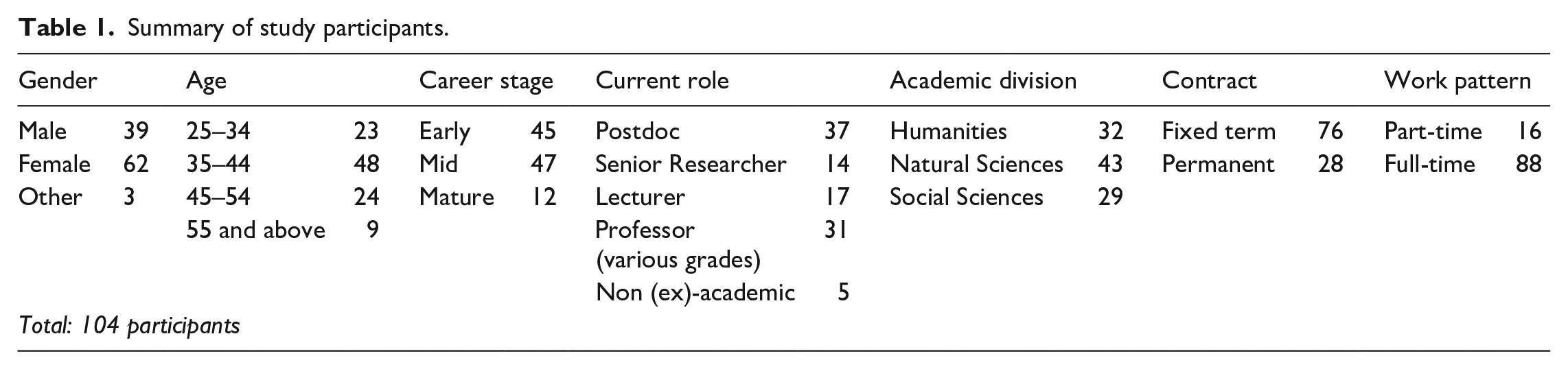
We utilized a cross-sectional sample of academics at different career stages, including postdoctoral researchers, lecturers and different levels of permanent professors (see Table 1). A purposive sampling strategy was used to recruit 104 participants from across the Humanities, Natural Sciences and Social Sciences. The study was qualitative, exploratory and examined OID through the lens of subjective individual experiences. Potential participants were contacted through calls circulated via various communication channels at the university – divisional and departmental. Those who agreed to participate completed questionnaires prior to being interviewed to provide information on stratifying features including gender, ethnicity, academic affiliations and work patterns. Participants also shared a copy of their updated curriculum vitae to enable us to understand their career. We asked them to visualize their significant career events to tease out any variation in their identification with their university.
Summary of study participants.
Interviews were conducted in person, or by phone, Skype or Zoom. These different formats reflected the impact of the COVID-19 pandemic. 1 While all interviews were conducted in person prior to COVID-19 (n = 30), we subsequently completed them online (n = 74). Interviews ranged from 60 to 167 minutes and lasted, on average, 90 minutes. We drew upon a narrative tradition (Riessman, 2008) for conducting interviews, utilizing a naturalist approach that ‘seeks rich descriptions of people and interaction as they exist and unfold in their native habitats’ (Gubrium and Holstein, 1997: 6). Narratives represent subjective constructions that are temporal in being based on a sequence of events, meaningful from an individual narrator’s perspective and social such that they are situated within a context (Elliott, 2005).
Our narrative interview progressed via the following steps. We began with a drawing exercise – the journey plots – that invited participants to reflect on the key milestones of their career journey by reflecting on the significant events, individuals and relationships that helped or hindered their getting to where they were today. We managed the drawing exercise virtually in a remote interview context, whereby individuals were emailed the drawing sheet prior to the interview. Figure 1 (exhibits a–d) depict the typical output of such an exercise. The horizontal axis documents the passage of time starting from the first time in life at which participants thought about pursuing an academic career, up to the present time. The vertical axis documents the relative significance of the event, individual or relationship being recollected – the higher up the axis the more positive and the lower down the axis, the more negative the influence. This drawing exercise was followed by a detailed oral reconstruction of their story. Each account varied in terms of its depth and coverage but was guided by the same set of interview probes: (1) the meaning of work and its significance; (2) expectations and emotions in relation to work and the extent to which expectations have been met; (3) work and career experiences in the current organizational context; and (4) career choices, satisfaction and long-term plans.
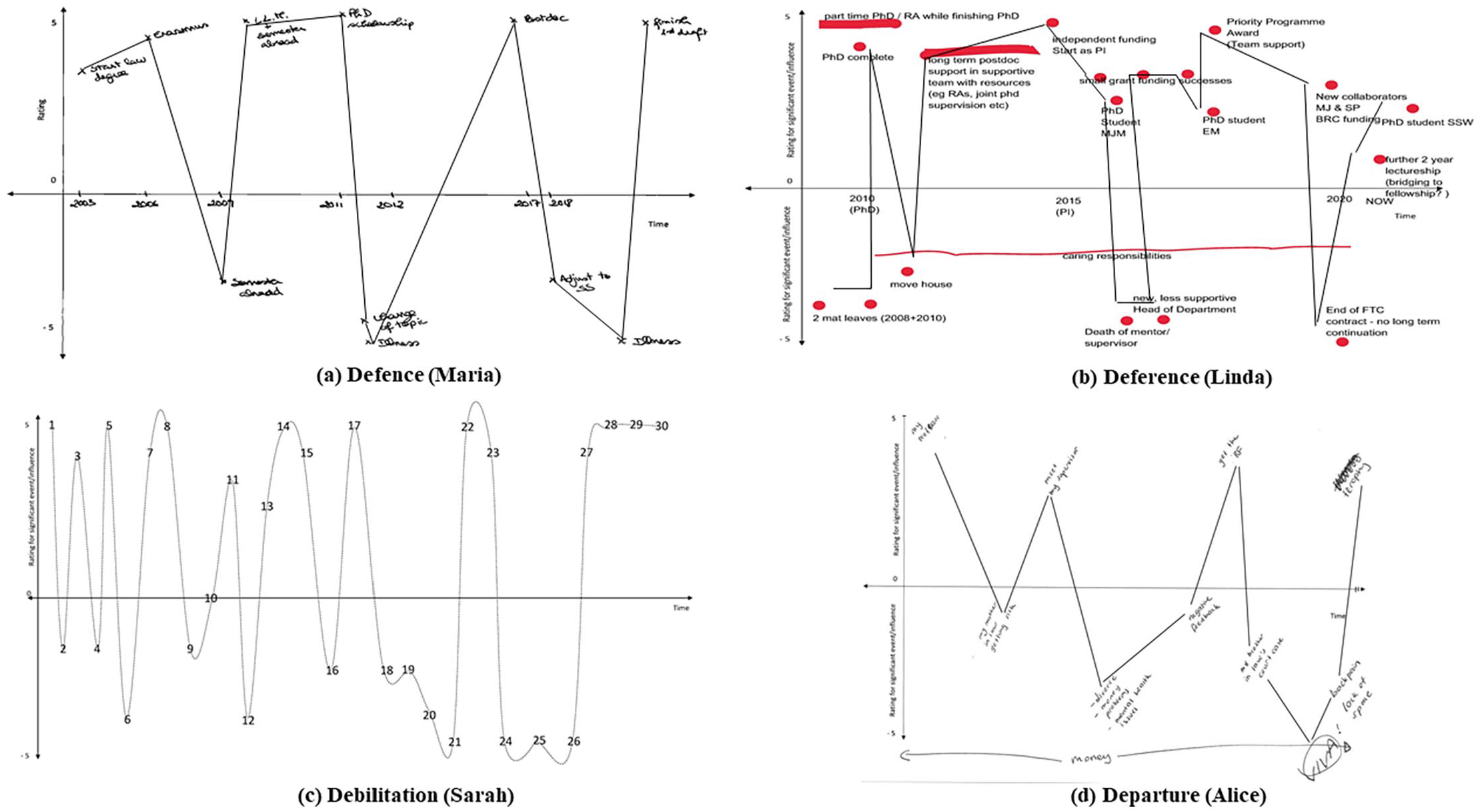
Sample journey plots.
Data analysis
We adopted a narrative analytical approach (Riessman, 2008), which holds that personal narratives – the stories we tell to ourselves, to each other and to researchers – offer a unique window into the formations and reformations of the meanings of life experiences (Brown, 2022; Riessman, 2003). This is apposite to our research question that seeks to understand how identification is discursively constituted in individuals’ narratives of disappointment. Our analysis was inductive and iterative, unfolding in three stages.
Stage 1: Drawing the narrative fragments together
Inspired by the analytical approach of Sonenshein (2010), we recognized that most narratives are fragments of stories. We began by reading interview transcripts in parallel with participant CVs and background questionnaires. This enabled us to grasp nuances relating to participants’ personal and organizational contexts and how these impacted their experiences. Through the lens of OID, we began engaging in preliminary ‘theorizing from the case rather than . . . component themes . . . across cases’ (Riessman, 2008: 53). It became apparent that participants’ OID was constituted in their emotional talk. To identify patterns across these emotionally laden cases, we undertook a cross-case analysis to identify emergent themes using NVivo Pro v12. The interview transcripts were read and open-coded into first-level descriptive codes. At this point, we identified a high incidence of talk about disappointments in which participants discussed their relationship with their organizations. As such, disappointment narratives became focal as a ‘primary discursive frame’ (Larson and Pearson, 2012) in our analysis of OID.
Stage 2: Identifying turning points in OID
As (Riessman, 2003) points out, one way to see how meanings shift is to look at ‘turning points’ in stories – moments representing a radical shift in the expected course of a life. We identified a high incidence of such moments in individuals’ disappointment-talk that captured key episodes of reflection in their OID; for instance, participant decisions to both commit to and depart from the organization. To make sense of these varied identification outcomes, we abstracted the inductive codes linked to informants’ discourse into a conceptual classification of the relationships between disappointment-talk and OID. In doing so, we began to identify differences in participants’ use of disappointment-talk for discussing OID. We remained open to disconfirming evidence and reanalysed the data to tease out these differences (Sonenshein, 2010), continuing to move between the narrative themes and the raw data to ensure credibility.
Stage 3: Development of discursive IW types that resolve conflicts between multiple discourses
We further analysed participants’ disappointment narratives to understand the different ways in which OID was constituted in them. Participants’ drawings of their career journeys were invaluable at this stage, allowing us to chart the key moments in their narration of OID (see Figure 1 exhibits a–d). As we further zoomed in on the data, we noted a confluence of additional discourses that were discussed through the primary discursive frame of disappointment in individuals’ narratives. These discourses related to the organization’s prestige and academic neoliberalism. Conflicts between these discourses constituted ‘identification dilemmas’ at the individual level. We discussed and recoded the data until we identified four discrete types of discursive IW emerging in our analysis that resolved these OID dilemmas: defence, deference, deterioration and departure. Each type of IW represented a distinct type through which individuals narratively engaged with disappointments to talk through their OID. These types were not mutually exclusive. Examining the confluence of discourses at play led us to identify the powerful role of discourses of prestige in organizing disappointment-talk along the different IW types identified.
Reflexivity
We were acutely aware of our positionings as insiders to the world of academia. This was helpful during the research because we were familiar with the sector being examined and could speak a shared professional language with participants. As (Riessman, 2003: 332) writes, a narrative analysis ‘does not assume objectivity; rather, it privileges positionality and subjectivity’. As such, it is important to recognize that the perspectives of both narrator and researcher come into view during each stage of the analytical process. We therefore utilized Lincoln and Guba’s (1985) notion of trustworthiness, which acknowledges the subjective nature of narrative analysis while providing criteria to allow others to have confidence in our interpretations: credibility, confirmability, dependability and transferability. To bolster the credibility and confirmability of our analysis, we support each theme in our findings with quotes from across participants and contextualize these using their CVs; for example, by noting their career stage or job role, their background characteristics and interview drawings (for instance, whether a disappointment appeared as a ‘low’ point on the drawing). To enhance dependability, we have outlined our analytical process to allow others to assess its rigour. To enhance transferability, we have provided contextual details of our study to allow an assessment of the relevance our findings in other settings.
Disappointment-talk as a primary discursive frame for narrating OID
In our study, disappointment-talk functioned as a primary discursive frame to guide individuals’ interpretations of experience. This means that participants’ talk about disappointment allowed them to narrate and potentially resolve the OID dilemmas resulting from conflicts between multiple discourses. We established four types of disappointment-talk when used as a primary discursive frame: defence, deference, deterioration and departure. Each represented a unique type of IW through which individuals narratively engaged with disappointments to talk through their OID.
Disappointment-talk centred on meaningful experiences of unfulfilled expectations relating to, for example, a diminished sense of purpose at work and restricted academic freedom. Embedded within such talk were references to the discourses of prestige and academic neoliberalism relating to the university, which were in conflict with the individual’s self-narrative of being an academic. For instance: I’ve been very disappointed actually; teaching is not valued, not really recognized. Teaching is not a prestigious activity. (John, Lecturer, Natural Sciences) The disappointments . . . come with insecurity of your work . . . even if you do well, you [aren’t] recognized and this is not reflected either in your career progression. . . . I think that [University] know they have a constant stream of people interested in coming here . . . that are going to bring funds . . . and they don’t feel pressure for securing and stabilizing people. (Owel, Senior Researcher, Natural Sciences)
It was also apparent from our analysis that individuals’ disappointment-talk was closely related to the narration of their relationship with the university: I have started to feel that [prestigious] University itself is not the whole academic world, nor should it be . . . So, while I still maintain good relationships with some people . . . I certainly stopped identifying with the [department] and the idea of working [there] started to seem less appealing. [. . .] I’m disappointed in the level of intellectual discussion [there]. (Ben, Ex-postdoc, Humanities)
In the following subsections, we examine the four different types of disappointment-talk through which individuals constituted their identification with the university.
Disappointment-talk as defence
One way in which disappointment-talk operated as a primary discursive frame to narrate OID was defence. Here, participants viewed conflicting discourses, and the resulting OID dilemmas, as opportunities to protect their identification with the university. Individuals appropriating the defence type of disappointment-talk engaged in contrasting and encouraging in their narratives to defend their self-definition as university members. Talking in these ways served to re-orient their focus and attention on the value of identifying with the university. Referencing discourses of prestige at the culmination of their accounts appeared to support the construction of a strong sense of identification with the university.
Contrasting
Stephanie’s (Postdoc, Social Sciences) narrative exemplifies contrasting as a type of IW in which individuals recounted prior disappointments to defend their OID. Her account reflects the conflict between the self-narrative (an academic of colour) and discourses of prestige (the university’s elite class-based membership) and academic neoliberalism (lack of permanent jobs), and the resulting identification dilemma: I’ve been told that because of my background, I won’t get a [permanent] teaching job in [prestigious university]. [. . .] It’s really fucking hard to be a person of colour [here], it’s so institutionally violent. . . . I hate entrances to [workplaces in university], hate them! It almost has its own border, I always feel . . . like I don’t belong. . . . it still creates a lot of anxiety because of [past] experiences.
A turning point in her disappointment-talk is signalled when she begins to contrast her present work contract at a new workplace with a past one: I have never been treated like this in my life, they have been incredible, just treated me like an equal. [. . .] It is a really different relationship that I have with people [here, it’s] how it should be. . . . I get on with all the academics . . . they’re amazing.
Although her disappointment at not getting a permanent job remains unresolved, framing it in light of a current positive experience of collegiality enables her to voice her strong feelings for the organization. In concluding her disappointment-talk, she draws upon the discourse of prestige to justify her identification. Her narrative begins to decouple ‘prestige’ from its assumed linkages to an elite background at the university and instead equates it with the development of her academic ability. This resolves the initial conflict between the self-narrative and discourses of prestige but leaves the discourse of academic neoliberalism unresolved: ‘[You need to] create a nice culture like [workplace] have . . . that’s more academic rather than [just] prestige and other things [reference to race] that some [workplaces] prioritize over intellectual ability.’
Encouraging
Maria’s (Postdoc, Social Sciences) narrative typifies encouraging as a type of IW in which disappointments are recited as opportunities for taking actions to uphold one’s identification with the university. Her talk intersperses the self-narrative (the interdisciplinary researcher) with discourses of prestige (being at the best university in the world), and academic neoliberalism (demands for mobility) in the telling of her OID: I just got very, very lucky . . . I was [doing] something that I was really interested in, [and] was working in one of the best institutions in the world . . . [However, I was told] ‘you are not going to stay here after your postdoc, you have to go elsewhere’. . . . I find [that] really discouraging [. . .] I [also] don’t really fit with any of the groups here . . . so they just allocated me to all three of them . . . it was . . . frustrating, I was wondering if I had made the right choice coming here.
A decisive moment in Maria’s narrative is reached when she talks about focusing on ‘the other part of it’ by using her disappointment as motivation to seek and seize development opportunities. In making use of these opportunities, such as joining a writing club and attending career talks, she reframes talk of herself in terms of a redeemed sense of belonging with the university: For the first time I feel like I belong to an academic community. I am starting to get to know people . . . It is just incredibly rewarding to be able to discuss things with people who have intelligent and well-thought-through arguments.
When drawing her disappointment narrative to a close, Maria revisits the discourse of prestige to rationalize her positive identification with the university. Her narrative recasts ‘prestige’ as a form of social capital such that associating with the prestigious university helps strengthen her academic self in preparation for a future career elsewhere. This undoes the tension between the self-narrative and discourses of prestige and academic neoliberalism: ‘Being in [university] is really a privilege because I just have access to all of these seminars and talks . . . and then there’s the “getting me ready for the rest of my career” part.’
Disappointment-talk as deference
A second way in which disappointment-talk functioned as a primary discursive frame to narrate OID was deference. This account characterized the identification dilemmas resulting from conflicting discourses as opportunities for self-adjustment and recalibrating their identification with the university. Individuals engaged in the deference type of disappointment-talk articulated university expectations and used these to reconstruct their definitions as organizational members through revising and respecting. Talking in these ways led individuals to submit to the expectations of the prestigious organization in their narratives and maintain positive constitutions of OID. References to discourses of prestige were central in being drawn upon to actively repair articulations of OID from weakened forms at the start of the narratives, to stronger, positive forms at their end.
Revising
Linda’s (Senior Researcher, Natural Science) narrative illustrates revising as a type of IW in which individuals recounted disappointments to understand the university’s expectations and revise one’s own expectations along those lines, thereby reconstructing OID. Her disappointment account highlights the identification dilemma emerging from a conflict between the self-narrative (the research productive academic), academic neoliberalism (lack of tenured posts) and prestige (short-termism of membership at prestigious university): The way it was set up was when you applied for . . . the funding, the university had to underwrite that they would, upon satisfactory completion, support continuity of the employment and move into a tenured post. . . . But [later] it was made clear that, ‘This shouldn’t have happened and [prestigious university] doesn’t do this . . . [. . .] [And] I thought, ‘. . . Why am I even trying to put in grants? . . . If I don’t belong here, . . . why am I doing all of these things?’ You feel a little bit separate from a lot of people.
A defining moment in Linda’s narrative is when she describes how the disappointment led her to clarify what was ‘in my head’ and redefine her relationship with the university:
I’m folding into the model for now . . . basically playing the game [. . .] They’ve made this in-between arrangement where . . . the five-year probation [will be] starting when this [contract] runs out. So, basically making it a ten-year probation.
In concluding her account, Linda circles back to the discourse of prestige to justify her reconciled identification with the university. Prestige is now narrated as the granting of individual legitimacy, which brings her gains externally, even if somewhat undermining her value internally. Such a reframing reconciles the discourses previously in conflict, thereby repairing OID: What they do offer . . . is their big name. Our chances of getting grants are improved by being here, and that is why we want to stay . . . and [so] if I go for this [new] fellowship, I should [do so] here because it will [get] better points . . . than else[where].
Respecting
Juliet’s (Lecturer, Humanities) narrative elucidates respecting as a type of IW in which disappointment-talk provided a frame to understand the university’s unexpected practices without necessarily revising one’s own expectations, thereby maintaining OID. Her account highlights the conflict between the self-narrative (a collegial academic) and discourses of academic neoliberalism (individual dispensability), and the ensuing OID dilemma. Unlike the others, she makes no direct reference to discourses of prestige at the onset of her story: I feel that in my position [as a lecturer] I should really be part of that body who meet regularly, who talk about [workplace], politics. . . . but the central body, which is the governing body, is not accessible to me. [. . .] . . . somehow, we are just under-valued, unrecognized. . . . you feel a bit invisible, a bit of a wasted resource. [. . .] I [also] get a portion of what my predecessor or other comparators . . . get.
Juliet arrives at a critical juncture in her narrative when she demonstrates deference to the university by accepting the situation and acquiescing to organizational norms, drawing upon her self-narrative as an academic: I’m doing all this work for nothing. But I am saying nothing. There is not much room for manoeuvre . . . it is the nature of the system. I try to be very realistic about everything. At my age, you know, choices are very much narrowing.
However, discourses of prestige are brought up at the culmination of her story, emerging as significant in justifying her attachment to the university. Prestige, to her, amounts to belonging to a collegial and social academic community that affords her the ability to bring her personable self to work. This reconciles the conflict between the self-narrative and discourses of prestige, and repairs OID through the recognition of her contribution to the social life of her workplace: [It] is a community, not just a workplace. . . . which suits me because personally I thrive [by] talking to people. . . . And you wouldn’t get that anywhere else, . . . it’s one of the privileges of being at [university] . . . it’s my personality [and prestigious university] is the ideal environment to allow that to happen . . . I would rate that very highly . . . I absolutely love [prestigious university].
Disappointment-talk as deterioration
A third way in which disappointment-talk served as a primary discursive frame to narrate OID was deterioration. This account casts the OID dilemmas arising from conflicting discourses as a source of internal dissonance. Participants employing the deterioration type of disappointment-talk articulated their increasing ambivalence towards the university through debilitating and detaching. These took form as recitals of personal decline, suffering and feeling trapped at the university. OID was constituted as broken in such talk. However, discourses of prestige were subsequently drawn upon to somewhat repair damaged OID and voice it, instead, as a more ambivalent form of attachment.
Debilitating
Wanda’s (Lecturer, Social Sciences) narrative exemplifies debilitating as a type of IW in which disappointment-talk brings to light the physical and emotional depletion that diminishes strong OID. Her account engages with the conflicts between the self-narrative (the valued academic) and discourses of academic neoliberalism (career instability) and the resulting OID dilemma. Wanda’s referencing of the fixed-term nature of work and lack of value as an individual employee hints at the costs of associating with a prestigious university: It’s constantly short-term, and with no . . . career progression, it’s just stalling the whole time . . . It’s unfair . . . I don’t think it has helped me [feel] secure [or] respected. [. . .] What does that mean about how they view the importance and longevity of [staff] like me?
In contrast to other accounts, there is no obvious turning point in Wanda’s story that drastically shifts the narration of her relationship with the university. Instead, her talk no longer questions but affirms her sense of disidentification: To not get any feedback or . . . professional conversation with me about [my career] . . . in 15 years does leave you feeling . . . professionally worthless. [. . .] [It] makes me feel . . . that I don’t really belong at the department, I’m just filling a gap until they can find somebody else . . . [in a permanent] role they can finance . . . Obviously, that doesn’t make you feel like you are part of the team . . . [or] particularly needed.
Her story pivots, however, when despite the continued depletion, Wanda overtly draws upon the discourse of prestige in concluding her account. The prestige of the university grants her individual legitimacy in the external world, even though she continues to narrate debilitation internally. Accounting for such legitimacy allows the discourse of prestige to transform her OID from a diminished to an ambivalent form: ‘Lots of people really respect [prestigious university] and this department, and you get a lot of people working with you because of that.’
Detaching
Sarah’s (Senior Researcher, Natural Sciences) narrative typifies detaching as a type of IW in which disappointment-talk acknowledges the self as disidentified with the university. Her account intersperses the self-narrative (the competent researcher) with discourses of academic neoliberalism (competitive job market), and the ensuing OID dilemma: A funder said, ‘you’d be competitive, you should apply [for this grant]’. [But] our grants team . . . said, ‘no, you won’t . . . and we won’t support you’. To me, that was disappointing. [. . .] [I was told] It would be a waste of time to apply, [but] surely, it’s none of [their] business . . . If I want to . . . I should be allowed to apply. [. . .] I . . . feel less like part of the common cause. . . . And even if there are other people . . . I still feel like I’m rattling around . . . nobody cares that I’m there . . . I need to feel part of something.
Sarah arrives at a decisive moment in her narration when, in responding to the disappointment, she describes detaching from citizenship activities. This differs from Wanda’s account above, which narrates debilitation that paralyses action. Instead, Sarah narrates actively disengaging: They often have these, ‘How to get a fellowship’ thing – if [grant manager] came and asked me to talk at those, I don’t know whether I’d be willing to put in the effort, because ‘well, you didn’t care that much about me, why would I care about helping you. . .?’
Although suggestive of disidentification, as her disappointment narrative draws to a close, she brings talk of prestige to the fore, engaging with it to reconstruct her OID from disidentified to an ambivalent form. Prestige is articulated as the granting of external recognition, which attaches a sense of pride at being an organizational member. This somewhat undoes the tension between the self-narrative as an academic and discourses of academic neoliberalism that motivated her OID dilemma, although a lack of internal support from the university still leaves part of it unaddressed: When I go to conferences, I like that [my badge] says ‘[Prestigious] University’. . . . And [can say], ‘I am a lecturer at the best university in the world.’ So, . . . there’s still . . . pride . . . But that doesn’t stop it being a difficult place [to be].
Disappointment-talk as departure
A fourth way in which disappointment-talk served as a primary discursive frame to narrate OID was departure. This account considered the OID dilemmas arising from conflicting discourses as opportunities for preserving one’s preferred academic identity by severing identification with the university. Participants adopting the departure type of disappointment-talk described a sense of disidentification with the university because of expectation divergence and used it to talk about taking remedial action through deviating. Articulating the breakage of bonds with the university enabled individuals to voice the need to no longer define themselves in terms of university membership. Discourses of prestige were referenced in narratives as being critical in actively cementing the growing sense of disidentification with the university.
Deviating
Alice’s (Postdoc, Humanities) narrative illustrated deviating as a type of IW in which individuals draw upon disappointment-talk to articulate the self as no longer a member of the university. Talk of ‘getting nowhere’ was a common theme used to voice the breakdown of OID here. Alice’s account successively draws upon the self-narrative (the promising book author) and discourses of academic neoliberalism (demonstrating productivity) and prestige (being a female minority in an elite university) to highlight her identification dilemma: Nobody was willing to give me a space to work. I found myself talking to these senior academics [with] multiple offices . . . explaining why I would need a private space to write a book. . . . How they tackled that, was really disappointing. [. . .] I would go to lunch . . . I felt so out of space [as a female religious minority], I didn’t feel like I belonged . . . everybody was looking at me, thinking ‘who is this person?’
A turning point in Alice’s narration of OID is reached when she focuses her disappointment-talk on her decision to deviate from the expected path, indicating a clear breakdown in her relationship with the prestigious university. Talk about purposefully acting to separate from the organization illustrates a sense of disidentification: To get a lectureship and put your foot on the step you must do what you need to do – research, publish a book, whatever. But afterwards I do not want this to continue. This year I am going to make applications and target smaller universities.
In concluding her narrative, Alice draws upon discourses of prestige to justify her decision to break bonds with the university. Unlike the other types of disappointment-talk in which prestige is invoked to salvage or redeem damaged OID, this type references prestige to cement disidentification. Alice sees prestige as invalidating her individual ability, which prevents her from reaching her full potential as a developing academic. Distancing from such prestige, then, begins to undo the knotting between the self-narrative and discourses of academic neoliberalism: I needed a small space to work, . . . a mentor mildly interested in what I was doing . . . But I didn’t even have that. I started feeling really lost, just didn’t feel that I was meant to be here. [. . .] Every time they engage with you . . . they expect you to reaffirm your gratitude, reassure them about how grateful you are about this opportunity . . . that hundreds of people apply for . . . I’m happy I’m employed . . . but beyond that, this institution hasn’t given me anything!
Discussion
Our study answers the question of how OID is discursively constituted in individuals’ narratives of disappointment by focusing on a prestigious British university. We found that disappointment-talk served as a primary discursive frame for talking through individuals’ OID dilemmas as constituted in multiple conflicting discourses relating to the prestigious organization and academic neoliberalism. Participants narrated their disappointments in four ways, each representing a unique type of IW. We now highlight how our findings contribute to the literature on emotional discourses in OID and the role of multiple discourses in identification. We also reflect on the implications of our findings for academic work.
Emotional discourses in identification
Our first contribution is to the literature on emotional discourse and OID. By focusing on disappointment-talk – as opposed to emotional talk more broadly (Ahuja et al., 2019; Coupland et al., 2008; Marsh and Musson, 2007; Zembylas, 2003) – we extend extant research that has shown how emotions can function as discursive resources for constructing and expressing the self (Coupland et al., 2008; Winkler, 2018). We show how disappointment-talk can serve as a primary discursive frame for interpreting and (re)working one’s sense of self in relation to the organization in four unique ways – defence, deference, deterioration and departure. Each of these types of disappointment-talk is a form of IW.
Our articulation of these types of IW broadens recent scholarship, which suggests that discourses of emotions ‘delimit individuals’ identity options and scope for agency’ through ‘reproducing the discourses that constitute particular identity positions’ (Ahuja et al., 2019: 990–992, emphasis added). We extend the literature by highlighting that disappointment-talk can also enable individuals to resist and reject the organizational discourses that anchor them to specific identity positions. This is demonstrated in our study through disappointment-talk of departure, which is employed by academics to reject rather than conform to the organizational discourses of academic neoliberalism and prestige. Our study thus addresses the limited empirical evidence on how specific emotion-talk, as discursive practices, yield specific identity and identification positions (Winkler, 2018).
The findings of our study also help shift focus from the purely debilitative effects of disappointment and resulting powerlessness (Van Dijk and Van Harreveld, 2008) by attending to its generative function as a primary discursive frame (Larson and Pearson, 2012), which helps narrate the ‘being’ and ‘becoming’ of individuals in relation to organizations. This highlights the important role of disappointment-talk in serving as a ‘strategic resource’ (Kornberger and Brown, 2007) appropriated by individuals to talk through the arrays of competing discourses in order to co-author their subjectivities as organizational members.
Multiple discourses in identification
Our second contribution is to build on a growing group of studies examining the influence of multiple discourses on identity construction (Clarke et al., 2009; Kuhn, 2006, 2009; Larson and Pearson, 2012) by extending this to a consideration of their influence on OID. In exploring the co-construction of discourse ‘through, with and against . . . other discourses’ (Leonard, 2003: 221) we identify a novel way in which individuals configure multiple discourses in narratives, which we term unravelling. Here, one among the multiple discourses in conflict ‘unravels’ the knotting between aspects of other discourses in individual narratives. In our study, the prestige discourse was often drawn upon by individuals to unravel the knotting between the multiple discourses that constituted individual OID dilemmas.
An important feature of ‘unravelling’ is that it operates with a certain level of stretch, such that the unknotting of discourses is achieved to a greater or lesser extent across different narratives. While prestige emerged as being significant in unravelling the tension between the discourses in conflict across all four types of IW in our study, it did so to different extents and in different ways. For example, we saw prestige completely undo the tension between the self-narrative as an academic and discourses of prestige and academic neoliberalism in the cases of Maria (defence narrative) and Linda (deference narrative). This was achieved by reinterpreting prestige from a prevailing organizational discourse to a personally meaningful discourse of the self. In contrast, Alice’s departure narrative showed her abandoning the discourse of prestige entirely in her decision to depart from the university for another less prestigious institution. This facilitated a reconciliation between Alice’s self-narrative as an academic and discourses of academic neoliberalism. These three examples therefore show how unravelling can untie the knot between multiple discourses.
However, our study also shows that discourses of prestige can, equally, slacken, rather than completely unravel the knotting between multiple discourses. This was seen across the defence, deference and deterioration narratives exemplified by Stephanie, Juliet, Wanda and Sarah. Here, the discourse of prestige was salient in unknotting certain elements of the conflict between the self-narrative as an academic and discourses of academic neoliberalism while leaving others unresolved. These examples therefore show how the knot between multiple discourses can be partially rather than completely untied through unravelling, such that certain elements are in accord while others remain in discord in individuals’ narratives.
Unravelling thus represents a novel way of configuring discourses, through which several knotted discourses in individual narratives become untied. This differs from the previously reported configurations of reticulating (Kuhn, 2009), knotting (Fairhurst and Sheep, 2020; Sheep et al., 2017), cohering (Larson and Pearson, 2012) and tilting (Kuhn, 2006). We clarify this distinction in Figure 2. Unravelling differs from other forms of configuring in highlighting how individuals’ narratives can disentangle multiple knotted discourses rather than be conditioned or entrapped by them. Unravelling is important because it advances our understanding of how multiple discourses shape individual identification – ‘a discursive process implicating, shaping, expressing, and transforming identity structures’ (Kuhn and Nelson, 2002: 7, emphasis in original).
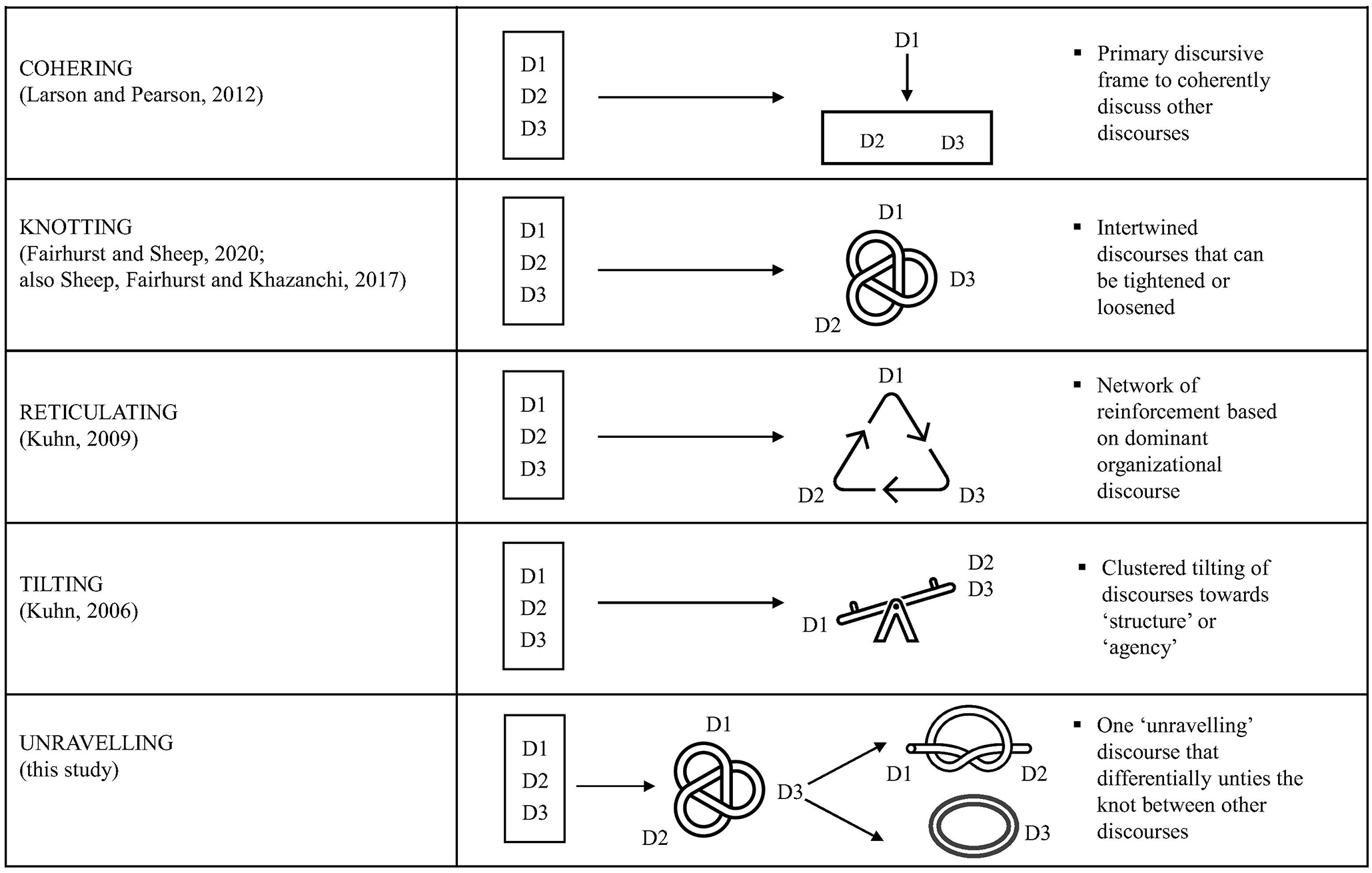
The configuration of multiple discourses in identity and identification.
Implications for academic work
Our study echoes many of the challenges noted in contemporary accounts of academic labour and illustrates the tightening grip of neoliberal policies at universities (e.g. Aboubichr and Conway, 2021; Bristow et al., 2019; McCann et al., 2020; Ogbonna and Harris, 2004). We build on this important literature to highlight that discourses of prestige do not always ‘uplift’ individuals but can also ‘descend’ them into despondency. This is not just because prestige raises expectations but also because, in our case, universities can be seen to be unfairly trading on their prestige to exploit individuals. Prestige is not always enough to retain academics in the ‘business’ of education today. As such, we cast new light on the ‘dark’ side of OID (Conroy et al., 2017), by showing how reputation can be both a benefit and a burden for individual employees, as well as for organizations (Mignonac et al., 2017; Zavyalova et al., 2016).
Our study’s recognition of the dark side of OID extends recent scholarship on suffering in organizations. We show that social suffering, which has been theorized to emerge through incompatibilities between organizational control (such as via organizationally inspired discourses) and individuals’ identities (Gill, 2019), can be partially mediated through talk. In our study, the multiple ways academics engage with competing discourses to differentially narrate their alignment to the organization supports the view that there are not only multiple contradictory discourses within higher education (Clarke et al., 2009) but also contradictory interpretations of the same discourses. For universities grappling with the forces of neoliberalism, this discursive view creates avenues for addressing contemporary challenges instead of being entrapped by them.
Our findings offer ways for universities to engage with and attend to disappointment-talk, to foster and sustain OID in ways that benefit not just the university but also the individual. This is especially relevant considering recent events such as COVID-19, funding cuts and hundreds of redundancies across UK universities – such that the disappointments we have studied are likely to be widespread across universities beyond our individual setting. For instance, senior academics can openly discuss their disappointments with junior colleagues and provide appropriate mentoring. This would give junior academics a better sense of what to expect from an academic career. Many early-career academics in our dataset wished they had been told more about the pitfalls of publications and funding, and the general scarcity of jobs in the present labour market. Working more closely with recently tenured academics could also provide the support and guidance to those more junior at a time in their careers when it can make a meaningful impact on their prospects. Our findings reflect that individuals sought and benefited from such opportunities. Universities could seek to leverage and protect the relatively unique strengths of the academic workplace when responding to individual disappointments. Despite neoliberal pressures, our participants found solace in intellectual freedom, collegiality and students. Adequately protecting and supporting such features could be bound up with academic groups, departments or universities to serve as ‘identification anchors’ (Tom and Elmer, 1994), which might sustain OID in challenging times.
Future research
Our study focused on one British university within a specific cultural context. Future research could examine how our conceptualization of four types of disappointment-talk may be transferable to other settings (Lincoln and Guba, 1985). Furthermore, our study relied largely on interview data. Ethnographic and observational data could illuminate other discourses that shape disappointment-talk and provide insights into why people talk about disappointment differently. Given recent research that individuals’ identities are influenced by certain co-workers (Gill, 2021), and that interpersonal interactions are shaped within institutional orders (Voronov et al., 2022), observations may also illuminate who influences OID.
We encourage future research that examines the concept of unravelling or that establishes other ways in which people configure multiple discourses. For instance, are there ‘packages’ (Gill et al., 2020) of discourses, in which certain arrays of discourses are more tightly bound than others and thus more resistant to unravelling? To investigate such issues, we suggest that there is value in future research examining the narration of other emotions and experiences bound up in IW, beyond types of disappointment-talk. IW focuses attention on how individuals construct their connection with an organization through or with(in) available discourses. It would be insightful to understand how people use specific types of emotion-talk to narrate their IW with organizations in different contexts and the associated implications (building on related research that has considered identity work, see Ahuja, 2022; Ahuja et al., 2019).
A further direction for research would be to clarify the limits of talk and discourse in shaping OID and identity work more broadly. We hold that the possibilities of using language to structure (social) reality are limited (Alvesson and Willmott, 2002). These limits stem, in part, from power relations and cultural traditions but there are likely to be other influences. We therefore encourage other research that draws on different philosophical or theoretical perspectives to examine the interplay of talk with material and somatic conditions. Such research could illuminate what may circumscribe or circumvent individuals’ discursive constructions.
Conclusion
This study examined how identification is discursively constructed in individuals’ narratives of disappointment while working at a prestigious university. Building on recent interest in OID as a discursive practice and the role of emotions as discursive resources, we established how individuals employed disappointment-talk as a primary discursive frame in four different ways to articulate their OID dilemmas: defence, deference, deterioration and departure. Our findings broaden previous scholarship by showing how discourses of emotion do not simply delimit agency but can also enable individuals to resist and reject the organizational discourses that anchor them to specific identity positions. We also identify a novel way of configuring discourses – unravelling – in which individuals draw on one among multiple discourses to undo the knotting between discourses that constitute their OID dilemmas.
Our study demonstrates that analysing emotion-talk yields more than just a descriptive account of people’s stated feelings and, instead, provides insights into how people resolve tensions and construct their connections with organizations within arrays of discourses. Individuals’ connections with an organization, even with a prestigious organization as in our case, appear to be precarious constructions. The narratives that individuals tell themselves and others allow them to change or maintain their constructions of connection. It is telling that disappointment was so prominent in our participants’ accounts of their connection with contemporary academia.
Footnotes
Acknowledgements
We are grateful for the guidance of Andrew Brown. Thank you to the three anonymous reviewers for their constructive comments. We also acknowledge and thank the feedback received from the 2019 EGOS conference and comments on earlier drafts from Eero Vaara and Tom Lawrence.
Funding
The authors disclosed receipt of the following financial support for the research, authorship and/or publication of this article: this work was supported by a Wellcome Trust Institutional Strategic Support Fund grant [2016/BRR00060].
