



Abstract
Collective workplaces – such as coworking spaces, open workplan offices, maker spaces, or fab labs – are founded on one central premise: working alongside others leads to interactions, collaborations and access to ‘buzzing’ knowledge. Yet, at the same time, users of these places go there to do their (often freelance) work, requiring a productive, and therefore usually quiet, work environment. Drawing on interviews and ethnographic fieldwork in the Netherlands, this research explores how users of collective workplaces navigate the coworking paradox: the need for quiet workplaces and the desire for social interaction. It shows how interactions emerge through rituals and especially routines, and describes the spatio-temporal conditions under which these interactions may lead to successful forms of social exchange and community formation.
Introduction
The early 2000s marked the emergence of collective forms of work: coworking spaces, open workplans, shared offices, maker spaces, fab labs and creative hubs all found their ways to cosmopolitan urbanity and – a few years later – ‘ordinary cities’ and rural settlements. And yet, this shift from worker isolation to more collective forms represents a return to collective work long present in trade apprenticeships, factories, and office environments. Many of today’s workers seek to work together, for instance, to escape the cacophony of working in a café or the isolation of working in one’s attic.
In their ideal-typical form, collective workplaces such as coworking spaces are geared toward fostering collaboration and knowledge exchange for their users (e.g. Moriset, 2013; Schmidt et al., 2014; Waters-Lynch et al., 2016). Existing literature on such forms of collective work has shown that collective workplaces have great potential for the exchange of tacit knowledge and practical and professional skills, for inspiring new collaborations, and for evoking new ideas (e.g. Bouncken and Aslam, 2019; Bouncken and Reuschl, 2018; Butcher, 2018; Spinuzzi et al., 2019). Yet, the title of one of the first and most influential publications on coworking, Clay Spinuzzi’s ‘Working alone together’ (2012), foregrounds one of the core issues of coworking: the paradox of a simultaneous need for silent workplaces and a ‘buzzing’ atmosphere.
On the one hand, silence has become an emerging theme in studies on collective work practices. Faure et al. (2020) see collective workplaces as governed by a logic of silence: a self-imposed regime of quietness that affords work to be done effectively. Such silence is never absolute. There is always a continuous murmuring and rustling of work being done, loaded with non-verbal interactions and signalling. Silence, they argue, is a lived, performed and organized event (De Vaujany and Aroles, 2019; Faure et al., 2020) that governs day-to-day life in collective workplaces. Without silence, productivity would plunge. Silence, therefore, is inherent to working collectively.
These observations stand in sharp contrast to a large body of literature discussing the affordances of collective work practices in terms of community (Avdikos and Iliopoulou, 2019; Blagoev et al., 2019; Garrett et al., 2017; Spinuzzi et al., 2019), learning (Butcher, 2018; Wijngaarden et al., 2020), social support (Gerdenitsch et al., 2016; Merkel, 2019a) and collaboration (Yacoub and Haefliger, 2022). The vast literature on coworking shows the manifold actions forming and shaping communities. Such communities have the potential to positively contribute to the users’ personal and professional development and even innovation (Yacoub and Haefliger, 2022). Yet, community formation is only possible through verbal interactions, and so is access to the ‘buzzing’ rumours and knowledge (Grabher, 2002).
Thus, if silence is the modus operandi, what is collective work exactly? And, how, where and when do such communities, forms of interactions and exchanges emerge in the first place? This article aims to understand how and why silence pertains in collective workplaces, and if at all and in which ways, this silence can be transformed into ‘non-silence’. Or, in other words, to answer the pressing question of how, where and when workers in collective workplaces negotiate the inherent tension between the need for ‘buzzing environments’ and the need for a quiet workplace. Drawing on interviews with users of, and ethnographic fieldwork in collective workspaces, this article introduces rituals, but especially daily routines in liminal spaces as a means to spatially and temporally manage this tension.
This research makes three contributions. First, it explores this paradox of coworking – in the broadest sense of the word – by bringing together two perspectives on collective workplaces: those that perceive verbal interactions as detrimental to productivity and satisfaction (see e.g. Appel-Meulenbroek et al., 2020), and those that assert that such spaces are a boon to the freelancer’s ills (see e.g. Merkel, 2019a). This tension is theorized using existing studies on privacy and propinquity in open workplan offices within single organizations (e.g. Fayard and Weeks, 2007). By applying these theories to the field of collective workplaces, consisting of a collection of freelancers rather than formal colleagues, this article builds an in-depth account of how the perspectives of ‘working alone, together’ (Spinuzzi, 2012) and ‘coworking is about community’ (Spinuzzi et al., 2019) can co-exist.
Second, it forwards how routines, ingrained in certain temporal and spatial contexts – often liminal spaces – manage and mitigate the tension presented above. Routines and rituals are considered essential drivers of community formation in much of the existing literature (e.g. Blagoev et al., 2019; Butcher, 2018); yet, we lack insights into exactly how this works, and how such routines and rituals are (culturally) embedded. By taking reflections on materiality, temporality and spatiality into account, this research develops a micro-geography of coworking practices, and identifies strategies to successfully combine silence and ‘buzz’. This adds to the call for more research on how collective workplaces can become (self-)organizing entities (Blagoev et al., 2019; Cnossen and Bencherki, 2019).
Third, many studies on this topic have looked at (processes of) successful community building, for example by means of ‘community work’ (Garrett et al., 2017), commoning (Waters-Lynch and Duff, 2021a), or indirect communication through ‘stigmergic curation’ (Waters-Lynch and Duff, 2021b). Yet, in line with the recent findings of Waters-Lynch and Duff (2021b), this article also acknowledges the difficulties in governing or curating successful workplaces by looking at the practices that are contested, rejected, or fail to be adopted. This helps in gaining a better understanding on how to best curate a collective workplace (Brown, 2017; Merkel, 2019b; Waters-Lynch and Duff, 2021b) and how to reap the benefits of coworking (e.g. collaboration and innovation – see Capdevila, 2015; Schmidt et al., 2014; Wijngaarden et al., 2021; Yacoub and Haefliger, 2022).
Theoretical framework
Collective work as a site of privacy and propinquity
Collective work practices – what I conceive as individual, usually freelance work, being done in the proximity of others – have rapidly spread all over the globe as a result of an increasing number of workers leading a flexible work life outside of the traditional office environments (see e.g. Gandini and Cossu (2021) for a brief history of the emergence of coworking spaces, Orel (2019) for coworking and digital nomadism, and Reuschke et al. (2021) for a discussion on coworking from homes). In the most minimal form, collective workplaces offer office-renting facilities with desks and Wi-Fi connections where independent individuals – ‘not affiliated with an organization or an established profession’ (Petriglieri et al., 2019: 124) – can work alongside their professional peers (Gandini, 2015). Ideal-typically, collective work is not solely ‘working alone, together’, it also promotes a normative model that endorses the values of community, collaboration, openness, diversity and sustainability (Gandini, 2015; Kwiatkowski and Buczynski, 2011; Merkel, 2015).
Thus, collective workplaces differ from other workplaces in the sense that they focus on community building, and knowledge and resource sharing dynamics (Capdevila, 2015). They aim to provide a solution to the professional isolation of freelance work by offering a community that is not found at home (Garrett et al., 2017; Spinuzzi, 2012) or in other workplaces (Fuzi, 2015). Considering the solitary experiences of freelance work (Merkel, 2019a), cooperating with other entrepreneurs can be critical in business development (Spinuzzi, 2012), providing crucial coordinating functions in connecting networks of individuals and groups (Merkel, 2015; see Granovetter, 1983). This makes coworking a strategic step to gain access to the required and desired social capital (Gandini, 2015). Similarly, such places – by fostering ‘accelerated serendipity’ (see Moriset, 2013; Waters-Lynch and Potts, 2017) – offer meaningful interactions with others having similar values yet different and complementary experiences, skills and networks (Brown, 2017). Using the idea of interstitial spaces, Yacoub and Haefliger (2022) explain how collaborative innovative practices – that is, the initiation of joint problem solving – between coworking members emerge. In the vast body of work on co-location from a geographic perspective, the concept of ‘buzz’ is often used to denote this access to ‘a concoction of rumours, impressions, recommendations, trade folklore and strategic misinformation’ (Grabher, 2002: 209).
Nevertheless, collective workplaces are also sites of a paradox between what Fayard and Weeks (2007) call propinquity and privacy. Theories of propinquity follow the line sketched above: proximity fosters social interactions. Collective work, in this sense, is a means to develop new ideas, alternatives and ways of working. Theories of privacy confer that people are more inclined to be comfortable with interacting when the boundaries of their conversation are within their control and within enclosed spaces. These theories highlight the difficulties in stimulating social interactions. Some authors even argue that coworking is much more a bubble than a serendipity machine (Gandini, 2015; Moriset, 2013). They, for example, state that physical proximity alone does not necessarily lead to the interactions, collaborations and cross-fertilization required for learning and knowledge sharing (Parrino, 2015; Spinuzzi, 2012). Even designing an environment accommodating collaborative practices, using, for example, whiteboards and digital enterprise tools, seems insufficient to immediately result in interactions (Waters-Lynch and Duff, 2021b).
Studies on open-plan offices indeed demonstrate that the increasing ‘openness’ of office spaces hampers rather than facilitates interactions – not in the least because it is harder to judge the (mental) availability of proximate colleagues (Peteri et al., 2021). Other recent empirical research shows that the expectations attached to buildings designed to foster collaborations by means of chance encounters often fail to materialize. Or, even worse, they lead to a decline rather than intensification of informal contact due to conflicts and territorial behaviours (see e.g. Irving et al. (2020) for a more detailed discussion). Bernstein and Turban (2018) observed a vast drop in face-to-face interaction (though an increase in instant messaging and email interaction) in situations where a traditional office was transformed into an open-plan setting.
The reason for this is clear: office noise can lead to stress among employees (Johnson, 1991) and has been repeatedly confirmed as annoying, dissatisfying and complicating work (Appel-Meulenbroek et al., 2020). The impossibility to withdraw from noise in workplaces also leads to a perceived loss of privacy (Bodin Danielsson and Bodin, 2009) and decreased motivation (Pindek et al., 2019). Especially speech and conversations are deemed disturbing. Verbal interactions do not only stand out in how they annoy others, but also in how much they affect productivity (Appel-Meulenbroek et al., 2020). Because speech – contrary to most other noises – is intelligible and variable, it affects working memory, reading capacities and memorizing tasks (Venetjoki et al., 2006). The variability of speech, with intermittent periods of silence and interaction, inhibits coping and habituation. Obviously, in open workplaces – such as collective workplaces – this is a pressing issue. Existing literature shows that workers have multiple options at hand to cope with noise, ranging from giving up on being productive, going home, making a greater effort to be productive or discussing the noise problems with colleagues. Especially the latter two options, Appel-Meulenbroek et al. (2020) demonstrate, are used most by workers in open workplan buildings. Interactions often cause annoyance and decreased productivity; yet, workers also engage in conversations on how to deal with this tension.
Silence in collective workplaces
Whereas traditional, compartmentalized office work is characterized by a rhythmic pattern of silence/noise (e.g. ‘noisy’ meetings and ‘quiet’ individual offices), the disappearance of these boundaries – spatial and temporal – in collective workplaces marks a growing importance of both rules governing collective practices as well as self-discipline. This leads to a pressing puzzle: how (if at all) do workers in collaborative settings (e.g. coworking, shared offices, etc.) reconcile the need for privacy and interaction? Silence plays an important role in doing so. Or, in the words of Arvidsson (2018: 293): ‘Co-working spaces are generally marked by silence.’
Recently there has been a surge in studies on silence in organization studies (e.g. Bigo, 2018; De Vaujany and Aroles, 2019; Faure et al., 2020; Vu and Fan, 2022). Silence is what is found between talk, in several forms of non-verbal communication and constitutive of discourse (Blackman and Sadler-Smith, 2009). Besides decreasing distraction, silence leaves room for new ideas to emerge. What is important here is that, in these studies, silence is not seen as a mere absence of noise, but rather a ‘lived event and experience enabling meaningful events and collaborations’ (Faure et al., 2020: 308; see also Bigo, 2018). Faure et al. (2020) argue that silence in collective workplaces is never absolute, nor externally imposed, but an individual and collective experience instead. For freelance workers in collective workplaces, for whom interactions (see ‘buzz’) are often a prerequisite for being able to make and sustain a career, silence has a paradoxical quality. Complete silence is not desirable. As a respondent in Liegl’s (2014) study on coworking remarked: ‘I was hoping for a little more eavesdropping.’
Yet, what is acceptable as ‘background’ noise or distortion is not easily identified. Irving et al. (2020) observed during an organization’s transition to open plan that – after an early period of interactivity – people felt increasingly distracted. This led to an informal obligation to avoid interaction and a collective effort to maintain full silence. Yet, the authors also emphasize that exactly these interactions make serendipitous encounters, and as such new collaborations, possible. Liegl (2014) shows that working in open settings (such as a café) is not necessarily done with the aim of contacting other people, but rather to see and be seen. Laptop workers usually do not work with, but alongside others. Spinuzzi (2012) calls this the ‘good neighbours’ configuration of coworking (rather than the ‘good partners’). Silence may discipline behaviour in collaborative spaces, but also enable the workers to flourish in other ways than just through verbal interactions and collaboration (see also Faure et al., 2020).
Communicating the spatial and temporal dimensions of silence through routines and rituals
Yet, how does ‘unproductive’ silence transform into a more productive form? Following the perspective of ‘Communication as Constitutive of Organization’, communication is the main force driving organizational practices (Schoenebornet al., 2019). Organizations, in this sense, are collective actors, literally talked into existence (Cooren et al., 2011). This field also sees organizations not necessarily as order and organized, but also in a continuous dialectic dialogue with disorganization. As Putnam (2019: 25) highlights: ‘organization is defined as the action of ordering, one that emphasizes predictability, stability and certainty while disorganization centres on disruptions, divergences and instability that surface from disorder’. Tensions, such as those between the need for privacy and propinquity (or silence and interactions), are inherent to any organizational form (Cooren et al., 2013), and give rise to dynamic forms of organizing, influenced by the material assemblages – people, spaces, objects – that shape interaction and communication. One of the ways to ‘manage’ this tension is through routines and rituals. Routines and rituals are used regularly and often interchangeably in the literature on coworking, though in essence, they refer to somewhat different practices with potentially different outcomes.
Routines are increasingly conceived as ubiquitous to organizational constitution and existence. Pentland and Feldman (2008: 235) describe routines as ‘recognizable, repetitive patterns of interdependent action carried out by multiple actors’. Routine patterns are temporal, their existence grained into longer patterns of development, and leave traces through time and space. Moreover, they have the potential to change, being a process of reproduction more than a ‘thing’ (Feldman et al., 2016). As a result, routines are enacted in certain timeframes and spaces, and are therefore inseparable from the socio-material context. At some point, routines may develop a level of sacredness, formality and aesthetic value, reaching the status of a ritual (Knuf, 1993; Koschmann and McDonald, 2015). Rituals, similar to routines, are elements recurring in time and space, yet, what makes them different is that they display a symbolic element through which beliefs, emotions and identities can be formed and changed. They are particularly important for incorporating individuals in larger structures (Trice et al., 1969), including organizations (Islam and Zyphur, 2009).
Butcher (2018) and Blagoev et al. (2019) observed that routines and rituals provide moments of connection between lengths of uninterrupted, silent, individual work in collective workplaces. Because freelancers lack the formal socialization in the firms’ values and dispositions inherent to traditional, Fordist or white-collar organizations (Alacovska, 2018), such routines need to be developed bottom-up. Cnossen and Bencherki (2019), for example, meticulously describe how the recurring use of certain imagery connected a wide range of otherwise loosely organized individuals. Waters-Lynch and Duff (2021b) call these spatial and material ‘editing’ practices shaping work and organization routines ‘stigmergic activities’, and conceive these practices as highly important for entrepreneurial learning. Nevertheless, Edenius and Yakhlef (2007) also highlight the difficulty of developing such routines bottom-up, especially with the usually fluid and volatile populations of collective workplaces.
Existing research on collective workplaces has shown how rituals and routines are essential to community building (Cnossen and Bencherki, 2019), and that common rituals in coworking spaces include breakfasts or network lunches (Blagoev et al., 2019). Rituals may open up the possibility to informally engage in small talk, discuss developments in one’s working life, test new ideas and share grievances and insights (Blagoev et al., 2019; Wijngaarden et al., 2020). Butcher (2018: 331) proposes that, in order to reap the benefits from coworking, coworkers first need to learn how to cowork: ‘[L]earning to cowork is a curated process . . . that is generative of shared everyday routines and rituals in coworking, as coworkers gradually appropriate the role of hosts, the community learns to become increasingly collaborative.’ This suggests that routines and rituals can play a key role in solving the privacy/propinquity paradox inherent to collective work. Therefore, the present article explores when and where ritualized and routinized interactions mitigate the disruptive effects of (verbal) interactions.
Data and methods
In line with the extant literature (e.g. Brown, 2017; Garrett et al., 2017; Vidaillet and Bousalham, 2018), this research takes a qualitative approach in order to understand how workers in collective workplaces ‘construct meaning in relation to the area of inquiry’ (Chun Tie et al., 2019: 2). It does so by means of interviews with workers in collective workplaces and ethnographic fieldwork. The interviews take the perception of workers regarding their social interactions in the workplace as leading, following the workers’ accounts of their experiences. A follow-up ethnographic study on everyday practices of learning and sharing ideas continues a tradition of research on this topic (e.g. Blagoev et al., 2019; Cnossen and Bencherki, 2019; De Vaujany and Aroles, 2019 on coworking, and Hindmarsh and Pilnick, 2007; Martine and Cooren, 2016; Meziani and Cabantous, 2020 on learning through interactions), and aims to supplement the participants’ accounts by also including the author’s experiences of, and observations during coworking.
Being part of a larger project on interactions and collaboration in collective workplaces, this article builds on fieldwork in eight collective workplaces located throughout the Netherlands. Coworking spaces are growing increasingly diverse (Schmidt et al., 2014), with some seeing coworking only as open spaces with membership programmes; others broaden the term by also referring to business incubators, serviced offices or regular business centres (Fuzi, 2015; Weijs-Perrée et al., 2019). The eight cases fit into this broad approach to coworking, with some spaces being partly coworking, partly serviced offices, serviced offices with incubation programmes, or other hybrid forms (see Table 1). They all are used primarily by self-employed, freelance entrepreneurs, often working in the creative sector. Nevertheless, considering their broader approach and often lacking self-identification as coworking spaces, I refer to them as ‘collective workplaces’ in this article. All locations were established in the early 2000s, meaning they are part of the early wave of collective workplaces, rather than the slick offices and turn-key workplaces of the neo-corporate model (Gandini and Cossu, 2021). Nevertheless, all but one are (by the time of writing) still in function, with relatively few changes to both their population as well as their identity and purposes. For reasons of confidentiality, all names of respondents and workplaces have been replaced by pseudonyms.
Collective workplaces in this study.
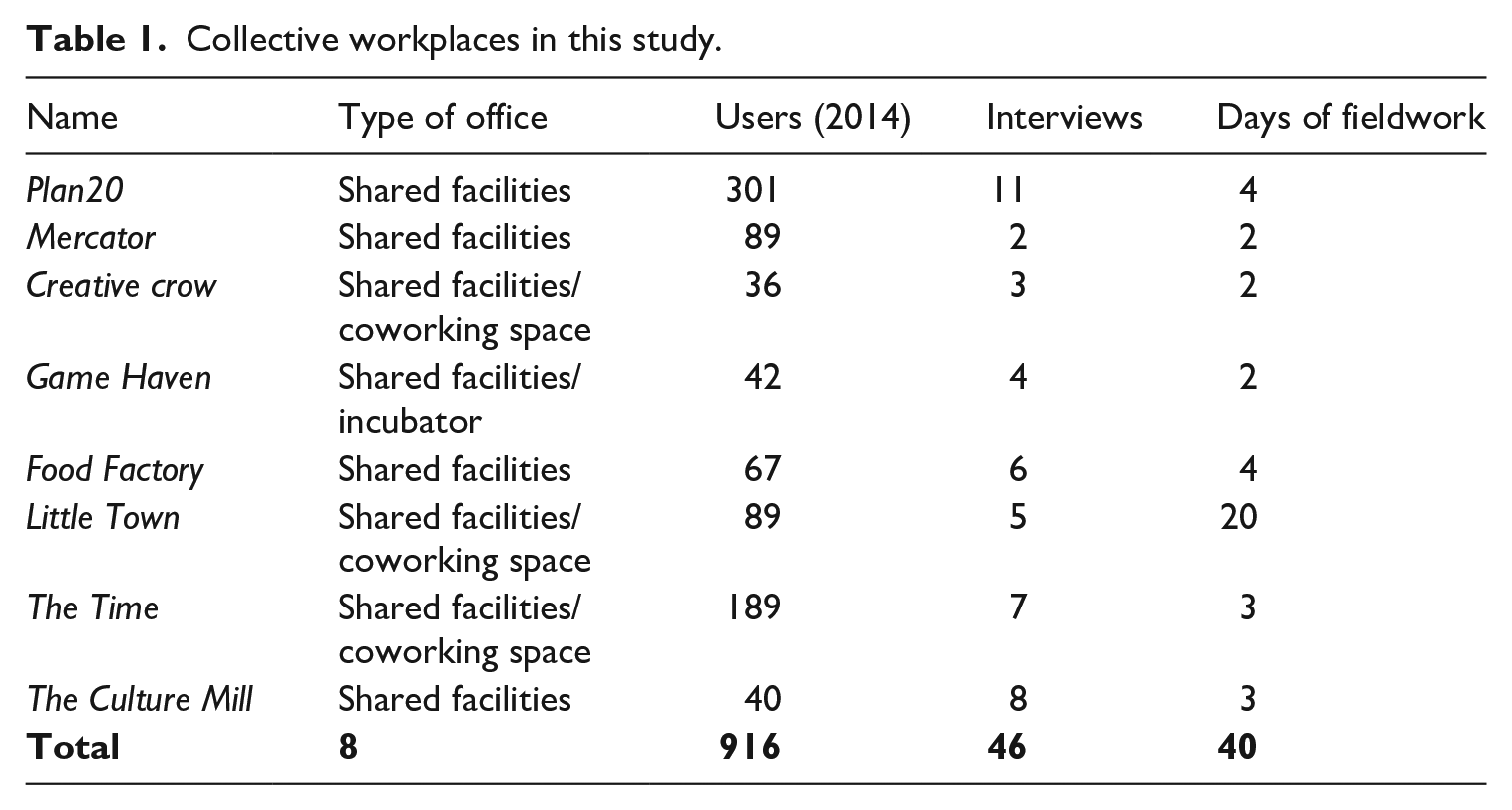
With the initial aim of understanding how social interactions in collective workplaces helped them in their professional career, 46 users (in 43 interviews) were asked about how they experienced their workplace, their interactions and collaborations with other users, and whether and how this contributed to knowledge exchange. Interviews were conducted between September 2014 and October 2015, and lasted an average of 55 minutes. Additionally, the places’ managers were interviewed to discuss how they experienced and sought to foster interaction and collaboration. All interviews were recorded and subsequently transcribed.
This article takes an abductive approach, looking at relatively unexpected observations (see Alvesson and Kärreman, 2007; Kennedy and Thornberg, 2018). Therefore, approaching the first interviews in a very open, interpretative manner, I observed several tensions that I felt needed closer scrutiny: the importance of silence, privacy and conditions for successful interactions. This is where I decided to dig into the privacy/propinquity paradox described above, and added an additional layer of ethnographic material. As rituals and routines are most efficiently observed ‘in action’ (Feldman et al., 2016), I spent in total one month (October 2015) participating and observing in the ‘flex-workers room’ in Little Town. Here, I particularly looked at recurring, recognizable patterns of routines, as well as the more symbolically laden, top-down endeavours of rituals. The decision to do so was primarily driven by the relative openness of Little Town’s open workplan setting, its average size (being large enough to house more than a handful of coworkers, yet at the same time being small enough to sustain social ties). Moreover, the focus on one workplace instead of all eight allowed for observing (emerging) patterns at the respective workplace.
Little Town, at the start of the project, housed 89 businesses and freelancers, though not all of them were using the ‘flex-workers’ rooms. Some rented separate offices – yet they shared space (e.g. corridors, balconies, smokers’ rooms, ‘common rooms’) and participated in lunches, drinks and other activities. All businesses were freelancers or SMEs employing under five workers. Little Town’s two ‘flex-rooms’ were usually occupied by between two and ten users. Nearly all users stuck to one particular room, the ‘silent room’, which looked like a former classroom, with high ceilings and large windows on one of the sides. One of the walls was filled with bookshelves that housed books, computer screens and a stereo set, as well as some lockers for, for example, equipment of the space’s users. In one of the corners, two sofas were installed – though never used during my stay – together with a small table, resembling a living room setting. There were two large desks, each occupied by some eight people, on either side of the room. Beer crates were spread out and hung throughout the room for decoration, and some of the walls were filled with ‘inspirational’ posters. In the other room (the ‘noisy room’), a small kitchen, coffee machine and piggy bank (for shared expenses) were found. This room was generally only used for using the kitchen amenities and having a chat while doing so, and not so much for working in itself see Figure 1 for the workplace layout. Additionally, some 20 days in total were allocated to observations in the other seven workplaces.
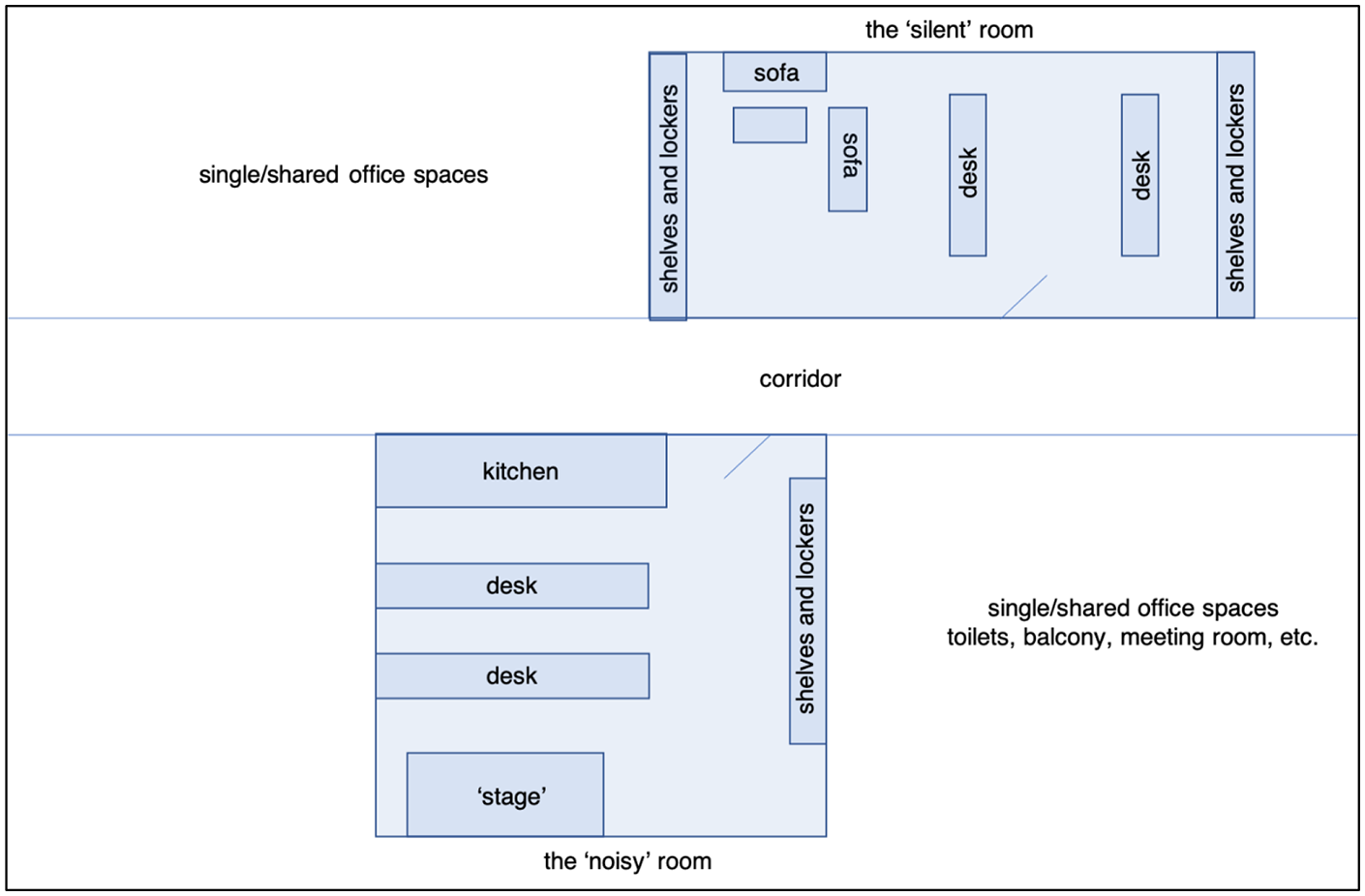
Workplace layout.
During fieldwork, I have always been overt in my position, introducing myself to workplace users during visits and presenting myself on the (more or less mandatory) Facebook group and during introductory talks. Fieldnotes were mostly written contemporaneously (keeping a notepad open and making jottings and notes throughout the day) and after visits, inscribing the fieldnotes right after leaving the fieldwork every day. Considering that continuously typing is commonplace in coworking spaces, jotting notes has been relatively non-intrusive (Emerson et al., 2011). Most attention has been paid to how people interacted, not only verbally but also in their attitudes and non-verbal communication. As periods of interactions were usually followed by much longer periods of silence (see De Vaujany and Aroles, 2019), there often was ample time to transform the jottings into actual fieldnotes.
Considering the size of the dataset (43 interviews, each approximately 30–50 pages, and some 30 pages of typed observations for the Little Town fieldwork only), all fieldnotes and transcribed interviews were added to a single project in Atlas.ti. This allowed me to organize the analysis with a coherent set of codes. The same emerging set of codes was used to study all interviews and fieldnotes in order to allow the abductive approach to come to fruition, and to be able to further build on the initial observations in an iterative process (Kennedy and Thornberg, 2018). I took the following steps to do so: first, the interviews were coded in an open coding process, with emerging codes such as ‘informal interactions’, ‘references to rituals’ and ‘self-presentation’. The interview protocol was developed and specified over time, zooming in on the most recurring and what respondents found most meaningful practices (Nicolini, 2009), in this case, these were especially forms and types of interactions and day-to-day routines. After this, the fieldnotes were added to the dataset and analysed using the same group of open codes first, to apply the ‘language’ of the respondents to the observations. As the interviewing process took more than a year, and partly ran parallel to the observations, I discussed my emerging interpretations with respondents and coworking users (see Creswell and Miller, 2000).
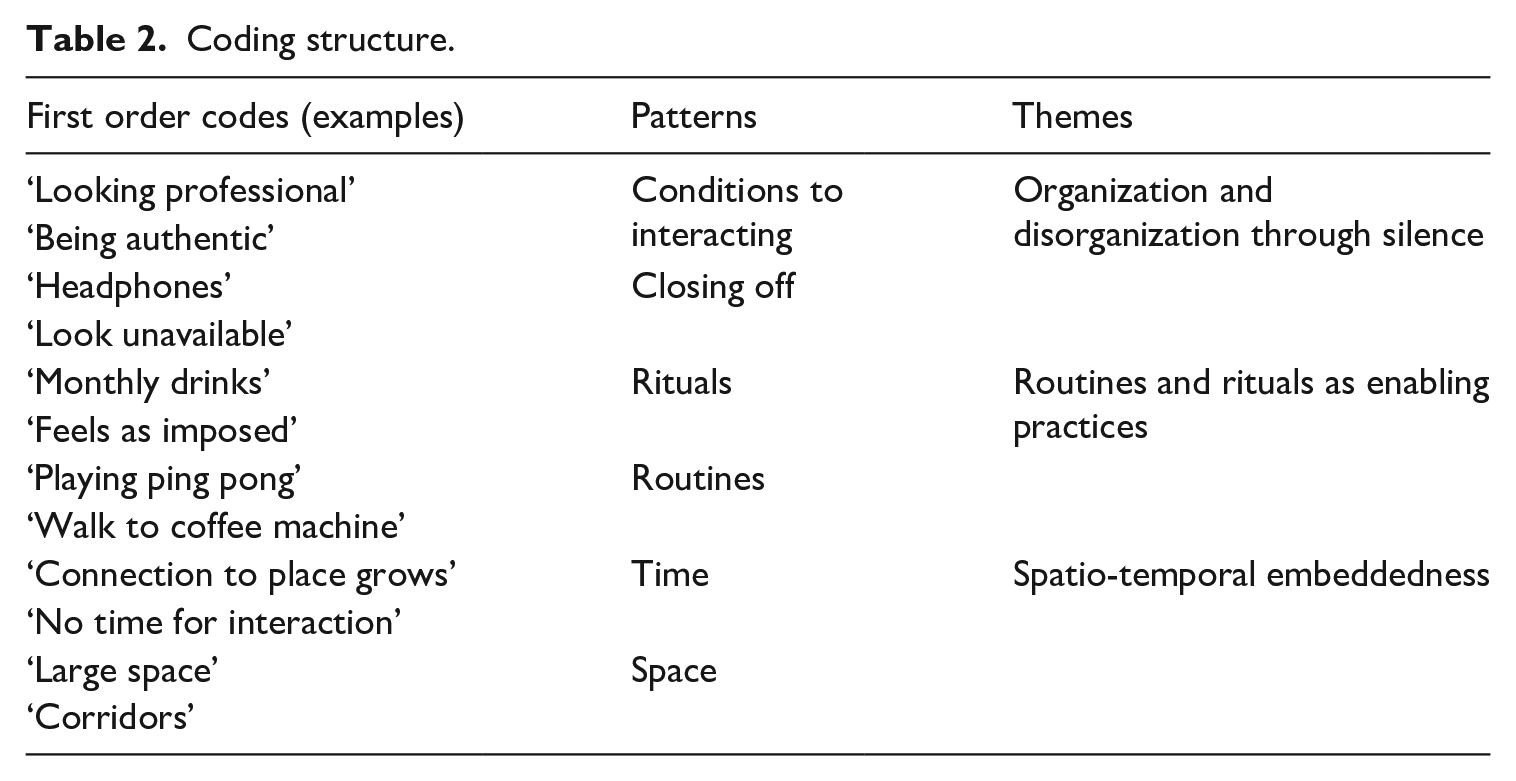
Further analysing the data, I took a more thematic analysis approach, using existing concepts around collective work such as silence, and role proficiency. This step aimed to connect the codes generated in the open coding process to the theoretical themes, as well as to provide new insights into the rather descriptive codes generated in the first analysis. In a third step, these combined deductive and inductive themes were divided and collected in four overarching themes: organization and disorganization through silence, rituals, routines, and spatio-temporal embeddedness of interactions (see Table 2 for examples of open codes, patterns and themes). Finally, based on the recurring codes within the themes (i.e. those that were prominent and prevalent within the larger themes), I selected short vignettes and sentences that were exemplary for each of these themes. These vignettes and sentences are presented in the Results section below.
Coding structure.
Results
Organization and disorganization
Silence is important in collective workplaces (see De Vaujany and Aroles, 2019), and so it was in Little Town. The extended periods of silence were one of the first things I noticed doing fieldwork, with fieldnotes including many references to the temporality of quietness. For example, I wrote on the first day of observations: ‘It has been quiet for over two hours. Everyone is actively focusing on his or her laptop without any verbal interactions.’
Despite this persisting silence in the collective workplaces, all interview respondents emphasized that their decision to co-locate was driven by their need to experience some sort of ‘buzz’, ‘life’ or vivacity. Even though respondents acknowledged the importance of such reuring [buzz], as many respondents called this in Dutch, most respondents also immediately highlighted the struggles that come with such liveliness, such as Jack, who summarized it concisely as ‘I like the buzz, but I also suffer from it.’ Abel stated that he often was kept from his work when there was any commotion around him. Likewise, Lucas stressed that ‘being able to do my work is most important, I have to [do my work to] make a living’. Looking available leads to a risk that ‘you have someone talking to you every hour or so, which means you can’t hammer away for a day’ [Bjorn]. Others, such as Rachel, underscored that sometimes the (often alcohol-infused) collegiate atmosphere forced her to occasionally close off herself and even her belongings. The social interactions they were looking for were also a source of disruption and instability.
In this respect, it is not surprising that breaking the silence was not always welcomed. Coworkers often responded sarcastically or were annoyed when users asked practical questions they considered unnecessary breaches of their workflow. For example, when a new member asked whether he put his screen on the correct storage shelf, a woman responded ironically by saying that ‘it will probably be destroyed tomorrow, that’s how people act here. Or they’ll remove the keys from your keyboard.’ With all the audience laughing, the new member quietly put back his screen on the desk and seemingly retreated to quiet work practices. In the interviews too, respondents mentioned fellow users asking unprofessional questions (e.g. asking to borrow expensive equipment). Kim also recounted such transgressions, such as receiving a message from a member, saying ‘Hi, I just turned 39 today. Will you come and join me for a coffee?’, which she found rather surprising: ‘I don’t even know you. And you invite me for your birthday and some coffee. That’s not how we hang out with each other here. I found that very. . . strange.’ In a similar vein, Axel criticized people not adhering to his work ethos: ‘when I’m here, I want to do business. I like it when people talk about their kids, but that’s only suitable when you’re taking a coffee break.’ Leo, conversely, explained that he stopped randomly dropping by people and talking to them, as he felt he was the only one doing this and did not want to get the reputation of being a ‘stray cat’. Charlie disclosed that she as a novice coworker was afraid to ask ‘stupid questions’.
The reluctance to speak up – or the rejection of those that did – was also infused by the tension – literally – between privacy and propinquity. Many respondents felt highly uncomfortable about discussing private or sensitive issues in a collective setting. William also mentioned that in some projects, ‘you’re not allowed to show anything . . . the people here, we can’t trust, or we’re not sure whether we can trust them . . . I think other people also feel this . . . It’s my business, keep your nose out of my work.’ Others also felt unease about unwillingly conveying personal information to others: ‘when I’m on the phone, I quickly go somewhere else. Like the meeting room. Or just, anywhere else. A place quieter. Just for privacy. Because that’s one of the main disadvantages of having so many people together. If you discuss things that eh. . . aren’t suitable for everyone’s ears, I find that difficult. You can’t do that here. Everyone can just walk by. You can really overhear anything’ [Charlie]. Moreover, Kim and Alex did not want to get personally involved with their coworkers too much, because they want to avoid mixing their private and professional lives. Looking professional is key. Ellen, for example, felt that if you spend too much time socializing, people will think ‘she’s just messing around. But that’s not true. I work really hard . . . I think I am really busy, just like anyone here.’
To balance this form of disorganization, workplace users retreated to a number of actions of spatial and material ordering. From a material perspective, several kinds of tangible and intangible boundaries were erected, disconnecting workers from their environments. For those that had access to lockable office spaces, doors were closed, meeting rooms were occupied and other kinds of ‘physical bubbles’ were erected. Similar to the findings of, for example, Butcher (2018) and Faure et al. (2020), for those who worked on fully open floors, I observed several strategies to distance. Despite working in a community setting and thus being bodily co-present, coworkers in the ethnographic study safely retreated to their perceived private spheres by using involvement shields (Goffman, 1963) such as headphones, and avoiding eye contact. Robert, for example, emphasized that it took some effort to get used to, and close himself off from all the noise and voices in his workplace. Others did so in their usage of the available space (see also Faure et al., 2020). For example, I never witnessed new entrants taking up a seat next to one that was already occupied, if there was an opportunity to avoid this situation. Spatial compositions were far from arbitrary: entering the workplace was accompanied by a quick, casual glance over the distribution of chairs, desks and the positions of present coworkers.
In conclusion, the tendency to start interactions ‘out of the blue’ was rare and even avoided by respondents. Many users seemed to superficially know each other (as in knowing their names, but not exactly what they do), but they did not seem very keen on starting a conversation without a cause. The situations where people did so seemed to evoke negative responses rather than ‘buzzing’ conversations. Nevertheless, such causes were ingrained in the fabric of the workplace, and thus, successful interactions occurred, often through routines and rituals. The next section will expand upon the complexities of enabling interactions through rituals and routines.
Rituals and recurring events
Rituals are usually conceived as recurring events, and have been a vital topic in studies on coworking (see also e.g. Blagoev et al., 2019; Brown, 2017; Merkel, 2015; Moriset, 2013; Spinuzzi, 2012). In this research too, rituals proved to be important for coworkers, and an important tool for navigating the tension between privacy and propinquity. Indeed, top-down organized events such as drinks and lunches were appreciated by the coworkers. Curated gatherings and events afforded workers to escape the isolation of the individual daily work and experience community advantages in practice. Moreover, during lunches or drinks, many coworkers seized the opportunity to informally discuss the everyday problems they encountered in their practices. Despite working alongside the other users, people started having in-depth conversations only at such organized, recurring and even ritualistic events.
Suzanne, for example, described how drinks led to forms of collaboration ‘that were informal and made me start a collaboration with a photographer here . . . He just dropped by my studio here in this workplace, and from there, we started an idea to share work. This partnership professionalised over time, but this is how it started. Very informally.’ Michael stressed that, instead of network lunches, monthly drinks were the way to go: ‘where everyone grabs a few beers or a glass of wine and loosens up. And then, at some point, you get into a conversation of “oh are you doing this”, “oh are you doing that” . . . With a lunch it’s all a bit boring, everyone is just waiting until they can grab sandwiches, you know.’ Especially the term ‘loosens up’ is striking here, as this implies that most of the time he felt constrained by existing structures (e.g. the imperative to remain silent in the workplace). The importance of such rituals for developing a ‘buzzing’ community also showed in the fieldwork. During the drinks and lunch rituals I attended in Little Town, for example, intentions for collaboration or other forms of support were voiced regularly. For example, during a recurring ‘soup lunch’ event, two new coworkers introduced themselves during the lunch, and their conversation, without much small talk, soon addressed their complementary work activities. When some bystanders joined in, this very quickly turned into a conversation about the development of one of the new members’ business models.
Nevertheless, despite some positive experiences, organizing such events seemed to be more difficult than often shown in the existing literature on coworking (e.g. Blagoev et al., 2019; Brown, 2017; Cnossen and Bencherki, 2019; Garrett et al., 2017; Waters-Lynch and Duff, 2021a). Interview respondents voiced two distinct reasons for this. First, and quite similar to the reasons for imposing silence in such workplaces, respondents argued that as entrepreneurs, they had generally little time for such events. For example, Kim mentioned that ‘I really like the drinks, and that there is a specific moment for sharing a drink with the others and have a chat, and perhaps maybe if there’s one more every year. . . like twice a year, I would like that. But not more. No.’ Respondents also recognized this in others: Leo and Heidi organized drinks, but these were poorly attended, despite their own perception of being expected to participate in such rituals.
Second, especially when rituals were ‘imposed’ by the management, it was much harder for them to become part and parcel of the community. This goes for top-down organized drinks, but also for other types of rituals, such as enforced self-presentation by making a selfie to add yourself to the daily attendance system. When this system was introduced to my fellow new coworkers, this was accompanied by awkward giggling and some quick-witted remarks about ‘feeling like in high school’. In sum, rituals such as drinks have the potential to induce interactions, but their infrequency and sometimes limited participation made the impact – at least in these cases – less than expected. This, however, does not mean that silence was predominant and indissoluble. Propinquity did happen, but more often in a different format: daily routines.
Rituals as enabling practices
Routines concern the day-to-day activities that govern much of the collective work life. Though having received less attention, routines are essential to developing a sense of common identity or community. In Little Town, the most prominent routine was offering a drink. At least a few times a day, a coworker offered to get coffee or tea for all other users present. Importantly, I observed that this rarely was the same person asking twice, indicating that there is an expectation to rotate ‘turns’. This I also noticed in my first days in the space, when users offered to teach me how to use the coffee machine, and how to do the maintenance duties such as filling the reservoirs and cleaning the machine. This implies that this routine is imbued with implicit rules. It is reciprocal, and demands the nurturing of the commons (see Water-Lynch and Duff, 2021b). In this case, this quite literally refers to the common coffee machine. What is more, though in itself offering coffee is not something unexpected, it often also was a starting point for (new) conversations that would go beyond the superficial. For example, often other coworkers offered to help out in carrying the coffee back to the workplace. Yet, having to ‘kill time’, waiting for the machine to do its grinding and pouring, led to discussions on work, problems encountered, societal issues, the coworking space and past events. These talks never occurred while working in the designated workplace (i.e. the ‘silent room’).
Another example of a routine that allowed breaking the silence – and one that has received much less recognition in the existing literature – was related to overcoming office inconveniences and incidents. Such nuisances seemed to be a recurring issue. In Little Town, almost every day, a coworking member asked for help with practical difficulties. During fieldwork, issues with fridges, power strips, internet connections, coffee machines, laptop chargers and office chairs ignited interactions between coworkers. Despite bringing an end to all productive silence in the workplace, the willingness to help usually was high, and after especially the successes in overcoming these hurdles, the conversations often were to be continued, encompassing different (e.g. more entrepreneurially substantive) topics. Asking for help, therefore, seems to be an exception: such conversation starters were deemed acceptable in the ‘silent room’, and even transformed the continuous silence into moments of verbal interaction.
In the interviews too, respondents reflected upon, for example, lifting and moving furniture, or organizing themselves around rising parking costs, and how this made them feel like a community. Alex vividly puts this the following way: ‘Like yesterday, when a server cabinet had to be placed in the loft next to this one . . . It didn’t fit through the door and stuff. And, uh, those are the moments when you feel most connected.’ Indeed, such collective activities, doing something together rather than just being together, have the potential of stimulating community and knowledge exchange. These examples clearly show that rituals and routines are often fruitful ways to induce interactions. But why are they so successful in mitigating the silence in collective workplaces? The next section dives deeper into these practices, and how, where and when they manifest.
Spatio-temporal dimensions of routines and rituals
The coffee example, in all its ubiquity, also shows that routines (and rituals) have certain spatio-temporal boundaries. Asking for coffee is an acceptable way to interact, yet, only so in occasional iterations. For example, when I wanted to get a coffee for myself, some 15 minutes after declining one, I felt hesitant to – again – ask my fellow coworkers. Moreover, with the coffee machine located in another room (i.e. the usually empty ‘noisy room’), this routine also has clear spatial boundaries. The required withdrawal from the ‘silent room’, through the corridor, to the ‘noisy room’, facilitated interactions, but also kept them literally away from the silent workplace. The same goes obviously for ritualistic events such as lunches and drinks. The events are allotted a specific moment in time (weekly, monthly or even yearly, depending on the type of ritual), and take place at a designated location – often a common space (canteen, garden, etc.).
The interviews further revealed how rituals and especially routines mapped spatially onto the workplace’s layout. When asking respondents when and how they interacted with their co-located peers, nearly all underscored the importance of the walk to the coffee machine, kitchen or liminal spaces such as corridors. Jessica emphasized, for example, that nearly all social interaction happened in the canteen. In a similar vein, Daniel stated that ‘if you don’t have such a space where everyone gets together, it could be. . . I really expect that the chances that you don’t know of the other members’ existence are much higher.’ These routines too – walks from and to the workplace – allowed for spontaneous and serendipitous encounters that would not have occurred in the workplace itself. In the words of Suzanne: ‘[we talk to each other] just in the hallway, in passing, or when you go to the toilet. Or yes, you know, and when people arrive, no, we don’t necessarily have to say good morning to everyone [who is around]. If you run into someone, yes, but otherwise we just get to work and we’ll run into each other during the day.’
Even though such liminal interactions seem superficial, many respondents argued that they did play an important role in fostering community. Michael, for example, explained how they cultivated a shared identity: ‘even if you’re busy, just saying hello at the watercooler every now and then gives you the idea that we’re all here, and we’re all on the same boat’. Lucas went even further by stating that just waving hi and goodbye gives an ‘old boys’ kind of connection, which made getting along in more formal situations a lot easier. This connection, Charlie explained, helps to gain trust and encouraged interactions outside of the workplace, such as walking to the supermarket to get lunch together, or grabbing a beer at a nearby bar.
What is also important here is that routines had to have a temporal pattern. Rachel and Sander always took a few minutes for playing table tennis or computer games, though during the workday itself, they rarely interacted. Moreover, after having been silent for a longer period of time, breaking the silence seemed to be more difficult, as the boundary between privacy and propinquity solidified. I noticed that, as the silence persisted, it was less likely to be broken without a routine event or situation. For example, after several people had entered or left the space in a short period of time, workers seemed to be more inclined to start talking (for example, about clients delaying their payments and other more practical issues). Finally, similar to the spatial embeddedness, the temporal recurrence of routines also made social relationships between coworkers more meaningful. Julia mentioned that collaborations in her workplace did not happen out of the blue, but rather that, ‘you really must have a reason to do things together. So, uh, if you have a bit of a good vibe and you have the same ideas and your conversations really become livelier, it will happen naturally. But if you meet more often, it becomes easier.’
Conclusion and discussion
This article is driven by the question why, in many collective workplaces, interactions seem to be limited. Why does spatial proximity not necessarily foster social exchange? This question has evoked a wide range of studies on this topic, starting with the difference between the ‘good partners’ configuration (where people collaborate with other coworking members) and the ‘good neighbours’ configuration (where people work parallel to each other without much interaction) (Spinuzzi, 2012). As both the interview and ethnographic data indeed show, interactions are less common than many proponents of collaborative work would suggest. Work – also in collective workplaces – happens in solitary and discrete settings and workflow breaches are discouraged.
Such parallel work is explained by one branch of research (e.g. Brown, 2017; Fuzi, 2015; Gregg and Lodato, 2018) by the argument that merely putting people together is not enough to facilitate interactions. This approach points toward curation from the perspective of a manager. Such top-down approaches help in establishing connections through the organization of, for example, drinks and lunches, which may transform workspaces into interstitial spaces (Furnari, 2014). Yet, this study also shows that in themselves, these instruments are limited and that alternative explanations for interactions (or the lack thereof) should be considered. One of these explanations is a self-perceived lack of time. The interview respondents stated they have little time to invest in such events, and were not always receptive to top-down organization of more casual meetings. As a result, many of the solutions suggested by existing work on coworking (e.g. networking, drinks) may do something to stimulate social interactions, but are not the sure-fire way to achieve ‘buzz’.
This article also aimed to convene with the emerging branch of literature on bottom-up community development. Garrett et al. (2017), for example, show that coworking spaces require adoption of a sense of community to become successful. Blagoev et al. (2019) argue that community formation is dependent upon a configuration of formal and informal interactions. Waters-Lynch and Duff (2021b) explain how through stigmergic curation individuals may feel a stronger connection to the collective. Cnossen and Bencherki (2019) then introduce spatial configurations as a way to (self-)organize as a group of individuals, and literally bring them together. Nevertheless, despite all efforts to foster such communities – either bottom-up or top-down – Waters-Lynch and Duff (2021a) speak of members having a strong sense of ambivalence about the progressive aspirations of community development.
This article explored where these struggles to interact, curate and organize – despite all success stories about collective spaces – come from. In doing so, it makes five contributions, which I will further unpack in the remainder of this conclusion. It shows (1) that silence is inherent to coworking, (2) the difficulties of inciting interactions in collective workplaces, (3) the limitations of ‘top-down’ curated rituals, (4) the importance of routines that inevitably lead to ‘unavoidable’ interactions in liminal spaces, and (5) that especially these interactions yield the promise of increased trust and collaborative exchanges.
First, organizations are not only talked into existence, but also silenced into existence (see Schoeneborn et al., 2019). The coworkers in this study used all kinds of involvement shields such as headphones, but also socially constructed barriers to interaction. Their explanation was not only that members had to learn how to cowork (Butcher, 2018), but also that interaction was always exchanged for ‘work time’. Respondents discussed the barriers they themselves felt and how they complained about others disturbing their focus. It also showed in the in-situ responses after ‘transgressions’ of these erected barriers. Obviously, such barriers are disadvantageous to community development, and presumably also the answer to the question of why so many collective workplaces struggle to foster interactions. As such, this research not only confirms why such silence is prevalent and important (see De Vaujany and Aroles, 2019; Faure et al., 2020), but also proposes it is inherent to collective work itself. This silence paradox in coworking therefore underscores that we should not only look at verbal or written communication when we seek to understand organizational practices (Schoeneborn et al., 2019), but also the silent, non-verbal communicative practices.
Second, though there is evidence of the importance of, for example, rituals as key to facilitating interactions and building a community (Blagoev et al., 2019; Butcher, 2018; Garrett et al., 2017; Vidaillet and Bousalham, 2018), this research paints a more nuanced picture. With ‘breaking the silence’ being discouraged in especially the silent workplace, interaction moves elsewhere – consciously or unconsciously. This may happen through recurring events such as monthly drinks. This research shows that such events not only help users to get acquainted with their fellow coworkers, but also help them to see and to be seen. In these designated spaces and timeframes – e.g. a Friday afternoon in the ‘noisy workplace’ – interaction was indeed encouraged rather than discouraged. This confirms the findings of earlier studies about the importance of such events in constituting communities and organizations.
Third, this research nevertheless nuances the idea of rituals as a quick fix for social interaction. The empirical work reveals the limitations of these usually curated occasions, and in this way diverts from studies that propose ‘curation’ as a solution (e.g. Brown, 2017; Merkel, 2019b). Though direct conversations in the workplace itself were often discouraged, there were specific spatio-temporal conditions in which interactions were allowed and even unavoidable. These are specifically found in low-profile, day-to-day routines. Such routines include the well-known example of offering coffee or tea, which in itself is not a surprising observation. Yet, when mapping this on the workplace layout, it shows that coffee routine interactions were facilitated just because they forced users out of the room, through liminal spaces such as corridors, and stimulated users to wait for the machine to do its work, together. Having to kill time in a liminal space, some small talk is expected rather than avoided (see Goffman, 1959). The same goes for short breaks (Arvidsson, 2018), such as a walk to the bathroom, or just generally entering or leaving the place. Contrary to rituals, routines often took place in the periphery, in corners and in hallways, and rather as part of a process rather than a goal in itself.
Therefore, and fourth, despite the ubiquity of silence, users frequently interacted, collaborated and shared information. Yet, contradicting the idea of interstitial spaces as catalysts for collaboration (Yacoub and Haefliger, 2022), members rarely did so in open spaces or in goal-oriented settings such as network lunches. Rather, they exchanged ideas in the more liminal areas such as corridors, kitchens, porches or the smokers’ balcony (see De Vaujany and Aroles, 2019; Shortt, 2015). This shows that liminality is not only relevant within organizations (Shortt, 2015), but also – or especially – in places where connections are weaker. Liminal spaces, therefore, are extremely important to foster a sense of community, with many respondents saving up their talks, greetings and questions for when one serendipitously runs into the other in the corridor. Serendipity thus exists, though it is usually confined to liminal spaces. Respondents especially pointed toward the more serendipitous encounters as helpful in constituting trust and fostering future exchanges. New connections are often driven by chance, accident and spontaneity (Boutellier et al., 2008; Irving et al., 2020; Kabo et al., 2014). This seems to contradict the idea that such connections only happen when both parties have a reason to make them, and that serendipitous encounters are otherwise avoided (Irving et al., 2020).
Fifth, though interactions can be avoided by not partaking in organized rituals (and many respondents did so due to, for example, self-perceived time constraints), it is much harder to evade day-to-day, routine interactions. These interactions are unplanned and therefore not loaded with expectations or distrust. The boundary between work and non-work obviously is clearer in situations in which one makes a cup of coffee, compared to being hunched over one’s laptop. Interactions in these settings occur in more private spheres instead of open workplans, making them less uncomfortable and allowing people to interact more personally – without distracting others by talking about their private lives. Kabo et al. (2014) demonstrate that, in physical space, path overlap contributes to individuals’ propensity to collaborate. Similarly, such proximity also leads to increased trust and knowledge transfer in R&D labs (Dolfsma and Van der Eijk, 2016). Looking at collective workplaces, the present article’s interview data point toward similar findings: through recurring face-to-face encounters, trust was established, practices were observed, and perhaps eventually, new collaborations could emerge, leading to further exchanges of knowledge. Thus, even in quiet workplaces, ‘buzz’ exists. Yet, it is concentrated in specific spatio-temporal settings.
Nevertheless, though this research covers multiple cases, much of the ethnographic data collection is confined to one particular coworking space. Existing research shows a great variety in types of workplaces (see the different kinds of communities Spinuzzi et al. (2019) introduce, or the different ‘waves’ of coworking described by Gandini and Cossu (2021)). The interviews, conversely, were done with individuals working in a broader category of collective workplaces, some of which are relatively closed (i.e. all respondents having their own studio) whereas others are fully or partly open. Future research could take the paradox presented in this research to explore whether it also holds in other (workplace) settings.
Furthermore, considering the importance of space, and especially liminal spaces in fostering interactions, future research could dive deeper – also following the perspective of Cnossen and Bencherki (2019) – to study how different spatial configurations lead to different kinds and intensities of interactions. From a temporal perspective, this research highlighted the importance of brief breaks and lengthier curated lunches or drinks. Existing research (e.g. Pitts, 2016) has shown that creativity is impacted by specific rhythms of work. Future work can take up this perspective to see how the alignment of such rhythms may (or may not) strengthen the potential of interaction or even collaborative work.
Finally, future research could further explore the relation between coworking, interactions and learning. While this research shows how interactions occur, and also touches upon the benefits of such exchanges, the findings are mostly restricted to ‘buzz’ as a form of knowledge exchange. Yet, how such interactions further develop into meaningful relationships that lead to informal help and exchange (see Wijngaarden et al., 2020) is not touched upon. Future research could therefore employ a stronger focus on experiential learning (see Zemel and Koschmann, 2014), looking, for example, at how more established connections between coworkers evolve over time and how this affects their work.
Footnotes
Acknowledgements
The author would like to thank all interviewees and individuals who took part in the fieldwork, Erik Hitters, Pauwke Berkers and Thomas Calkins for their feedback on earlier drafts of this article, and Mina Beigi and three anonymous reviewers for their very helpful suggestions.
Funding
The author(s) disclosed receipt of the following financial support for the research, authorship, and/or publication of this article: This work was supported by Dutch Research Council (Nederlandse Organisatie voor Wetenschappelijk Onderzoek) [grant number 314-99-110].

[Email: