



Abstract
Findings from prior research on the relationship between a team’s social network architecture and team innovation have been inconclusive. Integrating social network theory with input–process–output models of team innovation, our research aims to reconcile the mixed findings in the literature by introducing a novel process perspective as well as highlighting a relevant contingency factor to untangle the team social capital–team innovation link. We propose that team social capital, operationalized as bridging and bonding social capital, negatively influences team innovation via team proportional task conflict, which is the level of task conflict teams experience proportional to the general level of team conflict (i.e. task, relationship and process conflict). In addition, we expected group and differentiated individual-focused transformational leadership to buffer the negative indirect effect of team social capital on team innovation via team proportional task conflict. Results from time-lagged data collected from research and development teams in Iraq revealed that teams with bonding and bridging social capital are less innovative because they experience less proportional task conflict. Furthermore, group-focused transformational leadership buffered the negative indirect relationship of team bridging social capital on team innovation via proportional task conflict. Theoretical and practical implications of these findings are discussed.
Keywords
Introduction
Innovation, defined as development and implementation of novel and useful processes, products or procedures (West, 2002), is a highly prized good because it ensures the competitiveness and long-term survival of organizations (Anderson et al., 2014; Eisenbeiss et al., 2008). It is no surprise then that managers are eager to develop their teams’ innovative potential (Barsh et al., 2008). Extant research points to one promising approach in this regard by highlighting that the workplace social networks within which employees are embedded can be a catalyst for team innovation as they offer access to more diverse informational resources (see Van Knippenberg, 2017). Understanding the social network dynamics of team innovation requires the study of patterns and structures of social relationships and their effects on teamwork. A construct that captures such network dynamics is team social capital (Han, 2018). Team social capital, defined as the set of resources available to a team through social relationships (Oh et al., 2006), can be classified into two distinct types: team bridging social capital and team bonding social capital (Han et al., 2014; Oh et al., 2004, 2006).
So far, a small number of studies have examined the effects of both team bridging (i.e. the structure of the team’s external social network) and team bonding social capital (i.e. the intensity of informal social relations among team members; Han et al., 2014) on team innovation but yielded inconsistent findings. On the one hand, studies suggest that either internal bonding (Chen, 2009; Obstfeld, 2005) or external bridging social capital (Burt, 2004; Soda et al., 2021) are more important for determining a team’s creative and innovative potential. On the other hand, bonding and bridging social capital have been shown to either not directly influence team creativity as well as innovation (Han et al., 2014; Lee, 2010), or to even harm generative innovation (Carnabuci and Diószegi, 2015; Dokko et al., 2014). These empirical inconsistencies provide the impetus for our research as they demonstrate that there are gaps in our understanding of how and when team social capital affects team innovation, which may obscure the true nature of the team social network–team innovation relation.
To address these questions, we draw from social network theory (SNT; Burt, 1992; Burt et al., 2013) and input–process–output (IPO) models of team innovation (Stollberger et al., 2019; Van Knippenberg, 2017) to propose that team proportional task conflict (PTC; the level of task conflict in relation to the general level of conflict within a team; Jehn and Chatman, 2000) will help untangle the team social capital–team innovation link. SNT proposes that the structure of a team’s social network can be used as an indicator of its access to information (Burt, 1992). Accordingly, members of teams with bonding social capital tend to be characterized by homophily (i.e. an association with similar others; Lawrence and Shah, 2020) concerning their access to information, meaning they only have access to similar and, thus, redundant information (Burt, 1992; Ertug et al., 2022). Conversely, members of teams with bridging social capital have weak ties to dissimilar others and hence greater access to non-redundant information that adds to, rather than overlaps with, a team’s existing knowledge pool (Burt et al., 2013).
We additionally draw from IPO models of team innovation (Stollberger et al., 2019; Van Knippenberg, 2017) to identify the team process that connects team social capital to team innovation. In line with SNT, Van Knippenberg’s IPO model (2017) acknowledges that a team’s access to informational resources determines team innovation, but also highlights information elaboration, or the extent to which teams engage in information exchange and integration, as a crucial team process. Similarly, the IPO model by Stollberger et al. (2019) emphasizes the relevance of knowledge exchange and integration for team innovation but discusses team conflict as a more comprehensive team process in this respect. In contrast to information elaboration, team conflict, consisting of task conflict (TC; i.e. exchanging and scrutinizing informational resources to improve team task completion), as well as relationship (RC; i.e. interpersonal disagreements in teams) and process conflict (PC; i.e. team task coordination-related disputes; Jehn, 1995; Jehn and Chatman, 2000) more comprehensively represents cognitive (TC), affective (RC) and logistical (PC) team processes concerned with social and informational exchanges (Behfar et al., 2011). Because contemporary perspectives conceptualize team conflict as a complex profile involving the consideration of all individual conflict types and their interdependencies (Jehn and Chatman, 2000; O’Neill and McLarnon, 2018), we propose PTC as a team process that connects team social capital to team innovation. We focus on PTC as a functional conflict profile because it facilitates psychological safety and constructive controversy (O’Neill et al., 2018a) that should promote team innovation (Stollberger et al., 2019).
Relying on SNT, we expect both team bonding and bridging capital to negatively relate to PTC. Specifically, the homophily concerning access to redundant information flows in teams with bonding social capital creates a homogenous, agreed-upon knowledge pool that is likely to reduce levels of TC (Ertug et al., 2022). Likewise, strong bonds with similar others tends to facilitate intra-group trust (Coleman, 1988), thereby reducing the potential for RC to occur (Han, 2018). Yet, because greater similarity among team members can make it difficult to establish an informal hierarchy and impose a process structure (Dong et al., 2022), we propose that team bonding social capital promotes PC. Given that the resulting team conflict profile consists of low TC and RC as well as high PC, team bonding social capital should negatively predict PTC. Similarly, although teams with bridging social capital have access to external, non-redundant information, their weaker ties to the focal team should lead to PC when members introduce new ideas as those often involve changes to existing team processes (Alguezaui and Filieri, 2010). Existing PC has been shown to trigger interpersonal animosity among members and beget RC (e.g. Greer et al., 2008), which inhibits cognitive functioning, distracts team members from the task and prevents TC (Behfar et al., 2011). Combined, because team bridging social capital relates to a conflict profile consisting of low TC, as well as high PC and RC, we posit that it hampers PTC. Given the relevance of PTC for team innovation (e.g. O’Neill et al., 2018a), we further propose that PTC mediates the team social–team innovation relationship.
Moreover, we argue that the negative relation between team social capital and PTC is attenuated by group- and differentiated individual-focused transformational leader behaviours (Bass, 1985; Wu et al., 2010). Owing to the aforementioned undesirable relational and informational repercussions of team social capital, knowledge exchange and integration via PTC is unlikely to occur seamlessly, thus requiring further intervention and facilitation from team leaders. Here, IPO models of team innovation (Stollberger et al., 2019; Van Knippenberg, 2017) suggest that leadership represents a crucial context factor that motivates information elaboration in teams. We propose that transformational leadership may support a team’s knowledge integration efforts by regulating team dynamics that result from bridging and bonding ties, thereby enabling functional team conflict in the shape of PTC to emerge. Specifically, we argue that the display of group-focused transformational leader behaviours, including inspirational motivation and idealized influence, encourages members to pursue a common team vision, which may serve to avoid PC and thereby support the integration and implementation of new ideas typically generated by teams with bridging social capital. In turn, displays of differentiated individual-focused transformational leader behaviours, such as intellectual stimulation and individualized consideration, should spark the generation and voicing of new ideas that diverge from established approaches associated with TC for teams with bonding social capital that would otherwise struggle to do so.
Our research contributes to the literature on team social capital and team innovation in three ways. First, by examining PTC as an underlying pathway connecting team social capital and team innovation, we highlight that a team’s network ties do not exist in a social vacuum but are likely to have consequences for internal team processes such as team conflict. In doing so, we adopt a complexity approach to team conflict that has the potential to more comprehensively capture conflict patterns in teams and go beyond past research that has investigated various facets of the team conflict – team innovation relation individually (e.g. Hülsheger et al., 2009). Second, by proposing that the team social capital–PTC link depends on transformational leader behaviours, we advance our understanding of how leadership can regulate team innovation processes. Specifically, we contribute to the team social capital literature by demonstrating the crucial role of leadership (see, for example, Chang, 2017) while at the same time responding to a call to deconstruct transformational leadership (Van Knippenberg and Sitkin, 2013) by engaging in a more fine-grained analysis of the correlates of group- and differentiated individual-focused transformational leadership behaviours on team innovation. Finally, because we collected data in Iraq, we provide an additional contextual contribution to the literature. Most social network research in organizations has either been conducted in North America, Europe or Asia (e.g. Carnabuci and Diószegi, 2015; Han et al., 2014; Oh et al., 2004), making Middle Eastern data comparatively rare. Therefore, we test the generalizability of predominantly western theory to the Middle East as an underresearched study context.
Theoretical background and hypothesis development
To understand how and when team social capital relates to team innovation, our theorizing integrates SNT (Burt, 1992; Burt et al., 2013) with IPO models of team innovation (Stollberger et al., 2019; Van Knippenberg, 2017). One of the key tenets of SNT is the notion that a team’s social network structure determines members’ access to information. Typically, teams with bonding (bridging) social capital tend to have greater access to redundant (non-redundant) information (Burt et al., 2013).
Historically, research on social networks implied beneficial consequences, such as greater trust or innovation, of team social capital with little consideration for the social and organizational context said network structures are embedded in (Tasselli et al., 2015). Thus, current theorizing solely highlights certain potentialities that can accrue from a team’s social network structure but lacks detail on how these potentialities are realized given the influence of relevant team context factors (Borgatti and Halgin, 2011). However, IPO models of team innovation (Stollberger et al., 2019; Van Knippenberg, 2017) would allow for more specific predictions regarding social and organizational context factors that may play a crucial role in realizing the potential of a team’s network structures. In the context of the IPO framework (McGrath, 1964), team inputs refer to resources available to individuals (e.g. team members’ personality), groups (e.g. task structure) and organizations (e.g. external demands) that teams can draw upon to perform more effectively. Processes are actions performed by team members (e.g. team conflict) or emergent states (e.g. participative safety) that facilitate work progress. Outputs, in turn, describe the results of teamwork as a consequence of team inputs and processes (e.g. team innovation). IPO models specifically focusing on team innovation (Stollberger et al., 2019; Van Knippenberg, 2017) extend the theoretical scope of SNT because they not only acknowledge the role of informational resources for team innovation but also additionally highlight team processes focusing on knowledge exchange and integration, such as team conflict, as a crucial mechanism to realize the informational potentialities that social network structures offer.
In addition to this, IPO models of team innovation also specify when team inputs such as team social capital influence relevant team processes by emphasizing the role of leadership. Specifically, leaders may act as motivators and foster greater knowledge exchange and integration as part of the team processes (Van Knippenberg, 2017). Stollberger et al. (2019) explicitly highlight the role of transformational leadership to effectively regulate team processes and thereby enabling team innovation. Taken together, based on our integration of SNT with IPO models of team innovation, in the following we develop a theoretical model that specifies how and when team social capital (input) can undermine team innovation (output) via PTC (process), and the crucial role of transformational leadership in regulating a team’s conflict dynamics. Figure 1 depicts the proposed theoretical model.
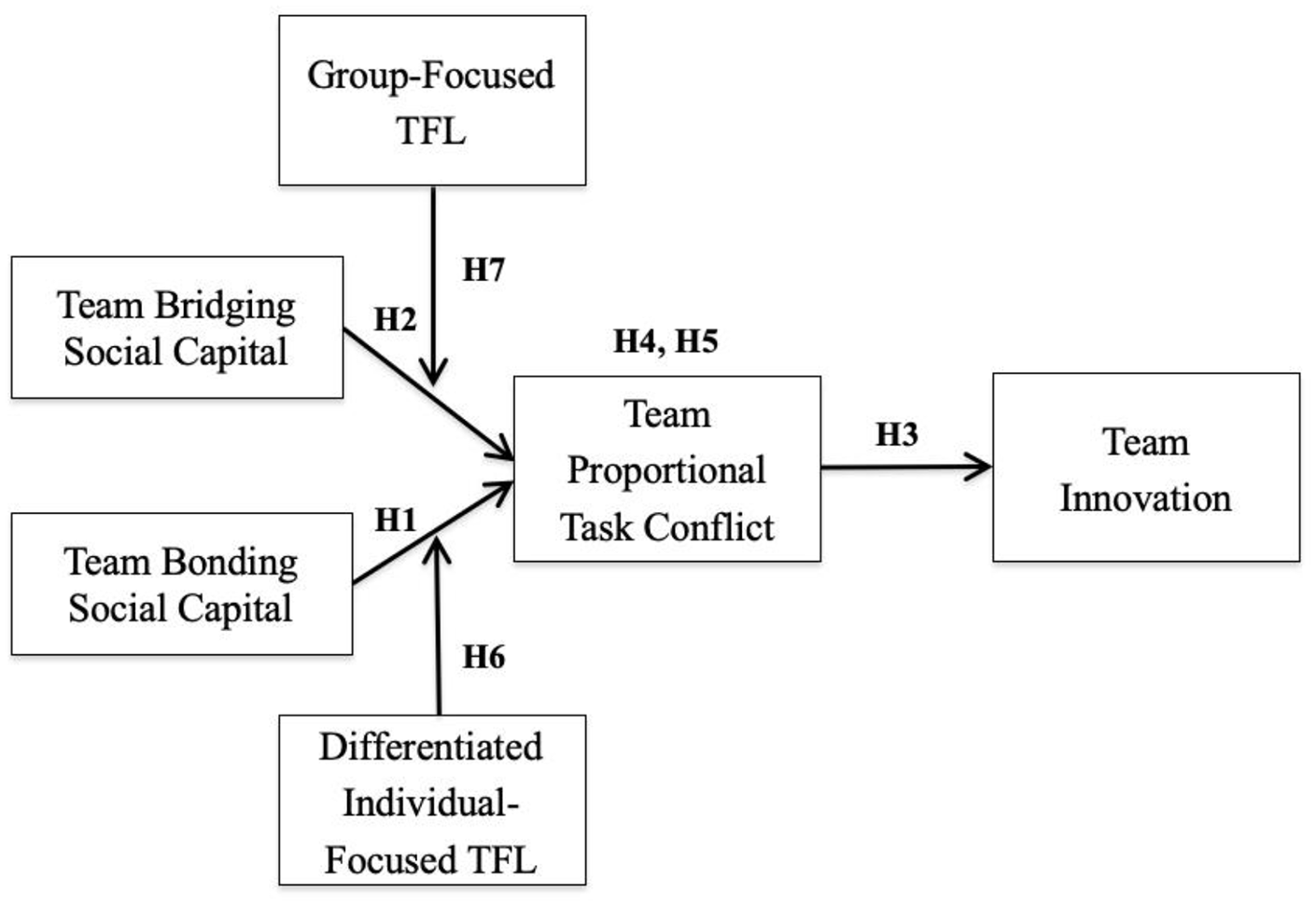
Theoretical model of how team social capital is associated with team innovation. H = Hypothesis.
Team social capital and team innovation: The mediating role of team PTC
Research on team social capital and team innovation has been inconclusive (Zheng, 2010). Some studies reported results in line with SNT (Burt, 1992; Burt et al., 2013) whereby bridging social capital promotes team innovation and bonding social capital does not (e.g. Burt, 2004; Soda et al., 2021). However, a non-trivial number of studies reported either null effects (Han et al., 2014; Lee, 2010) or even negative team social capital–team innovation relations (Carnabuci and Diószegi, 2015; Dokko et al., 2014). SNT scholars (Borgatti and Halgin, 2011; Tasselli et al., 2015) explain such inconclusive results by suggesting that prior social network research overlooked the crucial role of the social and organizational context in realizing the informational potentialities that come with a team’s network structure. This hiatus is surprising because theorizing and research on team innovation consistently demonstrated the crucial role of the team context for the quality of team innovation efforts (Hülsheger et al., 2009; Stollberger et al., 2019).
Integrating SNT with IPO models of team innovation, we propose that adopting a team conflict lens may elucidate the social context within which the informational potentialities of team social capital may be realized and could thus serve to reconcile disparate findings concerning the team social capital–team innovation relation. The team conflict literature distinguishes between three different conflict types: task conflict (TC) involves awareness of differences in viewpoints and opinions about the team’s task (Behfar et al., 2011; Jehn, 1995); relationship conflict (RC; De Dreu and Weingart, 2003) concerns tension and animosity among co-workers about interpersonal issues; and process conflict (PC; Jehn et al., 2008; Shah and Jehn, 1993) implies disagreements over the logistics of task accomplishment, such as the distribution of tasks, responsibilities and resources. Previous meta-analyses (Hülsheger et al., 2009; O’Neill et al., 2013), however, surprisingly found all three conflict types to be unrelated to team innovation. Because these meta-analytic results stand in stark contrast to findings of individual studies suggesting a positive effect of TC (e.g. De Dreu, 2006; De Dreu and West, 2001), and a negative effect of RC and PC (e.g. Farh et al., 2010) on team innovation, several scholars have called for further research on the team conflict–team innovation link (Hülsheger et al., 2009; O’Neill et al., 2013).
Responding to these calls, we adopt a complexity perspective by examining PTC (i.e. the level of team TC proportional to the general level of team conflict; Jehn and Chatman, 2000) as a linchpin connecting team social capital with team innovation. Traditionally, team conflict research was conducted in line with the separation perspective, which assumes that different types of conflict affect team outcomes independently of each other, thus permitting the individual examination of each type of conflict (e.g. TC) without considering the effect of the remaining two conflict types (e.g. RC and PC; Janssen et al., 1999). In contrast, the complexity perspective acknowledges the existence of conflict profiles, thereby implying that different team conflict types can co-occur and jointly influence team outcomes (e.g. Jehn and Chatman, 2000). According to the complexity perspective, examinations of the independent contributions of distinct conflict types to team outcomes are insufficient because the potential co-occurrence of other types is not considered (O’Neill et al., 2018b). Conflict profiles can be distinguished according to whether they exert a functional or dysfunctional influence on team outcomes (O’Neill et al., 2018b). Functional conflict profiles are those in which TC is high proportional to the general level of team conflict, whereas dysfunctional conflict profiles involve high PC and/or high RC proportional to the general level of team conflict (O’Neill and McLarnon, 2018). We specifically focused on examining PTC in our research because (a) it denotes a functional conflict profile, and (b) TC has consistently been proposed as the sole conflict type promotive of team innovation (Hülsheger et al., 2009; O’Neill et al., 2018b). Importantly, because we focus on conflict profiles that acknowledge interdependencies among individual conflict types (i.e. TC, RC and PC), in the following our approach to hypothesis development adopts an additive, sum-of-its-parts logic when formulating predictions concerning antecedents and consequences of PTC.
Relying on SNT that predicts team social capital to come with certain informational potentialities, we expect both team bonding and bridging capital to negatively relate to PTC. Specifically, although bonding social capital plays an important role in the team-internal exchange of information and the development of implicit knowledge associated with work duties (Han et al., 2014; Hansen, 1999), the quality of said information is such that most members will have similar ideas making team-internal information flows largely redundant (Burt et al., 2013). As a result, we believe that TC is likely to be reduced for teams with bonding social capital as this would necessitate saliently different viewpoints with regards to work tasks and a willingness to engage in constructive debate on divergent viewpoints (Jehn, 1995). Similarly, because teams with bonding social capital are homophilous (i.e. similar specifically in regard to their access to information), they have high levels of intra-team trust (Ertug et al., 2022) and are thus less likely to engage in RC. Moreover, Coleman (1988) suggested that bonding relationships ensure compliance with rules and norms that determine what behaviour is more or less desirable in a given team context. To avoid sanctions for rule-breaking, team members thus tend to shy away from engaging in RC, which is typically considered inappropriate (Curşeu et al., 2012). Taken together, we believe that team bonding social capital is negatively related to RC. Yet, homophilous teams have also been found to experience difficulties when it comes to establishing an informal hierarchy and process structure (Dong et al., 2022), presumably because that would involve the introduction of process-based dissimilarity among team members. This, however, is particularly important for research and development (R&D) teams, such as those in our study because the nature of R&D involves the often-unequal subdivision of roles, responsibilities and resources along the lines of work tasks either concerned with creativity or implementation (Elkins and Keller, 2003). Consequently, team bonding social capital should promote PC.
Following from the above line of reasoning, we conclude that team bonding social capital should elicit a team conflict profile with lower levels of TC and RC, but higher levels of PC. However, because high PTC requires a combination of high TC relative to the general level of team conflict, we hypothesize that team bonding social capital negatively relates to PTC:
Hypothesis 1: Team bonding social capital is negatively related to PTC.
Similarly, according to SNT (e.g. Burt et al., 2013) teams with bridging social capital have greater access to external, non-redundant information, and repeated team-external exchanges with others also offer members greater insight into other teams, thereby enabling them to observe different team processes, practices and strategies from those employed in their own focal team (Seibert et al., 2001). Given these advantages, bridging social capital has previously been associated with generative information exchanges in teams that foster innovation (Burt, 2004; Soda et al., 2021), which may imply that bridging ties are promotive of TC. At the same time, however, empirical evidence also exists that challenges this notion, as studies additionally reveal either null or negative effects of bridging social capital on generative team processes (Dokko et al., 2014; Han et al., 2014).
Adopting a complexity perspective on team conflict, it becomes apparent how the positive consequences of bridging social capital for team-internal generative processes can be altered and indeed reversed by the team conflict profile that emerges in response to information brought in by members from external sources. Specifically, bridging social capital may increase the likelihood for team members to offer new ideas on how to establish team-internal hierarches, or on the best way to distribute tasks and resources, which may deviate from existing team practices and thus promote PC (Han, 2018). In line with the complexity perspective on team conflict (e.g. O’Neill and McLarnon, 2018), greater PC will spiral into RC because process-related disputes easily descend into interpersonal animosity, thereby creating a vicious cycle of dysfunctional conflict (Behfar et al., 2008; Greer et al., 2008). RC in conjunction with PC, in turn, will inhibit members’ cognitive functioning as dysfunctional conflict distracts from work tasks, ultimately hampering a team’s information processing and exchange capability and preventing effective TC (Behfar et al., 2008; O’Neill et al., 2018b). 1 Combined, we predict that team bridging social capital will promote PC and RC as well as inhibit TC. In so doing, bridging social capital should give rise to a dysfunctional team conflict profile and thus exhibit a negative relationship with PTC. Based on the above rationale, we hypothesize:
Hypothesis 2: Team bridging social capital is negatively related to PTC.
Furthermore, and in line with IPO models of team innovation (Stollberger et al., 2019; Van Knippenberg, 2017), we additionally expect PTC to be positively related to team innovation. According to Van Knippenberg (2017), informational resources and potentialities, such as those inherent in team social capital (Borgatti and Halgin, 2011), will only predict team innovation if teams have effective knowledge exchange and integration processes in place. Building on this notion, Stollberger et al. (2019) suggest that team conflict, particularly TC, captures these crucial team processes relevant for team innovation to ensue. More specifically, disagreements about task-related issues characteristic of TC reveal diverse alternatives regarding task completion, evoke divergent thinking and encourage teams to reassess the task at hand (e.g. Jehn, 1995), all of which are important factors for generating new ideas among team members (Farh et al., 2010). In a similar vein, TC has also been highlighted to be helpful at the stage of idea implementation if constructive disagreements arise on how to put creative ideas into practice (Stollberger et al., 2019). However, as mentioned above, the sole reliance on TC to represent information exchange and integration processes in teams is suboptimal because other team conflict types (i.e. RC and PC) can co-occur and jointly influence team outcomes (Jehn and Chatman, 2000; O’Neill and McLarnon, 2018). Thus, we examine how PTC as a functional conflict profile relates to team innovation.
Relying on IPO models of team innovation (Stollberger et al., 2019; Van Knippenberg, 2017), we suggest that PTC should promote team innovation for two reasons. First, we surmise that if TC is meaningfully higher proportional to a team’s general level of conflict, such a conflict profile may foster a psychologically safe environment where critical engagement and risk taking are encouraged and team members do not fear a negative backlash owing to PC and/or RC (Edmondson, 1999). Second, Stollberger et al. (2019) note that the positive consequences of TC for team innovation should only be realized to the extent that team conflict patterns allow for constructive controversy; that is, the open-minded discussion of opposing views for mutual benefit (Tjosvold, 1991). We believe that constructive controversy is only possible if dysfunctional conflict dynamics owing to high PC and/or RC do not undermine a compromising and integrative team approach to task-related disagreements. In support of our argumentation, recent research suggests that a TC-dominant team conflict profile, such as PTC, promotes both psychological safety and constructive controversy in teams (O’Neill et al., 2018a). Thus, we predict:
Hypothesis 3: PTC is positively related to team innovation.
Combined, across Hypotheses 1–3 our argumentative logic delineates a process perspective (see Sparrowe and Mayer, 2011) and emphasizes the role of PTC as an explanatory link between team social capital and team innovation. Taken together, the negative effects of team bonding and bridging capital on PTC (i.e. Hypotheses 1–2), as well as the positive PTC–team innovation link (i.e. Hypothesis 3) imply that team social capital exhibits a negative indirect effect on team innovation via PTC. We thus propose the following set of hypotheses:
Hypothesis 4: PTC mediates the influence of team bonding social capital on team innovation, such that team bonding social capital is negatively related to PTC, which in turn is positively related to team innovation.
Hypothesis 5: PTC mediates the influence of team bridging social capital on team innovation, such that team bridging social capital is negatively related to PTC, which in turn is positively related to team innovation.
Team social capital and team innovation: The moderating role of group- and differentiated individual-focused transformational leader behaviours
Our theoretical arguments thus far can explain the negative effects of team social capital on team innovation found in previous studies (Carnabuci and Diószegi, 2015; Dokko et al., 2014). However, as of yet, they do not speak to the full spectrum of findings reported in the extant literature that also include null effects (Han et al., 2014; Lee, 2010) and positive relationships between team social capital and team innovation (Burt, 2004; Obstfeld, 2005). One reason may be that team social capital merely reflects the proximal social context without considering other relevant organizational context factors that could equally exert influence over team conflict patterns (Tasselli et al., 2015). Integrating SNT (e.g. Burt et al., 2013) with IPO models of team innovation (Stollberger et al., 2019; Van Knippenberg, 2017) we propose that group- and differentiated individual-focused transformational leadership (TFL) reflects a potent but heretofore unconsidered context factor that can attenuate the team social capital–PTC relation and thereby influence team innovation. Van Knippenberg (2017) proposes that (non-)redundant informational resources as a function of a team’s available social capital are more likely to translate into team innovation if motivators exist within the wider team or organizational environment that effectively facilitate knowledge exchange and integration processes. Echoing this point, Stollberger et al. (2019) specifically highlight the utility of TFL in influencing the team input (e.g. team social capital)–team process (e.g. PTC) relation and, in so doing, regulating team innovation processes. Based on our integrative framework, we suggest that group- and differentiated individual-focused TFL will modulate the team social capital–PTC relation because each set of TFL behaviours will be more effective in realizing the potentialities of teams with a certain network structure and associated social capital, thereby fostering PTC and team innovation.
Specifically, we propose that differentiated individual-focused TFL has the potential to generate ideational divergence in teams with bonding social capital and associated redundant information flows and, in so doing, stimulate greater PTC and subsequent team innovation. One of the main challenges facing leaders of teams with bonding social capital is how to facilitate idea generation and exchange given the relative dearth of original ideas in such teams (Burt, 1992; Martinez and Aldrich, 2011). Individual-focused TFL as a term includes TFL behaviours that are aimed at followers as individuals and include intellectual stimulation (i.e. creative stimulation that encourages followers to challenge prior assumptions concerning work tasks) and individualized consideration (i.e. a concern regarding followers’ individual needs and development; Kark and Shamir, 2002). In a team context, the within-unit variation of said individual-focused behaviours has been established as a distinct leadership style (see, for example, Kunze et al., 2016; Wu et al., 2010; Zhang et al., 2015). As such, differentiated individual-focused TFL is preferable at the team level over mean individual-focused TFL because employees are unlikely to attribute and connect positive individualized treatment by a leader to their collective engagement in teamwork, thus making it less likely that team processes will benefit from mean individual-focused TFL (Kunze et al., 2016). 2 A high level of differentiated individual-focused TFL therefore implies that team leaders behave differently towards different team members. For instance, in line with followers’ capabilities and needs, such leaders would intellectually stimulate some (e.g. those with the greatest creative potential) more than others, as well as display individualized consideration to some (e.g. those prone to engage in dysfunctional conflict) more than to others (Wu et al., 2010). Consequently, such leadership will (a) encourage some followers to come up with and voice divergent ideas, facilitating TC, as well as (b) address concerns of other followers and enable them to openly discuss divergent viewpoints without engaging in PC or RC, thereby promoting greater PTC among team members.
In line with our theoretical rationale, research shows that differentiated individual-focused TFL can disrupt existing team dynamics (Zhang et al., 2015), which may promote team processes that facilitate the development and implementation of new ideas (Eisenbeiss et al., 2008). In the context of the present study, we thus believe that differentiated individual-focused TFL will attenuate the negative indirect relationship between team bonding social capital and team innovation via PTC. Based on this rationale, we hypothesize:
Hypothesis 6: The relationship between team bonding social capital and team innovation via PTC will be less negative for teams with high as opposed to low levels of differentiated individual-focused TFL.
Furthermore, we argue that the display of group-focused TFL encourages followers to pursue a common team vision and thus contributes to resolving PC and RC, thereby creating a more coherent team dynamic within which teams can effectively engage in PTC and achieve greater team innovation. Although leaders of teams with bridging social capital will find that members have sufficient non-redundant information available to engage in TC, the high likelihood for PC to occur, spiral into RC and undermine the team’s cognitive capabilities means that leaders need to find a way to resolve PC and RC for TC and, when viewed altogether, for PTC to effectively contribute to team innovation. Group-focused TFL, such as inspirational motivation (i.e. inspirational appeals that motivate followers to reach ambitious goals and strengthen their confidence) and idealized influence (i.e. charismatic displays that reflect the leader’s values, sense of mission and purpose, and moral orientation) reflects leader behaviour that views the team as a whole and treats members in the same fashion; thus, the target of leader influence is the team rather than individual team members (Kark and Shamir, 2002; Wu et al., 2010). A high level of group-focused TFL can enhance the salience of a common team identity in the self-concepts of members, which, in turn, should increase the likelihood of team members to engage in cooperative behaviour and work towards a team’s mission and goals rather than pursuing their own agenda (Kark and Shamir, 2002; Wu et al., 2010). Consequently, we believe leaders displaying group-focused TFL pre-empt occurrences of PC and RC in teams with weak internal ties and realize the informational potentialities that accrue from bridging social capital. In so doing, group-focused TFL enables TC, and ultimately promotes PTC and subsequent team innovation.
Providing indirect empirical evidence for our theoretical claims, prior research showed that group-focused TFL promotes team identification (Wu et al., 2010) and that greater team identification alleviates team conflict because it fosters greater trust among members (Han and Harms, 2010). We thus hypothesize:
Hypothesis 7: The relationship between team bridging social capital and team innovation via PTC will be less negative for teams with high as opposed to low levels of group-focused TFL.
Methods
Sample and procedures
Our survey data were collected from 45 R&D departments in organizations located in Iraq in three waves. In the first wave (T1), we collected the data on team social capital (bonding and bridging social capital) and team members’ perceptions of transformational leadership behaviours. In the second wave (T2), one month later, we assessed team members’ experienced task, relationship and PC. In the third wave (T3), conducted one month after T2, department heads completed questionnaires to assess team innovation.
Concerning our study procedure, we initially discussed the objectives and procedures of our research with R&D department heads in the organizations participating in the study. After this, we distributed paper–pencil surveys to the department heads and team members, asking them to respond individually in a confidential manner across the three aforementioned waves of our study. Of an initial 352 questionnaires distributed across 46 R&D departments as part of the T1 wave, 337 useable questionnaires (T1 response rate: 95%) were returned. At the start of the second wave, T2 questionnaires were distributed to the 337 individuals who responded to the T1 survey of which 324 questionnaires were completed and returned (T2 response rate: 96%). In the final wave, 45 department heads completed and returned questionnaires evaluating their team’s innovation performance (T3 response rate: 100%). The final sample therefore consisted of 324 members across 45 R&D teams.
The organizations participating in the study were drawn from a variety of industries including chemical and petrochemical (22.2%), engineering (22.2%), food and beverage (17.8%), construction (22.2%) and textiles (15.6%). The department size ranged from 3–14 members. In terms of demographics, the sample was predominantly male (76.2%), the mean age was 39.07 years (SD = 6.14) and the average organizational tenure was 10.56 years (SD = 5.67). Among study participants, 3.1% held a master’s degree, 60.8% had a bachelor’s degree, 23.5% held a diploma and 12.6% had other certificates, for example from vocational school.
Each organization was asked to identify the R&D departments’ heads and to provide a list of the members of each department. This information is necessary to assess bonding and bridging ties. We translated scales for this study from English into Arabic following the backtranslation procedure recommended by Brislin (1980). Our data collection approach involving multiple sources (i.e. team members and leaders) across three waves should alleviate concerns regarding common method variance in the current study (Podsakoff et al., 2012).
Measures
Team bonding social capital (T1)
To measure team bonding social capital, respondents were asked to list the initials of their departmental colleagues and to select a value from 0 to 4 (0 = never, 1 = seldom, 2 = sometimes, 3 = very often, 4 = always) reflecting how frequently they exchanged information and support with them (Han et al., 2014). Consistent with previous studies (e.g. Han et al., 2014; Oh et al., 2004), team bonding social capital was measured as a team’s tie density defined as the average strength of connection between a team’s internal ties, and operationalized as the sum of the values of all team member ties divided by the number of possible team member ties (Hanneman and Riddle, 2005).
Team bridging social capital (T1)
We measured team bridging social capital by asking respondents to select up to 10 individuals (using initials) in the organization from outside their departments who had helped them by means of providing information, advice and ideas. Consistent with previous research (e.g. Han et al., 2014; Oh et al., 2004), Blau’s (1977) index of heterogeneity was used to measure team bridging social capital. The heterogeneity index reflects the diversity of a team’s external ties. Heterogeneity = (1– ΣP2i), where P is the proportion of social ties to other departments in the organization.
Group-focused transformational leadership (T1)
To measure this construct, we used a 12-item subscale from the Multifactor Leadership Questionnaire (MLQ-5X; Bass and Avolio, 1990) that assessed the following three sub-dimensions of TFL: attributive idealized influence, behavioural idealized influence and inspirational motivation. All items were rated on a five-point Likert-type scale from 0 (‘Not at all’) to 4 (‘Frequently, if not always’). Following Wu et al. (2010), our study revised the wording of the items to be consistent with a work group referent (e.g. ‘Our group leader emphasizes the importance of having a collective sense of mission when working in the group as a whole’). Consistent with previous research (e.g. Wu et al., 2010; Zhang et al., 2015), we used an overall group-focused transformational leadership construct (α = 0.98) by averaging scores of the sub-dimensions and aggregating those to the team level.
Differentiated individual-focused transformational leadership (T1)
We measured differentiated individual-focused TFL by using two subscales: individualized consideration and intellectual stimulation. These two subscales had eight items (four items each per subscale) and were drawn from the MLQ-5X (Bass and Avolio, 1990). The response scale for this construct ranged from 0 (‘Not at all’) to 4 (‘Frequently, if not always’). We kept the original individual referent for item wording without revision (e.g. ‘My group leader challenges me to re-examine critical assumptions to question whether they are appropriate’) and, in line with prior studies (e.g. Wu et al., 2010; Zhang et al., 2015), treated differentiated individual-focused TFL as a configural group property. Doing so involved operationalizing the construct as a coefficient of variation, which is calculated by dividing the within-group standard deviation of the individual-focused TFL measure by the within-group mean score of the same variable (see Wu et al., 2010). We combined the two aforementioned dimensions into one factor to form the differentiated individual-focused TFL construct (α = 0.97).
Team PTC (T2)
Eight items developed by Jehn (1995) were used to measure TC and RC (four items each per subscale). A sample item for TC is ‘How frequently are there conflicts about ideas in your work unit?’ A sample item for RC is ‘How much are personality conflicts evident in your work unit?’ PC is measured using three items developed by Shah and Jehn (1993). A sample item for PC is ‘How frequently do members of your group disagree about the way to complete a group task?’ These three subscales used a five-point Likert scale (1 = None, 5 = A lot). Alpha reliabilities for the subscales were 0.94 (TC), 0.88 (RC) and 0.83 (PC), respectively. Following the approach of Jehn and Chatman (2000), we operationalized PTC as the ratio of the level of TC proportional to the general level of conflict within the team (task, relationship and PC) using the following equation: PTC = TC / (TC + RC + PC).
Team innovation (T3)
Team innovation was measured by using a 22-item scale developed by Eisenbeiss et al. (2008). This measure is consistent with the innovation literature (e.g. West, 2002), which suggests that innovation measures should include items assessing both idea generation and idea implementation as well as focus on quantity and quality of innovations. For each item, the department heads were asked to indicate, on a seven-point scale ranging from 1 (e.g. no new ideas implemented) to 7 (e.g. many new ideas implemented) how innovative their department was. Sample items were ‘To what extent does your department develop ideas concerning new working methods or techniques?’ and ‘To what extent are the ideas concerning new targets or objectives implemented?’ (α = 0.99).
Control variables
Several control variables were included in our analyses to account for alternative explanations. First, we controlled for team size because innovation-related team processes are demonstrably influenced by a team’s size (e.g. Curral et al., 2001). Second, following Oh et al. (2004: 867), the total number of team ties (the sum total of bonding and bridging ties) was included as control variable to account for the ‘extensivity’ of the respective networks, thus allowing for capturing the unique effects of bonding and bridging ties. Third, we controlled for the team’s aggregated positive (α = 0.95) and negative (α = 0.85) affectivity by using the 20-item Positive and negative affect schedule (PANAS) (Watson et al., 1988; e.g. ‘interested’ and ‘enthusiastic’ for positive affectivity as well as ‘hostile’ and ‘irritable’ for negative affectivity), rated on a Likert scale from 1 (‘Not at all’) to 5 (‘Extremely’) since positive affectivity may facilitate team innovation by fostering members’ cognitive flexibility and willingness to adopt others’ views whereas negative affectivity is likely to narrow members’ horizon and receptivity to different perspectives, thus making team innovation less likely (Amabile et al., 2005). Fourth, we controlled for aggregated openness to experience measured with a two-item scale (α = 0.70, e.g. ‘I see myself as someone who has an active imagination’) rated on a Likert scale from 1 (‘Strongly disagree’) to 5 (‘Strongly agree’) (Rammstedt and John, 2007) given the strong association between an openness to diverse experiences with creativity (Feist, 1998) as well as its relevance for innovative behaviour (Madrid et al., 2014).
Justification for aggregation of predictors of team innovation
To justify the aggregation of individual team members’ survey responses to the team level (group-focused TFL, differentiated individual-focused TFL, TC, RC and PC), we conducted inter-rater agreement (rwg) and intra-class correlation (ICCs) tests (Bliese, 2000; James et al., 1984). The mean rwg were .95, .71, .88, .93 and .94, respectively, which indicated a high level of agreement regarding study variables among members within groups (LeBreton and Senter, 2008). A series of one-way Analysis of variance (ANOVAs) were performed to calculate ICCs. ICC1 of the five constructs exceeded the accepted cutoff value (ICC(1) > 0.06 (Bliese, 2000), which indicated adequate levels of between-group variability. The F ratios associated with the ICC1 value of all four variables were statistically significant at the .01 level. ICC2 of the five constructs were .97, .41, .96, .93 and .96, respectively. Therefore, the results above provided sufficient justification for the aggregation of our study variables to the team level.
Analytical strategy
We tested our hypotheses using path analysis (Muthén and Muthén, 2017). Prior to hypothesis testing, we z-standardized all study variables apart from the outcome team innovation to facilitate the interpretation of results (Dawson, 2014). We subsequently specified two path models. In Model 1, we tested our mediation hypothesis (i.e. H1–H5) in which team bonding and team bridging social capital, differentiated individual- and group-focused TFL, as well as control variables predicted PTC (i.e. the a-path). Furthermore, PTC, bonding and bridging social capital, differentiated individual- and group-focused TFL, as well as control variables were specified to predict team innovation (i.e. the b-path). In Model 2, we tested our moderated mediation hypothesis (i.e. H6–H7) by additionally entering interaction effects between team bonding social capital * differentiated individual-focused TFL and between team bridging social capital * group-focused TFL. To test the proposed moderated mediation model, we followed recommendations by Preacher and colleagues (2007) and employed bias-corrected bootstrapping using 10,000 bootstrap resamples. Proof for a moderated mediation effect is obtained if the 95% bootstrap confidence interval for the difference in the conditional indirect effects (e.g. at +/– 1 standard deviations of the moderator) excludes zero (Hayes, 2015).
Results
Prior to hypothesis testing, a series of confirmatory factor analyses (CFA) were conducted to determine the distinctiveness of study variables. Although previous studies with a comparable study design (Eisenbeiss et al., 2008; i.e. predictors assessed at the individual level and the outcome team innovation rated by team leaders at the team level) performed CFAs solely with individual-level constructs excluding team innovation, we adopt a more contemporary approach and performed a two-level CFA whereby each construct is included at the respective level it is measured (i.e. the individual or team level), which should provide a more accurate overview of how well our measurement models fits the data (Kim et al., 2016). Accordingly, at the individual level we included variables pertaining to individual-focused TFL, group-focused TFL, TC, RC and PC. At the team level, we included team innovation. Two-level CFA results demonstrated adequate model fit (Hu and Bentler, 1999) for the first-order six-factor model (χ2(633) = 1129.39, p < .001, TLI = .96, CFI = .96, SRMR individual-level = .03, SRMR team-level = .04, RMSEA = .05) as well as superior model fit compared with three alternative models. Specifically, alternative model 1 combined group- and individual-focused TFL (χ2(637) = 4153.71, p < .001, TLI = .69, CFI = .71, SRMR individual-level = .18, SRMR team-level = .04, RMSEA = .13), alternative model 2 combined TC, RC and PC (χ2(640) = 2542.48, p < .001, TLI = .83, CFI = .85, SRMR individual-level = .11, SRMR team-level = .04, RMSEA = .10) and alternative model 3 combined group- and individual-focused TFL, as well as TC, RC and PC into one factor (χ2(643) = 6227.75, p < .001, TLI = .51, CFI = .55, SRMR individual-level = .22, SRMR team-level = .04, RMSEA = .16). In sum, our two-level CFA results provide overall support for the distinctive factor structure of our study variables.
Hypothesis tests
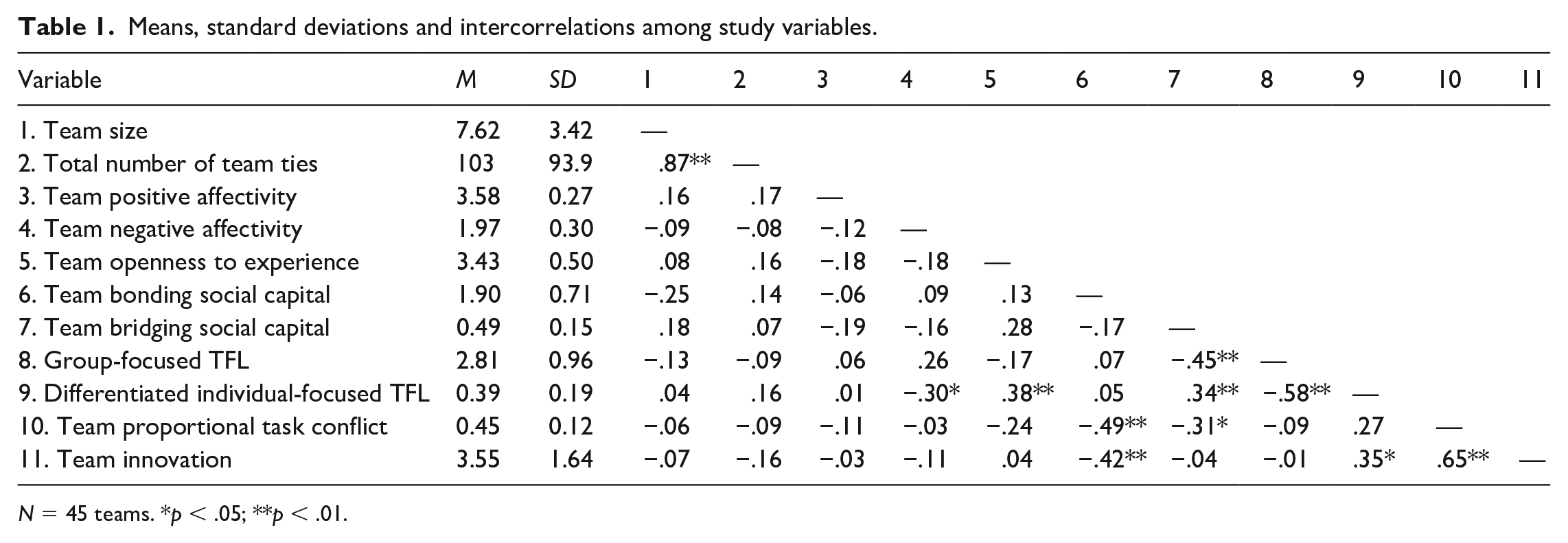
Table 1 summarizes means, standard deviations and intercorrelations among study variables and Table 2 depicts path analysis results. Model 1 revealed that, although team social capital does not directly predict team innovation (βbonding capital = 0.16, t = 0.28, ns; βbridging capital = 0.17, t = 0.62, ns), in line with Hypotheses 1–3 we found that both team bonding (β = −0.89, t = −6.07, p < .001) and team bridging social capital (β = −0.46, t = −3.21, p < .01) are negatively associated with PTC and that PTC is positively related to team innovation (β = 1.10, t = 2.79, p < .01). Our results further show that PTC mediates the negative relationship between both team bonding social capital and team innovation (indirect effect: –.98; 95% CI Low = −1.84; CI High = −.39) as well as between team bridging social capital and team innovation (indirect effect: –.51; 95% CI Low = −1.17; CI High = −.15), thereby supporting Hypotheses 4–5. Moreover, results for Model 2 demonstrated that the interaction term between team bridging social capital and group-focused TFL significantly predicted PTC (β = 0.35, t = 3.56, p < .001). Simple slope analyses (Aiken and West, 1991) revealed that the slope for low group-focused TFL was significant and negative (–1 SD, β = −0.65, t = −4.21, p < .001), whereas for teams experiencing high group-focused TFL there was no relationship between bridging social capital and PTC (+1 SD, β = 0.05, t = 0.32, ns). The interaction effect is illustrated in Figure 2. In a similar vein, moderated mediation analyses showed that the negative indirect effect of team bridging social capital on team innovation via PTC was present for teams with low (conditional indirect effect: –.72; 95% CI Low = −1.44; CI High = −.24) but not high group-focused TFL (conditional indirect effect: .06; 95% CI Low = −.21; CI High = .49), and that the difference was significant (difference: .77; 95% CI Low = .17; CI High = 1.57). These results suggest that team bridging social capital led to decreased team innovation via reduced PTC but only when group-focused TFL was low. Taken together, these results support Hypothesis 6. Finally, the interaction between team bonding social capital and differentiated individual-focused TFL did not significantly predict PTC (β = 0.14, t = 1.14, ns), which precluded a further test for moderated mediation and, as a result, Hypothesis 7 does not receive support.
Means, standard deviations and intercorrelations among study variables.
Path analysis results.
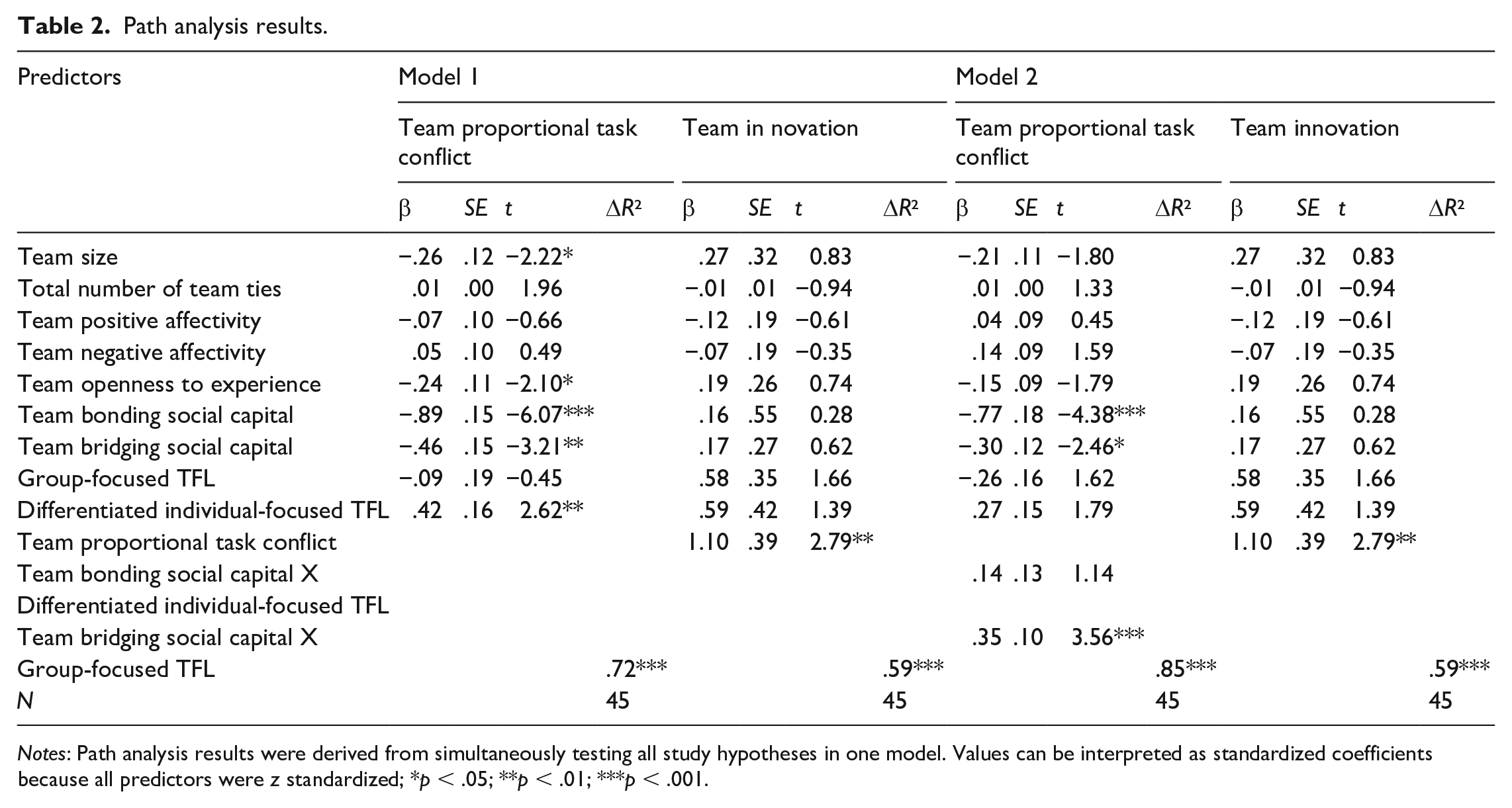
Notes: Path analysis results were derived from simultaneously testing all study hypotheses in one model. Values can be interpreted as standardized coefficients because all predictors were z standardized; *p < .05; **p < .01; ***p < .001.
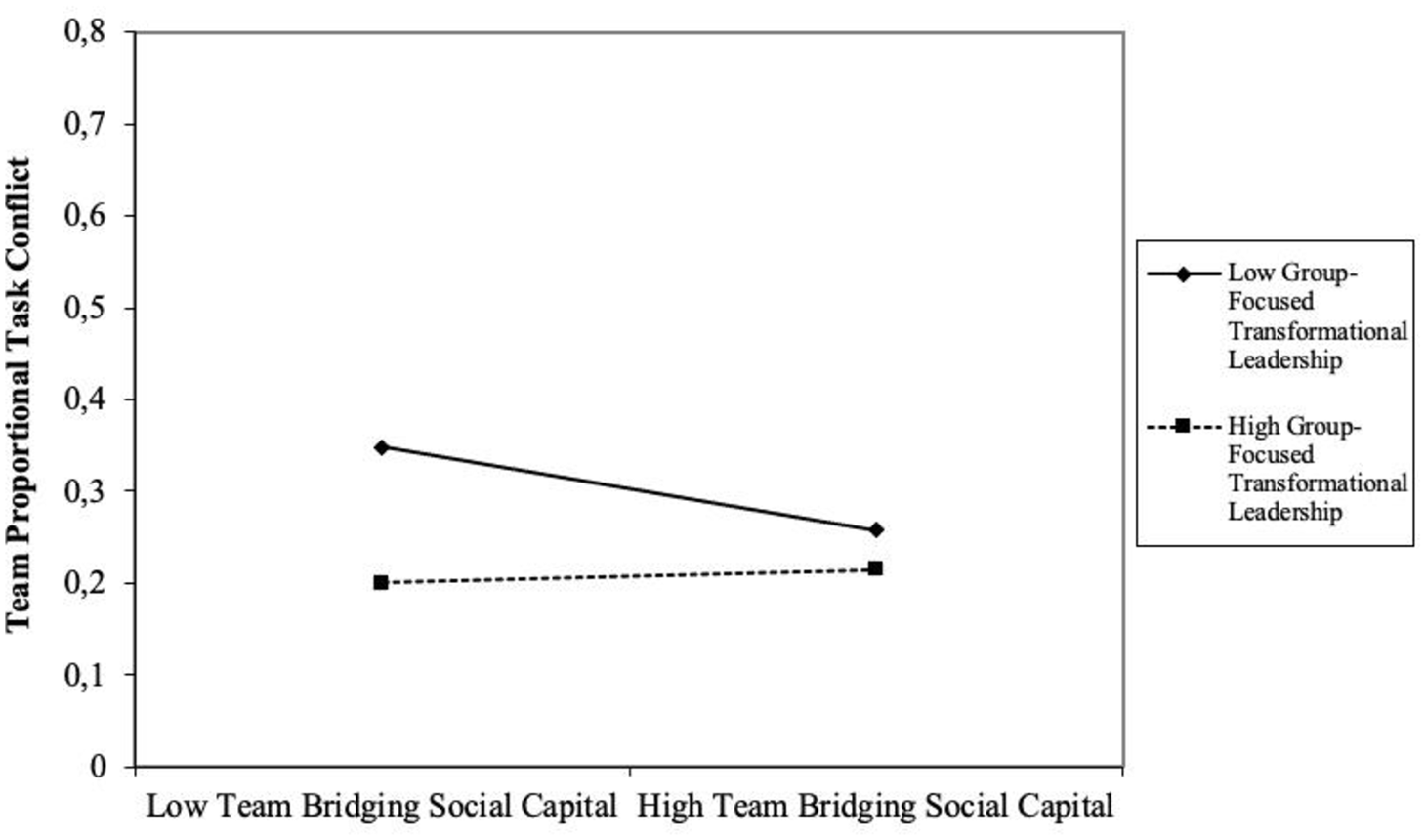
Moderating effect of group-focused transformational leadership on the relationship between team bridging social capital and proportional task conflict.
Supplemental analyses
Additional analyses were conducted to examine whether direct effects of TFL (Lee et al., 2020), curvilinear social capital effects (see, for example, Oh et al., 2004) or an interaction effect between bridging and bonding social capital (Han et al., 2014) influence team innovation via PTC. Although our decision to examine the moderating role of TFL is theoretically informed by IPO models of team innovation (i.e. Stollberger et al., 2019), most prior research tested direct effects of TFL on team innovation (Lee et al., 2020). We therefore additionally examined the possibility of whether group- or differentiated individual-focused TFL predicts team innovation via PTC. Results of Model 1 revealed a positive relationship between differentiated individual-focused TFL (β = 0.43, t = 2.59, p < .05) but not group-focused TFL (β = −0.09, t = −0.43, ns) and PTC. Our findings further showed that PTC mediates the positive relationship between differentiated individual-focused TFL and team innovation (indirect effect: .47; 95% CI Low = .10; CI High = 1.19). These results suggest that displaying differentiated individual-focused TFL directly facilitates functional team conflict processes, such as PTC and, in so doing, promotes team innovation. In contrast, group-focused TFL more indirectly affects these interrelationships by buffering the negative effects of bridging social capital on team innovation via PTC. Moreover, we neither found curvilinear team bonding (β = −0.16, t = −1.14, ns) or team bridging social capital effects (β = 0.12, t = 0.58, ns) nor that a team bonding * team bridging social capital interaction (β = 0.10, t = 0.40, ns) significantly predicted team PTC. In a similar vein, curvilinear team bonding (β = 0.38, t = 1.17, ns) and team bridging social capital (β = −0.22, t = −0.71, ns) as well as a team bonding * team bridging social capital interaction (β = 0.28, t = 0.78, ns) terms were unrelated to team innovation. Importantly, our study results remained substantively unaffected when controlling for these additional parameters found in previous studies.
Discussion
Integrating SNT (e.g. Burt et al., 2013) with IPO models of team innovation (Stollberger et al., 2019; Van Knippenberg, 2017), we developed and tested a moderated mediation model examining how and when team social capital influences team innovation. Empirical results from a multisource, time-lagged survey of R&D teams in Iraq provided support for a negative relationship between both team bridging and team bonding social capital and team innovation via decreases in PTC. Moreover, group-focused TFL was found to buffer team bridging capital’s negative influence on PTC and subsequent team innovation, whereas differentiated individual-focused TFL failed to modulate the negative effect of team bonding social capital on team innovation via PTC.
Theoretical implications
Our research makes several noteworthy contributions to the literatures on social capital and team innovation.
Contributions to the social capital literature
Our findings show that team social capital has no direct effect on team innovation. Instead, our results reveal that both team bonding and team bridging social capital is negatively related to team innovation via PTC. This finding extends the thus far inconclusive social capital literature that has promoted positive, negative and null effects of social capital on the effectiveness (Moore et al., 2018; Oh et al., 2004), creativity (Burt, 2004; Han et al., 2014; Perry-Smith, 2006; Soda et al., 2021; Zhou et al., 2009) and innovative potential (Carnabuci and Diószegi, 2015; Dokko et al., 2014; Lee, 2010; Obstfeld, 2005) of teams and individuals.
We suggest that one reason behind the discordant findings of prior research may be that most studies have placed insufficient emphasis on the examination of underlying mechanisms that explain how team social capital influences the creativity and innovation of teams (see Maurer et al., 2011 for a similar argumentation). This point is also echoed by recent theorizing on social networks (Tasselli et al., 2015), which suggests that prior work neglected to sufficiently account for the embeddedness of social networks in their respective social and organizational context as well as the consequences thereof.
Speaking to this issue, our findings demonstrate the importance of considering the immediate team context to explain both negative and null effects reported in the extant literature between team social capital and team innovation. Specifically, our findings show that, although not exhibiting a direct relationship, both team bonding and bridging social capital negatively relate to team innovation via decreases in PTC. High levels of team bonding social capital are likely to increase the homogeneity of ideas in teams, create redundant knowledge flows (Ertug et al., 2022) and make groupthink more likely (Kijkuit and Van Den Ende, 2007), all of which reduces the potential for teams to engage in PTC and to produce innovative solutions (O’Neill et al., 2018b; Stollberger et al., 2019). High levels of team bridging social capital, in turn, may lead to challenges concerning how to absorb and integrate diverse information obtained from outside sources (Alguezaui and Filieri, 2010; Han et al., 2014). Such intra-team struggles are likely to have an adverse effect on team innovation by increasing PC as well as RC and consequently reduce the PTC teams engage in (O’Neill et al., 2018b). In addition, supplemental analyses showed the absence of curvilinear social capital effects or interactive effects between team bonding and team bridging social capital reported in previous research (e.g. Han et al., 2014; Zhou et al., 2009). Taken together, our study contributes to the social capital literature by emphasizing the relevance of considering a process perspective regarding team social capital effects and, more specifically, by highlighting PTC as an underlying mechanism that helps elucidate prior findings on team social capital and team innovation.
Contributions to the team innovation literature
From the perspective of team innovation research, our study extends the scope of IPO models of team innovation (Stollberger et al., 2019; Van Knippenberg, 2017) in various ways. First, to the best of our knowledge, our study is the first to examine social capital effects on team innovation after prior research that has examined relationships with innovation at the organizational (Maurer et al., 2011) and individual level (Carnabuci and Diószegi, 2015). Thus, our findings serve to inform future discussions on the homology of social capital effects on innovation across levels of analysis, which play an ‘integral role in the validation of multilevel constructs and theories’ (Chen et al., 2005: 376). Our research thus contributes to the team innovation literature because although a team’s social network characteristics have previously been theorized to affect team innovation via relevant team processes (Stollberger et al., 2019), an IPO examination of team social capital on team innovation including the consideration of relevant underlying mechanisms has so far been lacking.
Second, by examining the moderating role of differentiated individual- and group-focused TFL, we further contribute to IPO models of team innovation (e.g. Stollberger et al., 2019) that highlight leadership as a crucial contingency factor for team innovation while at the same time recognizing the need for greater dimensional specificity when examining TFL effects (Van Knippenberg and Sitkin, 2013). On the one hand, our findings reveal that group-focused TFL buffers the negative effect of team bridging social capital on team innovation via PTC. A possible explanation for this effect is that in teams with many bridging ties and frequent inter-team exchange, group-focused leader behaviours such as idealized influence and inspirational motivation may serve to communicate a common vision and reaffirm to team members that they all contribute to the same goals, thus avoiding dysfunctional team conflict. On the other hand, we did not find a similar moderated mediation effect for differentiated individual-focused TFL influencing the negative consequences of team bonding social capital. The culture of our study context in Iraq may provide an alternative explanation for the ineffectiveness of differentiated individual-focused TFL behaviours in curtailing the negative impact of team bonding social capital. Lord and Maher (1991) were the first to highlight that prototypical behavioural expectations towards leaders, or implicit leadership theories, matter for leadership effectiveness and their content depends on the respective national cultural context (House et al., 2002). Given that Middle Eastern countries such as Iraq score highly on collectivism and associate loyalty and cohesiveness with their work relationships (House et al., 2002; Javidan et al., 2006), leadership, including displays of differentiated individual-focused TFL, may prove ineffective in counteracting the effects of bonding social capital because the reverence of a tight-knit collective may be perceived as culturally appropriate. Similarly, culture may play a role in how conflict is handled (Feitosa et al., 2018). Specifically, collectivistic countries, such as Iraq, prefer a more collaborative (as opposed to a dominating) conflict handling style (Gunkel et al., 2016).
Additionally, in supplemental analyses we explored whether the display of TFL behaviours more directly affects PTC and team innovation independently of a team’s social network architecture. Our results demonstrated that differentiated individual-focused TFL but not group-focused TLF promoted team innovation via increases in PTC. Because differentiated individual-focused TFL selectively caters to and develops team members’ needs and abilities in the interest of team performance, such leader behaviours may provide teams with necessary intellectual and/or personal resources to effectively resolve their task-related disagreements themselves (Wu et al., 2010). In so doing, differentiated individual-focused TFL may foster team innovation by empowering team members to engage in functional team conflict such as PTC, which is in line with prior evidence on TFL, creativity and innovation (Eisenbeiss et al., 2008; Lee et al., 2020).
Practical implications
Our research offers implications for organizational practice insofar as it emphasizes the need for managers to be aware of and counteract the potential disadvantages of their team’s social network dynamics for team innovation. According to our findings, one possible way to promote team innovation is to discourage bonding social capital, facilitate the benefits of bridging social capital and train group-focused transformational leader behaviours.
First, in order to prevent the development of teams with high bonding social capital and associated redundant information flows, managers interested in fostering team innovation may facilitate the development of shared team norms that revolve around openness to change. Alternatively, managers can hire new team members and, as a result, change the team’s composition to stimulate novel idea generation and implementation (Choi and Thompson, 2005).
Second, to promote team bridging social capital, potential new hires should be selected based on how highly they score on the personality traits self-monitoring, extraversion, openness to experience and conscientiousness as such individuals have been shown to be more adept at creating bridging ties, either in the shape of broader friendship (openness to experience) or advice networks (extraversion), or both (self-monitoring, conscientiousness; Fang et al., 2015). Organizations could employ psychometric testing procedures to identify those applicants with a favourable personality profile and recruit them into teams with a view to increasing their bridging social capital.
Third, from a theoretical perspective we proposed PC to be the most immediate consequence of teams with both bonding and bridging social capital, which then, through complex interdependencies among the remaining team conflict types, negatively relates to PTC. Practically, this suggests that there is an opportunity to pre-empt a dysfunctional conflict spiral by counteracting PC if it occurs early in a team’s time together (Greer et al., 2008). This could be done by engaging teams in conflict management training that should be informed by the conflict resolution preferences of the cultural context organizations are operating in (i.e. preferences for dominating, integrating, avoiding or obliging conflict resolution; Gunkel et al., 2016).
Fourth, organizations could encourage their managers to attend leadership development workshops in order for them to train situationally specific displays of group-focused transformational leadership (Day et al., 2014). This is relevant because from our study’s findings it follows that group-focused transformational leader behaviours such as idealized influence serve to mitigate the negative effects of bridging social capital and likely promote external knowledge integration.
Limitations and future research directions
Like any research, our study has a number of potential limitations that, once identified, can help inform future research. In line with most social network research (e.g. Carnabuci and Diószegi, 2015; Maurer et al., 2011; Zhou et al., 2009), our cross-sectional design prevents us from drawing definite causal conclusions. Future research with a longitudinal or experimental design is required to firmly establish causality with respect to our proposed interrelationships. Furthermore, we focused on PTC and TFL as mediator and moderator of the team social capital–team innovation link over other potential processes (e.g. psychological safety; Stollberger et al., 2019) and boundary conditions (e.g. authentic and servant leadership; Hughes et al., 2018) for two reasons. First, we examined PTC because team conflict is regarded as one of the key processes facilitating knowledge integration for greater creativity and innovation in teams (e.g. De Dreu, 2006; O’Neill et al., 2018b), thus making PTC the most appropriate candidate for our study of team social capital as this reflects informational resources that need to be successfully integrated into teamwork. Second, although other leadership styles, such as authentic or servant leadership, have also been related to team innovation (Hughes et al., 2018), the predominantly moral approach these leadership styles embody (Lemoine et al., 2018) means that they exert their influence more indirectly by affecting social exchange and social learning processes as opposed to team conflict. Regardless, examining the relevance of explanatory mechanisms and boundary conditions other than those reported in this research represents a fruitful avenue for future research. Finally, although on the small side, our sample size of 45 teams is greater than that of similar studies (Eisenbeiss et al., 2008; Han et al., 2014; West and Anderson, 1996) and Koopman and colleagues (2015) demonstrated that the bootstrapping procedure we used reduces Type I error and statistical power concerns.
Conclusion
Our results highlight the importance of considering underlying mechanisms and contingencies of team social capital effects with respect to team innovation and the related utility of a complexity approach to social network research. Such an integrative approach is useful to reconcile prior research findings and identify new ways of looking at team innovation. We hope that our approach will inspire future researchers to further explore the social team dynamics of innovation.
Footnotes
Acknowledgements
We would like to thank Michael A West for his insightful contributions to previous drafts of this article.
Funding
The authors received no financial support for the research, authorship and/or publication of this article.
