




Abstract
One of the most significant developments in international business in recent years is the dramatic expansion of Chinese – often state-led or state-supported – investment in Africa. While we know something of Chinese multinational enterprises’ strategies, we know comparatively little about their work and employment practices and even less about their influence on western multinational companies (MNEs). We examine these important issues by looking at the practices of a major Chinese MNE alongside those of a French MNE and a US MNE in Cameroon’s oil industry. We find that while the French and American MNEs were successful in importing their preferred practices and in evading host-country regulations for many years, this was challenged upon the arrival of the Chinese MNE. We query why and by what means did the entrance of a major MNE lead to significant changes in the behaviours of long-resident MNEs. The translation of the identified effects is explained by drawing on different levels of analysis that include an appreciation of the location of the MNE and the state within the international political economy of capitalism, attendant shifts in the frontiers of political influence, isomorphic institutional influences, actors’ postures within and beyond the MNE, and their relational interplay.
Keywords
Introduction
On the cusp of the new millennium, China emerged as a major presence in Africa and is on the verge of becoming its pre-eminent foreign power (Jackson et al., 2013; Xing et al., 2016). Chinese multinational companies (MNEs) are attracted to Africa for its rich repositories of natural resources. Today, the continent meets one-third of China’s petroleum requirements. Although the conspicuous presence of Chinese MNEs in Africa has engendered considerable research interest, its focus has been chiefly on firms’ motives, processes and impacts (Cooke, 2014; Xing et al., 2016). We know little of their company practices and how they manage their workforces (Fainshmidt et al., 2018), and even less about whether they exercise any influence on other MNEs’ practices.
We address these gaps in our understanding by examining the practices of a major state-owned Chinese MNE in Cameroon’s oil industry and enquire first, whether they are of a distinct character to those of long-established MNEs from France and the USA; and second, whether they had any effect in altering the behaviours and practices of the French and American MNEs and, where they had, how such effects were transmitted. Informing these orientating questions was the a priori assumption that, as the Chinese MNE is state owned, it might reasonably be expected to serve different interests and to behave differently to large, long-established, publicly listed MNEs that are obliged to serve private interests. We wondered, for example, whether the interests of the Chinese MNE would be aligned in significant part with the strategic ambitions of the Chinese government that include not only the specific aim of procuring a secure supply of oil, but also the more general ambition of enhancing the Chinese state’s geopolitical authority by building political and diplomatic influence with foreign governments. In these circumstances, a number of intriguing questions arose: might the attainment of these broader political ambitions render Chinese state capital to be more assertive and powerful, or rather might it compel it to be more accommodating to local interests; might it work with local state agencies to actively promote their interests in an effort to curry favour for itself over that which might otherwise be afforded MNEs from former colonial powers; and finally, if it did indeed adopt such postures and was successful, what influence in turn might this have on the orientations and behaviours of longer-established western MNEs. As these research questions relate directly to matters of the power resources of MNEs and of their relationship with their home and host state, of the international political economy of capitalism and of isomorphic pressures, we turn to three theoretical perspectives – neo-institutionalism (DiMaggio and Powell, 1983; Kostova, 1999), power and power relations (Ferner and Tempel, 2006; Ferner et al., 2012) and system–society–dominance effects (Smith and Meiksins, 1995) – as a means of providing a theoretical frame for our analysis.
The oil industry provides an ideal proving ground for examining the manner in which the various influences associated with these perspectives – institutional, economic and political – interact to shape MNEs’ practices. It is one of the most politicized of all industries globally (Yergin, 2020). It is traditionally dominated by western MNEs and, more recently, by firms from China, and whose oil fields are often located in developing economies. The host economies, in turn, are dependent on the incoming MNEs for the development of their oil reserves and for their incipient prosperity. As such, it is a sector inimitably located at the interface of global and local commercial and political ambitions, and thus permits an examination of multi-level influences shaping MNEs’ practices.
Cameroon is our host country. For decades, it was dependent upon the resources and expertise of MNEs from its former colonial powers – France and the UK – then from the USA and, more recently, state-owned enterprises (SOEs) from China. In examining our case MNEs’ practices, we focus in particular on their employment relations, recruitment, training and reward practices. The literature suggests these areas of policy-implementation are key areas of management and that MNEs often adopt a centralized approach (Almond et al., 2005). Critically, the shaping of such practices is conducted at the intersection of home- and host-country contexts, and as such provides a test-bed for examining the relative influence of parent-country and company influences, and local isomorphic pressures. Thus, we are permitted to identify the meso-level mechanisms connecting institutions and firms, across boundaries of different home countries and time periods (Jackson and Deeg, 2019) as well as assessing the effect of fluid hegemonic and political influences.
The article’s contribution is twofold. It provides rich evidence of the practices of a major Chinese MNE and it accounts for the manner in which its behaviours altered the practices of long-established French and American MNEs. This translation of effects is explained by an appreciation of the location of the MNE and the state within the international political economy of capitalism and attendant shifts in the frontiers of political control, isomorphic institutional influences and the posture of actors within and beyond the MNE, and their relational interplay. For many decades, the French and American MNEs imported their preferred work and employment practices contrary to the objectives of the host Cameroonian state. That the Cameroonian state struggled to steer the behaviours of MNEs is explained by deeply embedded relations of dominance and structural dependency. It remained a matter of ongoing contest and conflict. However, as wider structural conditions altered – as occurred with the arrival of Chinese foreign direct investment (FDI – so the frontier of control shifted to the advantage of the Cameroon state. China required access to African oil resources and its government was keen to extend its political influence across Africa. In pursuit of these broader objectives – in contrast to those of private capital whose prioritizing of a profit-maximization imperative renders it less territorially and politically constrained – it was willing to accommodate to the demands of the host state. In this recast international political economy, Cameroon’s government acquired new power resources that were derived from a new relationship of mutual interdependence and exchange. It used this opportunity for renewed political agency to bolster its institutions and insist that the French and American MNEs fall in line, which they largely did. Thus, the effect of the Chinese MNE on the behaviours of the French and American MNEs was mediated through the new power resources that it had helped bestow on the local state and social actors in Cameroon.
Literature review
There is a vast literature on the means and processes by which MNEs develop their organizational practices, including the extent to which they are influenced by institutional norms and regulations and by other firms’ behaviours. Neo-institutionalism argues organizations endeavour to act according to ‘taken-for-granted’ scripts and rules of appropriate behaviour (DiMaggio and Powell, 1983; Meyer and Rowan, 1977; Zucker, 1977). This is an important insight for its claim that organizations not only seek greater economic efficiencies, but they also strive to gain political power and institutional legitimacy. This, however, is not a straightforward task as organizations encounter a number of possibly competing institutional or isomorphic pressures within their organizational fields. Nevertheless, institutionalization is attributable to three forces (DiMaggio and Powell, 1983). The first, labelled coercive isomorphism is rule-like. It arises from political pressure, the force of the state, regulatory oversight and control. The second, referred to as normative isomorphism, stems from the professional formation of management together with the growth of professional networks that span organizations and across which new models of management diffuse. Third, when organizations confront uncertainty, they may draw from habitual understandings, or model themselves on other firms they perceive to be more legitimate or successful. Models of best practice then diffuse as companies imitate one another’s policies. As such, neo-institutionalists believe MNEs imitate particular practices less because they are nested in national business systems (NBSs) and more because they are promoted and diffused through dominant management models and professional networks. This they term mimetic isomorphism.
Importantly, DiMaggio and Powell (1983) further claim that as an organizational field becomes established, its members come to be hierarchically organized where particular firms assume the mantel of being central or key firms. Among the processes that lead to this form of hierarchical organization is government recognition, which is typically provided through the grant or contract process. This gives the chosen organizations enhanced legitimacy, visibility and status that may lead competing organizations to emulate their policies in the hope of receiving similar treatment and rewards. Thus, as organizational fields develop, and as the organizations operating therein come to encounter the variously identified institutional isomorphic forces, so they are seen to become more similar with one another.
Other neo-institutionalists emphasize the institutional duality confronted by MNEs; that is, the conflicting pressures for isomorphism emanating from their host country and parent-company (Kostova, 1999). The extent to which MNEs are pulled between these institutional forces is seen to be determined by the institutional distance between the institutional profile of MNEs’ parent-country and the host-country’s institutional context (Kostova and Roth, 2002). Where the distance is small, the transfer of practices from MNEs’ headquarters (HQ) is perceived to be relatively unproblematic as they are likely to be easily assimilated by the subsidiaries’ staff. However, where MNEs’ practices have few, if any, referents to host-country laws and norms, tensions may arise. Later work suggests that MNEs are capable of evading the strictures of their external institutional context and of developing their own intra-organizational institutional field (Kostova et al., 2008). Isomorphism is now seen to emerge from a managerial desire to disseminate a shared global management model and not from any necessary quest for legitimacy. Any observed similarity between firms’ practices is seen then to arise from their strategic choices and less from compliance with external isomorphic pressures.
While neo-institutionalism has contributed greatly to our understanding of MNEs, it is criticized for its inadequate treatment of power, conflict and social agency; its decontextualized and thin view of institutions; its grand-theorizing and under-theorization of host-country effects (Almond, 2011; Becker-Ritterspach and Blazejewski, 2016; Ferner et al., 2012; Jackson and Deeg, 2019). Critics have been particularly strident in decrying its sanitized treatment of power; especially its disregard for understanding how particular symbols, cultures and practices – in essence, taken-for-grantedness – come to be formed and embedded as legitimate, and subsequently how they – including those that are immoral or illegal – come to be mobilized against competitors, state regulators and employees (Hirsch and Lounsbury, 2015; Munir, 2015; Willmott, 2015). Indeed, critics have emphasized that in its neglect of how MNEs come to be powerful, neo-institutionalism has remained, in large part, a-historical, showing little appreciation for understanding complex and contextually nuanced causal processes (Jackson and Deeg, 2019; Suddaby and Young, 2015).
Attempts to address these criticisms from within the canon of institutional theory such as those emanating from the perspectives of institutional logics (Thornton et al., 2012), institutional entrepreneurship (Battilana et al., 2009) and institutional work (Lawrence and Suddaby, 2006) have made important advances, particularly in giving more focus to the role of agency and institutional change. Still, they have been found wanting, or as yet incomplete, both by their advocates and critics mainly because the links between macro-institutional orders (state, markets, firms) and actors are under-specified and under-theorized, and because of their continued neglect of interests, power and conflict (Battilana et al., 2009; Clegg, 2010; Hirsch and Lounsbury, 2015; Jackson and Deeg, 2019; Willmott, 2015).
The political perspective draws our attention to the manner in which institutional resources are marshalled by actors in the defence of their interests (Edwards et al., 2016). A MNE’s transfer of practices may challenge actors’ interests beyond the MNE, particularly the state. A state’s insistence that a particular employment norm is adhered to on the basis that it is legally required may challenge MNEs’ adoption of preferred practices (Ferner et al., 2012). In reply, a MNE may marshal its resources to compel a subsidiary to conform to its policies in defiance of host-country norms. As such, the transfer of practices from a corporate HQ to a subsidiary must be seen as the consequence of the interplay of interests and the possession and deployment of power resources by a variety of actors within and beyond the MNE (Ferner and Tempel, 2006).
Still, actors’ interests may overlap and can be expected to relate in complex ways. Whether and how interests are pursued may also change over time, as might actors’ ability to marshal power resources to good effect. Hence, terrains of contest can be expected to be multiple and shifting (Edwards and Bélanger, 2009). They might also be understood in the context of the MNE’s wider macro-political terrain, including the nature of the industry, the distribution of assets and employment, and the extent of host-country dependency (Morgan, 2011). MNEs, too, may engage in initiatives to press governments and policy-makers to make some institutional accommodation to their requirements (Almond and Ferner, 2006; Streeck, 1997; Streeck and Thelen, 2005). Streeck gives particular focus to the identification of critical junctures as moments in explaining institutional discontinuities. Whether MNEs are able to exert influence at such critical moments hinges on a number of factors, including whether they originate in hegemonic NBSs; their locational flexibility; their strategic capacity; the structure of ownership within an industry; the role and power of large industry players; and host-countries’ dependence on FDI (Edwards et al., 2013; Geary and Aguzzoli, 2016; Kristensen and Zeitlin, 2005). Thus, we come to see the interaction of home- and host-country effects as constituting a distinct (macro-) political sphere which may well have significant consequence for the capacity of MNEs to transfer and adopt particular work and employment practices.
This prompts consideration of another important dimension to state–capital relations. Clearly, power is located outside the state in an increasingly globalized economy and shifting geopolitical landscape. Globalization is conceived here as corporate power and international expansion. This necessitates a focus on political economy (Hicks et al., 2005). Its shape varies and pivots on relations of dominance and structural dependency as might arise from the influence of historical processes, such as colonization, or through shifting hegemonic forces as might accompany peaks in a particular country’s political-economic power. This is the benefit of Smith and Meiksins’ (1995) system–society–dominance (SSD) framework wherein they distinguish between three sources of external influence on firms’ practices: the economic mode of production (system effects); national legacies and institutional patterns (societal effects); and best practice strategies generated and diffused by the ‘society-in-dominance’ within the global economy at a particular period of time (dominance effects).
The SSD model is useful for illustrating how MNEs’ power operates at the three identified levels: (1) MNEs as active agents in creating the rules of the global economic system, (2) they often ride piggy-back on their parent countries’ quest for colonial/geopolitical expansion and (3) their practices are often seen as best where the MNE is from a dominant NBS. Such dominance smooths the path of transfer by shaping systems of meaning; it creates a presumption that the practices of a dominant MNE have superior efficacy and should be accepted by local actors, including policy-makers. Such effects are likely to be more pronounced in the context of ethnically based geopolitical hierarchies and/or postcolonial power relations involving ‘first world’ MNEs with subsidiaries in ‘third world’ or former colonized countries (Frenkel, 2008). However, the conditions underpinning such dominance effects are not immutable and can be expected to evolve (Ferner et al., 2012). They may weaken or be undermined as host economies come to rely less on inward investment from former colonial powers, or as a dominant economy’s hegemony is challenged by another country’s rising influence, or as MNEs’ hegemony is challenged by local actors and non-governmental organizations (NGOs) (Banerjee, 2017).
From this review of the literature, the following conclusions are derived. First, the shape of a MNE’s work and employment practices cannot be determined from its institutional features, be they as derived from its home or host country, or that they are the outcome of some ‘rational’ or ‘free’ decision-making process where they are deemed the most appropriate given the strategy or sector within which the firm operates. Rather they are derived from a relationship of power that involves the interplay of various actors with diverse identities, ideologies and interests within and without the MNE (Ferner and Tempel, 2006). Second, these political processes are played out at multiple levels such that there is scope for kaleidoscopic variation in the definition, interplay and pursuit of organizational interests (Ferner et al., 2006). MNEs thus bring diverse and sometimes contradictory ‘contextual rationalities’ into play when contesting and negotiating the methods and degree of local adaptation (Geppert and Dörrenbächer, 2014). By corollary, political processes – be they at or above the level of the MNE – are not separate from structural forces, but represent the working out of responses to them. This complexity is accentuated by their being played out across shifting institutional regimes whose parameters are shaped in the balance of international hegemonic forces. Any consequent political accommodations are therefore likely to cut across the boundaries of the MNE. The implications of such a view for the study of MNEs’ work and employment practices are manifest – it requires an investigation of the international political economy and how its shifting effects frame actors’ identities and interests and how their behaviours, in turn, stabilize and destabilize established institutional structures and organizational behaviours.
Chinese investment in Africa and Cameroon
It is estimated that between 2000 and 2014, the stock of Chinese FDI in Africa went from 2% of US levels to 55% and that it will surpass US levels by 2030 (Feng and Pilling, 2019). Cameroon is the second largest recipient of Chinese FDI in Africa and China is currently Cameroon’s largest trading partner. In part, as a bid to reduce the negative effects associated with Chinese investment abroad, Chinese firms are obliged to obtain formal authorization from their government’s Ministry of Commerce prior to investing overseas (Wenbin and Wilkes, 2013). The guidelines advise firms to comply with host-countries’ regulations and, although it is arguable whether this stricture acts as an effective oversight, it does ostensibly set China apart from other countries (Mvondo et al., 2019).
China’s model of capitalism is oftentimes referred to as state capitalism or authoritarian capitalism (Witt and Redding, 2014) as a great deal of its FDI is state-led, state-financed and piggy-backs the Communist Party’s ambitions to enlarge China’s presence and influence internationally (Buckley et al., 2018; Ramamurti and Hillemann, 2018). In the natural resources sector, the coordinating role of the Chinese state in the internationalization of its MNEs is believed to have led to distinctive forms of corporate behaviour (Buckley et al., 2018). Decision making is centralized and appointments to senior positions are informed by political considerations (Zhu et al., 2014).
Critical observers of Chinese investment in Africa liken it to being akin to that of former colonizing powers’ – particularly France’s – scramble for Africa in times past, constituting a new form of economic imperialism (Asongu and Aminkeng, 2013). In replacing Françafrique, Chinafrique is seen to replicate the elite connivance, the unequal exchange and the corruption of Franco-African commensalism, only on a much larger scale; although it is devoid of colonial echoes and of a civilizing mission (Smith, 2015). Other studies point to the benefits of Chinese FDI, particularly its development of countries’ public infrastructure, agriculture and workforce training (Cooke, 2014), which has offset western countries’ influence (Buckley, 2020). The arrival of skilled Chinese workers is cited, too, as a benefit in assisting international knowledge spill-overs (Jackson and Horwitz, 2018). Such studies stress that Chinese MNEs’ strategies are ultimately bound to the political aims of the Chinese state which is intent on playing a long-game of establishing deeply embedded and mutually beneficial ties between it and host nations (Abodohoui et al., 2018). In between these positions is another that claims China is neither a destroyer nor a saviour, that its model of FDI is not markedly different from that of western nations and that the postures of its leaders represent a thin shield for old-fashioned realpolitik. That is, China generally puts its own strategic interests first and, in doing so, may ride rough shod over the wishes of local administrations and local rules, if it can get away it, but where it is called to account, it may act expediently by complying with local rules and norms (Kurlantzick, 2007; Lee, 2017).
Yet other scholars call for caution in giving emphasis to and, by implication, overstating Chinese MNEs’ national origin (Lee, 2017). Lee’s richly detailed study of Chinese investment in Zambia’s mining and construction industries argues that Chinese FDI is distinctive not because of its nationality, but because it is distinguished as a form of state, rather than private, capital. Its primary motivation is to pursue ‘profit optimization’ rather than ‘profit maximization’; making a profit is one among several related objectives that include building political and diplomatic influence with foreign governments and securing steady flows of strategic raw materials. Pursuing these broader objectives does not necessarily make state capital more powerful. Rather, it compels it to solicit consent and make more compromises to accommodate local state and labour demands than is required of global private capital whose singular profit-maximization imperative renders it less territorially and politically bounded. Significantly, these compromises were less evident in Lee’s study of the construction sector which was marked by a lack of state strategy and labour capacity, pointing to the importance of the form of capital – and less its nationality – in being the key factor. The import of Lee’s study is that Chinese SOEs, despite their origin in a centralized economic order, are more embedded and prone to local pressure and local improvisation, than global private capital.
The evidence in respect of Chinese MNEs’ work and employment practices is equally sparse and strikingly divergent. Some studies find that Chinese MNEs import home-country practices and employ expatriate workers rather than develop local human capital (Jackson, 2014). Other studies point to their positive effects, including employment creation, the transfer of skills, technology upgrading and the introduction of a culture of organizational employment and discipline (Bräutigam et al., 2018). Yet other research suggests that Chinese MNEs localize their practices as a consequence of their early stages of economic expansion overseas and tend to follow a top–down process with local managers possessing little decision-making autonomy (Warner, 2014). One impressively detailed and rigorous study by Oya and Schaefer (2019) finds that workforce localization rates, health and safety standards, wage levels, training provision and unionization levels in Chinese firms are not necessarily lower than firms of other nationalities in Africa. That said, they find that Chinese SOEs employ relatively more local workers, partly due to their greater degree of compliance with host-countries’ legal requirements, and partly because of the costs of hiring Chinese workers. Similarly, Lee (2017) argues that, in respect of Zambia, where neoliberalism was externally imposed by international financial institutions (World Bank, IMF) – all foreign investors, including Chinese, took advantage of its permissive labour law regime.
In sum, we give emphasis to the multifaceted reasons for Chinese state investment in Africa, and the likelihood that it might provide the local state and labour interests with more potential for bargaining than might be permitted by profit-maximizing global private capital.
Data collection
The study’s fieldwork was conducted from 2010 to 2016. It enquired about the development and implementation of the MNEs’ practices since their arrival in Cameroon. This covered a period of 45 years for the French MNE, and 35 years and eight years for the American and Chinese MNEs respectively. The French MNE is anonymized as FCORP, the American as ACORP, and the Chinese as CCORP. We used semi-structured interviews and focus groups with key informants, supplemented by documentary evidence. Interviews were conducted with the MNEs’ management, government and state officials, representatives of the oil industry’s sectoral association, trade union representatives, NGOs and community group representatives. In the MNEs, informants included managers at the subsidiary level and HQ level. The union representatives were drawn from within the MNEs, the oil sector and nationally, and included the General Confederation of Cameroon Free Trade Unions (CGT-LIBERTE), the Confederation of Cameroon Trade Unions (CSTC), the Union of Free Trade Unions of Cameroon (USLC), the Confederation of Independent Trade Unions (CSIC) and the General Union of Cameroon Workers (UGTC). The NGO and community group representatives were drawn from the Centre for the Environment and Rural Transformation (CERUT), Destinee Charity Foundation and Unique Child Initiative, the South West Chiefs Associations and Mbonweh Women’s Development Association Cameroon. Informants were chosen with 10 years of service in the expectation that this would permit them to provide rich insights of developments over time. We also convened a number of focus groups in the MNEs in which the study’s preliminary findings were discussed. Participants included those previously interviewed (see Table 1).
Interview and focus groups participants.
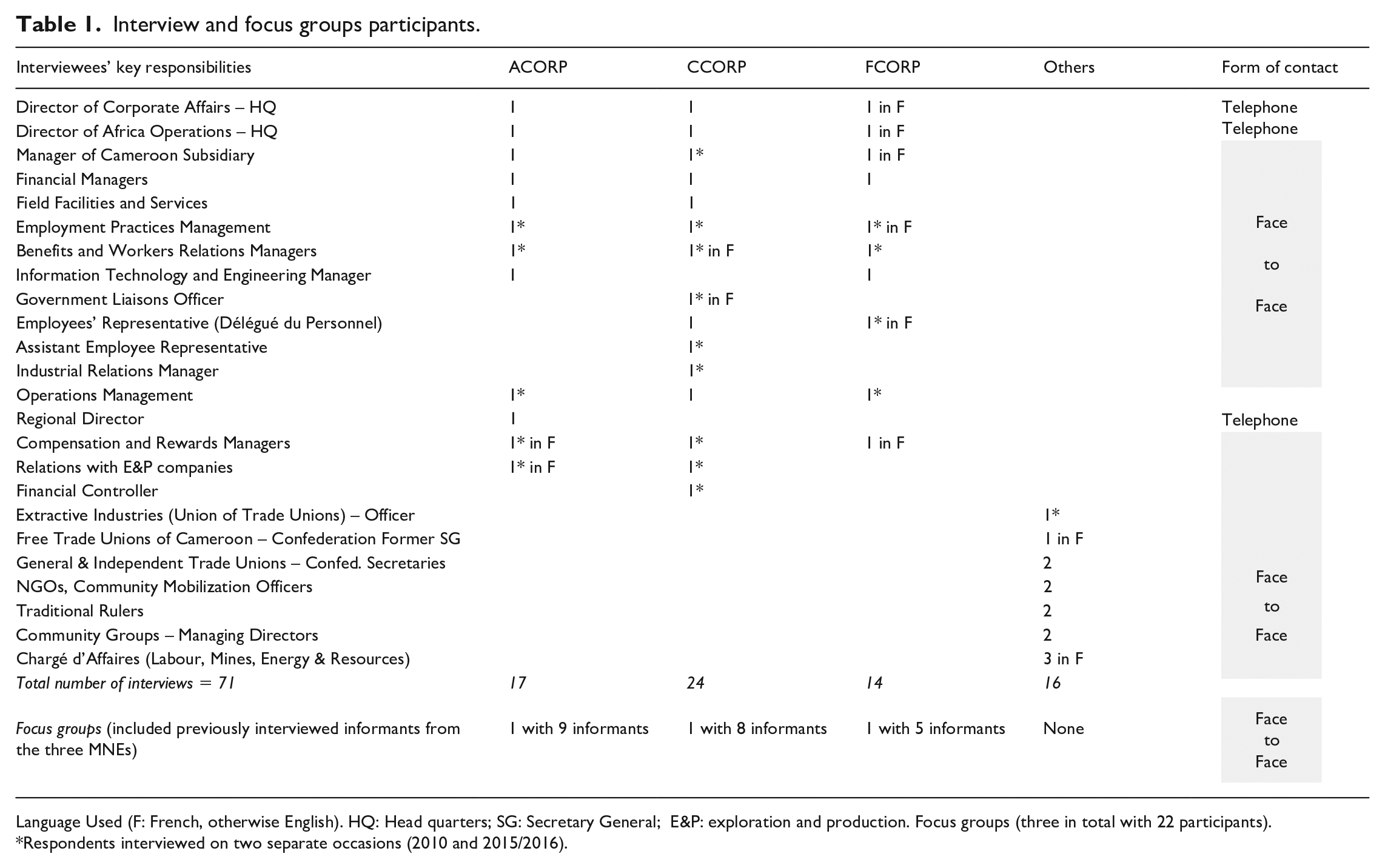
Language Used (F: French, otherwise English). HQ: Head quarters; SG: Secretary General; E&P: exploration and production. Focus groups (three in total with 22 participants).
Respondents interviewed on two separate occasions (2010 and 2015/2016).
The first phase of data collection (2010) consisted of 42 in-depth interviews; the second phase (2013) involved the three focus groups, and in the third phase (2015/2016), 29 interviews were conducted among those who had been interviewed in the first phase of the research. By such replication over time, and across and within organizations, our intention was to add to the data’s reliability and to the validity of our explanations. We also ensured the quality of the data by triangulating them with publicly available information in state archives, newspapers, company reports and NGO and union documentation. The interviews and focus groups lasted for an average of 43 and 58 minutes respectively. The questions asked covered: (1) the firms’ history and development in Cameroon; (2) the influences that shaped their work and employment practices; (3) an overview of their relationship with other actors in Cameroon and how this changed over the years and why; (4) the effects of the arrival of Chinese MNEs; and (5) the re-shaping of MNEs’ work and employment practices.
One of the article’s authors is Cameroonian and has lived in the French- and English-speaking parts of the country for over 30 years. In being well informed of the country’s institutions and social mores, he possessed the wherewithal to navigate access to the case organizations, public representatives and other interviewees. The other author’s initial unfamiliarity with, and distance from, Cameroon provided an important interrogatory perspective in the development of the study’s findings. To this extent, our different degrees of embeddedness allowed us to iteratively query taken-for-granted interpretations of the shape and import of institutional and political influences.
The interviews and focus groups were conducted in English and French. All the primary data were analysed in the recorded languages to avoid the problems associated with translation and the fallacy of achieving some form of exact equivalence (Chidlow et al., 2014). We used the explanation building technique developed by Glaser and Strauss (1967), which was undertaken as an iterative process and involved the identification of the various influences acting on MNEs’ practices. It was informed too by our understanding of the international literature. No software was used. We identified a variety of key influences: coercive isomorphism (regulatory pressures); normative isomorphism (pressures emanating from the state, sector and local actors); shifting frontiers of control and coercive pressures; subsidiary actors’ response to local isomorphic pressures; and the interplay of the effects because of the arrival and postures of the Chinese MNE. The identification and verification of early findings involved noting patterns, and possible configurations of causes and explanations. Conclusions were continuously interrogated and verified as the analysis was conducted by going back to the field notes.
Aspects of institutions in Cameroon
In the early 1960s, following independence, Cameroon’s public institutions were recast through the consolidation of the British and French cultures of public administration. While formal institutions in respect of education and training, the labour market, employment relations, financial and corporate governance exist, and are overseen by the law and the courts, they are poorly operationalized and remain fragile (Fonchingong, 2005). Informal institutions are oftentimes infused by clientelistic relationships, corruption and ‘Big-Man’ presidentialism; power is intensely personalized around the figure of the president. The president has been in power since 1982 and the Cameroon People’s Democratic Movement continues as the hegemonic political party.
Although centres of professional training exist, there is a dearth and continuing decline in the provision of qualified workers across all specialized skills in Cameroon. Between 1986 and 2010, investment in human capital development peaked and then declined in real terms (Aloumedjo, 2018). The state’s so-called local content policy requires MNEs to recruit local staff wherever possible and that 80% of managerial positions be held by local nationals. Workers generally prefer fixed pay, promotion based on seniority and social and family-friendly benefits (Ngok-Evina, 2008). Although there is no mandatory provision for trade union recognition, major indigenous private sector firms generally work with unions in a consensus-seeking manner. Firms, unions and the state routinely engage in national-level social dialogue, which has resulted in agreements detailing terms and conditions of employment across various sectors, including the oil industry.
Research findings
We begin by considering the cases of FCORP and ACORP up to the period of the late 2000s at which point CCORP established its operations. We then review CCORP’s practices before returning to consider, following a thematic approach, FCORP’s and ACORP’s practices in more recent years. Our account of FCORP and ACORP is preceded by a brief discussion of the wider geopolitical context within which each of them operated over the years of their establishment. This discussion is important in providing a sense of the power asymmetries as they lay between the MNEs, their home countries and the host-country’s administration, and how they shifted over recent decades and particularly with the arrival of Chinese FDI.
FCORP
France was the dominant colonial power in sub-Sahara Africa. 1 In the early 1960s, when it ceded independence to its African colonies, it did so under the informal motto of partir pour mieux rester (‘leaving so as to better stay behind’) (Smith, 2013). This led to a web of bilateral agreements covering a range of areas, including defence and aid, where France pledged to protect its former colonies from both external and internal threat in return for the right of first purchase of raw materials, including oil in Cameroon’s case. In effect, this amounted to life insurance for friendly regimes (Smith, 2013). The preservation of this neo-colonized francophone Africa pivoted on the bipolar post-Second World War order. This was its geopolitical sine qua non up until the early 1990s. In undertaking to defend western interests in sub-Saharan Africa, state-tethered French businesses prospered. Among them, the former state oil company, Elf Aquitaine, came to be known as ‘Elf Africaine’. With the fall of the Berlin Wall, however, francophone Africa was compelled to become a competitive market within a global economy. The consequences for French FDI directed to Africa have been substantial: in 1980, the share of France’s overseas capital investment flows going to Africa stood at 35% of total FDI; in recent years, it has fallen to less than 3%. As France’s grip on sub-Sahara Africa weakened other states moved to gain political and commercial advantage, most notably the USA, and more recently China that has courted and assisted African leaders with few conditions. African nations, too, grew increasingly willing to look elsewhere to forge new political alliances as old neo-colonial ties waned and as the monolithic hold of ruling elites was weakened.
French companies are well established in Cameroon. They operate across a variety of sectors. Significantly, they benefitted greatly from the country’s privatization programme of the late 1990s, particularly in sectors such as banking, railways and food processing. French companies also enjoy a significant presence in brewing, timber logging, telecoms, construction and civil engineering. French oil companies, Total and Perenco, held the lion’s share (up to 75% in the late 2000s) of oil production in Cameroon. There has never been a French chamber of commerce in Cameroon; there was no such requirement as French firms saw no need to coalesce to collectively bargain any commercial or political advantage. This was taken care of elsewhere, certainly until the early 2000s, through France’s already dominant position, elite cooperation and, as widely believed, through its corrupt and shady dealings.
FCORP is a privately owned French MNE. It established its operations in Cameroon in the early 1970s. It employed around 400 direct employees and another 900 on a contract basis. Its HQ directly controlled and coordinated virtually all its activities. Company work and employment practices were transferred to Cameroon. One senior HR manager conveyed: ‘we have specific HR policies and performance targets for staff in Cameroon and managers know they must take them seriously when they make requests for further investments’. The majority of its work on offshore platforms was contracted out, mostly to French firms, primarily because the requisite skills were not available locally and the cost of providing training to Cameroonian nationals was deemed too costly. This was confirmed by a 2010 Ministry of Labour inspection, which found that FCORP hired expatriates in contravention of collective agreements and the 1992 Labour Code. The HQ-designed payment systems also showed little regard for the provisions of sectoral agreements. Pay levels were influenced by rates in FCORP’s other subsidiaries and were dependent on staff’s position and seniority. All FCORP’s employees had a basic salary plus an annual bonus paid at the end of every year. The latter was fixed as a percentage of annual salary, usually close to one month’s pay. Pay also included benefits such as health and safety insurance.
Even though FCORP recognized unions for its indigenous staff, this was largely symbolic; there were no collective negotiations. Expatriate employees were not union members. Workplace union representatives were seen as an appendage of management who merely disseminated information. A national-level CSTC union official commented: ‘Many workers in FCORP did not see themselves as Cameroonians. Their managers did not allow them to work with us. We tried to know what was happening there but to no avail. We were powerless.’
ACORP
The USA has been the supreme global power since the end of the Second World War. Its hegemony is built upon its military might, and economic and political power. Oil, and particularly cheap oil, has been central to its economy’s lubrication. However, American involvement in sub-Sahara Africa has been peripheral, fitful and incoherent. It has relied on an assortment of assistance programmes that provide food aid, disaster and refuge relief, development support and security assistance, sometimes with stipulations in respect of trade (Oscaretin, 2013). However, since the end of the Cold War, total US aid (military, economic and disaster assistance) to the region has halved from over $2bn in 1985 to a little over $1bn in 1997, a trend that continued into the new millennium. Although oil constitutes the largest share (62%) of US imports from Africa, it has declined dramatically from 2011 to 2016 in both volume and value ($56.4bn to $7.2bn) (Cook et al., 2017). In 2007, the American state department reported that the stock of US FDI ($3.7bn) in Cameroon was significantly greater than that of France ($542m), a large part of which was accounted for by investment in the energy sector (USDR, 2007). Other US companies have operations in the country’s power industry, food production, mining and railway and port construction.
ACORP established its Cameroonian operations in the early 1980s. Control and coordination of its work and employment practices was highly centralized and it retained a posture of relative isolation from local institutional practice. A corporate manager noted: ‘We have robust systems to make sure that our African peers stay within the HQ’s policy parameters; there are regular meetings with our regional and subsidiary managers.’ In its early years, ACORP was permitted to import some of its own practices because of a late 1970s bilateral agreement between the Cameroon and US governments. In our interviews with civil society groups they argued that the agreement had created a loophole for US businesses to disregard local labour market regulations.
ACORP employed around 320 workers directly and another 700 as sub-contract operators. Approximately 90% of its workforce was expatriates, mostly of third-country origin. They occupied senior managerial, technical and engineering positions. Locally recruited staff held supervisory positions, as well as clerical and labouring jobs. Staff were mainly sourced from foreign training centres and employment agencies and, like FCORP, little or no regard was paid to Cameroon’s local content policy: ‘Our recruitment policy was brought directly from the HQ when the company first set up operations here. You know, we needed special skills in ACORP and, at the time, the manpower was non-existent here’ (Board Member).
ACORP’s pay levels were regarded as being among the best in Cameroon. Management were paid a base salary and performance-pay. Engineers and technicians enjoyed variable pay, while semi- and low-skilled staff were paid a fixed wage. All were set by HQ. ACORP refused its staff union representation. Its dealings with unions were indirect through its membership of the national employers’ confederation and its involvement in sectoral negotiations. As it was willing to pay a pay premium, it gained an exemption from implementing the pay terms of the collective agreements.
In sum, FCORP and ACORP exercised considerable power over their host in their deliberate and continued opposition to hiring local workers, developing and enhancing local skills and technological competences, and in their dealings with trade unions. Isomorphism arose not from any necessary compliance with external isomorphic pressures emanating from the host-country’s institutions or from the MNEs’ quest for local legitimacy, but from a managerial desire to transfer and reinforce a shared global management model. The reasons why both MNEs were able to escape local imposing constraints was due ultimately to their dominant position and size, and the host state’s reliance on their continued presence for the exploitation of its oil reserves.
CCORP
We look now at CCORP’s practices in Cameroon. Our starting point is to enquire whether a Chinese SOE with its distinctive form of capital, interests, organization and ethos behaved differently to FCORP and ACORP. A priori, we expected that the Chinese government’s political ambitions would have influenced CCORP’s corporate behaviours in a manner that was highly consequential for the Cameroonian state. We also thought that, with such an evident power asymmetry, CCORP would have felt no compulsion to adapt a localization strategy. If, however, we were wrong and it opted to adhere to Cameroon’s state policy, the question was, why did it?
CCORP is a Beijing-based SOE. In the late 2000s, it acquired a US MNE’s operations in Cameroon. Despite its size and significant investment (China became the second largest oil producer in Cameroon because of this acquisition), CCORP did not arrive in Cameroon in an inherently dominant position. French private capital remained predominant. Further, CCORP had to learn to navigate a new African operational and regulatory environment. It was also subjected to intense politicization. In an effort to secure its position, it sought to distinguish itself from other MNEs. It presented its strategy as one of resource-seeking with a difference, in that equality and mutual benefits through equitable partnerships were the professed principles underpinning its investments. Along with other Chinese MNEs, it invested in Cameroon’s physical and social infrastructure, building roads, schools and recruiting and training Cameroonians in large numbers. CCORP also collaborated with state agencies and educational institutes to provide for the skill development of local people in the four main oil industry centres (Banjoun, Douala, Maroua and Garoua). It also donated specialist training equipment to universities. This was perceived by political representatives as being very significant and a radical new departure from other MNEs’ practices.
CCORP management made frequent trips to Cameroon to meet government officials and subsidiary staff. These meetings involved consideration of work and employment policies. In May 2014, a few days after meeting Chinese officials, Cameroon’s President made a statement in support of Chinese investments: ‘China like France and other Western countries are good partners. But unlike the West, China does not take anything for free, from anyone’ (GEPMA, 2015). CCORP did not seek to impose Chinese or company-specific practices on its Cameroonian operations. Instead, it prevailed upon local management to conform to local regulatory requirements and socio-cultural values and norms. Its corporate operations director noted: ‘Operating units are required to stay within local rules and norms in order to be as responsive as possible to their host country and it’s left to the subsidiaries and regional managers to devise strategies in that respect.’
While the number of CCORP’s directly employed versus contract staff (265 to 650) was similar to FCORP and ACORP, the proportion of Cameroonians occupying managerial positions and technical grades, 90% and 72% respectively, was very significantly different. A senior HR manager stressed: ‘The company’s goal is to operate within the boundaries of and respect local cultures, peoples and laws as well as to improve the local content policy.’ It also replaced many of the expatriates of the former company with cheaper local employees and Chinese contractors. However, it paid them the sectoral norm. It also introduced new reward policies that were broadly in line with those agreed under the sectoral collective agreement. They included: funding further education, longevity of service award ceremonies, time-off for family occasions, employee keep-fit activities, employee loans and sponsorship of employee selected community projects. A CCORP’s representative at the sectoral negotiations noted as follows: It is relatively easy for us to fully implement (the collective agreement) because we have been using most of the requirements contained in it and due to the fact that it was agreed with input from and support of trade unions. Everyone is on board.
In 2015, too, it implemented a series of sectoral agreement provisions, including a yearly honorarium of 0.5% of salary paid to in-house union representatives, a 5% increase in severance and retirement pay, the provision of health care for staff with HIV/AIDS and personal accident insurance for workers assigned to high-risk jobs.
Employee relations management stressed that the firm and unions enjoyed a cordial relationship. Most workers were union members. Union representatives enjoyed direct access to senior management and were provided with information on company policies. Contacts were frequent and negotiations on terms and conditions of employment went beyond those of the sectoral agreements’ provisions. In late 2012, for example, at management’s request, employees’ representatives persuaded their colleagues to accept working an extra unpaid 15 minutes between shifts to allow for the handover of work lots. In return, management conceded that sick employees should not have to submit a certificate on the first two days, but only after three days’ sickness.
The question now becomes why did CCORP adapt this localization strategy and why was it willing to adopt a more concessionary approach than FCORP and ACORP. We discern a number of influences. There were obvious costs benefits. Recruiting local employees was cheaper than importing Chinese employees. Thus, there was an important economic rational. However, we do not believe this was the primary influence, albeit it provided positive reputational spin-offs. There were three other important factors. First, in contrast to former colonial powers’ dominance that was consolidated over centuries, Chinese FDI into Africa, and particularly in Cameroon, is very recent, being a little over a decade old. CCORP was thus navigating a new path and coming to terms with a very different context. To gain a secure foothold in Cameroon and in the region it was willing to adopt a localization approach. Second, CCORP is distinct in its form of capital. In being state owned it was greatly influenced by the state defined objectives of procuring a steady, reliable supply of oil, and of demonstrating to local actors, state and non-state, that China was different in its ambitions and behaviours to that of former imperial powers. This was important in enhancing China’s international reputation in the region. With China’s increasing reliance on African oil and its political ambitions to win close African allies for its own international political ambitions, the space for bargaining by local actors opened. Third, CCORP’s arrival coincided with a heightening of popular support for the sharing of the gains from Cameroon’s oil industry. Political elites and government were under increased popular scrutiny particularly from organized labour and NGOs to ringfence a greater portion of economic returns from foreign investors. We develop this theme some more later in the article but here we emphasize that in the course of our interviews, union representatives told us of their strategy of informing the media and NGOs of their relationship with CCORP management. This was one of the channels through which the union galvanized support and exerted influence on the company to continuously enhance its local-content policy. The unions’ use of external actors to put pressure on management is reflected in a CCORP HR manager’s comments: ‘They (trade unions) use NGOs and anonymous online posts to put pressure on us. We are paying particular attention to address such issues.’
FCORP and ACORP revisited: Accounting for the change in the shape of their practices
From about 2010 onwards, both FCORP and ACORP altered their work and employment practices to align with host institutional requirements. We examine why this came to pass and enquire whether the presence of CCORP had any effect and, if so, of what form and of what significance alongside other influences. The discussion is organized around the theoretical and conceptual frames considered in the literature review, and particularly those of DiMaggio and Powell (1983).
Evidence of isomorphic pressures
We enquire first whether the changed behaviours of FCORP and ACORP were driven by coercive isomorphic pressures emanating from institutional improvements in Cameroon’s legal enforcement mechanisms. Up until 2010, there was no evidence to suggest that state mechanisms of surveillance had improved. Certainly, in interviews with union representatives it was claimed that many of the country’s regulations were treated with continued disregard and indifference by FCORP and ACORP up to this point in time. However, from the early-2010s the Cameroon state made renewed efforts to compel resident MNEs to conform to the provisions of the state’s labour code and to abide by the collectively bargained sectoral agreements. Their ambition coincided with the arrival of new sources of FDI, principally CCORP. A chief of service in the Ministry of Industry, Mines and Technological Development explained: ‘Oil companies were able to evade our laws but not anymore. We seriously monitor employment standards as stipulated by the labour code and collective agreements. We are establishing new laws continuously to promote economic development which benefits all.’ One new provision was explicitly designed to close a loophole whereby western MNEs had been able to employ expatriates on the basis that their skills were not available in Cameroon. Now they were required to show that such employees could not be acquired through the newly established and better-resourced training centres, and that the positions to be filled were critical for the continuous operation of the MNE.
There is evidence that FCORP’s management had become increasingly aware that its practices did not enjoy support among elite groups and, in an attempt to improve their standing, they had begun to alter them prior to CCORP’s arrival. Thus, there was a burgeoning managerial inclination to change. However, these steps were perceived by those interviewed outside the MNE to be largely modest and tokenistic. It was not until after CCORP’s arrival and the implementation of a more intensive regulatory regime that both it and ACORP changed their practices in a significant fashion. Thereafter, CCORP’s arrival strengthened and bolstered the state and non-state actors in their capacity to impress upon FCORP and ACORP of the necessity to alter their policies in a more fundamental way and in a manner that respected the state’s sovereign authority. FCORP’s HR director conceded: ‘It is even more difficult now to bring in expatriates as the government is demanding evidence of the critical need of the specific staff; training options must first be explored to fill such positions.’ The Ministry of Employment and Vocational Training believed it had prevailed as evidenced by the Head of Service for Youth Employment’s remarks: Just like the new oil companies are using local workforce and adhering to the prescriptions of the law in respect of pay, benefits and working with workers’ unions, older companies have begun using the national employment agency, training centres, because it is the new norm.
We wondered additionally whether there had been an upgrading in the industry-related skills of the local workforce prior to 2010, as a consequence of which the Cameroon state might have been further enabled to prevail upon MNEs to recruit local workers and, thereby, adhere to the state’s labour market policies. This was certainly not the case. There remained a general lack of trained workers for the industry and the preference among employers to recruit their own staff from outside Cameroon for skilled positions remained. CCORP was different in that it was willing to invest in the provision of training of Cameroonian workers both within its own employment and more generally in the labour market to enhance educational and training provision. Again, those whom we interviewed – government officials, unions and local chiefs – pointed to the arrival of Chinese FDI as being the catalyst for change. Thus, we argue that the state’s capacity to call FCORP and ACORP to account was bolstered by the collaborative participation of the Chinese MNE in supporting its labour market objectives and ultimately in shoring up its authority.
We found little evidence of normative isomorphic pressures acting on our case study MNEs certainly in the sense as understood within neo-institutionalism; that is, practices diffused through professional networks. However, normative pressures were evident, albeit of a different kind. These were represented through the growing discontent and increased vocalization of objections to western MNEs’ employment practices from about 2010 on. They were transmitted through the political postures of party political representatives, local chiefs, NGOs and local activists (Tchakounté, 2013). These actors were adept at using both traditional and new social media outlets to expose the MNEs’ wayward practices. Articles by journalists and reports by NGOs, particularly CERUT, detailing oil MNEs’ violations of employment laws and their poor treatment of employees also became more frequent. In this context, too, the influence of the arrival of Chinese investment was also evident in interviews. The managing director of a leading NGO in the oil sector remarked: ‘Since the Chinese came, they made us more aware of how other companies were exploiting us . . . China embraces our ways.’ Significantly, the Cameroon government remained mute in the face of these protests and reports. In a country where political freedoms are severely curtailed and where the authors of such publications have been maltreated by the forces of law and order in the past, the current government’s inaction was widely interpreted as support for critics’ censuring of western oil MNEs.
Mimetic isomorphic pressures were also evident. They were closely allied to the influence of the aforementioned normative pressures. In parallel to criticizing the practices of western MNEs, the government threatened to offer further oil concessions only to rule-abiding companies. A senior government official in the Ministry of Industry, Mines and Technological Development affirmed: It was the case in the past that oil companies came here and told us how they were going operate. We had no choice. Today, oil firms from the BRICS [Brazil, Russia, India, China and South Africa] are knocking at our doors with better offers. We point this out to them (western MNEs) and they do consider it.
By such means, the government set about promoting the practices of rule-observant firms, and particularly by highlighting the case of CCORP. CCORP, too, portrayed itself as willingly respecting local rules and norms. Its self-promotion as a good citizen was regularly re-enforced by the press. According to CERUT for example, there was an average of seven media reports per month in 2015 detailing the positive impact of Chinese FDI in Cameroon. Together, then, with heightened public protest and the hierarchical organizing of firms within the sector, where CCORP assumed the role of being central, further pressure was exerted on long-established western MNEs to respect local regulations and norms. The comments of two ACORP managers, the first from the firm’s HR department, the other from operations, reflect this: It is more a case of portraying our company as not just exploiting the natural resources of the nation with disregard to the very citizens who should benefit from it as many media outlets have been reporting of recent. This has resulted in a growing resentment of foreign workers. The Chinese have changed things and we are adjusting.
The changed context was reflected too in local managers’ efforts to impress on their corporate peers the requirement that they now be given enhanced autonomy to manage their affairs locally. A senior HR manager in FCORP noted: ‘We had to convince the HQs that the situation has changed and we had to adjust to local reality.’
We conclude on the basis of the evidence here reviewed that CCORP’s arrival represented a significant moment or critical turning point. Its effect was transmitted first through mimetic isomorphism – the state’s praising and rewarding of CCORP’s good behaviours together with its ascription of it being a central firm had the effect of compelling other MNEs to copy its behaviours; and second, through coercive isomorphism where CCORP’s cooperative postures enhanced the state’s regulatory capacity to pressurize other MNEs to conform to local practices and norms. These pressures coincided with growing discontent and protest among a range of actors, governmental and non-governmental with the behaviours of MNEs. These tensions became even more voluble post-2010 as the practices of CCORP helped their cause by providing an example of how other MNEs might behave. So, the shifts in power were due both to the arrival of CCORP and the new forms of protest, communication and regulatory ambition demonstrated by the Cameroonian state. To the extent that the shifting behaviours of our case MNEs can be located in these shifting isomorphic pressures, DiMaggio and Powell’s (1983) conceptual framework is helpful. However, we must go further. We argue that consideration of isomorphic influences must also be understood in the context of an appreciation of the sources and mobilization of power resources, and particularly as transmitted through shifting geopolitical influences. This brings us to consider the article’s principal theoretical contributions to which we turn now.
Discussion
Our analysis to this point has established two important findings. First, CCORP’s behaviours were distinctly different from those of FCORP and ACORP; and second, CCORP’s behaviours had the effect of altering the behaviours and practices of FCORP and ACORP. The basis for CCORP’s distinct postures and practices is linked to its form of capital, that being state capital. FCORP and ACORP are publicly listed companies and are required to serve private interests. By contrast, CCORP was expected to serve different interests which were defined in large part by the Chinese government, which are a compendium of state, politics and economy. A further empirical reality is that CCORP is a recent arrival in Cameroon and, although the size of its operations is significant, it is not as large as the long-established operations of its western counterparts, particularly FCORP’s. CCORP’s willingness to work collaboratively with local state and non-state actors to address formal institutional deficiencies in Cameroon was informed by these features – its state ownership, its quest for a secure long-term supply of oil and the close alignment between its international economic expansion and the Chinese state’s geopolitical ambitions. For these reasons, CCORP was predisposed to adapt and adhere to Cameroon’s state localization policy. This had the effect – in tandem with attendant influences – of generating new rules of the game across the sector. That is, the erstwhile expectations of long-established FCORP and ACORP, of their being autonomous to manage their own affairs as they deemed fit, and which were reinforced through a deep-rooted set of systemic power relations, were fundamentally challenged as the wider political economy altered. Cameroon could now rely on very significant investment coming from China that was willing to accommodate to the expectations of the Cameroonian state and local institutions. FCORP and ACORP’s subsequent willingness to alter their practices must be seen, then, as an attribute of continuing – albeit recast – interdependent relations. They continued to need access to Cameroon’s oil reserves and Cameroon needed their expertise and production capacity, but not on the terms as once deigned under an acutely asymmetrical distribution of power. The task now is to determine whether and how these findings might be understood theoretically and, in particular, to appraise the analytical purchase provided by the theoretical frameworks considered in the literature review.
We argue that, in order to better understand the influence of institutional and political effects in the study of MNEs, we need to better appreciate that MNEs exist within networks of relations that include actors within and beyond the MNE, particularly the state (home and host) and involve the mobilization and coordination of interests. The extent to which the state, particularly that of the MNE’s home nation, will mobilize its influence to shape firms’ power and postures will obviously vary and will pivot critically on the form of capital, state or private. This and its potential consequences, however, is an issue which institutional theory has given scant attention. Those who have looked at resource mobilization (Battilana et al., 2009) do so in a narrow fashion in that they emphasize the importance of mobilizing financial resources, formal authority and social capital, but plainly this is not sufficient. Mobilization is a deeply political process and the specific forms it assumes reflect the exercise of political power by specific identifiable coalitions over others (Thelen, 2010). Agency is rarely consolidated around one actor, be that the MNE, the state and its agencies, or non-state actors, but is rather fragmented and requires mobilization and construction. The formation of coalitions depends critically on how one party might resource the other and vice versa. These alter as wider structural conditions change, and as they do, new opportunities arise and new networks and coalitions emerge. Consideration of power is thus invoked here by its association with structures of interdependencies; but not only that, but also by its links with structures of domination and oppression. Thus, while there is a need to embrace an agency-centric conception of power, it is also imperative to acknowledge larger power asymmetries where they exist and shifts therein (Munir, 2020; Willmott, 2015). Hence, there is a requirement to consider how power contests are interlinked with systematic power relations and the political economy of capitalism (Clegg et al., 2018; Lee, 2017; Smith and Meiksins, 1995). Thus, while a host-country’s institutions might have been evaded, captured or colonized by the preferences of MNEs, subsequently they may be re-acquired and re-modelled by the state both to constrain and reorient MNEs’ preferences.
We develop this point some more first by illustration from the current study; and second, by a discussion of its implications for modes of analysis. We found that the Cameroonian state mobilized the Chinese MNE as an ally to call management in the French and American MNEs to account for their role in delimiting state-led institutionalization. This insight is in contrast to much of neo-institutional theory that has tended to look upon MNEs and the state as adversaries or at least contestants where each is seen as a discrete actor possessing competing aims, such that in particular circumstances MNEs might be seen to defy the state by actively challenging, by-passing or recasting their institutional contexts; or in other circumstances, the state may be identified as possessing the capacity to hold MNEs to account. Rarely, however, have the state and MNEs been viewed as agents which might seek the support of the other to take on otherwise belligerent or recalcitrant MNEs. It is this we witness here. Importantly, though, the state’s success in cultivating and mobilizing Chinese support hinged on a particular moment of opportunity in the political economy of capitalism. The point deserves emphasis; the Cameroonian state was successful in a particular context. In understanding why this came to be, our argument is that it requires an analytical framework that is context-sensitive, that sees institutional processes as involving complex causal threads that need to be unpicked over long time frames, that combines an actor-centred institutional approach at multiple levels with a political perspective and critically one that takes account of MNEs’ and countries’ location within the international political economy of capitalism.
This is a benefit of the system–society–dominance perspective. Actors, be they the state or MNEs, are at once embedded in multiple organizational contexts or fields. Such fields’ boundaries are fluid and in flux, and continually admit new actors that create the opportunity for new institutional referents and institutional logics. The key point here is, to reiterate, that such political opportunities create new power dynamics that have implications for existing institutional rules and governance mechanisms. A great deal of the neo-institutionalist literature shies away from such an exploration (Clegg et al., 2018; Munir, 2020; Suddaby and Young, 2015). It is not that this literature does not identify the role of the state as an actor and state institutions as an influence, but the state’s location – whether that is of the home or host – in the political economy of capitalism and how this is shaped and re-shaped over time is often unspoken of. It is, to emphasize again, a context of significant flux, perhaps now more than ever, as established powers, such as the USA, retreat, and new powers, particularly China, seek to realize their ambitions for increased global influence. With such shifts, the sources of dominance effects are altered in very fundamental ways. Power may now come to reside beyond developed economies and their MNEs as host economies rely less on inward investment from former hegemonic powers. With such flux we anticipate that the local state might be motivated and advantaged, where it believes it possesses the strategic capacity, as was Cameroon, to establish new networks of relations and coordination of interests. These are deeply political processes and must be closely scrutinized to better understand the shape of MNEs’ practices.
This contribution has another related implication: we must not only continue to enquire how institutional mechanisms influence MNEs or of how MNEs shape institutions, but we ought also to examine how particular forms of interactions between institutions and MNEs come ultimately to shape MNEs’ practices. This is a nuanced but important distinction. That is to say, institutional effects cannot nor should they be seen in universal or abstract terms, such as they are viewed with concepts like institutional distance (Kostova, 1999), but rather as effects that are demonstrated in particular political and economic contexts (Jackson and Deeg, 2019). As we have argued, the Chinese MNE’s support for the development and further embedding of institutions had the effect of changing the institutional context within which the MNEs of other national origin operated; hence our emphasis on the forms of interaction. As such, MNEs’ strategies can potentially re-shape host-country institutions in new isomorphic directions in a co-evolution fashion (Cantwell et al., 2010; Jackson and Deeg, 2019).
Therefore, the key theoretical point is that the influence of institutions is a matter of context, circumstance and opportunity (Dörrenbächer and Geppert, 2011). But unlike a great deal of work within neo-institutionalism we emphasize that the formulation of institutional rules and logics is a competitive and contested process involving actors at multiple levels with varying levels of resources and social skills (Battilana et al., 2009; Fligstein and Zhang, 2011). In emphasizing that institutionalization is itself a political process (Hirsch and Lounsbury, 2015), we also emphasize that it is a co-evolutionary process whereby institutions and organizational forms and behaviours are interactively constituted: just as institutions can affect organizational forms and behaviours, organizations can effect change in, or create, institutions (McGaughey et al., 2016). As a consequence, institutional influences be they home- or host-country influences are not immutable; rather, they are fluid, flexible and adaptable and allow much scope to actors to exploit their potential in ways that are not fixed a priori. The central task, however, is to identify the relevant factors and the manner of their interaction to explain how institutions as competing multi-level nested processes within and beyond nations interrelate with actors’ resources and skills to influence managerial policy preferences within MNEs. Our research points to the importance of assessing the degree to which MNEs are differentially situated within the international political economy, and in their relationship with host institutions and, critically, host governments. Thus, within any one given sector in a particular host country there may be considerable heterogeneity in the positioning and postures of MNEs that is linked to their country of origin, the factors prompting their internationalization and their time of arrival.
Another important contribution of this article is the manner in which it illustrates how issues of power, negotiation and institutional building link with important moral and ethical issues surrounding MNEs, particularly where they have operations in the developing world. For this reason, too, institutional theory must move firmly to examine political negotiations and struggles involving MNEs, states, communities and social actors. A central question scholars must ask is how is the environment of MNEs constructed and negotiated, and what strategies, devices and power resources do MNEs rely upon in the pursuit of their interests and in the shaping of institutions? To do so will help us to identify and understand whether the forces of continuity or discontinuity in institutional logics (as being separate from institutions themselves) are malign or benign. The addition of the comment in parentheses is important for the reason that newly introduced institutions or reforms may have little effect while existing unaltered institutions may come to work in very different ways (Hall and Thelen, 2009).
Conclusion
This article makes two contributions. First, it provides evidence of the practices of a major Chinese MNE (CCORP) with operations in Cameroon’s oil industry of a close-up and detailed kind. This is important as we know little of the strategies and practices of Chinese MNEs in Africa. Second, it provides evidence of the manner in which CCORP’s distinct practices altered the behaviours and practices of two long-established MNEs from France (FCORP) and the USA (ACORP). The latter contribution is the more original and more significant. We make our argument by drawing on different levels of analysis that include consideration of various isomorphic pressures, the international political economy of capitalism and the power resources of the state and MNEs.
FCORP and ACORP imported their preferred work and employment practices contrary to the objectives of the host Cameroonian state. By contrast, CCORP respected and adhered to local rules and norms from the outset. We argue that the broader historical and international political economy context is important in accounting for these differences. For many decades, Cameroon’s institutional development was handicapped by deeply embedded relations of dominance and structural dependency, arising from long periods of colonization and, more recently, by its dependence on FDI from former colonial powers and other hegemonic powers. The settlement attained and maintained by the French and American MNEs for some three to four decades represented an imposed and unstable compromise. While it suited them, it was suboptimal and disadvantageous to the Cameroonian state and, as such, represented a subject of ongoing contest and conflict. However, as wider structural conditions altered it was open to challenge. This occurred following the arrival of Chinese FDI. At this point, the frontier of control shifted as altered economic, political and ideological influences interacted to generate new rules of the game. Cameroon could now rely on significant sources of investment from China together with its goodwill to abide by host-country regulations and norms. In being state owned, CCORP’s management’s priorities and behaviours were shaped by the political and economic priorities of the Chinese state. China required access to African extractive resources and its government was keen to extend its political influence across Africa. In pursuit of these broader objectives – that is, in contrast to those of private capital whose prioritizing of a profit-maximization imperative renders it less territorially and politically constrained – it was willing to make more compromises to accommodate to the demands of the host state. In this recast international political economy, Cameroon’s government acquired new power resources that were derived from a new relationship of mutual interdependence and exchange. It used this opportunity for renewed political agency to bolster its institutions and insist that the French and American MNEs fall in line, which they largely did. Thus, the effect of CCORP on the behaviours of FCORP and ACORP was mediated through the new-found political agency that it had helped bestow on the local state and social actors in Cameroon.
We next consider the current study’s implications for future research. First, a word of caution. While we undoubtedly need to learn more about Chinese MNEs we should be careful lest we accentuate a particular nationality effect over other possible influences that include sectoral dynamics, market structures, skill and technology requirements, and location in production networks/supply chains. These elements may well be as or more important than a firm’s nationality and, in considering them, we do well to avoid the risk of submitting to methodological determinism (Oya and Schaefer, 2019). Further, in as much as we call for a requirement to problematize or disentangle the composites of any supposed nationality effect so, too, do we align with Burawoy’s (2014) injunction to resist any temptation to homogenize ‘macro-forces’ that might shape micro-processes. Although he was referring to the role of the state specifically, as with the nationality of a firm, neither can be reified to be constituted by a singular and consistent set of elements or interests. Thus, we must recognize both the heterogeneity of Chinese capital, private and public, and the heterogeneity of the Chinese state interests.
We have argued here that the wider reasons for Chinese investment in Cameroon’s oil industry – political as well as economic – created the space for bargaining and concession that was less evident or absent in the case of speculative private capital from France and the USA. This raises the possibility that Chinese private capital operating elsewhere may also feel less obligated to concede to local state demands, or at least may enjoy more autonomy in determining its own practices. Similarly, there may be variations in outcomes across different African nations, depending on variations in host states’ regulatory capabilities, elite political vision and non-state actors’ organizational capacity (Lee, 2017; Yan and Sautman, 2013). As such, the configuration of forces and dynamics that we identify is likely to exist unevenly across different forms of capital, industrial sectors and host states. Future research would do well to heed such variation, but it will also need to place close attention to MNEs’ location within the international political economy of capitalism. This again is the strength of the system–society–dominance framework. Some leading scholars within international business (IB) have moved appreciably to understand the challenges involved. Buckley (2020), for example, in the context of examining the consequences of China’s Belt and Road Initiative argues that scholars who concentrate on developments at the firm level can no longer take the global institutional framework as given and that an explicit focus on the global trade and investment regime is now required. Conventional IB scholars, however, would be well advised to recognize and acknowledge the large corpus of work which informs some of the pioneering work on MNEs and the influence of political economy, such as that of Anthony Ferner, Gregory Jackson, Glenn Morgan and others. A focus on the international political economy and oscillations therewith is of even more importance in the study of FDI in African countries. 2 From the late 1980s to 2010 the international political economy context in Africa was one of a single dominant hegemon – the USA and its western allies, the accompanying ‘Washington consensus’ and neo-liberalism – which supported MNEs’ power in their dealings with host governments. Prior to that, some African countries, particularly non-aligned states, were capable of playing the USA off against Soviet Union power in terms of receiving aid and investment, albeit in a context where the globalization of production and finance had not advanced to anything like the degree it has today. The rise of China reflects the decline in US hegemony and perhaps foreshadows a return to a new ‘cold war’ rivalry on this occasion between China and the USA and its allies. Examining how African countries might play any developing ‘cold war’ to their benefit will be important. Thus, we argue that it is ever more essential to include an appreciation of the international political economy of capitalism in order to understand the consequences of these processes inside the firm and inside particular national contexts.
Finally, there is the manner in which we theorize and come to understand the influence of state capital. In comparison to speculative international capital, it is relatively little understood in IB. State capital interests are likely to be very different from those of private capital, but neither can they be homogenized to constitute one form. Beyond China, state capital plays a prominent role in countries as diverse as Sweden, France, Norway, Italy, Russia, Saudi Arabia, United Arab Emirates, India, Brazil and Malaysia. The question begged, as Lee (2017) proffers, is whether and how the constitution, aggregation and articulation of state interests shapes MNEs’ practices, and particularly how such effects might differ across state-owned MNEs originating from different national political regimes, from democratic to authoritarian.
Footnotes
Acknowledgements
The authors are grateful to the three anonymous referees for their comments and advice in improving the article and for the support provided by Alessia Contu in her role as associate editor. The article was partly written while John Geary held a visiting professorship at the Department of Sociology and Social Research, University of Trento. We thank the interviewees who participated in this study.
Funding
The authors received no financial support for the research, authorship and/or publication of this article.
