




Abstract
Do disability legislations that are meant to be beneficial for the employment situation of persons with disabilities have nevertheless unintended negative consequences? To provide key resources such as the right to workplace accommodation, governmental agencies first need to identify eligible persons and label them accordingly. However, this label may, in turn, induce public and self stigma that entails negative consequences for labeled individuals. We address this puzzle using a quasi-experimental study design: sharp regression discontinuity design. Specifically, we examine whether individuals officially labeled as “severely disabled” perceive fewer opportunities for relationship building at work than their counterparts with a similarly severe, yet unlabeled, disability condition. We use data from 845 employees with disabilities, which were drawn from a representative German workforce data set. As expected, labeling leads to perceptions of fewer opportunities for relationship building. We find this effect to be independent from supervisor knowledge of subordinate disability, type of disability, and one’s visibility of disability. These robustness checks strengthen the argument that the labeling effect might be driven primarily by self stigma rather than public stigma. Implications for organizations and public authorities are discussed.
Keywords
Introduction
Imagine you enter a bus. Instead of buying a ticket, you present an identification card (ID) to the bus driver that shows that you qualify for a free ride. Although your ride is technically free, you still have to pay a non-monetary price: the ID card you present states that you are “severely disabled”. How would you feel in this situation, and how might this official labeling affect your feelings and behavior?
Hannah, a 14-year-old German girl with trisomy 21, faced this situation every single day. In autumn 2017, she finally took action: she printed a new label and pasted it above the old one. Instead of the official “Schwerbehindertenausweis” (severe disability ID card), she now had a self-made “Schwerinordnungausweis” (severely ok ID card) and spread this new version of her disability ID in social media (see Figure 1). Accompanied by considerable media attention (Der Spiegel, 2017), Hannah’s actions started an intense public debate on whether these IDs are having their intended impact on card holders’ lives, improving social inclusion at work and in society at large.
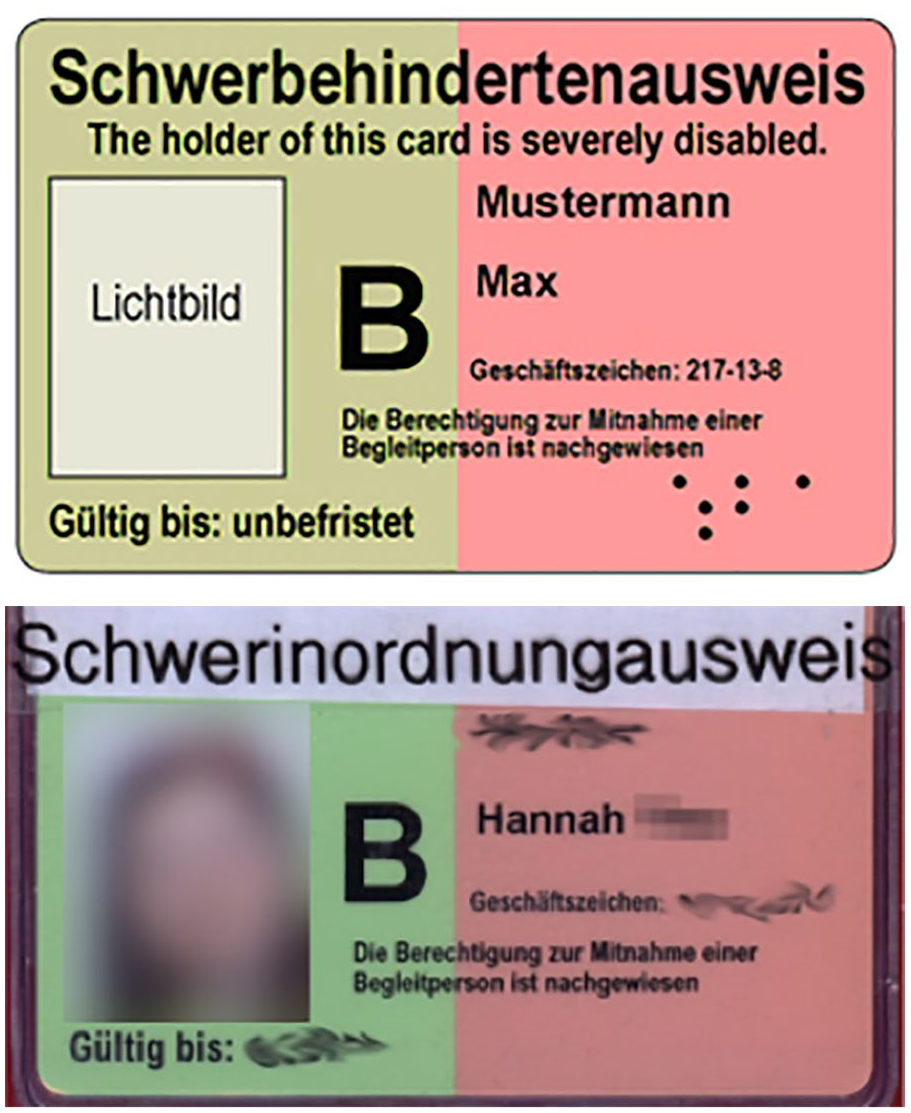
Hannah’s severe disability ID card before and after relabeling.
There is no doubt that governmental actions such as the US Americans with Disabilities Act (ADA, 1990) and the disability law in Germany (i.e. Book 9 of the Social Code, Equal Opportunities for Disabled People Act, 2001) are meant to be benevolent. One of their central goals is to provide a legislative environment that fosters recruitment and retention of persons with disabilities, a largely untapped reservoir of the labor market (Lengnick-Hall et al., 2008) with unemployment rates typically twice as high as those of the non-disabled (785 million; Bureau of Labor Statistics (BLS), 2017). To change this situation, German policy-makers have employed a quota system which requires 5% of workplaces in organizations to be filled with persons with disabilities (Kock, 2004). This quota system makes it necessary to officially define disability, to assess in a documented and reproducible process if persons have a disability, and consequently, to officially register and label individuals as “disabled”. While many people go through this labeling process every year, we are aware of no research that has investigated if and how this labeling process affects individuals like Hannah. Our study addresses these theoretical, empirical, and practical gaps, thereby contributing to disability, stigma, and ableism literatures.
First and foremost, our study offers a theoretical lens to explain why persons with severe disabilities might be at risk of perceiving an unsatisfactory level of relationship building at work. Such a lack of close interpersonal relationships in the workplace has been linked to a variety of negative outcomes including poor psychological well-being (Lunsky and Havercamp, 1999) and decreased quality of life (Duvdevany and Arar, 2004). In addition, for persons with disabilities, prior studies illustrate that relationship building at work is a key prerequisite for career advancement (Kulkarni, 2012) and access to relevant organizational resources (e.g. mentoring, coaching, counseling; Chandler et al., 2011).While existent studies have mainly focused on drivers of relationship building at the organizational level (Vornholt et al., 2013), including the role of coworkers (Scherbaum et al., 2005), supervisors (Dwertmann and Boehm, 2016), organizational cultures (Schur et al., 2009), or accommodation practices (Kensbock et al., 2017; Schur et al., 2014), we propose that a further, supra-organizational aspect plays a central role in this respect. More specifically, we offer structural stigma as a mechanism that causes drops in employees’ with disabilities perceived opportunities for relationship building at work.
Structural stigma is one of the four dynamically interrelated manifestations of stigma, including also public stigma, self stigma, and stigma by association (Bos et al., 2013). Public stigma informs other forms of stigma as it implies that certain inter-individual differences matter socially (e.g. white people versus black people, persons with versus without disabilities), and are devalued by the public (Link and Phelan, 2001). Self stigma is an internalization of public stigma, whereas stigma by association refers to a self or public devaluation because of being associated with a stigmatized person (e.g. healthy sibling of a person with trisomy 21; Corrigan, 2004). Finally, and most relevant to our study context, is structural stigma which involves processes at the macro-level (i.e. policies of private or governmental institutions) and is defined as a general devaluation of persons who are associated with these policies (Corrigan et al., 2005).
While structural stigma effects have been used to explain feelings of shame and social exclusion of other societal groups, such as ftachments as a fundamental huood stamp recipients in the USA 1 (Currie et al., 2001), this theoretical lens has not yet been used to explain detrimental effects of a labeled disability status at work. We believe this to be a serious shortcoming of the disability literature given that many individuals hold such governmental labels. Thus, applied to the German legislative context, we propose that the label “severely disabled” that is presented upon the disability ID card links card holders with the disability legislation, thereby inducing public and self stigma.
Self stigma is associated with negative consequences for the stigmatized individual, including, for example, decreased self-esteem and empowerment (Livingston and Boyd, 2010) or increased levels of (perceived) discrimination in interpersonal interactions (King and Ahmad, 2010; King et al., 2006). In this sense, our main argument is that stigma cued by a disability label may lead to perceptions of fewer opportunities for building close, informal relationships at work. Such relationships, which are “characterized by strong feelings of attachment, intimacy or commitment” (Baumeister and Leary, 1995: 500), are important for all organizational members as they contribute to feelings of belongingness and relatedness at work, a basic human need and key motivational factor (Ryan and Deci, 2000). These relationships are particularly relevant for employees with disabilities, as this group is at risk of developing low quality interpersonal relationships at work (Dwertmann and Boehm, 2016; Rusch, 1988). Thus, given that low quality interpersonal relationships do not contribute to feelings of inclusion (Shore et al., 2011), the core goal of the disability legislation might be missed.
Second, our study advances prior research on ableism (Campbell, 2008; Elraz, 2018; Jammaers et al., 2016). As shown by Jammaers and colleagues (2016), employees with disabilities are likely to be confronted with processes of ableism in the workplace, including discourses of disability as a source of lower productivity. These constructions of disability focus on the impairment, and, more concretely, on what disabled employees cannot do on the job (Wolbring, 2008). We build upon this work and extend it in two ways. First, we complement prior small-scale qualitative analyses with large-scale, quantitative data. Second, we argue that these processes of “othering” in the workplace (i.e. referring to persons with disabilities as “different”; Mik-Meyer, 2016) are not only activated by colleagues or supervisors, but also by other external triggers; that is, disability labels which might in a second step get internalized by affected employees. We propose that employees with a labeled disability condition are likely to buy into assumptions of reduced ability with negative effects for their self-perceptions.
Third, we add to research on identity-construction of employees with disabilities (Bogart et al., 2017; Forber-Pratt et al., 2017; Reeve, 2002). Specifically, given that the disability label conveys self-relevant information, we consider the label to play a more central role for the identity development of labeled persons than for their counterparts with unlabeled disability conditions. As illustrated by Hannah’s example, a disability label accompanies card holders in their day-to-day life, continuously reminding them of their severe disability status.
Finally, we follow prior recommendations for more disability research using large study samples (e.g. Baldridge et al., 2018; Beatty et al., 2019; Dwertmann, 2016). We also make a distinct methodological contribution to the body of literature by utilizing a quasi-experimental research method (i.e. a regression discontinuity design (RDD)). This method is popular in other social disciplines for making causal claims (Lee and Lemieux, 2010), yet largely unknown to management scholars (Bastardoz et al., 2017). This is important for two reasons. First, prior field studies on disability mostly remained on a correlational level of analysis, limiting their explanatory power and ultimate value for the field. In purely correlational study settings, disability status is endogenous with respect to the outcome variable as the former correlates with the error term (i.e. the unexplained variance) of the dependent variable (Antonakis et al., 2010). Thus, as differences in the outcome variable between persons with and without disabilities cannot be attributed to the disability status only, no conclusions can be made about the effect of disability. Second, experiments investigating the experiences of persons with disabilities are virtually impossible to conduct, as disability status cannot be randomly assigned. To work around this randomization problem, we use an externally imposed threshold (i.e. disability degree of 50, the least degree of disability severity at which persons are officially registered as severely disabled) and focus only on individuals close to this threshold. This approach allows us to examine whether individuals who are similar in severity of disability but differ in official disability label perceive different levels of opportunities for relationship building at work.
Theory and hypothesis development
The interplay of stigma and labeling processes for relationship building at work
The notion of stigma goes back to a Greek word and relates to a mark made on the skin by branding (Oxford Reference, 2018). In ancient times, a mark burned into the skin was thought to convey “that there was something immoral, unusual or bad about [the marked persons] and they should be avoided” (Abdullah and Brown, 2011: 936). Goffman’s (1963: 3) definition of stigma relates this “mark of disgrace” to an attribute that reduces the affected person “from a whole and usual person to a tainted, discounted one”. Recent approaches to define stigma combine notions of labeling, stereotyping, separation, status loss, and discrimination (Link and Phelan, 2001). In this line, observers use characteristics that matter socially (e.g. criminal, disabled) to create categories of people having versus not having a certain characteristic (e.g. being an ex-convict, being a disabled person; Link and Phelan, 2001).
While such a characteristic might be relevant per se, it enfolds its effect primarily through labeling processes. Labels are affixed to categories to help organize the stimulus information (Eagly and Chaiken, 1993). Stereotyped beliefs linked to a specific label become salient for both the bearer of the stigmatized label and the observers. This idea is central to stigma theory (Goffman, 1963), according to which stigma operates in the form of public and self-stigmatizing beliefs (Corrigan and Kleinlein, 2005).
Interestingly, the underlying operation process is argued to be almost the same for public and self stigma (Abdullah and Brown, 2011). Specifically, both are induced by a cue that activates stereotypes and stigmatizing attitudes (i.e. prejudices). The cue can be, for example, psychiatric symptoms, unusual physical appearance, or, as in the case of our study, an official label (Corrigan, 2004). This triggering role of labels can be observed in various contexts. For example, Hannah’s story is very much comparable to when persons enrolled in a food stamp program (i.e. US government food assistance program) are handing over food stamps to the cashier to receive free food (Stuber and Kronebusch, 2004). Viewed from the outside, these individuals become associated with a specific governmental policy, and are therefore categorized as “food stamps recipients”. Seen from the individual’s perspective, both the disability ID and the food stamps serve as cues that remind the affected persons of their label. In both cases, stigma is elicited and negatively affects persons’ self-perceptions. These individuals pay a non-monetary price for the apparently “free” benefits.
As shown in Figure 2, we refer to four distinct steps of the stigma process (Abdullah and Brown, 2011; Corrigan and Kleinlein, 2005), and apply it more broadly to disability stigma. In the first step, presented below, we argue that the disability ID card, respectively the label “severely disabled” which it conveys, functions as a cue. As the label is assigned by public authorities in an official and rather lengthy process, its perceived importance, correctness, and binding nature are particularly pronounced.
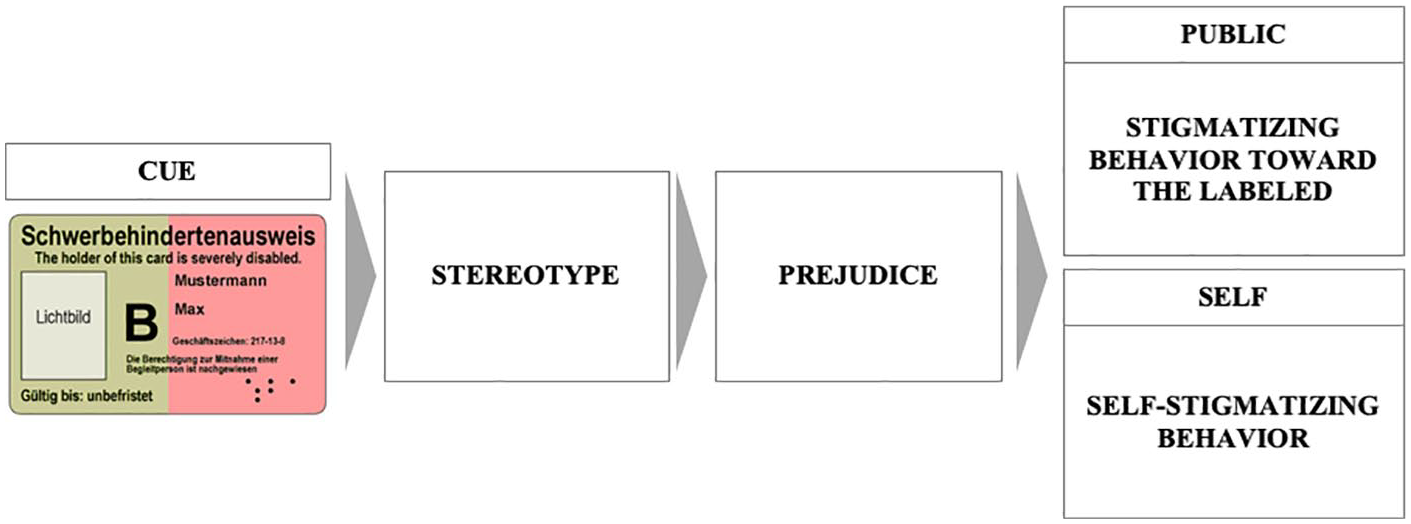
Operation of the stigma process.
In the second step, the cue elicits stereotypes which have been present before but were not yet stimulated. Hence, for persons who acquire a severe disability and receive the respective label, the widely shared stereotypical beliefs about their condition become personally relevant (Link, 1987). In this respect, prior research has shown that persons with disabilities are, on the one hand, stereotyped as incompetent, helpless, inferior, and submissive. On the other, they tend to be viewed as shy and warm to the extent that they do not compete with others or pose a threat (Cuddy et al., 2007).
In the third step, stereotypes are converted into prejudices (Corrigan and Wassel, 2008). Specifically, observers develop a stigmatizing attitude toward the labeled (e.g. s/he is incompetent because of his/her mental health illness) or labeled persons apply the prejudice to themselves (e.g. I am unable to function in society because of my impairment) (Abdullah and Brown, 2011).
Finally, in the fourth step, observers may discriminate against persons with a labeled condition (e.g. persons diagnosed with an affective disorder are not considered for a job because of their mental health condition), whereas labeled persons internalize prejudices and self-stigmatize (e.g. I do not seek employment because my mental health issues make me incapable of performing the job) (Abdullah and Brown, 2011).
Thus, since labeled individuals belong to a labeled category that they believe is viewed negatively by most others, they expect social rejection (Link, 1987; Link et al., 1989). Consequently, as proposed by modified labeling theory (MLT; Link et al., 1989), labeled individuals proactively limit social interactions for fear of negative reactions toward their disability, or they engage only in interactions with persons whom they know that they understand and accept their labeled condition (Link et al., 1989). For example, persons with disabilities have been shown to shy away and not to seek valuable information or help (e.g. do not request for a work accommodation) for fear that their colleagues or supervisors will perceive them as incompetent (Baldridge and Veiga, 2001, 2006; Kulkarni and Valk, 2010).
Similarly, persons without disabilities tend to reduce exchange relationships with their disabled work colleagues to task-oriented relationships, and are unlikely to engage in friendship-like relationships that go beyond a work acquaintance (Chadsey-Rusch et al., 1988; Lignugaris-Kraft et al., 1988; Rusch, 1988). Furthermore, when interacting with persons with a stigmatized attribute, they are likely to show ambiguous behaviors such as decreased eye contact, abbreviated interactions, or visual attention to the stigmatized attribute (Hebl et al., 2002; King and Ahmad, 2010; King et al., 2006). These behaviors are then often interpreted negatively by persons with a stigmatized attribute (Jones et al., 2016). In response to this, stigmatized persons tend to search for internal causes of the (often ambiguous) interpersonal treatment (Jones et al., 2016), which, in turn, is likely to trigger self-stigmatizing beliefs, leading to increased withdrawal from social interactions. In this sense, fewer opportunities for relationship building at work might result from self-reinforcing tendencies that involve both persons with and without a stigmatized attribute.
Labeling effects from an ableism and social identity perspective
The line of reasoning outlined above is congruent, yet largely unconnected with recent scholarly work on disability-induced othering, ableism, and identity-construction in the workplace (Baldridge and Kulkarni, 2017; Bogart et al., 2017; Elraz, 2018; Jammaers et al., 2016; Mik-Meyer, 2016; Santuzzi and Waltz, 2016). We believe that these streams of research provide an additional theoretical lens for the hypothesized labeling effect. More specifically, the concept of ableism refers to “a network of beliefs, processes and practices that produces a particular kind of self and body [. . .] that is projected as the perfect, species-typical and therefore essential and fully human” (Campbell, 2009: 5). In this line, being disabled is socially construed as the opposite of being able-bodied (Campbell, 2008). From this perspective, it is irrelevant whether one’s apparent or assumed disability causes significant differences between persons with and without disabilities (Onken and Slaten, 2000). What matters are shared ableist perceptions that devalue persons with disabilities and thus invoke feelings of shame on the part of persons with disabilities (Dirth and Branscombe, 2018). Just as in the case of a self-fulfilling prophecy, persons labeled with a severe disability start believing the ableist assumptions, and consequently, escape social interactions for fear of rejection due to their disability. The unintended consequence here is that they confirm the social discourse about persons with disabilities as being less willing or odd.
Building on this stream of research, we propose that an official disability label constitutes a particularly important, yet largely overlooked source of ableism in the workplace. In this respect, a severe disability ID card functions as a negative symbolic representation of “DIS-ability”, portraying the card holders as mainly unhealthy, unproductive, and incongruent with the requirements of the modern workplace.
Moreover, the label points to the card holders’ membership in the group of persons with severe disabilities. In line with social identity (Tajfel and Turner, 1979) and self- categorization theories (Turner et al., 1987), people derive important aspects of their sense of self from group memberships and tend to perceive their in-group in a more positive manner than relevant out-groups in order to maintain a positive self-esteem (Hogg et al., 1995). However, given that the label “severely disabled” points to an in-group that is devalued by the public, it is plausible that persons with disabilities seek to escape this in-group identity, and instead identify themselves with the dominant out-group (able-bodied persons) in order to protect their self-esteem from the stigma attached to the official disability label. Such a strategy of dissociating from a stigmatized in-group is particularly likely to be adopted by persons with less severe, and less apparent disabilities, that can be successfully accommodated (Dirth and Branscombe, 2018). Consequently, as they distance themselves from the group of persons with severe disabilities, they are also unlikely to self-identify as severely disabled persons. Their self might be thus more vulnerable to the effects of the disability label as the label “reminds” of an omitted social identity. In contrast, persons with an unlabeled disability condition are not subjected to the effect of the label, and thus are unlikely to make these experiences.
Taken together, we argue that the official label “severely disabled” functions as a strong cue that triggers processes of stigmatization and ableism. It marks out people with a stigmatized social identity, activates self-stigmatizing beliefs, and leads to expectations of devaluation and rejection by others, which, in turn, has negative implications for building close relationships at work. We propose that the effect of the severe disability label becomes apparent in perceptions of fewer opportunities for relationship building at work among persons just labeled as severely disabled as compared to persons just not labeled as severely disabled. Formally stated:
H1: Labeling as severely disabled leads to perceptions of fewer opportunities for relationship building at work.
Methods
Regression discontinuity design
To examine the effect of holding a severe disability ID card (German: Schwerbehindertenausweis) on perceived opportunities for relationship building at work, we apply a sharp regression discontinuity design (RDD). The RDD mimics an experiment in a non-experimental setting and is therefore often used in other social disciplines for making causal inferences (Lee and Lemieux, 2010). Given that there are only a few applications of the RDD in applied psychology and management journals (Bastardoz et al., 2017; Sieweke and Santoni, 2020), we provide a detailed description of why our study setting produces conditions that are appropriate for the application of this quasi-experimental study design.
The RDD offers a solution to the problem of participants’ self-selection into treatment and non-treatment conditions. In essence, it uses an assignment variable to determine participant selection into treatment and control groups. Persons who score below a certain value of the assignment variable are assigned to the control condition, whereas persons above this value are the treatment group. The cutoff score is externally imposed, for example, by a governmental policy, and thus limits affected persons’ control over the assignment process. Furthermore, the RDD focuses on observations that are located close to the known cutoff point. This ensures that persons from the control condition (i.e. persons just below the cutoff point) and the treated condition (i.e. persons just above the cutoff point) are highly similar to each other in terms of relevant characteristics and differ only in terms of their group status (i.e. being below versus above the threshold). In doing so, the RDD seeks to approximate the “what-if” outcome (i.e. counterfactual); that is, the expected value of the outcome variable that would be found for treated persons if they had not been treated (Lee and Lemieux, 2010).
Institutional background and the assessment process
Persons who are officially registered as disabled in Germany hold either a notice of assessment or a severe disability ID card. According to Book 9 of the German Social Code “Rehabilitation and participation of disabled people”, 2 these documents are issued by the local pension office, which is located in the municipality of residence, and include information about the severity (i.e. stated in degrees from 20 to 100 in increments of 10) and the type of disability (e.g. physical, psychological). To be granted such a document, persons need to apply at their local pension office (Kock, 2004). The application form requires applicants to provide information about doctors consulted (e.g. general practitioners, medical specialists) and to submit all reports or certificates issued by the doctors (e.g. hospital notes or reports). The application file is then reviewed by medical experts who decide whether the applicant is granted the notice of assessment (i.e. disability degree of less than 50) or the disability ID card (i.e. disability degree of 50 or more). This review procedure is designed in a way that excludes the possibility of interaction between the medical experts and the applicants, and thus ensures that the decision to grant a certain degree of disability is based solely on the individual dossier files. Applicants pick up the application forms either personally at the local pension office or download these from the pension office’s website. Accordingly, they submit the application forms either personally or online, and get notified about the decision by mail or email, respectively (vsbinfo, 2020). Either way, they do not interact with the actual decision-makers.
As shown in Figure 1, the disability ID is similar to the German ID card, and contains such information as a photo of the card holder, document number, first and last name, date of birth, date of expiry and issuing authority. It is typically issued for a period of up to five years, and needs to be renewed by following the same application procedure just described.
The degree of disability refers to the severity of one’s impairment. Specifically, it describes (in degrees) the extent to which an irregular health condition influences a person’s functioning in everyday life. Thus, the higher the degree of disability, the more pronounced are the expected limitations in everyday life. In case of multiple impairments, the degrees of disability per each impairment are not just added up but considered jointly. To calculate this “overall severity degree”, medical experts collect all information on a person’s impairments and their severity determined by a regulation published by the German Federal Ministry for Work and Social Affairs (Bundesministerium für Arbeit und Soziales, 2008). For instance, a moderate hearing impairment is assessed with a degree of 40–60, whereas a profound hearing impairment results in a disability degree of 60–80. Following this procedure, medical experts assess (in degrees) the extent to which the interplay of multiple impairments influences individual functioning in everyday life.
Analytical strategy
Given this legislative basis, the variable “degree of disability” is used as our assignment variable, and the cutoff is set at a disability degree of 50. From this follows that persons just below this cutoff point are our control observations (i.e. persons with a disability degree of 30 or 40, an unlabeled disability condition), and persons just above this point constitute the treated group (i.e. a disability degree of 50–60, persons with a labeled disability condition). The 30–60 degree bandwidth is the most narrow we can use because of the data structure. This is due to the coding of the assignment variable which assumes discrete values from 20 to 100 in increments of 10. 3 The effect of interest is the average treatment effect for the treated (ATT) which indicates the difference in the outcome between these two quasi-experimental conditions.
To test the hypothesis, we fit a fixed effects regression model using STATA (version 16):

where β0 indicates the “what-if” outcome (i.e. counterfactual), r = centered assignment variable, T = assigned treatment (0 = non-holders of the severe disability ID card, disability degree of 30–40, 1 = holders of the severe disability ID card, disability degree of 50–60), rT = interaction term formed out of the centered assignment variable and the assigned treatment, ai = intercept specific to the type of occupation,
In terms of handling missing values, we utilize listwise deletion and the full information maximum likelihood procedure (FIML; Newman, 2003). The latter approach is more efficient than listwise deletion as it analyzes all available data using maximum likelihood estimation. A similar pattern of results from both approaches would indicate that the study results are not deleteriously affected by the use of listwise deletion.
Data collection and sample
Data representative of the German workforce 5 (N = 8019) were collected via an online survey distributed through a German market research institute. Survey participants are adults who are employed in the first labor market in Germany (i.e. regular labor market where employment relationships exist without subsidies from public funds) and had registered at the institute’s website by providing demographic data. Our study sample is a sub-sample drawn from this large data set and includes 845 persons (10.5%) who are officially registered as disabled. This percentage closely corresponds to the actual percentage (9.4%) of persons registered as disabled in Germany (Federal Statistical Office, 2018). Of the 845 persons who began the survey, there are 511 persons who had complete data. 6
Of our 511 participants, roughly 280 (55%) report to be holders of the severe disability ID card. This group includes 212 persons with a physical disability, 25 persons with a psychological disability, and 43 persons with both physical and psychological disabilities. A total of 231 persons hold a notice of assessment, 182 of whom have a physical, 22 persons a psychological, and 27 have both types of disability. A total of 58% of participants are male. The average age of participants is 50 years old. The average job tenure is 15 years. A total of 25% of participants are employed part-time, while 7% are self-employed.
Measures
Disability status, severity, and type
Similar to prior disability studies conducted in the German context (Baumgaertner et al., 2015; Brzykcy et al., 2019; Dwertmann and Boehm, 2016), we asked survey participants to indicate whether they are officially registered as disabled (i.e. hold either the notice of assessment or the severe disability ID card). In addition, participants reported how severe their disability is and what type of disability they have (i.e. physical, psychological, or both), both of which are stated on their disability ID card or notice of assessment.
Perceived opportunities for relationship building at work
Participant perceptions were assessed using three items from the Job Characteristics Inventory developed by Sims and colleagues (1976) and further adapted by Morgeson and Humphrey (2006). Here, our focus is not the mere assessment of a job characteristic (i.e. the extent to which a job allows one to develop close relationships with coworkers). Instead, we follow Hackman and Lawler’s (1971: 264, emphasis in original) line of reasoning and use this measurement in order to capture “how [this job characteristic] is experienced by the employees”. In other words, regardless of the actual amount of the opportunities for relationship building provided by the employer, it is the amount of opportunities that an employee believes to experience which affects his/her reactions to the job (Hackman and Lawler, 1971). Thus, we consider the items to capture the extent to which employees perceive that they have sufficient opportunities to build close, friendship-like relationships with their coworkers. The items are “I have the opportunity to develop close friendships in my job”, “I have the chance in my job to get to know other people”, and “I have the opportunity to meet with others in my work”. They are measured using a five-point Likert scale ranging from 1 (strongly disagree) to 5 (strongly agree). We mean aggregate the items to get an overall score. Alpha reliability for this scale is .75.
Control variables
We included a number of control variables to partial out their effect on our outcome variable. More specifically, we control for gender, age (in years), job tenure (in years), company size (i.e. eight categories ranging from organizations with less than 10 employees to those with more than 10,000 employees), and type of disability. We do so as perceptions of social inclusion at work have been shown to vary by gender and organizational tenure. Specifically, male and shorter-tenured employees with disabilities are likely to proactively seek help from coworkers and supervisors, which, in turn, helps them integrate into their work organization (Kulkarni and Lengnick-Hall, 2011). Similarly, persons with psychological, physical, or both types of disability are likely to differ from one another in terms of how they perceive social interactions. That is, persons with psychological disabilities are more likely to perceive them in a more negative manner which might be part of their, for example, depression symptoms (e.g. cognitive distortions such as negative expectancy bias; Caouette and Guyer, 2016). Furthermore, we control for company size as large organizations are more likely to invest greater resources to integrate employees into the workplace (e.g. social gatherings sponsored by the employer; Eurofound, 2015), which, in turn, might enhance perceptions of more opportunities for building informal relationships with work colleagues.
We also control for full-time and part-time employment status, given that part-time workers might feel less integrated in the company’s social system (Miller and Terborg, 1979). Similarly, being self-employed (assessed based on a German classification of status in employment; Hoffmeyer-Zlotnik, 2003) is related to decreased chances of socializing in the work context. Furthermore, we control for telework (1 = telework is provided by the employer and used by the employee; 0 = option of telework is not provided), as it has been shown to trigger feelings of social isolation (Morganson et al., 2010).
In addition, we partial out the effect associated with job satisfaction to control for the possibility that persons with more severe disabilities show lower job satisfaction and perceive therefore fewer opportunities for building social relationships at work. We do so in view of prior research demonstrating lower job satisfaction among persons with severe disabilities (Pagán and Malo, 2009). To assess this variable, we use a single-item measure “How satisfied are you with your job in general?” developed by Scarpelo and Campbell (1983). A meta-analytic review of correlational relationships between single and multiple measures of overall job satisfaction finds a strong correlation of r = .63 (Wanous et al., 1997). In addition, prior studies provide support for an adequate convergent and discriminant validity of this measure (Dolbier et al., 2005).
We also control for resilience, defined as the “ability to thrive in the face of stress and other adversity” (Campbell-Sills et al., 2009: 1007). Resilient persons are likely to demonstrate their resilience through proactive behavior aimed at maintaining positivity, such as building and nurturing professional relationships (Jackson et al., 2007). Thus, resilient persons may be more likely to initiate social contacts. We assess resilience using four items from the unidimensional Connor–Davidson Resilience Scale (Campbell-Sills and Stein, 2007). Participants rate items on a scale from 1 (not true at all) to 5 (true nearly all the time). Alpha reliability for this scale is .78.
Furthermore, we control for sickness absence to exclude the possibility that persons with severe disabilities are more frequently absent from work due to health reasons (Hoedeman et al., 2010), and experience therefore less opportunities to socialize with their work colleagues. For this, we use a single item from the Work Ability Index Questionnaire (WAI; Ilmarinen, 2007) to assess sick leave during the past 12 months. Responses range from 1 = 0 days to 5 = 100–365 days. In addition, we include two further WAI items as control variables: participants’ rating of their work ability in relation to both physical and mental job demands, rated on a scale from 1 = very poor to 5 = very good. Here, we control for the possibility that a low rating of mental and/or physical work ability leads to withdrawal from social interactions at work. We do so in view of prior studies showing significant relationships between work ability and both the quality and the frequency of interactions with others at work (McGonagle et al., 2015).
Fixed-effects controls
To test whether the proposed labeling effect is independent of a participant’s type of occupation (German classification of occupations, 2010), we control for the variable “type of occupation”. In other words, we allow the intercepts to vary across types of occupation in order to control for individual differences that correlate with participants’ self-selection into a specific type of occupation. Consequently, differences in perceived and actual opportunities for relationship building at work between the various occupations are cancelled out of the equation.
Results
Table 1 shows descriptive statistics and correlation coefficients among study variables.
Means, standard deviations, and correlations.
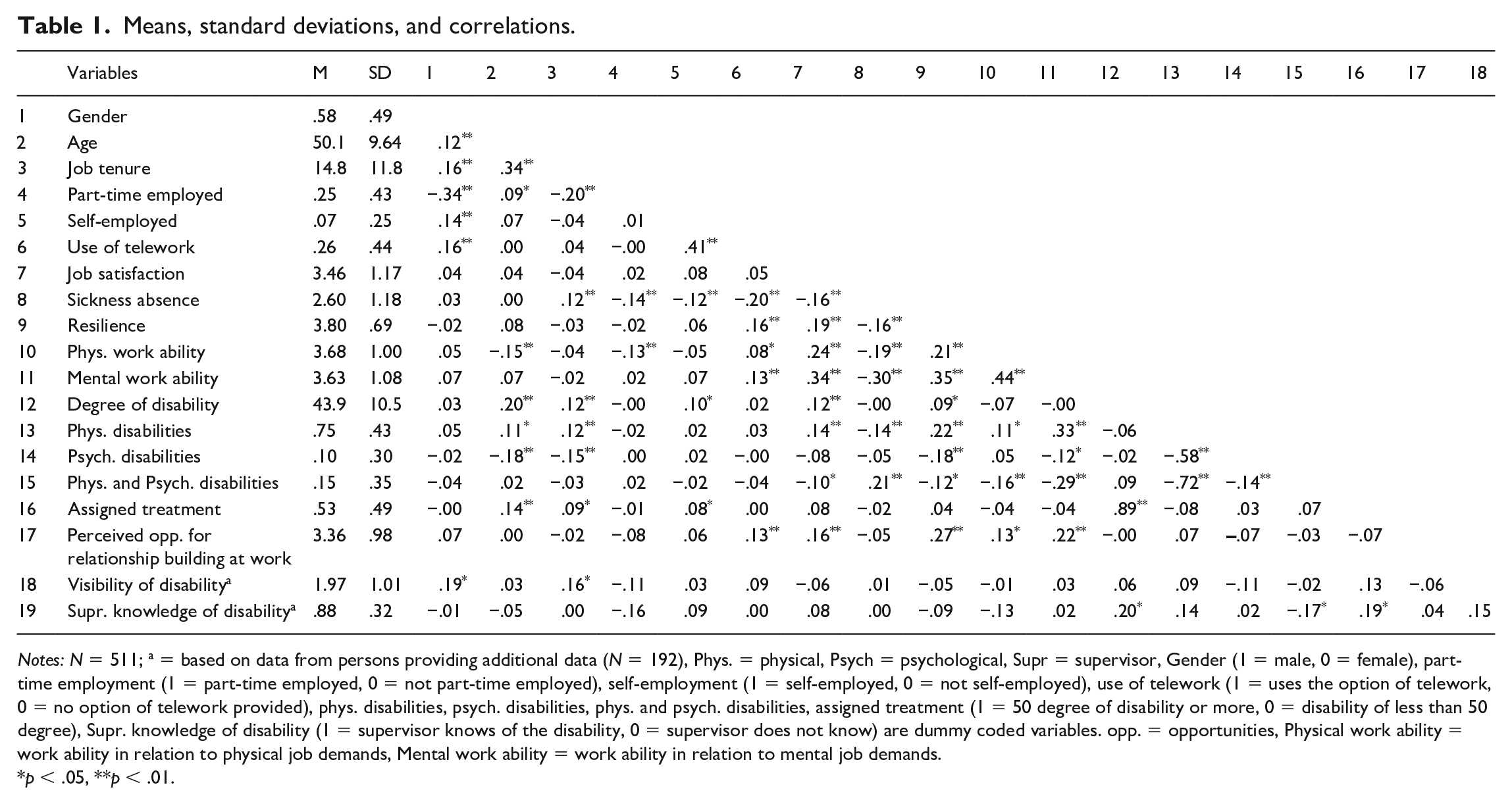
Notes: N = 511; a = based on data from persons providing additional data (N = 192), Phys. = physical, Psych = psychological, Supr = supervisor, Gender (1 = male, 0 = female), part-time employment (1 = part-time employed, 0 = not part-time employed), self-employment (1 = self-employed, 0 = not self-employed), use of telework (1 = uses the option of telework, 0 = no option of telework provided), phys. disabilities, psych. disabilities, phys. and psych. disabilities, assigned treatment (1 = 50 degree of disability or more, 0 = disability of less than 50 degree), Supr. knowledge of disability (1 = supervisor knows of the disability, 0 = supervisor does not know) are dummy coded variables. opp. = opportunities, Physical work ability = work ability in relation to physical job demands, Mental work ability = work ability in relation to mental job demands.
p < .05, **p < .01.
Measurement model
The measurement model contains three latent constructs: perceived opportunities for relationship building at work, resilience, and work ability, with a total of 10 items. To test for the discriminant validity of each of our three constructs, we specified four alternative measurement models and compared those to our hypothesized measurement model. The hypothesized factor model yields the best model fit (RMSEA = .030, CFI = .988, SRMR = .026, χ2(32) = 55.24, p > .05), and is significantly better than the three reduced models (refer to Table 2).
Measurement model comparison.
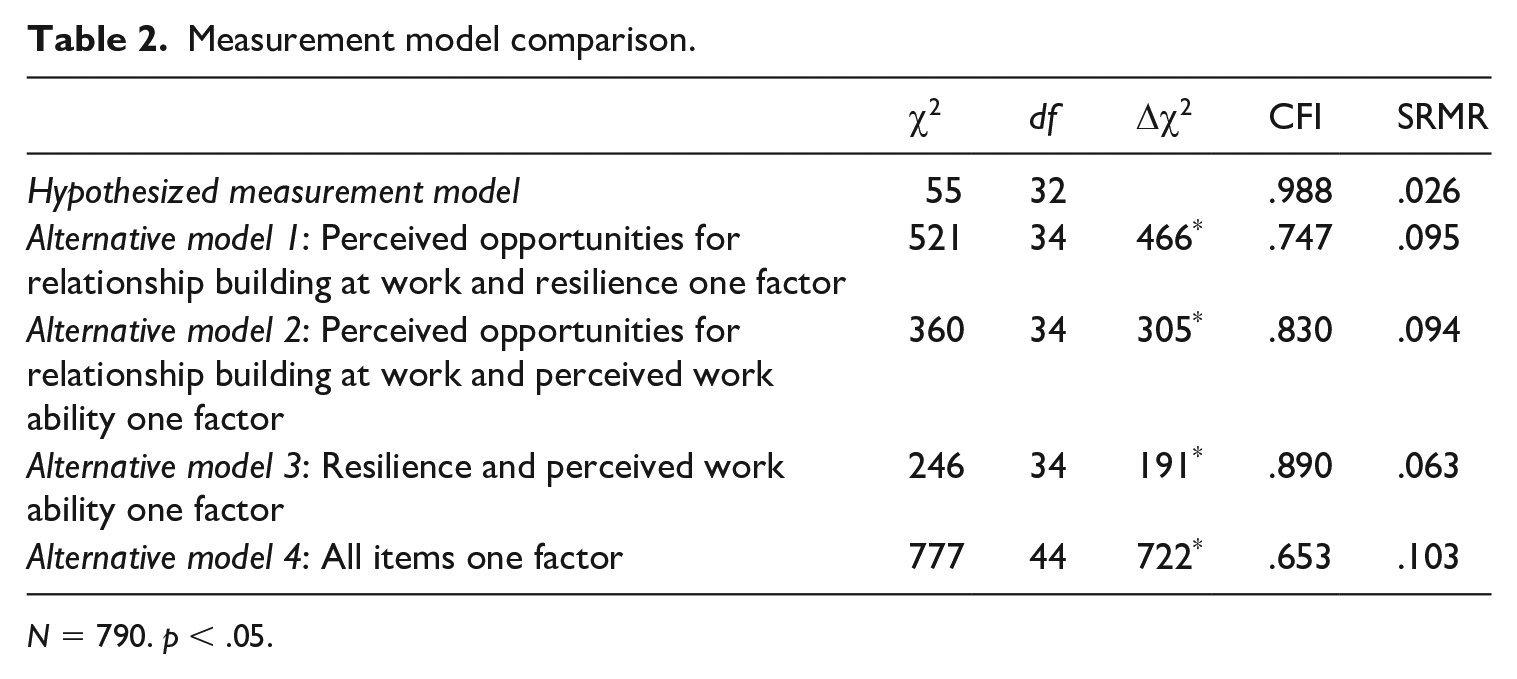
N = 790. p < .05.
Validity of the research design
To assess the internal validity of our quasi-experiment, we employ multiple specification tests following the procedure established by Imbens and Lemieux (2008). The results of validity and robustness checks are shown in the supplemental materials ranging from Appendix A to Appendix T.
Changes in control variables at the cutoff
Differences in the average value or the distribution of controls between the study conditions would cast doubt on the assumption that observations immediately on either side of the cutoff are comparable. The results yield non-significant between-group differences including age (β = .25, p = .805), gender (χ2(1) = .20, p = .652), job tenure (β = .33, p = .782), part-time vs. full-time employment (χ2(1) = .06, p = .796), organizational size (χ2(7) = 11.58, p = .115), self vs. non-self-employment (χ2(1) = 1.79, p = .180), use vs. non-use of telework (χ2(1) = .14, p = .702), job satisfaction (β = .17, p = .168), sick leave during the past 12 months (β = −.06, p = .636), resilience (β = .07, p = .284), as well as work ability in relation to physical (β = −.08, p = .458), and mental job demands (β = −.07, p = .509). We also find non-significant differences in the frequencies with which the 14 types of occupation are distributed in the control and the treatment conditions (χ2(13) = 8.51, p = .808), indicating that persons just below and just above the threshold are comparable in terms of the type of occupation they perform. Moreover, we find the three types of disability to be similarly distributed in the two groups (χ2(2) = 2.56, p = .277).
Jumps at non-discontinuity points
To examine whether there are jumps in the average value of the outcome at other values of the assignment variable, we re-run the analysis using other values of the assignment variable as cutoff points. The results indicate no significant differences in the average value of the outcome between the treated and control conditions when the cutoff is set at disability degree of 30 (β = −.32, p = .288), 40 (β = .26, p = .362), 60 (β = .23, p = .378), 70 (β = .00, p = .995), 80 (β = .44, p = .335) or 90 (β = .99, p = .095).
Density of the assignment variable at the cutoff
Appendix A displays a jump in the frequency of observations at the cutoff point, which might be suggestive of potential manipulations of the selection process. We cannot test this formally using McCrary’s (2008) test because it can be applied only in regression discontinuity (RD) designs with a continuous assignment variable. Instead, we rely on the results of a further inference procedure for RD designs in which the assignment variable has discrete values (Lee and Card, 2008). It utilizes standard errors clustered by the assignment variable to derive bias-corrected estimates of the treatment effect. We find the conventional and the bias-corrected effect estimates to yield a similar pattern of results (β = −.23, β = −1.01, respectively).
Sensitivity to the bandwidth choice
The results hold significant within other available bandwidths of data, thereby showing that the treatment effect is valid for observations located less close to the cutoff (see Table 3).
Treatment effect and marginal means for different bandwidths around the cutoff.
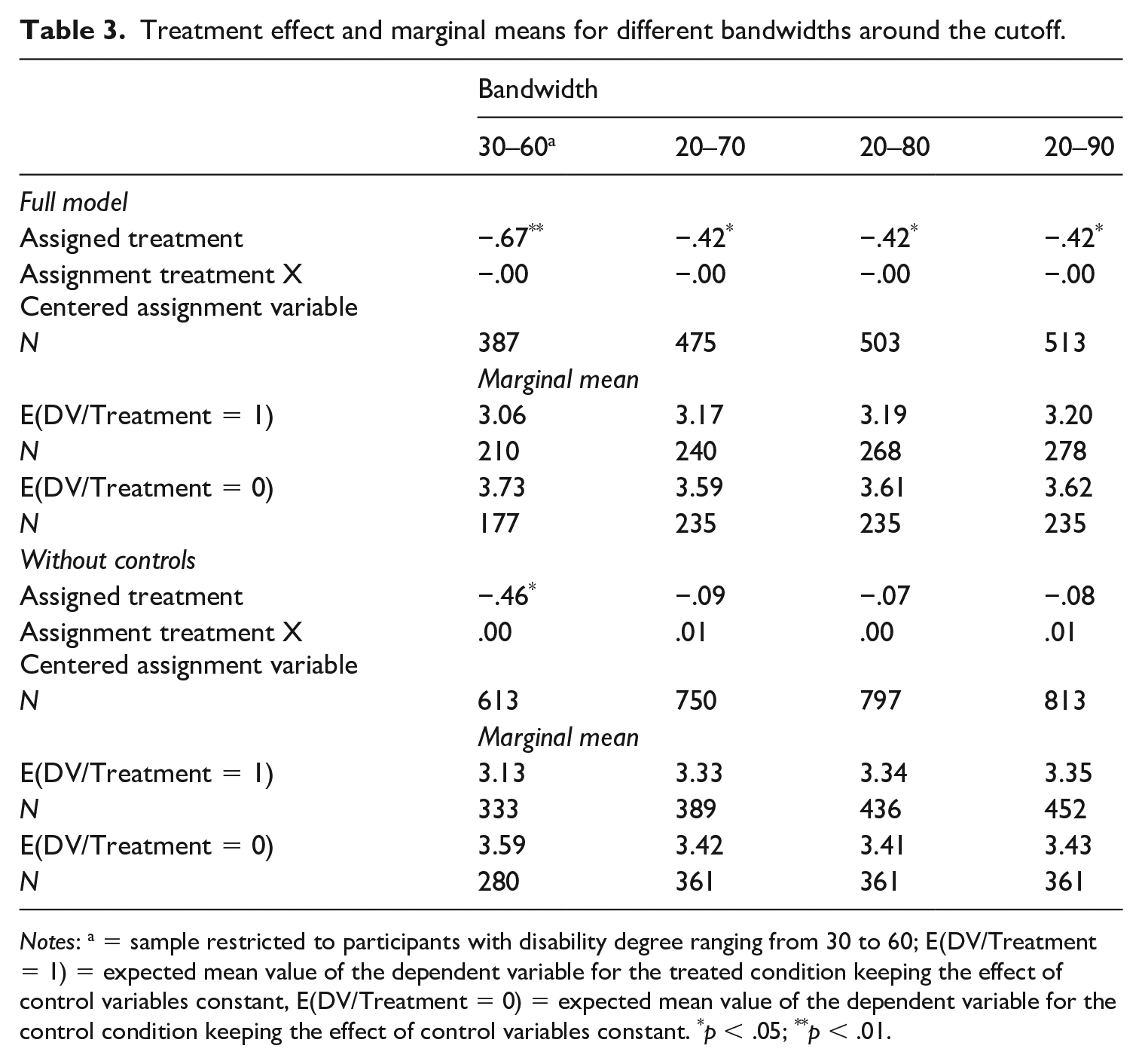
Notes: a = sample restricted to participants with disability degree ranging from 30 to 60; E(DV/Treatment = 1) = expected mean value of the dependent variable for the treated condition keeping the effect of control variables constant, E(DV/Treatment = 0) = expected mean value of the dependent variable for the control condition keeping the effect of control variables constant. *p < .05; **p < .01.
Taken together, these results help us validate our quasi-experiment. From this it follows that the quasi-experimental conditions are valid comparison groups, which, in turn, helps justify the causal interpretation of our study results.
Main results
We find the relationship between severity of disability and the outcome variable to be positive but not significant (β = .03, p = .102). Our hypothesis predicts that participants in the treatment condition perceive fewer opportunities for relationship building at work than the control group. We find a negative and significant treatment effect in each of the four bandwidths (β = −.67, p = .005, 30–60 degree bandwidth). The significant treatment effect is indicated by the vertical difference between the linear fit lines at the cutoff (refer to Figure 3). Thus, hypothesis 1 gains support.
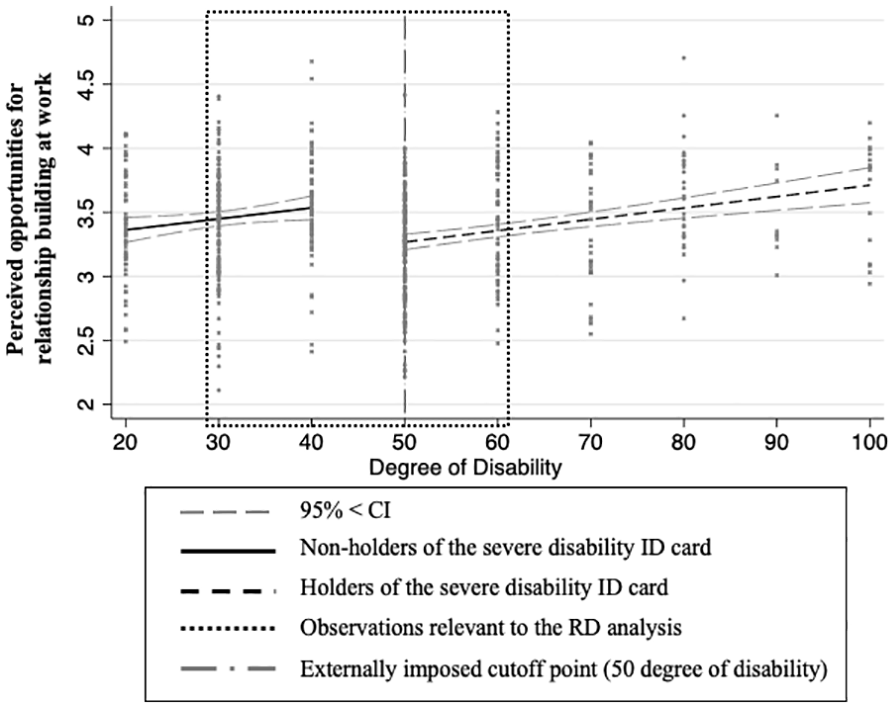
Linear fit lines for persons below and above the cutoff.
In addition, refer to Table 3 for marginal means (i.e. expected mean value of the outcome variable adjusted for the effect of control variables). The expected mean values of the outcome variable for the 30–60 degree bandwidth is equal to M = 3.06 (treatment group) and M = 3.73 (control group). Furthermore, the interaction term is not significant (β = −.00, p = .779), indicating that there is no significant change in slope at the cutoff. This is apparent from Figure 3, which shows that linear fit lines before and after the cutoff point are parallel but displaced vertically. All in all, we observe the average value of the outcome to drop at the cutoff, and to increase in magnitude at higher degrees of disability severity.
Robustness checks
Omitting control variables
The treatment effect holds significant when control variables are excluded from the equation (β = − .46, p = .027) (see Table 3). The results are also insensitive to the approach for treating missing data (i.e. listwise deletion versus full information maximum likelihood, see Appendix B).
Specifying the effect of interest for different disability types
Similar to the full sample, we observe a drop in the level of the outcome variable at the cutoff point for each of the three types of disability: β = −.68, p = .031, physical disabilities; β = −1.86, p = .307, psychological disabilities; β = −.25, p = .906, both types of disability (see Appendix C and Appendix D).
Specifying the effect of interest across levels of visibility of disability and supervisor’s knowledge of one’s disability status
We obtained further data from our study participants 7 to test the sensitivity of the results with respect to the visibility of their disability (“Can other people see that you have a disability?”), using a five-point Likert scale ranging from 1 = not at all to 5 = very clearly. In addition, we asked for their supervisors’ knowledge of the disability (“Does your supervisor know of your disability?”) with response categories including 1 = yes, s/he knew of my disability before I got hired, 2 = yes, s/he learned about my disability after I got hired, or 3 = No. In brief, we find no differences in either of these two control variables between treatment and control groups (β = −.27, p = .130; χ2(2) = 5.84, p = .054). The pattern of results corroborates the findings from the full sample, and is similar for employees with low, mean, or high visibility of disability (Appendix E and Appendix F), as well as for employees whose supervisors know or do not know of their disability (Appendix S). Moreover, we find the effect of interest to hold across different levels or categories of all other control variables (refer to the supplemental materials).
Testing mediation effects
We further examine whether our control variables mediate the treatment effect. We can rely on the Ordinary Least Squares (OLS) estimates because of the favorable results of the multiple Hausman tests. We find all of these tests to yield non-significant results, thereby indicating that effect estimates obtained through OLS regression analyses do not significantly differ from the two-stage least-squares regression (2SLS) estimates, and can be retained. 8 All in all, none of the control variables mediate the effect of interest (refer to Appendix T).
Discussion
Do the beneficiaries of anti-discrimination legislations or other governmental assistance programs pay a non-monetary price for their special treatment (e.g. free public transport, help with food expenses)? Hannah’s example, as well as the media coverage on the US food stamp program, seem to suggest this is the case; persons suffer from stigma induced by labels. Not surprisingly, replacing the food stamps with a payment card strongly resembling a standard credit card helped raise the participation rate in the food stamp program. This is because the latter solution is less visible and therefore less likely to induce self and public stigma (Currie et al., 2001).
Supporting this view, the results of our quasi-experiment underscore the assumption that being officially labeled as severely disabled leads to negative consequences for workplace experiences of persons with a labeled disability condition. Specifically, we find persons labeled as severely disabled to perceive fewer opportunities for relationship building at work than their counterparts with a similarly severe, yet an unlabeled, disability condition. In this way, our results add to at least three different streams of literature: (1) stigma, (2) ableism, and (3) identity-construction.
First, with regard to stigma, we find the effect of the disability label to hold across different types of disability (i.e. physical, psychological, and both), levels of the visibility of disability, and occupations. The effect is also robust with respect to supervisor knowledge of subordinate’s disability. These results can be interpreted to suggest that the labeling effect might be occurring through self stigma and less strongly through public stigma. In other words, it seems largely irrelevant whether people around the labeled person know of his/her disability label or whether one’s disability is visible. What seems to matter more are the internal cognitive processes that are induced by the label, which then lead to self-stigmatizing behavior. In this sense, our study contributes to prior research examining the direction of the effect between public and self stigma (Vogel et al., 2013). Here, our results corroborate findings by Vogel and colleagues (2013) that public stigma is internalized as self stigma. Moreover, instead of relying on self-reported measures of public and self stigma, our study utilizes the German legislative context to operationalize the label “severely disabled” as a stigma-inducing event. In our analyses, we explicitly model a selection procedure that takes places in the field (i.e. granting the severe disability status to some persons and to some not), and use further disability data (i.e. visibility of disability, supervisor knowledge of subordinate disability) to examine which of the two types of stigma may be primarily driving the effect of interest.
Related to this last aspect, our study’s findings shed light on the important, yet largely overlooked role that the legislative level plays for the labeled persons’ relationship building at work. Specifically, whereas prior studies provide support for positive associations between passing a disability legislation and the employment situation of persons with disabilities (Bruyère et al., 2004; Woodhams and Corby, 2007), our results show that the reverse may also be true: disability labeling impairs relationship building of labeled individuals. Thus, although disability legislations are meant to be beneficial, they may nevertheless bring about unfavorable consequences for persons linked with these legislations.
Second, we theorize disability labels as a source of ableism in the workplace, and thereby add to the emerging literatures on ableism and othering in organizational research (Elraz, 2018; Jammaers et al., 2016, 2019; Mik-Meyer, 2016). We link ableism and disability labeling as these two processes share the same focus: impairments get emphasized whereas individual strengths are largely ignored by both observers and labeled individuals (Wolbring, 2008). The core decision criteria for granting the severe disability status in Germany includes the medical assessment of the extent to which one’s physical and/or mental functioning deviates from the “able-bodied norm”. Accordingly, the product of this assessment process – the degree of disability – is a quantification of this deviation. Thus, disability labels shape social discourses of disability. They mark out individuals with severe disabilities as opposed to the non-disabled (able-bodied) counterparts, and therefore create the groups of “us” and “them”. In this way, they underscore the idea of “either/or” (Dunn, 2015). That is, “if present, disability is seen as representing the person’s essence, giving it precedence over all other qualities (positive or negative) that a person may possess” (Bogart and Dunn, 2019: 653).
Third, the label conveys self-relevant information, and therefore plays an important role in the process of identity-construction of the labeled individuals. In line with social identity (Tajfel and Turner, 1979) and self-categorization theories (Turner et al., 1987), the label “severely disabled” informs of a person’s membership in a social category that is devalued by the public and is therefore one of those social categories that persons seek to disassociate from. Our results provide a more differentiated view on this assumption. More specifically, we find the average value of the outcome to drop at the cutoff and to increase in magnitude at higher degrees of disability severity. This may suggest that potential self stigma cued by the disability label inhibits the development of a positive disability identity to a greater extent among the just labeled persons as compared to their labeled counterparts with more severe disabilities. Given the lower degree of disability, the former group is more likely to “pass as normal” and thereby to escape the issue of integrating disability into their self-concept. Consequently, as the just labeled persons distance themselves from the group of persons with severe disabilities, their self-concept is unlikely to comprise different (often contradictory) social identities (Dirth and Branscombe, 2018). Their self might be thus more vulnerable to the effects of the disability label as the label “reminds” them of an omitted social identity. On the contrary, the label might be less of a threat to the self-concept of employees with more severe disabilities as they are more likely to identify themselves with the group of persons with disabilities (Bogart et al., 2017; Santuzzi et al., 2019), and might already have integrated contradictory social identities into their self-concept (e.g. I am a deaf person and I am a successful engineer). All in all, we propose that the vulnerability toward disability labels decreases to the extent that disability has become an integral part of one’s self-concept.
Furthermore, Hannah’s story offers a unique example about what identity management strategies persons with disabilities might apply in order to achieve a better relative status position for their in-group (Tajfel and Turner, 1979). Hannah finds a creative solution: she creates a new label for her in-group, and thereby redefines existing elements of the inter-group comparison (i.e. in-group versus out-group comparison). Specifically, the comparison includes now Hannah’s re-labeled in-group (i.e. holders of the “severely ok” disability ID card) and the out-group of non-labeled persons. As noted by Tajfel and Turner (1979: 43), we now deal with “comparisons which were previously negative [but] are now perceived as positive”.
We further argue that these stigma processes are preceded by a specific form of disability disclosure not yet discussed in the literature: disability self-disclosure. We argue that for the labeling effect to become evident, labeled persons need to first admit to themselves that they belong to the group of severely disabled persons. Hence, if combined with a successful integration of disability into one’s self-concept, disability self-disclosure can be associated with a greater resistance against stigma. In fact, as Dirth and Branscombe (2018: 1309) put it, “attaining positive quality of life for persons with disabilities will be predicted on individual-level strategies like integrating one’s impairment/body into his/her personal self-concept”.
Finally, our study is among the few in management and applied psychology to utilize RDD (Bastardoz et al., 2017). In doing so, we advance prior disability research which, to the best of our knowledge, has not yet decisively addressed the problem of endogeneity bias and lacking causality. Related to this, our study is one of the rare research pieces on disability that provides results based on a representative sample of employed persons officially registered as disabled. Concretely, our data reflect the population of interest in terms of multiple factors including age, gender, size of town or city, place of current residence (i.e. German federal state), education, employment situation (i.e. full-time, part-time, self-employment), type of occupation, and type of disability. This considerably extends the results of prior disability studies, most of which are only generalizable to a specific work environment or a specific disability type.
Limitations and future research directions
A potential limitation concerns the role of stigma in our results. As we point out in the discussion, it might be particularly self stigma, and less so public stigma, that drives the effect of the disability label. We reached this conclusion in view of the results of our supplementary analyses that show that the effect of the disability label is independent from the level of the visibility of disability. Thus, although these results suggest that self stigma might play an important role when it comes to labeling, we cannot test this assumption directly as we have not measured stigma. That is why we consider our proposition with regard to the underlying mechanism of labeling as preliminary, and call for future research investigating the mediating effect of stigma in the relationship between labeling and inclusion in organizations.
One promising way to do so would be by using an experience sampling methodology (Fisher and To, 2012) in which study participants are repeatedly asked about the stigmatizing experiences that they make during a given time period (such as Hannah when entering the bus). Such a research design would produce rich longitudinal data that permit the tracking of individual stigma experiences over time, allowing for (1) a better understanding of stigmatizing cues and events, (2) a differentiation between the role of self, public, and structural stigma, and (3) the design of potential interventions that break such vicious circles between labeling, stigma, and impaired organizational socialization.
Furthermore, our initial data collection did not cover the information of whether others at work know of the participant’s disability status. Nonetheless, we consider the likelihood of the disability disclosure to be rather high in our study context. It seems somewhat unlikely that persons considered as severely disabled had not disclosed their disability label at work given that the disability law provides them with strong incentives to do so. Specifically, multiple special rights such as protection against dismissal, five days of additional paid leave, and tax reductions can only be used if the employee has informed the employer of his/her severe disability status (Kock, 2004). As employers in Germany are forced to fill 5% of the jobs with persons with disabilities to avoid fees and other system penalties, they also seem likely to urge their employees to disclose this information. In this line, additional information obtained from our study participants support these claims: a great majority of participants in both quasi-experimental groups report that their supervisors know of their disability status (83% in the control group without the label, 96% in the treated group with the label).
Moreover, the coding of our assignment variable (i.e. degree of disability) might raise questions regarding the comparability of observations around the cutoff point. Specifically, given that the variable “degree of disability” takes discrete values ranging from 20 to 100 in increments of 10, we cannot compare the outcome using observations just to the left and just to the right of the threshold (e.g. persons with a disability degree of 48 vs. persons with a disability degree of 52). However, although continuous variables are preferred for RDDs, we do not consider the coding of this variable to be detrimental for the validity of our results because of two reasons. First, the results of multiple specification tests indicate a sufficient internal validity. Most notably, we observe a balanced distribution of multiple control variables across the quasi-experimental conditions. In other words, the fact that we find no differences in multiple control variables between persons assigned to either the labeled or the non-labeled condition strengthens our argument that the quasi-randomization due to the cutoff point is unlikely to be biased. Second, whereas we agree that more fine-grained gradations are of value for RDDs, it is questionable if increments of 1 degree instead of the 10 degree steps would make sense in the case of degree of disability. How could a medical expert decide if a person has a disability degree of 37 or 38? Potentially, this would just lead to spurious accuracy whereas clustering persons in increments of 10 degrees might lead to more comparable results across the medical experts conducting the assessments all over Germany.
Practical implications
On 15 November 2017, several of the largest German media houses reported that the local pension office of Hamburg reacted to Hannah’s personal initiative described above and introduced official “severely ok” covers which can be put over the regular disability ID card in order to cover the severe disability label. Eight out of 16 German federal states have already followed Hamburg’s example and also offer covers for disability ID cards (Radio Télévision Luxembourg (RTL), 2020). As reported by German media (Norddeutscher Rundfunk (NDR), 2019), the covers enjoy great popularity and were already requested by nearly 10,000 labeled persons. The local minister of social security said that she can well understand this desire and that “people with disabilities feel as an integral part of society who do not want to be classified by others as a particular group”. The governmental office stated that while it “wants to react to this heart-melting story”, the regular severe disability ID card will still be needed (Der Spiegel, 2017).
All in all, it seems that Hannah derived the same conclusions as we did using population-representative data and a quasi-experimental research design: the labeling of persons as severely disabled has negative effects for their relationship building in both society at large and within work organizations in particular. Building on this finding, our study offers two basic routes for intervention on the societal level and on the firm level of analysis.
First, at the societal level, governmental agencies should re-evaluate if they really want to label 5–10% of the overall population as severely disabled, imposing significant stigma on them. We understand that those agencies face the dilemma described above: they have to define who qualifies as having a disability and they have to provide those individuals with some type of official label to make the quota and support system work. On the other hand, the label proves detrimental for self- and other-perceptions. The potential solution to this dilemma almost seems too easy; might it be that Hannah had the right idea? We believe that it would be worth a try to change the label of “severely disabled” into “differently abled” and to investigate if such a “strength focus” (Van Woerkom et al., 2016) can positively influence self and other-perceptions of severely disabled persons.
Second, next to interventions at the legislative level, both employers and employees are advised to focus on stigma-reduction strategies that target the intra- and interpersonal level. The goal here is to induce changes in cognitive schemata and behavior through, for example, individual coaching, in order to increase affected persons’ resistance against self stigma. Affected persons would benefit from learning how to identify and modify their self-stigmatizing beliefs so that these do not negatively affect the self (Corrigan and Calabrese, 2005). To further foster these developments and ensure their transfer to the workplace, firms might want to provide strength use support by, for example, allowing employees to work on tasks in line with their abilities (Van Woerkom et al., 2016). The goal here is to increase affected persons’ awareness of their strengths and abilities and thereby let the disability recede into the background. In addition, firms might want to think about introducing inclusive Human Resources (HR) practices as those signal the organizational value of inclusion throughout an employees’ tenure from recruitment and hiring to training, promotion, workplace accommodations, and pay practices. Such HR practices might also include the set-up of organizational interest groups combined with formal mentoring programs and top-management sponsorship, which have been found to be effective in increasing minority representation in more than 800 midsize and large US firms (Dobbin and Kalev, 2016).
Conclusion
Societies around the globe need to re-think their strategies of how to improve the employment situation of persons with disabilities, an underutilized resource of the labor market. The results of our quasi-experimental study show that persons labeled as severely disabled perceive fewer opportunities for relationship building at work. They underscore the importance of disability labels for affected persons’ social inclusion at work, and call for more research on factors that help reduce stigma and thereby improve their workplace experiences.
Supplemental Material
sj-pdf-1-hum-10.1177_0018726721991609 – Supplemental material for No such thing as a free ride: The impact of disability labels on relationship building at work
Supplemental material, sj-pdf-1-hum-10.1177_0018726721991609 for No such thing as a free ride: The impact of disability labels on relationship building at work by Anna Brzykcy and Stephan Boehm in Human Relations
Footnotes
Acknowledgements
We are very grateful to Dr Simone Balestra (University of St Gallen), Dr Helge Liebert (University of Zurich), and Prof. David Kaplan (Saint Louis University) for their comments on earlier versions of this manuscript. We also gratefully acknowledge the valuable feedback of Editor Connelly and the three anonymous reviewers.
Funding
The authors disclosed receipt of the following financial support for the research, authorship, and/or publication of this article: The research described in this article was supported by grants received from the MyHandicap Foundation, Switzerland.

Supplemental material
Supplemental material for this article is available online.
Notes
References
Supplementary Material
Please find the following supplemental material available below.
For Open Access articles published under a Creative Commons License, all supplemental material carries the same license as the article it is associated with.
For non-Open Access articles published, all supplemental material carries a non-exclusive license, and permission requests for re-use of supplemental material or any part of supplemental material shall be sent directly to the copyright owner as specified in the copyright notice associated with the article.
