



Abstract
Why do gig workers perceive work practices as aspirational in spite of their precarity? Selling beauty products through their networks appeals to many women as a convenient way to earn an income. Drawing on interviews and observations with women distributors of beauty products in a network marketing company, this article shows how aspirational messaging that appears spiritual is used to encourage these women to think and feel that they are in charge of their own destiny while making it difficult for those women to articulate the precarious conditions that are associated with such work. Practices that encourage those women to think in specific ways include internalising the right spiritual dispositions, developing as an entrepreneurial spiritual subject and selling the self. Women are also encouraged to feel in specific ways by monitoring how they feel about themselves and others. The article shows how ‘thinking rules’ and ‘feeling rules’ are used to construct an ideal female neoliberal spiritual subject in new forms of organising who is selling and consuming beauty products while aspirational-spiritual messaging makes it difficult to articulate precarity.
Introduction
Alternative organisational forms offer the ability of earning an income through gig economy work (Fleming, 2017; O’Doherty et al., 2013) but are characterised by precarity in the form of low income, limited benefits, high risk and lack of permanency (Butler and Stoyanova Russell, 2018; Gill, 2002; Mackenzie and McKinlay, 2021). Gig work typically can be divided into either the sharing economy or direct sales (Gleim et al., 2019). Network marketing, also referred to as multi-level marketing, is a form of direct sales gig economy work. Although many gig workers are men (Choi, 2018), it is women that are over-represented in precarious work (Choi, 2018; Churchill and Craig, 2019; Flores Garrido, 2020) and particularly in multi-level marketing, where women constitute 75% of participants (Direct Sales Association, 2020). These organisations have been criticised for operating as pyramid schemes 1 (Koehn, 2001), employing cult-like cultures where distributors face retribution and social isolation if they try to leave (Bhattacharya and Mehta, 2000; Biggart, 1989) and hiding work precarity (Masi de Casanova, 2011; Moisander et al., 2018). Network marketing firms have been further condemned for misleadingly promising great riches (Sullivan and Delaney, 2017), and the ability to combine earning an income with caring for family (Pratt and Rosa, 2003), while targeting socially deprived groups with limited employment opportunities such as mothers (Groß and Vriens, 2019), immigrants (Groß, 2008) or disabled people (Friedner, 2015).
Network marketing work is precarious and yet is commonly constructed in neoliberal terms as liberating for those who are able to perform the work and cultivate the right mindset (Sullivan and Delaney, 2017). Network marketing organisations (NMOs) are a gendered neoliberal workplace par excellence where women are encouraged to develop specific forms of human capital to achieve better employment outcomes (Gill, 2007, 2016; Gill and Orgad, 2015, 2018; Rottenberg, 2014, 2018). For example, women in network marketing are encouraged, through consuming the products they sell, to cultivate an appropriate feminine image, which is then used to sell products and services (Cahn, 2008; Sullivan and Delaney, 2017). Indeed, a characteristic of direct sales gig economy work is that distributors must be both selling and consuming the products. In addition, network marketers are encouraged to work on themselves through the adoption of ‘quasi-spiritual’ practices (Bromley, 1998). While spiritual practices in organisations have been explored (Bell and Taylor, 2003; Lynn et al., 2011; Nadesan, 1999), and particularly within the network marketing industry (Biggart, 1989; Bromley, 1998; Cahn, 2006; Sullivan and Delaney, 2017), so far we know little about how women adopt those spiritual practices to cultivate enterprising selves in alternative organisational forms. It is also under researched how these subjectivities relate to and intertwine with the precarity that is inherent within network marketing and gig economy work more broadly.
The psychic and affective life of neoliberalism provides the lens through which we consider the expression of subjectivities in alternative organisational forms. This draws on a growing body of work that has started to examine the way that neoliberalism is lived out on a subjective level (Baker and Kelan, 2019; Gill, 2017; Scharff, 2016). Psychic practices regulate how individuals are expected to think (Gill, 2017), whereas affective practices regulate how individuals are expected to feel (Gill and Kanai, 2018) to achieve the desired success. Psychic and affective practices are suitable for understanding how spiritual practices are embodied in subjectivities. The article thus addresses the research question on how psychic and affective practices are mobilised in new forms of organising to produce a female neoliberal spiritual subject labouring under precarity.
The article contributes an understanding to the literature of how psychic and affective practices construct a female neoliberal spiritual subject in new forms of organising, that link consumption and accumulation while making it difficult to articulate precarity. The article does so by reporting on interviews, observations and document analysis in the context of a beauty industry network marketing company that largely attracts women. It is shown how psychic and affective practices are used to form specific identities where any articulation of precarity is made impossible and the self is commodified through using the products one sells to earn a living. The article is structured as follows: first, we explore precarity and gig work, and psychic and affective practices before discussing New Age spiritualities and network marketing in the beauty industry. We then present our methodology and methods and explain how the empirical research was conducted. Next, we turn to present our findings around psychic and affective practices. Finally, we discuss how the findings advance theory.
Precarious, neoliberal, spiritual and gendered subjectivities in the gig economy
The current economic formation can be described as a nexus of precarity, neoliberalism and spirituality, that can be understood as gendered. In order to disentangle the different elements of this nexus, it is useful to start with precarity, which is a concept that has enjoyed a recent popularity. At least three different ways to use precarity exist in the literature (Millar, 2017): first, a labour condition related to flexible working conditions, the erosion of job stability and benefits; second, a socio-economic category or expression of class; third, based on Butler’s (2004, 2009) work as a frame of apprehension that conditions which lives are considered grievable. Drawing on work that seeks to bridge these differing approaches (Berlant, 2011; Butler and Stoyanova Russell, 2018; Mackenzie and McKinlay, 2021; Molé, 2010; Ozkiziltan, 2021; Tyler and Vachhani, 2021), we conceptualise precarity as a condition of certain labour market regimes, in particular neoliberalism, which has perpetuated inequalities in society (Amis et al., 2018; Stiglitz, 2013) through the roll back of regulations and promotion of free markets. Following such approaches, we are interested in how subjectivities are constituted through precarity. Precarity is then a vehicle to understand how subjectivities are formed under specific economic conditions but it goes beyond these economic conditions to include psychic and affective conditions.
Precarity is often researched through new forms of organising, such as in the gig economy. Gig economy work offers individuals alleged freedom attained through the promise of setting their own schedule (Moisander et al., 2018; Shade, 2018; Sutherland et al., 2020). This is particularly attractive to women as these positions supposedly make it easier to combine earning an income with care work (Pratt and Rosa, 2003). However, this flexibility and choice hides the precarity of these new types of work in which individuals are invited to be entrepreneurs of the self; autonomous, self-directing, decision-making individuals responsible for developing their own human capital, increasing their own self-value (Brown, 2003, 2015; Foucault, 2008; Rose, 1999; Weidner, 2009) and being in charge of their own destiny (Berlant, 2011). Individuals are accountable and personally responsible to transform themselves into ideal subjects to have success, or by extension failure (Du Gay, 1996; Rose, 1999; Scharff, 2016). If they fail, this failure becomes personal (Baker and Kelan, 2019).
Neoliberal precarity often requires individuals to adopt specific psychic and affective practices that constitute subjectivities, by being encouraged to act as entrepreneurs of the self, situated within existing power relations (Foucault, 1988). How neoliberalism is lived out on a subjective level through mechanisms of self-governance (Baker and Kelan, 2019; Mackenzie and McKinlay, 2021; Scharff, 2016) is explored through the psychic and affective practices of neoliberalism. Scharff (2016) draws on Butler’s Psychic Life of Power (1997), to develop the notion of the psychic life of neoliberalism where subject formation happens in relation to power. This subject formation happens through individuals cultivating the expected ways of thinking (psychic practices) and the expected ways of feeling (affective practices) (Gill, 2017; Gill and Kanai, 2018; Scharff, 2016). Gill (2017) suggests that the psychic life corresponds to a ‘turn within’, where individuals are encouraged to work on their own characteristics and disposition. For instance, the ‘increasingly psychological turn within neoliberalism’ (Gill and Orgad, 2018: 490, emphasis in original) encourages individuals to develop confidence to ensure that they are successful (see also Gill and Orgad, 2015). Similarly, individuals are encouraged to be resilient when dealing with failure (Gill and Orgad, 2018) and they need to be positive (Gill, 2017). Neoliberalism thus calls for individuals to develop specific mindsets around confidence, resilience and positivity to transform themselves into neoliberal subjects. This means that individuals not only need to develop the right mindset, they also need to develop the right feelings. In order to feel confident, individuals need to eradicate feelings of insecurity and if positivity needs to be cultivated, it is not possible to articulate negativity (Gill, 2017; Kanai, 2017; Scharff, 2016). Such negative feelings must be abjected and repudiated (Scharff, 2016; Tyler, 2013). Psychic practices thus focus on developing the right mindset for neoliberalism, whereas affective practices police feelings that one is denied, to form ideal neoliberal subjects. Psychic and affective practices also serve to preserve the ‘neoliberal mythology’ (Gill, 2014: 523) where, through working on the self, individuals construct their own reality where their success is in their own hands. They are encouraged to believe that they are in charge of their own destiny. However, this focus ‘within’ performs what Rottenberg (2018: 125) refers to as the ‘invisibilisation’ of gender, class and racial inequalities that no longer seem to have a place in the constructed realities. Inequalities become unspeakable as individuals lack the ability to articulate them (Gill, 2014). While this unspeakability has been widely documented in traditional forms of employment (Kelan, 2014), we question in this article if similar mechanisms are at play in new forms of employment where this unspeakability is likely to be mobilised through psychic and affective practices that relate to precarity.
The mobilisation of spirituality in psychic and affective practices is a means through which subjectivities are formed under neoliberalism, where New Age spirituality is often mixed with self-help and positive psychology (Gill and Orgad, 2015). One form of New Age spirituality centres on ‘manifestation’ where individuals can create their own reality through believing that something will happen (Hanegraaff, 1996; Hashimoto, 2018). Manifestation is presented as an empowering belief, albeit with a neoliberal sentiment, where agency is moved from an external ‘source’ to self-responsibility (Hanegraaff, 1996). Successful manifestation requires psychic and affective practices; for example, individuals must de-construct self-limiting beliefs (feeling rules) and replace them with positive beliefs (thinking rules) thus truly taking responsibility for changing their reality. Manifestation was popularised in Rhonda Byrne’s popular bestseller The Secret (2006). Here, Byrne instead uses the term Law of Attraction (LoA). However, the principle is the same; what you give out to the universe you will get back in return; ‘everything that’s coming into your life you are attracting into your life’ (Byrne, 2006: 4). In The Secret, for example, individuals are responsible for their success through working on their own well-being as a form of human and spiritual capital. Consequently, well-being links to the enterprising self with the goal of being a fully contributing economic neoliberal citizen. Self-help literature like this contributes to what du Plessis (2020) describes as self-censorship that silences dissenting views. Neoliberal spirituality is thus a specific way through which psychic and affective practices influence the constitution of subjects.
The subjects called into being by neoliberal spirituality are also gendered. The target audience of such discourses is predominantly white, western, middle-class women (Crowley, 2011; Gill and Orgad, 2018: Shome, 2014), where neoliberal ethics of competition, productivity and entrepreneurialism are conflated with personal well-being, fulfilment and spiritual enlightenment (Mickey, 2019). Underlying this is a consumerist ideology that links economic health to the choices of individuals (Miller and Rose, 2008). Through the purchase of goods and services, individuals can attain enlightenment, thus consumerism, neoliberalism and spirituality intertwine constituting the neoliberal spiritual subject (Williams, 2014). For women, these purchases often centre on beauty and the body (Gill and Orgad, 2015; Gill and Scharff, 2011; Riley and Scharff, 2012). Women are called upon to perform ‘glamour labour’ (Wissinger, 2015), which means that women must consume the products that they sell or endorse. It requires continuous work to edit the self and body in a carefully constructed image. Consumption becomes part of human capital, which in turn leads to neoliberal subjectivities that are brought into being (Rottenberg, 2018). An organisational example of this is the Canadian yoga brand Lululemon Athletica, which similarly links discourses of self-care and empowerment to consumerism, New Age mantras (employees are schooled in the LoA to enable them to design the future selves they desire) and neoliberal ideals (Lavrence and Lozanski, 2014). The self-empowered female neoliberal subject is brought into existence by purchasing Lululemon apparel and by doing so takes care of herself. Even mainstream events like women’s conferences draw on neoliberal spirituality by offering meditation and mindfulness (Fisher, 2017; Mickey, 2019). While the ideal neoliberal female subject has to engage in consumption such as buying the right self-help literature, the right yoga apparel or attending the right conferences, these consumption practices are designed to help those women to improve themselves to be better workers.
As such, these neoliberal spiritual practices are not only encouraging consumption but this consumption in itself is also linked to accumulation of capital. Capital can here be understood in a double sense. On the one hand, capital refers to an income and monetary wealth. On the other hand, it refers to the skills, experiences and attitudes that are cultivated. By consuming the products one is supposed to sell, individuals can cultivate an image that will entice others to purchase the products. This means that the consumption of products is intricately linked to one’s potential to earn an income and accumulate wealth. Additionally, through neoliberal spiritualities, women are encouraged to work on themselves through psychic and affective practices that often involve purchasing something, and by doing that, women can improve the human capital that they bring to the workplace as enterprising subjects. The female neoliberal subject is becoming empowered through consumption, which is equated with becoming successful at work. However, so far, how the female neoliberal spiritual subject is created through psychic and affective practices in alternative organisations, particularly in precarious gig work (Mrozowicki and Trappmann, 2021; Shade, 2018; Vosko and Zukewich, 2006; Wall, 2015), has not been explored. The article therefore seeks to understand how psychic and affective practices are mobilised in new forms of organising to produce a female neoliberal spiritual subject labouring under precarity.
Methodology
The article seeks to address the research question how psychic and affective practices are mobilised in new forms of organising to produce a female neoliberal spiritual subject labouring under precarity. The research followed the central tenets of discourse analysis (Potter and Wetherell, 1987), which include seeing discourse as a social practice and that discourse is constructed through and constructive of social worlds (Kelan, 2009). Discourse analysis questions how everyday common sense is constructed (Gill et al., 2017). Discourse analysis seeks to understand the consequences of such constructions (Potter and Wetherell, 1987), or in other words, what these constructions allow us to see and what they make difficult to perceive. Earlier research has for instance shown how difficult it is for research participants to articulate gender inequalities making gender unspeakable (Gill, 2014; Kelan, 2014). This version of discourse analysis has been used to analyse psychic and affective practices (Gill, 2017; Scharff, 2016) and as such discourse analysis is well suited to function as a methodological approach to answer the research question. In order to research this question, we looked for a setting that would link precarity, consumption and accumulation. The setting was selected because the majority of women working in those settings are earning little as a distributor but are expected to use the products to convey an image that others buy into, allowing the distributor to earn an income. Therefore, it is one of the contexts where precarity, consumption and accumulation intersect.
Research setting
The setting is the UK market of a global American NMO selling beauty products, called BeautyCo, a pseudonym like all the names of individuals in the article. BeautyCo is a global multi-level marketing organisation with over a million active self-employed distributors. A pyramid organisational structure allows distributors to gain sales profit, referred to as ‘residual income’, from distributors several levels down the pyramid. To be successful, distributors need to be selling products but predominantly building large teams, referred to as their ‘down-line’. An essential part of the business is that women also must use the beauty products themselves, which then becomes part of their image, which in turn helps to sell products.
In line with other networking marketing organisations (Pratt, 2000), individuals at BeautyCo hold ‘pin titles’ given the names of precious stones, which represent their sales volume accrued from their down-line distributors and their own sales. Unlike many other network marketing companies, BeautyCo requires no initial investment meaning that entry and exit barriers are low (Pratt and Rosa, 2003); however, individuals must operate as independent franchisees bound by ethical guidelines and a code of conduct. BeautyCo distributors are independently employed affiliates with no financial security or employment rights, typical of gig economy work. Network marketing work is precarious; at BeautyCo, the average monthly commission paid to active distributors (all that had placed an order in the last three months) was $37, and less than 5% of active distributors earned more than $400 per month (BeautyCo’s website data). Consequently, turnover at BeautyCo is high with the majority of individuals signing up for an account and quitting quickly.
Once an individual has registered for an account, they are provided with a training booklet that guides people through the process of making sales, recruiting others and the code of conduct. The sales and recruitment process are formulaic with distributors told that they must be ‘coachable’, in other words, follow the process. First, new distributors are asked to list all their contacts, starting with friends and family. Distributors are provided with a sales script, used to tell people about ‘a fantastic business they have partnered with’, encouraging them to come to an event where they can learn more about the business. This is left deliberately vague with the aim of enticing people to attend a full-day event, where a fast-moving and high-energy sales pitch is presented to potential new distributors. The events are evangelical in style; there is a lot of cheering, clapping and tears of redemption at being freed from their previous careers. Redemption from the past and liberating to a new more enlightened way of working is a recurrent theme within these events, with new recruits pushed to answer ‘what is your why?’ – meaning ‘what burning motivation do you have for entering this new life?’. We observed a recurring mantra of ‘sacking your boss’; where non-NMOs were presented as repressive and restrictive, while BeautyCo was constructed as liberating, providing women with flexibility to be available for their families. However, this was then juxtaposed by exhortations from the ‘team elite’ (senior leaders in the business) that success came through ‘giving your all’ to the business. Once at the recruitment event, potential new distributors are encouraged to register for an account. They are then quickly contacted afterwards and a mentor will meet with them on a one-to-one basis to work through their contact list, start selling products and try to build a team. Thus, the pyramid expands. While networking marketing has traditionally used this face-to-face prospecting, more recently BeautyCo has grown exponentially through social media with a new type of distributor, often young and glamorous, selling products and recruiting new members online via social media channels. This has created tensions between some of the long-standing distributors with the social media savvy new distributors growing businesses and reaching high pin titles in record times.
Data collection and participants
The article draws on empirical research conducted by the first author over a 15-month period at BeautyCo through interviews, observation and document analysis. Our introduction to the organisation came through a personal contact of the first author, who acted as a gatekeeper by offering introductions to interviewees. Interviews were conducted with distributors who ranged in ‘pin titles’ from executives, having small teams of three or four active distributors, to the BeautyCo elite, the ‘Million Dollar Club’. We employed the principles of theoretical sampling (Glaser and Strauss, 1967). We first selected women who seemed suited to answer the research question. We purposely selected the active distributors at executive level and above as they were generating income, therefore ‘successful’ within network marketing terms, and representative of those that were most ingrained in the business. However, we recognise that this presents a limited view of the organisation as these are the success stories within an industry where people often fail to recuperate any initial investment costs. As is typical for research using a discourse analytic approach (Ozturk and Rumens, 2014; Zitz et al., 2014), concentrating on a focused sample allowed the researchers to be ‘immersed in the research, to establish continuing, fruitful relationships with respondents and through theoretical contemplation to address the research problem in depth’ (Crouch and McKenzie, 2006: 483). Discourse analytic approaches are interested in language constructions, rather than the people generating the language, therefore linguistic patterns are likely to be evident from a small number of people (Potter and Wetherell, 1987). As the fieldwork and theory development evolved, we looked for women who might add a new aspect to the research. Owing to the fact that the final interviews did not lead to any significantly new categories, relationships or discursive formations, aligned with the concept of theoretical saturation of data (Hennink and Kaiser, 2019; Strauss and Corbin, 1998), we drew the interviewee selection to a close. Interviews were recorded totalling 780 minutes and ranging between 40 and 90 minutes with an average of 55 minutes.
The 16 women we focus on were all white, British or Northern European, aged between 22 and 57, with a mean age of 43. All identified as heterosexual, 11 were married, three divorced, one single and one cohabiting with her partner. All but the two youngest distributors had children, who ranged in ages from infants – often brought to meetings and events – through to adults. Education level and class backgrounds varied: for example, five were educated to undergraduate level, with the rest either holding vocational training or having left school at 16. All the women had previously worked in more traditional forms of organisation, but these varied widely: for example, while several had worked as beauticians, others had held careers in teaching, insurance and banking, publishing and even farming. For many, they had been drawn to network marketing with the promise of flexibility and autonomy to manage family commitments that was not afforded in their previous employment. Although it might be easy to see those women as ‘cultural dopes’ who blindly follow the practices employed by this organisation, it is important to recognise that those individual women are more complex and multifaceted than it might appear. This is probably akin to how women reading romance novels, who were traditionally constructed as unintelligent dopes, were shown to engage with romances as sophisticated readers who not only carved out time for themselves to read but also engaged in practices that made them feel nurtured and cared for (Radway, 2009). Akin to theorising on reading romance, we instead suggest that women potentially ‘gain’ something from their psychic and affective investments into specific discursive positions. Individuals take on specific discursive positions because they expect to receive some benefit from it, such as a sense of control or empowerment to counteract precarity and lack of control in gig work. However, that does not mean that those practices cannot be critically engaged with (Gill, 2006).
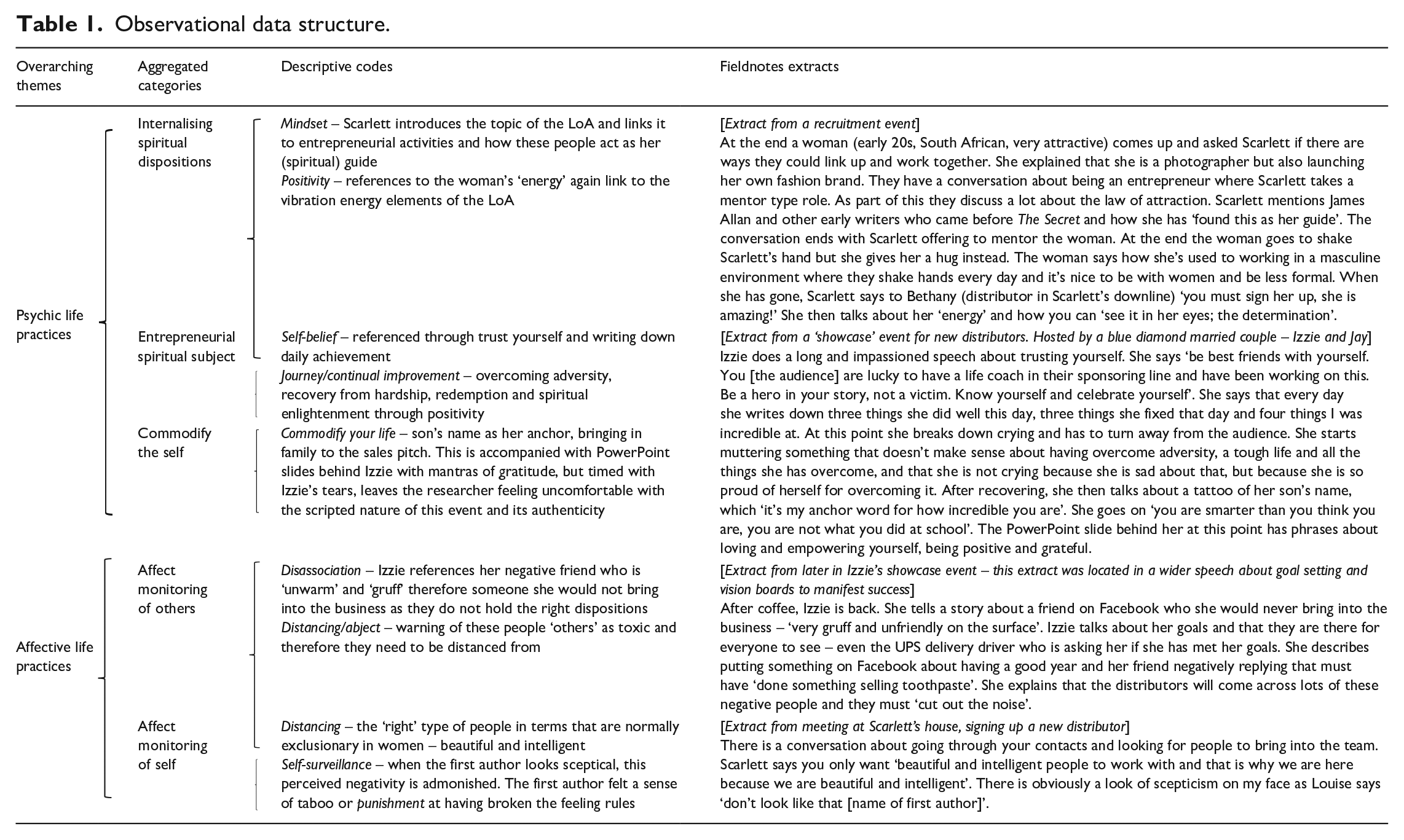
The second data collection method employed was observation at events. The gatekeeper facilitated access to the events. While observation is normally not a core part of the discourse analytic approach, using discourse analysis on observation material is not uncommon (Kelan, 2009). In this case, observation provided a key insight into the context in which work happened. The observations included attending three of the large ‘evangelical style’ showcase recruitment events previously described (see Table 1 as illustration), attending bi-monthly team meeting events where sales and recruitment techniques were shared, and shadowing the induction and training of a new distributor. In total, around 40 hours of observation enhanced our interview data by providing a deeper understanding of the culture and working practices at BeautyCo including how new distributors were instated. Guided by ethical principles relating to participant observation (Flick, 2007), the first author would take observational notes in situ in a notebook, recording without reflection or analysis the events as they happened and conversation taking place. Immediately after the event, the first author re-read and then added to these notes in the form of a reflexive journal. Here, feelings of enjoyment or anxiety, observations about the tensions and dynamics between people, reactions and initial reflections in relation to analysis were captured (Brannan, 2017).
Observational data structure.
Finally, document analysis is another example of how common sense is constructed and as such it is well suited for discourse analysis. For this research, documents (policy and procedures, training manuals, sales scripts, templates for social media posts) provided on the organisation’s website were collected and social media posts from five distributors were analysed; those were selected because they were particularly active on social media. BeautyCo is a global organisation headquartered in the USA and our research was conducted in the UK. While we make no claims on the generalisability of our findings to other global regions, document analysis from the organisation’s website resonated with our observations. This is perhaps not surprising as others have highlighted how network marketing expects distributors to ‘follow their leaders’ (Sullivan and Delaney, 2017: 844) to the degree that they have been criticised for seeking to manage their distributor’s identities (Kong, 2001; Pratt, 2000) through rigid organisational culture and practices (Bhattacharya and Mehta, 2000).
Data analysis
Our research focuses on how psychic and affective practices are mobilised in new forms of organising to produce a female neoliberal spiritual subject labouring under precarity. Core to this is the way that ‘feeling rules’ and ‘thinking rules’ are constructed to constitute subjectivities. Therefore, we adopted a discourse analytic approach where language is not simply a representation of reality, but rather a discursive means or context through which subjectivities are constructed (Rumens, 2012). As Potter and Wetherell (1987) argue, discourse analysis should be viewed as an approach to research, rather than a particular method or technique, with no one common or correct way to conduct this. Consequently, discourse analysis can be approached from a ‘top–down’ perspective focusing on broader issues; often of power, ideology and knowledge, or a ‘bottom–up’ approach of linguistic practice approaches to discourse analysis (Edwards and Potter, 1992). We approached discourse as both occurring in talk and part of a wider ideology that frames social constructions (Potter and Wetherell, 1987).
The materials comprised fieldnotes, interviews, social media posts and document analysis of distributor training materials. Interviews were transcribed verbatim and fieldnotes typed up. Discourse analysis starts by immersing oneself in the material by reading and re-reading the material. We started coding with two initial themes: psychic and affective practices, which we defined as ‘thinking rules’ and ‘feeling rules’ respectively. We then coded the interview transcripts, documents, social media posts and the reflective journal based on what could fall under ‘thinking rules’ and ‘feeling rules’. While there was a lot of overlap between the categories, we decided to code material that speaks mainly to the mind as ‘thinking rules’ and those speaking mainly to affect as ‘feeling rules’. This required a lot of discussion and subjective assessment. We then coded the two themes into descriptive codes, which summarised commonalities in the material. We combined these descriptive codes into aggregated categories that entailed various descriptive codes. We thus moved from dividing the material into two overarching themes, to developing descriptive codes through commonality in the material, which were then put together into aggregated categories, which in turn were situated in the overarching themes. We started with a rough coding based on overarching themes in a top–down approach, then coded the individual themes bottom–up into descriptive codes, which were then put together into aggregated categories. While all the material was analysed together, we chose to present the coding structure in different tables based on material type. This was largely done for practical purposes as one integrated table proved unwieldy. The tables list the overarching themes, aggregated categories and descriptive codes for each type of material and illustrate this analytic process of data interpretation. In line with the discourse analytic approach employed, there is some overlap and codes are not as distinct and clear, as is perhaps inferred in a table, but should be understood as connected through wider patterns of sense making (see also Rumens, 2012). In a sense, that is not surprising because thinking and feeling are interlinked but the focus on either ‘thinking rules’ or ‘feeling rules’ is analytically useful. In the main body of the article, we explain the two overarching themes and the aggregated categories we developed, and then provide ‘power’ quotes representing the strongest examples from the material, additional context and connections between the material in the main text and ‘proof’ quotes representing a wider selection of extracts in the tables (Pratt, 2008, 2009).
The psychic and affective life of the female neoliberal spiritual subject
The analysis first considers the psychic life of neoliberal spirituality, which works through creating the right mindset. They are ‘thinking rules’. We then look at the affective life of neoliberal spirituality, which structures how individuals are supposed to feel or ‘feeling rules’. Although the analysis formally divides thinking and feeling rules, in reality both are intertwined and act in concert to produce the female neoliberal spiritual subject. We suggest that as an analytical project it is worthwhile to highlight the different varieties and nuances in an understanding that they are intertwined. The material in the tables provides maps for the ‘feeling rules’ and ‘thinking rules’ and highlights how the overarching themes, aggregated categories and descriptive codes connect. In the main body of the text, we provide the strongest examples, a fuller description of specific discursive resources in context, which includes more detail on individuals, contexts and situations, and we highlight connections between the material.
The psychic life
Psychic life practices regulate how individuals are expected to think or in other words the ‘thinking rules’. This section examines the categories of individualising spiritual practices, working as an entrepreneurial spiritual subject and commodifying the self, which constitute psychic life practices.
Internalising spiritual dispositions
The internalising spiritual dispositions category contains the codes for positivity, managing your mindset and harnessing self-belief. Francesca typifies the tension for distributors to maintain a positive mindset, a LoA tool of manifestation, despite experiencing the challenge of gig economy work. Francesca is in her late-30s and married with young children. She used to work in marketing at a large corporation, leaving because she ‘just wanted the freedom to make my own decisions and cut out my own destiny’. She was introduced to BeautyCo by a distributor whom she met at a women’s business network event, even here relating this meeting to spiritual providence, stating: ‘So I thought, this is something of interest, I could build a business on this, and it was almost like a law of attraction’. Although Francesca has grown a team of distributors, she still describes it as ‘up and down’, acknowledging and listing the difficulties she has faced. She lists barriers: ‘I’m not a traditional salesperson’, that potential customers are ‘sceptical’, and her age: It does take a while and what I understand, because when you hear the young girls do it, they do it in such a quick time scale, but what I’ve noticed, whether it’s the type of people I’m connecting with are older? Maybe they are more settled in their ways? (Francesca)
Francesca then counters this by saying she is on a ‘learning curve’. She continues: When you go down the route of networking marketing, you tend to do introversion and look at yourself and self-development and reading up on it and trying to make yourself a stronger person. So, I am building confidence and what’s come out of that is this awareness that what we put out there comes back to us, it’s the law of attraction thing, [. . .] It’s fascinating, it’s all to do with aligning our energy and getting rid of all the negatives, so we are back in the flow with ourselves, [. . .] it seems a bit surreal and out there and other worldly. (Francesca)
Here, Francesca references the crux of manifestation: ‘what we put out there comes back to us’, thus negative thoughts attract negative consequences. While Francesca is aware of the precarious ‘up and down’ nature of network marketing, internalising spiritual dispositions presents a discursive construction, which calls upon individuals to vanquish negativity and create a positive mindset. In acknowledging organisational realities, Francesca risks negative thought, which has karmic consequences. Internalising spiritual dispositions of positivity, mindset and self-belief, silences the articulation of precarity, making it (karmically) unspeakable (Gill, 2014). While characteristics of positivity, mindset and self-belief have been well established as the gendered dispositions required by neoliberalism (Gill, 2017; Gill and Orgad, 2018; Scharff, 2016), the use of spirituality in gig economy work mobilises these dispositions into thinking rules thereby extending the requirement to internalise the ‘right’ dispositions for both the universe and neoliberalism.
Entrepreneurial spiritual subject
The second psychic life category identified is that of the entrepreneurial spiritual subject. The codes entailed in this category are journey, continual improvement and spiritual labour. Entrepreneurial spiritual subject constructs individuals as bearers of their own (spiritual) human capital (Weidner, 2009). This required continual ‘turn within’, which was framed as a form of spiritual labour and continuous improvement.
Liz’s case illustrates this: It is very clever, network marketing. It really is, it is very difficult in a way as well because you think, [. . .] because like I was a successful businesswoman in my nail salon; it was fantastic I grew that in six months and it was brilliant, I was successful in [business name], [. . .] then I come to BeautyCo and it is completely different. It is just like, why am I not being as successful as what I think I should be, and it is all to do with the mindset and the personal growth. I haven’t grown big enough yet; need to grow at least another foot before I get there. [Laughter] (Liz)
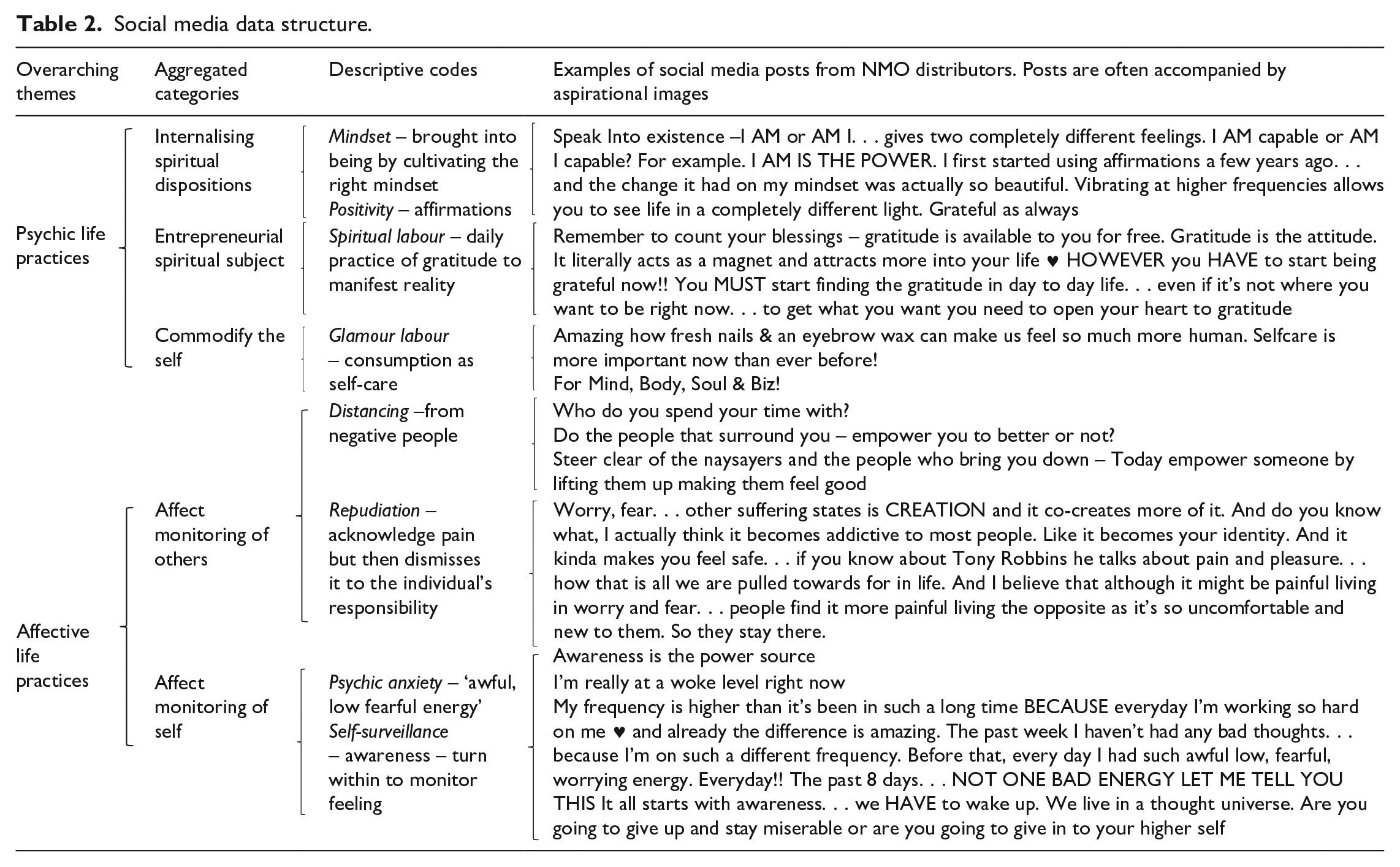
Liz has owned and run several retail beauty businesses before joining BeautyCo. She acknowledges that network marketing is ‘different’ and ‘very difficult’ but explains the difficulties she is facing in terms of personal deficiencies in mindset and personal growth; she is developing her spiritual human capital as a means to becoming successful in the NMO. Liz is a firm believer in the LoA and practises gratitude; for example, she posts positivity mantras daily on Facebook where she maintains her online product shop. These messages typically make statements such as ‘When the road seems long and nothing seems to be happening – trust the process’, ‘Always strive to improve yourself’ and ‘I’m working on myself, for myself, by myself’ (for further examples see Table 2). These Facebook posts are interspersed with beauty product reviews such that neoliberal spirituality intersects with the consumption of beauty products (discussed further below), and mantras of trust and gratitude sit next to messages about self-improvement. The entrepreneurial spiritual subject, constituted discursively through a journey of continual self-improvement, deflects criticism of precarity at BeautyCo through arguing that individuals have not yet arrived at their destination; they have not fully cultivated the right dispositions required by the LoA, but are in a continual state of becoming (Bröckling, 2005).
Social media data structure.
Commodify the self
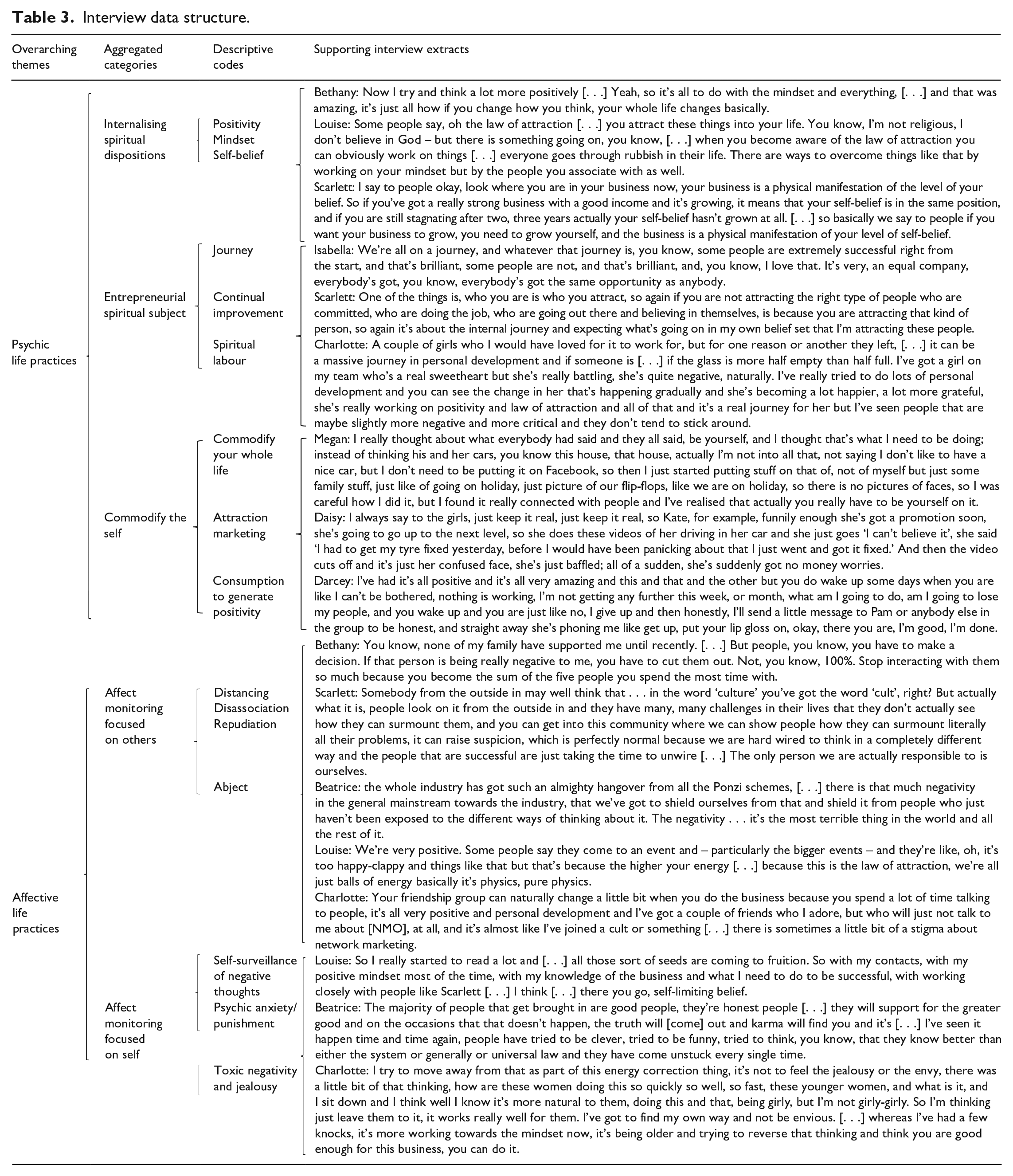
The final psychic life practice is to commodify the self. This category contains the codes: commodify your whole life, attraction marketing and consumption to generate positivity. Through consumption, distributors were brought into being (Gray, 2003), cultivating their identities along carefully selected forms to generate female spiritual subjectivities. In purchasing and using products, women constructed themselves through wellness and beauty and, through social media, commodifying their whole lives (Petersson McIntyre, 2021). At distributor training events, and in corporate training materials, senior leaders in the business encouraged using social media to portray perfect and aspirational lifestyles. Pictures of family holidays, financial abundance and comments about freedom and flexibility were promoted as a way to both sell products and attract potential new distributors (see Daisy in Table 3). In a team meeting, for example, Scarlett tells the group how she has been to a Mercedes garage and taken pictures next to a white convertible, posting photos on social media therefore alluding to this being her next new purchase ‘thanks to this great business’. BeautyCo’s promises of capital accumulation are manifest in the white Mercedes as a visible sign of monetary wealth. This cultivates an image of successful femininity and provokes viewers of this post to ask questions about ‘the great business’. The company training booklet promotes this as ‘attraction marketing’, which they describe as ‘attracting prospects to you rather than you going to them’. On social media, these posts link to the LoA with hashtags such as #gratitude and #manifest. Indeed, those that had reached the highest pin titles carefully curated their online presence as a form of glamour labour (Wissinger, 2015), posting photos interspersed with messages harking to the principles of the LoA; positivity and gratitude (see Table 2). While others have established how the neoliberal spiritual subject is empowered through consumption (Sullivan and Delaney, 2017; Williams, 2014), this offers insights into how consumption and spirituality are enacted and experienced within such organisational forms as network marketing as a means to commodify the self and accumulate wealth. Consumption cultivated an appropriate image, which was associated with positivity, ultimately manifesting business success. Megan describes going to the park to meet other mothers who could potentially be signed up as new distributors. She says: I’d always have a day with no make-up or something like that. Now I think, as you get older you think you need a bit more anyway, don’t you and I think well, you never know who you’re going to bump into, you always want to have that image, make sure you are sort of looking alright, and I think actually that just makes you more positive as a person. And I think generally, the whole concept of the business because you want to meet people and you never know. I meet a lot of people in the park having children, stuff like that, because you always want to be positive and have that effect or have that sort of image, just makes you more of a positive person that people want to chat to. Yeah. And they do talk about the law of attraction a lot and I think it definitely does work. Well, you are drawn to people that are positive, aren’t you? You are not going to grow with somebody negative either, are you? You are not going to get anywhere. (Megan)
Interview data structure.
Consumption is used here to cultivate the right image, which makes Megan feel more positive, which in turn attracts others thus linking consumption to mindset and success; you are ‘not going to grow with somebody negative’. Core to the LoA is manifesting; what you put out to the universe you attract back. The distributor’s code of conduct states that, for success, they must become a ‘product of the products’ by becoming a ‘100% product user’ and using ‘25 (or more) products per month’. Becoming a ‘product of the products’ links consumption, in this case using the products of the beauty company, with the promise of accumulation, in this case earning an income. By just using the products, women can transform themselves into a billboard that is used to sell the products, which in turn will mean that they have an income. With lipsticks given names such as ‘fearless’ and ‘ambition’, through consumption, women are emblematically a product of the products. As Darcey states, when ‘nothing is working’, you ‘put your lip gloss on’ and you are ‘good’. Here, the consumption of beauty products is used to feel better about yourself and at the same time this is used to sell more beauty products. Through commodifying the self, the neoliberal spiritual female subject both consumes product and is brought into being, and accumulates capital becoming a better worker.
In this section, we demonstrated the psychic life of neoliberal spirituality that shapes how individuals think through the categories of internalising spiritual dispositions, becoming an entrepreneurial spiritual subject, and commodifying the self.
The affective life
In the preceding section, we presented the psychic life of neoliberal spirituality that shapes how people are expected to think. We now turn to the affective life that constructs rules about how individuals should feel. The data analysis showed how the affective life practices operate through the following categories: affect monitoring of others and affect monitoring of self.
Affect monitoring of others
First, the affective life suggests feeling rules through affect monitoring of others. The research identified four codes that pertain to the affect monitoring of others: distancing, dissociation, repudiation and abject.
An example of distancing is provided in Table 3, which shows how Bethany distances herself from negative people by emotionally withdrawing or physically limiting contact with them. Dissociation from others occurred in relation to distributors who had left BeautyCo, and to external critique of the company, which often came from friends and family. People leave BeautyCo for a variety of reasons; a significant number sign up for an account but are never active. Others move from one NMO to another as the market becomes ‘saturated’ owing to too many distributors working in a geographical area increasing competition to recruit new distributors, a scarce resource. Through dissociation, those that ‘fail’ were constituted as not having the right attitude or work ethic, or not having a clear enough ‘why’. Precarity in BeautyCo constitutes the ‘failed’ distributors as marginalised and un-belonging. As Zara, one of our interviewees stated: [. . .] oh you’ve got to look for their pain [. . .] if they’re going through financial strife, or if they’re single mums or if they’re stay at home mums, that kind of person will normally want to do really well.Zara is married with two children, her husband has a professional job and, before leaving to become primary carer for their children, she was a sales director in a manufacturing business. This construction of ‘looking for their pain’ is specifically done to ensure that Zara can identify a weak spot that drives the distributor to success. This requires the affective monitoring of others. It also requires a specific kind of empathy for women who are different from herself such as single mothers, and this empathy is used in an instrumental way.
Scarlett talks about successful and unsuccessful women within BeautyCo: This business is all about belief, it’s all about belief [. . .] but these people have such low levels of self-belief, as soon as somebody says no, or they make a criticism, they are just completely thrown off course and they lose their power and they lose their attraction, people are just not attracted to want to work with them.
As a team elite and having achieved significant financial success in the company, Scarlett is in the minority. Scarlett is in her early 50s, middle class, white and divorced. She describes herself as an entrepreneur and has run businesses previously in the UK and Europe. Scarlett is referenced by many of the women we spoke with as someone with unwavering self-belief, but as a ‘team elite’, she has surmounted the uncertainty and precarity of BeautyCo. Scarlett references those that fail as distributors, while disassociating from them in terms that are evocative of the LoA; ‘they lose their attraction’. In this way, Scarlett is constructing herself as powerful through her self-belief, and repudiating the failure of others to their deficit of not following the correct feeling rules. Language such as ‘these’ people, evokes a discourse of stigma around those that fail.
Repudiation occurred through simultaneously acknowledging and then rejecting critique of the negative images of networking marketing organisations, for example, for being ‘cult-like’ or pyramid schemes (see Table 3, extracts from Scarlett and Beatrice). Distributors are aware of the criticisms of gig economy work such as this, as many of them faced objections from family and friends. However, in acknowledging and then rejecting these comments through positioning themselves as spiritually aware and ‘in tune’ with the universe, this preserves the myth of the LoA. While inequalities become unspeakable because to call them out ‘the neoliberal mythology would be punctured and perhaps also the speaker’s intelligibility as an entrepreneurial subject’ (Gill, 2014: 523), equally acknowledging and subsequently rejecting criticism of the LoA nullifies challenge, (re)constructs a good female neoliberal subject while reinforcing the affective life of neoliberalism.
Affect monitoring focused on the self
The second category of the affective life focused the feeling rules of neoliberal spirituality by affective monitoring of the self. This category included the following codes: self-surveillance of negative thoughts, psychic anxiety/punishment and toxic negativity and jealousy. The LoA works through karma-based principles where what energy you put out to the universe, you receive back. We previously discussed this in terms of psychic life practices of positive thinking and self-belief. In antithesis, negative thoughts become toxic, working as a form of neoliberal governmentality by ‘inducing and capitalizing on psychic anxiety as a mode of (self) governance’ (Tyler, 2013: 11). Negativity must be monitored and self-governed through practising positivity. Louise recognises this in the following comment where she links negativity to karma so that negativity attracts negativity: We’re told to keep the negative, keep the moaning out of your public life. We all have ‘crap’ going on in the background [. . .] don’t let it out, don’t let people know that you’re having a bad day or, you know, moaning about this, that and the other and it’s true. If you’re a moaning Minnie, that’s what you attract. (Louise)
A ‘moaning Minnie’ is an informal British expression of someone who annoys others through constant complaining. Instead, feeling the need to complain needs to be suppressed. Louise’s quote resonates with the first author’s observation of a team meeting (see also Table 1, Izzie, first example of affective practices in a meeting). At this event, Louise provided a testimonial to potential new distributors, telling them of her experience in BeautyCo. Louise describes herself as ‘nothing special’ but is immediately publicly admonished by one of the ‘team elites’ for this negative self-portrayal; in essence, breaking a feeling rule. When Louise then cries, the leader hugs Louise and tells everyone to give Louise a standing ovation. The feeling of not being special is not allowed while redemption through tears appears encouraged. Although Louise has reached a lower pin title and has a small monthly income, she has not reached the success levels of some of the other women we spoke with, despite being in BeautyCo for several years. She thus appears as less successful in comparison with others. At events, she repeatedly justifies her apparent lack of success attributing it to lack of self-belief and confidence. We followed up with some of the distributors and found that Louise had posted an update on social media in the form of a video message. In it, Louise explained that she left BeautyCo in late 2019 saying that ‘confidence and self-belief’ had been her ‘stumbling blocks’. Louise went to work in a more traditional organisation but lost her job when the COVID-19 pandemic hit. Consequently, she has recently joined another NMO. She said in the social media video: ‘I’d been looking within, a sign would come, I’m spiritual and I reconnected with another lady. I love this business model, it’s democratic for those who work for the rewards’.
Like many, network marketing failed to make a living wage for Louise, but she recurs to self-belief as the reason why and attributes the LoA as to why she joined another network marketing company despite ‘failing’ in BeautyCo. The precarious labour market and limited choices for women such as Louise are negated by the LoA. To acknowledge the difficulties of gig economy work ‘punctures’ neoliberal spiritual mythology and intelligibility as a female neoliberal spiritual subject (Gill, 2014), karmically enforced through the LoA, which acts as a form of punishment; negative feeling will attract negative consequences (see Table 3, Beatrice). In the LoA, there is no afterlife: rewards and punishments occur in the present. This presents an inherent contradiction with traditional beliefs of karma, which relies on reincarnation through a continuous circle of birth and death. In the LoA, karma is ‘in the moment’ and becomes a powerful silencing force to negate negativity and the reality of the precarious nature of work in BeautyCo. To do so risks retribution from the universe.
Affect self-monitoring also problematises comparison with others to a toxic behaviour, sometimes referenced as jealousy or bitterness. We see this in the following comment from Darcey (see also Charlotte, Table 3): If you’re jealous then there’s a reason that you’re jealous and you should really look inside as to why. What’s not happening, you’re not happy within your universe that’s making you feel it towards somebody else [. . .] jealousy always comes from being bitter and it’s not necessarily about exactly what’s happened, it’s other things that happened that’s made you bitter [. . .] and that’s going back to keeping yourself in a good place and being positive and everything like that.
The LoA holds individuals accountable so that jealousy becomes an individualised issue, here explained by Darcey as not being happy ‘within your universe’. The antidote to jealousy is to be positive, have gratitude and ‘keep yourself in a good place’. Jealousy is rejected; it makes people ‘bitter’, thus, individuals must self-govern by putting these feelings aside and focus internally rather than externally. Neoliberal spirituality constrains comparison with others as this may render inequalities visible. Therefore, the affective life of neoliberal spirituality, through affect monitoring, restricts people only to look within: to do otherwise would have negative consequences.
In this section, we showed how the affective life of neoliberal spirituality constitutes ‘feeling rules’, which sets rules for how individuals are allowed to feel. The affective life applies to affect monitoring of others and affect monitoring of the self.
Discussion
The findings have shown how the psychic life as the thinking rules, and the affective life as the feeling rules, create the female neoliberal spiritual subject in alternative organisations. The findings also provide detail on how consuming the beauty products one aims to sell is constructed as a central requirement for being successful in such a context. Our findings suggest that the thinking and feeling rules are mobilised to link the consumption of products with the ability to earn an income and to simultaneously make it impossible to articulate the precarity of this work. In that way, the thinking and feeling rules create subjectivities that are aligned with how precarity is lived under neoliberalism. The article shows how precarity allows certain subjectivities to emerge by using specific thinking and feeling rules. In this specific case, the thinking and feeling rules also encouraged subjectivities to be formed that entailed that the consumption of products is a required ingredient to earn an income. The findings thereby show how thinking and feeling rules are ways through which precarity unfolds its power to form subjectivities.
By showing how precarity works through thinking and feeling rules, the article advances theory in two ways. First, the article contributes to a refinement of theories of how the white female neoliberal spiritual subject is constituted (Shome, 2014; Williams, 2014). Although whiteness was not articulated in our dataset, whiteness is implicitly connected to the constitution of the female neoliberal spiritual subject; by naming the female neoliberal spiritual subject as white we aim to make this whiteness visible. While it has been suggested that the psychic and affective life of neoliberalism is a central mechanism through which neoliberalism becomes a lived experience (Baker and Kelan, 2019; Gill, 2017; Mackenzie and McKinlay, 2021; Scharff, 2016), this article extends this literature by showing how spirituality is used in those psychic and affective processes. The psychic and affective practices showed how women are encouraged to think and feel in the right way to be successful in the network marketing company context. In order to be successful, women need to internalise spiritual dispositions by ‘turning within’ to develop self-belief, be positive and have the right mindset. Scholars have previously explored how the psychic life of neoliberalism calls upon individuals to internalise and psychologise the right characteristics and dispositions (Gill, 2017). Whereas others have discussed these broader neoliberal dispositions as including confidence (Gill and Orgad, 2015, 2017) and resilience (Gill and Orgad, 2018), the psychic and affective life of neoliberal spirituality extends this to positivity, mindset and self-belief in order to benefit from good karma. The neoliberal spiritual subject finds enlightenment through consumption (Williams, 2014) and we have shown how, through commodifying the self, a similar mechanism operated in a corporate setting. The corporate neoliberal spiritual subject we observed at BeautyCo both consumes the beauty products to gain confidence and feel positive and turns within to develop the right dispositions creating a ‘soulful’ feminine subject (Fisher, 2017). Through glamour labour and attraction marketing the whole self is commodified and brought into being, which is spiritually rewarded by accumulating wealth, subsequently benefiting the organisation. The article thus shows the female neoliberal spiritual subject is constituted through consumption and accumulation in this organisational context, which advances theorising in this field.
Our second theoretical contribution relates to how the female neoliberal spiritual subject is constituted in new organisational forms, namely gig work, and how the female neoliberal spiritual subject requires side-lining the conditions of its existence, in this case precarity. We not only contribute to an extension of this sphere of organisations (Fisher, 2017; Lavrence and Lozanski, 2014; Mickey, 2019) but particularly focus on new organisational forms that are often constructed as providing individuals with increased freedom that is appealing to women (Pratt and Rosa, 2003), while also being precarious (Moisander et al., 2018; Mrozowicki and Trappmann, 2021; Shade, 2018; Sullivan and Delaney, 2017). Through examining psychic and affective practices, we are able to illustrate the thinking and feeling rules through which this happens. The entrepreneurial spiritual subject category framed individuals as being on a journey, a process of continuous improvement, as a form of spiritual labour. Individuals were in a continual process of becoming (Bröckling, 2005; Gill and Orgad, 2018; Scharff, 2016), working on themselves to develop their own spiritual human capital, which in turn contributed to economic capital. Criticism of the precarity in the gig economy is conflated with not yet having spiritually arrived at the destination through being able to harness ‘universal laws’. Similarly, it was necessary to disarticulate precarity in relation to gig work through affect monitoring of others. This creates distance from others who are critical of the organisation, disassociation from those who leave BeautyCo by positioning them as having failed and acknowledging and then repudiating critique as a way to nullify criticism. Furthermore, through affect monitoring of self we observed the exclusionary and constraining effects of neoliberal spirituality whereby psychic anxiety, self-surveillance and toxic negativity or jealousy is repressed. These mechanisms make it difficult, if not impossible, to articulate the wider condition of precarity. The article thereby extends prior research that has shown how current practices that constitute gendered neoliberal subjects function to hide structural and systemic inequalities (Adamson, 2017; Gill, 2007, 2016; Rottenberg, 2014, 2018) by specifically focusing on the subjectivities that precarity allows to create. The article has shown that new forms of organising are particularly prone to use spirituality to regulate the psychic and affective life of women, where the precarious nature of this employment is hidden under the veneer of positivity and being in charge of one’s own life.
Conclusion
This article showed which thinking and feeling rules operate to create a female neoliberal spiritual subject that requires the consumption of products to earn a living while making it difficult to articulate precarity. By showing how the female neoliberal spiritual subject is constituted by psychic and affective practices, further research could expand this theoretical framework. This theoretical framework could be extended by studying other settings such as social media influencers or yoga teachers. It would also be possible to study a similar set of women to find out how they are dealing with the COVID-19 pandemic where beauty sales have gone down and where face-to-face forms of training and selling are not possible. The theoretical framework might also be used around approaches to create mindfulness that have been adopted in organisational settings in recent years. Similarly, male dominated workplaces such as Uber or food delivery drivers could also shed light on these practices. Such research should therefore highlight if psychic and affective practices targeted at men differ from what this article documented. While our research has not shown how individuals resist those practices apart from leaving the organisational context, in other areas of employment there might be more effective strategies that are mobilised to challenge and resist psychic and affective practices. It would also be useful to explore how spirituality in relation to psychic and affective practices is employed in marketing and consumption more widely. Other organisational contexts such as religious organisations might draw on psychic and affective practices and research might want to explore this further. We have also presumed that women gain something from these psychic and affective investments but showing in detail what those women gain has been beyond the scope of this article. However, further research could detail why women engage in those psychic and affective investments. The research findings also raise questions for business and management educators in regard to how students are being taught about such practices, why they are so compelling and how they could be resisted. The article has thus shown how psychic and affective practices constitute the female neoliberal spiritual subject in new organisational forms, that inseparably link consumption, accumulation and precarity.
Footnotes
Acknowledgements
We would like to thank the associate editor Alessia Contu and the three anonymous reviews for the valuable feedback and generous time in helping develop the article.
Funding
The authors disclosed receipt of the following financial support for the research, authorship and/or publication of this article: the writing of this article has been supported by Elisabeth Kelan’s Leverhulme Trust Major Research Fellowship [MRF-2019-069].
