



Abstract
This article considers why and how evidence-based practice has become distorted in practice, and what to do about it. We present qualitative data from an action research project in policing to highlight tensions between the rhetoric and reality of evidence-based practice, and the ways in which evidence-based practice’s seductive catchphrase ‘what works’ is being understood and applied. Through the lens of care ethics, we integrate ‘what matters’ with ‘what works’, and ‘what matters/works here’ with ‘what matters/works everywhere’. This approach recognizes relational expertise, practical reasoning and critical inquiry as vital for evidence-based practice in practices of social intervention. Drawing on key care ethics motifs, we suggest that care is the ethical scaffolding upon which social justice relies, and hence crucial to organs of security, peacekeeping and law enforcement. From this position, we argue that policing might renegotiate its difficult relationship with the particular, recasting it from something uncomfortably discretionary (the maverick cop) and shameful (an individualized blame culture) into something that underpins and enhances police professionalism. While developed in a policing context, these reflections have a broader relevance for questions of professional legitimacy and credibility, especially within the ‘new professions’, and the costs of privileging any one type of understanding over others.
Keywords
The case for an evidence-based perspective
One of the most powerful trends in contemporary organizations is the call for actions, decisions and learning to be grounded in evidence (Barends et al., 2017; Boaz and Nutley, 2019; Briner et al., 2009). Enthusiasm for an evidence-based approach is often traced back to medical services research in the 1960s and 1970s. In the UK, Cochrane’s (1972) landmark work suggested that the question of effectiveness (i.e. whether treatments actually work), along with efficiency (i.e. the optimal use of resources), are two fundamental principles by which any health service should be run. Evidence of ‘what works’ is thus seen as key to enhancing the rationality of, and confidence in, clinical decisions about who and what to prioritize for medical intervention and treatment (Sackett et al., 1996).
Evidence-based approaches remain especially popular in healthcare (McLaughlin, 2001; Stewart, 2018), and seem particularly pertinent, albeit contested, in the context of public health emergency, such as the current COVID-19 pandemic (Lancaster et al., 2020). They have also informed debates about public service reform more generally, including education (Buskist and Groccia, 2011), social work (Bellamy et al., 2006) and, of direct relevance for this article, policing (Sherman, 1986, 1998). In the public services domain, the rise of the evidence-based movement may be a response to several intersecting societal developments, including a decline in deference to government and a demand for greater accountability and openness in policy-making and service delivery (Nutley et al., 2019). Within this context, emphasis is placed on rigorous, systematic and transparent analytics, both within and across institutions.
The ‘evidence-based’ moniker is used in a range of ways, including evidence-based policy, evidence-based research and evidence-based practice. Sometimes it is softened into evidence-informed or evidence-aware, which signal greater flexibility in the selection (and deselection) of different evidence types (Nevo and Slonim-Nevo, 2011). In this article, we use the term evidence-based practice (shortened as EBP) to reflect an overall commitment to the use of evidence both within organizations and among their stakeholders, users, clients and commentators. This commitment can be summarized as ‘making decisions through the conscientious, explicit and judicious use of the best available evidence from multiple sources to increase the likelihood of a favourable outcome’ (Barends et al., 2017: 1).
Within management and organization studies, EBP is often associated with the reduction of complexity and uncertainty. Capturing, synthesizing and socializing data on ‘what works’ is assumed to lessen the need for wasteful trial-and-error learning and wheel-reinvention, and hence reduce organizational risk (McLaughlin, 2001). Rousseau (2006: 261) advocates that ‘when managers acquire a systematic understanding of the principles governing organizations and human behaviour, what they learn is valid – that is to say, it is repeatable over time and generalizable across situations. It is less likely that what managers learn will be wrong’.
Crystallized in the mantra of ‘what works’, an evidence-based approach is compelling, even self-evident, as a focus for strategy, policy and delivery. When former UK Prime Minister, Tony Blair, declared that ‘what counts is what works’ during the 1997 general election campaign, his aim was to signal a new, post-ideological approach to public policy-making (Davies and Nutley, 2000). As well as being associated with consistency and risk-management, therefore, ‘what works’ conjures up an image of people cutting through the nonsense of both bureaucracy and ideology to get things done.
As the catchy ‘what works’ slogan has increased its purchase on organizational conversations, EBP specialists have highlighted the risks of its one-size-fits-all undertones and the importance of evidence-in-context (Boaz and Nutley, 2019; Briner et al., 2009). Pawson and Tilley (1998) have led the charge for more context-sensitive approaches to evidence evaluation, requiring multiple methods and information sources to be considered as the relevant evidence accumulates over both time and place. Their cumulative approach expands ‘what works’ into ‘what works, for whom, and in what circumstances’. More recently, Nutley et al. (2019) argue that the evidence required for effective decision-making includes evidence of the gravity and (a)typicality of any particular situation. They encourage academics and practitioners alike to deepen their examination of ‘what works’ by asking supplementary questions, such as precisely how and why interventions work, for whom, at what price and with what consequences.
The challenge from critical quarters
Among critical scholars, EBP attracts much scepticism (Learmonth and Harding, 2006; Morrell, 2008; Tourish, 2019). A core tenet of this critique concerns EBP’s advocacy of a hierarchy of research methods, which tends to privilege statistical and meta-analytical techniques over qualitative approaches to knowledge, such as interpretive, discursive or narrative methods. Morrell and Learmonth (2015) criticize this kind of pyramidal representation for valorizing the type of research that reduces, quantifies and aggregates, and devaluing alternative approaches that expose the complexities and inconsistencies of organizational experience. At best, this results in incomplete accounts of important phenomena; at worst, it distorts said phenomena, because any account aspiring to legitimacy at the summit of the evidence hierarchy ‘necessarily has to reduce, simplify, gloss, flatten, or sideline problems and situations that are inextricably contextual, messy, unique, contestable, oppressive, absurd, humorous, or socially complex in dozens of other ways’ (Morrell and Learmonth, 2015: 528).
Moreover, the questions for which evidence is most often sought tend to reflect (and reinforce) the needs of leaders, managers and other influential stakeholders. As Morrell and Learmonth (2015: 521) suggest, EBP may be ‘for management not about management’, because it privileges the interests of those already in power and marginalizes other perspectives. While it is conceivable that commissioned research could address issues of concern to more junior stakeholders, in practice this is unlikely, because organizations are not really designed or run for them. As Tourish (2019: 194) puts it, ‘foxes and hounds come together for a hunt but have fundamentally different interests in the outcome’. From this standpoint, EBP is for the hounds.
EBP discourses can be masterly political narratives, especially when using the definite article, the evidence, to imply a demarcated source and type of knowledge. The most successful narratives create certainty in order to justify a particular course of action (Stevens, 2011), and ‘often depend on slippages of meaning, carefully constructed areas of ambiguity, artful redefinition and judicious silences that allow trade-offs to be hidden [and] divergent interests to be reconciled’ (Du Toit, 2012: 5). Political questions are often glossed over, such as who gets to define, and indeed contest, what counts as evidence and what questions are to be addressed by it. For Du Toit (2012), EBP is therefore an anti-democratic practice that furthers the interests of those with the authority and expertise to define and redefine the terms of the debate.
Critical scholars urge us to push past the rhetoric of organizational ambition and codification to expose the visceral dilemmas that organizational members face every day, ensuring that it is not just the voice of the powerful that is heard. Learmonth and Harding (2006) argue that the spaces of lived organization are often radically different from those of the idealized and officially sanctioned organization, and that EBP distils, packages and promotes the latter, not the former. The lived organization demands that we challenge the ‘taken-for-granteds’ and ‘sacred cows’ of official rhetoric to which EBP is perhaps especially prone. Indeed, the ‘brilliant danger of an “evidence-based” slogan is that it can still appear obvious, even as common sense. After all, who can be “against” evidence?’ (Morrell and Learmonth, 2015: 530).
EBP in policing
Within policing, the EBP debate is especially lively (Knutsson and Tompson, 2017; Lum and Koper, 2017). In the UK, the case for EBP is often connected with the police professionalism agenda, where this is understood to refer to the codification of practice, the value and prestige of externally-recognized qualifications, and evaluation of performance based on standards established and supported by research (Brown et al., 2018; Green and Gates, 2014). It is associated with the establishment in 2012 of the College of Policing, which is seen ‘as the “what works?” clearing house for “policing and crime”’ (Neyroud, 2013: 122). 1
More sceptical voices argue that a narrow focus on ‘what works’ misrepresents the breadth of policing and the many ways in which police decisions both influence and are influenced by the values of society in general and individual community dynamics in particular (Punch, 2015; Sparrow, 2016). Greene (2014) suggests that the ‘why’ questions in policing are especially complex, involving legal, regulatory, cultural, geographical, political, psychological and many other factors; and ‘as a consequence, answers to the questions of “why” in policing are rarely singular’ (Greene, 2014: 195). Therefore, when EBP is narrowly equated with methods hierarchies and the so-called ‘gold standard’ of the randomized control trial (Sampson, 2010), it can only reflect a sub-set of police functions and activities. It might be effective for evaluating crime-reduction initiatives, but it has less to contribute to the moral, ethical and psychological aspects of policing, such as its function as container for society’s unresolved anxieties, neuroses and value conflicts (Hoggett, 2006).
While ‘what works’ enjoys considerable currency in policing, there are several interesting counter-narratives, including constructions of policing as craft (Fleming and Rhodes, 2018; Innes, 2010; Muir, 1979). Willis and Mastrofski (2014) argue that effective policing requires an integration of science and craft, suggesting that officers’ decision-making methods go beyond mere intuition and ‘gut feel’ and involve sophisticated techniques of analysis of individual and social behaviour. Of greatest relevance for our own analysis is Punch’s (2015) counter-narrative of ‘what matters’. Punch (2015: 16) argues that evidence of ‘what works’ is invaluable for certain aspects of crime-control, but that this ‘is always superseded by “what matters”. For policing is essentially about the relationship between the state and the citizen in relation to justice, diversity, equity, rights, integrity, accountability and governance.’
The focus of this article
Drawing these threads together, this article is a response to calls for further critical reflection on EBP from several quarters, including the specialist EBP literature (Briner et al., 2009; Nutley et al., 2019), critical management studies (Learmonth and Harding, 2006; Morrell and Learmonth, 2015) and policing studies (Brown et al., 2018; Fleming, 2019; Greene, 2014). We address one of the shortcomings of EBP identified in the critical literature, namely the issue of ethics (Morrell, 2008; Tourish, 2019). Specifically, we ground our reflections in the ethics of care. This casts care not as an emotion so much as a framework for guiding and evaluating action and interaction, especially between those who wield power and those who are in need or in trouble. 2 A care ethical approach to evaluation focuses on how an action or intervention will affect particular people in particular circumstances ahead of the abstract criterion of whether it is right or wrong or the instrumental criterion of whether ‘it works’.
The article is structured as follows. First, we introduce an action research project on organizational learning in policing. We describe our methods, followed by a synthesis of findings relating specifically to EBP. Based on this, we develop an alternative framing for EBP that supports the integration of ‘what matters’ with ‘what works’ (Punch, 2015) by drawing on the ethics of care. We acknowledge both tensions and opportunities in the police professionalism agenda when constructed in terms of the institutionalization of knowledge. We reflect on the implications of this analysis for police ethics, especially the ethics of social intervention, and consider the wider ramifications for EBP beyond policing.
Methods
This article is based on a four-year action research project at a major city police service in the UK. The project’s remit is to explore understandings and practices of organizational learning, one aspect of which is the way in which organizational learning and EBP intersect. Action research encompasses a range of approaches that emphasize the relevance of knowledge for practice, each with different assumptions about, and implications for, ontology, epistemology and axiology (Cassell and Johnson, 2006; Reason and Bradbury, 2001). The variant we use here is modelled on dialogical reflexive action research (Cunliffe, 2002; Ripamonti et al., 2016). This recognizes that multiple understandings are always in play in social and institutional relations, and seeks to make sense of this multiplicity to highlight the unnoticed, perhaps unintended and sometimes unwanted meanings and implications of the discourses-in-use. The aim is to stimulate constructive discussion and reflection that may create movement in patterns of thought and potentially energize alternative courses of action. In the specific context of this project, therefore, dialogical reflexive action research means that our work is not just about organizational learning; it is organizational learning in action.
Within this overall framing, we conducted field research with police leaders, officers and staff representing a range of seniorities from trainee constable through to chief constable (N = 112). Our participants come both from the corporate functions (professional standards, finance, training, legal, etc.) and from the front-line of policing, incorporating response units, neighbourhood policing and community support, and specialist safeguarding functions, including child protection, mental health and the policing of modern slavery. Our participants also include members of key external advisory and police regulatory bodies with a stake in organizational learning and EBP.
We collected two types of qualitative data: interview and participative-ethnographic. The former consists of data from semi-structured one-to-one interviews, which lasted between 20 and 82 minutes. These were audio-recorded, transcribed and thematically analysed (Braun and Clarke, 2006). The latter comprises different data outputs and artefacts resulting from our participation in practice, from where we have observed, challenged, shaped and delivered a range of initiatives, including staff development events, board presentations, consultations with key stakeholders such as regulators and staff representatives, and the establishment of a new network of learning champions. The data from this participative-ethnography strand were not typically audio-recorded. Instead, we took detailed notes both during and immediately after our many meetings and research encounters. This was both because recording would have made these events feel stilted and because of the sheer scale of this participative-ethnography, which amounted to over 200 days of engagement over the four-year period.
The research took place in three phases. Phase one (September to December 2017) consisted of a scoping study to identify the key interests and concerns for our main group of sponsors and members of a newly established organizational learning steering group. In phase two (January 2018 to June 2019), we conducted most of the field research, socializing, testing and refining our findings as we progressed. In phase three (July 2019 to July 2021), we supported the implementation of new ways of working with organizational learning and EBP, based on this research. In all three phases, the first author was a member of the new steering group, and used this position to present syntheses of the findings and to facilitate challenge and discussion.
Developing the ideas for this article has involved working abductively between the questions and concerns identified at the outset of the project and those that emerged as the work progressed and the engagement deepened. Abduction is an iterative process of observing, interpreting, shaping, applying and refining (Cunliffe, 2002; Nenonen et al., 2017). When deployed in the context of dialogical reflexive action research, it seeks to elicit possibilities of understanding rather than test any specific hypothesis or validate (or invalidate) any particular area of the literature on a topic. For this project, the topic of EBP was identified as a key research question during the initial scoping study; but the specific focus of the work we present here results from working iteratively between theoretical and empirical domains and between the letter and the spirit of organizational practice.
In the section below, we present our findings on how EBP is being understood and enacted in practice. Sometimes these findings arise through direct questioning (e.g. ‘what does the idea of “learning from the best available evidence” mean to you?’). At other times, they emerge more naturalistically and inductively, highlighting patterns of association and evaluation in our participants’ own frames of reference. We focus in particular on working definitions of the key concepts of ‘what works’, ‘learning from evidence of what works’, ‘learning from the evidence’, ‘learning from the best available evidence’ and, to a lesser extent, ‘what matters’.
We have clustered our data into themes, but these findings do not share the positivism that ‘data’ and ‘theme’ sometimes imply. Rather, they invoke some of the pragmatism of bricolage to refer to ideas that may be meaningful and/or actionable because of their resonance rather than their claims to objective truth or generalizability (Cunliffe, 2003; Gabriel, 2002). They share the provocative logic of the aporia as a way of sowing the seeds of doubt, alerting us that things may not be quite as the textbooks suggest and that some understandings are highly inconvenient for dominant and/or official discourses (Derrida, 1993; Koro-Ljungberg, 2010).
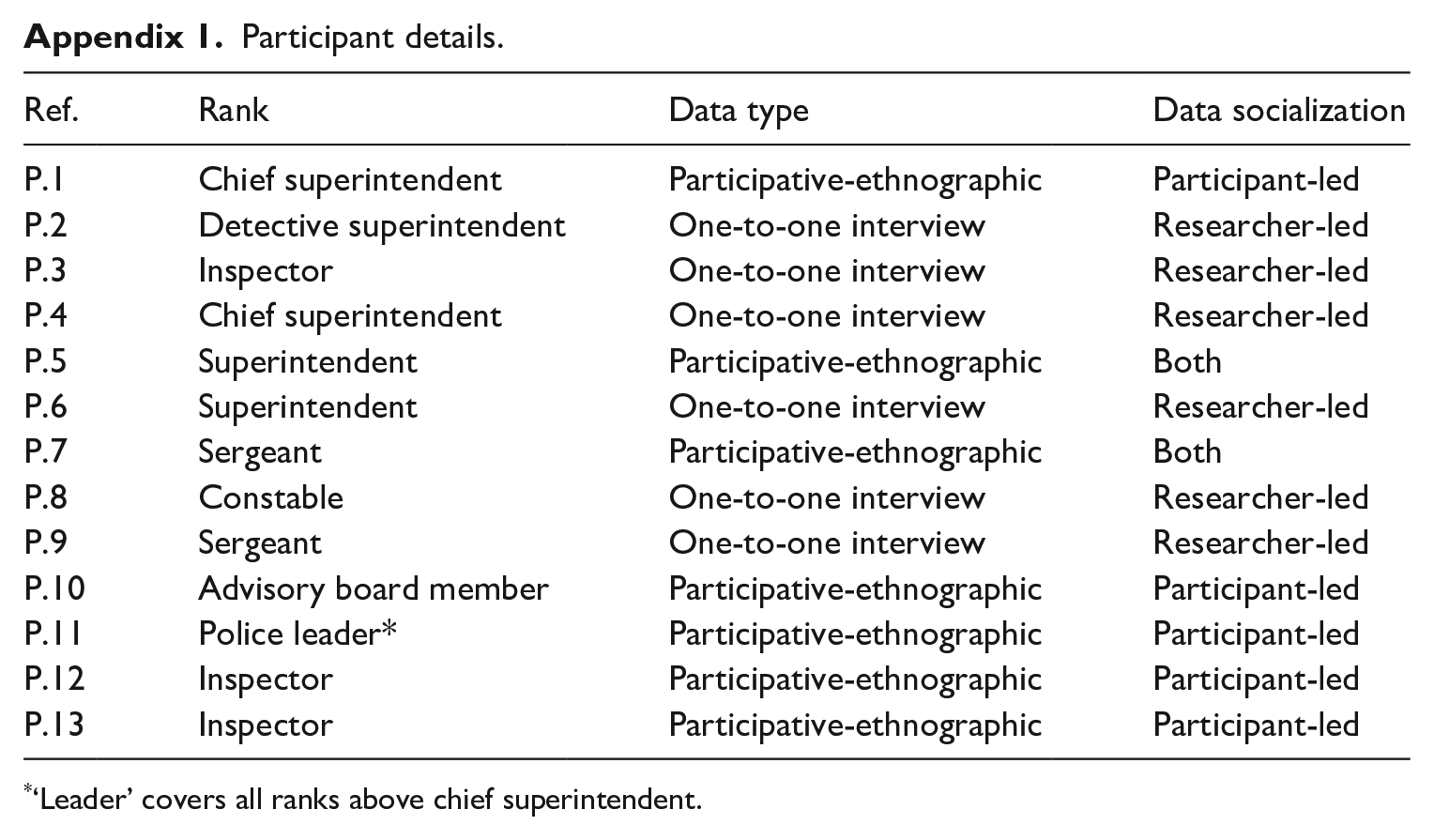
In terms of validity, action research invokes evaluation criteria that are different from those of more mainstream research methods. Bradbury and Reason (2001: 449) emphasize that its emergent, relational and dialogical qualities are designed to leave ‘new institutional patterns in its wake’, and that it is against this criterion that research should be evaluated. In this paradigm, the criterion of rigour is therefore supplemented by that of resonance. This is a specifically dialogical resonance, which is sought via processes of data socialization to gauge which findings ‘ring true’. On this project, data socialization happened in two main ways: The interview findings were socialized by us during steering group meetings, working group meetings and network events (with strict anonymity protocols); the participative-ethnographic data were usually facilitated by us, but they were often socialized and subjected to challenge by the participants themselves. Thus, the data we present here have achieved a dialogical resonance that suggests that they are not isolated cases or exceptions to the rule, but rather, ring sufficiently true to provoke debate and reflection. We present quotes from just over 10% of our sample, and include instances of both researcher-led and participant-led socialization (see Appendix 1 for a table of our 13 cited participants, P.1 to P.13).
Throughout the article, we offset a desire to share the richness of our data with a commitment to participant anonymity, confidentiality and safeguarding. Occasionally, this means altering minor details of an event to ensure that it is not traceable to individual people. We are very aware of our duty of care towards our research participants – a duty that is thrown into particularly sharp relief given the focus of this article. We are exposing some idiosyncratic understandings of EBP in this analysis, but at no point is this intended as a lack of respect or empathy for the people involved and the challenges they face.
Findings
Figure 1 synthesizes the data into four main themes (the central quadrants), each of which represents working definitions relating to EBP. They are presented along two axes that emerged as significant and interesting through the processes of abduction: general-particular and internal-external. In the section below, we present each theme in turn, illustrating some of the effects of the discourses-in-use on attitudes and actions. We purposefully include quotes from a wide range of ranks, noting issues of seniority when these seem especially salient.
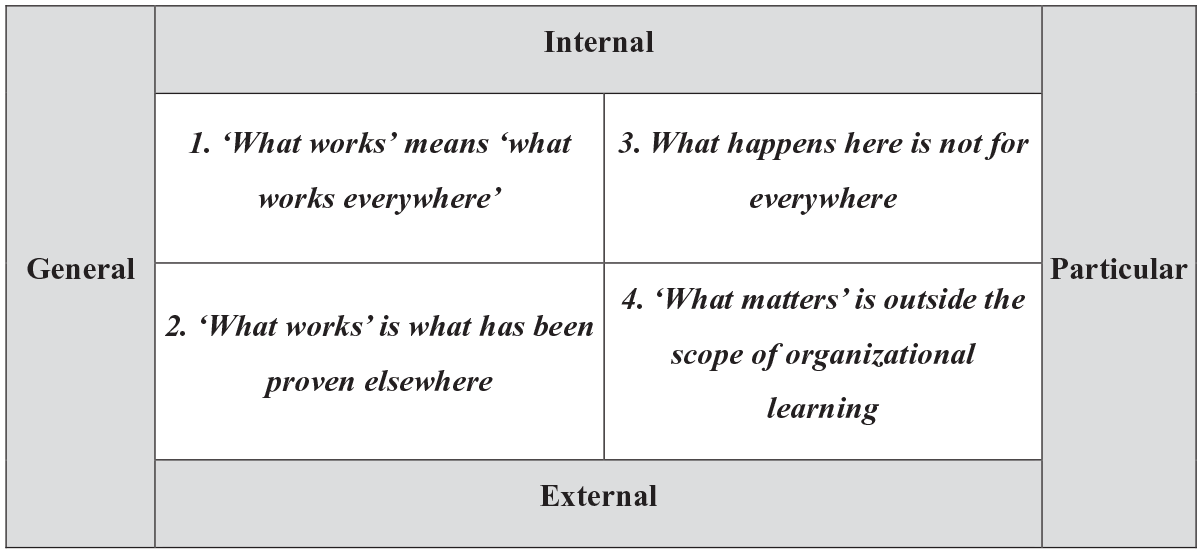
EBP Discourses-in-use.
‘What works’ means ‘what works everywhere’
Our findings reveal that slogans of ‘what works’ and ‘learning from evidence of what works’ have a strong purchase on working definitions of EBP. One of the most noticeable patterns, however, is a tendency to elide ‘what works’ with ‘what works everywhere’. Many initiatives are launched within the service with the banner heading of ‘what works’. These are frequently interpreted as instructions for what to do on every occasion, revealing an instinct to generalize and a subsequent loss of focus on the specifics of individual situations.
An illustration of this tendency and its potential effects comes from a discussion with a chief superintendent (P.1) about an evidence-based directive on domestic violence, a crime with relatively low conviction rates. The discussion in question is an example of the participative-ethnographic data whereby a conversation that we have facilitated has not only elicited certain understandings, but also enabled participants to socialize, contest and develop these understandings and their implications themselves. Thus, while this particular quote consists of ‘third party’ data about what others may or may not have done, it has been subjected to the ‘does it ring true?’ test for dialogical resonance highlighted above.
A review of more than 100,000 historical cases of domestic violence had been undertaken by the service’s Data Analytics Unit. It had concluded that if an officer arrests a perpetrator within 60 minutes of an offence taking place, the case has a greater likelihood of a successful conclusion in court. Based on this evidence, officers were instructed to adopt what the service called a ‘positive arrest policy’. According to the chief superintendent in question (P.1), some officers interpreted this to mean that they should not leave the scene of actual or suspected domestic violence without arresting someone. Such an extrapolation of ‘what works’ into ‘what works everywhere’ can have startling effects. As the chief superintendent explains: One officer told me about a case where a man had injuries which had apparently been inflicted by a woman from the same household. The officer strongly suspected that the woman had been acting in self-defence and in order to protect her young children. However, wanting to comply with the evidence-based directive, he believed he had no option but to arrest the mother, leaving the man alone in the house with the children.
The instinct to generalize can also be seen in an interview with a detective superintendent (P.2), who talked about her team’s lively debates about the importance of officers removing their boots when they enter Asian households. This had been identified as something that previously hampered community relations, making officers vulnerable to charges of cultural insensitivity, even racism. The issue of removing boots had been packaged up into an evidence-based ‘learning recommendation’, which some officers interpreted to mean removing their boots as a matter of routine, and then grumbled that it was a waste of time and effort and diminished their authority and credibility. They were attempting to follow protocol, but without the sensitivity and acuity that would really make a difference (i.e. without a genuine concern for, and interest in, the human beings whose home they were entering). As she explains: ‘We’re constantly being pushed to try to learn from the evidence. But the reality often is . . . What do they call it? Hitting the target but missing the mark.’
Within this context, it takes courage and a certain self-confidence to resist an initiative or directive that is labelled as ‘evidence-based’. One inspector (P.3) talked about the introduction of a new IT device designed to facilitate basic data capture for front-line officers. This device had been successfully piloted in one of the quieter districts and with ‘super users’, but when it was rolled out more widely and to less experienced officers it proved to be much more problematic. Officers reported that the time spent on data-entry was compromising their ability to give reassurance to the public, and that when faced with multiple incidents in short succession they had to choose between data-entry and talking to victims. What had worked well elsewhere, and under different conditions, did not necessarily work well here. However, resisting the potency of ‘what works’ is not always easy. As the inspector (P.3) explains: It should’ve been a no-brainer that we could feed back that this new kit was causing us so many problems. But there was so much hype that those conversations were quite difficult, actually. In the end, I had to take it on myself to push back and say, ‘No, being heads down in our tablets is just not what we need!’ But you know, I did think, ‘Well, there goes my career!’ [laughs]
Moreover, participants were often aware of tensions between ‘what works’ and ‘what works everywhere’, and suggested that these were masked by institutional enthusiasm for the latter. ‘What works everywhere’ was seen as the appropriate content of knowledge and information management repositories, but there was simultaneously a great deal of questioning of the value and possibility of these within a policing context. Participants acknowledged the importance of not having to reinvent the wheel all the time, but they also referred to some counter-currents beneath the surface of EBP rhetoric. As one chief superintendent (P.4) suggests: Nobody’s arguing that we shouldn’t follow the evidence of what works. And we need much, much better ways to access this evidence. The problem is, respect around here is often linked to your ‘legend’. People look up to you and trust you – or not [laughs] – because of what you’ve done and how you’ve coped when the chips were down. And that’s, you know, that’s a really, really individual thing.
An elision of ‘what works’ and ‘what works everywhere’ was found among all the ranks in our study. Perhaps unsurprisingly, the courage to resist this elision in favour of ‘what works here’ was reported more often by senior than by junior officers. However, even among more senior participants, the association of ‘what works’ with generalized knowledge and universal application was strong, and not always easy or even possible to resist.
‘What works’ is what has been proven elsewhere
One of the ways in which ‘what works’ exerts its influence is through an association with formal expertise, and in particular, external expertise. Our findings reveal considerable investment in, reliance on, and respect for, external advisors and especially research-advisors (as opposed to management consultants), who can bring evidence of ‘what works’ from their theoretical work and their experiences with other police and public service organizations.
The use of evidence of ‘what works’ is enmeshed in perceptions of the police professionalism agenda as founded on the values and data of external research. For instance, when asked about her own understanding of EBP, one superintendent (P.5) suggests: It’s part of what we have to do as a profession, you know, and to get promoted as well, err . . . to ensure that we only do what we know will work . . . And what the research tells us will work.
The relentless demands of policework, allied with a certain lack of self-confidence in their own abilities, mean that our participants rely heavily on external experts to sift through the evidence of ‘what works’. As another superintendent (P.6) explains: One of the frustrations of this organisation is that we don’t know what we know, or where to go to get it. So we reinvent the wheel time and time again, sometimes getting it right, sometimes not. We have to rely on academics such as yourself to wade through all this stuff, and just tell us: ‘Look, this works! Just do this!’
When asked what the expression ‘learning from the best available evidence’ means to him, this same superintendent (P.6) highlights the different kinds of credibility that accompany internal versus external expertise: I don’t know why we’re always so amazed when the research reinforces what we’ve felt and been saying all along! Often the evidence reinforces what we kind of already know. Or could have known if we’d sat down and put some thinking into it. Or if we’d had the courage to say it. But it’s funny, because if you [first author] say these things in management meetings, it has more force than if I say them.
To reinforce this association between ‘what works’ and external expertise, we draw on artefactual data from senior management team meetings, specifically, the way in which one particular meeting agenda is constructed with the title ‘what works’ as a standard agenda heading. Interestingly, the items assembled under this heading tend to be updates from partnerships with universities and other research institutes (including our own). For instance, notices of lectures and seminars are included under this heading of ‘what works’, along with announcements about new sponsorship schemes and opportunities to study for new qualifications and accreditations. The substance of ‘what works’ is seen as primarily generated outside the realm of everyday practice, and by those specializing in the business of knowledge.
Finally, and especially among participants from the front-line, there is a strong association between EBP, ‘what works’ and safety in the sense of covering one’s back. If something has the label ‘evidence-based’, it is understood to have been externally verified and is subsequently felt to be less anxiety-provoking. As one sergeant (P.7) explains: Actually, we don’t really question all these new learning directives. If you stopped and thought about it, you know, that’s not going to cut in on my patch! What do they know? [laughs] But if you follow this stuff, at least you know you’re going to be safe, right? They can’t hang you out to dry if something doesn’t work when they told you it does!
What happens here is not for everywhere
Connections between EBP and the avoidance of blame continue through into this next theme. Here, a fear of being blamed when one departs from standard practice acts to inhibit sharing potentially good tools and ideas across the organization, as individual officers quietly stick by ‘what works for me’ and resist making it available to others for fear that this will expose its weaknesses. Because there is an association between ‘what works’, ‘what works everywhere’ and safety from censure and allegations of misconduct, local innovations and ingenuities feel unsafe by comparison. As a constable (P.8) explains: Sharing the learning of what you’ve got that works is a serious risk! Whenever there’s a good idea, you know, a new app or a new way of dealing with something, you have to ask yourself two questions. First, is it really such a good idea, you know, does this really work? Second, is it safe to own up to? ‘Cause you could just as easily end up in disciplinary if your brilliant idea turns out to be absolutely the worst thing you could do! [laughs]
Our participants – especially but not exclusively those from the lower ranks – explicitly link EBP with a ‘blame culture’ in policing. For instance, when asked what ‘learning from the evidence’ means to him, one sergeant (P.9) explains: ‘What that really means is evidence of who to blame! [laughs] When they say they want to pick out the learnings and, you know, share good practice, that’s code for “who can we find who’s fxxked up?!”’
When constructive local initiatives are developed or experienced, it takes effort and courage to extrapolate them successfully and safely into other parts of the organization. Often it takes outsiders (see theme 2) to do this. For example, a member of one of the police external advisory bodies (P.10) told us of an instance where a piece of potentially life-saving learning was almost ‘lost in the system’. There was an incident in a police custody suite where a detainee had removed the emergency pull cord in one of the disabled toilets, and when back in his cell had used it as a ligature in an apparent suicide attempt. The custody sergeant’s initial assumption was that he would be disciplined for this as a breach of duty, so he arranged for the pull cords to be removed from the other disabled toilets in that station, but took no further action and waited for the results of the disciplinary inquiry. It took the external advisor to identify this as an opportunity for organizational learning, not a trigger for individualized blame, and to recommend that it be communicated as an evidence-based ‘learning recommendation’ across all UK police services. In short, the learning that arises from within local practice is often felt to be untrustworthy and/or unwelcome, especially in the context of learning from failure.
‘What matters’ is outside the scope of organizational learning
As we started to notice these patterns of understanding, we experimented with introducing new language into our discussions to see whether this might encourage constructive critical reflection. In particular, we introduced Punch’s (2015) language of ‘what matters’ as a possible counter-narrative to ‘what works’. This exposed some interesting understandings of the relative lack of value and trustworthiness of the particular as the basis for organizational learning. Specifically, we found that ‘what matters’ is often taken to mean ‘what matters to an individual researcher’ as opposed to ‘what matters to us organizationally’, revealing a sharp contrast between individual learning and organizational learning.
In one particular management meeting, a list of external research proposals was being evaluated as potential candidates for funding. The language of ‘what works’ was deeply engrained in this discussion, especially in relation to research into the relative efficacy of particular street-level tactics and new technological devices to support them. I (first author) suggested that we add the criterion of ‘what matters’ to the criterion of ‘what works’ in this evaluation, hoping to extend the debate beyond instrumental and technical efficacy towards the effects on community relations, officer morale, sense of psychological safety, and so forth. The reaction from one senior leader (P.11) was as follows: If we allow researchers to study what matters, we’ll end up with a lot of fascinating studies that have nothing to do with the real needs of the organisation. We can’t use our funding on researchers’ pet projects. There has to be a clear link back into organisational priorities, rather than allowing researchers to do what matters to them.
In subsequent discussions, notions of learning from evidence of ‘what works’ and ‘what matters’ were probed further. Helping to clarify some of the tacit assumptions and associations of this language, one inspector (P.12) explains: ‘The problem with you shaking our faith in ‘what works’ is that it risks tipping us back to where we used to be, when projects simply weren’t well thought through, didn’t follow any kind of robust methodology, and just weren’t a proper basis for any kind of decision or recommendation. It’s not that we don’t need to think about the . . . err . . . human factors. But we can’t afford to go backwards with this stuff.’
These findings suggest that the criterion of ‘what works’ is easily applied to the formal discourses of organization, spanning its efficiency and its appetite for systematized knowledge, learning and improvement. By contrast, the idea of ‘what matters’ seems to be associated with interests that are outside the main scope of organization in general and organizational learning in particular, and with investigations that are not always professionally designed or executed. When we have played these findings back to our police colleagues, drawing out the potential value of ‘what matters’ alongside ‘what works’, the reaction we often get is a merging of the two, which subsumes the former into the latter. As one inspector (P.13) puts it: ‘Yes, but “what matters” is “what works”.’
Discussion
Based on this analysis, we propose that working definitions of EBP are complex and contradictory, both within themselves and in relation to the academic literature. Practice-based understandings of what constitutes the proper and productive way to learn from evidence cluster around a faith in, and desire for, generalized forms of knowledge (i.e. ‘what works everywhere’). There is safety in basing decisions on this kind of evidence. This is both safety-in-numbers and safety-in-external expertise, where risk-management has happened elsewhere.
In contrast to these supposedly proper understandings of EBP are those involving more particularist forms of knowledge. Here, there is a sense that ‘what works for me’ may not be the same as ‘what works for everyone’, and that any learning that results from this might not be entirely safe to acknowledge, consolidate or share. The notion of ‘what matters’ seems to be tethered to such particularist understandings, and is associated with individual as opposed to organizational interests, and individual as opposed to organizational learning. It carries connotations of unprofessionalism, either in the sense of not being geared towards mainstream organizational objectives or in the sense of lacking rigour. This is absolutely not to suggest that our participants do not care about ‘what matters’ – indeed, their dedication and compassion are often profoundly humbling – rather, that notions of ‘what matters’ are dissociated from the technologies of knowledge (i.e. EBP, organizational learning and research).
Thus, while leading EBP scholars emphasize that ‘what works’ should expand to consider how, why, for whom, and at what costs (Nutley et al., 2019) and that ‘the changes in tense – from “worked” to “work” to “will work” – are not just a matter of grammatical detail’ (Cartwright and Hardie, 2012: ix), our findings indicate that some of this expansion and nuance is being lost in translation. The portrayal of EBP as narrowly focused on quantifiable, instrumental data may well be a ‘caricature of EBP’ for those steeped in the specialist literature on this topic (Fyfe, 2019: 1126), but it is a caricature that appears to be difficult to dislodge in practice and in the discourses-in-use.
Our analysis highlights the importance of surfacing and interrogating the various meanings of EBP in-use, and not assuming that more integrative conceptualizations of EBP in academic journals and conferences are being replicated or operationalized in practice, whether practice on the front-line or practice in the board room. Intriguingly, this recalls some of the classic policing literature, principally Bittner’s work on police-talk using techniques of conversational analysis and an ethnographic focus on police competencies-in-action (Bittner, 2013 [1965]). According to Meehan (2018), Bittner’s work has been unfairly neglected in contemporary policing studies, his ‘linguistic turn’ having been superseded by the ‘turn to evidence’.
In highlighting this contestability of meaning, we connect with policing scholars who emphasize the micro-politics of EBP. Our data suggest that presenting opportunities for learning as ‘evidence-based’ gives them a certain kudos, and that embracing EBP is as much about identity and status as about crime-reduction (Willis and Mastrofski, 2014). Telep and Somers (2019) propose that working definitions of EBP vary considerably among police ranks, and that senior officers and high-flyers are more likely to have understandings that tally with official, expert definitions. Our analysis differs a little from this in suggesting that idiosyncratic understandings of EBP are to be found at all ranks, and that leaders’ definitions are not necessarily more ‘correct’ than those further down the organization.
Our findings reveal how discourses of ‘what works’ and ‘what works everywhere’ can distort behaviours as officers navigate the various demands of their work, often under immense time, workload, political and psychological pressure. They encourage a prioritization of rules and edicts over sensitivity to the here-and-now, which can lead to careless, even dangerous decision-making, such as the decision to leave vulnerable children with a suspected abuser. Key discourses-in-use associate ‘what works’ with safety and external risk-proofing, and alternatives to ‘what works’ are seen as less organizationally relevant, less methodologically robust and less psychologically safe. With these patterns of association at work, resisting or even querying ‘what works’ requires courage, sensitivity to context, and an inquiring mindset, all of which are crucial in policing (Greene, 2014; Punch, 2015; Sparrow, 2016). For these reasons, we are proposing a reframing of EBP to bring ethics to the fore and legitimize precisely these qualities. We structure this primarily around the general-particular axis in Figure 1, drawing in aspects of the internal-external axis in support.
Tensions between the general and the particular
The interplay of general/particular goes to the heart of police ethics and ontology. As with other emergency services, this is symbolized by the wearing of a uniform that signals a suspension of individual identity in order to function as a representative of the whole (Joseph and Alex, 1972). In connection with organizational knowledge, the relationship often manifests as a tension between codification and standardization on one hand, and individual judgement and discretion on the other (Brogden, 1982; Lipsky, 1980). Within the realm of police ethics, it is crystallized in the question of whether the police are bound by a general morality for humankind, or by a special, exceptionalist ethics whereby they are held to a higher standard than others (Caldero and Crank, 2010; Kleinig, 1996).
In this tension between general and particular, it is the general that tends to prevail. As our findings indicate, the general provides more reassurance as a yardstick for strategic and operational decision-making and organizational learning. The particular, by contrast, is highly problematic. It is embroiled in a clash between the correct and universal interpretation and application of the law on one hand, and more idiosyncratic, maverick and potentially unlawful actions by individual officers drawing on their own experience on the other. There is thus a discursive tension at the heart of EBP in policing, which pits generalization against the value of context. This is significant because ‘context is everything . . . policing, like other social interactions, is so context dependent, with a multitude of nuanced variables, that statistically based research will always need to be contextualized by the specifics of each policing circumstance’ (Wood et al., 2018: 174).
Distrust of the particular also appears to be related to policing’s ‘blame culture’ (Heaton, 2011; McGraw et al., 2011; Tomkins et al., 2020). As our findings suggest, when the particular manifests as something unexpected, usually when something goes wrong, discourses of ‘learning from the evidence’ merge with ‘finding evidence of who to blame’. A fear of blame fosters faith in what has been proven safe by others and caution towards particularist experiences and understandings. Developing fluency in EBP rhetoric may be a status-enhancing tactic for some (Willis and Mastrofski, 2014); but our data suggest that it is also strongly associated with caution, nervousness and an instinct for self-preservation.
A care ethics reframing
Against this backdrop, it is to a powerful ethics of the particular that we turn to reframe the dynamics of EBP, namely the ethics of care. Care ethics provides a particularist framework for social relations and interactions, grounded in attentiveness to relationship and context. Its origins lie in parental, usually maternal, relations, but this is just a starting point for understanding how care can infuse, motivate and moderate our behaviour as a general theory of moral and social obligation (Engster, 2007; Hamington, 2018; Noddings, 2002). A key significance of care ethics for organizational relations lies in care’s deep and often hidden power asymmetries between those able to provide it and those who need it. As a result, care ethics has been fruitfully and critically applied to the notion of caring leadership (Gabriel, 2015; Ladkin, 2020; Tomkins and Simpson, 2015).
Gilligan (1982) portrays the ethics of care as a female moral voice. She contrasts this with the ethics of justice, which involves an abstract, universal morality and a distinctively male voice. 3 With the moral voice of care, actions and decisions are motivated by a concern for how they will affect particular people in specific instances – especially in relation to safeguarding against hurt and harm – rather than a concern for whether they are universally right or wrong. Care ethics is thus a challenge to modernity’s association of moral and intellectual maturity with the capacity for autonomous thinking and the suspension of emotion in reasoning. In other words, care ethics focuses attention on ‘what matters’ at least as much as ‘what works’; and first and foremost, on ‘what matters here’.
Other leading care ethicists argue for care and justice as co-construction, rather than separate moral registers. Indeed, Tronto (2015) sees care as the foundation for social and political maturity: Because care is something we all need and experience at some stage in our lives, it is precisely through care that we approach issues of fairness and democracy. Acknowledging the paradox of democracy’s emphasis on equality and care’s needs-based emphasis on inequality, she suggests that what makes care the enabler of moral symmetry is not the perfection of an individual caring act (which is necessarily asymmetrical), but the hope and expectation that care-giving and care-receiving will even out over time, thereby reflecting and reinforcing a pattern of life-long, societal reciprocity. From this perspective, the path to justice lies in acknowledging that we all have a right to receive care, not just in the obvious sense that we all need care in infancy and old age, but more broadly, that we all deserve and welcome care even as adults who are also capable of independent agency and responsibility. Thus, particularist care is not opposed to universalist justice. Rather, care is the ethical scaffolding on which social and institutional justice rely, because ‘chronologically, we learn first what it means to be cared for. Then, gradually, we learn both to care for and, by extension, to care about others. This caring-about is almost certainly the foundation for our sense of justice.’ (Noddings, 2002: 22). Through this prism, care is both chronologically and ethically a-priori.
A key motif in care ethics is the question of intervention; that is, how, why and with what consequences we decide to intercede (or not) in other people’s lives and projects. Through the lens of care ethics, we are directed to ensure that our interventions treat others as fellow human beings before, during and after an encounter. This intersubjectivity can be expressed as ‘doing unto others as they themselves would want to be treated’ rather than ‘doing unto others as you would have them do unto you’ (Ladkin, 2020). Where interventions are in circumstances of trauma or distress, it means restoring, healing and re-empowering, not just fixing, transacting and handling. In short, care ethics demands that care-recipients are left better off, or at least not worse off, for the encounter. This care ethical approach to intervention has been examined in the context of healthcare (Benner 2000; Benner et al., 2011) and organization studies (Gabriel, 2015; Tomkins and Simpson, 2015), where it is seen as fundamental to the ethics of control.
The issue of intervention is of profound relevance in policing. Bittner (1970: 40) argues that the need for, and quality of, intervention are ‘uppermost in the minds of people who solicit police aid or direct the attention of the police to problems, that persons against whom the police proceed have this feature in mind and conduct themselves accordingly.’ From this standpoint, police ethics is at heart a question of why, how and with what short- and long-term effects the police intervene in individual and community lives. Bittner has been criticized for emphasizing the coercive aspects of intervention (Kleinig, 1996; Meehan, 2018). Care ethics reconsiders police intervention through a less coercive, more restorative and re-empowering lens.
Within EBP discussions, the significance of care has been implied, but not – to the best of our knowledge – elaborated. For instance, Morrell (2008) highlights the importance of both ethics and situated judgement, and Morrell and Bradford (2018) apply this specifically to EBP in policing. We respond by suggesting that care ethics is, indeed, an ethics of situated judgement, and that this is especially pertinent to policing, where considerable skill and acuity are involved in sifting through all the information, including conflicting information, that is available in any given situation. Morrell and Learmonth (2015) call for a grounding of EBP in issues of both care and fairness, thereby sowing the seeds for our reframing of EBP as a co-construction of care and fairness (qua justice) (Tronto, 2015).
Furthermore, care ethics allows us to revisit some long-established connections between the EBP movement and medicine. Sherman (1986, 1998) has led the charge for evidence-based medicine as the template for evidence-based policing, suggesting that police actions be seen as different ‘treatments’ and that research should focus on the question of which ‘treatment’ works best. Against this, Thacher (2001: 387) argues that a framework of legal inquiry is more appropriate, because ‘policing is not a treatment’: Policing involves too much complexity and ambiguity for a singular ‘treatment’ approach, for the navigation of different value propositions is a question of normativity, not efficacy. From this perspective, the legal model is more germane, because it directly addresses the issue of practical reasoning as the co-constitution of, and tension between, general principles and particular applications.
We propose that care ethics offers a constructive way to acknowledge similarities between medicine and policing, supplementing a focus on ‘treatment’ with an emphasis on values, relational expertise and the elements of practical reasoning highlighted by Thacher (2001). The healthcare and nursing literature highlights that healing involves something more than ‘treatment’ based on generalized notions of efficacy. For instance, Moore et al. (2012) suggest that we broaden our understanding of ‘vital signs’ to incorporate the markers of compassion as well as those of anatomical functioning. Benner (2000) highlights that skilled nursing involves human judgement, contextual expertise and the navigation of a value pluralism in which respect for the other person as a fellow human being is a fundamental ethical principle.
In short, the ways in which skilled nurses make decisions based on knowledge and evidence that is both formal and informal, both tacit and explicit, both scientific and human, illustrate many of the practical reasoning skills that are so vital in policing. Both policing and nursing require information, rules and analytical technique; but they also demand considerable emotional maturity and resilience to contain the anxieties and hostilities of the situations they encounter. There is also a common element of self-sacrifice that speaks to the dynamics of power and represents a troublesome aspect of both police ethics (Kleinig, 1996) and care ethics (Card, 1990). Through the prism of care ethics, therefore, a more integrative conception of connections between medicine and policing is possible – one that involves an intertwining (rather than pyramidal ranking) of rules, practice, empathy, critique and conscience. Furthermore, since medicine is also said to suffer from a ‘blame culture’ (Parker and Davies, 2020), such connections throw up the possibility that issues with EBP in both these professions have as much to do with the fear and the effects of blame as with EBP per se.
Implications for police professionalism
In this analysis, we have referred to a tension between the codification of policing knowledge on one hand and individual discretion on the other (Brogden, 1982; Lipsky, 1980). As Wood et al. (2018) argue, discretion is a crucial policing skill, but it is not easily accommodated within the police professionalism agenda, which aims to reassure regulators, politicians and the public through consistency, transparency and systematization of policework. However, police professionalism does not have to be understood this way (Fyfe, 2013), and meanings of the professionalism agenda continue to change (Holdaway, 2017). If professionalism is approached in ethical terms (whether care ethics or any other ethics), rather than primarily as the institutionalization of knowledge, then new possibilities emerge. Kleinig (1996) suggests that the police profession is at heart one of peacekeeping, which would seem to call for the relational and practical reasoning skills of care as much as the technical skills of research and knowledge management. The discourses-in-use seem to reflect and reinforce an understanding of police professionalism that is yoked to the codification of knowledge as an unquestioned organizational benefit. As Kleinig (1996) suggests, such assumptions are worth challenging if we are to deepen our appreciation of both the ethics and the expertise of policing.
Furthermore, there is a paradox in police professionalism that is highly relevant for EBP. Professions and professionals usually have a considerable amount of discretion and autonomy. As Kleinig (1996: 38) argues:this is not to deny that there will be rules to which professionals will be expected to conform; however, such rules will not generally prescribe a narrow course of behavior but will leave professionals with considerable scope for creative counsel and conduct. As constructed and reproduced in our findings, the police professionalism agenda encourages police leaders, officers and staff to share some of the attributes of other professionals, such as higher educational qualifications and a career-long commitment to learning and self-improvement, but not other attributes, such as autonomy, self-regulation and the self-confidence that might be associated therewith. Fournier (1999) suggests that appeals to discourses of ‘professionalism’ are a disciplinary mechanism that regulates identities and subjectivities. From this perspective, the paradox of policing’s semi-professionalism is that of an ideology of learning presented as an unassailable good, but only insofar as it serves institutional interests (Contu et al., 2003).
If police professionalism is understood as primarily about institutionalizing ‘what works’ and ‘what works everywhere’, it privileges control, consistency and risk-management over critical inquiry and reflection. This compromises the ability to challenge both the premise and the contingency of knowledge, and stifles critical reflection on what it means – and could mean – to be a police professional (Holdaway, 2017; Wood et al., 2018). Furthermore, it suppresses some of the impetus for innovation, which needs the stimulation of the particular rather than the edict of faithful replication (Ekblom, 2002). Indeed, emphasizing ‘what works’ over all other criteria might prove counterproductive for genuine organizational improvement, especially if this involves a clash between rhetoric and reality. Such a clash may increase pressure to ‘pretend it works’ (Hope, 2004) and an evaluation approach that is more policing-led intelligence than intelligence-led policing (Cope, 2004).
As Bittner (1990) suggests, policing involves a ‘rich variety of services of every kind, involving all sorts of emergencies, abatements of nuisances, dispute settlements, and an almost infinite range of repairs on the flow of life in modern society’ (Bittner, 1990: 8–9). Such ‘repairs’ are crucial to social and institutional relations, but they are not easily quantified or standardized. They require a professionalism grounded in craft as much as science, for police-craft involves interpreting ambiguous, sometimes conflicting signals to make value judgements in particular situations (Muir, 1979; Willis and Mastrofski, 2014); and it is enmeshed in experiences and expectations of public value as a contested democratic practice (Benington and Moore, 2010). Police ‘repairs’ require a degree of ‘self-repair’, too. This recalls the constitutive role of self-care in care ethics, not as a practice of narcissistic self-coddling but as crucial to reflexive critical inquiry (Ladkin, 2020; Tomkins, 2020). It takes courage, resilience and moral maturity to resist the lure of one-size-fits-all approaches and learn to live with, and learn from, the consequences of one’s decisions.
For organizations aspiring to improvement and innovation, therefore, it is vital to enrich the discourses-in-use beyond a singular focus on ‘what works’ extrapolated into ‘what works everywhere’. The lived experience of organization often involves uncertainty, unpredictability, and a challenge to our sense of competence and control in the face of many different possibilities for action. But it is precisely here, in the decisions people make about which course of action to take, which previous experience or example to draw on, and how to come to terms with the accompanying uncertainty and anxiety, that both individual and organizational ethics unfold. The ‘brilliant danger’ (Morrell and Learmonth, 2015) of EBP focused only on ‘what works’ is that it risks compromising this vital integration of knowledge, values and emotion.
Final thoughts
In this article, we have exposed and problematized some of the discourses-in-use of EBP, suggesting that they may be distorting both strategic and operational decision-making. We have traced a path towards a more significant role for ethics, implying that this requires more than simply expanding the use of the verb ‘to work’ and highlighting the importance of other verbs such as ‘to matter’. We have responded to Morrell and Learmonth’s (2015) call for a radical reframing of EBP by approaching the topic from an unusual angle, paying attention to the texture of social and organizational relations not as they are officially supposed to be, but as they are interpreted, experienced and contested in practice. While we acknowledge that determining ‘what matters’ is as political and ideological a business as deciding ‘what works’, we nevertheless offer the ethics of care as a constructive way forward. We thereby hope to have risen to Tourish’s (2019: 205) challenge that it is not enough to just criticize EBP ‘in the spirit of ghouls who gather at the scene of a disaster to film it, but never offer any help’.
Care ethics urges us to resist too strong a tilt towards the general over the particular, no matter how tempting the safety, efficiency and risk-management connotations of the former. After all, those who provide care often wear uniforms, too. But their ethical canon makes them reassuring both as representatives of their profession as a whole and as individual human beings attending to other individual human beings. Thus, care ethics offers us a framework in which ‘what matters’ is not simply something to be subsumed into ‘what works’, but something to be valued on its own terms, as a complement, as a counterweight, and even as a prerequisite.
Approached this way, EBP becomes a commitment to inquiry in which technical expertise both strengthens and is strengthened by attentiveness, respect, judgement and conscience. This might encourage organizational conversations about knowledge, learning and research in which ‘what matters/works here’ is granted as much weight as ‘what matters/works everywhere’; for, as Bittner (1990) suggests, within effective policing, discretionary does not mean arbitrary. Wood et al. (2018: 184) concede that ‘it would undoubtedly be much easier if we were able to establish policies that work in all policing instances. However, it is misleading for us to assume that this is possible’. We would counter that care ethics converts this from problem into opportunity. Care recasts the particular as something that grounds and integrates knowledge and values; and as both principle and practice for the delivery of social and institutional justice. Indeed, it is somewhat surprising that police studies have not drawn more extensively on care theory to date. We think it is hard not to think of policing with Held’s (2006: 151) proposition that:those adept in the skills of care, of defusing conflicts before they become violent, of settling disputes among those who cannot just leave but must learn to get along with one another, have much to teach peacemakers and peacekeepers in other domains.
Although policing provides the particular context for these reflections, we think they also have a broader relevance. Our care ethics framing is relevant for all those with the right and responsibility to intervene in the lives of others, including emergency services, education services, social services and, of great relevance at a time of global health emergency, public health. Care ethics points to the possibility of an ethics of reciprocity in these societal interventions, whereby balancing care-giving and care-receiving over a lifetime might give us the privilege and the obligation of both universalist and exceptionalist ethics (Tronto, 2015).
Furthermore, our analysis signals the possibility of differences between EBP rhetoric and reality in other sectors, and the unintended consequences of such differences between the letter and the spirit of organizational practice. These may be especially marked in other sectors classified as professions, particularly the so-called ‘new professions’. The literature on the sociology of the professions has long recognized multiple, often contradictory, definitions of professionalism, including differences between the logics of social value and those of knowledge regulation, and between professional ethics and professional expertise. It may be that embracing EBP has become one of the ‘rites of passage’ towards professional status highlighted in Wilensky’s (1964) classic work. In this vein, it is interesting the note the enthusiasm for EBP in the relatively new profession of Human Resource Management, suggesting that the EBP ‘rite’ may apply to private as well as public sector organizations. 4
Care does not, however, always make for easy organizational conversations (Benner, 2000). Our work on this project is involving robust discussions about resisting the appeal of ‘what works’ and recognizing the significance of ‘what matters’. Policing is an extremely pressurized environment, and leaders and officers are often strapped for time, space and opportunity to reflect in-depth on the effects of dominant discourses (Bristow et al., 2021). In such a context, the appeal of ‘what works’ is not hard to understand, even while we think that, in its current operationalization, it (paradoxically) diminishes the professionalism of policework. Of all the findings and propositions we have developed over the past four years, this challenge to the discourses of EBP has evoked the most sharply divided reactions. Some police colleagues have expressed considerable scepticism, discomfort and resistance. Others have expressed relief, reassurance and enjoyment of our critique of one of contemporary policing’s ‘sacred cows’. This highlights that dialogical reflexive approaches are not straightforward, and that it is important to acknowledge and respect both these reactions while also articulating our own position on these issues. Perhaps what police-craft demands is research-craft, and an acceptance that when we take a stance, we experience both indeterminacy and vulnerability (Bell and Willmott, 2020).
The ethics of care has a profound and eternal relevance for personal, institutional and political experience. The Latin origin of the word security (securitas) means being without care (se – cura), and contains a deep ambiguity about whether this is care-free or care-less (Lowrie, 2020). Thus, security is at stake and at risk when care is oversimplified, overlooked or undervalued, and when care ethics loses out to other discourses, codes and principles. By relegating ‘what matters’ and ‘what matters here’ to the side-lines, we compromise the ability of the police – the paradigmatic organ of national, community and personal security – to deliver on their strategic, statutory and ethical mission. From this perspective, a singular focus on ‘what works’ risks becoming a strategy of carelessness. Not even the most ardent advocate of the scientific method would argue that this is what we want from our police services.
Footnotes
Appendix
Participant details.
| Ref. | Rank | Data type | Data socialization |
|---|---|---|---|
| P.1 | Chief superintendent | Participative-ethnographic | Participant-led |
| P.2 | Detective superintendent | One-to-one interview | Researcher-led |
| P.3 | Inspector | One-to-one interview | Researcher-led |
| P.4 | Chief superintendent | One-to-one interview | Researcher-led |
| P.5 | Superintendent | Participative-ethnographic | Both |
| P.6 | Superintendent | One-to-one interview | Researcher-led |
| P.7 | Sergeant | Participative-ethnographic | Both |
| P.8 | Constable | One-to-one interview | Researcher-led |
| P.9 | Sergeant | One-to-one interview | Researcher-led |
| P.10 | Advisory board member | Participative-ethnographic | Participant-led |
| P.11 | Police leader* | Participative-ethnographic | Participant-led |
| P.12 | Inspector | Participative-ethnographic | Participant-led |
| P.13 | Inspector | Participative-ethnographic | Participant-led |
‘Leader’ covers all ranks above chief superintendent.
Acknowledgements
We extend our heartfelt thanks to the leaders, officers and staff at the Metropolitan Police Service in London for their participation in this research project. Action research is only ever as good as the relationship between the practitioners and scholars involved; and the willingness of both to confront the challenges and vulnerabilities embedded in all organizational learning.
We would also like to thank Editor-in-Chief, Mark Learmonth, and our three anonymous reviewers for their stimulating and supportive stewardship of this article
Funding
The author(s) disclosed receipt of the following financial support for the research, authorship, and/or publication of this article: This project received financial and administrative support from the Centre for Policing Research and Learning (CPRL) at the Open University – a collaboration between academia and 24 UK police forces, under the leadership of Professor Jean Hartley.
