



Abstract
The employee flexibility desired in changing and uncertain business environments is amplified in small business settings. How can small business leaders facilitate the employee flexibility needed in this context? In the present study, we proposed that mastery goal-oriented leaders who are concerned with learning and competence development would create a work climate that promoted employee flexibility in their firms. We tested our hypotheses with multi-wave, multi-level data collected from leaders and employees in 141 small accounting firms in Norway. Findings revealed that leaders’ mastery goal orientation (MGO) was positively related to employee flexibility through a work climate that encouraged learning and development (a mastery climate). Yet, we also found that leaders’ MGO was negatively related to employee flexibility through a work climate that emphasized the expectations to be adaptive and flexible (an adaptability climate). Taken together, our study suggests that leaders’ mastery goal orientation may fuel employee flexibility when encouraging flexible-related behavior yet backfire when they signal that the same behavior is expected.
Keywords
Introduction
Flexible employees who can quickly acquire new skills and effectively adapt to changing work demands are valuable resources in business environments characterized by change and uncertainty (Beltrán-Martín and Roca-Puig, 2013; Camps et al., 2016). Flexible employees enable firms to pursue different strategic alternatives and develop the innovation needed to create new business opportunities, enabling adaptation in line with the dynamic environment (Bhattacharya et al., 2005; Wright and Snell, 1998). Together with flexible human resource management (HRM) practices, employee flexibility is found to relate positively to operational and financial outcomes across a variety of industry and cultural settings (Beltrán-Martín and Roca-Puig, 2013; Beltrán-Martín et al., 2008; Bhattacharya et al., 2005; Ketkar and Sett, 2009; Ngo and Loi, 2008; Way et al., 2015).
Research on employee flexibility has primarily focused on the influence HRM practices have on this important outcome and has thus been carried out in larger firms where HRM practices are in place. Yet, the value of employee flexibility is amplified in small- and medium-sized enterprises (SMEs) (Mesu et al., 2013) that do not often have the resources needed to implement HRM practices (Whyman and Petrescu, 2015). SMEs experience even greater change and uncertainty than larger firms (Wynarczyk et al., 1993) resulting from their vulnerability to external forces such as globalization, digitalization, and crisis situations such as the one created by the COVID-19 pandemic (OECD, 2017, 2020). The World Bank estimates that SMEs represent about 90% of businesses and more than 50% of employment globally (www.worldbank.org/en/topic/smefinance). Understanding what influences employee flexibility in this context is therefore important, not only for expanding the existing literature on the topic, but also for supporting the world’s economy and society.
In smaller firms, HRM is often undertaken by the business leader (e.g. Chief Executive Officer) in an informal and ad hoc way (Harney and Dundon, 2006; Mayson and Barrett, 2006). As such, the personal characteristics and behavior of the business leader should have much to say for the flexibility displayed by employees (Mesu et al., 2013). Research studying employee flexibility in larger organizations suggests that it could be enhanced when leaders facilitate a work climate that promotes learning (Camps et al., 2016). Separately, research drawing on social learning theory (Bandura, 1986) suggests that leaders having a mastery goal orientation (MGO), a generally stable disposition reflected in the preference for learning and developing competence in achievement settings (Vandewalle et al., 2019), induce a work climate for learning that goes on to influence employee outcomes in positive ways (Dragoni, 2005). Integrating these two perspectives, in the present study we examine how small business leaders’ MGO relates to employee flexibility in their firms through work climate perceptions.
Dragoni’s (2005) research provides a conceptual framework for predicting a positive relationship between small business leaders’ MGO, employees’ perceptions of work climate for learning, and employee flexibility. However, it is also important to consider how leaders could induce multiple work climates in their firms that may influence employee flexibility in different ways (Kuenzi and Schminke, 2009). We believe that in striving to achieve their own mastery goals, mastery goal-oriented leaders’ tendencies to persist despite obstacles and escalate effort when they face difficulties (DeShon and Gillespie, 2005) could also induce a work climate where employees perceive the normative expectation to be flexible and adaptable to change. Accordingly, we extend Dragoni’s (2005) conceptual model to account for the different work climates that could be induced by mastery-oriented leaders, and apply self-determination theory (SDT; Deci and Ryan, 2002; Deci et al., 2017; Gagné and Deci, 2005) to predict how employee flexibility could vary in relation to the different work climates.
Our study is primarily aimed at contributing to the HRM literature, where little is known about how employee flexibility is influenced in smaller firms. However, the benefits derived from our study are not limited to small business settings. Indeed, HRM practices are often implemented by managers who are known to vary in their abilities, personalities, motivations, and goal priorities (Kehoe and Han, 2020). Our findings are therefore also relevant for informing future research examining the implementation of flexibility enhancing HRM practices in larger organizations, when there is a need to account for variation related to managerial differences.
Our study also contributes to future research applying social learning theory to examine leader’s MGO in relation to employee outcomes. Notably, by extending Dragoni’s (2005) conceptual model, we uncover that mastery-oriented leaders may fuel employee flexibility when they encourage flexible behavior through a work climate that emphasizes learning. However, they could also stifle employees’ displays of flexibility by simultaneously signaling the normative expectation to be prepared for, respond flexibly to, and deal effectively with change. Accordingly, our research suggests the need to consider potential negative side-effects of displaying an MGO, a topic that has been largely overlooked in extant research.
With regards to the practical implications of our research, other studies have addressed how different goal orientations held by a leader creates conflicting perceptions of work that have implications for employee behavior (Porter et al., 2010). Attention has also been given to how leaders should self-regulate different goal-oriented behavior such that it fits with the leadership needs presented in the situation (Alexander and Van Knippenberg, 2014). The findings of the present research demonstrate that even a single, generally positive, goal orientation held by the leader results in behavior that needs to be self-regulated if they want to promote a work climate that best facilitates employee flexibility.
Theoretical background and hypotheses
Employee flexibility
Early conceptual work described flexible employees as being broadly skilled, developmentally orientated, open to taking on new and different work roles in the organization, and able and willing to modify their behavior to deal with unexpected and novel situational demands (Wright and Snell, 1998). In subsequent empirical research, employee flexibility has often been defined in terms of skill and behavior flexibility (Beltrán-Martín and Roca-Puig, 2013; Beltrán-Martín et al., 2008; Bhattacharya et al., 2005). Skill flexibility refers to the extent to which employees in the organization possess, or can quickly acquire, the skills necessary for performing a wide variety of work activities as well as their ability to anticipate future knowledge and skill demands. Behavior flexibility refers to the extent to which employees possess the range of behaviors necessary to perform a variety of work activities, such that they can easily and effectively respond to dynamic work conditions. While different conceptualizations of employee flexibility do exist in the literature, they typically align with the descriptions of skill and behavioral flexibility. For example, Camps et al. (2016) conceptualized employee flexibility as composite of individual competences that include the ability to work on different tasks and under diverse circumstances (competence: polyvalence), detect new requirements and learn to perform new tasks quickly (competence: anticipation), and being generally flexible and receptive to change (competence: adaptation).
Although employee flexibility is often conceptualized as a latent ability, there is also apparent interest in displays of employee flexibility, because it is understood that flexibility must be displayed to contribute to desired organizational performance outcomes (Bhattacharya et al., 2005; Way et al., 2015). As such, it is not uncommon to see employee flexibility operationalized in terms of the behavior employees’ display in response to or anticipation of work-related changes (Beltrán-Martín et al., 2008; Beltrán-Martín and Roca-Puig, 2013), which corresponds to a concept called adaptive performance in other research (Jundt et al., 2015; Pulakos et al., 2000). Like this research, we examine employee flexibility in the present study in terms of behavior displayed by employees, as observed by the leader. To support this approach, we define employee flexibility as the extent to which employees in the firm are observed by their leaders to continually anticipate and quickly acquire the knowledge and skills needed to respond to work-related changes (i.e. display skill flexibility), and easily and effectively respond to changing, unpredictable and ambiguous work conditions (i.e. display behavior flexibility).
MGO
Goal orientations reflect the generally stable predispositions people have toward adopting a goal of developing competence or demonstrating competence in achievement settings and the preferences for different types of activities that are aimed at achieving these goals (Elliot and Church, 1997; Elliot and Dweck, 1988; Vandewalle, 1997). Different goal orientations are identified in the literature (for a review, see Vandewalle et al., 2019). An MGO reflects a preference for developing competence in achievement settings that is demonstrated by the tendency to select developmental goals and activities, and the propensity to view challenging situations as opportunities to learn. It is sometimes also referred to as a learning goal orientation (LGO), depending on the goal orientation model used (Vandewalle et al., 2019).
Having an MGO is important in dynamic work contexts where changing work conditions require people to adjust their task strategies and engage in learning new tasks or ways of working. People having an MGO are more likely to seek out and engage in these situations than people focused on displaying competency (i.e. having a performance goal orientation), because they view them as opportunities for learning and personal development (Vandewalle, 1997). Furthermore, they are more likely to display an adaptive response pattern when dealing with change, uncertainty, or increased complexity at work (Bell and Kozlowski, 2002), by taking a problem-solving approach to the challenges they experience, persisting despite obstacles, and escalating their effort when they face difficulties (DeShon and Gillespie, 2005). The determined way that they strive to achieve their mastery goals is facilitated by their tendency to view ability as something that can be improved, to view effort as constructive because it provides the means to develop one’s ability, and to view errors and negative feedback as providing helpful information in the mastery process (Diener and Dweck, 1978; Dweck, 1989).
A recent meta-analysis supports the positive influence an MGO has on different outcomes relevant in dynamic work contexts (Stasielowicz, 2019), such as dealing more effectively with disruption in team-task settings (LePine, 2005) and displaying adaptive performance (Pulakos et al., 2000). Having an MGO is also associated with more effective individual learning strategies (Payne et al., 2007) and team learning behavior (Hirst et al., 2009). Furthermore, leaders who have an MGO are found to experience greater individual learning (Hjertø and Paulsen, 2017). They are also found to exert a greater positive influence on team performance (Dragoni and Kuenzi, 2012) and firm innovation (Zhang and Wang, 2020).
Leaders’ MGO and employees’ work climate perceptions
One of the ways that leaders having an MGO are believed to influence employee outcomes is by inducing a work climate that emphasizes their mastery goal-oriented priorities and preferences (Dragoni, 2005). As implied by Bandura’s (1986) social learning theory, leaders, by engaging in behavior that aligns with their achievement goals, are expected to transmit their goal priorities and preferences to others. Leaders occupy a position of formal power and authority in the organization, making their goal-oriented behavior more salient to their employees and more likely to be encoded as having special significance (Dragoni, 2005). This is particularly the case in small business settings where the leader is more likely to be in close, regular contact with employees (Mayson and Barrett, 2006). The repeated observation of leader behavior as well as the policies and practices implemented by leaders to facilitate desired outcomes provide the basis for employees’ work climate perceptions (Dragoni, 2005: Zohar and Luria, 2005), or beliefs about what behavior is important and expected in the organization (Kuenzi and Schminke, 2009). In the present study, we predict that mastery goal-oriented leaders will induce beliefs about the presence of two work climates, a mastery climate and an adaptability climate.
Leader MGO and mastery climate
Mastery goal-oriented leaders are expected to convey their preference for learning and development in various ways, including supporting employee development, encouraging experimentation and learning from failure, and praising employees who display high levels of effort and personal development (Dragoni, 2005; Dragoni and Kuenzi, 2012). As mastery goal-oriented leaders are less concerned with the demonstration of competence relative to others, they are also more likely to encourage learning through collaboration with coworkers, as opposed to fostering competition among organizational members. Thus, employees who work for leaders having an MGO are expected to perceive that learning through personal effort and social collaboration are important and expected behavior in the organization. Dragoni (2005) refers to the work climate induced by mastery goal-oriented leaders as a learning climate. In the present research, we define it more specifically as a mastery climate, which is a term derived from the goal orientation literature to describe a work context where employee learning and mastery through personal effort and cooperation with coworkers is emphasized (Černe et al., 2014; Nerstad et al., 2013, 2018). No known empirical research has investigated the relationship between leaders’ MGO and employees’ mastery climate perceptions. However, social learning theory in addition to their common theoretical foundations support a positive relationship between these variables. Accordingly, we hypothesize:
Hypothesis 1: Leader MGO will be positively related to employee perceptions of a mastery climate in their organization.
Leader MGO and adaptability climate
Resulting from their preference for developing competence, leaders having a MGO should actively seek out and readily engage in the challenges presented in dynamic work environments (Vandewalle, 1997). As they are inherently focused on mastering new tasks and work situations (Johnson et al., 2011), we expect that they will strive to deal effectively with these challenges, and push themselves to overcome obstacles that get in their way (DeShon and Gillespie, 2005). Furthermore, because they seek out challenges that present the opportunity to develop competence, mastery goal-oriented leaders should also be more active in identifying and anticipating the future changes that could present desired learning opportunities (Marques-Quinteiro and Curral, 2012). Thus, we expect that the behavior displayed by mastery goal-orientated leaders when dealing with change and uncertainty will induce perceptions of an adaptability climate, where employees believe that being prepared for, responding flexibly to, and dealing effectively with change is emphasized as important and expected behavior in the organization. No known empirical research has investigated the relationship between leaders’ MGO and employees’ perceptions of an adaptability climate. However, just as the relationship between leaders’ MGO and employees’ perceptions of a mastery climate, social learning theory suggests a positive relationship between these variables. Accordingly, we hypothesize:
Hypothesis 2: Leader MGO will be positively related to employee perceptions of an adaptability climate in their organization.
Employees’ work climate perceptions and employee flexibility
The work climate literature supports that beliefs about what is important and expected in the organization influence corresponding employee behavior (Kuenzi and Schminke, 2009). However, it is possible that perceptions of a mastery- and adaptability climate will influence employee flexibility in different ways. According to SDT (Deci and Ryan, 2002), work climates contain informational aspects that specify what behavior is important and controlling aspects that specify to what extent the behavior is expected. The degree to which controlling aspects are salient in a particular work climate has implications for the type of motivation an employee will experience for displaying climate corresponding behavior and, in turn, the level of behavior that will be displayed (Gagné and Deci, 2005). In the sections that follow, we build on this research to predict how perceptions of a mastery climate and adaptability climate could vary in their informational and controlling aspects, thus influencing employee flexibility differently.
Mastery climate and employee flexibility
Experiencing a mastery climate has been associated with a range of positive work outcomes, including greater energy at work and work engagement (Nerstad et al., 2013, 2020) and lower turnover intentions (Nerstad et al., 2013). Employees who experience a mastery climate are more likely to feel trusted by their supervisors, which gives way to greater knowledge sharing (Nerstad et al., 2018; Steindórsdóttir et al., 2020). They are also more likely to be rated by their supervisors as displaying innovative work behavior (Černe et al., 2017). Similarly, experiencing a mastery climate is found to attenuate the negative influence that knowledge hiding has on creativity (Černe et al., 2014).
While no known research has looked into the relationship between mastery climate and employee flexibility, there is sufficient reason to believe that mastery climate will also relate positively to this outcome. The type of behavior a mastery climate is said to encourage aligns well with the behaviors represented in employee flexibility. In particular, a mastery climate emphasizes learning and development and the mutual exchange of knowledge between colleagues (Nerstad et al., 2013), which should contribute to displays of skill flexibility. It also encourages employees to try new ways of working, and to share ideas between colleagues (Nerstad et al., 2013), which should contribute to displays of behavior flexibility.
Furthermore, applying a SDT lens, we expect that employees will be more likely to attribute the behavior that they display in relation to a mastery climate to a context where achievement is defined by learning, cooperation, and developing one’s competence relative to one’s own past performance (i.e. informational aspects), not expectations or external contingencies like rewards and punishments (i.e. controlling aspects) (Nerstad et al., 2013). Therefore, experiencing a mastery climate should promote and sustain autonomous motivation (Deci and Ryan, 2000; Gagné and Deci, 2005). When motivation is autonomous, climate corresponding behavior will be displayed out of the perceived importance of or enjoyment derived from engaging in the behavior (Deci et al., 2017; Gagné and Deci, 2005), providing the optimal conditions for eliciting employee flexibility. Accordingly, we hypothesize:
Hypothesis 3: Employees’ perceptions of a mastery climate will be positively related to employee flexibility.
Adaptability climate and employee flexibility
Adaptability climate is a new construct proposed in the present research. As such, there is no previous research that lends support for its influence on employee outcomes related to, and extending beyond, employee flexibility. However, we expect that experiencing an adaptability climate should signal to employees the normative expectations of being prepared for, responding flexibly to, and dealing effectively with change as well as the possible behavior–outcome expectancies (e.g. recognition, rewards) associated with displaying this behavior. Thus, just as a safety climate that emphasizes the importance and expectation of safety compliance has a positive influence on safety behavior (Zohar and Luria, 2005), an adaptability climate should also have a positive influence on employee flexibility.
On the other hand, SDT provides us with a framework to consider a more nuanced relationship between perceptions of an adaptability climate and employee flexibility. Unlike a mastery climate where informational aspects are emphasized, aspects of an adaptability climate could be experienced as controlling. Notably, the flexibility triggered by an adaptability climate has an exogenous source: perceived expectations of the leader. This work climate is therefore less likely to satisfy employees’ basic psychological needs for autonomy, referring to the need to experience volition; that is, that it is one’s own choice to display flexibility (Deci et al., 2017; Gagné and Deci, 2005). Because of this, experiencing an adaptability climate should correspond with greater controlled motivation for displaying flexibility (Deci and Ryan, 2002), particularly to the extent that employees are concerned with being reprimanded by their leader if they do not perform in ways expected, or would feel ashamed by not complying with normative expectations (Deci et al., 2017; Gagné and Deci, 2005). Employees might still comply with the behavioral expectations put forth by an adaptability climate but displays of the behavior are not likely to go beyond minimally acceptable levels.
In line with the theorizing above, perceptions of an adaptability climate could contribute to employee flexibility. However, we expect that the level of employee flexibility displayed will be restrained as a result of experiencing controlled motivation for this behavior. As such, we predict that the relationship between adaptability climate and employee flexibility will be less positive than the relationship predicted between mastery climate and employee flexibility. Accordingly, we hypothesize:
Hypothesis 4: Employees’ perceptions of an adaptability climate will be positively related to employee flexibility. However, the relationship will be less positive than the relationship between mastery climate and employee flexibility.
Leaders’ MGO, employees’ work climate perceptions, and employee flexibility
Work climate perceptions are viewed as a mechanism through which leaders’ mastery goal-oriented behavior influences employee outcomes (Dragoni, 2005; Naumann and Bennett, 2000; Zohar and Luria, 2005). Thus, putting the pieces of our conceptual model together, we hypothesize:
Hypothesis 5: Employees’ perceptions of a (a) mastery and an (b) adaptability climate will mediate a positive relationship between leader MGO and employee flexibility. However, (c) the relationship mediated by an adaptability climate will be less positive than the relationship mediated by a mastery climate.
Method
Research context
We tested our conceptual model with data collected from small Norwegian accounting firms, ranging in size from four to 20 employees. About 95% of accounting firms in Norway occupy this category. We argue that this industry presents an appropriate setting for testing our research model for several reasons: first, the accounting industry faces rapid technological innovations that have led experts and economists to forecast that many traditional accounting services can be automated (Frey and Osborne, 2017). Therefore, accounting firms have to make large changes in the services they offer if they are to remain viable in the future. Second, many small firms face difficulties in obtaining the competence needed for making this shift. Since they are small, they have limited financial resources to employ new, qualified personnel. Consequently, they are dependent on developing the traditional accountants they currently employ into the business advisors they need to move forward. The major shift faced in this industry and the emphasis it puts on learning new skills and working in new ways makes employee flexibility particularly important in this context. Finally, leaders (i.e. Chief Executive Officers) are likely to have direct and regular interaction with employees, since they are involved in daily operations and there are few structural boundaries that hinder interaction. This means that the link between leaders’ MGO, work climate perceptions, and employee behavior should be viable in the present research context (Lubatkin et al., 2006).
Sample and procedure
Using an official registry, we identified 1282 small accounting firms in Norway. Firms eligible for data collection (1040) were identified based on the criteria that they were independent and had total sales above 1 million NOK (about US$125,000) in order to ensure that they were firms with hired employees. The number of employees in these firms ranged from four to 20 (average firm size was 7.71, SD = 4.23). We contacted the business leader of each firm by telephone to inform them about the study and invite them to participate; 289 business leaders agreed to participate (28% of the eligible sample). We therefore administered the study to these 289 leaders and their respective employees (1978 in total). Surveys were distributed using a web-based tool to the different respondents (leaders and employees) at two time points to collect data on the study variables. At Time 1 (June 2015), leaders reported their MGO while employees reported their perceptions of the work climate. Six months later (Time 2, December 2015), leaders were asked to rate their employees’ flexibility. This time lag was chosen to reduce problems with common method and common rater bias (Podsakoff et al., 2012) that could otherwise impact the independent and dependent variables, and to make sure that there was sufficient time in the study period for leaders to observe the flexibility of their employees.
Our data collection procedures resulted in responses from 141 leaders (14% of the eligible sample) and 588 employees, representing a 30% response rate from the employee sample. However, 113 employee responses could not be matched with leader responses, because their leaders had not responded to the survey. Thus, we had useable responses from 141 leaders and 475 employees (representing 24% of the employee sample). The mean sales value of the firms included in the sample (141) was 7,134,638 NOK (about US$830,000) with a standard deviation of 4,017,923 NOK (about US$468,000). The minimum sales value was 1,783,000 NOK (about US$207,000) and the maximum sales value was 20,162,000 NOK (about US$2,348,000). The average number of employees responding per firm was 3.37 (SD = 2.71) and ranged from one to 13. Among the leaders, 44% were female and 56% were male. Their mean age was 49.48 years (SD = 9.09). The majority of leaders responding had a Bachelor’s degree (55.3%) as their highest level of education completed. Just over 16% reported having a Master’s degree and 17% reported they had other education, which may consist of courses or training in accounting practices that are not a part of the formal education system. In addition to this, 9.3% reported some college as their highest level of education, 1.4% reporting having only a high school degree, and 0.7% reported having a PhD degree. Among employee respondents, 77.4% were female and 22.6% were male. Their mean age was 44.94 years (SD = 11.12). The majority of respondents had either a high school (27.4%) or a Bachelor’s (47.5%) degree, while smaller percentages had a Master’s degree (7.1%) or only primary education (2.1%). Additionally, 15.9% reported they had other education (e.g. nonformal education in accounting practices).
As recommended by Armstrong and Overton (1977), we performed comparison tests of the climate variables ratings between the used sample (475) and the responses from employees that could not be matched (113). The result from the independent sample t-test indicated that there was no significant mean difference between the used and nonresponses sample in terms of either climate variable. Ratings of mastery climate in the final sample (M = 5.27, SD = 1.20) compared with the responses not used in the sample (M = 5.17, SD = 1.40) were not significantly different (t(532) = –.66, p = .51). Similarly, ratings of adaptability climate in the final sample (M = 4.16, SD = 1.30) compared with the responses not used in the sample (M = 4.36, SD = 1.25) were not significantly different (t(363) = 1.11, p = .27). Thus, we concluded that the final sample in this study was not influenced by nonresponse bias.
Measures
All measurement items can be found in the Appendix.
Leaders’ MGO
Leaders’ MGO was measured with five items taken from the goal orientations measure developed by Vandewalle (1997). Leaders were asked to indicate their level of agreement with each item using a five-point Likert-type agreement scale (1 = strongly disagree, 5 = strongly agree). One item was found to perform poorly (For me, development of my work ability is important enough to take risks). In a preliminary principal component analysis (PCA) that we conducted on the data, we found this item loaded onto a different factor than the other MGO items when we included them together with items measuring performance goal orientation (PGO), which we do not include in the article. The item in question loaded on the PGO factor. When an additional PCA was run with only the five MGO items, the loading for this item was only .51 on the target factor, very close to the threshold used for item elimination (Nunnally and Bernstein, 2007). The other four items had loadings between .81 and .92.
We believe that to a leader working in accountancy, taking risks for their own development while conducting work that involves managing and advising on other people’s finances could be seen as irresponsible. Similar problems with this item have been reported in other research, also in work domains where taking risks could be seen as irresponsible behavior (e.g. in safety-critical work contexts; Solberg, 2017). While current best practices do not recommend removing items after data are collected, an exception can be made when other published studies have documented the same issues with the same items (Heggestad et al., 2019). Based on the considerations presented above, we decided to remove the problematic item from the computed leader MGO variable. Cronbach’s alpha for the four items included in the calculated variable was .88. This was an improvement over the five-item measure, which had a Cronbach’s alpha of .82.
Mastery climate
Mastery climate perceptions were measured using four items from the original six-item measure developed by Nerstad et al. (2013). Because this study was part of a larger research project we did try, where possible, to administer shortened scales to reduce fatigue effects among respondents and increase participation. Current best practices specify that when scales are shortened, the selection of items should be based on a combination of empirical evidence and a conceptual understanding of the construct in order to maintain content validity (Heggestad et al., 2019). The decision to use the four items selected for the present study was made in consultation with a subject matter expert who had a vast conceptual understanding of the construct and had tested and found sufficient empirical support for the four-item measure in unpublished work. Furthermore, using data collected in an independent sample (N = 662), we found the correlation between the six-item measure and the shortened four-item measure to be r = .96, p < .001, which increased our confidence in the four-item measure. The independent sample data were collected from participants in a business school alumni network through an anonymous survey about the work environment that was sent out by email in an alumni newsletter and also posted on social media. Cronbach’s alpha for the four-item measure was .88, which is in line with the higher range reliability coefficients reported in Nerstad et al. (2013) for the six-item measure (α = .77, .85, .85 and .87 across samples and studies).
Adaptability climate
A work culture that emphasizes adaptability has been identified and operationalized in other research (Chatman et al., 2014; Ngo and Loi, 2008). However, we found that these measures were not appropriate for measuring adaptability climate as defined in the present study as they included references to being innovative, taking risks, and experimenting, and were thus broader in scope than our concept definition. Accordingly, we developed six items to be rated on a five-point Likert-type agreement scale (1 = strongly disagree, 5 = strongly agree) to correspond with our concept definition (Hinkin, 1998). Feedback on the items was solicited from several subject matter experts and naive judges in order to ensure their content validity. Four of the six items were deemed to best represent our conceptualization of adaptability climate. Data collected from an independent sample (N = 662) was used to examine the new measure’s factor structure and discriminant validity compared with mastery climate. We conducted a PCA and two CFAs on the data collected from the independent sample for this purpose. Results of these analyses support the discriminant validity of the adaptability climate measure from the mastery climate measure. The PCA found the four adaptability climate items to load strongly onto one factor (loadings between .78 and .88) with no cross loadings onto the factor where all four mastery climate items loaded. Furthermore, a two-factor CFA model that put the adaptability and mastery climate items on separate factors fit had an acceptable model fit (χ2(19) = 154.33, p < 0.0; χ2/df = 8.12; CFI = .95; TLI = .93; RMSEA = .10; SRMR = .06), and was also better than a one-factor model that put the items on a single factor (χ2(20) = 1034.52, p < 0.0; χ2/df = 51.73; CFI = .63; TLI = .48; RMSEA = .28; SRMR = .14). Cronbach’s alpha for the four-item measure used in the study was .87.
Employee flexibility
We measured employee flexibility using six items. Leaders were asked to indicate their level of agreement with each item using a five-point Likert-type agreement scale (1 = strongly disagree, 5 = strongly agree). Three items were from Beltrán-Martín and Roca-Puig’s (2013) measure of employee flexibility. These three items reflect skill flexibility and are based on Pulakos et al.’s (2000: 613) dimension of adaptive performance called “learning work tasks, technologies, and procedures”. On the other hand, the items Beltrán-Martín and Roca-Puig (2013) use to capture behavior flexibility are based on a construct called personal initiative (Frese and Fay, 2001), which is a form of proactive behavior. They are not aligned with the definition of employee flexibility used in the present research that is close to the concept of adaptive performance. Accordingly, we chose to develop three new items to capture behavior flexibility based on Pulakos et al.’s (2000: 613) dimension of adaptive performance called “dealing with uncertain and unpredictable work situations”. This dimension of adaptive performance is closely aligned with our definition of the behavior flexibility. Feedback on the new measurement items was solicited from a number of subject matter experts and naive judges in order to ensure the content validity of the items. All three items were deemed acceptable. Furthermore, a PCA we conducted on data collected from an independent sample of leaders (N = 400) found that the six measurement items loaded onto one factor and with loadings between .74 and .96. Cronbach’s alpha for the six-item measure used in the study was .93.
Analytical procedures
Our data have a multi-level structure, with employee responses nested within leaders (i.e. firms) (Hox, 2010). Our two-level hierarchical structure included 475 employee responses at the lower level (level 1) and 141 leader responses at the higher level (level 2). Accordingly, after conducting descriptive and correlation analysis of the study variables in SPSS (version 23), we conducted a multi-level CFA using Mplus 8.3 on the four study measures to examine their reliability and construct validity. Analyzing our hypotheses using ordinary least squares (OLS) regression models could lead to errors of prediction, because data across levels covary (Aguinis et al., 2013). Preacher and colleagues argue that data aggregation is problematic because it leads to severe bias and loss of power when calculating indirect effects, gives small groups and large groups equal weight in determining parameter estimates, and may not fairly represent group-level constructs. Furthermore, several studies have also identified problems when using mediation analyses in multi-level modeling (Preacher et al., 2010). To overcome these problems, we tested our hypotheses in Mplus 8.3 following the multi-level structural equation modelling (MSEM) procedures for 2–1–2 mediation models outlined by Preacher et al. (2010). MSEM allows for separating the within and between components of the indirect effect. In line with Preacher et al. (2010), we calculated the indirect effects predicted in Hypothesis 5 as the product of the regression coefficients from the a’ and b’ paths at the between level. Our MSEM model was tested using Bayesian inference, based on expert recommendations of its suitability for analyzing multi-level mediation models (Gelman and Hill, 2007; Yuan and MacKinnon, 2009). The method determines the posterior distribution of the indirect effect, together with a 95% credible interval. This interval has the intuitive interpretation that we can be 95% confident that the true value of the indirect effect resides within this interval.
As firm age may have an impact on the development of climates (the older the firm, the more time to develop a certain climate), and firm size could have implications for the extent to which a certain climate is shared between employees, we planned to control for these variables at both levels. However, we consequently found that firm age and firm size were not significantly associated with any of the variables in this study. As such, we did not include them as controls when testing the model (Becker, 2005; Spector and Brannick, 2011).
Results
Results of the multi-level CFA model including leader MGO, mastery climate, adaptability climate, and leader-rated employee flexibility as separate factors indicated a good fit to the data (χ2(53) = 170.49, p < .001; χ2/df = 3.22; CFI = .94; TLI = .92; RMSEA = .07; SRMRWithin = .06; SRMRBetween = .07). It also had a better model fit than an alternative model where mastery and adaptability climate were collapsed at the within level, (χ2(54) = 792.12, p < .001; χ2/df = 14.67; CFI = .64; TLI = .52; RMSEA = .17; SRMRWithin = .18; SRMRBetween = .07). In the better fitting four-factor model, all indicators loaded significantly onto their corresponding latent construct. At the within level, the factor loading range was .73 to .88 for mastery climate and .63 to .91 for adaptability climate. At the between level, the factor loading range was .74 to .96 for leader MGO and .71 to .92 for employee flexibility. The composite reliabilities for each construct exceeded the recommended cut-off level of .70 (Nunnally, 1994), including leaders’ MGO = .88; mastery climate = .87; adaptability climate = .87; employee flexibility = .93). Furthermore, all average variance extracted (AVE) values were above .50 (Hair et al., 2010), including: leaders’ MGO = .65; mastery climate = .62; adaptability climate = .64; employee flexibility = .68. The data showed adequate discriminant validity with the AVEs being larger than the squared correlations for each pair of constructs (Fornell and Larcker, 1981).
Table 1 shows the descriptive statistics and first-order correlations among the study variables. Results of the 2–1–2 MSEM analysis appear in Figure 1 and Table 2.
Descriptive statistics and correlations of study variables.
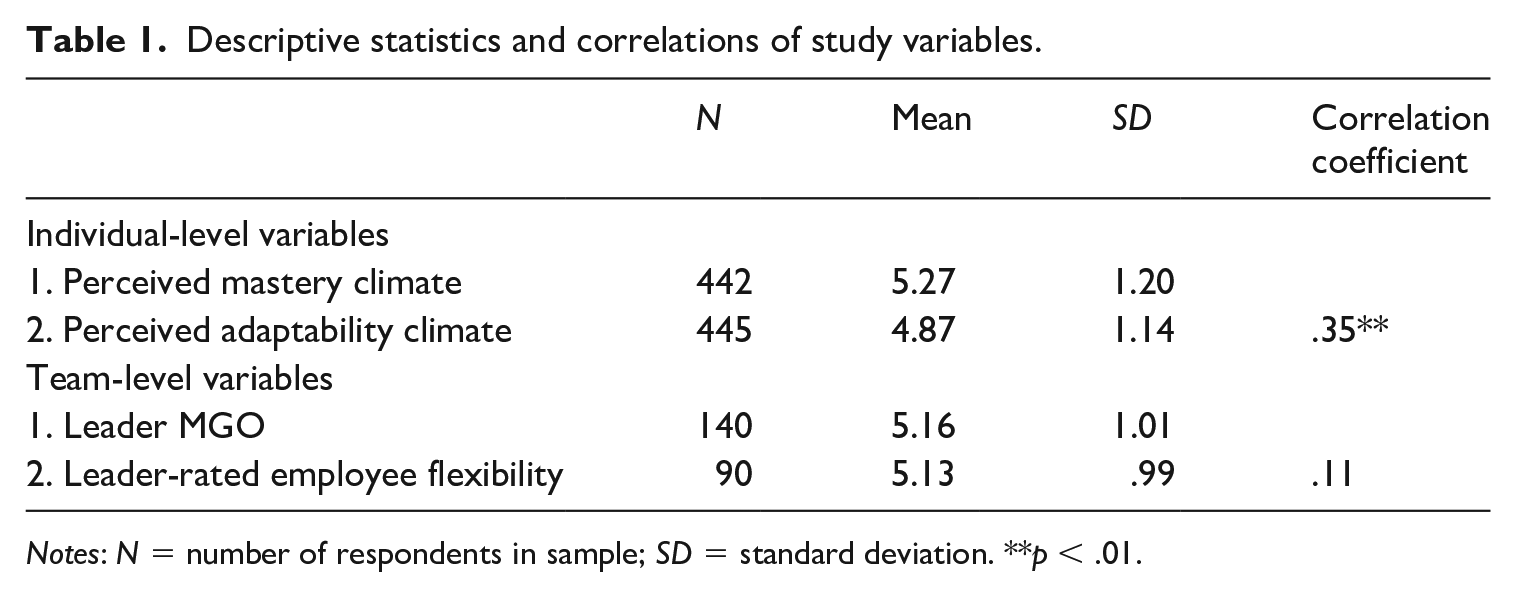
Notes: N = number of respondents in sample; SD = standard deviation. **p < .01.
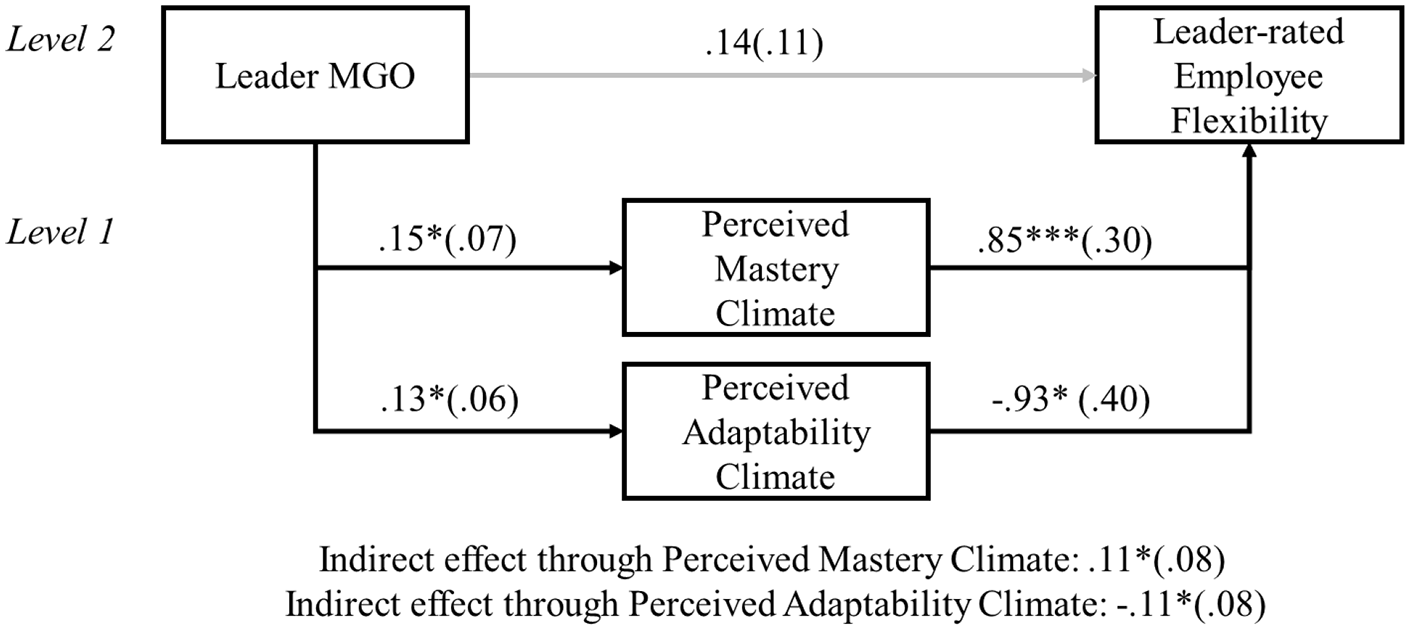
Results of the 2–1–2 MSEM analysis.
Credible intervals for observed indirect effects.
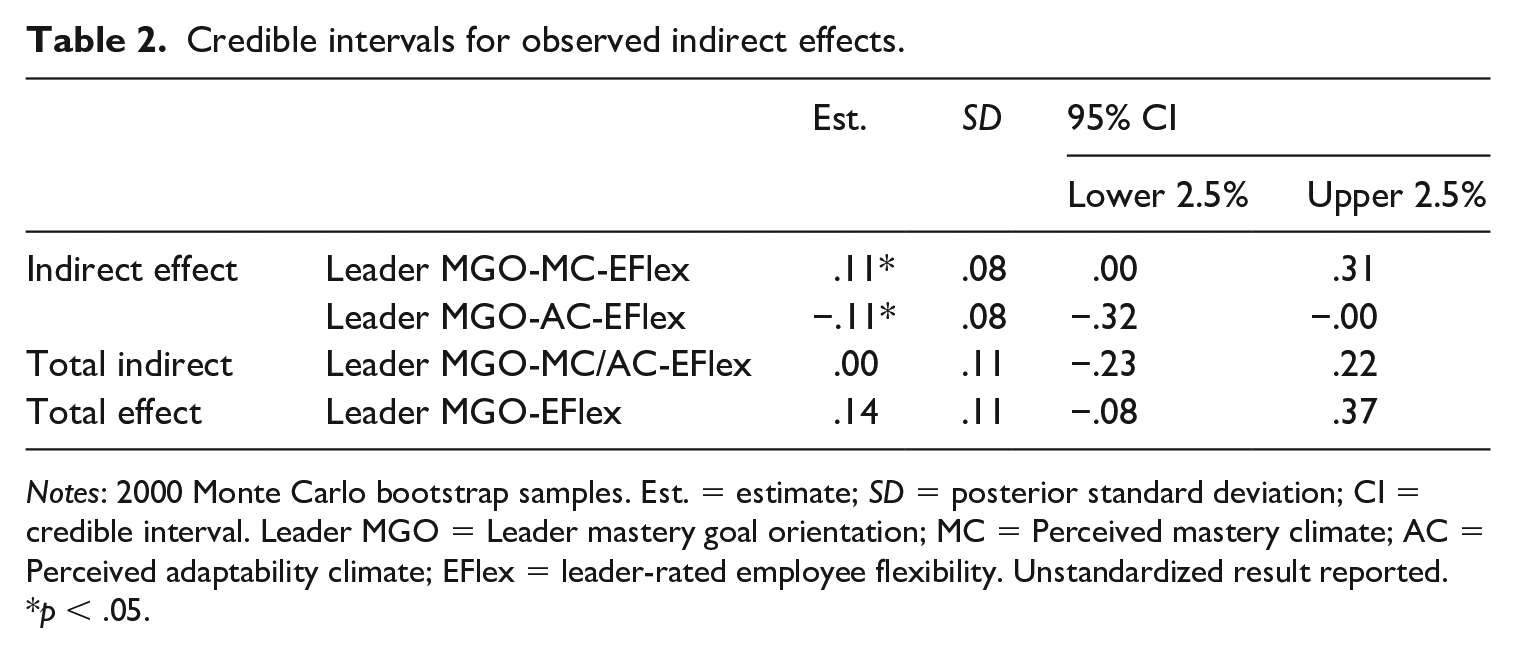
Notes: 2000 Monte Carlo bootstrap samples. Est. = estimate; SD = posterior standard deviation; CI = credible interval. Leader MGO = Leader mastery goal orientation; MC = Perceived mastery climate; AC = Perceived adaptability climate; EFlex = leader-rated employee flexibility. Unstandardized result reported. *p < .05.
As indicated in Figure 1 and Table 2, leaders’ MGO was found to be significantly and positively related to employees’ perceptions of a mastery climate (B = .15, SE B = .07, p < .05). Leaders’ MGO was also found to be significantly and positively related to employees’ perceptions of an adaptability climate (B = .13, SE B = .06, p < .05). Thus, Hypotheses 1 and 2 were supported.
In support of Hypothesis 3, employees’ perceptions of a mastery climate were found to be positively related to leader ratings of employee flexibility (B = .85, SE B = .30, p < .001). However, in relation to Hypothesis 4, we found that employees’ perceptions of an adaptability climate were negatively related to leader ratings of employee flexibility (B = –.93, SE B = .40, p < .05). The relationship was not in the expected direction; however, it was less positive than the relationship between mastery climate and employee flexibility. A contrast test of the two relationships also supported that the relationship between mastery climate and employee flexibility was significantly more positive than the relationship between adaptability climate and employee flexibility (B = 1.79, SE B = .55, p < .01, 95% CI [.668, 2.842]). Accordingly, Hypothesis 4 was partially supported.
In testing the first mediation hypothesis (Hypothesis 5a), we found a significant, positive indirect relationship between leaders’ MGO, employees’ perception of a mastery climate, and leader ratings of employee flexibility (B = .11, SE B = .08, p < .05). A specific test of the indirect effect indicated that the 95% credible interval was significant [.004, .314] since the interval did not include zero. Thus, Hypothesis 5a was supported. In testing Hypothesis 5b, we found a significant, negative indirect relationship between leaders’ MGO, employees’ perceptions of an adaptability climate, and leader ratings of employee flexibility (B = –.11, SE B = .08, p < .05). A test of the indirect effect indicated that the 95% credible interval was significant [–.324, –.002] since the interval did not include zero. The indirect relationship was not in the expected direction, accordingly Hypothesis 5b was not supported. However, the indirect relationship was less positive than the indirect relationship between leaders’ MGO, mastery climate, and employee flexibility. A contrast test of the two indirect effects also supported that the indirect effect through mastery climate work was significantly more positive than the indirect effect through adaptability climate (B = .24, SE B = .12, p < .01, 95% CI [.053, .530]). Accordingly, Hypothesis 5c was supported.
With regards to the overall fit of the structural equation model tested, the Bayesian posterior standard 95% credible interval for the difference between the observed and replicated Chi-square values was significant [20.52, 67.57] since it did not include zero, and the posterior predicative p-value was significant (p < .001). The deviance information criteria (DIC) of the hypothesized model was 3350.658. An alternative model without the direct path between leaders’ MGO and employee flexibility had a DIC value of 3351.350. Thus, the results showed that our hypothesized mediation model reported a smaller DIC value (∆ = .692) and was therefore superior (Zyphur and Oswald, 2015).
Discussion
Employee flexibility is desired and required by large businesses and small firms alike. Yet, the majority of research to date has addressed how to facilitate employee flexibility in large business settings, with HRM systems identified as a primary antecedent. In the present study, we addressed employee flexibility in small business settings. As HRM practices are neither extensive nor formalized in this context, we shifted our focus to the characteristics of the business leader.
Specifically, our study examined if small business leaders’ MGO could facilitate employee flexibility in their firms by inducing a work climate that promoted this outcome. However, we also sought to examine if mastery goal-oriented leaders could induce dual work climates that had different effects on employee flexibility. Drawing on social learning theory and SDT, we predicted that mastery goal-oriented leaders, by role modeling their preferences for learning and development, would induce perceptions of a mastery work climate that encouraged employee flexibility. However, we also predicted that mastery goal-oriented leaders, in striving to achieve their mastery goals, could induce an adaptability climate, where flexibility would be perceived as being expected of employees. We expected perceptions of an adaptability climate to be less positively related to employee flexibility than perceptions of a mastery climate.
In line with our hypotheses, we found that small business leaders’ MGO was positively related to perceptions of both a mastery climate and an adaptability climate in their firms. Yet, only the relationship between mastery climate perceptions and leader ratings of employee flexibility was positive. The more employees perceived an adaptability climate in their firm, the lower leader ratings were of employee flexibility. Accordingly, our findings indicate that leaders’ MGO could fuel employee flexibility when they encourage flexible behavior, yet stifle it when they signal that this behavior is expected. The theoretical and practical implications of our study are discussed below.
Theoretical implications
Our study contributes to the HRM literature by examining what influences employee flexibility in smaller firms that are unlikely to have the HRM practices found to positively influence this outcome in larger business settings. In doing so, we contribute to a greater understanding of how to facilitate employee flexibility in this very relevant, yet currently overlooked domain. On the other hand, the contributions of our study to the HRM literature are not limited to small business settings. To our knowledge, no research has examined leader characteristics or behavior in relation to employees’ skill and behavioral flexibility, neither in large nor small firms. Accordingly, our research takes a first step in contributing to greater knowledge about the influence leadership has on employee flexibility more generally. Furthermore, there is much research interest in the HRM literature in the role played by managers in translating intended HRM practices into experienced practice and, in turn, desired employee behavior (Bos-Nehles et al., 2013; Gilbert et al., 2011, 2015; Nishii and Wright, 2008; Purcell and Hutchinson, 2007). As our understanding of the way leaders’ abilities, personalities, motivations, and goal priorities influence HRM implementation increases (Kehoe and Han, 2020), so too will research investigating how the individual differences of leaders explains variation in employee flexibility in their units. Thus, while existing research on employee flexibility has largely focused on identifying the content of HRM practices that are important for enhancing this important outcome, our study could inform future research concerned with the managerial implementation of flexibility-enhancing HRM.
Our study also contributes to research in the HRM literature that suggests a learning climate or culture could be important for facilitating employee flexibility. Notably, Camps et al. (2016) find that employee flexibility is positively related to organizational learning capability, a dynamic capability that they argue is facilitated by a learning culture. While conceptualizations of learning climate and employee flexibility are different between our two studies, they are comparable enough to contribute collective evidence that employee flexibility is positively related to work climates or cultures that promote learning. Camps et al.’s (2016) research emphasizes the central role that managers should play in developing a learning climate, which our study empirically supports. However, our research also demonstrates that leaders can instigate multiple work climates that influence employee flexibility differently, and not always in compatible ways.
Our theorizing and findings relating to the dual work climate perceptions instigated by mastery-oriented leaders also make an important contribution to research applying a social learning lens to examine the relationship between leader goal orientations, work climate, and employee outcomes. Notably, we find empirical support for the positive relationship predicted by Dragoni (2005) between leaders’ MGO, employees’ perceptions of a work climate that emphasizes learning, and leader-rated employee outcomes, specifically employee flexibility. However, if social learning theory predicts that leaders, by engaging in behavior that aligns with their achievement goals, transmit their goal priorities and preferences to others, it is important to consider the broader range of behavior that could be associated with a particular goal orientation. By extending Dragoni’s (2005) conceptual model to account for the influence we expected mastery goal-oriented leaders to have on perceptions of an adaptability climate through displays of their own mastery-oriented behavior, we also show how having an MGO can influence employee flexibility in less positive ways. In doing so, our study responds to calls for research to examine multiple climate perceptions simultaneously (Kuenzi and Schminke, 2009) and supports why including multiple facets of climate in a single study could be important. Furthermore, our findings suggest the need for future research to consider potential negative side-effects of displaying an MGO, particularly across managerial and employee levels, a topic that has been largely overlooked in extant research. Future research is needed to see if the results found in the present research hold under different settings.
In the present study, we applied SDT in order to consider how perceptions of a mastery climate and an adaptability climate could trigger different levels of employee flexibility from employees. We selected SDT because the theorizing in this literature about informational and controlling aspects of work climates seemed to provide a good framework for outlining our expectations about how mastery climate and adaptability climate could relate differently to employee flexibility. Furthermore, as existing empirical research had connected mastery climate perceptions to SDT’s concept autonomous motivation (Nerstad et al., 2020; Steindórsdóttir et al., 2020), we had reason to believe that SDT could also provide compelling arguments for the relationship between adaptability climate (as a more controlling climate) and the controlled motivation that we expected would contribute to lower levels of employee flexibility. However, our findings related to adaptability climate and employee flexibility were not complete as predicted. Adaptability climate was not only less positively related to employee flexibility than mastery climate was, it was actually negatively related to employee flexibility.
One reason for this finding could relate to the consequences employees in our study perceived in relation to displaying flexibility. Perhaps they perceived no negative consequences for not displaying this behavior, or positive consequences for displaying it, such that they did not even experience controlled motivation. Thus, amotivation, or the absence of motivation for displaying flexibility, could have kept employees from displaying this behavior altogether (Deci et al., 2017; Gagné and Deci, 2005). Leaders’ use of contingent rewards and punishments to influence behavior is likely to vary across different firms. Accordingly, future research could examine if the perceived presence of these and other relevant external controls moderate the relationship between employees’ perceptions of an adaptability climate and leader-rated employee flexibility.
Another explanation for this finding could be that the expectations emphasized in an adaptability climate created an external standard that triggered a temporary performance-avoid goal orientation (PAGO) in employees. That is, the high achievement expectations emphasized in the adaptability climate could have prompted employees’ desire to avoid looking incompetent by not effectively adapting, such that they instead continued working in established ways and thus displayed inflexibility. This could be an interesting mechanism to examine in future research, particularly because research to date has only considered how mastery goal-oriented leaders elicit a temporary mastery goal orientation in their employees (Dragoni, 2005; Dragoni and Kuenzi, 2012).
Looking beyond the literature used to develop the present study, another explanation could be that employees in this particular context of study (accountancy firms) have been told for several years that significant changes are coming. That the future of the organizations they work for, and thus their own employability, rests on their ability to be adaptive. Yet, changes in this industry have not happened in the pace or magnitude predicted. Accordingly, the negative relationship observed between adaptability climate and employee flexibility could simply be a matter of change resistance in response to the lack of a compelling need to change (Stouten et al., 2018). On the other hand, change can be stressful for employees regardless of the pace or magnitude in which it unfolds. Some employees may cope with the demands of a changing work environment better than others. In other research, only employees who were high in their openness to change were found to respond positively to leader expectations to be flexible and adaptable (Griffin et al., 2010). Accordingly, future research could also identify individual differences that could explain why some employees respond positively to work climates that signal expectations for being flexible and adaptable, while others may not.
In short, our study does not provide any clear conclusions as to why employees’ perceptions of an adaptability climate were found to be negatively related to leader-rated employee flexibility. However, this discussion makes evident the need for future research that empirically tests the deeper psychological mechanisms that could underlie the relationship between leaders’ MGO, work climate perceptions, and employee flexibility as well as their boundary conditions.
Practical implications
Previous research emphasizes the need for leaders to switch achievement goals (i.e. from a MGO to a performance goal orientation) throughout a work process, such that the achievement goal they emphasize in a given situation is appropriate for the specific task being undertaken in their unit or group (Alexander and Van Knippenberg, 2014). Our research suggests that leaders having a particular goal orientation may also need to self-regulate their goal preferences and response tendencies such that they promote a work climate that supports the behavior they desire from employees, without simultaneously undermining it. More specifically, our research indicates that leaders having an MGO should focus on encouraging the learning and collaboration that promotes employee flexibility while avoiding sending too strong a signal that employees are also expected to be flexible, as this could have negative implications for desired employee behavior.
As in work contexts that require creative thinking and risk taking (Alexander and Van Knippenberg, 2014), we do believe that having an MGO is the most appropriate goal orientation for leaders who want to facilitate employee flexibility in changing and uncertain work contexts. However, to be effective, leaders need to be able to identify how having an MGO relates to the different behavior they display in response to changes and uncertainty at work. The challenge is to carry on with the behavior that promotes positive outcomes and refrain from engaging in behavior that could trigger negative responses. Accordingly, exercises in self-reflection and self-regulation could be helpful for mastery goal-oriented leaders who are experiencing issues with employee flexibility in their organizations or teams.
Limitations and further research needs
In this study, we focused on employee perceptions of mastery and adaptability climate as our main variables to explain the relationship between leaders’ MGO and their ratings of employee flexibility. However, in developing our conceptual model we identified other mechanisms that may also be important to study, namely employees’ intrinsic and extrinsic motivation for displaying flexibility (Gagné and Deci, 2005). Furthermore, we focused on explaining how small business leaders could influence employee flexibility through work climate perceptions but did not focus on when or under what conditions this relationship may be most viable or relevant. As indicated in earlier sections of this discussion, future research should investigate other potential mechanisms and boundary conditions in their studies.
Second, we tested our conceptual model in small accountancy firms. We believe that our findings are generalizable to other industries where incoming automation will likely change the nature of work considerably. Furthermore, we believe that our findings are generalizable to larger firms where line managers are expected to play an active role in facilitating change and thus employee flexibility in their teams. However, further research would be needed to determine the extent to which our findings hold in other business settings.
Furthermore, our design does not permit any causal conclusions. We collected data at two points in time and from different sources to avoid common method bias (Podsakoff et al., 2003, 2012). However, we did not measure our variables longitudinally, and thus we cannot be sure on the causal ordering of our constructs. Future studies collecting longitudinal data or using experiments could further investigate the causal relationships proposed in our study.
Finally, we used leader ratings of employee flexibility at the firm level, as this is the way that much of the extant research has measured this outcome (Beltrán-Martín and Roca-Puig, 2013; Beltrán-Martín et al., 2008). Furthermore, firm-level measures were expected to be sufficiently valid (Wall et al., 2004), particularly in the small firms we were investigating. However, this means that our conclusions are bound to leaders’ perceptions of employee flexibility in the organization as a whole. It would be interesting to compare the findings made in the present study with research examining the relationship between leaders’ MGO or employee climate perceptions and individual-level flexibility (i.e. a 2–1–1 model).
Conclusion
In the present research, we conducted a multi-wave, multi-level field study in order to investigate the relationship between small business leaders’ MGO and employee flexibility in their firms. We also examined how work climate perceptions could explain this relationship. We found that leaders who have an MGO induce a mastery climate in their organizations, where learning and trying out new ways of working are perceived as being encouraged. This, in turn, related positively with employee flexibility. On the other hand, we found that mastery goal-oriented leaders also induce a work climate where employees perceive the normative expectation to be flexible and adaptable to change. This adaptability climate was found to stifle employee flexibility. Our study makes important contributions to the HRM and general management literature. It also has useful implications for leaders having an MGO, with regards to helping them identify and self-regulate their goal preferences and tendencies, such that they can more effectively facilitate the employee flexibility needed in changing and uncertain work contexts.
Footnotes
Appendix
Acknowledgements
We are grateful to Associate Editor Kerrie Unsworth and three anonymous reviewers for their valuable comments on earlier drafts of this article.
Funding
The authors disclosed receipt of the following financial support for the research, authorship, and/or publication of this article: this research was supported by the RaCE program “Radical Technology-Driven Change in Established Firms”. Grant: The Research Council of Norway [247785].
