




Abstract
Through a nine-month ethnography in an advertising agency in Iran, a deeply conservative society, we explore the microprocesses through which actors search for and exploit areas of institutional plasticity toward incremental change. Given the infeasibility of more significant change in a highly institutionalized arrangement, actors in these settings are likely to seek out institutions characterized by the highest degree of plasticity. Yet, extant institutional research has not yet addressed the question of how they may go about doing so, which is what we seek to do in this article. By studying how celebrity endorsement became more normative in the field of advertising despite initial resistance from Iranian government regulators, we make four contributions to institutional literature. First, we demonstrate how institutional plasticity can serve as an antecedent to incremental institutional change in highly institutionalized contexts. Second, we trace the source of institutional plasticity to a misalignment between institutional pillars. Third, we identify the tactics and strategies that challengers use in the process of sensing institutional plasticity and stretching institutional boundaries. Finally, we shed light on the use of material and discursive resources across different stages of negotiations over incremental movements in the boundaries of normativity within a highly institutionalized setting.
Keywords
Introduction
The emerging literature on institutional change in highly institutionalized settings (Micelotta et al., 2017) has to date devoted limited attention to the question of how actors go about challenging the highly inertial practices, beliefs, values and norms comprising institutions (e.g. Claus and Tracey, 2020; Leung et al., 2014; Siebert et al., 2017). This research has highlighted the incremental and grassroots nature of change in highly institutionalized, coercively guarded arrangements (Claus and Tracey, 2020; Montgomery and Dacin, 2020), suggesting that the innumerable actions of challenger persons, groups and organizations aggregate to gradually shift higher-order arrangements over time (Dorado, 2005; Hallett and Ventresca, 2006).
Left unaddressed by this literature is the question of exactly how actors choose which elements of highly institutionalized arrangements to challenge. In such settings, potential challengers 1 are likely to perceive the arrangement as not amenable to more radical, transformative changes. To wit, it seems likely that challengers would seek to incrementally change those institutionalized practices, values and beliefs that custodians of the status quo would be willing to tolerate small transgressions over. In other words, challengers might seek out institutional plasticity, or an institution’s relative capacity for its constituent routines, values and beliefs to be “stretched to accommodate ever-changing practice performance” (Lok and De Rond, 2013: 186). Depictions of such incremental change in the institutional work literature have generally emphasized concerted, intentional, wide-ranging institutional projects (Lawrence and Suddaby, 2006; Wright et al., 2017) without addressing the less intentional microprocesses that seem likely to dictate the trajectory of such incremental changes. Thus, we ask: how do challengers leverage institutional plasticity to generate change in a highly institutionalized setting?
To answer this question, we draw on the recent work on the antecedent microprocesses of higher-order institutional change (Creed et al., 2010; Vaccaro and Palazzo, 2015) by examining the strategies and tactics through which challenger actors identify and leverage plasticity toward incremental change. To this end, we use an ethnographic study of Iranian advertising professionals formulating and pitching ads to government regulators. Following the 1979 Islamic Revolution in Iran, the trajectory of advertising was dramatically altered after control of the state was seized by a cadre of deeply conservative clerics. Until the Revolution, this trajectory mirrored the evolution of Iranian society writ large: throughout the first seven decades of the 20th century, progressive forces in the country and national alliances with Britain and the USA encouraged a degree of isomorphism with western norms for the types and content of marketing campaigns produced by advertising agencies. Since the early 1980s, however, the Islamic Republic of Iran Broadcasting (IRIB) and Ministry of Culture and Islamic Guidance (MCIG) have strictly monitored the products of advertisers’ work, approving only those ads that government regulators believe conform with conservative Islamic values. The result has been a catch-22 for Iranian ad professionals whereby the Islamic regulations governing the institution of advertising are at odds with the historically developed liberal societal norms espoused by advertising audiences.
In our study, we observed that advertisers challenge the status quo by deploying a set of tactics and strategies responsible for identifying areas of institutional plasticity and leveraging it through minor transgressions of Islamic beliefs and values. In doing so, they not only take account of what facets of the institutional environment are characterized by the highest degree of plasticity but engage in several tactics that allow them to understand the values and interests of the custodians, allowing them to prepare for mutually satisficing negotiations over transgressive ads with regulators, thus pushing the boundaries of institutional acceptability in incremental ways.
In studying Iranian ad professionals’ challenges to the status quo, our work makes several important contributions to the literatures on institutional change and plasticity. First, we find that challengers in highly institutionalized arrangements engaged in processes we label sensing and stretching, by which they gauged and strategized around institutional plasticity to orient their pitches of transgressive ads to government regulators. Through theorizing sensing and stretching, our study shows that plasticity can be leveraged as part of a change project, contra the thrust of the plasticity literature to date, which suggests that plasticity encourages the perpetuation of the status quo (e.g. Gümüsay et al., 2020; Herepath and Kitchener, 2016; Lok and De Rond, 2013). Second, through the historical analysis of the Iranian advertising profession and deep insight into the work of Iranian ad professionals, we trace the nature of institutional plasticity to a misalignment between the normative and regulative pillars of the advertising institution, whereby the liberal normative arrangements historically developed over 2500 years of monarchy lagged behind abrupt changes to advertising regulations spurred by the Islamic Revolution. Third, we build on recent conceptual work suggesting that actors must apprehend opportunities for change before they can act on them (i.e. Voronov and Yorks, 2015) by shedding light on the strategic process by which challengers come to sense institutional plasticity and stretch institutional boundaries through minor transgressions in a highly institutionalized arrangement. Finally, we contribute to the literature discussing the negotiations that often underpin institutional change (Helfen and Sydow, 2013; Zietsma and Lawrence, 2010). By distinguishing between the real-time negotiation and its preparatory stage, we demonstrate differences in the use of both subtle and explicit symbols across the different phases of negotiation by challengers of the status quo, co-opting custodians into stretching the boundaries of what is institutionally permissible through minor transgressions.
Institutional change: Transformational and incremental
After the majority of the early institutional scholarship sought to explain the drivers or effects of institutional stability, persistence and reproduction, much of scholars’ effort over the past two decades has shifted toward explicating the processes by which institutions change (Dacin et al., 2002; Greenwood et al., 2008). In that time, change in institutions – the “(more or less) enduring elements of social life” that provide persons with “templates for action, cognition, and emotion” (Lawrence et al., 2011: 53) – has been examined for its endogenous and exogenous catalysts across the individual, interactive and field levels of analysis (see Micelotta et al., 2017).
One distinction that has emerged as important in the institutional change literature is between transformative and incremental change, the former receiving the majority of scholars’ collective attention. Indeed, in their review of the institutional change literature, Micelotta and colleagues (2017: 1886) noted that, to date, change “has been conventionally portrayed as a dramatic and frame-bending experience that transforms institutional fields”. Researchers have devoted significant effort to investigating how actors use social movements (see Schneiberg and Lounsbury, 2017), discourse and rhetoric (e.g. Maguire and Hardy, 2009) and network positions (e.g. Maguire et al., 2004) to affect sweeping changes in regulatory frameworks, taken-for-granted practices and beliefs, and widely held values within a field. Some of these conversations evolved under the umbrella of institutional work, which emphasized the intentionality of actors purposefully engaged in creating, maintaining and disrupting institutions (Cartel et al., 2019; Lawrence et al., 2013).
However, while an intuitive starting point for change studies, given that truly transformational institutional shifts provide the most readily apparent evidence of change, more recent research has revealed institutional change to be, in many instances, incremental and evolutionary, with a critical mass of minor modifications to practice, value and belief culminating in more gradual field-level rearrangements (Dorado, 2005; Gehman et al., 2013). These minor modifications are often conceptualized as having their roots in the “autonomous actions of countless agents converging over time” (Dorado, 2005: 400), a distributed, “bottom–up” perspective on institutional agency that highlights local, on-the-ground variations in practice, value or belief and the more-or-less strategic improvisation of rank-and-file institutional inhabitants as the locus of higher-order institutional change (Hallett and Ventresca, 2006; Quack, 2007).
Research adopting this incremental perspective on institutional change has posited a number of cognitive, practical and discursive microprocesses through which the institutional rank-and-file affect significant changes in institutional arrangements (Powell and Colyvas, 2008; Reay et al., 2006). For example, Leung et al. (2014) showed how the everyday identity work of Japanese middle-class housewives brought about changes to the institutionalized professional roles of women in Japanese social enterprises (see also Creed et al., 2010). Smets and colleagues (2012) found improvisation and subsequent justification of practices in a recently merged Anglo-German law firm to result in the hybridization of field-level logics. Cumulatively, these studies suggest that institutions not only undergo dramatic transformations, but also the slow-moving incremental transformations constituted by aggregate actions of persons embedded in them.
Highly institutionalized contexts and opportunities for incremental change
According to Micelotta et al. (2017), one shortcoming of the literature examining incremental, bottom–up change is that it lacks adequate theorization of how institutional configurations recursively influence the on-the-ground practices and cognitions that undergird higher-order change. To date, researchers have (implicitly) suggested that institutional complexity – that is, the presence of several partially contradictory, fragmented and hierarchically arranged institutions (see Kraatz and Block, 2017) – can serve as a cultural toolkit from which persons can act and think in more-or-less transgressive ways that, cumulatively and over time, can snowball into higher-order change. However, we know little about whether (and how) other types of structural arrangements influence change processes. For example, practices, emotions and cognitions constituting bottom–up change in the context of institutional voids (e.g. Mair et al., 2012) or total institutionalization (e.g. Davies, 1989; Goffman, 1968) are still poorly understood.
This gap in our understanding becomes particularly salient in the context of highly institutionalized arrangements. Such arrangements are characterized by highly inertial and deeply sedimented symbolic systems and patterns of practice constituting institutions, which can be maintained through associated sanctions for non-compliance, deep-seated beliefs and taken-for-grantedness (Scott, 2014). Because of their resilience, such contexts would, on the face of it, seem to inhibit any sort of concerted change project. Yet, recent research suggests that such arrangements, even when highly guarded, can and do change (Claus and Tracey, 2020; Montgomery and Dacin, 2020).
Extant research on change in highly institutionalized arrangements implies that change in such settings is indeed likely to be incremental rather than transformational and led by grassroots efforts to affect these gradual modifications to overarching institutional structures. For example, Jarvis et al. (2019) found advocates’ emotional displays to be integral to grassroots challenges to deeply institutionalized modes of producing animal-based food products, resulting in incremental institutional changes such as state-level regulatory changes requiring more humane treatment of livestock. Ghaffari and colleagues (2019) showed how consumer improvisation in daily consumption practices spurred change in the deeply sedimented practices in the Iranian fashion clothing market. Claus and Tracey (2020) found that the “grassroots” status of a social movement organization (actually organized by non-governmental organizations (NGOs)) was integral to challenging institutions surrounding child marriage in Indonesia. These challenges culminated in a requested judicial review of child marriage exceptions that was eventually rejected by Indonesia’s highest court, though the public outcry this caused reflected the incremental changes to modal Indonesian perspectives on child marriage the social movement organization had brought about.
While this literature has given cursory attention to the tactics used by challengers to affect incremental change in highly institutionalized arrangements, it has yet to address how challengers choose which elements of highly institutionalized arrangements to challenge, especially when these are coercively guarded. Challengers are likely to understand immediate, transformative change in these settings to be highly unlikely, if not impossible. Given this understanding, the choice of which incremental changes to target becomes strategically important: while change initiatives that are too radical are more likely to fail, those too modest will delay more substantive progress.
Leveraging structural forces to change highly institutionalized arrangements
Institutional plasticity, defined as an institution’s relative capacity for its constituent routines, values and beliefs to be “stretched to accommodate ever-changing . . . performance” (Lok and De Rond, 2013: 186), is a structural characteristic of institutions that seems likely to be exploited by those seeking to incrementally change a given institution. To date, the little extant research on the plasticity has broadly suggested that some institutions “bend but do not break”, focusing on how normatively transgressive enactments of institutions can be “accommodated” without substantive change in the higher-order structural arrangement. Thus, scholars assert, the greater the plasticity of an institution, the greater the likelihood that the practices and symbols constituting the institutional status quo will persist. Herepath and Kitchener (2016) found that the plasticity of the institutions governing the medical profession in the UK enabled repair work, maintaining macro-order structures dictating appropriate medical practice. Gümüsay and colleagues (2020) observed that a state of “elastic hybridity” between market and religious logics governed normative enactment in Islamic banking to affect a stable state of mutual influence on actors embedded in this sector.
In sum, scholars have theorized plasticity as a condition that perpetuates institutional arrangements. Yet, equally intriguing is the idea that plasticity might be leveraged toward incremental institutional change. While the microprocesses by which actors go about leveraging plasticity toward such incremental change is as of yet unresearched, there are indications in the institutional change literature that allude to potential answers. Voronov and Yorks (2015), for example, suggested that such microprocesses almost certainly contain a perceptual element. Challengers must first reflexively apprehend opportunities for change in highly guarded institutions and be properly motivated to undertake the significant efforts to change them (e.g. McCarthy and Moon, 2018; Ruebottom and Auster, 2018). Such apprehension would seem particularly important in highly institutionalized settings, where identification of institutional plasticity would likely underpin any potentially successful efforts at incremental change.
Once motivated by an identified opportunity for change, challengers face the hurdle of moving highly sedimented practices, values and beliefs, often fiercely guarded by elite actors. Direct, field-level contestation toward transformative change is often infeasible for challengers, leading to more efforts toward incremental change, which seems likely to succeed when directed at those institutionalized practices, values and beliefs that have the highest degree of plasticity. Some institutional scholarship suggests that challengers may experiment with such minor transgressions as a function of testing institutional boundaries (e.g. Cartel et al., 2019; Dalpiaz et al., 2016). The small body of research on the topic suggests that plasticity often manifests in institutional guardians’ willingness to overlook, tolerate, coopt and haggle over the minor transgressions constituted by such experimentation (Hatani, 2016; Kent and Dacin, 2013; Lok and De Rond, 2013). Indeed, the limited work on “negotiations” mediating such institutional change efforts highlights the importance of debate and bargaining. Helfen and Sydow (2013: 1078), for example, discuss the notion of integrative bargaining, in which challengers might emphasize “shared motives and goals” and restrict their “initial claims in order to provide room for a joint problem-solving” to increase the chance that their appeals would be successful and result in mutually beneficial outcomes. Nevertheless, researchers have mostly focused on the content of rhetoric in these negotiations to the exclusion of the actual interactions that constitute these integrative negotiations, which, considering insights from the recent work on institutional microprocesses (see Powell and Rerup, 2017), seem likely to be the on-the-ground, quotidian medium for such efforts.
Cumulatively, these strands of institutional research provide only vague indications regarding how challengers in highly institutionalized contexts go about identifying those practices, values and beliefs with the highest degree of plasticity and practically changing these institutions in incremental ways. To redress this omission, we ask: how do challengers leverage institutional plasticity to generate change in a highly institutionalized setting?
To understand the mechanisms through which challengers might be able to leverage plasticity, we focus on the microprocesses underpinning such mechanisms (Gray et al., 2015; Powell and Colyvas, 2008; Reay et al., 2006) as the “series of specific dynamics operating at the micro level” (Kellogg, 2011: 497). We follow this line of scholarship in distinguishing our focal microprocesses into overarching strategies and their composite bundles of tactics that, in aggregate, constitute those strategies (Micelotta et al., 2017) that are instrumental in “building and changing” institutions through actors’ interpretations, actions and interactions (Corbett et al., 2018: 264). That is, we distinguish between the overarching, coordinated and planned strategies of institutional change and the “on-the-ground” tactical efforts that implement those plans to aid our efforts to identify how our focal challengers went about incrementally moving standards for Iranian advertising.
Empirical context
The evolution of Iranian advertising
Iranian advertising has a rich and tumultuous history, dating as far back as 1888. Until the Islamic Revolution in 1979, the country was ruled by King Mohammad Reza Pahlavi, an ally of the West. Under his rule, Iranian advertising followed western models and reflected liberal views. Western forms of advertising, including those showing female bodies, were legal and socially accepted. As clerics came to power following the Revolution, conservative religious beliefs came to dominate politics, business and everyday life (Bruno et al., 2013; Curtis and Hooglund, 2008). Given advertising’s distinctly western orientation, all its forms were halted. In 1980, a legal framework was established to monitor the activities of the advertising agencies, which were allowed to restart substantive advertising activities, albeit within much tighter and closely monitored constraints. By 1993, the industry was booming again, so the MCIG (Ministry of Culture and Islamic Guidance) in Iran expanded its responsibilities to monitor advertising agencies. This led to the formation of the Advertising Center under MCIG supervision (see Figure 1).
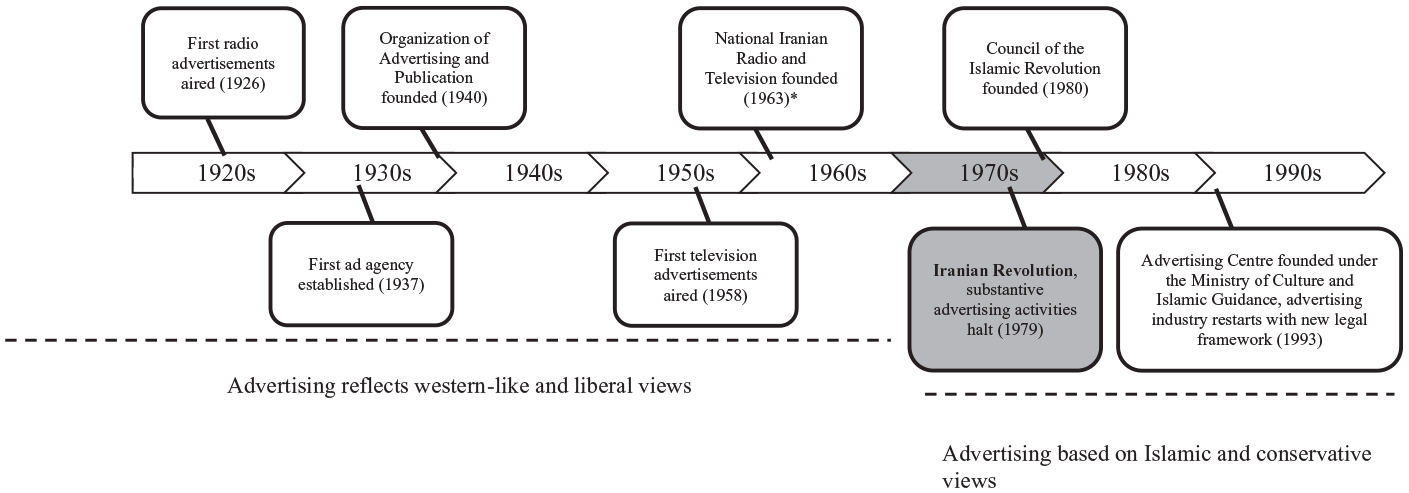
Timeline of significant events in the evolution of Iranian advertising.
Current regulations, censorship and regulatory approval
All Iranian advertising needs to adhere to the conservative Islamic rules of the country (for instance, female bodies and suggestive images are entirely prohibited) and has to be approved by the appropriate governmental institution through reviewing the storyboard or design of the ad. TV and radio commercials are approved by the Islamic Republic of Iran Broadcasting (IRIB), whereas billboards and public press releases are certified by the MCIG (Tehran Bureau, 2013). Both have representative offices in all major cities, and approval can be sought in any of those. However, the stance of the IRIB is much more relaxed than that of the Advertising Center under the Supervision of the MCIG, and enforcement differs across cities. This is acknowledged in a quote by the Minister of Culture and Islamic Guidance: There is no coordination between IRIB and Ministry of Culture and Islamic Guidance . . . MCIG has no interference to what is advertised in the national TVs, and this is a challenge between these two government agencies. Currently IRIB does not comply with the established rules . . . when we establish a rule in MCIG in Tehran, other cities should abide and conform to that rule. (quoted in ISNA News Agency, 2014)
Working based on western norms and historically shaped consumer values, while also obtaining approval from the conservative regulatory, creates a challenge for advertising agencies. They need to deploy strategic tactics to align disparities between societal norms and advertising regulations. Their implementation has become yet more problematic in recent years following rising tensions between advertisers and regulators, manifesting most prominently in the recent ban on the practice of celebrity endorsement. 2 In 2008, Hossein Rezazadeh, an Iranian weightlifter, appeared in a Dubai real estate commercial aired by an Emirati satellite channel. The Iranian government responded by banning any use of athletes and male movie stars in advertisements. The Head of the Information Office in the MCIG explained that “cultural and athletic role models . . . should be promoting chivalry rather than consumerism” (The Economic Times, 2008). However, the use of celebrity endorsement in advertising campaigns by many global brands during the 2014 World Cup and the election of reformist president Rouhani in 2013 increased ad professionals’ motivation to attempt pushing the boundaries of existing rules in Iranian advertising to achieve their commercial objectives.
Research setting
We selected Dalton (pseudonym), one of the most creative international advertising agencies in Iran, which managed to challenge the conventions and go beyond the established rules through its progressively defiant strategies. Over the course of the study, we observed Dalton become the first advertising agency in Iran to overcome the ban on celebrity endorsement. The campaign, developed for an engine oil client, was discussed by the officials and industry representatives at the 2015 conference on “The Role of Artists and Athletes in Advertising”, after which other Iranian agencies started using celebrity endorsement (Fallah, 2017). Crucially, this change did not significantly disrupt the conservative Islamic values of the state: the ban was lifted on the terms dictated by the regulators. The use of celebrities in advertising is expected to benefit the Iranian economy under western sanctions without promoting consumerism and to be practiced in a locally idiosyncratic way (for instance, reflecting the religious norms of modesty; see Fallah, 2017). Our study therefore highlights a change within, but not a significant disruption of, the dominant prescriptions of the advertising institution in Iran.
Method
Research design and data sources
In response to calls for ethnographic, in situ studies of microprocesses of institutional change (Lawrence et al., 2013; Zilber, 2002), we conducted an ethnography, focusing on deep engagement in the field and observing everyday realities of Iranian advertisers. The first author spent nine months at Dalton collecting data during 14 advertising campaigns. Observations spanned all campaign stages, starting with client meetings, where advertisers would obtain clients’ business requirements and the scope of the project in the form of briefs and understand their viewpoints reflected in their behaviors and discourses. This was followed by brainstorming sessions to generate conceptual ideas, executing ideas into concrete forms, presenting them to clients and incorporating their feedback, and subsequently seeking governmental approval on the proposed campaigns. This final process entailed many back-and-forths before the advertisement could be disseminated in the media.
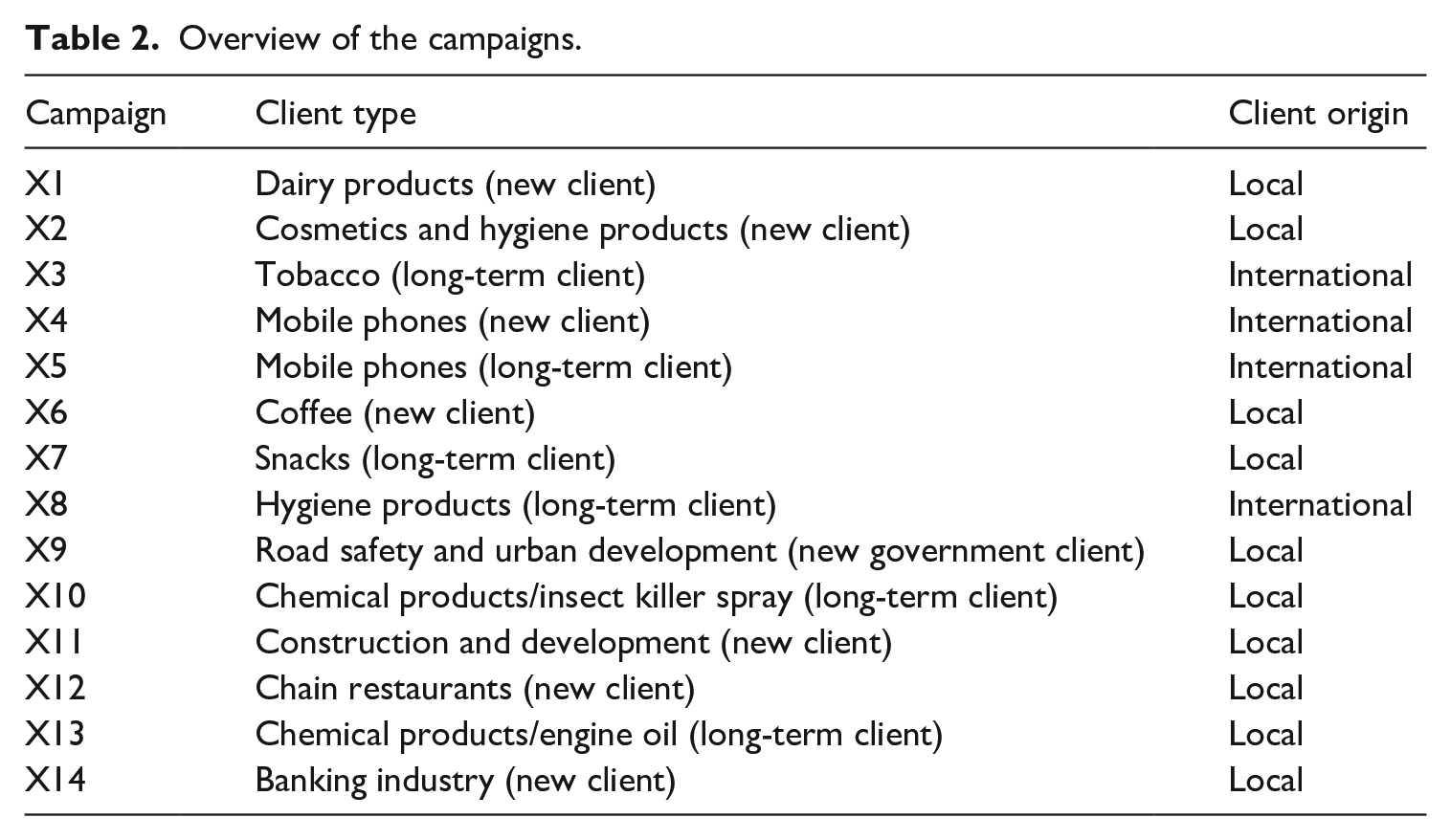
We employed several data collection methods. Participant observations involved watching participant activities and interacting with them, as well as conducting multiple semi-structured and informal interviews with 19 employees from different departments (including the CEO, creative, account and media professionals; their details can be found in the online supplementary file). To preserve participant anonymity, we use pseudonyms throughout the article. Observations were compiled into field notes, and formal interviews were recorded and transcribed, producing 250 pages of field notes and 113 pages of transcriptions. The researcher also asked participants to elaborate on their strategies and tactics, when the reasoning behind them was not clear. These informal interviews were also recorded and transcribed, resulting in 23 pages of transcriptions. Finally, we collected secondary data to triangulate and contextualize our analysis of the primary data. The data sources and their use in the analysis are described in Table 1. Table 2 provides an overview of the campaigns.
Data sources and their use in the analysis.
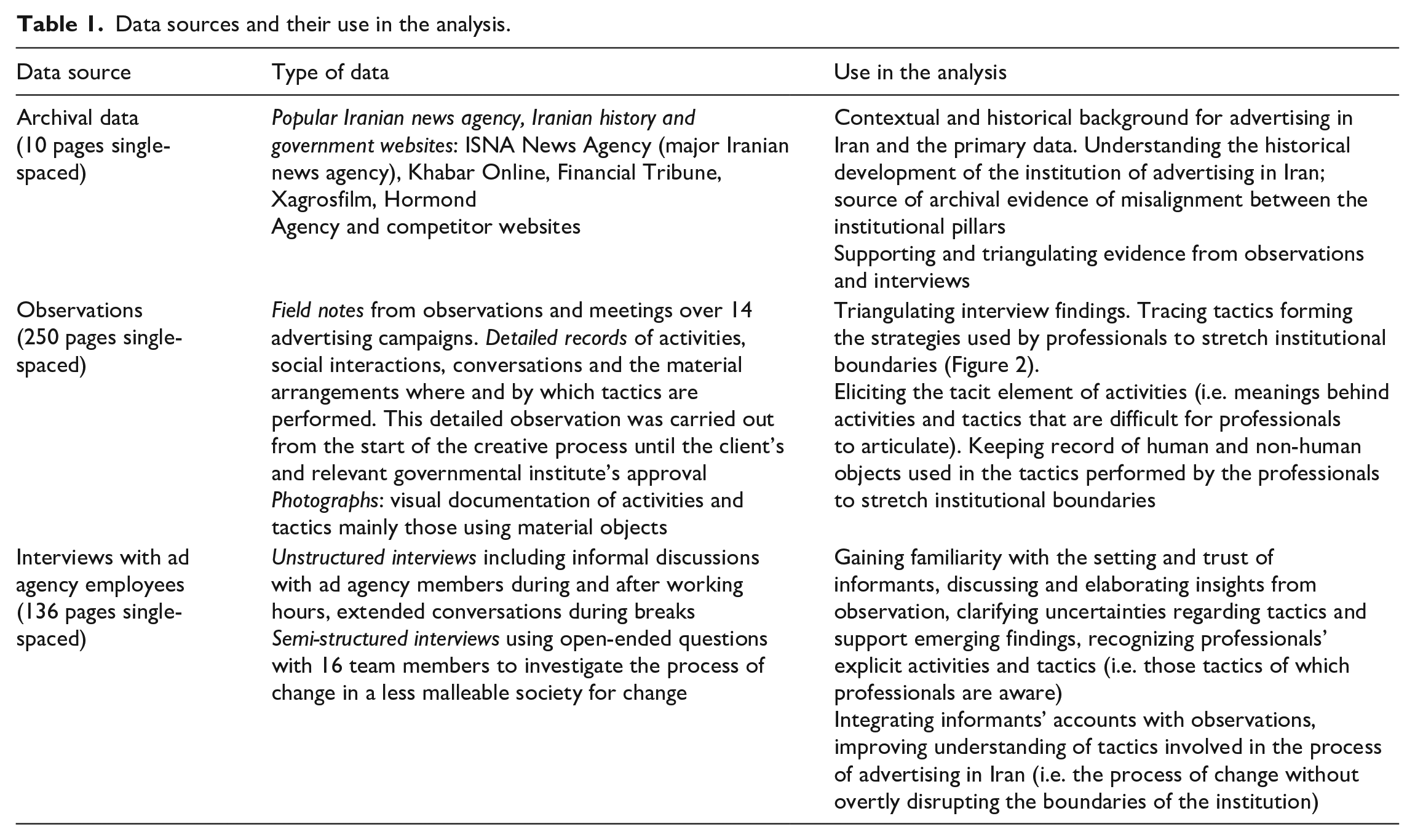
Overview of the campaigns.
We ensured the trustworthiness and rigor of our data in four steps (Lincoln and Guba, 1985). Through prolonged engagement with the organization and respondents, we familiarized ourselves with the context to increase the validity of our findings. We triangulated different sources of data and kept detailed records to use during the inference stage (Shah and Corley, 2006). Data from interviews and observations were transcribed, translated and back translated from Persian into English by the first author, an Iranian national brought up and socialized in the country. We used NVivo to store, search and collectively code, theorize and recode the data. Finally, we employed member checks to ensure that our interpretations reflected participant experiences and sought clarifications through informal interviews.
Data analysis
We relied on an abductive approach in our analysis (Locke et al., 2008; Timmermans and Tavory, 2012), which begins with “an initial . . . insight originating from the empirical data” (Smets et al., 2015: 939) and progresses through data coding, categorization and conceptualization (Gioia et al., 2013). Our initial surprising insight (Smets et al., 2015) came from the fact that advertisers were able to change the rigid conservative requirements that characterize the existing field of advertising, specifically, the ban on celebrity endorsement, without causing a significant disruption of the local context or generating tension with the officials. We iterated between multiple sources of data and existing literature (Strauss and Corbin, 1998) and engaged with multiple theories that might address the empirical puzzle.
We considered alternative theoretical frameworks to best explain our data (Gioia et al., 2013). By iteratively comparing our findings with the literature and consulting with secondary data, we concluded that advertisers stretched institutionally sanctioned boundaries but did not undermine the overarching institutional order, pointing us in the direction of literature on institutional plasticity (Lok and De Rond, 2013) and institutional change as the theoretical framework. This process was not always entirely linear, but to summarize our reasoning we present the three main stages of the analysis. In the first phase (data organization), the first author wrote a thick description of the advertisers’ work to generate an overall understanding of the events observed in the field and identify the activities and tactics involved in non-disruptive institutional change. In the second phase (data mapping and coding), we used the description of the data as the basis for the first-order codes. Open coding generated multiple descriptive codes reflecting the activities carried out by advertising professionals across multiple campaigns. We also conducted a chronology of events to identify three sequences of activities common across the campaigns. One of our initial insights suggested that advertisers’ international experiences helped them identify the nuances of the Iranian context that in turn allow them to assess the extent to which they can be transgressive in their work. For example, Iman, an art director who worked in Malaysia for several years reflected on the inability to use women’s portraits on billboards. We termed this tactic reflecting on internal and external socialization. Further, during the work on the campaign, some of the tactics used by professionals to increase the chance of approval by the officials involved the use of “material forms of visuality” (Meyer et al., 2013: 2) such as the ads themselves. Thus, we observed how advertising professionals came up with multiple versions of each ad for clients and regulators to avoid failure. This tactic was labelled preparing multiple more-or-less transgressive ads. Having identified the tactics through open coding, we began aggregating them into second-order themes (Corley and Gioia, 2004). We scrutinized the goals of these tactics that could bring them together to form strategies through which advertisers were able to implement incremental institutional change. We also put primary data into its longitudinal, historical context by relying on archival information (Pettigrew, 1997). Our insight was that norms guiding advertising professionals could be traced back to pre-1979, in contrast to regulations progressively enforced by the government after the Islamic Revolution. This helped us bring together the advertisers’ tactics to bridge said institutional disparities into the strategy of gauging institutional plasticity.
In the third phase (development of the theoretical model), we examined the relationship between the identified tactics and strategies to address our empirical puzzle (Smets et al., 2015). Following previous work on microprocesses of institutional change (e.g. Creed et al., 2010; Leung et al., 2014), we sought an explanation for the factors that allowed advertising professionals to accomplish institutional change. We compared activities, outcomes and multiple interactions between institutional actors across campaigns as an ongoing process rather than isolated instances. We then used archival data again to ascertain the success and non-disruptive nature of institutional change. Following Gioia and colleagues (2013), we organized our findings into two nested categories capturing the mechanism of change enabled by challenger actors’ leveraging of institutional plasticity. We combined the strategies involved in gauging plasticity and strategizing around it under the label of sensing, whereas strategies aimed at fabricating alignment toward co-optation of the custodians, and real-time co-optation of the custodians as stretching. To reflect the process through which we bridged data and theory, we illustrate the relationship between our codes and emergent theory in Figure 2, whereas Table 3 offers illustrations evidencing the first- and second-order codes.
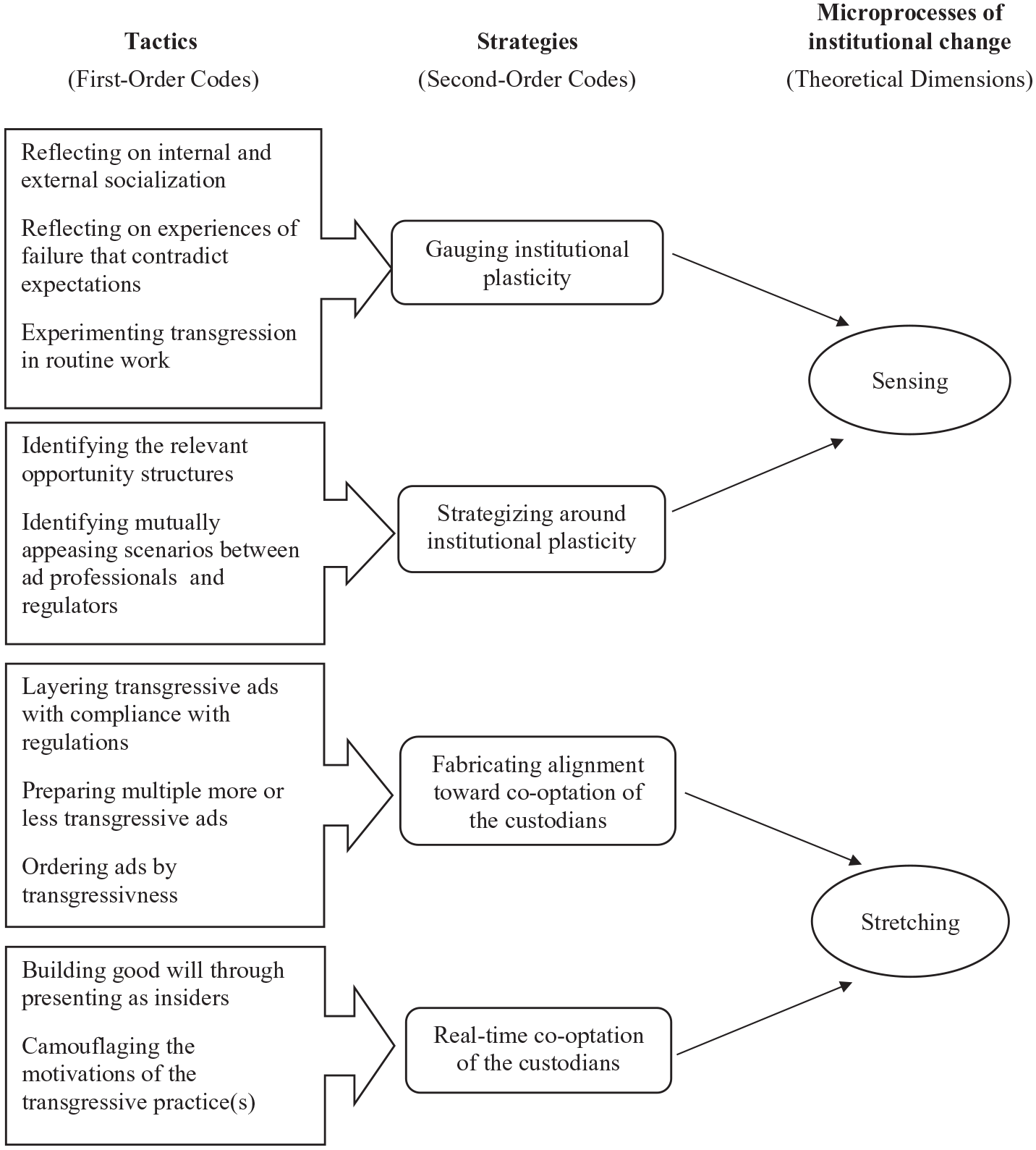
Microprocesses of leveraging plasticity for institutional change.
First-order codes, second-order codes and representative data.
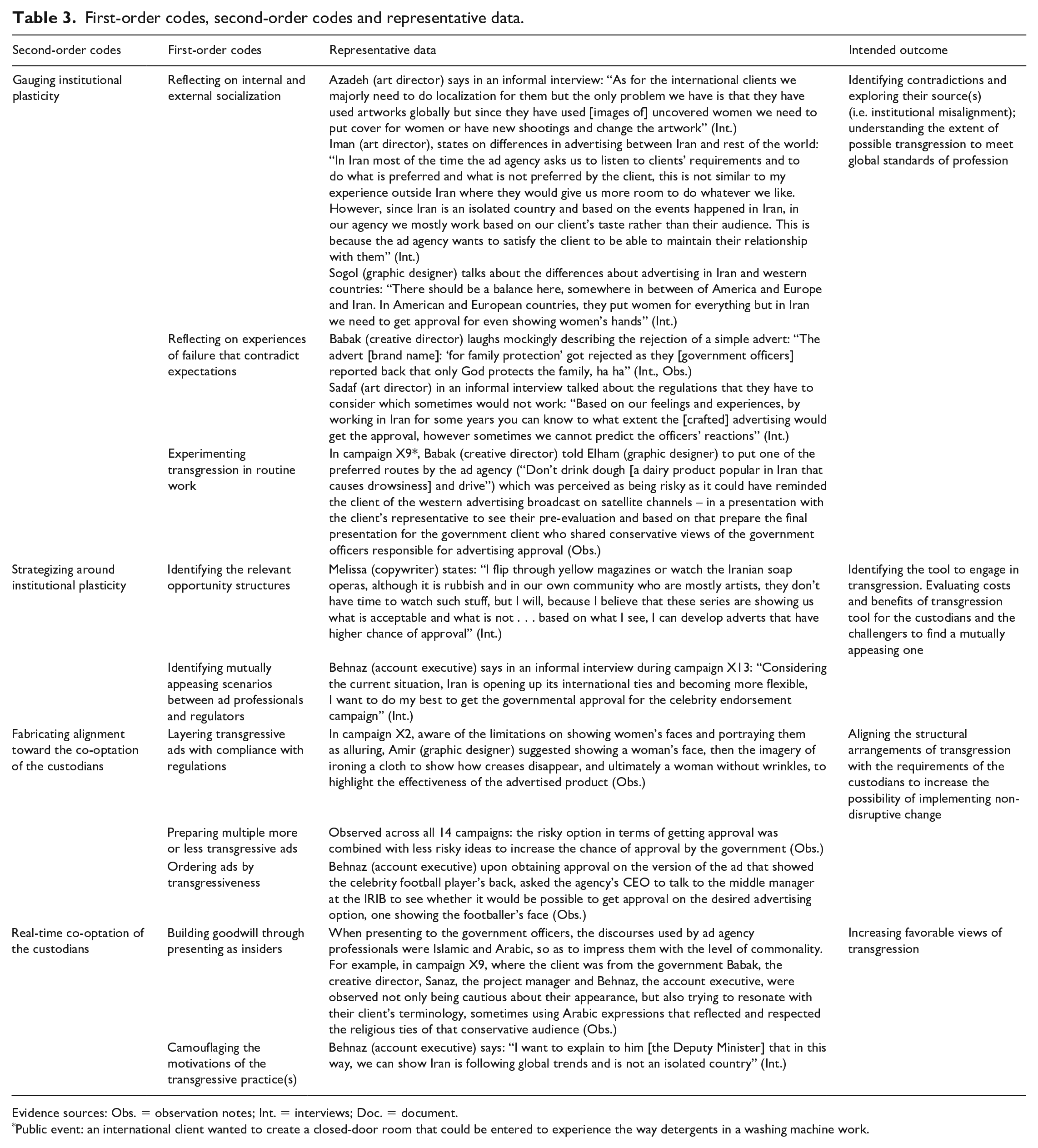
Evidence sources: Obs. = observation notes; Int. = interviews; Doc. = document.
Public event: an international client wanted to create a closed-door room that could be entered to experience the way detergents in a washing machine work.
Findings
Renowned for its creativity, Dalton tried to satisfy its clients by providing cutting-edge ideas that at times were challenging to implement, mainly owing to strict Iranian advertising regulations. As each campaign was differentially creative and normatively transgressive, we started our fieldwork by observing multiple campaigns. We soon realized the cumulative and mutually informative nature of campaigns in practitioners’ risk-taking behavior. Their understandings of where and when they could take risks in new ads was accumulated by engaging in routinized work constituting minor breaches of the status quo without intent to challenge it, especially when it came to the regulations in the field of Iranian advertising.
Analyzing change in a highly institutionalized setting
We started our fieldwork with an understanding that creativity in advertising requires “outside-the-box” thinking while Iran’s Islamic regulations promote thinking “inside the box”. However, as described above, despite these restrictive regulations, advertising practitioners do manage to accomplish their goals, prompting our motivation to understand how practitioners decide when to go beyond their minor risk-taking behaviors and what strategies to deploy to implement change in a highly institutionalized setting. Our analysis revealed four strategies describing how advertising professionals went about identifying and strategizing around areas of institutional plasticity that we saw as transpiring in two microprocessual phases: sensing and stretching. In the former, practitioners tried to identify the degree of plasticity and pre-emptively strategize plans to leverage plasticity through two microprocesses we refer to as gauging institutional plasticity and strategizing around institutional plasticity. In the latter, on the basis of the search and planning activities from the sensing phase, practitioners rely on the strategies of fabricating alignment toward co-optation of the custodians and real-time co-optation of the custodians to implement change. We begin the discussion of our findings by expounding on the microprocess of sensing, which comprises two overarching strategies: (1) gauging institutional plasticity and (2) strategizing around institutional plasticity.
Gauging institutional plasticity
Expanding on to the concept of apprehension, practitioners detected the misalignment between the normative and regulative pillars of institutionalized advertising in Iran through (1) reflecting on their internal and external socializations, (2) reflecting on experiences of failure that contradict ad professionals’ expectations and (3) experimenting with transgressions in routine work.
Reflecting on internal and external socialization
By developing a sense of the socio-cultural context in which they operate as well as contrasting their various professional experiences in different parts of the world, Iranian advertising professionals developed a sense about the milieu in which they work and its socio-cultural conditions and requirements. This sense can help creatives in crafting ads in such a way that they are likely to be approved. Through their extensive experience in the industry, they come to know the tacit and explicit rules and the implications for transgressing them in more or less significant ways. For example, to comply with regulations, advertising involving women is only used with caution, with their bodies fully covered. When working on a product designed mainly for female audiences (e.g. hairspray), instead of showing female hair, advertisers used visuals to subtly refer to it, securing an approval from the corresponding authorities (fieldwork notes; see Figure 3). During the hairspray campaign Sadaf, the art director told the team: We are not able to show female hair on TV and billboard . . . So, we need to find ways to indirectly convey our message. We can do this by showing some stuff that can resemble hair like clothes or a movement.
Later, in a post hoc interview, Melissa (the copywriter) said: We tried to convince the client to change their target audience from women to men to be able to show [real] hair. However, they didn’t agree. So, we were bound to use tricks and show some stuff that can resemble hair like the use of lion’s mane in foreign adverts. However, this is not suitable for our culture as people do not want to be compared with animals. Hence, later we decided to use visuals to resemble hair.
In another instance, Azadeh, the art director for an international client’s mobile phone campaign with a female protagonist, was encouraging her team to be bold and take risks: You know some stuff and you are aware of the rules, so although most of the time we are cautious, sometimes you need to take the risk as you know the result is going to be positive – guys, be bold!

Billboard advertisement for female hairspray in Iran.
Dalton’s creative director reflected on the Islamic rules and regulations in advertising as both good and bad for the advertisers and the public: It’s [conservative Islamic rules and regulations] negative as it makes us far from our audience and we need to show the products in indirect ways but in some cases, it can be beneficial, like other stuff in Iran . . . because people need to be curious and connect everything to make conclusions, this makes us creative as we are trying to find new ways and not following the cliches.
Advertising professionals also observe the behavior of various institutional regulatory actors to assess the extent of institutional plasticity. By observing how authorities based in different cities react to their proposals, advertisers sense the heterogeneity among regulatory bodies and strategize their ad pitches around it. This is pivotal to their ability to apprehend the extent of institutional plasticity. In the case of celebrity endorsement, despite its country-wide ban, the image of the celebrity, a football player, was approved for use in a TV commercial and on billboards in cities like Mashhad and Rasht but not in stringent Tehran. Our data suggest that advertisers read these contradictory views of regulatory bodies in the field of advertising as signaling the extent of readiness of institutionalized advertising for (incremental) change.
In addition to the knowledge professionals develop by operating in the local industry, their experiences outside the country and in other socio-cultural settings enable them to see differences between advertising in Iran and other societies. Iman, the art director, for example, reflected: In Iran we cannot show a woman’s portrait, at least not on the billboards, thus we need to seek other ways and new paths . . . for our client that wanted to advertise . . . hairspray we couldn’t show the hair and we came up with a kind of material that gives the same feeling to audience as the hair does and indirectly tried to convey our message.
Reflecting on experiences of failure that contradict ad professionals’ expectations
Although professionals know regulators’ preferences, the process of developing an ad is not entirely straightforward. Challenges arise when servicing international clients whose requests might contradict Iranian advertising regulations, which in turn intensifies advertisers’ cynicism about the regulations. An international detergent brand wanted to run a public event entailing placing a container resembling a washing machine in a public place that women could actually enter into. However, advertisers knew that the possibility of men entering the display with women and locking the door would be at odds with modest Islamic values. They convinced the client to use female promoters to run the display, increasing the chance of regulatory approval.
Further, in addition to regulations, unwritten rules exist that might be based on officials’ own preferences and cannot be fully considered before crafting the advert. Sadaf, the art director, expressed her frustration: “We don’t have problems with the set rules because we know them beforehand, but those rules or preferences that come into play when the job is done [the ad is being crafted] are the problem.”
Experimenting with transgressions in routine work
Advertisers occasionally break the rules to assess whether or not the advertising institution is ready for change. While engaging in these small transgressions, they not only seek to uphold their creative image but also to gauge the regulators’ reaction and any associated sanctions, based on which they plan the next small transgression.
Melissa, a copywriter for a 2014 Persian New Year-themed campaign discussed the slogan she developed (“Like spring, always be green”) with the team, worried that it would be rejected by the officials. Indeed, it could evoke the Green Movement (a mass demonstration of people claiming the 2009 presidential election was rigged). The notion of spring could allude to the Arab Spring uprisings. Despite Melissa’s concerns, the ad was approved by the officials. This success contrasted with the previous year’s experiences when less rebellious proposals were rejected by the regulators. In a radio campaign for crisps, the sound of a crisp crunching was rejected because it was thought to remind the audience of a trouser zipper opening. The creative director related how an ad copy for an insect killer spray was rejected by the MCIG for the suggestion that it could be used “for family protection”: according to the MCIG, the family could only be protected by God.
In the case of the Persian New Year ad, the government’s favorable reaction to the agency’s subsequent successful subtle breach of conservative rules created a perceived opportunity for the risk-taking creatives to raise the stakes in negotiating what was institutionally possible.
Strategizing around institutional plasticity
Upon recognizing the institutional and assessing the readiness of the institution for change, advertisers engage in the microprocess of stretching the boundaries of their institution. They do this by identifying (1) the relevant opportunity structures (Briscoe et al., 2014), and (2) mutually appeasing scenarios that could satisfy their needs along with those of the regulators.
Identifying the relevant opportunity structures
Advertisers exploit the socio-cultural attributes and conditions of the society to find opportunities to align the normative and regulative pillars. Their commitment to observe the news and be immersed in the society to understand when and where they can practice advertising as it is practiced worldwide can be seen from the quote from Behnaz, an account executive: We need to know the news, for example recently in Keyhan [the national newspaper], there was a news story about Rouhani [the president] stating the need to increase the Internet broadband width to have higher speed Internet in the country. Based on this, I know that they are more relaxed about the use of digital and social networks . . . so I can use this in my campaigns. Also, Rouhani and Zarif [Foreign Affairs Minister] are using Twitter themselves. Thus, I proposed to Khoshnam’s manager to ask Khoshnam [the celebrity football player in the campaign] to tweet from their camp about the condition of the team and ask people to pray for them before the games. This could help him to become the first footballer in Iran who followed the digital trend.
Advertisers also recognized that Iran was attempting to liberalize after Rouhani’s election and the 2014 World Cup, which made them more committed to take risks in their work – to obtain approval for what was effectively an instance of celebrity endorsement.
Identifying mutually appeasing scenarios between ad professionals and regulators
Having identified the opportunity structure, ad professionals try to find the means through which they can stretch institutional boundaries. Advertisers’ aim is to “connect the dots” in a way that not only satisfies the regulatory bodies but also gets their desired advertising practice approved.
Notably, our participants did not regard every contradiction arising in the campaign process as such an opportunity. In one example, during a campaign for a coffee brand, a designer presented a story in which a coffee drop in the cup would turn into a person skiing. Skiing was widely practiced in the country before the Islamic Revolution and was regaining popularity among the younger generation in recent years. However, the production manager objected, concerned that it would challenge the Islamic ideology by resembling a fortune-telling ritual and would promote the skiing culture that is at odds with Islamic values of avoiding social intermingling of men and women, making it unlikely to be approved by the IRIB. Although the idea had reputational and award potential, it had no appeal for the government. Hence, not all the opportunities were regarded by the actors as worth pursuing to achieve their goals: those challenged practices that entail mutual gains for institutional beneficiaries of the misaligned pillars were those most worth pursuing. Celebrity endorsement was perceived to be a tool that would make Dalton a commercially successful innovator – and help the regulatory bodies in presenting the country as open to the world. Dalton’s website states: For the first time in Iran’s history [since the ban] a celebrity was used for an advertising campaign. The campaign was one of the most successful in Iran . . . The second success was the sales of . . . motor oil which increased by 145%.
Once they have sensed when and where there might be areas of institutional plasticity, ad professionals go about strategically stretching the boundaries of institutional acceptability in those identified plasticity areas. We found two categories of strategies to comprise the microprocess of stretching: (1) fabricating alignment toward co-optation of the custodians and (2) real-time co-optation of the custodians.
Fabricating alignment toward co-optation of the custodians
In preparation for negotiations with regulators, after estimating the readiness of the institution for change and strategizing to leverage institutional plasticity, advertising professionals try to reconcile the differences between the regulatory bodies and the normative pillar of the field of advertising through (1) layering transgressive ads with regulatory compliance, (2) preparing multiple more or less transgressive ads and (3) ordering ads by transgressiveness. In this stage, they deploy several subtle signals of conformity with the state’s expressed rules and regulations to increase the chance of approval, effectively trying to obscure the transgressiveness of their ads with conformity to other norms. It is important to highlight the reciprocal nature of strategizing around institutional plasticity and fabricating alignment toward co-optation of the custodians. The strategies prepared after identifying the opportunity structure and mutually appeasing scenarios between the ad professionals and the regulators were sometimes modified based on the reaction of the regulators to the transgressive ad. This became evident in a discussion with Behnaz, the account executive, regarding the idea of celebrity endorsement and its ban in the country: “We can decide based on the governmental reaction what to do next.”
Layering transgressive ads with compliance with regulations
Using their experience to craft the ads, advertising professionals consider explicit rules and their tacit understandings to ensure that the crafted ads accord with all the regulations and preferences of regulatory bodies to increase the chance of the ad receiving approval. They incorporate compatible institutional prescriptions when crafting the ad – whether the ad is risky and contrary to the rules and conventions. For a billboard advertising a snack brand, a project manager reminded an art director that it was not possible for billboards designed for display in the capital to use only a foreign language or make deliberate orthographic or syntactic errors. This was based on one of the explicit rules imposed by the regulatory bodies about the use of language on billboards, with a set ratio of 70-to-30% of Persian-to-English required, even for foreign brands. In all campaigns, advertisers also conformed to the fundamental rules of not using alluring images of women even for female-oriented products (see Figure 3).
In the case of banned celebrity endorsement, agency professionals used the football player endorsing the client’s product, engine oil. However, they made sure that all other aspects of the advertising conformed to the institutional rules. For example, to show that the ad abides by all the Islamic rules, the football player in the final ad is photographed in leggings to ensure that his legs were covered (see Figure 4). Even when the ban was lifted, the Minister of Culture and Islamic guidance, said: There are still red lines and those values that existed before are still important. We need to see what is good and what is bad for the society and in each decision that we make we need to consider the benefit it might have for society. (Quoted in ISNA News Agency, 2014)
The celebrity endorsement in its final accepted form remained encapsulated within the boundaries of Islamic rules that was underscored in the statement from the IRIB: “Celebrities’ endorsement of domestic products and national industries should be in line with the general principles of ‘resistive economy’ and aim to draw attention to local industries and products” (quoted in Fallah, 2017).

Celebrity endorsement.
Preparing multiple more or less transgressive ads
Having assessed the risks, advertisers take precautions. When they see the likelihood of receiving approval as small, they prepare back-up plans comprised of safer options less likely to displease regulators. They do this by formulating three alternative versions of the ad: a safe option, creatives’ desired (riskier) version and an option situated in between the two. When the perceived risk of not obtaining the approval is low, advertisers still come up with alternatives but focus on client preferences, as was seen in all the observed campaigns. In a campaign for the Ministry of Road and Urban Development, two alternatives were developed: one dramatic and one family-focused, as the creative director stressed that the client was “obsessed with showing family scenes and their centrality”.
Ordering ads by transgressiveness
In the case of the celebrity endorsement campaign, they crafted three versions to alternate between to give them enough leeway to gradually obtain the approval for the riskiest version. Advertisers knew from experience that the IRIB would be less strict than the MCIG, but also that the head office in Tehran is the strictest of the Ministry branches. Hence, they prepared three plans for their billboard to secure approval from the Ministry. These were: (1) the football player shown from the front with his face shown, (2) the football player pictured from behind with only his well-known shirt number displayed and (3) the football player pictured from the front with his face not shown. Professionals then started evaluating the reactions of officials by presenting the ads in the order of transgressiveness to plan their final presentation. In the case of celebrity endorsement, they started with the Tehran officials by showing the second option (where the football player was pictured from the back with his shirt number shown). Behnaz, an account executive, explained: We knew that celebrity endorsement is banned so we thought if we show them the ad [with the football player’s face] and don’t get [approval] . . . then as for the second option which was the football player from his back and his shirt number, the governmental officers would have become sensitive and we might not get the approval on either option. However, if we start from the second plan, the football player from the back with his T-shirt number we can decide based on the governmental reaction what to do next.
After showing the second option, the ad agency did not get approval because the shirt number clearly indicated to the public who the football player in the advert was. Consequently, advertisers worked on getting approval for the third scenario, eventually receiving it. When the three options were submitted, in some cities like Mashhad, the first was approved and for some others, such as Rasht, the second was approved.
Based on the stringency of the regulatory bodies, advertisers decide whether layering transgressive ads with conservative rules and preparing multiple options is sufficient to receive approval, or if they might need to deploy other tactics, such as presentation of ads in their order of transgressiveness. When professionals are dealing with less stringent regulatory bodies, their strategy changes so that they prepare two options, the one desired by the creatives and another safe one that is presented to the responsible governmental institutes prior to the more desired one in advance of the real-time meeting. Upon receiving the approval of the safe option, ad professionals start their efforts to sell the desired version of the ad to the regulatory bodies. While the safe version of the ad incorporates regulations and officials’ preferences, the main concepts and ideas of the ad preferred by advertisers are held constant. For the safe option, the team members look to remove any elements that may not be entirely appropriate or seek to embellish its other aspects.
In the case of the celebrity endorsement, the campaign for TV commercials needed the IRIB’s approval (which is more relaxed than the MCIG). The agency produced two options: one showing the football player’s face and another one without it. The scenario without the football player’s face received approval from the IRIB, as it did not breach the rules set out by the ban. Following this success, agency members began their efforts to convince the officials to approve the riskier version. The account executive asked the CEO to talk to the middle manager in the IRIB to assess this possibility. After the agency’s CEO had consulted with the middle manager, he was advised to send in two letters, one from the ad agency and the other from the client company, appealing for their request to be considered. As advertisers were waiting for the governmental officer’s decision, the account executive arranged a meeting with the Deputy Minister of the IRIB to try to convince him to approve the second option.
At this stage, after devising the strategy and implementing tactics to stretch the boundaries in the institution of advertising, owing to the resistance imposed by the structural preferences of institutional custodians, advertising professionals try to prepare the scene to co-opt the regulatory bodies to be able to stretch the boundaries of the field.
Real-time co-optation of the custodians
Following professionals’ fabricating alignment to conform to the rules in preparation for real-time negotiation, in this stage they try to bring the opposing views closer together to initiate institutional change. When challenger actors attempt to normalize a transgressive practice, they need to engage with negotiation to co-opt institutional custodians into supporting such transgressions. Advertisers always require officials’ buy-in, but when their ideas challenge existing regulations, they must demonstrate that their interests align with those of the regulators. They rely on explicit, accepted symbols to build good will through presenting themselves as insiders, camouflaging transgressive symbol(s) and showing their level of understanding as insiders.
Building goodwill through presenting as insiders
Advertisers recognized that to gain approval for the controversial ideas, it is paradoxically necessary to obey the explicit rules of the government. Under conservative rule, modest Islamic clothing in presentations is preferred in Iran: for women, a head scarf (roo-sari, روسری), a knee-length coat (roo-poosh, روپوش) and a long dark dress or trousers; for men, trousers, a shirt and jacket, and a collarless shirt without a necktie. Advertisers obey these rules, demonstrating that they follow the same norms as the officials and have taken into account the regulators’ concerns to increase chances of approval. Simin, a media department employee responsible for obtaining approval from the regulators, adopted black apparel and a traditional head scarf to pitch an ad to the officials (see Figure 5). She explained: I cannot go to the Minister of Culture and Islamic Guidance with what I wear now [a loose colorful hijab] as if I go like this, the first signal I am sending to them is that we [the ad agency] are different so be cautious and maybe do not accept our ideas since it is going to be different from your way of thinking.
In another instance, an account executive also changed into proper Islamic clothing for a meeting with government officials when she sought to negotiate the appropriateness of the created ad incorporating a celebrity with the Deputy Minister of the IRIB.

Simin adopts traditional black clothing to visit the Ministry of Culture and Islamic Guidance.
Camouflaging the motivation of the transgressive practice(s)
When attempting to challenge the status quo, advertisers draw on the socio-cultural attributes and conditions of the society and the developed sense of the plausible trends in the government. In doing so, advertising professionals formulate reasons for which the proposed ad could be beneficial to the aims and objectives of the government and the wider society. Since celebrity endorsement could have been rejected by the governmental institutes, we noted how advertisers considered reminding the officers about its advantages for the entire country. Behnaz, an account executive for the World Cup campaign explained: I have arranged a meeting with the Deputy Minister of IRIB to explain the benefits of this campaign, talking about the reasons we [the ad agency members] think having Iranian celebrities in the adverts can be beneficial to the society as a whole.
She was planning to achieve this by referring to foreign celebrities known in Iran and those Iranian celebrity endorsements that had been broadcast on satellite channels: I want to tell him [the Deputy Minister] that in this way [using national celebrities in advertising] our athletes wouldn’t be required to do advertising with the foreign brands, and I want to give him the example of Hossein Rezazadeh. I also want to tell him that if we make it possible for our national celebrities to do the celebrity endorsement here, in Iran, they wouldn’t be attracted to go on satellite channels. Also, I want to explain to him that in this way, we can show Iran is following global trends and is not an isolated country.
Hence, celebrity endorsement, which is used by advertisers to promote products and consumerism, can also take on another meaning that fits with government objectives (here, signaling the country’s openness). Indeed, after two weeks of negotiations, the account executive finally succeeded in convincing the Deputy Minister to approve the ad and received his permission for celebrity endorsement to be used in the engine oil commercial.
Discussion
Exploring institutional change via sensing and stretching
Our study attempted to understand how advertising professionals align their industry’s intrinsic goals of stretching the boundaries of social acceptability within the conservative regulations governing institutionalized advertising in Iran. We found that these challengers strategically deployed several tactics aimed at sensing the level of plasticity (Lok and De Rond, 2013) inherent in the institutions governing Iranian advertising in preparation for presenting potentially transgressive ads to government regulators. We furthermore found these professionals to attempt leveraging institutional plasticity by incrementally stretching the boundaries of what is considered acceptable in an advertisement by those regulators. These processes are summarized in Figure 6, which offers a model of incremental institutional change in a highly institutionalized context and articulates the four interrelated strategies and 10 tactics used by institutional challengers in leveraging institutional plasticity. Rather than sequential, the processes depicted in the figure are cumulative and mutually informing, as illustrated by the arrows between them.
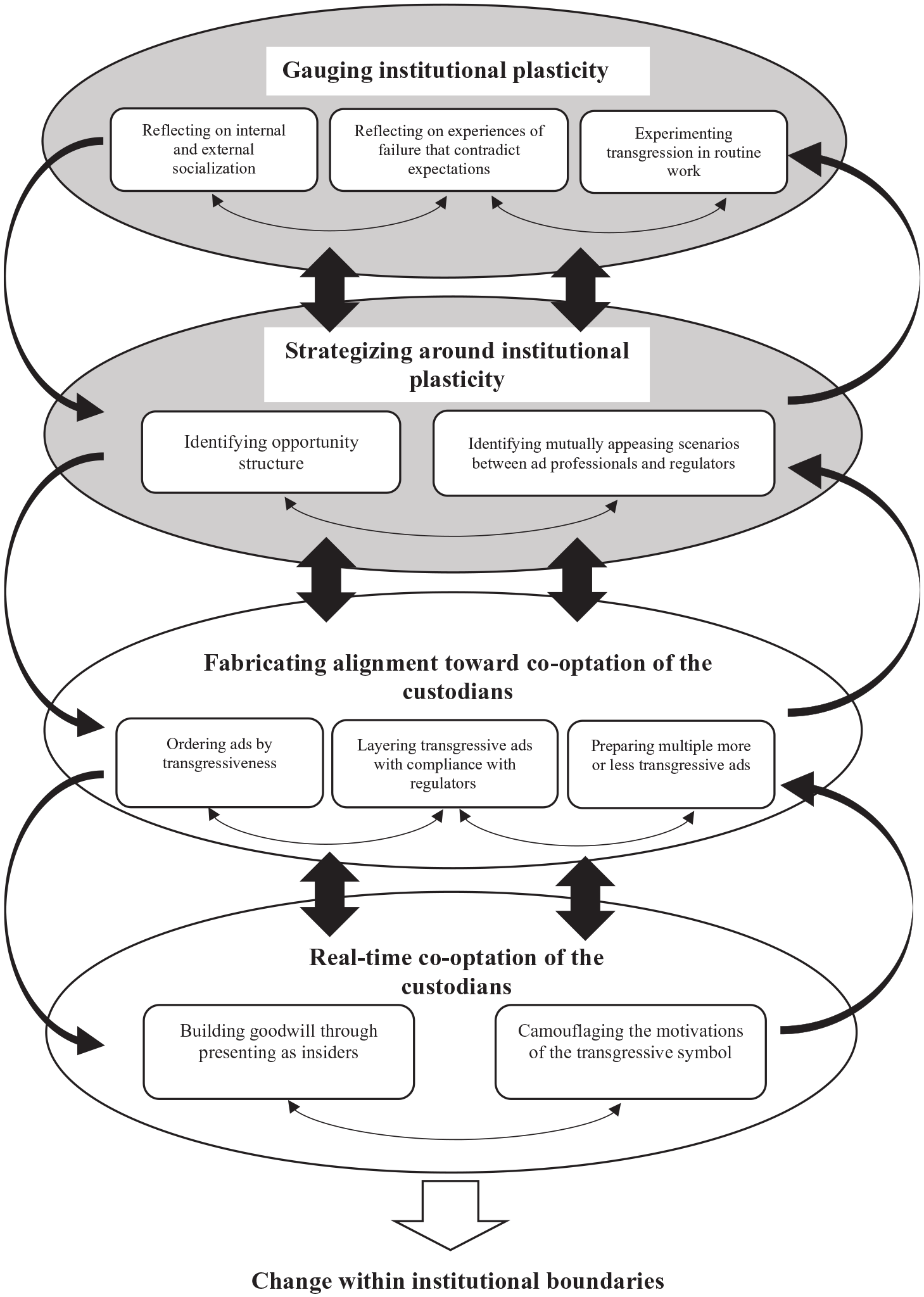
Tactics and strategies used by institutional challengers in leveraging institutional plasticity to implement change in a highly institutional context.
First, in gauging institutional plasticity, ad professionals recognize a misalignment between the normative and regulatory pillars governing Iranian advertising, a condition we found to constitute institutional plasticity in our focal context. Through deep socialization into the Iranian cultural context and the western-influenced profession of advertising, along with feedback from previous experiences of approval success and failure, advertisers recognized why cultural symbols widely viewed as moral, right, normal, appropriate or otherwise legitimate in Iranian advertising at large deviated from what government bodies were likely to approve. They also gauged institutional plasticity through running thought experiments among themselves in preparation for attempts to legitimate ads to regulators, to determine, in abstract, the probability that a given potential ad would be rejected or approved by regulators. Gauging institutional plasticity enabled advertisers’ strategizing around it by identifying the presence and nature of the institutional opportunity structure and devising the means of satisfying their own aspirations while concurrently conveying the relevant benefits to the regulatory bodies.
In leveraging the perceived areas of institutional plasticity, advertisers sought to fabricate alignment toward the co-optation of the custodians. Thus, they layered their ads with both transgressive elements and elements that strictly complied with well-articulated rules (e.g. standards for the Persian versus English text in ads). Additionally, advertisers leveraged plasticity through hedging by crafting multiple options for the same ad, each with a greater or lesser likelihood of being rejected as illegitimate by government regulators, the safest options infused with conservative cultural symbols that regulators were most likely to find legitimate. They also presented ads in order of their transgressiveness, the safest first, after which increasingly transgressive ads would be pitched until the professionals had, through negotiation with regulators, discovered the boundaries of what was institutionally acceptable.
Following this preparatory stage, integral to advertisers’ attempts to stretch the boundaries of institutional acceptability was co-optation of the regulators via tactics intended to encourage regulators to acquiesce to or even champion transgressive ads. Co-optation was achieved in real-time during pitches through building goodwill with regulators by adhering closely to conservative norms for dress and behavior. These real-time pitches also included rhetoric that functioned to camouflage advertisers’ true motivations in designing their ads (i.e. satisfying clients’ non-conservative preferences) by framing transgressive ads as providing well-defined benefits for conservative Islamic society.
Theoretical contributions
Through investigating incremental change in a highly institutionalized context, we make four contributions to the literature on institutional plasticity and change. Our primary contribution comes through helping establish a more complete understanding of the relationship between macro-structural antecedents and micro-foundational responses (see Micelotta et al., 2017) via theorizing sensing and stretching as responses to institutional plasticity in a highly institutionalized context. Previous work on institutional plasticity portrayed it as a macro-structural characteristic that fostered the perpetuation of the institutional status quo (e.g. Awasthi et al., 2020; Hatani, 2016; Herepath and Kitchener, 2016; Lok and De Rond, 2013). We, however, found plasticity to be a macro-structural antecedent for institutional change. Thus, our research provides a necessary counterweight to these extant studies of institutional plasticity, emphasizing that, as a characteristic of institutionalized advertising in Iran mediated through a specific slate of experiences, experiments and negotiations comprising institutional life, institutional plasticity can also foster macro-structural change. Our findings speak to the emergent work on non-conflictual institutional change (Claus and Tracey, 2020) by demonstrating how plasticity can be engaged by challengers as a means of stretching rather than disrupting institutional boundaries. In doing so, contrary to the institutional work perspective, which underscores intentionality in change efforts (Battilana and D’Aunno, 2009), we extend the understanding of unintentional, quotidian institutional change (Leung et al., 2014; Singh and Jayanti, 2013).
Through sensing, we identified the source of institutional plasticity as the misalignment between institutional pillars. Prior work has suggested that institutional transitions may affect some but not all components of institutional arrangements, leaving normative, cognitive and regulatory pillars at odds with each other (Caronna, 2004; Webb et al., 2009). We found that by studying the institutional setting and its evolution, challenger actors identified the nature of plasticity resulting from the dominance of the regulatory pillar reflecting the conservative Islamic rules over the institution of advertising. Our second contribution thus lies in identifying misalignment between institutional pillars as a condition that creates not only tensions but also a level of plasticity that in turn can be leveraged by challenger actors to foster change. As such, our findings point to the importance of closer interrogation of the relationship between institutional pillars in its local historical context in the study of institutional plasticity and change (Herepath and Kitchener, 2016).
Third, we found that actors strategize around plasticity through identifying the relevant opportunity structure and mutually appeasing scenarios for themselves and custodians. We thus reinforce Voronov and Yorks’ (2015) emphasis on persons’ ability to apprehend when institutional conditions present opportunities for change and extend it through identifying the specific tactics and strategies involved in apprehension, highlighting the role of actors in making sense of and strategically using their institutional environments in pursuing change. In doing so, we add an important strategic dimension to the previously uncovered cognitive and affective facets of apprehension (McCarthy and Moon, 2018).
Finally, we extend the literature on the interactive negotiation of institutional change (e.g. Helfen and Sydow, 2013; Kent and Dacin, 2013; Zietsma and Lawrence, 2010) by illuminating when and how actors are likely to negotiate change. In our case through the use of relevant institutionalized symbols and highlighting the temporal dynamics of negotiation reflected in fabricating alignment toward the co-optation of the custodians and real-time co-optation of the custodians, we show how the material aspects of interaction (e.g. subtle or explicit symbols like conformity to the Islamic rules in their advertising and challengers’ dress and discourses respectively) can moderate the impact of their change message on the other party. By interrogating the tactics involved in stretching, we found that such ongoing negotiations are aided by challengers’ ability to co-opt custodians into change through integrative negotiation tactics that both groups find acceptable. Notably, the preparatory negotiation stage involves more subtle strategies of layering transgression with compliance to build trust with custodians, where subtlety is necessary to ensure that compliance is perceived to be genuine. This stage is critical to help the real-time negotiation to lead to a mutually advantageous outcome, such that both parties could benefit from the negotiated change. Real-time negotiation, however, requires more explicit strategies of deploying shared language and material artefacts, such as traditional clothing, that signal affinity with the other party. By highlighting the importance of the affordances provided by face-to-face, interactive settings in advancing a change project, we demonstrate how in addition to rational and emotional appeals, the material dimension can further enhance the change rhetoric (Meyer et al., 2018).
Generalizability and boundary conditions
While our exploratory study leveraged an “extreme” context that threw the complementary processes of sensing and stretching into high relief (see Eisenhardt, 1989; Hudson et al., 2015), it is important to consider its boundary conditions. In our research, leveraging institutional plasticity appeared to be a more feasible strategy for actors to navigate a highly institutionalized context and accomplish their intended professional objectives than outwardly challenging or defying the regulatory institutions constraining actors’ aspirations. We therefore expect our results to be analytically generalizable to other highly institutionalized settings, particularly where one of the institutional pillars is more resistant to change or dominates over others and encountered in both western and non-western societies. Traditional professions, for instance, are usually characterized by norms established over decades or centuries that can be at odds with other societal developments or changes in the regulatory frameworks governing the profession. Hence, legal norms are resistant to change even in western societies (Siebert et al., 2017). Advocacy organizations often challenge deeply sedimented and highly taken-for-granted institutional practices, values and beliefs, such as animal rights (Jarvis et al., 2019) or environmental protection (Barberá-Tomás et al., 2019) organizations. We argue that in such settings, actors will likely seek out and leverage plasticity in ways broadly consistent with our findings.
However, we acknowledge the possibility that tactics might differ with the stakes involved in stretching the boundaries of institutions, which likely vary with sanctions for non-compliance and custodians’ interests. In our study, professionals were acutely aware of the consequences for not following regulations, but they also experimented with non-compliance, suggesting a favorable perception of the balance between risks and potential benefits. Where sanctions for non-compliance, such as fines or the risk of reputational loss, are high, exercising stretching strategies and tactics might require even greater caution (Faulconbridge and Muzio, 2016). Relatedly, recent work has shown that aspects of institutions that custodians might want to protect, as well as their own stakes in the institutional project might differ (Montgomery and Dacin, 2020). As a result, their own efforts at policing institutions may vary in nature and degree, likely requiring different approaches from potential challengers. Thus, Crawford and Dacin (2020) show that ordinary citizens may act as vigilante custodians, engaging in violent policing work in the absence of state involvement. It remains to be seen whether the presence of personal stakes makes negotiating change with such custodians more or less difficult for challengers.
Conclusion and future research
Our study focused on change in a highly institutionalized context. Drawing on the work on institutional plasticity and microprocesses of institutional change, we identified a set of tactics and strategies used for sensing institutional plasticity and leveraging it to stretch the rigid institutional boundaries. Our study also has important practical implications. Highly institutionalized contexts are often inequitable in the distribution of material and symbolic arrangements. Our research suggests that despite the restrictions imposed by such settings that make radical change unlikely, challenger actors may be able to redress this imbalance through tactics that avoid open confrontation and instead rely on negotiations and co-optation of those whose interests might be privileged by such resource inequity. These findings offer several future research avenues. First, future studies could assess the nature of institutionalization in other contexts and their source of institutional plasticity. Second, although our findings suggest that change in highly institutionalized contexts is incremental and slow, longitudinal studies of sensing and stretching might find that incremental changes chip away at conservative institutional arrangements until the “dam breaks” in a revolutionary change. Finally, longitudinal work might validate institutional plasticity as ontologically embedded in the differential rate at which various institutional pillars develop or change.
Supplemental Material
sj-docx-1-hum-10.1177_00187267211015014 – Supplemental material for Cracking the box or stretching its walls? Exploiting institutional plasticity in Iranian creative advertising
Supplemental material, sj-docx-1-hum-10.1177_00187267211015014 for Cracking the box or stretching its walls? Exploiting institutional plasticity in Iranian creative advertising by Mahsa Ghaffari, Liudmyla Svystunova and Lee Jarvis in Human Relations
Footnotes
Acknowledgements
The authors are grateful to the editor Professor Olga Tregaskis and three anonymous reviewers for their support and thoughtful engagement with the manuscript.
*To the memory of my beloved father, Majid Ghaffari.
Funding
The authors received no financial support for the research, authorship and/or publication of this article.

Supplemental material
Supplemental material for this article is available online.
Notes
References
Supplementary Material
Please find the following supplemental material available below.
For Open Access articles published under a Creative Commons License, all supplemental material carries the same license as the article it is associated with.
For non-Open Access articles published, all supplemental material carries a non-exclusive license, and permission requests for re-use of supplemental material or any part of supplemental material shall be sent directly to the copyright owner as specified in the copyright notice associated with the article.
