




Abstract
How do newcomers gain access to learning opportunities when they are denied opportunities to practice? Changes in the nature of work, such as labour outsourcing and technological advancements, have created challenges for newcomers to learn. They may be more easily relegated to low-level repetitive tasks, such as scutwork. In these situations, newcomers’ ambiguous position as learners can limit access to participation in practices needed to progress their learning trajectories. Using field-study data, we explore the situated learning of merchant-navy cadets. We show that, when newcomers are not permitted access to participation, the structural arrangements of practice – temporal structures, spatial territories and hierarchical arrangements – hinder learning opportunities. We show, further, that some newcomers leverage these same structural arrangements surreptitiously as resources to access participation, which we conceptualise as stealth work. Consequently, we unveil the soft forms of power at play in crafting access to learning trajectories, making three contributions. First, we show how structural arrangements of a practice can be leveraged to enable learning. Second, we show that gaining access stealthily, requires both normative and counter-normative performances. Third, we show the importance of access in crafting learning trajectories and unpack how such access is navigated by newcomers.
Keywords
Introduction
The continuity of a community of practice (COP) 1 , or indeed an organisation, 2 depends on having new members who will progress towards becoming skilled practitioners and, in turn, educate other newcomers in the development of the practice. It is now widely accepted that learning is a social phenomenon, situated within everyday practices; that is, newcomers learn through participating in and reflecting upon a practice, together with other members of the community (Beane, 2018; Gherardi and Nicolini, 2002; Hutchins, 1995; Lave and Wenger, 1991). As Lave (1991: 74) argues, ‘no rational organisation can exempt the production of old-timers from its agenda of crucial structural arrangements and giving learners access to full participation is a condition for meeting this goal’. Access to participation is, therefore, a crucial aspect of situated learning, allowing newcomers to progress through an inbound trajectory towards becoming full participants, or masters (old-timers) of a practice (Gherardi and Nicolini, 2002; Gherardi et al., 1998; Handley et al., 2006; Lave and Wenger, 1991).
The process of situated learning is elaborated in Lave and Wenger’s (1991) seminal work on legitimate peripheral participation (LPP). LPP denotes both the importance of access to participation and its embeddedness in wider sociocultural relations; including the formation of identity (as a ‘legitimate’ participant), shared systems of meaning and the political-economic structuring of a practice (Lave and Wenger, 1991). For situated learning theorists, then, power – seen as invested in the structuring of social practices and control over resources – is fundamental to LPP. As Contu and Willmott (2003: 285) note: ‘It is clearly difficult, if not impossible, to learn a practice and thereby to become an (identified) member of a community of practice, when power relations impede or deny access to its more accomplished exponents.’ Yet, the process of gaining such access is not much addressed in previous research. Specifically, we need to understand how newcomers respond when power relations ‘impede or deny’ access to participation in a practice (Contu and Willmott, 2003; Fenwick et al., 2012).
The need for this understanding is especially timely in the current context, where shifts in the nature of work have started to create significant challenges for newcomers’ access to participation in practices required to progress their learning (Barley and Kunda, 2011; Barley et al., 2017; Beane, 2018). For example, parts of a practice necessary for learning may now be performed by technology (Faraj et al., 2018), parts may be outsourced to casual and/or skilled labour (Leonardi and Bailey, 2017) and many, previously stable, careers have become fragmented owing to rise of contingent work (Bailey et al., 2012). These changes can reduce, or even replace, responsibilities traditionally provided to newcomers seeking to progress their learning and careers. For example, newcomers increasingly are consigned to scutwork rather than participating in learning opportunities that increase their skills (Beane, 2018; Kellogg, 2011).
Recent studies have begun to show how newcomers may circumvent barriers to participation by employing subversive, counter-normative forms of practice when learning opportunities are not available (Beane, 2018; Kellogg, 2011; O’Mahony and Bechky, 2006). These studies are useful in helping us understand the work that newcomers do to craft their own learning trajectories. However, we do not yet understand how newcomers secure access to the participation required to engage in these practices in the first place. In this article, then, we ask, how do newcomers negotiate access to participation in a practice when such access is not given to them?
To address this question, we used data from five months of field work in two research sites, combining non-participant observations and interviews to study deck cadets on container ships as they struggle to learn how to become officers. Changes in the shipping industry – such as increased shore-based training, increased pace of operations, limited crew numbers and financial constraints – have led to structural arrangements on board that constrain learning opportunities for cadets (Cariou and Wolff, 2011; Sampson, 2004). We analyse the process through which legitimacy is granted to cadets through their negotiation of access to participation. Specifically, we show how, in order to craft their learning trajectories, newcomers surreptitiously leverage structural arrangements of the practice (temporal, hierarchical and spatial) to gain access to participation. They accomplish this without appearing to contravene these structural arrangements, a process that we term ‘stealth work’. In conceptualising stealth work, we contribute to the literature on situated learning by unpacking how access to participation is negotiated by newcomers. We also contribute to the emerging literature on the counter-normative means newcomers use to empower their learning.
Access to participation in situated learning
In this section, we review previous accounts of newcomers’ access to participation and further refine our research focus. With their term LPP, Lave and Wenger (1991: 29) emphasise that ‘learners inevitably participate in communities of practitioners and that mastery of knowledge and skill requires newcomers to move toward full participation in the sociocultural practices of a community’. Learning here is seen as a way of being in the world, rather than knowing about it (Gherardi and Nicolini, 2002). Learning takes place through the learners’ involvement in the ‘actual practices of an expert’ (Lave and Wenger, 1991: 14). The involvement in these practices is shaped by the learners’ identification – by others and themselves – with the community and its imagined membership (Wenger, 1998).
Lave and Wenger (1991) underline the importance of learning through participation in their differentiation of ‘teaching’ and ‘learning’ curriculums. In the teaching curriculum, the understanding of what is learned, and the access to learning, is controlled by an instructor’s external understanding of a practice. A learning curriculum involves learning through participation in a specific COP, where instruction and a normative understanding of what practice looks like, is created through participation (Lave and Wenger, 1991: 97).
A central tenet of situated learning theory is that newcomers need access to participation in a shared practice in order to become legitimate peripheral participants, which then enables them to potentially progress from peripheral to full participation (Gherardi and Nicolini, 2002; Lave and Wenger, 1991). Without access to participation, it is not possible to learn the shared practice of a COP. The importance of access reminds us that power is an endemic feature of LPP (Contu and Willmott, 2003; Fenwick et al., 2012). Power is invested in the social organisation of a practice and in control over resources (Lave and Wenger, 1991) and may foster or impede access to participation. Contu (2014), for example, traced how power dynamics shaped trajectories of participation within the creation of design work. In particular, power dynamics were evident in the different skills and status among expert founders and the relative newcomers to the practice, and were constituted through the complexity of design work practices. Thus, being at the periphery of a COP is both an empowering and disempowering position (Lave and Wenger, 1991). A newcomer, by virtue of being a legitimate participant, is empowered to participate in the practices of that COP. At the same time, by virtue of their peripherality, newcomers can also be prevented from participating fully or from participating at all. The ability to secure access (or not) to participation is, therefore, one of the key areas of situated learning where unequal relations of power are made explicit.
While some studies concur that access is provisional and may need to be (re)negotiated locally, more typically participation is treated as ‘given’ (Lave, 1991), or as conferred by the situation (Borzillo et al., 2011). This suggests a need to understand better how access to participation is negotiated by newcomers who seek legitimacy to gain further opportunities for learning. As Dreier (1999: 8) noted, social contexts arrange practices to enable certain kinds of participation, and certain groups ‘have access to them or are excluded from them in particular ways. And social contexts may be arranged for particular trajectories of participation in them and through them.’ Accordingly, when answering the question of how newcomers negotiate access, we need to consider the social and structural arrangements that shape access to participation.
The role of structural arrangements in accessing participation
Reflecting its sociocultural tradition, situated learning theory reminds us that access to participation in a COP unfolds within a wider complex of social practices and historically embedded structural arrangements (Bechky, 2006). Social structures (such as role structures and spatial organisation) become a means through which practices are perpetuated, and practices reinforce social structures (Feldman and Orlikowski, 2011). Regarding the issue of access, Contu and Willmott (2003: 286) remind us that social divisions are ‘already structured into “communities” in ways that organise social space and impede or facilitate access to certain resources, forms of activity, technologies, and so forth’. Yet, as they argue further, ‘connections between the practices of “community” members and the “structural characteristics” of these communities have been left largely unexplored’ (Contu and Willmott, 2003: 286). While there are many potential ways in which to think about ‘structural characteristics’, we consider three broad aspects that are salient when it comes to gaining access to participation in a practice: spatial structures (or territories), temporal structures and hierarchical (role-based) structures.
First, as Gherardi (2009: 132) maintains, practices are structured spatially, that is: An organised space – a workplace – is a ‘situational territory’ (Goffman, 1971; Suchman, 1996) in which objects remind the subject of what they must do, prevent humans from doing things that may harm them, guide action according to intentions inscribed in their design, and make work and life comfortable, both materially and socially.
This notion of ‘spatial territories’ denotes both the spatial location of specific practices and the ‘spatial-social nesting of responsibilities’ within those locations (Orr, 1996; Yanow, 2006: 1752). Space, as ordered by activities, events and practices has received attention within what Stephenson et al. (2020: 809) call the constituting orientation of process studies. Similar to the notion of spatial territories, studies from this orientation focus on how specific arrangements of activities and materials order and reorder spaces to make them durable and are in turn ordered by these spaces.
Second, practices are temporally structured. Temporal structures are ‘understood as both shaping and being shaped by ongoing human action, and thus as neither independent of human action (because shaped in action), nor fully determined by human action (because shaping that action)’ (Orlikowski and Yates, 2002: 684). As Lervik et al. (2010: 288) note, for example, learning may be ‘affected if access to forms of knowledge embodied in materials or tools is temporally restricted to certain time period of intervals’. Temporal structures, then, ‘specify parameters of acceptable conduct, but . . . are also modified by the actions they inform’ (Orlikowski and Yates, 2002: 685).
Third, as implied in notions of ‘peripheral’ and ‘full’ participation and the movement of ‘newcomers’ to becoming ‘masters’ of a practice, LPP indicates a social hierarchy as to who is permitted do to what. We term these ‘hierarchical structures’, not as denoting the exercise of formal power through functional roles (although this is also one aspect in our particular context of seafaring) but, rather, as denoting the degree of participation one is permitted in a practice in relation to other members of that practice (Handley et al., 2006; Valentine, 2018).
These structural arrangements of a practice (spatial, temporal and hierarchical) act as the medium for, and outcome of, power dynamics in a COP (Bunderson and Reagans, 2011; Orlikowski and Yates, 2002). As such, they are likely to play an important role in facilitating or impeding newcomers’ access to participation in that practice. While the importance of practices’ structural arrangements has been recognised, we do not yet understand how newcomers navigate these arrangements in their pursuit of access to participation for learning.
Newcomer responses to lack of participation opportunities
It is clear from the above that access to participation in a practice is not a ‘given’, even for ‘legitimate’ peripheral participants, and that newcomers must play an active role in crafting their own access to practices. The proactivity of newcomers in securing participation is touched upon in Orr’s (1996) classic ethnography of photocopier technicians. In Orr’s study, when faced with ordains provided by management, technicians engaged in non-canonical practices (e.g. informal meetings and ‘storytelling’) to learn about machines ‘under the radar’ of management (Contu and Willmott, 2003; Orr, 1996). Brown and Duguid (1993: 11), similarly, reflect on the importance of ‘stolen’ knowledge over instruction. They observe that a student learns, not through mere instruction – or, as they describe it, ‘dismembered didactic exercises’ (Brown and Duguid, 1993: 11) – rather, through opportunities to observe and understand others’ authentic social practices. Similarly, Marchand (2008) contends that the role of the craft apprentice is tenuous, and they need to ‘steal’ knowledge through observation and mimesis. These studies are useful in focusing our attention on how learning within a COP occurs beyond canonical practices through the active role of newcomers as participants. However, they say less about how access to participation is gained in the first place.
Another stream of research focuses more explicitly on the counter-normative means that newcomers employ to craft learning trajectories when opportunities to participate in a practice are not readily available. These scholars have started to focus on how professionals cope with increasing flexibility and discontinuities of the workplace, where ‘expectation of mobility, the experience of uncertainty, and the necessity for individual agency’ characterise contemporary careers (Petriglieri et al., 2018: 482; Wolf, 2019). This work tells us that, owing to their peripheral legitimacy, most newcomers are relatively subordinate and cannot be openly demanding or deviant. Nevertheless, in some situations newcomers can be ‘secretly deviant’; that is, they break the rules, but the rule breaking is either not noticed or not admonished (Becker, 1963: 20). O’Mahony and Bechky’s (2006) study, for example, shows how contract workers in a creative industry progress in their careers without organisational guidance by finding learning opportunities in temporary workplaces. They do this through enacting ‘stretch work . . . to gain control and influence the odds of landing prized stretch work, contract workers differentiated their competence, acquired referrals, framed, bluffed, and discounted’ (O’Mahony and Bechky, 2006: 935). In using stretch work, they create continuity across their experiences, and through each contract, gain slightly new learning opportunities to develop their skills.
Focusing on practitioner response to managerial control, Rennstam and Kärreman (2019) conceptualise the notion of ‘constructive disobedience’. Through an ethnographic study of a COP of engineers, they show how managerial control is circumvented by engineers through processes of ‘critical apprehension’, ‘translation’ and ‘peer reviewing’. These processes enable the engineers to subvert and displace ‘rules and orders to construct a dynamic of control where work can be executed autonomously within the community of practice’ (Rennstam and Kärreman, 2019: 866). Hence, the engineers are able to circumvent managerial control and find ways of working that were suited to the COP.
Another study shows how technological advancements in surgical practices (moving from open surgery to robotics) lead to limitations in the work that is given to the trainees (Beane, 2018). In response, newcomers overcome constraints in learning opportunities through, what Beane (2018: 17) terms, ‘shadow learning’, that is: Shadow learning differed from legitimate peripheral participation in four key ways: its constituent practices ran counter to norms and policy, these were enacted opportunistically and in relative isolation, and they provided the competence required for access to work involving experts.
The abovementioned studies are particularly helpful in enabling us to understand the counter-normative practices that newcomers (and practitioners) engage in to craft their learning trajectories. However, we still need to understand how participation is accessed in the first place in order to allow such counter-normative practices to be enacted, as well as the role that structural arrangements play in this process. This understanding is important, both to inform situated learning theory more broadly, and also to deepen our understanding of this emerging phenomenon of counter-normative learning practices.
Research context and methods
In order to explore how newcomers negotiate access to participation, our research draws on a detailed study of the practices of navigational officers training and working on container vessels within the maritime industry. The deck department on the ship controls the navigation and cargo handling on board. This department features the deck officers: ship captain, chief officer, second officer, third officer; deck ratings: boatswain, able-bodied seaman (AB), ordinary seaman (OS) and the deck cadet. The deck officers are in charge of the navigation of the ship. The deck ratings look after the maintenance of the ship above deck and do the cargo operations as well as port operations under the management of the deck officers. The deck cadet is the newcomer on board and the focus of our study. The ‘deck officers’ are the relatively experienced members of the COP and ‘master mariners’, herein ship captains are the masters of the practice. The analysis focuses on the movement from cadet to a third officer (the junior-most officer – see online Appendices A and B for a detailed description of ranks and changes in the industry respectively). Our initial analysis showed that this was the most disrupted part of the overall ‘deck officer’ learning trajectory.
Research setting
The research was conducted as a five-month immersive qualitative field study within a third party crewing company (CrewCo – pseudonym). It was conducted at two research sites, a training centre in the Philippines (CrewCo Training Centre – CCTC), and a ship (MV Sea-Line). Access to CrewCo was gained through the first author’s personal network; initial contact was made with the head office of the organisation and subsequent access was then granted by the gatekeepers at CCTC and MV Sea-Line. As is common in field studies, informal access needed to be constantly renegotiated at times of observation and interviews. The first author spent four months living and working at CCTC and one month on board MV Sea-Line. CrewCo is responsible for sourcing, training, managing and looking after the crew while on board the ship. CCTC provides training courses for the Filipino CrewCo cadets and officers. Cadets are enrolled in the three-year deck cadet programme at CCTC where they undergo 10 months of shore-based training, interspersed with two periods of sea-time training, each lasting between eight and 10 months. MV Sea-Line is a container ship, one of the many vessels under CrewCo management where cadets spend their sea-service contracts to gain practical experience of work and life on board. MV Sea-Line is a ‘feeder vessel’, with a 12-person crew. This article focuses specifically on the two sea-service training periods of deck cadets because it is during these periods that their learning trajectories are most disrupted.
The ‘expected’ learning trajectory
Cadetship traditionally occurred as an apprenticeship on board a ship. Owing to the increased outsourcing of the training to shore-based training centres, cadets now spend around 12 months on board (approximately 22 months at CrewCo) as part of their sea-service training. The sea-service training acts as the practical foil to the theoretical and simulation-based training that the cadets receive on-shore. Cadets arrive on board the ship as ‘prospective officers’. Hence, their time on board should be governed by the Standards of Training, Certification and Watch-Keeping (STCW) regulations, with daily training records that they have to complete under the supervision of their training officer. They expect to spend an equal amount of time on deck and on the bridge, learning the practices of deck work and the practices of navigation. In terms of the practices of navigation, terrestrial, coastal, celestial navigation, dead reckoning, position fixing, ability to read and plot electronic charts and knowledge of echo sounders are all part of the STCW certification requirements. Cadets are supposed to complete these activities on board as part of the training requirement. Yet it is the captain and deck officers on board a ship, not the on-shore trainers or certification bodies that actually control cadets’ access to the ship’s bridge. In reality, then, when cadets do go to sea, they are not always given learning opportunities, especially to the practices of navigation on the bridge.
Data collection
Data were collected using non-participant observation and interviews. Formal observations (e.g. in the classrooms or the bridge/deck) were supplemented with informal observations (e.g. during meal times or break times) through spending 24/7 at the research sites for five months. Handwritten field notes were taken in-situ where possible and expanded in MS Word within 24 hours of observation. Formal observation notes were audio-recorded as a backup for written notes.
At CCTC, the focus of the observations was on cadet learning and training experiences at the training centre. Hence, technical maritime classes as well as simulation exercises and practical training were observed, initially on a daily basis and then two or three times a week towards the end of data collection. A semi-structured interview format allowed cadets and officers to share their experiences as to what they thought to be important in the learning process as well as their sea-service experiences. As there is only one cadet per ship, to get an understanding of the sea-service experiences of different cadets, we relied on this interview data. Most of the data for this article draw from the sea-service experience of cadets and interviews with officers recalling their training days.
Semi-structured interviews at CCTC were supplemented with an ‘interview-to-the-double’ (ITTD) segment (Nicolini, 2009); a technique that requires interviewees to imagine that they need to give detailed instructions to a double who will replace them at work the next day, with the aim to elicit the normative, moral and routine dimensions of practices (Nicolini, 2009). Participants were informed of the interview structure at the start, and before starting the ITTD part the researcher would explain the interview style. During ITTD, interviewees were asked to imagine a clone who would replace them for 24 hours and needed instructions of work activities in order to do so. The technique was particularly effective in making daily routines explicit. It also helped the researcher, as an outsider to the COP, to start to understand work practices. Documentary evidence of shipboard training record books, shipboard project workbooks as well as shore-based training assessments were also collected to understand the relationships between shore-based and sea-service training.
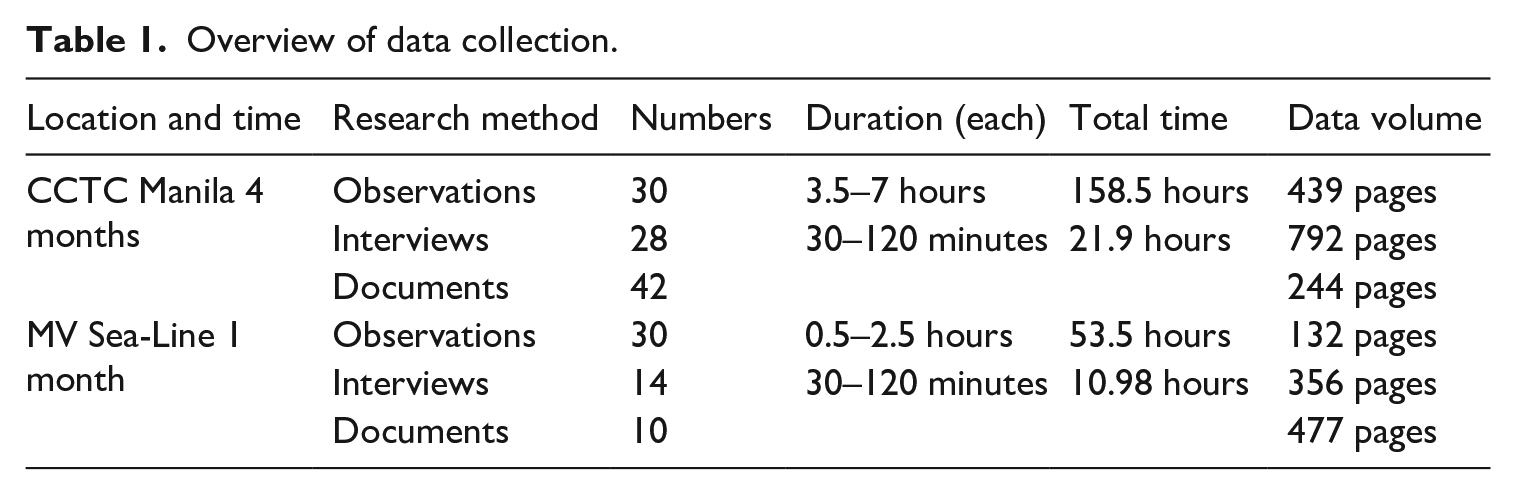
Data collection on board MV Sea-Line entailed close observation of navigation practices, which are pivotal to becoming officers. The first author observed, for example, watch-keeping of officers, berthing operations, master–pilot interactions, approach and departure from port, anchoring and drills, the interaction of officers during meal times, communication of crew and officers, and cadet work practices on the deck as well as the bridge. Interviews with seafarers from all ranks focused on their shipboard experiences, their pathways to learning, and experiences of dealing with cadets on board. Observations were supplemented by documentary data, including STCW, Safety of Life at Sea (SOLAS), International Convention for the Prevention of Pollution from Ships (MARPOL 73/78 Annex 3), passage planning forms, safety management system, near incident report photos in the mess room and a sample of watch timings records. By the end of the fieldwork, over 2000 pages of field notes, transcripts and archival material were collected, as summarised in Table 1.
Overview of data collection.
Data analysis
The first author discussed emerging findings with informants. They affirmed the overall intent and indeed further helped refine our thinking. The study insights and analysis were also shared with a wider set of maritime participants. The first author shared insights from the field with co-authors in regular meetings during field work. The authorship team divided up the work such that the first author was responsible for the data collection, insights from the field and industry knowledge. Technical maritime literature was consulted to ensure that our understanding of the context was sound and the codes were also assessed via peer debriefing between the authors. All authors worked together in refining the analysis and theoretical development of the article. During the analysis, codes were checked through repeated readings of the data. Comparisons were made between different data sets.
In line with our situated learning lens, our data analysis started alongside the data collection following Glaser and Strauss’ (1967: 79) idea of using previous theories on the subject that provide ‘initial direction’ and ‘possible modes of integration’. This sensitised us to specific empirical problems that were guided by subsequent data gathering. Once initial data gathering and analysis were completed, we started working iteratively between the data and the literature in four stages of analysis, expounded below.
Stage 1 – Data were initially sorted by data source (formal observations and informal observation and interviews) using participants’ descriptions of doings and saying as the initial codes. There was constant comparison across the data gathered. We started categorising the cadets’ work (e.g. deck practices, navigational practices), who was working where and when, and the tasks taken on by the cadets. During this round of analysis, one emerging pattern was that cadets frequently complained of lack of opportunities to go to the bridge, tiredness and reluctance of officers to give them opportunities to learn their practice. This was also observed on MV Sea-Line. In interview transcripts, cadets frequently referred to themselves as ‘fortunate’ or ‘lucky’ to go to the bridge. At this stage, the literature on situated learning and learning in practice was re-examined to better understand participation and access to LPP.
Stage 2 – Here, we focused on the surprising themes in the data (Abbott, 2004). The focus at this stage was on patterns of talk and action in reaction to lack of learning opportunities. We created codes such as ‘going to the bridge during rest times’, ‘when to ask questions’, ‘getting participation from a new officer’, as well as surprising narratives where cadets managed to get access to participation in a practice necessary for them to learn their trade. We collated these codes into four broad categories: relationship work, spatial work, temporal work and body work.
Stage 3 – At this stage, a second more comprehensive literature review was undertaken to understand the context surrounding the concepts we were discovering (Corbin and Strauss, 1990: 9–10). This led us to focus on change within the maritime industry, where elements of ‘total institution’ and the high-risk context sat alongside features of transience and fluidity being introduced through contract work and operational pressures. This broadened our focus to the literature on managing learning and careers through a changing work context.
Stage 4 – We started focusing on the relationships between themes discovered in Stage 2 around the work performed by newcomers and the work practices on the ship. Here, an interesting puzzle was noted; cadets appeared to be gaining learning opportunities by actively engaging with and leveraging the temporal, spatial and hierarchical structures on the ship and using these to access participation that was otherwise being denied. We focused on these three aspects because of their prevalence in structuring the participation in practices on board. To detail this process of ‘leveraging’, we found the literature on counter-normative newcomer learning useful and built from this to develop our concept of ‘stealth work’.
Findings
We divide our findings into two parts. The first part focuses on how structural arrangements constrain access to participation. The second section focuses on the means of accessing participation and the ways in which cadets leverage structural arrangements to gain access.
Experiencing constraints to accessing participation on the bridge
At CCTC, the cadets gained insight into their expected learning trajectory on board and what they were expected to do in their role as prospective officers. Per expectations, the cadets straddled two related communities, the community of deck ratings and the community of deck officers. These communities formed part of the same functional (deck) department, but conducted different activities and held different positions in the role-based hierarchy on a ship. However, by straddling two COPs, the identity of the cadet and therefore, which practices they could access was open to interpretation. If the cadet was recognised as a prospective officer, then they were given access to the practices of navigation, in alignment with this identity. If they were recognised as deck ratings, then this access was withheld by the officers. A striking initial observation was the ways in which structural arrangements – temporal, hierarchical and spatial – constrained cadets’ access to learning opportunities in the COP of deck officers on a ship. Specifically, structural arrangements constrained access to participation in the practices of navigation, which were critical to newcomers’ inbound trajectory towards becoming deck officers.
During sea-service training, owing to crew restrictions, pace of operations and increase in technological efficiency, the tasks of the cadets on the bridge were greatly reduced. It was more efficient to treat them as an ‘extra pair of deckhands’. Given the relative isolation of the ship, there was no way to enforce regulations to ensure that cadets got time on the bridge. Over half of interviewees noted problems of gaining opportunities to learn the critical navigation practices, which is commensurate with published reports (Ghosh and Bowles, 2013).
On a ship, there were role-based hierarchies, rigid temporal patterns and tightly controlled spatial territories. Power was manifested in practice through these structural arrangements as they enabled and constrained work and reinforced specific relations and practice norms. For cadets, these structural arrangements meant that they were subordinated to deck work, without access to the bridge as a physical space, without access to time for participation in navigation practices and without the permission to do so legitimately, as encapsulated below: RD (the training instructor) asks (the cadets) if they kept watch on the bridge or if they were always on deck? Most cadets say that they spend 8 hours on the deck and go up to the bridge in their spare time 1800–0000. They are not given time/access to familiarise themselves with the equipment. Sometimes officers do not like it when cadets touch the equipment. RD narrates a story from his cadet days where he constantly had to ask for permission from the chief officer and the third officer to familiarise with or work on the bridge . . . because the captain wanted him on the deck and not on the bridge. (Field notes, CCTC)
The training instructor was asking the cadets about their sea-service experiences. Here, we see how temporal structures (no allocated time on the bridge), spatial arrangements (not being allowed to touch the equipment on the bridge, not having physical access to the bridge) and hierarchical structures (continually having to ask for permission to go to the bridge) constrained the cadets from accessing participation. Table 2 highlights the constraints created by structural arrangements.
Experiencing disruptions to learning trajectories.
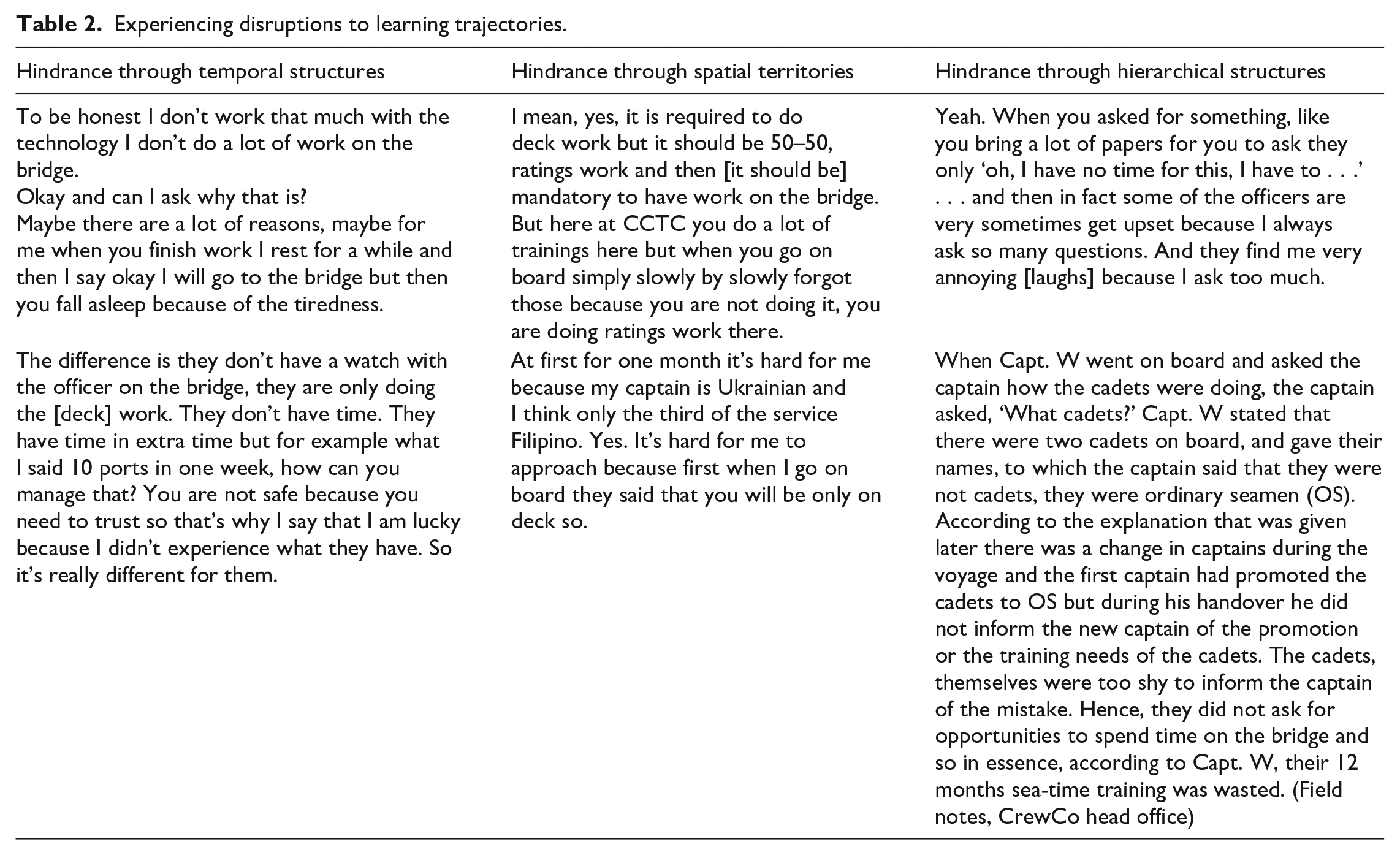
The two primary temporal structures that organised work on board included day-work times of deck ratings and shift-work times of officers. Cadets faced competing demands for time between working on the deck with ratings where time was rigidly controlled, and working on the bridge with officers where there were tight operational pressures to meet the estimated time of arrival. Participants noted that without designated time on the bridge, the physical exhaustion of the daily work prevented them from going there: ‘Once his captain asked him, “why don’t you come up to the bridge?” He states, “After working for 12 hours on deck, and cleaning the accommodation I was too tired to go on the bridge”’ (Field notes, MV Sea-Line, Conversation with a deck officer). Even though, in this case, the captain wanted the cadet to go to the bridge, the temporal structuring of day work, coupled with the physical intensity of work on the deck meant that the cadet was unable to access the practices of navigation. These temporal arrangements subjugated the cadets to participating in the different practices serially, rather than being able to move seamlessly between them.
Hierarchical structures on board also constrained access to participation. Cadets could not get physical access to the bridge without permission from the officers. However, cadets noted that when they asked for permission, they were instead told to do deck work. Sometimes, they were asked to complete the deck work and only then head to the bridge. Occasionally the officers even responded with anger to cadets approaching them: I mentioned that I would like to interview the officers and the crew, and . . . see . . . the work of the cadet. The captain said that . . . the cadet was extremely busy, and I would be able to speak to him after 5 p.m. I asked if [the cadet] came up to the bridge, the answer was very rarely, he needed to learn the jobs on the deck first, he came up to the bridge in his free time, if he felt like it. (Field notes, MV Sea-Line, first author’s research access conversation with Captain)
Without this permission, accessing participation on the bridge was seen as illegitimate or transgressive. Given the tightly controlled structuring of hierarchy, cadets could not be openly deviant by defying direct commands from their superiors. For example, two of the cadets narrated their experiences of working in the galley (ship kitchen) before starting their day work, which was not part of their job requirement. As one of the cadets noted: ‘If we complain maybe [the officers] will make life harder somehow, so we didn’t bother to ask why they give us tasks like this’ (Cadet Interview Transcript). Hierarchical structures on board were the most overt manifestation of power as the officers on board could control what is or is not seen as legitimate participation.
Finally, spatial arrangements on board defined the territories between the deck, the engine departments, and the officers and the ratings. For example, the accommodation on MV Sea-Line was divided as follows: Just below the bridge were the captain and chief engineer’s cabins; no-one was permitted access to this floor. On the level below were the second officer and second engineer’s cabins, along with a cabin for passengers. Then there was the third officer’s cabin (where the researcher stayed), the boatswain’s and the able-bodied seamen’s (AB) cabins. On the last accommodation level were the ordinary seamen’s (OS) cabins, the cadet, the wiper and the chief cook’s cabins. Below that was the galley and two mess halls which were separated into the officers’ mess and the ratings’ mess. (Field notes, MV Sea-Line)
Spatial territories reinforced the hierarchical structures on board; that is, where one should and should not be depending on their role and status within the COPs. The bridge was seen as a closed ‘high-status’ space on board. It was where practices of navigation were spatially situated and a space that was physically cut off from the rest of the ship, with a door and lock. Access to it was controlled by deck officers. Even when cadets managed to go to the bridge, they were faced with constraints that are specific to that spatial setting: I arrive on the bridge at 8.30 p.m. The captain and the CO are already there. The cadet is outside, kitted out in safety gear, which involves orange overalls, orange helmet and safety shoes. He is cleaning the windows outside the bridge. It is now 30 minutes before end of sea passage. (Field notes, MV Sea-Line)
As the field notes show, access to the bridge as a physical space did not guarantee access to participation in the practices of navigation. Crucially, the material artefacts on the bridge situate the practices of navigation to the bridge. This is important because, among others, knowledge and technical skill in using navigational equipment is the key differentiator between ratings and officers on board; a skill differential that is increasing with technological innovations in the industry. At times, when cadets did achieve access to the bridge, they were hindered by lack of familiarisation with the situated material artefacts: The first time I was very, very scared to touch the buttons because if I did something wrong maybe – if you touch the button and a fault appears then the officer will be very angry at me if the records inside disappear, something like that. (Cadet Interview Transcript)
Accessing participation by leveraging structural arrangements
Participation in shipboard practices was tightly controlled by structural arrangements, which executed the norms on board. Furthermore, the important safety and accountability procedures (when invoked) meant that cadets could not openly transgress these norms. However, unlike the case of constructive disobedience (Rennstam and Kärreman, 2019) or shadow learning (Beane, 2018), these cadets did not subvert rules by engaging in illegitimate (if tolerated) learning practices. The learning that the cadets sought to access was legitimate if they were identified as prospective officers rather than deck ratings. Furthermore, practices of navigation were crucial to their inbound trajectories, as illustrated in the excerpt below: In a way, it is like a self-fulfilling prophecy. The cadets do not get any training on the bridge while on board and then they come back as third officers who are expected to take over the watch. And when they make mistakes, the captain kicks them out. He speaks of a third officer that he sailed with who was from an ‘elite’ training programme. The captain wanted him discharged after only three days. (MV Sea-Line, Field notes, conversation with a deck officer)
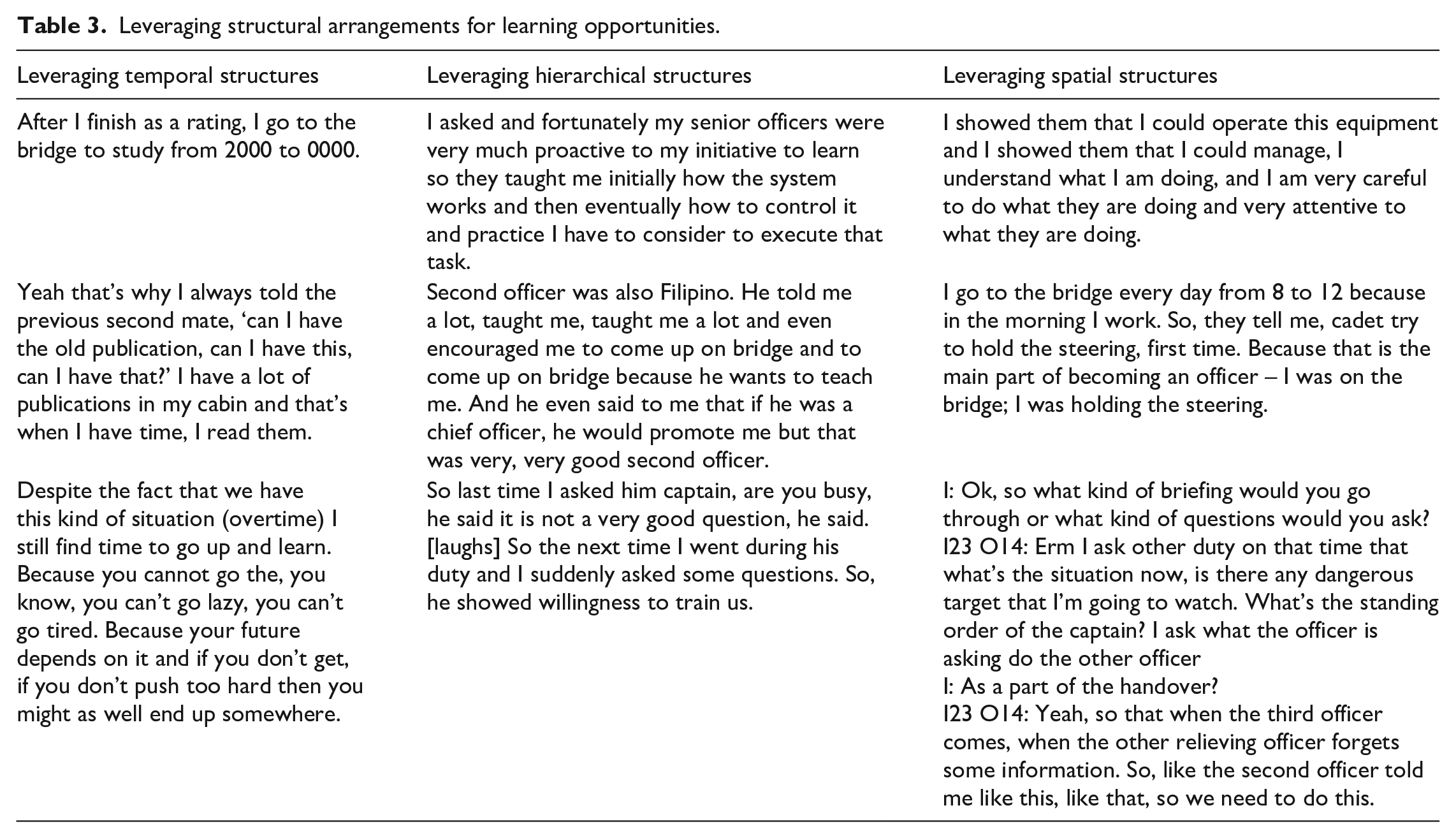
To progress in their inbound trajectories, cadets resourcefully accessed participation to legitimate learning opportunities to get back on the trajectory of a prospective officer. They did this by enacting what we term ‘stealth work’; that is, by leveraging structural arrangements in order to gain access to participation otherwise denied and doing so in a way that did not seem openly transgressive – meaning that they needed to do it stealthily or to ‘fly under the radar’, and still accomplish access to participation. By ‘leveraging’, we mean that the cadets were proactively and opportunistically drawing upon the same structural arrangements that were constraining their access as a means to negotiating access to participation. Put simply, they were knowing and using the rules (and rulers) to subvert the rules. Illustrative examples of leveraging structural arrangements are presented in Table 3, with vignettes and excerpts used below as rich examples.
Leveraging structural arrangements for learning opportunities.
Leveraging temporal structures
In response to being denied time for participating on the bridge, cadets leveraged specific temporal structures on board. For example, shifts on board are to be strictly adhered to and published to all. Deck work takes place between 6 a.m. and 5 p.m./6 p.m. Nevertheless, doing deck work also meant that, barring estimated time of arrival demands (e.g. reaching a port at 5 a.m., which was common on MV Sea-Line) and accommodation duties, cadets had evenings scheduled as rest times. Cadets engaged in stealth work by using that free time to go to the bridge, provided they were welcomed by the particular watch officer also scheduled to be on the bridge at that time. Here, leveraging rest times from deck work and officers’ shift times, meant that the cadets could access time for participation without being seen to transgress the set work routines. By using scheduled rest times, cadets were able to move from one temporal structure (that governing the deck ratings) to another (that governing the officers) without disrupting either. This was important in order to be seen as a legitimate member of the ‘deck officer’ community. As one cadet commented: ‘I voluntarily come to the bridge every weekend. I come and then do something, help, ask what I can do and then they, in turn, they gave me permission’ (Cadet Interview Transcript).
Successfully leveraging rest or break times, cadets had to prepare themselves for working overtime without it affecting their day to day work (as this would be seen as a transgression). Deck work involved hard manual labour (e.g. ship maintenance, cargo and mooring operations), being exposed to the elements and dealing with the sea. To accomplish deck work and then go to the bridge during rest times meant preparing the body to do the extra hours of work, despite being physically exhausted or even sick. Pushing the body in response to physical demands of work was repeatedly noted during interviews, with participants emphasising mental fortitude and describing making time to go to the bridge to learn despite being tired:
So how did you show him that you were eager to learn?
Yes, first I asked the officer, and the second is I really do it. I am not saying that ‘no, I am tired I need to rest’ . . . One hour it’s enough, one hour 30 minutes is enough. You learn something. (Officer Interview Transcript)
Other cadets motivated themselves to work through physical exhaustion by treating it as a way to demonstrate physical prowess to more senior members of the community. Cadets also described employing ‘rest management’. This meant developing a sense of when it was better to push oneself to gain learning opportunities, and when it was better to rest. As the example below shows, sometimes it was better to rest than socialise when in port to ensure competent future performance. Being alert to physical needs was noted as an important skill requirement, especially for keeping a navigational watch: Yeah, you have to be alert every time and manage your time, your rest hours, that is the most difficult part, whether you choose to rest or you choose to go out at the port . . . I choose to rest. (Cadet Interview Transcript)
Pushing the body too far was also a safety issue. Prioritising rest on some occasions was necessary because of arduous work that continuously needed to be done. One officer on MV Sea-Line noted: The officer says that his average workday is more than 12 hours, six hours on watch, plus cargo operations and paperwork. Even when there is time to rest, it is disturbed, it could be only five minutes of work but, it breaks the cycle. (MV Sea-Line, Field notes)
Managing rest also meant using the rest times for doing non-physical activities. For example, some cadets read nautical publications during their rest times to familiarise themselves with technical aspects of navigation instead of watching films or sitcoms. Stealth work empowered cadets, even if minutely, to change the power relations manifested in structural arrangements. Thus, the rest times built into the temporal structures of shipboard practices became a resource to enable the cadets to access time for participation.
Leveraging hierarchical structures
Leveraging hierarchical structures enabled cadets to gain access to participation by gaining officers’ permission to physically access the bridge. We found that cadets devised two ways for leveraging hierarchical structures, first, by getting permission from specific officers during their watch and, second, by taking advantage of transience created by contract work to renegotiate permission for access.
Cadets could seek out specific individuals who had the designated authority to give them permission to go to the bridge. The navigational watch schedule was a vital resource for ‘getting to’ the right officer because officers work in four to six-hour shifts for the navigational watch and during a navigational watch there was usually one officer on the bridge. Cadets could leverage the hierarchical structure by gaining sponsorship from one member of the community further up in the hierarchy. If one officer or the captain was not willing to provide access to the bridge, cadets devised ways to go to the bridge during shift times of other officers, as noted: The captain didn’t like me to go on the bridge. So, I usually sneaked [laughs] in, but it was a good thing as well. In a way, he finished on the bridge at two, so I started my duty at two. I asked for the chief mate, sometimes if the chief mate didn’t want to teach me, I went to the second mate, and when the second mate didn’t want to teach, I went to the chief mate. And, of course, I needed to clean first. (Officer Interview Transcript)
Here, the cadet was accessing the bridge counter-normatively by going around the captain to get permission from the chief mate on duty. To accomplish this without being perceived as transgressive, the cadet, helped by the tight structuring of time, developed an idea of who was going to be where and at what time, along with a relational sense of who would be willing to help. In building relationships, cadets noted ways and times of requesting learning opportunities that made those officers more sympathetic. Cadets noted, for example, during risky procedures such as docking or undocking the ship, in high-traffic sea lanes or when approaching a port, they should not ask questions, because they knew that the officers would be busy. They noted that it was better to approach the officers when the ship was at sea, because officers tended to be more relaxed, as noted below: The captain then informs the Bosun, [whom he calls Boatswain] to secure the anchors and prepare the ship for sea passage. The second officer is also now on the bridge and as we sail out the mood on the bridge shifts, suddenly there is a lot more talking and laughter between the three officers, all in Russian. (Field notes, MV Sea-Line)
Cadets also leveraged the hierarchical structures using the transient nature of the shipboard community as a way of gaining new sponsors. Crew changes happen often on a ship. A cadet on a 10-month sea-service contract, would see multiple changes in crew as officers have three-month contracts and ratings have 10-month contracts. Each time there was a change, cadets had the opportunity to renegotiate their access with the new crew member. For example, a cadet noted his experience with a returning captain who had previously not granted access to the bridge: The new captain, he did not trust me before, because I was a cadet. In the first month . . . He kept me cleaning on the bridge, clean, only clean, like that, [he was] very strict . . . So he was very surprised to see me on the bridge when he came back . . . Also, I wanted to surprise him and show him what I had learned in the meantime. When I went on the bridge he was very surprised. (Cadet Interview Transcript)
Here, the cadet took advantage of the crew change to renegotiate permission to access participation. They were able to build their reputation as a good helmsman, which could then be leveraged with the returning captain thereby ensuring continued access.
Developing relationships with individual officers potentially enabled cadets to gain enough trust to access participation that was counter-normative to their rank-based role, as illustrated: The highlight of my time on the bridge was when one time, I had the opportunity to act as an officer on the watch. Yeah. I had the controls, I had to log what was happening, and to me, that was like the highlight of my learnings on the bridge . . . the chief mate called me up and asked if I could help him . . . He was really tired because cargo operation went on from the morning Saturday up to the morning of Sunday so you could imagine just how tired the chief mate was. (Cadet Interview Transcript)
By leveraging the hierarchy, the cadet was able to access learning opportunities despite the norms of conduct on board. This enabled the cadet to ‘jump’ the hierarchy in terms of what was permitted according to rank and to take on the duties of an officer. Seeing that the chief officer was too tired to handle the watch, the cadet took advantage of the loosening of the hierarchy (e.g. lack of senior officers to share responsibility for tasks; or lack of availability of a particular officer rank). Such loosening of the hierarchy is becoming increasingly common owing to the reduction of personnel on board and extra pressure on officers. Taking advantage of such temporary lapses in hierarchical structures, cadets could earn trust to do the job, thereby increasing their sponsorship within the community and increasing their chances of accessing participation.
Leveraging spatial structures
Once cadets were permitted access to participation on the bridge, they found ways to maintain that access; to be accepted, in other words, as legitimate members in that space. To accomplish this, cadets leveraged the opportunities to participate in this ‘situational territory’ of deck officers and captains, and acting as part of the ‘bridge team’. When cadets would see opportunities to be on the bridge, for example being called up to clean, they would find ways to act as part of the bridge team, either keeping a lookout, asking questions that an officer would or taking responsibility for small tasks.
By acting as a legitimate member in that space, cadets signalled their intention to be a part of the navigation team. This was accomplished by developing the knowledge required to perform as part of the watch-keeping team. For example, a third officer taking over the navigational watch would note the situation on the bridge to properly relieve the officer: Yeah, because . . . I preferred to study first the situation before I relieved him. Then I say to the second officer, I know all the data on the bridge right now, the situation is good, and I can properly relieve you. (Officer Interview Transcript)
Cadets would also determine which spatially bound activities they needed to perform. Cleaning the bridge, for example, was not enough to be seen as a legitimate member, so cadets worked to position themselves as prospective officers. For example, ‘Yeah, yeah, I was his lookout at that moment. And at that moment I was able to come to the bridge 15 minutes before my watch’ (Cadet Interview Transcript). Going to the bridge 15 minutes before a change of watch was a significant action here because the handover of duties between officers took place 15 minutes before shift change. By participating in the handover, the cadet could position him/herself as part of the bridge team and gain an understanding of the information he/she needed to know to take over the watch in the future. Positioning oneself as part of the bridge team was important, as it meant that the officers tolerated the cadet being on the bridge. There was a change in identification of the cadet as an interloper to a peripheral member of the COP of officers. An officer on MV Sea-Line noted: The officer said that during his training as a part of the young seaman’s club, he actually learned the navigation practices, the bridge equipment, where documents are located and how to fill them, which would enable him to become an officer. He went on to tell me a story of an Indian cadet that he worked with – ‘he was excellent’, he said ‘One of those guys who would be really welcome to the industry’. ‘He would come up to the bridge, learn how to work with the documents, would plot the charts, and knew how to update the logbook and the bell book. Even with different captains of different nationalities, he was welcome. But someone like him is a rare find, one in a thousand. Most cases aren’t like that.’ I asked if the cadet who was leaving came up to the bridge at all. The reply was ‘only sometimes’. (Field notes, MV Sea-Line)
In the comments above, we get a sense of what was perceived to be ‘good’ performance by a cadet. Importantly, this entailed knowing the material artefacts on the bridge and how to use them. Practices of navigation are materially intensive and increasingly reliant on technology. To ensure continual access, cadets demonstrated their interest in working with the navigational equipment. By demonstrating increasing familiarisation with the bridge artefacts, cadets could signal their intention to being officers rather than ratings. Being trusted to manipulate the artefacts found only in the spatial territory was key to being seen as a legitimate member of that space: ‘The people see you as “oh he is good, he will become an officer, he will become a good officer”, you are not treated as a cadet anymore’ (Cadet Interview Transcript). In this example, there is an acknowledgement of the inbound trajectory of the cadet ‘he will become an officer’ and an acknowledgement of future potential ‘he will become a good officer’. Seeking opportunities for participation in specific spaces signalled intention, interest and ability for participation in the inbound trajectory to other members of the community. The cadets were demonstrating what Beane (2018) termed ‘competence for access’ through leveraging the spatial structures and then demonstrating their knowledge of the technologies and the specific artefacts on the bridge. As shown above, in our case, this was competence for maintaining access in a particular trajectory. Physical immersion on the bridge enabled the cadets to initiate a move beyond the linguistic socialisation developed through shore-based training, towards developing the knowing of the nuances of a practice (Ribeiro, 2012). When the cadets demonstrated this knowledge, they were able to enact a ‘dressage of knowledgeability’ of a particular community; that is, a performance of a knowledgeable identity of particular practices (Contu, 2014). Importantly, by enacting a ‘dressage of knowledgeability’, cadets were able to demonstrate which COP, and therefore which identity, they belonged to (Contu, 2014: 294). They did this by positioning themselves as this rather than that (Contu, 2014). In turn, this created a positive response from the experienced workers, generating acceptance as a legitimate peripheral participant in practices of navigation. Here, the identity of the cadet as a prospective officer, rather than a deck rating, became clearer to the relative masters of the practice. Consequently, the cadets were able to access the practices of navigation, central to their trajectory as prospective officers.
Discussion
We began this article by asking ‘how do newcomers negotiate access to participation in a practice when such access is not given to them?’ Our findings show that newcomers to a COP may expend considerable effort and skill in leveraging diverse structural arrangements to gain access to participation in a practice needed for learning in a manner that does not overtly violate practice norms. Leveraging entails an effortful accomplishment, wherein newcomers surreptitiously use those same structural arrangements of work practices that constrain their access to learning (in our case, temporal, hierarchical and spatial structural arrangements). This empowers them to access practices that help them to gain legitimacy as participants. We use the term stealth work to describe this accomplishment.
As scholars have argued, changes in the nature of work – such as parts of a practice being performed by technology – can preclude opportunities for newcomers to engage in practices necessary to progress their learning and careers (Beane, 2018). In our case, upon moving from the teaching curriculum of the training rooms to learning curriculum of the ship, newcomer labour became more valuable within undesirable practices (i.e. those of a deck rating) rather than those wherein our cadets sought to progress their learning as ‘prospective officers’. Their position in the COP as a newcomer became ambiguous – they were doing ‘deck rating work’ – and so access to participate in the practices of an ‘officer-in-training’ was denied. Lack of access meant that, according to the situated norms of the COP (i.e. norms around ‘what deck ratings do and don’t do’), newcomers found they could not progress their path as legitimate participants towards becoming officers. The literature on situated learning suggests, in more structured learning curriculums, structural arrangements (such as time, spaces and permissions for learning) can be resources for newcomers to participate in practices that are important for their learning trajectories (Gherardi et al., 1998; Lave and Wenger, 1991). Yet, as in our case, when access to participation in a particular trajectory is denied to newcomers, these structural arrangements (i.e. the temporal structures, hierarchical structures and spatial territories) become hindrances. For example, rigid temporal structures meant that when cadets were doing deck rating work, ‘rest time’ was the only free time for participation on the bridge. Stealth work allowed newcomers to turn these structural arrangements from hindrances into resources for access and thereby to find a way back into their intended inbound trajectory as prospective officers.
Stealth work – as the name implies – entails working surreptitiously around, and also drawing upon, the prevailing norms of a practice. The newcomers need to gain access in such a way that does not ‘rock the boat’, or bring their ambiguous status as legitimate participants into the limelight; an act that may impede further access. However, stealth work does not entail wholly counter-normative practices. Stealth work simultaneously requires the norms and rules (and rulers) that are manifest in the structural arrangements of a practice to be adhered to, while working around the constraints that those structural arrangements impose. As with undercover agents, our newcomers cannot openly transgress the norms of their practice community if they are to gain access; they must reliably perform the work required of them (e.g. deck work) at specific times and in specific places in order to progress their path from the periphery. Yet those structural arrangements that impede access (e.g. day work times and watch shifts) can also be leveraged as resources for access (e.g. using rest time and knowing if a ‘friendly’ officer would be on watch). For our newcomers, to gain access to participation in practices that allowed them to proceed their learning towards officers, they first had to behave as ‘good deck ratings’, while at the same time challenge the lack of access to practices of navigation. In contrast to previous studies, then, our concept of ‘stealth work’, tests underlying assumptions that practices to secure opportunities for learning are either normative or counter-normative. We show how the two go hand-in-hand within the work of gaining access to participation. Below, we detail further how this concept of stealth work contributes to situated learning literature.
The role of structural arrangements in situated learning
In any organisational context, structural arrangements (temporal, spatial and hierarchical) guide the participation of practitioners, for example, by reinforcing norms around where they are supposed to be, and what they are supposed to do and when, thereby reminding them about the courses of action available to them (Bechky, 2006; Gherardi, 2009). Importantly, as situated learning theory reminds us, power is invested in the structuring of social practices and in control over resources. Structural arrangements do not ‘sit outside’ of a COP. Rather, they are collectively constructed, shaped and sustained by those with legitimate authority and those whose interests and claims to power they serve (Bunderson and Reagans, 2011). This means that structural arrangements help constitute power relations in the community in ways that may impede, as well as facilitate, access to practices and resources that are crucial for newcomer learning (Contu and Wilmott, 2003).
The notion of stealth work develops these earlier insights regarding the importance of structural arrangements for situated learning by revealing the role they play in the process of gaining access to participation in a practice. We show how power is manifested through structural arrangements as they shape access to learning opportunities. In our study, structural arrangements impeded access to participation by constraining newcomers’ freedom to manoeuvre their time, locate themselves in specific learning spaces or gain sanction for observing old-timers’ performances. These arrangements manifested power dynamics (e.g. the officers’ legitimate authority) that reinforced the peripheral position of newcomers by setting boundaries as to what was, and was not, acceptable for them to do in certain situations. In so doing, they reinforce the legitimacy (or illegitimacy) of certain forms of peripheral participation (see Dreier, 1999).
Our case reveals, further, that shifts in structural arrangements as newcomers progress their learning may have profound effects on access by reinforcing ambiguity in their identity-related positions. In the training rooms, our newcomers assumed legitimacy as peripheral participants within a community of ‘prospective officers’; access to participation in key practices (e.g. simulation) was guaranteed by the structured teaching curriculum in place. However, once on board the ship, structural arrangements changed abruptly. Within the strict regimes on board, old-timers, faced with scarce resources themselves, were able to consign our newcomers to ‘scutwork’ (Kellogg, 2011), work also performed by deck ratings. Therefore, newcomers were denied access to participation in bridge-based practices, which hindered their meaningful engagement in learning. Here, then, our newcomers’ legitimate identity as would-be-officers became more fragile (they could easily be confused instead as ‘ratings’). This reinforced an identity that was ambiguous and further placed them as ‘other than’ prospective officers within the temporal, spatial and hierarchical structures on board. As we move towards more fluid, flexible forms of participation, and as organisational and occupational affiliations become looser, the ambiguity of newcomer positions within organisations is becoming increasingly common (Barley and Kunda, 2011). Our study suggests that the (shifting) structural arrangements within workplaces can exert an important role in reinforcing such ambiguity.
Through stealth work, however, newcomers could skilfully leverage the very structural arrangements that were impeding their learning and thereby improve their access as legitimate participants. Just as structural arrangements organise practices, they are negotiated and renegotiated in practice (Feldman and Orlikowski, 2011). They do not exist a priori to performances of practitioners (Rennstam and Kärreman, 2019). Stealth work allows performances by newcomers to change the function of structural arrangements from solely constraining access to also enabling access to participation, as summarised in Table 4.
Accessing participation through stealth work.
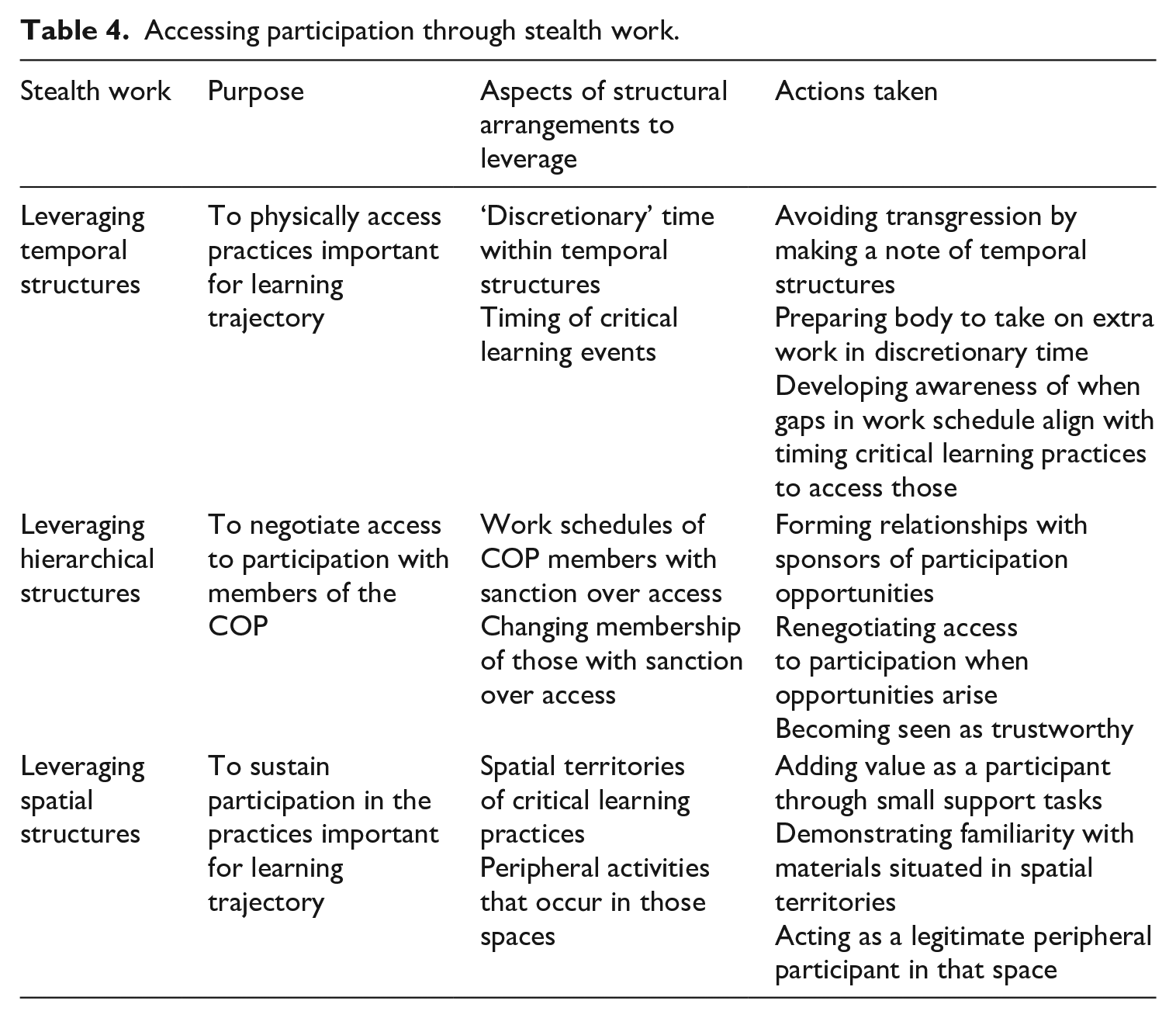
As seen in Table 4, the leveraging of structural arrangements through stealth work enables access to different aspects of LPP. This act of leveraging turns structural arrangements from hindrances to resources. To clarify, by leveraging we do not mean using one’s knowledge of structural arrangements as a resource with which to yield influence over others. Such a view would position knowledge (and power) as ‘thing-like’ – that is, as a resource that individuals use to further their interests and desires – and moves us away from the central tenets of situated learning and COP theory. Rather, our understanding of leveraging assumes a ‘knowing-in-practice’ perspective where knowledge and practice are ‘reciprocally constituted’ (Orlikowski, 2002: 250) and where power is understood as ‘negotiation of meaning and the formation of identities’ (Wenger, 1998: 189). The leveraging entailed in doing stealth work is as an act of drawing knowledgeably on structural arrangements, that themselves constitute and reconstitute relations of power, in order to influence and gain access to practices; it is an everyday practical accomplishment (Contu, 2014; Orlikowski, 2002). Stealth work refers to the everyday, embodied practices through which resources – structural arrangements in this case – are enacted as such (see Contu, 2014).
Stealth work and counter-normative learning practices
The notion of stealth work contributes to the emerging literature on counter-normative learning practices by showing how access to practices is initially secured when learning opportunities are denied. Norms of a practice refer to what one ‘should’ and ‘should not’ do in practice (Nicolini and Monterio, 2017; Rouse, 2001). Norms can be expressed through structural arrangements of a practice and, sometimes, explicitly as rules and policies. Practice norms are, therefore, inextricably tied to the exercise of control and self-discipline within a community (Barker, 1993). Within a COP, what counts as ‘norm-consonant’ or ‘norm-breaking’ behaviour is also mediated by one’s relative position as a legitimate participant (Becker, 1963).
Studies of ‘stretch work’ (O’Mahony and Bechky, 2006), ‘shadow learning’ (Beane, 2018) and ‘constructive disobedience’ (Rennstam and Kärreman, 2019), as outlined earlier, have been useful in helping us begin to understand how newcomers engage in counter-normative learning practices when norms and policies limit learning opportunities. These studies have helped further a line of enquiry in situated learning that focuses on how non-canonical practices engender (or not) learning within communities (Wenger, 1998). They build on previous work on how practitioners engage in ‘water cooler’ learning (Orr, 1996) or ‘steal’ knowledge through immersion in practice (Brown and Duguid, 1993; Ribeiro, 2012).
In contrast, stealth work appears to be closely tied to LPP, both in that it links to the peripheral status of newcomers, but also in that its constituent practices are not explicable as wholly counter-normative. When performing stealth work, newcomers leverage structural arrangements to challenge norms around what they can and cannot do as ‘scutworkers’. Simultaneously, they work with the norms to help them access practices that allow them to move from their ambiguous position as participants. Rennstam and Kärreman (2019: 882) note that constructive disobedience requires ‘a willingness to use one’s knowledge to subvert and display rules and orders’. We find, similarly, that effortful accomplishment of stealth work requires situational awareness and developing knowledge of the norms executed within structural arrangements such that newcomers can negotiate between the demands of the structural arrangements and leverage them resourcefully, at the appropriate moment. Interestingly, then, rather than its constituent practices being ‘either’ normative ‘or’ counter-normative, stealth work comprises both/and. The notion of stealth work extends our understanding of counter-normative learning by demonstrating an alternative way in which newcomers, with ambiguous status, gain access to participation when such access is not given to them.
Crafting learning trajectories through stealth work
Finally, we contribute to the literature on the ways in which newcomers craft learning trajectories (Gherardi et al., 1998; Wenger, 1998). Research has shown how practitioners respond to changes in the nature of work (Barley et al., 2017) by developing strategies to craft their own learning and career trajectories within increasingly mobile, uncertain workplaces (Wolf, 2019). It points to ‘necessity for individual agency’ in the crafting of trajectories towards mastery of a practice (Petriglieri et al., 2018: 482; Wenger, 1998).
Newcomers typically have access to some form of participation or another (e.g. access to scutwork). However, this may not be what is needed for newcomers to progress as legitimate participants in their community. Indeed, as our study shows, some forms of participation may create further restrictions to access and/or render their identity yet more fragile and increasingly peripheral in the desired practice. Differences in teaching and learning curriculums (Lave and Wenger, 1991) also mean that trying to understand which aspects of the practice one needs to access is not straightforward, especially for newcomers. The practices in which newcomers are instructed may differ from those actually expected or valued within the COP. As careers and developmental pathways become more fluid, newcomers will increasingly be left to intuit the direction they need to take to progress in their trajectory.
Our study contributes new insight into how such learning trajectories are crafted by showing how, through stealth work, power relations are negotiated in everyday practice. Stealth work is constituted by mundane and everyday practices but it is far from simple. It is bound to complex power relations and the tensions in everyday work between those participating in practices (newcomers and old-timers) and the different meanings and identities they attribute to them. Stealth work allows access to participation that can, over time, shift these identity constructions. In this way, the notion of stealth work helps to address previous concerns that ‘there is no clear articulation of how power relations are negotiated in the everyday practical accomplishments when there are members with different status claims’ (Contu, 2014: 290). It reminds us that practices do not work in isolation. That we must always consider, as Nicolini (2012: 205) puts it, the ‘nexus of practices’ that newcomers must navigate in seeking access towards becoming accepted as legitimate members of their COP.
While not exploring access per se, Contu’s (2014) study of design work helps further understanding of how the complex configuration of power relations and the relative status of practitioners shape participation in learning trajectories. In stealth work, we reveal how impediments to access to participation arise, not only because our cadets are relative newcomers to the practices of navigation, but also from the rigid structural arrangements on board the ship that themselves instantiate wider systems of power. This includes, for example, the organisation of shipping and management decisions around who does what, where and when and who is ‘in charge’. Access to participation through stealth work implies not only knowing these structural arrangements, but working with them to negotiate interests among members of the community. These interests are ‘situated and contingent on the emerging identities and the context that is posited in these [power] dynamics’ (Contu, 2014: 311). Stealth work enables newcomers to shift power dynamics that impede their learning. However, it would to be neglectful to position it simply as an act of ‘empowerment’. Stealth work also entails subordination to those in authority and to additional work and physical strain (e.g. ‘off-the-clock’ work in much-needed rest times). As situated learning theory tells us, newcomers have always had to negotiate or ‘jockey’ for learning opportunities (Lave and Wenger, 1991). Our study reveals more about what this process looks like and how it is accomplished in practice.
Boundary conditions, translation and future research
The empirical context of our study raises certain boundary conditions. First, the rigid structural arrangements strongly shape the practices on board, presenting us with a seemingly extreme case where the role of the structural arrangements is evident. In other settings, the structural arrangements may not manifest as strongly. Additionally, the maritime industry is still extremely male-dominated. While these dynamics were not the main focus of our study, certainly we saw that gender had a role to play within the practice norms (including around how our researcher – the only woman on board the ship – was permitted to act). In other settings, with different gender dynamics and different ways of working, different forms of stealth work may be observed. This along with the role of other distinctions such as age, race, formal training, institutional status in preferential treatment for access would be an interesting avenue for future research.
An important consideration is whether the concept of stealth work translates to other organisational settings. Here, we would argue that there are many organisational settings where access to participation for newcomers is not readily available (see also Bailey et al., 2012; Leonardi and Bailey, 2017); for example, organisations with transnational workforces and global production lines, organisations that rely heavily on casual or outsourced labour, and organisations in high-risk settings where strict safety rules may preclude newcomers’ participation in practices. In these contexts, stealth work may be employed to gain access to the participation needed for newcomers to learn.
Our analysis suggests two further avenues for future research. First, our study points to the additional physical and emotional strain that newcomers endure in order to leverage learning opportunities. For example, newcomers have to push through their physical and emotional stress and exhaustion, often in the face of authoritarian and unsympathetic old-timers. Future research might look further into this ‘dark side’ of having to work through such barriers to participation within COPs. One direction for future research is to better understand how counter-normative means to ensuring learning opportunities and career progression, presented in previous studies in a largely positive light, might be creating harm for newcomers through the intensification of work. This is important in an era where careers are increasingly precarious and where work–life balance is increasingly blurred.
Finally, future research might examine how wider institutional structures, beyond specific organisations or work contexts, enable and constrain participation in learning trajectories. In our study, newcomers were employed by the organisation that crewed the ships, which gave them certain participation rights (e.g. they were able to board the ship). With the rise of contingent work and the ‘gig economy’, it will be important to see how people with occupational rather than organisational affiliations secure access to participation through stealth work and potentially other means. For example, are freelance workers (e.g. Uber drivers) able to leverage structural arrangements such as legislature, and if so, how? This might provide more in-depth insight into the relationship between canonical and non-canonical learning practices and historically embedded institutionalised arrangements, seen as critical in shaping situated learning.
Supplemental Material
sj-docx-1-hum-10.1177_00187267211010366 – Supplemental material for Navigating turbulent waters: Crafting learning trajectories in a changing work context
Supplemental material, sj-docx-1-hum-10.1177_00187267211010366 for Navigating turbulent waters: Crafting learning trajectories in a changing work context by Ila Bharatan, Jacky Swan and Eivor Oborn in Human Relations
Footnotes
Acknowledgements
We would like to thank the following people and institutions for development of this article. Davide Nicolini, Trish Reay as well as the Strategy, Entrepreneurship and Management Department at Alberta Business School for in-depth feedback on earlier drafts of this article. The ESRC post-doctoral fellowship provided time and resources for writing. Earlier versions of the article benefitted from being presented at PROS symposium, OLKC and AOM as well as engagement with Ethnography Circle and the Advanced Workshop on Practice-Based Studies at Warwick University. Finally, we would like to thank Alessia Contu for her rigorous and supportive editorial steer as well as the three anonymous reviewers for their helpful comments on this manuscript.
Funding
The authors received no financial support for the research, authorship and/or publication of this article.

Supplemental material
Supplemental material for this article is available online.
Notes
References
Supplementary Material
Please find the following supplemental material available below.
For Open Access articles published under a Creative Commons License, all supplemental material carries the same license as the article it is associated with.
For non-Open Access articles published, all supplemental material carries a non-exclusive license, and permission requests for re-use of supplemental material or any part of supplemental material shall be sent directly to the copyright owner as specified in the copyright notice associated with the article.
