




Abstract
How is the complexity of contemporary professional work and services organized differently by management at the strategic level and professionals at the operational level? And what are the implications for managing this complexity? Drawing on literatures on institutional complexity, organizational roles and the analyses of case study data from interviews, observations and documents at a large public service provider in Norway, this article advances the understanding of management in complex organizations and makes the following three contributions to the institutional logics literature. First, we show how multiple institutional logics have different functions at strategic and operational levels, resembling a dynamic interplay in organizing professional work and services. Second, we show how these differences in handling multiple logics are contingent upon the different roles of the strategic managers and operational professionals. Finally, we advance the understanding of what institutional complexity may involve in organizations by disclosing how the significant conflicts stem not only from the presence of multiple logics, but also from differences within the organizations in how multiple logics are handled. Our findings have implications for the planning and management of organizational design and implementation strategies and demonstrate the utility of the institutional complexity perspective for managing complexity in contemporary organizations.
Keywords
Introduction
Managing complexity is a key contemporary challenge for the organization of professional work that has been recently addressed in organization theory via the literature on complexity of institutional logics; this literature has posed the presence of multiple logics as constituting one of the major management issues for contemporary organizations (Kodeih and Greenwood, 2014; Kraatz and Block, 2017). Theorizing of management of institutional logics has also largely been grounded in studies of professional work and professional service organizations, such as hospitals, law firms and insurance companies, providing important insights into how societal forces are at play in professional work settings (Reay and Hinings, 2009; Reay et al., 2017; Smets and Jarzabkowski, 2013; Smets et al., 2015). However, this literature tends to be divided into two loosely coupled approaches.
On the one hand, the management of institutional complexity has been addressed at the organizational level. In this view, multiple logics contribute to differing and sometimes conflicting expectations among external and internal stakeholders regarding organizational behavior and performance (Besharov and Smith, 2014; Delbridge and Edwards, 2013; Ocasio et al., 2017; Pache and Santos, 2010, 2013). Institutional conflicts have been disclosed between professional or occupational groups (e.g. physicians and nurses or professionals and managers) enacting ‘their own’ logics. Moreover, conflicts have been observed between the logics of external expectations, such as when organizations need to balance being competitive and accountable, socially responsible and profitable (Greenwood et al., 2011; Kraatz and Block, 2017; Reay and Hinings, 2009; Reay et al., 2017). Recent studies have focused on how organizations as social actors handle institutional complexity at the strategic or managerial level (Greenwood et al., 2011; Pache and Santos, 2013). At this level, complexity has been reported to be handled structurally through different mechanisms of organizing, such as segmentation (Goodrick and Reay, 2011) and compartmentalization of activities (Jarzabkowski et al., 2013; Kraatz and Block, 2017), deflecting or refocusing the influence of the complexity of logics (Martin et al., 2017), facilitation through dialogue and collaborative relationships (Reay and Hinings, 2009) or even recruitment or socialization practices (Battilana and Dorado, 2010).
On the other hand, institutional complexity has been studied at the micro level. In this view, institutional complexity and multiple logics are conceived as available resources to professionals that enable purposive agency in pursuing and accomplishing goals and interests (e.g. Andersson and Liff, 2018; Bévort and Suddaby, 2016; McPherson and Sauder, 2013; Reay et al., 2017; Smets and Jarzabkowski, 2013; Smets et al., 2015; Voronov et al., 2013). Recent studies have disclosed how professionals employ multiple logics pragmatically and creatively at the operational level; for instance, to give meaning to patient collaboration in their professional everyday work (ten Dam and Waardenburg, 2020), in co-opting others’ logics to facilitate vertical collaboration within professional organizations (Andersson and Liff, 2018), in manoeuvring positionally within an organizational hierarchy (Currie and Spyridonidis, 2016), in using multiple logics flexibly to frame performance in different ways in accordance with various contextual expectations (Smets et al., 2015; Voronov et al., 2013) or in negotiations with other professional groups for reaching decisions in courtrooms (McPherson and Sauder, 2013). As such, multiple logics are not challenges to be managed but resources or tools that reflexive, knowledgeable individual actors can use for strategic and tactical purposes in their performance of professional work.
However, to better understand the role of institutional complexity in the processes of organizing professional work, we need to combine the study of top-down processes on the organization level with studies of frontline professionals’ organizing of work, bottom-up (Purdy et al., 2019). Such insight is particularly important in light of prevalent contemporary management and governance reforms. So-called ‘joined-up’ or ‘whole of government’ reforms in organizing public service delivery (Christensen and Lægreid, 2007) call for integrated service delivery at the front lines (Halligan et al., 2011), creating new dilemmas and organizational complexities. These are particularly manifested as complex and overloaded work situations at the front line, posing challenges for the professionalism of professional workers, as well as for the efficient deliveries of professional services (Andersson and Liff, 2012; Evetts, 2009; Hazgui and Gendron, 2015). We address this need for more multilevel studies in the uses of multiple logics in professional organizations from the perspective of organizational roles and institutional logics as a differentiated framing device. We ask the following research questions: How are multiple institutional logics handled at the strategic and operational levels, respectively, organizing contemporary professional work? What implications does this have for the constitution and management of complexity in professional work organizations?
Drawing on an in-depth multilevel case study within a large public service provider in Norway, analysing how multiple institutional logics are handled from both the top-down and bottom-up perspectives in organizing professional work and services, we make three contributions to the literature. First, we show how multiple institutional logics have different functions at strategic and operational levels, resembling a dynamic interplay in organizing professional work and services. Second, we show how these differences in the use of logics are contingent upon the different roles and contexts of expectations of strategic managers and operational professionals. Finally, in this way, we advance the understanding of what institutional complexity may be about in contemporary organizations by disclosing how the significant conflicts stem, not only from the presence of multiple logics in organizations, but also from differences within organizations in how multiple logics are handled.
Theoretical aspects of institutional complexity
Thornton et al. (2012: 77) defined institutional logics as a higher order level of meaning manifested as ‘frames of reference that condition actors’ choices or sensemaking, the vocabulary they use to motivate action and their sense of self and identity . . . establishing core principles for organising activities and channelling interests’. According to the literature, institutional logics as ‘common cultural frames of reference’ (Cornelissen and Werner, 2014; Werner and Cornelissen, 2014) have both been used to refer to a background structure of shared reality in terms of cognitive schematas that structure actors’ perceptions (see Goffman, 1974: 21; Weick, 1995: 111) and as ‘tools for strategic and creative behavior’ (Diehl and McFarland, 2010: 1719). In the first sense, logics frame what kind of interpretations and actions are recognized as sensible and justifiable in a given culture (Werner and Cornelissen, 2014). For instance, a market logic frames interactions and their outcomes in terms of demand, supply and pricing; a bureaucratic logic frames interaction in terms of procedural accuracy and accountability. Both frame quite differently what are regarded as sensible ways to valuate purposes and actions. In the second sense, frames of reference are referred to as measures for symbolic communication to be used in signalling, and thus influencing, other actors’ perceptions of present situations (Cornelissen and Werner, 2014). In this vein, Kaplan (2008) coined the concept of a ‘framing contest model’, referring to how different actors engage frames to negotiate favorable definitions of situations at hand. Cornelissen and Werner (2014) pointed out that the concept of framing has been used to refer to leaders’ purposeful attempts at influencing the interpretation of employees; for instance, to create acceptance for and support of change initiatives. These two variants of frames, which also (as implicitly suggested) can be placed as a distinction between frames and framing (Cornelissen and Werner, 2014), are not mutually exclusive but complementary; they refer to different aspects of how frames work in social situations but with quite different implications for how logics are experienced and handled, especially in situations where multiple logics are present.
The presence of multiple logics may be experienced as a clash of frames that must be handled for social actors to be recognized as operating in a sensible and justified way. This is what much of the organization-level studies of management of institutional complexity have been addressing through disclosing how professional organizations can justify their conduct towards contradictory institutional expectations through different mechanisms of organizing (segmentation, compartmentalization, etc.; see Goodrick and Reay, 2011; Greenwood et al., 2011; Jarzabkowski et al., 2013; Kraatz and Block, 2017; Martin et al., 2017; Ocasio et al., 2017; Pache and Santos, 2013). In the second sense referred to, multiple frames can also be perceived as a complex or advanced repertoire of tools to influence social situations. This use of logics as frames resonates with microstudies disclosing how professionals use mixes of their own and other interaction partners’ logics to frame their cases in ways that gain legitimacy and acceptance of their viewpoints and interests, influencing others’ interpretation and valuations of the situations at hand (Andersson and Liff, 2018; Arman et al., 2014; McPherson and Sauder, 2013; Reay et al., 2017; Smets et al., 2015; Voronov et al., 2013).
We have then two aspects of logics as frames that seem to correspond roughly to the division between how management of institutional complexity is perceived in the literature (see introduction). The organization-level studies conceive that multiple frames are handled as a challenge of justification, whereas in the micro-level studies multiple logics are handled as an opportunity for influence. In contrast, the questions we raise in this study are whether and how multiple logics (as frames for actors’ choices and sensemaking) may have distinctive functions when studied at the micro level through divergent organizational roles. We do this by comparing how logics are handled differently at the strategic and operational levels for the purpose of organizing work. We engage role theory as a conceptual framework to theorize differences between how strategic manager roles and the roles of professionals at the operational level are constituted in a way that is significant for how they handle and relate to multiple logics in the organization of work.
A role has been defined as a position constituted by particular attributes and social expectations of what is considered appropriate behaviors for its occupants (Biddle, 1986; Sluss et al., 2011). According to Biddle’s (1986) comprehensive review, different approaches to role theory suggest that expectations come across as norms, beliefs and preferences, and they stem from different sources, such as structural position or function (e.g. formal position in the organization), institutional expectations and more immediate contextual or situational demands. Expanding on Thornton et al.’s (2012: 77) notion of institutional logics as ‘higher order levels of meaning’ providing ‘frames of reference for behavior’, we might say that, in principle, actors’ roles are constituted by a mix of higher order and lower order expectations, the last category referring to more immediate situational expectations. This mix of higher and lower order expectations gives rise to negotiations of roles in encounters between actors enacting their respective roles in social interaction (Sluss et al., 2011). Thus, the expectations specify the meaning and character of the role, both generally and specifically, as enacted in the situation. The concept of role identity refers to how the individual actor interprets and makes sense of that role as a basis for enacting and negotiating it. Therefore, a role identity can be perceived as ‘a cognitive schema that organizes and stores the information and meaning attached to the role (via behavioral expectations) and serves as a framework for interpreting in-role as well as extra-role behavior’ (Sluss et al., 2011: 508), which again are subject to social negotiation among role occupants in social situations. Thus, on the one hand, the enactment of specific roles has stable starting points in terms of the occupants’ salient role identities (providing interpretative schemes) that vary between roles. On the other hand, the enactment of specific roles faces different contexts of expectations as a mix between higher order and lower order expectations.
Drawing on role theory, we consider how different organizational roles impact the way multiple logics are handled on the basis of what kinds of expectations their occupants are facing in their particular role.
Research setting, design and methodology
To study how multiple institutional logics are handled differently between roles in the organization of professional work at the strategic and operational levels, we adopted an organizational case study design (Vincent and Wapshott, 2014) to examine Norway’s national welfare service provider, called NAV. The organization is a merger of three former separate public service lines – employment services, the national social security service and municipal social services – in a typical whole-government reform (Christensen and Lægreid, 2007). The result is comprehensive integrated service delivery (Halligan et al., 2011) through local one-stop shops, operating as state–municipal partnerships.
As a whole-of-government reform, the new NAV organization was designed to reduce the silo effect across different service lines. According to Pollitt (2003: 35), such reforms ‘offer citizens seamless rather than fragmented access to a set of related services’. However, such attempts to reform service provision tend to result in large and complex organizations that may replicate silo practices (Davies, 2009). Following the reform, NAV has exhibited significant complexity both horizontally and vertically in attempting to respond to the diverse expectations of multiple institutional fields (e.g. Besharov and Smith, 2014; Pache and Santos, 2010; Reay and Hinings, 2009).
At the strategic level, the complexity has been managed by reforming the governance structure, with specialized sections for different functions, such as processing disbursements and designing and implementing policy measures to support service users returning to work. However, at the operational level the integrated service interface of local one-stop shops must cope with the diverse expectations of local stakeholders and government requirements (Breit et al., 2018; Fossestøl et al., 2015; Klemsdal and Kjekshus, 2019). For instance, frontline professionals in local NAV branches must apply the extensive new policy measures specified by the central NAV administration and the Ministry of Labour and Social Affairs (Høiland, 2018).
To investigate the differing functions of multiple institutional logics at the strategic and operational levels in NAV, we analysed how managers and professionals perceive the expectations of their respective roles and how multiple logics constitute these expectations and their handling. To explore the dynamics of these differences, we tracked the implementation of work facilitation policies, ranging from management planning and strategizing to the reception of these initiatives by individual frontline professionals. The analysis is illustrated in a separate section with reference to the attempted implementation of the Facilitation Guarantee (FG) policy measure for work facilitation.
Data collection
For triangulation, the data were drawn from interviews, observations and documents. In total, 32 in-depth, semi-structured interviews of 90–130 minutes in duration were conducted over a period of 12 months (2015–2016) with managers at different organizational levels and frontline professionals from a selected local branch. To confirm and validate the findings, some informants were interviewed more than once. In the interviews with managers, topics of relevance centered on policy intentions, implementation efforts and managerial instructions. The interviews with frontline professionals focused on their immediate work situation, prioritization of tasks and responses to managerial instructions regarding the new policy measures.
All the interviews were recorded and transcribed. Immediately after each interview, new insights and analytical points were written as memos. Interviews at the local NAV branch were supplemented by data from 24 case and department meetings observed over four months in late 2015. Observation data were collected in a semi-structured way (Gillham, 2008) to gain initial insights into the frontline professionals’ work situation, norms and ways of working. The observational data were used to confirm important findings and included notes based on informal talks at the coffee machine or overheard conversations – for example, among interviewees discussing how to approach their upcoming interview. The documents analysed included research reports on NAV and work facilitation policies; policy documents, such as government white papers, audits and evaluations; internal NAV documents, such as job descriptions for central positions; target and disposition letters; workshop presentations on new policy measures; and statistics on policy measures implemented at the national and local levels. The documents were reviewed to identify meaningful and relevant passages of text (Bowen, 2009). Figure 1 provides an overview of the empirical data sources.
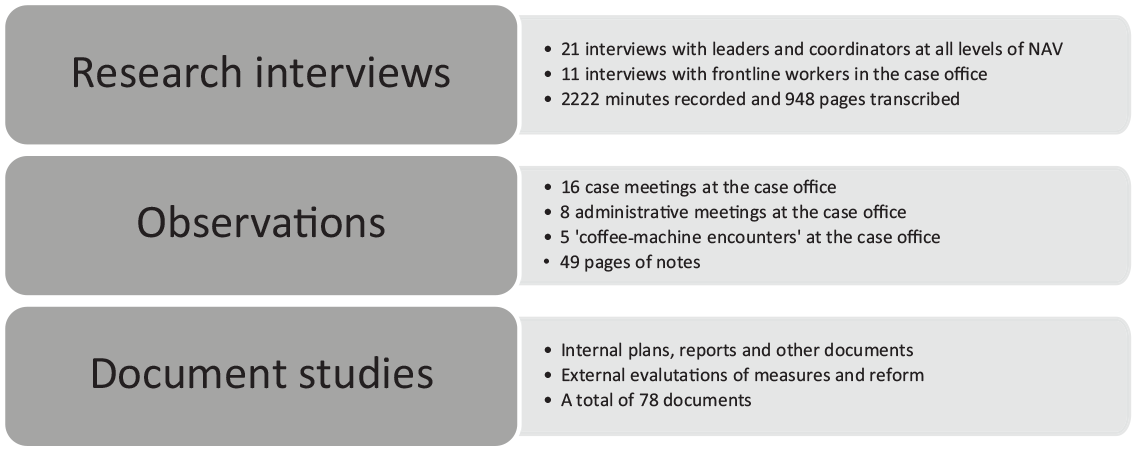
Empirical sources and data material.
To protect informants’ anonymity, the illustrative quotations used here are not linked to demographic information, such as gender, age or job description. Although both genders were well represented, all the informants were identified as ‘she’. The only demographic information provided indicates whether the informant worked directly with the target group of frontline informants or as a manager at the strategic level.
Data analysis
The data were compiled using NVivo qualitative software; in the initial phase of open coding, interview data were then reviewed in parallel with material from the observations and documents. To report the data in the recommended format for qualitative research (Pratt, 2009), Tables 1–2 in the appendix document the analytical process with selected quotations and coding cycles to support our interpretations. The analysis was roughly divided into two main tasks, and the coding cycles and analysis involved three linked stages. Tables 1 a–c provide an overview of the three-stage coding cycle in the first task, and Tables 2 a–c provide an overview of the three-stage coding cycles in the second task, including examples of empirical data linked to the codes.
Following Reay and Jones (2016: 442), our first analytical task was to identify ‘patterns of logics’ by linking our ‘insights and abstractions to the context through quotes, observations, and thick descriptions’. This entailed cycles of inductive analysis, inputting the data to NVivo and making deductive comparisons with theoretical accounts of institutional logics in NAV and similar public sector organizations. In attempting to identify ‘symbols and beliefs expressed in discourse (verbal, visual or written), norms seen in behaviors and activities, and material practices that are recognisable and associated with an institutional logic or logics’ (Reay and Jones, 2016: 442), the data were organized into topic-based bins (Fletcher, 2016). These reflected how informants discussed and valued policies or work tasks and were categorized in terms of the following attributes: 1) professional standards, individualized services and close follow-up; 2) justice, efficiency and standardization of services in application processing; and 3) registration and documentation procedures and goal achievement.
During the second stage of the first task analysis, the first-cycle codes were read and re-read in conjunction with the transcripts, notes and documents to identify further patterns and relationships and to synthesize the codes into broader categories (Currie and Spyridonidis, 2016). Institutional logics are ‘configurations of distinct, yet interrelated dimensions’ (Ocasio et al., 2017: 510), and we categorized relevant dimensions of logics that emerged during the first coding cycle. These were analysed in terms of characteristics, such as sources of legitimacy and identity, as well as what formed the basis for strategy, norms and attention (Thornton and Ocasio, 2008; Thornton et al., 2012). Dimensions that fit the data were summarized in the second-cycle coding as sources of legitimacy (e.g. professional standards, democracy, legitimate public expenditure); motivations (e.g. delivering services according to professional standards, tailoring services for individual clients, serving management, satisfying the system, providing services efficiently and justly); and NAV strategies (e.g. decision making based on professional standards, provision of just and efficient services, compliance with managerial instructions for documentation).
To identify differences between strategic and operational levels, we separated managerial principles and frontline work tasks. Managerial principles and values at the strategic level were derived from accounts of various new policies and implementation procedures, as well as internal and external expectations referred to in documents, departmental meeting notes and interviews with managers. At the operational level, we focused on frontline informants’ narratives and reflections on the working day at the NAV office, as well as work tasks and practices and their reasoning when prioritizing tasks. Along with the aforementioned dimensions, these emerged as underlying patterns in moving from ‘a descriptive to an interpretive, more explanatory mode’ (Currie and Spyridonidis, 2016: 83) during the third stage of coding, facilitating the gradual capture of patterns of logics in the data and the literature (Reay and Jones, 2016).
Three distinct logics
From the second-cycle categories, we discerned three distinct institutional logics, two professional and one administrative, within NAV. The literature on the complexity of logics in professional organizations commonly portrays professionalism as a separate or third logic (Freidson, 2001) that conflicts with market, bureaucratic, corporate and managerial logics (Andersson and Liff, 2018; Bévort and Suddaby, 2016; Reay et al., 2017; Scott et al., 2000). However, the data pointed to a somewhat different scheme. In contrast to a managerial logic prioritizing resource efficiency (Andersson and Liff, 2018: 76), the two variants of professional logic also sought to optimize the treatment of clients. These were labelled the logic of craft and the logic of industrial production. As portrayed in Table 1a, the logic of craft refers to aspects of professional work that stress the importance of collaboration and tailored services, which are time-consuming and require individual responsibility, care, creativity and improvisation. The frontline professionals eagerly portrayed their tailoring practices in idealistic terms, as this logic legitimizes their delivery of NAV’s mandate to provide opportunity and work facilitation for the people that need it.
The emphasis of the lengthy process in tailoring services according to the logic of craft shows a reflection on the contrast to the simultaneous expectations of efficiency and standardization according to the logic of industrial production. As illustrated in Table 1b, this logic serves to legitimize NAV as a productive and just provider of welfare services based on standardized regulations and mass production to satisfy the needs of the many. Informants at both strategic and operational levels associated this logic with tasks that included processing applications and requests within a deadline, ensuring that clients receive social insurance and benefits on time, using computer programmes to track client contact and following up in accordance with specified standards.
We also identified a separate logic of administrative accountability, referring to documentation of service delivery to maintain transparency and accountability, a central aspect of professional service provision, as stakeholders expect feedback to confirm that their expectations are met (Almquist et al., 2013). For instance, as NAV is financed by the Norwegian state, the government and taxpayers expect transparency and accountability based on this logic. As depicted in Table 1c, our third-cycle coding clearly indicated that this third aspect of work tasks includes documentation and registration activities, such as procedures and routines, performance measurement against detailed targets and, in NAV’s case, an emphasis on standardization and top-down instructions for implementation.
These three sets of higher order expectations entail clearly incompatible logics, and this complexity creates tensions within the organization (see Besharov and Smith, 2014; Pache and Santos, 2013). For example, while tailored solutions require an intensive focus in working with individual clients, efficient service provision often demands a rapid and extensive approach. Similarly, making public service work transparent and accountable diverts frontline professionals from client needs to system needs (e.g. Meyer et al., 2014).
Our second analytical task was to understand the roles of the logics at the strategic and operational levels of NAV. After coding for the strategic level response to institutional complexity (Table 2a), we coded for the role of multiple logics at both the strategic level (Table 2b) and the operational level (Table 2c). As well as illustrating the coding cycles at these different levels, Tables 2 a–c provide empirical examples to support the findings.
At the strategic level, as illustrated in Table 2a, we identified themes that include the external expectations of various stakeholders and the complexity of organizational design and responsibilities. Next, when coding themes into wider categories, we identified different organizational requirements, such as accounting for results to protect legitimacy; differentiation, specialization and compartmentalization to address the complexity of the organization and its responsibilities; and the need for better coordination and collaboration between specialized units. During the third cycle of coding for theoretical constructs and explanations, the findings were linked to former studies of how to reduce institutional complexity – for instance, by assigning specific functions to specialized departments (e.g. Goodrick and Reay, 2011; Kraatz and Block, 2008, 2017).
Coding for the role of multiple logics at the strategic level, as portrayed in Table 2b, we identified themes related to the importance of motivating frontline professionals to implement policy measures by linking this to professionalism. We also identified acknowledgements by managers of work overload at the operational level and an assumption that frontline professionals needed help to prioritize correctly. Linking these themes in broader categories, we identified several managerial strategies for implementation; these included linking the policy measure to the craft logic to ‘sell it in’ to frontline professionals; framing the policy measure in line with the logic of industrial production to ensure prioritization; and providing instructions regarding documentation procedures in line with the logic of administrative accountability. During third-cycle coding for theoretical constructs and explanations, the findings aligned with the use of logics in action literature (e.g. McPherson and Sauder, 2013; Smets et al., 2015), where logics are used for task performance.
At the operational level, as depicted in Table 2c, themes included how actors experienced and handled their everyday work situations and, in particular, how they organized their work in relation to managerial instructions – for instance, regarding policy implementation. These findings were again linked into broader categories; for example, in the case of frontline professionals’ reactions to managerial instructions, the main themes indicated that their work situation was increasingly complex because of their already extensive tasks. (‘There are so many things, so many things to do that. . . you have incredibly limited time’.) Frontline professionals experienced the additional tasks as too extensive rather than as incompatible, requiring ongoing daily prioritization. In this regard, they tended to prioritize individual clients’ needs as their basic concern.
Third-stage coding identified an underlying scheme for prioritization based on various patterns and dimensions underlying the framing of task categories and linking the second-cycle categories to theoretical constructs.
Analysis and findings
Turning now to our analysis of the differing functions of multiple institutional logics at strategic and operational levels in the case organization, we first report on how the institutional complexity of NAV was enacted in the organization. We then analyse the dynamics of how multiple logics were managed and used on different levels, and thus in different roles, through an in-depth analysis of the implementation of a particular policy measure from formulation to enactment.
Managing institutional complexity by mechanisms of organizing
As a large integrated public service organization, NAV operates in a complex institutional environment to meet the expectations of diverse stakeholders that include government ministries, organized interest groups and the professions. These expectations manifest as multiple and sometimes conflicting goals mediated by the Ministry of Labour and Social Affairs. As one manager put it: The NAV system has to focus on many goals. In the strategic letters we receive from the Ministry, there might be as many as a hundred different goals that must be realised. (Management informant)
The multiple goals of these diverse stakeholders relate to at least three different aspects of public service work, each informed by the three specific institutional logics mentioned above, providing tailored services to the individual clients (logic of craft) or cost efficient services for the citizens (logic of industrial production) in a transparent and accountable way (logic of administrative accountability).
NAV addresses these complex expectations at the strategic level by means of specialization and compartmentalization to manage the different aspects of its mandate. For instance, one department is responsible for processing benefit applications, while another is responsible for delivery: [W]e are organised by service department. We have responsibility for labour market measures and follow-up . . . But there is also a smooth transition between my section and those working directly on follow-up. Working with the NAV methodology, work ability assessment, activity plan . . . There is also a smooth transition to the labour market side. (Management informant)
These specialized departments are then organized as different sections dealing with specific service policies assigned to dedicated managers, whose work is narrow and specialized – for instance, implementing such a measure as the FG. For managers at NAV’s national administrative level, this includes responsibilities for planning and following up on the implementation of specific policy measures in collaboration with teams of dedicated coordinators in each provincial office. At the provincial level, managers’ responsibilities include implementation of the policy measure and follow-up with frontline professionals.
One manager acknowledged that this specialization might weaken coordination by promoting competition rather than cooperation among different departments and sections promoting their particular agendas, policies and measures at the operational level: There’s a lot of rivalry and self-interest [among administrative-level sections]. And bad coordination. They [the operational level] tell us this. Collaboration is not good enough. ‘Now you have to start [to collaborate]’, they say. Because they notice it. (Management informant)
Specialized strategizing
When tasked with planning and implementing specific measures at the operational level, dedicated managers at the strategic level of NAV made strategic use of the various institutional logics to advance implementation of their assigned policies, as shown in Figure 2.
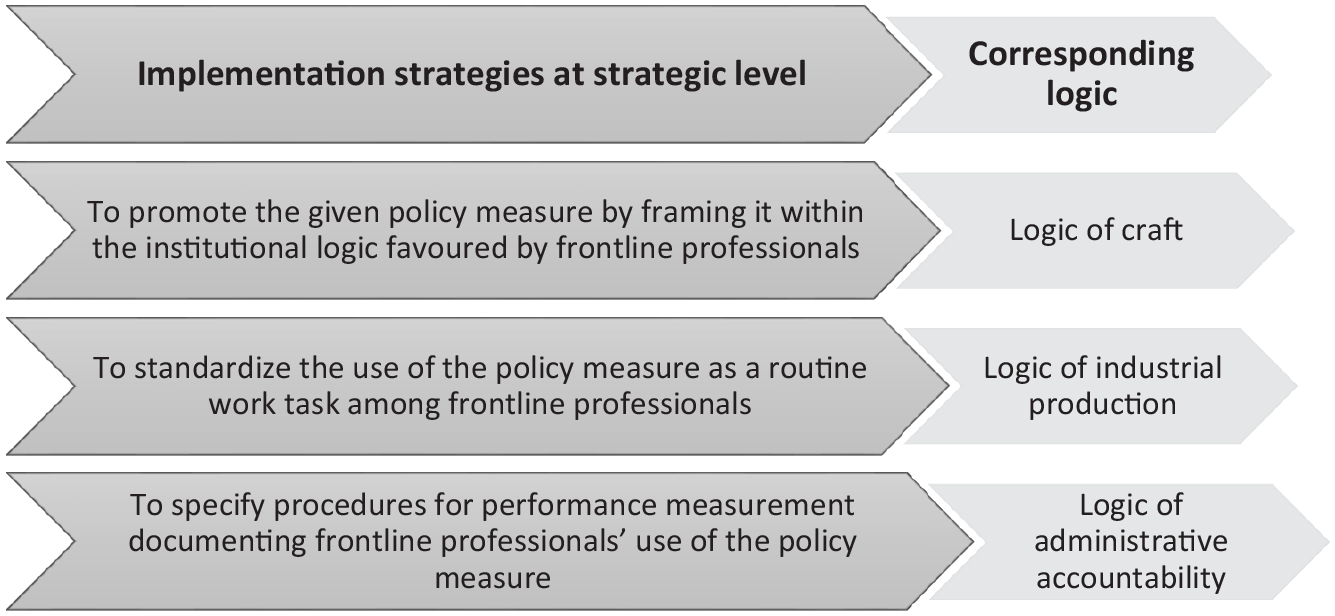
Use of institutional logics at strategic level portrayed through devoted managers’ implementation strategies.
First, they promoted the measures and tasks of their dedicated service areas in line with the logic of accountability. Performance measurement and continuous feedback and evaluation were used to facilitate prioritization of the measure by frontline professionals as considered appropriate by managers: And then we included it in the office scorecards, which is our management tool. So, every office got a target number. . . I’m not in favour of target numbers for everything. . . but this was about raising awareness and increasing use of the measure, and I think we have benefited. (Management informant)
In addition, using documentation procedures as a strategy for implementation aligned with the strong strategic-level focus on documenting policy implementation. As one of the strategic-level managers put it, it signalled how these logics become a central frame for the managerial role identity: We measure it – it means a lot. We know that these [dedicated] managers are then confronted with the numbers at every single leadership meeting, every three months . . . So, in addition, it becomes part of the management dialogue meetings. So, they are confronted with numbers and results . . . After all, we do very thorough measuring. (Management informant)
We also found that the strategic managers referred to the logic of craft, and sometimes, the logic of industrial production when framing the different measures and tasks, and that they did so in order to influence the professionals’ interpretation and valuation of the tasks to ‘sell them in’. We demonstrate this use of institutional logics more thoroughly in the analysis of the case of implementation of the FG policy below.
Situational complexity at the operational level
Moving from the strategic organization level to the operational level, frontline professionals at the local one-stop shop portrayed complexity primarily as a consequence of the number and diversity of work tasks driven by specialized departments and documentation practices. Regarding their immediate work situation, frontline professionals described the many and varied tasks that must be prioritized and handled each day. As depicted in Figure 3, these included the provision of employment services involving close and direct follow-up of clients and potential employers (logic of craft); processing applications related to secure income and work capability evaluations and responding to contact requests in a timely manner (logic of industrial production); and performance measurement, registration and documentation (logic of administrative accountability).
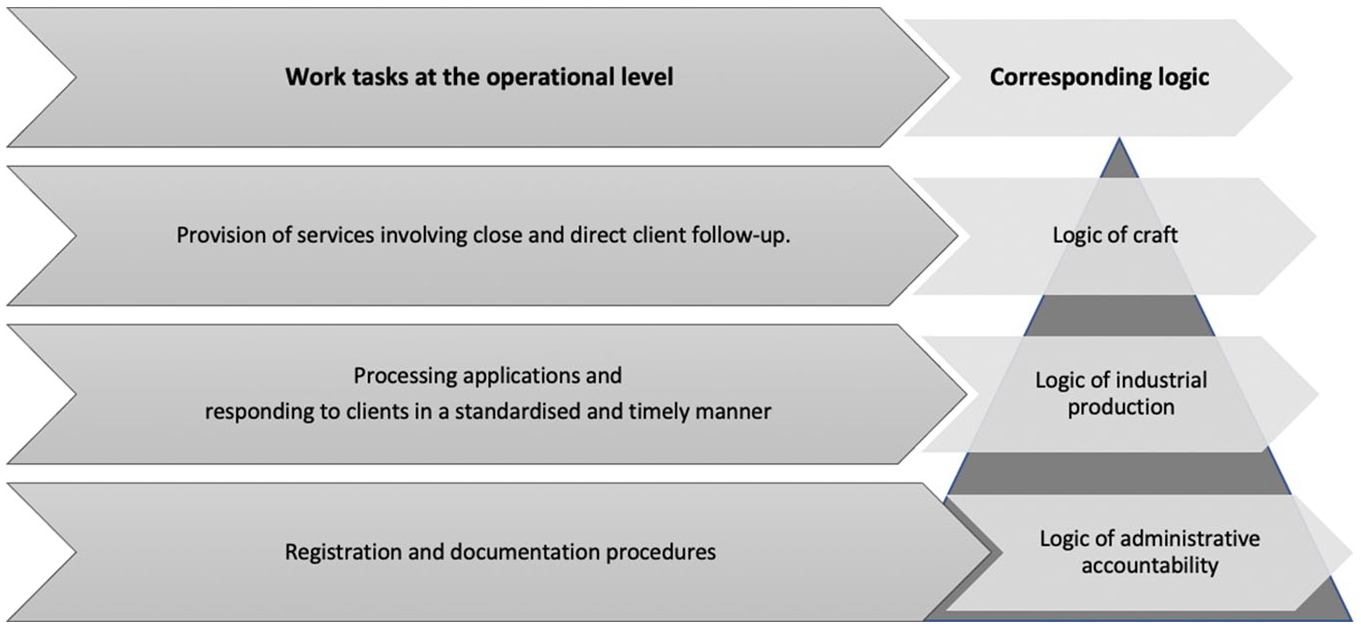
Work tasks at the operational level with corresponding logics in a value hierarchy.
They also referred to their heavy daily workload in terms of the number of clients (over 100 per professional) requiring regular follow-up. The following vignette is taken from a memo note written after a day of observations and interviews at the branch office: We are sitting at her desk and she is presenting her ‘work bench’, which is a digital platform where all her 105 assigned clients are listed. She points to markings at several of these clients on the list. This indicates that there are tasks to be followed up immediately. Some of them need follow-up for prolongation of economic support; others she needs to contact to check on their process of getting back to work. She needs to prioritise what sort of measures are appropriate to assist the client in this process. She must deliberate on how much time to spend on the different clients, as well as which clients to prioritise. In addition, she tells about how they have to handle a steady stream of new policy measures that they are supposed to implement as part of their repertoire of work. She complains of having to ‘follow up this and that’ when management had not allocated ‘time to make this possible’.
As the vignette illustrates, frontline professionals also noted the constant pressure to perform work they experienced as beyond their ‘core tasks’, including implementation of new policy measures and managerial instructions – for instance, new work facilitation methods and priorities or new information technology procedures. In this way, they experienced how dedicated managers’ implementation practices at the strategic level, framed as enhancements of the performance of core tasks, are loosely coupled to the practices of other dedicated managers, all arriving more or less simultaneously at the operational level as a large volume of new separate policy measures, expectations and work tasks: Yes, it is typical of NAV that there is a lot of [managerial] focus on one thing, usually within a relatively short period. Then the focus changes to something completely different [a new policy], and that new thing becomes our focus. We had this [FG] and then we had [policy 1]. Then we had [policy 2] and [policy 3]. The focus fluctuates quickly. [Policy 4] was once the area of focus; there are often two or three different areas of focus each year . . . It changes a little. (Frontline informant)
All frontline professionals painted a clear picture of a complex and overloaded work situation, making it unavoidable to prioritize work tasks at ground level: You have things that you always do and must do and always will do; then you have 10 things that you have to do to satisfy others – a system, a registration procedure or whatever. And because those do not necessarily seem important, they get de-prioritised . . . I prioritise follow-up and processing of important things. (Frontline informant)
As this quotation shows, frontline professionals clearly prioritized fluctuating demands according to a stable set of priorities, as discussed in the next section. Tables 1 a–c (appendix) provide additional empirical illustrations for how the professionals use the different logics in framing their conception of tasks.
Organizing work overload
The frontline professionals employed heavy prioritization to handle everyday task overload. In so doing, they deployed the three logics as a scheme for framing tasks according to a value hierarchy as depicted in Figure 3.
At the top of the hierarchy, the frontline professionals referred to the logic of craft, conveying a strong professional and even personal need to deliver services to meet the human needs of individual clients: But I follow them [the clients]. It is important that someone pays attention to them and to how it all turns out for them, I think. It is nice that they are also told when it works out. . . not just their problems. That, I think, is fulfilling. (Frontline informant)
This disclosure of feelings about following up with individual clients reflects a commitment to tailoring services to the needs of individual clients. This was also regularly communicated during case meetings when discussing how to prioritize clients for follow-up. In this regard, frontline staff expressed their distress about the lack of time and resources to deliver tailored services (as indicated in observation notes). This craft logic resonates strongly with the professional values of social work (National Association of Social Workers, 2017), and therefore, with a sense of professional identity in delivering social work services.
The logic of industrial production was also identified as an important aspect of service work: [A]n important part of our work is to provide benefits and income security . . . Although we’re supposed to focus on work facilitation services – which is of course really important if we’re trying to get people back to work . . . it is still a fact that we have to keep up with the administrative framework to ensure that people receive the benefits they are entitled to . . . and that people do not suddenly stop receiving their benefits because of administrative flaws. (Frontline informant)
Providing services in a fair and timely manner to meet clients’ needs was also identified during case meetings as a regular source of frustration and shortcomings (observation notes). This served as a crucial reference point for valuing and delivering social work services in line with professional standards (National Association of Social Workers, 2017).
Finally, among the different aspects of public service work, the logic of administrative accountability was clearly valued lowest. When tasks were classified according to this logic, documentation aspects were emphasized, although, in principle, they could equally be interpreted as checkpoints ensuring adherence to service provision procedures. The frontline professionals also viewed these activities as irrelevant to the core task of providing work facilitation services to individual clients. These findings confirm the frontline professionals’ tendency to associate the logic of administrative accountability with work tasks that make no sense at the operational level: It’s nonsense to implement something that’s not necessary . . . that does not provide better quality for our clients, just to get numbers or ‘satisfy the system’. (Frontline informant) What is good follow-up? . . . Ensuring that it meets target numbers or that it is actually done? We have many checkpoints during the day . . . We had a screen that showed how many [policy measure 1] had been done that month. Was it above or below target? Is this good or bad? (Frontline informant)
References to this logic dominated all the frontline interviews and case meetings and emerged clearly in the stated lack of belief that registering and documenting the use of policy measures constituted a useful work task.
The following scene during a meeting observation at the frontline office shows logics in use during interactions between frontline professionals and managers: The manager uses a PowerPoint slide portraying statistics to talk about the use of certain policy measures at the frontline office. This specific office scores high in using a specific policy measure compared with other local NAV offices, but the manager pinpoints that they also score low on other measures (logic of administrative accountability). A frontline employee asks for an explanation of the procedure for registering the use of a certain measure in their computer system. The meeting has so far been running without many interruptions, but it is swiftly filled with employees talking about how and why to register for scores, asking why they should prioritise this when so many other work tasks are more important (valuation and prioritisation). One employee asks the manager directly about what the point of measuring a specific task is – spending valuable time doing so – if it does not lead to any improvement for the clients (logic of craft/valuation and prioritisation). Another employee replies that she only does so for statistics (logic of administrative accountability/categorisation) and does not see any other purpose. In response, the manager clearly states that they should not at all be in doubt that these documentation procedures are very important (logic of administrative accountability/valuation). This is because all the important client follow-up work that they do (logic of craft/categorisation) lies behind these numbers. And even though what really counts is ‘the daily client work we do’ (logic of craft/valuation), ‘ok, we also need the numbers to document and show how well we are doing it’ (logic of administrative accountability/valuation).
The vignette illustrates how logics are used for framing aspects of the service work differently by the managers and the professionals. While, to the management, the work is counted as performed when accounted for in the system to be further displayed at the strategic level, the professionals differentiate the documentation aspect as separate tasks that are considered unnecessary for the real performance of work, which they directly couple with improving the well-being of individual clients. At the operational level, then, the three logics clearly constituted a value hierarchy as an integrated framing tool or scheme for classifying, evaluating and prioritizing what to do (and what not to do) in a complex and pressurized work situation.
In summary, we found that institutional complexity at the organizational level was managed by compartmentalization, assigning specialized work to dedicated one-policy managers. These managers then made strategic use of multiple logics as tools for promoting the implementation of the policy measure and tasks in question. However, this compartmentalization at the organizational level meant that frontline professionals were left with an uncoordinated overload of tasks to be performed at the integrated service interface. To cope with this overload, frontline professionals made systematic use of the institutional logics to justify valuation and prioritization of tasks.
The differing uses of institutional logics at the strategic and operational levels
The account of attempts to implement the FG below serves to illustrate differences in and dynamics between the use of institutional logics at the strategic and operational levels of NAV. This policy measure involves a contract to enhance collaboration among NAV, potential employers and potential employees (clients) seeking work facilitation services. Facilitated and partly developed by the strategic service department for employment measures, the FG addresses issues involving the logic of craft. For frontline professionals, the associated tasks encompass all aspects of work facilitation, which include writing contact information, describing the responsibilities and rights of the parties involved, collecting signatures and registering all the information on a computer system.
Institutional logics as a tool for implementation
Document analysis and interviews at central levels of NAV clearly indicated that the intent of the FG is to promote better collaboration and individualization of services – for instance, in the use of ‘supported employment’ in line with the logic of craft: The FG agrees very well with the supported employment mindset – that you have a procedural approach, and you make sure that employers feel secure. These are perhaps among the most important things you do in the process [of work facilitation] (Management informant).
During the interviews, managers at the strategic level further articulated their explicit framing of FG implementation in line with the logic of craft to motivate frontline professionals to prioritize the measure in their daily work with clients: [I]n the beginning, there was a lot of focus on methodology. I don’t quite know if that was a smart way of selling it in. In any case, I focused on the fact that it is a practical tool that employers, employees and employers’ organisations have asked for. . . not something that we [NAV administration] invented ourselves. (Management informant)
In seeking to influence this process of getting the professionals at the front line to prioritize the measure by framing the FG with reference to a logic of craft, managers demonstrated their awareness of the need for prioritization and how it is practised at the front line. They also demonstrated their awareness that the FG is not readily associated with the logic of craft, as a consequence of other implementation strategies they were using, leading to a danger of too standardized an approach because of an association with other logics: I’m afraid it’s going to be a bit industrial – a bit like signing something in a hurry or just routinely. But I think this varies quite a bit. There are those who understand it. . . But I’m concerned it may be a bit like that. (Management informant)
Managers’ awareness of the volatility of how measures and tasks are framed for how they were adopted at the operational level reflects their understanding that FG implementation would depend crucially on the associated logics. For that reason, the strategic use of logics for implementing and framing policy measures played a key role in advancing implementation of the FG – in this case, by standardizing it in line with a logic of industrial production, adding it to scorecards in line with a logic of administrative accountability and then by framing it as a logic of craft to encourage prioritization and appropriate use.
An integrated system for valuation and prioritization of operational tasks
Turning to the frontline professionals confirms that the managers’ worries were well founded. Rather than associating the FG with the craft logic as the policymakers and strategic-level managers intended, frontline professionals associated the FG with other logics. Our analysis shows that frontline professionals almost unanimously categorized and framed this and other similar measures in terms of the logic of administrative accountability, thereby devaluing the policy. One informant clearly confirmed this association: To use it [the FG] or not to use it? . . . I think that if I used it, it would be because of statistics and to. . . satisfy the system and those [management] who want us to use it. . . because I’m not engaged [and I don’t] see the purpose. I see the intention. . . but I do not think I see enough positive things to put it into use . . . I have never used it – never purposefully used it. I have tried hard to convince myself that there might be something good or effective about it, but I cannot see it. (Frontline informant)
According to this informant, the only reason to use the FG would be to ‘satisfy the system’, but she did not use it because it did not align with what engaged and concerned her as a professional. Thus, she framed the FG in terms of the logic of administrative accountability, which immediately devalued and de-prioritized it. Other frontline informants expressed similar views, stressing that these documentation activities were of secondary importance to tasks informed by the logics of craft and industrial production. Documentation activities were ‘just tasks to be done in addition to the core tasks’ – as some informants put it, it is nothing more than ‘extra stuff in the system to make it measurable’. Frontline informants further justified their lack of engagement with the FG by noting that it did nothing to improve the quality of their work with clients and employers (logic of craft): [The FG] was an answer to a question that had not been asked . . . There is no point in measuring the number of FGs . . . because that does not say anything about the quality of what is being done. . . in that setting. (Frontline informant)
To frontline professionals, the use of FG contracts seemed unnecessary and unnatural, serving only to measure performance but not the quality of services provided. However, they did appreciate and prioritize those aspects of the FG that could be associated with the logic of craft, especially its primary objective of promoting collaboration and NAV’s availability to employers. The professionals stated that, while they naturally subscribed to this intention, they did not do so ‘via the system’: My point is, I can write FG contracts for all my users until I turn green without any effect on my follow-up work . . . As long as I have made sure to give all my collaborators [information] about how they can contact me – mail, phone . . . I feel I have no need whatsoever for an FG, really. . . because I give it anyway without documenting it on a piece of paper that I could stamp and process. And it is not. . . this might sound very negative. . . but principally, I am not doing my follow-up work because I want it to look good in the statistics. (Frontline informant)
As this example shows, the FG’s core goals – to make NAV trustworthy and available and to provide an overview of contact information and the rights of employers and potential employees – were considered useful and in line with professional standards and the values of service delivery. In the preceding quotation, the informant justified her decision to prioritize this method of work facilitation but not to document and register it as instructed by management. Resisting managerial instructions was justified by using the logic of craft to devalue obedience to managerial instructions as nothing more than satisfying statistical measures associated with the logic of administrative accountability. Thus, the analyses of the case of FG demonstrate how multiple logics were engaged differently by the strategic managers and the frontline professionals when framing the policy measure. The strategic management, while aware of promoting the policy measure according to a logic of administrative accountability and the danger of its association with a logic of industrial production, actively framed the measure according to a logic of craft to influence the professionals’ interpretation and perception of the measure to be prioritized. However, the professionals at the front line rejected this framing of the measure in line with a logic of craft and framed it instead according to a logic of administrative accountability to justify their down-prioritization of it.
Discussion and conclusions
The purpose of this article is to enhance our understanding of the varying functions of multiple institutional logics in the organization of professional work. We advance a multilevel approach and ask: How are multiple institutional logics handled at the strategic and operational levels, respectively, organizing professional work? What implications does this have for the constitution and management of complexity in professional work organizations? We find that frontline professionals use multiple logics in the process of an informal organizing of overloaded and fragmented work situations. This use of multiple logics differs from how strategic managers handle logics, partially as a source of formal divisions of work at the strategic level and partially as resources advancing managerial instructions, which again contribute as such to the fragmentation of already overloaded work situations at the front line. Through this top-down/bottom-up duality, we find that multiple logics both create and resolve vertical and horizontal tensions in the organization. We will now discuss these findings in relation to the various literatures on handling of institutional complexity.
On the one hand, the finding of how professional work is organized top down as strategic compartmentalization according to higher order expectations from different institutional logics, is in line with other organization-level studies, for example, on how segmentation and compartmentalization are mechanisms used to organize for – and thereby manage – institutional complexity (e.g. Goodrick and Reay, 2011; Jarzabkowski et al., 2013; Kraatz and Block, 2017; Martin et al., 2017).
On the other hand, a novel finding of our study is how multiple logics are purposively used by professionals in attempts at organizing overloaded work situations at the front line. We find that the professionals use the set of logics as an integrated tool for framing tasks to justify certain systematic priorities, thereby ordering their work situation into a coherent functioning whole and subsequently, in line with Høiland and Willumsen (2018), coping with it also on a personal level. This differs from and supplements the prevalent findings in micro-level studies of how multiple logics are used. These studies have primarily been concerned with how multiple logics are being used in the performance of tasks as a framing device for influencing other interlocutors’ perceptions and valuations, that is, as a tool for purposively accomplishing their professional interests and projects in encounters with other actors, for instance in negotiating decisions in courtrooms (McPherson and Sauder, 2013) or in selling products to different audiences (Voronov et al., 2013). Thus, while one might argue that organizing work may be considered an unintentional by-product of the accomplishment of tasks in these studies, it is not thematized as such, and consequently, it is not considered an aspect of the purposive use of multiple logics.
The next major finding of our study is that different approaches to handling logics can be explained by the different roles of the organizational actors. In line with role theory (Biddle, 1986; Sluss et al., 2011), difference in uses of multiple institutional logics between the managers at the strategic level and the professionals at the operational level can be explained by their differences in structural positions and salient role identities, as well as by differences in the contexts of expectations. At the strategic level, the managers are confronted with higher order levels of meaning that provide different and somewhat conflicting expectations related to providing a service that contains care regards for individual clients; efficiency regards for providing services at lower costs and so on; and a response to expectations of accountability. These higher order expectations are handled by compartmentalization and specialization. At the strategic level, different departments are specialized according to different aspects of services (oscillating between industrial logic and craft logic). This means that the complexity of the expectations facing the individual strategic managers are reduced, as they are allowed to dedicate their time to limited service areas. In addition, all managers must demonstrate compliance with higher order expectations via accountability measures, such as documentation, which again are handled by promoting these expectations towards the operational level in terms of management by objectives (MBO) systems, written contracts and so on, as well as demands for written reports on performances.
At the front line, the professionals are facing quite a different context of expectations. First, they experience an extensive set of lower order expectations related to handling the extensive and wide number of tasks. This amounts to an overload of tasks that call for prioritizations. That is, organizing in terms of what to do and how to do it. In this work of organizing their work situations, their role as professionals at the front line provides them with a salient role identity that manifests in terms of interpretative schemes, favouring tasks that most directly relate to assisting individual clients. This provides the basis for the way they establish multiple logics into a value hierarchy with the logic of craft on top and the logic of administrative accountability at the bottom.
In this way, the role of the strategic managers entails that they perceive the performance of the professional work and services in terms of them being documented and formally accounted for (in line with the logic of administrative accountability). This extends from their contexts of expectations of a higher order sort, where responses are manifested in abstract numbers and general reports, rather than specific individual stories of client work. However, the professionals at the front line perceive the professional work and services according to different logics, primarily in terms of clients’ experienced needs for help; their experience of the work effort provides the clients with added value, underplayed by what are considered general norms for good professional work (logics of craft).
We also find that the strategic managers are sensitive to these ways of valuation and prioritization of tasks among the professionals at the front line. In their attempts to promote prioritizations of their own specialized tasks portfolio at the integrated frontline interface, strategic managers also employ a deliberate use of the logics of industrial production and logics of craft to frame the perceptions at the front line of the different measures and tasks, thereby attempting to influence the prioritizations of tasks at the front line. Thus, in their role as strategic managers, they have to respond to higher order expectations at the field level and then translate these into lower order expectations in terms of tasks, policy measures and so on advanced towards the operational level. Thus, they use logics both as frames of reference for justifying a strategic division of work and as devices for framing tasks and policy measures to influence the interpretation of these measures at the front line.
The findings suggest that strategic managers and professionals are not only representing ‘their’ logics (Andersson and Liff, 2018) in internal battles over what is considered appropriate work, but rather that both parties use the whole set of logics for different purposes. Although the managers advance the prioritization of work at the front line through a logic of administrative accountability, they also employ the logics of craft and industrial production as frames of reference for influencing how the professional perceives the particular instructions and measures the managers promote. The professionals, although prioritizing in line with the professional logics of craft and industrial production, also use the logic of administrative accountability deliberately and actively when classifying tasks, and thus, when taking part in the ‘framing contests’ (Kaplan, 2008; Werner and Cornelissen, 2014) of how to classify particular responsibilities.
This points to our third major novel finding that these different ways of handling multiple logics are conflicting across several dimensions. The way the multiple logics are handled at the strategic level by compartmentalization and specialization of strategic service areas protects the individual managers from the broader institutional complexity of the organization; this enhances a narrow focus on their limited portfolio of tasks and policy measures in their enactment of strategic influence at the operational level. Consequently, it leads to competition rather than coordination among the different strategic managers in their approach towards the operational level, resulting in increased fragmentation of an already complex integrated front line. Then, at the operational level, this internally generated complexity is experienced as task overload, and multiple logics are instead used as a scheme for valuing and prioritizing those tasks. Although strategic managers attempt to influence this process by framing their respective policy measures in terms of the logics that frontline professionals prioritize in their everyday work, we still find traces of what have been called framing contests around how to frame and classify policy measures between strategic managers and professionals. This leads to policy measures advanced from the strategic level being down-prioritized at the operational level. In this way, we find that, rather than multiple logics representing conflicts to be dealt with, the significant sources of conflict are found in the different ways that the multiple logics are handled across levels and roles within the organization, as illustrated in Figure 4.
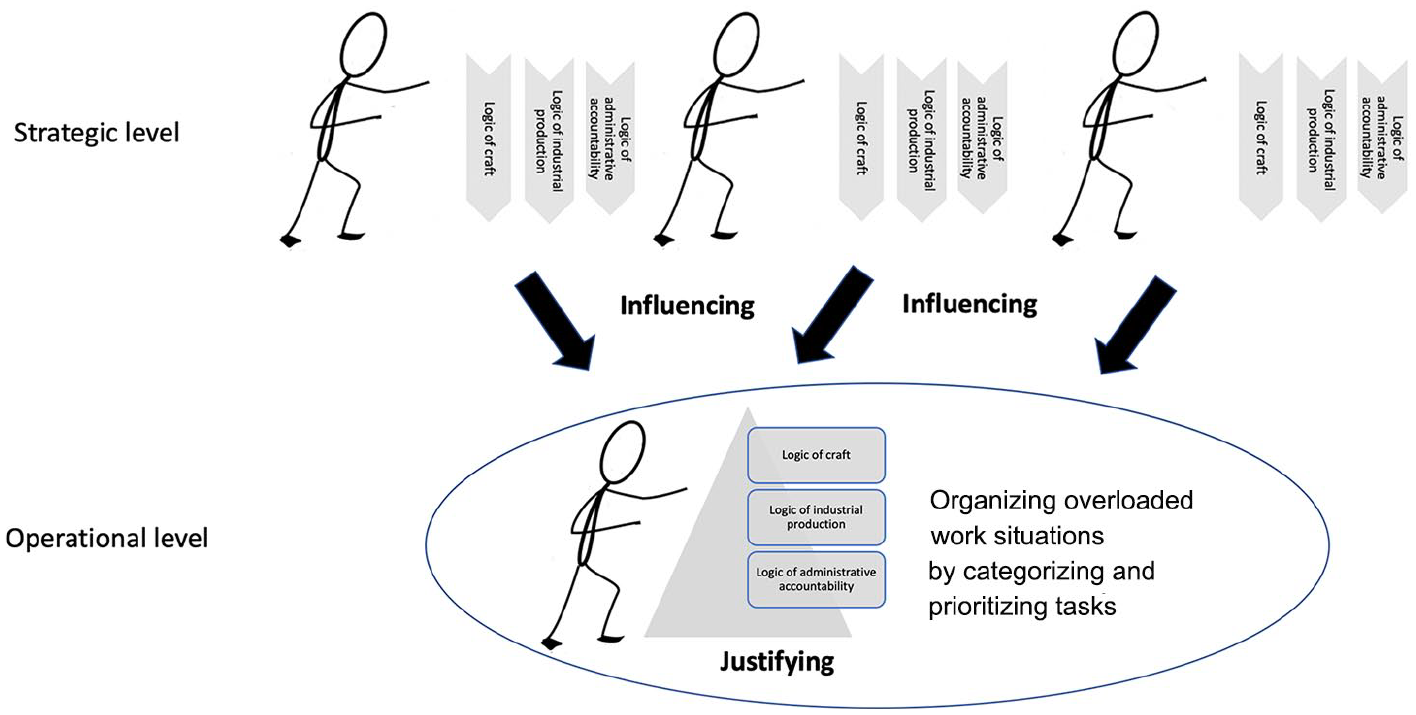
Institutional logics as tools at strategic and operational levels under the boundary condition of work overload at the frontline.
The study has implications for the planning and management of organizational design and implementation strategies and demonstrates the utility of the multiple logics perspective for understanding and managing complexity in contemporary professional service organizations. The study raises questions about how organizational structure and subsequent use of multiple logics at the strategic level increase complexity at the operational front line. The ensuing fragmentation and work overload require frontline professionals to deal with additional demands before they can deliver core services.
Our findings have been established in a study involving a specific context – public welfare services under so-called whole-of-government governance. Whether similar mechanisms actually can be seen in other types of whole-of-government organizations that use other ways of organizing complexities of professional work is not possible to conclude within our research design. This could be an interesting theme for new research arenas. Still, we argue that our findings have validity for professional work and professional service organizations more broadly. Aspects of the organization and the work situations in the case we have studied are similar to other service providers who perform complex tasks in the presence of individual clients on the one hand, and manifold political and institutional expectations on the other hand, such as medical doctors and nurses, police officers and customer service representatives. In general terms, our analysis suggests that multiple logics are used differently as sources for organizing professional work, respectively, in a top-down manner by managers at the strategic level and in a bottom-up manner by professionals at the operational level. These distinctions are due to differences in the contexts of expectations at the two levels, contributing to different kinds of complexities to be handled by the respective organizational roles. At the strategic level, managers face a narrower set of higher order expectations, while professionals face a larger set of lower order expectations constituting overloaded work situations. We hold that these differences in contexts of expectations facing the managerial and the professional roles may be termed a more general trait of how different levels of organizations comprise different kinds of environments (i.e. higher order vs lower order expectations).
To conclude, our analysis demonstrates the varying roles of institutional logics in both creating and managing this intra-organizational complexity and associated dynamics. By disclosing how the significant conflicts stem not only from the presence of multiple logics in organizations but also from differences within organizations in how multiple logics are handled, we advance the understanding of what institutional complexity may be about in contemporary organizations.
Footnotes
Appendix I
Below are the tables documenting the analytical process, with selected quotations and coding cycles to support interpretations.
Acknowledgements
We would like to thank the three anonymous reviewers and the associate editor Tim Kuhn for valuable and constructive comments and suggestions during the review process. We would also like to thank Lars Fuglsang and Bjørn Erik Mørk for valuable comments on an early draft of the article.
Funding
The author(s) disclosed receipt of the following financial support for the research, authorship, and/or publication of this article: This research was supported by funding from Regionalt Forskningsfond Vestlandet.
