




Abstract
This article explores how racialised professionals experience selective incivility in UK organisations. Analysing 22 in-depth, semi-structured interviews, we provide multi-level findings that relate to individual, organisational and societal phenomena to illuminate the workings of subtle racism. On the individual level, selective incivility appears as articulated through ascriptions of excess and deficit that marginalise racialised professionals; biased actions by white employees who operate as honest liars or strategic coverers; and white defensiveness against selective incivility claims. On the organisational level, organisational whitewashing, management denial and upstream exclusion constitute the key enablers of selective incivility. On the societal level, dynamic changes relating to increasing intolerance outside organisations indirectly yet sharply fuel selective incivility within organisations. Finally, racialised professionals experience intersectional (dis-)advantages at the imbrications of individual, organisation and society levels, shaping within-group variations in experiences of workplace selective incivility. Throughout all three levels of analysis and their interplay, differences in power and privilege inform the conditions of possibility for and the continual reproduction of selective incivility.
Introduction
Owing to the global rise of right-wing extremist ideologies, diversity is now at a critical juncture (Nkomo et al., 2019). The promise of equality has been largely unfulfilled for marginalised employees in organisations, and for some of them inequalities may be intensifying. In particular, despite decades of equality legislation, workplace racism remains a particularly persistent problem (Dickens, 2007; Quillian et al., 2017; Seifert and Wang, 2018; Stainback and Tomaskovic-Devey, 2012). Racialised workers routinely experience bullying and harassment; denial of opportunities in recruitment and selection, training and development, network access and promotion processes; and receive lower performance ratings, pay and other rewards (e.g. Bertrand and Mullainathan, 2004; Fox and Stallworth, 2005; Greenhaus et al., 1990; Guest, 2017; James, 2000; Pedulla and Pager, 2019). Racism is endemic in organisations, and disadvantages all aspects of racialised employees’ work lives severely, as evidenced by myriad reports (McGregor-Smith, 2017; Nwabuzo, 2017; Solomon et al., 2019).
While racism exacts significant harm on its targets, it is also deeply corrosive to organisations. Research shows that increased racial diversity is associated with better organisational outcomes, ranging from greater market share to larger profits (Herring, 2009; Smulowitz et al., 2019). Firm-level racial diversity can serve as a strategic human resource that facilitates sustainable competitive advantage (Richard, 2000). The benefits of racial inclusion tend to be even more noticeable in top management echelons, as racially diverse management teams buttress corporate reputation, business innovation and performance (Andrevski et al., 2014; Miller and Triana, 2009). By contrast, negative diversity climate perceptions surrounding race are associated with absenteeism, reduced commitment and increased turnover intentions for minority workers (Avery et al., 2007; McKay et al., 2007; Triana et al., 2015), which can indirectly depress organisational performance. Yet, ironically, racism continues unimpeded at all levels and across all job types, causing problems for both racialised workers and the organisations in which they operate.
Race and organisation scholarship has long tended to bifurcate racism into two main categories of practice: blatant racism – explicit processes of race-based discrimination, and subtle racism – implicit processes of race-based discrimination (Pettigrew and Meertens, 1995). Conventionally, policy has focused on the relatively more overt forms of racism and its effects on racialised employees in different career stages and employment contexts. Yet, research has shown that subtle forms of racism are ubiquitous, and its impact ranges from career-damaging foreclosure of opportunities to significant dangers to employee well-being (Deitch et al., 2003; Van Laer and Janssens, 2011). When expressed through subtle means discrimination is hard to pin down, precisely because its gradual unfolding appears insignificant, but the chronic nature of low-level hits nonetheless can trouble targets considerably (Cortina, 2008; Cortina et al., 2013). Further, in cases of subtle discrimination, there is usually only a vague connection between perpetrators’ unwelcome attitudes, behaviours and cues and a targeted employee’s identity (Dipboye and Halverson, 2004; Offermann et al., 2014). The ambiguity inherent to subtly expressed prejudice can lead targeted employees to misrecognise discrimination as an outcome of personal shortcomings on their own part, which can cause significant distress, undermining confidence as well as performance (Salvatore and Shelton, 2007). Additionally, when discrimination occurs subtly, employees can find it difficult to seek remedies through organisational grievance procedures because of the elusive nature of the mistreatment. The lack of clear and obvious remedies can further deepen employees’ sense of disempowerment, exacerbating the damage to careers and well-being (Jones et al., 2016). In this light, developing new paradigms of discrimination is vital as the workings of racism change to take on ever-subtler forms in organisations (Ogbonna and Harris, 2006).
This article explores the workplace selective incivility experiences of racialised professionals (the term adopted by this article to underline the social constructedness of race). As a theoretical lens, selective incivility incorporates individual, organisation and society-level effects, and is thus a powerful multi-level framework that can delineate how racism can operate through subtle means as a layered reality (Cortina, 2008). In this sense, selective incivility is significantly more useful than alternative theories, such as Sue’s (2010) micro-aggressions model, which is neither explicitly multi-level nor exclusively focused on subtle discrimination. Additionally, utilising selective incivility as a theoretical lens contributes to the diversity literature by offering a more integrative analysis of race discrimination. By taking a holistic approach, we address the oversimplifications common to the prevailing scholarly preference for single-level accounts of workplace racism (e.g. characterising discrimination as a problem of individual deviance or structural inequality only). Our study addresses three inter-related questions: How do racialised professionals experience selective incivility as shaped by: (a) individual-level phenomena (i.e. interactions with co-workers, superiors and customers/clients); (b) organisation-level processes (i.e. management and HR policies and practices); (c) society-level realities (i.e. social norms and ideology)? To answer these questions, the article undertakes qualitative research based on in-depth, semi-structured interviews. This methodological choice reflects a conscious effort to privilege the voices and perspectives of racialised professionals, as the elusive nature of subtle racism is most intelligible to the people who personally experience it in organisations.
Subtle racism in the workplace
The literature on subtle racism is comprised of explanations ranging from a focus on individual misbehaviours all the way to structural inequalities (Van Laer and Janssens, 2011). In general individual-level explanations attempt to understand the psychosocial processes that generate discrimination on the basis of race, and how to remedy them in order to ensure fairer interactions in social settings (e.g. Dovidio and Gaertner, 2000; Gaertner and Dovidio, 1986; McConahay, 1986; Sears, 1988; Sears and Henry, 2003). In this perspective, exploring the cognitive mechanisms behind discrimination is the primary mode of understanding and addressing racial bias in organisations and society. At the structural end of the spectrum, scholarly attention shifts to society-level phenomena that configure an unequal system of race relations conditioned by the dominance of specific group(s) over others, and inform discriminatory policies and practices (Bonilla-Silva, 2006; Essed, 1991; Feagin, 2006). Each level of analysis offers explanations for subtle racism that come with a variety of strengths and weaknesses, ultimately underlining the inadequacy of limiting the analysis to any specific level.
Individual-level research focuses on psychological forces that shape attitudes and behaviours that express subtle racism. For this group of arguments intentionality behind perpetrators’ actions can be equivocal or clear, and the targets may experience some ambiguity in attributing the causes of the abuse. Key conceptualisations of subtle racism, where perpetrators have relatively unambiguous intentionality, are symbolic racism (Sears, 1988; Sears and Henry, 2003) and modern racism (McConahay, 1986). Symbolic and modern racists stand on the conservative end of the political spectrum, with strong beliefs in competition and individualism, and rejection of redistributive efforts, either organisationally or in society more generally. Not surprisingly, symbolic racism tends to be associated with a lack of support for positive discrimination or positive action measures designed to ensure greater parity in organisations (e.g. Franchi, 2003). At the point of hiring, modern racists, supported by apparent business justifications from authority figures in organisations, can cause significant distortions favouring white employees (Brief et al., 2000). Additionally, symbolic and modern racists can exact harm upon minorities through greater workplace bullying (Fox and Stallworth, 2005). While subscribing to the legitimacy of indirectly discriminatory policies, symbolic and modern racists consider themselves non-racists because of the subtlety of their biases.
Another individual-level explanation for subtle racism is aversive racism, where perpetrators have no conscious intention to engage in biased behaviour. In contrast to individuals who express symbolic or modern racism, individuals with aversive racism strongly believe in the liberal values of tolerance, fairness and equality, while still carrying unconscious biases that lead them to discriminate (Gaertner and Dovidio, 1986). Aversive racism occurs in multi-factor situations, where numerous reasons may account for the discriminatory behaviour, which helps perpetrators to justify biases by referencing other seemingly valid considerations. In this way, no clear discrepancy exists between the discriminators’ positive self-image and negative actions, creating conducive ground for persistent bias (Gaertner and Dovidio, 1986). As Dovidio and Gaertner (2000) demonstrate in a US-based study, despite longitudinal declines in self-reported prejudice, participants have still made selection decisions that disfavoured black candidates in candidate pools populated by roughly equally qualified people. While aversive racism research mainly originates from the USA, its salience does not necessarily inhere in the North American context. For example, Hodson et al. (2005) show through UK experimental data that aversive racism remains intractable in legal settings, even when jurors have the benefit of procedural innovations that clarify how to carry out less biased evaluations. As aversive racism has garnered growing attention in recent years, organisations have started to focus on unconscious bias as a central diversity issue. Employees are now widely offered unconscious bias training, although research argues such individualised interventions are largely ineffectual (Noon, 2018). One of the fundamental problems with individual-level analyses of subtle racism is that they offer fragmented and de-contextualised solutions. This individualistic approach unduly reduces subtle racism to a problem with specific employees or their abstract social-psychological categorisation processes that come from a place of innocence unmarked by harm ideation. Whether symbolic, modern or aversive in nature, the individualistic theorising of subtle racism pays insufficient attention to the organisational, institutional and systemic forces that constantly reproduce racial conflict between groups. Thus, such explanations fail to capture the domination of racialised employees through an unequal distribution of power, resources and rewards (e.g. Essed, 1991).
Through micro-aggressions research, Sue (2010) attempts to account for racism by focusing on individuals’ psychologies more expansively. Encompassing a spectrum from the blatant to the subtle end, his account of low-level slights ostensibly focuses on interpersonal encounters between perpetrators and targets of discrimination. Yet, he also signals that racialised minorities experience micro-aggressions against a noxious social backdrop of inequality (Sue, 2010). Micro-aggressions exert an oppressive material effect on targets, because they indirectly limit opportunities for ethnic minorities in terms of recruitment, selection, retention and promotion, which reinforces dominant groups’ privileges (Sue, 2010). Additionally, the incessant and ambiguous nature of the attacks on the targets exhausts cognitive resources and degrades their work performance (DeCuir-Gunby and Gunby, 2016; Holder et al., 2015; Kim et al., 2019), intensifying material inequalities. Further, racial micro-aggressions lead ethnic minorities to experience weaker belonging in organisations (Lewis et al., 2019). Yet, although the micro-aggressions scholarship considers subtle racism as an issue that encompasses more than interpersonal effects, organisational and societal complexities remain a relatively more implicit part of the theorising. Moreover, utilising micro-aggressions could unduly complicate research focused solely on subtle racism, because it is a spectrum theory of blatant and subtle racisms expressed in micro-measures. Yet, Sue’s (2010) ideas are instructive in this study because of his significant emphasis on racialised individuals’ voices, and lived experiences, as the most appropriate data source in studying subtle racism.
Located at the structural end of the literature, everyday racism is another prominent explanation of subtle racism. Everyday racism is a concatenation of practices unique to a racialised social system that hinges on the marginalisation of racialised groups. Here, normalisation of structural inequality entails a mix of denial of racism and subtly exclusionary moves perpetrated by the dominant group. Everyday racism works insidiously, slowly undercutting racialised minorities’ job satisfaction and well-being (Deitch et al., 2003). Research shows that everyday racism becomes progressively more acute as employees go up the career ladder, and can take a wide range of harmful forms, such as negative stereotyping and problematisation of cultural differences (Van Laer and Janssens, 2011). While everyday racism nicely shows that subtle racism encompasses structural relations that reproduce workplace inequalities, it can unduly elide the active role of individuals in perpetuating interpersonal discrimination. Subtle racism has doubtless a significant structural dimension, but targets often experience subtle racism as propagated by specific perpetrators. The theoretical emphasis on structure alone risks distancing research from targets’ personal experiences of discrimination.
Taken together, the literature on subtle racism reveals clear evidence that majorities hold explicit or implicit biases against racialised minorities, which disadvantages stigmatised populations materially and symbolically in a plethora of social arenas including the workplace. Yet, neither individual-based explanations, nor structure-led accounts, delineate the multi-level dimensionality of racialised individuals’ lived experiences in the workplace. The existing literature neglects holistic accounts that outline the layered complexity of how subtle racism works, and thus fails to account for why it persists. There is a pressing need for more nuanced understandings of subtle racism within the coordinates of a theoretical framework that can accommodate explorations that straddle across multiple levels of analysis. Turning to the multi-level concept of selective incivility is therefore a promising avenue for understanding subtle racism in all its complexity.
Selective incivility as a multi-level framework of subtle racism
Cortina (2008) developed the concept of selective incivility by combining insights from multiple literatures. In part, selective incivility draws from the general workplace incivility literature (Andersson and Pearson, 1999; Cortina et al., 2001; Pearson et al., 2001), which theorises antisocial work behaviours that appear with low intensity and ambiguous intentionality. Additionally, selective incivility contains ideas from subtle sexism (e.g. Jackson et al., 2001; Swim et al., 2004; Tougas et al., 1995) and subtle racism, such as symbolic racism (Sears, 1988; Sears and Henry, 2003), modern racism (McConahay, 1986) and aversive racism (Dovidio and Gaertner, 2000; Gaertner and Dovidio, 1986). According to Cortina (2008), with the ascendancy of social norms that decry blatantly discriminatory attitudes and behaviours, contemporary discrimination emerges through a subtle channel of expression, selective incivility, where perpetrators selectively target minorities for workplace incivility.
To assemble her notion of selective incivility, Cortina (2008) subscribes to Andersson and Pearson’s (1999: 457) broad definition of workplace incivility as denoting ‘low intensity deviant behavior with ambiguous intent to harm the target, in violation of workplace norms for mutual respect. Uncivil behaviors are characteristically rude and discourteous, displaying a lack of regard for others.’ According to Cortina, while organisations view general workplace incivility negatively, it does not attract the same penalties that discriminatory behaviours like blatant racism would. Blatant racism is illegal in most country contexts, and many organisations have adopted non-discrimination policies that refute blatantly racist behaviours as unequivocally wrong under a zero-tolerance agenda. Therefore, individuals who may have racial biases have strong incentives to cover their true intent by resorting to selectively propagated uncivil actions, disguised as general incivility, against minorities (Cortina, 2008). Equally, individuals who hold implicit biases may selectively expose minorities to incivility, while believing themselves to hold egalitarian values and construing their actions as non-racist (Cortina, 2008). Finally, even persons who may not have explicit or implicit biases can potentially engage in selective incivility, if they model their behaviours after group-level norms in organisations with poor diversity climates, where minorities are marginalised (Cortina, 2008). While perpetrator intentionality exists on a continuum, the consequences for targets can be equally deleterious.
Cortina’s (2008) multi-level theorising involves three levels of analysis: individual, organisation and society. At the individual level, selective incivility hinges on affective factors, such as aversion against outgroup members, differences in esteem as well as cognitive factors such as social categorisation and stereotyping (e.g. Dovidio et al., 2001; Jones, 2002). At the organisational level, the practical force of organisational non-discrimination policies, extent of leadership support, and the nature of intra-organisational socio-cultural norms regarding diversity may shape selective incivility (e.g. Dipboye and Halverson, 2004). Finally, at the society level, Cortina (2008) propounds that a tradition of discrimination, differences in social roles and inter-group asymmetries in power can inform selective incivility (e.g. Operario and Fiske, 1998). In cases of selective incivility, the interplay between perpetrators and targets is an outcome of the interaction effects between racial prejudice at the individual level and the organisational climate surrounding subtle racism. Further, society-level race ideology and norms inform individual and organisation-level practices. In sum, Cortina (2008) theorises selective incivility as a multi-level concept that eschews wholly individual-level or structural explanations, because subtle racism resides in the imbrications of multiple levels of analysis and their interaction effects.
More recently, Cortina et al. (2013) extended the scope of selective incivility by accounting for race and gender intersectionally, demonstrating that racialised women experience selective incivility more sharply and damagingly. Originally developed by black feminists in the USA, intersectionality is an analytical tool that traces the dynamic effects of systems of oppression that pertain to the multiple identities simultaneously held by people (Crenshaw, 1990; Davis, 2008; Hill Collins and Bilge, 2016). Historically, the intersectionality scholarship focused on gender, race and class mainly (Yuval-Davis, 2006), but the concept is sufficiently tractable to account for a far wider array of social positionalities (Healy et al., 2019). In this research, eschewing an exclusive focus on surface-level diversity (Harrison et al., 1998), we consider intersectional dimensions of selective incivility expansively. Additionally, we consider intersectionality as a multi-level construct, going beyond dominant characterisations of intersectionality as double jeopardy (i.e. additive view of (dis-)advantages at the individual level).
Methodology
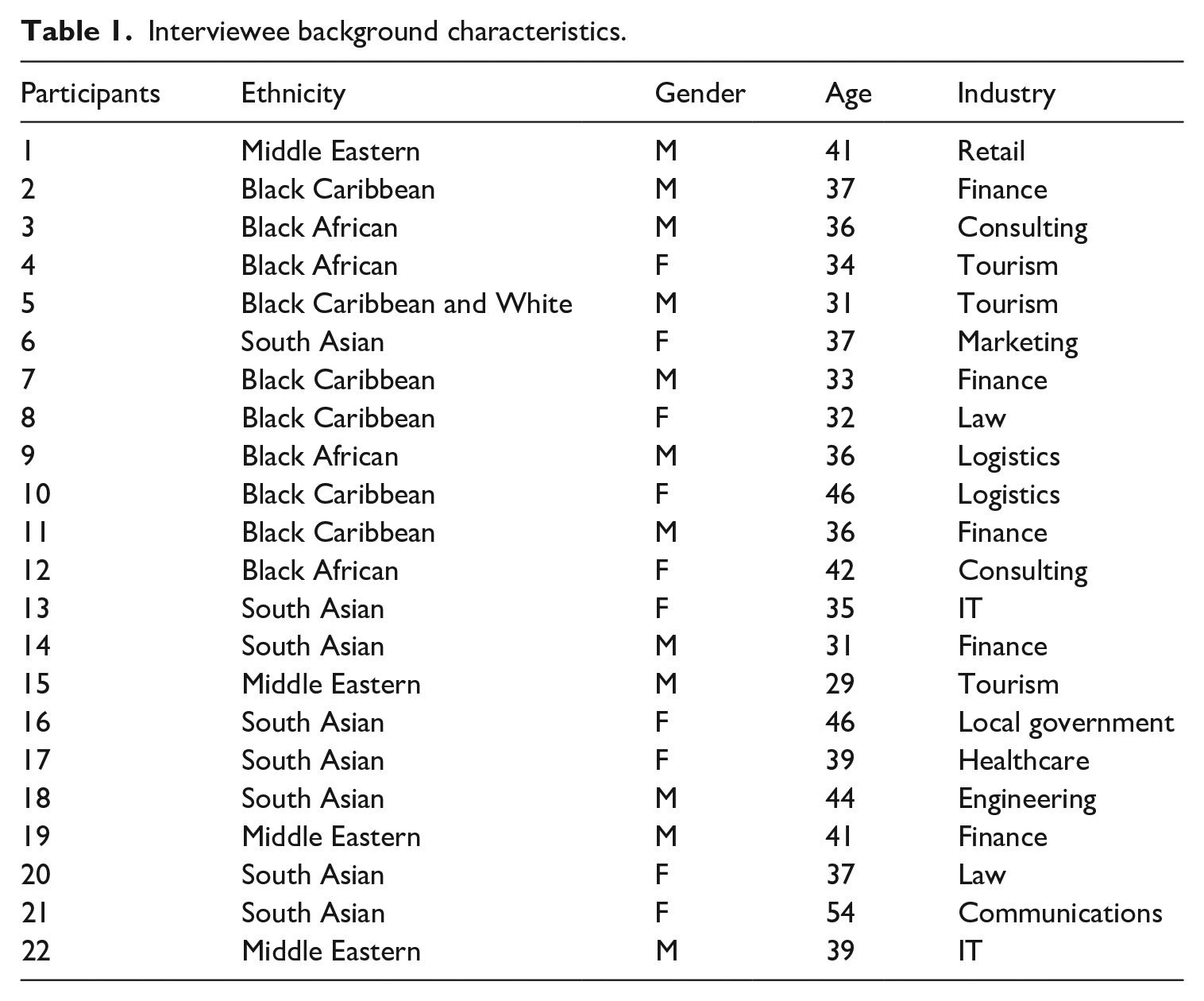
Interviews with 22 ethnic minority professionals comprised the data for this study. The age range of the participants was 29 to 54. There were 12 male and 10 female participants. Five participants were Black Caribbean, four were Black African and one was mixed race (Black Caribbean and White). Eight participants had a South Asian background, and four participants had a Middle Eastern ethnic origin. The participants worked in a cross-section of industries, including communications, consulting, finance, engineering, healthcare, IT, law, local government, logistics, marketing, retail and tourism. Table 1 summarises the participants’ key characteristics.
Interviewee background characteristics.
Interviews lasted 45 minutes to 75 minutes, and were conducted by one of the authors in locations chosen by the participants. The interviews were digitally recorded and fully transcribed. The participants received assurances of anonymity and confidentiality, and they were clear that they could withdraw from the study at any time during or after the interviews, if they wished to do so. At all stages of the research process, from data collection to data analysis, we prioritised reflexivity (Alvesson and Sköldberg, 2009). The interview process benefitted from a sense of rapport and mutual understanding between the participants and the interviewer, a racialised academic. Nevertheless, we remained vigilant about our possible preconceptions, particularly against the risk of interpreting the data as influenced by our own experiences of exclusion. Additionally, as an all-male research team, we continually questioned our own awareness and views regarding the gender dimension of our research.
The data collection process hinged on a combination of purposive sampling and snowball sampling, non-probability sampling methods that prioritise securing deep understanding over achieving representativeness. Purposive sampling is particularly apt for explorations of social phenomena in fine detail by recruiting participants with specific qualities that confer a tight relevance to the research questions at hand (Patton, 2002). Snowball sampling, which involves tapping into initial participants’ social and work contacts to access further participants, is also a well-recognised approach for supporting participant recruitment in qualitative research (Browne, 2005). In this research, while slow and time-consuming, the sampling strategy, which utilised author networks and referral chains, yielded an eventual sample composed of informationally rich participants (Bryman and Bell, 2007). Empirical saturation shaped the sample size (Guest et al., 2006; Morse, 1994). By the 20th interview, saturation set in substantially, and by the 22nd interview, no significant new insights emerged.
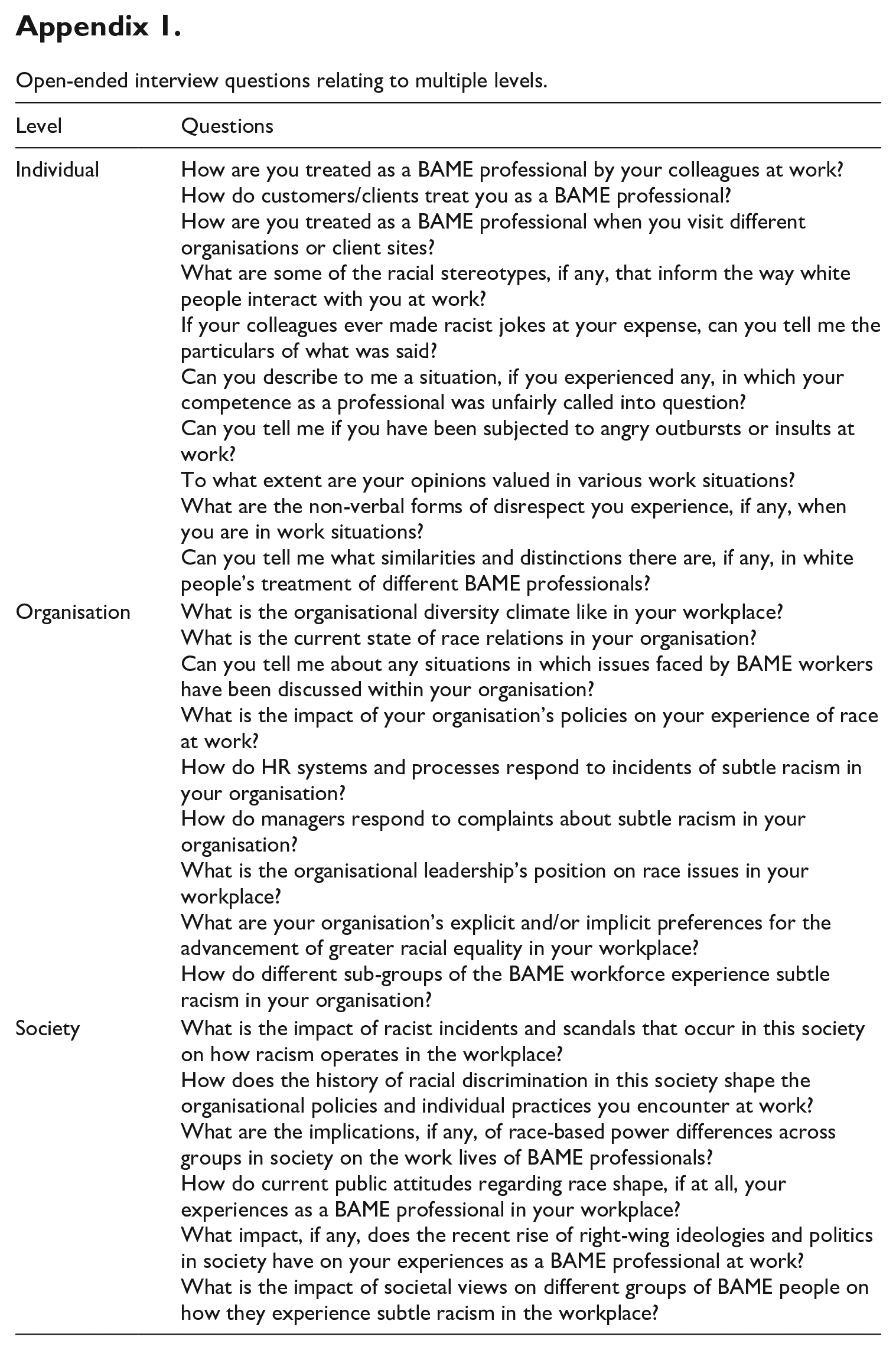
The interviews had an in-depth, semi-structured mode, which afforded participants influence over the question flow and content, prioritising their voices and perspectives. Open-ended questions corresponded broadly to our multi-level analysis (i.e. individual, organisation and society levels), as informed by Cortina’s (2008) theorisation. Specifically, the questions explored participants’ sense of how racially motivated selective incivility linked to issues of discrimination propagated by particular individuals such as colleagues, supervisors and clients/customers; organisational realities and processes that contribute to selective incivility; and wider societal forces that shape selective incivility organisationally and individually. Our interview process utilised the popular UK-based umbrella term BAME (Black, Asian and minority ethnic) that refers to all ethnic groups except for those socially constructed as white. However, we decided to adopt the phrase ‘racialised professionals’ eventually, as we recognised in our later discussions and reflections that our participants’ comfort and identification with the term BAME varied considerably. Guided by interpretivist ontology, we privileged participants’ views of the social world and the meanings they attached to systems, policies and practices that they encountered as carrying significant weight. In particular, the interviewing approach prioritised understanding the participants’ perceptions of selective incivility through the tracing of their lived experiences (Sandberg, 2005), as subtle racism may not be objectively identifiable outside the targets’ experiential knowledge.
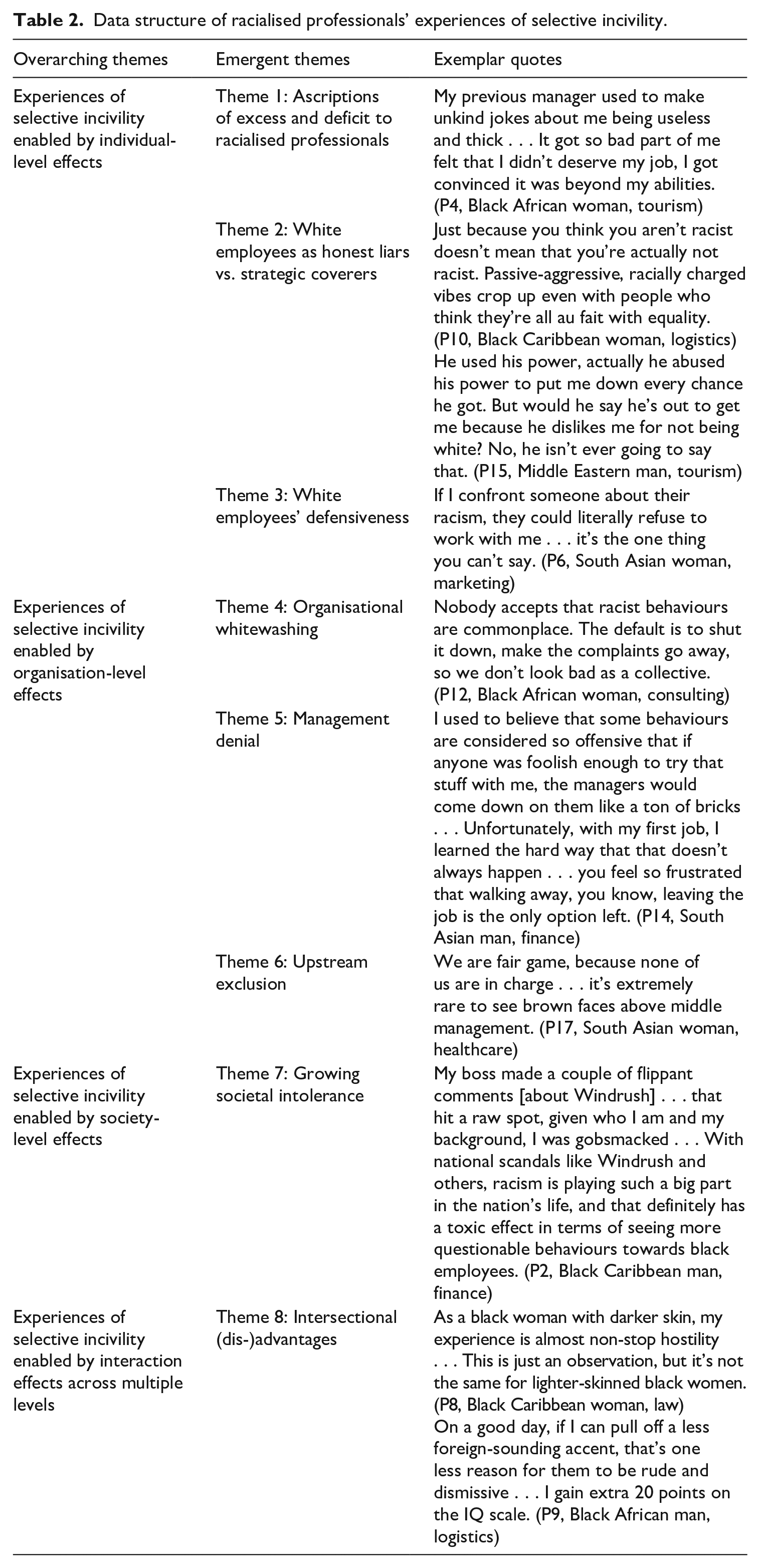
We opted for thematic analysis to dissect our data (Boyatzis, 1998). The analysis process began by each author independently carrying out active and repeated readings of the interview texts to immerse deeply into the data. During the active reading phase, we referred to the literature frequently in order to ensure we accounted for all dimensions of interest (Tuckett, 2005), but we also remained open to previously unreported, newly discoverable phenomena. Our initial code generation exercise focused on all data segments that seemed key to racialised professionals’ selective incivility experiences (Braun and Clarke, 2006). After the coding and collating of the data, we grouped together the long list of initial codes, and translated them into themes. While each author independently coded the data, frequent team meetings helped clarify a convergent approach to coding and interpretation to ensure consistency and precision. During the team meetings, we also checked the themes for coherence vis-a-vis the patterns we detected, the relative separateness of each theme’s content and the degree of match between the themes and data extracts (Patton, 2002). Where codes overlapped, we turned them into a common code, and we dropped some codes, as they did not correspond to any of the themes. The final step involved defining and labelling themes by clarifying what each theme denoted, how the themes interrelated and what particular dimensions of the data the themes encapsulated (Braun and Clarke, 2006). Table 2 depicts the data structure of our research.
Data structure of racialised professionals’ experiences of selective incivility.
Racialised professionals’ experiences of selective incivility
Experiences of selective incivility enabled by individual-level effects
At the individual level, participant accounts of selective incivility correspond to three particular themes: ascriptions of excess and deficit to racialised professionals (Theme 1), white employees as honest liars vs. strategic coverers (Theme 2), and white employees’ defensiveness (Theme 3).
Theme 1: Ascriptions of excess and deficit to racialised professionals
The vast majority of the participants in this study pointed out negative stereotypes as the key basis of white employees’ selective incivility against them. The racial stereotypes often stemmed from well-worn cultural misrepresentations of workers from particular ethnic origins. Despite variations in the typecasting, the stereotypes connoted significant convergences. Specifically, the interviews indicated that white employees ascribed characteristics of excess and deficit to racialised professionals, casting them as misfits for their jobs and work contexts. Racialised professionals’ emotional states and work behaviours seemed problematic for falling outside an elusive ‘normal’ range:
Whatever I do, it seems to come across wrong. Assertiveness is taken as being aggressive and rude, they think that my confidence is really just arrogance, my ambition looks pushy and annoying . . . I don’t know my place, I’m always somehow off-kilter. (P7, Black Caribbean man, finance)
Ascriptions of excess and deficit constituted selective incivility in their own right, but they also served as justification for further abusive behaviour towards racialised professionals, compounding distressing experiences of exclusion and marginalisation. For example, perceptions of racialised professionals’ deviation from ‘normality’ meant that they were at the receiving end of sustained indignities perpetrated by white employees:
As soon as I spoke at team meetings, my manager would start shuffling round in his seat, he couldn’t wait for me to finish . . . He would look at me as if to say he couldn’t stand my voice . . . He would shoot down every single idea I came up with. He said I wasn’t commercially savvy, I wasn’t strategic enough, things like that . . . It really knocked down my confidence. (P13, South Asian woman, IT)
When questioned further, the above participant explained that she never saw her manager behaving rudely towards white workers, but she could not always be sure her ethnic minority status motivated his animus. Such attributional uncertainty led participants to doubt themselves as undeserving impostors in their organisations.
Additionally, many racialised professionals linked accumulative effects of selective incivility to slower career progression. White employees’ ascriptions of excess and deficit onto the participants led to the devaluation of their contributions in the workplace. As a result, at key career stages, the participants felt overlooked and underutilised, subject to unfair foreclosures of opportunity:
I’ve been passed over for a promotion repeatedly. I always ask for feedback . . . there’s never any concrete answer. The only feedback I get is kind of patronising advice, and that’s really upsetting for me, because it’s really uncaring feedback . . . they’re absolutely indifferent to how that rejection affects me. (P5, mixed race man, tourism)
Ascriptions of excess and deficit led participants to feel rejected and devalued, creating a weak sense of organisational belonging. The sustained experiences of selective incivility sharpened feelings of injury and marginalisation as racialised professionals in organisations.
Theme 2: White employees as honest liars versus strategic coverers
The majority of the participants considered the perpetrators of selective incivility as either honest liars or strategic coverers. White employees who fell into the honest liar category held a non-racist self-image, yet engaged in subtle racism. For the participants, interactions with honest liars were particularly confusing, because they observed evidence of rhetorical support contradicted by negligible real-life backing. Honest liars were unwilling to pay more than lip service to equality, and lacked the desire to challenge the unequal distribution of resources and rewards across different groups in organisations. Thus, even if no conscious racial animus marred honest liars’ actions, their inconsequential support wore thin in significance, and betrayed a selective lack of solidarity:
The people who build their persona on being inclusive . . . I don’t doubt their intensions necessarily, but you talk about things like recruitment and retention and promotion, they put up a wall, you have people you think will support you react like ‘this is not my issue’, which is disappointing. (P12, Black African woman, consulting)
Conversely, some participants believed that they worked with white employees who clearly held a self-image steeped in an ideology of racial superiority even if they did not make it explicit in interpersonal communication. Functioning as strategic coverers, these employees displayed a disturbing pattern of selective incivility marked by considerable malice. Oftentimes, strategic coverers were uniquely problematic, because such perpetrators seemed to question the participants’ very existence and purpose in organisations. Strategic coverers’ selective incivility expressed a profound underestimation of the participants’ capacity to contribute to their organisations as productive professionals:
The attitude is: ‘You’ve achieved this much, what more do you want?’ Like I didn’t even deserve to have my current role, but they gave it to me, because I am the token minority, and a better role for me would be downright unfair to others. (P14, South Asian man, finance)
Most of the participants expressed doubts about the change capacity of honest liars and strategic coverers. At least some of the time, targets recognised experiences of selective incivility exactly for what they were, yet they found it difficult to make a grievance claim against the perpetrators, reducing opportunities for change. Additionally, the participants believed perpetrators displayed complex, longstanding behavioural patterns, and one-size-fits-all, short-term training solutions (e.g. unconscious bias training) would likely have no effect.
Theme 3: White employees’ defensiveness
The majority of the participants indicated that speaking truth to power regarding race was a fraught process met by highly defensive responses from white employees. In particular, white employees had a tendency to display substantial unease in workplace interactions that questioned racial dynamics. When the participants pointed out instances of possible racism, they encountered disavowal as well as emotional blowback. Thus, white employees’ defensiveness (cf. DiAngelo, 2018) often closed up racialised professionals’ conversational space to challenge and address selective incivility. Resultantly, the participants felt inhibited from revealing the full extent of the difficulties they experienced to peers, managers, human resource officers and so on. The chilling effects of white defensiveness on racialised professionals’ speech reinforced interpersonal domination, and shielded the majority from responsibility for inflicting harm.
Some of the participants revealed that white employees tended to consider even the mildest challenges against racially inflected interactions as a personal affront, deploying a self-protective stance permanently. Thus, racialised professionals often faced not only the dismissal of the validity of their grievances, but also potential audience penalties from majority group members who invariably considered challenges as a threat rather than a learning opportunity:
I used to make much more noise about racism, but I realised it didn’t get me anywhere. That kind of proactive approach attracts more abuse. In my country, there is a saying, someone who tells the truth is driven out of nine villages. You’re supposed to be just grateful and play nice. You’re supposed to keep quiet, and pretend there’s no racism, otherwise people get incredibly threatened. (P15, Middle Eastern man, tourism)
In the participants’ workplace experiences, race most often arose as a highly emotive subject. When participants complained of their discomfort with perpetrators, oftentimes the interpersonal conflict assumed a new dimension in which the perpetrators assumed the role of the victim. Specifically, white employees expressed strong negative feelings about any interpretation of racial undertones in their attitudes or behaviours:
I had an exchange with someone because he made a very insensitive joke about refugees, and I said, ‘As a woman of colour, your comments are really offensive to me. Can you be more sensitive in the future?’ [He] looked so shocked. I felt like I wounded him. (P10, Black Caribbean woman, logistics)
Overall, the participants thought that race was a taboo subject in their organisations. When the racialised professionals challenged perpetrators, they faced punitive and unpleasant emotional responses, which stifled their capacity to raise awareness in the workplace.
Experiences of selective incivility enabled by organisation-level effects
At the organisation level, organisational whitewashing (Theme 4), management denial (Theme 5) and upstream exclusion (Theme 6) emerged as enablers of selective incivility against racialised professionals in the workplace.
Theme 4: Organisational whitewashing
Some participants thought their organisations were preoccupied with conveying the impression of valuing equality and non-discrimination rather than aiming to tackle subtle racism. Thus, organisational action often skewed towards legitimating the current order as essentially unproblematic. For example, managers and HR officers seemed to operate with the assumption that incidence of bona fide racism was relatively more rare and isolated, perpetrated by ‘bad apples’, rather than constituting a dominant feature of interpersonal interactions within an unequal organisational culture. Such an approach reinforced organisational beliefs about the suitability of the current racial hierarchies, and invisibilised them. Organisational whitewashing of widespread selective incivility hinged on downplaying racialised professionals’ concerns:
I raised a formal grievance . . . you hope and pray that HR is on your side in these things, but they decided that I was overreacting. There was no case, nothing actionable at all . . . you can be undermined for months, and if you complain, that’s what they think. (P18, South Asian man, engineering)
Some participants who lodged subtle racism claims faced questions about the validity of their perceptions, and the particular manner in which they reacted to subtle racism:
I was responsible for a project with a few others who kept excluding me from the decision making . . . I was having a meeting with one of them, and he kept criticising me and making me feel like everything I did was shit. I raised my tone of voice, not like shouting, but I did speak more forcefully, of course how dare a black man speak like that? He was livid, like suddenly his face got so white, and he just upped and left . . . They made it out that my behaviour had been threatening, and he felt unsafe . . . I was the one who had to make a grovelling apology to a man who couldn’t stand the sight of me. (P2, Black Caribbean man, finance)
According to the participants, individuals who benefited from white privilege ran organisations in accord with a racially differentiated distribution of resources and rewards. Yet, the legal, reputational and stakeholder pressures required organisations to give the appearance of equal opportunity. Thus, while organisations offered diversity training, such steps reflected the underlying organisational need to express compliance. The corrective measures that appeared scrupulous or introspective often watered down the problems or hid the depth and breadth of selective incivility. The training-centric diversity management strategies controlled the agenda for change and negated calls for organisational transformation:
Whenever there’s a problem, be it racism or any other type of bias, HR and the board have the same strategy to put out the fire . . . they throw some more diversity training at the problem . . . Nothing other than superficial stuff, and that really has very, very little impact . . . everybody’s really in on it, it’s common knowledge . . . the real concern is managing our reputation. (P21, South Asian woman, communications)
In the participants’ view, organisational efforts to contain the appearance of selective incivility created an environment of concealment, where organisations not only self-congratulated, but also actively disguised the extent of workplace race discrimination. Thus, incidents that required reflection and change were trivialised, and organisational disciplinary mechanisms did not deter the perpetrators of selective incivility.
Theme 5: Management denial
Some participants believed that middle and senior management had a tendency to deny the incidence and extent of selective incivility in organisations. The denialist management approach worked by suggesting that targets perceived racism unwarrantedly, often because managers tended to consider selective incivility as generic lapses in interpersonal conduct without any untoward racial content. When racialised professionals expressed alarm and frustration about an incident, the management response was to construct the event in question as happenstance or a misunderstanding, invalidating the viability of targets’ claims. In this sense, management denial involved a consistently positive reading of perpetrators’ motives:
Somebody would have to physically attack me, like screaming racial slurs at me, you know, actually punching me in the face before management would say, ‘oh yes, that was racist, we need to do something about that’. I don’t think my manager is capable of acknowledging anything less clear-cut than that as racism. It’s clear to me who they would give the benefit of the doubt. (P11, Black Caribbean man, finance)
Moreover, the denialist approach indicated managerial arrogance, insinuating that racialised professionals were disgruntled trouble-makers. Such recriminations positioned grievances as imagined and vexatious, as well as damaging to workforce cohesion. As a result, some participants felt alienated and disenchanted at work. The long-term disempowerment through denial of subtle racism reduced some participants’ work motivation and performance:
At my previous work, I suffered a lot with racism, but whenever I tried to seek support, it was swept under the carpet by the team leader, who always had an unsupportive answer to give to everything I mentioned . . . I was gaslighted the entire time, and that slowly killed off all the motivation I had going into the job, and then obviously my performance went downhill, which then made me the problem employee. (P19, Middle Eastern man, finance)
Overall, management denial had a silencing effect on racialised professionals, and an emboldening effect on perpetrators. Managers seemed to be the most immediate authority figures and the first port of call when selective incivility occurred. Thus, managerial failure to acknowledge and intervene in support of racial equality severely reduced some participants’ capacity to seek redress, and increased the likelihood of employee turnover.
Theme 6: Upstream exclusion
The participants in this study almost universally complained of a racial diversity shortage in the upper echelons of organisational management. Numerical balancing efforts still remained limited to employees without management authority or the lowest rungs of the managerial hierarchy. The progressive lack of racial diversity as the participants looked up the organisational hierarchy reduced their confidence about the viability of voicing concerns. They also faced new dilemmas as they went up the organisational hierarchy even if moderately. On the one hand, as they assumed middle management roles, selective incivility seemed to increase and become more visible to them, especially because at the middle levels of the organisations they found themselves surrounded by a super-majority of white employees. On the other hand, challenging other management-level employees could spell career costs:
I tend to avoid taking a confrontational stance . . . Plus, I don’t think it’s the smart move to be controversial, to let someone who has power over you know that you think they’re being a racist . . . If everyone who has a say over your career is white, it’s a very tough situation. (P20, South Asian woman, law)
The participants also worried that the numerical under-representation of race diversity in the higher echelons created a boardroom knowledge deficit, and the top management remained uninformed about how widely and deeply selective incivility afflicted their organisations. On the one hand, racialised professionals thought that the cumulative effects of selective incivility stunted their career course or would likely substantially limit their access to the executive level. On the other hand, existing organisational decision-makers, whose almost overwhelming whiteness our participants frequently raised as a critical problem, also lacked a good understanding of how selective incivility operated, which served as a major impediment to thwarting subtle racism from the top:
All the top positions are occupied by white men, and the simple fact is that my career has a ceiling . . . The leadership doesn’t have a good understanding . . . because the people at the top who can do more to change the culture and who can make a difference that way, that doesn’t include anyone who walks in my shoes. (P22, Middle Eastern man, IT)
According to the participant narrations, the upstream exclusion was responsible for the dearth of effective interventions and corrective measures. The lack of top management insight into racialised professionals’ situated experiences led to piecemeal interventions that failed to address selective incivility adequately.
Experiences of selective incivility enabled by society-level effects
Some participants linked growing societal intolerance (Theme 7) over the past decade to a heightened frequency and severity in their experiences of selective incivility in the workplace.
Theme 7: Growing societal intolerance
The participants had a keen awareness of the coarsening of public rhetoric regarding ethnic minorities in the past decade. They referred to how racial inequalities were deepened by government policies, including the prevent policy that enlists educators to report students suspected of terrorist sympathies, the hostile environment policy designed to drive away undocumented immigrants, the Windrush deportations that wrongly denied citizenship rights of immigrants from Caribbean countries and so on. For the participants, the erosion of community goodwill appeared to be linked to a decline in the climate of inclusion within their organisations. The negative changes in the wider social context surfaced in their interactions in and outside their organisations:
I face the threat of racism every time I walk out of my home. Because tolerance is very much in decline, understanding gone, everyone’s at everyone else’s throat . . . [Our clients] question my experience, and what I can do for their business more openly. They don’t bother if it’s going to sound rude to me or not . . . They just think they can get away with it now. (P3, Black-African man, consulting)
Additionally, the participants referred to societal debates over the inclusion versus exclusion of ethnic minorities (e.g. the Brexit process) as polarising the community climate. Some participants thought societal polarisation reinforced already existing negative images white people utilised in their interactions with racialised professionals. In this way, societal forces were not simply a static background condition for the participants’ lived experiences and career trajectories, but an evolving constellation of events and processes that sharpened workplace discrimination:
We live in a racially divided country, health stats, education stats, labour market stats . . . race is written all over our society . . . if you think about racism and it’s again on the rise . . . yeah I think it makes a difference to how we work together or fail to work together rather. (P16, South Asian woman, local government)
Some participants believed that white employees tended to perceive organised life as a zero-sum game, where minimising disadvantage for racialised professionals would require a levelling off or lessening of white privilege, which they opposed. Perceived threats to white privilege in organisations intensified subtle racism, mirroring rising societal disagreements over the distribution of valued resources across groups.
Experiences of selective incivility enabled by interaction effects across multiple levels
In the interviews, the imbrications of society, organisation and individual-level effects emerged as intersectional (dis-)advantages (Theme 8) that enabled divergences across participants’ experiences of selective incivility.
Theme 8: Intersectional (dis)-advantages
Some participant accounts pointed to interconnections between societal narratives and ideas regarding race, organisations’ internal reflection of society’s race-inflected divisions and the unfair differential treatment of racialised professionals at work. Importantly, participant experiences of intersectionality (i.e. situated effects of holding multiple identities simultaneously) did not reflect a straightforward advantage or disadvantage in relation to selective incivility. For example, some participants emphasised the ever-shifting implications of gender and race:
It’s also not a case of you’re a woman, so it’ll always be worse for you. It depends on the company culture, and the people there . . . In some industries, it really pays more to be a man . . . I’ve also seen cases where it’s actually worse if you’re a man. (P4, Black African woman, tourism)
Instead of double jeopardy, most participants described the interplay of gender and race as unpredictable and context-dependent. They believed racialised professionals’ gender could have different degrees of salience across various job types, organisational settings, occupations and industries. Additionally, some participants mentioned that differences in class privilege, types of accent and skin tone influenced their standing, underlining the complexities of intersectional (dis-)advantages.
Interestingly, some participants believed the intersections of racialised status and racialised professionals’ attitudes and worldviews significantly affected the extent of selective incivility they experienced in organisations. Specifically, they considered that racialised professionals whose views about workplace racism tallied with organisational race orthodoxies held an advantage over racialised professionals who protested racism:
I knew a trainee manager who sang from the same hymn sheet on racism as the average white employee . . . ‘racism is a problem of the past, it’s not relevant anymore’. It’s frustrating to see a brown person getting it so wrong. I thought, what’s he playing at? . . . he was an honorary white man, which worked for him career-wise. (P1, Middle Eastern man, retail)
Expressing conformity with the existing race-inflected organisational norms and power structures seemed to confer limited and conditional immunity upon some racialised professionals. The participants thought that racialised professionals who monitored themselves by carefully curating a workplace identity that signalled an exclusive focus on individual career progression instead of solidarity avoided even deeper selective incivility, which potentially generated further silencing effects.
Discussion
Our research expands the conceptual scope of Cortina’s (2008) selective incivility, while also confirming key elements of the framework. Our findings regarding frequent ascriptions of excess and deficit to racialised professionals reflect the powerful grip of negative social categorisations that shape white employees’ perceptions of difference. As we explain, while selective incivility appears as merely momentary expressions of denigration, it also has cumulative consequences on working lives and careers, because it has the long-term effect of casting racialised professionals as interlopers in organisations. Additionally, honest liars versus strategic coverers exemplify how outgroup aversion and differential esteem, either consciously or unconsciously deployed, tend to be widely expressed in organisations. The ubiquity of honest liars and strategic coverers are important in understanding the continuity of selective incivility, despite the increasing social rejection of racism in rhetorically inclusive organisations. Introducing white defensiveness (see also DiAngelo, 2018), we extended Cortina’s framework at the individual level by accounting for the affective responses of white people to claims of selective incivility. White defensiveness explains why calling out racism can ironically seem more offensive than subtly racist behaviours, and thus it points to an important mechanism unaccounted for by the selective incivility framework. The silencing effects of white defensiveness, as revealed by this study, form a critical aspect of how selective incivility operates at the individual level.
At the organisation level, our research shows that organisational whitewashing and management denial within a context of upstream exclusion of racialised professionals render organisational policy, norms and leadership practices advantageous to white employees, providing fertile ground for selective incivility. While our findings map onto organisation-level concerns in Cortina’s (2008) framework with some degree of fit, they signify the need to account for the centrality of organisational power hierarchies, which ensures selective incivility is easy to deploy and resistant to change. It is possible to deny subtle racism or whitewash it because power holders are white, and they have the capacity to define reality in accordance with their interests. By contrast, most racialised professionals wield significantly less power and influence in organisations, which reduces their ability to make legitimate claims about selective incivility that would ensure perpetrators are deterred. Interestingly, at the society level, Cortina (2008) recognises the importance of existing power asymmetries across groups to the operation of selective incivility at work. Yet, our study shows that power differentials generate workplace pecking orders, which enable selective incivility. Thus, power realities should be key to the organisation level of analysis also in selective incivility.
As we demonstrate, at the level of society, dynamic macro-level changes in equality norms and practices are endogenous to organisational policies and employee actions (e.g. Tatli et al., 2017). In our research, the worsening social exclusion in the national context further fuelled selective incivility in the workplace, underlining a strong relationship between community diversity climate and organisational race relations (see also Ragins et al., 2012). Building dynamism into the society-level effects in Cortina’s (2008) framework, we demonstrate how selective incivility has time and place dimensions. Society-level effects are long-lived factors, but they do not statically shape how selective incivility operates, because they are subject to significant historical forces that can become highly salient within specific periods (e.g. the current anti-immigrant culture in the UK). Thus, we show that the nature and implications of selective incivility emerge within particular contexts, and contextual sensitivity must guide the theory’s empirical application.
A further theoretical contribution of our article is to trace the interplay of all three levels of analysis that constitute selective incivility through our intersectional approach. Although the levels of analysis in selective incivility are analytically separable, they are not mutually exclusive. All levels bleed into each other in some respects, and a strong interplay transpires across the three levels of analysis. While the notion of selective incivility recognises that different levels interact, it does not specify the crucially important interaction effects that emerge at the interface of individual, organisation and society levels. One useful step in this direction was Cortina et al.’s (2013) incorporation of intersectionality of race and gender into selective incivility, but their operationalisation of intersectionality mainly resided at the individual level. As we argue, intersectional theorising aims to capture the interplay of different levels of analysis in shaping the social experiences of individuals who carry multiple identities simultaneously. Additionally, Cortina et al. (2013) emphasise how selective incivility intensifies for workers with two stigmatised identity categories (i.e. double jeopardy). However, we argue, the intersections of identities people hold based on their structural locations can confer upon them both advantages and disadvantages in a complex and counterintuitive manner. In our research, intersectional (dis-)advantages carry nuances in relation to gender and race owing to additional dimensions, such as accentism and national origin, colourism, occupational/industry affiliation and so on. We also reveal that intersectional (dis-)advantages accrue through the interplay of surface-level characteristics (i.e. gender and race) and deep-level characteristics (i.e. capacity for self-monitoring/conformity; individualistic vs. solidaristic outlook). Thus, our study highlights the multidimensionality of racialised professionals’ selective incivility experiences, superseding double jeopardy to emphasise within-group variety and complexity.
Practical implications
Our research demonstrates the incompleteness of single-level analyses in understanding subtle racism in organisations. Studies that consider subtle racism at the individual level (e.g. Dovidio and Gaertner, 2000; McConahay, 1986) or the structural level (e.g. Bonilla-Silva, 2006; Essed, 1991; Feagin, 2006; Van Laer and Janssens, 2011) have the advantage of parsimony. Yet, their strong emphasis on a particular layer of reality risks overconfidence in the efficacy of partial solutions. In this light, the practical insights and policy implications of this study point to a radical rethink of the existing approaches to diversity and inclusion training. All of our participants were in professional roles situated in rhetorically inclusive organisations that relied extensively on superficial modes of diversity training (e.g. unconscious bias training) to address discrimination issues. Yet, our findings chime with recent research that questions the widely held HR view that employees are responsive to unconscious bias training, and would modify their attitudes and behaviours when they realise they have subtle biases (Noon, 2018). That some of the participants thought diversity training was a means of organisational whitewashing revealed the depth of their distrust in convenient solutions that reduce a complex, multi-level organisational issue to the individual level of deviant employees.
This study highlights the need to eschew temporally limited, substantively superficial training, which has a poor track record in creating meaningful change (Bezrukova et al., 2016). Training should prioritise perspective-taking activities that build a nuanced awareness of the obstacles faced by different racialised people, and goal-setting activities that track trainees’ progress over time against measurable actions (Lindsey et al., 2017). Engaged, critically reflexive training requires safe spaces for workers to ask difficult questions, have uncomfortable conversations and reflect on and problematise white privilege proactively. Importantly, training regimes that acknowledge the complexity of subtle racism, and accordingly eschew piecemeal solutions in favour of intensive activity over time, require significantly greater financial resources for their design and implementation.
Furthermore, the power and standing of racialised employees need to be enhanced significantly in organisations to address selective incivility effectively. All available solutions within the law need to be deployed to dismantle racial hierarchies in organisations, including targeted calibration of selection and promotion to enhance racialised employees’ numerical representation in the upper echelons (Noon, 2010, 2012). In addition, using leadership development programmes, mentoring and coaching opportunities, and external recruitment consultants may help to resolve the existing power imbalances between white and racialised employees in organisations. As well, action plans that articulate publicly declared key performance indicators for race equality need to be in place to track over time organisational performance in eradicating racial hierarchies. Voluntaristic organisational action can be supplemented by government regulation that would mandate the publication of board and senior management composition of organisations by ethnicity, and publication of ethnicity pay gap data (McGregor-Smith, 2017). Mirroring the multi-level nature of discrimination, both bottom–up and top–down approaches can be mobilised simultaneously to create meaningful change (Groutsis et al., 2014).
Challenging white supremacy that historically defined organisations requires recognising the variegated problems faced by racialised workers. Voice opportunities for disadvantaged workers are critical for resistance to inequalities (Ozturk and Rumens, 2015). In order to amplify racialised professionals’ voices that have long been ignored or silenced, organisations need to put in place forums to explore workplace racism. It is also important to ensure racialised workers’ full involvement in strategic planning for organisational diversity and inclusion, secure significant racial diversity in organisational decision-making processes and make race equality a key feature of all organisational projects. Complexity and opacity of selective incivility make it highly impervious to change. However, comprehensive training along with diffusion of power across all groups, and effective voice mechanisms designed for empowerment, can disrupt the continuing dehumanisation of racialised professionals in organisations.
Conclusion
This research has highlighted the multi-level nature of subtle racism by utilising the theoretical lens of selective incivility. We are mindful that the results apply to a particular group, racialised professionals, who may face different work realities as compared with lower-income racialised workers with insecure employment contracts. Future studies focused on the intersection of class and race hierarchies may reveal additional complexities in multi-level workings of selective incivility. Indeed, utilising selective incivility in relation to other less well-studied bases of inequality, such as age, disability, sexual orientation, gender identity, religion and so on in a wider range of contexts, including non-western settings, can reveal further the nuances of subtle discrimination that pervade work organisations today. Additionally, future research could deploy selective incivility to scrutinise hierarchies within the category of whiteness as well, expanding the topical reach of the concept into a wider array of social groups, which equality scholarship tends to miss as possible targets of racism (e.g. Eastern European workers in the UK). Moreover, a critical next step to broaden insights from selective incivility research to date is to undertake qualitative research that encompasses both majority and minority groups, exploring the full range of ambiguities and ambivalences that help reproduce conditions for selective incivility.
Selective incivility has enormous emotional, psychic and materials costs for racialised professionals, but it likely entails significant indirect costs for organisations as well, through declining motivation and increased turnover intentions, as our research signals. Quantitative research can help measure such indirect costs, providing further evidence of the full extent and kinds of harm selective incivility generates for not only racialised workers but also their organisations. The concept of selective incivility is extraordinarily powerful, and we strongly advocate its wider and diverse use in equalities research. Not only can selective incivility offer a more refined view of how new modes of discrimination are shaping human relations in the context of work, but also it can provide fresh and novel insights to tackle subtle racism, one of the most fundamental problems in organisations today.
As we conclude our article, the heinous racism that led to George Floyd’s death in the USA and the disproportionate impact of the Covid-19 pandemic on racialised communities (often identified as BAME in UK terminology) weigh heavily on our minds. These realities are painful reminders of how organisations and societies have spectacularly failed to live up to the principle of equality for all. As organisations may experience contractions in business activity as a result of the pandemic, it is especially important to remain vigilant that racialised workers do not experience the brunt of the fallout (e.g. redundancies, promotion or salary freezes, reduction in hours, etc.). Despite the numerous organisational problems our research lays bare in the context of subtle racism, we remain optimistic that transformative change is possible. A powerful ray of hope at this time of great upheaval has been the emergence of a new alliance politics between young people from divergent backgrounds as they protest in favour of race equality in the main streets of world cities. It is our hope that the growing public awareness of racism’s unacceptable toll will help inspire a renewed solidarity to push race equality into the epicentre of organisational life.
Footnotes
Appendix
Open-ended interview questions relating to multiple levels.
| Level | Questions |
|---|---|
| Individual | How are you treated as a BAME professional by your colleagues at work? How do customers/clients treat you as a BAME professional? How are you treated as a BAME professional when you visit different organisations or client sites? What are some of the racial stereotypes, if any, that inform the way white people interact with you at work? If your colleagues ever made racist jokes at your expense, can you tell me the particulars of what was said? Can you describe to me a situation, if you experienced any, in which your competence as a professional was unfairly called into question? Can you tell me if you have been subjected to angry outbursts or insults at work? To what extent are your opinions valued in various work situations? What are the non-verbal forms of disrespect you experience, if any, when you are in work situations? Can you tell me what similarities and distinctions there are, if any, in white people’s treatment of different BAME professionals? |
| Organisation | What is the organisational diversity climate like in your workplace? What is the current state of race relations in your organisation? Can you tell me about any situations in which issues faced by BAME workers have been discussed within your organisation? What is the impact of your organisation’s policies on your experience of race at work? How do HR systems and processes respond to incidents of subtle racism in your organisation? How do managers respond to complaints about subtle racism in your organisation? What is the organisational leadership’s position on race issues in your workplace? What are your organisation’s explicit and/or implicit preferences for the advancement of greater racial equality in your workplace? How do different sub-groups of the BAME workforce experience subtle racism in your organisation? |
| Society | What is the impact of racist incidents and scandals that occur in this society on how racism operates in the workplace? How does the history of racial discrimination in this society shape the organisational policies and individual practices you encounter at work? What are the implications, if any, of race-based power differences across groups in society on the work lives of BAME professionals? How do current public attitudes regarding race shape, if at all, your experiences as a BAME professional in your workplace? What impact, if any, does the recent rise of right-wing ideologies and politics in society have on your experiences as a BAME professional at work? What is the impact of societal views on different groups of BAME people on how they experience subtle racism in the workplace? |
Funding
The authors received no financial support for the research, authorship and/or publication of this article.
