




Abstract
This study explores the impact of city-specific factors on skilled migrants’ career capital within the intelligent career framework. It compares global and secondary cities as distinct career landscapes and examines how differently they shape development and utilisation of three ways of knowing (knowing-how, knowing-whom and knowing-why). Findings from 82 qualitative interviews with skilled migrants in global (London) and secondary (Newcastle) UK cities explain the importance of cities at an analytical level, as skilled migrants’ careers were differently constrained and enabled by three groups of city-specific factors: labour market, community and lifestyle. By exploring the two types of cities in career context, this article contributes to developing an interdisciplinary dialogue and problematises careers as a relational and contextually embedded phenomenon. Limitations and recommendations are discussed.
Introduction
Previous decades witnessed significant changes in the focus of career studies. A range of ‘new career’ concepts, most notably the boundaryless career (Arthur and Rousseau, 1996), emerged as an alternative to ‘old’ organisational careers that progressed along a linear trajectory within a single employment setting. Consequently, attention has moved from organisational environments to individual attitudes and preferences. More recently, however, calls for a more explicit recognition of contextual career influences have been raised (Chudzikowski and Mayrhofer, 2011; Inkson et al., 2012; Zeitz et al., 2009). At the same time, studies of international or global careers, spanning more than a single country, have advocated a more relational and context-specific approach, particularly for inquiries into careers of skilled internationally mobile individuals, who have typically been seen as somewhat liberated from contextual influences (Al Ariss and Crowley-Henry, 2013).
In response to these calls, theoretical and empirical accounts of manifold career boundaries faced by both indigenes and migrants at national, organisational and community levels have been provided (e.g. Qureshi et al., 2013; Rodriguez and Scurry, 2014; Zikic, 2015). Yet, cities as a contextual layer have received less attention in both ‘mainstream’ and international careers scholarships. One notable exception is ‘global cities’ (Sassen, 1991; Smith, 1999) – economic, knowledge and cultural hubs, such as London, New York and Hong Kong, which attract high volumes of individuals pursuing international careers. Yet, a growing number of skilled migrants live and work in less globalised ‘second-order cities’ – a notion prominent in urban studies, human geography and other social disciplines, but largely overlooked by career scholars. This is a significant gap in the literature, considering that global and second-order (or secondary) cities are likely to navigate careers in different ways (see Connolly, 2008). Thus, including secondary cities into the scholarly agenda is an important step towards developing a more comprehensive account of increasingly more diverse careers of skilled migrants.
Various approaches to conceptualising career capital can be identified in the literature, and the intelligent career framework (Arthur et al., 1995), focusing on three ways of knowing (knowing-how, knowing-whom and knowing-why), is adopted as a foundation for this study. The intelligent career framework has been compared to other career capital theories, such as Bourdieu’s (1986) forms of capital (see Zikic and Ezzedeen, 2015). However, and unlike Bourdieusian field-embedded capitals, the intelligent career has been criticised for underestimating structural boundaries (Duberley and Cohen, 2010). As the intelligent career stems from the boundaryless career debates, this criticism is not surprising but nonetheless important, as the framework is gaining wider currency in career studies (Culie et al., 2014; Rodriguez and Scurry, 2014) and informs perceptions of individual careers. This article seeks to contribute to the context-sensitive perspective on the intelligent career by elaborating cities as a novel and significant level for the relational analysis of careers. It takes London and Newcastle as examples of global and secondary cities, respectively, and investigates how differently these urban environments affect development and utilisation of skilled migrants’ career capital. By exploring relations between the city-specific factors and the ways of knowing, this study offers empirical and theoretical insights into skilled migrants’ intelligent careers and differences in their experiences within the same national context. This contribution is particularly timely considering the increasingly stern competition for skilled foreign workers among developed economies (Al Ariss et al., 2012).
This article is structured as follows. The next section draws upon the existing scholarship to discuss career capital and position it within the broader debates regarding contextualisation of careers. The following section elucidates the notions of global and second-order cities. Section three overviews the context of this study and explains the research process. The fourth section presents the main findings of this study. The final sections discuss the theoretical and practical contribution, consider the limitations, and propose avenues for subsequent studies.
Towards a context-specific view of career capital
The fundamental dilemma that career studies have been preoccupied with is whether careers should be understood as properties of individuals, their contexts or both. The notion of the boundaryless career (Arthur and Rousseau, 1996) has guided career debates towards problematising careers from the micro-individual standpoint. Arguments of absolute and ubiquitous boundarylessness, however, have been a subject of theoretical and empirical scrutiny, with a growing body of studies suggesting that, instead of downplaying the impact of boundaries, more effort should be put to conceptualise boundaries and to explore how actors engage with them (Inkson et al., 2012; Zeitz et al., 2009).
Inkson (2006: 55) suggests that ‘boundaries are crossed because people have the will and the personal resources to cross them’. From the boundaryless career perspective, DeFillippi and Arthur (1994) proposed a competency-based view of careers. In subsequent studies (Arthur et al., 1995; DeFillippi and Arthur, 1996), this view was developed into the intelligent career framework that conceptualised career capital as three distinct sets of competences or ways of knowing. Knowing-why refers to identification of personal career goals and purposes, and motivation and confidence to pursue them (Inkson and Arthur, 2001). It addresses the issues of individual values and interests, which are core for developing the sense of purpose and career identity. Knowing-how is a wealth of individual knowledge, abilities and expertise (DeFillippi and Arthur, 1994). It comprises a wide range of capabilities needed to execute jobs tasks and to achieve career objectives, including soft skills and technical expertise, as well as tacit and explicit knowledge (Inkson and Arthur, 2001). Knowing-whom encompasses a network of ‘relationships with old school or college contacts, previous employer or industry affiliations, professional associates, and family and friends’ (Arthur et al., 1995: 10) who can provide career support and guidance. An essential feature of the intelligent career framework is the interconnected relations between the ways of knowing (Arthur et al., 1995), wherein both the presence and absence of one way of knowing can affect the accumulation of the other two (Zikic and Ezzedeen, 2015). Parker et al. (2009) have elaborated six unidimensional links from one way of knowing to another. For instance, knowing-whom is linked to knowing-why because social interactions influence people’s identities, motivation and values. Likewise, knowing-how and knowing-whom are linked, as trust and reputation built from work performance can facilitate developing social contacts. The relations between the ways of knowing were further developed by Beigi et al. (2018), who found that, in addition to dyadic ties, one way of knowing can connect the other two types.
People are said to invest in their competences to navigate boundaryless careers (DeFillippi and Arthur, 1996). Indeed, the intelligent career framework casts light not only upon resources individuals deploy to engage with boundaries (knowing-how and knowing-whom), but also upon their will to do so (knowing-why). This approach can be particularly useful for examinations of international careers, as it can illuminate motivation to work abroad (Dickmann et al., 2018). Yet, as a conceptual and theoretical extension of the boundaryless careers, the intelligent career has fallen heir to its preference for the agential perspective (Inkson and Arthur, 2001). Lately, the need for a more context-specific approach is becoming more widely acknowledged (Zikic and Ezzedeen, 2015). Even the founding fathers of the intelligent career theory argue that ‘each form of knowledge is dynamically changing in response to shifting environmental, employment, and personal variables’ (Arthur et al, 1995: 9) and that the value of career capital is not inbuilt, but dependent upon career settings, which may or may not recognise individuals’ competences (DeFillippi and Arthur, 1996).
Recently, more relational accounts of skilled migrants’ career capital have become available (e.g. Al Ariss and Syed, 2011; Rodriguez and Scurry, 2014; Zikic and Ezzedeen, 2015), and there is evidence that all three ways of knowing are contextually embedded. Some pre-migration ties (knowing-whom) can remain useful in the host environment – for instance, facilitating transnational partnerships and knowledge exchange – but many others lose their value. As Qureshi et al. (2013) exemplify, contacts with important people in India can be valuable assets enabling relocation to the UK through well-established migration channels. Yet, once in the UK, the worth of these connections often shrinks, leaving migrants with little or no career support (also Zikic, 2015). Furthermore, conventional reliance on ethnic networks in the host country is strongly associated with unlawful work conditions and low-skilled jobs (see Csedo, 2010), potentially leading to ghettoization and social exclusion. Contacts with host country nationals can be more advantageous for skilled migrants (Csedo, 2010; Zikic, 2015), but foreigners are often excluded from resources-rich indigenous networks on the basis of perceived lack of similarity and trustworthiness (Varma et al., 2011). Issues with establishing local contacts are more likely to arise in environments culturally distant from migrants’ countries of origin and in settings dominated by groups with sociodemographic characteristics different from those of migrants (Ibarra et al., 2005; Varma et al., 2011).
Transferability of knowing-how poses one of the major challenges for international careers. Employers often demand host-country-specific qualifications and experiences, whilst leaving foreign expertise misprized (Qureshi et al., 2013). Although relations between knowing-how and the environment are more complicated than the fit-or-not-fit dichotomy and migrants are able to negotiate the value of their skills (Erel, 2010), the context sets the more or less favourable battlefield for such negotiations. In the UK, degrees in business and engineering are most advantageous for migrants’ careers (Csedo, 2008), owing to high demand and relatively low supply of qualified professionals in the respected sectors. The need for certain workers is also reflected in the migration policies. In the UK, a Shortage Occupations List facilitates recruitment of foreign workers identified as most useful for the national economy. Thus, the value of knowing-how is exposed to political rhetoric regarding (un)desirable migration, as was recently accentuated by then Prime Minister Theresa May (2017, emphasis added), who affirmed that ‘Britain . . . will always want immigration, especially high-skilled immigration’.
Yet, who is recognised as (highly) skilled and rewarded as such is a subject of informal judgement by employers, colleagues and customers, who are biased by local ideologies, norms and beliefs, and the value of knowing-how can be discounted on the basis of stereotypes associated with gender, race, sexual orientation or merely foreignness (Acker, 2006). The ‘similar-to-me’ effect generates a tendency to (sub)consciously view people with resembling sociocultural characteristics as more skilled, placing more pressure on migrants to master communication norms and knowledge of the local language (Zikic, 2015). Yet, expectations of socialisation vary across locations, and migrants can experience less pressure to accept local conventionalities in settings with a high presence of other migrants (Almeida et al., 2015).
Finally, motivation, values and ambitions (knowing-why) are also influenced by the social context. If skills and connections cannot generate desired outcomes in a given environment, career agents can be less driven to invest in them (Yao, 2014). Ibarra (2003) suggests that knowing-why can evolve in reaction to new experiences and environments. Individuals respond to promoting and hindering contextual circumstances by raising or dropping their career standards and altering professional identities. In the event of undesired career events and outcomes, over which individuals have little or no control, people can engage in post-rationalisation of these events and outcomes in an attempt to sustain the sense of control over one’s life and career (see Gould and Sarama, 2004). Likewise, career success is contextualised, as people take into account the environment in which they operate and achievements of other people, adjusting understandings of success accordingly. Heslin (2005) suggests that people routinely apply other-referent criteria when making sense of both objective (e.g. earnings and status) and subjective (e.g. satisfaction and pride) career success. Such sensemaking is likely to result in changes in motivation and confidence one has to pursue career goals.
To summarise, career capital should be regarded as a collective property of both agential and contextual domains, but a more detailed explanatory account is required to appreciate the impact of the environment. In response to this issue, this article introduces the city as a novel analytical level at which to examine how skilled migrants develop and utilise career capital.
Careers in global and second-order cities
Compared with national, organisational and community levels, cities have received only passing attention in the existing career scholarship. One notable exemption is global cities, conceptualised as control posts of the world economy through which global flows of resources operate (Sassen, 1991; Smith, 1999). Global cities are characterised by high density of international networks of capital and information – conditions that inevitably magnetise internationally mobile people and navigate their careers. Therefore, insights into skilled migrants’ career experiences in London (Csedo, 2008), Singapore (Beaverstock, 2002), Berlin (Miera, 2008) and other global hubs were an important move towards appreciating the impactful role of cities. Nowadays, however, the dynamics of international mobility are shifting, and more migrants settle in smaller and less globalised second-order cities (Stenning and Dawley, 2009). Concurrently, urban scholars (Cardoso and Meijers, 2016; Connolly, 2008) have acknowledged that secondary cities are not immature embryos of global cities, but unique environments with their own idiosyncratic features, including career influences.
An opportunity to accelerate career development has been identified as one of the major factors encouraging migration to global cities (Favell, 2008; King et al., 2018). Fielding (1992) introduced the escalator metaphor to analyse the effect of relocation to London on socioeconomic mobility of young professionals. Lately, King et al. (2018) confirmed the escalator effect for careers of Baltic graduates in London and found that their mobility was guided primarily by career considerations intertwined with personal and lifestyle reasons. However, migration premium differs between global and second-order cities. A study by Champion et al. (2013) compares the effect of internal migration to London and to nine second-order English cities and concludes that, on average, secondary cities have a less substantial positive effect on career mobility than the UK capital. As migration can be stimulated by a variety of factors (King et al., 2018), it is reasonable to expect that migrants’ motivation and ambitions will be different in global and secondary cities, considering labour market and lifestyle dissimilarities. The escalator model suggests that at later stages of life and career migrants ‘step off’ the escalator, perhaps looking for a better work–life balance (Fielding, 1992; Findlay et al., 2008). Some second-order cities can function as downshifting regions, attracting migrants by lower living costs and better child-rearing conditions, rather than promising career prospects.
There is little doubt that career opportunities are more plentiful in global cities with high concentrations of skilled jobs. For example, according to a report by Dobb et al. (2013), New York is home to 217 companies with annual revenues exceeding $1 billion. In comparison, Chicago, the second US city on the list, hosts 105 such companies, followed by Los Angeles with 82. Yet, competition can be very stiff, owing to a wider assortment of experiences and competences available for employers to cull from. A review by Champion and Townsend (2013) reveals lower levels of education in the UK secondary cities, in sharp contrast to (and at least partially because of) the exceptionally high stock of skills in London. This is particularly important for career capital development as individual skilfulness has been found contingent upon the level of skills of their setting (Csedo, 2008), indicating better learning opportunities in global cities.
The diversity of population in global cities suggests that the locals are more accustomed to foreigners and, therefore, are less inclined to discriminate against them (Almeida et al., 2015; Varma et al., 2011). Acceptance by the indigenes is also a less pressing issue in cosmopolitan settings (King et al., 2018), as a high stock of foreign professionals increases the likelihood of receiving relevant career support within the migrant community (Miera, 2008). This implies that in less heterogeneous second-order cities, where migrant networks are less developed, access to indigenous networks can be more needful, whilst also more difficult.
Overall, the existing scholarship provides some valuable insights into migrants’ careers in global cities, although the issues of career capital are rarely addressed explicitly. Also, there is an evident dearth of empirical and conceptual inquiries into skilled migrants’ experiences in secondary cities. This study contributes to this lacuna by examining factors shaping accumulation and deployment of skilled migrants’ career capital in global and secondary cities.
Method
Research context
The research was conducted in two English cities, London and Newcastle-upon-Tyne. Although not necessarily representative of the diversity of global and second-order cities, these cities provided apposite cases to explore the role of city-specific factors in formation and utilisation of career capital and to develop an explanatory account of their impact.
London is the epitome of a global city. It is one of only two cities (New York being the other) classed as Alpha++ by the Globalization and World Cities Research Network (GaWC, 2017) in recognition of the highest level of integration with the world’s economy. London dominates the UK’s economic, political and cultural landscapes, but its influence stretches far beyond the national borders. The most prosperous city in Europe, London hosts hundreds of British, European and global companies that create plentiful skilled jobs. Despite the Brexit uncertainty, in 2019 London topped the Global Power City Index for the eighth consecutive year, scoring particularly high for cultural integration, economy, and research and development. Thus, it is not surprising that London is attracting large numbers of international migrants and has been dubbed ‘the brightest beacon in Europe’s landscape’ (Favell, 2008: 30).
Newcastle-upon-Tyne, a city in the North-East of England, is classed as ‘sufficiency’ city (GaWC, 2020) and exhibits a low engagement in the world’s economy. Formerly one of the world’s most progressive industrial hubs, the city’s prosperity was undermined by the decline of traditional industries in the second half of the past century. Further, owing to high reliance on public expenditure, Newcastle, like many other UK secondary cities, was affected by the 2008 recession more severely than the capital (Champion and Townsend, 2013). The resultant high levels of unemployment, combined with the prevalence of labour-intensive industries, create the labour market characterised by part-time, low-paid and/or low-skilled jobs. This city has witnessed a long history of international migration, but the number of non-UK residents is relatively small, and their share does not exceed 10% (ONS, 2018). Also, Newcastle boasts a strong association with working-class Geordie culture, which, as Hollands (1995) warns, is rather exclusive and in certain conditions (e.g. shortage of jobs) can transgress into nationalism and xenophobia. This was in part reflected in the results of the 2016 European Union membership referendum, wherein concerns about the level of immigration were the central themes in the ‘Leave’ campaign. Although Newcastle narrowly voted to Remain in the EU, all other voting districts in the North-East were in favour of leaving the EU.
Sampling and analysis
To explore career capital as a complex context-embedded phenomenon, the study generated qualitative data using in-depth semi-structured interviews. Qualitative studies are capable of generating nuanced explanatory accounts of people’s success and misfortune (Silverman, 1993), and semi-structured interviews are specifically recommended for inquiries into individual experiences within social contexts (Smith and Elger, 2014), which corresponds to this study’s research aim. The sample was purposeful rather than truly representative of the stock of skilled migrants in London and Newcastle. The effort was made to create two corresponding sub-samples, each incorporating a diversity of characteristics and experiences. In addition to existing contacts in the migrant community (18), the respondents were recruited via corporate websites (14) and a social media platform designed for people who live and work abroad (33). As the data collection progressed, a snowballing strategy was used to identify an additional 17 participants. The respondents were 82 skilled migrants who were defined as individuals born outside the UK to non-British parents, educated at postgraduate university degree level and above and/or with at least three years of experience in occupations defined as skilled in the Standard Occupational Classification by the Office for National Statistics (ONS, 2010), and whose relocation was initiated by themselves (or their families) rather than by employers (Al Ariss and Crowley-Henry, 2013). At the time they were interviewed, 43 participants (aged 24–61, mean: 38) had lived and worked in Newcastle for 1–34 years (mean: 7) and 39 (aged 26–58, mean: 37) in London for 1–26 years (mean: 6). Among them, 18 individuals had career experiences in both cities – they provided more contrastive explanation for single-city stories, whilst largely corroborating them. The numbers of men and women were approximately equal: 23/20 in Newcastle and 22/17 in London. Further, 32 respondents (15 in Newcastle and 17 in London) were categorised as black and minority ethnic. The interviews were conducted in English, either face-to-face (67) or via Skype (15) – the format was selected for practical reasons, as well as preferences of interviewees. The interviews lasted between around 40 and 90 minutes (one hour on average). All of them were recorded and transcribed verbatim with freely given consent from the participants, which resulted in 1278 pages of textual data. Strict confidentiality was maintained.
The research followed abductive reasoning and the template analysis approach (King, 1998), which involved comparison within and between the cases, as well as frequent iterations between the empirical material and the literature (Smith and Elger, 2014). This approach allows testing pre-existent conceptual ideas whilst exploring new themes that crystallise from the empirical material. A set of a priori themes was developed from the literature and informed the interview guide, and was later used to code the data; however, the guide was updated regularly as new themes surfaced. The interviews first invited the respondents to share their migration and career experiences, employment biography and future plans. Then the participants were asked more specifically about development and deployment of the three ways of knowing. The focus was on interpersonal relations (knowing-whom), skills and expertise (knowing-how) and ambitions and goals, as well as motivation and confidence to pursue them (knowing-why). The respondents were asked to comment on how these ways of knowing changed in the cities, and to what extent their careers were able to benefit from them, either acquired in the cities or through pre-existing competencies. Finally, they were asked to share their vision on contextual factors that constrained and enabled specific types of career capital. The respondents who had lived and worked in both cities were explicitly asked to compare and contrast their experiences. The pre-selected themes were probed, although without asking leading-the-witness questions (see Gioia et al., 2012). For example, London- and Newcastle-based respondents were asked whether respectively high and low numbers of other migrants in the cities had any impact on their career capital. However, the participants were encouraged to bring factors relevant for their individual stories to the discussion. This facilitated a more constructive dialogue between the researcher and participants as ‘knowledgeable actors’ (Gioia et al., 2012).
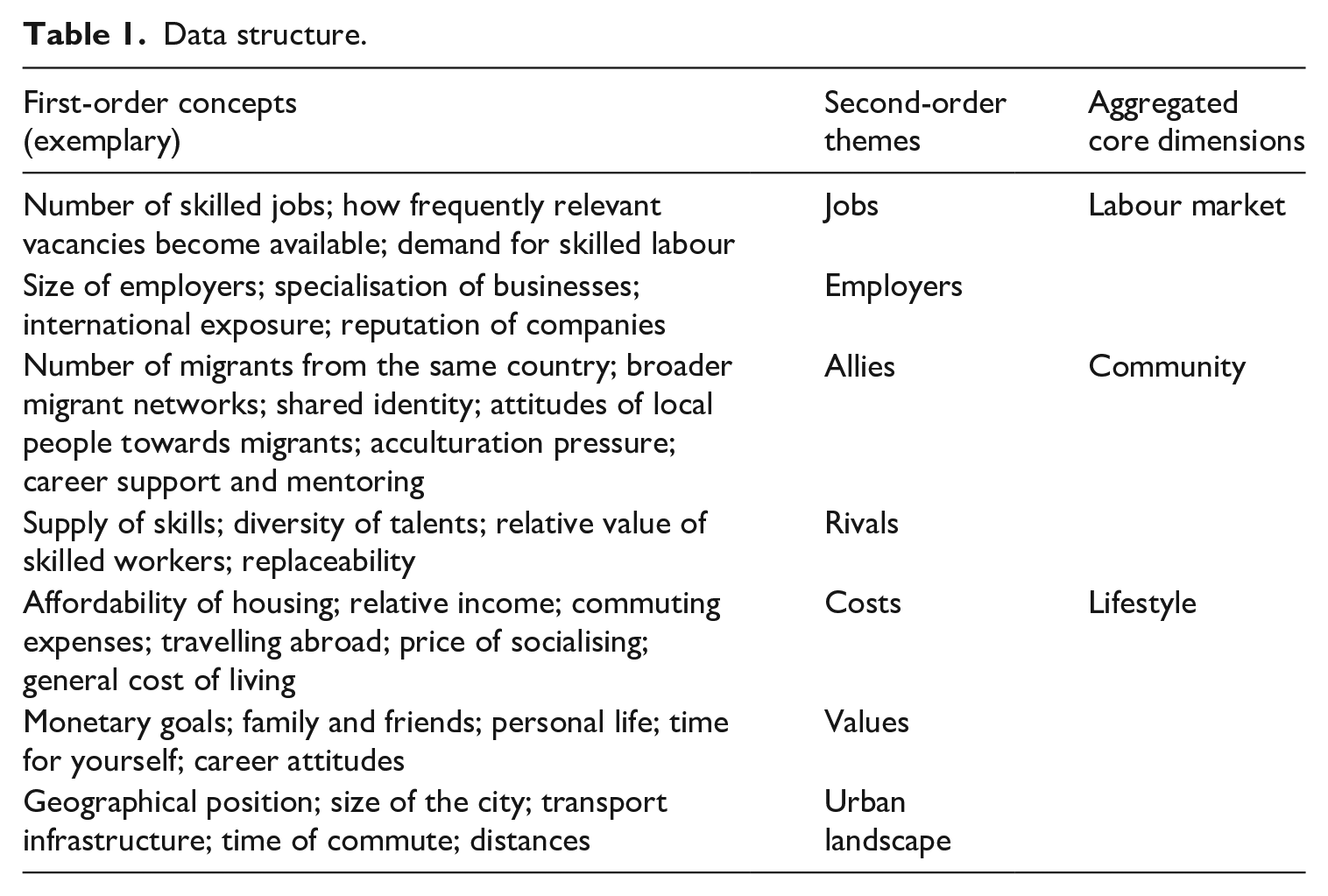
Conducting interviews and analysing the material proceeded in concert. Upon transcription, the interviews were subjected to manual coding, in that the initial first-order concepts were tested, refined and discarded if not proved useful, whereas new categories emerged from the data. In the abductive process, close and repetitive reading of the transcripts and references to the literature enabled a flexible, dynamic and inclusive approach to coding (Alvesson and Kärreman, 2007). Next, emergent patterns were explored on how the descriptive codes could be developed into more coherent and abstract second-order themes and then aggregate dimensions that would allow for a theoretical account explaining the impact of city-factors on career capital. In this data-to-theory move, particular attention was paid to themes that had not received adequate explanation in pre-existent scholarship (Gioia et al., 2012).
The data structure is presented in Table 1. Each stage of the analysis involved comparison between the codes and themes, both within London- and Newcastle-based sub-samples and across them. To check the quality, the analysis was discussed with three ‘outside experts’ (see King, 1998) selected on the basis of their extensive knowledge of qualitative methodology and career studies. One of them was specifically asked to adopt an outside perspective and critique some equivocal inferences (see Gioia et al., 2012).
Data structure.
Results
Three key city-specific factors emerged from the analysis: labour market, community and lifestyle. Although each group was associated particularly strongly with one way of knowing (labour market and knowing-how, community and knowing-whom, lifestyle and knowing-why), all three factors were found relevant to all ways of knowing, as explained and illustrated in the following three sections concerned with one group of factors each.
Labour market: Jobs and employers
Relevant skilled employment was particularly important for acquisition and utilisation of knowing-how. Capital-based respondents found skilled, even niche, jobs plentiful and frequently advertised. Aslan (plastic surgeon, Morocco) noted: ‘you can specialise in anything in London, there always be demand for your trade. And if [there are no vacancies right now] you just wait for a few weeks and it will change’. The jobs market in Newcastle was tagged ‘sluggish’. Skilled positions were ‘few and far between’ in the city still undergoing traumatic deindustrialisation, and became available less frequently. Employment for life was not uncommon in Newcastle, and some of the most desirable positions remained occupied for years: ‘I think three most senior HR people have been with the company more than 30 years. Each of them. And about 10 years in their current jobs’ (Hong, HR manager, China). Thus, London was seen as offering more opportunities to deploy and advance knowing-how.
Further, large wealthy corporations with international reputations were numerous in London, and employment in them was described as particularly advantageous. Hakaru expressed a common belief that knowing-how acquired in London was globally transferable: All these huge famous companies, they’re all here . . . If you are lucky to become part of them, you can learn in one year more than in five somewhere else. And you can go and work anywhere in the world, because everybody knows London, and everybody knows [these companies]. (Hakaru, engineer, Japan)
Besides, it was stressed that such organisations employed many foreign workers and had a relatively good understanding of their credentials, which enabled an adequate use of migrants’ knowing-how and informed training programmes suitable for migrants.
Experiences of Newcastle-based interviewees were somewhat dissimilar, as the majority found employment in domestic small and medium enterprises. The respondents felt that local employers lacked international expertise and, although appreciative of foreign expertise, did not always have a clear idea of how to utilise and advance it. Ernie (strategic planning manager, Australia) contrasted his experiences: There were other Aussies in the company [in London] and people from all over, so my manager had an idea of our education, but also they made the effort to tailor the development programme they had to accommodate everyone’s needs and experiences . . . [In Newcastle], they clearly liked me, but did not quite know what to do with me [laughs]. So, they just threw me in and assumed I would swim like everybody else [laughs]. (Ernie, strategic planning manager, Australia)
Similarly, other respondents in Newcastle described company-led training as unadapted for migrants and less capable of meeting their needs than in London. Further, some of the participants questioned transferability of knowing-how acquired in the secondary city. Although enjoying his job, Anton (biologist, Russia) was, like other respondents, concerned that his knowing-how was too context-specific and lacked London’s symbolic premium: ‘Nobody there [in Russia] knows about Newcastle anyway, maybe just football fans [laughs]’.
Regarding knowing-why, dense concentration of skilled jobs in London often led to excessively high expectations. The respondents emphasised that skilled jobs in London were numerous, but, as will be elaborated later, also stressed that such jobs were not easily accessible. Whereas some said that this challenge gave their motivation a boost, many others reported high levels of stress. Patel (insurance manager, Sri Lanka) compared job hunting in London to ‘chasing the carrot’ because numerous global insurance companies had ‘crazy high expectations’ of candidates, which eventually made him feel ‘not good enough’. This pressure was further intensified by families and friends back home: ‘If you don’t succeed in London, everybody thinks you will fail everywhere, as here you have the best conditions’ (Kimiko, manager, Japan). In turn, many of Newcastle-based respondents came to terms with limited career opportunities in the secondary city, where finding a suitable skilled job was seen ‘more of serendipity than your own success’ and adjusted their goals and expectations accordingly. When Ernie (strategic planning manager, Australia) moved to Newcastle, he was hoping that his expertise would help him to progress to directorship, but soon realised that ‘there are no jobs of this level here’. As relocation was not an option because of family responsibilities, Ernie conceded that progression was unlikely to happen. Like many other respondents, he found it ‘liberating’ and, whilst hoping that the right opportunity would eventually present itself, switched his attention to other matters.
Finally, the high number of skilled jobs in London facilitated development of knowing-whom by offering opportunities to bond with people in the same occupation. Knowledge exchange often occurred within these professional communities of practice, which evidenced the interplay between the ways of knowing. Moreover, employment in global organisations enabled migrants to expand their networks transnationally. In Newcastle, such opportunities rarely presented themselves. Maikel described his experience in Newcastle as ‘professional solitude’, as opposed to London ‘comradeship’: This is a lonely job anyway, granted. But in London I have a group of 5–7 other dentist solicitors – they all work in different companies, but we go out together, we share, we discuss things . . . This combination of professional and personal support is very helpful, very. (Maikel, dentist solicitor, the Netherlands)
Community: Competitors and allies
Differences in communities existing in the cities were profoundly important for migrants’ knowing-whom. Thanks to diverse and developed migrant networks, even respondents from countries with low numbers of nationals in London (e.g. Barbados and Georgia) were able to forge contacts either with people from countries culturally and linguistically akin to their own or merely with other migrants, regardless of their origin. Most importantly, migrant networks in London proved replete with valuable and diverse career resources: ‘Until I could afford, you know, professional services, people in the community helped with everything – legal advice, accommodation, first job, you know’ (Patel, insurance manager, Sri Lanka).
As career resources, such as information about jobs, references to clients or legal advice, were accessible through other migrants, many London-based respondents experienced little need in support from indigenous contacts. Nonetheless, getting access to resources embedded in indigenous networks was seen as a relatively easy task. It was suggested that long-term exposure to diversity had made people in London broad-minded and tolerant to migrants’ cultural and linguistic mistakes. In addition, the respondents found that they shared some important commonalities with many indigenes, namely high levels of education and international experience: [My wife and I] are friends with some British couples and I don’t think they are that much different . . . Some of them say it’s easier for them to be friends with us than with, I don’t know, some English farmer [laughs]. (Dato, event manager, Georgia)
Receiving relevant career support from migrant contacts was less likely in Newcastle, with its small and somewhat invisible foreign-born population. Furthermore, the paucity of benefits attainable through the migrant community suggested that important career resources were concentrated within indigenous networks. However, qualified and educated Newcastle-based migrants often felt that they had little in common with people in the city, who were portrayed as convivial, but lacking a cosmopolitan outlook and being predominantly working class. A perception shared by many was that the indigenes were relatively unaccustomed to migrants and that minimising ‘foreignness’ was a prerequisite for winning their acceptance: ‘I am not saying that people here [Newcastle] are more British than in London, but they certainly want you to be more British here. If you don’t become one of them, they are not interested’ (Mira, council worker, Vietnam). Consequently, many Newcastle-based participants felt obliged to advance their language skills, become acquainted with popular British music, films and TV, and support best-loved local sports teams – efforts rarely made by London-based respondents.
Such efforts also illustrate far-reaching implications of community for developing knowing-how. Career mentoring, with line managers and supervisors named as preferred mentors, appeared to be particularly significant for advancing professional expertise. Notably, some of the respondents in both London and Newcastle suggested that managers were disposed to nominate as protégés people resembling younger versions of themselves, facilitating mentorship between migrants. Besides, feedback from non-UK mentors was seen as more candid and, therefore, more useful for developing professional expertise. As Justine, a teacher from Lithuania noted: ‘Foreigners are more straight-to-the-point usually, they tell you directly what you need to do differently. So, I learned easier and quicker in London’. The odds of having a foreign supervisor in multinational London were higher than in Newcastle.
On the positive side, comparatively low levels of qualification of indigenous workers coupled with a low number of foreign professionals in Newcastle enabled skilled migrants to present themselves as possessors of rare and valuable skills and to capitalise upon them, especially when local organisations were seeking to expand to new markets and customers, to innovate and to improve their performance. Maria (engineer, Peru) was, strictly speaking, underqualified for the job she was hired for, but the company was looking to diversify its stock of skills and wanted her as ‘a breath of fresh air’. Although, like Ernie in the previous section, Maria felt that her employer had only a vague idea of how overseas skills should be utilised, she and many other respondents suggested that Newcastle employers valued and rewarded overseas expertise and ‘foreign’ personality traits, such as diligence and dedication.
In London, respondents faced stiff competition against indigenous workers and other migrants alike, which hindered standing out in the jobs market. The interviewees suggested that ‘whichever skills you have, in London they are not unique’ and foreign knowing-how was less beneficial – even for vacancies specifically requiring overseas credentials, as ‘employers can afford to be picky’. Gilles (financial analyst, France) once applied for a job that specified an advanced level of French and good knowledge of the French market as essential criteria, but learned that there was ‘a queue of Frenchmen who wanted it’ and his origin was less a privilege than he had hoped.
As the cachet that skilled migrants enjoyed in London and Newcastle differed significantly, so did their knowing-why. Owing to the rich and diverse supply of skills, many respondents in the capital felt they were regarded as ‘expendables’ and could be replaced effortlessly. Whereas some participants presented this as an invigorating urge to perform better, many others discussed the detrimental effect it had on their self-esteem. In contrast, Newcastle-based respondents stressed that, although looking for a new job would be a challenge, it would be equally difficult for their employers to find a suitable replacement. As Kristina (HR manager, Lithuania) exemplified, ‘they spent a few months looking for the right person and wouldn’t want to do it again’. Consequently, the participants reported confidence in their value, which further inspired their ambitions and reinforced their self-image as competent and esteemed professionals.
Lifestyle: Values and welfare
London and Newcastle emerged as urban spaces with different lifestyles. This category comprises inter-alia values entrenched in the cities, costs of living, relative wealth and infrastructure, with particularly significant implications for the respondents’ knowing-why. The capital was described as an expensive setting pervaded with pricey temptations, such as luxurious cars and chic restaurants. Whereas some respondents flourished in this environment, many others found it overwhelming. Yet, even less career-driven participants and those experiencing more anxiety than excitement about London’s lures reported gradual internalisation of materialistic values. Jose moved from Portugal intending to pursue a bohemian lifestyle and to enjoy London’s high culture whilst working as a street artist. He soon realised that his desires required substantial funds and he ‘joined the rat race’ to become an antique appraiser. Four years later, Jose could afford the original plan, but continued raising his goals, not least because of the desire to purchase a car more expensive than his colleague’s.
Salient in Jose’s story, expenses and the cost of living in London were a recurrent theme in other interviews. Despite comparatively high wages, the purchasing power of earnings was a chief concern, further aggravating the self-assurance issues. Many believed that the real value of their income was insufficient to secure the quality of life expected to follow the status of skilled professionals. As a result, this status was questioned: Remuneration looks decent on paper, but when you have a skilled visa and a skilled job but cannot afford a mortgage in a million years or when cinema with children is a rare treat, then, you know, it’s not what a highly-qualified person can call success. So, either I am not successful or not highly qualified, this is how I see it. (Nora, teaching assistant, Saudi Arabia)
In sharp contrast, Newcastle was presented as a very affordable environment, but also with fewer temptations and lower expectations regarding the standard of living. Coupled with the aforementioned shortage of skilled jobs and perceived employment security, these factors gave priority to non-monetary concerns. A frequently voiced opinion was that, ‘Newcastle people are a bit more concerned about their families and social life and commitments outside of work than their professional commitments’ (Ecrin, pricing manager, Turkey). Notably, even achievement-orientated respondents who were optimistic about their career prospects in Newcastle tended to warm to such attitudes over time. Ecrin went on to explain how she accepted her colleagues’ resistance to overtime work even when deadlines were looming and how she learned to ‘unwind’. Lower prices in Newcastle evidently contributed to reducing the level of stress. Indeed, as the excerpt below illustrates, Newcastle-based respondents had lower incomes but reported better welfare than their London peers, which cemented a sense of identity as skilled professionals: I actually earn less here [in Newcastle], there’s no London premium, but I’m better-off, I can afford more. But then you also have more respect for yourself. In London I was maybe in the top-half of earners. Many of my students would have more expensive clothes, watches, phones [than mine] . . . Here I’m top-20%, maybe top-10%, so you feel more professional, more positive about yourself. (Shourav, lecturer, Bangladesh)
Further, the lifestyle had an evident effect on knowing-whom. Because of distances and costs, socialising in London required advance planning. Another significant challenge was the high turnover of people, which made it ‘difficult to make a friend who’d stay for more than a couple of years’. Nonetheless, high mobility facilitated development of global networks and, as contacts departed for elsewhere in the world, knowing-whom of London-based participants extended internationally. In contrast, Newcastle-based interviewees described networking as affordable and spontaneous, as ‘everything is cheap and just round the corner’. Also, networks developed in Newcastle were durable, but regarded by some as somewhat peripheral and isolated: I mean one of the most difficult things of being here is that there are no or there are very few international networks. So that idea of global space of global professionals – it starts to disappear a little bit, it’s not that clear. (Joaquin, lecturer, Colombia)
The quote above reflects the relatively isolated geographic position of Newcastle, which also impacted on how migrants acquired and applied their knowing-how. The respondents provided examples of external projects that offered valuable opportunities for skills use and development but were rejected owing to transport issues. Anton (biologist, Russia) had a chance to become a visiting consultant in his motherland, which would have required monthly visits. He declined the offer as there were no direct flights from Newcastle and connections were long and wearisome. However, commuting within the city was regarded as quick and easy, which extended employment opportunities: ‘You can get anywhere within 30 minutes max, so I did not even consider the location of the office when looking for jobs’ (Janek, IT specialist, Hungary). In a distinctly different manner, expensive and time-consuming commutes within London were described as ‘the worst nightmare’, as opposed to affordable and convenient (inter)national connections. At some point, Ursula (chef, Poland) left her job in a Michelin-starred restaurant on the other end of London and, whilst looking for a new position, was helping a friend in his restaurant in Madrid as ‘flying to Madrid weekly was easier than taking the tube daily’. As many others, Ursula emphasised that long London commutes left her short of time for personal and professional development, as well as socialising, which was not an issue in Newcastle.
Discussion
This qualitative study responds to the growing number of calls for context-sensitive investigations of career capital (e.g. Rodriguez and Scurry, 2014; Zikic and Ezzedeen, 2015), as well as the call for this special issue to explore the importance of cities in shaping people’s careers. To advance understanding of how contextual factors influence development and deployment of skilled migrants’ career capital, this article drew upon the intelligent career framework (Arthur et al., 1995; Inkson and Arthur, 2001), often criticised for overlooking the significance of environments in which careers unfold (see Duberley and Cohen, 2010), and took London and Newcastle as illustrative examples. The findings are summarised in Table 2.
Factors influencing career capital in global and secondary cities.
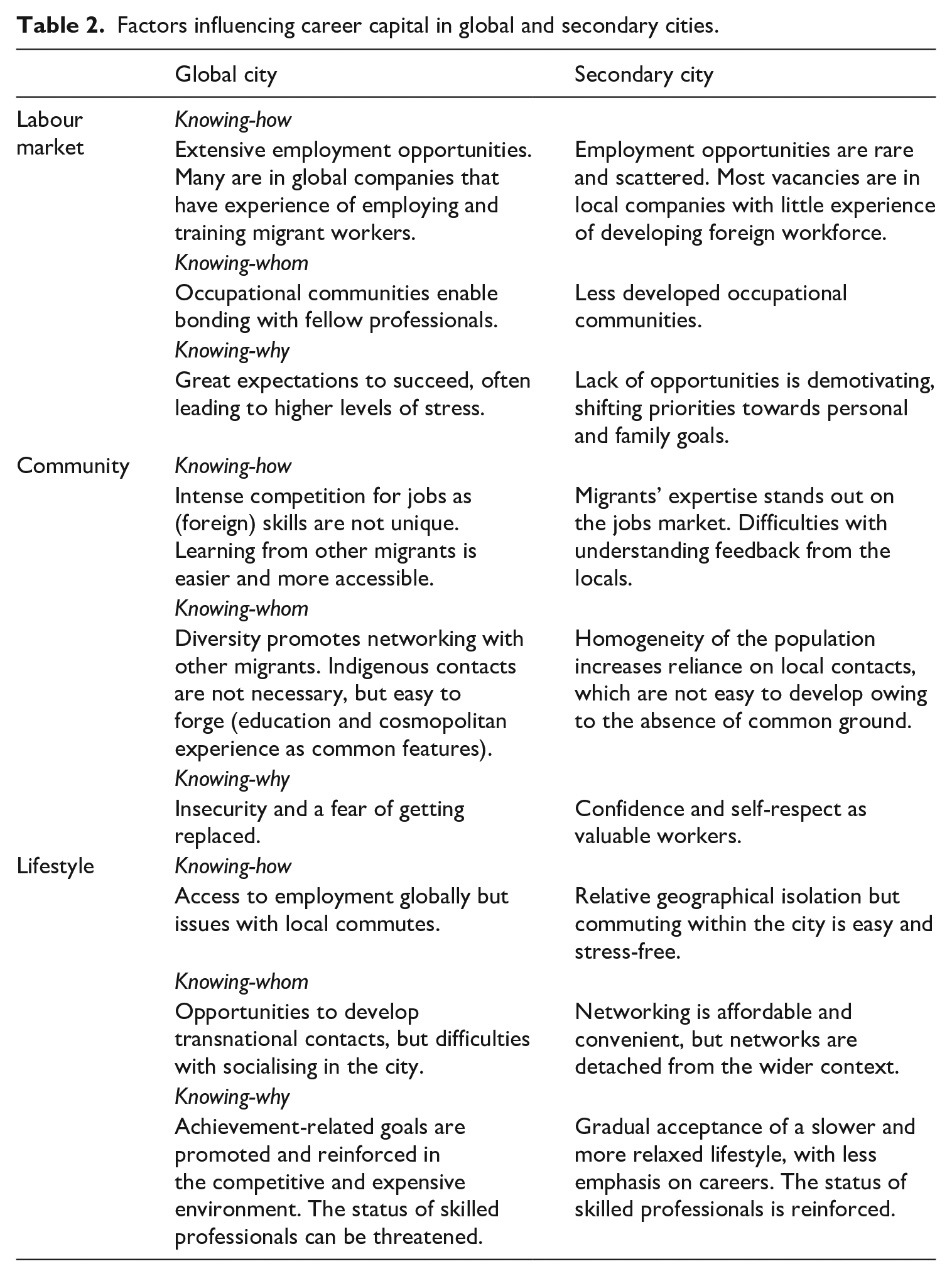
This article contributes to theorisation of the impact of cities on skilled migrants’ career capital by providing an exploratory account of manifestation, scope, impact and contextual foundation of the three groups of city-specific factors that differently shape skilled migrants’ career capital in global and secondary cities: labour market, community and lifestyle. These factors are not unknown to career scholarship and may appear to overlap each other, e.g. all three of them intensify the pressure to succeed (knowing-why) in global cities. However, labour market, community and lifestyle shape skilled migrants’ ways of knowing in conjunction with each other, rather than separately, and, despite being intertwined and having occasional unidirectional effects, mechanisms accountable for their impact emerged as empirically and conceptually distinct. The examination of the city-specific factors has also allowed for a valuable theoretical expansion of the concepts of global and secondary cities within the intelligent career framework, which facilitates the much-needed interdisciplinary dialogue (see Parker et al., 2009).
Global cities have been said to become global marketplaces for (inter)nationally mobile workers (Beaverstock, 2002; Sassen, 1991), and a metaphor of escalator has been used to signal their career-boosting effect (Fielding, 1992). However, the findings support the recent results (e.g. King et al., 2018) that suggest that the escalator effect is not guaranteed. The labour market can be understood as an arena of opportunities where career capitalists trade in their talents and ‘the relationship between the job market and the currency of knowing how job skills’ (Arthur et al., 1995: 12) has been recognised. The example of London affirms that global cities attract high volumes of skilled jobs and create numerous opportunities to advance and apply knowing-how, whereas the jobs market in secondary cities is often characterised by ‘the low-skills equilibrium’ and sporadic career opportunities (see Stenning and Dawley, 2009). Nonetheless, the diversity of knowing-how in London made the respondents speak vociferously about the intense competition. As one of the respondents wittily remarked, ‘The escalator might be here, but the queue is too long’. The example of Newcastle suggests that fast-track careers can occur in secondary cities; as recruiting skilled professionals can be difficult (Stenning and Dawley, 2009), migrants’ expertise is more likely to be seen as unique and difficult to replace and to equip them with better means to negotiate their interests (see Inkson and King, 2011). The labour market and the community represent the demand and supply sides of employment relations and, together, offer a more balanced perspective on migrants’ talents and skills. The findings further enrich this perspective by stressing the role of the transport infrastructure and the geographical position for connecting the demand for and the supply of knowing-how.
The results regarding knowing-whom speak to the notion of networks homophily, which suggests that people are inclined to bond with people who bear similar characteristics (Harvey, 2008; see also Beaverstock, 2002; Varma et al., 2011). Harvey (2008) identified that migrants’ participation in indigenous networks depends, among other factors, on cultural differences between migrants and the dominant local group, the size of migrant network and the annual inflow of migrants to a region. Global cities host sizeable migrant communities and attract large numbers of new migrants, which facilitates networking among internationally mobile workers (Beaverstock, 2002), and London-based respondents reported little need to integrate in indigenous networks. Yet, on the basis of shared high levels of qualification and exposure to international experience, developing local contacts in London was relatively easy. These results corroborate the recent study by Skovgaard-Smith and Poulfelt (2018), who find that migrants and Dutch nationals in Amsterdam have common identities as educated professionals with global careers. In Newcastle, there is less common ground between skilled migrants and the indigenes but, as the foreign population is small and scattered (Stenning and Dawley, 2009), relevant career aid from migrant contacts is also unlikely to be obtained. Furthermore, opportunities to network with fellow professionals are numerous in global cities but inhibited in secondary cities. However, knowing-whom disadvantages of secondary cities are somewhat alleviated by relatively affordable social life, as well as the proximity and durability of local contacts.
The findings about knowing-why largely refer to the (deceptively) glamorous image of global cities (Favell, 2008; King et al., 2018). The profusion of career opportunities in London, with access inhibited by the abundant supply of talent, was often experienced as an urge to prioritise careers and financial gains, further underpinned by costs of living and expensive temptations. An important and disturbing finding was that very few participants described this experience as entirely positive, whereas many felt anxious, disorientated and exhausted, which may imply the reasons to ‘step off’ the escalator in the future (Fielding, 1992; Findlay et al., 2008; see also King et al., 2018). In contrast, Newcastle was often described as a tranquil and affordable city characterised by a healthy work–life balance rather than by exciting career opportunities. Yet, when such opportunities arose, skilled migrants were noticeable as possessors of rare overseas expertise and were willingly hired by local employers. Consequently, all three factors examined in this article undermined the respondents’ self-perception as skilled professionals in London, whilst fortifying it in Newcastle. The findings that career-related attitudes, values and objectives of many respondents in both cities changed during their residency emphasise the important dynamism of relations between career agents and their urban contexts.
The experiences of the respondents in London verify global cities as ‘transnational social spaces’ (Smith, 1999) or ‘transnational communities’ (Beigi et al., 2018) where knowledge is produced and disseminated globally through transnational networks. Miera (2008) exemplifies how Polish entrepreneurs in Berlin deploy their Polish skills and contacts to establish businesses aiming at the Polish community in Berlin and then successfully expand their enterprises back to Poland. Similarly, many London-based respondents in the current study expanded their transnational contacts and expertise, whilst also developing a certain sense of detachment from their immediate social space (see King et al., 2018). Furthermore, the accumulation of knowledge in the global city discounted migrants’ skills and talents. Some individuals can derive extra motivation from this challenge, but for many the appeal of the global city has shrunk over time. At the same time, the results elaborate secondary cities as distinctly impactful career settings (Connolly, 2008). Whereas social connections are less important for skilled migrants in relatively homogeneous secondary cities, there is more prestige attached to their skills and experiences, which can allow them to take an advantageous position as ‘bridges’ connecting the gap between local business and the outer world. In turn, occupying this position bolsters their professional identities, although career experiences in the secondary cities appear to be largely restricted to the local and national environments.
These arguments also add to the debate about the context-driven links between the three ways of knowing (Beigi et al., 2018; Parker et al., 2009), and therefore contribute to the intelligent career framework. The results provide further empirical evidence to illustrate how changes in one way of knowing entail changes in the others (Zikic and Ezzedeen, 2015). However, this study argues that these relations are not necessarily direct, as earlier commentators seem to suggest. For example, plentiful knowing-how opportunities in global cities do not always result in enhanced knowing-why and can be overwhelming for some people. Furthermore, the results suggest that the effect of contextual forces is complex and nonlinear, in that the same factor (e.g. homogeneity of population in Newcastle) inhibits development of one way of knowing (knowing-whom) whilst promoting another (knowing-how). This argument connects with the calls to transcend the overly simplistic ‘good-or-bad’ dichotomy when studying career boundaries (see Gunz et al., 2007). In a similar way, this study advises that global and secondary cities are no more or less (dis)advantageous for skilled migrants’ careers per se. Rather, their effects should be seen in light of agential intents, targets and aspirations, as well as life and career stages, which should be acknowledged when developing individual career projects and providing career counselling and support.
This article also advances theoretical development of a specific body of literature concerned with skilled migrants’ careers. The results of this study are at odds with previous findings that discussed international experience as invariably beneficial for career capital (e.g. Dickmann et al., 2018; Suutari and Makela, 2007). Instead, they reaffirm that, in Rodriguez and Scurry’s (2014: 1061) words, many migrants experience ‘career capital stagnation as a result of structural barriers’, or even deterioration – for example, when unable to access skilled jobs because of the dearth of vacancies (secondary city) or the intense competition (global city). The results have also illuminated the contextual influence upon skilled migrants’ career capital and questioned the notion of internationally mobile skilled individuals as a privileged group endowed with unfettered agency (see Al Ariss and Crowley-Henry, 2013). Instead, this study contends that even skilled global careers are shaped by contexts and a relational perspective is required to appreciate their complexity (Al Ariss and Crowley-Henry, 2013; Al Ariss et al., 2012). This argument contributes to the debates about ‘the dark sides of contemporary careers’ (Baruch and Vardi, 2016) that argue that careers are far from being wholly positive experiences – indeed, skilled migrants face career barriers in both global and secondary cities.
Practical implications
The theoretical insights into complex relations between the ways of knowing and urban environments offered by this article can inform skilled migrants’ efforts to navigate their career interests. Before moving to either global or secondary cities, it is of paramount importance that prospective migrants explore contextual conditions and form realistic career expectations. The city-specific factors discussed in this article indicate that migrants should be prepared to compromise and re-evaluate some of their goals and ambitions. This appears particularly important for privileged skilled migrants who are likely to find their agency more constrained by city-specific mechanisms than the previous studies (see Al Ariss and Crowley-Henry, 2013) or their own presumption suggest. Nonetheless, the findings indicate that skilled migrants can and should take a proactive stance in relations with city contexts. Prospective migrants to global cities need to develop a robust entry strategy that would enable them to differentiate themselves from their competitors. Investing in social networks to identify and access valuable career opportunities can be very useful and relatively easy. At the same time, migrants should stay on the ball in ever-changing global cities, as opportunities can come and go very quickly. In secondary cities, the findings encourage migrants not to be overly modest and to underscore the value of their foreign expertise to potential employers. Social networks can be a valuable addition to this approach, but developing them is likely to require laborious social adaptation.
The findings also have implications for employers and city authorities, entering the increasingly stiff competition for global talents (Al Ariss et al., 2012). In global cities, organisations may need to learn how to minimise the ‘brain waste’ and forge longer-lasting employment relations with foreign skilled professionals. Also, introducing wage premiums to global cities and reviewing them regularly is critical for attracting and retaining foreign workers. In turn, secondary cities would benefit from developing national and global transport connections, whereas local organisations should raise their awareness of foreign skills and their applicability. Further, employers and authorities in secondary cities should collaborate to assist social integration of skilled migrants through, for example, supporting migrant societies and creating opportunities for migrants and local people to socialise, whilst raising cultural awareness and providing reassurance within the local community.
Drawing upon theoretical contributions made by this article, these recommendations can also provide a framework for further theory development, and future studies can examine how city-specific factors are navigated by migrants, employers and municipalities, including career decision-making in the city context.
Limitations and future research
Although this article is dealing only with city-specific factors, it acknowledges the impact of other analytical levels (individual, organisational and national) for understanding career experiences. For example, whether skilled migrants thrive or strive in competitive global cities is likely to be influenced by their personalities, sociodemographic characteristics and objectives (King et al., 2018; Zikic and Ezzedeen, 2015). At the same time, cities are embedded in broader cultural, social and political contexts (see Yao, 2014), and therefore London and Newcastle are not truly representative of all global and secondary cities. Furthermore, there is evidence that careers in cities can vary across boroughs, districts and wards (see Beaverstock, 2005), and that efforts to incorporate different analytical levels are encouraged to create a more comprehensive account of careers (see also Al Ariss et al., 2012). Also, a wider range of both qualitative and quantitative methods should be used for these endeavours to overcome the limitations of self-reported retrospective data. Further, although some of the results can be extrapolated further – e.g. availability of skilled vacancies and costs of living are applicable to the career capital of indigenous workers – more explicit effort should be made to examine the career capital of other groups of career agents in the city context. It would also be useful to explore relations between the city-factors and the dynamics of these relations. Finally, the subsequent studies should make use of the theorisation of urban career landscapes offered by this article and explore a wider range of career-related phenomena and processes in global and secondary cities – for example, other ways of knowing, such as knowing-where, knowing-when and knowing-what (Jones and DeFillippi, 1996), or career success.
Conclusion
Contextualising skilled migrants’ career capital is important in the current conditions of reliance on and competition for internationally mobile workers. This study sheds light on how differently urban contexts constrain and enable skilled migrants to develop and deploy their career capital and elucidate specific mechanisms that account for these differences. It explores three ways of knowing of skilled migrants in a global (London) and secondary (Newcastle) city and confirms the significant impact of city-specific factors – namely, labour market, community and lifestyle. All of them proved impactful for all three ways of knowing, even though links between knowing-how and labour market, knowing-whom and community, and knowing-why and lifestyle were articulated more strongly than other dyads. In global cities, skilled migrants have excellent opportunities to benefit from their knowing-whom, but their knowing-how is often misprized and knowing-why is eroded. In secondary cities, skilled migrants’ knowing-how is appreciated, although not necessarily used adequately, and knowing-why is reinforced, whilst knowing-whom appears to be of limited use.
Footnotes
Acknowledgements
I would like to thank Steve Vincent (Newcastle University) and Nick Wylie (Coventry University), as well as the guest editors and three anonymous reviewers for their helpful comments and suggestions.
Funding
The author received no financial support for the research, authorship and/or publication of this article.
