




Abstract
The historic turn in organization studies has led to greater appreciation of the potential contribution from historical research. However, there is increasing emphasis on integrating history into organization studies, rather than on recognizing how accommodating history might require a reorientation. As a result, key conceptual and methodological insights from historiography have been overlooked or at times misrepresented. We identify four modes of enquiry that highlight distinctions from history about ‘how to conceptualize’ and ‘how to research’ the past. First, historical organization studies research the past primarily through reference to archival sources. Second, retrospective organizational history reconstructs the past principally from retrospective accounts, such as those generated in oral history. Third, retrospective organizational memory uses ethnography and interviews to explore the role of memory in the present. Fourth, historical organizational memory traces the institutionalization of organizational memory through archival research. From the analysis, we argue that historical organization studies are increasingly established, and interest in ‘uses of the past’ has contributed to the rise of retrospective organizational memory. However, historiographical reflexivity – a new concept for organization studies – focuses attention on engaging with both history and collective memory, and on the distinct methodological choices between archival and retrospective methods.
Keywords
Introduction
Increasingly, researchers in organization studies assert that ‘history matters’ (Peng et al., 2017; Wadhwani and Jones, 2014). Advocates of a ‘reconceptualization’ of organization studies (Zald, 1993), or a ‘historic turn’ (Clark and Rowlinson, 2004), have promoted greater engagement with the humanities and historiography (Booth and Rowlinson, 2006). Here, historiography refers to the philosophy, theory and method of writing history (Partner and Foot, 2013), and engages with fundamental problems of researching the past (Rowlinson et al., 2014).
One of the key debates in the field has dealt with the nature of interdisciplinary engagement between organization studies and history. Üsdiken and Kieser (2004: 324) outlined two approaches, one being integrationist, which ‘retains concerns with theory and explanation in the “social scientific” tradition’ but considers history as a ‘source of explanatory generalisations or theories’. Thus, history is not considered a replacement for organizational theories (Kieser, 1994: 619), but as a means to enrich the ‘positivistic programme of theoretical and empirical accumulation’ (Zald, 1993: 516). The second approach, which Üsdiken and Kieser (2004: 324–325) named reorientationist, seeks to challenge the social scientistic foundation of organization studies, and to prioritize the narrative approach to history. Recent contributions to organizational history have been firmly integrationist at the expense of engaging with historiographical debates that offer significant scope for more pluralist and interdisciplinary scholarship in organization studies. We draw on reorientationist scholarship that calls for a meaningful engagement with historiography (Clark and Rowlinson, 2004), and propose historiographical reflexivity as a way of not just enriching organization theory as conceived by integrationists, but more importantly as a way to widen and deepen the engagement with historical theories and methods and their relationship to organizational memory.
Historiographical reflexivity is defined as an engagement with history as a source of theorizing as well as a repertoire of methods for researching the past. This engagement requires recognition of the intellectual origins of historical concepts, for example invented tradition and imagined communities, which engage with collective memory. There is also an expectation that historical research in organization studies could contribute to broader historiographical debates and historical narratives. To further elaborate the centrality of historiographical reflexivity for organizational research, we develop an alternative framework that proposes different modes of enquiry for comprehending the organizational past. Historiographical reflexivity foregrounds insights from historiography, and reflexively adapts them to organizational theorizing. This article draws on major historiographical debates about the relationship between memory and history (Kansteiner, 2002; Ricoeur, 2004). These debates have particular relevance for organizational memory studies, which are increasingly connected with historical organization studies.
From this analysis, we discover ultimately how investigations have thus far focused heavily on two research modes – historical organization studies and retrospective organizational memory – at the expense of what we see as the more historiographically reflexive modes of enquiry. The latter have potential to promote reorientationist scholarship by taking a self-consciously angular approach to key historiographical questions. It is in this sense that we advance a theoretical stance of historiographical reflexivity as a vehicle for developing our understanding of key issues related to the past.
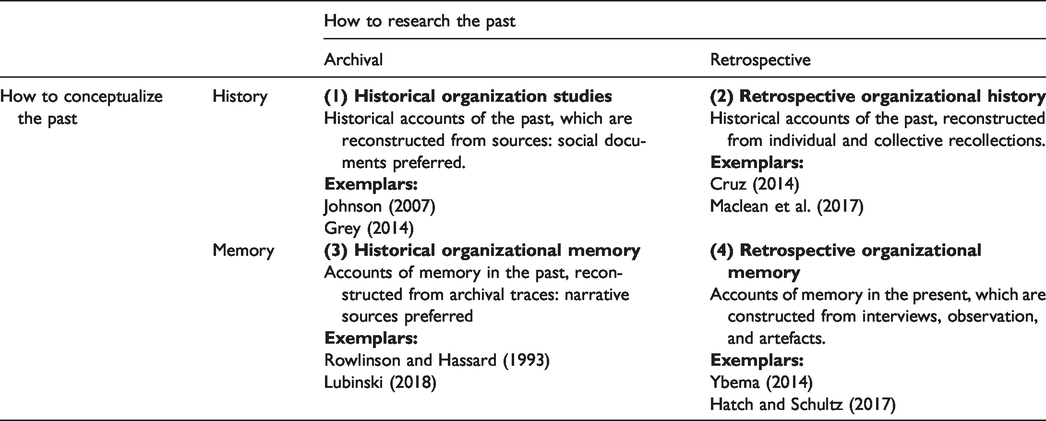
In this article, therefore, we first outline a stance of historiographic reflexivity as the basis for discussing debates and deliberations at the boundary of history and memory as approaches to researching and conceptualizing the past (LaCapra, 1998; Le Goff, 1992; Wertsch, 2002), and focally with respect to studies of organization. In so doing, we discuss relatedly two stylized methods of acquiring information on the past: archival and retrospective. Taken together, our comparative discussions of these twin sets of dimensions – history versus memory and archives versus retrospection – lead us to propose four modes of enquiry for researching the past in organization studies: historical organization studies, retrospective organizational history, retrospective organizational memory and historical organizational memory. In what is the centrepiece of the article, opportunities for different combinations of history and memory with archival and retrospective methods are illustrated through exemplars for each mode of enquiry. From this analysis we discover ultimately how investigations have thus far focused heavily on two of these modes – historical organization studies and retrospective organizational memory – at the expense of what we see as the more historiographically reflexive modes of retrospective organizational history and historical organizational memory.
Introducing historiographic reflexivity
Although significant progress has been made in terms of integrating history with organization studies, even pluralistic notions such as dual integrity – which combines theoretical fluency with historical veracity – clearly locate theory within the domain of organization studies (Maclean et al., 2016: 618). History is, therefore, being demoted to ensuring empirical accuracy – a much lesser concern for organization scholars than the theoretical fluency aspect of dual integrity. This effectively reduces historiography to a body of work that can provide empirical background but no conceptual contribution.
Dual integrity particularly foregrounds ‘history-as-conceptualizing’ as a vehicle for generating theory, which closely aligns with the inductive theory building approach of common qualitative research templates (Langley and Abdallah, 2011). This offers a promising avenue for establishing historical research in organization studies, but also gives rise to criticisms that this integration actually reduces the potential of the ‘historic turn’ (Clark and Rowlinson, 2004) to generate a ‘theoretically informed, historicized approach to understanding how and why we come to be where we are in contemporary organized societies’ (Durepos et al., 2019: 16). Kipping and Üsdiken (2014) highlighted the tendency for integrationist approaches to use history as a form of data rather than as a way to frame conceptual contributions. Others responded by outlining the potential of theory elaboration through reflexive historical case studies that both challenge and refine existing theories (Stutz and Sachs, 2018). These criticisms share a concern with the narrow conception of theory in organization studies that excludes both critical and abductive reasoning (Mantere and Ketokivi, 2013; Megill, 2007), and thus a wide range of conceptual contributions that are routinely recognized as theoretical in related fields (Bramwell, 2015).
Narrative, a key conceptual device in history (Mink, 1966; White, 1984), becomes solely a means of presenting the data in a descriptive manner, with the theoretical contribution, and frequently also the methods, being wholly located within the organization studies tradition. Historical narratives, however, combine a number of analytical elements (Somers, 1994), in particular emplotment, which serves as an alternative mode of conceptualizing and theorizing in history. Thus, historical theories are easily ignored because they do not follow the expected format, and conveniently maintain the integrationist position that theorizations on the basis of historical data can only be derived from organization studies.
Conceptualization through narrative is not just something that historical researchers within organization studies do, but conceptualizations are already embedded in historical narratives and presented as ‘lines of reasoning’ (Alvesson and Kärreman, 2007) rather than formal theory development (Popper, 1945). However, organization theory has only very partially drawn on historiography to inform its theorizing, instead preferring to view history as a source of data (Leblebici, 2014) or occasionally as a method (Van Lent and Durepos, 2019).
Integrationist approaches also make explicit reference to historical concepts, such as the origins of rhetorical histories in the ‘invention of tradition’ literature, but in the process of borrowing reframe them in ways that are inconsistent with their conceptualization in history. Such changes invariably align these concepts more closely with organizational theorizing and research practices at the expense of historical research. Suddaby et al. (2010: 157), for example, present certain historiographical concepts as ‘a constructivist perspective in which history is an interpretive device for imposing culture (Said, 1979), shaping identity, and creating community (Anderson, 1983) and framing the motivation for action and change (Hobsbawm and Ranger, 1983)’. Yet these scholars deconstructed such historical accounts to highlight tendentious interpretations of sources that used representational techniques to position certain cultural or social groups in a specific (positive or negative) light in the present, not to advocate such practices.
Hobsbawm, in particular, as a Marxist historian, was deeply critical of cultural historians’ attempts to appropriate his concept of invented tradition in such a manner (Magnússon and Szijártó, 2013, 155–157): ‘More history than ever is today being revised or invented by people who do not want the real past, but only a past that suits their purpose’ (Hobsbawm, 2002: 296). This partial borrowing of concepts from historiography represses their intellectual content, as highlighted by Lubinski’s critical insight that it is ‘ironic’ that research on rhetorical history has ‘ignored historical narrative’ and consequently failed to conceptualize the role of context for organizational uses of the past (Lubinski, 2018: 1790).
Rhetorical history and related approaches make for excellent and engaging pieces of organizational research but they are not historical in the sense that historical research is a well-defined and established research practice: history focuses on generating new knowledge about the past, and it views all information about the past as ‘source’ not ‘data’. In this, it follows a verification rather than a replication logic, by prioritizing the accessibility of the underlying information for cross-referencing rather than believing in a methodological approach that would replicate one historian’s interpretation of the sources (Rowlinson et al., 2014). Hence, the term ‘history’ describes the means by which the research is carried out. In contrast, approaches such as rhetorical history focus on historical narratives and their construction, and employ standard qualitative research methods such as (anonymized) interviews and observations to investigate occurrences in the present. Here, historical narratives become the object of research (Decker, 2016).
From the perspective of historiographical reflexivity, integrationist approaches limit the potential of history to contribute to organization studies that reorientationist approaches promised. On the one hand, history is presented as being empty of conceptual thought, and on the other, as a narrative construction solely for the purposes of the present with no reference to independently verifiable sources that would hold historical researchers accountable for their interpretations. The reorientationist critique sought to go beyond simplistic notions of ‘history matters’ and advocated a greater engagement with historical narrative as well as concepts, categories and questions emanating from historiography, in order to open up the field to ‘diverse forms of theoretically informed historical writing in organisation studies’ (Clark and Rowlinson, 2004: 347). Not only does historiographic reflexivity provide integrationist perspectives with greater awareness of their position vis-a-vis key historiographical debates, for example that of history and memory as alternative ways of comprehending the past, but also engenders greater plurality in how the past can be researched. Hence, we draw on the history and memory debate in historiography to develop alternative reorientationist modes of enquiry, which make theoretical contributions by taking self-consciously angular approaches to key historiographical questions.
How to conceptualize the past: History and memory in historiography
Many disciplines have engaged with the concepts of history and memory, highlighting their distinct yet intertwined nature. Kansteiner (2002: 180), a historian of memory, considers memory ‘a slippery phenomenon’ as ‘collective memory is not history’, but acknowledges that ‘memory’s relation to history remains one of the interesting theoretical challenges in the field’ (Kansteiner, 2002: 184). Although some organization scholars have outlined the importance of clearly defining the key concepts of past, history and memory (Ravasi et al., 2018; Suddaby et al., 2010), the recent proliferation of concepts has highlighted considerable ambiguity. There is broad agreement that the past is gone and hence ontologically inaccessible (Collingwood, 1946; Mills et al., 2013; Munslow, 1997; Trouillot, 1995), so neither history nor memory can claim superior or more objective knowledge. However, history and memory provide different answers to the question of how to conceptualize the past, where memory considers the past as prior to, but not fundamentally different from, the present, whereas ‘the founding principle of history’ (Fasolt, 2004: 4) is that the past is distinct from, rather than just prior to, the present (De Certeau, 1988; Koselleck, 1985; Schiffman, 2011). This has been aptly encapsulated by the phrase, ‘the past is a different country’, with the eponymous book by influential historian of heritage, Lowenthal (1985: xvi), emphasizing that memory and history are ‘two different routes to the past’ – routes which can be characterized as the ‘learned past’ and the ‘lived past’ (Misztal, 2003: 99–101).
Yet much recent research on the past in organization studies elides the difference between history and memory. Wadhwani et al. (2018), for example, define the past as ‘all events that occur chronologically before the present’, and then describe history as ‘mobilizing the past in the present’, which has more in common with definitions of memory as the ‘invocation of the past in the present … designed to create an atemporal sense of the past in the present’ (Katriel, 1994). By contrast, Jenkins (1999) and Munslow (1997), two influential historians, define history as ‘knowledge of the past’ that is distinct from the past itself and based on the traces left behind. We summarize the ways in which scholars from sociology, history and memory studies have sought to clarify the distinction between these two key concepts in Table 1.
Conceptualization of the past in history and memory.
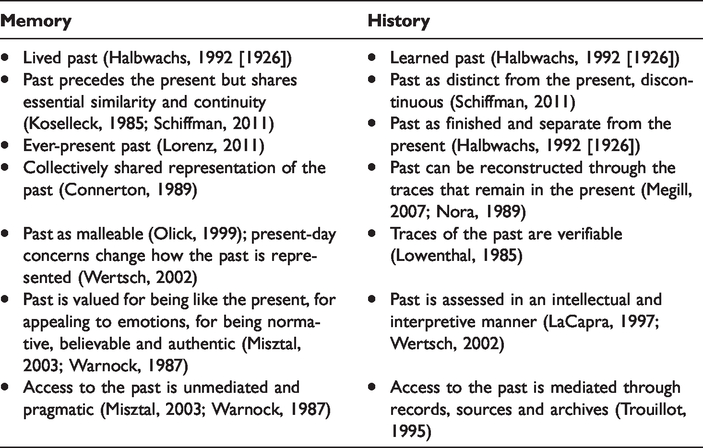
The well-known historian Tony Judt emphasized the difference between history and memory, arguing that ‘to allow memory to replace history is dangerous … history of necessity takes the form of a record, endlessly rewritten and re-tested against old and new evidence’ (Judt and Snyder, 2012: 277–278). Historians know about the past through its ‘traces’ in the present – by explaining the evidence (e.g. archival sources) rather than narrating past events and actions (Megill, 2007: 246). Hayden White (1973, 1987), a leading exponent of a literary approach to history, criticized historians for hiding the fact that all history is the study of documentary ‘traces’ of events, and not of past events themselves (see also Callinicos, 1995). Additionally, Munslow (2015: 135) emphasizes the point that conflating ‘the past’ with ‘history’ is to ‘commit the fundamental category error of conflating writing with a non-existent reality’.
Definitions of memory view the past and present as continuous, and instead suggest an ‘ever-present past’ (Lorenz, 2011: 26). Since Halbwachs (1992 [1926]), sociologists have defined memory as collectively shared representations of the past (Olick, 1999). Similar to there being different kinds of history (Jordanova, 2006: 228), memory encompasses, at the very least, ‘two cultures’ (Olick, 1999) – centred on individual or collective memory – although it is memory as a collective domain, as in cultural memory, that is of primary concern to historiography (Terdiman, 1993). Collective memory focuses on the malleability of what is remembered as the ‘past’ for the purposes of the present, frequently challenging or integrating historical accounts in the process. Memory selectively seeks, for example, symbolic similarity, emotional appeal, unmediated access, the personal and the subjective (Misztal, 2003; Warnock, 1987).
Through comparing how scholars have discussed the differences between history and memory (see Table 1), it is the understanding of the past that stands out as key: is it ‘finished’ and gone (history) or temporally prolonged into the present (memory). To expand, on the one hand, history is seen as an intellectual and interpretive endeavour that produces accounts of a past based on sources and archives (Lowenthal, 1985: xxii, 214; Trouillot, 1995: 49; Wertsch, 2002: 31–62). Collective memory, on the other hand, is defined as the representation of the past shared and commemorated by a group – a phenomenon enacting and giving substance to that group’s identity, its present conditions, and its vision for the future (Connerton, 1989: 4, 58; Misztal, 2003: 71). History and memory embody different assumptions about the nature of the past, yet they clearly co-exist in modern societies and in academic research practices. Zerubavel (1997: 5), a sociologist of time, suggested that their relationship is as much characterized by conflict as it is by consensus or interdependence. Funkenstein (1989: 9), a historian of memory, characterized history as ‘ignoring the present and its meanings as much as possible’ and attempting to avoid projecting ‘our concepts on the people of the past’, whereas collective memory, he argues, is ‘completely insensitive to the differences between periods and qualities of time; it is shallow in terms of chronology; it is completely topocentric’. People or historical events ‘are not recognized for their uniqueness’ and are instead viewed as links to an ongoing past.
Nevertheless, the relationship between the two remains contentious. Some scholars see history merely as the official memory a society chooses to honour, with historical narratives becoming integral parts of collective memory (e.g. Hutton, 1993). Habermas (1997), a social philosopher, and LaCapra (1997), a cultural historian, consider history as critical work that establishes which aspects merit being passed on as living heritage. These debates, however, are less concerned with the difference between history and memory, as with the dominance of one over the other, as highlighted by Ricoeur (2004: 384–411). Is memory just a less rigorous form of history – deemed acceptable as a substitute when no adequate archival records have survived – or is history merely providing the content and narrative for collective memory?
As our subsequent exemplars demonstrate, recent work in organization studies has often employed either history or memory when establishing a conceptual framework, but without necessarily reflecting how this practice influences the founding of a theoretical contribution. In a rare exception, Suddaby and Foster (2017: 20) show how such conceptualizations of the past can determine what kind of theories – in this case of organizational change – can be developed: ‘Our explicit theories of change and our ability to change, thus, vary by our implicit models of history’. However, their four positions conflate history and memory – for example, history-as-rhetoric encompasses memorialization and strategic forgetting, practices clearly based on collective remembering and not history. Equally, they omit the question of how we research the past, as the methodological choices that underpin theorizing have received less attention so far (Van Lent and Durepos, 2019: 430). In the next section, we present two stylized methods that offer significant potential in terms of enhancing levels of theoretical flexibility.
How to research the past: Archival and retrospective methods
Recent work on the past in organization studies predominantly falls into two categories: approaches conceiving the past through the lens of history, which investigate their setting with archival methods (historical organization studies), and projects based on the concept of memory, which employ retrospective methods (retrospective organizational memory). This suggests a notion of methodological alignment that greater historiographical reflexivity would dispel, for archival and retrospective methods have been widely employed outside of organization studies in combination with either history or memory. This is an area where management scholars ought to develop greater literacy with historiography and historical theory (Suddaby, 2016), without misrepresenting the content and nature of these debates. In fact, much of the contestation of the boundary between history and memory is owing to the conflation of the conceptual and methodological choices inherent in studying the past, which we maintain ought to be considered as separate and independent.
Archival methods are often seen as the unquestioned norm for historical research, so much so that one is often used to define the other. The influential business historian Donald Coleman (1987: 142), for example, argued that business history is defined by the use of business records. Archival methods investigate traces of the past, which are referred to as sources – with such sources being analysed and triangulated with other sources as part of a verification logic (Rowlinson et al., 2014: 258), and different types of source analysis sharing common features (Howell and Prevenier, 2001; Kipping et al., 2014; Rowlinson, 2004; Stoler, 2009). Historical sources are frequently, but by no means always, collected and maintained in archives (Decker, 2013). Only rarely do historians discuss how their analysis of sources leads to the development of argument and narrativization (Megill, 2007; Rowlinson et al., 2014; Taylor et al., 2009; White, 1984).
A key distinction is made between two broad classes of historical sources: social documents, and narrative sources (Howell and Prevenier, 2001; Rowlinson et al., 2014). On the one hand, social documents tend to form part of normal organizational routines – they are usually internal to the focal organization, restricted to their immediate functional purpose, and generally oriented toward the present rather than the future. Narrative sources, on the other hand, reflect a tendency for their authors, implicitly or explicitly, to address a wider audience. Whereas historical approaches traditionally favoured social rather than narrative documents, increasingly the latter are used to answer questions that focus on (past) actors’ memory, identity and sensemaking. Here again, validity tends to focus on a ‘verification logic’ (Rowlinson et al., 2014: 258), permitting readers to disambiguate between source material and its interpretation.
Retrospective approaches have been considered distinct from historical research, as they are based primarily on interviews and ethnography, as opposed to documentary historical research (Wolfram Cox and Hassard, 2007). In general, retrospective methods involve the retelling of past events, for example, in the form of life histories and recollections of past events, with researchers often being less interested in the accuracy of recall than in the forms of reflection and interpretation that occur post-hoc (Perks and Thomson, 2016). Retrospective methods thus rely on memory even when memory is not the focus, much like archival methods rely on the creation of archives which are frequently used in the service of producing histories.
In organization studies, retrospective researchers have discussed different approaches to collecting data about the past (Wolfram Cox and Hassard, 2007), pointing to diverse applications of the method. Researchers may either seek to elicit sensemaking or focus on maximizing accurate recall. Meanwhile, oral history explicitly draws on retrospective methods by making use of collective memory ‘as a historical source’ (Perks and Thomson, 2016: xiv). Oral history is clearly a sub-field of history (Jordanova, 2006: 53), but with affinities to retrospective approaches in organization studies. Obvious differences include identifying informants by name and depositing audio files and transcripts in an (oral history) archive, thus symbolically appending them to the historical record as a form of testimony.
Clearly, retrospective and archival methods are sufficiently flexible to enable organizational researchers to align them with either history or memory studies. This opens up alternative research agendas that have hitherto received insufficient attention in organization studies, which we discuss in the next section.
Ways of making sense of the past
History and memory, therefore, embody different assumptions about the nature of the past in organization studies. Although they are implicitly associated with distinct methodological choices, a more reflexive approach highlights the opportunities inherent in seeking more self-consciously angular modes of enquiry – ones that clearly distinguish between conceptual and methodological aspects. We outline four modes of enquiry that combine history and memory with archival and retrospective methods (see Table 2). In developing this framework, our aim is to expand the range of approaches that incorporate the past in organization studies, at the same time providing more substantial theoretical foundations for key concepts.
Modes of enquiry into the past in organization studies.
Historical organization studies
This mode of enquiry is well developed and has been coined to describe research which has ‘dual integrity’, meeting the expectations of an engagement with theory in organization studies, as well as providing verifiable citations to archival sources that define history (Maclean et al., 2016; Rowlinson et al., 2014). This dual integrity distinguishes historical organization studies from the vast literature in business history that does not engage with organization theory. Historical organization studies therefore describe much of the work associated with the ‘historic turn’ in organization studies (Bucheli and Wadhwani, 2014; Clark and Rowlinson, 2004; Kipping and Üsdiken, 2014; Rowlinson et al., 2014), albeit more restrictively than management and organizational history, which encompasses a broader variety of research concerned with organizational phenomena (Booth and Rowlinson, 2006). The argument here has been that the kind of data and analytical practices found in history are relevant for the further development of knowledge in organization studies (see Table 3), which makes this a predominantly integrationist approach. Historical organization studies reconstruct the past from sources. Here, the past is conceptualized as a distinct research setting – one selected for theoretical reasons. Archival research is employed almost as a default methodological position, and one that is not necessarily extensively justified.
Historical organization studies exemplars.
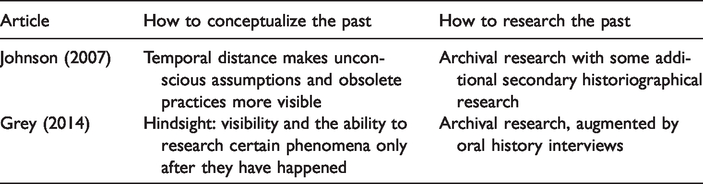
Some forms of historical organization studies may draw on history in a purely empirical sense in that the past provides the data (Kipping and Üsdiken, 2014). For example, Johnson’s (2007: 97) study of the Paris Opera seeks to unpack how imprinting occurs when new organizations are founded, highlighting that cultural entrepreneurs have significant agency in ‘selecting and incorporating historical specific elements that remain for decades or even centuries as fundamental features’. The past is the empirical setting in which to analyse the processes by which historical contexts are incorporated into new organizations. Johnson presents a historical narrative and focuses on the activities of stakeholders to gain a clearer understanding of how powerful individuals (such as Louis XIV, the king of France) can determine which elements of the historical process are imprinted, thus highlighting that this is neither a random nor an egalitarian phenomenon. Johnson sets out reasons for studying the past as affording her temporal distance analytically, which makes outdated or obsolete practices (as distinct examples of imprints) more visible. This allows her to demonstrate that historical contexts are not just imprinted as cases of mimetic isomorphism (Stinchcombe, 1965), but that innovative organizational structures can be imprinted owing to the intervention of influential stakeholders, highlighting that imprinting is not a passive process. Indeed, in footnote no. 3, Johnson outlines her data collection as largely archival, with additional documents from major research libraries, but otherwise provides surprisingly few methodological pointers. Her short description suggests mostly, but not exclusively, the use of social sources: charters of the royal academies, regulations concerning the Parisian theatres, personal correspondence of relevant figures, contemporary periodicals, reports by court officials, and the administrative records of the Opera.
Yet historical organization studies make little contribution to our historical understanding of the period, nor are they particularly concerned with ‘being historical’ (Zundel et al., 2016: 227–229). Johnson’s work exemplifies integrationist historical research in organization studies that is primarily concerned with advancing organization theory by drawing on history as an empirical setting, rather than engaging with historiographical concerns. This is not just a question of whether the application of contemporary theory to a historical period is anachronistic, but rather raises issues such as whether these insights really translate to the present day. Johnson argues that the Paris Opera demonstrates how influential stakeholders can steer the imprinting of new organizations – but it is difficult to see which present-day stakeholders could realistically match the power of an absolutist monarch. Although she acknowledges briefly that stakeholders today are less powerful, she does not consider it a limitation in terms of her theoretical contribution. Moreover, other research suggests that initial imprints may change significantly over time, for example in terms of routines that change their meaning (Mutch, 2016). Johnson acknowledges this as an area for further research but leaves the question of which elements continued from initial imprint to the present day unanswered. Historiographically, reflexive research would consider the influence of different contexts as well as how they shape the initial imprint in greater detail.
In his research on organizational secrecy at Bletchley Park – the UK’s first signal intelligence organization – Grey (2014: 107) is explicit about why historical organization studies are ‘uniquely well suited’ for the topic. Given ‘Studying organizational secrecy presents severe methodological problems … [for] … that which is secret is inaccessible to researchers’, Grey argues that ‘historical analysis is virtually the only way of studying’ this issue validly. In the context of clandestine, secret or illegal activities, historical organization studies are effectively a more robust methodological choice owing to the limitations of alternative research methods. Although the notion of temporal distance underpins this line of reasoning, more accurately it is hindsight which, rather than being a drawback, affords access to otherwise invisible phenomena. Although ontologically inaccessible, collecting data on the past can be a better option when the research site in the present is just as inaccessible. In Grey’s study, data collection, again, was primarily archival, with many social documents forming part of the organizational routine at Bletchley Park being made available. Grey also draws attention to the use of internal histories of Bletchley Park written at the end of World War II, which are narrative sources that remain close in time to the events described, as well as to the benefits of conducting oral history interviews during the study. However, these are clearly supplementary in design.
The selection of archival methods is not a default position for Grey, but a considered choice. Thus, rather than suggesting that archival methods should be employed when there is nobody left alive to interview, or when the research setting is too far in the past, Grey, in his book on the same subject, highlights that historical distance affords a better understanding of the temporality of organizing (Grey, 2012: 16). Such temporal distance combines a degree of closeness based on the careful study of documents and artefacts with the distance derived from elapsed time. These epistemological considerations also inform the article and highlight how a greater engagement with historiography serves to create more reflexive research on the organizational past that is not purely driven by organization theory but instead challenges assumptions about how we study organizations.
In terms of method, there is a clear reliance in this position for archival research. Both exemplars emphasize that archival methods afford researchers the advantage of temporal distance, making them distinct from other documentary research methods. A particular variant of temporal distance, hindsight, can be a fundamental reason to employ historical organization studies where a phenomenon cannot be adequately researched in the present, either because it can only be known after the fact (e.g. secrecy, fraud) or because it would be too dangerous (e.g. clandestine and illegal activities). Grey chose to augment his account with oral history interviews, which was not an option for Johnson, whose empirical setting is too far in the past. The purpose of these interviews is, however, primarily illustrative and only used to provide ‘more vivid and personalized accounts to illustrate themes from the archive’ (Grey, 2014: 108), reinforcing the importance placed not only on archival sources, but also and especially on those social documents closest in time to the events researched, as they are deemed to have the greatest validity and credibility. Where other avenues for data collection are explored, this is not so much in the spirit of evaluating methodological alternatives, but rather to underscore a preference for archival research as the logical, procedural corollary in situations of temporal distance. This holds true even when people are still alive and could be interviewed, as in the case of contemporary history.
Although the standards and advantages of archival methods are an important feature of this mode of enquiry, its focus on ‘dual integrity’ means that research is motivated largely by the concerns of organization theory, which has expanded into the past as a new empirical frontier. Here, this mode follows the inductive research design templates of other qualitative research approaches closely, which means that theories from the present are used to analyse data about past events. In contrast to theory-informed history, which seeks to generate new knowledge of the past, the contribution is to theoretical knowledge in organization studies. There is some evidence of researchers drawing on historiography to develop organization theory (Grey, 2014; Mutch, 2016), but this is not the norm (Kipping and Üsdiken, 2014). Methodological choices are rarely considered explicitly or elaborated in terms of how they relate to the conceptualization of the past. The strongly integrationist tendency in this mode of enquiry thus does not realize the conceptual advantages of retrospective organizational history and historical organizational memory.
Retrospective organizational history
This position is the least well developed of the four and uses retrospective methods in the service of writing history – a practice that is well established in the discipline of history and institutionalized as oral history. Even though crossover between oral history and fields such as business history and organizational research has been limited (Keulen and Kroeze, 2012), several oral history projects have generated publicly available sources with an organizational context. Oral history archives – based largely on interviews with named individuals – can be collected over long periods, by various researchers, and made accessible for use in a range of research projects. However, interviews typically conducted in organizational research – where subjects’ identities remain anonymous – are collected during an investigation for the sole use of the researchers involved. This limits the time frames that can be researched – both in terms of for how long interviews can be collected and the time periods that can be covered in interviews. Oral history, then, differs from standard organization studies methods, because interviews with named individuals are kept for posterity, whereas most qualitative research interviews are rarely used beyond their initial study. Because oral history focuses on how interviews add to our knowledge of the past, their usefulness is not limited to the time period when or the specific research project for which they were collected.
Organizational resistance and power are areas that can arguably benefit from combining research into history with retrospective methods, as this combination offers greater insight into the personal experience of marginalized and under-represented groups. Cruz’s (2014) study of Liberian market women’s experience of trauma and how it affects their organizing practices uses oral history to track changes in organizational practices via the medium of recollections and memories, a process she describes as indirect and elusive (see Table 4 for a summary). Her rationale for doing so is that orality is more important in the society under investigation (Liberia), which has lower levels of literacy than settings normally chosen for organizational research – a factor compounded by the legacy of civil wars which destroyed documentary and material evidence. Hence, even though Cruz explicitly seeks to elicit memories retrospectively, she does so with an oral history focus – that is, to substitute for the absence of traditional historical records rather than seek their interpretation by individuals. Based on insights from psychology and ‘crisis oral history’ (Cave, 2016), Cruz deals with the issue of trauma and how this affects individuals’ memories and their present-day organizational practices. By understanding common responses to trauma – e.g. idealization, amplification and contraction – she unpacks how market women talk about civil war, and how their present-day organizations are affected by this experience, in order to reconstruct a plausible account of how they organized themselves during the war.
Retrospective organizational history exemplars.
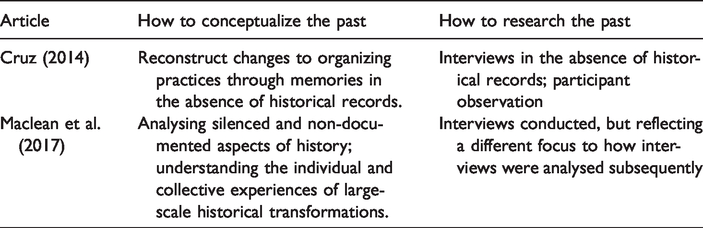
Cruz explains in detail how she used retrospective methods to get ‘closer’ to this account of the past, documenting intimately the impact the past has had in the present. In doing so, she describes her method as ‘walking my way backwards’, which involved first observing present-day organizational practices and then asking whether they existed during the war (Cruz, 2014: 449–452). Although this approach poses challenges – owing to the time that had elapsed between the research interviews and the focal period of research – she asserts it is only the women who were present during the Civil War who can give a realistic account of the trauma and difficulties they faced. Cruz’s work thus highlights the potential for using memories of practices as sources that can be analysed for their historical content with the right methodological sensitivity.
Our next exemplar reveals yet another approach to retrospective organizational history, by aligning itself self-consciously with ‘history from below’, which respects the life stories (Ghorashi, 2008; Harrison, 2014) of those who might otherwise be ignored in the historical record. Maclean et al. (2017) do not interview participants as eyewitnesses for the purpose of historical reconstruction, as Cruz does, but instead – like other advocates of oral history approaches (Haynes, 2010) – focus more on the meaning of events to individuals. They also argue that the often sparse and untrustworthy nature of archival documentation necessitates such an approach. This concern with the insufficiency of traditional historical sources clearly motivates all the exemplars in this mode of enquiry and reinforces the argument for employing recollections as historical sources, which strongly aligns them with oral history traditions.
However, in their study of German reunification, Maclean et al. (2017) are not just motivated by the absence or insufficiency of historical records, but also by how East Germans relate their individual experiences of the major transformations experienced since 1989 to the wider historical context. They make the case for oral history on the one hand to expand the domain of history into areas that have been silenced or were previously considered inaccessible, and on the other hand to draw on it as an alternative source for identity work during periods of significant historical change. Importantly, in this study oral history is treated like an archival resource, as the authors highlight how they returned to interviews previously conducted with a different research question in mind, and on revisiting the material began to appreciate the presence of themes and issues they were initially less concerned with (Maclean et al., 2017: 1218, 1224). Considering oral history interviews as sources rather than data entails consideration of the unintentional nature – and unelicited content – of these interviews. As sources, they are now analysed from a greater temporal distance and in a different context from which they were collected, much like an archival source. The analysis of existing oral histories could be expanded in organization studies; however, organizational scholars display the same scepticism of using secondary interview data such as oral history collections as they hold for archival sources (Rowlinson et al., 2014: 250).
However, in many ways oral history approaches have been consciously designed not only to address many of the shortcomings of traditional archival methods (e.g. the focus on elites, gaps in archival records, lack of information on tacit practices or experiences) but also to facilitate combining them with the advantages of archives; and the latter are widely accessible, clearly identify individuals and organizations instead of anonymizing them, and provide a resource for research that can cover – and be accessible for – longer time periods than most interview studies. The lack of interest in oral history collections suggests that organization studies eschews not just historical archives but any secondary qualitative data (Corti et al., 1995; Fielding, 2004), which ultimately makes the equation of memory and retrospective methods more palatable than history or archival methods.
As our exemplars suggest, retrospective organizational history is particularly relevant when researching marginalized groups, where there is often a ‘silence of the archives’ (Decker, 2013), so that sources may be deemed unreliable, or where the research question focuses on the experiences and the meaning-making of individuals. Additionally, studies following this mode of enquiry share a concern that other ways of collecting data would not be valid to portray the lived experience of the people interviewed. Thus, whether the meaning individuals ascribe to events is the primary focus, or whether these experiences are useful in reconstructing historical practices, retrospective accounts are collected to generate new knowledge of the past. Oral history can be archival, in the sense that not all oral histories need to have been collected by the researchers doing the analysis. In that sense, oral histories can be treated akin to memoirs, and oral history archives relevant to organization studies are increasingly available (Courtney and Thompson, 1996), but arguably underused for theory development. The lack of interest by organization scholars in these resources and approaches is curious considering the general suspicion of archival sources in the field on the grounds that they prioritize the intentions and views of the powerful (Mills and Helms Mills, 2011). Within history, this has prompted the development of oral history as a legitimate means of expanding the field by collecting and preserving the memory of previously excluded groups and regions of the world (Vansina, 1985), but oral history and life history approaches to interviewing are only slowly gaining ground (Dean and Ford, 2017). Although still underdeveloped and fragmented as a mode of enquiry, retrospective organizational history challenges existing notions of how the organizational past can be researched by employing retrospective methods commonly associated with memory, but in conjunction with history.
Retrospective organizational memory
This position focuses on retrospective research into how the past is narrated in the present, which has seen substantial interest in recent years (Linde, 2008; Mai, 2015). Suddaby et al. (2010) developed the concept of rhetorical histories, which has become influential as a way of understanding the history-making of organizations (Foster et al., 2011, 2017; Oertel and Thommes, 2015; Suddaby et al., 2016). The focus here is on the present, which recounts the past instrumentally in ways that suit current needs and strategies, essentially ‘revising the past (while thinking in the future perfect tense)’ (Gioia et al., 2002: 622). The historiographical choices here are presentist, in that the past matters only in as much as it has relevance to the present. Although some researchers refer to their approach as memory (Foroughi, 2019; Nissley and Casey, 2002), others refer to it as (rhetorical) history (Poor et al., 2016), but these scholars do not seek to reconstruct a historical account of the past as a researcher, but instead study how organizational actors use the past.
Our first exemplar (Ybema, 2014) defines history as a field of discursive struggle over the meaning of the past (see Table 5). At a Dutch newspaper, editorial staff reimagined the organization’s past in order to gain support for organizational change: ‘reframing the collective past is dominated by a legendary succession of radical changes in the newspaper’s history’ (Ybema, 2014: 496). He argues that such stories need to be ‘plausible, coherent, interesting, emotionally appealing and instrumental, rather than accurate. Such stories about former days do not so much inform us about the past, but rather inform us about people’s experience of, and preoccupations in, the present’ (Ybema, 2014: 497). History is viewed as a symbolic site of conflict over the direction of organizational change, rather than a tool to legitimize it. In this explicitly ethnographic approach, the past is not studied historically, but rather in terms of the everyday actions of the present that make reference to a past, real or imagined, or else a specific interpretation thereof.
Retrospective organizational memory exemplars.
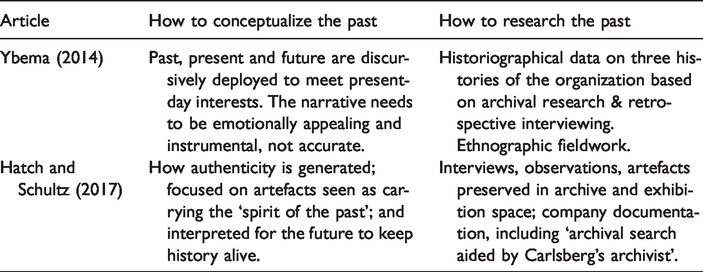
Ybema (2014) follows an approach based on the ‘inventions of tradition’ literature (Hobsbawm and Ranger, 1983), in juxtaposing the historiography of the organization with competing recollections of organizational members in the present. Hence, he draws on multiple types of data collection. Historiographical data took the form of three histories of the organization published several years apart. These histories were based on archival research and in some cases retrospective interviewing, especially in respect of the most recent and widely drawn upon corporate history (1996). This was contrasted with data collected during ethnographic fieldwork in 1998 that included recording conversations and follow-up interviews. These various accounts are juxtaposed to reveal the ways in which discursive struggles about the past can affect the present and potentially influence the future. There is no consideration of archival methods, as history is meant to be represented by published corporate histories, with the use of fieldwork and interviews emphasizing the importance of the present over the past. History here is essentially presented as any narrative about the past, regardless of how this knowledge was collated and analysed.
Our next exemplar focuses on microprocesses of organizational remembering at the Carlsberg Group (Hatch and Schultz, 2017). Here, the authors contribute to the question of how the past is made relevant to present and future activities, notably regarding the role and influence of a company motto carved into stone over a corporate entrance. Hatch and Schultz challenge the notion that forgetting can be permanent in organizational contexts – because artefacts carry the ‘spirit of the past’, which can be distributed through narratives both within and beyond the organization, and thus cast forward into the future. The predominant concern here is with making the past relevant in the present for the future. The successful attempt to return a forgotten or latent memory (the company motto) into active use is heavily mediated by Carlsberg’s corporate archivist who guides this ‘recovery’ of history (Hatch and Schultz, 2017: 673). This recovery focuses on archival research for the time period 1999–2001 and is clearly less germane to the data collection than the interviews and observations.
There is little discussion of any archival research about the motto and how it was created and what it meant to the organization at the time of creation – all of which would be historical research questions in nature. All direct quotations refer either to interviews or marketing materials designed by a copywriter for the ‘Group Stand’ (Carlsberg’s new identity statement). Any supporting data, again all based on interviews, are presented in a table (Hatch and Schultz, 2017: 667–670), making the data collection and analysis clearly social scientific and not historical in content and design. It remains unclear what is meant by the ‘spirit of the past’ and how it would be represented and conveyed by artefacts, rather than being generated by organizational members interpreting such artefacts in the present. The authors therefore use organizational memory and organizational history interchangeably, for example by identifying organizational history with ‘heritage symbols, traditional cultural practices, or memory forms’ (Hatch and Schultz, 2017: 659).
Both exemplars highlight that where organizational remembering is based not just on personal memories but also on collective ones, the past is selectively reconstructed via historical knowledge embodied in material artefacts and historical narratives. Historical knowledge may be mediated by either corporate archivists (Hatch and Schultz, 2017) or published corporate histories (Ybema, 2014), yet selective mediation, and the process of recovering the past in a manner useful to the present, clearly engages with themes germane to memory studies, such as identity, power, authenticity and emotional appeal (Casey and Olivera, 2011). Hatch and Schultz highlight the importance of authenticity for any use of history to be deemed acceptable to its intended audiences. In the context of Carlsberg, authenticity is achieved by referencing the moral authority of the craft tradition. This focus on authenticity represents a different form of validity than the intertextual verification logic that is the hallmark of historical research.
Retrospective organizational memory, then, provides fascinating and insightful accounts of how histories are produced, but it does not produce history itself. Narratives of occurrences in the past are only relevant as the objects of research: when authors in this mode of enquiry refer to history, they think of history as the object, not the product, of their research endeavours.
Historical organizational memory
The final mode of enquiry investigates memory in the past via archival methods. Like retrospective organizational history, this position is better developed in history than in organization studies. Here, for example, the concepts of ‘invented tradition’ (Hobsbawm and Ranger, 1983) and ‘imagined community’ (Anderson, 1983) enabled historians to analyse the rise of nationalism, as well as providing a radical critique of it. Hobsbawm and Ranger’s well-known edited volume brought together examples that demonstrated, across historical periods and countries, how seemingly ancient traditions were invented for the purpose of legitimation, and subsequently became taken for granted. These concepts are influential in public history and collective memory studies, but there are few studies in organizational settings, with the exception of occasional corporate culture and identity studies (Heller and Rowlinson, 2019; Suddaby et al., 2010).
One of the first examples of this kind of approach is the work of Rowlinson and Hassard (1993), whose account of how the British chocolate confectionery company, Cadbury, constructed its history for a centenary in 1931 draws on the concept of invented tradition (Hobsbawm and Ranger, 1983) (see Table 6). In particular, they show that Quaker beliefs changed over the centuries and were not as stable as organizational memory presented them. Rowlinson and Hassard (1993) juxtaposed different histories and historical documents to demonstrate the constructed nature of the (invented) history produced in the 1930s, highlighting how this became centred on memory and the sensemaking of participants. Thus, the culture outlined in the different Cadbury histories responds to the needs of the firm and its audience at the time the histories were written. Their approach is based, therefore, on contrasting archival sources and corporate histories with corporate culture and memory, outlining the history of how a corporate culture was invented and managed through collective memory.
Historical organizational memory exemplars.
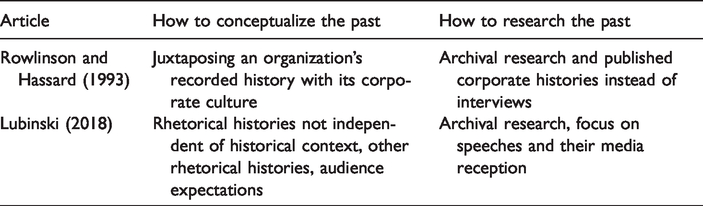
Lubinski (2018) similarly employs a historical approach because she reconstructs memory in the past from archival sources. Her article showed how German companies’ narratives of shared Aryan heritage ceased to be accepted by their Indian audiences once Hitler’s overtly racist speech contradicted their underlying intent. Thus, an analysis of research in this mode ultimately highlights that rhetorical ‘histories’ are socially shaped and validated collective memories that reflect multiple authors and interests, rather than discreet and (overwhelmingly) single-authored accounts by historical researchers. Consequently, she challenges the assumptions of the somewhat autonomous nature of rhetorical histories through her archival analysis that systematically embeds the production of rhetorical histories in a dialogue with their historical context. She highlights the importance of audience acceptance, and particularly demonstrates that rhetorical histories are competing with other rhetorical histories for legitimacy, and that their creators must skilfully manage any discrepancy with other narratives. Here, archival research is employed to reconstruct wider social practices that validate uses of the past: it thus shifts the focus away from the skilful production of rhetorical histories in organizations towards their co-construction with society.
In the process, Lubinski defines a narrative not as something that is ‘told’ to audiences, but as something that is ‘lived’ and ‘experienced’ through social practices. For such a narrative to be accepted into collective memory, at least for a time, it needs to be plausible and acceptable to its intended audience. This highlights the importance of context in understanding how rhetorical histories are created and why they are perceived as convincing.
Both exemplars therefore employ archival sources and historical contextualization to challenge the ‘hypermuscular’ (Lubinski, 2018) depiction of the creators of rhetorical histories by demonstrating that these accounts are better understood as collectively shaped accounts of the past. Once these narratives are accepted as a part of collective memory, organizations struggle to change them when they become less useful for their strategic direction (Rowlinson and Hassard, 1993). Similarly, where other narratives compete with or contradict already accepted rhetorical histories, they can undermine their perceived authenticity.
Historical organizational memory therefore employs archival data collection to reconstruct how organizational memory was shaped in the past, in contrast to retrospective organizational memory, which focuses on organizational memory in the present. By employing historical methods to research memory in the past rather than the present, studies in this position frequently highlight the often purposive and political nature of remembering through deconstructing how memories become institutionalized. The focus of this mode of enquiry, then, is on juxtaposing collective memory in the past with the historical record. Consequently, this mode shows a preference for narrative sources to understand memory in the past, but with the resulting accounts still being based closely on historical sources.
Discussion
The reorientationist agenda of opening up the way for ‘diverse forms of theoretically informed historical writing in organisation studies’ (Clark and Rowlinson, 2004: 347) is best realized by encouraging plurality through historiographically reflexive approaches to researching the past. By historiographical reflexivity we mean an engagement with concepts, categories and questions emanating from historiography. In this analysis, we have focused on two key historiographical questions related to theories and methods of studying the past – how to study the past and how to conceptualize the past – questions that have dominated debates in the late 20th and early 21st century, and which have become crystallized in the notions of history and memory. It is through assessing these questions with reference to these concepts that we arrive at our four modes of enquiry – modes that, therefore, provide a more differentiated and historiographically grounded approach for organization studies in this regard because we separate out theoretical from methodological concerns.
Thus, rather than debate whether history or memory is the dominant or superior way to approach the past, with one being a sub-category of the other (Ricoeur, 2004), our approach goes beyond this binary debate of history versus memory (e.g. Eley, 1997; Hutton, 1993; Kansteiner, 2002; LaCapra, 1998), which is frequently (though mistakenly) reduced to so-called objective versus subjective analysis. However, arguably neither is objective (Burke, 1989), for instead each conceives differently not just the way in which we can know about the past, but also why we might want to know about it. Our four modes demonstrate that history can be produced by drawing on memories through recollections and testimony, and organizations’ use of memory in the past can be researched historically. These more self-consciously angular modes carefully select both their conceptualization of the past and the methods for studying it without necessarily requiring both to be aligned, whereas the dominant integrationist approaches of historical organization studies and retrospective organizational memory insist, in the case of the former, that history has to be researched with archival methods, and memory with retrospective methods for the latter. Integrationist approaches have frequently portrayed any reference to the past as historical, without engaging the methodological or theoretical repertoire that defines history as a research practice. But we are not seeking to promote a purity of approach; rather, we highlight the opportunities for cross-fertilization that are generated as a result of being clear about the unique benefits of a more pluralist and reorientationist approach.
Historiography provides important conceptual, theoretical and methodological insights that are new to organization studies, but that require reflexive engagement to fully realize their potential. In the preceding sections, we discussed notions of history and memory as ways of theorizing the past from different perspectives and elaborated the implications of this through our four modes of enquiry. History is a research practice that ultimately presents an account of the past that is authored by one or more identifiable historical researchers whose interpretations are verified through direct references to the underlying sources. Collective memory is organizationally and socially negotiated, which means it is framed and re-framed by multiple unnamed ‘authors’ and evaluated in terms of how authentic it appears within a given socio-historical context.
Importantly, we highlighted not just the tendency in organization studies to conflate the two, but also to equate them with methodological choices. Here, we contribute a historiographically grounded approach to archival and retrospective methods as distinct choices that are unrelated to the conceptualization of the past. Interestingly, our more angular modes (retrospective organizational history and historical organizational memory) correspond to established fields of research in historiography. The lack of familiarity with historiography has limited organizational research on the past in ways that are difficult to see if these distinct conceptual and methodological choices are conflated.
By disentangling the conceptual and methodological implications of these questions, we offer alternative avenues for reorientationist scholarship – namely in the modes of retrospective organizational history and historical organizational memory. Of the two, retrospective organizational history is certainly the less developed, with few examples of methodological or empirical work beyond the exemplars. Where life histories are collected, they are infrequently analysed with reference to reconstructing historical events. This is somewhat surprising because data collection is based primarily on interviews, which should be more familiar to organization scholars than archives. However, oral histories are considered secondary qualitative data as they are usually deposited in existing archives – and secondary qualitative data are still rarely used in the field and are considered with considerable suspicion, much like archives (Corti et al., 1995; Strati, 2000).
The research opportunities that arise here are closely related to the strengths of retrospective organizational history, notably in terms of engaging with marginalized and rarely studied groups – as noted previously, for instance, in terms of gender and professions, post-conflict locations and alternative forms of organizing. Given the ongoing interest in these topics – especially in respect of emerging economies (George et al., 2016; Mair et al., 2012) – future research can contribute to these debates by critically investigating the ethnocentric and gender-biased nature of much organizational theorizing. This responds to the call by Smith and Russell (2016) for ‘polyphonic constitutive historicism’, which advocates capturing diverse voices in organizations, rather than the voices of a few elite individuals, here inviting us to extend our analytical focus beyond the kinds of elite organizations we usually consider in research investigations. Identity – an issue of major recent interest in organization studies – represents a key area for research, yet research on history and organizational identity is only slowly emerging (Ravasi et al., 2018).
Retrospective organizational history seeks to use interviews and recollections as alternative historical sources. Such sources may be archived to augment or challenge existing archival collections, although currently practices vary. These are collections, however, which may, for a variety of reasons, inadequately present the past of under-represented or marginalized groups. History has often been criticized for being written by the winners and archives for preserving an official version of the past, stripped of personal, emotional and uncomfortable experiences (Burton, 2005). This mode seeks to provide a more interpretive and constructionist view of the past through methods such as life history interviewing, which offers insights into more informal practices of organizing. These are no less significant for being informal and indeed are key to understanding many of the global challenges that societies face today.
Although retrospective organizational history seeks to connect history and memory, its focus on silenced, lost or undocumented forms of history means it is not so much memory that matters, but rather its methodological corollary, retrospective methods. This, of course, can only be the case if there is a meaningful choice of how to conceptualize and how to research the past – a debate which took place in historiography several decades ago in terms of the methodological practices of oral history. Here, insights from retrospection are largely subservient to the aim of broadening the domain of history rather than studying a mnemonic ritual practice. Hence, this mode offers new ways in which to develop further critical and reflexive historical research (Barros et al., 2018; Durepos et al., 2019; Stutz and Sachs, 2018), with obvious relevance to organizational ethnography and critical management studies. Unfortunately, there is little connection to insights from retrospective organizational memory in terms of identity and change, as this integrationist mode does not consider oral history archives as viable sources.
In contrast, the mode of historical organizational memory has witnessed a steady increase in contributions (Cailluet et al., 2018; Lubinski, 2018; Smith and Simeone, 2017). By employing historical contextualization, research into how rhetorical histories were used in the past allows authors to draw on the advantages of archival research in ways that provide a better appreciation of wider social and temporal trends – thus making an impact on how effectively versions of the past can be used. Since the 1980s, Nora (1989) and others (Hartog, 2003; Koselleck, 1985) have highlighted the experience of time and expectations of change in the ‘longue durée’, albeit this representing trends of which individuals are rarely cognizant (Mutch, 2016: 1184). The appeal of nostalgia, for example, waxes and wanes over time (Davis, 1979; Do et al., 2019; Fischer, 1980; Strangleman, 1999; Walsh and Glynn, 2008), as does that of a founding figure whose proclamations need regular reinterpretation to remain relevant (Basque and Langley, 2018).
Historical organizational memory is in some ways better positioned to extend concepts from retrospective organizational memory, as the former contrasts memory with history. Notably, contributions here have brought the notion of historical contextualization into organizational theorizing by highlighting the way in which context is constitutive of the process of using the past in organizations (Lubinski, 2018). This mode offers some clear avenues for promoting ‘history in theory’ approaches (Kipping and Üsdiken, 2014), which have remained otherwise fairly underdeveloped. The historiographically reflexive way in which work in this mode positions itself makes maximum use of both conceptions of the past, by juxtaposing history and memory not just empirically but also theoretically. A small but increasing number of contributors are exploring the relevance of this mode for organizational research, for example in terms of learning how organizations make use of their historical resources (Smith and Simeone, 2017) or how they position themselves strategically in the context of economic nationalism (Lubinski and Wadhwani, 2020). All of these contributions highlight the importance of context in making certain organizational uses of the past more successful than others at particular points in time, thus challenging the hypermuscular view of skilful managers strategically changing the narrative of their organization’s past (Leca et al., 2009; Lubinski, 2018; Zundel et al., 2016). This promises more context-sensitive organizational theory that combines important insights from memory studies and history.
The two modes of enquiry we propose therefore differ from existing practice in historical organization studies and retrospective organizational memory, both of which do not always sufficiently question whether history can only be researched with archival methods and memory with retrospective methods. Referring to memory and retrospective methods as history represents a sleight of hand that does nothing to address this disciplinary blind spot. Historiographical reflexivity has the potential to transform organizational research on the past by promoting key reorientationist ideas, and in particular being attentive to concepts and methods from historiography. Taken together, our four modes highlight the possibility of taking a reflexive approach to the key historiographical distinction between history and memory by clearly distinguishing how the past is conceptualized in theoretical terms vs how the past is researched in terms of method. Although this offers a more reflexive engagement with historiography in comparison to the two more established and predominantly integrationist modes of historical organization studies and retrospective organizational memory, it highlights the important role of the, as yet underdeveloped, modes of retrospective organizational history and historical organizational memory in promoting more pluralist research on the past in organization studies.
Conclusion
Researching the past in organization studies requires a different kind of theoretical awareness to that which the discipline of organization studies traditionally provides. We call this historiographical reflexivity, which considers historiography as a key resource for concepts, theories and methods. By clearly distinguishing history and memory as alternate yet equally legitimate ways of conceptualizing the past, research in organizational history becomes more pluralist through its engagement with both history and collective memory studies. Importantly, the question of how to conceptualize the past, in terms of history or memory, does not determine how to research the past through archival or retrospective methods. In practice, organizational research has thus far mostly failed to consider these questions as central to studying the past, and instead appears largely to have conflated them.
We contribute to organizational theorizing by introducing four modes of enquiry that consider these two questions separately. Historical organizational studies and retrospective organizational memory study history with archival methods and memory with retrospective methods, respectively. These modes are predominantly integrationist and could benefit from more historiographically reflexive theorizing – by either considering historiography as a source for organizational theorizing, or by engaging more meaningfully with the past-focused nature of historiographical concepts and debates. Retrospective organizational history seeks to expand the historical record by drawing on people’s recollections of the past, whereas historical organizational memory focuses on how collective memory is institutionalized in the past through archival methods. Both modes are fundamentally reorientationist and, although currently underdeveloped, offer new avenues for historiographically reflexive theorizing.
Footnotes
Acknowledgements
The authors would like to thank the editor, Professor Sheep, and the three anonymous reviewers, for their constructive comments and guidance.
Funding
The authors received no financial support for the research, authorship and/or publication of this article.
