




Abstract
Drawing on 49 oral-history interviews with Scottish family business owner-managers, six key-informant interviews, and secondary sources, this interdisciplinary study analyses the decline of kinship-based connections and the emergence of new kinds of elite networks around the 1980s. As the socioeconomic context changed rapidly during this time, cooperation built primarily around literal family ties could not survive unaltered. Instead of finding unity through bio-legal family connections, elite networks now came to redefine their ‘family businesses’ in terms of affectively loaded ‘family values’ such as loyalty, care, commitment, and even ‘love’. Consciously nurturing ‘as-if-family’ emotional and ethical connections arose as a psychologically effective way to bring together network members who did not necessarily share pre-existing connections of bio-legal kinship. The social-psychological processes involved in this extension of the ‘family’ can be understood using theories of the moral sentiments first developed in the Scottish Enlightenment. These theories suggest that, when the context is amenable, family-like emotional bonds can be extended via sympathy to those to whom one is not literally related. As a result of this ‘progress of sentiments’, one now earns his/her place in a Scottish family business, not by inheriting or marrying into it, but by performing family-like behaviours motivated by shared ethics and affects.
Keywords
Introduction
Research on family businesses is often insensitive to the subtleties of context. Not only has previous research largely understood the family reductively, but it has also focused entirely on the effects of the ‘family’ cause (often ‘along a family-attributes scale’) (Basco, 2015: 261), neglecting to analyse family as a phenomenon which is itself shaped in meaningful ways by socio-historical forces. Efforts have concentrated on examining heterogeneity in the family’s involvement in ownership and management as a cause of variable business outcomes, originally comparing outcomes from family versus non-family businesses and more recently examining differences among families (Chua et al., 2012; Daspit et al., 2018). The dominant micro-oriented research paradigm makes it difficult to go beyond unidirectional causal analysis and consider family as a ‘finite resource’ (Tabor et al., 2018: 54) that can be exhausted. Existing research rarely ‘describes bidirectional effects between families and their firms’ (Jaskiewicz and Dyer, 2017: 116; Nordstrom and Jennings, 2018), and many quantitative studies in the family business literature either ignore context or treat it as a variable that creates scope conditions for their findings (Evert et al., 2016). By contrast, only a small but important stream of work at the intersection between organization studies and family business research analyses both firms and families as holistically dependent on the spatio-temporal context in which they develop (Carney and Gedajlovic, 2002, 2003; Sasaki et al., 2019, 2020).
That said, there is little disagreement that business families in regional economies have built strong networks around kinship relations (Le Breton-Miller and Miller, 2018). The forces underpinning elite networks of corporate power have long been the focus of considerable study. Family as a bio-legal structure influencing socioeconomic action is a prime example of such a force of elite reproduction (Scott, 1991). Kinship is widely recognized to stand alongside elite education, interlocking directorates and ‘old boys’ social clubs as a key means of achieving elite cohesion (for the case of Britain, see Harvey and Maclean, 2008; Maclean, 1999; Maclean et al., 2010, 2012; Scott, 1982, 1991). Research that compares wealthy minority-ethnic with white family businesses in Britain has established that both depend on the significance of a shared business culture embedded in familial and class networks (Mulholland, 1997). The effectiveness of these forms of capital for transferring privilege from one generation to the next is undeniable (Kuusela, 2018; Marcus, 1991; Robinson, 1984).
Like the family business literature, however, the broader literature on elite cohesion and reproduction is also insufficiently sensitive to context. Such research tends to depict elites as forever interested in preserving their privileged social position rather than navigating their ever-changing contexts in a variety of ways (Khan, 2012). In elite business studies, the aim even for ‘those ascending the hierarchy from humble backgrounds is not to change the rules of the game, but to seek legitimation’ and join the relevant social structures (Maclean et al., 2012: 401), often literally marrying into existing elite families. Under this view, the structural properties of the corporate elite network (with a focus on its members’ ‘position’ and their common education, wealth and background bases) create an ‘inner circle’ as the means of consolidating (as opposed to shaping or creating) its members’ resemblances to each other and holding power (Chu and Davis, 2016).
As a result, the existing elite business network literature focuses on the assumed effects of recruitment and connections (Davis and Williams, 2017), leaving change to network content as a response to changing contexts unexplored (Abbott, 1997). When change is acknowledged, it is usually discussed in terms of how structural instabilities are countered by innovative means of achieving elite cohesion and reproduction such as new media, flexible (semi-formal) interactive spaces, and professional business education (Davis, 2017a). The concern with which and how elite members connect with each other has thus sidelined what these connections contain, leading us to overlook the fact that elites themselves change over time (Bika, 2011, 2012), while at the same time ‘factoring in the combinations of conditions’ in which they operate (Welch et al., 2011: 749).
We argue that ‘disentangling family heterogeneity to advance family business research’ is not going far enough (Jaskiewicz and Dyer, 2017: 111). We still know too little about how changes in social context influence what elite family business members ‘have’ in terms of fixed blood relations or ‘do’ in terms of negotiated family practices (Morgan 1975, 1996). In order to fill this lacuna, we need to problematize ‘family’ itself and the relationship between family business and context (Bika et al., 2019). Different kinds of families are not mere expressions of universal and timeless forms of bio-legal kinship. Like all social phenomena, the family metamorphizes across time and space. We need to learn more about the context of different families, but also about the family itself ‘in context’ as a middle-range concept that is historically specific, ‘bounded in time and space’ (Jackson et al., 2019: 34). Even in the small body of valuable work (Carney and Gedajlovic, 2002, 2003; Mehrotra et al., 2013; Sasaki et al., 2019, 2020) that looks at family businesses making sense of, adapting to and engaging with the changing context in which they are embedded, the family itself is thought to have an unchanging, ahistorical essence. Unlike previous family business ‘by context’ studies that illustrate how such businesses re-enact their different contexts, we look at the changing context in order to explain how the very criteria that make a business a ‘family business’ and what ‘class of organizations [the family business] belongs to’ (Sasaki et al., 2019: 818) come to be redefined over time.
This study questions the continued importance of kinship-based networks of family-controlled firms (Kuusela, 2018; Le Breton-Miller and Miller, 2018; Lester and Cannella, 2006) by unravelling what actually makes business-owning class elites ‘group’ together (Khan, 2015) and thus moves beyond the ‘often deployed conceptions of an ascribed grouping’ that ‘does not presuppose shared collective cultures’ (Savage, 2015: 235). Using Scotland as a geographically defined case study, we ask: How have the conceptions of ‘family’ that define ‘family business’ changed over the past half-century? What are the evolving contexts that spur these changes and the socio-psychological mechanisms by which they have occurred?
Drawing on extensive oral-history interviews with leaders of Scottish family businesses, the present study examines the post-industrial emergence of local entrepreneur-to-entrepreneur networks. We argue that a shift from ‘relational’ proximity (defined as a structure of connections and operationalized in terms of a history of interactions) to ‘processual’ proximity (defined as decision-making commonality and operationalized in terms of shared values) is currently under way in Scottish inter-firm networks (Boschma, 2005). Pre-existing social ties nurtured in local, trusted environments segregated by class distinctions have now been extended to include ‘storied networks’ that evangelize a ‘familial’ purpose (Vincent Ponroy et al., 2019) as a new source of Scottish business network cohesion (Knox et al., 2006: 130; Maclean et al., 2010).
The article’s contribution lies in explaining the importance of class destination in creating post-industrial inter-corporate unity as opposed to the influence exerted by familial or class origin in facilitating elite cohesion and reproduction. To put it simply, shared ‘blood’ has been replaced by shared values and shared feelings. Whereas the former is determined at birth or through law (e.g. marriage or adoption), the latter can be acquired as part of a process of social mobility that now generates occupational membership that is unevenly spread between different classes (Savage et al., 2013). This is related to the concept of the 21st-century ‘collaborative’ community, that is, a community based on value rationality or ‘a shared commitment to a set of ultimate goals’ as opposed to instrumental rationality or a resurrection of past achievements (Adler et al., 2008: 366). So far, this idea of collaborative community has only been used in the organizational explanation of geography-independent professions, but it might also be relevant to geographically localized business networks, with the Scottish networks under examination as an excellent example of the phenomenon. After the 1980s, instead of exerting authority legitimized by a unified ruling class (Maclean et al., 2010; Scott, 1982), a new, more diverse Scottish business elite came to re-frame itself as ‘family’ to build emotional bonds among suppliers, employees and customers. This is an ‘as-if-family’ identity that owner-managers share regardless of their social-class origins.
The rest of this article is structured as follows. The next section reviews the empirical literature on the family’s role in elite endurance. The section after that describes theoretical foundations of our understanding of the transition from bio-legal to affective ties in terms of what was known during the Scottish Enlightenment as a ‘progress of sentiments’. A description of the study’s methodology is then offered. This is followed by a presentation of findings about how Scottish business class networks fundamentally changed in and around the 1980s, and a concluding discussion of the broader implications of these findings.
Literature review
Empirical research on the family’s role in elite endurance
All too often in the existing literature, the role played by kinship in social class is taken for granted, considered to go hand-in-hand with the business elite’s ability to interlock (Raynard et al., 2019), self-regulate (Moran, 2008) and maintain dominant ideas (Davis, 2017a). Inter-firm networks are mostly distinguished in terms of qualitative-vs-quantitative, sparse-vs-dense and strong-vs-weak ties. Connections to other social categories such as class, community and gender are rarely made (Bott, 1957; Kuusela, 2018; Palmer and Barber, 2001; Zeitlin, 1974), as such categories are ‘not representable on paper in a form that mirrors so closely their manifestation in practice’ (Knox et al., 2006: 135). As a result, previous research tends to leave unexplained what happens to elite networks when ‘self-made’ business people begin to appear and diversity increases (Carney and Nason, 2018; Khan, 2012) or when well-connected actors are no longer preferred as corporate board members in a new socioeconomic context (Chu and Davis, 2016).
The changing nature of elite networks for the last half of the century requires further contextualization. Although extant research considers historical changes in the post-war density, size and frequency of contact of local family-based business networks, this only documents their national dis-embeddedness and decreasing influence (Franks et al., 2005; Maclean, 1999; Moran, 2008; Savage, 2015). Some of this research is preoccupied with confirming the individual weak ties binding together the post-war British business elite (Harvey and Maclean, 2008; Maclean et al., 2010). Other studies focus on the reflexivity of newcomers (Maclean et al., 2012) or how, where and with whom they communicate (Davis, 2017a). This leads to a lack of information about ‘what really goes on in networks’ (Jack, 2005, 2010: 120), as well as about the social forces operating around them. These forces include not only powerful ‘bridging actors’ with extensive inter-organizational ties but also locally shared frames of reference and the local regulative environment (Marquis et al., 2007), which are often wrongly assumed to be historically equitable and neutral (Greenwood et al., 2010).
Furthermore, as Simsek et al. (2003) argue, the embeddedness effects of inter-firm networks on economic action (e.g. diffusion of information and practices) misses the point that influence is a two-way street, going not only from the inter-firm network to firms and individuals but also from firms and individuals to the network. What is needed is a view of interconnectedness based on contextualized experiences and self-understandings of relevant actors, not merely based on network structure (and the functional utility of interlocks).
As current accounts of elite networks are both over-simplified and unduly static, we need to move beyond existing theories of elite reproduction and their overwhelming emphasis on relational ties. Lacking an in-depth view of the differentiated, ever-changing social world within which the business-owning class is embedded (Bika et al., 2019; Khan, 2015), there is a tendency to uncritically accept elite cohesiveness, presupposing its conscious desire to dominate workers and circulate a pro-market, neoliberal ideology. Careful empirical analysis is the only cure for such oversimplification; as Cousin et al. (2018: 227) argue, ‘elite(s) groupness should be cautiously assessed and described, and not assumed’. Approaching inter-firm networks as ‘histories of cohesion’ and ‘sites and tools of agency’ in particular times and places (Abbott, 1997) rather than as a ‘summation of brokerage and closure’ (Vedres and Stark, 2010: 1151–1152) offers a promising avenue for a much-needed re-contextualization of the ties that bind business elites today.
Changing ideology is a central component of the relevant context. The idea that changes in the make-up of socioeconomic elites leads to ideological development is not new. Social-class groupings ‘condition the set of ideational resources which can be drawn on’ even within an organization (Watson, 1982: 265). In the 19th-century era of the family firm, the ‘“gentleman capitalist” appointed due to accident of birth rather than business acumen’ succeeded through a system of kinship appointments and technical apprenticeships (Ingram and Lifschitz, 2006: 335). The separation of ownership from control then led to a post-war stratum of ‘disinterested’ professional business leaders and a new social responsibility ideology in management-controlled industrial Britain (Nichols, 1969). More recently, the so-called ‘professional econocracy’ and a ‘rule by numbers’ ideology has emerged as the means of maintaining elite cohesion in fragmented times, reflecting contemporary UK business leaders’ economic and related professional qualifications and experience (Davis, 2017b). In the era of the professionally managed corporation, however, we too often accept that the owning classes have become silent observers of the workings of the ‘liquid managerial elite’ (Davis, 2017a) without asking how they might be reworking and legitimizing anew their favourable socioeconomic status.
Scottish Enlightenment theories on moving from circles of kinship to circles of sympathy
The puzzle of which socio-psychological mechanisms enable individuals to move from a set of bonds built around kinship to a network of loyalties with non-kin has been of interest since ancient times. The Stoics emphasized the need to extend one’s circle of concern to ever-increasing numbers of others, from the self to the family, then on to the local community, and ideally on to humanity as a whole (Singer, 1981/2011). In the western rationalist tradition, this was typically framed as a struggle between emotion and reason, as a philosophical commitment to the equal importance of all fought to overcome our affective ties to those closest to us. A key innovation of the Scottish Enlightenment – the flowering of philosophy and social theory in Scotland during the 18th century – was to see this process not as a battle between reason and feeling but as a simultaneously cognitive and affective extension of our ‘moral sentiments’ (Frazer, 2010; Hume, 1739–40/2000, 1751/1998; Hutcheson, 1728/1742/2002, 1755/2005; Smith, 1759/1790/1984). For many in this era, the key psychological faculty at work was what was then known as ‘sympathy’ but is closer to what is now known as ‘empathy’. The Stoic idea of expanding circles of moral community now became expanding ‘circles of sympathy’ (Forman-Barzilai, 2010).
The theorists of the Scottish Enlightenment never intended their theories of the moral sentiments to apply only to their time and place. They would be unsurprised to learn that, centuries later, social psychologists across the world have largely confirmed their hypotheses about the creation of affective bonds via sympathy or empathy.
First, the Scottish Enlightenment theory of sympathy puts forward that the greater degree of similarity between two individuals, the easier and stronger is the sympathetic transmission of sentiments between them. Pre-existing ‘relations of blood’, among other ‘relations of resemblance and contiguity’, allow sympathy/empathy to create affective bonds between individuals with considerably greater ease than it could if these ties were not already present (Hume, 1739–40/2000: 207). Repeated studies in a wide variety of cultural contexts have confirmed that sympathy or empathy is indeed easiest – and hence most likely to be found – when there is either real or perceived similarity between two individuals (Davis, 1996: 116–118; Hoffman, 2000: 206–209).
Social psychologists have also found that situations in which subjects have conflicting interests with the potential objects of their sympathy/empathy are associated with a reduced level of shared emotion. In situations of competition, subjects’ feelings are instead largely determined by the counter-empathetic effects attributed to the ‘principle of comparison’ (Davis, 1996: 112; Postema, 2005). Close contact in situations of cooperation and mutual interest, by contrast, are likely to lead to the formation of strong affective attachments. When they do, there is considerable experimental evidence that empathy can lead to both altruistic motivation and helping behavior (Batson, 1991).
These psychological operations will have profound social effects. Unless our circles of sympathy are extended through a successful ‘progress of sentiments’ (Baier, 1991), psychological forces tend to strengthen pre-existing social divisions, drawing those who are already similar or connected to one another tighter still (Hume, 1739–40/2000: 229). This idea is familiar to sociologists as the principle of homophily, leading like to gravitate towards like (Lazarsfeld and Merton, 1954). Unless something extends the circle, we will have the strongest sympathetic bonds to those tied to us by kinship or other forms of resemblance, such as pre-exisiting class identity. Competition between classes can strengthen these barriers, resulting in oppression and conflict; competition between kinship groups breeds mutual enmity, resulting in amoral familism (Banfield, 1958).
Unlike their Stoic predecessors, the theorists of the Scottish Enlightenment thought that our circles of psychological attachment are not likely to be extended as a result of rational reflection, but may be extended by exogenous changes in one’s social context. Hume (1739–40/2000: 371) notes that ‘our situation, with regard to both persons and things, is in continual fluctuation, and a man that lies at a distance from us may in a little time become a familiar acquaintance’. In a period of rapid social change, those who once saw each other as distant, dissimiliar, and in competition may suddenly find themselves in a situation of close cooperation. When such distant others are brought near, ‘our hearts are immediately caught, our sympathy enlivened, and our cool approbation converted into the warmest sentiments of friendship and regard’ (Hume, 1751/1998: 117).
When changing social contexts bring previously unconnected people into close proximity on a regular basis, encourage them to engage in cooperation rather than competition, and reduce the perceived differences among them, we can theorize that the strength of sympathy among them may approximate that previously familiar only among kin. The new unit of social cohesion produced by these socio-psychological developments is what we are calling here the ‘as-if-family’. This change will probably not go unnoticed by those involved. The family-like nature of their new affective ties will likely enter into individuals’ own accounts of their relationships with non-kin, as new affective connections are understood via analogy with older connections (Frazer, 2010: 154–157).
Given its confirmation in later research, this theory of moral sentiments first developed in the Scottish Enlightenment could potentially be used to help explain a wide variety of social phenomena. By using this theory to explain changes in Scottish family business networks in our own lifetimes, we are not claiming that the Scottish Enlightenment influenced today’s Scottish business culture in any direct way. There is nothing distinctively Scottish about a progress of sentiments that leads our subjects from circles of kinship and the bio-legal family to circles of sympathy and the as-if-family. The best available theory to explain the mechanisms underlying the changes we found in Scotland just happen to be Scottish in origin. If future research reveals that similar changes have occurred in other contexts, then this theory should have the same explanatory power elsewhere.
Methodology
In qualitative family business research, individual accounts are all too often treated as firm-level representations devoid of context, utilized primarily to verify organizational outcomes (Fletcher et al., 2016). By contrast, the present study draws on a set of 55 oral-history interviews collected in and around Edinburgh on the contextualized actions and self-understandings of Scottish family business leaders, exploring how these have changed over time. Family businesses as defined by the Scottish Business Insider Dataset are those where family members own the majority share. Building on this definition, our research design aimed to examine ‘the micro-foundations of family business structures and behaviours’ and to demonstrate ‘how various organizational processes are interconnected’ and ‘decisions are made’ in changing contexts and at multiple levels (Fletcher et al., 2016: 23). This captures our meso-level view of the family business organization that looks at how ‘each micro situation is nested within wider macro levels’ (Jackson et al., 2019: 25).
A three-stage methodology was adopted. First, six key-informant background interviews were carried out with executive officers of family business associations. At the same time, attendance at Scottish family business events (conferences, seminars and networking events) helped the field-researcher (first author) to understand the wider societal context in which these informants operate. Second, using the Insider Dataset, a random sample of thirty oral-history interviews were conducted with top-ranked family business owners (out of 105 initially approached) in the wider Edinburgh area, including the Lothians, Fife, Forth Valley and Scottish Borders (Table 1). Third, individuals or firms that are related with each other were identified by analysing the oral-history interview transcripts of the previous step, and snowballing was used for targeting 19 follow-up interviews, for a total of 49 interviews (Table 1). The average numbers of shareholders and family involved in managing the 48 interviewed family businesses were 7.33 (SD: 7.30) and 2.60 (SD: 1.23), respectively. Archival and other financial data, along with published company history books (for 10 cases) and media documentation, helped to triangulate the study’s findings and engage with event tracking, as did ‘back-in-time’ and non-directive questioning during interviews that lasted on average 1.33 hours (SD: 0.46). This multi-source evidence basis underpinned our effort to analytically ‘reconcile explanation and understanding’ (Welch et al., 2011: 748).
Profiles of the participants.

Industrial sector: A: agriculture; C: construction; H&R: hotels/restaurants; M: manufacturing; OS: other services; T: transport.
Cases in grey did not develop as-if-family affects. 49 oral-history interviews in total – one firm counts for two interviewees in case 33.
Case 41 is the brother of Case 13. He runs his own family SME and holds shares in the old family firm run by his brother.
HG: high growth.
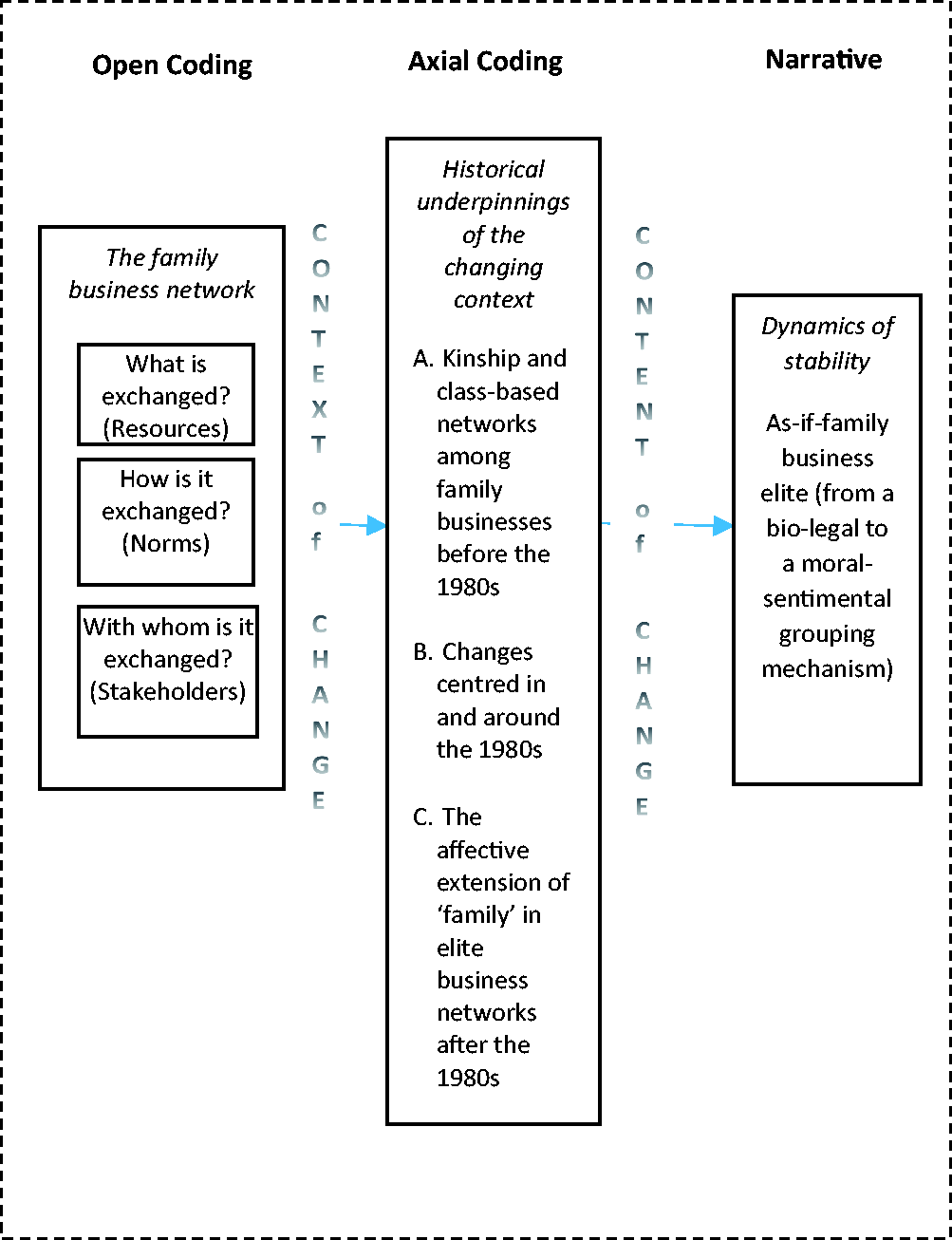
Qualitative oral history interviews permitted us to read family business owners’ memories not as an undisputed set of facts but as reflective ‘story-telling’ (Maclean et al., 2012). In-depth interviews made it possible to hear Scottish family business owner-managers’ understanding of changes over time in their mutual help patterns by exploring three questions: (i) What is exchanged? (ii) How is it exchanged? and (iii) With whom is it exchanged? These questions examined the areas of (i) resources, (ii) norms and (iii) stakeholders, the categories used to open code the data collected (Figure 1). An accumulation of individual self-understandings built up a moving picture of change in networks over time, with a focus on the ways in which different actors drew meaning and resources from their relationships with others in an evolving social context (see Table 2 for detailed information on the context of change and Table 3 for the content of change). The inductive analysis began with each owner-manager’s oral history account vis-a-vis other time-stamped archival material that gave sense to and identified, bottom-up, their family business networks. Our analysis focused on capturing network variability and ‘what produces a certain change’ (Welch et al., 2011: 748).
Data structure.
Historical dynamics driving change in individual family businesses – Context of Change.

BSE: bovine spongiform encephalopathy (commonly known as mad cow disease); CEO: chief executive officer; DIY: do it yourself; FB: family business.
Historical dynamics driving change in individual family businesses – Content of Change.

BSE: bovine spongiform encephalopathy (commonly known as mad cow disease); CEO: chief executive officer; FB: family business.
Our axial coding between historical periods, with the key changes centred in and around the 1980s, reflected the return of the Conservatives into power and a new emphasis on individualism, entrepreneurship and deregulation in Great Britain. It was at this time of rapid socioeconomic change that elite family businesses had to change what they ‘do to stay in the same place’, and our research came to focus on providing a contextualized explanation of the evolving mechanisms underpinning their ‘dynamics of stability’ (Gehman et al., 2018: 294). This is a method of theorizing that uses context as an analytical feature, integrated into rather than itself being a means of explanation (Welch et al., 2011), but also embraces subjective self-understanding and interpretive complexity (Gehman et al., 2018). Our oral histories (using pseudonyms for participants) made us see the family business elite world differently, and provided evidence against its widely accepted relational basis through this ‘before-and-after’ temporal coding. The start point of change was not always the same for individual family firms whose networks often did not overlap (Table 1), but this was consistent with an approach that never aimed to control variance (Gehman et al., 2018). All but 14 of the 48 businesses included in our sample made some degree of transition to a new kind of ‘family’ firm. For most – a total of 22 firms – this transition began in the 1980s. For some, its onset began about a decade earlier (five) or later (seven) (Table 2).
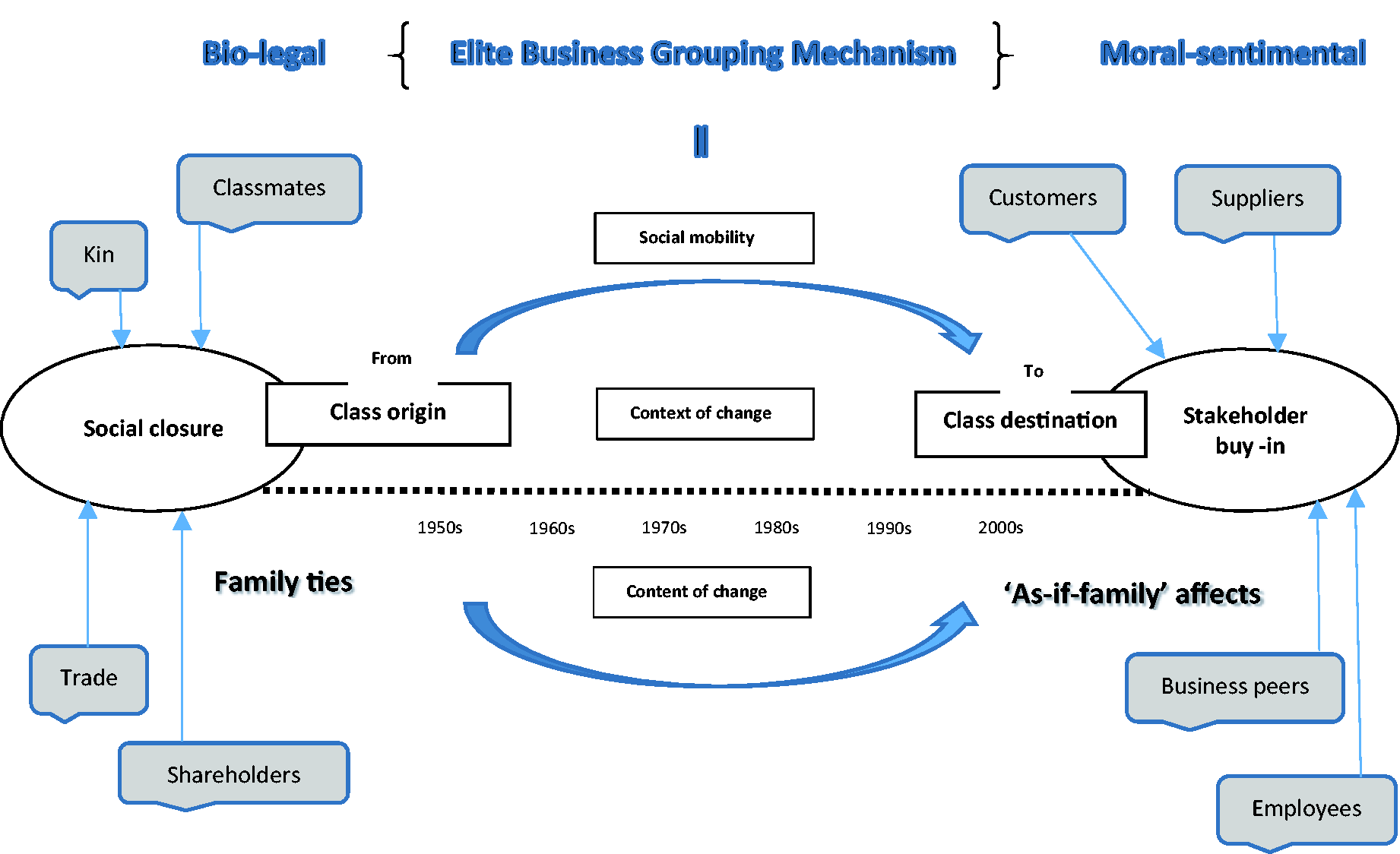
We put together a narrative analysis of a new kind of family business elite that we saw as being increasingly based on a moral-sentimental rather than a bio-legal grouping mechanism (selected as our core explanatory category – see Figure 1) whose activation ‘depends on the conditions in which it operates’ (Welch et al., 2011). We explained this change as a reworking of the familial ideology in the context of new social mobility patterns, then visualized it with a model of how elite business grouping mechanisms have worked in the post-war period in Scotland (Figure 2). In this analytical endeavour, we approached ideology as ‘a set of interrelated beliefs that might best be described as constituting an attitude of mind towards human obligations’ (Carlisle and Manning, 1994: 685), and viewed it as connected to a variety of social institutions rather than to a particular social movement or political party (Fine and Sandstrom, 1993). In a changing social context, new family business networks led our informants to reframe the ideology of family, and hence the concept of a family business itself, in order for their ownership-management to remain relevant. By changing the content of family ideology in the context of wider socioeconomic transformations, owner-managers could exert effect by relating unfamiliar modes of networking to what they already knew, redefining family so as to now include rather than exclude non-kin stakeholders.
A model of how elite business grouping mechanisms work in context.
Findings
Networks among Scottish family businesses before the 1980s
In Victorian Scotland, family businesses exemplified respectability. They were seen as a counterbalancing force to the low state of business ethics among ‘self-made’ entrepreneurs, often of foreign origin, who had few local community connections. Nenadic (1993: 105) explains family business growth in Victorian Scotland as the result of informal inter-firm ties among family and friends aiming to ‘control local markets and regulate levels of new firm formation’.
This study’s oral-history evidence reaffirms that, well into the middle of the 20th century, Scottish family businesses continued to see themselves as deeply embedded in the local community. In the words of the interviewees, the embeddedness of family business leadership was beyond doubt: [My father] did a lot of business [cutting logs] with the likes of the whisky distillers, the local industry … They would go pheasant hunting together … The major accounts were all through friendship. (Scott B, Manufacturing, 3rd generation, Large)
Scott (1982) outlines how during this period British landowners still saw themselves as a class above middle-class merchants tainted with industrial trade. ‘Going into business’ to make a living was still considered inferior to landowning (Francis, 1980: 6). In this study’s oral-history material, the absence of nostalgia was notable in the reports of those who still experienced classist condescension against early post-war Edinburgh family businesses. For example: ‘Edinburgh was a professional city and anyone in business was considered and literally referred to as trade’. Snobbish standards applied, ‘and my father having been a London solicitor found that difficult to take; one tended not to get invited to parties’ (Gareth
Post-war Scotland was characterized by large companies being interconnected and medium and small business being dependent on their special relationships with the larger companies (Scott and Hughes, 1980a). In the 1950s, family business elites built relations of trust with each other by moving sideways rather than up and down, for example, by training offspring in each other’s bakeries for free, as Alex I was staying with some friends’ uncle and I had been there about a week and K said to me ‘You obviously don’t know what you are wanting to do, why don’t you come and work for me?’ (Albert M, Manufacturing, 3rd generation, Large). My father would say, ‘You have to do it this way’, and in the 1950s you did what you were told. If you had a salesman they would be expected to call and see a customer every six weeks and if you were called on the seventh week the brewer would look in his diary and say, ‘You are late, why are you?’ Because that was the procedure I suppose. It was very traditional; you had to be accepted in the brewing industry. I think they liked to be dealing with people who had been in the industry. It was a long, protracted business, gosh yes. (Sam S, Agriculture, 3rd generation, Medium) Fleet expansion was agonisingly slow until the mid-1960s; the difficulties incurred in trying to obtain extra ‘A’ licences were considerable … The Railway Protection Board and local haulage contractors (some of which were very large companies) … always stated that ‘suitable transport services already existed’. (Isaac’s Company History Book, Case 15) There were streets named after the family … the (local) schools were very involved with the (paper-making) business, so it was very much a community business and a family. (Martin L, Manufacturing, 3rd generation, Large) The whisky industry has always been very much holding ranks … It was the families that would deal with the families. If somebody wants to buy whisky that doesn’t make whisky, there’s something strange about that! (Martin L, Manufacturing, 3rd generation, Large) My father had contacts within the brewery company that knew them from playing football, people that remembered him. His involvement in football didn’t stop after he stopped playing. He got involved with a local team, he was a director on the board there so again he was getting to know people … The brewers would give my father [and his partner] cheap loans [for pub renovation projects] if they used their beer … In 1962 they landed that [bonded warehouse] contract, it took them up another level. (Donald O, Construction, 3rd generation, Large) We compared notes many times … we had a very neat distribution in our warehouse that my father installed and developed, and they copied it. We were not head-to-head competitors. (Gareth A, Services, 3rd generation, Medium)
The changes in and around the 1980s
By the final decades of the 20th century, the battle against the dilution of family business ownership in Britain had been fought and lost, often as a result of equity issued in the process of making acquisitions (Franks et al., 2005: 593). During the period 1957–1981, ‘share ownership by individuals had fallen from 65.8% to 28.2% of market value’ (Maclean, 1999: 97). This was accompanied by the widespread control of large firms by financial shareholders (e.g. banks, insurance, pension funds and investment trusts), the ‘contraction of much domestically owned manufacturing capacity’ and the decline of interlocking directorships (Moran, 2008: 69). Top Scottish companies were no longer owned by particular families. Now, wealthy families owned shares in many various-sized Scottish companies, sustaining continuity of control over firms by constituting the majority of company board members and directors (Scott and Hughes, 1980b).
These new patterns of equity ownership and corporate management were fundamentally changing all of Scottish business life. The dangers of this new industrial reality are described by a small-scale entrepreneur and 3rd generation shareholder of a large Scottish manufacturing company: My father tells me that when he was a young man the Scottish X trade was controlled by about 30 different families. D was one of those companies competing with the others. I think we are the only one left, literally the only one left. My father protected the company, he managed to make it big enough that we were able to defend ourselves, the other ones who had difficult times were gobbled up, went bust or were taken over. (Greg D, Services, 1st generation, Micro) We approached the brewers [in 1966] … who were being squeezed by the largest [non-local] supplier … and said, ‘Why don’t you have our UK brand and you can own it?’ They agreed to fund all the stock … That freed up money to go and develop our business outside the UK, which we did. (Paul G, Manufacturing, 3rd generation, Large) A group of five of us used to go on textile trade missions and then we’d find that this was not as effective as doing it ourselves – others taking advantage of our contacts. (Alan B, Manufacturing, 3rd generation, Medium) At one time if you had gone to the boarding school (like myself), you might well have been there with lots of other engineering firms … the industry is so small now, so the boundaries are slightly important. (Ros P, Manufacturing, 3rd generation, Large) In those days, there were probably twenty family businesses in the bakery ingredient-manufacturing world. There are now probably about four of us. (Albert M, Manufacturing, 3rd generation, Large) Some of the [Clyde] boats were owned by the whisky distilleries themselves. These have now been swallowed up into far bigger groups. The big boys come in and [then] there’s no family left in them. (Jeremy C, Manufacturing, 2nd generation, Medium) I met my wife in 1988 … My wife’s uncle hunted me out of the whisky company and set me up with this technical guy, and we operated for 18 months before he brought on some older people from another company … It was a gentlemen’s agreement that we were going to be given approximately a quarter of the company each … I said that if these guys (who were slowing us down) were kept in the company, I would have to leave, thinking that he would say, ‘Well, no!’ … He then said, ‘Actually, I’ve known these men for many, many years’ … They were involved in his business right from the beginning, so they were very well-trusted. So I left. (Martin L, Manufacturing, 3rd generation, Large) There’s a big issue with us not to be seen as being apart or better. It’s self-preservation because people don’t like it. I was brought-up quite well-off part of the Scottish bourgeoisie. The things that are important – education, the way you treat people – they have got the hallmarks of a tribe. (Gideon M, Construction, 3rd generation, Large)
Post-1980s ‘as-if-family’ networks
As the importance of kinship and other tight intra-class connections declined, new entrepreneur-to-entrepreneur networks depended on a new kind of ideological framing. The ‘as-if-family’ qualities of this new kind of business structure were based on members’ shared values and emotions, not in ‘blood’ relations or established class hierarchy. Understanding this change requires an ‘approach which does not take the functions of the family for granted’ (Morgan, 1975: 7). By switching from literal kinship to an ‘as-if-family’, family ownership came to be replaced by ‘family values’ as central to the self-understanding of what makes a ‘family business’.
A new affect-based cohesion was now encouraged within family firms that moved away from ownership transfer to business growth as the key characteristic of succession: I don’t need the ownership to prove that I am the boss; I have everything to prove by building and taking forward this business … I could use an analogy from last week, we had a big visit [so as] to understand what we are about. They said that you know everybody’s names; you acknowledged everybody. People waved at you. (Trevor J, Manufacturing, 3rd generation, Large) I’m not into ‘management’. We try to pay [our staff] well, treat them like human beings, you know, as friends; get more loyalty that way. If they don’t respect you, they won’t want to work for you, they’ll go away. (Scott B, Manufacturing, 3rd generation, Large) I need to feel that this director would almost have family qualities. You know? Good family qualities and they would do anything for the business and for me and that someone would go the extra mile for you; we tend to associate those with family qualities. Even with people whose genes are identical, I’m not sure you’d get the same result. I think, you know, without using the word ‘love’ there’s something like that going on or love in terms of their personal relationship with you and their personal relationship with the business. (Gideon M, Construction, 3rd generation, Large) We’re like brothers, you know people actually say that Ben [our Managing Director, who started as an apprentice in our young boys’ academy] is more a Silverman than we are, they actually say, you know he’s nicknamed Ben Silverman and he’s more a Silverman than we are, and he’s just so passionate about the company. (Simon Sk, Construction, 2nd generation, Medium) G (Manufacturing, 3rd generation, Large) goes to talk to the target and says ‘We are family too, we are just like you, we will look after your people, we will look after the farmers that supply you’. G has driven that business forward with new products layered on top of lots of acquisitions; there have been eleven acquisitions. (Jason, Key-Informant) I bought a company which was a one-hundred-year-old family business that used to work for us as a sub-contractor and the husband died suddenly. Small company, £3M turnover, 40 employees, wonderful reputation of doing a good job and the wife called us and she said would you buy this company, never had it on the agenda and I said why, she said my husband always spoke highly of you. We looked after them like family again. I think there’s a painting company here that works for me and if they’re struggling, if they need money, I would pay them in advance of them doing the job. It’s a simple rule, treat people the way you want to be treated is my view. In the same token, when I’m in trouble, when I need someone to turn up with ten painters tomorrow, I pick up the phone. (Simon Sk, Construction, 2nd generation, Medium) There would be a lot of farmers (supplying us) that just wouldn't sell their stock to you, if they had a bad opinion of you. If [they] saw you with a big yacht or driving a Bentley or something like that [making too much money], they wouldn’t be very happy because they [would] think that we are ripping them off. (Nathan S, Manufacturing, 2nd generation, Medium) We have a long-standing loyal consistent level of staffing; it means you can build a relationship and build a history with a customer and it becomes very tight … when things do go wrong or you are under pressure from competition that relationship at the very least gives you a second chance to hold onto that business. It doesn’t guarantee you will hold onto it, but it gives you that opportunity because there’s an emotional attachment that others can’t have. (Callum C, Services, 2nd generation, Medium) We build homes that people want to live in. We build relationships with landowners; we care about the trees their grandparents planted, and the streams where they played as children. Decisions should never be made on price alone; these activities help to give us a human face, to let people know who we are. (Barry’s Company History Book, Case 23) We set ourselves targets of at least 30% of our turnover should be negotiated with clients, repeat work … the bigger guys, the national builders would put claims into people and maximize each job. We don’t. We look to build a relationship with that person so that we may negotiate with them in the future. (Donald O, Construction, 3rd generation, Large)
These new inter-class, inter-corporate fora provided considerable inter-firm practical, informational and, just as importantly, emotional support. Advice, counselling and peer-to-peer coaching were all on offer: You are a member, and you all meet up in a forum at various times throughout the year being at a six-weekly interval and chat on a very confidential basis so that you can talk about anything. So it is for business advice; if they have any concerns about what they are doing within their business, they can discuss it and get other people’s viewpoints, advice and experiences from their own businesses which will help them with their business. But it is not necessarily business; it can extend as well to family issues, relationships, anything really. (Janet M, Construction, 3rd generation, Large) So when we talk at the forum, we talk about three things: we talk about our business, our family and our personal life; you get into this situation where you’re listening to everybody around the room, and then you will then present your own update. Where is your life right now? It’s a very cathartic experience. It’s like going to therapy; it works; one of the rules of the forum is that you cannot be judgmental. (Gideon M, Construction, 3rd generation, Large) I need to learn how to speak [the forum language]; learn to step back and let people develop around me; create the environment for my manager to manage; I knew it but I couldn’t verbalize it before. (Carsten R, Other services, 2nd generation, Medium) I sat with my [four- and six-year-old] sons four years ago, and I said, listen we need to have family values. We have a big board in the hallway with our values [i.e. ‘work hard’, ‘do your best’, ‘don’t trust everyone’, ‘respect your family’ and ‘make a wrong right’]. (Simon Sk, Construction, 2nd generation, Medium)
Discussion and conclusion
Through the study of post-war Scottish family business networks, this study has shown how relational proximity based on class and kinship ties has been extended into an ‘as-if-family’ in and around the 1980s. Our research indicates that this is rooted within a new processual proximity based on achieved characteristics such as shared affects, values and class destination rather than ascribed privileges such as shared ‘blood’, upbringing or class origin (Khan, 2015; Ruef et al., 2003; Savage, 2015). Scottish family business owners’ embeddedness in new inter-firm networks did not merely lead to alliances, joint ventures, mergers, business partnerships and other dyadic relationships between member firms, but also engaged individual members’ ‘learning through increased consumption of value’ (Barbalet, 2012: 426), resulting in simultaneously cognitive and affective forms of achieved commonality. Family business owner-managers did not network because they were relationally the same but rather networked so that they would become processually the same in a socially mobile and rapidly changing context.
There are two important implications of understanding business-owning elites through an ‘as-if-family’ conception. The first is that the 21st-century business elite life-world is no longer a scene of social closure. Rather than a barrier to entry into the business elite, the ‘as-if-family’ is a stakeholder buy-in process available to all those who qualify for admission. Its diverse members first subscribe to common values through the sharing of emotion and only then develop trust and decision-making commonalities, not the other way around. The ‘as-if-family’ grows out of a transition from traditional like-mindedness, entitlement and trust based on class origin and literal kinship to a new set of affective bonds underlying networks that are better equipped to survive in the neoliberal economic order. As this new kind of ‘as-if-family’ comprises ‘something more than a network of relational individuals’ (Ribbens McCarthy, 2012: 85), there is a need to move beyond the ‘compelling imagery of fixed entities with variable attributes’ (Emirbayer, 1997: 286). The content of 21st-century ‘as-if-family’ networks is as variable as its structure and cannot be inferred from its elements. Family business elites may no longer be approached in terms of the bio-legal relations they ‘have’ or ‘do’ in accordance with their class origins, but rather as collaborative, affectively laden communities in which members purposefully ‘perform’ family values appropriate to their class destination.
The second implication of an ‘as-if-family’ conception is that we may misunderstand what family business is today by paying excessive attention to owner-managers’ bio-legal characteristics while neglecting the contribution of non-kin stakeholders (Bika and Kalantaridis, 2019; Bika et al., 2019; Ng and Roberts, 2007; Ram, 2001; Sanchez-Famoso et al., 2015; Vincent Ponroy et al., 2019). One now earns his or her place in a more malleable family business environment rather than inheriting or marrying into it. At the core of this change lies the socializing of ‘familiness’ (Pearson et al., 2008), referring to the internal resources created by familial affects cultivated to underpin a firm’s family-based competitive advantage. It is time to stop merely asking questions such as ‘which families are most likely to build familiness’ or how and with what resources they ‘contribute to family firm success’ (Zellweger et al., 2010: 54), thus only acknowledging sources of heterogeneity within family businesses (Chua et al., 2012). Instead, we should also consider the social conditioning of family businesses’ strategic behaviour (Edwards and Meliou, 2015; Zellweger et al., 2019) and focus on when the affectively loaded idea of ‘family’ is used to exclude or include a set of diverse stakeholders in different contexts. We gain a deeper understanding of family business ‘in context’ rather than ‘by context’, moving the debate further along than merely accounting for how the situational context (and its variable enactments) enables or constrains family business activity.
Having this in mind, our study contributes to three areas of social science research – inter-firm networks, business elites and family business research – while also serving as a model for interdiciplinary explanations of social phenomena more generally.
First, this study offers an in-depth historical account of business class networks, integrating research on network effects with that on network dynamics (Hoang and Antoncic, 2003) linking the micro with the macro in a non-deterministic fashion (Jackson et al., 2019). The evidence presented showed the Scottish business-owning class extending their grouping mechanisms from kinship and class networks to elite entrepreneurial networks. It explains how and why the actual nature and content of such networks changed over time, plugging a key gap in network research (Jack, 2010), using a qualitative process-oriented approach and focusing on social-class origins and destinations as key factors influencing family business relationships. Our findings resist the widespread allure of focusing on bridging social capital as the primary pathway to social power (Harvey and Maclean, 2008; Maclean et al., 2014; 2017) or as an explanation of organizational information/practice diffusion and performance outcomes (Ingram and Lifschitz, 2006). Instead, they suggest we need to focus to a greater degree on elites’ affective and ethical integration, on what was known during the Scottish Enlightenment as ‘moral sentiments’, and embrace a less abstract and generalized notion of elite business actors (Jackson et al., 2019).
In the new elite networks investigated here, the focus is not on how to solve collective-action and resource problems through corporate governance factors like remuneration, shareholders’ rights and board composition, ‘learning to own’ cross-generationally (Kuusela, 2018: 1161). Instead, collective-action problems are solved via a sympathetically achieved commonality of emotion that produces behaviour oriented by shared values. This is a ‘cognitive view of emotion as a form of evaluative judgment’ (Sayer, 2005: 950) and as an amplifier of the meaning of an idea (Tracey, 2016), building affect-based cohesion on the basis of the slogan ‘this is how we feel about things here’ and closing the ‘“empathy gap” between economic elites and others’ (Cousin et al., 2018: 240). The new emphasis on ethics and affects fleshes out how stakeholders must be purposefully aligned to ensure family business survival. In the life-world of business practice, elites strategically learn to develop characteristic affects and experience ‘family values’ as moral sentiments: compassion, loyalty, shame, deference, care and even ‘love’. A re-framed ‘as-if-family’ is thus built as a ‘moral community’ (Ingram and Lifschitz, 2006; MacKenzie and Millo, 2003; Mizruchi and Marquis, 2006) and an ongoing source of support for growth. The ‘as-if-family’ is not a metaphor that stands static for universal use, reflects organizational nostalgia of the past (literal) family firm (Gabriel, 1993, 1999) or ‘reifies some forms of embeddedness over others’ (Gilding, 2010: 763). Instead, it is performative in ways that dynamically incorporate non-kin as active members (with feedback) of a forward-looking business community.
Second, the study not only moves research attention away from the structural properties of corporate elites but also shows that these are not, as previously thought, always resilient in the face of change (Davis et al., 2003). Elites either evolve or fail when the context shifts rapidly around them. Financialization, globalization and privatization are among the wider forces that necessitate these changes (Davis and Williams, 2017). Our work thus complements Bourdieu’s theory of elite reproduction and the work of his followers in business studies looking carefully inside the networking process (Maclean et al., 2010). In this literature, networks are ‘fluidly emerging spatio-temporal entities in constant becoming’ (Halinen et al., 2012: 218). We also build on the transitions to modernity and post-democracy literature, in which the ‘class decomposition thesis’ highlights how elite identity has become amorphous, fragmented and ‘self-made’ (Davis, 2017a; Davis and Williams, 2017; Giddens, 1972; Khan, 2012; Savage, 2015; Zeitlin, 1974). The understanding of corporate elites should now go beyond social closure and transmission (Kuusela, 2018) and embrace a more fractured conception of structure that does not always reproduce existing class patterns. As Sewell (1992: 15) suggests, in a more context-sensitive view, ‘plenty of thoughts, perceptions and actions consistent with the reproduction of existing social patterns fail to occur’.
Third, we contribute to family business research as a critical social science that reflects ‘on the relationship between family firms and wider institutions, discourses and ideologies’ (Fletcher, 2014: 137). This enables us to go beyond the dominant rationalist discourse that sees family as either antithetical to business or as ‘integral to the efficient working of the business system’ (Fletcher, 2006: 215). We reject the notion of ‘freely acting autonomous family business owners’ (Fletcher, 2014: 140) to understand how owner-managers continually construct, deconstruct and reconstruct the meanings of ‘family’ in changing contexts. Diverging from the view of the family firm as the shareholders’ inheritable asset, we show that such firms are now understood as built by succeeding generations of people who become an ‘as-if-family’ underpinned by ethics and affects. We stress the contextual and temporal conditions of family business leadership as ‘a skilful process of reality construction and shifting influence’ (Fletcher, 2014: 140) that does not make assumptions about the ‘immutable properties that determine their (members’) identity and behaviour’ (Jackson et al., 2019: 26). This is middle-range theorizing that takes seriously socio-psychological mechanisms in a contextualized explanation of family business networks that goes beyond functionalist concerns about the transfer of privileged social connections.
In addition to these three specific contributions to various areas of social science research, this study also serves as a model for successful interdisciplinary collaboration across the humanities and social sciences more generally, drawing as it does on a theory of sympathy and the moral sentiments developed in the pre-disciplinary milieu of the Scottish Enlightenment (see Frazer, 2017). Using in-depth qualitative data, it delves into the self-understanding of family business elites experiencing what was known in the 18th century as a ‘progress of sentiments’, as new affective connections are understood via analogy with older connections. Our fourth contribution is therefore not only to present empirical evidence of the continuing usefulness of the Scottish Englightment theory of the moral sentiments, but also to offer an excellent example of how current social phenomena can be addressed in an interdisciplinary manner, drawing on centuries-old philosophical theories that have not lost any of their perennial relevance.
To conclude, although Scottish family business networks are no longer primarily based on bio-legal kinship, the idea of ‘family’ is re-framed and used through members’ affectively laden interaction with suppliers, employees and customers in everyday business operations, as well as business peers in both formal fora and informal networking activity. This performative family ideology constitutes the contextualized answer of Scottish family business leadership to neoliberalism’s attempts to remove all moral and emotional constraints on economic interaction. To this extent, downgrading kinship in favour of an ‘as-if-family’ allows for a new form of intra-elite trust-building and creates another channel through which elite recruitment materializes (Reeves et al., 2017). This new moral-sentimental rather than bio-legal version of what makes a business a ‘family business’ thus meets the needs of a local and more educated elite to respond successfully to a new socioeconomic context characterized by neoliberalism, globalization and the rise of the professional-executive class.
Footnotes
Declaration of conflicting interests
The authors declared no potential conflicts of interest with respect to the research, authorship and/or publication of this article.
Funding
The author(s) disclosed receipt of the following financial support for the research, authorship, and/or publication of this article: The authors acknowledge support from the UK Economic and Social Research Council (ES/S004656/1).
