




Abstract
This article seeks to address an empirical puzzle: ‘why do community-based labour organizations (CLOs) in China and Japan play a similarly marginal role in facilitating social change, despite drastic differences in national circumstances?’ Theoretically, special importance is given to a cross-disciplinary approach that combines anthropology and business and management perspectives. Methodologically, the comparative study draws on ethnographic fieldwork and interviews to explore how leadership activism is embedded in and shaped by an intricately interwoven web of political, economic and cultural forces, what anthropologists refer to as ‘a total social phenomenon’. The findings highlight a series of agential and structural challenges, especially those arising from the tension between culture and social institutions. More generally, the work contributes to an alternative, critical understanding of leadership.
Keywords
Introduction
Under the ‘creative destruction’ of neoliberalism where the influence of traditional labour unions has been waning (Harvey, 2005), the primary means of collective action has been increasingly articulated through a proliferation of non-governmental and grassroots organizations across many parts of the world. Of particular importance here is community-based labour organizations (CLOs) whose potential as new actors to lay the foundations of a different future for employment relations has sparked meaningful debate (Cooke and Wood, 2014). Emerging at the periphery of traditional labour politics, CLOs have played an increasingly crucial role in filling a representation gap left by mainstream unions’ inability or unwillingness to organize disadvantaged workers. To a certain extent, they constitute a Polanyian countermovement essential to face an unequal world where capitalist domination is overweening and alternative futures are in short supply (Burawoy, 2015). In China and Japan, CLOs are vigorous champions of labour rights, amid an accelerating trend towards precarious employment that has resulted in growing social inequalities. Their organizing leaders seek to promote social justice for non-regular and vulnerable workers who are excluded from, or differentially included in, social protection.
Despite the significance of CLOs, empirical comparative research, especially in non-western contexts, is scarce. 1 Drawing on ethnographic participant observation and interviews, this article sets out to compare CLOs in China and Japan through the prism of leadership. In both countries, CLOs are typically small-scale organizations run by a couple of leading activists. Their engagement with workers, network and coalition building, the state and mainstream unions is crucial to the effectiveness of activism for progressive social change – existing studies tend to focus predominantly on mainstream unions’ involvement in community or civil society organizing (Fine, 2007; Heery et al., 2012; Holgate, 2015; McBride and Greenwood, 2009; Tapia, 2013; Tattersall, 2018). In closely examining these interrelated engagement areas, the comparative study aims to highlight the complex ways in which leaders’ perceptions and practices in everyday life are influenced not only by key political-economic institutions but also by dominant cultural values that infuse almost every aspect of social life. In anthropological terms, leadership activism is ‘a total social phenomenon’, which requires a holistic, context-sensitive empirical investigation. Such an approach will offer a fresh critique of ‘leadership romanticism’ (Collinson et al., 2018) – i.e. decontextualized and idealized leadership – which derives its provenance from western traditions and continues to permeate much of the contemporary leadership and management literature. By bridging different disciplinary perspectives and engaging in a systematic cross-national comparison, this article hopefully contributes to generalizable insights and lessons that will inform a more critical, deromanticized understanding of leadership beyond its original organizational and national focus.
In achieving the above goals, the article shies away from being driven by a pre-defined, narrow set of concepts or hypotheses that might lead to the imposition of inappropriate, often Anglo-Saxon modes of thought (Buckley and Chapman, 1997). Instead, the research process is centred upon an empirically observed puzzle: ‘why do CLOs in China and Japan play a similarly marginal role in facilitating social change, despite drastic differences in national circumstances?’ To address the puzzle, the rest of the article first lays out theoretical and methodological underpinnings before moving to a fieldwork-based comparative analysis of leadership activism in CLOs.
Total social phenomenon and its relevance to critical leadership studies
Total social phenomenon is a key notion in anthropological theory. The notion is virtually synonymous with the name Marcel Mauss and his classic treatise on The Gift (1954). For Mauss, a gift is given within a particular complex set of social relations and institutions, which at the same time encompasses those relations and institutions. In other words, gift exchange comprises a total social phenomenon, which is at once economic, legal, political, religious, moral, social and personal. This conceptualization is also known as ‘holism’, which, along with its methodological companion ethnography, defines a distinctive style of inquiry inherent in anthropology since its birth as a modern discipline (Otto and Bubandt, 2011). Remaining at the core of anthropological theory and practice – albeit uneasily due to functionalist and structuralist fallacies in the past 2 – holism brings to the fore the centrality of contexts in comprehending human life. Contexts, or lifeworlds, are conceived as a relatively ‘seamless’, interconnected whole that emphasizes the complex and dynamic interrelationships of all aspects of human existence (Ortner, 1984: 148).
Applying the anthropological holism to leadership activism in China and Japan’s CLOs, Figure 1 shows how the role of leaders in driving social change hinges not only on key political and economic institutions but also on culture. The relationship between culture and social institutions, which assumes special significance in anthropological theory and practice, merits further consideration. Until the early 1970s, anthropology was divided between the British school of ‘social’ anthropology and the American school of ‘cultural’ anthropology. Durkheim-influenced British anthropologists approached culture from a social institutional angle whereas American anthropologists concentrated on individual autonomous interpretations of culture as a web of meanings. 3 The subsequent rise of ‘discourse analysis’ or ‘symbolic anthropology’ (Bourdieu, 1991; Parkin, 1984), which accentuates the role of language use in social construction of reality, has brought together the two foci as a collective concern and placed a renewed emphasis on the dialectical relationship between individual interpretive freedom and structural-institutional constraints. Among anthropologists, culture is now widely recognized as an ever-continuing discursive process in which a society’s core values, beliefs and norms are constructed, maintained, mediated, challenged or changed, a process intricately intertwined with political and economic forces.
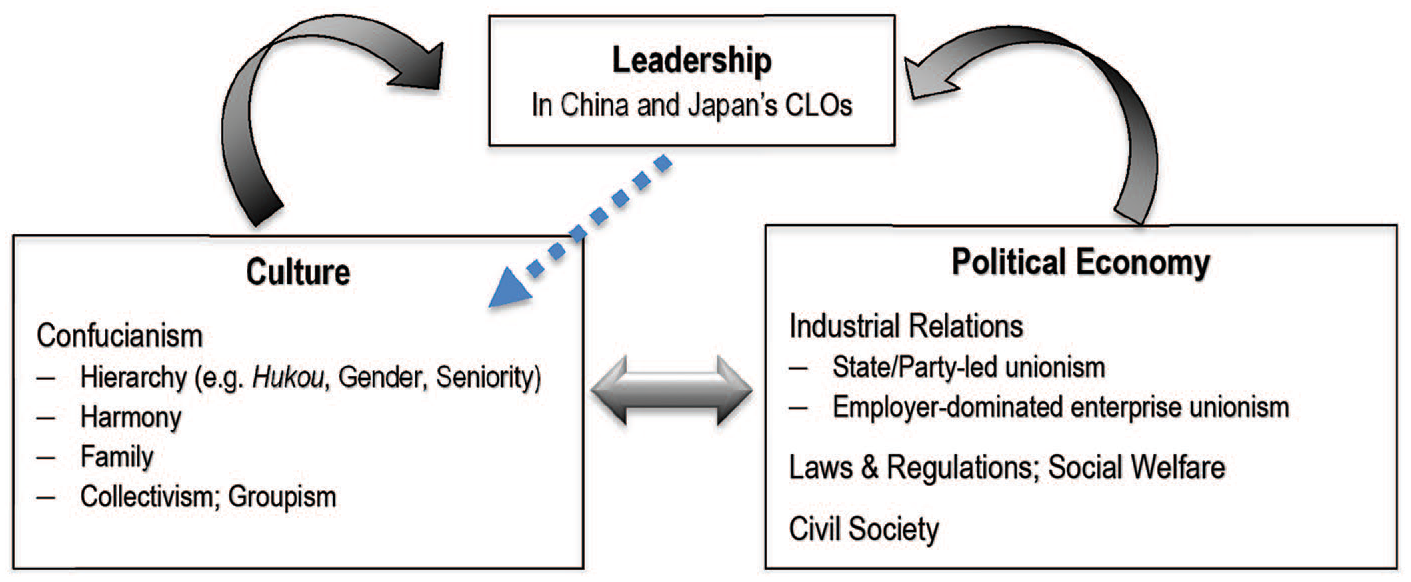
Social action as a total social phenomenon.
Such a holistic, processual view throws light on the role of culture and agency in social dynamics, which has important implications for understanding leadership challenges facing CLOs in China and Japan. This is especially because, as demonstrated most potently in anthropological accounts, the kinds of wholes where non-western people live their lives stand in stark contrast to life in the west. China and Japan, despite significant differences in their contemporary political-economic systems, are culturally proximate, sharing a common cultural tradition of (broadly defined) Confucianism. Confucian values – including, for example, hierarchy, family-oriented ethos, harmony and collectivism – foreground an interconnected relationship between individual and society, with precedence given to the fulfilling of socio-cultural norms and expectations. These and other historically inherited values invariably bear on modern social institutions in China and Japan. Hence, examining the engagement of leaders with key institutions such as industrial relations and laws entails a cultural dimension, which existing research tends to overlook or understudy.
The article’s culture-centred holistic approach can make a distinct contribution on two fronts. First, the ‘non-western’ holism in China and Japan is immensely valuable in contesting the situatedness of modern western thought. In particular, it lends itself well to the interrogation of cultural assumptions of individualism, which idealize individuals as solid selves devoid of social ties (Dumont, 1985, 1986; Lukes, 1973). To be sure, the separation of individuals from society is a powerful modern ideology responsible for ‘a theoretically unbridgeable chasm between is and ought to be’ (Dumont, 1986: 244). Within the field of business and management, which is ‘a largely North American creation’ (Chapman, 1997: 9), individualism and its variations have continued to exert a strong influence, not least on leadership research. In their recent piquant critique of leadership romanticism, Collinson et al. (2018) unpack an interrelated set of assumptions by delving into their deeper aesthetic and philosophical roots in western history. These assumptions fixate on leaders’ ‘natural’, ‘transcendental’ and ‘positive’ attributes, embrace ‘expressive collectivism’ (or the collective endorsement of individual expression), and eschew ‘points of rupture’ (or conflict and contradiction). From an anthropological point of view, the thesis of leadership romanticism not only disembeds leadership from its complex contexts or lifeworlds in which it acquires specific meanings and experiences, but also confuses powerful, grandiose discourses – i.e. what leaders ought to be, see, e.g., Alvesson and Kärreman (2011) – with real-life situations. To put it another way, leadership is neither contextualized as a total social phenomenon; nor is it grounded in empirical reality.
Second, and relatedly, investigating culture and its entanglements with social institutions affords fresh insights into the role of leaders as social change agents. This is closely related to the aforementioned anthropological conceptualization of culture as discourse or a symbolic and inherently contestable construct, which opens up new avenues for critique (Linstead, 1997). As Figure 1 illustrates, leadership activism pertaining to CLOs in China and Japan is influenced by an interconnected set of culture and political-economic forces. It should be stressed that core cultural values are often instrumentally used, or implicated, in the legitimization of social institutions. Herein lies the political engagement of leading actors in ‘society-as-discourse’ (Parkin, 1984), i.e. how to bring about social change through discursive reconstruction of culture. In real-life settings, such agential freedom and capacity is, however, often fraught with restrictions, contradictions and complications. While possessing the potential to effect change, leaders are being affected by the culture they inhabit. Agency, therefore, does not emerge from a void; to use Karl Marx’s famous saying, ‘men make their own history, but not under the circumstances of their own choosing’. The ‘messy’ theoretical picture depicted here raises important methodological issues, as well as underlining the complex and often contradictory nature of challenges confronting leading actors.
Methodology
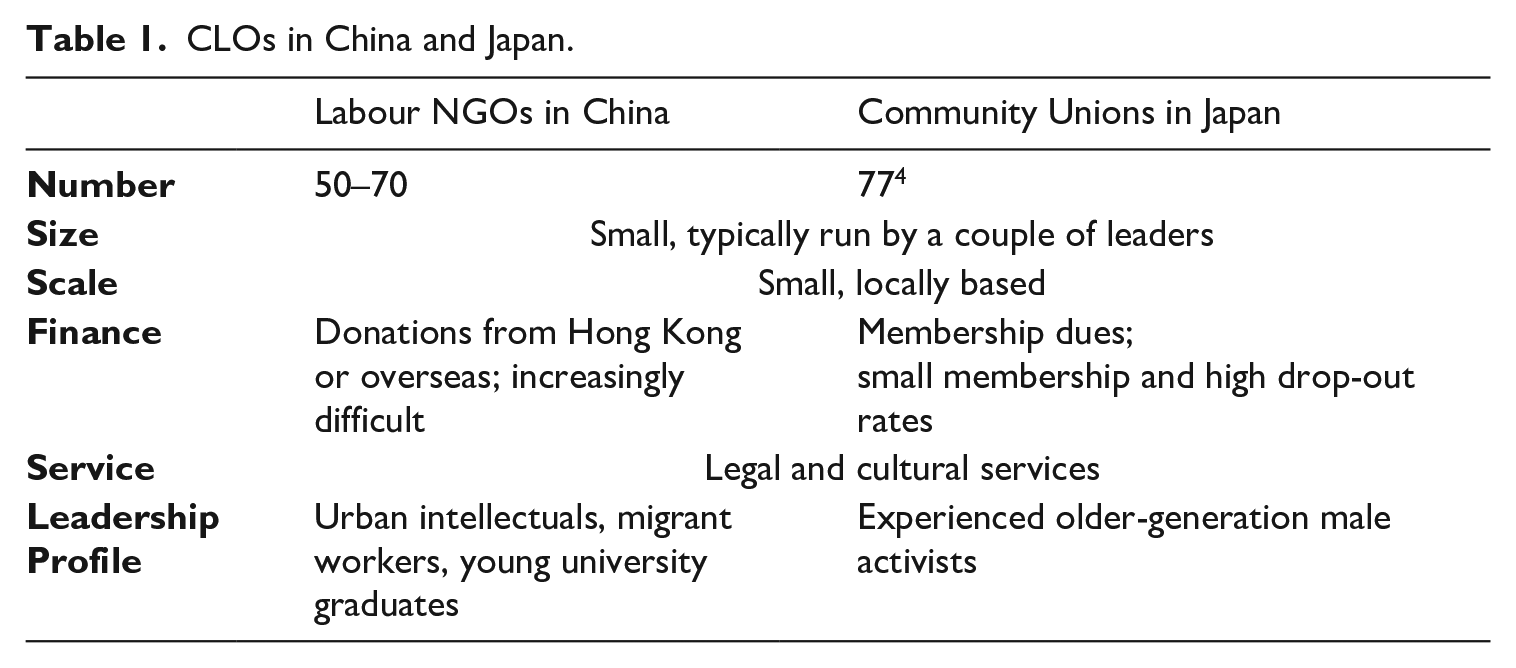
This study is an extension of the author’s many years of research on non-regular workers and social inequalities against the backdrop of an accelerating global trend towards labour market flexibilization (Fu, 2011, 2015, 2016). For many non-regular workers in Japan and China, CLOs appear to be one of the very few institutional devices whereby they could have their voice heard and seek help. A further pertinent fact is that there are considerable similarities between the two countries’ CLOs. As shown in Table 1, while taking different forms, CLOs are a loose array of small-scale, locally based organizations, typically run by a couple of leaders. Although struggling with limited financial and human resources, they manage to provide workers with legal and cultural services. The main difference, however, lies in the leadership profile; leaders in China tend to be more varied individuals, including urban intellectuals, young university graduates and migrant workers, whereas those in Japan are characterized by a preponderance of experienced older-generation male activists.
CLOs in China and Japan.
In Japan, community unions, or ‘individually-affiliated unions’ (kojin kamei kumiai), play an important role in championing labour rights, especially those of non-regular, female, young and foreign workers in small and medium-sized enterprises. Established in the early 1980s, they flourished under the auspices of Sohyo, a left-wing confederation of public-sector unions. In 1989, Sohyo merged into Rengo, the most powerful national union confederation comprised mainly of large enterprise unions. Consequently, many community unions collapsed; others transitioned into self-sustaining organizations while new ones emerged. It is worth noting that community unions enjoy considerable political independence and legal freedom, especially regarding the ease with which a union can be quickly formed and engage in collective bargaining; in fact, the union recognition procedures are more liberal than those in the US and the UK (Suzuki, 2008, 2012).
In China, since independent unions relying on membership-based funding are strictly proscribed, labour NGOs emerge as the main form of CLOs, representing a grassroots effort to organize and empower long-exploited rural migrant workers. Created in the mid-1990s, they sprang up in economically well-developed cities and regions where a huge number of rural migrant workers were concentrated. The development was closely related to deplorable sweatshop conditions and pervasive disaffection with mainstream unions and local governments. In marked contrast to Japan’s community unions, labour NGOs are plagued by a tenuous lawful status; they are tightly controlled by the Party-state via a cycle of surveillance, repression and co-option, the corollary of which has been a constant struggle between organizational survival and labour activism (Chan, 2013; Howell, 2015; Xu, 2013).
Despite the drastically different political and legal environment, neither form of CLOs has been able to exert strong socio-cultural power that could rival state and capital power and drive meaningful change. Both China and Japan are described as presenting inhospitable terrain for labour movements (Friedman and Lee, 2010; Weathers, 2010). As mentioned at the beginning of the article, central to the research process is the question: ‘why do CLOs in China and Japan play a similarly marginal role in facilitating social change?’
To address the question, a qualitative research design was used, with an emphasis on leaders’ perceptions and practices in everyday life. Six-month intensive fieldwork was undertaken during March–August 2016, which was supplemented by a follow-up study during June–September 2017. The author is a Chinese national, speaks fluent Japanese and has had extensive experience in conducting ethnographic research, which enabled relatively effective first-hand data collection within a tight time frame. Beijing and Shenzhen in China and Tokyo in Japan were chosen as the primary field sites, as they were among CLOs’ most concentrated and active areas.
In Japan, significant amounts of data were gleaned via participant observation sessions inside two community unions based in Tokyo. The author attended a number of training workshops, campaign rallies, street marches and various social gatherings, and on these occasions had numerous informal conversations with leaders, ordinary workers, civil society leaders, labour lawyers, union officials and party politicians. In addition to this ethnographic component, more than 20 unstructured interviews were conducted with community unions’ leaders within Tokyo’s metropolitan area. In China, due to heightened political sensitivity and limited financial resources available for this research, primary data was collected through a series of unstructured and semi-structured interviews with a total number of 11 labour NGOs’ leaders based in Beijing and Shenzhen; where possible, efforts were made to interview the same individual multiple times during the two phases of fieldwork. The lack of immersing participatory investigation is mitigated by the fact that there is a burgeoning body of literature on labour NGOs, which is a well-trodden area of research within Chinese studies. The article also draws on a wide range of secondary fieldwork sources, including organizational pamphlets, campaign documents, newspaper articles and social media platforms. To protect individual and organizational privacy and confidentiality, pseudonyms are adopted to disguise real identities.
The following empirical data analysis features a ‘thick description’ (Geertz, 1973) and a systematic comparison of leaders’ engagement with workers, network and coalition building, the state and mainstream unions, with a view to showing social action as a total social phenomenon. In comparing leadership challenges in each engagement area, special emphasis is placed upon how leaders’ strategies and actions are embedded in and shaped by an interconnected set of political, economic and cultural forces.
Comparing leadership challenges facing CLOs in China and Japan
Workers
Both forms of CLOs focused their efforts on worker engagement via legal and cultural services. In China, labour NGOs gravitated towards less ambitious legal aspects of working life due primarily to stringent political control. They were committed to promulgating labour rights knowledge through consultation, training classes, leaflets, exhibitions and social media. In addition, they offered advice and assistance that helped aggrieved workers to seek justice via state-approved bureaucratic and judicial channels – which were designed for solving individualized, rather than collective, disputes. The importance of law was emphasized frequently by leaders, as Ms Yang commented: Many rural migrant workers were not familiar with legal knowledge. Even they know something is not right, they don’t know how to resolve it legally. They tend to resort to uncontrolled emotions, irrational thinking and sometimes violent acts . . . Of course, law is the most powerful weapon that workers could use to ‘safeguard their legal rights’ (weiquan).
Labour NGOs also ran a rich array of educational and leisure activities, which enabled workers to acquire new skills, unwind, feel involved and engage in artistic endeavours (such as musical composition and poetry writing). For rural migrants, those ‘cultural services’ (wenhua huodong) were highly beneficial; they provided not only informal learning opportunities, but also an antidote to alienations experienced in a hostile urban environment and a sense of camaraderie and belonging – which, as argued by Xu (2013), would contribute to the long-term nurturing of working-class consciousness.
Nonetheless, leaders’ relationships with workers were far from smooth in everyday interactions. For one thing, Chinese workers were wary of ‘free help’, especially from ‘non-official’ organizations, which they thought might turn out to be a commercial scam. For another, labour NGOs’ lack of institutional legitimacy made it difficult for leaders to get their intentions across and to establish credibility, as Mr Zhao explained: I was once criticised by rural migrant workers about my salary; they questioned, ‘how come you earn more than us?’ . . . They assume those working for labour NGOs shouldn’t be paid for their work. In China, this line of work has a very low social standing. The nature of civil society is not well understood.
The situation was further compounded by the emergence of professional fee-charging ‘citizen representatives’ (gongmin daili), with whom labour NGOs had to compete. A more fundamental problem, however, lay in the fact that rural migrants, labelled as ‘floating populations’ (liudong renkou), frequently moved back and forth between city and country because of hukou (household registration), China’s long-existing institutional discrimination against rural citizens. Despite that hukou encouraged second-class treatment for rural migrant workers and created a major obstacle to developing sustainable collective capacity, few labour NGOs made explicit the link between hukou’s structural exclusion and labour rights violations – the latter figured most importantly in their public discourses. Moreover, hukou and its status hierarchies adversely affected the relationship between leaders and rural migrants. In certain labour NGOs, young university graduates and urban intellectuals relied heavily on their legal knowledge and expertise to construct credible impression, enhance superior status and impose power. Some leaders’ attitudes contained an undertone of sympathy, rather than striving to empathize with rural migrants’ realities. Others felt deeply frustrated by rural migrants’ rustic ignorance; for instance, a well-educated young leader who left for a new career in a company considered his volunteering experience at a labour NGO as ‘a botched social experiment’. Clearly, intellectual ability or youthful exuberance alone was not enough for engaging effectively with workers from drastically different social backgrounds.
In Japan, community unions were famous for developing aggressive and innovative bargaining tactics, in sharp contrast to mainstream enterprise unions that rarely organized confrontational demonstrations or strikes. Their services were centred on labour counselling and collective bargaining. It should be noted here that the Japanese law requires only two workers (e.g. one union leader and one aggrieved worker) to form a union and compels the employer to bargain over even one worker’s grievances. If the employer refuses to bargain, community unions could help workers seek local governments’ arbitration and court litigation. While counselling services were dispensed free of charge, directly negotiating with the employer would oblige the worker to become a dues-paying member. Like China’s labour NGOs, community unions were also interested in organizing educational and leisure activities such as workshops and tea parties that would provide workers with opportunities to learn new knowledge, acquire professional skills, share their grievances and nurture a feeling of ‘one-is-not-alone’ (hitori dewa nai) – a phrase frequently evoked in leaders’ everyday discourses. However, worker attendance was typically low; the author attended a series of workshops, campaign rallies and social gatherings during which only a handful of rank-and-file members showed up.
The Japanese public was largely apathetic, if not negative, about community unions. Labour protests tended to be seen as the disruption of social order and thus frowned upon, as Mr Nakamura recounted: Some journalist wrote an article in a local newspaper, criticising how our marches blocked the traffic, created annoying noises and caused trouble to residents and commuters . . . He didn’t even bother to write why we took to the streets and what we were protesting about!
While community unions were occasionally applauded by the media for protecting helpless and powerless workers, they were sometimes referred to as ‘Refuge Temples’ (kakekomidera), which in the past offered emergency help to Japanese women fleeing from their abusive husbands. This somewhat derogatory expression had connotations of temporariness and triviality, which were reinforced by community unions’ strong focus on solving isolated individual disputes, i.e. ‘individualized’ bargaining. Many leaders spoke about how difficult it was to mobilize workers at a collective level, as illustrated by Mr Suzuki: Of course, we support union building in the workplace. However, organising workers across different companies is very difficult because of the influence of enterprise unionism . . . Even within the same company, it is difficult to create a strong alliance between non-regular and regular workers, who themselves tend to shun each other . . . In the Japanese company culture, workers are expected to be loyal and solve their problems within the company. Seeking help from outsiders like us is not something they can easily do without some trepidation.
In addition, there was a high membership drop-out rate; many workers cancelled their membership soon after their problems were solved. Some leaders ascribed members’ low involvement to the lack of financial and human resources available for mobilizing efforts; others surmised that Japanese workers were too preoccupied with their own lives or simply apathetic about labour activism. There was, however, relatively muted discussion about community unions’ male-dominated organizational culture. The majority of the leaders were older-generation males who grew up in the 1950s and 1960s, a period marked by relatively strong labour and student movements in Japan. Everyday leadership practices were highly gendered; a high-profile leader, who enjoyed extensive media visibility, grudgingly admitted that the absence of women in senior leadership positions and labour activism in general was a real problem and said half in jest, ‘yes, we promote gender equality, which does not mean we actually practice it!’. There were also complaints about older-generation leaders’ lack of interest in adopting new technologies and supporting young leaders. For example, community unions’ websites and campaign logos were often derided by young people as dasai (‘out-dated’ or ‘uncool’). Such distinctive macho, seniority-based leadership practices arguably encumbered community unions’ ability to attract a broad cross-section of workers, especially women and youth who made up the bulk of disempowered and disengaged workers in Japan. Ms Sato, one of the very few female leaders, expressed deep concern about the future of community unions: For women, especially young women, the environment is toxic . . . Older males are behaving like a ‘King of the Mountain’ (oyama no taisho) who are content with creating an obligation of gratitude from pitiful workers in their own small territory . . . They also monopolise knowledge and skills and are not really interested in training young people. Lack of future successors is a critical issue facing community unions. The whole situation amounts to self-obsessed navel-gazing to me!
Network and coalition building
Among China’s labour NGOs, internal network building or cross-organizational collaboration was few and far between. This was predominantly because such an alliance was an anathema to the authorities and could lead to accusations of orchestrating politically-threatening ‘mass incidents’ (qunti shijian). As a result, conscious efforts were made by leaders to circumvent any joining-hands actions, especially regarding the organization of workers across multiple workplaces. Nonetheless, there were occasional collective celebrations during the festive season (such as the Chinese New Year) across different labour NGOs located in close proximity. Such cultural services were less likely to attract negative attention from the authorities. A few labour NGOs, aided by Hong Kong-based labour activists, ventured to connect their labour rights campaigns with transnational civil society and advocacy networks. However, foreign partnership and funding was a highly sensitive political issue due to the perceived external ‘hostile forces’ that would pose a risk to national security and stability. In April 2016, the state passed a new stringent law on the management of foreign NGOs in China, with the aim of tightening control over funds domestic labour NGOs could receive.
The resulting intense competition for scarce funding contributed to strained inter-organizational relationships. There existed a prevalent attitude of mutual distrust among leaders who tended to see each other as competitors. Moreover, in the absence of independent financial monitoring, labour NGOs were involved in reported pecuniary scandals, which led many to cast doubt on the integrity and competence of leaders as a whole, as Mr Zhao put it: We are ‘a motley crew’ (ren tan za). Some are clearly using labour NGOs to ‘go after fame and wealth’ (zhui mingli). They don’t have a genuine interest in safeguarding labour rights . . . Surely, there are some leaders who misuse and embezzle funding; for them, personal gains are more important than anything else.
In Japan, Community Union National Network (CUNN), a loosely connected nationwide network, was founded in 1990. It organizes a national conference every year and is characterized by a decentralized power structure where each community union maintains its own decision-making freedom. During joint campaigns, CUNN’s central administration in Tokyo made overtures to member unions, but often failed to ensure maximum involvement due to lack of authority. For instance, only around one third agreed to join a recent campaign to raise the minimum wage; many spurned the invitation because the campaign was led by a community union whose political party association was not to their liking. Mr Tanaka, a leader from one of the most long-existing and well-known community unions, commented: It might be difficult for outsiders to understand, but the Japanese won’t simply put the past behind and move on . . . Different political and personal views bitterly divided the labour movement in the past, which continues to have repercussions on the relationship between community unions.
There were cross-organizational collaborations, which were based mainly on personal relationships. The same could be said about community union’s partnerships with local civil society groups. Typically, those collaborations and partnerships were locally based, small-scale networks centred upon a couple of veteran leaders. Community unions were a very small world where leaders knew each other well. Among old friends, efforts were made to develop a strong spirit of camaraderie. At the same time, however, there existed protracted, interpersonal disputes, which were the main causes of recurrent inter-organizational fighting and intra-organizational splitting.
The state and mainstream unions
Labour NGOs in China are carefully controlled by the state. Scholars often invoke ‘state corporatism’ to underline top-down monopolization (Chan and Chiu, 2015) or portray the state’s shifting strategy as periods of harassment, muted tolerance, repression and co-option (Howell, 2015). Until recently, the Chinese government imposed onerous legal registration requirements for an official status. Consequently, some labour NGOs were registered as a business entity; others chose to be affiliated with existing lawful organizations; and yet others simply operated without a licence and kept a low profile. Since the early 2010s, the registration regulation had been relaxed and a selected number of ‘non-threatening’ labour NGOs had been incorporated into the state’s welfare-focused service cooperation as subcontractors with access to public funding (Howell, 2015). Along with the co-option, labour NGOs as a whole continued to be subject to intermittent harassment, licence revocations and forced shutdowns if their activities were deemed to be overstepping political boundaries – as evidenced, for example, by a massive wave of crackdown in Guangzhou in December 2015 that saw organizing leaders detained and sentenced for ‘disruption of social order’.
Despite the adverse political environment, some labour NGOs, especially those based in Guangdong province’s Pearl River Delta, sought to influence state policy by means of research publication and international pressure. Many leaders showed remarkable resilience and were engaged in various modes of everyday negotiations with authorities. Some relied on informal guanxi or personalized networks – a much-valued cultural norm – to elicit sympathy and support from local officials, while others were keen on developing proactive strategies to deal with government harassment. As Ms Wang said: Not all local officials are hostile towards us; some are sympathetic towards our cause, albeit not openly . . . It is very important to build individual guanxi and deepen personal relationships, which will always make things easier. Especially when ‘the situation is tense’ (feng sheng jin), you will have first-hand information and get prepared: forewarned is forearmed.
Such informal negotiations, as pointed out by Franceschini (2014), often resulted in a tacit agreement in which labour NGOs were allowed to keep their tenuous lawful status by operating in accordance with the state’s social stability and ‘rule-by-law’ regime.
Occasionally, labour NGOs developed collaborative relationships with the All-China Federation of Trade Unions (ACFTU), the only legitimate representative of organized labour in China that remains firmly a part of the Party-led state. Over the past two decades, the state had taken a gradualist and decentralized approach to the reform of employment relations (Friedman and Kuruvilla, 2015). Amid rising labour unrest (Figure 2), local governments and ACFTU branches were more open to cooperation from labour NGOs. For instance, some Guangdong-based labour NGOs were invited to participate in official discussions during the drafting process of new pro-labour laws. There were also examples where labour NGOs under the auspices of the local ACFTU carried out so-called ‘enterprise intervention’ (Chan, 2013), which included social auditing, in-factory training and support for the establishment of unions or employee representation committees. These and other pro-labour experiments, however, had largely fallen within the state-sanctioned ‘rule-by-law’ system; they rarely extended beyond a single workplace or a small local area. Many were short-lived due to management manipulation, local governments’ pro-capital stance and the absence of independent labour unions. Thus, not all leaders would readily enter into a coalition with the local ACFTU that was closely allied with the local government, as explained by Mr Sun: Although some official unions now outsource auxiliary services to labour NGOs, they don’t really trust us. To their eyes, we are not legitimate. Union and party officials are worried that we interfere with worker representation, which they think should be their business. It is not an easy relationship . . . We’d better ‘go our own way’ (jingshui bufan heshui).
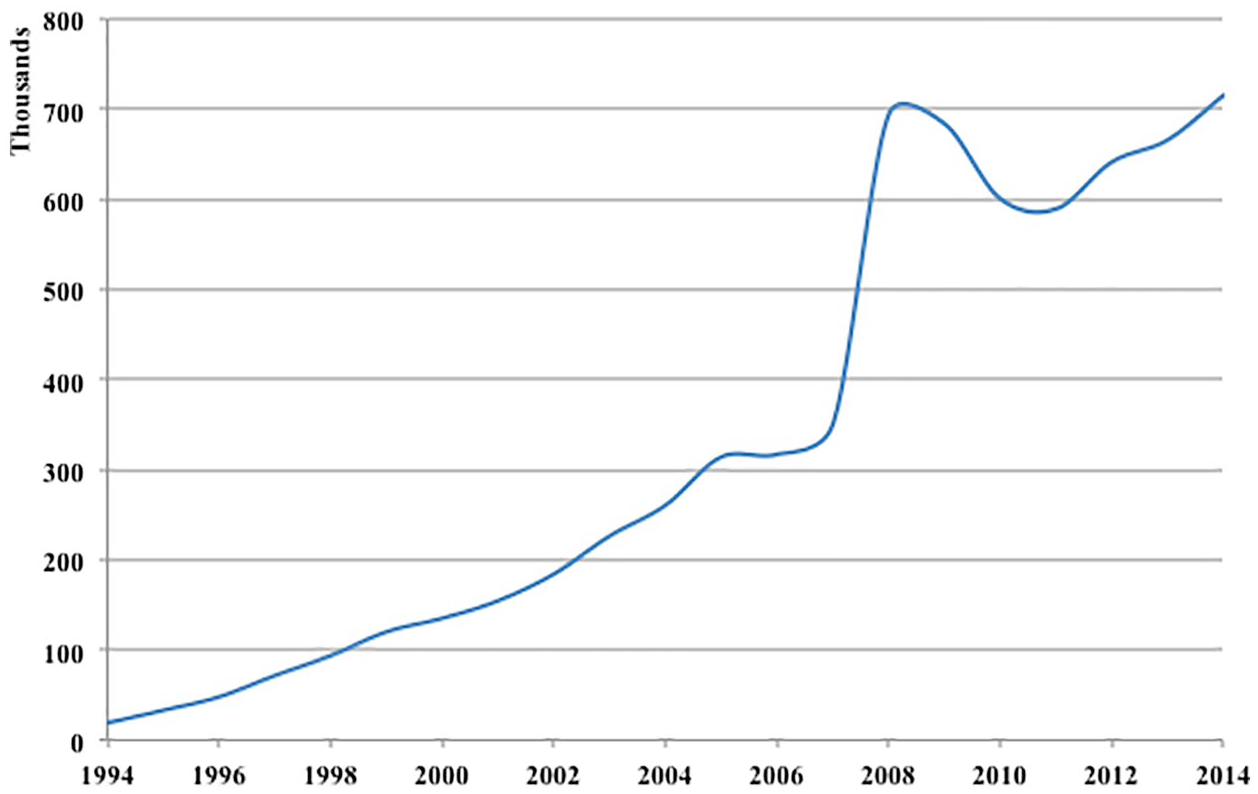
Labour disputes in China: Accepted cases by labour dispute arbitration committees (1994–2014) 5 .
Community unions in Japan are highly independent of the state. Benefiting from the liberal legal recognition that enabled a small yet resilient labour countermovement, leaders had long embraced a distinctive left-wing culture. They were not hesitant to rail against the country’s conservative politics and corporate dominance. Through collaboration with various stakeholders, community unions occasionally managed to lead high-profile political campaigns, such as a well-reported Hibiya Tent for homeless temporary dispatched workers and a more recent campaign to raise national minimal wage. It should be noted here that, compared to strong civil society’s advocacy power in countries such as the UK, Japan’s civil society was rigidly controlled by the state and too weak and fragmented to offer a substantial partnership (Pekkanen, 2006). Within Tokyo’s metropolitan area, there existed different types of small-scale coalition between community unions and civil society groups, designed primarily to provide vulnerable workers with services in a variety of areas including workplace safety insurance, religion, education and housing. For example, a leading community union formed a service-focused local partnership with Catholic Tokyo International Centre and Tokyo Occupational and Health Centre.
Leaders concurred that, in order to make a real impact on policy making, they should form broad alliances and seek direct dialogue with Rengo, the most powerful national union confederation. Yet, in reality, they not only deeply despised Rengo for colluding with the management, but also kept their distance from Rengo-affiliated community unions, as Mr Kobayashi commented: Rengo is not a real union; it is a management’s sweetheart union, representing the interests of big companies. They now try to establish their own community unions to bolster the declining membership, but they are not really interested in fighting for vulnerable workers . . . They don’t like us and we don’t like them. The feeling is mutual!
At the national confederation level, Rengo’s stance was bitterly opposed by Zenrokyo and Zenroren; the latter were associated with left-wing political parties and derived much of their support from public and service sectors. The majority of community unions were affiliated with Zenrokyo. While sharing a common antagonistic attitude towards Rengo, Zenrokyo and Zenroren had a historically developed frosty relationship due to Zenroren’s association with the Communist Party. As a result, independent and Zenrokyo-affiliated community unions tended to shun any collaboration with their counterparts affiliated to Zenroren, as described by Mr Kawaguchi, a highly influential veteran leader: The Communist Party’s despotic control in the past has left an indelible mark in people’s memories. Many of us still vividly remember the disaster it caused to the labour movement . . . Their leadership style is tyrannical and we don’t share the same political ideals . . . Yes, X is a Zenroren-affiliated community union supported by some unpopular Communist politicians. Even though X’s campaign initiative is great, many of us find it hard to join hands.
In addition to the high-level, affiliation-based rift, community unions were plagued by internecine strife within the same affiliation or organization; internal fighting and splitting in turn generated new amalgamations. This distinct factionalism – which has its roots in ‘groupism’, a defining character of Japanese culture 6 – was responsible for an increasingly patchy, heterogeneous and fragmented union landscape unfolding in Japan. This was further exacerbated by declining union membership rates (Figure 3). During occasional joint campaigns (such as the annual May-Day March), which were usually organized by politically neutral elites or lawyers’ associations, there was a clear seating and communication divide between different confederations’ affiliates. The fragmented labour movement landscape is well illustrated by Takasu (2012: 305) in his portrayal of a high-profile campaign led by community unions where an unwieldy jumble of unions, political parties and civil society groups were temporarily connected together.
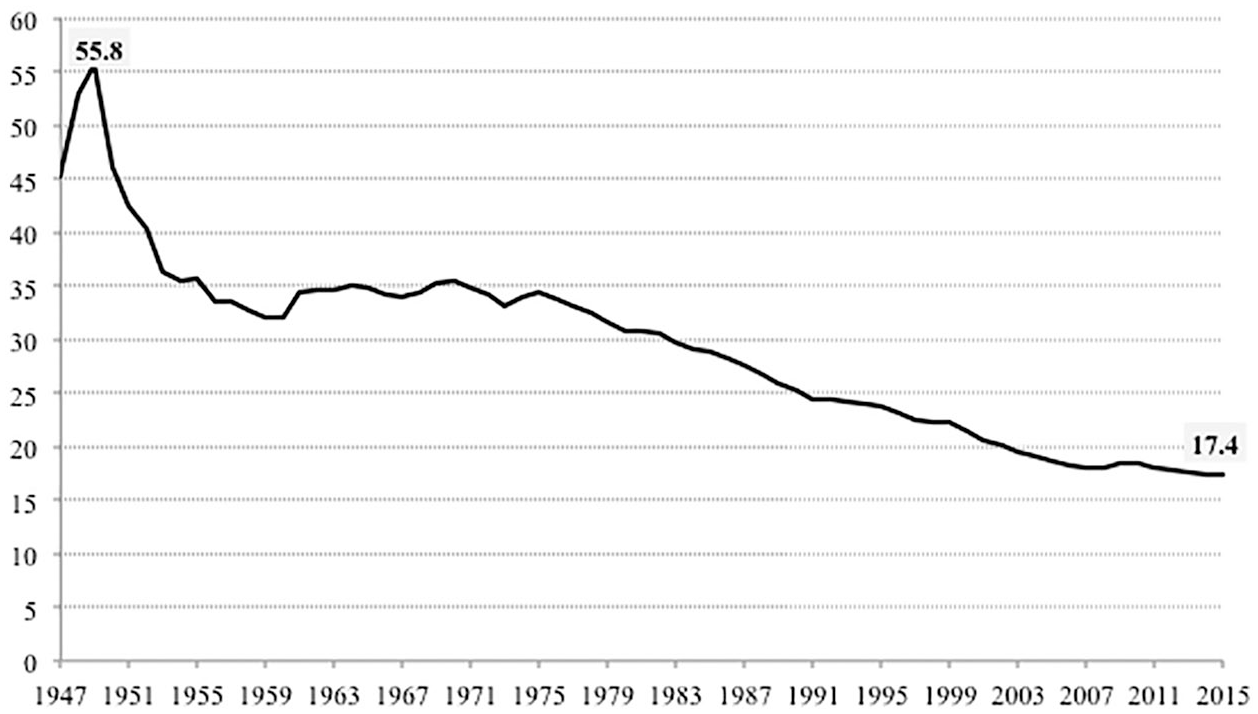
Union density in Japan (1947–2015).
Discussion
As vigorous champions of labour rights, CLOs in China and Japan play an important role in promoting social justice for workers, especially disadvantaged groups such as rural migrants and women. To some extent, they were pioneering a nascent stage of what scholars refer to as ‘social movement unionism’, which aims to move beyond workplace struggles, broaden the social basis of resistance and influence policy (Engemann, 2015; Fine, 2006, 2007; Heery et al., 2012; Holgate, 2015; McBride and Greenwood, 2009; Tapia, 2013; Tattersall, 2010). Such a positive presence notwithstanding, neither labour NGOs in China nor community unions in Japan has been able to drive meaningful social change. Through the lens of leadership, the above comparative study highlights a series of challenges arising from both structural and agential factors.
Labour NGOs in China
Figure 4 summarizes how leadership activism in China’s labour NGOs is embedded in and shaped by an intricately interwoven political, economic and cultural forces. When engaging workers, leaders adopted a strong law-oriented focus on individual dispute resolution. This focus was in tune with the state’s enthusiasm for ruling the country by law and for promoting a ‘harmonious society’ (he xie she hui) – a reinvention of Confucianism aimed at reconciling social tensions and defusing class formation. 7 Since 2008, the state has enacted a series of pro-labour laws, with the aim of encouraging aggrieved workers to rely on law as the tool for resolving ‘individual’ disputes – as Gallagher et al. (2015) remark, China would rank third in Employment Protection Legislation strictness among OECD countries. The crux of the matter, however, has always resided in the weak enforcement of laws and regulations. For one thing, local governments, empowered by the state’s economic decentralization, are keen to nurture a pro-capital, pro-stability climate. 8 The pressure to stand out in terms of growth has led to rampant corruption. In many cases, local officials use their authority to advance their personal interests; many develop surreptitious relationships with businesses and grant them privilege and protection – activities that constitute a key element in China’s lax regulatory environment. For another, in marked contrast to the increasing autonomy conferred upon private capital, the official ACFTU continues to be a vital component of political centralization, functioning as government agencies or benevolent mediators. 9 The absence of independent unions – a key driver of ‘bottom-up pressures’ (Chung, 2015) – and collective bargaining rights leaves workers’ daily struggles in a decidedly uneven battlefield. As Friedman (2014) argues, while the state makes paternalistic concessions by enacting pro-labour legislations, the local government forges a strong alliance with employers, enforces market despotism and suppresses workplace conflicts. This central-local government division, coupled with official unions’ subservience to the state, is a salient feature of China’s industrial relations. It allows for continued legitimacy of the central state amid growing antagonism towards employers and local governments. Labour resistance, as a result, is ‘alienated’ (Friedman, 2014); despite its rising number and intensity, worker insurgency was either brutally suppressed or adroitly channelled into the state-controlled legal and bureaucratic apparatus (Lee and Zhang, 2013).
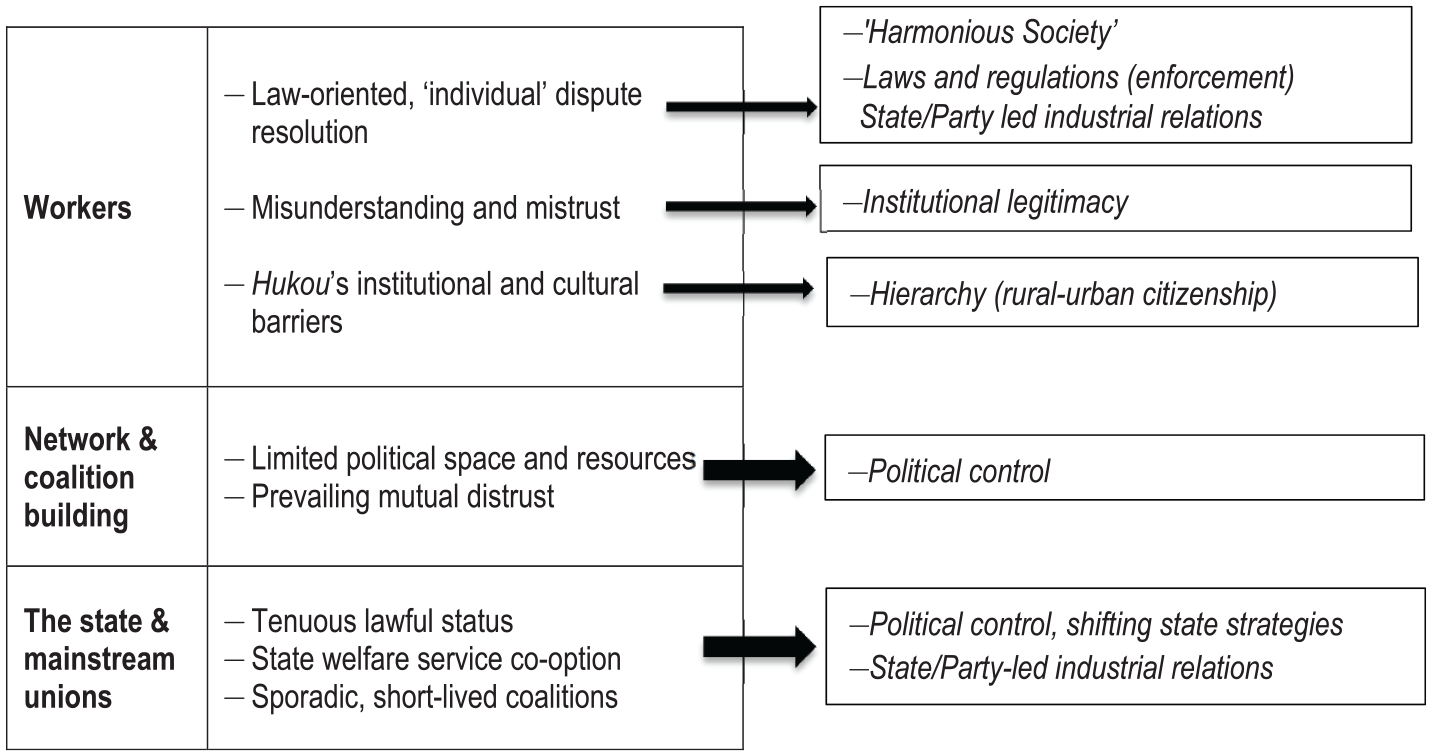
Leadership challenges facing labour NGOs in China.
Friedman and Lee (2010) argue that labour NGOs’ legal emphasis – which is also supported by many foreign foundations – is complicit in the harmonization of structural conflicts and in the cellularization of workers, thereby militating against workers’ participation in policy-making processes at the class level. Significantly, this emphasis has also clouded a critical issue in respect of hukou, the rural-urban citizenship divide. Institutionally, hukou poses serious barriers to durable labour movements as rural migrants, who are deprived of opportunities to settle in the city, ‘float’ between production in the city and reproduction in the countryside. Moreover, deriving its symbolic power from Confucian hierarchical moral codes and reinforced by the state’s neoliberal development discourses, hukou perpetuates traditional prejudice and metes out social injustice to rural populations as second-class citizens. 10 The cultural discrimination, combined with labour NGOs’ lack of institutional legitimacy, affects adversely leaders’ everyday interactions and contributes to the lack of trust and understanding from rural migrant workers.
In terms of their engagement with internal networking, coalition building and policy making, labour NGOs were shackled predominantly by political and economic obstacles. The state’s top-down control and shifting strategies compelled leaders to prioritize survival, focus on depoliticized activities and shy away from fostering any large-scale collective actions that could be seen as serious threats to social stability. Operating within a limited political space, a grey legal zone and an informal civil society, labour NGOs struggled with not only a tenuous lawful status but also limited financial and human resources, which in turn put considerable strain on the relationship among themselves. Their sporadic pro-labour coalition with official ACFTU unions, which could be best described as ‘ad-hoc’, to use Tattersall’s typology (2018), served largely in the interests of the state and local governments. Again, the above-mentioned characteristics of China’s industrial relations present a paramount structural barrier to the development of meaningful and sustainable pro-labour experiments.
Community unions in Japan
In Japan, community unions are highly independent of the state and enjoy substantial legal freedom. Nonetheless, leaders’ collective bargaining strategy was directed towards individuals or a small group of individuals. The main reason for this lies in Japan’s industrial relations marked by employer-dominated ‘enterprise unionism’ (kigyo kumiai) or decentralized bargaining at the enterprise level. 11 Compared to the state/Party-led political unionism in China, the Japanese enterprise unionism is characterized by the dominance of private employers and a cooperative management-union relationship where the firm’s performance is considered as the most important determinant by both parties. 12 The Japanese state, in contradistinction to the Chinese state’s ‘visible hand’, is notoriously ‘elusive’, with party officials, ministry bureaucrats and employer associations composing a cohesive power triumvirate where no one seems to rule the roost. 13 Underneath this ‘truncated pyramid’ (Wolferen, 1989), there has long existed a cosy relationship between business and government, often operating along informal lines, where large employers have preferential accesses to government ministries and exert a powerful influence on state policy. 14 For workers, it is the employer, rather than the state, that provides much of the social safety net coverage – for example, Japan spent only 0.17% of GDP on unemployment benefits, the second lowest of all OECD countries in 2015. In addition to this so-called ‘welfare corporatism’ (Lincoln and Kalleberg, 1990), employers have historically been adept at building institutions and shepherding workers and their struggles into the confines of a single firm by dint of not only coercive measures but also ‘creative’ use of culture. As Goodman (1998) explains, Japan’s post-war ‘firm-as-family’ employment system was created by appropriating the apparent discursive power of Confucianism-informed traditional values, in order to keep workers loyal to the firm, mask labour-management conflicts and boost profits. Under the system, the fate of workers would be closely tied to the single firm, and pressure to socialize into the ‘corporate community’ reinforced this (Whittaker, 1998). This employer-dominated enterprise unionism has remained relatively stable in contemporary Japan, despite rapid expansion of non-regular temps and ‘non-regular regulars’ (Gordon, 2017) on the labour market periphery. Consequently, community unions met immense difficulties in mobilizing workers across different firms and engaging in broad working-class representation.
The industrial relations structure alone, however, cannot fully account for the whole spectrum of leadership challenges facing community unions (Figure 5). Although benefiting from the liberal political and legal environment, leaders struggled to attract and maintain rank-and-file members who tended to see community unions as ‘Refuge Temples’ aimed at providing temporary individual solutions. They were unable to strike a positive or responsive chord with the general public who showed an apathetic, if not negative, attitude towards labour activism. Such a marginalized presence has much to do with the fatal defeat of key union movements in the post-war labour struggles, historically inherited ideological conflicts between union factions and state-controlled civil society, which, together with the employer-dominated enterprise unionism, generate Japan’s ‘liberal yet weak institutional frameworks’ (Royle and Urano, 2012: 619). To be sure, they present considerable impediments to building robust and durable ‘labour associational power’ across organizational and union-affiliation boundaries (Kojima, 2017). In particular, the distinct factionalism at multiple levels is a major contributing factor to Japan’s increasingly patchy and fragmented labour movement landscape. The corollary is that even high-profile joint political campaigns – such as Hakenmura led by community unions (Takasu, 2012) – have had little or no impact on the policy-making process.
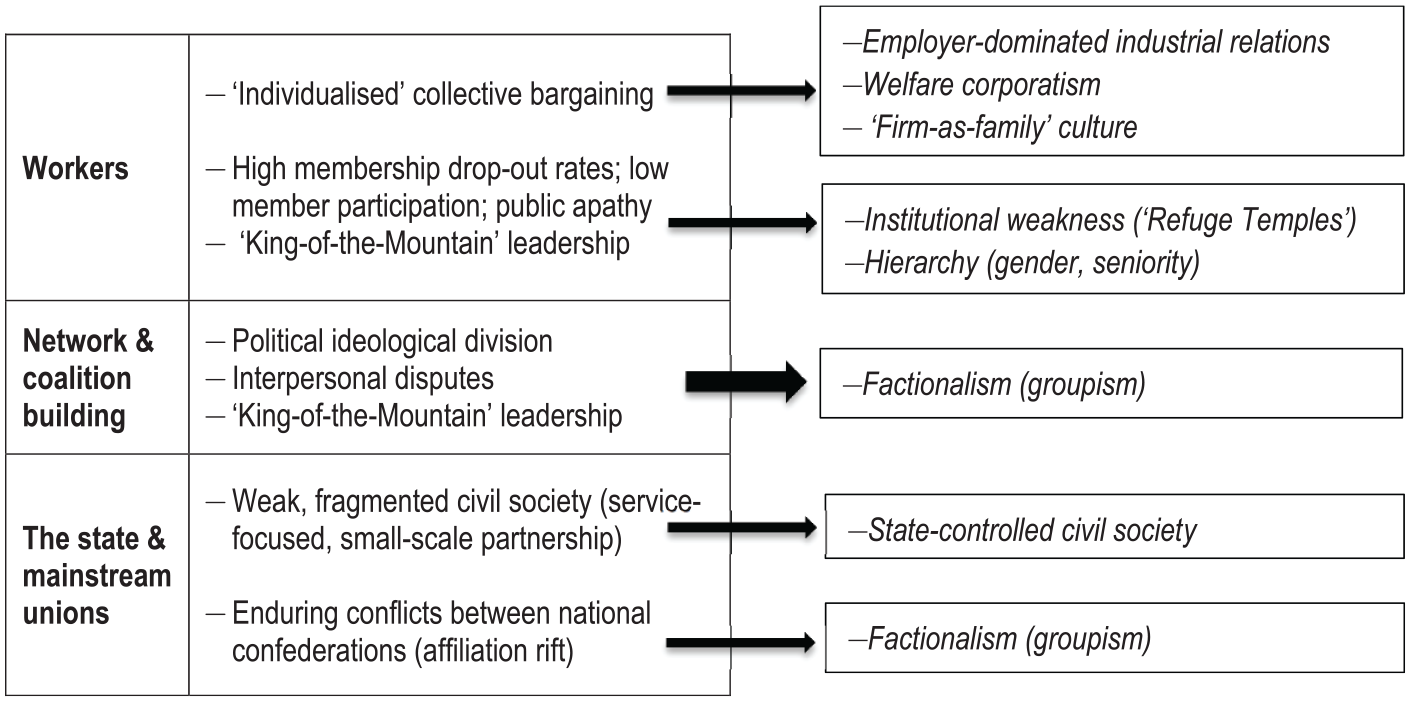
Leadership challenges facing community unions in Japan.
Perhaps more strikingly, older-generation male leaders were enmeshed in informal power struggles and protracted interpersonal disputes. They were prone to the traditional practice of ‘King-of-the-Mountain’ (oyama no taisho), referring to a (male) leader of a small group who is content with protecting, and creating an obligation of gratitude from, weak members of society. This practice is also related to the enduring union factionalism rooted in the Japanese culture of ‘groupism’ where inter-group competition is a salient feature. 15 For aggrieved workers and ordinary members, it smacks of an assumed male superiority and condescending charity, which run counter to community unions’ proclaimed equality and social justice ideals. Arguably, this highly gendered, seniority-based and group-oriented leadership discourages a broad cross-section of workers from participating in labour movements, especially women and young people who comprise the majority of most disadvantaged workers in Japan. Together, those structural and agential factors predispose community unions to prioritize individualized bargaining, act in isolation and ensconce themselves at the periphery of labour politics as ‘Refuge Temples’. They pose serious challenges to the establishment of novel collective (or distributed) leadership configurations that can, as illustrated by Butler and Tregaskis (2018)’s study, produce successful change management.
Social action as a total social phenomenon
This comparative research reveals the complex ways in which leaders’ perceptions and practices are embedded in and shaped by an intricately interwoven web of political, economic and cultural forces, as shown earlier in Figure 1. Social action is indeed a total social phenomenon whose many spatial and temporal manifestations necessitate a contextualized and holistic approach. By bringing the anthropological insights to bear upon critical leadership studies, this research helps to unpack popular romanticized assumptions, which posit a representation of universal, natural or transcendental truth, attribute undue influence and responsibility to leaders, and leave little room for the possibility of leadership manifesting in paradoxical, conflictual or contradictory terms (Collinson et al., 2018).
The first main finding is that national industrial relations, especially the institutional dynamics between the state, capital and labour, has a direct impact on leadership activism in CLOs. That the Chinese state/Party-led political unionism contrasts sharply with the Japanese employer-dominated enterprise unionism and union factionalism leads to distinctly different sets of leadership challenges. Clearly, the state-capital-labour relationship, along with other relevant institutional arrangements concerning laws and regulations, civil society and welfare provision, plays a prominent role in affecting leaders’ ability to develop collective-action capacities and galvanize social change.
Secondly and more importantly, the comparative research sheds light on the critical role of culture and its implications for agency. In both China and Japan, the political-economic institutional environment that circumscribes leadership activism is imbued with cultural values; the latter are often implicit in, and instrumentally used to legitimize, the former. The interconnectedness between culture and social institutions provides both opportunities and challenges for social change agents. On the one hand, culture, as a system of malleable symbols, enables discursive multivocality and is therefore amenable to social (re)construction (Cohen, 1969, 1974; Turner, 1967). On the other hand, such agential freedom in practice is not immune from institutional and structural constraints, especially when it comes to deep-seated cultural norms and beliefs that pervade almost every aspect of social life. The resulting tension perhaps explains why leaders in China and Japan’s CLOs appeared to be undertaking both internalization and dis-internalization of their inherited ‘native categories’ (Buckley and Chapman, 1997; Moore, 2015). While presenting themselves as a progressive force for social justice and equality in public discourse, leaders were complicit in, or acquiesce to, the maintenance of core cultural values, notably hukou- or gender-based Confucian hierarchy, in everyday practice. The apparent discrepancy between what leaders say they (should) do and actually do might be attributed to leadership integrity; in a possible yet rare scenario, some leaders were mainly interested in using their position of power to amass personal prestige and enhance superior status. The vast majority, however, did want to make a positive difference through their hard and often unrewarded work. To a great degree, the contradiction between leaders’ official discourse and everyday practice attests to the depth and extent of cultural pervasiveness and embeddedness in both political-economic processes and personal lives.
Thus, successful social action entails leaders’ capacity to engage in critical self-reflexivity and to recalibrate the role of culture in contesting the status quo. Another thought-provoking issue emerging from the research is concerned with the effectiveness of promoting such globally popular concepts as equality, human rights and social justice. Deriving their discursive power form Christianity-informed individualism and egalitarianism, these western concepts require careful reinterpretation and reconstruction, not least in countries that are influenced by diametrically opposite cultural values. As strong advocates of ‘rule-by-law’ (fazhi) and ‘human rights defenders’ (weiquan), leaders in China’s NGOs vociferously emphasized labour rights violations, but rarely linked these to hukou’s institutional exclusion and cultural discrimination. For over half a century, hukou has institutionally legitimized two classes of citizenship whereby rural citizens are denied equal access to social welfare and subjected to abuse and exploitation by urban employers, as documented by numerous writers (Fu et al., 2018; Lee, 1998, 2007; Peng, 2011; Pun and Liu, 2010a, 2010b; Swider, 2015; Zhang, 2014). Similarly, in envisioning a better society, leaders in Japan’s community unions had largely failed to directly challenge persistent cultural assumptions regarding the male breadwinner-female dependent family model. Crucially, this patriarchal gender order remains the single most important cause of social inequality in Japanese society, which underlies the country’s entrenched labour market dualism, state regulatory and welfare frameworks, corporate management strategies and mainstream unions’ conservatism (Gottfried, 2009, 2014; Macnaughtan, 2015; Osawa et al., 2013; Roberts, 2011; Yun, 2010).
Conclusion
Focusing on CLOs’ leaders in China and Japan, this article has attempted to offer an alternative way of tackling populist and academic infatuation with romanticized leadership that derives its genesis (and persistence) from western thought. By contextualizing leadership activism as a total social phenomenon and adopting thick descriptions, the empirical findings have uncovered the ‘non-romantic’ facets of leadership, especially those arising from the tension between culture and social institutions. To use Grint (2010)’s metaphor, it is the room, the ‘sacred’ surrounding space, not the elephant, that makes leadership more susceptible to critical analysis.
Like all studies, there are inherent limitations in the research design. For example, not sufficient attention was given to workers, i.e. followers, although efforts were consciously made to incorporate their views into the analysis. Future research could critically engage with leadership by delving into everyday intricacies of workers’ life and the way in which leadership is perceived and affected by workers. Followership research may prove particularly valuable for leadership studies in CLOs, traditional unions and other advocacy organizations, since leaders’ ability to influence depends much on perceived legitimacy from followers they seek to represent. Furthermore, much could be gained from cross-national comparative and empirically grounded research, which has the potential to provoke new ways of thinking. As this study hopefully suggests, the ‘non-western’ holism lends itself easily to critical investigation by forcing us to ‘gain an awareness of what otherwise goes without saying, the familiar and implicit basis of our common discourse’ (Dumont, 1985: 94).
Footnotes
Acknowledgements
I would like to thank the Associate Editor Olga Tregaskis and the anonymous reviewers for their encouragement and constructive comments. This fieldwork-based research would not have been possible without generous support from many people. I am particularly grateful to Glenda Roberts, who helped me secure a research fellowship at Waseda University in Japan. My gratitude also goes to Charles Weathers, OSHRM colleagues at the University of Essex and participants of Nissan Seminar at the University of Oxford for their insightful comments on earlier drafts of this article.
Funding
The author(s) disclosed receipt of the following financial support for the research, authorship, and/or publication of this article: This research is funded by British Academy Leverhulme Small Research Grant (2015).

Notes
Huiyan Fu (PhD, Social Anthropology, University of Oxford) is Senior Lecturer at the University of Essex. Her main research interests lie in precarious work, social inequalities and critical management studies. She is the author of An Emerging Non-Regular Labour Force in Japan: The Dignity of Dispatched Workers (Routledge, 2011) and the editor of Temporary Agency Work and Globalisation (Routledge, 2015). Her work also appears in journals such as British Journal of Industrial Relations and Gender & Society. [Email: