




Abstract
How do professionals respond when they are required to conduct work that does not match with their identity? We investigated this situation in an English public services organization where a major work redesign initiative required professionals to engage in new tasks that they did not want to do. Based on our findings, we develop a process model of professional identity restructuring that includes the following four stages: (1) resisting identity change and mourning the loss of previous work, (2) conserving professional identity and avoiding the new work, (3) parking professional identity and learning the new work, and (4) retrieving and modifying professional identity and affirming the new work. Our model explicates the dynamics between professional work and professional identity, showing how requirements for new professional work can lead to a new professional identity. We also contribute to the literature by showing how parking one’s professional identity facilitates the creation of liminal space that allows professional identity restructuring.
Keywords
Introduction
Professional identity is an essential component of how professionals make meaning of their lives (Kyratsis et al., 2017; Nelson and Irwin, 2014; Pratt et al., 2006). It is “an individual’s self-definition as a member of a profession and is associated with the enactment of a professional role” (Chreim et al., 2007: 1515). A key aspect of professional identity is the tight connection between professionals’ view of themselves and the work they do (Pratt et al., 2006; Reay et al., 2017). As Pratt et al. (2006) illustrate, when professionals are asked “who they are,” they often answer by describing the nature of their work. This tight connection between identity and work results in stability because one cannot change without the other (Pratt et al., 2006; Reay et al., 2017). When facing imposed change, professionals often avoid adopting work practices that do not fit with their identity, making the implementation of change initiatives difficult (Reay and Hinings, 2009). However, research has shown that professionals can change their identity in concert with changes in their work when they believe the new work is valuable (Ibarra, 1999; Kyratsis et al., 2017). This situation often occurs as part of professional advancement, such as when physicians learn to become specialists (Pratt et al., 2006). And yet, with increasing numbers of professionals employed in organizations, professionals may be required to adopt new work practices where they do not initially see value, and where the required new practices are not well aligned with their identity (Muzio et al., 2020; Reay et al., 2013). To better understand such situations of organizational change, we need to know more about how professional identity and professional work can become unbundled and potentially realigned.
Most studies show that professional identity is relatively stable and difficult to change, or seldom changes (Abbott, 1988; Chreim et al., 2007). This resilience of identity is easily understood by the long periods of immersion and socialization that characterize professional education (Freidson, 2001). When faced with the prospect of new work practices that are inconsistent with established professional identity, professionals find ways to avoid those practices (Currie et al., 2012). Studies showing how professional identity can gradually change over time have been mostly limited to cases where professionals adapt their identity as they follow established pathways through socialization (Ibarra, 1999; Pratt et al., 2006). Researchers have also investigated situations where professionals collectively developed new identities in response to changing external factors such as new technology or societal trends (Goodrick and Reay, 2010; Nelson and Irwin, 2014), or where professionals engaged in identity change as part of taking on new desired professional work (Kyratsis et al., 2017). Little is known about how professionals restructure their identities during times of imposed change, such as job redesign when professionals’ work tasks or positions can be dramatically altered in ways that professionals dislike.
We studied a case of imposed changes to professional work in an English public services organization that implemented a major job redesign initiative requiring experienced professionals to take on new tasks and become multi-skilled. The overall goal of the initiative was to improve support for the frail elderly population and thus allow them to remain in their home settings through more integrated health and social care. However, in doing so, rehabilitation professionals (occupational therapists and assistants) were required to learn how to provide financial consultations as well as rehabilitation services, and caseworkers were required to learn aspects of rehabilitation in addition to their knowledge about financial services. We conducted an in-depth case study of the initiative over time through on-site observations and interviews with professionals and managers. This research approach allowed us to address our question: how do professionals restructure their professional identity in response to job redesign?
We contribute to the literature in the following three ways. First, we develop a process model that shows how changes in professional identity and work can occur separately over time in response to an identity threat. In contrast to the extant literature, we explain how professionals can initially protect their identity and avoid new work, but later engage in identity restructuring as they try new professional work. Our model shows how professional identity and professional work can be temporarily separated as part of professional identity restructuring. Second, we introduce the concept of “identity parking” (or setting aside) one’s previous professional identity as a way to engage with new professional work that is required. We suggest that identity parking can be an effective way for professionals to cope with identity threats, because they can temporarily set aside their old selves and try new ways of working. Third, we contribute to the literature on liminality by showing how professionals can create a liminal space that allows them to learn new work tasks and later engage in identity restructuring.
Theoretical background
Professional identity change
Professional identity (how professionals see themselves) is based on a system of knowledge and influenced by interrelations among professionals (Abbott, 1988). Previous studies have shown the importance of a tight relationship between professional work and identity; that is, the work professionals do and professionals’ view of themselves. Pratt et al. (2006) identified three types of identity work—enriching, patching, and splinting that facilitated the transition of medical students’ identity to that of specialist physicians. Identity work refers to “the range of activities individuals engage in to create, present, and sustain personal identities that are congruent with and supportive of the self-concept” (Snow and Anderson, 1987: 1348). Identity work is more frequent and prevalent in situations of confusion, tension, ambiguity, and strain, which lead people to actively engage in making sense of the situation so as to construct or reconstruct one’s identity for consistency (Brown, 2015).
Our analysis of the extant literature shows three different ways that scholars have conceptualized the transition from one professional identity to another in relationship to professional work. First, studies have given attention to processes of change that are “usual” and expected transitions where professionals take on increasing levels of authority or responsibility as part of their career advancement. Research shows how professionals’ view of themselves can change slowly over time in coordination with changes in their professional work. In these studies, change has been conceptualized as an ongoing process where people follow the path of those who have gone before them; that is, people are socialized into a particular professional identity where they concurrently take on the work and identity of their more advanced colleagues. This type of change can occur as people move into management training or move forward with professional specializations. For example, Ibarra (1999) showed how employees entered management training programs and experimented with provisional selves—“trying on” possible identities as they developed their own new identity. Pratt et al. (2006) found that medical students constructed a new professional identity while engaging in specialist training; these changes were triggered by watching others who had already completed the training and noting the “mismatch between what [fully qualified] physicians did and who they [students] were” (p. 235). They found that medical students engaged in different processes to develop a new professional identity that matched with the new professional work; the nature of the desired new identity explained the different construction processes (Pratt et al., 2006: 247). Medical students who wanted to become surgeons engaged in a different process from those training to be a general practitioner or radiologist. Collectively, these studies show processes of change in professional identity that gradually occur over time as people see themselves differently through learning new work skills. Change occurs as professionals match themselves with role models who are already engaged in similar work. During this type of professional identity change, scholars suggest that new work and new identity are learned iteratively and simultaneously; that is, identity and the work that professionals do are gradually learned over time through professional learning and training.
A second way that professional identity can change gradually and iteratively with changes in professional work is through collective action. Studies in this regard have analyzed how professionals can collectively take actions to change away from an undesirable identity, but without a clear model of what the new identity should be. For example, Goodrick and Reay (2010: 67) detailed how registered nurses gradually changed their professional identity by working collectively to move away from a view of themselves as “handmaidens to physicians.” In distancing themselves from an unattractive professional identity, they shaped their desired future selves and future work in coordination with social and economic changes such as women’s rights and the rise of science. Similarly, Nelson and Irwin (2014) explored how librarians developed a new professional identity after their previous work was made almost redundant with the introduction of internet searches. Librarians changed their professional identity by reframing themselves as professionals who connected people and information—creating new work and an associated new identity that had not existed previously. In addition, Reay et al. (2017) showed how the professional role identity of family physicians (general practitioners) was changed through the coordinated efforts of multiple actors. Other health professionals (e.g., nurses, rehabilitation therapists, managers) convinced physicians that their old professional role identity as an independent practitioner was unsustainable and undesirable in a setting where new professional work based on team-based care was paramount. Over time, the actors engaged collectively to create a new professional identity for physicians that did not exist previously—head of the team. As a final example, Humphreys et al. (2015) showed how a new (previously unknown) leadership identity was constructed through the interconnected efforts of a leader and his followers. All of these examples show how a new professional identity can be gradually restructured in opposition to a past unsatisfactory identity, and how the nature of work can change through the process.
A third approach to professional identity change focuses on purposeful alterations in identity made by professionals in response to a perceived disconnection between a previous and new identity (Kyratsis et al., 2017; Petriglieri, 2011). These studies highlight attention to identity threats, with underlying assumptions that professional work underpins the desired changes. For example, Petriglieri (2011) proposed that in response to identity threats, individuals could engage in strategies to either protect or restructure their established identity. She further suggested that individuals could change or restructure their identity in one of three ways: by changing the importance of that identity to them, by changing the meaning associated with that identity, or by abandoning that identity. More recently, Kyratsis et al. (2017) built on these suggestions in their study of physicians who restructured their professional identity while undergoing a shift in practicing principles—authenticating the new identity, reframing what “physician” meant for them, and justifying the new identity through cultural repositioning. Other studies have somewhat similarly shown how changing the meaning of one’s identity can serve as an effective way to accomplish identity change (Baldridge and Kulkarni, 2017; Kreiner and Sheep, 2009; Maitlis, 2009). By infusing “identity threats with positive value” (Kreiner and Sheep, 2009: 33), or by acknowledging and accepting physical changes that threaten professional identity (Baldridge and Kulkarni, 2017; Maitlis, 2009), individuals can learn to see themselves differently. This line of research shows how professionals can create and sustain valued identities; however, they only indirectly suggest that different work can be associated with identity change. Overall, these studies tend to gloss over how the connection between identity and work impacts the process of professional identity change.
The three approaches explained above suggest that professional identity change is difficult to accomplish and relies on individuals determining that identity change is better than identity protection. The tight connection between how professionals see themselves and the nature of their work (e.g., Pratt et al., 2006) has so far received insufficient consideration in understanding how professional identity changes, because we still know relatively little about the dynamics between the nature of work and the concept of self. Beech (2011) has provided some insights into the evolving dynamics between work and identity in considering a state of liminality that exists as part of changing from one identity to another. This attention to liminality as part of professional identity change opens up a new approach to investigating the way in which professionals navigate the connections between identity and work as they engage in processes of change.
Liminality and identity change
The concept of liminality originated in anthropological studies (Turner, 1982). The most cited example is the progression from a boy to a man, where an actor is neither a boy (the old identity) nor a man (the new identity), but is “liminar” (Beech, 2011; Ibarra and Obodaru, 2016). Liminar is “in-between” and “socially invisible,” which places one in an “interstructural” position (Beech, 2011). During liminality existing norms and routines are suspended, bringing disruption to the sense of self (Shortt, 2015; Söderlund and Borg, 2018); people subsequently look for answers to who they are, where they are situated, and who they should identify with. Liminality provides “privileged spaces where people are allowed to think about how they think, about the terms in which they conduct their thinking, or to feel about how they feel in daily life” (Turner, 1987: 102). Liminality is traditionally associated with uncertainty, ambiguity, and unsettled feelings because of the in-between and interstructural characteristics of liminality. As a result, there are few instructions or rules for the liminars, and organizational life can be difficult (Bamber et al., 2017; Beech, 2011; Turner, 1982).
In contrast to the long-standing belief that liminality is an unpleasant experience, research shows that the in-between and interstructural characteristics of liminality mean that actors are not under “structural obligation” (Turner, 1982: 27); neither are they bound by “conventional norms and traditions” (Söderlund and Borg, 2018: 891). Therefore, there can be a sense of freedom that creates room for creativity (Bamber et al., 2017; Ibarra and Obodaru, 2016). Liminal experience can thus equip individuals to engage with multiple realities in work and life, and find alternative ways to understand the world (Cohen, 2011; Ibarra and Obodaru, 2016). As a result, individuals may be able to enhance their competencies and engage in an “increased appreciation” for life (Maitlis, 2009). In addition, liminal physical space where “traditional routines, norms, and activities are suspended or renegotiated” can help promote creativity and develop new knowledge (Söderlund and Borg, 2018: 891). This is because such a space creates opportunities for new relationships and learning how to avoid regular routines; these opportunities can be inspirational and promote creative thinking and alternative behavior (Hay and Samra-Fredericks, 2016; Söderlund and Borg, 2018).
Overall, the literature has shown the importance of a tight connection between professional identity and professional work, suggesting that if there is change, the two must change together (Pratt et al., 2006; Reay et al., 2013). However, as professionals are more frequently employed in organizations, rather than working in independent practice, they are increasingly required to change their professional practice in response to employment requirements. Such required practice changes can be at odds with professional identity, setting up potential separation from identity and practice that has not yet been examined. We address this research gap by drawing on the concept of liminality as part of identity change (Beech, 2011) and studies showing how a state of “in-between-ness” can create space for reflection and creativity that could influence professional identity (Ibarra and Obodaru, 2016; Söderlund and Borg, 2018). Thus, we address our research question: how do professionals restructure their professional identity in response to job redesign?
Methodology
Research setting
We engaged in a case study of job redesign within a UK public services organization. This organization provides services related to home repairs and adaptations for frail elderly people to increase their ability to live independently in their own homes. The job redesign required three different professional groups to extend the remit of their work and take up each other’s roles. The three professional groups are: Occupational Therapists (OT), Occupational Therapist Assistants (OTA), and Caseworkers (CW). All OTs have a university degree in occupational therapy. OTAs and CWs typically have a university degree in psychology or education and have worked in their respective roles for a number of years.
The standard working process prior to the job redesign was as follows: when a potential service user (elderly client or their caregiver) phoned in a request, an OT or OTA visited the client in their home, assessed their needs, and recommended housing adaptations (clinical assessment). This assessment was then forwarded to a CW to conduct a financial assessment and charitable funding application (financial assessment). After funding was in place, the home modifications were completed by outside renovation experts.
The key aspects of the job redesign are as follows: OTAs and CWs were given a new title of Housing Assessment Officer (HAO); OTs maintained the same job title. In the prescribed new working arrangements, all staff were required to carry out both assessments (clinical and financial) regardless of their job title. However, only OTs were assigned the most complex cases, particularly with respect to clinical assessment. In order to clearly show professional background, we refer to professionals by their previous job title rather than using HAO.
The job redesign was unpopular among all professionals; everyone was required to take on activities outside of their previous remit and they did not like the changes. People held established professional identities of how they saw themselves in relation to the work that they did, and the imposed change in the nature of their work did not match with their professional identities. As we show in the findings section, in initial interviews, people expressed their unhappiness and reported their desire to seek employment elsewhere.
Our research setting provides an ideal site to examine how professional identity can change. Our conceptualization of identity change is situated within the understanding that identity is continually becoming (Brown, 2015; Burke and Stets, 2009). Since professionals were forced to change the nature of their work if they wished to continue employment with the organization, the situation allowed us the opportunity to explore potential changes in the relationship between professional identity and professional work over time. Consistent with Eisenhardt’s (1989: 537) advice, our case holds potential “to replicate or extend the emergent theory” through the investigation of a rich and dynamic environment (Stake, 2005).
Data collection
We engaged in semi-structured interviews (Table 1), observations, and documentary analysis. Altogether, 57 semi-structured interviews were conducted over two time periods. Interviews lasted for one hour on average and were transcribed verbatim. Interviews focused on people’s views of the job redesign and how they were managing their new work arrangements. There is an approximately one-year gap between Time Period 1 (T1) and Time Period 2 (T2), that allowed researchers to step back from the field, reflect on data analysis, and then focus upon issues of theoretical concern in the later phase of research (Kvale, 1996).
Interview summary.
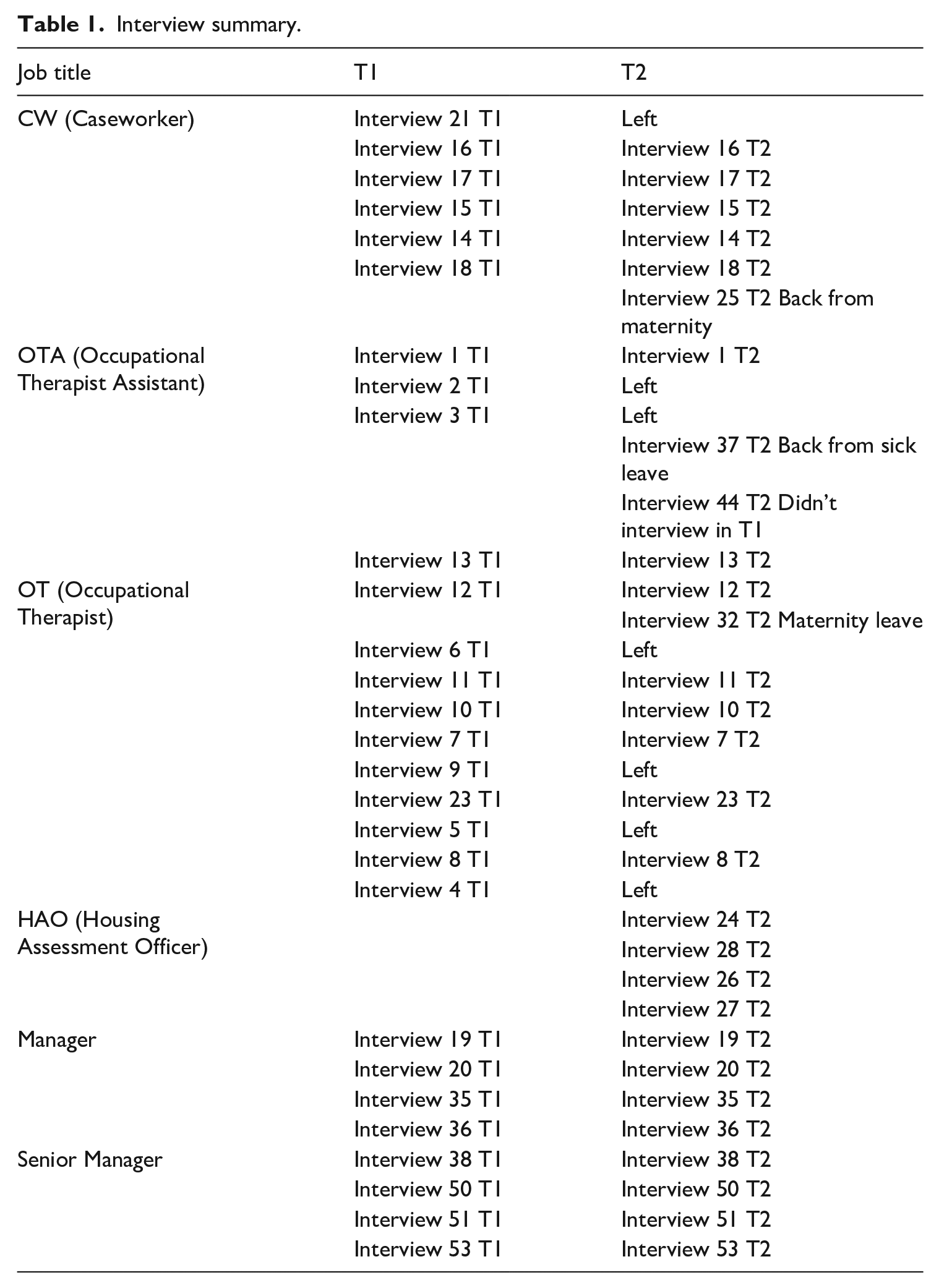
The first author also observed team meetings, training sessions, a workforce conference, a consultation meeting with all staff and managers, and three days observation in the office, totaling 45 hours of observation. Researcher notes from the observations were maintained chronologically and used in parallel with interviewees’ accounts to improve understanding of key activities in the workplace (Thorpe and Holt, 2008). In addition, we also gathered relevant documents, such as meeting minutes, training documents, and job description documents. The data collected were enriched by informal interactions with the interviewees—breakfast meetings, staff birthday drinks, and the Christmas lunch—where additional contextual information that was helpful in understanding the workplace dynamics was collected (Mantere et al., 2012).
Data analysis
We first analyzed our data according to the two time periods of data collection (T1 and T2). Our aim was to improve our understanding of the process of restructuring a new professional identity. We initially focused on the informants’ explanations about their work prior to and after the job redesign, and then directed our attention to how informants explained their responses to the changes in their roles. As we engaged with the data, we began to develop a deeper understanding of how people were restructuring a new professional identity.
Our insights emerged through open coding of our data. We developed first order codes by reading and re-reading the interview and observational data, paying close attention to people’s descriptions of their original and new roles, changes to people’s daily activities, and their reactions to the new role and the job redesign (see Figure 1). We also gave close attention to how people explained their interactions with each other, and similarly analyzed the observation notes associated with interactions during meetings and social events.
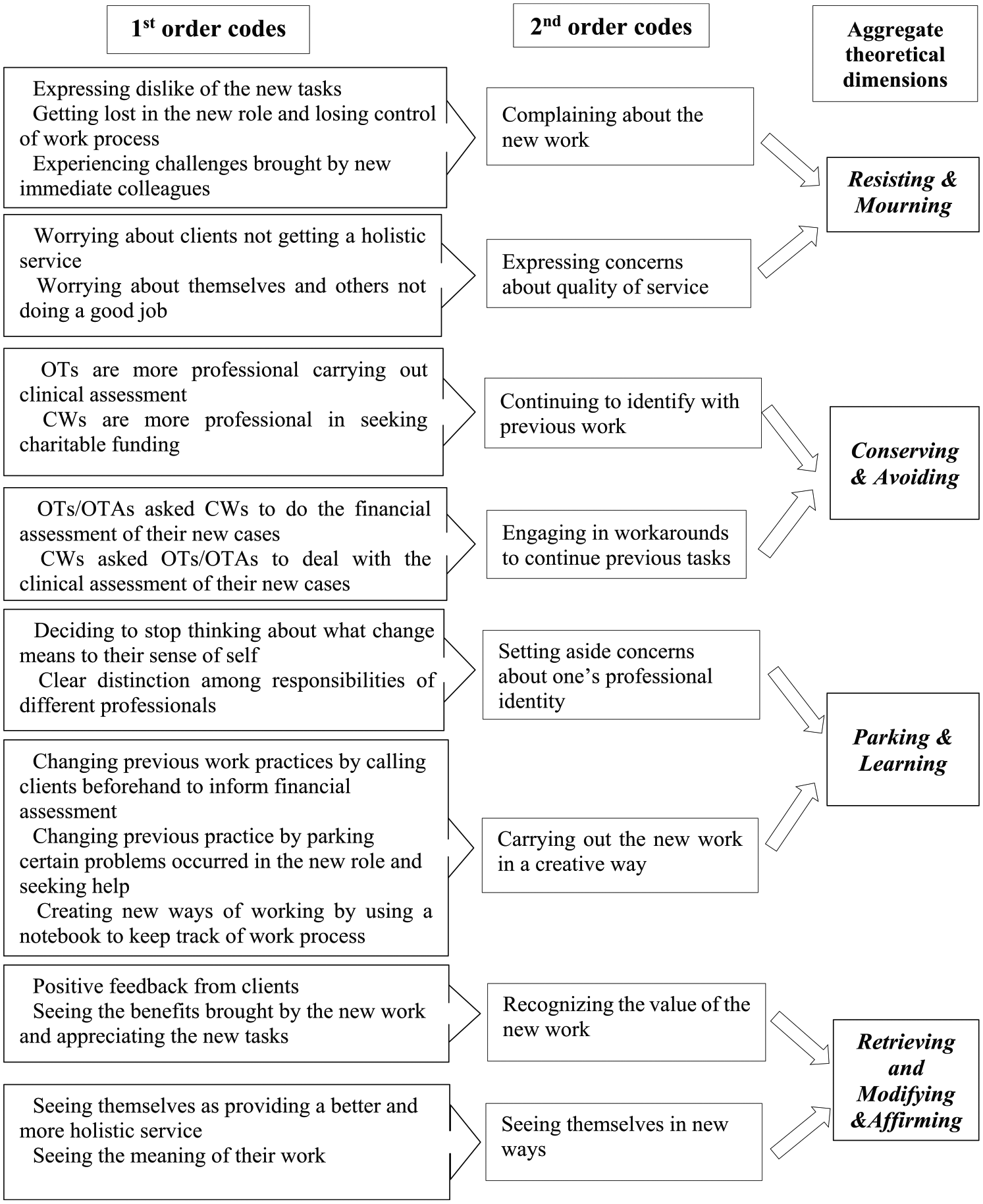
Coding categories.
We grouped the first order codes to identify second order codes, and then further grouped these to derive aggregate dimensions. We increasingly realized that people consistently talked about the nature of their work in close connection with how they saw themselves, and as a result, our coding reflected these connections. For example, second order codes “complaining about the new role” and “expressing concerns about quality of service” were grouped together into a higher-level code titled “resisting identity change and mourning loss of previous work” (Figure 1, Table 2). Our overall analysis shows four aggregate dimensions that we translated into four stages of professional identity restructuring (Figure 2).
Additional quotes.
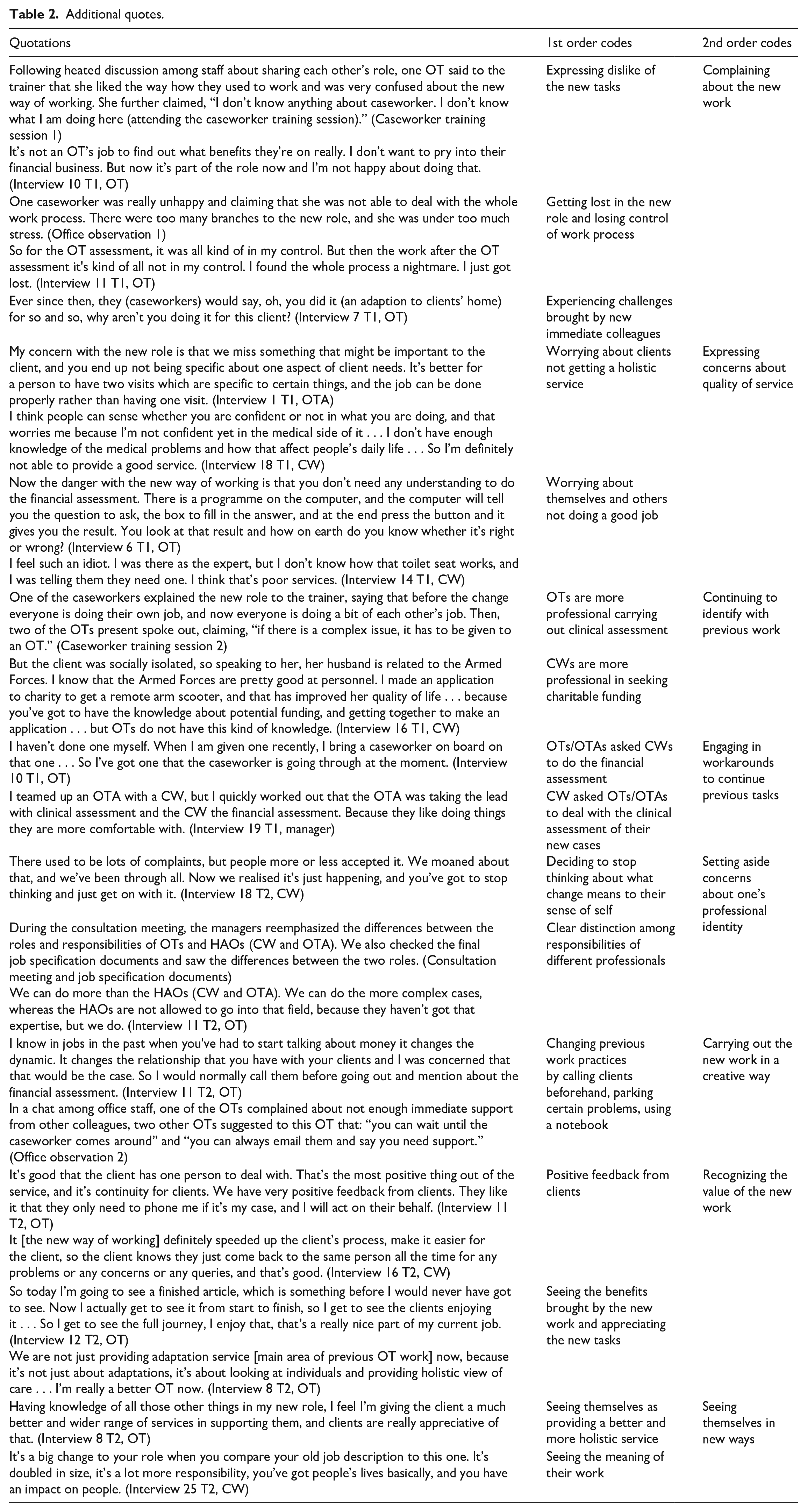
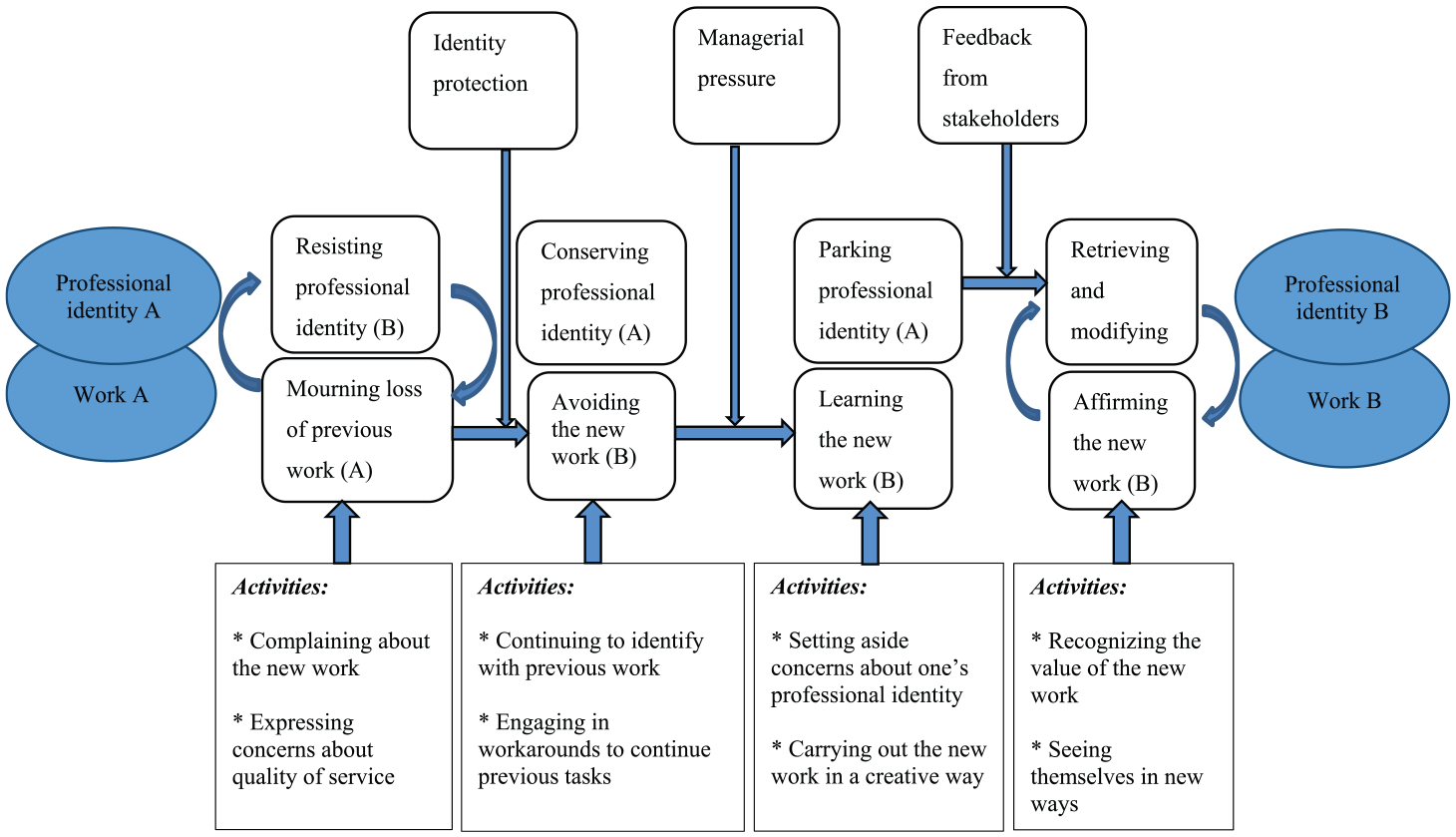
Professional identity restructuring.
Findings
Our data analysis shows how OTs, OTAs, and CWs first rebelled against the imposed work changes, and then engaged in a process we call “identity parking”—creating liminal space that enabled them to learn the new work. Only after fully engaging in the new professional work, they began to see value in the new work arrangements, and eventually began modifying their professional identity to match the new work they were doing.
In our initial interviews (T1), very soon after the job redesign was announced, employees angrily explained why their professional identity was mis-aligned with the new work arrangements. They told us how their view of themselves prevented them from adopting the new ways. For example:
I’m an OT. I’m trained to be an OT, not to fill out endless forms and apply to funding. (Interview 7 T1, OT) I’m a caseworker. My role is to help clients make grant applications from charities and organise all the practical side . . . I’m not a nurse . . . I’ve got no medical training. (Interview 14 T1, CW)
By the end of our study (T2), we heard very different accounts from interviewees. They said they could see value in the new ways of working, and that they saw themselves in a new way. That is, they seemed to have modified their own professional identity, as the following quotes show:
Casework has become part of my everyday role now. So I don’t think about the caseworks and the grants. I just think about how I provide a more rounded service to my clients. (Interview 7 T2, OT) I’m an OT who doesn’t have [the full] qualifications, because effectively that’s what we do. We do the same job (as OTs), but just at a different level. (Interview 27 T2, CW)
Since professional identity is known to be highly resilient and tightly connected with professional work, we wanted to understand how these professionals made this transition in professional identity, especially when they were initially adamantly opposed to the change. We focused on changes to both work and identity to reveal four types of identity work that professionals conducted as they engaged in a process of restructuring their professional identity. Below we explain each of these components of the professional identity work we identified and provide illustrative quotes.
Resisting identity change and mourning loss of previous work
With the redesign of their professional work, people initially strongly resisted even the idea of doing the new tasks. As part of this resistance, we noted that they were also mourning the loss of their previous role. They were angry and shocked that they were being asked to work in new ways—taking on tasks that they did not like and were not trained to do. They focused on their professional qualifications, and continually compared their current work with the new role, complaining bitterly at meetings and social gatherings and in the office. For example, the newly joined CW told us about a very negative atmosphere in the office. He was unhappy that other staff members were spending too much time complaining and dwelling on the past, as the following quote illustrates:
So [a caseworker] and me used to talk a lot, and we used to think a lot of people in the team were very negative and we used to think blimey, if everyone just got on with their jobs rather than moaning about everything, it would be okay. (Interview 24 T2, CW)
Interviewees mourned the loss of their previous professional work in two different ways. First, they complained about the differences between the new work they were required to do and their previous way of working. They explained that there was a dissonance between the required work and how they thought of their professional selves, and expressed dislike of the new tasks. For example, OTs and OTAs were not interested in financial assessment and found it to be a tedious job. Similarly, as one CW argued, she did not want to carry out a clinical assessment:
When somebody sits in front of you, and you are scrutinizing their bank statement, it’s very uncomfortable. It’s a tedious job to do . . . It’s not what I’m trained to do. (Interview 1 T1, OTA) I don’t like that side of the job. I’ve always enjoyed helping people, but the thought of assessing people getting on and off the toilet, getting in and out of the bath, doing all those personal and independent things, all leaves me cold . . . It’s not what I went to school for. (Interview 16 T1, CW)
OTs reflected on their previous professional work and education, pointing out strongly that they were trained as OTs rather than filling forms for financial assessment: “It [financial assessment] is very time consuming. I’m not motivated with that part of it, because it’s not healthcare. I’m trained to be an OT, not to fill out endless forms, applying to funding . . .” (Interview 7 T1, OT).
Some people expressed their very negative emotional responses to taking on new work activities that did not match their professional background. They contended that many aspects of their established professional role that they valued had been replaced by other activities that they disliked. They were concerned about losing significant parts of their professionalism. For example, some OTs and OTAs saw the new work as diluting their specialist OT knowledge and complained that they spent most of their time doing more administrative tasks compared with their previous role:
At the casework training session, Victoria (OT 4 T1) claimed that, “I don’t want my knowledge to be diluted; I am trained as an OT.” (Observation from staff training 1) If I take 100% of my time, I probably take 10% face [to face] client time, and 90% feeding the beast [doing administrative work] now, and that annoys me to death. (Interview 5 T1, OT)
CWs disliked the idea of doing the clinical assessment, and argued that the new role did not provide a holistic service to the client, a former source of professional pride: “It’s about looking at individuals and providing a holistic view . . . my biggest fear is that we become a glorified adaptation service. That’s not what it is about. We are losing all the other [professional] services” (Interview 14 T1, CW).
Interviewees also complained about the multitude of seemingly endless “non-professional” tasks associated with the new work arrangements, claiming that they were difficult to remember, and suggesting that they were not very important. They often found themselves lost in the process, and were frustrated that the new work requirements made them feel incompetent, compared with their previous roles where they considered themselves experts. With the redesigned work, people suddenly become novices in their professional jobs:
I knew exactly what I was doing before, and now what am I doing? What do I need to do next? Oh! I’ve forgotten that. Oh! I need this. Oh! I’ve got to send an email for that. It’s frustrating. (Interview 5 T1, OT)
They also complained about their new working relationships with colleagues and managers. Previously these professionals worked independently based on their personal expertise, focusing either on clinical or financial assessment, without being influenced or challenged by others. However, early in the implementation of the new work arrangements, OTs, OTAs, and CWs were required to work simultaneously on the same case, based on the underlying premise that they could help each other learn the new skills required. This approach led to unexpected challenges. For example, one OT was angry that a CW challenged her decision on clinical assessment and viewed such action as encroachment on her professionalism:
I was on a visit with a caseworker. The gentleman had dementia and mobility problems . . . I explained to him that I would give him a toilet seat and a frame together, so it’s steadier. I was basically pulled up, the caseworker interrupted me in the middle of talking to the client’s wife: “oh, why don’t you provide so and so instead?” I said: “I couldn’t.” She was undermining my professionalism, and I didn’t like it, I did not like it at all, I really was cross, how dare she? (Interview 4 T1, OT)
OTs and OTAs also noticed that managers tried to push them to take on more cases and worried that the new arrangements reduced professional autonomy:
[OT 4 T1] said, “I would not be pushed to do more visits than I physically and mentally could.” She also contended: “I have never been queried by the manager before. I do not like the fact that I have been queried of the work I’ve done.” (Staff meeting observation 2)
There was also concern about the potential danger for clients. Some worried that people may not get “quality services” because the new arrangements required professionals with only partial skills to provide a wide variety of services. Others were concerned about levels of education and expertise with respect to the provision of particular services, and could not understand why they were no longer allowed to use their own full set of skills. For example, CWs believed that clients should have a full assessment of their living conditions (as CWs were well experienced in doing) rather than only focusing on property adaptation that was part of the new work arrangements. OTs also doubted the abilities of OTAs and CWs in carrying out the clinical assessment part of the new role:
Adapting property is giving different options to clients. For example, it might be considered for some people to move to shelter accommodation, because they might be socially isolated. That’s what worried me about the job redesign, that we are only focused on doing adaptations, not looking at the bigger picture. (Interview 16 T1, CW) When you are working alongside somebody, who has never worked in a similar background, who has no knowledge of occupational therapy, it is very difficult to bring people in [to occupational therapy]. Occupational therapy is . . . very difficult to do if you’ve not had experience in that. It takes a long time. (Interview 7 T1, OT)
With the initial implementation of the new work arrangements, professionals resisted the new work activities and mourned the loss of their previous professionalism. They complained loudly about the differences in their new work responsibilities and worried about being unable to use significant parts of their professional knowledge and expertise. Their sense of professional responsibility also led them to express concern about the welfare of clients, and they consistently pointed out the dangers of lower quality service with the new arrangements. Most professionals were adamant that they should be able to continue providing services that matched with how they viewed their professional selves. The job redesign threatened their professional identity and was at odds with their professional practices. To protect their identity, professionals began to secretly rearrange work with their colleagues, finding ways to avoid the new work by continuing to engage in only their old work activities. We explain these actions in the next section.
Conserving previous professional identity and avoiding the new work
As professionals slowly began trying some aspects of the new work arrangements, often because they had no choice, they conserved their previous professional identity by claiming they were better than other professional groups. They avoided the new work by finding someone else to complete tasks they did not want to do, thus protecting their professional identity.
As a way of reaffirming their professional selves, they claimed they were better at tasks within their previous remit compared with the other professional groups. For example, OTs argued that CWs and OTAs needed the help of a screening tool to carry out clinical assessments, which could (wrongly) prevent them from noticing body actions (which OTs believed was a critically important part of the assessment):
When we went out on a visit, caseworkers take their tablets. I use my own notes on a visit. I don’t use tablets on my visits. I think it’s a barrier to clients, and usually you can observe a lot of body actions when you are speaking to somebody. (Interview 8 T1, OT)
Professionals were initially required to team up to provide services, so they could learn from each other about how to perform tasks that were new to them. Their initial response was to find ways to modify the new work role and continue doing the aspects of work with which they were experienced. That is, they unofficially divided the work among themselves in ways that replicated their established practices and engaged in workarounds to continue previous tasks. As a result, professionals temporarily manipulated the intended new work arrangements by reshaping the division of work among team members in ways that helped to protect their professional selves. As shown below, OTs and OTAs asked CWs to do the financial assessment for their new cases, whereas CWs tried to avoid doing the clinical assessment:
We are working with the caseworkers a couple of times. Before we go out, we say, right, I’m going to ask about this bit [clinical assessment], and you ask about that bit [financial assessment]. We would encourage each other to keep doing our [previous] role. (Interview 2 T1, OTA)
At this stage, and not surprisingly, some professionals found jobs at different organizations so that they could maintain their established work practices and professional identity. Those who stayed in the organization, went through an unsettling stage of looking for answers as to who they were and who they were going to be. When trying the new work, professionals found it difficult to identify with the new role; this led to a few more professionals leaving the organization, as the following quote shows:
[I’m leaving for a new job.] It is similar [to what I used to do as an OTA] . . . If we find a case that needed a shower or stair lift, we just pass it through [to caseworkers]. We actually do the [clinical] assessment and send it through. (Interview 2 T1, OTA)
In this second stage, professionals found ways to conserve their previous professional identity and avoided the new work. By engaging only in tasks that they valued, they stayed true to their previous professional selves. They avoided the new work by partnering with colleagues and rearranging their tasks so that everyone continued to do their old work. However, as managers began to realize that professionals were continuing their old ways of working, they demanded that professionals take on the new work and stop the secret arrangements; managers ensured professionals worked alone, rather than teaming up on one case. As a result, professionals who wanted to keep their job had little choice, and grudgingly began to learn the new work.
Parking professional identity and learning the new work
With pressure from managers who wanted to stop the unauthorized division of tasks according to established professional backgrounds, team members were compelled to learn and carry out aspects of the new work. During this stage, professionals found ways to set aside concerns about their identity and engaged in what we call “parking” professional identity by deciding to stop thinking about what the change meant to their sense of self. By parking their professional identity, they were able to reduce cognitive overload and give themselves a sense of at least temporary stability by creating mental space for learning the new work.
With increasing pressure from managers to fully take on the new role, professionals realized that unless they left the organization, they would have to learn the new work. Interviewees said they decided to stop thinking about what the new work meant and “just get on with it.” As the following quotes show:
I kind of just realized it’s got to be done. So I stopped having all these worries, just think to get on with it. That’s the way they want to do it, you just kind of think, just get on and do it. (Interview 1 T2, OTA) I think it will just carry on as it is. That’s the way we are going. That’s the way they [managers] wanted to go. I don’t think it will stop. You’ve just got to do it. (Interview 17 T2, CW)
OTs were originally worried that OTAs and CWs would take over their jobs, but over time, they realized that OTAs and CWs could only deal with the relatively straightforward cases; more complex clients required OTs for at least some aspects of their care. As a result, they reestablished their relationships with immediate colleagues and began to develop new distinctions among the responsibilities of different professionals in the new work arrangements, as illustrated here:
If a case comes in, if it is complex, or somebody is terminally ill, if they’ve got complex neurological conditions, or if there are other complex issues, it’s for OTs. If it is a straightforward adaptation, then the OTA can do that, but anything more than that, it has got to be passed to an OT. (Interview 19 T2, Manager) The OTs are getting much more of the cases that are suitable for us, which I don’t believe OTAs or CWs could manage . . . It would be beyond their realm of skills . . . The others can do those more straightforward things, so the OTs have got more time to deal with more complex cases. (Interview 8 T2, OT)
Professionals began to gain proficiency and a clear understanding of the new work through ongoing practice and formal training in both clinical and financial assessment. Their increasing level of competence and confidence also equipped them with the ability to make alterations to the work in ways that fit with their own needs. As a result, employees became comfortable with the new tasks and incorporated them into their everyday workplace routines:
There is a lot more formal training. Every member of the team has to undertake some significant training as well as mandatory training we have to do every year. (Interview 1 T2, OTA) I’ve learned how to discuss someone’s finance in a way, that isn’t too intrusive, to put the client at ease, to ensure that they know all the information that’s necessary . . . so I’ve worked out my own way of discussing it, and it seems to be working. (Interview 7 T2, OT)
Professionals carried out their new work tasks in creative ways that allowed them to modify tasks they disliked most. OTs and OTAs found that they felt better if they called clients before a home visit to inform them that as part of the overall assessment, bank statements would be required and that these statements would have to be scrutinized. Calling clients beforehand helped professionals accomplish the new task—the financial assessment, with new and creative routines that did not exist prior to the job redesign:
It wasn’t part of the established routine, but I decided to let people know ahead of time that I have to see their bank statements, so people are forewarned, which I found really helpful. (Interview 37 T2, OTA)
Professionals also developed new resolutions to problems that occurred. For example, CWs put aside problems they couldn’t immediately solve and asked for help later. They sometimes left the clinical component of the assessment form incomplete while going ahead with the financial assessment. Then, later that day or the next day they sought help from colleagues to resolve their problems, and then finished the required documentation. This help-seeking occurred in person or through email after client visits. This approach reduced frustrations and allowed professionals to maintain their sense of competence and appear confident in front of clients: “There is no pressure on a visit to make an on-the-spot decision, so I’ve always given myself some time to think about a case and seek help if needed, then come back to the clients” (Interview 25 T2, CW).
Another example of modifying work tasks to maintain control was the use of a paper notebook to track tasks that were done and those still remaining. Although the notebook was a low-tech innovation, they found it to be very effective and professionally comforting because it introduced structure to the confusion that could otherwise arise:
I’ve got a book I write everything down, just to give me a little memory jog, because it’s easier just to look through my paper book . . . So I’ve got a bit of a quick memory jogger in my book: what’s been done, and what I need to do, so that’s how I manage it. (Interview 1 T2, OTA)
During this stage, professionals set aside worries about their previous selves, allowing them to concentrate on learning the new work. While practicing the new role, they became clear about the requirements of the new work and developed creative ways to do it, which helped them to regain a sense of competence and expertise. As professionals became increasingly comfortable with the new ways of working, they began to recognize that there could be value in the new arrangements for clients, as we explain in the next section.
Retrieving and modifying previous professional identity and affirming the new work
As professionals increasingly recognized value in their new work, they revisited their identity that they had previously “parked” while they learned new tasks. We call this “retrieving” their professional identity from a virtual parking lot. The temporary separation from their identity seemed to facilitate a process of seeing themselves in new ways.
Clients liked the new arrangements—they were happy that they only needed to work with one staff member, rather than both an OT and CW, as was required in the old model. They appreciated that they were no longer “passed from one person to another” and they believed that their needs were being met better than in the past. Interviewees heard more and more positive feedback from clients, and as a result developed increasing levels of positive engagement with the new work role:
I was kind of surprised how much clients like the new model. Having one person to work with, so that they don’t get passed from one person to another—they say it’s definitely a benefit. We have really good feedback from clients about it, and they know who to phone. (Interview 15 T2, CW)
Professionals increasingly recognized benefits of the new work arrangements as they participated in public speaking events with members of the community. For example, they were invited by management to represent and promote the job redesign initiative to other organizations in conferences and other public events:
[Researcher notes] On a car journey back from the conference, OT and CW were wildly enthusiastic about presentation by an organisation that had already done the same job redesign as they were going through. Both said they were proud that they already learned the required new skills and could help clients better. They seemed to be seeing their own roles in a whole new [positive] light. (Observation notes) I did a poster last month for an event to promote our team . . . through doing the event I can now see where the managers are coming from, and why they wanted to try this job redesign initiative. (Interview 7 T2, OT)
CWs and OTAs told us that they gained OT knowledge as they increasingly carried out OT related work; they were proud about learning new skills, and happily talked about feeling like a “fake” OT (a positive term used by several interviewees to express their new work role) or an “OT without formal qualifications.” OT skills and knowledge were highly regarded by both employees and managers of the organization, and the CWs began to take pride in their broadened expertise. As the CW role increasingly became part of OTs’ and OTAs’ remit, they valued their abilities to see cases through from beginning to finish:
[Researcher notes] Overheard staff talking in the office. CW was asked if he wanted to be an OT. He smiled and replied jokingly, “I am already a fake OT.” (Office observation 3) It’s [clinical assessment] quite interesting! I’m enjoying it. I’ve learned more about this incremental approach, about trying the equipment. You first try to offer one person [a certain type of equipment], and gradually scale up. I think that’s been quite interesting. (Interview 15 T2, CW) I wouldn’t want to hand back my casework side now. I want to carry on seeing the case through from start to finish. (Interview 1 T2, OTA)
This positive feedback and benefits gained from the new work paved the way for professionals to reconsider their professional identity. As they retrieved their identity, they were able to gain new insights about how they could be even better and began to see themselves differently. OTs and OTAs said that before the job redesign, they believed they provided good service by using their expertise in occupational therapy to deliver services that clients needed to live independently in their own homes. CWs said that in their previous roles, they provided clients with what they needed to live an independent life by helping them apply for charitable funding. All professionals had seen themselves as experts in their respective areas and believed in the value of their expertise.
However, as professionals performed and mastered the new work tasks, they began to appreciate their new professional selves and the value of being able to provide more rounded services for clients. They developed new ways of seeing their previously “parked” professional identity, realizing that they now thought about themselves differently in connection with the new work. We see this as retrieving their identity from its parked location and realizing that their view of themselves was altered in the process. Specifically, CWs and OTAs began to realize they were happy with their new professional role of helping clients with both clinical and financial assessments. OTs believed that with the new work arrangements, they had become better professionals who could better meet the needs of their clients by helping them live independently at home. They also reported feeling surprised that they actually enjoyed helping clients with knowledge of the financial aids available, as well as knowledge about clinical assessment:
I do enjoy it [the new role] and I feel more valued and more skilled now, because I have got all the extra bits that we could offer clients. (Interview 16 T2, CW) It’s a holistic service now, that’s the idea; we are learning the job of a CW. We used to focus on adaptation, but it’s not as holistic as the service now is, which is better, because we do quite a lot of different things to provide our service now, not just the disabled adaptation. (Interview 12 T2, OT)
Because the new work arrangements ensured that professionals worked on a case from start to finish, they began to take ownership of the overall work; this allowed them to find deeper meaning in their work, rather than feeling like a cog in the operation line. They reported feeling that the new way of working enabled them to get a better picture of outcomes for the client, whereas previously they were only responsible for part of a finished product:
I find it [the new role] satisfying because it’s hands on, and there is a payoff. You get to see outcomes, rather than just a cog somewhere in the chain. (Interview 27 T2, CW) It’s a better way for me as well, because it’s job satisfaction at the end of the day. You see something being done from start to finish, and you’ve been part of that, it feels good. (Interview 32 T2, OT)
During this stage, we observed that OTs, OTAs, and CWs responded to positive feedback from clients and began taking on a new multi-faceted professional identity associated with the new way of working (i.e., the holistic care approach). Thus, they began to think about themselves differently, suggesting they had modified their professional identity as part of the process of engaging with the new work.
Discussion
We wanted to understand how professionals can change their identity in response to an imposed job redesign. As shown in Figure 2, we developed a process model based on our findings that shows four dynamic stages that people moved through as they changed from their previous professional identity (A) and previous professional work (A), to a new professional identity (B) associated with new professional work (B). We show how professionals moved through these stages and developed new ways of thinking about themselves and their work.
Our model suggests that when a job redesign is first introduced, professionals are likely to resist changing either their work or their identity. Professionals are autonomous workers and highly resistant to change (Currie et al., 2012; Reay et al., 2013); however, as professionals are increasingly employed in organizations, they face situations where they are required to work in different ways (Muzio et al., 2020). Professionals in our case mourned the loss of their previous work role in the following two ways. On the one hand, they focused on themselves by complaining bitterly about being asked to take on new tasks they did not want to do. On the other hand, they focused on the needs of their clients, suggesting that they should not take on the new way of working because clients might receive poorer quality services since the professionals lacked the appropriate knowledge and skills.
In the second stage, professionals were clinging to their professional identity and avoided the new work by engaging in a number of work-around activities. They asked each other to perform assessments (clinical or financial) that were not part of their previous role; this helped professionals to conserve their previous professional identity, and allowed them to avoid engaging in the new work. They publicly asserted “who they were” and “who they were not” claiming they were better in providing services that were within their previous role remit. At this stage, professionals did not let go of either their previous identity or their established work. They maintained their professional boundaries and conserved their professional identity (Abbott, 1988; Currie et al., 2012). Our findings support previous studies suggesting that in cases of job redesign, professionals are likely to perform “identity-protection responses” (Petriglieri, 2011: 647) and try to eliminate the source of the threat. In this second stage, professionals protected their identity. Some did this by finding work in a different organization where they could continue to work in the old way and continue to adhere to their old professional identity.
In our model we show how in the third stage, because of managerial pressure, professionals who stayed with the organization had no option except to fully engage in the new work. To do this, they “parked” their professional identity (set it aside). We suggest that parking one’s professional identity can create a liminal cognitive space, where professionals’ are able to temporarily suspend their preconceptions (Shortt, 2015; Söderlund and Borg, 2018) and fully engage in learning new work. In this stage, professionals also reconfigured the boundaries of their responsibilities and began to develop skills required for the new role. We see that by parking their identity, professionals created liminal space where they could manage new work in innovative ways. This conceptualization of liminal spaces as sites of creativity builds on previous research showing how new ideas and practices can be generated in zones of in-between-ness (Ibarra and Obodaru, 2016; Swan et al., 2016).
Positive feedback from stakeholders enabled professionals to move to the next stage of modifying their professional identity. This is when they began to see themselves in a new way—they started developing a new professional identity in connection with their new work. We term this stage as retrieving and modifying professional identity and affirming the new work, which involves recognizing the value of the new work, and seeing themselves in new ways. An important component of the process was that professionals experienced positive feedback from clients and gained personal satisfaction from learning new skills. With ownership of their own cases, professionals were also able to appreciate the meaning of their new work. Similar to previous research, our findings show how experiences during a temporary period of liminality can influence the development of new perspectives (Ibarra and Obodaru, 2016; Söderlund and Borg, 2018). Our model shows how professionals can overcome previous skepticism about new work by engaging in new practices, similar to previous research (Reay et al., 2013). However, our findings go further to help explain how seeing a new role in a positive light can then lead professionals to recognize changes in their own sense of self. In our case, as professionals recognized they were providing better and more holistic care, they were able to retrieve their previous identities but also modify them in light of the new work and their newly realized values.
Our study contributes to the current literature in the following three ways. First, as shown in Figure 2, we developed a process model delineating four stages of professional identity restructuring: resisting identity change and mourning the loss of previous work, conserving previous professional identity and avoiding the new work, parking previous professional identity and learning the new work, and retrieving and modifying a new identity and affirming the new work. We propose that this model adds to the literature on professional identity change by showing how professionals who are required to change aspects of their work may be able to move through a series of transitions where the relationship between professional identity and work can be at least temporarily severed. Our findings suggest that the impetus for moving from one stage to the next changes. Professionals moved from stage one to two because of identity protection, from stage two to three because of managerial pressure, and from stage three to four because of encouraging feedback from stakeholders. Without these factors, we suggest that the transition process could become bogged down at any time. Similar to previous research (Pratt et al., 2006), our model shows that violation of work-identity integrity is likely viewed as an identity threat by professionals, but can eventually lead to the formation of a new professional identity. Our model stands somewhat in contrast to Petriglieri’s (2011) proposition that individuals respond to such threats by either protecting or restructuring their identity; our findings show that both responses can occur in sequence when professionals first engage in identity protection, but over time begin a process of restructuring their identity.
In particular, our model highlights the importance of changes in professional work that occur in tandem with alterations in professional identity. We suggest that professionals can temporarily disentangle their work and identity, and then later recombine them as they master the new work. By continually hanging on to either identity or work at any one point in time, professionals can engage in a series of steps as they move from professional identity (A) to professional identity (B). We conceptualize this process as being similar to climbing a ladder—moving from one rung of the ladder to the next. It is only through the mastery of new tasks that professionals can see value in the new work, and then begin to reconceptualize their professional identity. Our mental picture of climbing a ladder is conceptually helpful, because sequential attachment to either work or identity enables professionals to experiment and take small steps along the path rather than take giant leaps. In contrast to Ibarra and Obodaru’s (2016) suggestion that people will be better off by integrating their new and old identities rather than focusing on one of the identities during change, we suggest that established professionals may not be able to easily contemplate such integration. People who hold dual identities may be better able to adapt to change (Berry et al., 2006), but established professionals are typically firmly situated in their identity. We propose that such professionals can best navigate change one step at a time.
Our second contribution to the literature on professional identity change is by showing the importance of “parking” (or setting aside) one’s previous professional identity in order to fully engage with new professional work. Building on Petriglieri (2011), we argue that identity parking is a way of coping with identity threat and enables professionals to move from identity protection to identity restructuring. Identity parking allows professionals to move away from their initial anger and sadness associated with demands to change the nature of their work (identity protection); it also gives them the distance and time to learn new work, thus facilitating their engagement in meaning change (Petriglieri, 2011) as a key component of professional identity restructuring. Identity parking can serve as a way to temporarily manage a disjuncture between the work that people are required to perform and how they see themselves. It also shows the potential for intentionality and purposeful change that professionals can undertake as a positive way of coping with identity threat.
Although our concept of identity parking has some overlap with Pratt et al.’s (2006) concept of identity splinting, we suggest that established professionals (in contrast to those who are learning to advance their professional skills, such as medical residents) may need to create a clearer distance from their past identity. We propose that temporarily, but clearly breaking the connection between identity and work may be a critical step in the change process for established professionals. However, identity parking is understandably difficult for professionals who strongly identify with their profession (Abbott, 1988; Freidson, 2001). With an increasing number of professionals employed in organizations and with “institutional decay” in terms of professionals regulating their own profession (Muzio et al., 2020), professionals must find ways to adapt to employer required changes. Identity parking provides people with the opportunity to try out new ways of working, similar to findings by Reay et al. (2013); however, our study provides additional insights into the process of putting new ideas into practice by showing how professionals can develop more positive evaluations of required new work if they have the opportunity to develop their own ways of accomplishing the new tasks.
Our final contribution is to the literature on liminality as an important component of professional identity change. Our findings suggest that liminality can be created by parking (setting aside) one’s professional identity to create a cognitive space where their preconceptions of self are suspended (Shortt, 2015; Söderlund and Borg, 2018). Liminality allows professionals freedom from past cognitive constraints to learn new work and find creative ways of managing new challenges (Bamber et al., 2017; Ibarra and Obodaru, 2016; Shortt, 2015; Swan et al., 2016). Instead of enabling the coexistence of the “old” and the “new” for a limited period of time (Howard-Grenville et al., 2011), our case suggests that liminality can serve as a way to put the “old” on hold, but not abandon it, while trying out the “new.” This can occur by suspending judgment on particular issues to open up alternative possibilities rather than engaging in ongoing rumination.
Previous studies have shown that the duration of a liminal experience can impact on identity—a very long period of liminality might lead to “twixters” (those who are trapped in being in-between) while a short time of liminality might not lead to the expected positive outcomes (Ibarra and Obodaru, 2016: 60). Extending these important considerations, we show that not only creating liminality is important; it is also critical to conclude the period of liminality as occurred in our study when professionals retrieved their professional identity. It is through the closure of liminality that modifications and restructuring of identity can take place. We suggest that such periods of liminality may be especially important for established professionals who are well-embedded in their roles, in contrast to less experienced professionals such as those advancing their careers (e.g., Ibarra, 1999; Pratt et al., 2006). In contrast to previous approaches showing that work and identity change go hand in hand (Reay et al., 2017), our study shows the importance of a clear disruption.
Conclusions
We wanted to understand how professionals can restructure their professional identity in response to job redesign. Based on our findings, we identified four stages involved in this process: (1) resisting identity change and mourning the loss of previous work, (2) conserving professional identity and avoiding the new work, (3) parking professional identity and learning the new work, and (4) retrieving and modifying a new professional identity and affirming the new work. We revealed that a temporary liminal stage of separating professional work and identity is important because it allows established professionals to set aside or park their professional identity while trying out new professional work. Without the creation of this liminal cognitive space, professionals tend to be so tightly connected to their established identity that they cannot engage open-mindedly with new work. We show that professionals can learn to appreciate new work if they have time and space to creatively make modifications that generate positive outcomes for clients. We suggest that our stage-based model provides new insights that improve our understanding about the process of constructing a new professional identity.
Our study also helps to explain how managers can provide support to facilitate required changes in professional work. The relationship between organizational managers and professionals will always hold some level of tension, since professional practice must be guided by professional standards as well as those of the organization. However, managers could help by setting the stage and providing conditions to create liminality—giving encouragement and time for professionals while pushing them to try and learn the new role. In our case, managers did not allow professionals to continue engaging in workarounds, but pushed them to take on the new work. In order to monitor such situations, managers must stay well informed and closely engaged with professionals, so that they are aware of practices at the front line. In addition, well-informed managers can better evaluate the most appropriate time when professionals might be willing to set aside their preconceptions of what they should do as professionals and help them engage with the new work; strategies to accomplish this include training courses and senior mentoring schemes. Our findings also provide valuable insights into how professionals can positively respond to a job redesign or other changes to professional work. Professionals must be actively involved in trying out the new work and learning first-hand how it affects them and their clients. It is crucial that professionals try to reserve their judgment on anomalies and set aside their deeply-rooted understanding of what they should do as professionals. By suspending their judgment of new work and their professional selves (with the help of, and pressure from managers), they can create a liminal space that allows them to be more open-minded.
Overall, we believe that this study helps to advance knowledge about how established professionals can respond to changes in their work, particularly when those changes are brought about by events outside their control such as imposed job redesign or organizational restructuring. Similar to all qualitative research, we cannot predict to what extent our findings are broadly generalizable; however, we suggest that our results could be extended to other settings where professionals employed within organizations are required to take on more diverse skills that include multidisciplinary work. Interdisciplinarity is increasingly a requirement for university education and practices in the workplace, and professionals are frequently expected to bridge gaps across disciplines (Repko and Szostak, 2017). Future research could explore how the increasing multidisciplinarity of professions is interpreted and responded to by professionals themselves. Our study is particularly relevant for understanding workplace changes where different professional groups exist, and where collaboration is essential to their work. We therefore suggest researchers explore how different professional groups negotiate their identity in other collaborative environments and how collaboration affects their identity construction. We hope that our study helps to encourage others to pursue such research in the future.
Footnotes
Acknowledgements
We thank the associate editor Timothy Kuhn and two anonymous reviewers for their constructive comments. We are also grateful to Graeme Currie, Gerry McGivern, and Mark Learmonth for their valuable feedback on earlier versions of this article. The research was conducted while Yaru Chen was a PhD student at Warwick Business School. Yaru Chen would like to thank PubPri Research Group (University of East Finland) and NIHR CLAHRC WM for the financial support for her PhD study. We also thank the interviewees who participated in our study.
Funding
The author(s) disclosed receipt of the following financial support for the research, authorship, and/or publication of this article: Public & Private Health and Social Care Scholarship (a joint scholarship between PubPri Research Group, University of Eastern Finland and Warwick Business School), The National Institute for Health Research Collaboration for Leadership in Applied Health Research, and Care West Midlands (NIHR CLAHRC WM).
