




Abstract
What happens when people try to ‘transcend’ organizational boundaries and engage with so-called outsiders? Current boundary-work literature does not fully account for the processual, dispersed, and political dynamics triggered by such efforts. To address this shortcoming, this article builds on an ethnographic study of a professional care provider’s attempts to engage local citizens within one of its care homes. We analyze how actors negotiate the parameters of outsider engagement – that is, how they interactively (re-)erect and (re-)efface boundaries between actors (Who is engaged?), issues (What is their engagement about?), and positions of authority (Does local engagement affect central decision-making?). We contribute to extant theorizing by, first, explicitly scrutinizing boundary work’s temporal and spatial dynamics. Testifying to the importance of analyzing temporal sequences, we show how attempts at transcending boundaries intensified boundary work on multiple organizational platforms. Paradoxically, inclusionary efforts evoked exclusionary effects (and vice versa) as actors came to contest and, eventually, redefine ‘appropriate’ insider–outsider relations. Second, our analysis highlights how the political effectiveness of an inclusive and non-hierarchical approach still, ironically, depends on ongoing hierarchical support and managerial enforcement. Third, our article makes a case for the adoption of long-term, multi-sited methodologies when studying the everyday dynamics of boundary-work processes.
Keywords
Introduction
In popular organization and management literature, the image of the boundaryless organization has popularized the notion of actors, ideas, and products flowing freely across contemporary organizations’ notional boundaries. Likewise, academic literature tends to treat organizational boundaries as fluid and porous (Hirschhorn and Gilmore, 1992; Kellogg et al., 2006). While this premise forms a welcome rebuttal to static conceptions of boundaries as ‘something stable “between” individuals and groups, organizations and environments’ (Heracleous, 2004: 101; see also Ellis and Ybema, 2010; Hernes, 2004; Wright, 2009), its emphasis on fluidity, permeability, or ‘boundarylessness’ risks creating an equally skewed counter-image in which boundaries are seen as increasingly insignificant to organizing (Paulsen and Hernes, 2003). In order to reconcile such ‘solid’ and ‘liquid’ boundary conceptions, scholars have demonstrated that organizational boundaries are potentially both divisive and permeable, rigid and fluid. Depending on their particular context and situational relevance (Sturdy et al., 2009b), boundaries may be strategically enacted to function as bridges or as barriers. By acknowledging that they are a negotiated but nonetheless ‘essential medium through which people acquire status and monopolize resources’ (Lamont and Molnár, 2002: 169), a growing amount of research highlights the political character of boundaries within organizational processes (e.g. Alvesson et al., 2009; Bucher et al., 2016; Wright, 2009).
While these accounts do conceptual justice to the recursive relationship between boundaries and the organizational practices from which they emerge (Zietsma and Lawrence, 2010), we believe that extant literature has underresearched the processual, dispersed and political dynamics of boundary-work processes and undertheorized the temporally interlocked sequences of ongoing, multi-sited boundary negotiations. Current boundary studies have, for example, examined the contested legitimacy of organizational actors and practices within a particular field (e.g. Zietsma and Lawrence, 2010), the various strategies by which actors defend or challenge their positions (e.g. Bucher et al., 2016), and the different kinds of boundaries (e.g. physical, social, and mental) they uphold or break down, each of which holds the potential to structure social relationships in various ways (Hernes, 2004). Although these studies illustrate that recent literature has indeed moved beyond one-dimensional and overly simplistic boundary conceptions, they often continue to reify boundaries, that is, they downplay the sequential and interconnected character of disparate, often-contested boundary enactments – an awareness of which, we contend, is crucial to fully understanding boundary-work processes. For instance, some scholars have explored how boundaries ‘operate’ (Vakkayil, 2012: 216) or scrutinized the ‘state’ of boundaries – for example, by observing the ‘[s]trong boundaries around a field’ (Zietsma and Lawrence, 2010: 190) and how these may remain ‘intact’ or become ‘compromised’ (2010: 209). Such accounts, even when empirically focused on the processes in which boundaries are negotiated, remain at risk of theoretically treating boundaries as ‘separated and disconnected from the process[es] that created them’ (Bakken and Hernes, 2006: 1601). Moreover, by empirically concentrating on boundaries as being relatively singular demarcations of a field, jurisdiction, or work unit, scholars often end up exclusively focusing on boundary spanners and their cross-boundary activities (e.g. Ellis and Ybema, 2010; Kellogg et al., 2006). Inadvertently, such vernacular may insufficiently account for boundaries’ plural nature, the processual and potentially paradoxical effects of their enactment, their contingency upon boundaries that are drawn and negotiated elsewhere, and the political implications of their dispersed negotiations. While this critique resonates with the work of critical scholars who have also highlighted the convoluted dynamics of insider–outsider relations (Sturdy et al., 2009b; Wright, 2009), we contend that this literature has empirically not yet fully accounted for – and subsequently theorized – the unfolding processes in which boundary work is ‘done’.
Building on an ethnographic study of actors’ dispersed negotiations over the nature, scope, and significance of citizen engagement within a professional care facility, we set out to untangle the (dis)connections between boundary enactments that are performed over time and across different sites. This allows us to illuminate how such dynamics both affect and reflect the shifting power relations among the actors involved. To better account for boundary work’s processual, dispersed, and political character, we ask: (1) how do actors’ disparate boundary enactments interact across time and space; and (2) how do such boundary-work sequences interact with the power relations among those actors whose respective positions are renegotiated in the process? By empirically grounding our analysis in the multiplicity of micro-interactions we observed in different locales throughout our fieldwork, as well as in both its moment-to-moment and longer-term dynamics, we are able to contribute new insights to the current literature. First, we develop a processual approach to boundary work for investigating actors’ interconnected negotiations over divides between different actors (insiders vs. outsiders), issues (on vs. off the agenda), and authority positions (more vs. less able to exert influence beyond a formal mandate). This approach allows us to empirically demonstrate how disparate boundary enactments can be interlocked – that is, how attempts at boundary effacement inadvertently trigger boundary (re-)enactment, and vice versa. Second, our analysis suggests that the ‘transcendence’ of established hierarchical positions does not mean that power asymmetries between actors become irrelevant. Even when outsider engagement becomes the formal policy imperative, its significance and viability, paradoxically, continues to depend on ongoing hierarchical support for ‘non-hierarchical’ organizing. Third, our article shows that empirically studying messy, convoluted boundary processes calls for the adoption of long-term, multi-sited methodologies.
In what follows, we begin by critically reflecting on existing organizational-boundary studies. Next, we turn to our ethnographic study of a professional care organization’s pursuit of citizen engagement – analyzing the processes in which actors try to (re)open and (re)erect new and traditional boundaries between actors, issues, and positions of authority. In the final section, we discuss our findings’ implications for boundary-work theory and research.
Boundaries as temporal, situational, and contentious constructs
Over the past decades (Child, 1997; Miles et al., 1974; Santos and Eisenhardt, 2005), scholars have increasingly acknowledged the need to soften the notion that boundaries are pronounced, one-dimensional demarcations between an organization and its environment. Wright (2009), for example, demonstrates the ambiguity of organizational membership in his study of internal consultants who – being positioned inside an organization’s formal boundaries but acting outside its hierarchy – strategically maneuver in order to accentuate their identity as either an insider or outsider, depending on its situational relevance. Likewise, Garsten (1999: 612) points to the liminal position occupied by temporary employees who are drawn ‘more closely into the normative organizational order’ by organizational leaders, while still being considered strangers in the workplace and excluded from the benefits enjoyed by those with full-time employment. Such accounts demonstrate that the notion of a boundary should not, conceptually, necessarily be tied to the idea of a formal organizational bureaucracy with clear-cut demarcations of membership, roles, and responsibilities. Instead, they highlight the socially constructed and situational nature of actors’ status as an insider or outsider (whether self-proclaimed or ascribed by others). This, however, does not mean that boundaries have become any less important to structuring organizational life (Paulsen and Hernes, 2003). On the contrary, highlighting their ‘multiplicity, complexity and dynamism’ (Sturdy et al., 2009b: 42), boundaries have been stated to reflect the ‘essence’ of organizing (Santos and Eisenhardt, 2005).
In order to explore the intricacies of boundary work in organizational settings, we discuss boundaries’ (1) processual, (2) dispersed, and (3) political character. Our discussion shows that while, on the one hand, extant scholarship has demonstrated boundaries to be temporally and situationally constituted – negotiated as concrete stakes in ongoing political struggles – it is, on the other hand, limited in its empirical exploration, and thus its theorization, of these dynamics. In essence, the literature has moved toward a ‘more nuanced and contingent view of boundaries than that of the “black and white” insider–outsider notion’ (Sturdy et al., 2009b: 43–44), but it has yet to fully account for the intricate micro-dynamics that constitute broader insider–outsider relations.
Boundary work as a process
First, boundary scholars commonly conceptualize boundaries as emergent phenomena that are actively accomplished through people’s actions. For instance, Lamont and Molnár (2002: 168, emphasis added) define boundaries as ‘conceptual distinctions made by social actors to categorize objects, people, practices, and even time and space’ that can be reflected in ‘objectified forms of social differences manifested in unequal access to and unequal distribution of resources (material and nonmaterial) and social opportunities’. By conceptualizing boundaries as ‘demarcations of social structure in action’ (Sturdy et al., 2009b: 24), and thus situating such demarcations in ‘messy socio-political processes that lead to particular organizational arrangements that are later perceived to be stable and “real”’ (Heracleous, 2004: 101), analytic attention is directed toward people’s boundary work, that is, to the actions by which people erect, defend, dissolve, or move across divides as they negotiate the relationship between what is considered inside and outside (Gieryn, 1983; Zietsma and Lawrence, 2010). Studying boundary work in this way has proven a valuable lens for investigating how relationships between designated insiders and outsiders are negotiated and potentially transformed over time (e.g. see Bucher et al., 2016; Rodríguez et al., 2007; Zietsma and Lawrence, 2010).
Although current boundary literature conceptually acknowledges that boundaries gradually emerge from social interactions, studies generally lack empirical grounding in both the short-lived, dispersed micro-interactions and the broader, long-term developments that constitute insider–outsider relations. Owing to their reliance on historical reconstructions of boundary processes (e.g. Zietsma and Lawrence, 2010), analyses of formal documents (e.g. Bucher et al., 2016), or actors’ more distant reflections in interview settings (e.g. Wright, 2009), such post-hoc reconstructions are limited in the extent to which they can encompass the situated actions through which boundary work is ‘done’ (Sturdy et al. (2009b) being a notable exception, although these authors do not yet systematically address boundary work’s sequential micro-dynamics). Importantly, these accounts tend to downplay people’s ‘disagreements over the present state of affairs and the direction action should follow’ (Porter et al., 2018: 893); yet how such disagreements are dealt with may considerably influence how boundary processes unfold. As such, we contend that, and demonstrate how, boundary-work literature would benefit from a more explicitly processual approach in which more attention is paid to both the short-lived and the long-range sequences of potentially contradictory boundary enactments through which insider–outsider relations are (re)constituted.
Boundary work as dispersed
Second, boundary scholars have emphasized that insider–outsider dynamics are shaped by a multitude of boundaries rather than by one single boundary (Hernes, 2004). Much research focuses on how an organization’s formal boundary is ‘spanned’ (Aldrich and Herker, 1977), in particular zooming in on the work of the actors who do such ‘spanning’ (e.g. Ellis and Ybema, 2010; Kellogg et al., 2006). While these studies provide evidence of how individual actors ‘work’ at and on the notional boundaries of an organization, Yanow’s (2004) study shows how the significance of front-line workers’ boundary-spanning efforts (e.g. gathering information from customers) is contingent upon the extent to which the knowledge generated in such encounters is taken seriously by other actors within their organization. From this perspective, even when an organization’s formal boundaries are spanned, such efforts remain conditional on internal boundaries negotiated elsewhere – for example, on the extent to which decision-making actors place the gathering and use of ‘external’ information high on their organizational ‘mattering map’ (Yanow, 2004: 20). Because activities across organizational boundaries may continue to be circumscribed by the boundary re-erecting work of actors in other settings (e.g. on different organizational platforms) or at another point in time, statements on how organizational boundaries are ‘spanned’ or ‘transcended’ thus require further elaboration.
While extant literature conceptually acknowledges the multiplicity, interconnectedness, and situationally constituted nature of boundaries, and while some empirical studies substantiate this claim, current research has only begun to scratch the surface of how boundary dynamics unfold at dispersed-yet-interrelated sites. Generally, boundary studies focus on a particular boundary that is being spanned – either across (e.g. Ellis and Ybema, 2010) or within (e.g. Wright, 2009) an organization’s formal boundaries – and as such fail to explore the various sequences of in-situ boundary enactments within and across multiple organizational sites. In contrast, we investigate how outsider engagement is negotiated on multiple ‘external’ and ‘internal’ organizational platforms (i.e. within multiple series of meetings both between and among organizational members and non-members), allowing us to grasp both the connections and disconnections between such dispersed negotiations.
Boundary work as political
Third, taking a more explicitly processual and situationally specific angle helps us to more fully explore boundary work’s political dimensions. Some studies have already demonstrated boundary work’s inherently political character (Sturdy et al., 2009a); for example, Sturdy and colleagues (2009a: 635) have demonstrated that ‘the attractiveness of outsider knowledge is based on its relative political legitimacy within internal boundaries’. More generally, boundaries become ‘objects of strategic interest for actors motivated either to maintain or to disrupt systems of privilege’ (Zietsma and Lawrence, 2010: 192). Existing studies thus view boundary work as inherently political, but they do not systematically capture the various ways in which power is exercised within boundary-work processes over time and across locales.
In order to address the politics of dispersed boundary processes, Lukes’ (2005) three-dimensional view of power may help scholars appreciate how, first, actors may engage in direct and overt conflict within designated decision-making arenas – spaces in which powerful actors can affect the outcomes of decision-making processes in pursuit of their particular interests. Second, and alternatively, actors may prevent such conflicts from reaching decision-making processes in the first place – for example, as they confine ‘the scope of decision-making to relatively “safe” issues’ (Lukes, 2005: 22). Third, and more subtly, people may try to ‘secure compliance by controlling [other actors’] thoughts and desires’ (Lukes, 2005: 27), for example, by shaping their preferences in order to prevent conflict from arising in the first place. Translating this to the context of boundary work, this means that we should scrutinize: (1) how actors deal with explicitly conflicting boundary enactments as they negotiate their mutual involvement within the designated organizational platforms; (2) how actors manage to determine the boundaries of such platforms – for example, as particular actors and issues are included or excluded (e.g. see Brown and Dillard, 2015); and (3) how actors more subtly try to synchronize others’ views on ‘appropriate’ boundaries in order to further their own particular ideas and interests (Baxter and Montgomery, 1996). By investigating these multiple faces of power as exercised over time and across different locales, we can provide a fuller account of the political processes that shape insider–outsider relations within, between, and beyond different organizational platforms.
In sum, and in order to help us theorize the micro-dynamics that constitute insider–outsider relations, we define boundary work as the ongoing and interactive sequences of actors’ situated efforts to establish, maintain, challenge, and/or move across boundaries. Specifically, our approach to boundary work is, first, explicitly processual, as we analyze the sequences in which people demarcate and attach meaning to different ‘sides’, potentially triggering others to enact alternative boundaries. Second, and expanding on earlier work that acknowledges the potential ambiguity of insider–outsider relationships and the situated nature of boundary enactments (e.g. Heracleous, 2004; Porter, 2013; Sturdy et al., 2009b; Wright, 2009), we draw attention to boundary work’s dispersed character: how are boundary enactments in different locales interrelated? And third, by taking such a processual and situationally specific angle, we are able to more fully explore boundary work’s manifest, latent, and more hidden political dimensions, and thus to explore how it may affect as well as reflect established power relations among various actors and across various sites.
Methodology
In order to shed light on the temporal, situationally dispersed, and political qualities of boundary-work processes, this study builds on an ethnographic research approach (Schwartz-Shea and Yanow, 2012; Ybema et al., 2009). Ethnography enables us to investigate boundary work up-close to ‘reveal its complexity and dynamism and its embeddedness in social relations (Sturdy et al., 2009b: 173). Conducted between June 2013 and December 2015, we build on two-and-a-half years of ethnographic fieldwork at CareOrg (a pseudonym), a large professional care organization that employed around 2800 people and served over 3500 clients. While directed and supported from its headquarters, the organization had geographically divided its operations into four service regions, each with its own management team. As a private, not-for-profit organization, CareOrg provided publicly funded services at its 15 elderly care homes in a rural part of the Netherlands. As national criteria for care-home admission became stricter in early 2013, CareOrg faced increasing numbers of empty rooms in several of its facilities, compromising the organization’s financial position. As a result, CareOrg management began considering either closing or redeveloping a number of its locations. In their exploration and development of such different scenarios, increased local citizen engagement was marked as a key imperative.
As the organization renegotiated its relationship with local groups of citizens, we particularly focused on the boundary work that was performed around one such location: the care home it operated in the rural settlement of Carville (also a pseudonym). Although this care home was already facing the possibility of being replaced by new, smaller-scale facilities in 2018, whether or not it would be feasible to keep the ‘old’ home up and running until then was uncertain – at the very least, CareOrg would need to rely on an increasing number of volunteers in order to do so. The facility was the last of its kind in town, meaning that its residents would be forced to move to a different home in a different town should closure occur. Local citizens regularly stated their interest in keeping the facility open and the CareOrg leadership expressed their commitment to exploring such a scenario. Closing the home without first engaging with local citizens and looking for a joint solution would, according to the CareOrg director, ‘run counter to the organization’s identity as a rural service provider’. Moreover, the CareOrg leadership stated that successfully soliciting local volunteers’ contributions would require the organization to ‘make more space for others to participate’ instead of ‘decid[ing] ahead of time what things will look like’. With other facilities soon facing a similar situation, the organization considered the developments in Carville an important pilot case. Accordingly, the process of citizen engagement was monitored closely by CareOrg’s central management team and supported by several advisory staff members from the organization’s headquarters. Carville citizens, however, were reported (by themselves, as well as by CareOrg employees) to be hesitant to engage with CareOrg in a joint trajectory. They considered the organization to be ‘foreign’ to the town, having taken over the local facility only a few years earlier as the result of a merger. The precarious situation surrounding the care home reminded people of the closure of a large mental healthcare institution in town in the early 1990s – an event that still disturbed many Carville residents, who felt that ‘they’ [the institution’s management] had taken the facility away from them. Many feared a similar fate for the care home.
Over the course of our fieldwork, we followed the processes in which employees and citizens both discussed the care home’s challenges and negotiated the scope of their mutual engagement. In our analysis, we attempt to explain the sometimes-contradictory sequences of boundary enactments through which employees and citizens demarcated the scope of newly erected platforms for such engagement. In particular, we paid attention to what constituted participants’ beliefs regarding a legitimate scope for local citizen engagement and how they dealt with situations in which different, and at times contradictory, perspectives collided.
In order to empirically grasp the processual, dispersed, and political dynamics of such boundary-work sequences, we captured participants’ dispersed-yet-interconnected interactions within multiple empirical sites. Our focus primarily revolved around observations of various periodic meetings – namely, those in which Carville citizens and CareOrg employees negotiated their mutual involvement – which we then combined with extensive periods of ‘hanging out’ in order to observe how such meetings were prepared and evaluated. We also observed the ‘internal’ meetings in which employees discussed the care home’s situation and parameters of participation. As such meetings were situated in different physical and geographical locations (e.g. in the care home itself, in local community-owned venues in town, or at CareOrg headquarters, located an hour’s drive away from Carville), we followed actors and issues as they ‘travelled’ across organizational platforms (Van Hulst et al., 2017) – sometimes literally, accompanying participants as they travelled between sites and meetings. Such ‘travelling’ was conceptually significant to our analysis: moving back and forth between sites allowed us to grasp the connections and disconnections between people’s boundary enactments across time and space. It allowed us to uncover the situated character of insider–outsider statuses and relations. For example, citizens’ and local employees’ positionings developed in diametrically different directions within, on the one hand, Carville-based interactions and, on the other hand, headquarter-based deliberations. By following these boundary enactments in-situ, we were able to capture ambiguities and contradictions that would have remained concealed if our empirical focus had been confined to a single empirical vantage point, or if we had relied on participants’ post-hoc (e.g. interview-based) justifications for their actions.
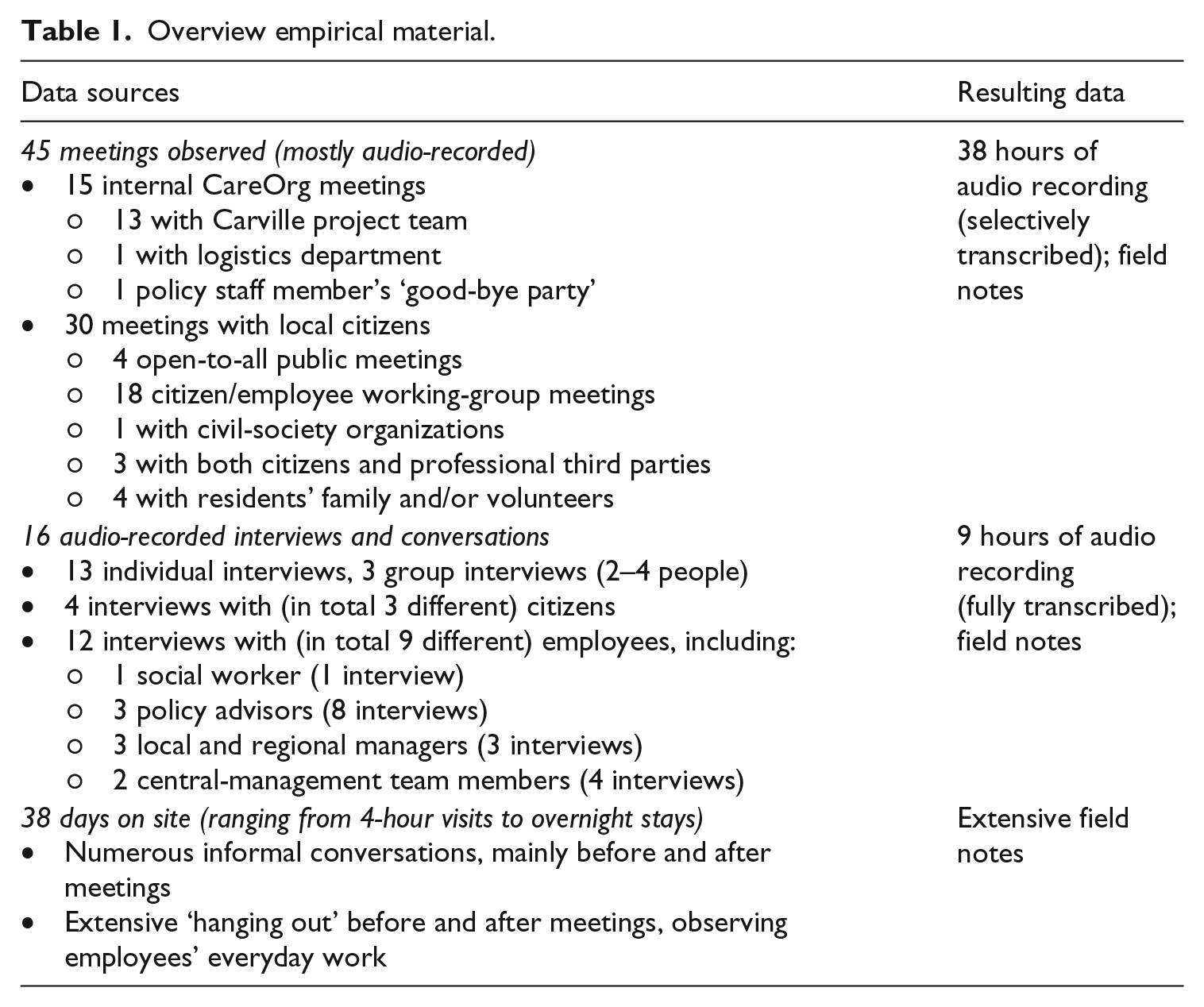
Fieldwork was performed by the first author, who spent 38 days on site. In total, 45 meetings were observed, including both strictly internal CareOrg meetings, and meetings that also involved citizens and/or other local actors. Most meetings were audio-recorded and selectively transcribed. During the majority of meetings, the researcher’s role was that of a mostly passive observer. In the latter part of the fieldwork, after having already attended meetings over a fairly long stretch of time, participants would sporadically ask for the researcher’s input throughout their discussions. In such instances, the researcher refrained from taking sides with any of the actors, instead pointing out the various dilemmas or trade-offs observed in the process. During the final phase of our fieldwork, we organized two reflection sessions with CareOrg managers in various hierarchical positions in order to share our observations. This allowed us to check whether we ‘got it right’ from their perspectives, and, given that complete agreement among all actors is improbable, to better understand the interpretive discrepancies we had encountered (Schwartz-Shea and Yanow, 2012). During our final months in the field, similar discussions were informally held with other employees and local citizens, and used to refine our analysis. We included these sessions’ transcripts and field notes in our data set. Appendix 1 provides additional reflection on how the first author’s position as an observer was affected by developments within the empirical field itself.
Additionally, 16 interviews with both employees and citizens were audio-recorded and transcribed. Mostly taking place in the hours before or after meetings, these interviews provided us with a more grounded understanding of participants’ motivations for and interpretations of the boundary work that took place within the observed interactions. Such opportunities also allowed informants to further elaborate on what they saw as legitimate positions for the different actors involved in the care home and to reflect on the situations in which these positions were (not) being enacted. In addition, they allowed us to specifically discuss the developments taking place within social settings that could not be observed directly. Interviews were individually prepared, enabling us to ask questions about respondents’ motivations for and interpretations of the actions we had observed. To illustrate the types of questions asked, Appendix 2 details a ‘sample’ interview guide (e.g. how did participants: feel citizen engagement affected their own work, evaluate such changes, interpret other people’s actions within observed meetings, etc.). When audio recording was not feasible, extensive field notes were made. Table 1 presents a more detailed breakdown of our observations and interviews. Alongside local media coverage, we also tracked CareOrg’s internal and external publications throughout the duration of our fieldwork.
Overview empirical material.
Analysis
Trying to incorporate disparate types of information on multiple levels, a key challenge within our analysis was to make sense of our ‘complex, messy, [and] eclectic’ data set (Langley and Abdallah, 2011: 202). We were interested in how the parameters of outsider engagement were negotiated within local boundary-work sequences, but also in how these sequences related to structural processes of inclusion and exclusion. A key objective of our analysis, therefore, was to structure our data in such a way that we could investigate the relationship between ‘macro’ phenomena and ‘micro’ instances of ordering (Nicolini, 2009). This process already began during our fieldwork, which helped us continuously ‘map’ which actors and sites were most relevant to our study and/or required additional empirical scrutiny.
As a first step, and to capture the macro-dynamics of inclusion and exclusion (e.g. who was involved on which platform, what was the scope of each platform’s agenda, how did the different platforms relate to one another and to those in decision-making positions, etc.), we composed a timeline (an excerpt of which is presented in Figure 1) and drafted a case narrative. Oscillating between the micro-dynamics of boundary work and their shifting structural embeddedness, we later decomposed our data into two main periods. These periods constituted comparative analytical units that were characterized by ‘a certain continuity in the activities within each period and [. . .] certain discontinuities at its frontiers’ (Langley, 1999: 703). This enabled us to investigate how actions within the first period led to more structural changes that, in turn, affected actions within the second period (Langley, 1999). In particular, we distinguished between a period before and a period after a central management crisis within CareOrg – a development that radically altered the boundary dynamics within our case setting. Within these two periods, we identified, coded, and compared both the concrete micro-instances of boundary work in which actors’ structural positions and relationships were enacted or challenged, as well as the responses that such actions triggered.
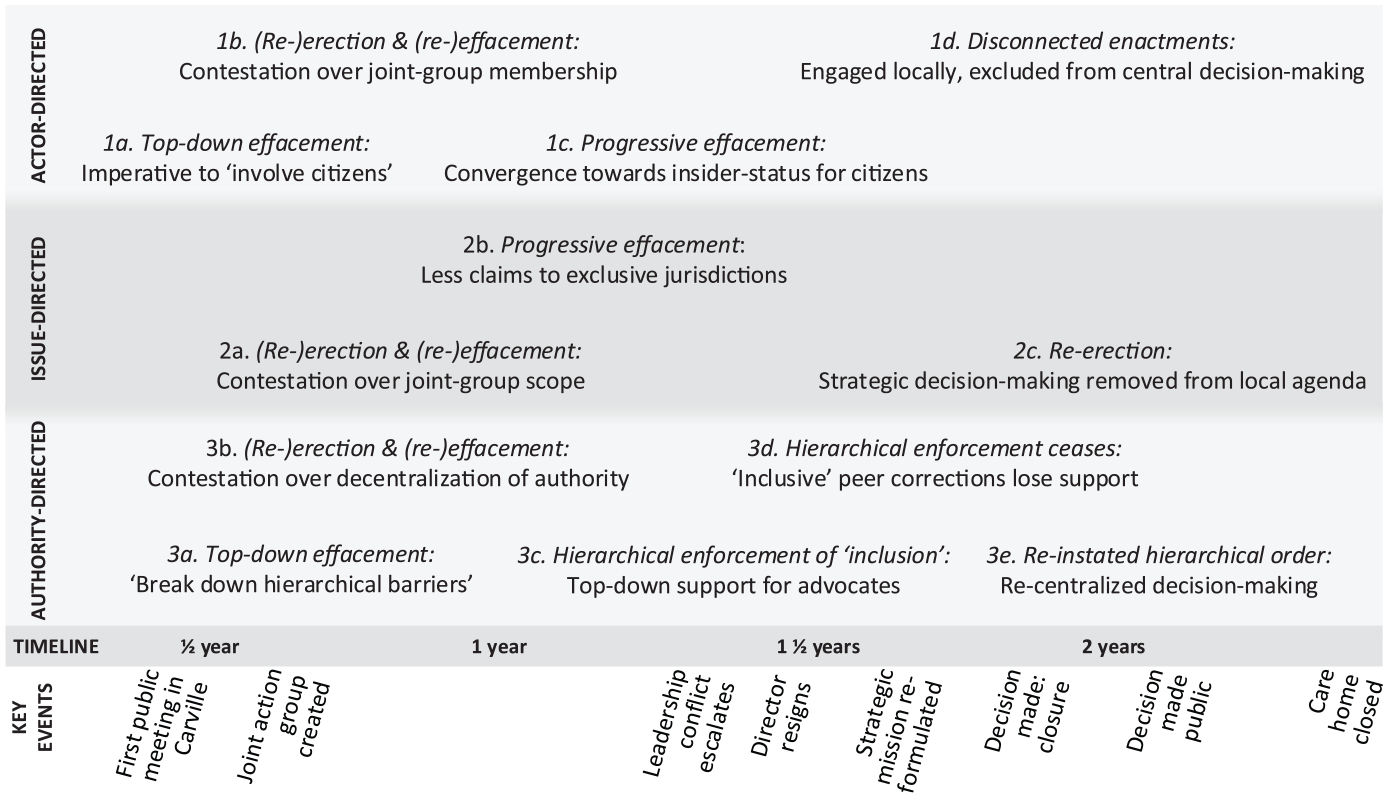
Case timeline: Shifting dynamics within three interacting areas of boundary works.
Initial coding was based on our observations of the actions with which participants affected (or tried to affect) the relationship between (a) CareOrg employees and local citizens, and (b) CareOrg employees themselves. Throughout this process, we marked such data segments with labels that reflected their empirical context (e.g. ‘challenging CareOrg legitimacy’, ‘determining the local group agenda’, and ‘calling for non-hierarchical decision-making’). Next, we moved back and forth between these initial codes and our emerging process model of boundary-work sequences. We clustered and categorized the initial codes according to: (a) the type of boundary to which participants’ actions pertained (eventually identifying three key areas of distinction-making: actors, issues, and positions of authority), and (b) how such distinctions were addressed (i.e. attempts to (re-)erect or (re-)open boundaries). We then identified the sequences in which instances of (re-)erecting or (re-)opening boundaries were (dis)connected across time and space (i.e. we scrutinized boundary work’s processual and dispersed dynamics). This allowed us to analyze how such micro-dynamics eventually changed between the two main phases of our fieldwork; that is, as the broader organizational context was radically altered (helping us to grasp the shifting political dynamics of boundary work). In this way, we were able to untangle the processual, dispersed, and political character of the boundary-work sequences through which Carville citizens and CareOrg employees contested and gradually reconstituted their relationships.
Findings
Focusing on how actors erected, challenged, and crossed multiple boundaries over the course of our two-and-a-half-year period of fieldwork, we now analyze the fervently debated and regularly reconstructed positioning of Carville citizens vis-a-vis CareOrg’s local care home. In a nutshell, our observations revealed that, initially, advocates of citizen engagement seemed to transcend traditional boundaries by successfully establishing citizens’ positions as insiders in the care home’s situation. Over time, however, this local-insider position became increasingly marginal to central decision-making processes within CareOrg, which eventually thwarted the care home’s entire existence. Against a background of the shifting power relations within CareOrg, the local transcendence of boundaries became obsolete when hierarchical boundaries were forcefully re-erected elsewhere and citizens were again excluded from the very processes with which they were initially invited to engage – highlighting boundaries’ markedly processual, dispersed, as well as political character.
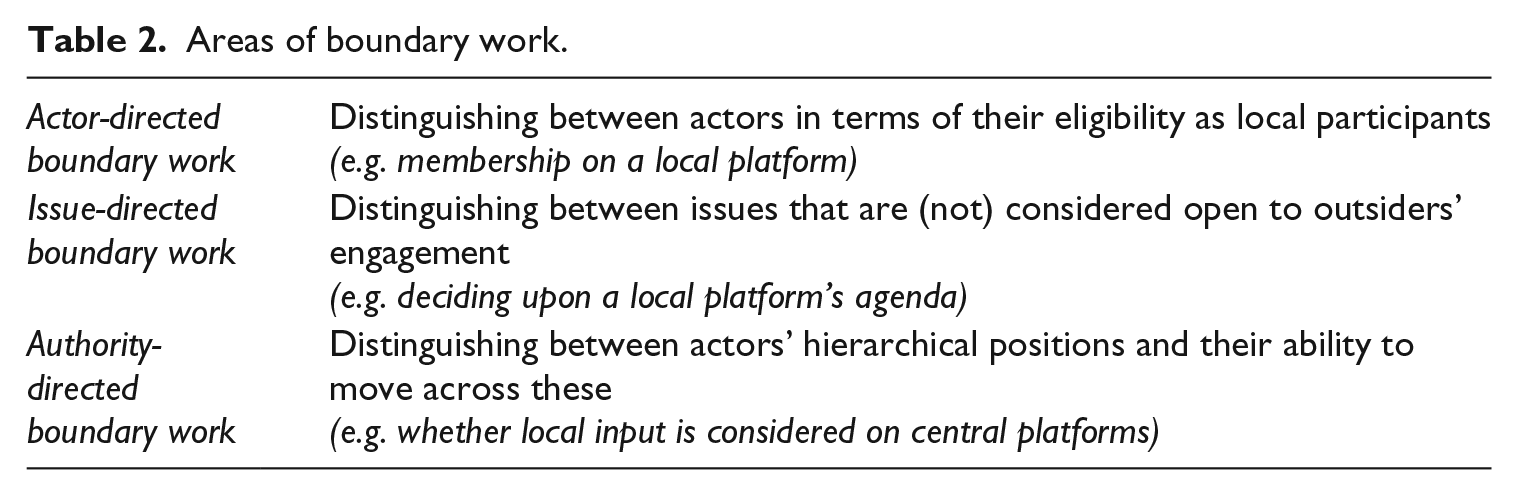
In order to offer a fine-grained analysis of the intricacies of the process, we set out to untangle and understand the interconnected boundary-work processes directed at actors (seeing groups or individuals as insiders or outsiders), issues (the domains to which actors were considered an insider or outsider), and positions of authority (mediating the impact of local Carville-based actors on central decision-making processes). Within and across each of these areas (summarized in Table 2), we observed ongoing sequences in which actors engaged in discursive acts of effacing boundaries, as actors downplayed traditional divides and enabled movement across these, and discursive acts of erecting boundaries, as actors re-instated such divides and delimited or marginalized the newly created spaces for engagement. By scrutinizing such sequences across multiple locales, we were able to investigate how the exercise of power manifested itself within direct confrontations over contentious boundary enactments, but also how actors were able to prevent unfavorable voices or contentious issues from reaching discussion platforms or decision-making tables in the first place. Furthermore, our analysis showed how engagement advocates tried to win the ‘hearts and minds’ of both citizens and employees in order to create a broader support base for a more inclusive approach.
Areas of boundary work.
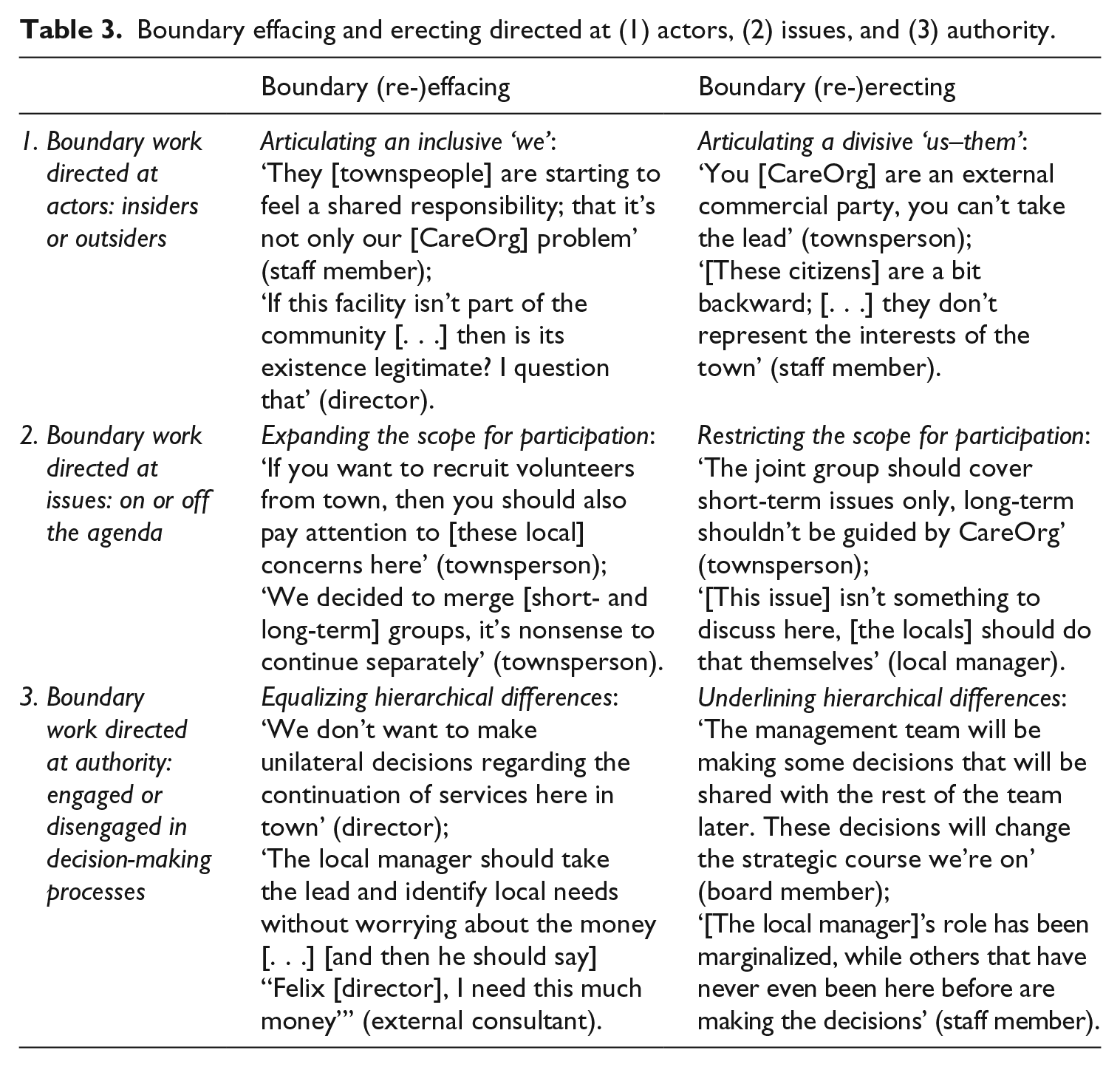
In what follows, we first zoom in on how actors both opened up and narrowed down local opportunities for engagement before zooming out again to examine the shifting power dynamics within the organization. While discussing these findings, we occasionally refer to Figure 1, which provides a temporal overview of the main case events and the broader shifts in boundary-work dynamics that shaped the character of citizen engagement. Moreover, Table 3 presents an overview of key empirical illustrations for each area of boundary work.
Boundary effacing and erecting directed at (1) actors, (2) issues, and (3) authority.
Zooming in: Opening up and narrowing down spaces for local engagement
Already evident in our earliest observations in Carville, we witnessed a process that was inherently paradoxical: boundary opening tended to invite or provoke boundary erection and vice versa. To unravel this process, we now describe the interrelated dynamics of (1) actor-directed and (2) issue-directed boundary work.
Actor-directed boundary work
Foundational to the pursuit of citizen engagement, we observed both employees and citizens performing actor-directed boundary work; that is, during strategic deliberations over the care home’s situation, these actors negotiated who was and who was not considered an eligible participant. Organized by the CareOrg management and open to all inhabitants of Carville, the first public meeting between CareOrg employees and local citizens was the starting point of a trajectory meant to jointly explore and develop scenarios for the facility – creating, in essence, a platform on which to engage citizens that had, up until then, been excluded from such strategic processes (1a. in Figure 1): ‘Now it’s your turn, people of Carville; [. . .] we desperately need each other in order to make this happen, hence our open invitation – to join us, to think along and to help us explore the possibilities’ (invitation by CareOrg published in local weekly, September 2013). On a rainy Wednesday night in September 2013, approximately 60 people gathered in the care home’s main hall. In his opening presentation, Frank, a CareOrg manager, consistently emphasized local citizens’ important role in the process and reframed the care home’s precarious situation as a joint challenge, stressing the interdependence of CareOrg staff and Carville citizens: ‘We need to move beyond feelings of sorrow; closing the facility is a worst-case scenario, but it might happen if we don’t work together’ (notes, September 2013).
While such messages conveyed an attempt to transcend traditional us–them divides, they also produced the opposite effect. The citizens that attended this first public meeting did not instantly take up the insider role that had been solicited. In fact, some responded by re-erecting barriers between CareOrg employees and citizens, either by excluding themselves as legitimate participants (‘In the end, we’re just amateurs from town.’) or by questioning CareOrg’s legitimacy, referring to the organization as an ‘external commercial party’ (notes, November 2013). Similarly, initial boundary effacing attempts also had a counter-productive effect on employees. Even long before this first public meeting, citizen-engagement advocates within CareOrg had been involved in – as one board member put it – the ‘long and difficult process’ of trying to ‘open up co-workers’ minds [to] look at things differently’ (meeting transcript, October 2014) as they tried to gradually socialize colleagues into accepting a more inclusive approach. Nonetheless, some employees still raised an eyebrow when, during the initial meeting, manager Frank invited citizens to embark on a ‘joint journey’. Employees could still be heard ridiculing citizen engagement backstage, stating that ‘it’s crazy we’re doing this as an organization’ (meeting notes, November 2014). In short, attempts to move across organizational boundaries ironically triggered both citizens and employees to re-instate divisive barriers.
Such paradoxical sequences of opening and (re-)erecting boundaries became particularly apparent as efforts to engage citizens became more concrete (1b. in Figure 1). While it was possible to refer to poorly defined notions (e.g. ‘the community’, ‘citizens’, or ‘the public’) when talking about citizen engagement in the abstract, more explicit boundaries needed to be employed when determining which individual citizens would become part of the newly erected local platform. In particular, a ‘joint action group’ was set up to make citizen engagement in Carville more concrete. This group, which would include both employees and local citizens, was to meet monthly and make plans for safeguarding the care home’s continuity. Marking the inclusive character of the process, the joint action group was itself a strong local symbol of boundary transcendence between employees and citizens. Once established, however, group membership turned out to be a contested issue. Employees, for example, initially refused to allow a particular community-interest group to be formally represented on the platform, accusing its members of ‘backward thinking’ and ‘not representing the community’s interests’ (meeting transcript, July 2013). Moreover, several local citizens refrained from participating owing to their explicit refusal to regard CareOrg as a legitimate partner. As such, throughout the process of determining group membership criteria, the abstract notion of ‘citizen engagement’ became increasingly circumscribed – and, consequently, contested – as both employees and citizens specified boundaries in order to include and exclude particular actors as legitimate participants in the trajectory.
Nonetheless, over the course of the joint action group’s continued meetings we observed increasing convergence in citizen members’ positionings, which eventually coalesced into a more pronounced insider status (1c. in Figure 1). For example, during a public meeting, one prominent Carville inhabitant and group member took the stage to state how at first she had been ‘pretty cynical’ about CareOrg’s motives, but now – after learning more about the situation – ‘realized that they [CareOrg] were facing the consequences of national developments’ for which CareOrg itself could not be blamed (meeting notes, May 2014). Her account was illustrative of citizen-members’ shifting positionings. By discursively transcending the division between ‘the town’ and the care home, and by increasingly regarding CareOrg as a ‘valuable partner’ (meeting notes, November 2014), local participants progressively framed the care home’s challenges as a shared concern of both CareOrg and the people of Carville: ‘The care home doesn’t stand in isolation – it’s really a part of Carville, so we’re doing this for the benefit of our town’ (meeting transcript, February 2015).
Nevertheless, even as citizen members of the joint group developed a more inclusive identity, their insider status remained ambiguous; at times it was accentuated – for example, when citizens and employees worked together – and at other times it was denied – for example, when they were accused of ‘shouting on the sidelines’ or when they themselves still occasionally refused to acknowledge CareOrg as a legitimate partner. As a result, the formation of the joint action group – symbolizing the imperative of boundary opening – also triggered a host of boundary re-erecting and boundary re-effacing work. Accordingly, such sequences, and members’ ongoing need to translate the abstract imperative of citizen engagement into concrete practices, resulted in employees’ and citizens’ continual contestation of ‘appropriate’ insider–outsider relations. Throughout this to-and-fro of boundary opening and closing, their orientations to citizen engagement – including the actor, issue, and authority-directed boundary work in which these orientations materialized – were gradually redefined.
Issue-directed boundary work
Further zooming in on the emergence of local spaces for citizen engagement, the boundary work we observed was not only directed at the ‘who’, but also at the ‘what’. By engaging in issue-directed boundary work, actors negotiated which issues were considered to lie either within or beyond the scope of citizen engagement. These negotiations demonstrated the same paradoxical sequences – the to-and-fro of opening and closing – that we also observed in actor-directed boundary work. Likewise, the need to make the parameters of ‘engagement’ more concrete immediately raised contestation. Advocates of citizen engagement often used poorly defined concepts to delineate the legitimate scope for such engagement, generically claiming that they should be involved in ‘decision-making’, ‘plan-making’, or ‘issues that concern them’. Such statements triggered further negotiations, causing both employees and citizens to apply more concrete boundaries as they disputed the issues that should or should not be opened up to citizens’ scrutiny (2a. in Figure 1).
For example, as soon as actors’ involvement was decided on (an act of actor-directed boundary effacement), negotiations ensued over the scope of their involvement (potential re-erection of boundaries). For example, during the second public meeting, when citizens were invited to take part in the joint action group, debate focused on the group’s agenda:
Will the group be allowed to think ‘out of the box’? About different business models or alternative ways to use the empty rooms?
The group will focus on the period up until 2018, to keep everything going until then.
But of course you’re welcome to think along about the period after that! [. . .]
We should broaden our scope here. Groups should be formed for both the short and the long term. The latter should be separate from CareOrg; long-term developments should come from within Carville itself. The first group can deal with [the facility’s] current issues, the second should be about the community, led by locals.
I’m not in favor of splitting this process in two. The long-term group’s capacities are also needed in the short term!
I will never agree to have one group that is led by CareOrg! (Notes, November 2013)
Clearly, while the joint group’s agenda (i.e. the issues) was in itself already contested, negotiations over this agenda were intertwined with efforts to delineate group membership (i.e. the actors). Eventually, manager Frank reluctantly accepted the formation of two separate groups – inviting local citizens to help tackle short-term challenges in the joint action group while a second group, comprised solely of Carville inhabitants, was formed in order to focus on local care services in the more distant future.
Even after the joint action group began meeting regularly, the boundaries of its scope remained contested. By excluding citizen input on particular issues, CareOrg employees regularly restricted the local platform’s agenda; for example, by responding to local citizens’ remarks with comments such as, ‘That [issue] is not something to discuss here’ (meeting transcript, September 2014). Such restrictions sometimes concerned relatively trivial issues, such as when an employee declined a citizen-member’s input regarding the design of a leaflet because it did not fit CareOrg’s ‘corporate visual style’ (meeting transcript, April 2014). At other times, however, employees also dismissed more-major concerns. Facing a dwindling local economy, citizens regularly suggested that CareOrg contract suppliers from town. Within the joint group, however, employees immediately disregarded this issue as, in their eyes, CareOrg’s pursuit of economies of scale prohibited the discussion of local contracting (meeting transcript, October 2014). Such interactions often led to heated arguments in which group members interactively demarcated which issues were open to citizen input.
While the exact scope of citizen engagement remained a contentious issue, both citizens and employees seemed progressively less inclined to claim exclusive jurisdiction over specific issues or to disqualify ‘the other’ as an illegitimate actor (2b. in Figure 1). For example, members of the aforementioned citizen-only group – which was established to focus on long-term issues for which CareOrg was considered an unfit partner – eventually, and after its most disapproving members had resigned, agreed to merge with the joint action group, stating, ‘It’s nonsense to proceed separately, because we need each other’ (meeting transcript, April 2014). In turn, employees accepted that local citizens and community groups could determine the agenda for subsequent public meetings, which were open to all Carville inhabitants. As they were ‘consistently praised for being good partners in the trajectory’ (meeting transcript, December 2014) and began to discover that a more inclusive agenda was beneficial to CareOrg’s reputation, they strategically built on this notion to foster a more favorable attitude among the townspeople. By allowing citizens to define which issues mattered on the platforms on which they participated, citizen reluctance to acknowledge CareOrg’s legitimacy as a partner seemed to diminish – again highlighting the interconnectedness of actor-directed and issue-directed boundary work as well as the more-subtle ways in which CareOrg employees tried to move the process forward.
In sum, when zooming in on the emergence of local spaces for citizen engagement, we witnessed both citizens and employees performing boundary work as they negotiated who was (not) allowed to ‘sit at the table’ (actor-directed boundary work) and determined what citizen engagement was (not) about (issue-directed work). Although advocates of citizen engagement pursued gradual effacement of the boundaries that separated organizational insiders from organizational outsiders, such attempts paradoxically triggered a contradictory surge of boundary re-erecting work (which, in turn, triggered subsequent re-effacing work). Our analysis shows that such paradoxical sequences of boundary (re-)effacement and (re-)erection were prompted by actions aimed at translating abstract ambitions into concrete practices. Subsequently, these actions gave rise to competing ideas as to who was eligible to participate and which issues this participation concerned. Although these boundaries were never completely settled, such sequences contributed to a gradual shift in how the actors involved defined the space for citizen engagement.
Zooming out: Making or breaking the strategic significance of local engagement
So far, we have zoomed in on the sequences in which actors (re-)opened and (re-)erected boundaries as they gradually carved out local opportunities for citizen engagement. It is important to note, however, that the resulting local platforms – such as the joint action group – lacked any formal decision-making power. In other words, citizen-participants still relied on CareOrg employees to make sure their input was actually considered within ‘internal’ CareOrg decision-making processes. In this section, we zoom out to juxtapose local Carville developments with the shifting power dynamics witnessed within the broader CareOrg organization. We discuss how these dynamics affected the developments surrounding the care home during the first half of our fieldwork (part I) and after a leadership conflict altered actors’ respective positions and relationships (part II). To highlight the dispersed nature of the boundary-work processes, we describe the long-term sequences we observed of employees initially breaking down, before later forcefully re-erecting, hierarchical barriers, which eventually made the citizen engagement that occurred within local Carville platforms marginal to central CareOrg decision-making processes.
Authority-directed boundary work (part I): unsettling the organizational hierarchy
To (re)construct the relationship between actors’ different positionings within (or even outside) the organizational hierarchy, employees performed authority-directed boundary work that shaped the potential of local perspectives and interests to flow between organizational platforms and impact more centralized decision-making processes. Since the beginning of the trajectory in Carville, Felix, CareOrg’s then-director, had urged his colleagues to break down hierarchical barriers whenever they hampered meaningful citizen engagement (3a. in Figure 1). He emphasized that he wanted to ‘make sure that the decision [of whether to close the care home] [was] not just made in the boardroom or by the management team, but by a broad range of people involved with the facility’ (notes, June 2013). To further support this process, a considerable number of staff members from the organization’s headquarters were assigned to be involved in, and follow up on, the care home’s developments. Moreover, the director also took it upon himself to personally attend a joint action group meeting. In these ways, CareOrg’s central leadership tried to promote citizens’ insider-status within the local platforms on which they were engaged while also making sure that citizen input would be effectively ‘taken forward’ and considered within internal decision-making processes.
Nonetheless, employees’ imperative to transcend hierarchical boundaries regularly triggered other employees to re-erect these (3b. in Figure 1). Both within internal CareOrg meetings and in discussions with citizens, employees sometimes declined local citizens’ suggestions by, for example, stating that the organization ‘already [had] a policy for that’ (meeting transcript, October 2014). In such instances, others would step in to enforce the principle of inclusivity – for example, by ensuring local participants that her colleague would ‘carefully follow up on these comments [and] discuss them with [his] supervisor’. Despite local citizens’ lack of formal authority, such peer-to-peer corrections – intended to re-efface the hierarchical boundaries that had been re-erected – had the effect of stimulating employees to nevertheless take citizen suggestions and comments forward.
Paradoxically, top–down support for boundary effacement enabled citizen-engagement supporters ‘on the ground’ to indeed soften the organizational hierarchy and to promote an inclusive approach by effectively (re-)effacing boundaries between actors and issues (3c. in Figure 1). For instance, Matilda, a senior staff member, was assigned to facilitate processes of citizen engagement with the explicit mandate to interfere and correct her colleagues whenever she felt they did not sufficiently acknowledge and act upon citizen input. As long as citizen engagement remained a prominent feature of the central management team’s ‘mattering map’ (Yanow, 2004), advocates for such engagement were able to broadly signify the importance of treating citizens as insiders to the trajectory. By successfully effacing established internal boundaries and correcting colleagues who engaged in their re-erection, employees could make sure that local input mattered throughout the organizational hierarchy.
Authority-directed boundary work (part II): Forcefully re-erecting barriers
So far, we have examined how the hierarchically endorsed imperative to soften the organizational hierarchy played out within the local Carville spaces. Simultaneously, however, this imperative – as well as the broader strategic course of the organization – was also being challenged on higher levels of management. Specifically, CareOrg’s medical staff started to oppose the director’s attempts to keep its rural care homes open, which ended up prompting a leadership conflict with considerable consequences. Although the medical staff had, up until then, barely been involved in the Carville trajectory, they increasingly began to object to attempts to sustain the rural care homes, instead preferring services to be more concentrated within fewer, medically better-equipped nursing homes (news coverage, February 2015). What ensued was described as a ‘classic power struggle’ (interview transcript, December 2015), underpinned by conflicting views on the organization’s core business and on what constitutes ‘quality care’. In the process, the medical staff approached local media to express their concerns: ‘They [the medical specialists] said, “This policy isn’t good for the elderly [. . .] and we’re here to save them.” [. . .] And Felix [the director] personified this policy’ (staff member, interview transcript, April 2015). While their critique was not solely directed at CareOrg’s strategy of citizen engagement, it did significantly affect the dominant policy discourse, which up until then had stressed such engagement as a strategic focal point. In March 2015, Felix resigned as a result of the medical staff’s disapproval and was replaced by an interim director. In the period that followed, the central management team triggered a process of ‘strategic reorientation’, which in turn recalibrated what was seen as CareOrg’s core business. As a result, the new leadership moved toward a more medicalized and internally focused approach to care provision. Cynically, one staff member claimed that they, as CareOrg employees, were now forced to ‘hide behind our high walls, with our doctors’ (notes, July 2015), disregarding the particular needs and interests of local citizens.
Substantially altering the dynamics within local boundary-work sequences, such changes within higher management came at the cost of citizen-engagement advocates’ symbolic resources in boundary negotiations elsewhere (3d. in Figure 1). Whereas the previous management team had endorsed the boundary work and peer-to-peer corrections made by those advocating for a more inclusive approach, the organization’s newly articulated strategy both legitimized those who erected more-pronounced barriers between CareOrg employees and citizens, and granted local staff less influence over increasingly centralized decision-making processes (3e. in Figure 1). Two key staff members who had been involved in the trajectory, one of which was Matilda (the staff member assigned to emphasize citizen engagement), resigned shortly after the director. With their resignations, the joint action group’s direct connection to CareOrg’s central management team disappeared, heavily compromising the extent to which local negotiations were able to traverse the organizational hierarchy. In the period that followed, Jeff, the local care-home manager in Carville, lamented that the head office felt ‘sooo far away now’ (notes, July 2015). Confirming Jeff’s remarks, a consultant who had temporarily supported the process of citizen engagement complained that she was no longer authorized to talk to anyone important and that Jeff’s role was marginalized as decisions were now made by other managers ‘that have never even been here’ (notes, July 2015). After a period in which hierarchical barriers had been progressively ‘broken down’, the new management team reinstated strict lines of authority that sidelined both local staff and citizens.
Illustrating the renewed hierarchical boundaries and shifted priorities, a CareOrg board member announced in an internal meeting that the interim director would be making ‘some difficult decisions’ that might impact the process in Carville (meeting transcript, April 2015). Although the departing director, Felix, had recently proclaimed that after many years of making a profit in Carville he considered it ‘reasonable to accept the current losses for the next few years’ (interview transcript, April 2015), the new management, just a few weeks later, announced that the organization could not survive without a speedy reorganization. In July 2015, the board decided to close the care home within one year – one-and-a-half years earlier than originally planned. To the frustration of those still involved in engaging local citizens, employees received clear instructions to hold off on discussing the decision with citizen members of the joint action group. The new board’s decree symbolized both the new, more-strictly bounded scope of local citizen engagement and its curtailed significance to central decision-making processes (2c. in Figure 1). Despite persistent local rumors, local volunteers were only officially informed of the management’s decision three months later. In their attempts to re-efface the new hierarchical barriers and re-claim their position as insiders in the trajectory, local employees and citizens, who objected to management’s unilateral decision to close the facility, asserted that ‘a management team can’t just [do this,] they have a town that also has a seat at the table’ (meeting transcript, April 2015). Nevertheless, given the reinstated hierarchical order that had come to characterize CareOrg’s decision-making processes, such efforts had become futile (1d. in Figure 1).
* * *
In conclusion, by comparing our observations before and after the change in leadership, we see that CareOrg’s radical shift in policy significantly changed the power dynamics of participants’ boundary work. Initially, managerial initiatives had systematically promoted citizen engagement and sanctioned actors to open up internal hierarchical barriers in order to make such engagement effective. Instead of merely creating an open space for participation, however, such top–down boundary effacement resulted in ambiguity on the ground, which fueled negotiations over – and thus increased the symbolic significance of – new, more precise or refined boundaries. For instance, while boundary-effacing work gave rise to local platforms for citizen engagement, these platforms’ members engaged in boundary-setting work in order to demarcate who would be engaged and on which issues. In turn, when such boundary-setting was seen as overly constraining the space for engagement, others would try and correct this by attempting to re-open these very same boundaries. In a nutshell, formal policies intended to transcend well-established boundaries actually gave rise to intensified sequences of boundary (re-)erection and (re-)effacement – both within and across three key areas of distinction-making: actors, issues and positions of authority.
Ironically, our findings show that ongoing boundary work by actors who held formal positions of authority was necessary to ensure the effective effacement of hierarchical boundaries. Once the initial hierarchical support for citizen engagement had eroded and the new management had reinstated strict hierarchical boundaries by decree, similar boundary re-effacement attempts proved less viable. Whereas the previous imperative of boundary effacement had implied that ‘local’ perspectives must be attended to, the newly reinstated boundaries more clearly indicated whose perspectives needed to be considered – and whose did not. As a result, the objections of both local staff and citizens to closing the care home could be ‘legitimately’ discarded. Upon reflection, we conclude that the potential withdrawal of hierarchical support for a non-hierarchical way of working had always been hanging over the trajectory like a sword of Damocles. Local boundary negotiations and the resulting engagement of Carville inhabitants were strategically significant only as long as CareOrg’s central leadership agreed to this premise. In other words, for local actor-directed and issue-directed boundary effacement to ‘matter’ within central decision-making, effective authority-directed boundary effacement proved to be a necessary condition. Our findings highlight the fundamental power imbalance between central-management actors and both local employees and engaged citizens, even when the latter’s engagement is the official policy imperative. In the end, successful boundary effacement is at the mercy of those who control their possible re-instatement.
Discussion
Building on other critical studies that refute the notion of boundaries as clear-cut divisions between organizations and their environments, we investigated the fine grain of the boundary dynamics triggered by the engagement of organizational ‘outsiders’. Our findings confirm that boundaries, while not acting as clear-cut demarcations, nonetheless remain central to structuring organizational life (Paulsen and Hernes, 2003). In fact, attempts at transgression or erasure paradoxically turned boundaries into symbolic rallying points, which allowed us to investigate the intricacies of processual, dispersed, and political boundary-work dynamics. Going forward, we now turn our attention to the theoretical, methodological, and practical implications of our study.
Boundaries constitute a significant focal point for studying human relations in organizational settings since they reflect ‘the essence of [the process of] organization’ (Santos and Eisenhardt, 2005: 505). Our approach substantiates this notion and illuminates the convoluted and often-paradoxical dynamics that underlie this process. As a first contribution, by explicitly accounting for its processual (temporally sequenced) and dispersed (spatially situated) dynamics, our approach to boundary work reveals that, ironically, attempts at transcending organizational boundaries intensify actors’ boundary work, provoking ongoing negotiations within and across multiple organizational platforms and triggering often-unanticipated temporal sequences. Instead of providing a snapshot of one type of boundary work, we analyzed how actors (1) bargained over who ‘sits at the table’ (actor-directed boundary work), (2) debated the scope of their involvement (issue-directed boundary work), and (3) negotiated the extent to which local participants could affect central-management decisions (authority-directed boundary work). By tracing actors’ ongoing boundary enactments within and across these three areas of interest, we were able to witness the kaleidoscopic to-and-fro of boundary effacement and boundary erection, thus untangling the messy processes that both affect and reflect shifting insider–outsider relationships. Consequently and importantly, witnessing one type of boundary work occurring on one platform at one point in time is of limited analytical value and can even be misleading when making sense of putative insider or outsider statuses. As we have shown, any single act of boundary construction may directly or eventually trigger an opposite effect, or may simultaneously be counteracted on another platform at another point in time. For this reason, such acts only become meaningful when analyzed as part of a stream of interrelated moves and countermoves, and placed against the backdrop of boundary work done elsewhere. By analytically focusing on the spatially and temporally situated boundary work through which actors negotiate the parameters of insider–outsider positionings and by sensitizing themselves to contradictory and counterintuitive patterns and processes in their analyses, researchers can improve their accounts of the sometimes-paradoxical connections between consecutive or concurrent boundary enactments.
Such paradoxical sequences and situational contradictions, we believe, deserve more systematic research attention, particularly when studying the ‘messy’ boundary dynamics typical of most organizational settings. Crucially, attempts at transcending or effacing boundaries and pursuing inclusiveness still evoke questions about who or what is (not) considered to ‘matter’ within an organization (Yanow, 2004); triggering intensified boundary-work sequences and paradoxically eliciting boundary re-erection. Distinction-drawing, in tandem with boundary effacement, thus remains at the heart and soul of any process of organizing. In contradistinction to the notion of the ‘boundaryless organization’ (Hirschhorn and Gilmore, 1992) or to any plan or policy designed to integrate organizational, professional, or functional fields or units, attempts to erase boundaries will – subsequently or simultaneously – provoke the re-drawing of boundaries and making of categorizations. In essence, while acts of boundary effacement constitute symbolic moves that may or may not reconfigure how others perceive divides within or between organizations, these acts do not put a halt to people’s inclinations to draw distinctions, nor do they automatically settle competing perspectives on how to efface (or indeed re-erect) boundaries. Consequently, researchers need to become more sensitive to how acts of boundary effacement tend to both increase the salience of organizational divides and trigger actors to make these divides explicit.
How, then, does our approach differ from other approaches within existing boundary-work literature? Zietsma and Lawrence’s (2010) influential study, for example, is also rooted in a processual approach to boundary work. The difference, we contend, lies in that our study takes the processual conceptualization of boundary work one step further. By referring to the ‘state’ of boundaries (2010: 213) and by speaking of boundaries ‘around’ an organizational field (2010: 190), Zietsma and Lawrence tend to use boundaries themselves as a starting point before investigating how they are subject to processes of change. In contrast, our analysis primarily looks at people’s in-situ boundary enactments. This subtle-but-significant difference reflects ‘two versions of the social world: one, a world made of things [i.e. boundaries] in which processes represent change in things; the other, a world of processes [i.e. boundary-enactment sequences] in which things are reifications of processes’ (Van de Ven and Poole, 2005: 1379). When we analytically reify boundaries – that is, when we disconnect them ‘from the process that created them’ (Bakken and Hernes, 2006: 1601) – we also risk obscuring some of the constitutive processes of insider–outsider relations. For example, by highlighting boundary work’s processual and dispersed nature, our approach sensitizes us to both the possibility and the consequences of diametrically opposed boundaries that can be enacted across different locales and/or at different points in time – the locally engaged, yet centrally excluded position of Carville citizens being an illustrative case in point. Moreover, our approach brings into focus how boundary effacement actually requires ongoing boundary work, as it cannot be assumed that one’s acts of inclusion will resonate with other actors or in other social settings. It thus illuminates the contested and situationally constructed nature of insider–outsider divides, the parameters of which may be constructed differently by different actors and within different social settings. In sum, if we restrict our analysis of outsider engagement to temporally or spatially isolated acts of boundary spanning, then we turn a blind eye to the multi-sited, moment-to-moment quality of boundary opening and boundary closing that characterizes actors’ bargaining over ‘appropriate’ insider–outsider relations. By conceptualizing boundary work as ongoing boundary-enactment sequences, we can account for the interactive and often-paradoxical dynamics that lay beneath the surface and beyond the horizon of any single act of boundary work within confined organizational settings.
Our critique of parsimonious boundary conceptualizations resonates with critical work in the field of management consultancy (e.g. Alvesson et al., 2009; Wright, 2009). Here, scholars have called for a more dynamic approach to boundaries and highlighted ‘the need to specify insider–outsider relations with respect to what, whom, and when’ (Sturdy et al., 2009b: 172). While this strand of work has significantly contributed to a more dynamic concept of boundaries, we contend that its implications have yet to be fully fleshed out within empirical analyses, which still largely rely on interview data (e.g. Alvesson et al., 2009; Wright, 2009). While Sturdy et al.’s (2009b) work also draws on observational data in capturing insider–outsider dynamics, our current focus on situationally dispersed boundary negotiations within and between multiple empirical sites allows us to expand extant theorization by scrutinizing how actors’ situated boundary enactments are (dis)connected across space and time. By engaging in first-hand observations of boundary-work processes as witnessed within and across multiple social settings, our study provides the empirical groundwork required to grasp the ‘short-lived factors and changes’ (Van de Ven, 2007: 212) that affect how insider–outsider relations are shaped over time and across sites. This, in turn, also makes it possible to more fully explore these relationships’ emergent and dispersed power dynamics – an issue we will now explore in greater detail.
As a second theoretical contribution, our study demonstrates that, despite possible efforts to transcend hierarchical boundaries, established power imbalances continue to shape the relations between actors across and beyond the organizational hierarchy – sometimes within direct confrontations and oftentimes by sidelining opposition or by keeping potentially problematic issues off the agenda (the eventual decision to close the venue being a cynical example). By following actors and issues throughout a variety of formal and informal settings, we were able to capture the differential impact of central actors’ boundary enactments on locally performed boundary work: top–down boundary effacement legitimized local actors’ engagement while simultaneously intensifying the performance of boundary work, whereas top–down boundary re-erection unambiguously shut down such space for negotiation and dissolved local actors’ influence. As a consequence, we conclude that – even when endorsed by formal policies and successfully pursued within participatory processes – outsider engagement remains vulnerable to the whims of central actors’ priorities. For example, even when local Carville citizens were (eventually) granted influence within the newly erected local platforms for engagement, this did not guarantee that their input would actually reach central decision-making agendas, nor did it imply that all employees were fully convinced that citizen perspectives indeed mattered. When ‘external’ actors lack the formal means to advocate on ‘internal’ platforms, their so-called empowerment appears to remain highly situated and contingent upon established power relations. While we certainly do not claim that efforts to engage with designated outsiders are necessarily futile or unproductive, we do contend that the effectiveness of an inclusive and non-hierarchical approach paradoxically depends on ongoing hierarchical support and managerial enforcement.
By acknowledging the persistence of such power dynamics in the pursuit of boundary transcendence, our approach is relevant beyond our current focus on citizen engagement. In particular, investigating boundary-enactment sequences may provide a useful analytical lens in other empirical settings that also involve attempts at non-hierarchical coordination against a background of existing hierarchical positions and relations. For example, research on employee participation in organizational change initiatives indicates that attempts to move across hierarchical lines may still ‘result in existing asymmetrical power relations being accepted and normalized’ (Thomas and Hardy, 2011: 325). Similarly, studies of teamwork (e.g. Chreim et al., 2013; Finn et al., 2010) have shown that despite teamwork’s ‘ostensibly egalitarian rhetoric’ (Finn et al., 2010: 1152), power inequalities continue to shape teamwork dynamics, both among team members and within a team’s relation to the broader organizational hierarchy (Barker, 1993). Within such fields of research, our approach may help scholars appreciate the layered and complex character of attempts at so-called boundary spanning. It helps to highlight the intricate and dispersed boundary-work dynamics, and the potentially paradoxical sequences that may ensue, as actors strive for ‘participation’ or ‘horizontal mutual adjustment’ – triggering the overt or covert power play or self-disciplinary control that may effectively delimit the scope of such efforts.
This brings us to our third and final contribution. In order to adequately unravel such interconnected boundary-enactment sequences, we believe that researchers’ methodological and analytical focus should move back and forth between the various empirical sites in which boundaries are (re-)erected, challenged, or transformed in order to trace emerging (dis)connections across these sites. Accordingly, we have honored Van Hulst et al.’s (2017: 233) plea to ethnographically follow people, things, and issues as they travel across different locales: Instead of offering a static account of organizational settings and structures, or of a team, organization or community in isolation or in two-way interactions, the ‘following fieldworker’ travels along with, or ‘trails’, actors, interactions and/or artefacts, ‘mapping’ over time and across locales, levels and domains.
In our case, in order to lay the empirical groundwork necessary to make claims about local cross-boundary dynamics and their contingencies on broader power relations, we followed both actors – that is, we ‘shadowed’ (McDonald, 2005) designated boundary-spanners as they traversed through internal and cross-boundary spaces and assumed different positions within different organizational arenas – and issues – that is, we tracked the issue of outsider engagement as it was negotiated throughout decision-making processes within and across multiple organizational communities.
As this methodological strategy of following makes it inherently challenging to anticipate which processes and spaces will significantly intersect and how, fieldwork must be set up to maximize exposure (Schwartz-Shea and Yanow, 2012) to those boundary-work sequences that shape the position of outsiders in relation to internal work processes. For our, and indeed for any, such study, fully realizing such exposure proved impossible in terms of time and difficult in terms of access, especially as one can never consistently predict which meetings or platforms will give rise to the interactions most relevant to the research questions at hand. Importantly, future research following this approach should first and foremost keep an eye on both those organizational spaces in which actors attempt to resist or oppose the discourse endorsed by those in power and on the ways in which people try to neutralize such resistance in their frontstage or backstage interactions. Such sensitivity to silent or silenced resistance (or, alternatively, to resistance to resistance) may help prevent blind spots from developing, that is, it may prevent fieldworkers from losing sight of the actors and issues that remain ‘disconnected’ from what is being followed.
In addition to these three theoretical contributions, our approach to boundary work also suggests a number of practical implications for citizens, professionals, managers, and policy makers who pursue citizen engagement. First, we caution advocates not to approach citizen engagement as a ‘one-off’ issue of institutional (re)design – a notion that still pervades much of the literature on citizen engagement (e.g. Fung, 2006). Importantly, the job is not done after a local space for citizen engagement has been created. Instead, this is when the real work begins: advocates should be prepared to make an ongoing investment in dealing with recurrent contestations over the scope and impact of participation – facing a range of actors with often-competing interests and divergent perspectives on what citizen engagement should look like (Glimmerveen et al., 2018, 2019). In particular, our study shows that citizen-engagement advocates must not turn a blind eye to the ‘internal’ organizational dynamics that precipitate or are triggered by ‘external’ alignment with citizens. While in our study their participation on local platforms appeared to be increasingly productive, citizen engagement eventually proved futile after being sidelined by the new management team as it reinstated strict lines of authority and terminated the initiative. Given that the impact of citizen engagement is, to a large extent, negotiated outside the arenas designated for such engagement, participation advocates should expect to play on multiple ‘chessboards’ at the same time. It may require a substantial investment to engage with those actors who may not be ‘natural’ proponents of citizen engagement (e.g. financial controllers, medical specialists, logistics managers, etc.) and to make sure that local boundary effacement is recognized and deemed significant beyond its immediate context.
Second, our findings shed a different light on the prevalent idea that effective participation (or any attempt at cross-boundary engagement) is at odds with centralized control (e.g. Loeffler and Bovaird, 2016). While participation by definition requires a degree of decentralized control, our findings suggest that hierarchical enforcement may sometimes be necessary in order to ‘internally’ advocate for participation among front-line employees who would otherwise not be inclined toward citizen engagement. At the same time, however, hierarchical enforcement without street-level discretion and dedication may be equally ineffective. Still, we caution against the tendency among citizen engagement advocates to see decentralization as a panacea for participation.
Third and finally, our study also shows that citizen engagement advocates should be reflexive about the often-unrealistic expectations and unintended consequences that may turn citizen engagement into a high-maintenance and high-risk initiative – both for the participating citizens and for the organizations that pursue their engagement. Participation is not a magic bullet for service improvement. In fact, and especially, when predicated on unrealistic expectations of alleged organizational-boundary transcendence it is more likely to frustrate rather than empower those who choose to participate.
Conclusion
Our study of outsider engagement refutes the popular notion of boundary transcendence as the new model of and for organization (Hirschhorn and Gilmore, 1992). Building on the idea that ‘changes toward fluidity and complexity should not be taken as synonymous with boundaries disappearing’ (Paulsen and Hernes, 2003: 4), our analysis of boundary work’s processual, dispersed, and political dynamics shows that the alleged transcendence of organizational boundaries remains a highly circumscribed process. In our study, actors’ temporally sequenced and spatially situated boundary enactments typically exposed a constant to-and-fro between (issue, actor and authority-directed) boundary opening and boundary closing. As such, our analysis has demonstrated how formally sanctioned boundary effacement from ‘up above’ can paradoxically trigger intensified actor and issue-specific boundary work ‘on the ground’. Moreover, we have shown how the top–down re-erection of hierarchical boundaries – a move that effectively marginalizes those lacking formal authority – can be equally contentious. In fact, such a re-instatement of hierarchical order unambiguously shuts down potential space for negotiation, highlighting the persistence of power imbalances despite attempts to soften them. As a result, internal organizational hierarchies, professional-turf matters, and us–them antagonism remain, however ironically, germane to the heart of attempts to transcend organizational boundaries.
Footnotes
Appendix 1: On researcher positionality
In ethnographic studies, reflexivity is key: how do a researcher’s personal characteristics and location in the field affect a research project’s outcomes (Schwartz-Shea and Yanow, 2012; Ybema et al., 2009)? This section provides a first-person account in which I (i.e. this article’s first author) reflect on how, in my experience, participants apprehended my presence as a researcher, how I related to these participants, and how developments within my empirical field affected my position.
Let me start with how I experienced my relation to the local citizens I came across during my fieldwork. Generally speaking, I felt like an outsider spending time in Carville. Being a rural settlement with under a thousand inhabitants, people in this town tended to know each other fairly well, often having lived here for at least a substantial part of their lives. People in Carville were allegedly known for their skeptical attitude toward the government, ‘the big city’, and the Randstad (the mostly urban western part of the Netherlands). This common belief was regularly confirmed during my fieldwork, for example, as people often made critical remarks about ‘The Hague’ (i.e. where the Dutch national government resides), while also regularly mentioning the feeling of being ‘left out’ by the larger municipality that Carville was part of. During my fieldwork, I lived and worked in Amsterdam while, being in my late 20s, I was also considerably younger than the local citizens engaged with the care home’s developments. Especially upon my first arrivals in Carville, I indeed felt like an outsider. Initially, many local citizens did not seem too eager to open up within conversations, both with me and within the initial meetings with CareOrg employees.
While I remained somewhat of an outsider throughout my fieldwork (I spent much more time outside than inside the field), this experience did change over time. Having grown up in a fairly small town in a (different) rural area in the Netherlands, I more-or-less unwittingly found myself stressing these rural roots when introducing myself to people in Carville – something I would rarely do otherwise. On a few occasions, when it made sense to spend longer than one day in town, I spent the night in a vacant room in the care home (I lived over 200 kilometers away, initially lacking a driver’s license). These prolonged stays provided me with opportunities to walk around town and to learn about the town’s recent history: about the large mental health institution, for example, which had already closed over 25 years ago, but still seemed to leave considerable marks on inhabitants’ collective consciousness. Or about the years-long debate about what would happen to the large piece of land that this institution left behind. While such issues may seem trivial to my research focus, they constituted an important context to understanding citizens’ perspectives on the current situation surrounding the care home.
Moreover, and more practically, knowing this history helped me with small talk and building rapport with local townsmen. Seeing me returning to Carville regularly over what eventually turned out to be a two-and-a-half-year period, I established positive rapport with several people in town who were involved with the care home’s developments. For example, people started inviting me over for dinner and offered me the use of their bicycles when spending time in town. Gradually, they also started being more open in their conversations, sometimes sharing their experiences, motivations, or rationales under the condition that I would not share these with others in the trajectory. Because of my status as an outsider, it seemed that local citizens also considered it harmless to be relatively frank with me. Moreover, my longer stays in town allowed me to strike up conversation with people I randomly encountered, enabling me to get a feel for how big of an issue the situation around the care home was to the people in town. It increasingly made me relate to the locals’ fear of the care home being closed – seeing yet another public facility move away from the town.
Still, it was a select number of CareOrg employees with whom I built up my closest ties during fieldwork. The entry point for my research at CareOrg was a shared interest in learning about the pursuit of citizen participation. Accordingly, the main advocates of citizen participation within the organization, including CareOrg’s director, were the ones most supportive to my presence as a researcher. At the study’s onset, they constituted my key informants as I tried to gain an initial understanding of the organization’s strategies and experiences within their pursuit of citizen participation. Following this pursuit, I came to sympathize with these people’s ambition to let citizens participate in decision-making processes that affected them. It was relatively easy to personally relate to their agendas – even though these were never entirely unambiguous. As several of these people occupied powerful positions within the organization, our shared interest granted me with considerable advantages in terms of access: it opened many doors to potential research sites that I expected to be relevant to my inquiries.
At the same time, as I found myself establishing a good relationship with these citizen-participation advocates, I had to take particular care not to skew my personal identification nor my exposure in the field toward these advocates’ actions, accounts, and agendas. The ‘easy access’ following from their interest in my research also made me conscious of what I might not be seeing when only relying on them as gatekeepers. In other words, I had to deliberately seek exposure to those sites where support for participation was less self-evident; sites where I might encounter alternative accounts of the pursuit of participation. For example, I made sure to expose myself to the dynamics and developments within CareOrg’s logistical department; a department that participation advocates sometimes scolded for ‘operating on an island’ and frustrating the organization’s participatory ambitions. It was here that I was able to grasp a better understanding of the competing considerations that various employees had to deal with; considerations that were potentially at odds with the ‘democratizing’ imperative of participation. Such exposure was crucial to my research and to my eventual findings, that is, making it possible to move beyond the notion of citizen participation as a panacea for local care service governance.
Having said that, my position in the field sometimes did limit my empirical scope, especially during later parts of my fieldwork. Initially, while my main focus was on the local process in Carville, I experienced no difficulties ‘accessing’ the organization’s regional office or central headquarters. In hindsight, however, I did not get an entirely satisfying view of the rationales and strategies applied by what eventually turned out to be an important group of actors: the organization’s medical staff. While the medical staff was not directly involved in the participatory trajectory in Carville, their actions triggered a leadership crisis and the subsequent resignation of CareOrg’s director.
These events substantially affected the local trajectory, but also my own position as a researcher. Toward the end of my fieldwork, the developments within the organization’s leadership frustrated my former abilities to easily access research sites. As various participation advocates had resigned from their offices, the perceived significance of my research to the organization’s central management was heavily compromised. I now experienced that accessing research sites indeed turned out to be ‘a continually negotiated process [that] reflects localized socially embedded conditions and practices’ (Bondy, 2013: 578) – whereby such ‘localized conditions’ had not changed in my favor. My research endeavors were not immune to the (political) processes that I was studying.
Appendix 2: Sample interview protocol
Interviewee: CareOrg regional logistics manager.
Site: Regional Office of CareOrg, around 30 minutes by car from Carville.
Context: This interview was conducted eight months into our fieldwork, one day after a meeting of the ‘joint action group’ in which [interviewee] was ‘corrected’ by his colleague, who thought he was not sufficiently acknowledging (and following up on) suggestions made by a local citizen. In short, the townsman seemed to emphasize the merits of contracting local businesses for supplying meals in the care home, and of granting some choice to the care home’s inhabitants in this matter. [Interviewee] responded by emphasizing the challenges of local contracting and providing choice, stating that these were ‘nice ideas’, but ‘impossible’ to realize. I mainly wondered: how did [interviewee] experience these interactions himself, particularly the part where he was ‘corrected’ by his colleague? And how does this relate to how he sees his own role in the trajectory in Carville?
Interview goals:
Introduction before starting the interview:
Checks beforehand:
(see initial set of questions on other side)
About [interviewee’s] job and role:
About the implications of the pursuit of citizen participation:
About [interviewee’s] views on a legitimate scope for citizens’ participation:
About yesterday’s meeting:
Acknowledgements
We would like to express our sincere gratitude to all of the CareOrg employees and local citizens who participated in this study, to the Jo Visser Fund for financially supporting our research project, to Arjen Schmidt for commenting on an early draft of this manuscript, and to Lilli Turner for her meticulous editing.
Funding
The authors disclosed receipt of the following financial support for the research, authorship, and/or publication of this article: This research project was funded by the Jo Visser Fund.
