




Abstract
Knowledge sharing is a discretionary act of employees who might see benefits in keeping their knowledge to themselves. We focus on the other-oriented nature of knowledge sharing to outline how respectful leadership as an other-oriented leadership style can enhance followers’ knowledge sharing through its effect on followers’ other-orientedness. Specifically, we propose that respectful leaders increase followers’ social mindfulness—defined as the cognitive (i.e. perspective taking) and affective (i.e. empathic concern) willingness to behave in a way that increases others’ opportunities—which facilitates knowledge sharing. To test our conceptual model, we conducted a three-wave field study with 275 followers, and a multi-source field study with 83 leader-follower dyads. In line with our hypotheses, followers’ perspective taking (Study 1 and 2) and empathic concern (Study 1) mediated the positive effect of respectful leadership on followers’ knowledge sharing. Moreover, perspective taking and empathic concern possessed interactive effects in Study 1, suggesting that the relationship between respectful leadership and followers’ knowledge sharing was strongest when both components of social mindfulness were high. We discuss theoretical implications of the identified motivational pathway and elaborate on implications for practitioners who aim to facilitate knowledge sharing at work.
The success of organizations is tied to employees’ motivation to engage in knowledge sharing (Bavik et al., 2018), defined as the “act of making knowledge available to others within the organization” (Ipe, 2003: 341). Research has demonstrated that knowledge sharing can improve important outcomes, such as decision-making, innovation, and performance (Jiang and Chen, 2018; Srivastava et al., 2006). The valuable and specialized knowledge resides within the minds of individual employees, who share knowledge with others to enable collective utilization of the available informational resources (Mesmer-Magnus and DeChurch, 2009). However, despite the organizational benefits of knowledge sharing, employees are often unwilling to share their knowledge because it turns their valuable individual resource into a public good (Cabrera and Cabrera, 2002). Knowledge sharing enables others to access and use previously personalized knowledge and thus provides leeway to claim the associated benefits, such as status and reputation (Rhee and Choi, 2017).
Scholars have recently started to explore leadership as a tool to address this challenge and facilitate knowledge sharing in organizations. Existing research has provided initial evidence that different leadership styles—for example, transformational, empowering, and ethical leadership—can facilitate knowledge sharing (Bavik et al., 2018; Dong et al., 2017; Jiang and Chen, 2018; Liu and Li, 2018; Srivastava et al., 2006). However, these studies primarily study knowledge sharing at the team level and position knowledge sharing as a mediator of the positive effects of leader behavior on performance-related outcomes such as innovation (Dong et al., 2017; Jiang and Chen, 2018; Srivastava et al., 2006). The mechanisms through which leaders affect knowledge sharing at the individual level therefore still have to be clarified (Bavik et al., 2018). As a first step in this direction, Bavik and colleagues (2018) considered followers’ extrinsic motivation in combination with their moral identity as mechanisms linking ethical leadership to employee knowledge sharing. However, this research depicts a follower-centric mechanism that focuses on the motivation and identity of the focal employee without considering the unique other-oriented nature of knowledge sharing. Moving beyond prior research, we rely on the conceptual understanding of knowledge sharing as a voluntary, socially mindful behavior that provides others with the choice of whether and how to use the shared knowledge. Based on this theoretical perspective, we seek to link followers’ knowledge sharing with the leadership literature more tightly through a conceptual framework that centers around the other-orientedness of leaders and their followers.
In doing so, we aim to make three contributions to the literature on knowledge sharing and leadership. First, we focus on a specific other-oriented leadership style, namely respectful leadership—defined as behavior that manifests in “the belief that the other person (i.e. the follower) has dignity and value in his or her own right” (Van Gils et al., 2018: 1592)—to offer a theoretically aligned explanation of leadership as an antecedent of followers’ knowledge sharing. The focus on respectful leadership addresses recent calls to avoid construct ambiguity by studying clearly defined, unidimensional aspects of leadership as drivers of employee behavior (Sidani and Rowe, 2018; Van Knippenberg and Sitkin, 2013) and advances the knowledge sharing literature that has started to examine the influence of broad leadership styles (e.g. Bavik et al., 2018; Jiang and Chen, 2018; Liu and Li, 2018).
Second, in line with our understanding of knowledge sharing as an other-oriented behavior, we seek to identify a motivational mechanism that depicts how respectful leaders enhance employees’ willingness to consider others’ interests in knowledge sharing interactions at work. To this end, we turn to social mindfulness theory (Van Doesum et al., 2013) that outlines how both the cognitive attempt to understand what others may need (i.e. perspective taking; Boland and Tenkasi, 1995) and the affective response to others’ needs (i.e. empathic concern; Miller and Wallis, 2011) underlie behavior that increases an interaction partner’s choices over outcomes in a situation. In line with recent theorizing (Gilin et al., 2013; Longmire and Harrison, 2018), we expect that perspective taking and empathic concern are at least partly variable characteristics rather than completely stable traits. This implies that the formation and salience of perspective taking and empathic concern can be influenced by work context factors such as respectful leadership. Taken together, we add a mediation path model to the literature that describes two indirect effects through which respectful leadership positively affects followers’ knowledge sharing, namely through followers’ perspective taking (Path 1) and through followers’ empathic concern (Path 2).
Third, we add to a recent debate on the potential interplay between perspective taking and empathic concern (Longmire and Harrison, 2018). Whereas perspective taking and empathic concern have been established as two conceptually different mechanisms (Ku et al., 2015; Longmire and Harrison, 2018), they may occur in a variety of combinations (i.e. both variables can be high, both can be low, or one is high and the other is low). This entails that the link between followers’ perspective taking and knowledge sharing can be moderated by empathic concern or the link between empathic concern and knowledge sharing can be moderated by perspective taking. Drawing from Longmire and Harrison (2018: 908) who suggested that “when both perspective taking and empathic concern are high, we might experience an amplification of positive effects,” we propose that perspective taking and empathic concern possess a positive interaction effect, such that they reinforce each other. Understanding whether an interaction exists between the mediators is not only pivotal to make accurate predictions about their consequences for employees’ knowledge sharing, but also contributes to social mindfulness theory (Van Doesum et al., 2013) that has yet to clarify whether perspective taking and empathic concern only have additive or also interactive effects on relevant outcomes.
We have organized our manuscript in the following way. First, we outline the specific characteristics of knowledge sharing and respectful leadership. We then develop our hypotheses with regard to the links between respectful leadership and social mindfulness as well as knowledge sharing. Second, we present the methods and results of two studies—a three-wave field study with 275 followers, and a multi-source field study with 83 leader-follower dyads—to test our hypotheses. Third, we summarize and discuss the theoretical as well as practical implications of our results.
Theoretical background
The literature on knowledge sharing has examined characteristics of individuals (e.g. extrinsic and intrinsic motivation), characteristics of the relationship between individuals (e.g. trust), characteristics of the knowledge that is shared (e.g. tacitness), and characteristics of the context in which knowledge sharing unfolds (e.g. opportunities for interaction) to understand whether and how knowledge sharing can be facilitated (Ipe, 2003; Wang and Noe, 2010). To date, the majority of research on contextual antecedents of knowledge sharing has focused on organizational characteristics, such as organizational support and human resource practices (Burmeister et al., 2018a; Caligiuri, 2014; Minbaeva, 2005), rather than leadership behavior. In fact, researchers have called for studies to clarify how leader behavior affects knowledge sharing at work (Wang and Noe, 2010).
Given that knowledge sharing mainly benefits others rather than the self (Cabrera and Cabrera, 2002), a leadership style that puts emphasis on other-orientation should be particularly suitable to enhance employees’ knowledge sharing. Respectful leadership constitutes a specific leadership style that captures other-orientedness in leader behavior (Van Gils et al., 2018) and that can help to overcome the problems of multidimensional leadership constructs (i.e. leadership styles such as transformational leadership that consist of several sub-dimensions). Multidimensional leadership constructs are often conceptually ambiguous because it is unclear how the dimensions can be aggregated to form one overall construct (Van Knippenberg and Sitkin, 2013). Furthermore, they are so broad that they positively correlate with almost any outcome, rather than relating to specific mechanisms and effects. As a consequence of their generic application, the leadership field has become “curiously unformed” (Hackman and Wageman, 2007: 43). To help remedy this situation, we focus here on respectful leadership as a theoretically aligned leadership style that allows to test construct-specific effects.
Respectful leadership and social mindfulness
Social mindfulness describes a motivational orientation in which individuals consider the needs and interests of others through (1) the cognitive component of perspective taking and (2) the affective component of empathic concern (Van Doesum et al., 2013). This implies that in contrast to many studies that treat perspective taking and empathic concern as trait-like dispositional tendencies, the social mindfulness literature proposes that they can at least in part be influenced by social context variables such as leadership. The assumed variability is consistent with scholarly work that has emphasized intraindividual variability in perspective taking (Parker and Axtell, 2001) and in empathic concern (Nezlek et al., 2001).
Leaders send daily cues to followers that over time may change followers’ social mindfulness because, due to their hierarchical position and prestige, leaders are often perceived as credible sources of role modeling (Rogers and Ashforth, 2017). Followers may thus copy the attitudes and behaviors of their leaders through processes such as observational learning and imitation (Brown et al., 2005). Indeed, the cultural evolution literature refers to respect-based learning mechanisms as a prestige-based transmission process through which leaders who are held in high respect by followers trigger pro-social behaviors through imitation processes (Henrich et al., 2015).
Respectful leadership and perspective taking
Perspective taking describes a mindset that activates cognitive procedures that are directed toward the psychological states of other individuals (Trötschel et al., 2011). The definition points to the importance of cognitive efforts, which means individuals need to deliberately distance themselves from their own perspective to see the world through the eyes of the other. When considering the respectful leader as a role model, this entails that followers may take over the leader’s tendency to consider the perspective of others. Followers describe respectful leaders as persons who try to become aware of others’ preferences, spend time on finding out their view, prepare for understanding their state of knowledge or ask them before involving them in additional projects (Van Quaquebeke and Eckloff, 2010). Resulting from the leader’s genuine interest in including the view of others, perspective taking becomes more salient in followers’ cognitive network and provides them with concrete examples of how to reach out to others cognitively (Brown et al., 2005):
Hypothesis 1: Respectful leadership is positively associated with followers’ perspective taking.
Respectful leadership and empathic concern
Trying to understand others’ thinking processes is different from feeling with the other. Accordingly, empathic concern describes the affective motivation to feel for and with others (Davis, 1983) and reflects the component of social mindfulness that drives action. People who feel empathic concern possess an inner drive to help others improve their situations, which might entail the sharing of knowledge in an organizational context (Decety et al., 2016). Role models, such as leaders, can shape their followers’ affective reactions toward others in terms of empathy (Kram and Cherniss, 2001). We thus propose that respectful leadership motivates followers to emotionally understand the situations of their colleagues. Respectful leaders regularly express their empathy for others, and care about reacting appropriately to special incidents happening in a followers’ private life (Van Quaquebeke and Eckloff, 2010). Followers may be “infected” by their leaders’ affective concern for others (Forgas, 1995), and consequently become more considerate of others’ emotions. Indeed, emotional displays by leaders have been shown to transfer to followers (Bono and Ilies, 2006). In addition, a leader’s lack of empathic concern has been conceptualized as the main reason for the creation of a downward spiral that impairs empathy and the enactment of social skills in organizations (Holt and Marques, 2012):
Hypothesis 2: Respectful leadership is positively associated with followers’ empathic concern.
Social mindfulness and knowledge sharing
Knowledge sharing is a discretionary behavior that offers the knowledge receiver the opportunity to use the shared knowledge in various ways (Cabrera and Cabrera, 2002). Such opportunity-enhancing behavior is called socially mindful behavior and involves both the cognitive capacity to see which knowledge the other person may need (i.e. perspective taking) and the affective capacity to focus on the other’s interest (i.e. empathic concern).
First, followers’ perspective taking may facilitate knowledge sharing because followers high in perspective taking possess a more in-depth understanding of others’ thinking processes. This makes them more aware of how others may benefit from their knowledge and allows them to incorporate new information to align their strategies for knowledge sharing (Vance et al., 1991). To that end, followers need to understand that colleagues may not possess the same knowledge as they do; that is, they must be able to see the usefulness of their knowledge for others within the organization (Boland and Tenkasi, 1995). Indeed, research has indicated that many organizational members do not share knowledge because they are not aware that the knowledge they possess may be helpful for their colleagues (Abrams et al., 2003). Providing further support for the important role of perspective taking, meta-analytic evidence based on 47 effect sizes found that perspective taking positively predicted support behaviors, which includes behaviors such as knowledge sharing or helping (Longmire and Harrison, 2018):
Hypothesis 3: Followers’ perspective taking is positively associated with their knowledge sharing.
Second, followers’ empathic concern can facilitate knowledge sharing because their recognition of others’ emotions instills sympathy and the willingness to benefit others, for example through sharing one’s knowledge. Followers who engage in empathic concern demonstrate genuine interest in others’ emotional processes and are motivated to engage in action, based on the feeling that others are in need of support (Song et al., 2018). For example, this may be the case when colleagues are stressed because they lack knowledge that is necessary for task completion. In line with our argument, empirical research has shown that empathic concern facilitates other-oriented extra-role behavior because its affective element of emotional arousal motivates employees to engage in pro-social behaviors (Settoon and Mossholder, 2002). Furthermore, meta-analytic evidence based on 40 effect sizes found that empathic concern positively predicted support behavior (Longmire and Harrison, 2018):
Hypothesis 4: Followers’ empathic concern is positively associated with their knowledge sharing.
Respectful leadership and knowledge sharing: Social mindfulness as a mediator
Respectful leadership by definition involves that the leader “provides the follower with any information that is relevant for him/her” (Van Quaquebeke and Eckloff, 2010). The leader’s willingness to share information may trigger generalized social exchange relationships in followers, such that followers reciprocate their leader’s respectful behavior not only to the leader but also by making knowledge resources available to others beyond the focal leader (e.g. to colleagues). Such generalized social exchange processes have been well established in the literature (Yoshikawa et al., 2018) and suggest a positive link between a leader’s respectful behaviors and followers’ knowledge sharing. We add to this general explanation and argue that knowledge sharing is enhanced through a specific, other-oriented mechanism triggered by respectful leadership. Particularly, we propose that respectful leaders increase followers’ propensity to engage in other-oriented cognitive and affective reactions. It is through this motivational mechanism, we state, that respectful leaders enhance followers’ knowledge sharing. Bringing together our arguments on (1) the positive links between respectful leadership and followers’ perspective taking and empathic concern, and (2) the positive links between followers’ perspective taking and empathic concern and their knowledge sharing, we argue that both social mindfulness facets constitute mediating links:
Hypothesis 5: Respectful leadership has a positive indirect relationship with followers’ knowledge sharing through followers’ perspective taking.
Hypothesis 6: Respectful leadership has a positive indirect relationship with followers’ knowledge sharing through followers’ empathic concern.
Synergies between perspective taking and empathic concern
The interplay between perspective taking and empathic concern remains an open question that has not been looked at in the social mindfulness literature. This is a relevant shortcoming, given that the effect of one variable might be influenced by the presence of the other (Longmire and Harrison, 2018). In contrast, if both variables would operate independently from each other, this would mean that the strength of the effect of one of the two social mindfulness facets is not influenced by the value of the respective other facet. We draw from research suggesting that an amplification of positive effects may occur when perspective taking and empathic concern are high (Longmire and Harrison, 2018) to propose that perspective taking and empathic concern reinforce each other’s effects. This is because other-oriented behavior such as knowledge sharing may require a cognitive component to understand what others need (Carlo et al., 1999), and an affective component triggered through feeling with the other to motivate individuals to act in other’s interests (Eisenberg, 1986). Hence, we assume that understanding the thinking processes of the other and feeling with the other result in a particularly high likelihood of sharing knowledge with the other because one can both see the cognitive value of and feel the affective need for such behavior. Followers’ perspective taking and empathic concern should therefore have synergistic effects on their knowledge sharing:
Hypothesis 7a: Empathic concern moderates the relationship between perspective taking and knowledge sharing, such that the relationship is strongest when empathic concern is high (vs low).
Hypothesis 7b: Perspective taking moderates the relationship between empathic concern and knowledge sharing, such that the relationship is strongest when perspective taking is high (vs low).
Study 1
Methods
Sample and procedure
We collected time-lagged data from a sample of employees in Germany as part of a larger project. All procedures performed in this research were in accordance with the 1964 Helsinki declaration and its later amendments or comparable ethical standards. Research ethics committee approval for employee surveys that do not contain sensitive information were not required according to the institutional and national regulations and guidelines. The participants were informed that involvement was anonymous and completely voluntary and that they could opt out at any time without consequences. An established data collection company invited 3487 of their panelists to take part in our study. Participants were included if they provided their informed consent, were at least 18 years old and currently employed for at least 20 hours per week.
We collected the data across three waves with a time lag of one week between each wave. At Time 1, 436 participants completed the study, yielding a response rate of 12.5%, which is typical for organizational research using panel studies (Lee and Lings, 2008). Of these, 330 participants also completed the study at Time 2 (drop out of 29.6%), and 275 participants at Time 3 (drop out of 16.7%). Participants worked on average 36.30 hours per week (SD = 6.66). Their age ranged from 19 to 65 years (M = 44.74, SD = 11.99). Of the participants, 136 (50.0%) were female and 96 (34.9%) held a university degree.
Measures
At Time 1, respectful leadership was measured with the German version of the 12-item respectful leadership scale (Van Quaquebeke and Eckloff, 2010). A sample item was “My leader takes me and my work seriously” (Cronbach’s α = .97; 1 = totally disagree, 7 = totally agree).
At Time 2, social mindfulness in terms of perspective taking and empathic concern were measured with four items each as introduced by Koller and Lamm’s (2015) German Interpersonal Reactivity Index (1 = totally disagree; 7 = totally agree). 1 For perspective taking, an example item was: “I try to look at everybody’s side of a disagreement before I make a decision” (Cronbach’s α = .66). 2 For empathic concern, an example item was: “I often have tender, concerned feelings for people less fortunate than me” (Cronbach’s α = .75).
At Time 3, knowledge sharing was measured with a German translation of the 3-item scale by Wilkesmann and colleagues (2009). An example item was: “I show my colleagues special procedure so that they can learn them” (Cronbach’s α = .94).
Further, we controlled for participants’ age, gender, education, working hours per week, and time pressure at Time 1. We included age as a control variable because older workers tend to have higher generativity motives and may be more likely to engage in knowledge sharing at work (Burmeister et al., 2018b; Fasbender et al., 2016). Participants’ gender (i.e. binary coded with 0 = male and 1 = female) was included as a control variable to exclude the possibility that the investigated relationships are due to gender differences (i.e. women tend to score higher on empathy scales, Davis, 1983; Van der Graaff et al., 2014) rather than due to respectful leadership. We also included education (i.e. binary coded with 0 = no university degree and 1 = university degree) as a control variable because a university degree may be an indicator for employees’ greater amount of knowledge resources that can potentially be shared with colleagues (Burmeister et al., 2018c). Further, we included working hours per week as we argue that the more employees work, the less resources (e.g. time and mental energy) they are willing to invest in sharing their knowledge with others at work. Finally, we included time pressure (3-item scale; Wu et al., 2014) as a control variable because we assumed that the more time pressure people experience, the less time they can invest in helping and supporting others above and beyond their normal work duties (Eatough et al., 2011).
Results
Preliminary analyses
Table 1 presents means, standard deviations, and correlations of the variables in Study 1. To ensure the discriminant validity of the four multi-item measures used in this study, we conducted confirmatory factor analyses. Results showed that the intended four-factor structure yielded a good model fit (χ2 (224) = 461.14, p < .01, Comparative Fit Index (CFI) = .95, Root Mean Square Error of Approximation (RMSEA) = .06, Standardized Root Mean Square Residual (SRMR) = .05), and was superior to alternative models. 3
Means, standard deviations, and correlations of variables in Study 1.
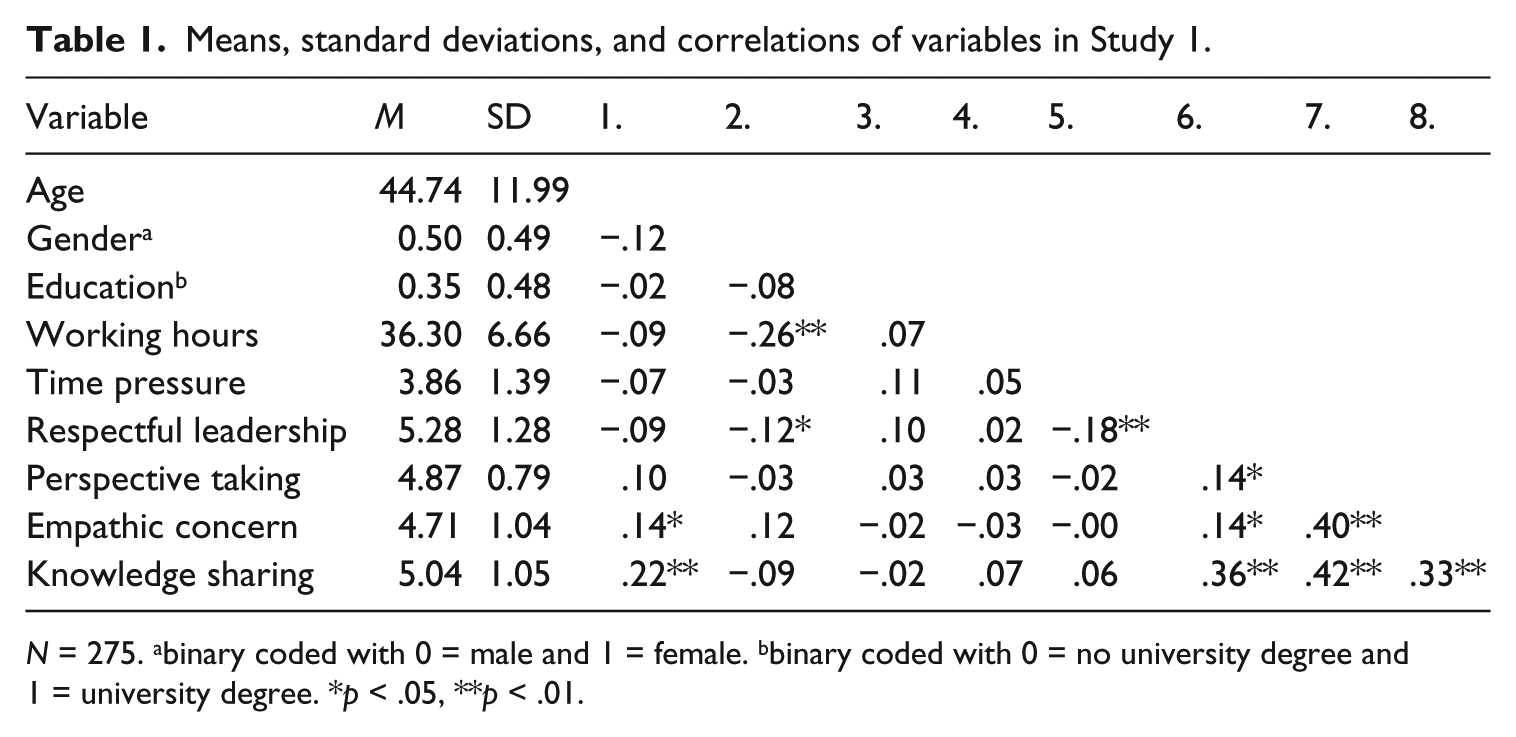
N = 275. abinary coded with 0 = male and 1 = female. bbinary coded with 0 = no university degree and 1 = university degree. *p < .05, **p < .01.
Hypotheses testing
We used structural equation modeling (SEM) in Mplus 7.31 to investigate the direct and indirect relationships between respectful leadership, empathic concern, perspective taking and knowledge sharing. We specified all hypothesized direct and indirect effects simultaneously in the model. In addition, we specified the direct effect of respectful leadership on knowledge sharing, as not testing for the direct effect can spuriously inflate indirect effects (Preacher and Hayes, 2008). Overall, our hypothesized model showed a good model fit (χ2 (225) = 490.13, p < .01, CFI = .95, RMSEA = .07, SRMR = .07).
Hypotheses 1 to 4 addressed the direct relationships between respectful leadership, perspective taking, empathic concern, and knowledge sharing. 4 As can be seen in Table 2, we found that respectful leadership had a positive effect on perspective taking and empathic concern, supporting Hypotheses 1 and 2. Further, perspective taking and empathic concern had positive effects on knowledge sharing, supporting Hypotheses 3 and 4. Hypotheses 5 and 6 addressed the indirect relationships between respectful leadership and knowledge sharing. We found a positive indirect effect of respectful leadership on knowledge sharing via both perspective taking and empathic concern.
Results of structural equation modeling in Study 1.
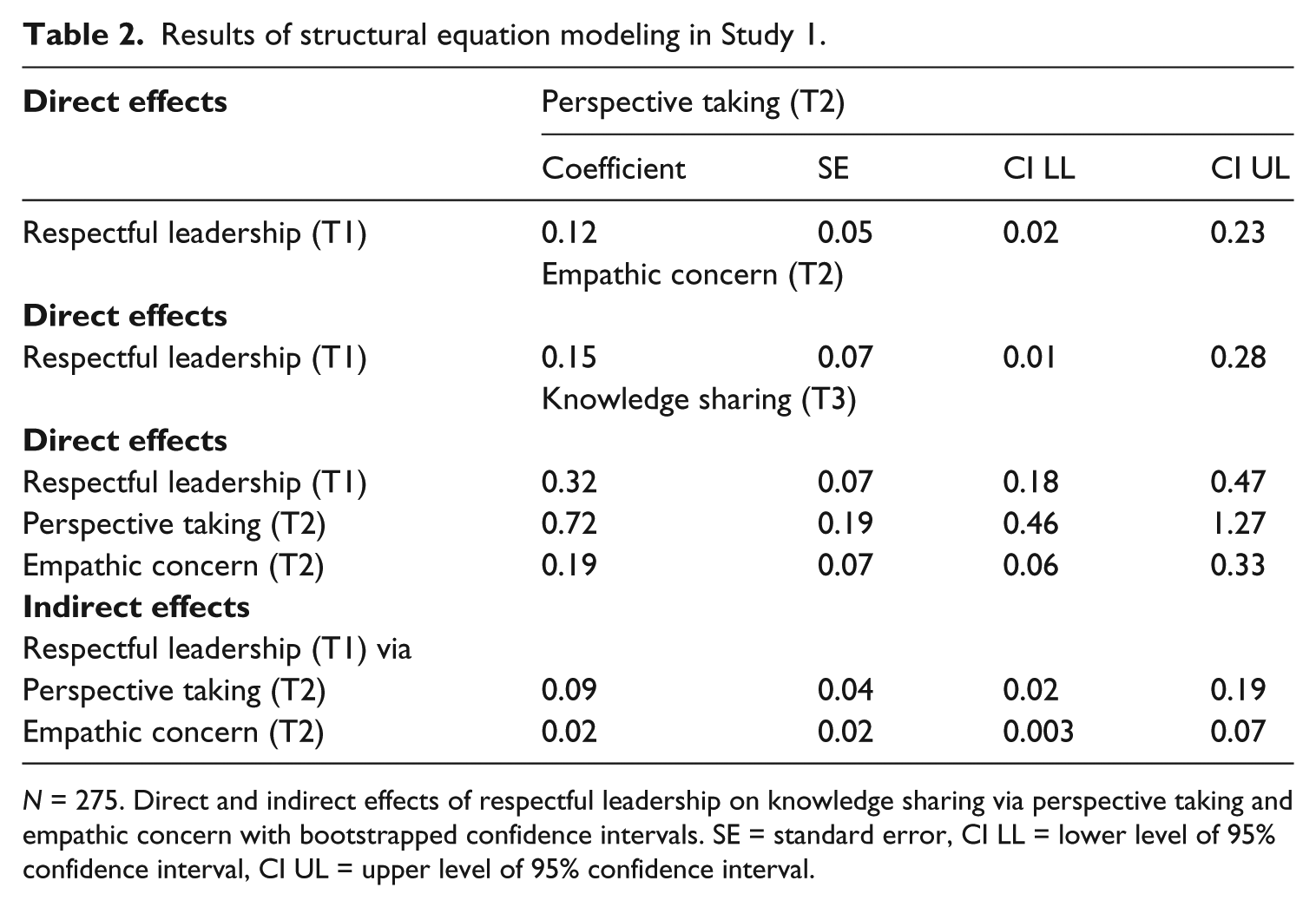
N = 275. Direct and indirect effects of respectful leadership on knowledge sharing via perspective taking and empathic concern with bootstrapped confidence intervals. SE = standard error, CI LL = lower level of 95% confidence interval, CI UL = upper level of 95% confidence interval.
Hypotheses 7a and 7b stated that perspective taking and empathic concern possess a synergistic effect on knowledge sharing. To test these hypotheses, we computed the interaction term between the mean centered items of perspective taking and empathic concern using the XWITH command in Mplus and regressed it on knowledge sharing. We applied robust maximum likelihood estimation (MLR) to compute interaction effects on the latent level as ML is not available. Specifically, the mediation model with interaction was compared against the mediation model without interaction. Overall, the results indicated that the model with interaction (log likelihood = -8,247.38, Akaike Information Criterion (AIC) = 16,644.76, Bayesian information criterion (BIC) = 16,914.08, sample-size adjusted BIC (SABIC) = 16,676.28) was characterized by lower information criteria than the model without interaction (log likelihood = -8,249.44, AIC = 16,646.89, BIC = 16,912.62, SABIC = 16,677.99), thus suggesting a better model fit. Also, a likelihood ratio test revealed that the model with interaction fits the data significantly better than the model without interaction (Δ−2 log likelihood = 4.13, Δ d.f. = 1, p < .05). The estimated coefficients for the mediation model with interaction are presented in Figure 1. We found a positive interaction of the effects of perspective taking and empathic concern on knowledge sharing. A simple slope difference test showed that the positive effect of perspective taking on knowledge sharing was significantly higher at high (+1SD; simple slope = .94, p < .01) as compared with low levels of empathic concern (-1SD; simple slope = .63, p < .01, simple slope difference = .31, p < .05), supporting Hypothesis 7a. Furthermore, a simple slope difference test showed that the positive effect of emphatic concern on knowledge sharing was only significant at high (+1SD; simple slope = .32, p < .01), but not at low levels of perspective taking (-1SD; simple slope = .06, NS, slope difference = .24, p < .05), supporting Hypothesis 7b. As can be seen in Figure 2, high (vs. low) empathic concern strengthened the positive effect of perspective taking on knowledge sharing, and also high (vs low) perspective taking strengthened the positive effect of empathic concern on knowledge sharing.
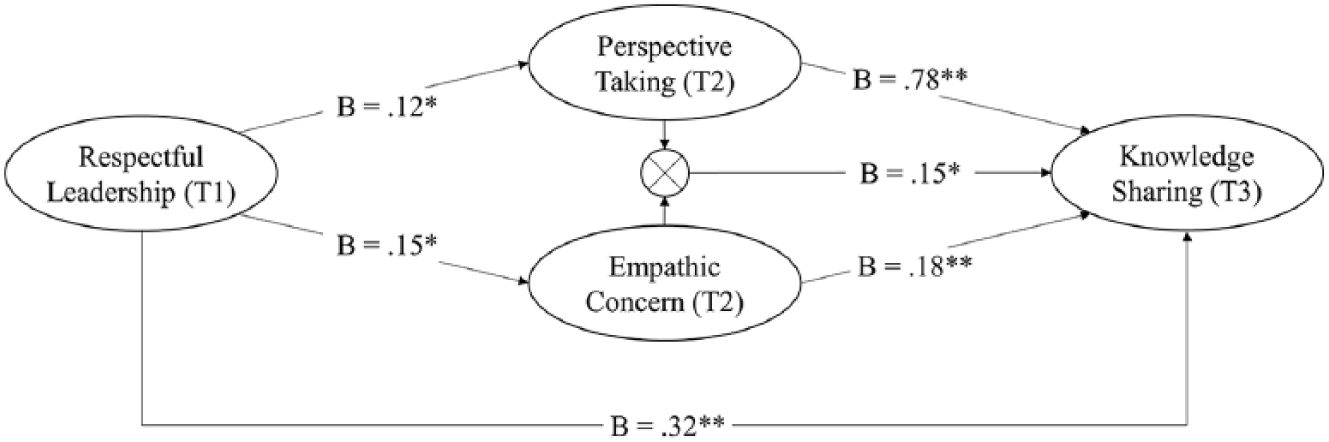
Results of structural equation modeling with interaction in Study 1.
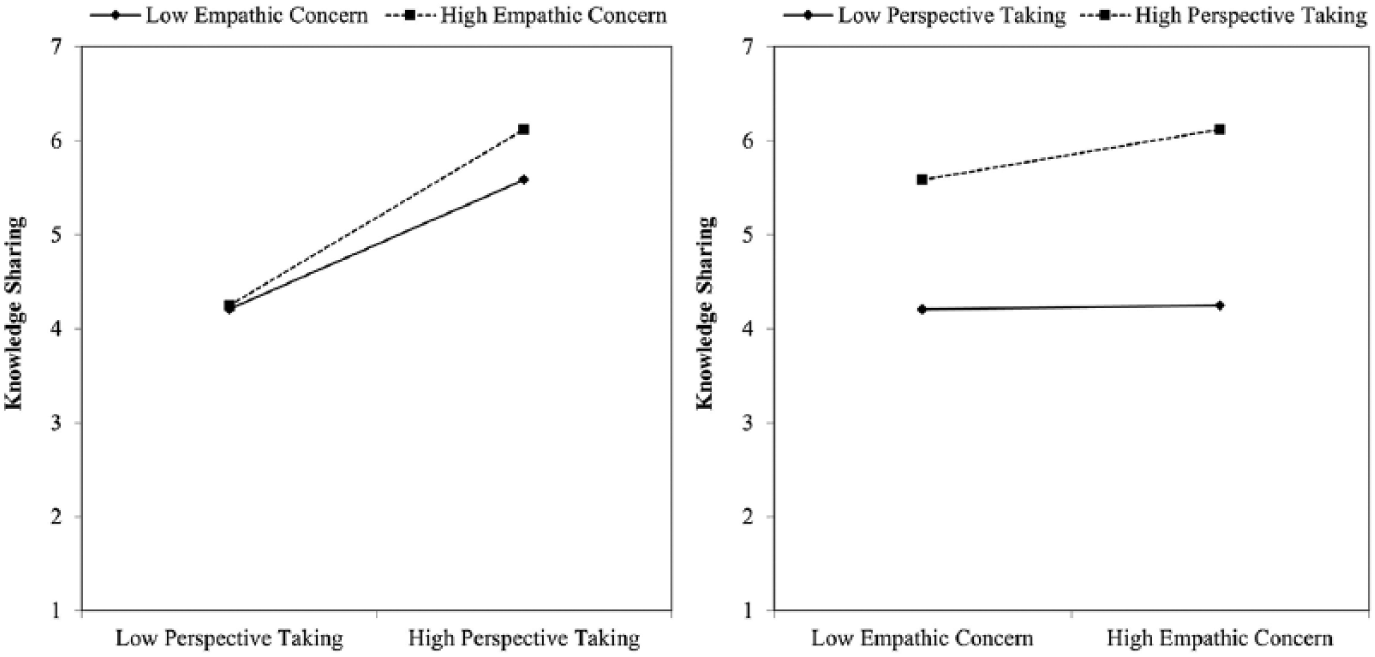
Interaction effects of empathic concern and perspective taking on knowledge sharing in Study 1.
Study 2
In Study 2, we aimed to replicate the findings from Study 1 by using multi-source data from leader-follower dyads to reduce the potential for common-method bias.
Methods
Sample and procedure
We collected data from leader-follower dyads in the Netherlands. To recruit a heterogeneous sample allowing for a generalization across industries and job functions, we used our personal network to contact organizations. We provided interested organizations with a short advertisement text for the study and they made an internal announcement that asked organizational members (i.e. followers and leaders) to get in touch with the research team. Interested organizational members received a link to the online survey and we asked them to forward the link to the second dyad member (i.e. follower or leader, depending on their role). Participants were included if they provided their informed consent, were at least 18 years old, currently employed for at least 20 hours per week, and worked at least three months with their supervisor. We chose a cut-off value of three month as other research has argued that employees require “a minimum of three months tenure with the leader in order to allow enough time for the relationship to be differentiated” (MacMillan, 2013: 58). We used a participant code to match responses from leaders and followers. Our data collection strategy resulted in 191 completed surveys; yet, 13 questionnaires were filled in by the manager only or by the follower only (i.e. no complete dyad), resulting in 89 complete dyads. Of these, six dyads were excluded because they worked together for less than three months. Thus, the final sample consisted of N = 83 leader-follower dyads.
Participants worked in various industries and most represented industries were construction and housing (10.1%), consultancy and education (10.1%), finance, insurance and legal services, (9.0%), and public sector (16.9%). Leaders’ age ranged from 22 to 71 years (M = 44.18; SD = 11.49). Of the leaders, 66.3% were male and 68.9% held a university degree. Leaders worked on average 44.43 hours per week (SD = 10.23). Followers’ age ranged from 19 to 60 years (M = 32.53; SD = 10.39). Of the employees, 51.7% were female and 39.8% held a university degree. They worked on average 37.91 hours per week (SD = 9.32). Followers worked with their leaders on average for 2.93 years (SD = 3.15) with 15.7% less than a year, 44.6% for one to two years, 18.1% for three to four years, and 21.7% for five or more years.
Measures
For all multi-item measures, 5-point scales ranging from 1 (completely disagree) to 5 (completely agree) were used. Respectful leadership was rated by the followers using the Dutch translation of the 12-items scale developed by Van Quaquebeke and Eckloff (2010) (Cronbach’s α = .90). Followers’ social mindfulness in terms of perspective taking (Cronbach’s α = .71) and empathic concern (Cronbach’s α = .77) was measured with the Dutch translation of seven items each from the Interpersonal Reactivity Index developed by Davis (1983). Followers’ knowledge sharing was rated by the leader with the Dutch translation of the 3-item scale by Wilkesmann and colleagues (2009) (Cronbach’s α = .76). As in Study 1, we controlled for followers’ age, gender, education, and working hours per week. Furthermore, we controlled for dyadic tenure as the tenure of dyadic leader-follower relationships can influence the effect strength between dyadic interaction partners (Burmeister et al., 2018b, 2018c; Nifadkar et al., 2018).
Results
Table 3 presents means, standard deviations, and correlations. We used path analysis in Mplus 7.31 to investigate the direct and indirect relationships between respectful leadership, empathic concern, perspective taking and knowledge sharing. We used maximum likelihood (ML) estimation with bootstrapping (10,000 draws) to account for deviations from normality when estimating the indirect effects (Preacher and Hayes, 2008). We tested our conceptual model by including all hypothesized effects simultaneously in the model, while controlling for the direct effect of respectful leadership on knowledge sharing. Thus, the model was saturated and showed a perfect model fit.
Means, standard deviations, and correlations of variables in Study 2.
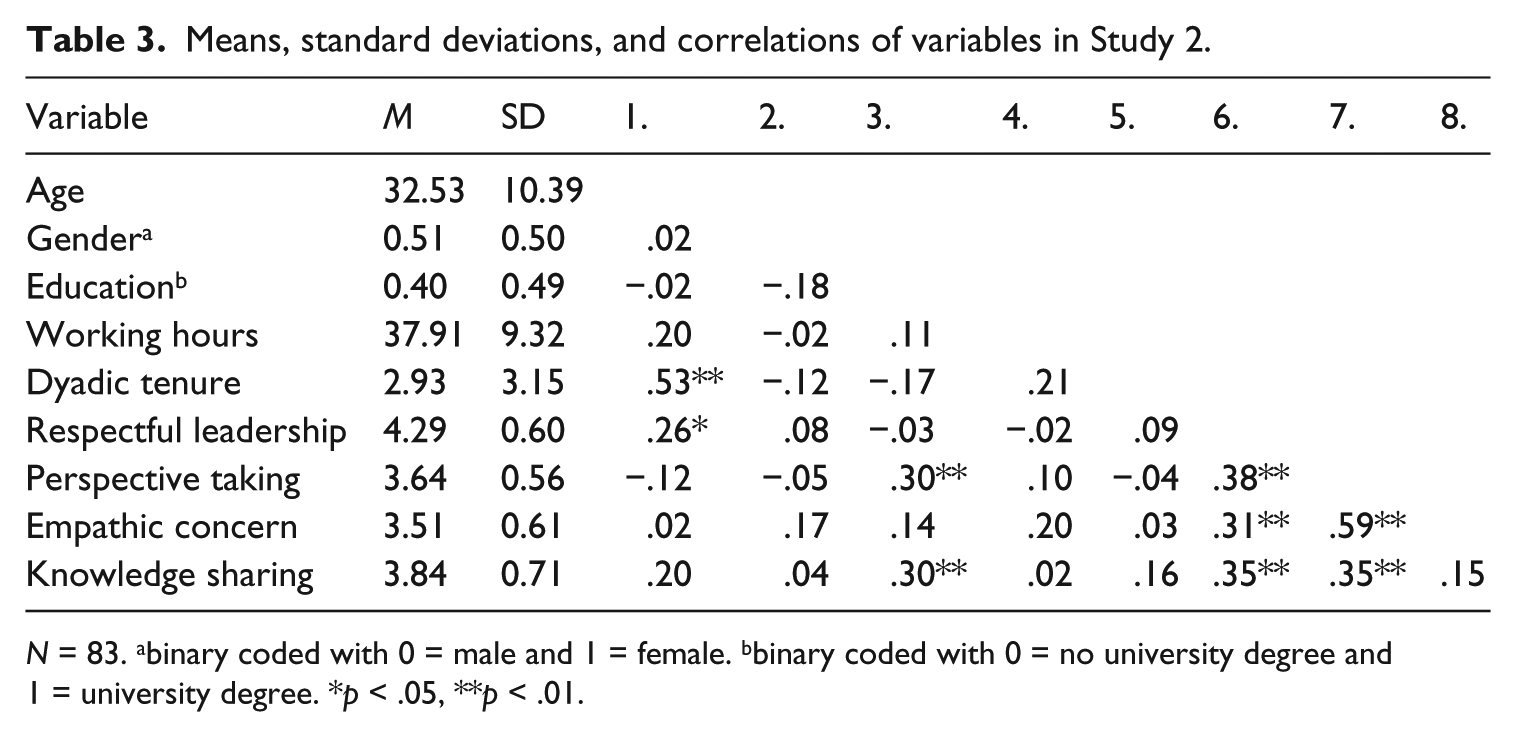
N = 83. abinary coded with 0 = male and 1 = female. bbinary coded with 0 = no university degree and 1 = university degree. *p < .05, **p < .01.
Table 4 presents the direct and indirect effects of respectful leadership on followers’ knowledge sharing through perspective taking and empathic concern. 5 Respectful leadership was positively associated with both perspective taking and empathic concern, supporting Hypotheses 1 and 2. We also found a positive relation between perspective taking and knowledge sharing, supporting Hypothesis 3. However, Hypothesis 4 was not supported because the relation between empathic concern and knowledge sharing was not significant. Further, we found an indirect effect of respectful leadership on knowledge sharing through perspective taking, supporting Hypothesis 5. In contrast, the indirect effect of respectful leadership on knowledge sharing through empathic concern was not significant, thus not supporting Hypothesis 6.
Results of path analysis in Study 2.
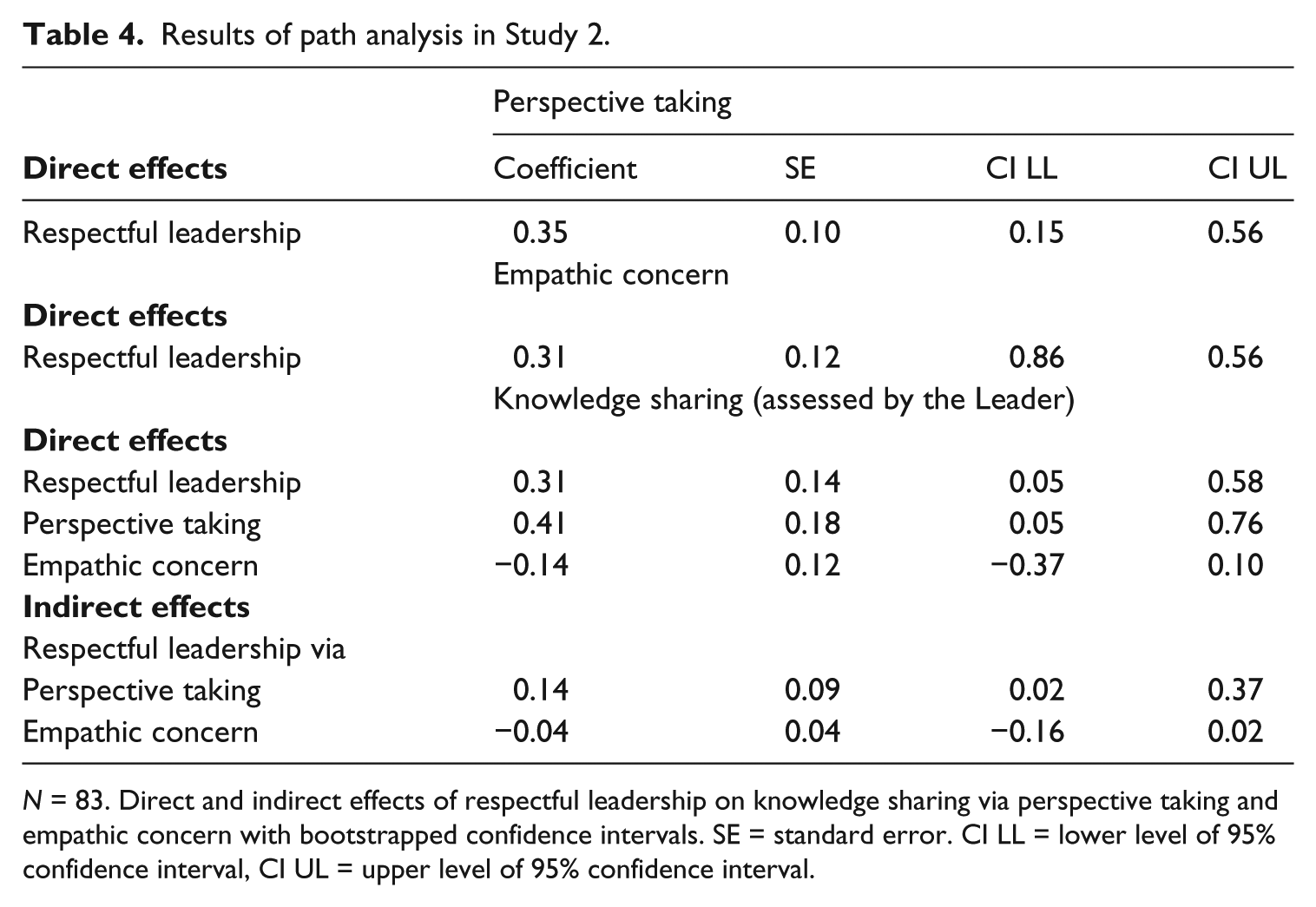
N = 83. Direct and indirect effects of respectful leadership on knowledge sharing via perspective taking and empathic concern with bootstrapped confidence intervals. SE = standard error. CI LL = lower level of 95% confidence interval, CI UL = upper level of 95% confidence interval.
Finally, we tested whether perspective taking and empathic concern have synergistic effects on knowledge sharing. Specifically, we computed an interaction term using the mean centered scale scores of perspective taking and empathic concern, which was then regressed on knowledge sharing. The interaction term was not significantly associated with knowledge sharing (B = -.01, p > .05). Thus, Hypotheses 7a and 7b were not supported in Study 2.
Discussion
In this research, we employed a social mindfulness lens to argue that followers’ perspective taking and empathic concern constitute other-oriented motivational mechanisms through which respectful leadership helps employees to surpass their self-interests and share their knowledge with others at work. Across two studies, we demonstrated that followers’ perspective taking mediated the positive effect of respectful leadership on followers’ knowledge sharing. The mediating effect of empathic concern was only supported in Study 1. In addition, we identified an interaction effect of the mediators in Study 1, such that followers’ perspective taking was particularly positive for their knowledge sharing at high levels of empathic concern and vice versa.
Theoretical implications
Our study has at least three theoretical implications. First, we add to the knowledge sharing literature in general, and research on leadership as a contextual antecedent of employees’ knowledge sharing in particular. Research on leadership as an antecedent of knowledge sharing has only recently evolved, and studies on the mechanisms through which specific leadership styles can contribute to solving the motivational dilemma of knowledge sharing remain rare. Our work suggests that an integrated model combining other-oriented constructs on the side of the leader and the follower provides a promising avenue to enhance our understanding of knowledge sharing in organizations. As an additional contribution, our focus on respectful leadership as an antecedent of followers’ knowledge sharing also extends the literature on consequences of respectful leadership. That is, studies on respectful leadership have predominantly focused on follower-centric outcomes such as job satisfaction and job performance (Decker and Van Quaquebeke, 2015; Van Gils et al., 2018; Wöhrmann et al., 2017). To contrast, our work corresponds to the conceptual core of respectful leadership, namely the genuine interest in others.
Second, our findings imply that the array of theoretical perspectives used to study through which mechanisms leadership affects knowledge sharing needs to be extended. Specifically, we utilized social mindfulness theory (Van Doesum et al., 2013) to introduce perspective taking as a cognitive motivational mechanism and empathic concern as an affective motivational mechanism that explains the positive effects of respectful leadership on followers’ knowledge sharing. Interestingly, we found that perspective taking was a stronger and more consistent positive mediating mechanism between respectful leadership and knowledge sharing than empathic concern. To contrast, meta-analytic evidence has recently shown that empathic concern has stronger positive relationships than perspective taking with pro-social behaviors, and that perspective taking may even have negative effects under certain circumstances (e.g. in competitive contexts; Longmire and Harrison, 2018). The reason for the replicated positive effect of perspective taking (rather than empathic concern) in our research may lie in the conceptual fit between perspective taking and knowledge sharing as cognitive activities in a work context. In contrast, less specific pro-social behaviors such as helping may be more closely aligned with empathic concern.
Third, we also contribute to social mindfulness theory. Our work provides initial evidence that more complex interrelations between the two facets of social mindfulness may exist, such that the strengths of the effects are contingent upon each other. That is, the findings from Study 1 indicated that perspective taking is a necessary pre-condition for empathic concern to foster knowledge sharing (but not the other way around). An explanation could be that knowledge sharing is a rather task-focused, cognitively demanding endeavor that cannot occur without the cognitive understanding of what knowledge the other needs. Remarkably, we did not find an interaction effect in Study 2 that relied on a relatively small sample size which might not have been sufficient to detect an interaction effect in a field setting (McClelland and Judd, 1993). This entails that our interpretation of the findings should be taken with caution and future research is warranted.
Limitations and future research directions
The methodological strength of our study lies in the complementarity of the research designs of Study 1 and 2, such that we replicate the proposed conceptual model using samples from two different countries as well as two different research designs (i.e. time-lagged design in Study 1 and dyadic design in Study 2). However, as with any study, our research has limitations that may inspire future research. First, we cannot completely rule out the possibility that followers’ social mindfulness triggers the leader’s respectful behaviors (i.e. reversed causality). 6 Relatedly, followers may also be more likely to share and seek knowledge from respectful leaders and vice versa (Nifadkar et al., 2018). In the long-term, this reciprocal exchange may increase organizational learning, innovativeness, and performance (Wang and Noe, 2010). Hence, future research may also want to consider long-term effects of respectful leadership and knowledge sharing, for example by capturing change scores of followers’ social mindfulness over time after being assigned to a respectful leader.
Second, we did not investigate any moderators of the proposed relationships in our model. With regard to moderators of the first-stage paths in our model, future research could investigate boundary conditions that may influence the strength of the effect of respectful leadership on followers’ social mindfulness. For example, the social identity model of leadership (Hogg, 2001) argues that leaders are more effective at influencing followers when followers perceive the leader as prototypical for their work team. Hence, respectful leaders may speak more effectively to followers’ social mindfulness if followers’ identification with the leader is high or when they are perceived as prototypical for the team (Gerpott et al., 2017). Concerning moderators of the second-stage paths in our model, the literature suggests that perspective taking may have null or even negative effects on knowledge sharing in competitive environments (Ku et al., 2015; Longmire and Harrison, 2018). Hence, it would be interesting if future research tests for the moderating role of outcome interdependence in linking perspective taking with knowledge sharing, either as a general context factor or as a situation-specific measurement (e.g. degree of conflict; Gerpott et al., 2018).
Third, we examined knowledge sharing as an overall construct and did not distinguish between different types of knowledge. However, previous research has suggested that different types of knowledge exist. For example, Nonaka and colleagues (2006) differentiated between explicit knowledge (i.e. objective information that can easily be articulated) and tacit knowledge (i.e. “sticky” knowledge deeply rooted in doing that is difficult to express). Future studies could examine whether the two facets of social mindfulness have differential effects on the sharing of different types of knowledge. Specifically, perspective taking may be more closely tied to sharing explicit, task-related information, whereas empathic concern may be more relevant for sharing tacit knowledge.
Practical implications
Our study provides several implications for organizations that aim to increase knowledge sharing. First, as knowledge sharing is facilitated by respectful leader behaviors, respectful behavior could be established as a selection and performance criterion for leadership positions. This is a particularly challenging task when considering that employees often feel not as respected by their leaders as they would like to be (Van Quaquebeke et al., 2009). For selection decisions, work sample tests such as situational judgment tests with high predictive validity (Schmidt and Hunter, 1998) could be used to assess the extent to which potential leaders will be likely to demonstrate respectful behavior toward their followers. For performance evaluations, information from annual reviews and feedback from followers or peers could be used to reward leaders that behave respectfully toward their followers. Disrespectful leaders could be identified and asked to participate in compulsory training sessions on respectful leadership. In those trainings, leaders could learn about the characteristics and benefits of respectful leadership using role plays and case studies. For example, organizations could train managers to use language that is experienced as respectful by followers (Van Quaquebeke and Felps, 2018).
Second, respectful leaders exert their positive influence on followers’ knowledge sharing via increased perspective taking and empathic concern. However, organizations might not want to rely solely on leaders to increase followers’ social mindfulness. Therefore, organizations aiming to foster knowledge sharing could also use other practices to communicate the benefits of engaging in perspective taking and empathic concern. As a first step, organizations may want to offer trainings in which the nature and benefits of social mindfulness are explained to and experienced by employees (e.g. Reb and Atkins, 2015; Roeser et al., 2012). Furthermore, organizations could rely on easily implementable online interventions that consist of guided writing exercises that connect experiences with reflection tasks to improve employees’ perspective taking (Song et al., 2018) and empathic concern (Okonofua et al., 2016). To conclude, we hope that our work helps both theory and practice to acknowledge the value of respectful leaders and social mindfulness to foster knowledge sharing at work.
Supplemental Material
HUM844813_Supplementary_Material – Supplemental material for Respectful leadership and followers’ knowledge sharing: A social mindfulness lens
Supplemental material, HUM844813_Supplementary_Material for Respectful leadership and followers’ knowledge sharing: A social mindfulness lens by Fabiola H Gerpott, Fasbender Ulrike and Burmeister Anne in Human Relations
Footnotes
Author’s note
All authors contributed to this article equally.
Funding
This research received no specific grant from any funding agency in the public, commercial, or not-for-profit sectors.

Notes
References
Supplementary Material
Please find the following supplemental material available below.
For Open Access articles published under a Creative Commons License, all supplemental material carries the same license as the article it is associated with.
For non-Open Access articles published, all supplemental material carries a non-exclusive license, and permission requests for re-use of supplemental material or any part of supplemental material shall be sent directly to the copyright owner as specified in the copyright notice associated with the article.
