




Abstract
In response to the numerous hard and soft ethical regulations that have emerged in the wake of recurrent corporate scandals, Multinational Corporations (MNCs) have adopted ethical tools. This move is often interpreted as a means to garner legitimacy and as loosely coupled to corporate activities. Little is known, however, about the processes by which external regulations affect the design of ethical tools. Approaching organisations as open polities and building on institutional theory and the sociology of compliance, we conducted a qualitative study of the development of 23 ethical tools at four MNCs. We analytically induced a three-stage model that explains how ethical tools are externally sourced (importation), then subjected to competing pressures from distinct professional groups that replicate legal features of the environment (politicisation), to become finally turned into quasi-legal procedures (legalisation). Our analysis contributes to theory by explaining how external regulations relate to the organisational production of ethical tools in a self-reinforcing manner, while specifying the role of ethics professionals in the process of ethical tool production.
Keywords
Regulations increasingly define both what constitutes ethical behaviour for organisations and how ethics are applied in corporations. This trend is sustained by both hard and soft regulations. On the hard side, there is increased ‘judicialisation’, which is the ‘domination of non-judicial negotiating or decision-making arenas by quasi-judicial (legalistic) procedures’ (Tate and Vallinder, 1995: 5). On the soft side, there is a growing ‘politicisation’ of corporate environments (Scherer et al., 2016), visible in the explosion of norms and standards that focus on defining corporate responsibility and accountability, such as ISO 26000 (Gilbert et al., 2011; Rasche et al., 2013). Despite these trends, little research has connected the development of external ethical regulations to the politics surrounding the implementation of ethical tools within organisations (Clegg et al., 2018; Weber and Waeger, 2017).
Thus far, the literature dedicated to ethical tools has focused on the determinants of their adoption (Chua and Rahman, 2011; Weaver et al., 1999) or on their organisational effectiveness (Kaptein and Schwartz, 2008), leaving untouched the work of professionals involved in the development of ethical tools (Romani and Szkudlarek, 2014) and how external regulations influence their design. Through institutional theory, authors have clarified multiple endogenous factors (e.g. search for legitimacy, reputation) and exogenous factors (e.g. cultural shifts, public pressures) that drive the corporate adoption of ethical tools (Bondy et al., 2008) and have suggested that ethical regulations may in fact remain ‘decoupled’ from actual organisational practices (Meyer and Rowan, 1977; Weaver et al., 1999).
However, the micro-dynamics underlying the design of ethical tools remain overlooked, as do the political struggles that may take place at the boundary between organisations and their external institutional environment. As a result, little is known about how the external political trends that sustain the development of ethical regulations relate to the internal politics of ethical tool development, though we can expect the two phenomena to be empirically related (Clegg et al., 2018; Weber and Waeger, 2017).
In this article, we seek to theorise the relationships between the (internal) development of ethical tools and (external) ethical regulatory trends by uncovering the processes by which external regulations are connected to, translated into, and involved in the design of ethical tools. To do so, we combine insights from the ‘open polity model of organisations’ (Weber and Waeger, 2017) and the ‘sociology of compliance’ (Edelman and Talesh, 2011; Parker and Nielsen, 2011; Talesh, 2009) in a baseline framework. Open polity scholarship focuses on how ‘internal political processes are intertwined with external conditions, so that organisational responses to their environment are mediated and shaped by boundary processes and organisational coalition dynamics’ (Weber and Waeger, 2017: 887) and suggests we might explore how external and internal politics interact in ethics regulation. The sociology of compliance (Edelman and Talesh, 2011; Parker and Nielsen, 2011; Talesh, 2009) is a field of study derived from the institutional analysis of how legal pressures influence organisations (Edelman, 1990, 1992; Meyer and Rowan, 1977). It acknowledges the necessarily ambiguous nature of any regulation (Edelman, 1992) and sheds light on the key role played by professionals (Lenglet, 2012), their subjective interpretations (Edelman and Talesh, 2011), and their embodied experience (Pérezts and Picard, 2015) in the processes through which external regulations are ‘translated’ into an organisational context.
To empirically investigate how external ethical regulations shape the design of ethical tools, we focus our analysis on the professionals involved in designing these tools at four MNCs headquartered in France. Adopting analytical induction as our research method, we analyse 23 processes of ethical tool design. We build on this analysis to develop an augmented framework that captures how external ethical regulations are translated in MNCs through the design of ethical tools. This model consists of three steps: ethical tools are first sourced through importation; then, they are subjected to competing pressures from distinct groups of ethics professionals through politicisation, which replicates the legal features of the environment; and finally, they are turned into quasi-legal procedures through a focus on compliance, standardisation, and individualisation of responsibility at the legalisation stage.
As a whole, our study offers a twofold contribution to theory. First, our results show the connections between the internal and external political dynamics of ethical regulations, thereby advancing current analyses of organisations as open polities and the sociology of compliance. We explain how these regulations are connected to organisations through the sourcing of ethical tools, the intra-organisational replication of political divisions and processes, and the emerging and self-reinforcing legalisation of ethical tools. Second, our study advances current knowledge of how ethical tools are designed in organisations (Romani and Szkudlarek, 2014). We highlight the key roles played by distinct groups of professionals and their interpretative processes throughout the process of translating regulations. In so doing, we underline the risk of the Balkanisation of ethics professionals.
Reconsidering the institutional perspective on the adoption of ethical tools
In line with prior research on ‘ethical programs’ (Kaptein, 2015; Treviño and Weaver, 2001), we broadly define ‘ethical tools’ as the set of devices designed to formalise and regulate ethics in the workplace. This definition is consistent with the notion of a ‘business code’, that is, a distinct and formal document containing a set of prescriptions developed by and for a company to guide present and future behaviour on multiple issues of at least its managers and employees toward one another, the company, external stakeholders and/or society in general (Kaptein and Schwartz, 2008: 113).
In addition to important empirical studies on the effectiveness of ethical tools (for an overview, see Kaptein, 2015; Kaptein and Schwartz, 2008; Romani and Szkudlarek, 2014), there are a number of articles that employ institutional theory to account for the adoption of ethical tools. According to these articles, ethical tools are adopted in response to institutional pressures and the adoption of compliant behaviours is central to an organisation’s survival (DiMaggio and Powell, 1983; Meyer and Rowan, 1977). These compliant behaviours may be related to fears of legal punishment or a bad reputation (Chua and Rahman, 2011; Conroy and Emerson, 2008). Such fears might also explain the increasing development of ethics offices and tools, which signal positive intent (Bondy et al., 2004) and increase social legitimacy (Meyer and Rowan, 1977; Suchman, 1995).
Prior institutional research also shows that institutional pressures explain not just the adoption of ethical tools but also their isomorphism (Bondy et al., 2008; Conroy and Emerson, 2008). These studies view ethical tools as a voluntary rule-setting mechanism to escape or limit state intervention in organisational decisions (Chua and Rahman, 2011). Ethical tools are thus approached as ‘self-regulation’ devices (Adams et al., 2001) meant to manage regulatory risks (Bansal and Hunter, 2003; Levis, 2006) rather than means to increase a firm’s performance (De Jong et al., 2005). Despite their voluntary nature, ethical tools are thus outcomes of organisations’ perceived obligation to comply with social and legal expectations.
However, an analysis of the micro-foundations of compliance practices that connect external regulations to the development of internal tools and practices is still missing from the literature. Institutional studies have usually assumed the pre-existence of such tools in organisations or organisational fields, neglecting the development of these tools within organisations (Kaptein and Schwartz, 2008; Romani and Szkudlarek, 2014). They have also assumed that ethical tools circulate without necessarily being altered, despite evidence that practices or tools are usually tailored to local contexts (Ansari et al., 2010; Gond and Boxenbaum, 2013). As a result, little is known about the design of ethical tools and the work of the professionals in charge of designing these tools.
Additionally, and more importantly for our purpose, prior institutional studies of ethical tools have overlooked the political mechanisms affecting organisational responses to external pressures and have regarded the adoption of ethical tools as a homogenous organisational outcome. However, recent approaches to organisations as ‘open polities’ (Weber and Waeger, 2017) suggest that such institutional processes may be influenced by both dynamics in the external political environment and dynamics in organisations (Clegg et al., 2018). For instance, Waeger and Weber (2018) conceptualise how intra-organisational political dynamics can shape organisational responses to multiple and contradictory institutional pressures, and Mezihorak’s (2018) study of the adoption of outsourcing at an MNC shows how such internal and external political dynamics combine to shape the labour process. Further, in a literature review of studies with an open polity approach to organisations, Weber and Waeger (2017: 888) call for future work focused on the boundary processes that ‘couple organisations’ internal policies to their external political environments’. In what follows, we respond to this call: specifically, we open the ‘black box’ of ethical tool design and closely analyse how MNCs translate ethical regulations into internal ethical tools through boundary micro-processes. We address the following question: How are external ethical regulations translated in organisations through the design of ethical tools?
Boundary micro-processes of ethical tool adoption: Model development
To explore the boundary micro-processes that connect external ethical regulations to the adoption of ethical tools, we develop a baseline model that combines concepts from the analysis of ‘organisations as open polities’ (Weber and Waeger, 2017) and the ‘sociology of business compliance’ (Parker and Nielsen, 2011). Figure 1 provides an overview of our baseline model that summarises the previous literature and has guided our inquiry. This model explains how the development of ethical regulations reinforces the ambiguity of such regulations. Further, it explains how the legal sphere shapes the boundary micro-processes underlying the adoption of ethical tools. These boundary micro-processes also involve the translation of regulations by ethics professionals, political dynamics, and material dimensions. We now present each component of our baseline model in greater detail.
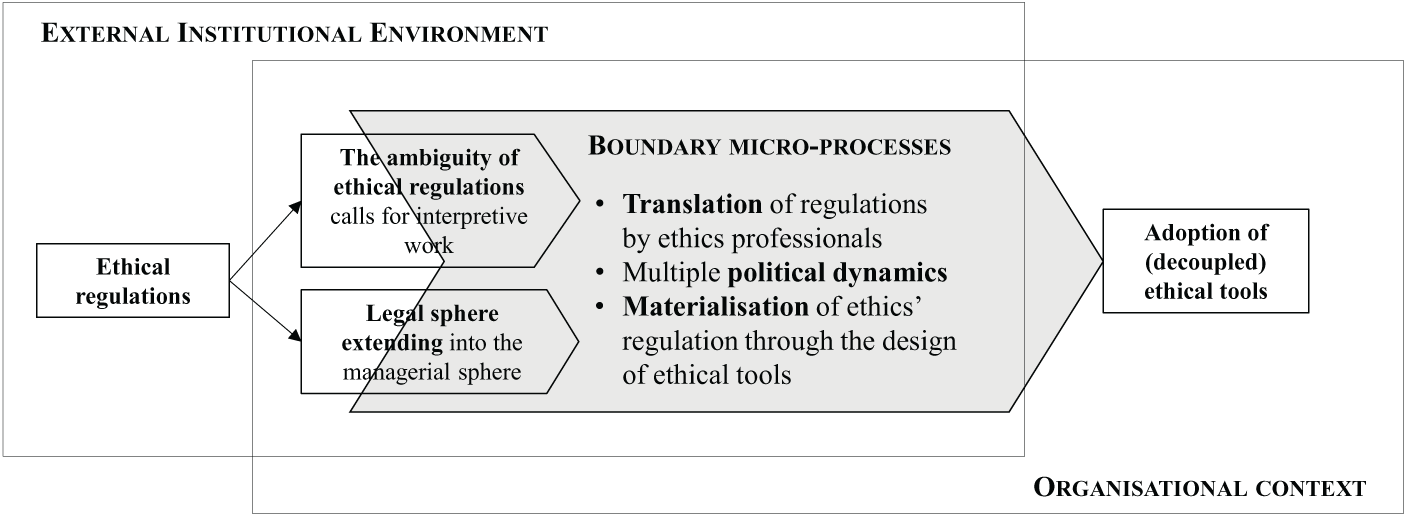
Boundary micro-processes of ethical tools adoption: A baseline model.
Addressing the ambiguity of ethical regulations
The sociology of business compliance moves from a positivist to an interpretivist stance on regulations, a stance that fully recognises the role of the organisational interpretative processes through which compliance is achieved and external regulations are translated (Parker and Nielsen, 2011). In this perspective, the ambiguity of regulations enables organisations to construct their own meaning of compliance (Edelman, 1990), leading to different organisational interpretations of compliance (Edelman, 1992; Lenglet, 2012) – even though isomorphic pressures drive organisational behaviour (DiMaggio and Powell, 1983).
We argue that the specific context of the adoption of ethical regulations is especially relevant to advancing our understanding of organisational interpretative processes, as ethics is a particularly ambiguous notion. Definitions of ethics vary across legal frameworks and across organisations. They usually point to broad values like ‘integrity’ or ‘honesty’ that are difficult to implement and enforce (Crane and Matten, 2010; McCrudden, 2008). Just as for corporate social responsibility or sustainability, the increasing number of distinct soft standards intended to regulate ethics creates a high degree of opacity in this field (Wijen, 2014). And yet, despite this ambiguity, MNCs have responded to ethical regulations through a similar adoption of codes of ethics or enforcement of whistleblowing procedures (Bondy et al., 2004; Chua and Rahman, 2011). To understand how organisations manage the adoption of ethical regulations, compliance studies suggest focusing on the role of the professionals in charge of translating external regulations into internal policies and practices; from the open polity viewpoint, such professionals operate as ‘boundary spanners’ who connect features of the external political environment to organisational practices (Rao and Sivakumar 1999; Weber and Waeger, 2017).
Recognising the role of professionals and the extension of the ethical regulative sphere
Sociology of compliance studies have highlighted the importance of the professionals in charge of this translation as key mediation points between law and practice (Edelman, 1992; Edelman and Suchman, 2007; Edelman and Stryker, 2005). Previous studies suggest that these professionals often have a background in law, even though their positions or status may differ across organisations (e.g. compliance officers, legal officers, internal auditors). As a result, they ‘embody the law’ and create an ‘overlapping zone’ between the legal field and their organisation. By sanctioning or discouraging certain types of behaviour, these professionals set the tone for how their organisation will comply (or fail to comply) with regulations (Lenglet, 2012) and develop regulatory expertise that helps them build powerful internal positions (Farjaudon and Morales, 2013). This extends the legal or normative sphere into the managerial and organisational sphere, further linking external and internal political dynamics (Weber and Waeger, 2017).
Considering multiple political dynamics
Because external regulations are usually ambiguous, this process of interpretation and translation is a ‘contested area’ (Edelman, 1992) within which a variety of actors compete to express their views (Edelman et al., 2001). Different experts can provide such divergent interpretations about the impact of a regulation for the organisation that the interpretative process becomes highly political (Edelman and Stryker, 2005; Lenglet, 2012; Talesh, 2009).
Accordingly, the organisational implementation of laws, standards, and norms is subjected to political dynamics (Weber and Waeger, 2017) and multiple occupational and professional groups may compete to shape the meaning of regulatory frameworks for the organisation (Lenglet, 2012). As some conceptions of regulations may be more accepted or legitimate than others (Edelman et al., 2001; Power, 2004; Shamir, 2010), professional groups may consolidate their power positions or undermine the positions occupied by other groups (Farjaudon and Morales, 2013). The process of translating regulations therefore not only reframes the meaning of the law but also potentially allows organisations to evade legal mandates (Edelman, 1992) and plays a central role in preserving managerial authority and discretion in organisations (Edelman and Talesh, 2011; Potoski and Prakash, 2011).
Considering materiality: Ethical tools in practice
Tools have not been the main focus of scholars interested in the sociology of compliance (Parker and Nielsen, 2011), and studies of boundary processes that adopt an ‘open polity’ approach have neglected materiality (Weber and Waeger, 2017: 906). However, several recent empirical studies suggest that specific tools may play an important and concrete role in compliance (Pérezts and Picard, 2015; Vigneau et al., 2015). For instance, Pérezts and Picard’s (2015) empirical analysis of an anti-money laundering compliance unit at a French investment bank suggests that compliance professionals spend a lot of energy designing management tools – such as files, lists, or matrices – that other employees or organisational actors can then use. Interestingly, their analysis of whether and how compliance occurs in practice relies on the analysis of how a specific set of files related to risk assessment are consulted and manipulated by compliance officers. Our focus on ethical tools can help advance such an inquiry and thus contributes to expand prior analyses of both organisations as open polities and business compliance.
Because the field of ethical regulation is populated with many tools, we focused on this material dimension of the role of compliance professionals. This is an area that deserves further inquiry, as ethical tools function as the lynchpin between external pressures and the internal implementation of ethics. Such an approach is attuned to recent studies that insist on the specific features of ethical tools and the potential organisational interests that are served in the development of such devices (see, e.g., Haxhi et al., 2013). We therefore consider the actors in charge of ethics as more than ‘professionals’ competing to shape interpretative processes in their organisation’s responses to ethical regulations; we also consider them as ‘designers’ who are actively engaged in producing new ethical tools and who advance their own views though the design process. Equipped with our conceptual apparatus (Figure 1), we now explore the role of ethics professionals in designing ethical tools in order to unpack the processes that underlie MNCs’ responses to ethical regulations.
Methods and data
Research design and case sampling
A qualitative approach was deemed appropriate (Yin, 2003) to our study, as the processes of designing ethical tools have been largely overlooked in prior research (Romani and Szkudlarek, 2014). As MNCs are described in the literature as heavy consumers of ethical tools (Bondy et al., 2008; Kaptein, 2015), have been the source of influential ethical scandals, and have sufficient resources to design specific tools, we focused on this type of organisation and approached four MNCs headquartered in France. Following a logic of ‘purposive’ sampling (Yin, 2003), we focused on MNCs that were known to be engaged in or about to commence processes of ethical tool formalisation so that we could document the complete process of ethical tool design. Our ‘multiple case study’ design (Yin, 2003) allowed us to capture some variance across organisational contexts while also documenting multiple processes of ethical tool design in each organisation.
Consistent with our exploratory approach, we maximised ‘theory-driven variance’ in the data (Palys, 2008: 697) by selecting cases with distinct external and internal contexts (Pauwels and Matthyssens, 2004). With regard to the external context, our four MNCs operate in different industries (automobile, electric equipment, energy) yet encounter a relatively similar set of ethical issues (conflicts of interest, corruption, fraud, human rights issues in the supply chain, workplace harassment). With regard to the internal context, we selected organisations with various levels of maturity in and recognition for their ethical standards and tools. Two MNCs were already well advanced, with formalised ethical tools designed more than 10 years ago (hereafter: MNCs 1 & 3), whereas the ethical tools of the other two MNCs were still in development at the time of the study (hereafter: MNCs 2 & 4). At these four MNCs, ethics was sometimes expressly referred to as such and was other times referred to through other labels, such as corporate responsibility or sustainable performance. Appendix A provides an overview of the characteristics of the four MNCs (see Table A1, Appendix A, available online as supplementary material). Across these four MNCs, a total of 23 processes of ethical tool formalisation were documented (the full list of the ethical tools is provided in Appendix A, Table A2, available online as supplementary material).
Data collection
In order to uncover the processes by which external regulations are translated in organisations through the design of ethical tools, we combined several techniques of data gathering. Appendix A provides the full list of data sources for each MNC (Table A2, see Appendix A, available online as supplementary material) and shows how these sources are used in our data analysis (Table A3, see Appendix A, available online as supplementary material).
In-situ observation and participant observation
The lead author of the paper carried out in-situ observations of meetings and brainstorming sessions for the preparation and design of ethical tools at three of the four MNCs. All observations 1 were transcribed as field notes after each session (for a total of about 112 hours of observation, see Appendix A, available online as supplementary material). Through participant observation, the lead author was also involved in the process of formalising ethical tools at three MNCs and was thus continuously informed about the design of the tools. This researcher acquired an insider’s knowledge of the issues underlying these tools’ development and became acquainted with most of the professionals in charge of ethics at three of the four MNCs. These lasting interactions helped her develop close relationships with the actors, observe the in vivo interactions of managers, and move beyond superficial accounts to collect informal information about the design process.
Interviews
A total of 26 interviews were conducted with professionals in charge of developing ethical tools at the four MNCs to validate insights from our observations and deepen our understanding of the design of ethical tools. These face-to-face interviews were semi-directed and covered topics related to the interviewee’s background and views on ethics and ethical tools, the specific processes of development under observation, and the challenges inherent to designing tools. Interviews were recorded and transcribed for analytical purposes.
Secondary and archival data
Observation and interview data were complemented with internal and external data from each MNC, including the ethical tools themselves and internal information and corporate videos related to the tools. We also collected other publicly available data related to our topic for each MNC, including their corporate social responsibility (CSR) reports or newspaper articles about their ethical tools.
Data analysis
Analytical induction (Bansal and Corley, 2011) was adopted as the main strategy to analyse our data, following the ‘Gioia method’ (Gioia et al., 2013). First, we engaged in open coding by identifying initial data concepts and grouping them into ‘first-order concepts’. We compared data across informants to discern the main concepts; we created a first-order concept only if there was enough data from at least two cases of ethical tool design.
Second, a round of axial coding was performed (Strauss and Corbin, 1998) by looking for deeper relationships between first-order concepts and assembling them into more abstract ‘second-order themes’ (Gioia et al., 2013). During this process, the researchers discussed how to interpret the themes while moving back and forth between the literature and the empirical data. Through this process, prior concepts related to the sociology of compliance (e.g. professionals’ interpretations of ethical regulations) and open polities (e.g. linking the organisation with the external environment) were found to be relevant to make sense of our themes (see Figure 1).
Third and finally, to define aggregate dimensions, we gathered second-order themes into the aggregate dimensions. We found three aggregate dimensions, each of which corresponds to a distinct stage of the process of ethical tool development: ‘external sourcing of ethical tools’, which corresponds to the importation of ethical tools in the organisation; ‘legalist domination’, which refers to the politicisation stage in the design of tools; and finally, ‘ethical tools as quasi legal procedures’ which corresponds to the legalisation of ethical tools. Figure 2 illustrates the data structure of our findings. Appendix B ( available online as supplementary material) provides additional illustrative data for the aggregate constructs we identified. Together these aggregate constructs form the stages of a framework that accounts for how ethical tools translate external regulations. After briefly presenting the context within which ethical tools are designed at MNCs, we introduce our findings.
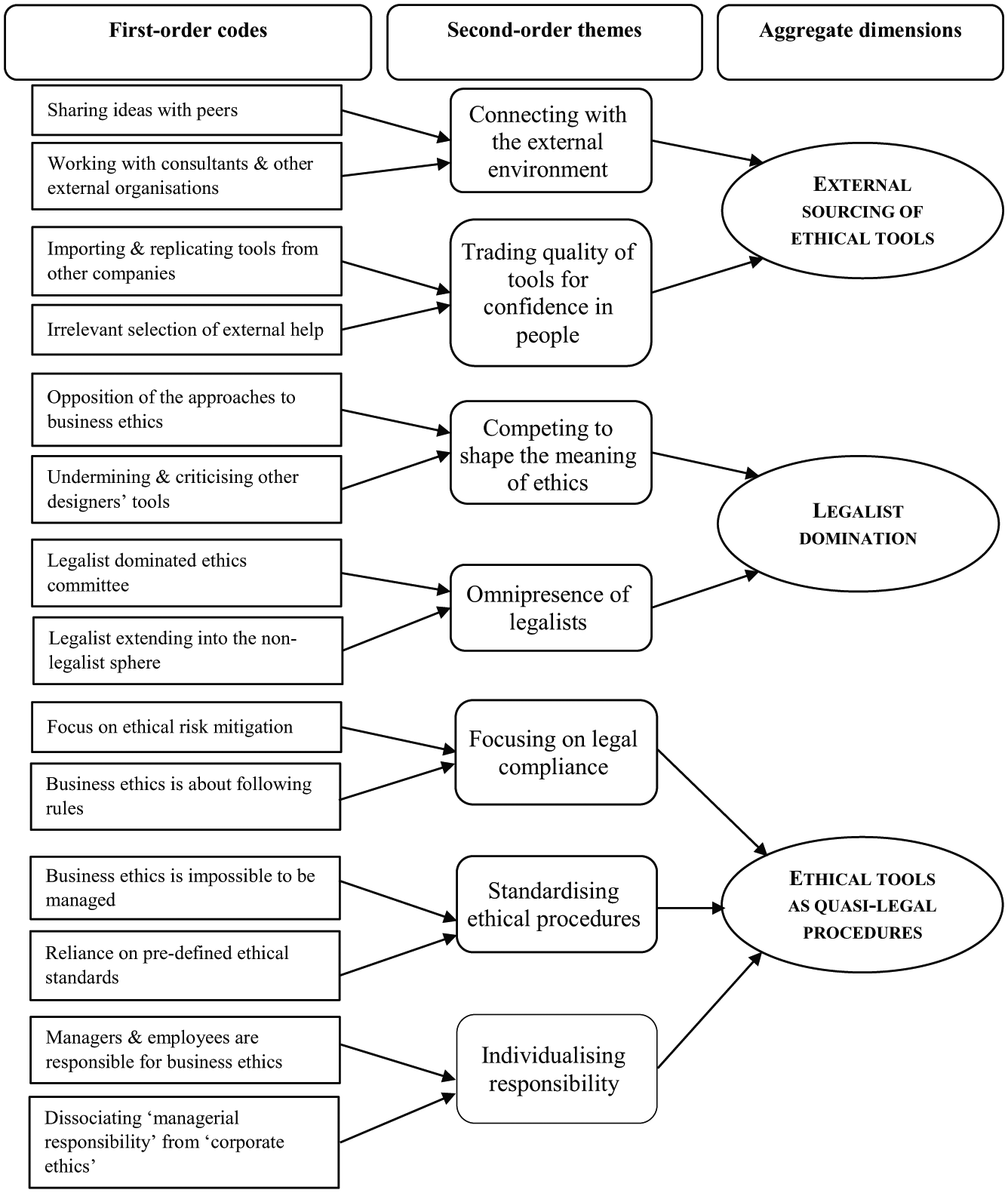
Data structure.
Case context
The increasing number of ethical and financial scandals (e.g. Siemens in 2006; Alstom in 2014; Tesco in 2014; Volkswagen in 2015; Rolls Royce in 2017) has led to an increase in the number of regulations on ethical issues (Conroy and Emerson, 2008) and influenced the adoption and design of ethical tools by our case study MNCs.
Specifying the actors and processes of ethical tool design
At each of the MNCs studied, an average of 3 to 5 people were specifically tasked with the role of designing an ethics program (see Appendix A, available online as supplementary material); we refer to these actors as ‘ethics professionals’ or ‘designers’ throughout the narrative. Their role was to actively participate in reflecting on and implementing ethics in the MNC. We thus excluded from this group anyone whose role was limited to simply assisting in this process in order to focus our analysis on the persons in charge of designing ethical tools.
Ethics professionals are not necessarily members of the ethics department; our term also covers members of the legal or compliance department with whom collaboration is more or less forced. Accordingly, two different designer ‘profiles’ emerged from our data: the legalists and the non-legalists. We employ the term ‘legalist’ to designate legal experts or their equivalents due to their connection to the law and rules, generally fostered by legal studies. 2 However, it is not their legal education that specifically defined actors in this category, but rather their expression of an adherence or particular attachment to rules and compliance with them in questions of ethics, as inferred from the analysis of their discourse.
We use the term ‘non-legalists’ for the professionals with other profiles. These profiles are inflected by their varied prior experiences and positions – that is, human resources, sustainable development, ethics, unions, academia, or operations. None of them had an educational or professional background in law or a related area. They therefore form a group with heterogeneous professional profiles. The fuzziness surrounding who is really in charge of ethics raises certain problems that we will explore in our findings.
Although the processes of ethical tool design differ in ways that we will document in our findings, we nevertheless found underlying commonalities in the design process across the four MNCs. For instance, all MNCs had established an ethics committee (‘steering committee’ for MNC 4) at the same level as the executive committee and which directly reports to the Chief Executive Officer (CEO). The objective of the committee is to approve the content of the ethics program and authorise its release. This committee meets a few times per year to discuss and approve proposals for ethical tools.
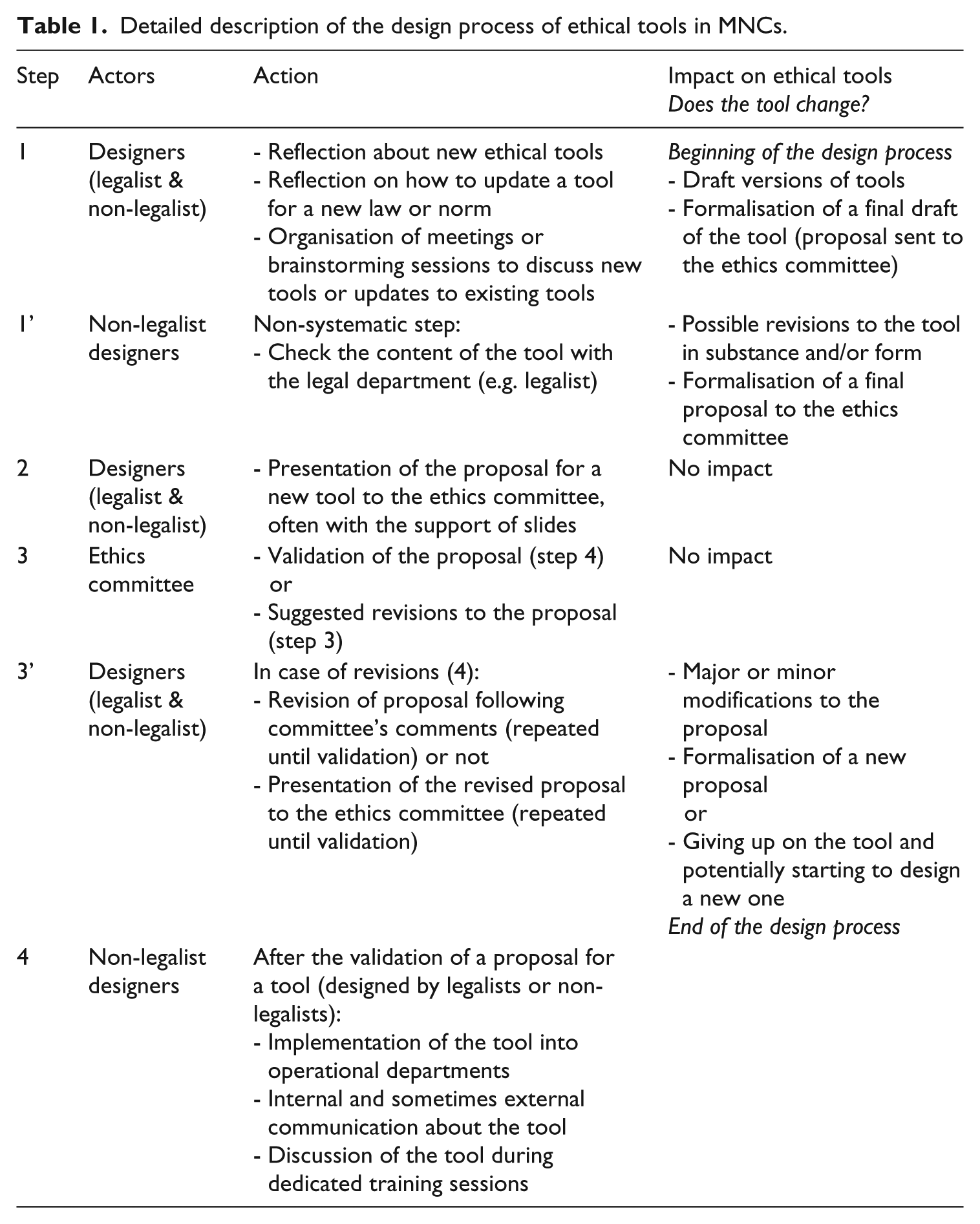
Accordingly, a ‘standard’ path for deciding whether an ethical tool will be adopted and/or for defining or specifying its content can be summarised as a four-stage process. First, the tool is formalised by designers from the ethics or legal department, i.e., by non-legalists or legalists; second, a potential consulting phase with the legal (or compliance) department ensures that the proposed content complies with applicable standards; third, the proposal is then sent to the ethics committee for validation; fourth and finally, it is ultimately sent back to the ethics department for its implementation in operations and divisions. Table 1 provides more practical details about this process, specifying the key actions that take place at each stage, as well as their likely impact on ethical tools.
Detailed description of the design process of ethical tools in MNCs.
Findings: Unpacking the translation of external regulations within organisations
Our empirical analysis suggests that external ethical regulations are translated within organisations. Figure 3 presents our ‘augmented framework’ according to which external ethical regulations are first imported in the organisation in ways that support the development of ethical tools, then politicised by competing internal approaches to ethical tool design in which the legalist perspective dominates, and ultimately legalised through the production of ethical tools that are constituted as quasi-legal procedures. In what follows, we build on our data to explain each stage of this process and then explain how the process can become self-reinforcing.
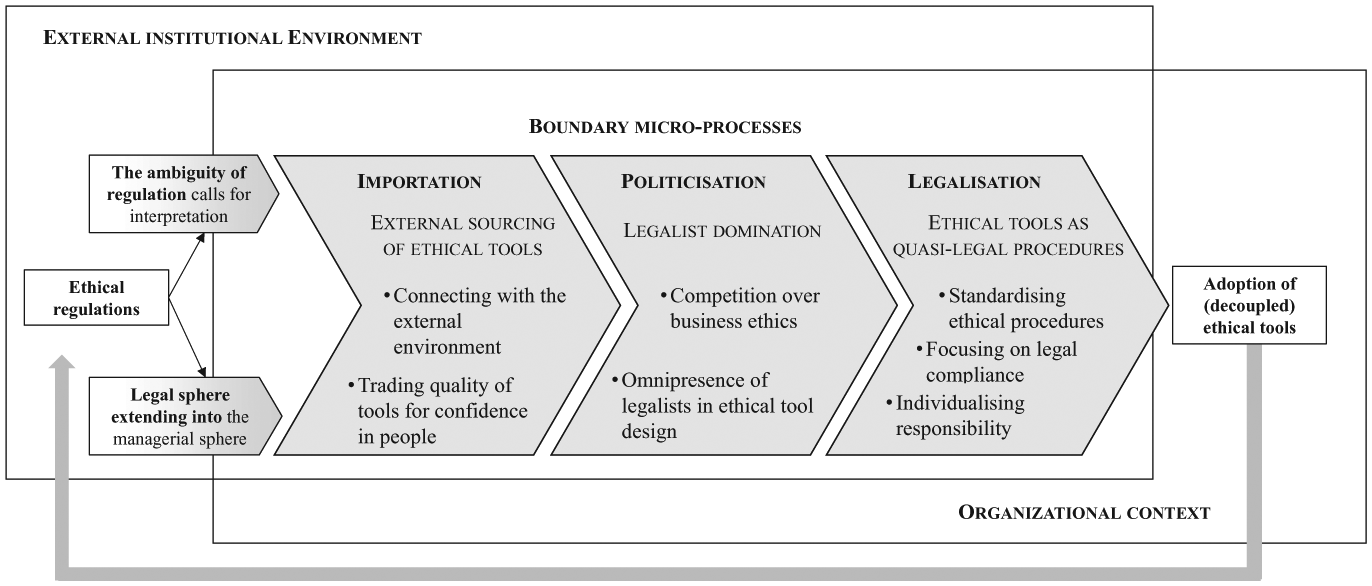
Boundary micro-processes of ethical tools adoption: An extended framework.
Importation: The external sourcing of ethical tools
Ethics professionals are aware of the ambiguity of ethical regulations and the difficulty of implementing them. They therefore mainly rely on their relationships with external actors to determine their implementation, leading to the development of channels connecting ethical regulations to the external environment. In this process, the legal and judicial trend of ethical regulations pushes actors to trade quality of tools for confidence in particular people to select or adopt ethical tools (Davis and Greve, 1997).
Connecting with the external environment
Our analysis first reveals that MNCs have numerous occasions to share their ideas with their peers regarding business ethics and its implementation. In our case, all MNCs studied joined French clubs or think tanks related to CSR and ethics, such as Le Cercle Éthique des Affaires (CEA), and were involved in business ethics forums to ‘share’ best practices: ‘I have to say that there are other companies with good programs too, that’s for sure, because we hear about these programs in the groups we belong to’ (Joseph, MNC 1, Interview 25).
As ethics department are usually small, most ethics professionals in the larger French MNCs knew each other; as one of them explained it during a CEA meeting, ‘it’s a small world’ (notes from observation). During data collection, we noticed that 12 of our 15 interviewees were interacting with each other on a regular basis through such forums. Professionals in charge of ethical tools at our MNCs were members of not only ethics clubs but also industry-specific clubs, where business ethics was often tackled as a ‘hot topic’, creating more occasions to share with their peers.
We found ethics professionals to work so closely that they were well aware of the ethical tools developed by other MNCs. This was illustrated by one of our interviewees, who commented on the recent outsourcing of a whistleblowing procedure by another French MNC: ‘we thought that the fact that the tool was not outsourced would slow it down, but now, with an open tool, it doesn’t go any quicker’ (Farid, MNC 2, Interview 11).
Second, the four MNCs were also working with consultants and other external organisations like Transparency International, Institute of Business Ethics, or Global Compact to either import or design ethical tools. Ethics professionals consider the development of such relationships to be an important ‘institutional’ facet of their job that informs the design of ethical programs: ‘There’s a part that’s more institutional, let’s say, which is to participate, to get closer to NGOs, institutional working groups in the Global Compact. We’re trying to create an agreement with Transparency International’ (Guillaume, MNC 3, Interview 10).
We found that MNCs rely mainly on consultants to design their ethical tools. This was the case at all four MNCs. MNC 4 worked with three different consulting companies, at the same time, to develop and design their ethical tools. Though external, these consultants were usually regarded as collaborators by ethics professionals: ‘The Danish Institute reviewed it; we sent it to other external stakeholders, NGOs. It’s really a collaboration’ (Pascale, MNC 1, Interview 19). Yet, in comparing the consulting firms’ ethical tool proposals with the tools actually implemented, we found that the differences between them were at best subtle. Ethical tools were not really ‘co-constructed’ or ‘redesigned’ in collaboration with the MNCs, nor were they adapted to specific organisational needs: ethics professionals tended to reuse the ethical tools sold by consultants almost ‘as such’, altering only a few words or some visual details. Consulting firms tend to sell ‘the same document, everywhere, [companies are] free to adapt it and make it work, but it’s no longer my business’ (Michel, consultant for MNC 3, Interview 9). Together with sharing ideas for tools with their peers, this collaboration with external organisations shows how actors in MNCs connect with the external environment when developing ethical tools in order to address uncertainties surrounding ethical regulations.
Trading quality of tools for confidence in people
We also found the external sourcing of ethical tools to be characterised by a tendency to trade quality for confidence when importing ethical tools. Ethics professionals preferred following external trends and mimicking peers to tailoring tools to internal organisational needs. This tendency was manifested in two forms. First, we found that the external environment directly resourced the process of ethical tool development, as MNCs were not only sharing their ‘best practices’ in external forums but were most often importing and replicating them. Our findings suggest that ethics professionals do not so much feed these forums as rely on them to find new tools: I was the one who formally initiated the process for the group, first as a scout ‘pilot fish’ to look at the different reference tools that existed to see what was interesting for us […] to have a somewhat more developed idea of the most recent advances, the most relevant examples that could inspire us. (Robert, MNC 4, Interview 14)
During meetings, we observed that ethics professionals mainly focused on what other companies were doing. For instance, one of the ethics professionals in MNC 4 was obsessed with the ethical programs of a French MNC in a different industry and wanted to contact them to acquire more information on their tools. More generally, our data suggest that if an ethical tool seems to work well at a well-established firm and is accompanied by a convincing business case, it is very likely to be imported, whether or not it fits current processes of ethical tool formalisation, the organisational context, or the overall corporate strategy. For example, at MNC 1, ethics professionals decided to design a new tool to be made available through the intranet: short video interviews with well-regarded ethics experts to be used as online training. They had heard that similar videos were well received by employees at another French MNC from a different industry and decided to implement this tool in their firm, even though a two-day training module already existed at MNC 1. We observed the same phenomenon in MNC 2, where four out of seven documented processes were copied from or inspired by those of other companies (notes from observations, MNC 2). Overall, this suggests that ethics professionals tend to trust the information reported by their peers, rather than independently evaluate the relevance of an ethical tool for their own organisation.
Second, our observations suggest that the criteria driving the choice of external providers were more related to consultants’ prominence (Abrahamson, 1991) than to any specific internal needs. For example, managers from MNC 3 wanted to work with John Ruggie, a reputed specialist in human rights, not because their organisation faced human rights issues but mainly because he is ‘the one’ that every MNC wants to work with: ‘he is trendy’ (Guillaume, MNC 3, Interview 18). MNC 1 – which does face human rights issues – is proud to have worked with this same consultant not because he is relevant but because he is ‘in high demand’ (Pascale, MNC 1, Interview 19). A bias towards pre-existing relationships also contributed to working with consultancies that were only loosely relevant to the MNC’s context: Because indeed, the choice was made to work with a consulting firm that [MNC 4] knows well, that the management knows well, that has already assisted us with similar processes over the years. And true, they’re not CSR experts […] maybe we’re risking not really being in the crux of the matter, I don’t know. (Corentin, MNC 4, Interview 13)
Together with the tendency to replicate the tools of other companies, the selection of such potentially irrelevant external help suggests that MNCs not only have a number of ongoing relationships with external actors, they may also implement their tools without considering whether and how they meet internal needs. As a whole, we found that throughout the stage of ethical tool importation, several channels ‘connected’ the activity of ethical professionals to the external environment – sharing ideas with peers in various forums or working with consultants and external organisations – in ways that led to sourcing ethical tools that were not necessarily relevant to the organisation.
Politicisation: How legalists come to dominate the organisation of business ethics
Our analysis suggests that once external ethical regulations make their way into MNCs, they are then subjected to political dynamics. Two groups of ethics professionals competed to promote distinct approaches to business ethics that shaped the design of ethical tools at all the MNCs observed. We found this competition to be biased towards a group of actors who advocated for an approach to ethics based on compliance, mirroring the ‘hard’ trends of judicialisation and legalisation of the external regulatory environment.
Competing to shape the meaning of ethics
At each MNC, we observed an opposition between the approaches to business ethics that are advocated by the two groups involved in the design of ethical tools, that is, the legalists and the non-legalists. The legalists’ response to the question ‘how do you define an ethical problem?’ is incontrovertible and always makes reference to compliance: ‘It’s through compliance; so here we’re smack dab in compliance … to rules, practices, applicable standards, etc. That’s where we feel we have an ethical problem’ (Sabine, MNC 3, Interview 7). Legalist professionals usually have a legal educational background and tend to regard business ethics as a compliance issue vis-a-vis the rules and laws that govern business life.
Conversely, non-legalists approach business ethics as an opportunity to convince others of the importance of ethical issues and to make them aware of their responsibilities. Despite their heterogeneous backgrounds, non-legalists share the view that business ethics is not only a matter of compliance. Indeed, the non-legalist approach to business ethics puts values first, encourages employees’ and managers’ autonomous judgement and decision-making on a case-by-case basis, and accordingly favours the creation of spaces to discuss issues over the application of pre-defined compliance rules: ‘One of the biggest challenges […] has to do with culture, ‘speaking up’ culture, so that people aren’t afraid to speak up, to say, ‘Here, I’m not sure, I think something’s not right’’ (Marie, MNC 1, Interview 26 – Non-legalist).
Similarly, at MNC 1, Pascale (legalist) and Bernard (non-legalist) disagree on the allocation of a bonus for ‘good ethics performance’. Pascale wanted to integrate it through profit sharing with employees: ‘But there’s a problem in terms of industrial risks, we integrated occupational accidents into incentives and employee profit sharing, in particular. So it has a business impact in the end’ (Pascale, MNC 1, Interview 19 – Legalist).
For Bernard, however, it would be wrong to pay for ethical behaviour or a lack of unethical behaviour; according to him, being ethical is simply doing one’s job properly. It is therefore not appropriate to give ‘bonuses for something that you’re supposed to do, particularly in French companies that are extremely reserved in terms of remuneration systems’ (Bernard, MNC 1, Interview 2 – Non-legalist).
As both approaches to ethics lead to very distinct types of tools (e.g. strict guidelines to be followed vs. discussion forums) and are thus material to the design of tools, we found both types of professionals tend to denigrate or sometimes deliberately undermine the other group’s approach. Non-legalist designers defend their approach to ethics, and they refuse to fall into a legalist, compliance-based approach: We trust our consultants to steer us also, but we really don’t want the legalists to dictate the approach. We really want it to be an in-depth process that is meaningful and adds value and not… that’s not just a compliance effort. […] If we have to wait for the law and the legal department, not only would we be running behind, we would be even further behind than we are now. (Robert, MNC 4, Interview 14 – Non-legalist)
Conversely, legalist professionals tend to consider the non-legalists’ vision of business ethics to be insufficiently practical and to be philosophical in a pejorative sense: In fact, it’s a notion very particular to [MNC 3] to say that, on the one hand, there’s sustainable development with its values, message, spreading the good word, prevention, etc., and then, on the other hand, legal management with coercion, penalties, formalisation, etc., tools. In fact, some people are philosophical and some people are operational […] I think we need to stop philosophising. Today, corporations have real issues, real problems, with huge sanctions behind them. (Sabine, MNC 3, Interview 8)
Omnipresence of legalists in ethical tool design
Our analysis also suggests that these competitive dynamics were biased towards the legalist approach for reasons that pertain to the design, approval, and implementation process for ethical tools. Before beginning field observations, we assumed, based on secondary data sources such as the MNCs’ organisational charts, that non-legalist professionals from the ethics department were in charge of the design of ethical tools, while the legal department only supported or approved this process. Our empirical evidence contradicted this view. We found the legal departments in all MNCs to have de facto extended their responsibilities in ethical tool formalisation through several structural factors. The legal departments at some MNCs produced their own ethical tools that compete with the ones produced by non-legalists. For instance, in MNC 1, there are two ethics departments: one inside the legal department and one at the same hierarchical level as the legal department. Both departments compete to extend their jurisdiction over ethics within the organisation.
Behind this struggle for the ‘ownership’ of ethics, there is of course competition between the two groups, further fuelled by the belief that each department can design their ethical tools and try their luck with the ethics committee. Indeed, the organisational processes we documented at the four MNCs (see Table 1) give significant weight to ethics committees, which are usually empowered to validate or veto the implementation of an ethical tool. At all MNCs studied, this committee is the highest power in the area of ethics; its members meet once or twice per year to discuss and approve the ethics department’s proposals. However, we found that most members of ethics committees have a legalist profile (e.g. internal auditors, lawyers), which is usually reflected in the committee’s name (e.g. ‘The Risk and Ethics Audit Committee’ at MNC 2). In all four cases, these committees were legalist-dominated ethics committees. As a result of their position, legalists could promote a compliance-focused approach to ethics as well as tools that meet legalist criteria.
Legalists can also leverage their position to influence and modify tools made by non-legalist designers and therefore extend the legalist sphere. MNC 2 offers a striking illustration of this process of legalists impinging on the non-legalist sphere – a process that we found at all the other MNCs – with the case of a new mediation tool initially intended to expand the scope of the whistleblowing procedure for financial and accounting practices usually managed by compliance officers or lawyers. At the finalisation stage of this new whistleblowing procedure, a legalist manager (internal control) refused to include HR in the process (observation from a meeting), arguing that ‘they will be annoying’ (quote from observation of a meeting). This was despite the fact that Christophe, the co-director of ethics, insisted on having an HR professional involved in this procedure to improve its reception by employees. The ethics committee decided to follow the legalist’s recommendation, excluding HR from the new whistleblowing procedure, which only covers ‘the areas of finances, accounting, banking, anti-corruption, and prevention of anticompetitive practices’ (extract from the whistleblowing tool of MNC 2). This example reveals the difficulties non-legalists face when attempting to gain the favour of the committee.
Christophe (Co-Director of Ethics, MNC 2) then decided to create a new ethical tool, inspired by the tool of another MNC not part of our sample. This second tool was a mediation process that could be used by employees experiencing doubt about an ethical issue; its main interest was its informal character and the freedom of speech it guaranteed, consistent with the idea of ethics that Christophe wanted to promote. According to his collaborator, Farid, with this new tool, ‘we are not in legal space. On the contrary, we want this [mediation] to happen before [any legal issue]’ (MNC 2, Interview 11). Following their own approach to ethics, the non-legalist designers refused to release the formal whistleblowing procedure to managers in order to promote their softer mediation tool: ‘Clearly, we’re not giving it any publicity because we wouldn’t want that system to be prioritised […]. We never gave out brochures saying here’s the address of the whistleblowing tool, use the whistleblowing tool, and give it priority’ (Christophe, MNC 2, Interview 11).
However, the ethics committee, reluctant to sign off on a mediation procedure that was ‘too informal’, decided to include a new formal step in it without first consulting its non-legalist designers. Employees who wish to use the mediation procedure now have to first sign a confidentiality agreement at HR offices aimed at managing the corporation’s liabilities in the event of a subsequent legal issue. Worse, the information given by employees ‘is not given anonymously and must be made in writing’ (Extract of document presenting the tool to employees, MNC 2). This change undermined the very purpose of this second tool, which was to enable informal discussions. According to non-legalist designers, this formal step at HR offices creates an impediment – one that they had hoped to avoid with this new tool: It was the legal department’s idea. It’s so that we can protect ourselves a bit if cases go badly, we have to be able to say that we made people aware. So it was really oriented towards a protection thing. […] In the procedure, you’ll see there are forms that are really well delimited to maintain confidentiality and determine what data we collect, what we don’t collect, what we do with it. But this kind of document, which has the merit of setting boundaries and preventing things from spinning out, also puts on the brakes […] because people say, ‘oh, oh, oh, what are they writing? What’s that going to be? Well. It’s an additional brake. (Farid, MNC 2, Interview 11)
The non-legalist promoters of this softer second tool were too discouraged to get into a ‘fight’ with the committee. The mediation tool was approved with the addition of this formal step, and the non-legalist designers did not have an opportunity for further input. Ironically, as it was their tool in the first place, they were supposed to promote it in the end: R: It’s the legal department, there’s a legal officer […] And it’s her with another young woman from working conditions, who put that tool in place. […] It was built in a mindset where the legal is of great importance. […] But in the design of the tool itself, we were neither mentioned nor… F: …Nor consulted. (Rachel; Farid, MNC 2, Interview 11)
Ultimately, both whistleblowing and mediation tools reflected a legalist ideology of ethics. These examples illustrate how, with the support of the legalist ethics committee, legalists sideline non-legalists in the process of ethical tools design. The design process internally reproduces the legalistic trends of business ethics that exist outside the organisation.
Legalisation: Turning ethical tools into quasi-legal procedures
We found that ethical tools become reduced to legal procedures through internal political dynamics. This process reflects the pursuit of three objectives in the formalisation of ethical tools: a focus on legal compliance, the standardisation of ethical tools, and the individualisation of responsibility for ethical issues.
Focusing on legal compliance
Ethics departments are among the most recently created departments at the four corporate headquarters. In two of our four cases (MNCs 1 & 2), the creation of this department directly resulted from a prior ethical scandal. In all cases, the multiplication of corporate scandals pushed professionals to focus on ethical risk mitigation. This shift reflects the increased risk of legal and/or financial penalties for companies that do not respect ethical regulations (around corruption or human rights abuses, for example). In our interviews, ethics professionals expressed their feeling that the legislation of corporate ethics has not ceased to increase, and both legalists and non-legalists believe companies’ unethical behaviour is likely to become criminalised: So, there’s part of the answer, which is that the legal framework, well, it’s moving towards a greater criminalisation than before, so there’s that. There’s the fact that large corporations are more and more complex because they’re global and constantly changing, and internally, through acquisitions, etc. So the risk and exposure to risk is much greater than before, I think. (Hélène, MNC 3, Interview 8)
This risk of litigation is particularly high for MNCs, which are exceptionally exposed due to their multi-regulated international context. Accordingly, ethics professionals tend to focus on ‘legal threats’ and reduce the purpose of ethical tools to a means to mitigate ethical risk. As explained by the director of ethics of MNC 1, ‘it would be a disaster’ (Interview 2) not to implement ethical tools in their company because of such threats. More generally, we observed that ethics professionals view business ethics as a risk that can be identified and managed, like any other risk for the company: For a start, you’ve got to do risk mapping. […] On top of that, once the measures are in place, that doesn’t mean you can avoid all risk. Any activity, whatever it may be, involves risk. So the risks have to be identified, they have to be avoided insofar as possible, and then, if there are any, you have to find a solution. (Pascale, MNC 1, Interview 19)
The focus on a compliance approach to ethics is also nurtured by the fact that almost all ethics professionals view ethics as a matter of following the rules. ‘Following the rules’ reduces legal risks and undermines more substantive views of ethics that call upon individuals’ judgement. Accordingly, the ‘rule of the game’ is to enhance compliance with the hard and soft laws that surround business ethics: ‘When we do ethics and business training… Practically more than… let’s say half of the training session is compliance with anti-corruption, anti-fraud, competition laws and human rights. That’s at least half of the training’ (Joseph, MNC 1, Interview 25).
As mentioned by one of our interviewees, this approach reflects the views of the top management: ‘You respect the law and that’s that; that’s the tone from the top’ (Sabine, MNC 3, Interview 5). Ethical tools thus ultimately recreate ‘a normative framework’ within the organisation (Pascale, MNC 1, Interview 19); ethics professionals train employees so that they follow rules, in particular legal rules, instead of relying on their moral compasses: ‘[…] when we do training, we are always in the legal realm’ (Guillaume, MNC 3, Interview 16). Combined with ethical risk mitigation, this view of ethics as rules explains how the focus on legal compliance has ‘colonised’ the space of ethical tool design.
Standardising ethical procedures
Beyond a focus on compliance, we also found the legalisation of ethical tools to be driven by a willingness to standardise ethical procedure. This standardisation of ethics is a response to the feeling shared by our interviewees that ethics is impossible to manage. For many interviewees, changing the personal ethics of employees is an impossible endeavour and most of them think that no tool is truly capable of regulating behaviour. As one interviewee put it: ‘it’s human, it’s not automatic, hey?’ (Farid, MNC 2, Interview 11). Ethics professionals feel overwhelmed by the number of possible solutions to the same problem. The conclusion is generally incontrovertible: ethical tools will always be imperfect as the field of ethics is vast and thus requires case-by-case management. Ethics professionals are discouraged by the recurrence of similar tasks within the ethics department, which accentuates these feelings of the unmanageability of ethics: […] One of the limits we identified in deployment is that yes, people have communicated, but they’ve talked once, twice, maybe three times at one specific time which was in one month, this or that month. And what happens after that? Because we’ve talked about it once, everyone’s up to date? There are new acquisitions. There are people who leave, people who come back, etc. (Sabine, MNC 3, Interview 7)
Ethics professionals feel that there is nothing they can do about it: ‘In any case, it’s not possible to constantly inundate people with this’ (Bernard, MNC 1, Interview 2). Accordingly, both legalists and non-legalists expressed similar feelings of uselessness when confronted with the recurrence of ethical issues, the scale of potential risks, and the difficulty of reaching out across MNCs that all count several thousands of employees.
A corollary of this view of business ethics is the reliance on pre-defined ethical standards when designing ethical tools. To address the uncertainty inherent in ethical behaviour, ethics professionals fall back on already-available hard and soft rules. For example, MNC 3 developed multiple choice questionnaire tools to assess whether employees had understood how to use the ethics guidelines. After presenting a classical dilemma of choosing between one low-price supplier that employs child labour and one high-price supplier that does not hire children, there is a multiple-choice questionnaire; the tool then provides the appropriate answer by directly citing the ethics guidelines and other standards like ISO 26000 or the Global Compact. Figure 4 is a slide extracted from this self-training tool on child labour, which illustrates how ethical tools ultimately point to external standards without providing any operational guidance.
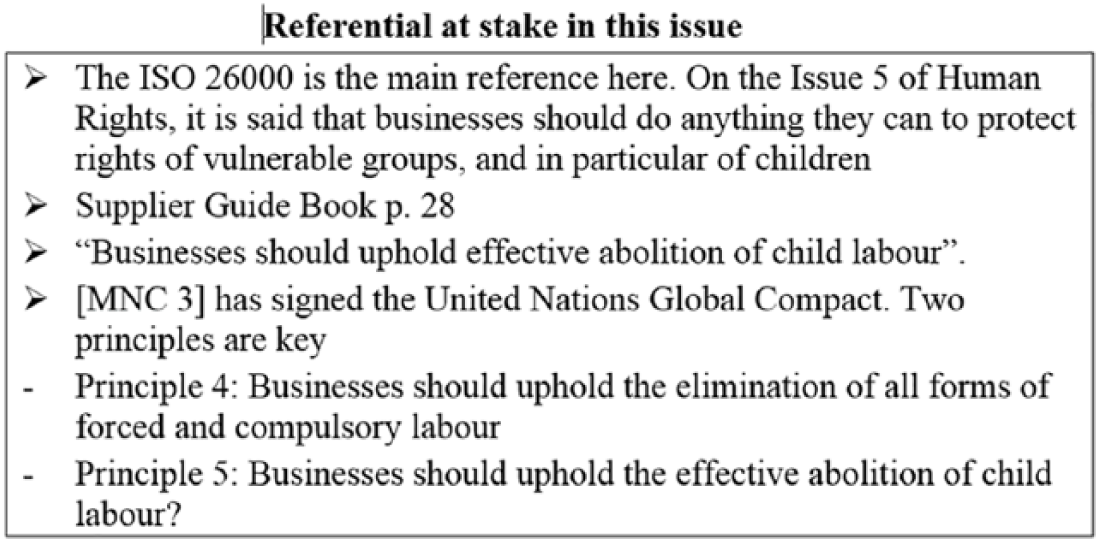
Extract of the self-training tool of MNC 3.
More broadly, our analysis reveals that ethics professionals mainly rely on external regulative standards to design internal tools without necessarily engaging any heavy translation work. This is exemplified by one of the slides extracted from a PowerPoint presentation for a training session in MNC 2. The first column presents a list of 20 ethical issues that must be considered internally. This list of issues is straightforwardly derived from external ‘soft’ regulatory standards; the two adjacent columns reference the source for each issue in the ISO 26000 and the Global Compact guidelines. This reliance on external standards reflects expediency in addressing the perceived unmanageability of ethics, and it nurtures the overall standardisation of ethical procedures.
Individualising responsibility
Beyond a focus on compliance and standardisation, we also found that the design of ethical tools supported the individualisation of responsibility in terms of ethical behaviour. Indeed, a corollary to framing ethics as a risk is a corporate willingness to delegate this risk to managers as much as possible by making them responsible for the ethical issues they may be confronted with. Almost all ethical tools are targeted to managers in order to make them ‘accountable’ (Bernard, MNC 1, Interview 2). The response to the question ‘who is the target of the training session related to ethics’ is clear and definite: ‘Frontline managers! Top management and then frontline managers – that is, the last manager of the operational line’ (Guillaume, MNC 3, Interview 16). In each MNC, ethics training and awareness seminars exist but are mainly, if not exclusively, intended for managers and directors, who are deemed responsible for the possible ethical problems they will encounter: ‘It’s a bit like what we do for safety […] each manager and each employee is responsible for safety. So that’s also how we treat ethics’ (Joseph, MNC 1, Interview 25).
The underlying purpose is to ‘circumscribe’ the decisions made by managers facing an ethical problem in order to reduce the risk for the centre of the organisation, corporate headquarters. The more localised the decision, the easier it becomes to dissociate ‘managerial responsibility’ from ‘corporate ethics’ in the event of legal action: ‘We have to protect the corporate veil, so if a person decides to do something stupid over in their corner, we want to be able to prove that that decision was made independently’ (Valentine, MNC 1, Interview 3).
Similarly, most ethics professionals we interviewed pay close attention to wording in their ethical tools to avoid overly committing the MNC and to prevent the MNC as a whole from being held liable in the event of a violation. Consequently, employees and managers bear the legal risks of noncompliance: When we have the president sign it, we have to make sure that it doesn’t go too far in terms of implicating him personally in the event of a problem. […] It’s enforceable, so it’s enforceable; we have to weigh the pros and cons in terms of liability. We can’t be charged if Joe Schmoe didn’t do the job we told him to, but we didn’t go double check, sort of thing. (Charles, MNC 2, Interview 23)
As a result of the constant focus on compliance, standardisation, and individualisation of responsibility, potentially ambitious ethical tools become reduced to the organisational replication of legal procedures. Accordingly, the process of ethical tool design extends the legalisation of organisations (Sitkins and Bies, 1993).
As a whole, our findings thus suggest that ethical tools are imported and/or designed through a three-stage process of importation, politicisation, and legalisation: ethical tools are first brought into organisations through various connections with the external environment, in ways that trade quality of tools for confidence in people; they are then subjected to the political dynamics of legalist and non-legalist ethics professionals, in ways that privilege a legalist viewpoint; and finally, they are ultimately formalised as quasi-legal procedures.
Discussion, implications, and conclusion
We began this study by observing that MNCs have adopted ethical tools in response to the proliferation of ‘hard’ and ‘soft’ ethical regulations affecting them. Though significant attention has been given to this phenomenon and to the effectiveness of the ethical tools developed by MNCs, how MNCs develop these tools and what factors influence their process remain overlooked. To uncover the ‘boundary micro-processes’ at work in the development of ethical tools at four MNCs, we adopted a qualitative design and built on concepts from the literature of open polities and business compliance. We synthesise our findings in a new framework (Figure 3) that theorises the dynamics of importation, politicisation, and legalisation that shape the adoption of ethical tools.
These results have important theoretical implications for the analysis of how external ethical regulations influence the internal organisational context and how ethics professionals at MNCs design ethical tools. We now discuss these implications in turn.
Explaining the adoption of ethical tools: The role of boundary micro-processes
Figure 3 summarises our analysis, suggesting that ethical tools are externally sourced, then subjected to intra-organisational political dynamics in ways that replicate environmental features, before ultimately being transformed into quasi-legal procedures. As ethics professionals aim to address the ambiguity surrounding ethical regulations and because their work is affected by the increasing dominance of the legal sphere, this translation is biased towards a search for standardisation, a focus on compliance, and an individualisation of responsibility. Taken together, these three factors explain why ethical tools may remain decoupled from organisational decision-making.
Our findings contribute to institutional insights by showing how multiple mechanisms of isomorphism, thus far theorised at the field level as external pressures on organisations (DiMaggio and Powell, 1983), come to play at the individual level through the practices of ethics professionals inside organisations. Our approach is informed by a recent emphasis on the micro-foundations of institutions (Barley, 2008; Powell and Colyvas, 2008; Powell and Rerup, 2017). We provide corporate ethics, which has been much analysed at the macro-level, with a micro-level examination. First, we found multiple forms of isomorphic replication to be involved in actors’ practices at each of the three boundary micro-processes elaborated in this study. At the importation stage, ethical tools were sourced through the use of loosely relevant consultants (Hargadon and Sutton, 1997), but also through the benchmarking activities of ethics professionals and cycles of fads and fashions. At the politicisation stage, normative pressures operated differentially through the specific backgrounds of competing groups of ethics professionals in charge of tool design. Finally, at the legalisation stage, tools developed as formal procedures reflect the coercive pressures of the external environment, through the work of ethics professionals. Our theorisation of the boundary micro-processes of ethical tool development (Figure 3) thus shows how the ‘localised actions’ (Powell and Rerup, 2017) of ethics professionals explain the co-occurrence of multiple macro-level isomorphic dynamics.
Second, our results advance institutional theory by integrating insights from compliance and open polity studies. In relation to compliance studies, we document the interpretative dynamics underlying the organisational ‘importation’ of external ethical regulations and show how a ‘legalist mindset’ shaped this process at the four MNCs. In doing so, we respond to a recent call for considering how individual sense-making capacities shape institutional processes (Powell and Rerup, 2017). In relation to open polity studies, our analysis uncovers the intra-organisational political struggles between distinct professional groups that provide specific meanings to the external pressures for ethics within organisations. These insights advance the study of how internal politics mediate corporate reactions to external pressures (Weber and Waeger, 2017) by specifying a mechanism through which external tensions between ‘hard’ (legal) and ‘soft’ (standards-based) modes of ethical regulations from the environment are translated in organisations. As competing experts within the organisation derive their status from the external environment, they contribute to create a form of intra-organisational Balkanisation of the management of ethics that sustains and reproduces political struggles from the environment within organisations (Clegg et al., 2018).
Overall, our three-stage ‘extended’ model of the boundary micro-processes at work in the adoption of ethical tools also provides a clearer picture of how the political dynamics in the MNCs’ environment shape organisational politics (Clegg et al., 2018). We found that professionals’ interpretations and practices replicated these external political trends within organisations and thus potentially reinforce them at the field level (see bottom ‘feedback’ grey arrow on Figure 3). Indeed, by altering the competition between legalists and non-legalists over the meaning of ethics and by contributing to reduce efforts that could enhance ethical judgement within organisations, trends such as judicialisation contribute to the (re)production of compliance-focused, standardised ethical tools that place the responsibility for ethics on individuals rather than on the MNC. These tools, ‘quasi-legalised’ through their importation, can in turn reinforce the judicialisation of organisations’ environments at the field level as they nurture the adoption of these tools by other MNCs.
Beyond boundary spanning: Ethics professionals as legal expertise carriers, political mediators, and material tool designers
In showing the role and influence of legalists and non-legalists in ethical tool formalisation, our analysis advances not only compliance studies (Parker and Nielsen, 2011) but also an emerging stream of studies dedicated to the new professionals of ethics, climate change, or CSR (Brès and Gond, 2014; Tams and Marshall, 2011; Wright and Nyberg, 2012). Romani and Szkudlarek (2014) have highlighted the importance of considering the identity and professional context of corporations in understanding the early stages of ethical tool design. Our findings extend this perspective by showing that it is also necessary to consider the profile of the professional ‘enforcers’ of ethics in organisations (Feldman and Lobel, 2011) as well as their actual practices. A legal background, for instance, may explain a compliance-based approach to ethics that is little compatible with approaches based on independent ethical judgement and discussion. This insight suggests that the new ‘professionals’ of CSR, climate change, or ethics should not be treated as ‘one block’ (e.g. Risi and Wickert, 2016). Rather, we should further investigate how various professionals compete in shaping the design of tools. This situation raises the question of the compatibility of the various domains of expertise of competing groups of ethics professionals, as well as the ethical risks associated with a fragmented knowledge basis. Traditionally, professions have built their legitimacy and status from a unified knowledge base (Abbott, 1988). The self-sustaining Balkanisation of ethical expertise within organisations could threaten the capacity to further institutionalise ethics within organisations (Muzio et al., 2013).
Our framework also complements analyses of the ‘boundary spanning’ role of ethics professionals, addressing a recent call from the literature about organisations as open polities (Weber and Waeger, 2017). First, we found ethics professionals to be well aware of the activities of their counterparts at other organisations, partly thanks to their connections through a variety of forums and clubs. This also contributed to the sourcing and importing of multiple tools through their personal networks. Through these connections, ethical professionals could continuously ‘resource’ the design of ethical tools, while extending their reach beyond their own organisations. Such ‘resourcing’ may merit more attention, as it likely explains how macro-institutional dynamics around ethics permeate and nurture organisational politics. Future studies could analyse ethics professionals’ networks to investigate how their ‘boundary spanning’ and ‘resourcing’ activities contribute to the circulation of ethical tools within and across organisational borders.
Second, we found that ethics professionals, like the CSR managers studied by Gond et al. (2018) or Wickert and de Bakker (2015), connect external field trends (judicialisation) to internal political dynamics (competing expertise) and thus operate as ‘political mediators’ (Weber and Waeger, 2017). This political role of ethics, CSR, or sustainable development managers could be further theorised to appreciate how these new actors mediate internal and external political dynamics (Clegg et al., 2018). Our analysis focused on the importation of external political trends into organisations, while only suggesting that this process can also feed back into the field through the production of specific types of ethical tools. Future studies could extend this insight by considering how internal corporate politics could be leveraged to reshape the external political environment of the organisation.
Third, our study documents the politics surrounding the production of ethical tools. Prior open polity studies have paid little attention to the role played by material devices in the boundary processes that link organisations to their political environments (Weber and Waeger, 2017: 906). Our analysis begins to address this gap by showing how ethical tools are mobilised in ways that embed important political dynamics. Future research could extend this analysis by investigating how such ethical tools operate as ‘boundary objects’ (Star and Greisemer, 1989) coordinating the activities of multiple groups of professionals within and outside of MNCs. Finally, because our focus is on multinational corporations that operate globally and our findings reveal new insights on the design of ethical tools, we think our framework is ‘transferable’ (Lincoln and Guba, 2002) to other organisational contexts despite the French cultural setting of our study; it could be used as a starting point to investigate and explore the design of ethical tools in MNCs headquartered in different contexts.
Supplemental Material
828437_SUPPL_MAT – Supplemental material for How do external regulations shape the design of ethical tools in organisations? An open polity and sociology of compliance perspective
Supplemental material, 828437_SUPPL_MAT for How do external regulations shape the design of ethical tools in organisations? An open polity and sociology of compliance perspective by Wafa Ben Khaled and Jean-Pascal Gond in Human Relations
Footnotes
Acknowledgements
We thank Tim Kuhn, our acting editor on this paper, for the quality of his editorial guidance through the review process, as well as three anonymous reviewers for their constructive comments. We are also grateful for the encouragements we received when presenting this paper during the EGOS (2015) and EURAM (2015) conferences. Earlier versions of this manuscript received the ‘Aalto That’s Interesting! Award 2015’ as well as the best paper award of the Business and Society SIG at EURAM 2015. A special thanks for their comments goes to Yoan Bazin, Melissa Boudes, Arno Kourula, Bernard Leca, Jérôme Méric, Jeremy Moon, Jérémy Morales and Julia Parigot. We also thank our copy-editor, Bronwyn Haslam, for her help and numerous judicious suggestions. The first author also acknowledges the support she received for this project from the Chaire Éthique et Gouvernement d’Entreprise of Paris Dauphine University.
Funding
This research received no specific grant from any funding agency in the public, commercial, or not-for-profit sectors.
Supplemental material
Supplemental material for this article is available online.
Notes
References
Supplementary Material
Please find the following supplemental material available below.
For Open Access articles published under a Creative Commons License, all supplemental material carries the same license as the article it is associated with.
For non-Open Access articles published, all supplemental material carries a non-exclusive license, and permission requests for re-use of supplemental material or any part of supplemental material shall be sent directly to the copyright owner as specified in the copyright notice associated with the article.
