




Abstract
This article explores the embodied compositions of professionalism in the context of the counselling psychology profession in Russia. Specifically, we develop an embodied intersectionality framework for theorizing compositions of professionalism, which allows us to explain how multiple embodied categories of difference intersect and are relationally co-constitutive in producing credible professionals, and, importantly, how these intersections are contingent on intercorporeal encounters that take place in localized professional settings. Our exploration of how professionalism and professional credibility are established in Russian counselling shows that, rather than assuming that a hegemonic ‘ideal body’ is given preference in a professional context, different embodied compositions may be deemed credible in various work settings within the same profession. An embodied intersectionality framework allows us to challenge the notion of a single professional ideal and offer a dynamic and contextually situated analysis of the lived experiences of professional privilege and disadvantage.
Introduction
This article explores the embodied constitution of professionalism in the context of the psychological counselling profession in Russia. Following Rumens and Kerfoot (2009: 767), we approach the concepts of ‘professional’ and ‘professionalism’ as constructions that are changeable and ‘given meaning by the various [embodied] actions undertaken by [an individual] to demonstrate “mastery” of a professional ideal’. Research has long indicated the exclusionary nature of professional work along the lines of gender, class, race and other dimensions of difference (e.g. Adamson, 2015; Ashley and Empson, 2013; Bolton and Muzio, 2007; Tomlinson et al., 2013; Van Laer and Janssens, 2011; Witz, 1992; Witz and Savage, 1992). Recent studies have increasingly highlighted that analysing the embodied nature of professionalism – that is, how professionalism is experienced and constituted through the active and acted upon body (Dale, 2001) – is critical to our understanding of the complexity of the lived experiences of professional identities, and professional privilege and disadvantage (Gatrell, 2013; Haynes, 2008, 2012; Jyrkinen and McKie, 2012; Sullivan, 2012). However, whilst current research offers some critical insights into these issues, it tends to focus mainly on the gender dimension, in which embodied experiences of professionals are typically theorized in relation to an ideal masculine norm. Billing (2011) suggests that such analyses perpetuate the gender binary and do not account sufficiently for women’s (and men’s) experiences in/of contemporary professional work. Some studies (e.g. Jyrkinen and McKie, 2012; Karlsen, 2012; Price-Glynn and Rakovski, 2012; Tomlinson et al., 2013) have therefore begun to tease out the complexity of individuals’ experiences of professional work by exploring how multiple dimensions of difference (e.g. class, age, ethnicity) shape professionals’ privilege or disadvantage; however, most have not explicitly incorporated an embodied analysis.
This article aims to address the aforementioned limitations of extant research by theorizing counsellors’ lived experiences of establishing professional credibility through the concept of embodied intersectionality (Mirza, 2009, 2013), which posits the experiencing, active and acted upon body as situated within multiple intersecting social forces. We propose a framework that develops the current conceptualization of embodied intersectionality to include an intercorporeal dimension; that is, the shaping of lived experience through the embodied co-presence of others. We also explicitly foreground a contextual dimension as part of our framework, through analysis of how both localized work settings and broader social and cultural processes shape constitutions of professionalism. We argue that the proposed framework allows us to examine how particular compositions of professionalism become more or less credible depending on who interacts, and where the interaction is situated. In doing so, it extends current understanding of the relationship between professionalism, embodiment and social identities by pushing the analysis of embodied experiences of professionalism beyond comparisons with a ‘male norm’, and capturing the dynamism and complexity of the lived experiences of professional privilege and disadvantage.
The article is based on analysis of 26 in-depth interviews with counselling psychologists in Russia, which represents an interesting context for the theorization of embodied constitutions of professionalism. First, counselling in Russia is a female-dominated field (Griffin and Karepova, 2011). Exploring embodied constitutions of professionalism in this context complements previous studies that have focused on male-dominated professional and organizational settings (Haynes, 2008, 2012; McDowell, 1997; Riach and Cutcher, 2014). Second, as we explain later in the article, the counselling profession only emerged in Russia in the early 1990s. 1 Its relative novelty and the specificities of professional regulation mean that there may not (yet) be a taken-for-granted, archetypal image of a credible counselling professional. This makes it an apt setting for exploring the contextual and situated emergence of embodied compositions of professionalism, rather than beginning our inquiry with the assumption of a certain pre-existing, embodied ideal.
The article addresses the following questions. How is embodiment mobilized or retired in constituting the credible professional? How does this occur through intercorporeal interaction in different work settings? How can an embodied intersectionality framework further our theorization of professional embodiment? In answering these questions, the article extends and enriches existing analysis of embodied constructions of professionalism. It does so, first, by developing an embodied intersectionality framework that includes an intercorporeal dimension, in order to foreground relationships between embodied subjects as important sites for constitutions of professionalism. Second, the framework considers how this relational emergence of co-constituting categories of difference that underpin embodied compositions of ‘credible’ professionals is situated – that is, shaped by local and broader contextual settings. Such analysis enables a theorization of the links between the social context of professionalism and embodied compositions, unveiling how privileged or marginalized embodied compositions may emerge in different settings within a single profession. As such, we argue that, rather than assuming that a hegemonic ‘ideal body’ is given wholesale preference, different embodied compositions may be deemed credible within the same profession. We suggest that, by extending our theorization beyond the conception of a single ‘ideal body’, embodied intersectionality allows for a more dynamic and situated analysis of professional work, embodiment and experiences of professional privilege and disadvantage. Finally, our empirical study enriches the body of literature exploring the lived experiences of professional work in post-socialist economies.
The article proceeds with a review of existing research on professionalism and embodiment, arguing for the adoption of embodied intersectionality as a valuable critical approach to exploring constitutions of professionalism. Having introduced our empirical context and methodology, we analyse how ‘credible professionals’ are constituted through the intersection of age, gender and sexuality in two different counselling work settings. We conclude by outlining how our findings extend current debates surrounding the embodiment of professionalism, and point to avenues for further research.
Professionalism and embodiment
Research on the sociology of professions has exposed how, as professions struggle for status, reward and credibility, they follow a process of social closure that typically involves segregation and stratification along the dimensions of, for example, gender, class and race (Adams, 1998; Adamson, 2015; Bolton and Muzio, 2007; Witz, 1992; Witz and Savage, 1992). Whilst these studies do not explicitly situate embodiment at the core of their analysis, they reveal how professional structures have historically been organized to privilege masculine identities and knowledge. Further research has revealed that being perceived as a credible professional is not just a matter of extrinsically ascribed qualifications, but is linked to social identity characteristics, typically those of white, middle-class masculinity, which disadvantages other social identities that fail to ‘fit’ the professional ideal (Kerfoot, 2003; Rumens and Kerfoot, 2009). Recent studies have increasingly highlighted how the work of conveying professional credibility entails active body management and maintenance (Haynes, 2008, 2012; Waring and Waring, 2009), indicating that embodiment is integral to the constitution of professionalism and key to understanding the lived experiences of professional work. This research exposes in detail how feminine corporeality does not align well with expectations of control ‘central to the embodiment of the professional’ (Haynes, 2012: 500). Studies suggest that the ‘hegemonic visions of an idealized [professional] body’ (McDowell, 1997: 35) privilege masculine bodies, making it difficult for women to ‘fit in’ because their bodies are marked as lacking certain embodied professional characteristics such as masculine rationality, and/or as excessive, for example too sexy or leaky (Gatrell, 2013; Jyrkinen and McKie, 2012; McDowell, 1997; Meriläinen et al., 2015; Trethewey, 1999). Hence, women need to manage and discipline their bodies intensively to add ‘credibility to their competence’ (Haynes, 2012: 496).
Although extant research highlights how body-related assumptions inform the constitution of a credible professional and the shaping of professional advantage and disadvantage, the current theorization of professional embodiment presents some limitations. These stem partly from the fact that most studies, explicitly or implicitly, have tended to theorize embodied experiences of professionalism in relation to the singular oppositional category of the male professional. While historically understandable, this assumed homogeneity of the professional ideal is problematic. First, research on female professionals offers valuable insights into how they perform complex body work by managing elements of their appearance, such as weight, dress and demeanour, or/and bodily states such as pregnancy (Gatrell, 2013; Haynes, 2008, 2012; McDowell, 1997; Trethewey, 1999); however, juxtaposing women’s experiences against the masculine professional ideal often means that a systematic consideration of differences between women is overshadowed by this dichotomy. This oversight is problematic because various interrelated dimensions of difference, such as age, class and ethnicity, produce different organizing principles of inequality (see Skeggs, 1997). Similarly, the masculine ideal may also obscure varieties of masculinity, as not all men ‘fit’ the hegemonic masculinity standards (Coston and Kimmel, 2012; Rumens and Kerfoot, 2009). In fact, interaction between several dimensions of difference, for example race and masculinity (Price-Glynn and Rakovski, 2012) or age and masculinity (Riach and Cutcher, 2014) may re-shape men’s privilege in professional work.
Finally, empirical evidence points to the existence of nuances in ‘body preferences’ in different professional work situations, spaces and contexts. For instance, studies of female-dominated professions show that men may be seen as ‘naturally’ suited to some roles, for example management, but not to others where more feminine characteristics may be required (Pullen and Simpson, 2009). This suggests that in different professional situations an embodied professional ideal may be underpinned by identity characteristics other than those of a white, middle-class man. Moreover, recent research highlights that professional identity presentations may vary depending on the gender of the client (e.g. Haynes, 2012), organizational space (e.g. Simpson, 2014; Tyler and Cohen, 2010) or organizational norms that encourage or discourage the display of certain embodied characteristics (e.g. Riach and Cutcher, 2014; Rumens and Kerfoot, 2009). Hence, the fact that particular professional identity presentations may be seen as more or less acceptable depending on the context calls further into question the purchase of theorizing embodied experiences against a singular, hegemonic, masculine professional ideal.
In light of this critique, we suggest that an analytical framework is required that goes beyond the assumption of one hegemonic professional ideal, and that calls attention to the varieties of lived, embodied experiences of professionalism by systematically accounting for how such experiences are shaped by interrelated, socially and contextually situated categories of difference. In the next section, we develop an embodied intersectionality framework that, we argue, offers such productive theorization of how multiple embodied categories of difference intersect and are relationally co-constitutive in producing localized compositions of credible professionals.
Compositions of professionalism: An embodied intersectional approach
Recent studies have begun to expose variations in women’s and men’s experiences of professional work by considering how several categories of difference intersect (e.g. Jyrkinen and McKie, 2012; Karlsen, 2012; Price-Glynn and Rakovski, 2012; Tomlinson et al., 2013). However, not all have considered an embodied dimension to be integral to their analysis, nor have they explicitly conducted an intersectional analysis. To understand how and why certain intersections of embodied social categories are rendered more or less professional in certain situations, and to ensure that the body’s central and active role in the ‘formation and maintenance of social systems’ (Shilling, 2003: 19) and professional experiences is brought to the fore, we propose to theorize experiences of professionalism through embodied intersectionality (Elg and Jensen, 2012; Mirza, 2009, 2013).
Intersectionality theory stems from analyses of the constitution of marginalized identities, notably the position of Black women (Collins, 2000; Crenshaw, 1991). More recently, however, an all-encompassing view of intersectionality has been proposed, as an analytic paradigm that can be applied to studying all social relations, identities and power effects (Corlett and Mavin, 2014; Davis, 2008; Dhamoon, 2011). A key argument of intersectionality is that the production of social differences, with accompanying power effects, must be seen in light of how multiple social categories intersect to produce local subject formations, a process that is not predetermined but remains an open empirical question (Hancock, 2007). This perspective implies that subject positions are defined not by the accumulation of categories of disadvantage or privilege, but by intermeshing categories characterized by fluidity and indeterminacy, the compositions of which become salient in particular circumstances (Atewologun, 2014). Embodied intersectionality foregrounds the body by paying attention to how social positions are constituted through multiple, interrelated differences being ‘lived out on and within the body’ (Mirza, 2013: 5; see also Elg and Jensen, 2012). In her study of Muslim women’s experiences of racism and Islamophobia in the UK, Mirza (2013) shows how the intersecting processes of gender, race and religion shape women’s positions and how they negotiate these through religious practices and self-presentation. She posits embodied intersectionality as a means to understand:
. . .how the external materiality of [the women’s] situatedness (the political, economic and social structures that produce inequality) is constituted, reconfigured and lived through their corporeal representation (i.e. as racialised “dangerous” or “oppressed” others). (Mirza, 2013: 7)
In other words, embodied intersectionality explicitly foregrounds the body as the centre of intersectional analysis and thus allows us to unveil how the social is experienced and negotiated through the body. Whilst Mirza’s (2013) conceptualization of embodied intersectionality highlights the inter-connectedness of lived embodied experience and social forces, we argue that this conceptualization should be extended to a framework that accounts for how the social context is inter-connected with lived embodied experiences, including through relations between bodies.
To do so, we ground our framework in a phenomenological epistemology of the body (Merleau-Ponty, 1962) that conceptualizes the self as embodied and situated, and that views lived experience as predicated on ‘the body’s interactions with itself, with others, and with the world’ (Weiss, 1999: 119). However, an embodied engagement is not purely instinctual or biologically determined; the position we take in the world is shaped by social expectations and ideals (Csordas, 1999; Dale, 2001). These tenets of embodied subjectivity (Dale, 2001) allow us to highlight a co-constitutive relationship between body and society: the body is not viewed as self-contained and divorced from an external objective reality that independently exerts itself upon it; rather, it is both acted upon and active, both situated and situating (Casey, 1993), and always in a bodily relationship with others (Trigg, 2013). As the body constitutes the subjective source of understanding (Csordas, 1999), and as ‘there can be no understanding which is not situated in some historical context’ (Benhabib, 1992: 25), it follows that selfhood, rather than being an innately predetermined ‘separate or isolated entity’ (Mansfield, 2000: 3), must be understood as situated, that is, as conjoined with the world. Moreover, as Dale (2001: 65) emphasizes, there must be recognition of the ‘specificity of embodiment’, in other words how subjective, embodied experience is differentiated depending on the kind of body that encounters a particular social context. The above theorization brings to the fore the importance of relationality and context in the constitution of embodiment, allowing us to view the embodied self as always already situated, shaped by ‘who else is present’ and the ‘situation we find ourselves in’ (Van den Berg, 2010: 104). Our knowing of the world cannot be separated from our embodied engagement with it (Gärtner, 2013), and subjective embodiment is ‘composed, recomposed and decomposed’ (Gatens, 1996: 110) through such engagement.
In the context of this article, understanding the situated, embodied self presents a way of theorizing the interrelationship between embodied experiences of professionalism and social context. First, we propose to extend the concept of embodied intersectionality to encompass intercorporeality to construct a framework through which we analyse how embodied positionings are shaped in relation to other bodies. Previous research has highlighted that the presence of others may significantly affect embodied self-presentation. For example, Riach and Warren (2015) argue that continuous negotiations take place between one’s own embodied presence and responsiveness to other bodies in a shared professional work space. Similarly, Hindmarsh and Pilnick (2007: 1396) emphasize the importance of intercorporeal knowing at work, that is, ‘practical knowledge of the dynamic bodies of others’. The phenomenological understanding of embodiment that we employ underscores that experiences do not take place in an inner sanctum of ‘hidden subjectivity’ (Crossley, 1995: 143) but are situated in the intersubjective space that emerges through embodied engagement with others. In our case, the inclusion of an intercorporeal dimension may enable us to theorize how a sense of professionalism is shaped by the co-presence of other embodied subjects in different situations.
Second, we incorporate a multi-level contextual analysis into the proposed framework. Intersectionality implicitly understands subjectivities as situated within institutional contexts and cultural ideologies (Brah and Phoenix, 2004; Dhamoon, 2011; Mirza, 2013), and our framework brings to the fore the embodied qualities of such relationships. For example, subjectivities are shaped by norms that demarcate which bodies may rightfully or preferably occupy particular spaces (Puwar, 2004). In a similar vein, organizational spaces are both gendered and gendering (Tyler and Cohen, 2010). In other words, spaces are imbued with gendered practices and meanings, acquiring different degrees of social valorization (Simpson, 2014; Vacchani and Pullen, 2011). The view of the embodied self as situated, informed by our phenomenological epistemology, further helps to foreground analysis of how the context (both broader social and cultural processes and an immediate, localized spatial setting in which professional interaction occurs) may shape constitutions of professionalism and professional credibility. Bridging this gap between micro- and macro-level contextual analyses may yield a more holistic understanding of how preferential or discredited embodied positions are constituted in different localized work settings.
In summary, we argue that an embodied intersectionality framework that includes intercorporeal and contextual dimensions enables analysis of embodied compositions of professionalism that may help delineate varieties of lived experience in the professional workplace. Before exemplifying this through our data analysis, we next describe the cultural and institutional context of the Russian counselling profession.
Research context: The counselling profession in post-socialist Russia
Psychological counselling in Russia was banned under the Communist regime, as it was seen as inherently individualistic and therefore incompatible with socialist ideology and its collective values (see Karepova, 2010). The profession emerged following the fall of the Soviet Union in 1989, and its subsequent rapid growth in popularity was facilitated by the relative novelty of this field, which offered promising employment opportunities while many traditional industries were collapsing during economic transition and perestroika (Griffin and Karepova, 2011). Moreover, the fall of the Socialist regime resulted in profound uncertainty and the breakdown of traditional social norms and life patterns, causing social anxiety and creating increased demand for advice on conducting a coherent and meaningful existence in the new context (see Karepova, 2010). Demand for counselling services in contemporary Russia remains high in a variety of industries, including education, medicine, business and politics.
The development of professions, as of all social institutions, is historically and culturally embedded. In this respect, an explanatory note is required when discussing professions and professional work in a non-Anglo-American context. The Anglo-American concept of ‘professions’ often refers to ‘traditional’, knowledge-based and high-status occupations that possess autonomy and control over their work arrangements (for debates, see Evetts, 2003; MacDonald, 1995). Therefore, the discussion of privilege and disadvantage in this context is typically related to issues of social closure that accompany the professionalization process, that is, professions’ strive for status and autonomy (e.g. Witz, 1992; Witz and Savage, 1992). However, historical and institutional differences in professional work in a (post-)socialist context mean that professionalization does not occur in the same way in Russia, as professionals are typically state employees, and professional matters are regulated by the state (Balzer, 1996; Svensson and Evetts, 2010). In fact, the notion of ‘professionalism’ in Russia typically refers to professionals’ personal traits, values, behaviours and skills to do the job (Riska and Novelskaite, 2011), rather than a system of work organization.
However, even without a vision of professional closure in the Anglo-American sense, studies show that individual specialists still strive for professional excellence (Mansurov and Yurchenko, 2010). Our participants made clear that the relative novelty of their profession requires them to prove their credibility in the eyes of their clients and society. Professional standards in Russia are state-regulated, but are still adjusting as the psychology profession develops (Karandashev, 2009). For instance, professional titles and jurisdictions are still rather broad: the two main professional qualifications, ‘Psychologist’ and ‘Clinical Psychologist’, enable graduates to embark on a variety of employment, including individual counselling, business coaching, work in HR and development, psychology teaching and research. Specialist certifications offered by professional associations are voluntary (Karepova, 2010). This context presents an interesting case for our inquiry as it allows us to explore how professionalism is constructed when a counsellor’s practice spans various professional settings. Furthermore, in a context in which formal regulation is still evolving and where, as one of our participants pointed out, ‘nobody believes in the legal system [of professional standards]’, professional credibility and expertise must be expressed and gauged in a way that does not relate to professional qualifications; hence, this context allows us to explore in detail how professionals draw on other characteristics to construct credibility.
Finally, a number of key features of Russian counselling are relevant to our discussion. First, counselling in Russia has been a female-dominated field since its emergence in the 1990s, and in 2013 women constituted 73% of graduate students in psychology (Higher School of Economics, 2013). As previously discussed, most other studies have explored male-dominated professional contexts; hence, examining a female-dominated profession allows us to critically scrutinize the assumption of a masculine ‘ideal’ of professionalism. Second, this profession is one of the most popular choices for mature students who return to university to gain a second university degree (Griffin and Karepova, 2011), which results in an interesting age profile for the profession. The average age of psychology graduates is higher than in many other professional settings. Lastly, counsellors in Russia tend to hold multiple jobs and work in multiple professional settings because earning high wages in this profession remains challenging. 2 Two types of work are dominant: individual and group psychological counselling relating to personal and family issues, and business counselling commissioned by corporate clients, which typically involves individual coaching and delivering group workshops on business psychology. As explained above, current professional regulations do not stipulate the need for mandatory specialist certifications in order to undertake these types of work. Clients in family counselling tend to be predominantly women, while in business settings clients are predominantly men (Karepova, 2010). This has to do with the essentialist gender role ideology dominant in post-socialist Russia (Ashwin, 2000) and the prevailing male-breadwinner model that bolsters the segregated nature of the post-socialist Russian labour market, in which men are located in more lucrative sectors (Kozina and Zhidkova, 2006). In our analysis, we show how these contextual characteristics of counselling work shape embodied compositions of professionalism. Before we proceed to our data analysis, we next outline our methodology.
Method
Following a methodological approach typical of intersectional research exploring lived experience (e.g. Christensen and Jensen, 2012; Ludvig, 2006; Mirza, 2013), we draw on 26 professional life-story interviews. An epistemological question that arises is how to access lived experience through language. As Csordas (2008: 118) notes, ‘there is a tendency to mistrust language’s ability to provide access to experiences’, in that language is seen to reduce lived experience. However, following Merleau-Ponty (1962), language is not simply an outer and necessarily reductive expression of an inner emotional landscape; rather, experience is ‘“given in” language’ (Csordas, 2008: 119) and ‘soaked through with language’ (Van Manen, 1990: 38). Language itself is ‘a bodily act’ (Fotaki et al., 2014: 1242); it is not divorced from the embodied subject. Although such a perspective radically re-interprets the relationship between language and lived subjectivity, nevertheless, ‘accounts . . . – whether caught in oral or in written discourse – are never identical to lived experience itself’ (Van Manen, 1990: 54). The task of the researcher, then, is ‘to construct a possible interpretation of the nature of a certain human experience’ (Van Manen, 1990: 41, emphasis in original). We cannot claim to have had unmediated access to the lived experiences of the participants; however, translation of those experiences into language still provides a means to grasp them.
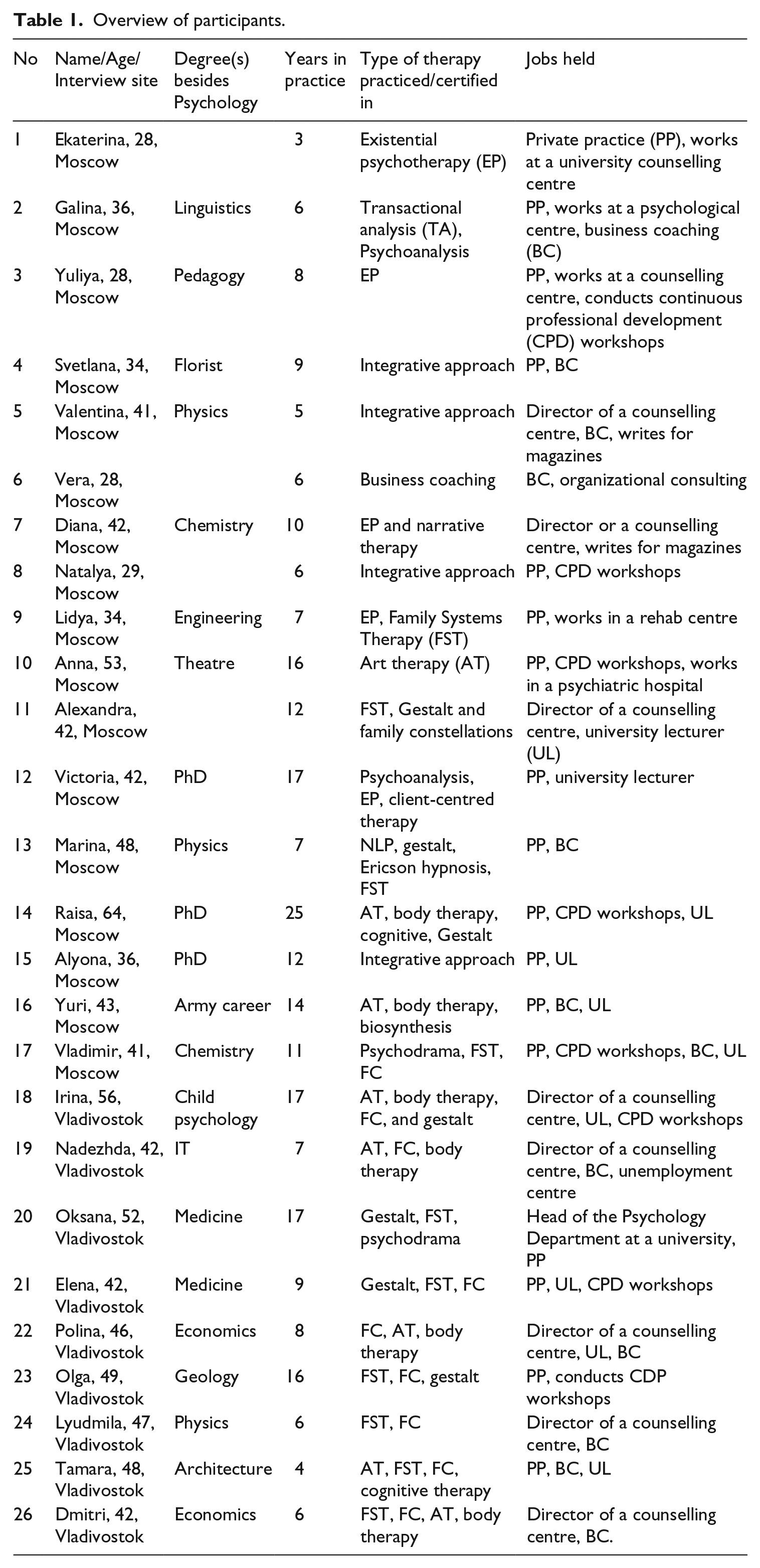
Interviews were carried out with practicing counsellors in Moscow and Vladivostok. There is no public directory of counsellors in Russia, so the population size is unknown. This determined the sampling method. Participants were recruited through email contact via professional websites (13 responded to 94 initial requests) and subsequent snowballing. Twenty-six interviews were conducted with 23 female and three male counsellors (see Table 1). The participants were aged between 28 and 64 years, with an average of 42 years. Their counselling work experience ranged from three to over 20 years. They represented a range of therapeutic approaches and levels of seniority, from early career psychologists to directors of counselling centres. Twenty participants had studied counselling as their second university degree, and the majority held multiple jobs. All participants were of Russian nationality. The interviews, lasting between 60 and 90 minutes, were subsequently transcribed and translated into English by one of the authors, who is a native Russian speaker. Pseudonyms are used throughout to ensure anonymity. The interview questions centred on the professional histories of the participants, including questions about background, career choices, training, employment and work practices. They were encouraged to give examples of what they considered good professional practice and the qualities and behaviours that they felt were central to counselling work.
Overview of participants.
It is important to acknowledge reflexively ways in which researchers are implicated in the research process (Alvesson and Sköldberg, 2009). Following our phenomenological approach, making explicit our values and assumptions (Cunliffe, 2003) is not just a matter of addressing ‘cognitive bias’, but of acknowledging how our embodied subjectivities ‘are implicated in the accounts they produce’ (Fotaki et al., 2014: 1240). As Van Manen (1990) notes, collecting, organizing and analysing data is not merely a cognitive process, but an embodied search for meaning, a corporeal process (see Pullen, 2006) that is not exempt from being shaped by the researcher’s embodied ‘self-location’ (Pillow, 2003: 178). To start with, the interviews were conducted from a feminist position – an intellectual position inseparable from our embodied experiences that informed our interpretations. The interview process itself was an intercorporeal, contextually-specific encounter between researcher and participant, in which positions were negotiated and shaped by, for example, gender and nationality (Pillow, 2003). As such, being a female researcher of Russian background facilitated rapport, especially with female participants, owing to the assumed extent of shared understanding. Participants’ age also shaped the interview encounters (see Lundgren, 2012). Participants who were clearly older than the researcher often adopted a ‘lecture’-like or slightly condescending response style, while the interviews unfolded more like informal conversations with younger participants. This is not to say that experienced differences in age (or other social categories) are predetermined and fixed; rather, they are negotiated and assigned meaning in the interview situation, which ‘furnishes the practice of doing age’ (Lundgren, 2012: 669, emphasis in original).
In remaining true to our phenomenological methodology during the analysis phase, we strove to be aware of experiencing moments in which the participants’ accounts resonated with us on a level of ‘bodily sensations, felt experiences, emotions’ (Cunliffe and Coupland, 2012: 64), as such recognition constitutes ‘an integral part of sensemaking’ (Cunliffe and Coupland, 2012: 64, emphasis in original). Many researchers will recognize a visceral reaction when data ‘speak’, or conversely the frustrated poring over transcripts that seem to refuse to open up to inquiry. At first, we performed initial transcript analyses individually, noting instances in which participants talked about markers of professionalism and attributes of a good/bad counsellor, examples of sessions and client relations, career successes and disappointments, and how they viewed the development of the counselling profession in Russia. We made note of what we thought these instances told us about establishing a credible or non-credible professional, remaining open to which social categories emerged as meaningful in the narratives. We then brought our notes together, corroborating and synthesizing, comparing preliminary interpretations, and noting similarities and differences. We returned to the literature in an iterative process of reading our initial findings in light of our chosen key theoretical constructs: intersectional embodiment, intercorporeality and contextual settings. At this stage, we related our initial findings about counselling professionalism to the setting in which they appeared, what other actors were present in the descriptions, and how these micro-level interactions might be interpreted in relation to the broader conditions of the Russian post-socialist economy. The fact that one author is of Russian origin while the other is not allowed a ‘defamiliarized’ view and the questioning of ‘assumptions about how “local reality is constructed”’ (Cunliffe, 2003: 999). Through questioning each other’s interpretations and engaging in mutual interrogation (see Gilmore and Kenny, 2014), we arrived at what we felt was a mutual understanding regarding the interpretation of the data, which is presented next.
Compositions of embodied professional credibility in Russian counselling
Our analysis is structured in three sections, showing how professionalism was constituted by the counsellors. Specifically, we discuss the embodied intersectionality of compositions, how these emerged in intercorporeal relations, and how professional embodiment comes to be privileged or disadvantaged in specific counselling settings.
Professionalism as embodied and intersectional
When participants described what makes a good and credible counsellor, they often started from a gendered position. For instance, more importantly than qualifications, a good counsellor was seen to possess certain gender-related characteristics to which our participants referred in essentialist terms:
I think that women who are counsellors are good because they are capable of listening and understanding, they are more open. [Men] really enjoy the leading positions, being in command. (Vera, 28) Women have more empathy toward other people . . . and are capable of understanding others better . . . clients are always in need of care and love, and women can provide that care better than men. (Svetlana, 34)
As these extracts indicate, counsellors commonly expressed a belief in innate differences between men and women, shaped by psychological theories of difference (Karepova, 2010) and the dominance of an essentialist gender discourse in Russia (Ashwin, 2000). Openness, empathy and listening skills are typically feminine characteristics attributed to women’s nurturing capability. Although their emotional expertise is often devalued in organizations (see Trethewey, 1999), in the counselling context it was presented as an advantage, or even a condition for being a good counsellor. These characteristics assume a way of connecting that is only made possible by a particular embodied subjectivity. According to the participants, being a woman means knowing, experiencing and understanding the counselling situation from a particular embodied vantage point. Statements like these allude to a particular, differentiated body (Dale, 2001) – in this case a gendered one – as a source of experience and knowledge, indicating that one’s embodied position necessarily informs one’s knowledge of the world and others. Such statements also simultaneously fix this position in essentialist terms; that is, a normative, gendered (feminine) embodied subjectivity comes to signify professionalism.
Yet, gender alone does not convey professional credibility. According to our participants, in addition to caring for and understanding the client, experience is a crucial aspect of a good counsellor. However, experience does not equate simply to longevity of practice or accumulation of professional knowledge, but instead assumes the embodiment of appropriate life experience. As Dmitri (42), director of a counselling centre, commented ‘If a counsellor is young, twenty-two, not married, doesn’t have children, then . . . he [sic] will hardly understand these [family- or parent-related] issues for he doesn’t have such experience’.
Professional expertise is often attributed to the visible performance of knowledge (Treem, 2012), and this comment indicates that a younger or older body implies a particular kind of embodied knowing and life experience. Younger specialists were viewed as undesirable owing to their lack of biographical experiences, such as parenting. As mentioned earlier, counselling is one of the most popular re-training choices, which means that there is a high proportion of inexperienced specialists, fresh out of their second university degree, but who may be in their forties. However, according to our participants, their age did not seem to diminish their credibility, since inexperience was linked to a biologically young body, and older specialists were perceived as innately embodying life experience, and therefore credibility. Yuliya highlighted these nuances in embodied experiences at the intersection of age and gender ‘When I worked [in her first job as a school counsellor] . . . I was simply directly told: ‘Listen, girl! What can you possibly tell us here? We know everything without your advice!’ (Yuliya, 28).
As Yuliya’s comment suggests, age and gender intersect to produce a non-credible professional, being dismissively referred to as a ‘girl’. However, such positions are not completely fixed. Yuliya said that deprecatory comments are typical of interactions with senior colleagues and school teachers but, in specific encounters, younger female embodiment may also be advantageous, as another participant explained ‘Young specialists, for example . . . can work with children, as children take up tonnes of your energy. Groups of five- to six-year-olds can be guided by younger women, since they have enough energy’ (Irina, 56).
What such comments show is that similar embodied compositions come to acquire advantage or disadvantage depending on who they encounter in a particular counselling situation, which brings us to discussion of the importance of intercorporeality.
The intercorporeal constitution of professionalism
Our participants commented on how they themselves were the very instrument of their work: ‘in psychology you yourself are a working tool’ (Irina, 56). A capability to attune to the client was seen as the counsellor’s foremost skill; a skill that, as we began to indicate in the previous section, appears to be constituted through intercorporeal engagement. The kind of embodiment judged to be professional is contingent on the relationship with other bodies, notably those of clients. As discussed previously, women are seen as possessing essentialist qualities that make them seem suited for the counselling profession. When discussing the characteristics of the counselling relationship with clients, a particular type of female figure emerged as uniquely credible:
I think they are such womanly characteristics: to listen, to accept, to understand; it is something more motherly. Men are usually taught to be strong . . . Many people actually need a good mother and women are the ones then . . . I have employees of various ages and I can see who are the most popular. I have a female colleague who is the eldest here and amongst clients who find us through the website she is the most popular . . . she inspires trust because she has a benefit of age and experience. Moreover, in some sense she is not scary for a man – she is more of a mother figure. (Diana, 42, director of a counselling centre)
Diana associates a good counsellor with being ‘motherly’, suggesting that a counsellor becomes valuable through embodiment of a particular gendered identity, in this case that of mother. The notion of mother invokes a register of embodied capabilities, the meanings of which are underpinned by a broader social and cultural imaginary of what motherhood means and how it is practised. The mother figure is typically constructed in Russian culture as the desexualized embodiment of genuine care, as trustworthy and unassailable (Hubbs, 1993), making her seem credible in the counselling context. The desexualized, ‘safe’ status of the mother is further reinforced by the association with mature age as the basis for life experience, conveying additional credibility. In Diana’s comment, the mother figure, constituted by the intersecting processes of gender, age and sexuality, appears reassuring for a male client who might otherwise hesitate to enter into counselling, as ‘during the session [men] are very weak’ (Vera, 28), a position that is counter to social norms of performing masculinity. The embodied sense of trust and safety associated with the bonding between mother and child is translated into the therapeutic relationship, which becomes grounded in bodies as ‘bound with other bodies’ (Trigg, 2013: 421).
In contrast to a credible mother figure, the intersections of gender, age and sexuality in specific client relationships may also come to undermine counselling professionalism, as Natalya (29) explained:
[Clients] are mostly women . . . of middle age and middle class . . . Women usually come with family problems. However, one tricky thing is that they very rarely agree to have a session if they come together with their husbands . . . Well, you see, I’m a young and pretty girl; who knows what can happen . . . I mean . . . it is a sort of lack of trust in relation to their partners. So I have to juggle this situation and work only with women.
When heteronormatively positioned in an intercorporeal relation to a married man, age, gender and sexuality converge to produce non-credible professional embodiment. Sexuality in therapeutic space has been the subject of academic debate and popular culture stereotypes that present images of the female client becoming attracted to her male therapist (Friedman and Downey, 2000). Reflected in Natalya’s statement we can see how, similarly to the mother example above, broader gendered, heteronormative structures underpin embodied evaluations at the micro level of the counselling relationship, showing how the lived experience of these social divisions is mediated by the body (Mirza, 2013) and how this occurs in interaction with a particular kind of other body – in this case that of a married, (heterosexual) male client.
Other instances suggested the centrality of an intercorporeal relationship to the emergence of credibility:
Men in our culture are more likely to have problems with sex-role identification and addictions, and I think that in such cases it’s a man who can better help another man. (Ekaterina, 28) It is handy to be a man in business training . . . Sometimes men [clients] treat you better or with more trust in this situation . . . it is something like ‘oh, we are all men here, we’ll figure it out’ . . . (Vladimir, 41)
These examples again indicate how therapeutic credibility is seen as founded in a shared intercorporeal knowing (Hindmarsh and Pilnick, 2007) between counsellor and client, and how it leads to particular bodies being composed as trustworthy and professional. This results in homosocial reproduction, whereby a claimed shared corporeality facilitates bonding between embodied subjects, thereby barring others from entering that social space and thus upholding hierarchical social structures (Bird, 1996). In contrast to the private, one-on-one therapeutic setting in which a mother figure is privileged and, interestingly, is seen as being able to establish a successful relationship with all clients, male embodiment signifies credibility in the male-dominated business coaching situation. This brings us to discussion of the significance of context and localized work settings.
Compositions of professionalism as situated
As the above analysis shows, different embodied compositions gain salience, a process that, as argued in our theoretical discussion, should be examined in the context in which it happens. The view of an embodied self as situated foregrounds such exploration of how various social settings and locations afford or constrain the professional credibility of particular embodied subjectivities. As indicated above, in the individual counselling situation, set in the refuge of a counsellor’s private office, an older woman constitutes a privileged embodiment of professional credibility. Consistent with traditional gendered social norms in Russia (Ashwin, 2000; see also Vacchani and Pullen, 2011), feminine embodied capabilities are valuable in the intimate, private counselling space, where clients are seen as vulnerable and where the relationship between counsellor and client is seen as particularly personal and intense. On the other hand, male bodies, particularly younger ones, tend to have an advantage in a business environment:
In business training there are more men . . . in business it is masculine assertiveness that is needed . . . even aggression sometimes . . . . (Vera, 28) A trainer should be young, energetic . . . these corporate workshops are active and therefore they need the same kind of leaders. (Lidya, 34)
As these extracts indicate, in contrast to the nurturing and emotional qualities required in an individual counselling context, the business context privileges embodied compositions underpinned by masculinity. As Vera’s comment suggests, this masculinity is normatively associated with virility and aggressiveness. Lidya’s comment suggests that a youthful masculinity, associated with being energetic and active, is seen as crucial in the context of business coaching. This reflects other research suggesting that ‘energy’ and ‘intensity’ are favoured embodied qualities following normative corporeal translations of successful professionalism in male-dominated settings (Meriläinen et al., 2015). Hence, this particular localized professional setting clearly shapes the constitution of credibility, privileging one particular version of masculinity and excluding other forms as invalid (see Simpson, 2014). Interestingly, energy and activity do not have sexual connotations in relation to heterosexual masculinity, differently to the case of the young female body that constitutes a sexual threat in individual counselling. Thus, we see very different embodied credible professionals emerge in different workplace locations and situations within the same profession.
The privileging or disadvantaging of certain embodied compositions is also shaped by the broader professional context of Russian counselling. For instance, speaking of recruitment, Valentina (41), director of a counselling centre, said:
If I were to employ someone I’d prefer a man . . . There is something in men counsellors that women lack . . . But [older male counsellors] usually have their private practice and they don’t want to work with some counselling agency . . . so, [I would employ] a younger man.
While Valentina would prefer to hire older men, such candidates are generally unavailable. This indicates the structural conditions of the labour market, whereby the feminized character of the profession means that there is a greater supply of women candidates and men are a scarce resource. These broader contextual constraints shift intersections of gender and age, advantaging young male counsellors, who are constituted as desirable professionals regardless of a lack of embodied experience gained through age. This indicates that the dynamics and effects of intersecting categories are not predetermined; rather, they are always situated (see Hancock, 2007; Van den Berg, 2010). As shown above, both the immediate workplace settings in which counselling relationships are situated and broader social and cultural contexts come to shape variations in the privilege and disadvantage of embodied compositions of professionalism.
Discussion
This article set out to explore how embodiment is mobilized or retired in constituting professionalism in the Russian counselling profession, and to understand how an embodied intersectionality framework may contribute to the theorization of professional embodiment. Our findings show that no single ‘ideal body’ is given indiscriminate preference, but that different embodied compositions are deemed to be professional, depending on the situatedness and relationality of others. We argue that our proposed framework provides the following valuable contributions to debates surrounding professional embodiment.
First, current literature that points to the importance of the embodied nature of professional experiences is largely gender-focused (e.g. Gatrell, 2013; Haynes, 2008, 2012; Sullivan, 2012), while studies emphasizing the importance of multiple dimensions in understanding experiences of professional privilege and disadvantage do not always consider the body as a key site for analysis (e.g. Karlsen, 2012; Price-Glynn and Rakovski, 2012; Tomlinson et al., 2013). An embodied intersectionality framework grounded in a phenomenological epistemology enables us to bridge this gap in theorization, as it offers a means to account for intra-categorical variations in professional experiences, and ensures that the active role of the body is brought to the fore when analyzing professionalism. Such theorization makes it possible to conceptualize how multiple categories of difference are inseparably lived (Elg and Jensen, 2012). At the same time, it allows us to show how particular categories may become salient in different settings. Our participants drew on essentialist and embodied gender categories in describing counselling professionalism. For example, age was associated with an assumed extent of life experience, and gender was associated with the ability to care well. Yet, it was clear that different embodied intersections of age, gender and sexuality produced more or less credible positions depending on work setting and client. We see here the shape-shifting qualities of social categories that dynamically intersect to produce differently valued positions.
This brings us to our second contribution, which is the inclusion of an intercorporeal dimension in our analysis, that is, the view that bodies are always bound to other bodies (Gatens, 1996; Trigg, 2013), in this case notably clients’ bodies. The significance of clients’ presence in a professional context has been discussed previously to some extent (e.g. Haynes, 2008), but the added intercorporeal dimension of our framework provides a means to analyse systematically how clients’ and professionals’ bodies work in concert with one another. As we have demonstrated, conveying professionalism involves aesthetic work and bodily presentations, as suggested by other studies (e.g. Gatrell, 2013; Haynes, 2012; Waring and Waring, 2009), but our analysis goes further to indicate that meanings of professionalism forged in relationships between bodies are not limited to perceptible differences inscribed on their surfaces. What becomes crucial in the composition of professionalism is an embodied ‘knowing’ of the other that engenders trust and a sense of professional credibility (Gärtner, 2013; Hindmarsh and Pilnick, 2007). A perceived embodied sameness prepares the ground for intersubjective understanding (‘we are all men here, we’ll figure it out’), a knowing that goes beyond simply cognitively decoding bodily expressions and is based on an ability to conceive of others’ ‘experiences . . . reverberating through us’ (Trigg, 2013: 420). We have shown how some embodied subjectivities, for example that of a mother seen as a desexualized embodiment of care and age-related experience, emerged as ‘compatible’ with most clients, while others, for instance young female counsellors, were not deemed credible when encountering particular categories of clients, such as heterosexual married men.
Third, we have also argued for the systematic incorporation of contextual analysis into the embodied intersectionality framework; that is, considering how variations of credible embodiment emerge in particular settings in both the broader social context and the localized professional situation. Previous studies have argued that work spaces and environments are crucial to the construction of professional identities (Haynes, 2012; Riach and Cutcher, 2014; Rumens and Kerfoot, 2009; Simpson, 2014; Tyler and Cohen, 2010). By viewing the self as situated, an embodied and embedded intersectionality framework offers a means to unveil how the privileging or marginalizing of professional identities occur in different professional settings in a particular social context. For instance, our findings show how embodied compositions of age and masculinity produce valued positions in a business environment, while in more intimate settings of family counselling, compositions of femininity and age convey professional credibility. Furthermore, we have shown how the broader Russian context, for instance heteronormativity, traditional gender role ideologies and the structural conditions of the professional landscape, shape the lived experiences of individual professionals by rendering certain professional bodies more or less credible.
The insights outlined above lead us to argue that no single ‘ideal body’ is given preference in this particular professional context. As such, the embodied and embedded intersectionality framework allows us to go beyond theorizing professional identity and experience in relation to the one hegemonic (masculine) ideal characteristic of much existing analysis that, as Billing (2011) argues, is theoretically unproductive as it sustains a gender binary and victimizes the ‘other’. Thus, we strengthen recent arguments for the need to move past analyses that rely on gender dichotomies (e.g. Billing, 2011; Fotaki et al., 2014; Pullen and Simpson, 2009) by showing how doing so enables us to unpack a more dynamic and situated nature of embodied professionalism. Such analysis represents more adequately the diversity of lived experiences of the contemporary professional workplace and underscores the complexity of embodied experiences of professional privilege and disadvantage.
Concluding remarks
In our exploration of how professional credibility is conveyed through embodied compositions in different professional settings, we have demonstrated that an embodied intersectionality approach enables us to unveil the inter- and intra-categorical diversity of lived experiences of professional privilege and disadvantage in Russian counselling. However, our theoretical framework need not be limited to a post-socialist setting alone. An embodied intersectionality approach allows us to explore how abstract notions of professionalism are translated into individuals’ lived experiences of professional privilege and disadvantage, yielding further understanding of how professionalism is ‘made’ in everyday interactions. Such analysis may be valuable in professional contexts beyond Russia. In fact, using this framework to explore embodied compositions of professionalism in the Anglo-American context might pose interesting questions about contemporary professional projects. For instance, further research might investigate insights that such theorization might bring to our understanding of the relationship between embodied compositions of professionalism and professionalization processes, particularly in light of contemporary challenges to professional control in the Anglo-American context (see, for example, Evetts, 2003; Svensson and Evetts, 2010).
Our embodied and embedded intersectionality framework furthers understanding of embodied professionalism as a complex and dynamic construct contingent on a situated intercorporeal interaction. We have found this framework particularly useful for examining the dynamics of professional–client relationships in different professional settings. It is here that we see further potential for fruitful research. As indicated in our theoretical discussion, social context includes spatial aspects, for example spatial demarcations of acceptable bodies (Puwar, 2004) and spaces as imbued with gendered practices and meanings (Simpson, 2014; Tyler and Cohen, 2010). Further explorations of space as a resource that affords or constricts particular corporeal dispositions would further critical understanding of how preferred or discredited embodied professionalism is spatially constituted.
In arguing for the importance of highlighting varieties of lived experiences of professional privilege and disadvantage, we do not imply the demise of professional inequality. On the contrary, gaining insights into how professional credibility is established through multiple social categories in different contexts enables us to engage in more critical analysis of professional privilege and marginalization and scrutinize the more subtle professional boundaries that affect inclusion and exclusion, with the aim of redressing these imbalances. Taking into consideration the dynamic and situated nature of experiences of professional privilege and disadvantage might help devise emancipatory initiatives sensitive to the different needs of diverse categories of professionals.
Footnotes
Acknowledgements
We would like to thank Scott Taylor for early encouragement and Kathleen Riach for helpful comments on an earlier draft of this article. Our thanks also go to the three anonymous Human Relations reviewers for their excellent suggestions.
Funding
This research received no specific grant from any funding agency in the public, commercial, or not-for-profit sectors.