




Abstract
Objective
The effects of three prototypical designs of energy consumption displays on energy-specific situation awareness were examined.
Background
Energy efficiency is crucial for the sustainability of technical systems. However, without accurate situation awareness of energy dynamics (energy dynamics awareness, EDA) it can be challenging for humans to optimize the use of energy resources of electric vehicles (EVs) through their behavior.
Method
We examined three prototypical energy display designs that varied by their informational value to support EDA. Furthermore, we investigated the differential effects on EDA measured by (1) a newly constructed scale (experienced EDA), (2) estimating energy consumption, and (3) identifying efficient trips in an online experiment. Participants (N = 82) watched standardized driving scenes (videos) of EV trips presenting the energy displays.
Results
We found a strong effect of display type on experienced EDA, with the trace display being the most supportive. The EDA scale showed excellent internal consistency. The consumption estimation and efficient trip identification indicators were not affected by the display type.
Conclusion
The study indicates that experienced EDA is immediately affected by displays with higher information value, but performance might need more time and training. More research is needed to investigate the cognitive processes related to EDA and to examine how distinct display elements enhance EDA.
Application
Results from this research can be used as guidance for the design of energy displays, especially in EVs. The EDA scale can be used as an evaluation measure in the human-centered design process of energy displays.
Introduction
To achieve climate goals in the transport sector, optimizing the energy efficiency of vehicles is key (Axsen et al., 2020; Williams et al., 2012). In electric vehicles (EVs), driver behavior is a relevant factor for energy efficiency (optimizing driving maneuvers, i.e., ecodriving; Barkenbus, 2010; Bingham et al., 2012). Psychologically, driving can be described as an action regulation control loop (Fuller, 2011): Drivers continuously observe relevant information from the environment and then act based on this information and existing knowledge to achieve their driving goals (e.g., security, time, and efficiency). Yet, due to the invisibility and high volatility of energy dynamics (e.g., transformation processes) in driving, it is demanding for EV drivers to fully comprehend the efficiency of their actions in a given situation, hindering optimal energy-related action regulation. This highlights the potential of green ergonomics, specifically display designs that support humans in preserving valuable energy resources (Thatcher, 2013).
Situation awareness (SA) is key for situation comprehension in dynamic contexts (Endsley, 1995b, 2015) and is (among other factors) supported by human–machine interfaces (HMIs; Endsley et al., 2003). Previous studies have explored the use of HMIs in assisting drivers with energy-related action regulation, including motivation, ecodriving tips, and energy consumption and range information displays (Dahlinger et al., 2018; Di Lena et al., 2017; Franke et al., 2019b; Lundström, 2014; Moll & Franke, 2021; Strömberg et al., 2011).
Energy displays that visualize energy transformations and consumption to improve awareness of energy dynamics address the challenge of enabling an accurate understanding of energy efficiency and supporting energy-related action regulation. We adapt the concept of SA to the specific application of energy dynamics and refer to this domain-specific SA as energy dynamics awareness (EDA). The objective of the present research is to examine the effects of prototypical energy consumption displays on drivers’ EDA.
Energy Perception and Understanding
Accurately determining the energy consumption of technical systems requires technological support (e.g., displays and energy meters, Attari et al., 2010; Baird & Brier, 1981). Reasons for this lie in the inaccessibility of energy consumption information to our direct perception (Steg et al., 2015) and generally bounded rationality in interpreting given information (Gigerenzer & Gaissmaier, 2011; Simon, 1955), which has also been demonstrated in the context of ecodriving (Larrick & Soll, 2008; Moll & Franke, 2021). Additionally, inter-individual differences seem to play a role in understanding energy consumption, for example, competencies (energy literacy; DeWaters & Powers, 2013; DeWaters et al., 2013), habits (energy-efficient behavior; Stragier et al., 2012), or general cognitive styles of interaction with technology (affinity for technology interaction, ATI; Moll & Franke, 2021).
Energy-Specific Situation Awareness
Situation awareness serves as a basis for adequate decisions and actions and is defined as “ […] the perception of the elements in the environment […], the comprehension of their meaning, and the projection of their status in the near future” (i.e., the three levels of SA; Endsley, 1995b, p. 36). While SA has been predominantly examined with safety in action regulation (e.g., driving safety, Baumann & Krems, 2007; Ma & Kaber, 2005), it has also been applied to the regulation of energy/range resources of EVs in first studies (Franke & Krems, 2013), including ecodriving (Endsley & Kiris, 1995; Nienhüser et al., 2012).
Training, individual factors, and system factors influence SA (e.g., automatization and interface design; Endsley et al., 2003). In a driving situation, traffic, road characteristics, and maneuvers are important for energy-related action regulation. These elements must be (1) perceived, (2) comprehended, and (3) projected to understand the current energy efficiency of the vehicle and its influencing factors, and therefore, to build EDA.
SA measurement instruments can be categorized as indirect or direct and objective or subjective measurements (Endsley, 1995a). For the present research, we applied two assessment methods for EDA (cf., section Outcome Measures): performance measurements (indirect and objective) and a self-rating scale (EDA scale; direct and subjective). In general, self-rating scales are versatile but may be inaccurate due to a lack of introspection or misinterpretation of confidence and workload. Objective performance measures circumvent the limitations of introspection, but quantifying performance or decisions derived from EDA results in EDA being measured only indirectly. Moreover, they are task-specific and do not measure the three EDA levels individually.
In line with recent discussions about the calibration of subjective and objective measures of SA (Endsley, 2020), our terminology distinguishes between EDA as measured by objective methods (referring to actual EDA) and EDA as measured by subjective measures (e.g., a self-rating scale). We refer to the latter as “experienced EDA” to point out that participants experience the displays’ supporting effect when using them. Subjective SA is generally considered to indicate how a person chooses to act based on their SA and to influence performance equally to objective SA (Sulistyawati et al., 2011). We conclude that EDA, especially well-calibrated experienced and actual EDA, enables energy-efficient decisions.
EV Energy Displays
Energy displays are helpful in EVs due to the volatile and bi-directional nature of energy flow (e.g., regenerative braking, the conversion of kinetic energy into electric energy during deceleration; Cocron et al., 2013). However, the influence of energy displays on accurate perception and understanding of energy depends on distinct display elements (Sanguinetti et al., 2018).
Instantaneous consumption displays (ICDs)cpresent real-time energy consumption, hence, the most disaggregated, latency-free, dynamic energy information. This allows drivers to assess consumption during individual route sections or driving maneuvers and enables drivers to understand the influence of situational factors (e.g., terrain) or actions (e.g., strong acceleration) on consumption. Compared to other feedbacks, ICDs can be useful to understand energy dynamics and ultimately learn ecodriving (cf., Sanguinetti et al., 2017). However, the use of ICDs may lead to increased mental workload, as drivers must memorize and integrate volatile consumption data relevant to the maneuver of interest (Franke et al., 2019b). Moreover, drivers seem to process the provided information inaccurately (Moll & Franke, 2021), perceiving dynamic data as simplified, salient snapshots of information (so-called peak bias).
A major challenge in interface design to support SA is the information gap (Endsley, 2000), that is, that users only need a small yet relevant subsection of information provided by the environment to achieve their task goals. A display must therefore provide as much required information as possible in a usable way without transmitting irrelevant information. This informational value constitutes the independent variable for our study (cf., section Energy Displays). In our context, the ultimate task goal is energy-related action regulation (ecodriving) by identifying (in)efficient driving behavior.
Present Research
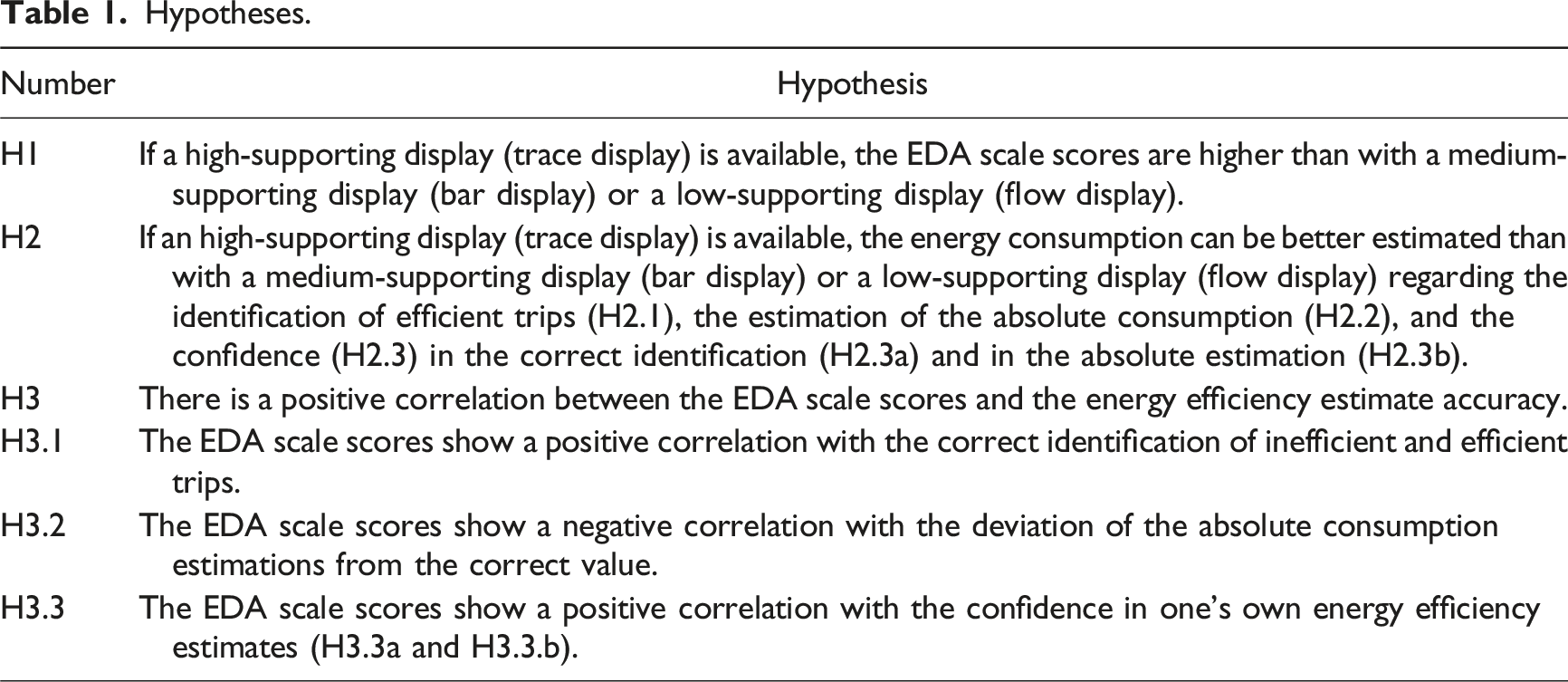
Hypotheses.
Method
In our online experiment, participants viewed driving scenes (videos) of EV trips from the driver’s field of view, along with one of three different energy displays. We used this highly controlled setup, showing the same trip to every participant, to reduce situational disturbances inherent in field studies.
Pilot Study
Pilot study participants were recruited via the University of Lübeck’s online platform and on Facebook and compensated by participation in a raffle or study participation certificates for course credit. The final sample (N = 30; age: M = 24.6 years, SD = 3.6; 10 male, 20 female) had an average driving experience in total kilometers with any vehicle of M = 26,695 km (SD = 51,507 km; median = 3250 km), and a weekly driving distance of M = 43 km (SD = 88 km; median = 2 km).
Participants
An a-priori power analysis (Faul et al., 2007), based on the pilot study, determined a required sample size N = 62 (parameters: power = .8, α-error = .05,
Material
Driving Scenes
We collected OBD-II data and dashcam footage of the driver’s view in a Renault ZOE EV in urban conditions. The recorded six driving scenes represented three pairs of driving scenes. Two driving scenes of each pair shared the same route (“Route A,” “Route B,” or “Route C”) but differed in consumption due to the driver using two different driving strategies: (1) driving-to-keep-distance (constant distance to vehicle ahead) = inefficient or (2) driving-to-keep-inertia (constant speed) = efficient (adapted from Blanch Micó et al., 2018). The practice trial driving scene was a reversed section of Route B with moderate efficiency (134.5 Wh/km). Trips distance ranged between 0.70 and 1.10 km, duration from 141 to 282 seconds, and average energy consumption from 51.5 Wh/km to 180.9 Wh/km. To produce the final video material for the study, the driving data was processed, imported into a web app, and synchronized with the dashcam recordings. Additionally, speed, trip kilometers, and the positions of the throttle and the brake pedal were displayed. In our vehicle, pressing the braking pedal led to regenerative braking.
Energy Displays
Referring to common approaches to present instantaneous energy dynamics, we implemented three prototypical display designs for the present study: (1) flow display, (2) bar display, and (3) trace display (see all Figure 1). All displays are inspired by real EV displays and aligned with each other (i.e., same colors, consumption formula, and calculation). As the energy consumption metric, we used watt-hours per km (Wh/km). Despite being less familiar to experienced EV drivers, we believe that instantaneous consumption values between 0 and approximately 2000 Wh/km and average consumption values between 51.5 and 180.9 Wh/km are easier to process for inexperienced drivers than the decimals in kWh/km. Almost all existing ICDs fit one of these three display prototypes, but major differences exist between them. Three prototypical displays to visualize instantaneous consumption. All displays are adapted from existing concepts and literature (e.g., Franke et al., 2019b; Moll & Franke, 2021; Schwarze et al., 2019).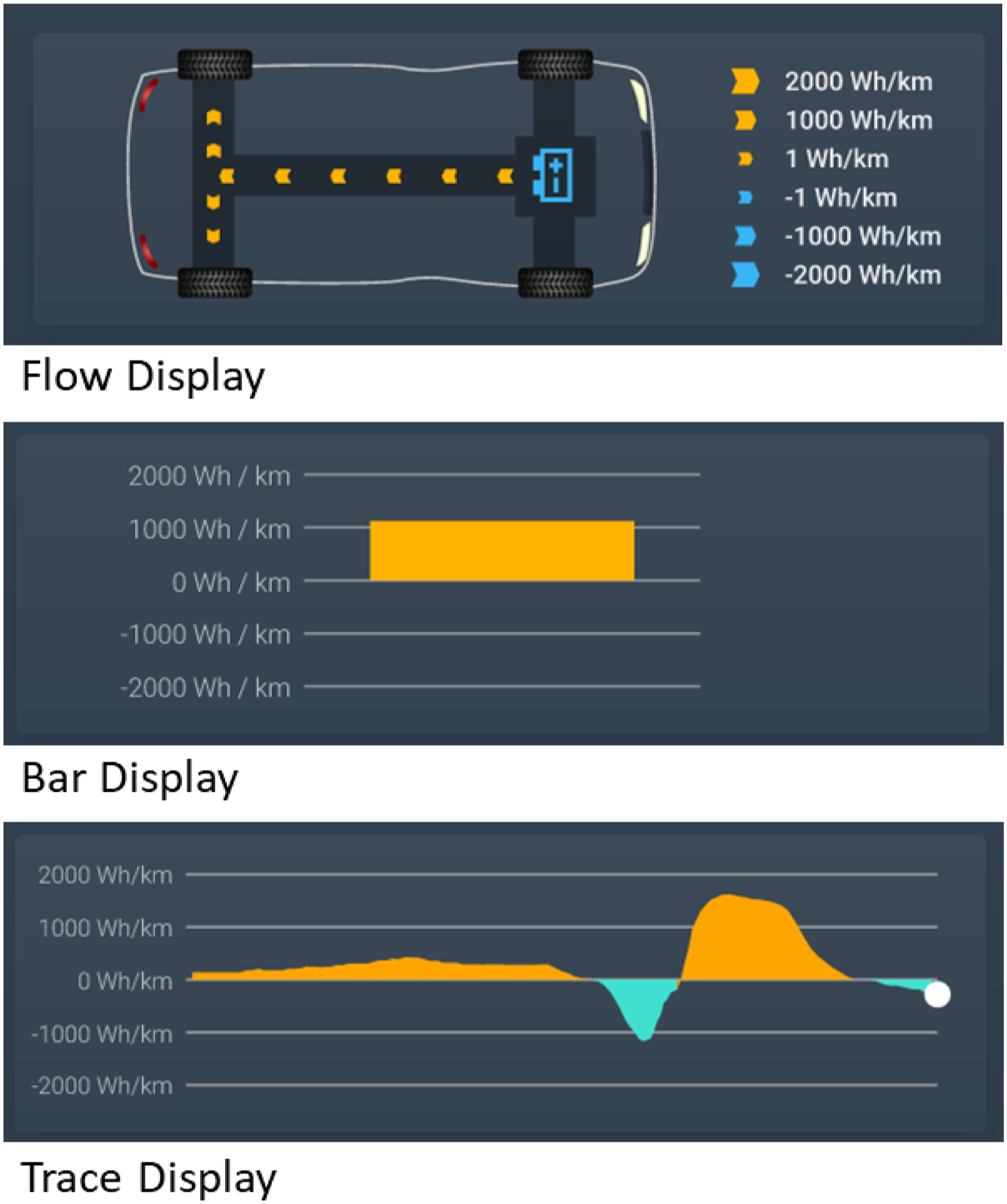
Flow Display
The flow display visualizes the bi-directionality of energy flows by providing arrow indicators and directional movement inside a schematic EV. While energy is consumed, orange arrows move from the motor to the tires. When energy is regained through regenerative braking, blue arrows move in the opposite direction. The thickness of the arrows represents the amount of energy consumed/regained. This design approach may help understand energy flows by visualizing their “paths” and “directions” in a meaningful way.
Bar Display
The bar display presents instantaneous consumption as a bar with no distraction from other information. Its height indicates the amount of energy while the width of the bar is constant and carries no additional information. An orange bar in the positive range means that energy is consumed, a blue bar in the negative range that energy is regained.
Trace Display
The point of trace display on the right side of the chart shows the same behavior as the bar of the bar display. The display visualizes the instantaneous consumption as a trace line continuously moving from right to left. The x-axis represents the last 100 m traveled. Hence, the trace stops moving when the vehicle stops.
In comparison, the flow display provides less task goal-oriented information but additional irrelevant information (low information value) as the path of the energy flow does not help in accurately perceiving consumption. The instantaneous consumption is even harder to accurately perceive: First, the energy flow design implies less space to indicate changes in consumption magnitude compared to the other displays (i.e., arrow size vs. bar height). Second, the arrows only have the scale legend on the right but miss a visual comparison scale like the inner lines in the bar and trace display (Diaz et al., 2018). The bar display provides task goal-oriented information and no irrelevant information (medium information value). The trace display provides a large amount of task goal-oriented information and no irrelevant information (high information value) because it addresses the volatility of the energy consumption data by providing additional visual persistence of the data. The distance provides a reference period, which may help to reduce bias (e.g., peak bias) in human perception and concatenates consumption magnitude with duration, as suggested by Franke et al., 2019b; Moll & Franke, 2021. As a result, the display visualizes colored areas that correspond to the consumed/regenerated energy amount to support the comprehension of the data. In summary, for EDA, the trace display is high-supporting, the flow display low-supporting, and the bar display medium-supporting (see Figure 2 for a comparison of their dynamic behavior). Comparison of the dynamic behavior of the three displays. The figure presents screenshots from the three displays, captured at four sequential maneuvers during a single trip sequence. These were taken starting 9 seconds into the low-efficiency trip on route B and continued for 12 seconds. The x-axis of the trace display represents the previous 100 m traveled; therefore, the time does not correspond with the position of the x-axis. Refer to the supplementary material for the original videos.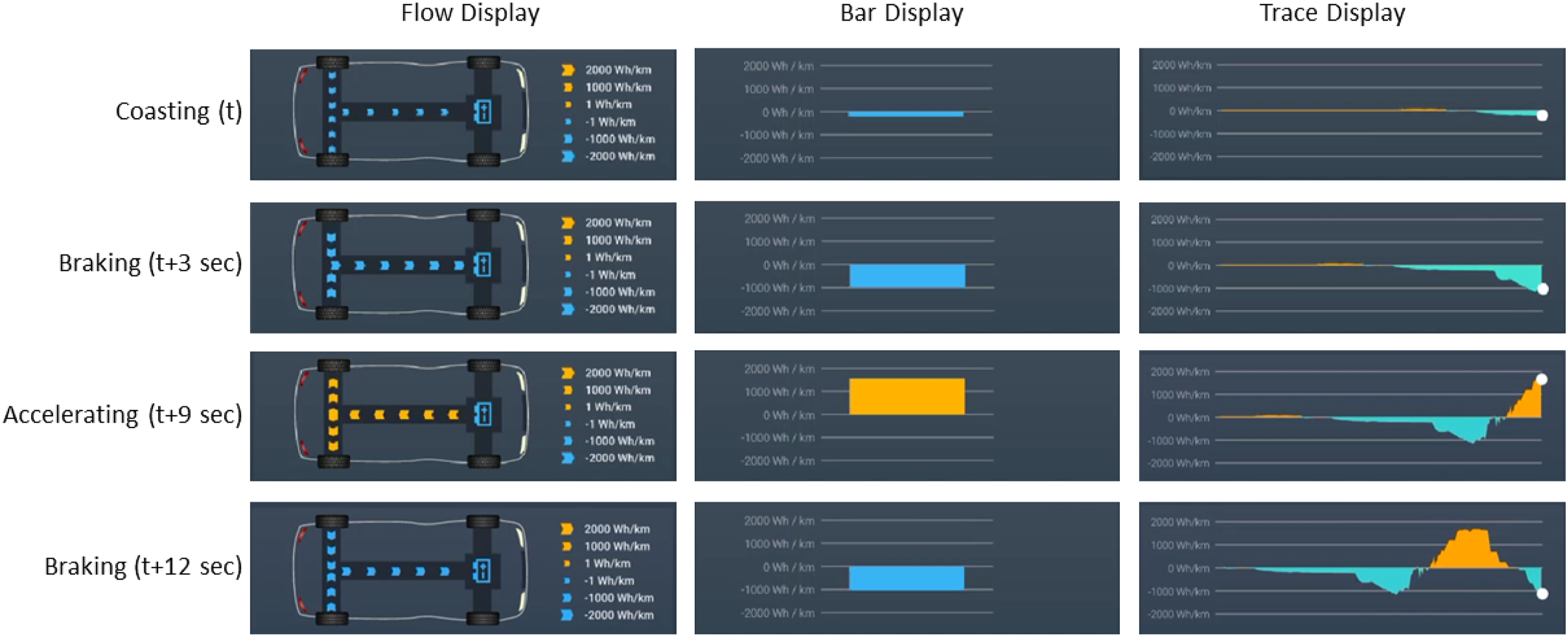
Outcome Measures
The EDA Scale.
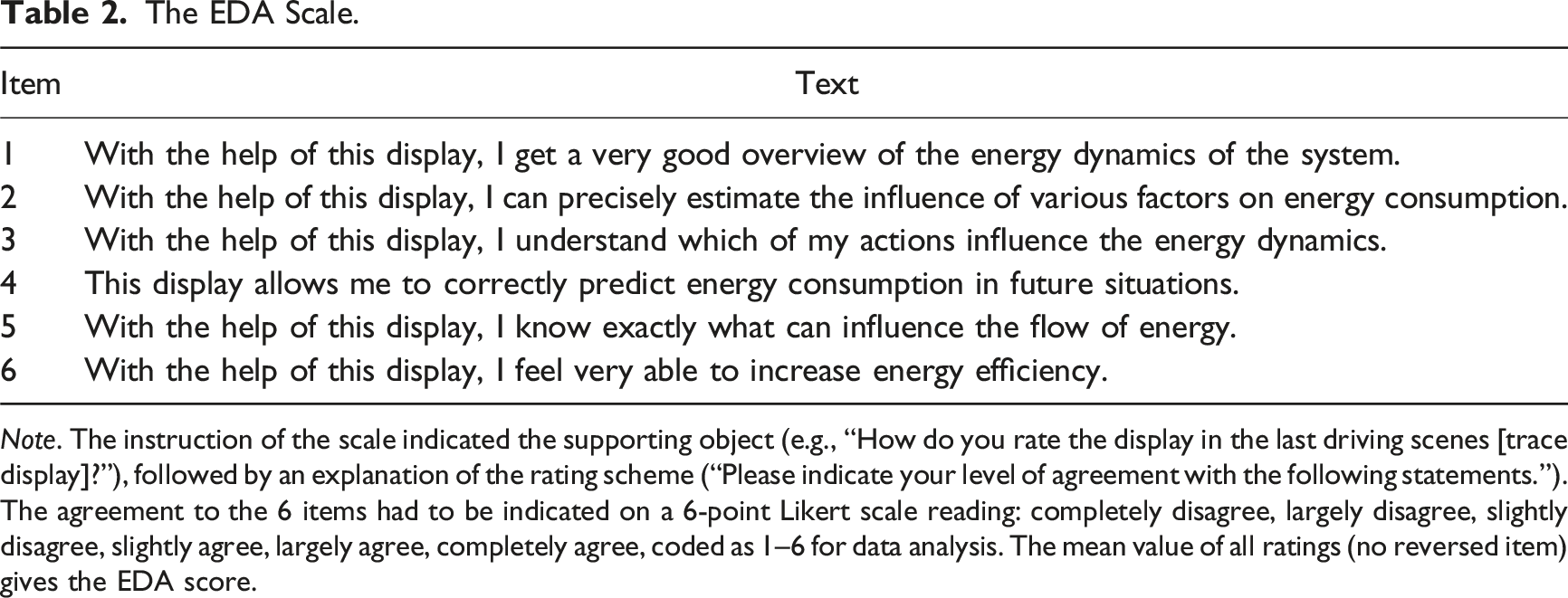
Note. The instruction of the scale indicated the supporting object (e.g., “How do you rate the display in the last driving scenes [trace display]?”), followed by an explanation of the rating scheme (“Please indicate your level of agreement with the following statements.”). The agreement to the 6 items had to be indicated on a 6-point Likert scale reading: completely disagree, largely disagree, slightly disagree, slightly agree, largely agree, completely agree, coded as 1–6 for data analysis. The mean value of all ratings (no reversed item) gives the EDA score.
As a prerequisite to interpreting the EDA scale mean, we conducted a joint scale analysis including both samples (pilot and main study, N = 112), analyzing the three display conditions separately to account for the assumed display’s effect on EDA. The scale items, displays, and driving scenes were the same in both studies, and we used different recruiting strategies to prevent double participation. We assessed the scale’s internal consistency with Cronbach’s alpha (Cronbach, 1951), used parallel analysis (Horn, 1965) for factor number extraction as an indication for one-dimensionality, and conducted an exploratory factor analysis (principal axis factoring extraction method; PAF; Costello & Osborne, 2005).
In all conditions, EDA scale scores were distributed normally. Skewness and kurtosis were within the range of ±1. Cronbach’s alphas indicated high internal consistency (αflowdisplay = .893, αbardisplay = .864, αtracedisplay = .923). Parallel analyses suggested one factor in the flow and trace display condition and two factors in the bar display condition (scree plot and eigenvalues were borderline to one factor). In the factor analyses, we specified the number of factors to one for consistency. The explained variance of the factor was 58% (flow), 52% (bar), and 67% (trace). All items showed similar statistics, with rather strong factor loadings and an αifitemdeleted value below the corresponding scale value.
As performance measurements (indirect and objective EDA measurement), we queried participants’ average energy consumption estimates of a trip in Wh/km (ConsEst) because an accurate EDA should be associated with a more accurate estimation of the consumed energy. To answer, participants moved a slider to values between 0 and 250 Wh/km with an accuracy of 1 Wh/km. To obtain the score, we calculated the absolute difference to the correct value. Additionally, to avoid an explicit number answering format as in the consumption estimates, after both trips on the same route, participants tried to identify the inefficient one (efficient trip identification; EffIdent). Confidence in performance for both measures was rated on a 6-point Likert scale, ranging from 1 = not sure at all to 6 = completely sure. As ecodriving knowledge and behavior have been shown to be related (McIlroy & Stanton, 2017; Pampel et al., 2018), control variables included 7 items of the Energy Literacy Questionnaire (DeWaters et al., 2013; DeWaters & Powers, 2013), energy-efficient behavior (Stragier et al., 2012), ATI (Franke, Attig, & Wessel, 2019), technical system knowledge (adapted from Franke et al., 2016), and demographic information. Measurement methods are detailed in the Appendix.
Design and Procedure
The study utilized the online survey tool LimeSurvey and employed a within-subjects design. Participants were randomly assigned to one of three groups, each with a different combination of display and route to mitigate route-specific effects. The order of the display blocks (each containing the two efficiency conditions) was randomized. Participants saw an instructional video with a practice trial driving scene. Then they watched six driving scenes—two scenes with different energy consumptions (inefficient or efficient) for each of the three energy feedback displays (flow, bar, and trace). Each display block had a different route. After watching the first driving scene, participants responded to the ConsEst question and the corresponding confidence rating. After the second driving scene, participants responded again to ConsEst (including confidence rating), stated their EffIdent (including confidence rating), and completed the EDA scale. Control variables were completed after all driving scenes. In the end, participants were directed to the raffle and participation certification. The average duration of the main study was M = 43 min (SD = 8 min; median = 42 min). To address fatigue-related decreasing motivation, we (1) counterbalanced the order of the scenes to avoid position effects in the data and (2) implemented a timer that disabled the “next” button in LimeSurvey for the duration of the scene, preventing participants from skipping scenes. This research complied with the American Psychological Association Code of Ethics and was approved by the ethical committee of the University of Lübeck (no. 21–142). Informed consent was obtained from each participant.
Data Analysis
For H1, H2.2, and H2.3, we used a one-way repeated measures ANOVA (Leonhart, 2017), for H2.1, we used Cochran’s Q test (Cochran, 1950) and its chance-corrected effect size measure R (Berry et al., 2007), and for H3, we used a repeated measures correlation (Bakdash & Marusich, 2017) to estimate the within-individual correlation between two variables on several occasions (i.e., test whether individuals score higher on two paired variables in one display condition compared to another display condition). For all analyses, the threshold of α was set to .05, and effect sizes for correlations (H3) were interpreted as small (r = .10), medium (r = .30), and large (r = .50) according to Cohen (1988). Following Bakeman (2005) and Cohen (1988), we calculated generalized η2
Results
Descriptive Statistics of all Dependent Variables Sorted for Each Display and Route.
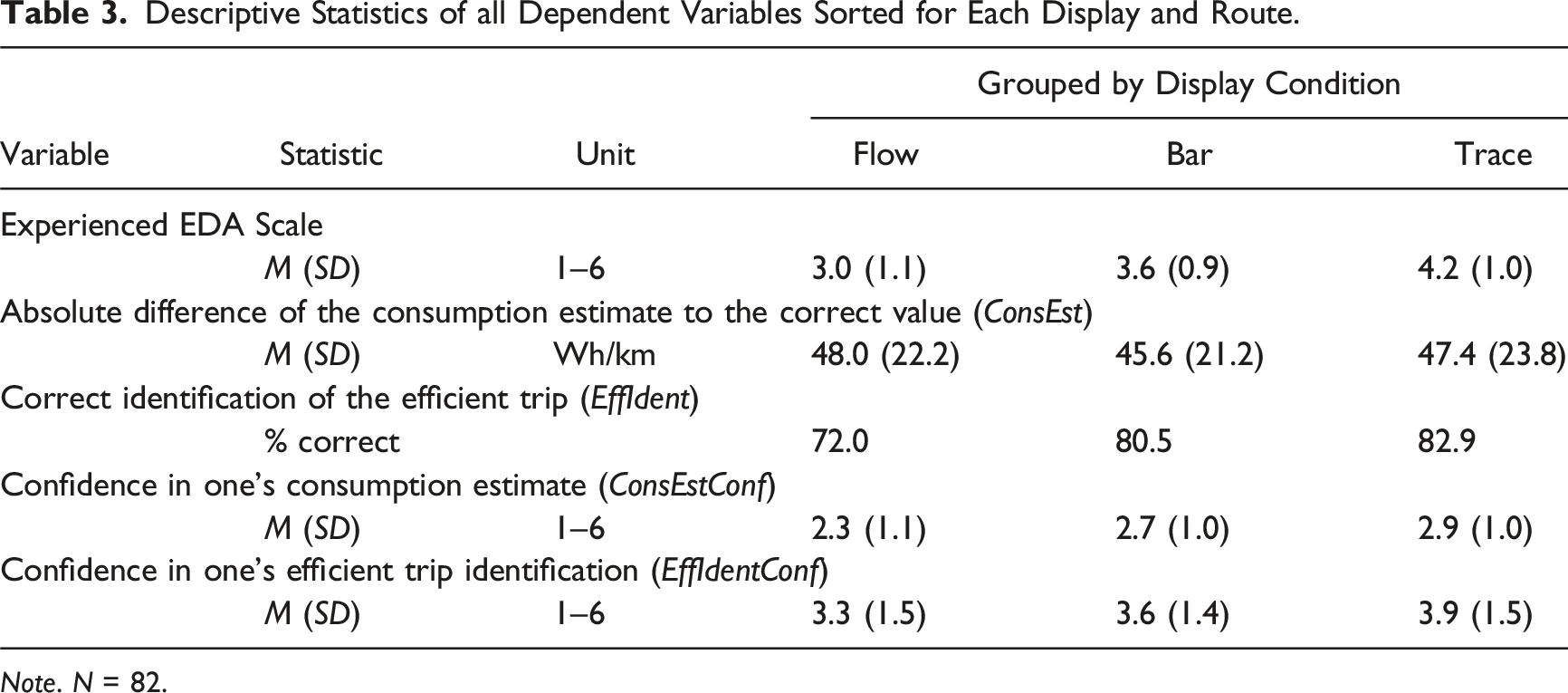
Note. N = 82.
The EDA scale scores were significantly different at the different display conditions (H1, F (1.88, 152.35) = 36.22, p < .001, Result of the repeated measures ANOVA of the EDA scale scores (H1). N = 82, ***p < .001, error bars represent standard deviations.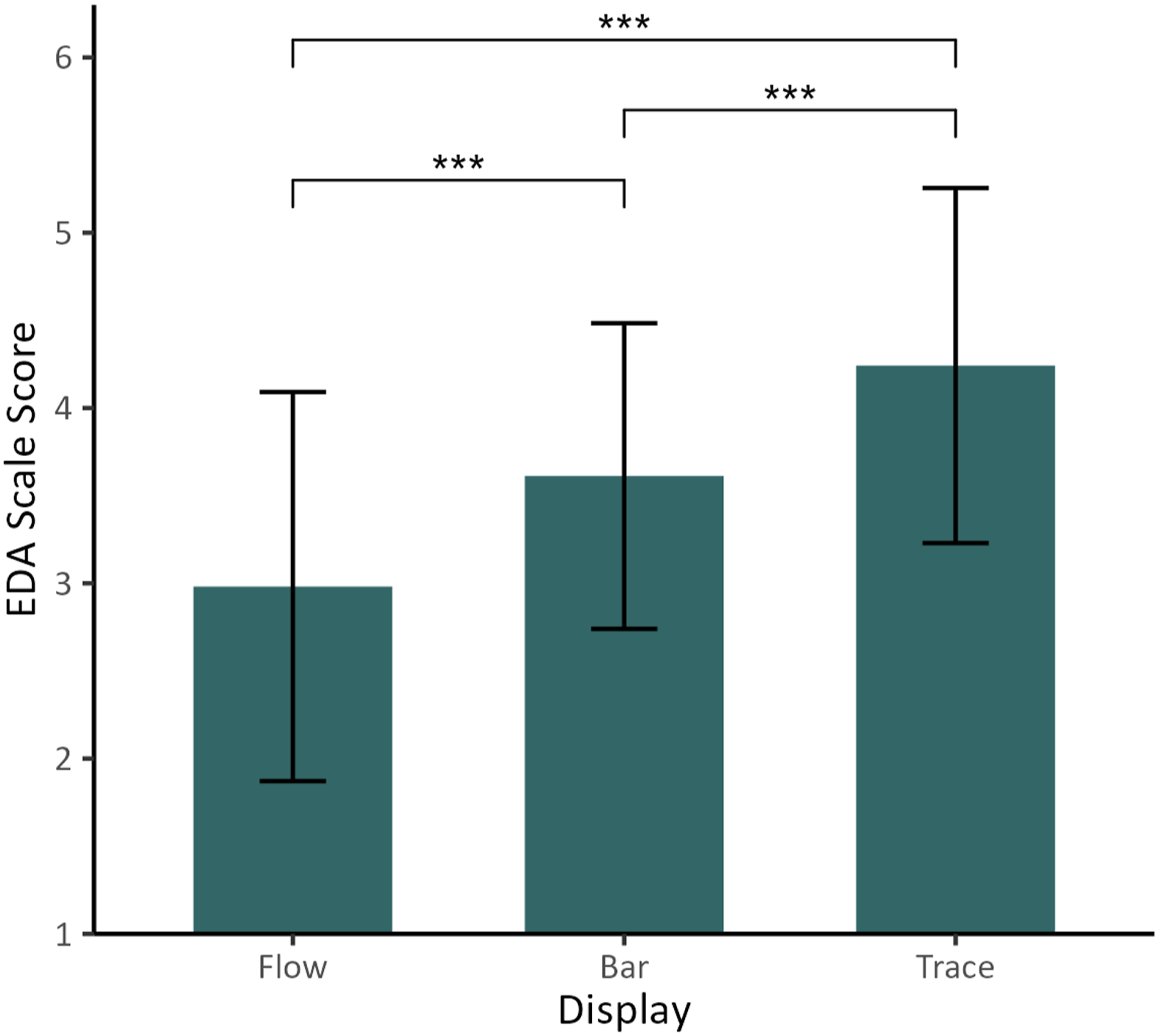
Cochran’s Q test indicated no significant differences between the correct efficient trip identifications in the three display conditions (H2.1, χ2 (2) = 3.44, p = .179) and a very weak effect size (R = .01) of the display. Also, absolute deviations of the consumption estimate from the correct value were not significantly different in the display conditions (H2.2, F (2, 162) = 0.29, p = .746,
In contrast, the efficient trip identification confidence ratings were significantly different in the display conditions (H2.3a, F (2, 162) = 4.73, p = .010,
The EDA scale showed a positive correlation with the correct efficient trip identification (H3.1, rrm = .17, p = .033) but no correlation with the deviation of the consumption estimation from the correct value (H3.2, rrm = .02, p = .784). Also, the EDA scale showed a positive correlation with the identification confidence ratings (H3.3a, rrm = .39, p < .001) and the estimation confidence ratings (H3.3b, rrm = .55, p < .001).
Exploratory Analyses
To examine the influence of individual characteristics on the performance measures, we calculated Pearson correlation coefficients between the mean EDA measures (across all three conditions) with the personality and knowledge control variables. Significant correlations were found between energy literacy and the consumption estimate score (r = −.26, p = .020, indicating more accurate estimates with higher literacy scores) and between self-rated technical knowledge and the consumption estimate score (r = −.23, p = .042).
Discussion
Summary of the Findings and Implications
The objective of the present study was to examine the effects of three prototypical energy consumption displays on EDA measured by self-ratings, estimating energy consumption, and identifying efficient trips. We found that the energy display type influenced the experienced EDA (H1) and estimation confidence (H2.3). The 6-item EDA scale showed very good internal structure statistics and a relationship with the efficient trip identification (H3.1) and the confidence ratings (H3.3). This is a first indicator of the conceptual relevance of the EDA scale and implies a consideration in the design process of energy displays in technical systems. Also, this relationship supports the theoretical assumptions of Endsley (2020) that subjective SA and confidence relate. We used repeated measures correlation analysis to calculate correlations across conditions (controlling for inter-individual variance) for H3. As multiple statistical approaches exist, which may yield different findings, these results should be interpreted cautiously.
Contrary to the hypotheses, performance in efficient trip identification (H2.1) and consumption estimation (H2.2) were not affected by the type of energy display. The present research uncovers considerable challenges to measure the effect of displays to accurately understand energy consumption. Across all displays, participants were unable to accurately estimate the energy consumption (which is in line with other empirical findings, e.g., Moll & Franke, 2021) but the share of correct answers in identifying the efficient trip was high for all displays. This could mean that participants had a generally correct but abstract understanding of energy consumption, enabling them to perform well in discriminating between very high and low consumption (as in our driving scenes). Participants might need more feedback and training to refine this abstract understanding to perform better in estimating consumption. The efficient trip identification task seems already promising to assess EDA, but the data is very rough. To compare displays, many participants and driving scenes would be necessary to detect differences. For this, shortening the scene length would be necessary and probably increase the task difficulty (due to less information). Additionally, a more structured approach to selecting the scenes could be beneficial and increase test economy. This would mean that future research should prioritize scenes that are critical for energy consumption and where human action regulation (ecodriving) is possible.
The correlation of experienced EDA and efficiency identification (H3.1) implies that displays facilitating correct efficiency identifications, also enhance experienced EDA. This could be interpreted as a first hint towards the assumption that the independent variable leads to a good calibration of experienced and actual EDA. Yet, the lack of a correlation between the consumption estimation accuracy and experienced EDA (H3.2) and the lack of objective performance differences due to the display condition (H2.1 and H2.2) leave room for alternative interpretations, for example, that participants were unaware of insufficient EDA due to the lack of adequate performance feedback (cf., Endsley, 2020). But, considering the observed correlations and the methodological issues, we conclude that the energy displays first influence the experienced EDA and then the performance associated with EDA, although we were not yet able to observe this in the current study.
Furthermore, the results imply that experienced EDA and actual EDA should be theoretically understood as individual concepts within a common theoretical model of energy-specific SA. In summary, the results contribute to the discussion concerning the conceptual distinction of experienced (subjective) and actual (objective) SA and their combined influence on task performance (see also Edgar et al., 2018; Schrills & Franke, 2023).
Limitations and Future Research
Important situational information (e.g., g-forces and peripheral visual information) that could help estimate efficiency is missing in this video-based method. Yet, statistical differences between the displays can be assumed to be largely unaffected by the shortcomings of the video-based method as they apply to all displays. Furthermore, the lengthy duration of the online study (43 minutes on average) may decrease motivation and cognitive performance, particularly affecting the EDA performance measures.
We ranked existing energy display design approaches by their informational value (independent variable). Yet, additional properties of the displays might also have an impact on the dependent variables. The development of custom energy displays that operationalize the independent variable more precisely while keeping all other properties constant would be more standardized and allow more conclusions about the display elements, but may be difficult to construct while keeping meaningful display visualizations.
The absence of distinct performance data between display conditions is a study limitation. However, the correlation between experienced EDA and efficiency identification is a first indication for the conceptual relevance of performance data. Future research could reveal clearer distinctions with more diverging display conditions (e.g., addressing different information processing stages) and well-calibrated performance tasks (e.g., more identification tasks or estimation training). Overall, empirical research on quantitatively estimating energy consumption is limited. The findings from this study can contribute to establishing basic energy display design principles (e.g., types of indicator, included dimensions) and their link to variables of human-energy interaction (Dahlinger et al., 2018; Sanguinetti et al., 2018).
It is important to note that this research focuses specifically on information perception and processing (i.e., the facets more closely linked to SA). Compared to real-vehicle or driving simulator studies, an online study is not able to capture the impact of different energy displays or improved EDA on energy-efficient driving behavior. By shedding light on the differential effects of energy displays on EDA, we aim to pave the way for future studies, ultimately providing more insights into which energy feedback display supports ecodriving in electric vehicles.
Conclusion
The objective of the present study was to examine the effects of energy consumption displays on EDA in an online study using driving scenes. We used prototypical display approaches and classified them regarding their informational value to support EDA. The EDA scale showed very good scale statistics, significant differences due to the energy displays, and correlated with the performance to identify an efficient trip out of two. The type of display did not influence the performance measurements but the subjective ratings, which implicates the potential of the EDA concept and scale for further studies examining the psychological benefits of energy displays in technical systems. The research’s novel contribution to the field of human-energy interaction is a new concept (EDA) including its measurement and empirical results from a new online experiment paradigm. Further research that includes the concept of EDA seems promising, especially research that links EDA with distinct energy display elements and with energy-related action regulation.
Supplemental Material
Supplemental Material - Energy Consumption Displays in Electric Vehicles: Differential Effects on Estimating Consumption and Experienced Energy Dynamics Awareness
Supplemental Material for Energy Consumption Displays in Electric Vehicles: Differential Effects on Estimating Consumption and Experienced Energy Dynamics Awareness by Markus Gödker, Vivien E. Moll, and Thomas Franke in Human Factors
Footnotes
Key Points
Three prototypical energy consumption displays were examined for their effects on energy dynamic awareness (EDA) and estimates of energy usage (performance) during electric vehicle driving in an online study. Experienced EDA, measured by a new self-rating scale, was strongly affected by display type. Display type did not affect the ability of drivers to distinguish between efficient and inefficient driving behavior, nor did it affect the accuracy of driver estimates of performance. However, EDA was correlated with the ability to distinguish between efficient and inefficient driving behavior. The new contribution to the field of human-energy interaction—EDA—can be considered in the evaluation process of energy displays in technical systems.
Acknowledgments
The authors would like to thank Jana Ahrens, Matin Schodjaian-Bahnamiri, Lukas Bernhardt, Jan Heidinger, and Tim Schrills for their contribution to the success of this research. Also, we would like to thank the reviewers for their efforts to review the manuscript. We sincerely appreciate the valuable comments, which helped improve the manuscript’s overall quality. This research has been preregistered under  . This research was funded by the Deutsche Forschungsgemeinschaft (DFG, German Research Foundation) under the name “AMORi”, project number 498999989.
Supplemental Material
Supplemental material for this article is available online.
Appendix
Author Biographies
Markus Gödker is a PhD candidate in the field of engineering psychology at the University of Lübeck in Germany. He received his master of science in psychology in 2017 at the Rheinische Friedrich-Wilhelms-University in Bonn, Germany.
Vivien Esther Moll is a PhD candidate in the field of engineering psychology at the University of Lübeck in Germany. She received her master of science in psychology in 2017 at the Heinrich-Heine-University Düsseldorf, Germany.
Thomas Franke is a professor of engineering psychology at the University of Lübeck in Germany. He received his PhD in psychology in 2014 from the University of Technology in Chemnitz, Germany.
References
Supplementary Material
Please find the following supplemental material available below.
For Open Access articles published under a Creative Commons License, all supplemental material carries the same license as the article it is associated with.
For non-Open Access articles published, all supplemental material carries a non-exclusive license, and permission requests for re-use of supplemental material or any part of supplemental material shall be sent directly to the copyright owner as specified in the copyright notice associated with the article.
