




Abstract
Objective
This study explored the effects of hearing protection devices (HPDs) and head protection on the ability of normal-hearing individuals to localize reverse alarms in background noise.
Background
Among factors potentially contributing to accidents involving heavy vehicles, reverse alarms can be difficult to localize in space, leading to errors in identifying the source of danger. Previous studies have shown that traditional tonal alarms are more difficult to localize than broadband alarms. In addition, HPDs and safety helmets may further impair localization.
Method
Standing in the middle of an array of eight loudspeakers, participants with and without HPDs (passive and level-dependent) had to identify the loudspeaker emitting a single cycle of the alarm while performing a task on a tablet computer.
Results
The broadband alarm was easier to localize than the tonal alarm. Passive HPDs had a significant impact on sound localization (earmuffs generally more so than earplugs), particularly double hearing protection, and level-dependent HPDs did not fully restore sound localization abilities. The safety helmet had a much lesser impact on performance than HPDs.
Conclusion
Where good sound localization abilities are essential in noisy workplaces, the broadband alarm should be used, double hearing protection should be avoided, and earplug-style passive or level-dependent devices may be a better choice than earmuff-style devices. Construction safety helmets, however, seem to have only a minimal effect on sound localization.
Application
Results of this study will help stakeholders make decisions that are more informed in promoting safer workplaces.
Introduction
Accidents involving reversing heavy vehicles, often deadly in nature, are still reported each year (Kazan & Usmen, 2018; Laroche et al., 1995; National Institute for Occupational Safety and Health [NIOSH], 2004) in a variety of workplaces (i.e., construction, transport, mines, municipalities), despite the often mandatory use of reverse alarms. A wide range of alarm signals have been studied in the literature, including single-tone, multi-tone, broadband, and combinations thereof (Alali, 2011; Catchpole et al., 2004; Vaillancourt et al., 2013). In practice, the two most common types of reversing alarms installed on heavy machinery are the traditional single-tone alarm, referred to as the tonal alarm (“beep-beep”), and wideband random noise, referred to as the broadband alarm (“psssht-psssht”; Burgess & McCarty, 2009; Institut de recherché Robert-Sauvé en santé et en sécurité du travail [IRSST], 2014; Vaillancourt et al., 2013; Withington, 2004). Previous studies have documented better spatial localization, lower reaction thresholds, and more uniform sound propagation behind heavy vehicles with the broadband alarm compared to the tonal alarm, thereby yielding a better efficiency of this alarm in ensuring worker safety (IRSST, 2014; Laroche et al., 2018; Nélisse et al., 2017; Vaillancourt et al., 2012, 2013). Personal safety equipment (PPE), such as hearing protection devices (HPDs) and safety helmets, is required in many noisy environments, but their use may pose a number of safety concerns. This study focusses on how PPEs affect the ability to localize the tonal and broadband alarms. This is an important safety concern since workers must adequately localize reverse alarms in order to promptly react and move out of the danger zone.
The effect of safety helmets on sound localization remains relatively unexplored. However, one research group has addressed this issue using military helmets (Melzer et al., 2012; Scharine, 2005; Scharine & Letowski, 2013; Scharine et al., 2007). Scharine and Letowski (2013) compared the impact of various configurations of military helmets on sound detection and localization. Localization performance was reduced while wearing a helmet, particularly a helmet that completely covers the ears, Further, Scharine et al. (2007) showed that localization performance was similar without head protection and with a military helmet that did not cover the ears, while performance increasingly degraded as the level of ear coverage increased from no coverage, to partial coverage, and then to total ear coverage. Other research groups obtained similar results. Abel et al. (2009) studied the effect of an advanced communications earplugs, used in combination with military helmets varying in their degree of ear coverage, on horizontal plane sound localization. Localization ranged from 94% (no helmet) to 80% (helmet completely covering the ears) without hearing protection, and from 83% (no helmet) to 78% (helmet with complete ear coverage) when using the communications earplugs. Increasing coverage of the ears particularly affected front/back localization. Such findings were explained by the gradual loss of high-frequency spectral cues with increasing ear coverage. Vause and Grantham (1999) explored sound localization in the frontal and lateral plane while using a military helmet that only partially covered the ears, used alone and in combination with two types of passive earplugs. Used alone, the military helmet studied did not significantly impact sound localization (compared to no head protection); however, the combined used of ear and head protection resulted in increased localization errors, mainly front/back errors.
Conventional passive HPDs, the most commonly used type of hearing protection, have been shown to reduce sound localization performance relative to unprotected ear (Berger, 2003; Berger & Casali, 1997; Bolia et al., 2001; Borg et al., 2008; Brungart et al., 2007; McKinley, 2000; Nixon & Berger, 1998; Noble et al., 1990; Simpson et al., 2005; Takimoto et al., 2007), and increase the number of front/back confusion errors (Abel & Armstrong, 1993; Abel & Hay, 1996; Alali & Casali, 2011; Brown et al., 2015; Gallagher et al., 2014, Gallagher et al., 2015a, Gallagher et al., 2015b; Zimpfer & Sarafian, 2014). In addition, earmuff-type devices are generally more detrimental to sound localization than earplugs (Abel & Hay, 1996; Russell, 1976; Suter, 1989; Talcott et al., 2012; Vaillancourt et al., 2013). Some studies focused specifically on the localization of different reverse alarms with hearing protectors. (Alali, 2011; Alali & Casali, 2011; Casali & Alali, 2010; Vaillancourt et al., 2013).
Alali and Casali (2011) investigated seven different HPDs, including passive and active earplugs and earmuffs, to study their effect on the sound localization of a “standard” reverse alarm (which includes dominant frequencies of 1000, 1250, and 3150 Hz) and a modified tonal alarm (with additional frequency components at 400 Hz and 4000 Hz) in individuals with normal hearing. The alarm, 15 s in duration, was presented from one of eight loudspeakers covering a 360º span, in the presence of background noise. Head movements were allowed, and vehicle backup was simulated by increasing the alarm level at a rate matching a vehicular speed of 10 km/hr. Compared to all other listening conditions, including unprotected performance, only a special pair of custom-made diotic earmuffs resulted in significantly worse localization. The authors explained this result by a loss of binaural localization cues when a single microphone feeds a single sound input to both ear cups. Left/right localization was also superior to front/back localization, consistent with other studies. Finally, the modified tonal alarm proved superior than the single-tone alarm. Good localization with HPDs in this study likely reflects the use of a long duration alarm (15 s) and the allowed head movements.
In Vaillancourt et al. (2013), participants were asked to identify the location of reverse alarms (tonal and broadband), 3 s in duration, coming from one of 12 loudspeakers covering a 180º half-sphere, in the presence of an 80-dBA background noise. Loudspeakers were placed behind the normally hearing participants, to the left and to the right—left/right localization being assessed in the former condition compared to front/back localization in the latter two conditions. No head movements were allowed and vehicle backup at a speed of 10 km/hr was simulated by gradual alarm level increases. Sound localization was measured without HPDs, with a passive earmuff (PELTOR Optime 95) and with passive earplugs (EAR Ultrafit). Overall, localization performance was better for the broadband alarm than the tonal alarm, and in the left/right condition compared to front/back. While earplugs did not significantly alter sound localization, earmuffs resulted in significantly higher front/back confusions for both alarms and left/right confusions for the tonal alarm.
Level-dependent HPDs offer amplification of low-level signals and provide attenuation against sound levels that can damage hearing, their goal being the prevention of noise-induced hearing loss while maintaining situational awareness of softer speech and alarm signals. Most models come with a selectable or adjustable volume control. In general, these products do not necessarily improve sound localization over passive hearing protection, and can even further degrade performance (Alali, 2011; Alali & Casali, 2011; Brown et al., 2015; Brungart et al., 2007; Casali & Alali, 2010; Mlynski & Kozlowski, 2019; Smalt et al., 2019; Laroche et al., 2017; Vaillancourt et al., 2019; Zimpfer & Sarafian, 2014).
While the advantage of a broader spectrum alarm for sound localization has been well documented, little is known on the effects on the ability to localize reverse alarms of (1) safety helmets; and (2) the combined hearing and head protection, such as the use of a construction safety helmet with earplugs, earmuffs, and double hearing protection (earplugs worn under earmuffs). Safety helmets used in industry are not necessarily similar in shape and form to those used for military applications, nor do they offer the same amount of ear coverage. However, because they are made of hard plastic and are worn close to the ear, they can modify sound localization cues by altering sound waves traveling around the head. In the case of level-dependent HPDs, additional questions arise as to whether or not using the devices in their level-dependent mode improves localization over the passive protection offered when the device is powered off (passive mode), and if performance varies as a function of the HPD volume level.
This study explored the effect of HPDs on the ability of normal-hearing individuals to localize the most commonly used types of reverse alarms (tonal and broadband) in background noise, while performing a task. The effects of passive hearing protection (earplugs, earmuffs, and double protection) and head protection (safety helmet) were evaluated in the first experiment, while the second experiment focused on the effects of electronic level-dependent devices.
Experiment 1: Effects of Passive Hearing Protection and Head Protection on Sound Localization
Methods
Seventy-two participants (34 women; 38 men) with normal hearing, between the ages of 18 and 39 years old (average age = 24.7; SD = 4.0), took part in the first experiment. Participants were divided into three equal groups, tested both unprotected and with either: passive earplugs (EAR Ultrafit; NRR [Noise Reduction Rating]= 25 dB), passive earmuffs (PELTOR Optime 95; NRR = 21 dB), or double protection (EAR Ultrafit under PELTOR Optime). All participants met the following inclusion criteria: (1) normal hearing in both ears, defined by pure-tone air-conduction detection thresholds equal to or below 25 dB HL at each octave frequency between 0.25 and 8 kHz, and at 3 and 6 kHz; (2) negative otological history; and (3) normal tympanometry results (static compliance = 0.30 to 1.70 cm3; external auditory canal volume = 0.9 to 2.0 cm3; gradient = 51 to 114 daPa (decapascal); pressure = −150 to +50 daPa) as per Martin and Clark (2003). This research complied with the American Psychological Association Code of Ethics and was approved by the Institutional Review Board at University of Ottawa. Informed consent was obtained from each participant.
The localization experiment was carried out in a large audiometric room (2.9 m × 5.6 m × 2 m) with 4-inch thick perforated absorptive panels for walls and ceilings and carpeted flooring. Participants were standing in the middle of a 1 m-radius loudspeaker sphere, with eight loudspeakers (Pyle PDWR30B) arrayed uniformly over 360º, as per Figure 1. They were asked to call out the number of the loudspeaker from which a reverse alarm was presented in a 80-dBA background noise (sawmill wood shavings) generated simultaneously by all eight loudspeakers to create a quasi-diffuse noise field around the participant. This noise was selected among a set of 12 noises used in earlier studies (Laroche et al., 2018), due to its wide spectral content and complex temporal structure (Figure 2).
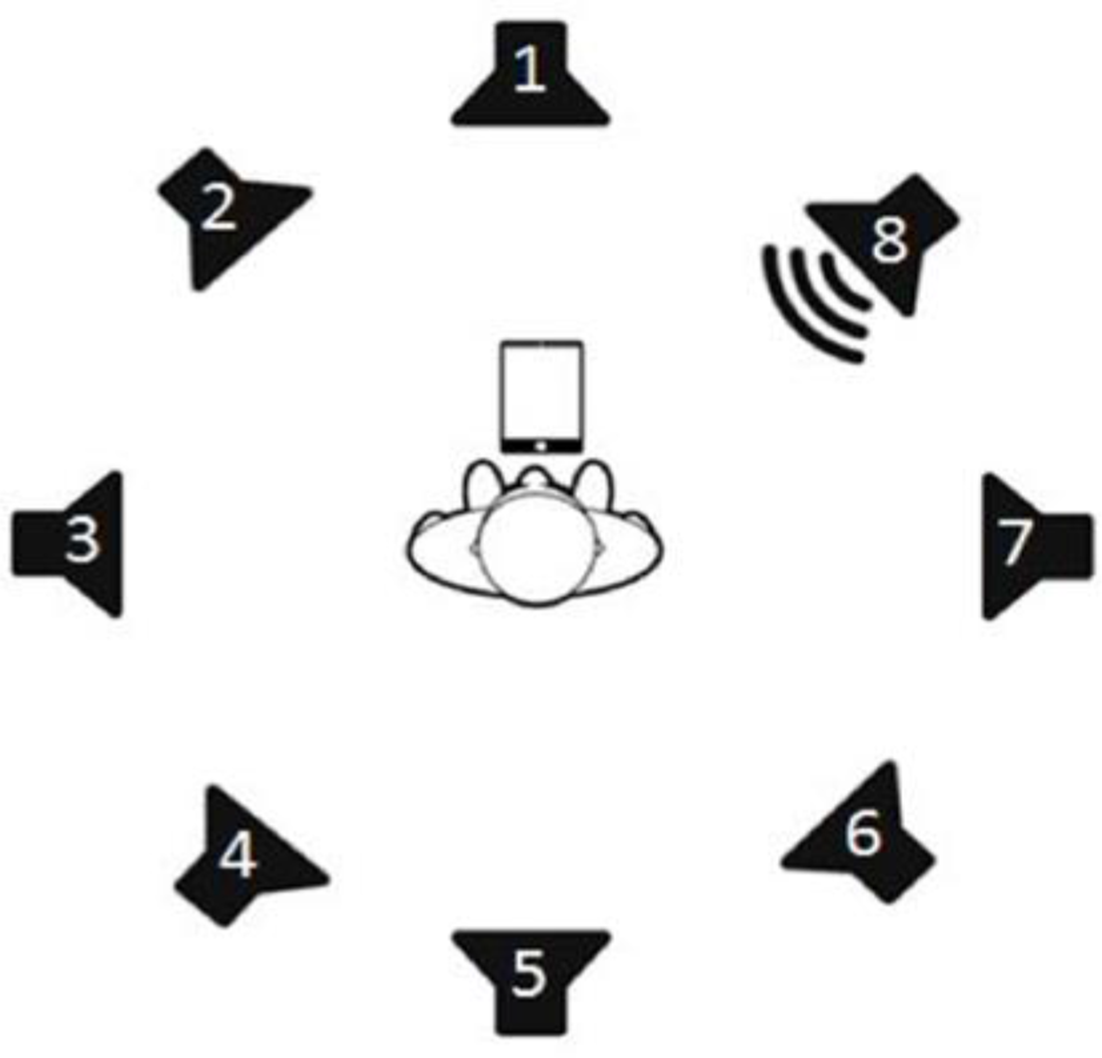
Experimental setup.
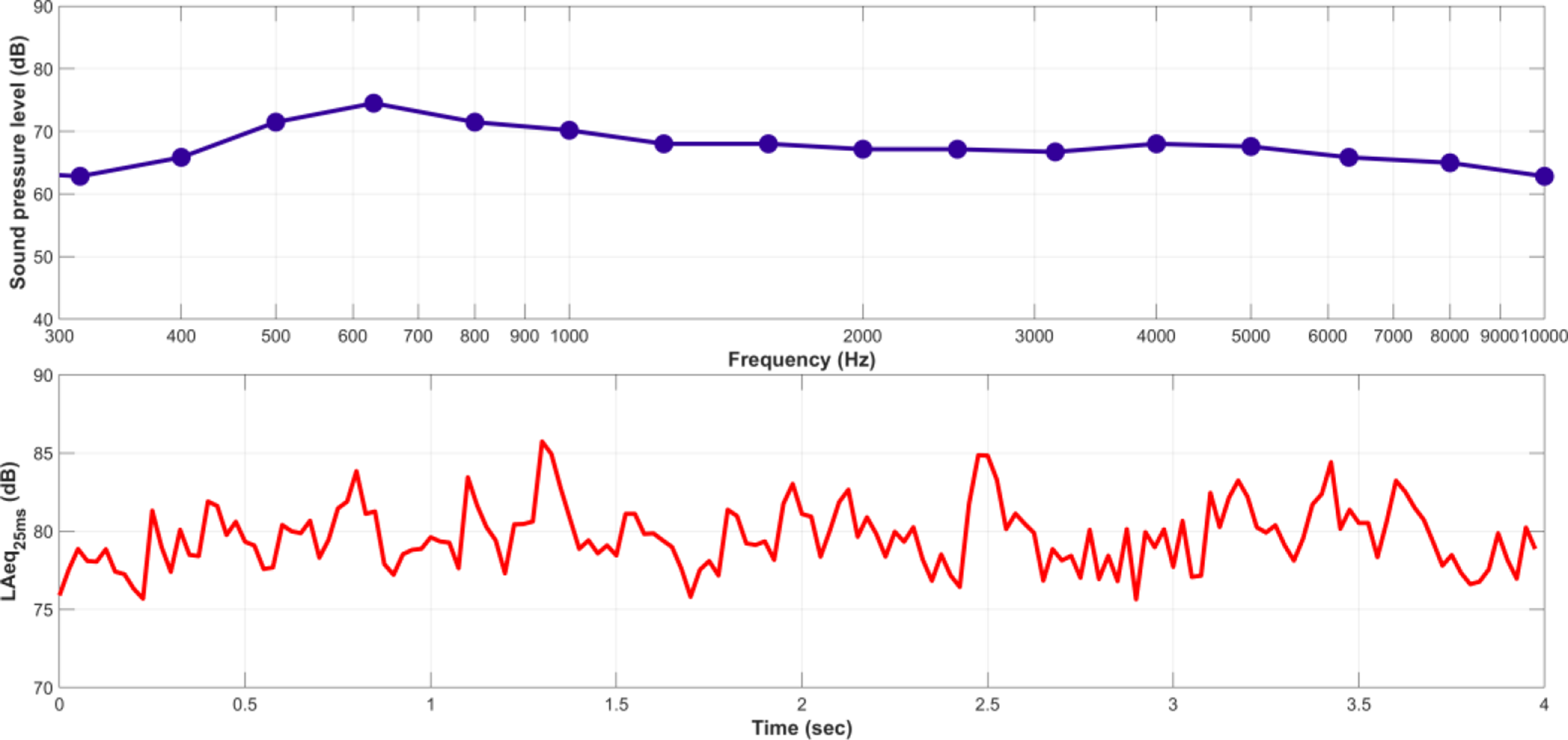
Spectral content and temporal structure of the background noise.
Two commercially and widely available reverse alarm signals (tonal and broadband) were studied. The tonal alarm (Grote Model 73030) is composed of a dominant pure tone near 1250 Hz with weaker harmonics and lasts 990 ms per cycle (500 ms “beep” and 490 ms “pause”), whereas the broadband alarm (Brigade Electronics BBS-107 Heavy Duty) has acoustic energy spread over a larger frequency spectrum, mainly from 700 to 4000 Hz, with a 770 ms cycle (400 ms “pschtt” and 370 ms pause). The spectral characteristics of both reverse alarms are illustrated in Figure 3. The two alarm sounds were recorded from commercial units in an anechoic room, according to standard SAE J994 (2009), and were used as stimuli during the experimental conditions.
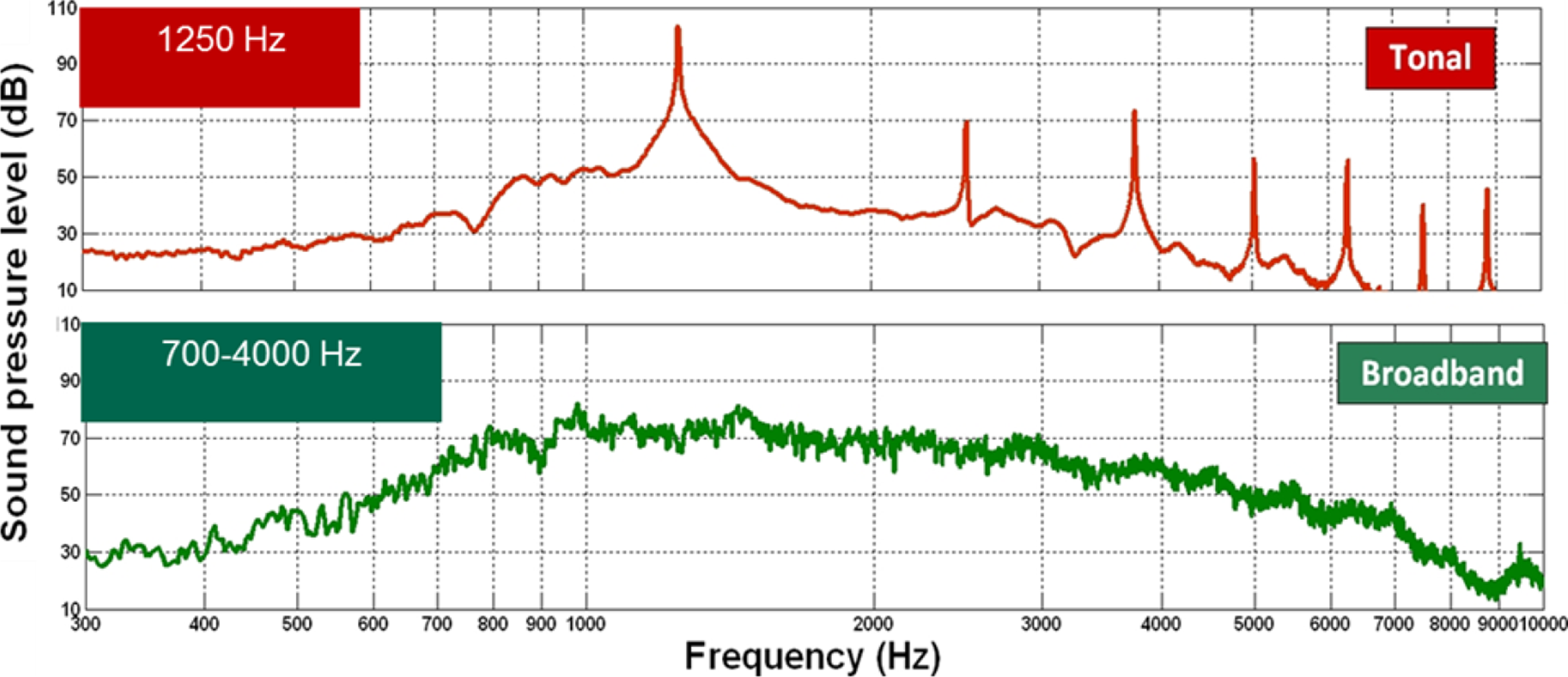
Spectral characteristics of the tonal and broadband alarms. The upper left boxes show the frequency zones where most of the energy is concentrated.
Reverse alarm levels were calibrated to yield a 0 dB signal-to-noise ratio (SNR), the minimum alarm level prescribed by ISO 9533 (1989) behind heavy vehicles. Based on a previous study on detection in different background noises (Laroche et al., 2018), this SNR corresponds to, on average, a level 12 to 15 dB above detection thresholds in noise for the two alarm signals. In these circumstances, the much wider frequency content of the broadband alarm drives the localization performance, a phenomenon well accounted for in the literature (e.g., Nélisse et al., 2017; Vaillancourt et al., 2013).
The alarm level was based on the active (“beep” or “pschtt”) portion of the alarm cycle. Each alarm signal lasted a full cycle (.990 s for the tonal alarm and .770 s for the broadband alarm) and was presented randomly 2 to 8 s after the onset of the background noise. Alarm duration was kept short to represent a potentially dangerous situation during which the time available to move away from the source of danger (rear of the vehicle) is restricted. All stimuli were presented using a LabView interface developed specially for this purpose.
During the localization measures, participants were involved in a task, which consisted of manipulating colored disks on a computer tablet to reproduce patterns displayed on the screen. A free online version of this task, the Tower of London, is available online as part of the PEBL Psychological Test Battery (http://pebl.sourceforge.net/battery.html). Since a previous study (Nélisse et al., 2017) had not shown an important effect of this particular task on sound localization abilities, it was not considered as a factor during data analysis. It was however retained in the experimental protocol to provide cognitive loading while localizing and to uphold ecological validity. Alarm audibility in noise and task comprehension were verified during a familiarization phase prior to testing. While both feet remained in a fixed position on markers on the ground, head and upper body movements were allowed. No strategy that could prove helpful with sound localization was discussed with the participants.
Participants were required to identify the source of the reverse alarm (tonal or broadband) in four listening conditions, as listed in Table 1, designed to determine the effects of head protection and passive hearing protection on sound localization. Localization accuracy was measured separately for each alarm in each listening condition, for a total of eight experimental conditions (two alarms × four listening conditions). For each experimental condition, 36 reverse alarm trials were presented randomly from the eight loudspeakers. Scoring was expressed as the percent correct loudspeaker identifications for each participant in each experimental condition.
Listening Conditions for Both Experiments
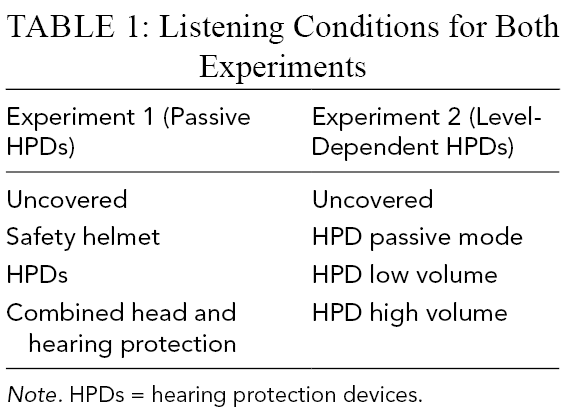
Note. HPDs = hearing protection devices.
Results
Results are summarized in Figure 4, which displays percent correct scores for sound localization in each listening condition, separately for the broadband and tonal alarms. For each group of participants (earplugs, earmuffs, and double protection), a two-way repeated-measures ANOVA (analysis of variance) with within-subject factors alarm type (two levels: tonal and broadband alarms) and listening condition (four levels: ear uncovered, safety helmet alone, hearing protection alone, and combined used of hearing protection and safety helmet) was carried out. An α level of 0.05 was used to determine statistical significance for the ANOVAs. Post-hoc pairwise t-tests were adjusted for multiple comparisons (Bonferroni correction).
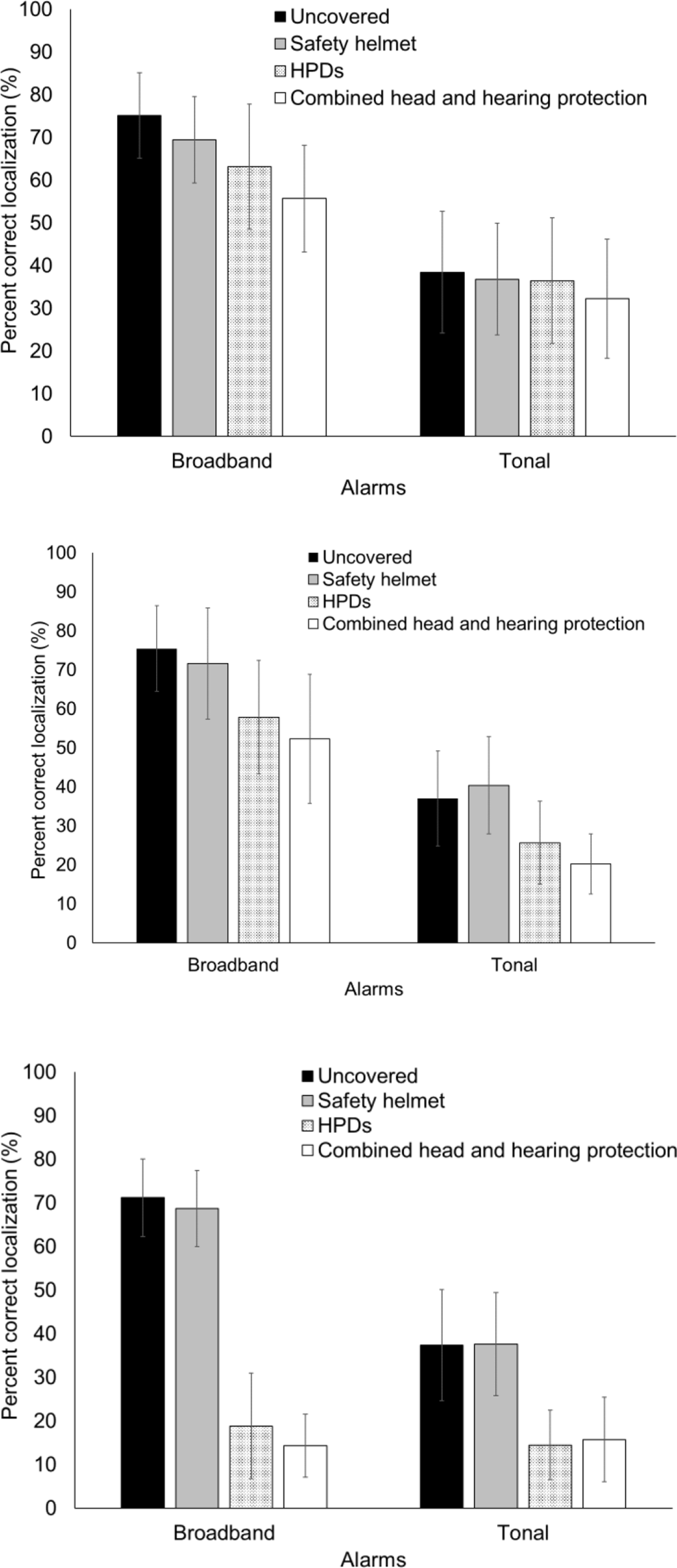
Correction localization scores (mean and standard deviation) when using passive EAR Ultrafit earplugs (upper), passive 3M PELTOR Optime earmuffs (middle), and passive double protection (lower). Note. HPD = hearing protection device.
Group 1: Passive EAR Ultrafit earplugs
The two-way repeated-measures ANOVA for this group revealed significant main effects of alarm type [F(1,23) = 198.26, p < .001] and listening condition [Greenhouse–Geisser corrected: F(2.31, 53.07) = 12.04, p < .001], as well as a significant interaction between both factors [F(3,69) = 4.24, p = .008].
Post-hoc pairwise t-tests were performed to compare both alarm types in each listening condition. Performance with the broadband alarm proved superior than with the tonal alarm in all listening conditions [uncovered: t(23) = 11.46, p < .001; safety helmet: t(23) = 9.43, p < .001; HPDs: t(23) = 8.22, p < .001; combined head and hearing protection: t(23) = 7.33, p < .001], with differences in performance ranging from 23% in the combined head and hearing protection condition to 37% in the uncovered condition.
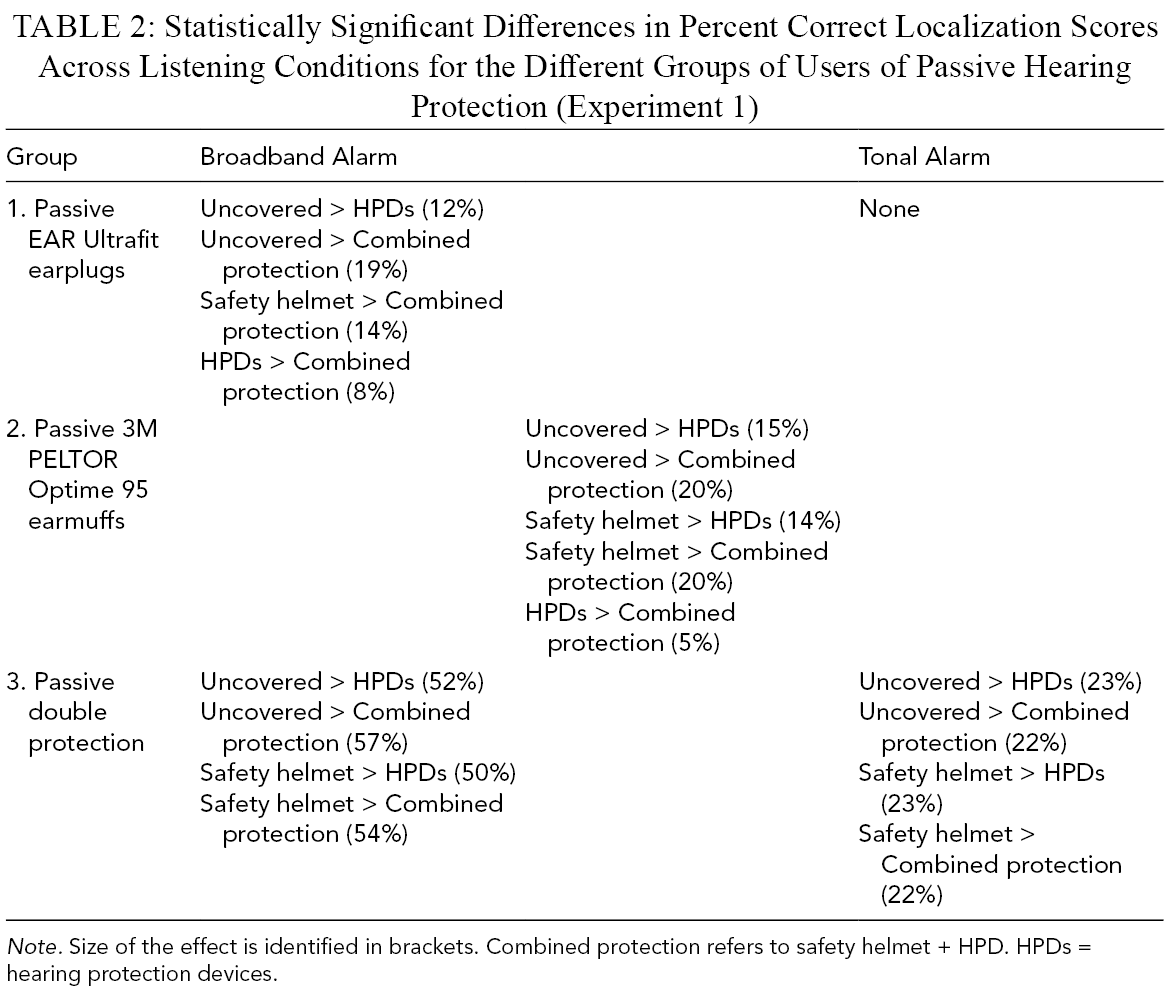
One-way repeated-measures ANOVAs revealed a significant effect of listening condition for the broadband alarm [F(3,69) = 19.51, p < .001], but not for the tonal alarm [F(3,69) = 1.25, p = .3]. For the broadband alarm, significant differences between listening conditions, as determined by post-hoc t-tests, are listed in Table 2.
Statistically Significant Differences in Percent Correct Localization Scores Across Listening Conditions for the Different Groups of Users of Passive Hearing Protection (Experiment 1)
Note. Size of the effect is identified in brackets. Combined protection refers to safety helmet + HPD. HPDs = hearing protection devices.
Group 2: Passive 3M PELTOR Optime 95 earmuffs
Results of the two-way repeated-measures ANOVA for this group revealed significant main effects of alarm type [F(1,23) = 275.01, p < .001] and listening condition [F(3,69) = 61.29, p < .001], but no significant interaction between both factors [F(3,69) = 1.620, p = .193].
Averaged over the listening conditions, performance proved superior with the broadband compared with the tonal alarm, by 33%. Averaged over the two alarms, significant differences between listening conditions, as determined by post-hoc t-tests, are listed in Table 2.
Group 3: Passive double hearing protection
Results of the two-way repeated-measures ANOVA for this group revealed significant main effects of alarm type [F(1,23) = 120.69, p < .001] and listening condition [Greenhouse–Geisser corrected: F(2.13, 48.87) = 252.63, p < .001], as well as a significant interaction between both factors [F(3,69) = 61.69, p < 0.001].
Post-hoc pairwise t-tests were performed to compare both alarm types in each listening condition. Performance with the broadband alarm proved superior than with the tonal alarm in two of the four listening conditions [uncovered: t(23) = 10.97, p < .001; safety helmet: t(23) = 11.05, p < .001; HPDs: t(23) = 2.19, p = .156; combined head and hearing protection: t(23) = −.70, p = 1.0]. Participants performed better with broadband alarm than with the tonal alarm, by 34% in the uncovered condition and by 31% when using the safety helmet. It should be noted that in both conditions of passive double hearing protection (HPDs and combined head and hearing protection), performance (ranging from 14% to 18%) fell close to chance level (1/8 = 12.5%) for both alarm types.
One-way repeated-measures ANOVAs revealed a significant effect of listening condition for both the broadband alarm [Greenhouse–Geisser corrected: F(2.08, 47.77) = 299.97, p < .001] and the tonal alarm [F(3,69) = 51.42, p < .001]. Significant differences between listening conditions, as determined by post-hoc t-tests, are found in Table 2.
Differences across groups for passive hearing protection
To document differences across HPDs (passive earplugs, passive earmuffs, and passive double hearing protection), a mixed-design ANOVA was carried out using data in the HPDs condition from each group, with one within-subject factor alarm type (two levels: tonal and broadband alarms) and one between-subject factor group (three levels: earplugs, earmuffs, double protection). Results of the statistical analysis revealed significant main effects of alarm type [F(1,69) = 166.39, p < .001] and group [F(2,69) = 63.60, p < .001], as well as a significant interaction between both factors [F(2,69) = 26.99, p < 0.001].
A significant effect of group was found when localizing the broadband alarm [F(2,69) = 73.53, p < .001]. Post-hoc t-tests indicated better localization with earplugs than with double hearing protection (by 44%) and with earmuffs than with double hearing protection (by 39%), but no significant difference between earplugs and earmuffs. A significant effect of group was also found for the tonal alarm [F(2,69) = 22.16, p < .001]. Post-hoc t-tests indicated a better performance with earplugs than with earmuffs (by 11%) or double hearing protection (by 22%), and a better performance with earmuffs than with double hearing protection (by 11%).
Similar results were noted when a mixed-design ANOVA was performed using the localization data obtained in the combined head and hearing protection listening condition.
Summary
Across all groups, uncovered listening resulted in 74% correct localization for the broadband alarm and 38% for the tonal alarm (Figure 4). Averaged over all conditions, the advantage of the broadband alarm over the tonal alarm ranged from 23% to 38%, except in conditions of double hearing protection (performance close to chance level for both alarms). This difference in performance between both alarms can be explained, at least in part, by fewer front/back confusions. Inspection of response matrices showed that, overall, the percentage of front/back confusions was 3% lower with the broadband alarm than the tonal alarm for the earplugs and 11% lower for the earmuffs. Double hearing protection however resulted in similar percentages of front/back confusions for both alarms.
Localization performance was generally worse with HPDs than without (except when earplugs are used with the tonal alarm), with differences ranging from 12% to 52%. Participants localized the tonal alarm better with earplugs compared to earmuffs, but no significant difference was found for the broadband alarm. With either alarm, double protection was most detrimental to localization (almost chance level performance). The use of HPDs generally resulted in more frequent front/back confusions (e.g., increase of 4%–7% with earplugs and earmuffs, and 8%–14% with double hearing protection with the broadband alarm).
In contrast, the percentage of left/right confusions was generally low (≤2%). It was however higher with the tonal alarm compared to the broadband alarm with earplugs (by 3%–4%) and with earmuffs (by 9%–18%), and rose to about 40% for both alarms when double protection was used.
The safety helmet did not have a significant effect on performance when used alone. When combined with hearing protection, its effect was limited to a small (5%–8%) drop in performance in some listening conditions (passive earplugs with broadband alarm and passive earmuffs with both alarms). To reduce the number of experimental conditions while including the most difficult conditions relative to worker safety, it was decided to include the safety helmet in all experimental conditions in Experiment 2 on level-dependent hearing protection.
Experiment 2: Effects of Level-Dependent Hearing Protection and Head Protection on Sound Localization
Methods
A new group of 72 participants (57 women; 15 men) with normal hearing, between the ages of 18 and 39 years old (average age = 24.0; SD = 3.3), took part in the second experiment. These participants met the same inclusion criteria as in Experiment 1. Participants were divided into three equal groups, tested unprotected and with either the (1) 3M PELTOR Tactical Earplug (NRR = 23 dB), (2) 3M PELTOR Protac III (NRR = 26 dB), or 3) Howard Leight IMPACT H (NRR = 21 dB).
The amplification (sound restoration) provided by the level-dependent devices set at different volume settings was determined by having an acoustic manikin (B&K 4128) wear the devices when immersed in the sawmill noise played in an audiometric chamber (Eckel Industries). Only two volume settings (normal and high) are available with the 3M PELTOR Tactical earplugs, with a difference in gain of about 10 dB between both for the noise under study. For the level-dependent earmuffs, which offer more volume settings (five fixed positions for the 3M PELTOR Protac III, and one continuous volume control for the Howard Leight IMPACT H), it was decided to use the highest volume and a volume corresponding to about a 10 dB drop in amplification relative to the highest setting. This ensured a similar difference in gain for all devices between the two volume settings. It should be noted that the 3M PELTOR Tactical earplugs offer the most amplification, followed by the Howard Leight IMPACT H earmuffs, whereas the 3M PELTOR Protac III offers slight attenuation (negative gain), even at the highest volume setting.
The methodology and scoring used was also similar to that described for Experiment 1. The four listening conditions are identified in Table 1, each occurring with the use of the safety helmet.
Results
Percent correct scores for sound localization with level-dependent hearing protection are displayed in Figure 5 in each listening condition, separately for the broadband and tonal alarms. For each group of participants (3M PELTOR Tactical Earplugs, 3M PELTOR Protac III earmuffs, and Howard Leight IMPACT H earmuffs), a two-way repeated-measures ANOVA with within-subject factors alarm type (two levels: tonal and broadband alarms) and listening condition (four levels: uncovered, HPD passive mode, low volume, and high volume) was carried out. An α level of .05 was used to determine statistical significance for the ANOVAs. Post-hoc pairwise t-tests were adjusted for multiple comparisons (Bonferroni correction).
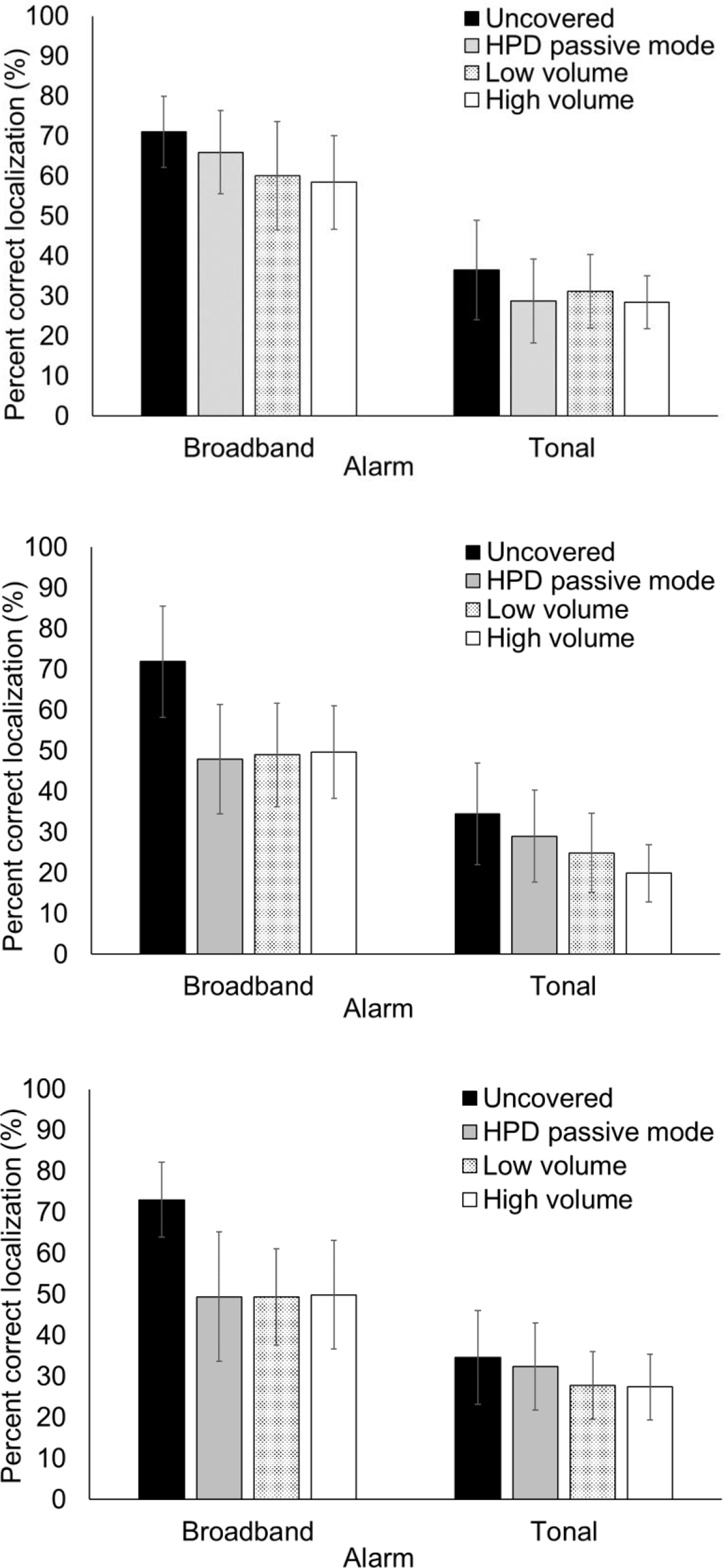
Correction localization scores (mean and standard deviation) when using the safety helmet combined with 3M PELTOR Tactical earplugs (upper), 3M PELTOR Protac III earmuffs (middle), and Howard Leight IMPACT H earmuffs (lower). Note. HPDs = hearing protection devices.
Group 1: 3M PELTOR Tactical Earplug
The two-way repeated-measures ANOVA for this group revealed significant main effects of alarm type [F(1,23) = 474.72, p < .001] and listening condition [Greenhouse–Geisser corrected: F(2.35, 54.03) = 10.21, p < .001], as well as a significant interaction between both factors [F(3,69) =3.76, p = .015].
Post-hoc pairwise t-tests were performed to compare both alarm types in each listening condition. Performance with the broadband alarm proved superior than with the tonal alarm in all listening conditions [uncovered: t(23) = 17.26, p < .001; HPD passive mode: t(23) = 18.45, p < .001; low volume: t(23) = 10.55, p < .001; high volume: t(23) = 13.02, p < .001], with differences between alarms ranging from 29% (low volume) to 37% (HPD passive mode).
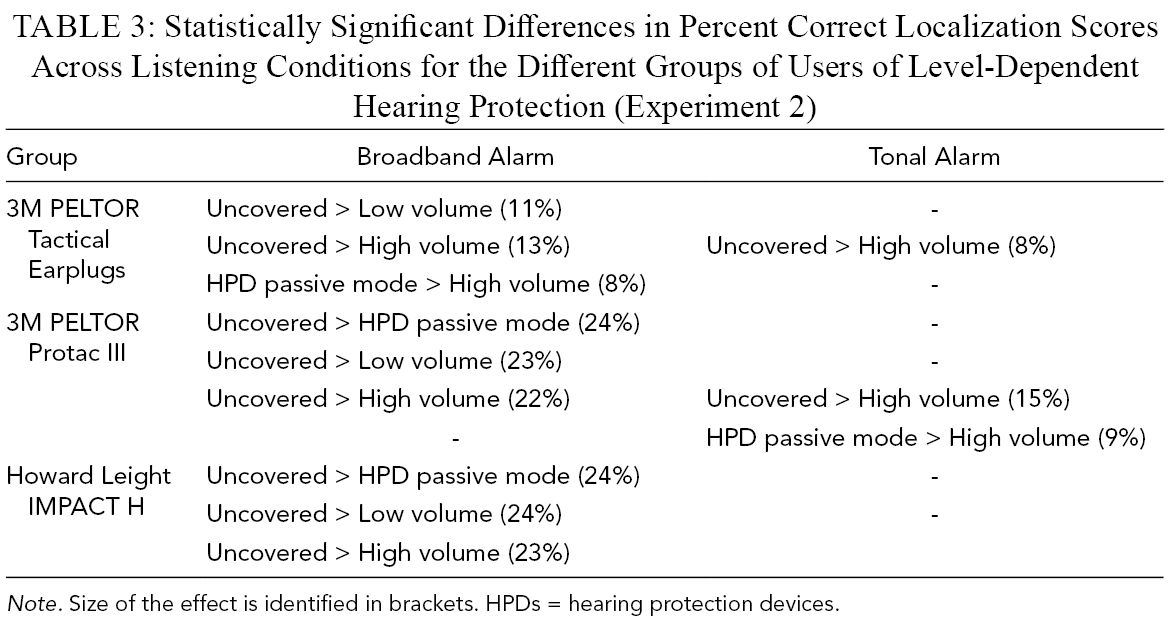
One-way repeated-measures ANOVAs revealed a significant effect of listening condition for both the broadband alarm [Greenhouse–Geisser corrected: F(2.02, 46.44) = 11.05, p < .001] and the tonal alarm [F(3,69) = 4.80, p = .004]. Significant differences between listening conditions, as determined by post-hoc t-tests, are found in Table 3.
Statistically Significant Differences in Percent Correct Localization Scores Across Listening Conditions for the Different Groups of Users of Level-Dependent Hearing Protection (Experiment 2)
Note. Size of the effect is identified in brackets. HPDs = hearing protection devices.
Group 2: 3M PELTOR Protac III
Results of the two-way repeated-measures ANOVA for this group revealed significant main effects of alarm type [F(1,23) = 218.66, p < .001] and listening condition [F(3,69) = 41.28, p < .001], as well as a significant interaction between both factors [F(3,69) = 6.74, p < .001].
Post-hoc pairwise t-tests were performed to compare both alarm types in each listening condition. Performance with the broadband alarm proved superior than with the tonal alarm in all listening conditions [uncovered: t(23) = 12.36, p < .001; HPD passive mode: t(23) = 5.32, p < .001; low volume: t(23) = 6.69, p < .001; high volume: t(23) = 11.06, p < .001], with differences between alarms ranging from 19% (HPD passive mode) to 37% (uncovered).
One-way repeated-measures ANOVAs revealed a significant effect of listening condition for both the broadband alarm [F(3,69) = 34.21, p < .001] and the tonal alarm [F(3,69) = 9.18, p < .001]. Significant differences between listening conditions, as determined by post-hoc t-tests, are found in Table 3.
Group 3: Howard Leight IMPACT H
Results of the two-way repeated-measures ANOVA for this group revealed significant main effects of alarm type [F(1,23) = 330.48, p < .001] and listening condition [Greenhouse–Geisser corrected: F(2.27, 52.30) = 19.33, p < .001], as well as a significant interaction between both factors [F(3,69) = 10.88, p < .001].
Post-hoc pairwise t-tests were performed to compare both alarm types in each listening condition. Performance with the broadband alarm proved superior than with the tonal alarm in all listening conditions [uncovered: t(23) = 12.02, p < .001; HPD passive mode: t(23) = 5.63, p < .001; low volume: t(23) = 8.01, p < .001; high volume: t(23) = 10.07, p < .001], with differences between alarms ranging from 17% (HPD passive mode) to 38% (uncovered).
One-way repeated-measures ANOVAs revealed a significant effect of listening condition for both the broadband alarm [Greenhouse–Geisser corrected: F(2.05, 47.09) = 22.72, p < .001] and the tonal alarm [F(3,69) = 3.59, p = .018]. Significant differences between listening conditions, as determined by post-hoc t-tests, are found in Table 3.
Differences across groups for level-dependent hearing protection
To document differences between the three hearing protectors when operating as level-dependent devices, a mixed-design ANOVA was carried out with two within-subject factors of alarm type (two levels: tonal and broadband alarms) of gain (two levels: low volume, high volume), and one between-subject factor group (three levels: 3M PELTOR Tactical Earplugs, 3M PELTOR Protac III earmuffs, and Howard Leight IMPACT H earmuffs). Results of the statistical analysis revealed significant main effects of alarm type [F(1,69) = 373.67, p < .001] and group [F(2,69) = 9.00, p < .001]. There was no effect of volume [F(1,69) = 2.72, p = .104] or significant interactions between these variables.
Post-hoc t-tests indicated better localization with the 3M PELTOR Tactical Earplugs than with both the 3M Peltor Protac III (by 9%) and Howard Leight IMPACT H (by 6%) earmuffs. Both earmuff-style devices performed similarly.
Similar findings were noted using the localization data in the HPD passive mode. The 3M PELTOR Tactical Earplugs proved superior to the two earmuffs when localizing the broadband alarm (by 17%–18%). However, there was no effect of protector type with the tonal alarm.
Summary
Across all groups, uncovered listening resulted in 72% correct localization for the broadband alarm and 35% for the tonal alarm (Figure 5). The advantage of the broadband alarm over the tonal alarm ranged from 17% to 37% over all listening conditions and HPD groups in this experiment. This difference can again be explained, at least partly, by fewer front/back confusions in the case of the broadband alarm. Indeed, inspection of the response matrices revealed an increase in front/back confusions by about 8% when uncovered (similarly to findings obtained in Experiment 1). For HPD use, with the exception of a few listening conditions (OFF and low volume with the Howard Leight IMPACT H earmuffs), front/back confusions were less frequent with the broadband alarm compared to the tonal alarm, by 4%–10% across all listening conditions and groups.
In the HPD passive mode, the earplugs appeared to be less disruptive to sound localization than the earmuffs, at least for the broadband alarm, while no significant difference between HPD groups was noted for the tonal alarm. No statistically significant difference was found between the HPD passive mode, and the low volume conditions for all three level-dependent devices, but the HPD passive mode sometimes proved superior to the high volume condition (3M PELTOR Tactical earplugs with broadband alarm and 3M PELTOR Protac III earmuffs with tonal alarm).
Using level-dependent HPDs did not significantly increase the occurrence of front/back confusions, at least for both earmuffs. For the level-dependent earplugs, listening at the highest volume setting resulted in an increase of about 4% in front/back confusions compared to all other listening conditions (uncovered, OFF, low volume). Interestingly, the OFF mode did not increase front/back confusions compared to uncovered, contrary to the 6% increase in such errors in Experiment 1 with passive HPDs. Physical (geometry) and acoustical (high frequency attenuation) differences across devices may account for this finding.
Finally, the percentage of left/right confusions was generally low (≤2%) for all listening conditions with the broadband alarm, and without HPDs for the tonal alarm. With the tonal alarm, left/right confusions increased up to 4% with the 3M PELTOR Tactical earplugs, 6%–10% with the 3M PELTOR Proctac earmuffs, and 4%–6% with the Howard Leight IMPACT H earmuffs.
Discussion
Personal safety equipment, including hearing protection and safety helmets, is commonly used in many workplaces. This study explored the effects of head protection and passive hearing protection (Experiment 1) and level-dependent hearing protection devices (Experiment 2) on the ability of normal-hearing individuals to localize reverse alarms (tonal and broadband) in background noise, while performing a task.
Consistent with previous research findings (Nélisse et al., 2017; Vaillancourt et al., 2013), the broadband alarm offers a significant advantage in sound localization accuracy over the tonal alarm, due to its broader frequency spectrum. In the uncovered listening condition, averaged over both experiments, the broadband alarm resulted in a doubling of localization accuracy compared to the tonal alarm (73% vs. 36% correct localization). Similar results (83% for the broadband alarm and 42% for the tonal alarm) were obtained by Nélisse et al. (2017) using an identical methodology. This advantage for the broadband alarm over the tonal alarm was also maintained with hearing protection, ranging from 17% to 38% over all listening conditions and HPD groups, except when double passive hearing protection, in which case performance for both alarms dropped close to chance level. Further analyses also revealed that the broadband alarm resulted in up to about 10% less front/back confusions than the tonal alarm. This finding is supported by the literature on better front/back sound localization when the signal’s spectral energy extends to higher frequencies (Butler, 1986; Makous & Middlebrooks, 1990).
The head protection used in this study (construction safety helmet) did not significantly reduce sound localization performance. Without HPDs, no significant effect of head protection was noted, but when used in combination with passive HPDs (Experiment 1) a 5%–8% drop in percent correct sound localization was noted in some listening conditions (passive earplugs with broadband alarm and passive earmuffs with both alarms). Since the type of helmet used in this study provides close to no ear coverage, its limited impact on sound localization was expected based on the literature available (Abel et al., 2009; Scharine et al., 2007; Vause & Grantham, 1999).
Results also show that HPDs appear to disrupt localization cues. Inspection of confusion matrices showed that the drop in performance with HPDs resulted mainly from increased confusions between adjacent speakers, followed by front/back confusions, while left/right errors remained low (except when double protection is used). In Experiment 1, localization performance was better with the passive earplugs than the passive earmuffs. Double passive hearing protection resulted in localization accuracy reduced to almost chance levels. This considerable detrimental effect of double hearing protection cannot be explained only by the amount of overall attenuation provided, since participants reported being able to hear the alarms. In Experiment 2, performance was better with the level-dependent earplugs than the level-dependent earmuffs, when these devices are used in their passive mode.
The superiority of earplugs over earmuffs in sound localization is well documented (Abel & Hay, 1996; Russell, 1976; Suter, 1989; Talcott et al., 2012; Vaillancourt et al., 2013). To account for this, some authors (Brown et al., 2015; Joubaud et al., 2015; Zimpfer & Sarafian, 2014) have shown, based on objective measurements of head-related transfer functions, that spectral localization cues are more disrupted by earmuffs than earplugs.
In Experiment 2, localization in the level-dependent mode was poorer than unprotected performance, and interestingly, was often similar or poorer than performance in the passive mode. This result was also expected based on the available literature (Alali, 2011; Alali & Casali, 2011; Brown et al., 2015; Brungart et al., 2007; Casali & Alali, 2010; Smalt et al., 2019; Zimpfer & Sarafian, 2014). In addition to the disruptive effect of passive hearing protection, the frontward orientation of the microphones on the level-dependent devices could potentially further disrupt localization spectral cues.
The ability to localize accurately a heavy vehicle equipped with a reverse alarm may also be dependent on the position of the vehicle relative to the worker. In individuals with normal hearing using level-dependent HPDs (three earmuff-style and one earplug-style HPD), Mlynski and Kozlowski (2019) evaluated sound localization using an array of eight speakers separated by 45°, when listening to a tonal alarm. Front/back confusions were frequently noted for a signal coming directly from the front (0°) and back (180°), especially with earmuff-style HPDs. Frequent front/back confusions were also obtained for the 45° and 315° positions, in addition to confusions between adjacent positions. Signals directly from the sides (90° and 270°) yielded the most accurate performance. Participants also performed better with earplugs compared to earmuffs, while localization performance was not improved in the level-dependent mode over that in the passive mode and at times was further degraded. Other researchers (Brown et al., 2015; Heckman et al., 2011; Mlynski & Kozlowski, 2017) have also shown best localization accuracy for lateral positions (90° and 270°) compared to sources coming directly from the front and the back (0° and 180°). Further analyses of the localization data obtained in the current study yielded similar findings, in all listening conditions, of more frequent front/back confusions for signals coming directly from the front and the back (0° and 180°) and more accurate judgments for signals coming from the two side positions (90° and 270°). The current study confirmed the conclusions found by Mlynski and Kozlowski (2017) for the tonal alarm and extended them to the broadband alarm. While the findings above apply to both alarms, it should be noted that localization performance was better for the broadband alarm than for the tonal alarm in all uncovered listening conditions and in all situations when wearing passive and level-dependent earmuff and earplug hearing protectors, with the exception of double hearing protection. In the latter case, results reached chance level with both alarms.
Where good sound localization abilities are essential to the safe and effective performance of tasks in a noisy workplace, the broadband alarm should be the alarm of choice among commercially available devices. Additionally, double hearing protection is to be avoided, and earplug-style passive or level-dependent devices may be a better choice than their earmuff-style counterparts. Construction safety helmets, however, seem to have only a minimal effect on sound localization.
Since hearing loss is common in workplaces where HPDs are required, similar studies should be carried out with hearing-impaired individuals. In addition, different configurations of safety helmets, and tasks requiring different degrees of cognitive resource allocation, should be investigated as their effect on sound localization has thus far received little attention. Furthermore, a previous survey of field mounting practices (Nélisse et al., 2017) has shown that alarm devices are not always ideally installed directly behind the heavy vehicle to provide an unobstructed sound propagation path in the danger zone. Suboptimal mounting positions can significantly alter the propagation of alarm signals behind vehicles (Nélisse et al., 2017). The effect of mounting practices on sound localization therefore merits further investigation. Finally, alternative alarm signals to the tonal and broadband alarms could be investigated.
Key Points
Sound localization is more accurate with the broadband alarm than the tonal alarm.
HPDs negatively impact sound localization accuracy compared to uncovered listening, by increasing confusions between adjacent speakers, and front/back confusions, while left/right confusions generally remain low (except with double passive hearing protection).
Double hearing protection results in localization accuracy close to chance levels.
Level-dependent HPDs do not restore sound localization abilities. In fact, they result in performance often similar to, or poorer, than when passive hearing protection is used.
Participants performed better with earplugs than with earmuffs during sound localization tasks.
A construction safety helmet did not negatively impact sound localization when used alone, but had a small effect in some cases when used in combination with HPDs
The position of a sound source relative to the listener has a significant effect of localization accuracy. Sounds coming directly from the sides (90°/270°) are more accurately identified, and front/back errors are most common for signals coming directly from the front and back (0°/180°).
Footnotes
Acknowledgments
This research was supported by the Institut de recherche Robert-Sauvé en Santé et en Sécurité du travail (IRSST) in Montréal, Québec (Report R-1067; Vaillancourt et al. 2019). Part of Experiment 1 was presented at ICBEN 2017 in Zurich (Laroche et al. 2017). Only raw data were presented with no statistical analysis in the proceedings. The authors gratefully acknowledge the participants who generously shared their time and contributed to the advancement of knowledge in this field.

Author Biographies
Chantal Laroche is a full professor in the Audiology and SLP program at University of Ottawa, Ontario, Canada. She received her PhD in biomedical sciences (Audiology) from University of Montréal in 1989.
Christian Giguère is a full professor in the Audiology and SLP program at University of Ottawa, Ontario, Canada. He received his PhD in information engineering from University of Cambridge in 1993.
Véronique Vaillancourt is a research agent in the Hearing Research Lab at University of Ottawa, Ontario, Canada. She received her Master of Health Sciences (Audiology) from University of Ottawa in 1992.
Claudia Marleau is a former student in the Audiology program at University of Ottawa, Ontario, Canada. She received her Master of Health Sciences (Audiology) from University of Ottawa in 2018.
Marie-France Cadieux is a former student in the Audiology program at University of Ottawa, Ontario, Canada. She received her Master of Health Sciences (Audiology) from University of Ottawa in 2018.
Karina Laprise-Girard is a former student in the Audiology program at University of Ottawa, Ontario, Canada. She received her Master of Health Sciences (Audiology) from University of Ottawa in 2018.
Emily Gula is a former student in the Audiology program at University of Ottawa, Ottawa, Canada. She received her Master of Health Sciences (Audiology) from University of Ottawa in 2017.
Véronique Carroll is a former student in the Audiology program at University of Ottawa, Ontario, Canada. She received her Master of Health Sciences (Audiology) from University of Ottawa in 2017.
Manuelle Bibeau is a former student in the Audiology program at University of Ottawa, Ontario, Canada. She received her Master of Health Sciences (Audiology) from University of Ottawa in 2017.
Hugues Nélisse is a researcher at Institut de recherche Robert-Sauvé en santé et en sécurité du travail (IRSST), Montréal, Québec, Canada. He received is PhD in mechanical engineering from University of Sherbrooke in 1995.